Unlock your full potential by mastering the most common Boat Electrical interview questions. This blog offers a deep dive into the critical topics, ensuring you’re not only prepared to answer but to excel. With these insights, you’ll approach your interview with clarity and confidence.
Questions Asked in Boat Electrical Interview
Q 1. Explain the difference between AC and DC power systems in marine applications.
Marine electrical systems utilize both Alternating Current (AC) and Direct Current (DC), each serving distinct purposes. DC power, typically 12V or 24V, is the backbone of most boat systems, powering essential components like navigation lights, bilge pumps, and electronic devices. Think of DC as a smooth, unidirectional flow of electricity, like water flowing constantly in one direction. AC power, usually 120V or 240V, is primarily used for shore power connections, allowing you to replenish batteries and run higher-power appliances like air conditioners or microwaves. AC is like a water wave, periodically changing direction.
The key difference lies in the nature of the current: DC flows consistently in one direction, while AC periodically reverses direction. This impacts the types of equipment that can be used; DC motors are common in boats, while AC motors are usually found in shore-powered appliances. Converting between AC and DC is often necessary, and this is accomplished using inverters (DC to AC) and battery chargers (AC to DC).
Q 2. Describe your experience troubleshooting electrical problems on boats.
Troubleshooting boat electrical problems often requires a systematic approach. I’ve encountered everything from intermittent lighting issues to complete system failures. My process usually begins with a thorough visual inspection, checking connections, wire insulation, and fuses. I then use a multimeter to measure voltage, current, and resistance to pinpoint the fault. For example, a dead bilge pump might indicate a blown fuse, a corroded connection, or a faulty pump motor itself. I meticulously trace the wiring, comparing my findings to the boat’s electrical schematic. One memorable case involved a mysterious battery drain. By carefully monitoring current draw with a clamp meter, I discovered a parasitic load caused by a faulty switch that was constantly drawing power, even when off. This was solved by replacing the faulty switch.
Q 3. What are the common causes of battery drain in a boat?
Battery drain on a boat can stem from several sources. The most common culprits are:
- Parasitic loads: These are small electrical draws from devices that remain on even when the boat is off, like interior lights left unintentionally switched on or faulty bilge pump switches.
- Faulty components: A malfunctioning radio, improperly wired accessory, or a corroded wire connection can lead to significant battery drain.
- Alternator issues: If the alternator isn’t charging the batteries adequately while the engine is running, the batteries will eventually discharge.
- Corrosion: Corrosion on battery terminals or connections can create high resistance, hindering charging and leading to discharge.
- Low battery capacity: Older batteries naturally lose their capacity over time.
Identifying the source often involves meticulous testing and systematic elimination.
Q 4. How do you test a marine battery?
Testing a marine battery involves checking both its voltage and its capacity. A simple voltage check using a multimeter will reveal the battery’s state of charge. A fully charged 12V battery should read around 12.6V. A lower voltage indicates a lower state of charge. However, voltage alone isn’t a complete picture. To assess the battery’s overall health, a load test is crucial. This involves placing a load (a known resistance) across the battery and measuring the voltage drop. A significant voltage drop under load suggests the battery has reduced capacity and needs replacement. Furthermore, a visual inspection for corrosion, cracks, or bulging casing is also essential. You can also use a battery tester, which simplifies this process.
Q 5. Explain the function of a battery charger in a boat’s electrical system.
A battery charger is essential for replenishing the boat’s batteries after use. It converts AC shore power into DC power suitable for charging the batteries. Modern chargers often incorporate sophisticated features like multi-stage charging (bulk, absorption, and float) to optimize the charging process and extend battery life. The bulk stage rapidly charges the battery, while the absorption stage maintains a constant voltage until fully charged. The float stage applies a small trickle charge to maintain the battery at full capacity. Choosing the right charger is crucial – it must be compatible with the battery type (e.g., flooded, AGM, gel) and voltage.
Q 6. What are the safety precautions you take when working with boat electrical systems?
Safety is paramount when working with boat electrical systems. My precautions always include:
- Disconnecting the power: Before any work, I always disconnect the power source to the circuit I’m working on. This prevents accidental shocks.
- Wearing appropriate PPE: Insulated gloves, safety glasses, and non-conductive footwear are essential to minimize the risk of injury.
- Working in a dry area: Water and electricity are a dangerous combination. I avoid working on electrical systems in wet or damp conditions.
- Using properly insulated tools: Damaged or improperly insulated tools can pose a significant shock hazard.
- Proper ventilation: When working with batteries, ensure adequate ventilation to prevent the buildup of potentially explosive gases.
I always double-check my work before reconnecting the power.
Q 7. Describe your experience with wiring diagrams and schematics.
I have extensive experience interpreting and utilizing wiring diagrams and schematics. These are crucial for understanding the boat’s electrical system, troubleshooting faults, and performing repairs. I’m proficient in reading both simple and complex diagrams, identifying components, tracing circuits, and understanding the flow of electricity. I often use the schematic to identify the source of a problem, for instance, tracing a faulty wire or a bad connection. The ability to read and interpret schematics is fundamental to effective troubleshooting and repair in boat electrical systems. I’ve used schematics ranging from simple single-page diagrams for smaller boats to extensive multi-page documents for complex systems on larger vessels.
Q 8. How do you troubleshoot a faulty bilge pump?
Troubleshooting a faulty bilge pump involves a systematic approach. First, ensure the float switch is operating correctly; it should activate the pump when the water level reaches a certain point. Check for obstructions in the pump’s intake and outlet – debris can easily clog it. Next, visually inspect the pump itself for damage or wear and tear. If the pump is running but not pumping effectively, the impeller might be worn or broken. Replacing the impeller is often a straightforward fix. If the pump isn’t running at all, check the power supply: use a multimeter to test for voltage at the pump’s terminals. If there’s no voltage, trace the wiring back to the circuit breaker or switch, checking for blown fuses or tripped breakers. A faulty switch or wiring fault will also prevent operation. Finally, if all else fails, the pump motor itself may have failed and require replacement.
Example: I once worked on a sailboat where the bilge pump wasn’t activating. After checking the float switch and wiring, we discovered a small crab had wedged itself into the intake, preventing the pump from working! Simple removal of the obstruction solved the problem.
Q 9. Explain the operation of a marine alternator.
A marine alternator is essentially a DC generator that charges the boat’s batteries while the engine is running. It works on the principle of electromagnetic induction: as the engine turns a belt connected to the alternator, a rotor spins within a stator, generating AC current. This AC current is then rectified into DC current by a built-in rectifier, which then passes through a voltage regulator to charge the batteries at a safe and optimal rate. The alternator’s output is usually around 12 or 24 volts, depending on the boat’s electrical system.
Think of it like a bicycle dynamo: as the wheels turn, the dynamo generates electricity to power a light. The marine alternator is a more sophisticated version, designed for higher output and durability in a marine environment.
Q 10. How do you select the appropriate size of wire for a particular application?
Selecting the appropriate wire size is crucial for safety and efficiency. Too small a wire can overheat and cause a fire, while too large a wire is unnecessarily expensive and bulky. The American Wire Gauge (AWG) system is used to specify wire size; lower AWG numbers indicate thicker wires, which can carry more current. To determine the correct wire size, you need to know the amperage (current) the circuit will draw. Consult a wire sizing chart or an online calculator, which will factor in the voltage drop and the length of the wire run. Always ensure that the wire’s insulation rating is appropriate for the intended application, considering factors like temperature and exposure to moisture.
Example: A high-wattage stereo system will require much thicker wire (lower AWG) than a small navigation light. Ignoring this can lead to overheating and potential fire hazards.
Q 11. What is the purpose of bonding and grounding in a boat’s electrical system?
Bonding and grounding are essential for safety and preventing corrosion in a boat’s electrical system. Bonding connects all metal parts of the boat to create a common electrical potential, eliminating stray currents that can cause corrosion (galvanic corrosion). Grounding connects the boat’s electrical system to the water (through the hull) – making a reference point for electricity to flow safely back to the source and providing a path for fault currents to safely travel to ground rather than back through the boat’s systems. A properly bonded and grounded system minimizes the risk of electric shock and protects equipment.
Analogy: Imagine a tree; bonding is like the trunk, connecting all the branches (metal parts) together. Grounding is like the roots, anchoring the tree to the earth (water), providing a safe path for electricity to flow.
Q 12. Explain the function of a voltage regulator.
A voltage regulator maintains a constant voltage output from the alternator, preventing overcharging of the batteries. Alternators generate varying amounts of voltage depending on engine speed, and overcharging can severely damage the batteries. The voltage regulator senses the battery voltage and adjusts the alternator’s output accordingly, ensuring the batteries are charged at the optimal rate without being overstressed. Typical voltage regulators maintain a voltage of around 13.8-14.2 volts for a 12-volt system.
Think of it as a thermostat for your home heating system: it senses the temperature and adjusts the heat output to maintain a comfortable temperature.
Q 13. How do you diagnose and repair a faulty circuit breaker?
Diagnosing a faulty circuit breaker starts by checking if it’s simply tripped. A tripped breaker will be in the ‘off’ position. If it is, reset it by switching it off and then on again. If it trips immediately, there’s a short circuit or overload in the circuit it protects. You’ll need to trace the circuit, checking all connections and components for shorts or excessive current draw. A multimeter can be used to test for continuity and voltage. If the breaker is permanently in the ‘off’ position and won’t reset, the breaker itself may be faulty and needs replacing. Always use a breaker of the correct rating and never attempt to bypass a circuit breaker.
Safety First: Always disconnect the power source before working on any electrical components.
Q 14. What are the different types of marine lighting and their applications?
Marine lighting encompasses various types, each suited to different applications. Common types include:
- Navigation lights: Required by law, these indicate the boat’s position and heading. They include port (red), starboard (green), stern (white), and masthead (white) lights.
- Anchor lights: A white light illuminating the boat’s position at anchor.
- Floodlights: Provide general illumination for working on deck at night.
- Courtesy lights: Interior lights for comfort and convenience.
- Running lights: Illuminate the boat for navigation and safety during night time operation.
- Underwater lights: Used to illuminate the hull for aesthetic purposes or to deter marine life.
- LED lights: Becoming increasingly popular due to their energy efficiency and long lifespan.
The choice of lighting depends on the specific requirement; for instance, navigation lights require specific intensities and visibility angles to comply with international regulations.
Q 15. Describe your experience with installing and maintaining marine electronics.
My experience with marine electronics installation and maintenance spans over 15 years, encompassing a wide range of vessels from small sailboats to large motor yachts. I’ve handled everything from basic installations – like adding a new depth sounder – to complex system integrations involving radar, autopilots, and entertainment systems. I’m proficient in running cable, properly grounding systems, and ensuring all components are correctly fused and protected. For instance, I recently completed a refit on a 40-foot sailboat, completely overhauling its outdated electronics suite with a modern integrated system. This included meticulous cable routing to minimize interference and ensure a clean, professional installation. My work always prioritizes safety and adherence to ABYC standards.
Beyond installation, I have extensive experience in preventative maintenance and troubleshooting. Regular inspections, cleaning, and testing are crucial for ensuring reliable operation and preventing costly repairs down the line. I’m adept at diagnosing and repairing faults, using multimeters, continuity testers, and other specialized tools to pinpoint problems quickly and efficiently.
Career Expert Tips:
- Ace those interviews! Prepare effectively by reviewing the Top 50 Most Common Interview Questions on ResumeGemini.
- Navigate your job search with confidence! Explore a wide range of Career Tips on ResumeGemini. Learn about common challenges and recommendations to overcome them.
- Craft the perfect resume! Master the Art of Resume Writing with ResumeGemini’s guide. Showcase your unique qualifications and achievements effectively.
- Don’t miss out on holiday savings! Build your dream resume with ResumeGemini’s ATS optimized templates.
Q 16. What are the common types of marine switches and their applications?
Marine switches are vital for controlling various onboard systems. Common types include:
- Toggle switches: Simple on/off switches, often used for lights, bilge pumps, and other simple circuits.
- Rocker switches: Similar to toggle switches, but with a rocking motion. They’re frequently used for their more compact size.
- Push-button switches: Used for momentary activation, such as horn activation or activating a spotlight.
- Rotary switches: These offer multiple positions, often used for selecting different functions (e.g., navigation lights).
- Circuit breakers: These are safety devices that automatically interrupt the circuit in case of overload or short circuit, protecting equipment and wiring.
- Fused switches: Combining a switch with an inline fuse for additional protection.
The application of each switch type depends on the specific circuit and user needs. For example, a toggle switch might control a bilge pump, while a rotary switch might select different navigation light functions. Circuit breakers are essential for protecting vital systems like the engine and anchor windlass.
Q 17. How do you test a marine electrical circuit for shorts or opens?
Testing for shorts and opens in marine electrical circuits requires systematic troubleshooting using a multimeter. For shorts:
- Visually inspect: Look for any obvious signs of damage to wiring, chafing, or corrosion.
- Check fuses and circuit breakers: A blown fuse or tripped circuit breaker often indicates a short circuit.
- Use a multimeter: Set the multimeter to continuity testing. Disconnect the circuit from the power source and test for continuity between the hot wire and ground. A low resistance reading indicates a short circuit.
- Isolate the short: Trace the wiring to locate the exact point of the short. This may involve disconnecting sections of the circuit to narrow down the location.
For open circuits:
- Visually inspect: Check for broken wires, loose connections, or corroded terminals.
- Use a multimeter: Set the multimeter to voltage measurement. Check for voltage at different points in the circuit. If voltage is missing at a particular point, it indicates a break in the circuit.
- Trace the circuit: Follow the wiring path to locate the open circuit. A visual inspection and checking connections at each point will often reveal the problem.
Remember to always disconnect the power before working on any electrical circuits. Safety is paramount when troubleshooting electrical systems.
Q 18. Explain your experience with working on different boat sizes and types.
My experience encompasses a diverse range of boat sizes and types, from small dinghies and sailboats to large yachts and commercial fishing vessels. This breadth of experience has given me a comprehensive understanding of the unique electrical challenges presented by each type of vessel. Smaller boats often have simpler systems, but these systems still need careful attention to detail, particularly given the confined spaces. Larger vessels, on the other hand, present more complex systems with multiple circuits, requiring a higher level of expertise in system integration and troubleshooting.
Working on sailboats has honed my skills in dealing with tight spaces and complex rigging systems, while working on powerboats has provided valuable experience with high-power systems and engine integration. For example, I recently worked on a 70-foot luxury yacht, troubleshooting a problem with the generator’s electrical system. This involved understanding the intricate interaction between the generator, the battery bank, and the ship’s service panels.
Q 19. Describe your experience with various types of marine electrical components.
I’m familiar with a wide array of marine electrical components, including:
- Batteries (flooded lead-acid, AGM, lithium-ion): Understanding the charging characteristics and maintenance needs of various battery types is crucial for ensuring reliable power.
- Alternators and regulators: I’m proficient in testing and repairing alternators and ensuring proper charging rates.
- Wiring and connectors: I am experienced with different gauge wires and appropriately sized connectors for diverse applications, considering voltage drop and amperage ratings.
- Fuses and circuit breakers: Knowing how to select and install appropriate protection devices for various circuits is a key safety aspect.
- Switches and control panels: I have worked with a variety of switches and panels and understand their proper installation and wiring configurations.
- Motors and actuators: I have experience troubleshooting and repairing motors used for bilge pumps, windlasses, and other onboard systems.
- Sensors and transducers: I am familiar with the installation and calibration of various sensors, including depth sounders, speedometers, and temperature sensors.
My experience allows me to effectively diagnose and solve problems involving these components, ensuring optimal performance and system reliability.
Q 20. What is your experience with troubleshooting engine electrical systems?
Troubleshooting engine electrical systems requires a detailed understanding of how the engine’s electrical components interact. My experience includes diagnosing and repairing problems with:
- Starting systems: Identifying issues with starter motors, solenoids, and batteries.
- Alternators and charging systems: Checking the alternator’s output, voltage regulator functionality, and battery charging rates.
- Ignition systems: Diagnosing problems with ignition coils, distributors, and sensors.
- Sensors and warning systems: Understanding how various sensors provide feedback to the engine control unit (ECU) and interpreting warning lights.
I utilize diagnostic tools, such as multimeters, and engine diagnostic software to efficiently identify faults. For example, I recently resolved an intermittent starting problem on a diesel engine by tracing a faulty wire connection to the starter solenoid. My systematic approach ensures that I address the root cause of the problem, preventing future issues.
Q 21. How familiar are you with NMEA 2000 networking?
I am very familiar with NMEA 2000 networking. It’s a crucial system for integrating various marine electronics components on modern vessels. I understand its backbone cabling, device configurations, and troubleshooting techniques. I’m proficient in using diagnostic software to identify and resolve communication issues within the NMEA 2000 network. This involves using a diagnostic tool to check for data flow and identify any faulty devices or wiring issues. This system allows for seamless integration of instruments like GPS, chart plotters, autopilots, and engine displays, providing a unified information system for the vessel. My experience includes designing, installing, and troubleshooting NMEA 2000 networks on various vessels, ensuring proper data communication between all connected devices.
Q 22. How do you address corrosion issues in a marine electrical system?
Corrosion is the bane of any marine electrical system, silently degrading connections and causing failures. Addressing it requires a multi-pronged approach. Think of it like rust on a car – if left unchecked, it will eventually cause major problems.
Regular Inspection: Visually inspect all terminals, connections, and wiring harnesses at least annually, or more frequently in harsh saltwater environments. Look for any signs of white powdery residue (corrosion), discoloration, or loose connections.
Proper Cleaning: Clean corroded areas with a wire brush, followed by a corrosion inhibitor such as CRC Marine or similar. For heavily corroded components, replacement is often the best solution.
Protective Coatings: Apply dielectric grease to all connections after cleaning. This grease prevents moisture from reaching the metal and acts as a barrier against corrosion. Consider using marine-grade sealant on wire splices and connections exposed to the elements.
Material Selection: Choose corrosion-resistant materials where possible. Stainless steel fasteners and tinned copper wiring are significantly more resistant to corrosion than their uncoated counterparts.
Proper Grounding: A well-maintained grounding system is crucial. Ensure all grounds are clean, secure, and properly sized to prevent voltage drops and heat buildup, which can accelerate corrosion.
For example, I once worked on a boat where the corroded battery terminal connections led to a complete loss of power during a crucial moment. A simple cleaning and application of dielectric grease prevented further issues and saved the owner a significant amount of trouble and expense.
Q 23. Describe your experience with preventive maintenance of boat electrical systems.
Preventive maintenance is key to a reliable marine electrical system. It’s akin to regular servicing of a car engine; small efforts prevent major headaches. My approach is systematic and thorough.
Visual Inspection: This is the first and most important step. I thoroughly check all wiring, connections, and components for signs of damage, corrosion, or loose connections.
Terminal Cleaning: I clean all battery terminals and connections with a wire brush and apply dielectric grease to ensure a clean and corrosion-free connection.
Fuse and Circuit Breaker Checks: I test all fuses and circuit breakers to ensure they are functioning correctly and replace any that are blown or damaged.
Battery Testing: I regularly test battery voltage and specific gravity (for flooded lead-acid batteries) to ensure proper charging and capacity.
Wiring Harness Inspection: I inspect wiring harnesses for chafing, damage, and proper routing to prevent shorts or damage.
Documentation: I maintain detailed records of all maintenance performed, including dates, findings, and actions taken.
One example is a regular client who owns a sailing yacht. By consistently performing these checks, we avoided a major electrical fire caused by a chafing wire, which could have resulted in significant damage and financial loss.
Q 24. What are the different types of marine connectors and their applications?
Marine connectors are specialized for the harsh marine environment; they need to withstand moisture, vibration, and saltwater. Several types exist:
Anderson Powerpoles: These are popular for their high current capacity, ease of use, and reliable connection. They are commonly used for battery connections and high-power accessories.
Deutsch Connectors: These are often used in more demanding applications requiring water-tight sealing, particularly on boats with multiple systems and power sources. They offer great protection against the elements.
Circular Connectors (e.g., Bayonet): These are frequently used for navigation lights, instruments, and other devices where a secure, waterproof connection is needed.
Standard Terminals: These are used for connecting wires to devices and components, but require careful preparation and protection with dielectric grease and heat shrink to prevent corrosion.
The choice of connector depends heavily on the application. For example, you’d use high-current Anderson Powerpoles for a powerful trolling motor while a smaller, waterproof circular connector would suffice for an instrument panel light.
Q 25. What is your familiarity with different types of marine fuses and circuit breakers?
Marine fuses and circuit breakers are essential for protecting your boat’s electrical system from overloads and short circuits, preventing fires and equipment damage. They are like safety valves for your boat’s electrical system.
Fuses: These are one-time-use devices that melt and break the circuit when excess current flows. They come in various amperage ratings and types, such as blade fuses, cartridge fuses, and glass fuses.
Circuit Breakers: These are reusable devices that automatically interrupt the circuit when an overload or short circuit is detected. They can be reset after the problem is addressed. They offer better protection and are easily resettable.
It’s crucial to use the correct amperage rating for both fuses and circuit breakers to protect the circuit without unnecessarily interrupting normal operation. Using a fuse or circuit breaker with too high an amperage rating can lead to damage or fire.
Q 26. Explain your experience with working with different types of marine batteries.
I’ve worked extensively with various marine battery types, each with its own strengths and weaknesses:
Flooded Lead-Acid (FLA): These are the most traditional and often the least expensive option, but require regular maintenance (checking water levels) and have a shorter lifespan compared to other types.
Absorbent Glass Mat (AGM): These are sealed, maintenance-free batteries, offering better vibration resistance and longer lifespan than FLA batteries. They’re more expensive but are worth it in many scenarios.
Gel Cell Batteries: Similar to AGM, but use a gel electrolyte instead. They are usually more robust and less prone to damage from impacts or vibration, often a good choice for marine use.
Lithium-ion Batteries: These are the newest technology, offering high energy density, lightweight design, and long lifespan. However, they are more expensive and require a specialized battery management system (BMS).
My experience involves selecting the right battery type based on the boat’s power demands, space constraints, and budget. For instance, I recently replaced an aging FLA battery bank on a sailboat with a more compact AGM system to save space while improving reliability.
Q 27. How do you ensure compliance with safety regulations when working on boat electrical systems?
Safety is paramount. I strictly adhere to all relevant safety regulations, including those set by ABYC (American Boat and Yacht Council) and local maritime authorities. This involves:
Proper Personal Protective Equipment (PPE): I always use appropriate PPE, including safety glasses, gloves, and non-conductive tools when working with boat’s electrical systems.
Disconnecting Power: Before undertaking any work, I always disconnect power from the circuit I am working on to avoid electrical shocks.
Lockout/Tagout Procedures: I use lockout/tagout procedures to prevent accidental re-energization of circuits during maintenance or repairs.
Understanding Electrical Hazards: I have a deep understanding of electrical hazards, including the risks of shock, fire, and arc flash.
Working in a Safe Environment: I only work in well-ventilated spaces, ensuring good visibility and avoiding overhead hazards, like low hanging beams.
Following these procedures helps prevent accidents and ensure a safe working environment. In my experience, a methodical and safety-conscious approach significantly reduces the risk of accidents and ensures the longevity of the boat’s electrical systems.
Q 28. Describe your experience with diagnosing and repairing problems in a boat’s electrical system related to navigation lights.
Troubleshooting navigation light issues often involves systematic checks. I start by ensuring the lights are functioning correctly and that any burned-out bulbs are replaced. If the problem persists, my approach becomes more diagnostic:
Visual Inspection of Wiring: Inspect the wiring harness leading to the navigation lights for any damage, corrosion, or loose connections.
Voltage Checks: Measure the voltage at the lights to confirm power is reaching them. A voltage drop indicates a problem with wiring or connections.
Continuity Test: Using a multimeter, test the continuity of the wiring to identify any breaks in the circuit.
Switch Checks: Examine the navigation light switches to ensure they’re functioning correctly.
Fuse/Circuit Breaker Check: Check the relevant fuses or circuit breakers to make sure they aren’t blown.
Recently, I worked on a boat where one of the sidelights wasn’t working. By systematically checking the wiring, I discovered a corroded connection at a poorly protected junction box. After cleaning the corrosion and applying dielectric grease, the light worked perfectly, proving that a methodical approach leads to successful repair.
Key Topics to Learn for Boat Electrical Interview
- DC Electrical Systems: Understanding battery banks, charging systems, voltage regulators, and distribution panels. Practical application: Troubleshooting a low voltage situation on a boat.
- AC Electrical Systems: Knowledge of inverters, shore power connections, and managing AC loads. Practical application: Diagnosing a problem with shore power not working correctly.
- Wiring and Cabling: Familiarity with marine-grade wire, proper cable routing, and connection techniques. Practical application: Installing new lighting circuits while adhering to safety standards.
- Electrical Safety: Understanding grounding, bonding, and isolation transformers. Practical application: Explaining the importance of proper grounding to prevent electrical shock.
- Troubleshooting and Diagnostics: Using multimeters, amperage clamps, and other tools to identify and resolve electrical faults. Practical application: Locating a short circuit in a boat’s wiring system.
- Engine Electrical Systems: Understanding alternator charging systems, starter motors, and ignition systems specific to marine engines. Practical application: Diagnosing a problem with an engine’s starting system.
- Navigation and Communication Systems: Basic knowledge of the electrical aspects of GPS, radar, VHF radios, and autopilots. Practical application: Troubleshooting a faulty GPS antenna connection.
- Lighting Systems: Understanding different types of marine lighting, including navigation lights, interior lighting, and underwater lights. Practical application: Designing and installing an efficient and safe lighting system for a specific boat.
- Specialized Systems (if applicable): Depending on the role, knowledge of specific systems like thruster drives, windlasses, or other electrical boat components might be crucial.
Next Steps
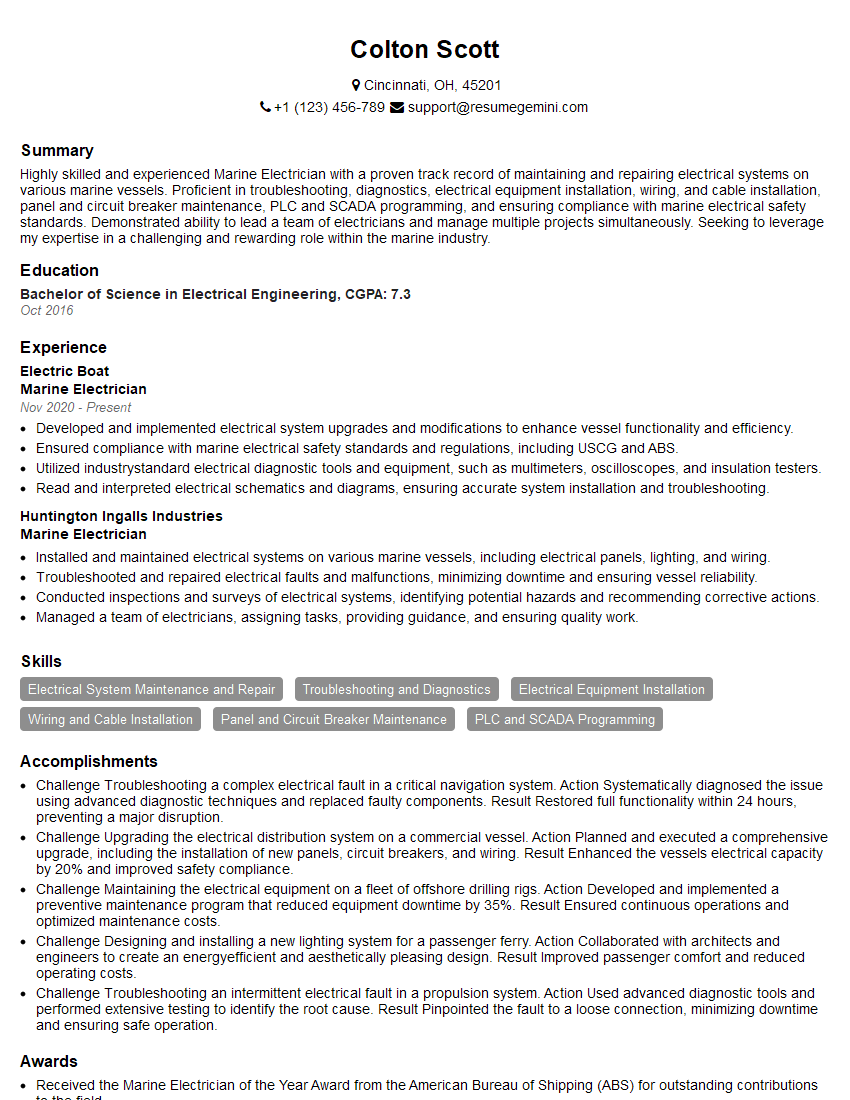
Mastering boat electrical systems is crucial for a successful and rewarding career in the marine industry. It opens doors to diverse roles and demonstrates a valuable skillset highly sought after by employers. To significantly boost your job prospects, create an ATS-friendly resume that highlights your expertise. ResumeGemini is a trusted resource to help you build a professional and impactful resume that showcases your skills effectively. Examples of resumes tailored to Boat Electrical are available to guide you. Take the next step and craft a resume that truly reflects your capabilities and lands you your dream job.
Explore more articles
Users Rating of Our Blogs
Share Your Experience
We value your feedback! Please rate our content and share your thoughts (optional).
What Readers Say About Our Blog
Attention music lovers!
Wow, All the best Sax Summer music !!!
Spotify: https://open.spotify.com/artist/6ShcdIT7rPVVaFEpgZQbUk
Apple Music: https://music.apple.com/fr/artist/jimmy-sax-black/1530501936
YouTube: https://music.youtube.com/browse/VLOLAK5uy_noClmC7abM6YpZsnySxRqt3LoalPf88No
Other Platforms and Free Downloads : https://fanlink.tv/jimmysaxblack
on google : https://www.google.com/search?q=22+AND+22+AND+22
on ChatGPT : https://chat.openai.com?q=who20jlJimmy20Black20Sax20Producer
Get back into the groove with Jimmy sax Black
Best regards,
Jimmy sax Black
www.jimmysaxblack.com
Hi I am a troller at The aquatic interview center and I suddenly went so fast in Roblox and it was gone when I reset.
Hi,
Business owners spend hours every week worrying about their website—or avoiding it because it feels overwhelming.
We’d like to take that off your plate:
$69/month. Everything handled.
Our team will:
Design a custom website—or completely overhaul your current one
Take care of hosting as an option
Handle edits and improvements—up to 60 minutes of work included every month
No setup fees, no annual commitments. Just a site that makes a strong first impression.
Find out if it’s right for you:
https://websolutionsgenius.com/awardwinningwebsites
Hello,
we currently offer a complimentary backlink and URL indexing test for search engine optimization professionals.
You can get complimentary indexing credits to test how link discovery works in practice.
No credit card is required and there is no recurring fee.
You can find details here:
https://wikipedia-backlinks.com/indexing/
Regards
NICE RESPONSE TO Q & A
hi
The aim of this message is regarding an unclaimed deposit of a deceased nationale that bears the same name as you. You are not relate to him as there are millions of people answering the names across around the world. But i will use my position to influence the release of the deposit to you for our mutual benefit.
Respond for full details and how to claim the deposit. This is 100% risk free. Send hello to my email id: lukachachibaialuka@gmail.com
Luka Chachibaialuka
Hey interviewgemini.com, just wanted to follow up on my last email.
We just launched Call the Monster, an parenting app that lets you summon friendly ‘monsters’ kids actually listen to.
We’re also running a giveaway for everyone who downloads the app. Since it’s brand new, there aren’t many users yet, which means you’ve got a much better chance of winning some great prizes.
You can check it out here: https://bit.ly/callamonsterapp
Or follow us on Instagram: https://www.instagram.com/callamonsterapp
Thanks,
Ryan
CEO – Call the Monster App
Hey interviewgemini.com, I saw your website and love your approach.
I just want this to look like spam email, but want to share something important to you. We just launched Call the Monster, a parenting app that lets you summon friendly ‘monsters’ kids actually listen to.
Parents are loving it for calming chaos before bedtime. Thought you might want to try it: https://bit.ly/callamonsterapp or just follow our fun monster lore on Instagram: https://www.instagram.com/callamonsterapp
Thanks,
Ryan
CEO – Call A Monster APP
To the interviewgemini.com Owner.
Dear interviewgemini.com Webmaster!
Hi interviewgemini.com Webmaster!
Dear interviewgemini.com Webmaster!
excellent
Hello,
We found issues with your domain’s email setup that may be sending your messages to spam or blocking them completely. InboxShield Mini shows you how to fix it in minutes — no tech skills required.
Scan your domain now for details: https://inboxshield-mini.com/
— Adam @ InboxShield Mini
support@inboxshield-mini.com
Reply STOP to unsubscribe
Hi, are you owner of interviewgemini.com? What if I told you I could help you find extra time in your schedule, reconnect with leads you didn’t even realize you missed, and bring in more “I want to work with you” conversations, without increasing your ad spend or hiring a full-time employee?
All with a flexible, budget-friendly service that could easily pay for itself. Sounds good?
Would it be nice to jump on a quick 10-minute call so I can show you exactly how we make this work?
Best,
Hapei
Marketing Director
Hey, I know you’re the owner of interviewgemini.com. I’ll be quick.
Fundraising for your business is tough and time-consuming. We make it easier by guaranteeing two private investor meetings each month, for six months. No demos, no pitch events – just direct introductions to active investors matched to your startup.
If youR17;re raising, this could help you build real momentum. Want me to send more info?
Hi, I represent an SEO company that specialises in getting you AI citations and higher rankings on Google. I’d like to offer you a 100% free SEO audit for your website. Would you be interested?
Hi, I represent an SEO company that specialises in getting you AI citations and higher rankings on Google. I’d like to offer you a 100% free SEO audit for your website. Would you be interested?