Interviews are more than just a Q&A session—they’re a chance to prove your worth. This blog dives into essential Optical Coatings interview questions and expert tips to help you align your answers with what hiring managers are looking for. Start preparing to shine!
Questions Asked in Optical Coatings Interview
Q 1. Explain the difference between dielectric and metallic optical coatings.
Dielectric and metallic optical coatings differ fundamentally in their interaction with light. Dielectric coatings are made from non-conducting materials like silicon dioxide (SiO2) and titanium dioxide (TiO2). They function primarily by controlling the interference of light waves, creating constructive or destructive interference to enhance or suppress reflection at specific wavelengths. Think of them like carefully layered transparent films that subtly manipulate light’s path. Metallic coatings, conversely, utilize highly conductive materials such as aluminum or silver. These coatings reflect light primarily through the interaction of light with free electrons in the metal. This interaction leads to a high reflectivity across a broad range of wavelengths, often resulting in a mirrored appearance. Imagine shining a light on a polished metal surface – that’s the metallic coating effect. The key difference boils down to the mechanism of reflection: interference for dielectrics and electron interaction for metals.
Q 2. Describe the process of sputtering for optical coating deposition.
Sputtering is a physical vapor deposition (PVD) technique widely used for depositing optical coatings. It involves bombarding a target material (the material we want to coat the substrate with) with high-energy ions, typically argon ions. This bombardment ejects atoms from the target, which then travel through a low-pressure gas and deposit onto a substrate. Think of it like a tiny sandblasting process, but instead of sand, we use ions to ‘blast’ atoms from the target onto the surface we want to coat. The process is controlled meticulously to ensure uniform coating thickness and quality. Parameters such as the gas pressure, ion energy, and target-substrate distance are critical for achieving the desired coating properties. Different sputtering techniques exist, including DC sputtering, RF sputtering, and magnetron sputtering, each with its advantages and disadvantages regarding deposition rate, film quality, and material compatibility.
Q 3. What are the common types of optical coating defects and their causes?
Optical coatings, despite their precision, can suffer from several defects. Common defects include:
- Pinholes: Tiny holes in the coating that disrupt its uniformity and can lead to scattering or reduced performance. They often arise from insufficient cleaning of the substrate or gas impurities during deposition.
- Scratches and other surface imperfections: These can be introduced during handling or cleaning, affecting the coating’s optical properties, particularly the scattering of light.
- Thickness non-uniformity: Inconsistent coating thickness across the substrate surface leads to variations in optical performance, resulting in uneven reflection or transmission.
- Contamination: Dust particles or other contaminants present during deposition can become embedded in the coating, altering its optical characteristics and performance.
- Stress-induced cracking: Excessive stress within the coating layer, often due to differences in thermal expansion between the coating and substrate, can cause cracking.
The causes are often related to process parameters, substrate preparation, and environmental conditions during the coating process.
Q 4. How do you measure the thickness of an optical coating?
Measuring the thickness of an optical coating is crucial for ensuring performance. Several techniques are employed, depending on the coating type and thickness range. These include:
- Optical methods: These utilize the interference of light reflected from the coating and substrate interfaces. Measuring the wavelengths of these interference fringes allows for precise thickness determination. Examples include ellipsometry and spectrophotometry.
- Mechanical profilometry: This method uses a stylus to profile the surface of the coated substrate, providing a direct measurement of the coating thickness. This is particularly useful for thicker coatings.
- X-ray reflectivity (XRR): This technique employs X-rays to determine the thickness and density of thin films with high accuracy.
The choice of method often depends on the desired accuracy, coating thickness, and available equipment. For instance, ellipsometry is excellent for thin dielectric coatings, while profilometry is better suited for thicker, less transparent films.
Q 5. Explain the concept of refractive index and its importance in optical coatings.
The refractive index (n) is a crucial material property defining how much light slows down when passing through a medium. It’s the ratio of the speed of light in a vacuum to its speed in the material. A higher refractive index indicates greater slowing and bending of light. In optical coatings, the refractive index is vital because it determines the amount of light reflected and transmitted at each interface between layers. The design of optical coatings relies heavily on precise control of refractive indices to achieve desired optical effects like anti-reflection or high reflection. For example, alternating high and low refractive index layers in a dielectric stack can create interference effects that lead to significant changes in reflection and transmission.
Q 6. What are the advantages and disadvantages of using different coating materials (e.g., SiO2, TiO2, Ta2O5)?
SiO2, TiO2, and Ta2O5 are common coating materials, each with its own advantages and disadvantages:
- SiO2 (Silicon dioxide): Offers excellent environmental stability and is relatively easy to deposit. Its refractive index is relatively low, making it suitable for low-index layers in anti-reflection coatings. However, its lower refractive index limits its applications in high-reflection coatings.
- TiO2 (Titanium dioxide): Possesses a high refractive index, making it ideal for high-index layers in multilayer coatings. It’s widely used in high-reflection coatings and mirrors. However, it’s more susceptible to environmental degradation than SiO2 and can be harder to deposit uniformly.
- Ta2O5 (Tantalum pentoxide): Offers a high refractive index and good chemical durability. It’s often used in applications requiring high stability and resistance to environmental factors. However, it can be more challenging and expensive to deposit compared to SiO2 and TiO2.
The choice of material depends on the specific application requirements, considering factors like desired refractive index, environmental stability, deposition process, and cost.
Q 7. Describe the design considerations for anti-reflection coatings.
Designing effective anti-reflection (AR) coatings involves careful consideration of several factors:
- Substrate refractive index: The refractive index of the substrate significantly influences the design. The goal is to minimize the reflection at the air-coating and coating-substrate interfaces.
- Target wavelength range: AR coatings can be designed to be effective across a broad spectral range (broadband) or optimized for specific wavelengths (narrowband).
- Number of layers: Single-layer AR coatings provide moderate performance, while multilayer coatings offer superior performance, especially for broadband applications. More layers provide more design flexibility to achieve a lower reflection across a wider spectral range.
- Refractive indices of coating materials: A combination of high and low refractive index materials is typically used to create interference effects that minimize reflection.
- Angle of incidence: AR coatings are often designed for specific angles of incidence, and their performance may degrade at angles significantly different from the design angle.
The design process often involves sophisticated optical modeling software to optimize layer thicknesses and refractive indices for the desired performance.
Q 8. How do you design a high-reflection coating for a specific wavelength range?
Designing a high-reflection coating for a specific wavelength range involves carefully selecting the thicknesses and refractive indices of multiple layers of dielectric materials. Think of it like building a layered cake, where each layer contributes to the overall reflective properties. The design process typically starts with defining the target wavelength range and the desired reflectivity. We then use optical design software, employing techniques like the matrix method or equivalent layer methods, to calculate the optimal layer thicknesses and materials. These calculations leverage the principle of constructive interference, where light waves reflected from different layers add up to produce a strong reflected wave at the desired wavelengths. For example, if we need a high reflector for a laser operating at 1550 nm, we might choose materials like silicon dioxide (SiO2) and titanium dioxide (TiO2) with their known refractive indices. The software will then calculate the precise thicknesses of alternating layers of SiO2 and TiO2 needed to maximize reflection at 1550 nm. The process is iterative, often involving fine-tuning to account for manufacturing tolerances and material variations.
A practical example would be the design of a high-reflectivity mirror for a laser cavity. High reflectivity at the laser’s wavelength is crucial for efficient laser operation, maximizing the energy stored within the cavity.
Q 9. Explain the principle of interference in optical coatings.
Interference in optical coatings is based on the superposition principle of waves. When light strikes a thin film, it’s partially reflected at the top and bottom surfaces. These reflected waves can interfere constructively or destructively, depending on the optical path difference between them. The optical path difference is determined by the film’s thickness and refractive index. Constructive interference occurs when the path difference is a multiple of the wavelength, leading to enhanced reflection. Destructive interference occurs when the path difference is an odd multiple of half the wavelength, leading to reduced reflection and potentially increased transmission. Imagine dropping two pebbles into a still pond – the resulting ripples interfere with each other, sometimes creating larger waves (constructive interference) and sometimes canceling each other out (destructive interference). Similarly, light waves reflected from different layers in an optical coating interfere, creating the desired reflection or transmission characteristics.
Q 10. What are the challenges in achieving high-performance optical coatings?
Achieving high-performance optical coatings presents several challenges. One major challenge is achieving high-reflectivity or high-transmission across a broad spectral bandwidth while maintaining low scattering and absorption. It’s like trying to hit a very small target in the center of a dartboard, where the target represents the desired optical performance. Variations in the deposition process (temperature, pressure, etc.) can lead to non-uniformity in layer thickness, causing degradation in performance. Furthermore, achieving high durability and resistance to environmental factors like humidity, temperature changes, and mechanical stress is critical but challenging. Another challenge lies in minimizing light scattering, which can degrade the image quality in applications like imaging or optical communication. The selection of suitable materials with desired refractive indices and low absorption across the target wavelength range is also crucial but can be limited by material availability and cost. Lastly, controlling the stress within the layers is vital to prevent cracking or delamination of the coating.
Q 11. Discuss the role of substrate preparation in the optical coating process.
Substrate preparation is absolutely critical for the success of an optical coating. A poorly prepared substrate can lead to poor adhesion of the coating, resulting in delamination, scattering, and ultimately, coating failure. The process typically involves several steps including cleaning to remove contaminants (dust, grease, etc.), surface polishing to achieve the desired surface roughness, and potentially etching or other surface treatments to improve adhesion. Think of it as preparing a canvas before painting a masterpiece – a smooth, clean surface ensures the paint adheres properly and the final result is sharp and clear. For instance, in applications requiring high laser damage threshold, ultra-precise surface cleaning and polishing techniques are essential. Failing to properly prepare the substrate can lead to coating defects, making the entire coating process worthless.
Q 12. How do you characterize the optical properties of a coating (e.g., transmission, reflection, absorption)?
The optical properties of a coating, such as transmission, reflection, and absorption, are characterized using specialized optical instruments. A spectrophotometer is commonly used to measure the spectral transmission and reflection of a coating across a wide wavelength range. This instrument shines light through or onto the coated sample and measures the intensity of the transmitted or reflected light at different wavelengths. The absorption can then be calculated from these measurements, using the fact that transmission + reflection + absorption = 100%. Ellipsometry is another powerful technique used to determine the thickness and refractive index of each layer in a multilayer coating. This involves measuring the change in polarization state of light reflected from the sample. The data obtained are used to fit to an optical model and obtain the parameters of the coating layers. In simpler terms, we are essentially taking detailed ‘snapshots’ of how light interacts with the coating to understand its properties. We then use this data to assess the coating’s performance against the design specifications.
Q 13. Describe different techniques for monitoring the coating process in real-time.
Real-time monitoring of the coating process is essential to ensure consistent quality and avoid defects. Several techniques are available, including optical thickness monitors that measure the light reflected during deposition. These monitors use interference principles to track the thickness of the growing film layer by layer, enabling precise control of layer thickness. Another technique is quartz crystal microbalance (QCM), which monitors the mass deposition rate by measuring changes in the resonant frequency of a quartz crystal oscillator. In-situ spectroscopic ellipsometry can be used to monitor both thickness and optical properties of the films simultaneously during deposition. These real-time monitoring techniques offer the advantages of immediate feedback, which helps to optimize the deposition process and promptly identify and rectify any deviations from the desired parameters, preventing the production of faulty coatings.
Q 14. What is the importance of environmental stability in optical coatings?
Environmental stability is paramount for the long-term performance of optical coatings. Exposure to humidity, temperature fluctuations, and UV radiation can degrade the optical properties of the coating over time, causing issues like reduced reflectivity, increased scattering, and even physical damage. This degradation can lead to system malfunction and costly maintenance. Consider a coating on a telescope mirror operating outdoors: if the coating is not environmentally stable, its reflectivity will decrease over time, reducing the telescope’s performance. The importance of environmental stability drives the development of durable coatings with high resistance to these factors. Coatings used in harsh environments, such as aerospace or outdoor applications, require rigorous testing and specialized design to ensure long-term reliability and performance under the expected environmental conditions.
Q 15. Explain the concept of optical scattering and its effect on coating performance.
Optical scattering refers to the redirection of light from its original path as it interacts with imperfections within an optical coating or substrate. These imperfections can range from microscopic surface roughness to variations in the refractive index of the coating material. The effect on coating performance is significant because scattering reduces the amount of light transmitted through or reflected from the coated surface, degrading its efficiency. For instance, in a high-quality camera lens, scattering leads to reduced image clarity and contrast. In solar cells, scattering lowers the amount of light absorbed, resulting in reduced power output. The amount of scattering is typically quantified by a scattering coefficient, often expressed as a percentage of incident light scattered.
Imagine shining a flashlight on a smooth mirror versus a piece of sandpaper. The mirror, representing a high-quality optical coating with minimal scattering, reflects the light cleanly. The sandpaper, representing a coating with significant scattering, redirects the light in many directions, resulting in a diffuse reflection.
Career Expert Tips:
- Ace those interviews! Prepare effectively by reviewing the Top 50 Most Common Interview Questions on ResumeGemini.
- Navigate your job search with confidence! Explore a wide range of Career Tips on ResumeGemini. Learn about common challenges and recommendations to overcome them.
- Craft the perfect resume! Master the Art of Resume Writing with ResumeGemini’s guide. Showcase your unique qualifications and achievements effectively.
- Don’t miss out on holiday savings! Build your dream resume with ResumeGemini’s ATS optimized templates.
Q 16. How do you select the appropriate coating method for a specific application?
Selecting the appropriate coating method hinges on several factors: the desired coating properties (e.g., refractive index, thickness, durability), the substrate material and geometry, the required deposition rate, and the budget. Several common methods exist, each with its strengths and weaknesses.
- Evaporation: Suitable for simple single-layer coatings, offering good control over thickness. However, it’s less efficient for complex multilayers.
- Sputtering: Offers excellent adhesion and durability, ideal for high-stress applications. The process can be complex and expensive for intricate coatings.
- Chemical Vapor Deposition (CVD): Excellent for uniform, conformal coatings on complex shapes. However, it requires specialized equipment and precise process control.
- Sol-Gel: A cost-effective method for depositing specific materials, especially oxides. It’s limited in terms of precision and thickness control compared to physical vapor deposition techniques.
For example, if we need a durable, scratch-resistant coating for a high-power laser mirror, sputtering would be a preferred choice. If the application requires a large-area coating with a specific refractive index profile, CVD might be more suitable. The selection process is essentially an optimization problem to balance cost, performance, and manufacturing feasibility.
Q 17. Describe the process of cleaning and preparing optical substrates for coating.
Cleaning and preparing optical substrates is a critical step in optical coating, as even microscopic contaminants can dramatically affect adhesion and performance. The process typically involves several stages:
- Initial Cleaning: Removing large particles using isopropyl alcohol (IPA) and lint-free wipes or a suitable ultrasonic bath.
- Deionized Water Rinse: Removing any residual IPA.
- Advanced Cleaning: Using a more powerful cleaning agent such as a detergent solution or specific chemical mixtures to remove organic and inorganic contaminants. Often, this includes an ultrasonic bath for thorough cleaning.
- Drying: A controlled drying process (e.g., nitrogen drying) to prevent water spots.
- Inspection: Verification of surface cleanliness using techniques like optical microscopy or surface profilometry.
Contamination can severely affect coating quality. Imagine trying to paint a wall with dirt on it – the paint won’t adhere properly. The same applies to optical coatings. A rigorous cleaning protocol is essential to ensure good adhesion and consistent coating performance.
Q 18. How do you address adhesion issues in optical coatings?
Adhesion issues in optical coatings arise from several factors, including surface contamination, substrate roughness, and incompatibility between the coating material and the substrate. Addressing these issues requires a multi-pronged approach:
- Improved Substrate Preparation: Thorough cleaning and pre-treatment, possibly including processes like plasma cleaning, to enhance surface energy and promote better adhesion.
- Adhesion Promoters: Applying a thin layer of material between the substrate and the coating to improve compatibility. This could involve using a specific primer or interlayer.
- Material Selection: Choosing coating materials known for good adhesion to the specific substrate. For example, certain titanium oxide layers are well known for excellent adhesion to many substrates.
- Process Optimization: Optimizing coating parameters (deposition rate, substrate temperature) can enhance the mechanical interlocking between the coating and the substrate.
For example, if we are experiencing poor adhesion of a dielectric coating on a glass substrate, we might try plasma cleaning the glass before coating, or introduce a thin chromium layer as an adhesion promoter. Careful control of deposition temperature is also essential to prevent stress-induced delamination.
Q 19. What are the common methods used for measuring the stress in optical coatings?
Measuring stress in optical coatings is crucial because excessive stress can lead to cracking, delamination, and performance degradation. Several techniques are commonly used:
- Optical Method (Fizeau Interferometry): Measures the curvature change of a substrate caused by the stress in the coating. This is a highly sensitive and widely used method.
- Mechanical Method (Substrate Curvature): Similar to the optical method, this technique measures the change in curvature of the substrate using mechanical profilometry.
- X-ray Diffraction (XRD): This method can provide information about the lattice parameters of the coating material, which can be used to determine the stress state.
The choice of method depends on the sensitivity and resolution required. For example, Fizeau interferometry is ideal for high-precision measurements of stress in thin films, while XRD is better suited for determining the stress profile within thicker coatings.
Q 20. Explain the principle of multilayer interference filters.
Multilayer interference filters leverage the phenomenon of constructive and destructive interference to selectively transmit or reflect specific wavelengths of light. They are typically composed of alternating high- and low-refractive index layers, with thicknesses carefully chosen to achieve the desired spectral characteristics. Constructive interference occurs when light waves reflected from the various interfaces are in phase, leading to enhanced reflection at specific wavelengths. Destructive interference occurs when these reflected waves are out of phase, leading to reduced reflection (enhanced transmission) at other wavelengths.
Imagine a series of mirrors with slightly different spacing. Certain wavelengths of light will reflect back strongly, reinforced by the multiple reflections, while other wavelengths will pass through relatively unimpeded.
The design process involves using mathematical models (such as the transfer matrix method) to calculate the required layer thicknesses and refractive indices to achieve the desired spectral response. These filters are widely used in various applications, including optical filters, dichroic mirrors, and laser optics.
Q 21. How do you design a broadband anti-reflection coating?
Designing a broadband anti-reflection (AR) coating aims to minimize reflection across a wide range of wavelengths. A single-layer AR coating is only effective for a narrow wavelength range. To achieve broadband performance, a multilayer coating with at least two layers is needed. The design typically involves using materials with significantly different refractive indices and carefully choosing layer thicknesses to achieve destructive interference across a wide spectral band.
A common approach involves using the quarter-wave stack design, where each layer’s thickness is a quarter of the wavelength of light at the center of the desired broadband region. However, the optimal design often involves more sophisticated optimization algorithms to achieve even better performance across a broader wavelength range.
For example, a typical broadband AR coating for visible light might consist of several alternating layers of silica (SiO₂) and titanium dioxide (TiO₂), precisely tailored to minimize reflection from 400nm to 700nm. This careful design and precise control of layer thickness is crucial for producing a high-performance broadband AR coating.
Q 22. Discuss the challenges in achieving durable and long-lasting optical coatings.
Achieving durable and long-lasting optical coatings is a significant challenge due to the delicate nature of the thin films involved. These coatings are susceptible to various forms of degradation, impacting their optical performance and lifespan. The primary challenges include:
- Environmental Factors: Exposure to humidity, temperature fluctuations, and UV radiation can lead to coating deterioration. Moisture can cause delamination (separation of the coating from the substrate), while temperature changes can induce stress and cracking. UV radiation can degrade the coating material, altering its optical properties.
- Mechanical Stress: Coatings are subjected to mechanical stress during handling, cleaning, and environmental exposure. Scratches, abrasion, and even the sheer weight of the coating itself can cause failure. The coefficient of thermal expansion mismatch between the coating and the substrate can exacerbate stress-related issues.
- Chemical Degradation: Coatings can react with chemicals in the environment, such as cleaning agents or atmospheric pollutants. This chemical attack can alter the coating’s structure, leading to changes in optical performance and reduced durability.
- Adhesion Issues: Poor adhesion between the coating and the substrate is a major cause of coating failure. If the bonding is weak, the coating can peel off easily, rendering it useless. This requires careful control of surface preparation and coating deposition techniques.
To mitigate these challenges, researchers and engineers employ various strategies, including the use of robust coating materials, optimized deposition techniques (e.g., ion-assisted deposition), and the incorporation of protective overcoatings. Developing coatings with superior adhesion, hardness, and chemical resistance are crucial for ensuring long-term performance.
Q 23. Explain the concept of polarization in optical coatings.
Polarization in optical coatings refers to the orientation of the electric field vector of light. Light is a transverse electromagnetic wave, meaning the electric and magnetic fields oscillate perpendicular to the direction of propagation. Unpolarized light has its electric field vector oscillating in all directions. Polarized light, however, has its electric field vector constrained to a specific direction or plane.
Optical coatings can manipulate the polarization of light by using materials with anisotropic properties (different optical properties depending on the direction of the light). For example, a polarizing beam splitter cube uses a birefringent material (a material with a different refractive index for light polarized in different directions) to separate the light into its s-polarized and p-polarized components. This is achieved by precisely controlling the angle of incidence and coating layers design.
The concept of polarization is crucial in many applications, including:
- Polarizing filters: Used in photography, microscopy, and displays to reduce glare and enhance contrast.
- Liquid crystal displays (LCDs): Polarizers are essential components of LCD screens to control the transmission of light.
- Optical sensors: Polarization-sensitive detectors are used to measure stress, strain, and other physical properties.
Understanding polarization behavior is vital for designing optical coatings that control the polarization state of light, tailored to the specific requirements of the application.
Q 24. Describe different types of optical filters and their applications.
Optical filters selectively transmit or reflect specific wavelengths of light. Different types of optical filters exist, each designed for specific applications:
- Bandpass filters: Transmit light within a narrow wavelength range, blocking light outside this range. They’re used in spectroscopy, fluorescence microscopy, and laser systems to select a specific wavelength or color.
- Longpass filters: Transmit light longer than a specific cutoff wavelength, blocking shorter wavelengths. They are common in fluorescence microscopy to remove excitation light from the emitted signal.
- Shortpass filters: Transmit light shorter than a specific cutoff wavelength, blocking longer wavelengths. These filters are useful in applications that require separating UV from visible light.
- Neutral density (ND) filters: Attenuate light uniformly across a broad wavelength range, reducing the intensity without altering the color. They’re frequently used in photography and microscopy to control the amount of light entering the system.
- Dichroic filters: Reflect specific wavelengths while transmitting others. These are used in fluorescence microscopy, optical instrumentation, and laser systems for wavelength separation.
- Interference filters: These filters utilize the principle of thin-film interference to achieve high spectral selectivity. They consist of multiple layers of dielectric materials with different refractive indices, creating constructive and destructive interference to control light transmission.
The choice of filter depends heavily on the application’s requirements. For instance, a high-resolution spectroscopy application necessitates a bandpass filter with very narrow bandwidth, while photography might benefit from a neutral density filter to control light intensity.
Q 25. How do you troubleshoot issues related to optical coating performance?
Troubleshooting optical coating performance issues requires a systematic approach. The process typically involves:
- Visual Inspection: Begin with a thorough visual inspection of the coated component for any obvious defects such as scratches, cracks, delamination, or coating imperfections. This helps identify the initial signs of a problem.
- Spectral Measurement: Use a spectrophotometer to measure the transmission or reflection spectrum of the coating. Compare these measurements to the design specifications to identify deviations in performance. A shift in the peak transmission wavelength or a reduction in transmission/reflection could indicate a problem.
- Environmental Testing: If the issue arises after environmental exposure, conduct environmental testing to assess the coating’s resistance to humidity, temperature, and UV radiation. This is crucial to establish the relationship between degradation and environmental factors.
- Microscopic Analysis: Employ microscopic techniques (such as SEM or AFM) to examine the coating’s surface morphology and microstructure. This can reveal defects invisible to the naked eye, such as pinholes, voids, or surface roughness. This information can provide insight into the cause of performance issues.
- Chemical Analysis: If chemical degradation is suspected, employ chemical analysis (e.g., XPS or Auger spectroscopy) to investigate the chemical composition and bonding states of the coating. This helps to determine whether chemical reactions have altered the coating’s properties.
The specific troubleshooting strategy will depend on the nature of the issue and the available tools and resources. A detailed record-keeping system is crucial for tracking coating parameters, deposition conditions, and performance data to trace the origin of any problems.
Q 26. What is the difference between single-layer and multilayer coatings?
The key difference between single-layer and multilayer optical coatings lies in the number of layers used and the resultant optical properties.
- Single-layer coatings: These consist of a single thin layer of material deposited on a substrate. They are relatively simple to manufacture but provide limited control over optical properties. Common applications include anti-reflection coatings (though typically more effective with multiple layers) where a single layer can offer a limited reduction in reflection at a specific wavelength.
- Multilayer coatings: These coatings comprise multiple thin layers of alternating high and low refractive index materials. This layered structure allows for precise control over the transmission and reflection of light across a wide range of wavelengths, enabling the creation of highly specialized optical filters and mirrors. The precise layering creates interference effects which can result in nearly perfect reflection or transmission within specified wavelength ranges. Examples include highly reflective mirrors for lasers or complex bandpass filters used in scientific instruments.
Multilayer coatings offer superior performance in terms of spectral selectivity and control over optical properties compared to single-layer coatings, but they are more complex and expensive to manufacture.
Q 27. What are the applications of optical coatings in the biomedical field?
Optical coatings play a significant role in the biomedical field, offering enhanced functionality and performance in various applications:
- Medical Imaging: Coatings are crucial for improving the performance of optical imaging systems used in endoscopy, microscopy, and optical coherence tomography (OCT). Anti-reflection coatings enhance image clarity, while dichroic filters enable wavelength selection for specific imaging modalities.
- Optical Sensors: Coatings enable the development of highly sensitive optical sensors for detecting biological molecules, such as glucose or proteins. These sensors often utilize thin films with specific properties tailored to interact with the target molecules.
- Biomedical Implants: Coatings can enhance the biocompatibility and functionality of biomedical implants by providing corrosion resistance, reducing friction, and promoting cell adhesion. For instance, specialized coatings can improve the longevity and function of intraocular lenses.
- Optical Therapeutics: Optical coatings are used in various therapeutic applications, including laser surgery, photodynamic therapy (PDT), and targeted drug delivery. Coatings can help control light delivery and enhance the efficiency of these treatments.
The use of biocompatible materials and surface modification techniques are crucial in biomedical applications of optical coatings to ensure safety and efficacy.
Q 28. Discuss the future trends in optical coating technology.
The future of optical coating technology is driven by the demand for improved performance, reduced costs, and the exploration of novel applications. Several key trends are shaping this field:
- Metamaterials and Plasmonics: Research into metamaterials and plasmonics promises to revolutionize optical coatings by enabling unprecedented control over light-matter interaction. This could lead to devices with extraordinary optical properties not achievable with conventional materials.
- Advanced Manufacturing Techniques: Developments in techniques like atomic layer deposition (ALD), roll-to-roll coating, and 3D printing are paving the way for high-throughput, low-cost manufacturing of high-quality optical coatings.
- Sustainable and Biocompatible Coatings: The focus is shifting towards the development of environmentally friendly and biocompatible coating materials, reducing the environmental impact and improving safety in various applications, particularly in the biomedical sector.
- Integration with other Technologies: Optical coatings are being integrated with other technologies, such as microfluidics and nanotechnology, to create sophisticated multifunctional devices. This trend is particularly evident in biosensing and lab-on-a-chip applications.
- Artificial Intelligence (AI) and Machine Learning (ML): AI and ML techniques are being utilized to optimize coating design, deposition processes, and performance prediction. This can lead to the development of customized coatings tailored to specific needs more efficiently.
These advancements are poised to expand the capabilities and applications of optical coatings in diverse fields, including telecommunications, energy, healthcare, and environmental monitoring.
Key Topics to Learn for Optical Coatings Interview
- Thin-Film Interference: Understanding the principles of constructive and destructive interference in thin films, including the impact of film thickness and refractive index.
- Design and Simulation: Proficiency in using software (e.g., TFCalc, Macleod) to design optical coatings and simulate their performance under various conditions. Practical application: Designing anti-reflection coatings for solar cells or lenses.
- Deposition Techniques: Familiarity with various deposition methods such as sputtering, evaporation, and chemical vapor deposition (CVD). Understanding the advantages and limitations of each method for different applications.
- Material Properties: Knowledge of the optical and physical properties of common coating materials (e.g., SiO2, TiO2, Ta2O5) and their selection criteria based on application requirements.
- Characterization Techniques: Experience with techniques for characterizing optical coatings, such as spectrophotometry, ellipsometry, and atomic force microscopy (AFM). Practical application: Assessing the quality and performance of deposited coatings.
- Optical Coatings Applications: Broad understanding of applications in various fields like ophthalmics, photonics, solar energy, and displays. Discuss specific examples of coating types and their functionalities.
- Troubleshooting and Problem-Solving: Ability to diagnose and solve issues related to coating defects, performance variations, and process optimization.
- Advanced Concepts (as applicable to your experience): Explore topics like rugate filters, multilayer coatings, metamaterials, and polarization control techniques.
Next Steps
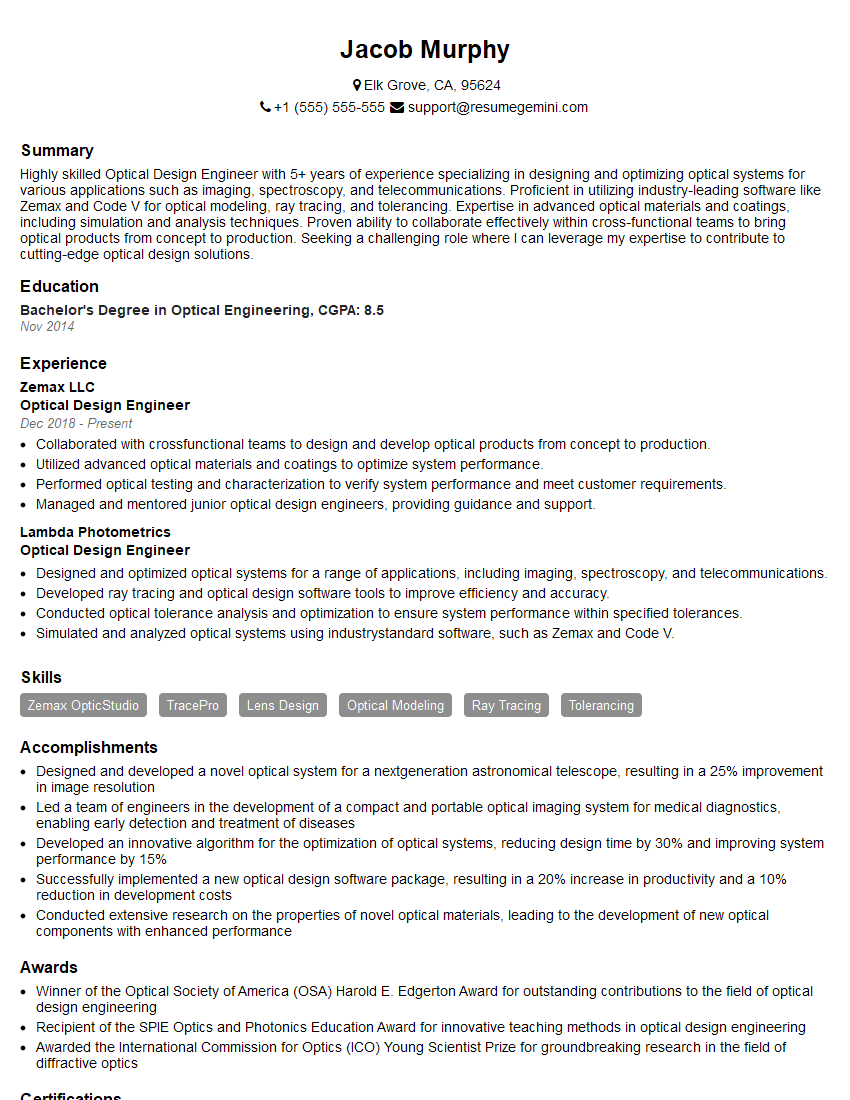
Mastering Optical Coatings opens doors to exciting career opportunities in cutting-edge industries. To maximize your job prospects, it’s crucial to present your skills effectively. An ATS-friendly resume is key to getting your application noticed by recruiters. We recommend using ResumeGemini, a trusted resource, to build a professional and impactful resume that highlights your expertise. ResumeGemini provides examples of resumes tailored to Optical Coatings, giving you a head start in crafting the perfect document to showcase your qualifications.
Explore more articles
Users Rating of Our Blogs
Share Your Experience
We value your feedback! Please rate our content and share your thoughts (optional).
What Readers Say About Our Blog
Very informative content, great job.
good