Unlock your full potential by mastering the most common Fiber Optic Documentation and Record Keeping interview questions. This blog offers a deep dive into the critical topics, ensuring you’re not only prepared to answer but to excel. With these insights, you’ll approach your interview with clarity and confidence.
Questions Asked in Fiber Optic Documentation and Record Keeping Interview
Q 1. Explain the importance of accurate fiber optic documentation.
Accurate fiber optic documentation is paramount for several reasons. Think of it like a detailed map for your network: without it, troubleshooting becomes a nightmare, upgrades are incredibly difficult, and even simple maintenance tasks can be unnecessarily time-consuming and expensive. Precise records allow for efficient network management, enabling quick identification of faults, streamlined expansion, and cost savings in the long run.
- Troubleshooting: Pinpointing a fault in a poorly documented network can take days; accurate documentation reduces this to hours, or even minutes.
- Upgrades and Expansions: Knowing the exact location, type, and specifications of existing fibers is crucial for planning future upgrades and avoiding costly mistakes. Without it, you risk damaging existing infrastructure.
- Maintenance: Routine maintenance is simplified. Knowing where splice points, connectors, and other critical components are located prevents accidental damage during cleaning or repairs.
- Compliance and Auditing: Many industries have regulations around network infrastructure. Detailed documentation helps ensure compliance and simplifies audits.
Q 2. Describe different methods for documenting fiber optic cable installations.
Several methods exist for documenting fiber optic cable installations, each with its strengths and weaknesses. The best approach often involves a combination of techniques.
- As-built Drawings: These are detailed, CAD-generated diagrams showing the exact location and routing of fibers, including splice points, connectors, and equipment. They’re invaluable for long-term reference.
- Fiber Optic Splice Closure Documentation: Each splice closure (a protective enclosure housing spliced fibers) should have a clear label with details like fiber IDs, dates, and technician information. This ensures traceability of connections.
- Database Management Systems: Software solutions store detailed information about every fiber, including its length, type, termination points, and associated equipment. These systems allow for centralized access and analysis of network data.
- Labeling and Tagging: Physical labels applied directly to cables and equipment with relevant IDs are crucial for on-site identification. Consistent labeling ensures clarity across the entire network.
- Photographs and Videos: Visual records, especially during installation, are incredibly useful for referencing cable routes and documenting unusual situations.
For example, in a recent project, we used a combination of as-built drawings created in AutoCAD, a database system to manage fiber identifiers and connectivity, and clear photographic documentation of each splice enclosure.
Q 3. What software or tools are you familiar with for creating and managing fiber optic records?
I’m proficient in several software solutions and tools for fiber optic record management. My experience encompasses both standalone applications and integrated network management systems.
- AutoCAD: For creating and managing highly detailed as-built drawings of the fiber optic network infrastructure.
- Fiber Management Software: I have experience with several specialized fiber management software packages that enable efficient tracking of fiber runs, connections, and inventory. These usually include features like automated reporting and connectivity diagramming.
- Network Management Systems (NMS): Many NMS platforms incorporate modules dedicated to managing fiber optic networks. These provide a holistic view of the entire network infrastructure, integrating fiber data with other network elements.
- Spreadsheet Software (e.g., Excel): While not ideal for large networks, spreadsheets can be effective for smaller projects, particularly when coupled with clear labeling and documentation systems.
For example, in one project, we used a combination of AutoCAD for our as-built drawings and a dedicated fiber management software to track individual fiber strands and maintain an inventory of spare cables.
Q 4. How do you ensure the accuracy and completeness of fiber optic documentation?
Ensuring accuracy and completeness requires a multi-faceted approach. Think of it like building a house – every detail, from the foundation to the roof, needs to be meticulously documented.
- Cross-Checking: Comparing data from different sources (e.g., design drawings, field measurements, database entries) helps identify and resolve discrepancies early on.
- Regular Audits: Periodically reviewing and updating documentation ensures that records accurately reflect the current state of the network.
- Standardized Procedures: Following consistent naming conventions, labeling systems, and documentation formats minimizes errors and simplifies data management. This includes defining clear roles and responsibilities for documentation maintenance.
- Version Control: Tracking revisions and changes to documentation helps avoid confusion and ensures everyone is working with the most up-to-date information.
- Training: Providing thorough training to all personnel involved in fiber optic installation and documentation guarantees that everyone understands the importance and procedures involved.
For instance, we instituted a system where every splice closure has a unique ID linked to a database entry and corresponding as-built drawing. This ensured traceability and minimized errors.
Q 5. Explain your experience with creating as-built drawings for fiber optic networks.
Creating as-built drawings is a critical part of my work. These aren’t simply copies of design plans; they reflect the actual network installation. I meticulously document any deviations from the original design, ensuring the final drawings accurately represent the ‘as-built’ reality.
My process typically involves:
- On-site Surveys: Thorough on-site surveys to verify the installed network infrastructure.
- Data Collection: Gathering data on cable routes, termination points, splice locations, equipment IDs, and fiber types.
- CAD Software Usage: Utilizing CAD software (primarily AutoCAD) to create detailed drawings that accurately represent the installed network. This includes creating symbols and layers to clearly represent different network elements.
- Quality Control: Rigorous quality control checks to ensure accuracy and completeness of the drawings before finalization.
- Revision Control: Tracking all revisions and changes to the drawings through a version control system to maintain a clear history of modifications.
In a recent project, I created as-built drawings for a large campus network. The final drawings were critical for future maintenance and upgrades, and the accurate documentation saved the client significant time and expense during subsequent projects.
Q 6. How do you handle discrepancies between design plans and as-built documentation?
Discrepancies between design plans and as-built documentation are inevitable. The key is to identify, document, and resolve them promptly. My approach involves a systematic investigation.
- Identify the Discrepancy: First, pinpoint the exact nature of the difference. Is it a minor deviation in cable routing or a significant change in equipment configuration?
- Investigate the Cause: Determine why the discrepancy occurred. Was it due to unforeseen obstacles, design changes, or human error?
- Document the Change: Clearly document the discrepancy in the as-built drawings and database records. This includes explaining the reason for the deviation.
- Impact Assessment: Assess the potential impact of the discrepancy on network performance and functionality.
- Resolution Strategy: Develop a strategy to address the discrepancy. This might involve simple documentation updates or more complex network modifications.
For example, if a cable route deviated significantly from the design plan due to unexpected underground utilities, I would document this deviation clearly in the as-built drawings, note the reason, and update the associated database records. This ensures the documentation accurately reflects the current network state.
Q 7. Describe your experience with various fiber optic cable types and their documentation requirements.
My experience encompasses various fiber optic cable types, each with specific documentation needs. The level of detail required depends on the cable’s application and the network’s complexity.
- Single-Mode Fiber (SMF): Documentation should specify the fiber type (e.g., G.652D), attenuation characteristics, and connector type. These are crucial for long-haul applications.
- Multi-Mode Fiber (MMF): Similar to SMF, documentation includes the fiber type (e.g., OM3, OM4), core diameter, and modal bandwidth. This is relevant for shorter distances.
- Ribbon Fiber: Documentation should clearly identify the number of fibers in the ribbon, the arrangement, and individual fiber identification within the ribbon.
- Armored Fiber: Documentation needs to include details about the armoring type and its impact on cable routing and installation techniques.
In each case, accurate documentation includes clear identification of the cable type, supplier, specifications, length, and any relevant testing data. This ensures that network maintenance and future upgrades can be performed efficiently and effectively. In one instance, we used color-coded labels to identify different fiber types within a multi-fiber cable and meticulously documented each fiber’s specifics in the database system.
Q 8. What are the common challenges in maintaining accurate fiber optic records?
Maintaining accurate fiber optic records presents several challenges. Think of it like meticulously mapping a vast, intricate network of underground tunnels – each cable is a tunnel, and losing track of even one can cause significant problems. Common difficulties include:
- Inconsistent Documentation Practices: Different teams or contractors might use varying labeling conventions, data entry formats, or software, leading to discrepancies and inaccuracies.
- Lack of Centralized Database: Without a central repository, information is scattered across spreadsheets, drawings, and individual notebooks, making it hard to find what you need quickly, especially during emergencies.
- Human Error: Incorrect data entry, mislabeling cables, or incomplete documentation are all too common and can lead to significant issues down the line.
- Difficulties with As-Built Documentation: Keeping the ‘as-built’ documentation updated to reflect changes made during installations, repairs, or expansions is a constant struggle. Real-world situations rarely adhere perfectly to the initial plan.
- Legacy Systems and Data Migration: Older documentation formats might be incompatible with newer systems, requiring significant effort for data migration and integration.
For example, imagine a team installing new fiber, but the previous documentation is incomplete. This lack of information can result in accidental cable cuts or splicing errors, causing significant downtime and repair costs.
Q 9. How do you ensure the security and accessibility of fiber optic documentation?
Securing and ensuring accessibility of fiber optic documentation is crucial. It’s like protecting the blueprints to a critical infrastructure – you want authorized personnel to access the information easily, while preventing unauthorized access or modification. My approach incorporates several key strategies:
- Secure Database System: Utilizing a robust database management system (DBMS) with access control features like role-based permissions ensures that only authorized individuals can access, modify, or delete data. For instance, using a system with password protection, encryption, and audit trails.
- Data Backup and Disaster Recovery Plan: Regularly backing up the database to a secure offsite location safeguards against data loss due to hardware failure, natural disasters, or cyberattacks. Think of it as having a secondary set of blueprints stored safely away from the original.
- Version Control: Implementing a version control system allows tracking changes to the documentation, facilitating easier auditing and rollback capabilities in case of errors. This way, you always have a history of changes.
- Regular Audits and Security Assessments: Conducting periodic security audits helps identify vulnerabilities and ensures the system’s security posture is maintained. This is like regularly inspecting your building’s security system to prevent any potential break-ins.
- Employee Training: Educating employees on security protocols and best practices is essential to prevent internal threats. This includes proper password management and awareness of phishing attacks.
Q 10. How do you prioritize tasks when managing multiple fiber optic documentation projects?
Prioritizing tasks when managing multiple fiber optic documentation projects requires a structured approach. I typically employ a system based on urgency and importance. Think of it like a triage system in a hospital – the most critical cases get immediate attention.
- Urgency/Importance Matrix: I categorize each project based on its urgency (how soon it needs to be completed) and importance (impact on operations). This helps me visualize and prioritize. Projects that are both urgent and important get immediate attention.
- Project Timeline and Milestones: Each project gets a detailed timeline with clearly defined milestones. This allows for efficient tracking and progress monitoring.
- Resource Allocation: I allocate resources based on project priority and available manpower. This includes assigning roles and responsibilities to individual team members.
- Regular Project Reviews: Conducting regular project reviews helps identify and address potential delays or issues promptly. This prevents minor problems from escalating into major setbacks.
- Flexibility and Adaptability: Being able to adjust the priorities based on unforeseen circumstances or changes in project scope is essential. Real-world scenarios frequently demand this type of adaptability.
For instance, if an emergency cable failure occurs, documentation related to that specific area becomes the top priority, even if it disrupts the schedule of other ongoing projects.
Q 11. What is your experience with GIS systems and their application to fiber optic documentation?
My experience with Geographic Information Systems (GIS) is extensive. I view GIS as an indispensable tool for managing fiber optic infrastructure documentation. Imagine GIS as a sophisticated map that allows not just visualizing the network’s geographical layout but also storing and managing associated data.
I’ve utilized GIS to create interactive maps displaying the location of fiber optic cables, splicing points, and other critical infrastructure components. This enables efficient troubleshooting, planning for expansions, and identifying potential conflicts with other utilities. For example, a GIS system can overlay fiber optic cable locations with underground utility maps, preventing accidental cable damage during excavation projects. Additionally, GIS allows for powerful spatial analysis, such as determining the optimal route for a new fiber line by considering factors like distance, terrain, and existing infrastructure.
Specific software I’m proficient in includes ArcGIS and QGIS, leveraging their capabilities for data visualization, spatial analysis, and network modeling.
Q 12. Explain your understanding of fiber optic testing and how it relates to documentation.
Fiber optic testing is crucial for ensuring network performance and reliability and is directly linked to documentation. Think of it as a medical checkup for your fiber network. Testing verifies the quality of the installation and identifies any potential issues before they impact service. This data is essential for creating accurate and up-to-date documentation.
Common tests include Optical Time-Domain Reflectometry (OTDR), which measures signal attenuation and identifies faults along the fiber, and optical power meter measurements, which verify signal strength. The results of these tests are documented along with the cable’s specifications and location, creating a complete picture of the fiber optic network’s health. For example, an OTDR test may reveal a significant attenuation along a specific cable segment, requiring immediate attention. This information is then meticulously recorded in the documentation to inform future maintenance and repair activities. Without detailed testing results and their corresponding documentation, troubleshooting a fiber network can be incredibly time-consuming and costly.
Q 13. Describe your experience with using different labeling systems for fiber optic cables.
I have extensive experience with various labeling systems for fiber optic cables, recognizing that consistency is paramount. Think of labeling as a vital code that allows quick and accurate identification of each cable throughout its lifecycle.
I’ve worked with different systems, including color-coded sleeves, heat-shrink tubing with printed labels, and adhesive labels. The best system depends on the specific requirements of each project, considering factors such as environmental conditions, ease of application, and longevity. For example, in harsh environmental conditions, heat-shrink tubing might be preferred for its durability, while in easily accessible areas, adhesive labels could be sufficient. Maintaining a standardized labeling system within a project, however, is crucial to ensure consistency across the entire network. Clear documentation of the employed labeling system – including a legend that details the meaning of different colors or codes – is vital for seamless maintenance and future upgrades.
Q 14. How do you handle updates and revisions to fiber optic documentation?
Handling updates and revisions to fiber optic documentation requires a rigorous process to maintain accuracy and consistency. Think of it as maintaining a living document that evolves alongside the network. My approach involves:
- Version Control: Using a version control system such as Git, allows tracking changes to documentation, enabling easy restoration to prior versions if needed. This is particularly valuable when dealing with complex networks undergoing frequent modifications.
- Change Management Process: Establishing a clear change management process ensures that all updates and revisions are properly documented, reviewed, and approved before being implemented in the system. This reduces the risk of errors and inconsistencies.
- Regular Audits and Reconciliation: Performing regular audits of the documentation against the actual physical network helps identify discrepancies and ensures accuracy. Think of it as doing a double-check to maintain a harmonious alignment between the digital records and the real-world infrastructure.
- Centralized Documentation System: Maintaining all documentation in a centralized system facilitates easy access and updating. This way, everyone works with the same current information.
- Clear Communication: Keeping all stakeholders informed of changes helps to reduce confusion and avoid potential issues down the line.
For example, after a cable splice, the change is documented, reviewed, and then reflected in the centralized system, including updates to the network diagrams and OTDR test results.
Q 15. What are the industry standards for fiber optic documentation you adhere to?
Industry standards for fiber optic documentation are crucial for maintaining network integrity and ensuring efficient troubleshooting. I adhere to a combination of standards, including TIA-568, ISO/IEC 14763-3, and vendor-specific guidelines. TIA-568 provides comprehensive cabling standards, including fiber optic cabling, specifying everything from cable types and connectorization to testing procedures. ISO/IEC 14763-3 focuses specifically on fiber optic cabling systems, providing detailed requirements for documentation throughout the lifecycle of the system. Vendor-specific guidelines are essential because different manufacturers may have unique requirements and best practices for their equipment. For example, a detailed as-built drawing showing cable routes, splice locations, and equipment details is paramount, following specific conventions for labeling and referencing. We also incorporate structured cabling standards to maintain uniformity and scalability.
- TIA-568: Defines cabling infrastructure standards, including fiber optic cable types and testing.
- ISO/IEC 14763-3: Addresses fiber optic cabling system requirements, providing specifics on documentation.
- Vendor-Specific Guidelines: Essential for ensuring compatibility and proper operation of specific equipment.
Career Expert Tips:
- Ace those interviews! Prepare effectively by reviewing the Top 50 Most Common Interview Questions on ResumeGemini.
- Navigate your job search with confidence! Explore a wide range of Career Tips on ResumeGemini. Learn about common challenges and recommendations to overcome them.
- Craft the perfect resume! Master the Art of Resume Writing with ResumeGemini’s guide. Showcase your unique qualifications and achievements effectively.
- Don’t miss out on holiday savings! Build your dream resume with ResumeGemini’s ATS optimized templates.
Q 16. How do you handle emergency repairs and their impact on fiber optic documentation?
Emergency repairs require a swift response while meticulously maintaining accurate documentation. The primary focus is to restore service quickly; however, detailed records of temporary fixes are essential. I utilize a standardized emergency repair form that captures the precise location of the fault, the nature of the repair (e.g., splice replacement, cable rerouting), the time of the repair, and the technicians involved. Pictures or videos are crucial, capturing the before and after states of the affected area. Post-repair, a full documentation update is required, reflecting the temporary solution and planned permanent resolution. This may involve integrating the emergency repair information into the main fiber optic documentation database and updating as-built drawings. The process prioritizes restoring service, but careful recording ensures that we can plan for longer-term solutions and avoid future issues.
For instance, if a fiber strand is cut during construction, the emergency repair might involve a temporary splice. The documentation would detail this temporary fix, noting the location, type of splice used and its temporary nature. Once a permanent solution is implemented (e.g., replacing the damaged section), this information would be updated in the system.
Q 17. How do you collaborate with other teams or stakeholders on fiber optic documentation projects?
Collaboration is key in fiber optic documentation. I use a combination of tools and strategies to work effectively with different teams. This includes regular meetings with network engineers, construction crews, and IT teams. We employ collaborative software platforms that allow for real-time updates and version control of documents, such as shared network drives with access control, or dedicated project management software. Clear communication channels are paramount. For example, I might schedule weekly update meetings to review the progress of a fiber optic installation project, ensuring that everyone is on the same page regarding documentation updates and any changes to the original plan. A shared repository where all relevant parties can access and update documentation helps to maintain a single source of truth. This prevents discrepancies and ensures that everyone works with the most current information.
Q 18. Describe your experience with managing large volumes of fiber optic documentation.
Managing large volumes of fiber optic documentation requires a systematic approach. I employ a database-driven system, often utilizing GIS mapping software integrated with the database. This allows for efficient searching, filtering, and visualization of data. The database stores detailed information, including cable routes, splice locations, equipment details, and test results. Using geographic information system (GIS) mapping helps to visually represent the fiber optic network. This makes troubleshooting and planning much simpler. Regular data backups and version control are also critical to prevent data loss and maintain an audit trail. This allows for tracking changes over time, essential for regulatory compliance and troubleshooting.
In one project involving over 500 kilometers of fiber, this database system proved invaluable in quickly identifying the location of a fault, allowing for a rapid restoration of service. Without this system, the process would have been significantly more complex and time-consuming.
Q 19. What is your process for verifying the accuracy of fiber optic splice records?
Verifying the accuracy of fiber optic splice records is crucial for network reliability. My process involves a multi-step approach. First, I compare the splice records against the as-built drawings. Next, I cross-reference the records with OTDR (Optical Time Domain Reflectometer) test results. OTDR testing provides visual confirmation of the splice locations and attenuation values. Additionally, physical verification of splice locations is conducted on-site, comparing physical labeling to the documentation. Any discrepancies are investigated and corrected, with all changes carefully documented. This rigorous process ensures that the records accurately reflect the network’s physical reality.
For example, if the splice record indicates a splice at a certain location, but the OTDR test shows a different location or an unexpectedly high attenuation, I would investigate to determine the cause and update the records accordingly.
Q 20. How do you ensure compliance with relevant regulations and standards regarding fiber optic documentation?
Compliance with regulations and standards is paramount. I ensure compliance by maintaining an updated knowledge of relevant regulations, such as those from local authorities and industry bodies. We regularly review our documentation procedures to ensure they align with the latest standards. This includes using standardized formats for documentation, utilizing appropriate testing equipment, and maintaining a complete and accurate audit trail for all changes. Internal audits and regular reviews are conducted to ensure continuous compliance. Regular training updates for the team keeps everyone informed of current best practices and standards.
Q 21. What strategies do you employ to prevent errors in fiber optic documentation?
Preventing errors in fiber optic documentation requires a proactive approach. We employ several strategies, including standardized templates for all documentation, automated data entry wherever possible, and rigorous quality checks at each stage of the process. Cross-checking of data between different sources is vital. Regular training of staff on proper documentation procedures, and using clear and consistent labeling throughout the network minimizes errors. We also implement a system for reviewing documentation before finalization, ensuring accuracy and consistency. A checklist is used to verify that all essential information is included in the records before they are considered complete.
Q 22. Explain how you ensure that the documentation reflects the current state of the fiber optic network.
Maintaining accurate and up-to-date fiber optic network documentation is paramount. Think of it like a detailed map for your network – if the map is wrong, you’re going to get lost! I ensure accuracy through a multi-pronged approach.
Regular Audits: Scheduled physical inspections and testing of the network are crucial. This involves verifying that the physical infrastructure matches the documented network map. Discrepancies are immediately noted and corrected in the documentation system.
Automated Systems: I leverage Optical Time Domain Reflectometers (OTDRs) and other automated testing tools. These tools provide detailed reports that can be directly integrated into the documentation system, minimizing manual data entry and reducing errors. This is particularly useful for large networks.
Version Control: All documentation changes are meticulously tracked. Using a version control system allows for rollback to previous states if necessary, and provides a clear audit trail of who made what changes and when. This is crucial for accountability and troubleshooting.
Change Management Process: Every modification to the fiber optic network, no matter how minor, must follow a strict change management process. This process ensures that all documentation is updated accordingly before and after the change, preventing inconsistencies. Think of this as a ‘before-and-after’ photo system for the network.
By combining these methods, I ensure that the documentation consistently reflects the current state of the fiber network, providing a reliable and accurate reference for all network operations.
Q 23. How familiar are you with different types of fiber optic connectors and their documentation?
My familiarity with fiber optic connectors is extensive. I’m proficient in identifying, documenting, and troubleshooting various types, including SC, FC, LC, ST, and MTP/MPO connectors. Each connector has unique characteristics, and proper documentation is essential for maintaining network integrity.
Connector Type: Accurate documentation includes the specific type of connector (e.g., SC/APC, LC/UPC).
Polishing Type: APC (Angled Physical Contact) and UPC (Ultra Physical Contact) polishing types affect optical performance and need to be clearly documented.
Fiber Type: The type of fiber (single-mode or multi-mode) used with the connector is vital information.
Location: Precise location details, including rack and panel information, cable labels, and any other relevant identifiers, are recorded for easy identification.
Testing Results: Post-installation testing results, including attenuation and return loss, are documented to provide a comprehensive record of connector performance.
Inconsistent or missing connector information can lead to significant network issues. Imagine trying to connect two incompatible connectors – it simply won’t work. My approach ensures that this type of error is avoided.
Q 24. How do you organize and archive fiber optic documentation for long-term retention?
Long-term retention of fiber optic documentation requires a well-structured archiving strategy. This strategy should prioritize accessibility, security, and data integrity.
Digital Archiving: I prefer digital archiving using a robust database management system (DBMS). This allows for easy searching, retrieval, and version control. I’d use a system that supports structured data, such as a relational database (SQL) or a purpose-built network management system (NMS).
Data Backup and Redundancy: Regular backups to offsite locations are critical for data security and disaster recovery. This ensures that documentation is protected against data loss from various causes including hardware failure or natural disasters. I would explore cloud-based solutions, ensuring sufficient redundancy and security measures are in place.
Metadata and Tagging: Comprehensive metadata tagging ensures easy searchability and retrieval of documents based on various criteria (e.g., connector type, location, date installed). This speeds up searches significantly during troubleshooting.
File Naming Conventions: Consistent file naming conventions are essential for maintaining organization and preventing confusion. A standardized format improves discoverability and reduces human error.
Regular Audits and Purging: Regular audits of the archive help to identify outdated or redundant information. A defined data retention policy with scheduled purging of obsolete data is crucial to managing storage space and maintaining data integrity.
A well-organized and well-maintained archive prevents chaos when you need to find critical information quickly.
Q 25. Describe your experience in troubleshooting issues related to incomplete or inaccurate fiber optic documentation.
Incomplete or inaccurate documentation is a nightmare for any network professional. I’ve encountered numerous situations where missing information significantly hampered troubleshooting efforts. My approach involves systematic investigation:
Identify the Gaps: First, I pinpoint the exact missing or inaccurate information. This could range from missing connector types to incorrect cable lengths or fiber type.
Gather Additional Information: Next, I utilize various methods to gather the missing information. This might include reviewing previous documentation, interviewing technicians who worked on the network, and performing physical inspections.
Reconciliation: I would then compare different data sources and resolve inconsistencies. This could involve cross-referencing information from multiple documents or using OTDR traces to validate physical infrastructure. Sometimes, this can be detective work!
Update the Documentation: Finally, I update the documentation system with the newly acquired information, ensuring its accuracy and completeness. This crucial step prevents future troubleshooting issues.
For example, I once had to troubleshoot a network outage caused by a mislabeled fiber cable. Without accurate documentation, it took considerably more time to identify the problem. This experience highlighted the critical need for accurate and complete documentation.
Q 26. What is your approach to identifying and resolving conflicts in fiber optic documentation?
Conflicts in fiber optic documentation are a common issue and must be addressed promptly. My approach involves:
Identify the Conflict: The first step is to clearly identify the conflicting information and the sources of the conflict.
Investigate the Sources: I investigate each source of information to determine its reliability. This may involve comparing the documentation to the actual physical infrastructure.
Prioritize Information: Based on my investigation, I prioritize the most reliable source of information. This might involve referencing documentation created through more rigorous procedures or utilizing more recent data.
Reconcile the Discrepancies: Using the most reliable data, I correct the inconsistencies in the documentation and make necessary updates.
Document the Resolution: Finally, I meticulously document the resolution process, including the identification of the conflict, the steps taken to resolve it, and the final, reconciled version of the documentation.
Imagine two different documents listing different fiber counts for a specific cable. My process ensures that we find the correct count and update the documentation to reflect that.
Q 27. Describe a time you had to improve a faulty fiber optic documentation system or process.
In a previous role, we relied on a spreadsheet-based system for fiber optic documentation. It was inefficient, prone to errors, and lacked version control. This led to frequent inconsistencies and significant difficulties during troubleshooting.
To rectify this, I proposed and implemented a new system using a dedicated network management system (NMS). This system provided a centralized, relational database for storing fiber optic information, enabling:
Automated Data Entry: Integration with OTDR testing equipment automated data entry, minimizing errors.
Version Control: The NMS provided built-in version control, allowing us to track changes and revert to previous versions if necessary.
Improved Reporting: The system generated customized reports, providing valuable insights into network performance and capacity.
This improved documentation system streamlined workflows, reduced errors, and enhanced network maintenance and troubleshooting capabilities. This change significantly reduced the time spent on troubleshooting and allowed for more proactive network management.
Q 28. How do you use fiber optic documentation to support network troubleshooting and maintenance?
Fiber optic documentation is the backbone of effective network troubleshooting and maintenance. It acts as a comprehensive guide to the network’s physical and logical layout.
Fault Isolation: During a network outage, the documentation helps quickly pinpoint the location of the fault. By tracing the fiber paths, I can easily identify the affected segments.
Maintenance Planning: Accurate documentation is essential for planning maintenance activities, such as fiber cleaning, testing, and cable replacements. This reduces downtime and improves the overall efficiency of maintenance activities.
Capacity Planning: Comprehensive documentation helps in evaluating network capacity and planning future expansions. Understanding the existing fiber routes, their capacity, and utilization allows for informed decisions on upgrades or expansion projects.
Network Audits: Regular audits based on the documentation ensure that the network is operating at optimal performance and identify potential risks before they escalate into major problems.
In essence, accurate documentation is the compass guiding me through the complexities of the fiber network. It ensures that troubleshooting is efficient, maintenance is proactive, and network expansions are well-planned.
Key Topics to Learn for Fiber Optic Documentation and Record Keeping Interview
- Fiber Optic Network Topology: Understanding different network architectures (e.g., star, ring, mesh) and their documentation requirements. Practical application: Creating accurate as-built diagrams for troubleshooting and future upgrades.
- Cable Identification and Labeling Standards: Mastering industry best practices for labeling fibers, cables, and equipment. Practical application: Ensuring efficient troubleshooting and minimizing downtime during maintenance.
- Splice and Connector Documentation: Precisely documenting splice locations, connector types, and optical performance data. Practical application: Maintaining accurate records for network performance monitoring and fault isolation.
- Optical Power Measurements and Loss Budgets: Understanding how to interpret optical power readings and calculate loss budgets. Practical application: Identifying potential signal degradation points and proactively addressing them.
- Database Management for Fiber Optic Data: Proficiency in using database systems (e.g., spreadsheets, dedicated fiber management software) for efficient data storage and retrieval. Practical application: Generating reports for network capacity planning and performance analysis.
- OTDR Testing and Interpretation: Understanding how to perform and interpret Optical Time Domain Reflectometer (OTDR) tests for fault location and network characterization. Practical application: Troubleshooting fiber breaks, macrobends, and other network impairments.
- Regulatory Compliance and Best Practices: Familiarity with industry standards and regulations related to fiber optic documentation and record keeping. Practical application: Ensuring compliance with relevant standards and minimizing legal risks.
Next Steps
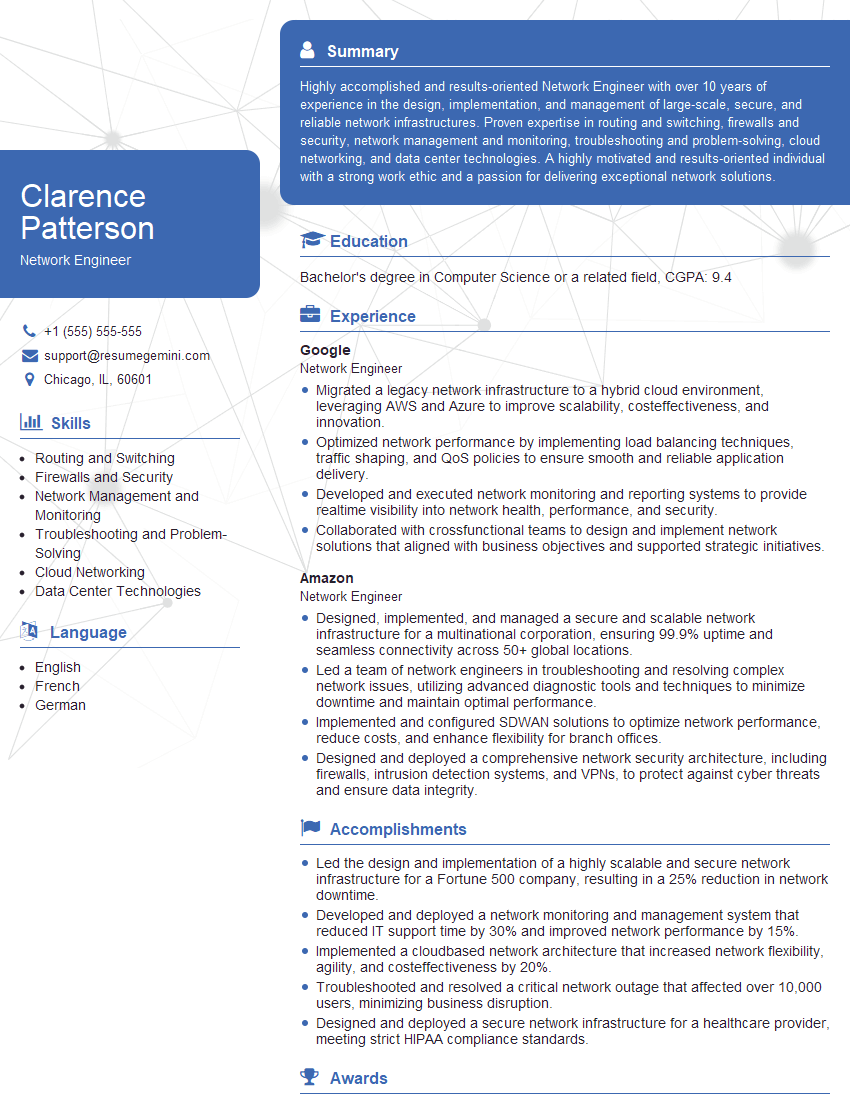
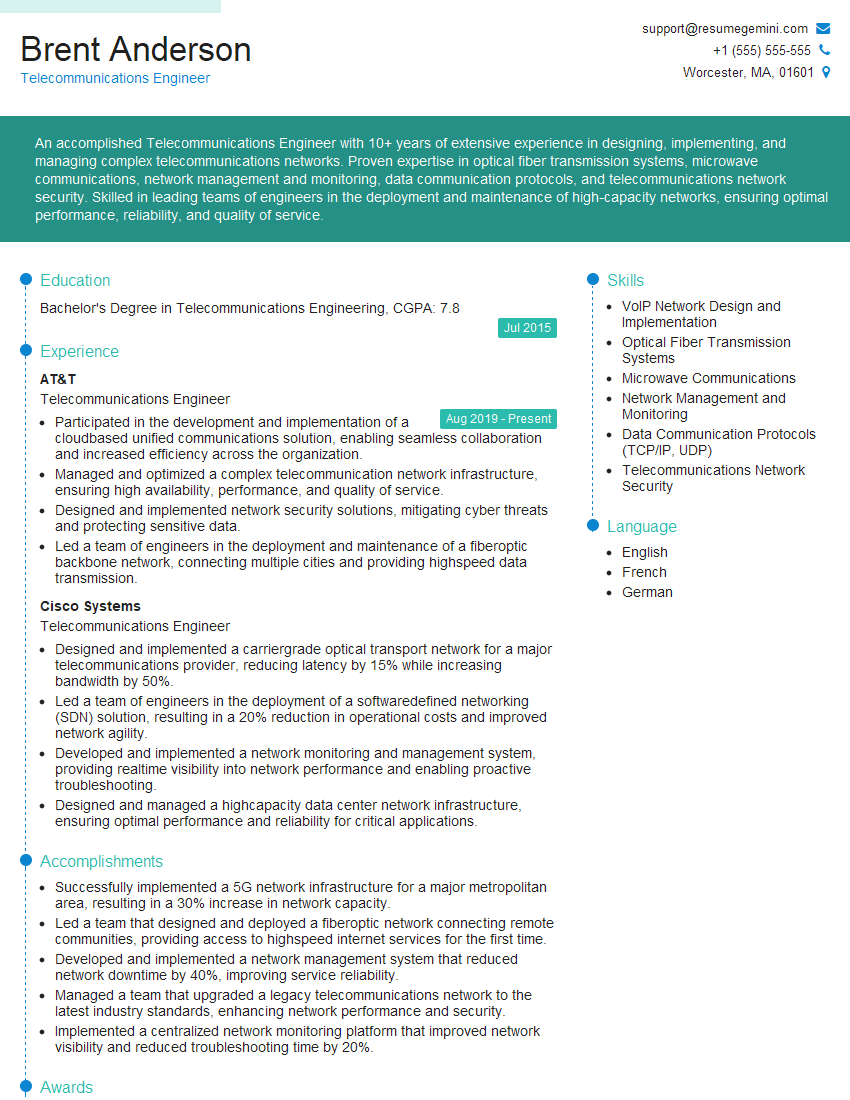
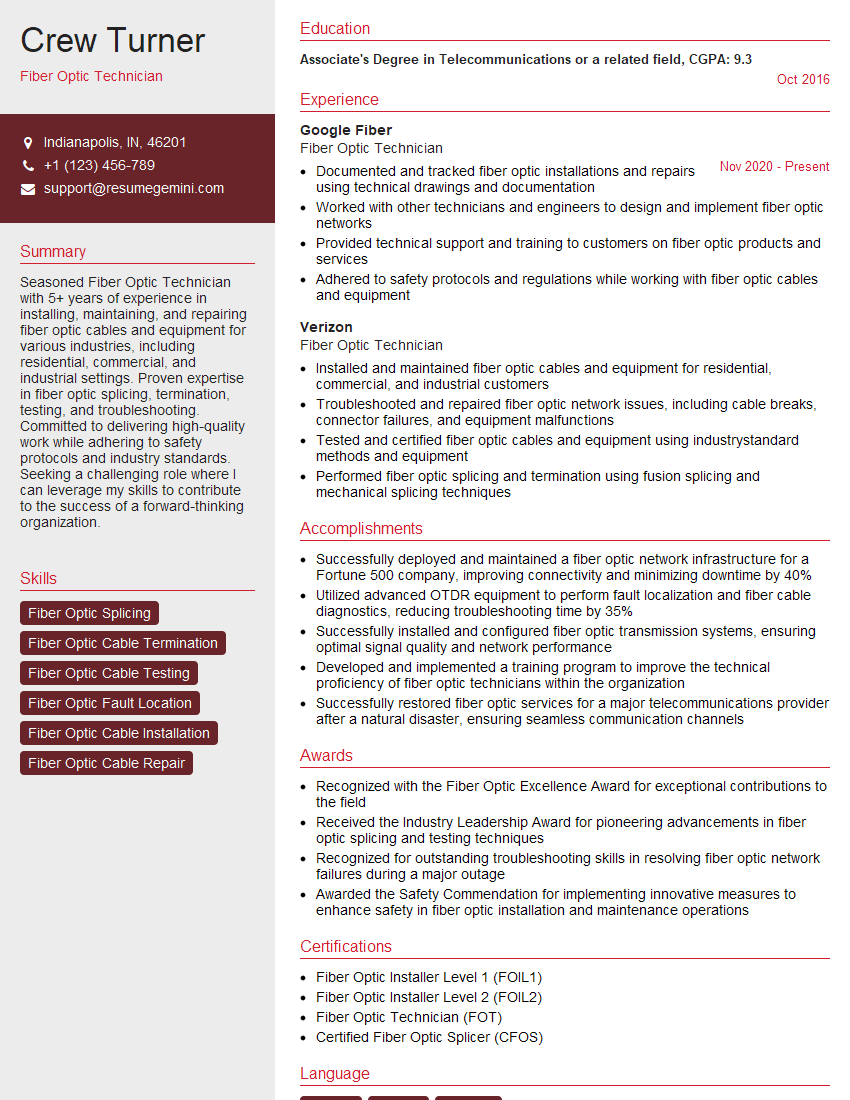
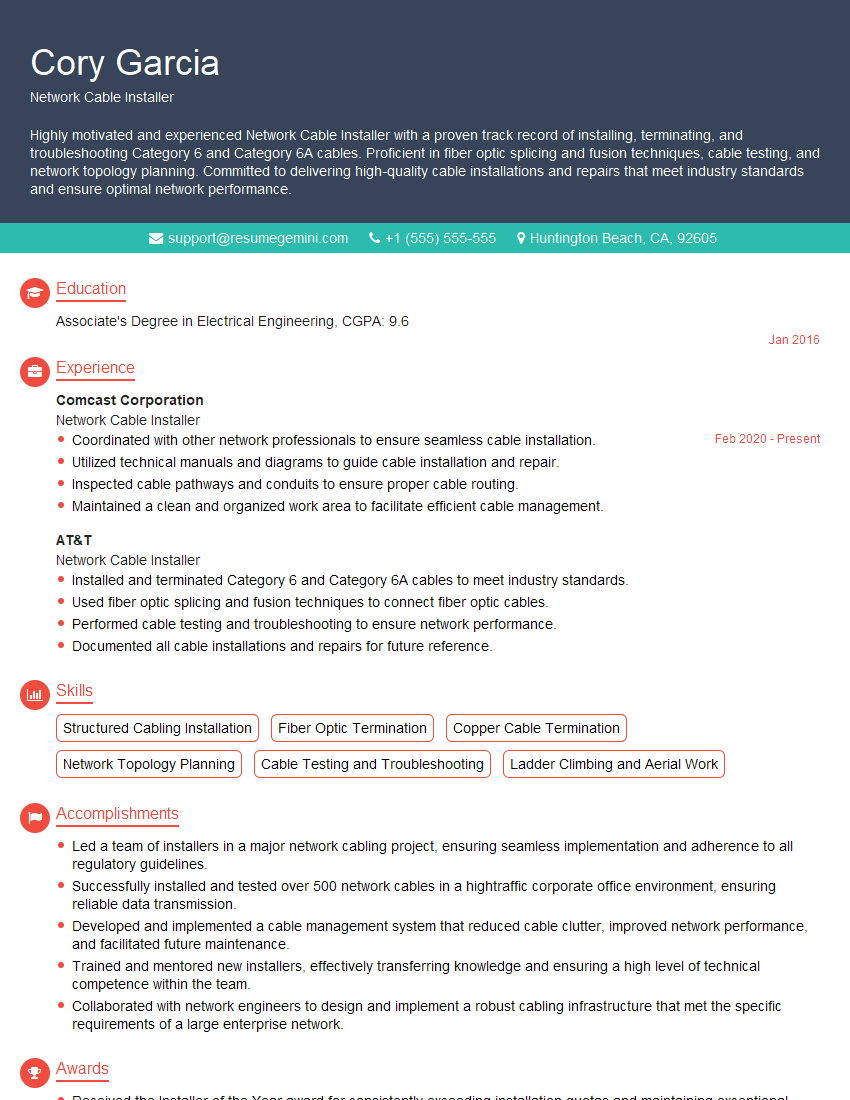
Mastering Fiber Optic Documentation and Record Keeping is crucial for career advancement in the telecommunications and networking industries. Precise and well-maintained records are essential for efficient network operation, maintenance, and upgrades. This skillset is highly valued by employers, leading to increased job security and better career opportunities. To stand out, create an ATS-friendly resume that highlights your expertise. ResumeGemini is a trusted resource to help you build a professional and effective resume. Examples of resumes tailored to Fiber Optic Documentation and Record Keeping are available to help guide you. Invest the time to showcase your skills – it will pay off!


Explore more articles
Users Rating of Our Blogs
Share Your Experience
We value your feedback! Please rate our content and share your thoughts (optional).
What Readers Say About Our Blog
Very informative content, great job.
good