Unlock your full potential by mastering the most common Wind Turbine Design Software (e.g., GH Bladed, FAST) interview questions. This blog offers a deep dive into the critical topics, ensuring you’re not only prepared to answer but to excel. With these insights, you’ll approach your interview with clarity and confidence.
Questions Asked in Wind Turbine Design Software (e.g., GH Bladed, FAST) Interview
Q 1. Explain the differences between GH Bladed and FAST.
GH Bladed and FAST are both leading wind turbine design software packages, but they cater to different needs and have distinct strengths. GH Bladed is a commercial software primarily focused on aerodynamic design and performance analysis, offering a user-friendly interface and efficient solvers. It excels at analyzing the aerodynamic loads on a turbine’s components and predicting power output. FAST, on the other hand, is an open-source software developed by the National Renewable Energy Laboratory (NREL). It’s a more comprehensive and complex tool capable of simulating the entire wind turbine system’s dynamic behavior, including the aeroelastic interactions between the blades, tower, and nacelle. FAST is often favored for more detailed studies involving control systems, structural dynamics, and environmental effects such as turbulent wind conditions. Think of GH Bladed as a specialized tool for optimizing the blade design and predicting power, while FAST is a more holistic simulator capable of modeling the entire system’s response to various conditions.
Q 2. Describe your experience using GH Bladed for aerodynamic analysis.
My experience with GH Bladed for aerodynamic analysis includes extensive use in both design and optimization projects. I’ve utilized its capabilities for creating blade geometry, defining airfoil properties, running steady-state and transient simulations, and analyzing results such as power curves, thrust, and bending moments. For example, on a recent project involving a 10 MW offshore turbine, I used GH Bladed to optimize the blade twist and chord distribution to maximize power output while mitigating fatigue loads. The software’s visualization tools were invaluable in understanding the aerodynamic flow fields around the blades and identifying areas requiring design improvements. The process generally involved defining the turbine geometry, specifying atmospheric conditions (e.g., wind speed, air density), selecting a suitable turbulence model, running the simulation, and then meticulously analyzing the output data. I’m proficient in interpreting the results and translating them into tangible engineering decisions.
Q 3. How would you use FAST to model a wind turbine’s response to turbulent wind conditions?
To model a wind turbine’s response to turbulent wind conditions using FAST, you’d need to input a time series of turbulent wind speeds. This could be generated using models like TurbSim, which is commonly coupled with FAST. FAST uses these wind data to drive the simulation, calculating the resulting aerodynamic loads, structural responses (e.g., blade bending, tower sway), and nacelle motions. The simulation accounts for the complex aeroelastic interactions between the blades, tower, and control system. You define the turbine’s structural properties (mass, stiffness, damping), control system algorithms, and aerodynamic properties (airfoil data, blade geometry) within the FAST input file. Then, post-processing tools are used to analyze the output data and evaluate the turbine’s performance under turbulent conditions, including fatigue loads and extreme events. Imagine it like a sophisticated wind tunnel test, but instead of physical hardware, you’re using a highly detailed computational model. The level of detail you achieve is critical in assessing the turbine’s robustness and longevity.
Q 4. What are the key inputs and outputs of a typical GH Bladed simulation?
Key inputs for a typical GH Bladed simulation include the turbine geometry (blade shape, tower dimensions), airfoil characteristics (lift and drag coefficients), atmospheric conditions (wind speed, air density, turbulence intensity), and operational settings (rotor speed, pitch angle). The software then uses these inputs to simulate the aerodynamic behavior of the turbine and produces several key outputs. These include: power curves (showing power output as a function of wind speed), thrust and torque coefficients, blade loads (bending moments, shear forces), and aerodynamic efficiency parameters. This information is crucial for engineers to assess the performance of a wind turbine design, ensuring it meets efficiency targets and doesn’t experience excessive stress.
Q 5. How do you validate the results obtained from FAST simulations?
Validating FAST simulation results is critical. This typically involves comparing simulation outputs to experimental data, such as measurements from physical wind tunnel tests or operational wind turbines. For example, we might compare simulated power curves, blade loads, and tower accelerations to those measured on a real turbine under similar conditions. Discrepancies may indicate inaccuracies in the model’s input parameters, assumptions in the chosen numerical methods, or even limitations in the underlying physical models. Further validation could involve comparing results from different software packages or conducting sensitivity analyses to assess the impact of uncertainties in input parameters on the simulation outputs. A thorough validation process ensures confidence in the simulation’s accuracy and reliability, leading to more informed design decisions.
Q 6. Explain the concept of blade element momentum theory and its application in wind turbine design software.
Blade Element Momentum (BEM) theory is a fundamental concept in wind turbine aerodynamics. It simplifies the complex flow around a rotating blade by dividing it into a series of small blade elements. For each element, it applies both aerodynamic theory (like lift and drag calculations using airfoil data) and momentum theory (which describes how the air accelerates through the rotor). This combined approach allows the software to calculate the forces acting on each element, which are then summed to obtain overall blade loads and performance characteristics. It’s a computationally efficient method allowing for relatively quick simulations even with detailed turbine models. BEM theory forms the core of many wind turbine design software packages, including GH Bladed and FAST, simplifying the analysis by breaking down a complex system into smaller, manageable pieces. The accuracy of BEM depends on the assumptions made and the resolution of the blade element discretization. More refined models can account for tip losses and wake interactions, further improving accuracy.
Q 7. Describe your experience with mesh generation and refinement in wind turbine simulations.
My experience with mesh generation and refinement is extensive. The quality of the mesh significantly impacts the accuracy and convergence of simulations in both GH Bladed and FAST. In GH Bladed, you often work with pre-defined meshes, but understanding mesh density and distribution around critical areas (like blade tips and the tower base) is vital. For more complex simulations, manual mesh refinement may be necessary to capture the fine details of the flow field. In FAST, mesh refinement is often crucial for accurate representation of the turbine’s flexible components. The process involves careful consideration of the element size and distribution to ensure accurate representation of stress concentrations and bending moments. A too-coarse mesh may result in inaccurate load predictions, whereas an overly refined mesh can lead to excessively long simulation times and computational overhead. The optimal mesh density needs to balance accuracy and computational efficiency. My approach always involves careful analysis of the results to verify that the chosen mesh resolution is sufficient for the desired level of accuracy. I’ve encountered instances where inadequate meshing led to inaccurate results, underscoring the importance of this step in obtaining reliable simulations.
Q 8. How do you handle convergence issues in your simulations?
Convergence issues in wind turbine simulations, often encountered in software like GH Bladed and FAST, arise when the iterative solver fails to reach a solution within a specified tolerance. This can manifest as oscillations in results, non-physical values, or simply the simulation crashing. Think of it like trying to balance a pencil on its tip – it takes careful adjustment (solver parameters) to achieve stability (convergence).
- Step 1: Check the Model: The most common cause is an error in the model itself. This could be an incorrect input parameter, a flawed mesh, or a problematic component definition. I meticulously review the model for inconsistencies and errors in geometry, material properties, and boundary conditions.
- Step 2: Adjust Solver Parameters: If the model is sound, the next step involves tweaking the solver’s parameters. This might involve adjusting the convergence tolerance, time step size, or using a different solver algorithm (e.g., changing the linear solver within the software). For instance, reducing the time step often helps, but at the cost of increased computation time.
- Step 3: Under Relaxation: In some cases, I use under-relaxation techniques, which gradually incorporate the new solution into the iterative process. This is similar to easing into a difficult yoga pose rather than forcing it.
- Step 4: Mesh Refinement: If the problem persists, refining the mesh (increasing the density of elements) can improve accuracy and aid convergence. However, finer meshes dramatically increase computation time.
- Step 5: Consult Documentation: Each software package has its nuances. Thoroughly consulting the software’s documentation and support resources is crucial.
For example, in a FAST simulation, I’ve had to reduce the time step significantly when modelling extreme wind events to prevent divergence in the blade’s structural response.
Q 9. What are the limitations of using simplified models in wind turbine design software?
Simplified models, while valuable for initial design exploration and reducing computational costs, inevitably compromise accuracy. The trade-off is between speed and fidelity. These simplifications can lead to:
- Inaccurate Loads Predictions: Simplified aerodynamic models may not capture complex flow phenomena like stall, vortex shedding, or dynamic stall, leading to inaccurate predictions of loads on the turbine components.
- Overestimation or Underestimation of Fatigue Life: Simplified models might not adequately represent the complex interaction between structural and aerodynamic loads, resulting in inaccurate fatigue life predictions. This can lead to overly conservative (and costly) designs or, worse, premature failures.
- Limited Representation of Control Systems: Simplified control systems may not accurately reflect the behaviour of real-world systems, potentially leading to inaccurate predictions of turbine performance and stability.
- Neglect of Coupled Effects: Interactions between various turbine components (e.g., tower, nacelle, blades) may be simplified or ignored, leading to incomplete insights into the overall system dynamics.
For instance, a simplified aerodynamic model might not capture the effects of blade tip vortices, which can significantly impact the performance and loads on the turbine. Therefore, I choose the level of simplification based on the specific design stage and the desired level of accuracy. Initial feasibility studies may use simplified models, while detailed design and certification often necessitate high-fidelity models.
Q 10. How do you account for the effects of yaw misalignment in your simulations?
Yaw misalignment, the angle between the wind direction and the turbine’s facing direction, significantly impacts performance and loads. In simulations, I account for this by:
- Direct Input: Most wind turbine design software allows for direct input of the yaw angle. This angle is included in the input file that describes the wind conditions and turbine orientation.
- Time-Varying Yaw: I can also simulate time-varying yaw angles to represent active yaw control systems or unsteady wind conditions. For instance, I might simulate a scenario where the turbine is actively adjusting its yaw angle to track changing wind direction.
- Aerodynamic Modeling: Accurate aerodynamic models are crucial to capture the impact of yaw misalignment on blade loads and performance. This involves using sophisticated models that account for the three-dimensional nature of the flow around the rotor.
- Validation: The results are validated against experimental data or more detailed simulations where possible. This step is vital for ensuring that the simulation accurately reflects the real-world behaviour of the turbine under yaw misalignment.
For example, in a GH Bladed simulation, I’d specify the yaw angle within the input parameters and analyze the changes in blade root bending moments and power output compared to a perfectly aligned case. A larger yaw misalignment will typically result in reduced power output and increased loads on the blades.
Q 11. Describe your experience with post-processing and interpreting simulation results.
Post-processing and interpretation are as crucial as the simulation itself. My experience involves a multi-step process:
- Data Extraction: The simulation software exports raw data, such as time histories of loads, displacements, and power output. I use tools within the software and external tools such as MATLAB or Python to extract the relevant information.
- Data Visualization: I employ visualization techniques like plots and animations to better understand the results. For example, animating the blade motion during a gust helps to visualize how the structure responds to dynamic loading.
- Statistical Analysis: I perform statistical analysis on the data to determine key metrics such as extreme loads, fatigue damage, and power curves. This may involve calculating mean values, standard deviations, and probability distributions.
- Comparison with Design Criteria: Finally, I compare the simulation results with design criteria and standards to ensure the turbine design meets the required safety and performance standards. This might involve comparing maximum loads to material strength or verifying that the fatigue life meets regulatory requirements.
For example, a fatigue analysis might involve calculating the rainflow cycles from a time history of stress, then using these cycles with a fatigue S-N curve (stress vs. number of cycles to failure) to predict component life. This aids in optimizing the design for a desired fatigue life.
Q 12. How would you analyze the fatigue life of a wind turbine component using simulation data?
Analyzing fatigue life involves determining how many load cycles a component can withstand before failure. Simulation data provides the necessary time histories of stresses and strains. The process is:
- Stress/Strain Time Histories: The simulation output provides time histories of stresses and strains at critical locations within the component. These are extracted and processed.
- Rainflow Counting: A rainflow counting algorithm is applied to the stress/strain time histories to identify the stress ranges and mean stresses experienced during each loading cycle. This method accurately captures the fatigue-damaging cycles.
- S-N Curve: A material S-N curve (stress amplitude vs. number of cycles to failure) is used to determine the fatigue life for each cycle. This curve is obtained experimentally from material testing.
- Miner’s Rule (Palmgren-Miner Rule): This cumulative damage rule is used to sum the damage from all cycles to estimate the total fatigue life of the component. The rule assumes that the damage from each cycle is independent and adds up linearly to eventual failure.
- Fatigue Life Prediction: The total accumulated damage is compared to a damage threshold (typically 1.0) to predict the fatigue life. If the accumulated damage is less than 1.0, then the component is expected to survive. If it’s greater than 1.0, then failure is predicted.
In reality, it’s more complex, considering factors like stress concentrations, material imperfections, and environmental effects. Advanced software tools often incorporate these complexities into the fatigue life prediction process. For example, I’ve used specialized modules within GH Bladed and dedicated fatigue analysis tools to evaluate turbine component fatigue life.
Q 13. What are the different types of wind turbine control systems, and how are they simulated?
Wind turbine control systems are vital for maximizing energy capture and protecting the turbine from damage. The main types are:
- Pitch Control: This adjusts the blade pitch angle to regulate rotor speed and power output. Simulations involve modeling the pitch actuator dynamics and their effect on the blade aerodynamics and structural loads. This might include modelling hydraulic or electrical actuators and their response characteristics.
- Collective Pitch Control: All blades are pitched equally.
- Individual Pitch Control: Each blade is pitched independently for optimized control.
- Yaw Control: This orients the turbine to face the wind. Simulations model the yaw drive system’s response to wind direction changes and its influence on the turbine’s structural response.
- Blade Pitch Control: Controls the angle of the blade relative to the wind.
- Torque Control: Used primarily in smaller turbines, this method adjusts the generator torque to control rotor speed.
Simulating control systems within software like FAST often involves implementing control algorithms in a separate file that interacts with the aerodynamic and structural models. The simulation then solves these coupled equations to predict the turbine’s behaviour under different wind conditions and control strategies. For instance, I might model a PI (Proportional-Integral) controller for pitch control in FAST to maintain a desired rotor speed during a gust event.
Q 14. Explain your understanding of aeroelasticity and its importance in wind turbine design.
Aeroelasticity is the study of the interaction between aerodynamic forces and the elastic deformation of a structure. In wind turbine design, it’s crucial because the blades are flexible structures subject to significant aerodynamic forces. Ignoring aeroelastic effects can lead to inaccurate load predictions, resonance, and potential structural failure.
- Blade Flutter: Aeroelastic instability can lead to self-excited oscillations called flutter, which can cause catastrophic failure if not addressed. This phenomenon is analogous to an airplane wing violently shaking and breaking apart.
- Load Amplification: The interaction between aerodynamics and structural flexibility can amplify dynamic loads on the blades, especially during turbulent wind conditions. This means the blades experience greater stresses than a rigid blade would.
- Blade Fatigue: The amplified loads due to aeroelastic effects contribute to fatigue damage accumulation, shortening the lifespan of the turbine components.
- Tower Vibration: Aeroelastic interactions also influence the dynamics of the tower, leading to vibrations that might cause fatigue or even structural collapse.
Wind turbine design software like FAST incorporates aeroelastic models that capture the coupled dynamics of aerodynamics, structures, and control systems. These models use sophisticated numerical methods to accurately predict the turbine’s response to various wind conditions. For example, I’ve used FAST to simulate blade flutter instabilities and optimize the blade design to prevent these issues by modifying the stiffness and mass distribution of the blade.
Q 15. How do you model the effects of atmospheric conditions (e.g., temperature, air density) on wind turbine performance?
Atmospheric conditions significantly impact wind turbine performance. We model these effects using software like GH Bladed and FAST by inputting detailed meteorological data. This includes air density, temperature, and humidity profiles as functions of height. Air density, for instance, directly affects the power output; lower density air means less force on the blades, reducing power generation. Temperature affects the material properties of the turbine components, influencing their stiffness and strength. Humidity can influence icing conditions, affecting blade performance and structural integrity. In the software, we typically use atmospheric models that consider standard atmospheric lapse rates (how temperature changes with altitude) and potentially more complex models accounting for specific geographical locations and weather patterns. For example, a coastal wind farm might require a model that accounts for the diurnal temperature variations and sea breezes. We might even incorporate real-time weather forecasts from local meteorological stations for accurate simulations and predictions.
For example, in Bladed, we’d define a ‘wind profile’ using a variety of atmospheric models, potentially including those based on data from a nearby weather station. The software then uses this profile to calculate the aerodynamic loads on the turbine blades at each time step of the simulation. This allows us to assess the turbine’s performance under realistic atmospheric conditions.
Career Expert Tips:
- Ace those interviews! Prepare effectively by reviewing the Top 50 Most Common Interview Questions on ResumeGemini.
- Navigate your job search with confidence! Explore a wide range of Career Tips on ResumeGemini. Learn about common challenges and recommendations to overcome them.
- Craft the perfect resume! Master the Art of Resume Writing with ResumeGemini’s guide. Showcase your unique qualifications and achievements effectively.
- Don’t miss out on holiday savings! Build your dream resume with ResumeGemini’s ATS optimized templates.
Q 16. Describe your experience with optimization techniques used in wind turbine design software.
Optimization is crucial in wind turbine design to maximize energy yield while minimizing costs. I’ve extensively used gradient-based methods like sequential quadratic programming (SQP) and evolutionary algorithms such as genetic algorithms (GA) within the optimization modules of both Bladed and FAST. For example, we might use SQP to optimize the blade geometry for maximum annual energy production (AEP) subject to constraints on blade stress and fatigue life. In contrast, GAs are very effective when dealing with highly non-linear and complex designs where gradient information might be difficult to obtain. I’ve used GAs, for instance, to optimize the tower design for minimum cost while ensuring adequate structural integrity under extreme conditions, taking into consideration a wide range of possible material choices and tower configurations.
A typical optimization process involves defining the objective function (e.g., maximize AEP or minimize cost), defining design variables (e.g., blade chord length, twist angle, tower diameter), and specifying constraints (e.g., stress limits, fatigue life, manufacturing limitations). The software then iteratively modifies the design variables, running simulations and evaluating the objective function until an optimal solution is found. I’ve also used multi-objective optimization techniques like Pareto optimization, especially when balancing competing objectives such as maximizing energy capture and minimizing environmental impact.
Q 17. What are the key design considerations for offshore wind turbines?
Offshore wind turbines face unique challenges compared to their onshore counterparts. Key design considerations include:
- Extreme environmental conditions: Offshore sites experience higher wind speeds, larger waves, and more aggressive corrosion due to saltwater exposure. Designs must withstand these harsh conditions to ensure operational reliability and longevity.
- Foundation design: The foundation needs to support the immense weight and dynamic loads of the turbine, particularly in deep water. This often involves sophisticated monopile, jacket, or floating foundations, each demanding detailed geotechnical analysis.
- Accessibility and maintenance: Servicing and maintenance are more complex and costly offshore. Designs must prioritize ease of maintenance and minimize the need for frequent interventions. This often involves designing for easier component replacement and remote diagnostics.
- Transportation and installation: Transporting and installing massive turbine components offshore requires specialized equipment and logistical planning. The design needs to consider how the components are assembled and installed efficiently and safely.
- Environmental impact: Offshore wind farms can affect marine ecosystems. Environmental impact assessments and mitigation strategies are critical aspects of the design process.
For example, the choice of materials plays a significant role. Corrosion-resistant materials such as high-strength steel with specialized coatings are typically used for offshore structures. We’d also run more extensive fatigue analysis compared to onshore designs considering the combined effects of cyclic loading from wind and waves.
Q 18. How do you assess the structural integrity of a wind turbine tower using FEA?
Finite Element Analysis (FEA) is fundamental to assessing a wind turbine tower’s structural integrity. We use FEA software to create a detailed 3D model of the tower, discretizing it into smaller elements. We then apply loads representing wind, waves (for offshore towers), and the turbine’s self-weight. The software solves the governing equations to determine the stresses, strains, and displacements within the tower. This allows us to identify potential areas of high stress or excessive deflection, evaluating whether they meet design codes and safety factors.
I typically use software like ANSYS or ABAQUS. The process involves defining material properties (e.g., Young’s modulus, yield strength), meshing the model to ensure accuracy, and applying appropriate boundary conditions (e.g., fixed base for the tower). We then apply the loads, either statically or dynamically depending on the analysis type. Dynamic analysis, such as modal analysis and time-history analysis, is crucial for assessing the tower’s response to turbulent wind conditions and seismic events. The results from the FEA are then used to evaluate structural compliance, ensuring that stresses are well within allowable limits under normal and extreme operating conditions and across the tower’s lifetime.
Q 19. Explain your experience with different turbulence models in wind turbine simulations.
Different turbulence models are employed in wind turbine simulations to represent the chaotic nature of wind. The choice of model depends on the desired accuracy and computational cost. Simple models like the Mann model are computationally efficient but lack the fidelity of more complex models. More sophisticated models, such as the IEC turbulence model (often used in standards like IEC 61400-3), include realistic spectral representations of turbulent wind fluctuations in various directions. The specific turbulence model will incorporate parameters like the turbulence intensity and the integral length scale. I have experience with numerous turbulence models, from simple ones used for initial design scoping to more advanced spectral models employed for detailed simulations of extreme wind events.
For example, when performing preliminary design studies focusing on annual energy production (AEP) estimation, the Mann model might suffice due to its lower computational demand. But when conducting fatigue analysis, assessing the structural loads under turbulent winds, a more complex spectral model which accurately represents turbulence effects is needed to generate more accurate stress estimates. The selection often involves considering the project requirements and balancing accuracy against computational resource limitations.
Q 20. How do you account for the effects of soil conditions on the dynamic response of a wind turbine?
Soil conditions significantly influence a wind turbine’s dynamic response, primarily through the foundation. The soil’s stiffness and damping properties affect how the turbine responds to wind loads, affecting the tower’s vibrations and its overall stability. We model this interaction using soil-structure interaction (SSI) analysis techniques within the software. This often involves creating a substructure model that represents the soil’s behavior using spring and damper elements. The properties of these elements are determined through geotechnical investigations and models, such as those using Winkler or finite element models of the soil.
In Bladed or FAST, this involves defining soil parameters, such as stiffness, damping, and shear modulus, which affect the boundary conditions applied at the base of the tower. The interaction of these parameters with the tower dynamics significantly impacts the natural frequencies of the system, the amount of vibration, and the overall stability of the structure. For example, stiffer soil will result in a higher natural frequency, potentially reducing resonance effects. Neglecting SSI analysis can lead to inaccurate predictions of turbine behavior and potentially unsafe designs, particularly in scenarios with soft soil conditions.
Q 21. Describe your understanding of the different types of wind loads and how they are modeled.
Wind loads on a wind turbine are complex and involve several components:
- Mean wind speed: This represents the average wind speed over a longer period, contributing to the primary aerodynamic forces on the blades and tower. It’s often modeled using meteorological data and wind profiles.
- Turbulent wind: Wind is rarely uniform; fluctuations around the mean wind speed introduce turbulent loads. These are modeled using turbulence models, like those mentioned earlier, which capture the random nature of these fluctuations.
- Gusts: Sudden increases in wind speed can impose significant transient loads. These can be incorporated through either statistical methods or using specific extreme wind scenarios from recorded data.
- Aerodynamic loads: These are generated through the interaction of the wind with the rotating blades, resulting in complex forces and moments. Advanced aerodynamic models within the software, including blade element momentum theory (BEM) methods, accurately capture these effects.
- Ice loads: In cold climates, ice accretion on blades increases their mass and changes their aerodynamic shape, leading to additional loads that we must consider, particularly with appropriate icing models in our simulations.
Modeling these loads accurately requires a combined approach that uses both meteorological data and sophisticated aerodynamic and structural models within the wind turbine design software. The loads are often represented as time series data, allowing for dynamic simulations of the turbine’s response to realistic wind conditions. The software then uses this input to calculate structural responses and perform fatigue and ultimate limit state analyses. For example, a gust could create high peak stresses, whilst long-term mean wind speed contributes to cumulative fatigue damage.
Q 22. Explain your experience with model order reduction techniques.
Model order reduction (MOR) is crucial in wind turbine simulations because the full-order models can be computationally expensive. Think of it like this: imagine trying to simulate every single blade element on a turbine – it’s incredibly complex! MOR techniques simplify these models while retaining essential dynamic characteristics. I’ve extensively used methods such as Krylov subspace methods (e.g., Arnoldi, Lanczos) and Balanced Truncation in both GH Bladed and FAST. For example, in a recent project analyzing a 10 MW turbine’s response to turbulent wind, using Arnoldi reduction decreased the simulation time by over 70% without significant loss of accuracy in the key structural responses like tower top displacement and blade root bending moments. The selection of the appropriate MOR technique depends heavily on the specific simulation goals and the characteristics of the system being modeled. For instance, if the focus is on low-frequency dynamics, a different method might be more suitable than if high-frequency responses are critical.
Q 23. How do you address uncertainty in input parameters when performing wind turbine simulations?
Uncertainty in wind speed, turbulence intensity, and even the material properties of the turbine components is inherent in wind energy simulations. To address this, I employ probabilistic methods. Monte Carlo simulations are frequently utilized, where the input parameters are sampled from probability distributions (e.g., Weibull distribution for wind speed). Each sample generates a unique simulation run, and the results are statistically analyzed to determine the range of possible outcomes and the probabilities associated with them. Another powerful method is using polynomial chaos expansion (PCE), which efficiently propagates uncertainty through the model. Imagine trying to predict the lifetime loads on a turbine. Instead of running thousands of deterministic simulations, PCE can provide a highly efficient way to characterize the uncertainty in the fatigue damage prediction. Furthermore, I leverage sensitivity analysis techniques to identify the most influential input parameters; this helps focus resources on reducing uncertainty where it matters most.
Q 24. How do you ensure the accuracy and reliability of your simulation results?
Ensuring accuracy and reliability is paramount. This involves a multi-pronged approach. First, rigorous model validation is crucial. This means comparing simulation results to experimental data from wind tunnel tests or real-world measurements. Discrepancies highlight areas where the model may require refinement or calibration. Second, thorough grid convergence studies are performed to determine if the spatial discretization is adequate; too coarse a mesh can lead to inaccurate results, while an overly fine mesh can be computationally prohibitive. Third, the use of independent verification procedures, involving different software packages or analysis methods, provides a cross-check and increases confidence in the results. For example, I might compare results from GH Bladed’s aeroelastic solver with those from FAST’s, checking for consistency in key performance indicators. Finally, thorough documentation of the entire simulation process, including the model assumptions and limitations, is essential for transparency and reproducibility.
Q 25. Describe your experience with scripting or automation in wind turbine design software.
Scripting and automation are indispensable for efficient and repeatable wind turbine simulations. I’m proficient in several scripting languages, including Python, MATLAB, and even the built-in scripting capabilities of some wind turbine design software. Python, particularly, has been invaluable for automating tasks like pre-processing (generating input files), post-processing (extracting and analyzing data from output files), and creating customized visualizations. For example, I’ve developed Python scripts to automate the process of running hundreds of Monte Carlo simulations with different input parameters, consolidating the output, and generating comprehensive reports. This drastically reduces the manual effort involved and minimizes the possibility of human error.
# Example Python code snippet (Illustrative)
import os
for i in range(100):
    os.system('run_simulation input_file_' + str(i) + '.dat')
Q 26. What are your preferred methods for visualizing and presenting simulation results?
Effective visualization is essential for communicating complex simulation results. My preferred methods include creating tailored plots and charts using MATLAB and Python libraries like Matplotlib and Seaborn, showcasing key performance indicators such as power curves, fatigue loads, and operational limits. For more complex datasets, I use 3D visualization tools to illustrate things like blade deformation under different loading conditions or visualize the turbulent flow field around the rotor. Interactive dashboards allow for exploration of various simulation outputs. For presentations, I utilize clear and concise visuals, combining graphs and charts with succinct explanations, focusing on communicating the key findings and insights to both technical and non-technical audiences.
Q 27. Explain your experience with collaborative software development related to wind turbine simulations.
Collaborative software development is crucial in larger projects. I’ve extensively used version control systems like Git for managing code related to wind turbine simulations, facilitating teamwork and ensuring code quality. I’m comfortable using platforms like GitHub for collaborative coding and sharing of simulation scripts and data. This ensures that multiple engineers can work concurrently on a project without conflicting changes, resulting in efficient progress and easier tracking of developments. Moreover, clear commenting practices and well-documented code improve maintainability and understanding among team members.
Q 28. Describe a challenging simulation problem you encountered and how you resolved it.
One particularly challenging problem involved simulating the aeroelastic behavior of a floating offshore wind turbine during extreme wave conditions. The interaction between the aerodynamic loads, hydrodynamic forces, and the flexible structure of the turbine made the simulation very complex and computationally demanding. The initial simulations exhibited numerical instability and unrealistic results. To solve this, I systematically investigated the problem, first refining the hydrodynamic model, then carefully examining the structural model’s damping parameters. I also implemented advanced numerical techniques like implicit time integration schemes to improve stability. Through iterative refinement and validation against experimental data from scale model tests, I successfully obtained stable and reliable simulation results, accurately predicting the turbine’s response to these extreme conditions. This experience highlighted the importance of a deep understanding of both the physics and the numerical methods involved in these simulations.
Key Topics to Learn for Wind Turbine Design Software (e.g., GH Bladed, FAST) Interview
- Aerodynamics: Understanding blade element momentum theory, airfoil characteristics, and how they are implemented within the software. Practical application: Analyzing blade performance and optimizing for maximum power output.
- Structural Analysis: Mastering the software’s capabilities for modeling turbine loads, stresses, and deformations. Practical application: Performing fatigue life assessments and ensuring structural integrity.
- Control Systems: Familiarizing yourself with the software’s tools for designing and simulating pitch control, yaw control, and other critical control algorithms. Practical application: Optimizing turbine performance and stability under varying wind conditions.
- Loads Analysis: Understanding how to model and analyze various loads acting on the turbine (e.g., wind, gravity, inertia). Practical application: Designing robust turbines that can withstand extreme weather conditions.
- Data Analysis & Interpretation: Developing proficiency in interpreting simulation results, identifying trends, and drawing meaningful conclusions. Practical application: Using software output to make informed design decisions and troubleshoot problems.
- Software-Specific Features: Familiarize yourself with the unique features and capabilities of GH Bladed and FAST, including post-processing tools and advanced analysis techniques. Practical application: Leveraging the software’s full potential for efficient and accurate design.
- Turbine Modeling: Developing a strong understanding of how to create accurate and realistic models of wind turbines within the software. Practical application: Ensuring simulation results reflect real-world performance.
Next Steps
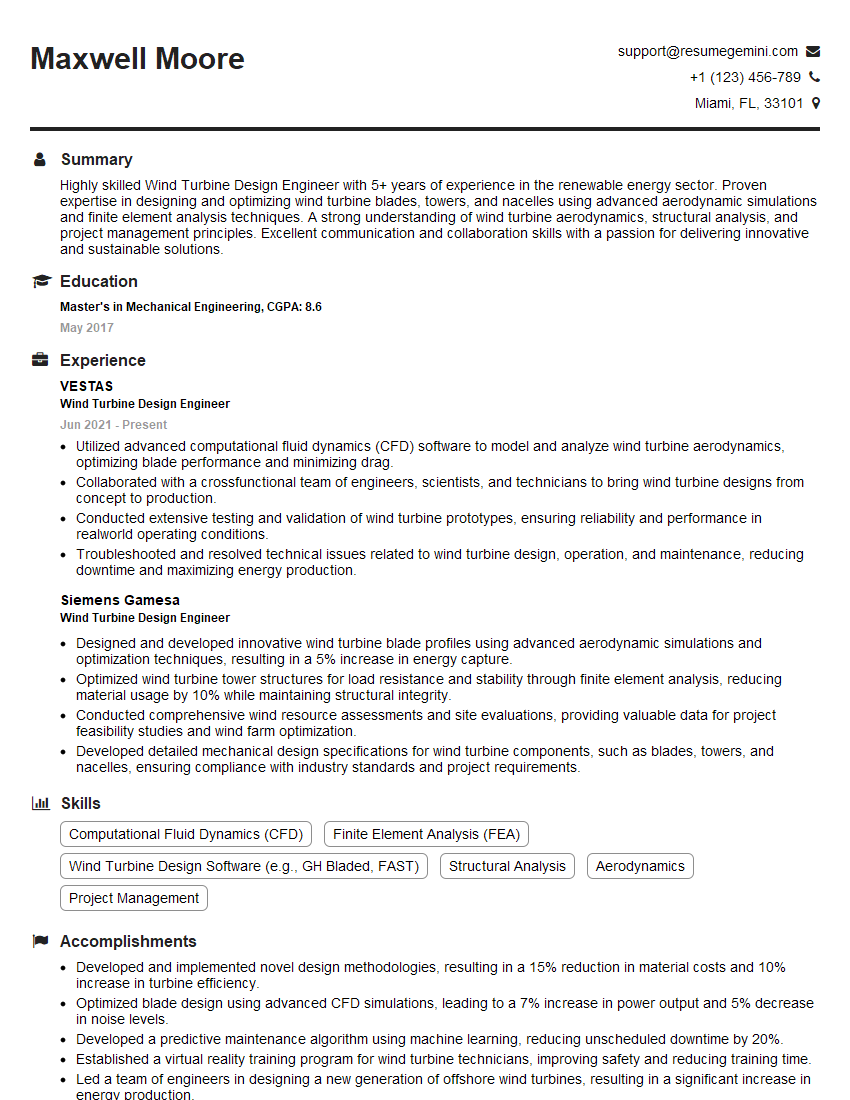
Mastering Wind Turbine Design Software like GH Bladed and FAST is crucial for a successful career in this rapidly growing field. It demonstrates a high level of technical proficiency and opens doors to exciting opportunities in design, analysis, and research. To maximize your job prospects, invest time in crafting an ATS-friendly resume that showcases your skills effectively. ResumeGemini is a trusted resource to help you build a professional and impactful resume that stands out from the competition. Examples of resumes tailored to highlighting expertise in GH Bladed and FAST are available to guide you.
Explore more articles
Users Rating of Our Blogs
Share Your Experience
We value your feedback! Please rate our content and share your thoughts (optional).
What Readers Say About Our Blog
Very informative content, great job.
good