Preparation is the key to success in any interview. In this post, we’ll explore crucial Arranger interview questions and equip you with strategies to craft impactful answers. Whether you’re a beginner or a pro, these tips will elevate your preparation.
Questions Asked in Arranger Interview
Q 1. Explain your experience with various music notation software (Sibelius, Finale, Dorico, etc.).
My experience with music notation software spans several leading programs. I’m highly proficient in Sibelius, Finale, and Dorico, each offering unique strengths. Sibelius excels in its intuitive interface and excellent playback engine, making it ideal for quick sketching and initial arrangement ideas. Finale, known for its power and extensive features, is my go-to for complex scores requiring detailed notation and engraving. Dorico, with its modern workflow and advanced features like its powerful engraving capabilities, is particularly well-suited for large-scale projects and film scoring. I’ve used all three extensively in professional settings, choosing the software best suited to the project’s specific needs and my own workflow preferences at any given time. For example, for a smaller project with a quick turnaround, Sibelius’s speed and ease of use would be preferable. For a large orchestral score, Dorico’s power and precise control would be a better choice.
Q 2. Describe your workflow for arranging a typical song.
My arranging workflow is iterative and highly dependent on the specific project, but generally follows these stages: First, I thoroughly analyze the song’s melody, harmony, and rhythm to understand its emotional core and intended feel. Then, I sketch out basic instrumental parts, focusing on the core melody and harmony, often using a simpler software like Sibelius for quick mockups. Next, I build the arrangement by adding counter-melodies, rhythmic variations, and textural layers. I constantly listen to the arrangement, making adjustments to balance and dynamics as I go, often recording MIDI mockups to quickly hear my ideas. Finally, I refine the arrangement, paying close attention to details like voicing, articulation, and dynamics before finalizing and exporting the score.
For example, when arranging a jazz standard, I might start by sketching out a basic piano comp and then add a walking bass line, followed by a horn section, and finally, percussion.
Q 3. How do you approach harmonizing a melody?
Harmonizing a melody involves creating chords that complement and enhance the melodic line. I approach this by considering the melody’s inherent contour and the overall mood of the piece. I often use Roman numeral analysis to understand the underlying harmonic structure and identify potential chord progressions. I might begin by building a basic diatonic harmony (using chords from the key of the melody), then explore secondary dominants, borrowed chords, and other chromatic alterations to add color and interest. The context is crucial: a melancholic melody might call for minor chords and suspensions, while an upbeat melody might require major chords and brighter harmonies. I experiment with different voicings and inversions to find the most effective and pleasing harmonic texture.
For example, if a melody rises in pitch, I might use ascending bass lines or chord progressions to reflect and enhance that movement.
Q 4. How do you create compelling instrumental arrangements?
Creating compelling instrumental arrangements requires a deep understanding of instrumentation, orchestration, and musical form. I aim to write parts that are both musically interesting and playable for the chosen instruments, considering their individual timbral qualities and technical capabilities. I prioritize creating a balanced and engaging sonic tapestry, avoiding monotony by incorporating rhythmic and melodic variety across instruments. I often use techniques such as counterpoint, call-and-response, and thematic development to create interplay and depth. Furthermore, I pay close attention to dynamics and articulation to create a sense of drama and emotional impact.
For example, in an orchestral arrangement, I might use the strings for sustained harmonies, the woodwinds for lyrical melodies, and the brass for powerful punctuations.
Q 5. Explain your experience with different musical styles and genres.
My experience encompasses a wide range of musical styles and genres, including classical, jazz, pop, rock, and world music. This breadth of experience allows me to adapt my arranging approach to suit the specific aesthetic and technical demands of each genre. For example, arranging for a classical string quartet requires a different approach than arranging for a rock band. I’ve worked on projects ranging from chamber music compositions to large-scale orchestral scores and contemporary pop songs, developing a versatility that allows me to comfortably navigate different stylistic conventions.
Working on a classical piece deepened my understanding of counterpoint and formal structure, while arranging a pop song taught me about the importance of catchy hooks and effective rhythmic variations. These diverse experiences enriched my arranging capabilities immensely.
Q 6. How do you handle revisions and feedback from clients or directors?
Handling revisions and feedback is a crucial aspect of the arranging process. I actively encourage and welcome constructive criticism. My process typically involves a clear understanding of the client or director’s vision from the outset, including open communication about expectations and preferences. I then incorporate their feedback carefully and efficiently, prioritizing clarity and maintaining a collaborative spirit. I present revisions in a clear, organized manner, with explanations of the changes made, ensuring that the feedback is fully addressed. For significant changes, I often propose alternative solutions, allowing the client or director to make informed decisions. Ultimately, my aim is to deliver a product that fully aligns with their artistic goals.
Q 7. Describe your proficiency in audio editing software (Pro Tools, Logic Pro, Ableton Live).
While my primary expertise lies in music notation and arrangement, I possess a solid working knowledge of audio editing software, including Pro Tools, Logic Pro, and Ableton Live. My proficiency extends to basic audio editing tasks, such as cleaning up recordings, adjusting levels, and applying basic effects. I’m comfortable using these programs to create rough MIDI mockups or to prepare audio files for mixing and mastering. However, I typically collaborate with audio engineers for professional mixing and mastering, leveraging their expertise in these more advanced aspects of audio production.
Q 8. How do you ensure the balance and clarity of your arrangements?
Ensuring balance and clarity in an arrangement is paramount. It’s like conducting a conversation – each instrument needs its space to speak, yet they must harmoniously contribute to the overall message. I achieve this through careful consideration of several factors:
- Frequency Balance: I analyze the frequency spectrum, ensuring no single instrument or frequency range overwhelms the others. Too much bass can muddy the mix, while too much treble can sound harsh. I use equalization (EQ) to sculpt the sound of each instrument, creating space and avoiding masking.
- Dynamic Range: Varying the volume of different instruments and sections is crucial. A dynamic arrangement keeps the listener engaged. Think of a crescendo building to a powerful climax, followed by a quiet, intimate passage. This ebb and flow is essential.
- Textural Balance: The textures of different instruments should complement each other. A busy string section might require a simpler melodic line from the woodwinds to avoid sonic clutter. I carefully consider the interplay of different instrumental timbres.
- Panning: Strategically placing instruments in the stereo field (left, right, center) adds depth and spatial interest. It prevents instruments from being masked by others and provides a richer sonic experience. For instance, I might pan acoustic guitars wide, giving them a larger sense of presence.
- Instrumentation: Choosing the right instruments for the specific musical style and emotional impact is critical. A delicate melody might be best suited to flutes and harp, whereas a powerful anthem might benefit from a full orchestra.
Regular listening checks during various stages of production, ideally on different playback systems, allow me to fine-tune the balance and ensure clarity is maintained across various listening environments.
Q 9. How do you manage deadlines and prioritize tasks in a busy project schedule?
Managing deadlines and prioritizing tasks in arranging is crucial. It’s a bit like a conductor planning a concert – meticulous organization and smart time management are non-negotiable. I employ a multi-pronged approach:
- Detailed Project Breakdown: I dissect the project into manageable sections (e.g., individual instrument parts, sections of the arrangement). This allows for better tracking of progress and identification of potential bottlenecks.
- Prioritization Matrix: I use a prioritization matrix (like Eisenhower Matrix) to categorize tasks based on urgency and importance. Critical tasks get immediate attention, while less urgent ones are scheduled accordingly.
- Realistic Scheduling: I avoid over-scheduling. I build buffer time into my schedule to account for unforeseen delays or creative roadblocks. It’s better to slightly underschedule and deliver a polished product than to rush and compromise quality.
- Regular Check-ins: Throughout the project, I hold regular check-ins with the client or producer to discuss progress, address any concerns, and make necessary adjustments. This ensures the project remains on track and aligned with expectations.
- Agile Methodology: I sometimes use aspects of the Agile methodology. This allows for iterative development, testing, and feedback integration, improving the final result and adapting to shifting needs.
Project management software helps tremendously in tracking deadlines and tasks, ensuring I can efficiently manage multiple projects simultaneously.
Q 10. Describe your experience working with live musicians.
Working with live musicians is a rewarding and dynamic experience. It’s like a collaborative painting where each musician adds their own unique brushstroke. My experience encompasses:
- Session Work: I’ve worked extensively in recording studios with various ensembles, from small chamber groups to full orchestras. This involves careful preparation of scores, providing clear instructions, and fostering a collaborative environment during the recording sessions.
- Rehearsals: Rehearsals are vital. They allow me to address any ambiguities in the arrangement, fine-tune the musical interpretation with the musicians, and ensure the overall performance aligns with the vision. It’s an iterative process of listening, adjusting, and refining.
- Communication: Effective communication is key. I clearly communicate my intentions, address technical issues, and provide constructive feedback. I value input from musicians, often incorporating their creative suggestions.
- Adaptability: Things don’t always go according to plan. I am prepared to make adjustments on the spot, considering instrumental limitations or spontaneous musical ideas that emerge during rehearsals or performances.
One memorable experience involved arranging for a string quartet. The musicians’ insights on phrasing and dynamics significantly enhanced the arrangement, resulting in a far more nuanced and expressive piece than I initially envisioned.
Q 11. How do you handle creative differences with collaborators?
Creative differences are inevitable in collaborative projects. I view them as opportunities for growth and improvement, not as conflicts. My approach is:
- Open Communication: I encourage open and respectful dialogue. I actively listen to others’ perspectives, even if they differ from my own.
- Understanding Perspectives: I strive to understand the rationale behind differing opinions. Often, a seemingly contradictory suggestion stems from a valid concern about musicality or feasibility.
- Compromise and Collaboration: I believe in finding common ground. This might involve incorporating elements from different suggestions or experimenting with different approaches until a consensus is reached.
- Respectful Disagreement: Sometimes, complete agreement isn’t possible. In such cases, I prioritize maintaining respect and ensuring that the final decision reflects the best interests of the project. It’s about finding a solution that everyone can support, even if it’s not their ideal outcome.
For example, in a project with a vocalist who preferred a more soulful feel, while I initially envisioned a more pop-oriented arrangement, we reached a compromise through incorporating soulful elements into the pop framework, resulting in a unique blend.
Q 12. Explain your approach to creating a unique and memorable arrangement.
Creating a unique and memorable arrangement involves several key steps:
- Deep Understanding of the Source Material: I meticulously analyze the source material, identifying its emotional core, melodic strengths, harmonic language, and rhythmic nuances.
- Conceptualization: I brainstorm several approaches, envisioning how to reimagine the piece within a specific style or context. This involves exploring different textures, harmonies, rhythms, and instrumentation. Sketches and demos are vital here.
- Instrumentation and Orchestration: I carefully choose the instrumentation to support the musical ideas and add to the piece’s character. Unique instrumentation can be a powerful way to create something fresh and memorable.
- Arrangement Structure: I create a compelling arrangement structure that guides the listener through an emotional journey. This might involve building anticipation, resolving tension, or highlighting specific moments.
- Creative Detailing: Adding small, unexpected details and ornamentation can bring life to an arrangement. It’s about injecting personality and distinctiveness. This could be a unique rhythmic motif, an unexpected harmonic shift, or a specific instrumental voicing.
- Refinement and Iteration: The arrangement undergoes multiple revisions and iterations. I listen critically, make adjustments, and seek feedback to ensure the arrangement is both musically effective and emotionally resonant.
A memorable arrangement I created involved incorporating elements of electronic music into a classical string quartet piece, resulting in a fresh and intriguing sonic landscape.
Q 13. What are some of the common challenges you encounter when arranging music?
Arranging music presents various challenges. It’s like navigating a complex musical puzzle:
- Balancing Artistic Vision with Practical Constraints: Sometimes the ideal arrangement might be impractical due to budget, time, or instrumentation limitations.
- Maintaining Coherence and Unity: Creating a cohesive arrangement where all elements work together seamlessly requires careful planning and execution.
- Avoiding Sonic Clutter: Too many instruments or complex textures can muddle the mix, making it difficult for the listener to discern individual parts.
- Balancing Innovation with Respect for the Source Material: Arranging requires creative reinterpretation, but it’s crucial to remain respectful of the original work.
- Dealing with Technical Limitations: Software crashes, equipment malfunctions, and other unforeseen technical challenges can disrupt the workflow.
- Meeting Client Expectations: Client feedback can sometimes conflict with personal artistic vision, requiring careful negotiation and compromise.
Overcoming these challenges requires adaptability, problem-solving skills, and a relentless pursuit of musical excellence.
Q 14. How do you use orchestration techniques to enhance your arrangements?
Orchestration techniques are fundamental to enhancing arrangements. It’s like painting with sound – using different instrumental colors to create a vivid and dynamic musical picture.
- Register and Range: I consider the range of different instruments, avoiding clashes and ensuring a pleasing distribution of sound across the frequency spectrum. For example, I might use low strings for the bass line and high strings for the melody.
- Texture and Timbre: I utilize the unique timbres and textures of various instruments to create contrasts and interest. This might involve using muted trumpets for a softer sound, or pizzicato strings for a percussive effect.
- Instrumental Doubling and Layering: I use doubling to reinforce melodic lines or harmonies, or layering to build texture and fullness. For instance, I might double a melody with oboe and clarinet for a rich and blended sound.
- Counterpoint and Polyphony: I employ counterpoint and polyphony to create intricate musical textures. This involves weaving multiple independent melodic lines together, creating a rich and engaging soundscape.
- Harmony and Voice Leading: Careful attention to harmony and voice leading is essential for creating a smooth and coherent flow in the arrangement. Smooth transitions between chords and sections contribute to overall musical continuity.
- Instrumentation Choices: My selection of instruments directly influences the character and color of the arrangement. A jazz arrangement might feature saxophone and piano, while a classical piece might utilize a full orchestra.
Mastering orchestration techniques allows me to create rich, nuanced, and emotionally impactful arrangements.
Q 15. How do you adapt your arrangements for different instrumentation?
Adapting arrangements for different instrumentation requires a deep understanding of each instrument’s capabilities and limitations. It’s not simply a matter of substituting instruments; it’s about reimagining the musical texture to suit the new sonic palette. For instance, an arrangement for strings might emphasize legato lines and harmonic richness, while an arrangement for brass could highlight powerful punctuations and rhythmic drive.
My approach involves several key steps:
- Analyzing the original arrangement: I identify the essential melodic, harmonic, and rhythmic elements.
- Understanding the new instrumentation: I research the range, timbre, and technical capabilities of each instrument. For example, a flute’s high register would necessitate different melodic choices compared to a cello’s low register.
- Re-voicing and re-harmonization: I might need to rearrange harmonies to accommodate the available ranges and voicings. A chord that works well for strings might need adjustments for a brass ensemble.
- Considering the instrumental character: I ensure the arrangement reflects the unique personality of each instrument. I might use the bright tone of a trumpet to accentuate a melody, while assigning a mellow saxophone to a supporting harmony.
- Iterative refinement: I test the arrangement through simulations or live performance and make adjustments as needed, ensuring a balance between each instrument’s contributions.
For example, I once adapted a string quartet arrangement for a woodwind quintet. The delicate string textures were replaced with the warm breathy quality of the oboe, and the lower register cello lines were transferred to the bassoon. The result was a different, but equally compelling, interpretation.
Career Expert Tips:
- Ace those interviews! Prepare effectively by reviewing the Top 50 Most Common Interview Questions on ResumeGemini.
- Navigate your job search with confidence! Explore a wide range of Career Tips on ResumeGemini. Learn about common challenges and recommendations to overcome them.
- Craft the perfect resume! Master the Art of Resume Writing with ResumeGemini’s guide. Showcase your unique qualifications and achievements effectively.
- Don’t miss out on holiday savings! Build your dream resume with ResumeGemini’s ATS optimized templates.
Q 16. Explain your familiarity with music theory principles (harmony, counterpoint, form).
Music theory is the foundation of my arranging work. I possess a strong understanding of harmony, counterpoint, and form, which allows me to create arrangements that are both structurally sound and musically expressive.
Harmony: I’m adept at using chord progressions, voice leading, and harmonic rhythm to create interesting harmonic movement and emotional impact. I understand different harmonic styles, from classical to jazz to contemporary pop, and can seamlessly incorporate them into my arrangements.
Counterpoint: I understand the principles of independent melodic lines moving together harmoniously. I can write effective countermelodies that complement the main melody while maintaining clarity and interest. This is especially crucial in arrangements with multiple instrumental parts.
Form: I skillfully use formal structures like verse-chorus, AABA, sonata form, etc. to create a clear and satisfying musical narrative. I understand how to manipulate these structures to achieve specific musical goals, such as building tension and release or creating a sense of unity and coherence.
For instance, in arranging a pop song, I might use a verse-chorus form but modify it by introducing a bridge section with a contrasting mood and harmony to provide variety and keep the listener engaged.
Q 17. How do you incorporate rhythm and groove into your arrangements?
Rhythm and groove are essential ingredients in any compelling arrangement. They’re what make the music move and make the listener want to tap their foot. My approach involves several techniques:
- Analyzing the rhythmic foundation: I carefully examine the original rhythm and identify the main rhythmic pulses and patterns.
- Adding rhythmic interest: I often add rhythmic variations, such as syncopation, polyrhythms, or rhythmic displacement, to add excitement and complexity. I might add a rhythmic counterpoint to a melodic line or utilize rhythmic ostinatos.
- Considering the groove: I pay close attention to the overall feel of the music and ensure the rhythmic elements contribute to the desired groove. I use different rhythmic patterns and techniques to achieve specific grooves, such as a swing feel in jazz or a straight feel in pop.
- Using rhythmic instruments effectively: I use percussion instruments like drums, bass, and shakers to reinforce the rhythmic structure and build the groove. I understand how different percussion instruments interact with other instruments.
For instance, when arranging a ballad, I might use subtle rhythmic variations in the accompaniment to add depth without overwhelming the melody. In contrast, arranging a dance track would involve a more prominent and complex rhythmic arrangement to drive the energy and create the intended danceable groove.
Q 18. Describe your process for creating a demo of your work.
Creating a compelling demo is crucial for showcasing my arranging skills. My process involves several stages:
- Choosing the right software: I use Digital Audio Workstations (DAWs) such as Logic Pro X or Ableton Live to arrange and mix the demo.
- Selecting appropriate virtual instruments and samples: I choose high-quality sounds to create a polished and professional-sounding demo.
- Creating a high-quality MIDI arrangement: I carefully program the MIDI data, ensuring accurate note placement, velocity, and articulation.
- Mixing and mastering: I apply appropriate EQ, compression, reverb, and other effects to achieve a well-balanced and dynamic mix. I then master the track to ensure a consistent loudness and sound quality across different playback systems.
- Adding visual elements (Optional): If needed I might include a simple video or visual accompaniment to enhance the demonstration.
I aim for my demos to not only showcase my arranging skills but to also demonstrate my proficiency with audio production. I want potential clients to hear a finished product that highlights the quality of my work.
Q 19. How do you approach the task of arranging music for a specific mood or emotion?
Arranging for a specific mood or emotion requires a sensitive understanding of musical elements and their psychological impact. The goal is to translate the intended feeling into a musical language that resonates with the listener.
My approach involves:
- Analyzing the emotional content: I carefully consider the text, lyrics, or overall concept to fully grasp the intended mood. Is it joyful, melancholic, suspenseful, or something else?
- Choosing appropriate musical elements: I select musical elements that align with the desired emotion. This involves choosing appropriate tempo, rhythm, harmony, melody, instrumentation, and dynamics. For example, a slow tempo and minor key might suggest sadness, while a fast tempo and major key might evoke happiness.
- Developing a musical narrative: I structure the arrangement to create a clear musical narrative that supports the emotional arc of the piece. I might build tension and release through dynamic changes and harmonic progressions, or create a sense of closure through a satisfying resolution.
- Experimentation and iteration: I experiment with different musical choices to find the best way to evoke the intended emotion. This often involves iterative refinement based on my own intuition and feedback.
For instance, to arrange a piece of music that evokes feelings of longing, I might use a slow tempo, a minor key, a melancholic melody, and a sparse arrangement emphasizing the space between notes to create a feeling of emptiness and yearning.
Q 20. What are your preferred techniques for creating dynamic contrast in your arrangements?
Dynamic contrast is crucial for creating a captivating and engaging musical experience. I employ various techniques to achieve a dynamic range in my arrangements:
- Varying dynamics levels: I use crescendos (gradual increases in volume) and diminuendos (gradual decreases in volume) to create a sense of tension and release.
- Using dynamic markings: I utilize standard dynamic markings (p for piano, mf for mezzo-forte, ff for fortissimo, etc.) to precisely specify the desired dynamic levels.
- Strategic use of silence: Rest and pauses create contrast and emphasize musical ideas. A sudden silence can be more impactful than a loud passage.
- Varying instrumental textures: Alternating between full orchestral passages and solo sections enhances the dynamic contrast.
- Dynamic contrasts within instrumentation: Utilizing different instruments to emphasize dynamic shifts, for example, switching from quiet strings to loud brass.
For instance, in a symphonic work, I might use a quiet string passage to build anticipation before a powerful crescendo in the brass section. The contrast between the soft and loud sections creates a powerful emotional effect.
Q 21. Explain your experience using virtual instruments and sample libraries.
I have extensive experience using virtual instruments (VIs) and sample libraries. They are invaluable tools for creating detailed and nuanced arrangements, especially when working with budgets or time constraints that prevent live recording sessions.
My proficiency includes:
- Selection of appropriate VIs and samples: I carefully select high-quality VIs and samples that match the specific instrumentation and style of the arrangement. I consider the realism and expressiveness of the sounds. I have a familiarity with many libraries such as Spitfire Audio, Native Instruments, EastWest, etc.
- Programming and articulation: I’m adept at using the built-in articulations and programming options in VIs to create realistic and nuanced performances, such as legato, staccato, vibrato, and other expressive techniques.
- Mixing and balancing VIs: I understand how to properly mix and balance VIs within the overall mix to ensure they sound natural and blend well with other instruments. I have worked across various genres and styles, and this knowledge ensures a natural sound.
- Troubleshooting and problem-solving: I have experience in addressing issues such as latency, sample loading, and other potential technical challenges that may arise when working with VIs.
For example, in a recent project, I used Spitfire Audio’s Albion V library to create a realistic orchestral sound, carefully layering strings, brass, and woodwinds to achieve a full and rich texture. I then used Native Instruments’ Kontakt to supplement with specialized percussion and other instruments to build the desired arrangement.
Q 22. How do you ensure your arrangements are both musically interesting and technically feasible?
Balancing musical interest and technical feasibility in arrangement is a crucial skill. It’s like building a house: you need a beautiful design (musical interest) that’s also structurally sound (technically feasible). I achieve this through a multi-step process.
Initial Conceptualization: I start by thoroughly understanding the source material – its genre, mood, and intended audience. This guides my creative choices from the beginning, preventing the creation of overly complex arrangements that are impractical to perform or record.
Instrumentation & Part Writing: I carefully select instruments that complement the song’s style and emotional impact. My part writing considers the technical capabilities of each instrument, avoiding unnecessarily difficult passages that might strain performers or detract from the overall sound. For example, I might avoid overly fast runs for woodwinds if the performance context doesn’t support virtuoso players.
Harmonic Analysis & Structure: A strong understanding of harmony allows me to create arrangements that are both pleasing and logical. I avoid excessive modulations or complex chord progressions that might sound jarring or confuse the listener. Similarly, I ensure that the arrangement’s structure supports the song’s emotional arc, building tension and release effectively.
Iteration and Revision: I always iterate on my arrangements. I might initially create a more ambitious version, then refine it based on feedback from collaborators or by conducting play-throughs to identify any technically challenging sections.
For example, in a recent project for a string quartet, I initially wrote a very intricate passage that proved to be physically demanding for the violinists. After feedback, I simplified the passage, retaining its musical essence while enhancing its playability. The resulting arrangement maintained the desired musical impact without compromising technical feasibility.
Q 23. Describe your understanding of copyright and licensing issues related to music arrangements.
Copyright and licensing in music arrangement are crucial considerations. I understand that arranging an existing composition requires obtaining the necessary permissions from the copyright holder(s). This isn’t just about legality; it’s about ethical practice and respecting the work of composers and songwriters.
Copyright Ownership: The copyright of a musical composition (melody, harmony, lyrics) is usually held by the composer or songwriter. The copyright of the arrangement, however, is a separate entity and is owned by the arranger unless otherwise agreed.
Licensing: To legally arrange a pre-existing work, I need to obtain a mechanical license (for reproducing the music) and potentially a synchronization license (for using the arrangement in a visual media project like a film). These licenses stipulate the terms of use, including payment of royalties.
Public Domain Works: Works whose copyright has expired fall into the public domain, making them free to use without licensing. However, even for these works, it’s good practice to cite the original composer.
Creative Commons Licenses: Some composers release their music under Creative Commons licenses, which offer varying levels of freedom for use, often requiring attribution.
I always thoroughly research the copyright status of a work before starting an arrangement and obtain the necessary licenses to ensure compliance. Ignoring copyright laws can lead to legal repercussions and damage professional reputation.
Q 24. How do you balance artistic vision with the practical constraints of a project?
Balancing artistic vision and practical constraints is a delicate act, akin to navigating a tightrope. I find that open communication and a pragmatic approach are key.
Clear Communication: Early and frequent communication with clients or collaborators is vital. I make sure to understand their budget, timeline, and any technical limitations (e.g., instrumentation, recording facilities). This helps to manage expectations from the outset.
Prioritization & Compromise: Sometimes, achieving the complete artistic vision might not be feasible due to time or budget constraints. In such cases, I prioritize the most important elements of the arrangement and might need to compromise on less crucial aspects. For instance, I may decide to simplify certain instrumental parts if the overall timeline is tight.
Creative Problem-Solving: Constraints can also spark creativity. A budget limitation might lead me to discover innovative and cost-effective ways to achieve a desired sonic result. For example, instead of relying on expensive orchestral samples, I might use creatively layered synthesizers to achieve a similar effect.
In a recent project with a limited budget, I initially envisioned a large orchestral arrangement. After discussions, we agreed to scale it down to a smaller ensemble of strings and woodwinds. This allowed us to maintain a high level of quality while remaining within budget. The final arrangement, while simpler, still achieved the emotional impact envisioned.
Q 25. Explain your experience with different audio mixing and mastering techniques.
My experience encompasses a wide range of audio mixing and mastering techniques, both analog and digital. My approach is informed by a deep understanding of acoustics, psychoacoustics, and signal processing.
Mixing: I’m proficient in using Digital Audio Workstations (DAWs) such as Pro Tools, Logic Pro X, and Ableton Live. I focus on achieving a balanced and cohesive mix, paying close attention to levels, equalization (EQ), compression, and stereo imaging. I strive for a natural and transparent sound that enhances the emotional impact of the music.
Mastering: Mastering is the final stage of audio post-production, where I optimize the overall sound for different playback systems. This involves techniques like dynamic range processing, limiting, equalization, and stereo widening to ensure the arrangement translates well across different listening environments – from car speakers to high-end headphones.
Analog Techniques: I also appreciate and incorporate analog techniques where appropriate. For example, I might use analog EQ or compressors in my signal chain for their unique character and harmonic richness.
I regularly experiment with different plugins and techniques to achieve the desired sound. I find that a combination of digital precision and analog warmth often yields the most satisfying results.
Q 26. How do you stay up-to-date with current trends in music arrangement?
Staying updated in the rapidly evolving field of music arrangement requires a multifaceted approach.
Listening Actively: I constantly listen to a wide range of music, both contemporary and classic, paying close attention to different arrangement styles and techniques. This helps me identify emerging trends and innovative approaches.
Following Industry Publications & Blogs: I subscribe to relevant music magazines, online blogs, and forums to stay abreast of the latest news, technology, and techniques.
Attending Workshops & Conferences: I attend industry workshops and conferences to learn from leading arrangers and to network with professionals in the field.
Experimentation & Exploration: I actively experiment with new software, plugins, and compositional techniques to broaden my skill set and creative palette.
For example, my recent exploration of generative AI tools for music composition has opened up new avenues for creating unique and interesting arrangements.
Q 27. How do you handle situations where you need to make quick decisions or adjustments during a project?
Handling quick decisions and adjustments is a crucial skill for any arranger. I approach these situations with a combination of experience, adaptability, and problem-solving skills.
Clear Understanding of Goals: A strong understanding of the project’s overall goals and artistic vision allows me to make informed decisions, even under pressure.
Prioritization: When time is limited, I prioritize the most critical aspects of the arrangement. I may need to cut or simplify sections to meet deadlines, but always strive to maintain the core musical essence.
Flexibility: I’m flexible and adaptable. Changes in instrumentation or performance constraints might require me to make quick adjustments to the arrangement, and I’m comfortable improvising creative solutions.
Feedback Incorporation: I value feedback and use it to guide my adjustments. If there is a need to make quick revisions, I use iterative feedback cycles to ensure that changes are aligned with the project’s overall objectives.
Recently, I had to make several changes to an arrangement just hours before a recording session due to the unavailability of a particular musician. By using my knowledge of instrumentation and quickly adapting the parts, we were able to smoothly proceed with the recording, resulting in a successful project.
Q 28. Describe your experience collaborating with composers or songwriters.
Collaboration is at the heart of my work. I have extensive experience collaborating with composers and songwriters, valuing their input and ensuring a creative and productive process.
Open Communication: I maintain open and honest communication throughout the entire process. This involves regular discussions about their artistic vision, expectations, and any potential challenges.
Active Listening: I actively listen to their feedback and incorporate their suggestions where appropriate. I also offer my professional insights and expertise to help guide the creative process.
Respect for Artistic Input: I respect their ownership of the original composition, ensuring that my arrangements enhance, rather than overshadow, their work.
Iterative Process: Collaboration often involves an iterative process, where I present initial sketches and receive feedback, refining the arrangement based on those comments. This ensures that the final product reflects both the composer’s vision and my arranging expertise.
In a recent project, I collaborated with a songwriter who had a clear vision for her song, but was unsure how to translate it into a full orchestral arrangement. Through open communication, careful listening, and iterative revisions, we created an arrangement that perfectly captured her musical vision and exceeded her expectations.
Key Topics to Learn for Arranger Interview
- Workflow and Orchestration: Understand the core concepts of workflow design, task scheduling, and dependency management within Arranger. Consider practical scenarios involving complex workflows.
- Data Handling and Transformation: Explore how Arranger handles various data formats and how to implement data transformations within your workflows. Focus on efficiency and error handling.
- Monitoring and Logging: Learn how to effectively monitor the execution of your Arranger workflows, troubleshoot issues, and interpret log files for debugging and performance analysis. Practical experience is key here.
- Integration with External Systems: Familiarize yourself with connecting Arranger to other systems and APIs. Understand different integration methods and potential challenges.
- Security and Access Control: Explore Arranger’s security features and best practices for securing your workflows and data. Consider different authentication and authorization methods.
- Performance Optimization: Learn techniques to optimize the performance of your Arranger workflows, including strategies for efficient resource utilization and parallel processing.
- Error Handling and Fault Tolerance: Master techniques for handling errors and ensuring fault tolerance in your workflows. Understand how to design robust workflows that can recover from failures.
Next Steps
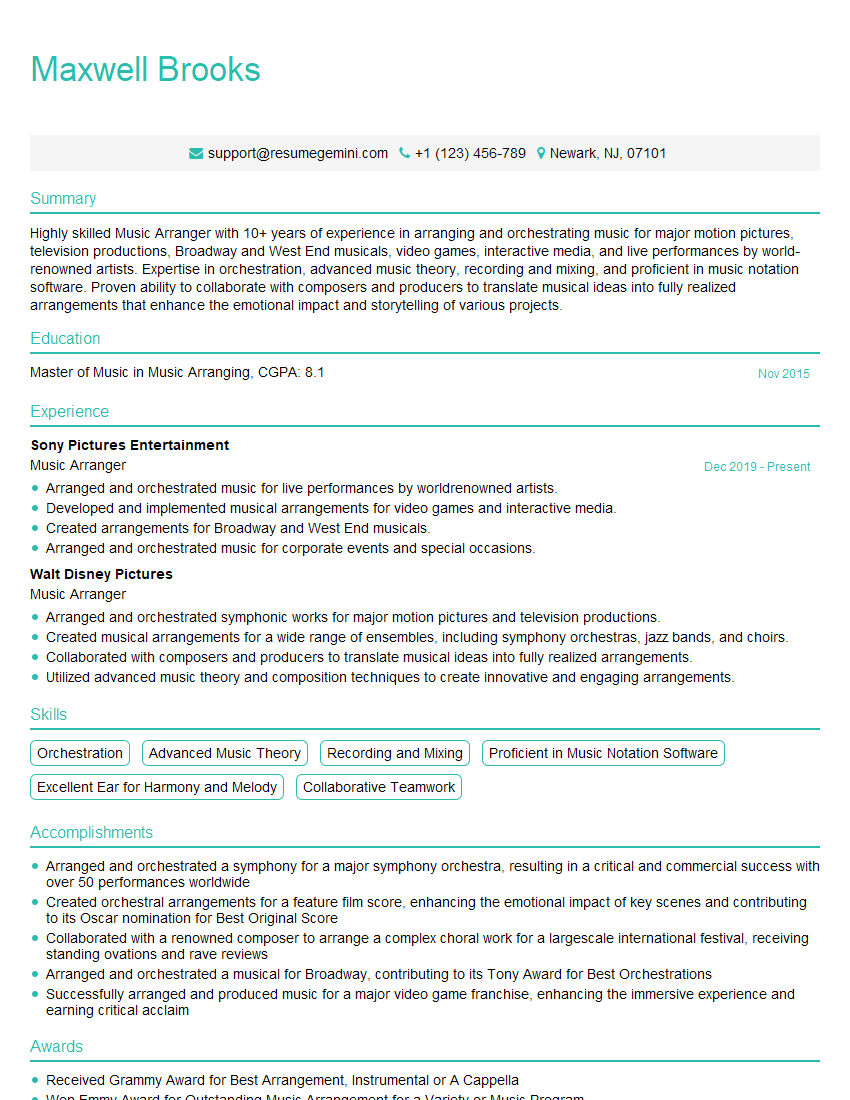
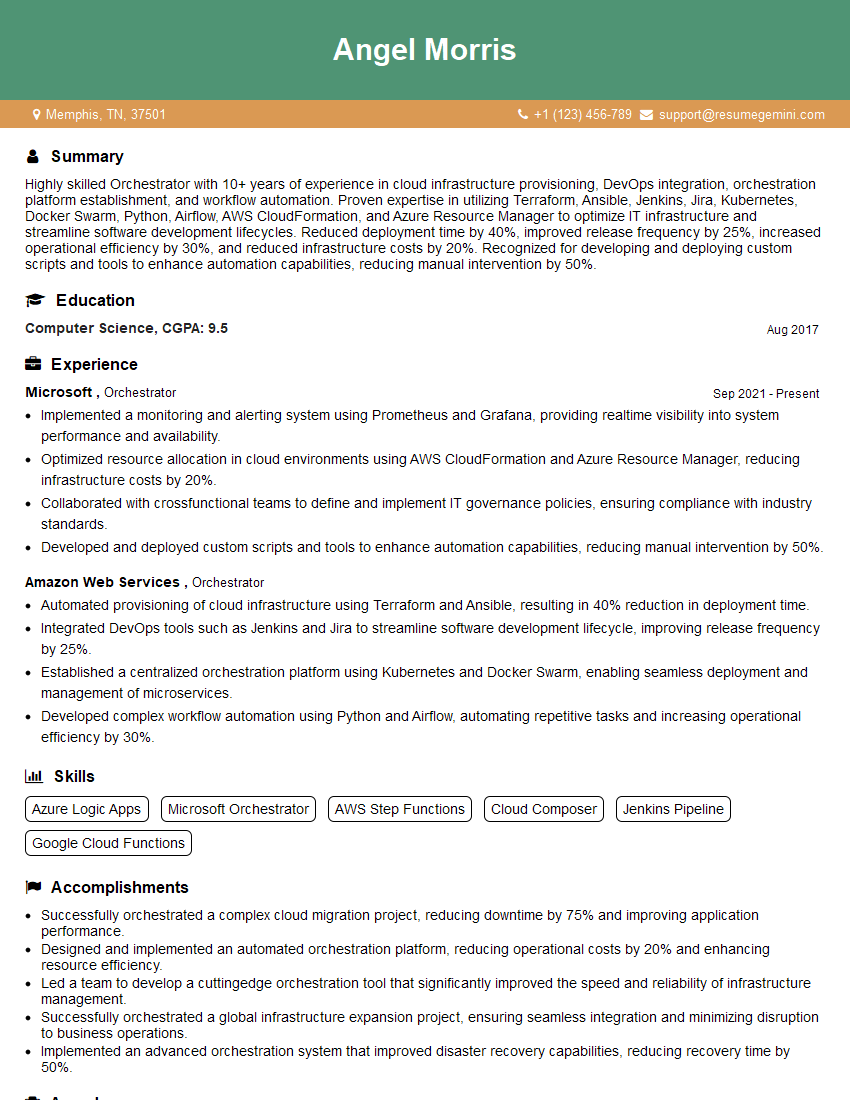
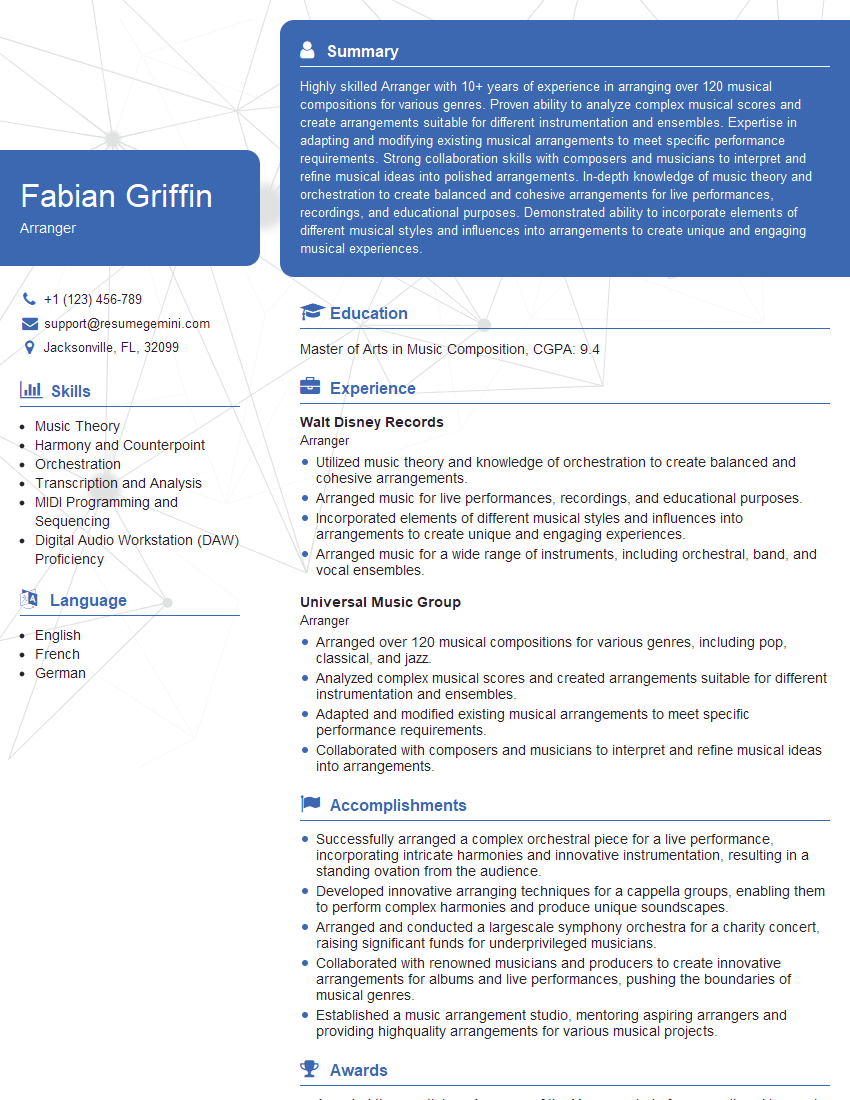
Mastering Arranger significantly enhances your career prospects, opening doors to exciting roles in data engineering, workflow automation, and DevOps. To increase your chances of landing your dream job, it’s crucial to present your skills effectively. Crafting an ATS-friendly resume is essential for getting your application noticed. We highly recommend using ResumeGemini, a trusted resource for building professional and impactful resumes. Examples of resumes tailored to Arranger roles are available to help you create a compelling application that showcases your expertise.
Explore more articles
Users Rating of Our Blogs
Share Your Experience
We value your feedback! Please rate our content and share your thoughts (optional).
What Readers Say About Our Blog
Very informative content, great job.
good