Preparation is the key to success in any interview. In this post, we’ll explore crucial Training Development and Implementation interview questions and equip you with strategies to craft impactful answers. Whether you’re a beginner or a pro, these tips will elevate your preparation.
Questions Asked in Training Development and Implementation Interview
Q 1. Describe your experience in needs analysis for training programs.
Needs analysis is the cornerstone of effective training. It’s the systematic process of identifying the gap between current performance and desired performance. Think of it as diagnosing a problem before prescribing a solution. My approach involves a multi-faceted strategy:
- Performance Analysis: I start by examining current performance data – sales figures, customer satisfaction surveys, error rates – to pinpoint areas needing improvement. For example, if sales are down and we suspect it’s due to insufficient product knowledge, that becomes a training need.
- Organizational Analysis: This looks at the broader organizational context. What resources are available? What are the company’s strategic goals? Are there any organizational barriers preventing employees from performing effectively? For instance, a lack of appropriate tools or outdated processes might be contributing to the performance gap, not just a lack of skills.
- Task Analysis: Here, we break down the specific tasks employees need to perform. What knowledge, skills, and abilities (KSAs) are required for each task? We might use techniques like observation, interviews, and questionnaires to gather this data. For example, for a sales role, we’d examine the steps involved in closing a deal and identify the necessary skills like negotiation and presentation.
- Learner Analysis: This focuses on the characteristics of the learners themselves. What’s their current skill level? What are their learning styles and preferences? Are there any accessibility needs to consider? This ensures the training is tailored to the audience and ensures engagement.
By combining these analyses, I build a comprehensive picture of training needs, leading to a targeted and effective program.
Q 2. Explain your process for developing a training curriculum.
Curriculum development is a structured process. I typically follow these steps:
- Define Learning Objectives: Based on the needs analysis, I clearly define what learners should be able to do after the training. These objectives should be SMART – Specific, Measurable, Achievable, Relevant, and Time-bound. For example, instead of ‘improve sales skills,’ a SMART objective would be ‘Increase sales conversion rate by 15% within three months of completing the training.’
- Content Outline: I create a detailed outline of the training content, breaking it down into modules or units. Each module will address a specific learning objective.
- Develop Learning Activities: I choose appropriate learning activities to engage learners and help them achieve the objectives. This might include lectures, group discussions, role-playing, simulations, case studies, and hands-on exercises. The mix will depend on the learners, content, and learning objectives.
- Select Delivery Methods: I determine the best way to deliver the training – instructor-led, eLearning, blended learning, etc. The choice depends on factors like budget, learner accessibility, and content complexity.
- Develop Assessments: I create assessments to measure learner understanding and progress. These might include quizzes, tests, projects, or performance evaluations.
- Pilot Test and Revise: Before full implementation, I conduct a pilot test to identify any flaws in the curriculum and make necessary revisions based on feedback.
Throughout this process, I ensure alignment with the overall training goals and the needs identified in the initial analysis. For instance, if the needs analysis showed a need for improved communication, the curriculum would include activities focused on active listening and clear communication techniques.
Q 3. How do you evaluate the effectiveness of a training program?
Evaluating training effectiveness is crucial to ensure ROI (Return on Investment). My evaluation approach uses a Kirkpatrick’s Four Levels model, augmented with other relevant metrics:
- Level 1: Reaction: This measures learner satisfaction and engagement with the training. I use surveys and feedback forms to gather data.
- Level 2: Learning: This assesses whether learners acquired the knowledge and skills taught in the training. I use pre- and post-training tests, quizzes, or simulations.
- Level 3: Behavior: This evaluates whether learners apply the new knowledge and skills on the job. I monitor their performance through observation, performance reviews, or 360-degree feedback.
- Level 4: Results: This measures the impact of the training on organizational outcomes such as increased productivity, improved customer satisfaction, or reduced error rates. I collect data from relevant metrics like sales figures, customer surveys, or operational reports.
Beyond Kirkpatrick’s model, I also track things like training completion rates and cost per trainee to fully assess the program’s efficiency and impact. For instance, if a sales training program resulted in a significant increase in sales, and the feedback from learners was highly positive, we can conclude the training was successful.
Q 4. What are the different learning styles and how do you adapt your training to accommodate them?
Different learners process information in different ways. Recognizing and catering to these learning styles is critical for effective training. Common learning styles include:
- Visual: These learners prefer to learn through seeing – diagrams, charts, videos, presentations.
- Auditory: These learners learn best by hearing – lectures, discussions, audio recordings.
- Kinesthetic: These learners learn through hands-on experience – simulations, role-playing, practical exercises.
I adapt my training to accommodate various learning styles by incorporating a variety of methods and materials. For example, a training program on software might include video tutorials (visual), narrated instructions (auditory), and hands-on practice sessions (kinesthetic). I also try to make the learning experience interactive and engaging to appeal to all types of learners.
Q 5. What experience do you have with eLearning platforms and authoring tools?
I have extensive experience with various eLearning platforms and authoring tools. I’m proficient in using platforms such as Moodle, Articulate Storyline, and Adobe Captivate. I’ve used these tools to design and develop interactive eLearning modules, including:
- Interactive scenarios and simulations: To allow learners to practice skills in a safe environment.
- Branching scenarios: To personalize the learning path based on learner responses.
- Gamified learning experiences: To enhance engagement and motivation.
My experience with these tools allows me to create engaging and effective online learning experiences tailored to specific needs. For example, I recently used Articulate Storyline to develop an interactive training module on customer service, incorporating branching scenarios and gamification elements to increase learner engagement and knowledge retention.
Q 6. How do you ensure your training materials are accessible to diverse learners?
Ensuring accessibility is paramount. I incorporate several strategies to make training materials accessible to diverse learners:
- Multi-modal content: I use various formats such as text, audio, video, and interactive elements to cater to different learning styles and preferences.
- Closed captioning and transcripts: To support learners who are deaf or hard of hearing.
- Alternative text for images: To make the content accessible to screen readers.
- Color contrast: To ensure readability for learners with visual impairments.
- Simple language and clear instructions: To ensure clarity and understanding for all learners.
- Consideration of cultural differences: Using inclusive language and culturally sensitive examples.
I also follow accessibility guidelines such as WCAG (Web Content Accessibility Guidelines) to ensure my materials meet accessibility standards. This helps ensure a broader reach and makes the training more inclusive and beneficial for all participants.
Q 7. Describe your experience with instructional design models (ADDIE, SAM, etc.).
I’m familiar with various instructional design models, including ADDIE and SAM. My preferred approach often blends elements from different models to best suit the project’s needs.
- ADDIE (Analysis, Design, Development, Implementation, Evaluation): This is a linear model, useful for structured projects with clearly defined objectives. I use it to ensure a systematic approach, from needs analysis to evaluation.
- SAM (Successive Approximation Model): This is an iterative model, particularly suitable for projects that require flexibility and adaptation. I find it useful when dealing with complex or evolving training needs.
For example, in a recent project, I initially used the ADDIE model for the initial phases of the training development. However, as the project progressed, and we received feedback from pilot tests, we adopted an iterative approach similar to SAM to refine the training materials based on learner feedback and evolving needs. This blended approach helps to ensure a high-quality and effective training program.
Q 8. How do you handle feedback from trainees and incorporate it into future training sessions?
Feedback is the lifeblood of effective training. I actively solicit feedback throughout the training process, not just at the end. This includes using a variety of methods like post-session surveys, informal check-ins during the training, and observation of participant engagement. I analyze this feedback using qualitative and quantitative approaches. For example, I look for recurring themes in written feedback, analyze survey scores to identify areas for improvement, and observe body language and participation levels during sessions to gauge understanding and engagement.
Once collected, I categorize the feedback. This helps me identify trends and prioritize areas needing adjustment. For example, if several trainees mention difficulty understanding a particular concept, I might revise the training material to simplify the explanation or add additional examples. If engagement is low in a particular section, I might incorporate more interactive elements, such as group activities or short quizzes.
Finally, I incorporate the refined materials and methods into the next iteration of the training. This iterative process ensures that the training continuously improves and aligns with the needs and learning styles of the trainees. I also document all changes made, along with the rationale behind them, to maintain a record of continuous improvement.
Q 9. What metrics do you use to track the success of your training programs?
Measuring training success requires a multifaceted approach. I don’t rely solely on post-training tests; instead, I employ a Kirkpatrick-style evaluation model which encompasses four levels: Reaction, Learning, Behavior, and Results.
- Reaction: This measures trainee satisfaction and engagement through surveys and feedback forms. I look for comments reflecting enjoyment, clarity, relevance, and overall satisfaction.
- Learning: This assesses knowledge gained through pre- and post-training tests, quizzes, and practical exercises. I look for significant improvements in scores indicating successful knowledge transfer.
- Behavior: This examines changes in on-the-job performance. This can involve observation, manager feedback, and performance reviews to assess whether trainees are applying what they learned.
- Results: This focuses on the overall impact of the training on organizational goals. Key performance indicators (KPIs) like improved efficiency, reduced errors, increased sales, or cost savings are measured to determine the training’s return on investment (ROI).
Beyond these four levels, I might also track completion rates, time-to-completion, and feedback response rates to get a holistic view of training effectiveness. Combining quantitative data with qualitative feedback paints a complete picture of the training’s success.
Q 10. How do you stay up-to-date on the latest trends in training and development?
Staying current in the rapidly evolving field of training and development is crucial. I employ a multi-pronged approach that includes:
- Professional Development: I regularly attend conferences, workshops, and webinars focused on learning and development best practices and emerging technologies. This provides opportunities for networking and learning from experts.
- Industry Publications and Research: I subscribe to relevant journals, newsletters, and online resources that publish research on adult learning, instructional design, and training technology. This allows me to stay abreast of the latest findings and theories.
- Online Learning Platforms: I actively participate in online courses and communities that offer training on new methodologies and tools. This keeps me updated on cutting-edge approaches and technologies.
- Networking: I actively engage with other professionals in the field through online forums, professional organizations, and industry events. This facilitates knowledge sharing and the exchange of best practices.
By combining these approaches, I ensure my knowledge base remains relevant and informs my training design and delivery.
Q 11. Explain your experience with blended learning approaches.
Blended learning is a powerful approach that combines online and in-person learning experiences. My experience spans various blended learning models. I’ve designed programs incorporating eLearning modules for self-paced learning, followed by instructor-led workshops for hands-on practice and collaborative problem-solving. I’ve also utilized virtual classrooms for interactive sessions, supplementing them with asynchronous online discussions and assignments.
For example, I once developed a blended learning program for sales representatives. The online component included modules covering product knowledge, sales techniques, and customer relationship management. The in-person component consisted of role-playing exercises, group discussions, and coaching sessions to reinforce the online learning and develop practical skills. This blended approach provided flexibility and allowed for personalized learning experiences while maintaining the social interaction that’s crucial for teamwork and skill development.
Successful blended learning requires careful planning and integration of the different modalities. I emphasize creating a cohesive and consistent learning experience across all platforms to optimize engagement and knowledge retention.
Q 12. How do you design training for different levels of technical expertise?
Designing training for diverse technical expertise requires a differentiated approach. I start by carefully assessing the learners’ existing knowledge and skills through pre-assessments or needs analyses. This helps me identify the knowledge gaps and tailor the training accordingly.
For beginners, I employ a foundational approach, starting with the basic concepts and gradually building complexity. I use clear and concise language, avoiding technical jargon whenever possible. I also provide ample opportunities for practice and feedback. For intermediate learners, I can focus on more advanced topics and challenge them with complex case studies or problem-solving scenarios.
For advanced learners, I provide opportunities for deeper exploration and specialization, encouraging them to contribute their expertise and share their knowledge with others. This could involve advanced workshops, mentoring programs, or collaborative projects. This differentiated approach ensures that each learner is challenged and engaged at their appropriate level, maximizing learning outcomes.
Q 13. Describe a time you had to adapt a training program due to unforeseen circumstances.
During a leadership development program, a key speaker canceled unexpectedly just a week before the session. This was a significant setback as the speaker’s presentation was a central part of the curriculum. I had to act quickly to mitigate the disruption and ensure the program’s value wasn’t compromised.
My immediate response was to identify alternative solutions. I contacted several other experts in the field, ultimately finding a highly respected consultant who could deliver a similar presentation, though with a slightly different focus. I quickly negotiated a contract, ensuring they had access to the original speaker’s materials and presentation outlines.
To ensure a smooth transition, I communicated the change to all participants well in advance. I also revised the program schedule to accommodate the new speaker’s presentation style and content. Although the initial plan was disrupted, the quick adaptation ensured the training program remained valuable and engaging for the participants. This experience highlighted the importance of flexibility and resourcefulness in training development and implementation.
Q 14. What is your experience with creating engaging and interactive training materials?
Engaging and interactive training materials are key to effective learning. My approach involves incorporating various techniques to keep learners actively involved:
- Interactive exercises and activities: I integrate activities such as quizzes, games, simulations, and group discussions to encourage active participation and knowledge application.
- Multimedia elements: I use videos, animations, infographics, and interactive visuals to present information in an engaging and easily digestible format.
- Real-world examples and case studies: Relating the training content to real-world scenarios increases relevance and helps learners understand the practical application of the concepts.
- Storytelling and narratives: I use storytelling to make the content more relatable and memorable.
- Gamification: I incorporate game mechanics such as points, badges, leaderboards, and challenges to motivate learners and enhance their engagement.
For example, I recently developed a compliance training program that used a gamified approach with scenarios, quizzes, and points systems, resulting in higher completion rates and increased knowledge retention compared to previous traditional methods. The key is to tailor the interactive elements to the specific learning objectives and the target audience.
Q 15. How do you handle conflict or resistance to training within an organization?
Resistance to training is common, often stemming from perceived irrelevance, time constraints, or fear of change. Addressing this requires a multi-pronged approach.
- Proactive Communication: Before training begins, I clearly articulate the program’s value proposition, highlighting its relevance to individual roles and the organization’s goals. I emphasize the practical skills gained and how they improve efficiency or job performance. This builds buy-in from the start.
- Needs Assessment: A thorough needs assessment is crucial. Understanding the root causes of resistance—whether it’s a lack of confidence, insufficient resources, or poorly designed training—allows for targeted solutions.
- Addressing Concerns: I create a safe space for employees to express their concerns and address them openly. This might involve individual discussions, feedback forms, or focus groups. Addressing fears and doubts directly fosters trust and reduces resistance.
- Incentives & Recognition: Offering incentives like certificates of completion, recognition programs, or opportunities for advancement can increase participation and motivation.
- Iterative Improvement: I incorporate regular feedback loops throughout the training process. This allows for adjustments to the content and delivery methods based on participants’ needs and preferences. Continuous improvement demonstrates responsiveness and engagement.
For example, in a previous role, I encountered resistance to a new software implementation. By conducting individual interviews, I discovered that the resistance stemmed from fear of the unfamiliar technology and lack of support. I addressed this by providing additional one-on-one training, creating quick reference guides, and establishing a mentorship program.
Career Expert Tips:
- Ace those interviews! Prepare effectively by reviewing the Top 50 Most Common Interview Questions on ResumeGemini.
- Navigate your job search with confidence! Explore a wide range of Career Tips on ResumeGemini. Learn about common challenges and recommendations to overcome them.
- Craft the perfect resume! Master the Art of Resume Writing with ResumeGemini’s guide. Showcase your unique qualifications and achievements effectively.
- Don’t miss out on holiday savings! Build your dream resume with ResumeGemini’s ATS optimized templates.
Q 16. How do you measure the return on investment (ROI) of a training program?
Measuring the ROI of training is crucial for justifying the investment. It involves quantifying the benefits relative to the costs. I use a combination of quantitative and qualitative methods.
- Quantitative Measures: This includes measuring improvements in productivity, efficiency, sales, error rates, or customer satisfaction. For example, we might track the number of customer service calls resolved successfully per hour after training on new software.
- Qualitative Measures: These assess less tangible benefits such as employee engagement, satisfaction, and knowledge retention. We might use post-training surveys, focus groups, or 360-degree feedback to assess these aspects.
- Cost Analysis: Calculating the total cost of the training program is essential. This includes development costs, instructor fees, materials, technology, and participant time.
- ROI Calculation: A simple ROI calculation can be:
(Return on Investment - Cost of Investment) / Cost of Investment * 100%. The ‘return’ is the increase in revenue or cost savings due to training.
In a previous project, we implemented a sales training program. We measured the ROI by tracking sales figures before and after the training. We also conducted surveys to gauge employee confidence and job satisfaction. The results showed a 15% increase in sales and a significant improvement in employee morale, demonstrating a strong ROI.
Q 17. What is your experience with training budget management?
Effective training budget management involves meticulous planning and resource allocation. I approach this with a structured process.
- Needs Analysis: A comprehensive needs assessment helps prioritize training initiatives based on organizational needs and impact.
- Cost Estimation: Accurate cost estimation for each training component (materials, instructors, technology, venue) is critical.
- Resource Allocation: Prioritize training initiatives with the highest potential ROI. This often involves making trade-offs and justifying budget requests based on data.
- Budget Tracking: Regular monitoring of expenditures against the budget is essential to identify potential overruns and make necessary adjustments.
- Value-Based Decisions: Focus on the value delivered by training programs rather than solely on cost-cutting. Investing in high-impact training is usually more economical in the long run.
For example, when developing a budget for a leadership development program, I explored various options for training venues, comparing costs and suitability. By negotiating with vendors and utilizing cost-effective technology, we were able to deliver a high-quality program within budget.
Q 18. How do you ensure the training content remains current and relevant?
Keeping training content current is vital for its effectiveness. I employ several strategies.
- Regular Reviews: I establish a regular review schedule to ensure content remains aligned with industry best practices, new technologies, and regulatory changes.
- Feedback Mechanisms: Incorporating feedback from participants, subject matter experts, and stakeholders helps identify areas for improvement and update content.
- Continuous Learning: I encourage a culture of continuous learning amongst trainers, regularly updating their knowledge through professional development and industry research.
- Technology Integration: Utilizing learning management systems (LMS) with features like automated updates and version control ensures that the latest version of training materials is readily available.
- Modular Design: Creating modular training content allows for easier updates and revisions of specific modules, without requiring a complete overhaul of the entire program.
For instance, in a compliance training program, we utilized an LMS to automatically push out updates related to changes in legislation, ensuring participants always had access to the most current information.
Q 19. Describe your experience with different training delivery methods (online, in-person, etc.).
I have extensive experience with various training delivery methods, recognizing that the optimal approach depends on the training objectives, audience, and budget.
- In-Person Training: Provides opportunities for interactive learning, collaboration, and immediate feedback. Ideal for complex topics or when building strong interpersonal skills is crucial.
- Online Training: Offers flexibility, scalability, and cost-effectiveness. Suitable for large audiences and self-paced learning. Effective use of multimedia, interactive exercises, and assessments enhances engagement.
- Blended Learning: Combines online and in-person components, leveraging the advantages of both methods. This approach is particularly effective for complex topics requiring both theoretical understanding and practical application.
- Virtual Instructor-Led Training (VILT): Utilizes technology to deliver live instructor-led sessions remotely. Allows for real-time interaction and engagement, while maintaining flexibility and reducing travel costs.
For example, for technical training on a new software system, I employed a blended learning approach. Online modules covered the theoretical aspects, followed by an in-person workshop where participants practiced using the software with the instructor’s guidance.
Q 20. How do you manage the logistics of training programs (scheduling, materials, etc.)?
Managing training logistics requires meticulous planning and attention to detail. I utilize project management techniques to ensure a smooth and efficient process.
- Scheduling: Selecting appropriate dates and times, considering participant availability and resource constraints.
- Venue Selection: Identifying a suitable venue with appropriate facilities, considering accessibility, capacity, and technology requirements.
- Materials Preparation: Preparing and distributing all necessary materials, including handouts, presentations, assessments, and any technology required.
- Technology Setup: Ensuring all technology functions correctly, including audio-visual equipment, online platforms, and learning management systems.
- Participant Management: Tracking registrations, communicating logistical information, and addressing any participant queries.
- Post-Training Follow-up: Collecting feedback, distributing certificates of completion, and providing ongoing support.
I use project management software to track tasks, deadlines, and resources, ensuring accountability and preventing logistical bottlenecks. For instance, in a large-scale training program, I used a project management system to track the progress of all tasks, ensuring all materials were ready on time and the venue was properly set up for the training sessions.
Q 21. How do you utilize technology to enhance the training experience?
Technology is instrumental in enhancing the training experience. I leverage various technologies to improve engagement, effectiveness, and accessibility.
- Learning Management Systems (LMS): LMS platforms provide a central repository for training materials, track participant progress, and offer assessment tools. Examples include Moodle, Canvas, and Cornerstone.
- Interactive Simulations and Games: Gamification techniques enhance engagement and knowledge retention. Simulations allow learners to practice skills in a safe environment.
- Virtual Reality (VR) and Augmented Reality (AR): Immersive technologies create engaging and realistic learning experiences, particularly useful for hands-on training.
- Video Conferencing: Enables live, remote training sessions and facilitates collaboration.
- Mobile Learning Apps: Provide access to training anytime, anywhere, promoting continuous learning.
For instance, in a safety training program, I integrated a VR simulation allowing participants to experience emergency situations in a safe environment. This enhanced learning retention significantly better than traditional methods.
Q 22. What is your experience with learning management systems (LMS)?
My experience with Learning Management Systems (LMS) is extensive. I’ve worked with a variety of platforms, including Moodle, Canvas, and Cornerstone OnDemand, managing everything from course creation and deployment to user administration and reporting. I’m proficient in leveraging LMS features to enhance the learning experience, such as creating personalized learning paths, tracking learner progress, and providing automated feedback. For example, in a recent project, I utilized Cornerstone OnDemand to develop a blended learning program for sales representatives, integrating e-learning modules, virtual instructor-led training (VILT), and on-the-job assessments. This allowed for detailed tracking of individual progress and overall program effectiveness, leading to a significant improvement in sales performance.
Beyond basic functionality, I understand the importance of integrating LMS with other HR and business systems for seamless data flow and comprehensive reporting. This allows for a more holistic view of employee development and its impact on organizational goals.
Q 23. Explain your approach to onboarding new employees through training.
My approach to onboarding new employees through training prioritizes a structured, engaging, and supportive experience. I believe in a phased approach, starting with pre-boarding materials that introduce company culture and expectations. This is often followed by a comprehensive orientation program covering essential policies, procedures, and technology.
I then incorporate a blended learning approach, combining online modules with interactive workshops and mentoring opportunities. This ensures that new employees receive both the theoretical knowledge and practical skills they need to succeed. I also focus on building a strong support network by pairing new hires with experienced mentors and fostering collaboration within their teams. For example, in my previous role, we implemented a buddy system, pairing each new employee with a seasoned colleague who could offer guidance and support during their first few months. This resulted in significantly improved employee retention and faster integration into the workplace. Regular check-ins and feedback sessions are crucial to identify any challenges and address them promptly. The ultimate goal is for new hires to feel welcomed, supported, and confident in their new roles.
Q 24. How do you incorporate adult learning principles into your training design?
Incorporating adult learning principles is paramount to effective training design. I utilize the principles of andragogy, which recognizes that adult learners are self-directed, experienced, and problem-centered. This means I design training that:
- Is relevant and practical: Training content directly addresses the learners’ needs and job-related tasks. I avoid irrelevant information and focus on practical application.
- Encourages active participation: I use interactive methods like group discussions, case studies, and simulations to engage learners actively. Passive lectures are minimized.
- Provides opportunities for self-assessment and feedback: Learners are given opportunities to reflect on their learning and receive regular feedback to guide their progress.
- Offers choice and flexibility: I often offer multiple learning formats (e.g., online modules, workshops, on-the-job training) to accommodate different learning styles and preferences.
- Focuses on problem-solving and application: Learning is not just about acquiring information; it’s about applying knowledge to real-world situations.
For instance, instead of a lecture on customer service, I might use a role-playing exercise to simulate challenging customer interactions, allowing learners to practice their skills in a safe environment.
Q 25. What experience do you have with developing microlearning modules?
I have significant experience developing microlearning modules. Microlearning focuses on delivering concise, focused learning content in short bursts. This approach caters to the limited attention spans and busy schedules of today’s learners. I leverage various formats such as short videos, interactive quizzes, infographics, and podcasts to deliver knowledge efficiently.
For example, I recently developed a series of five-minute microlearning modules on data security best practices for a large financial institution. These short, focused modules were far more effective than a lengthy, traditional training session. Each module addressed a specific aspect of data security, allowing learners to engage with the information without feeling overwhelmed. The use of interactive elements like quizzes ensured active participation and knowledge retention.
Q 26. Describe your experience with gamification in training.
I’ve successfully incorporated gamification into several training programs. Gamification leverages game mechanics and game design techniques to enhance engagement and motivation. This involves incorporating elements like points, badges, leaderboards, and challenges to make learning more fun and rewarding.
For instance, in a sales training program, I implemented a points-based system where learners earned points for completing modules, participating in discussions, and achieving high scores on assessments. These points could be redeemed for rewards, creating a sense of accomplishment and boosting motivation. Leaderboards further enhanced the competitive aspect, encouraging learners to strive for excellence. The result was a significant increase in learner engagement and knowledge retention compared to traditional training methods. It’s crucial, however, to ensure the gamification elements align with the learning objectives and don’t distract from the core content.
Q 27. How do you assess the knowledge retention of trainees after completing a program?
Assessing knowledge retention requires a multi-faceted approach. I use a combination of methods to gauge how effectively trainees have absorbed the training material. Immediately post-training, I use summative assessments such as quizzes or exams to measure immediate knowledge gain. However, to assess longer-term retention, I employ methods like knowledge checks at intervals after the training concludes – for example, one week, one month, and three months later.
These follow-up assessments help determine the knowledge decay rate and identify areas where additional reinforcement might be needed. Furthermore, I incorporate on-the-job observations and performance reviews to assess how well trainees are applying their newly acquired knowledge and skills in their daily work. This provides a more realistic measure of the training’s effectiveness. Finally, I gather feedback from trainees through surveys and focus groups to understand their learning experiences and identify any areas for improvement in the training program.
Q 28. What is your approach to creating a positive and engaging learning environment?
Creating a positive and engaging learning environment is crucial for effective training. I focus on fostering a collaborative and supportive atmosphere where learners feel comfortable asking questions, sharing their perspectives, and participating actively. This involves:
- Clear communication and expectations: Establishing clear learning objectives and providing regular feedback to learners.
- Creating opportunities for interaction: Utilizing group activities, discussions, and peer learning to encourage collaboration.
- Providing a safe and inclusive environment: Fostering respect, empathy, and psychological safety for all learners.
- Using varied and engaging instructional methods: Incorporating interactive elements, multimedia, and real-world examples to keep learners interested.
- Celebrating successes and acknowledging effort: Recognizing learner achievements and providing positive reinforcement.
For example, I might start a training session with an icebreaker activity to create a relaxed atmosphere and encourage interaction among participants. Throughout the training, I would actively solicit questions and create opportunities for participants to share their experiences and perspectives. By creating a positive and welcoming learning environment, I ensure that learners feel engaged, motivated, and supported throughout their learning journey.
Key Topics to Learn for Training Development and Implementation Interview
- Needs Assessment: Understanding the learning gap and defining specific training objectives. Practical application: Conducting surveys, analyzing performance data, and interviewing stakeholders to identify training needs.
- Learning Design & Development: Creating engaging and effective training materials, choosing appropriate delivery methods (e.g., eLearning, instructor-led training, blended learning). Practical application: Designing interactive modules, developing engaging presentations, and selecting appropriate learning technologies.
- Instructional Design Models: Applying theoretical frameworks like ADDIE (Analysis, Design, Development, Implementation, Evaluation) or SAM (Successive Approximation Model) to structure the training process. Practical application: Utilizing a chosen model to guide each stage of training development, from initial needs assessment to post-training evaluation.
- Training Delivery & Facilitation: Mastering effective presentation and facilitation skills to engage learners and ensure knowledge transfer. Practical application: Developing strong communication skills, adapting to different learning styles, and using active learning techniques.
- Evaluation & Measurement: Designing and implementing methods to measure the effectiveness of training programs. Practical application: Developing pre and post-training assessments, using Kirkpatrick’s four levels of evaluation, and analyzing training data to inform future improvements.
- Technology Integration in Training: Leveraging technology (LMS, authoring tools, virtual reality) to enhance training effectiveness and accessibility. Practical application: Selecting appropriate technology, integrating it seamlessly into the training design, and troubleshooting technical issues.
- Budgeting and Resource Management: Planning and managing the budget and resources required for successful training implementation. Practical application: Creating a detailed budget, securing necessary resources, and tracking expenses.
Next Steps
Mastering Training Development and Implementation opens doors to exciting career opportunities and significant professional growth. It demonstrates valuable skills in project management, communication, and instructional design, all highly sought after in today’s competitive job market. To maximize your chances of landing your dream role, focus on crafting an ATS-friendly resume that effectively highlights your skills and experience. ResumeGemini is a trusted resource to help you build a professional and impactful resume that catches the eye of recruiters. Examples of resumes tailored to Training Development and Implementation are available, allowing you to model your own based on best practices. Invest the time in crafting a strong resume—it’s your first impression and a crucial step in your job search.
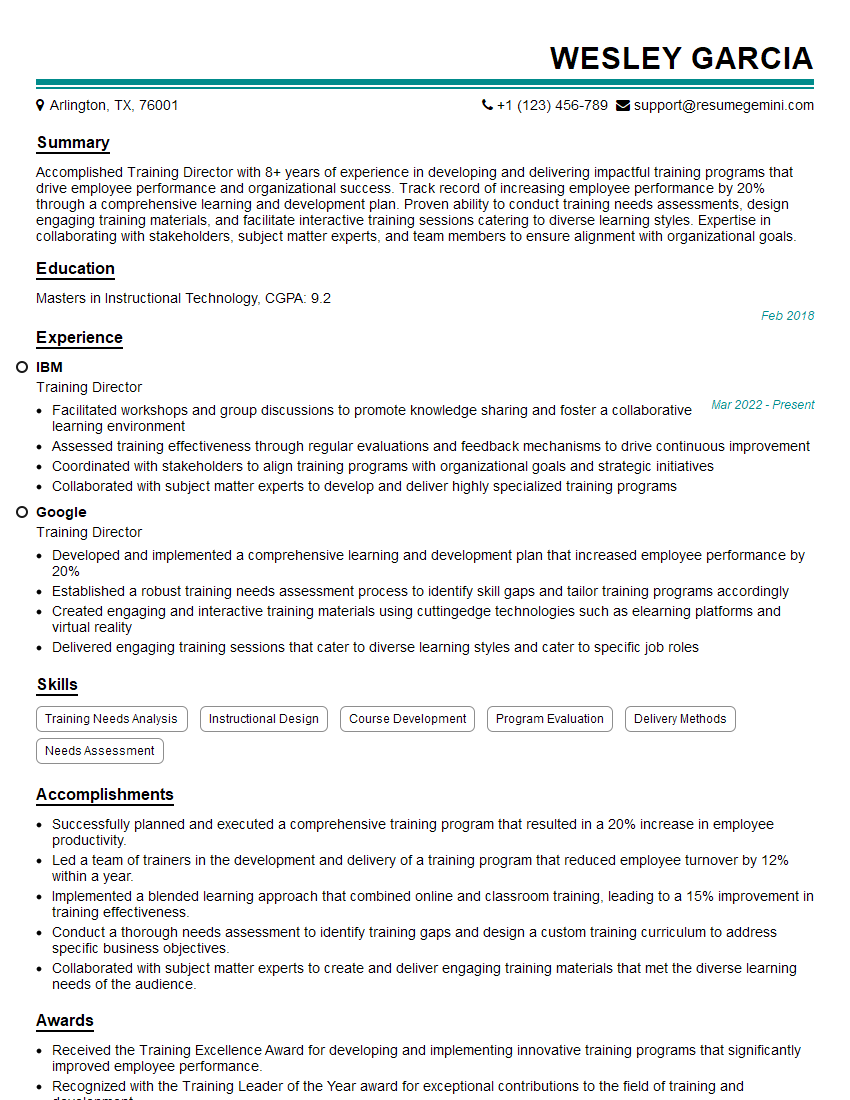
Training Director Resume Sample
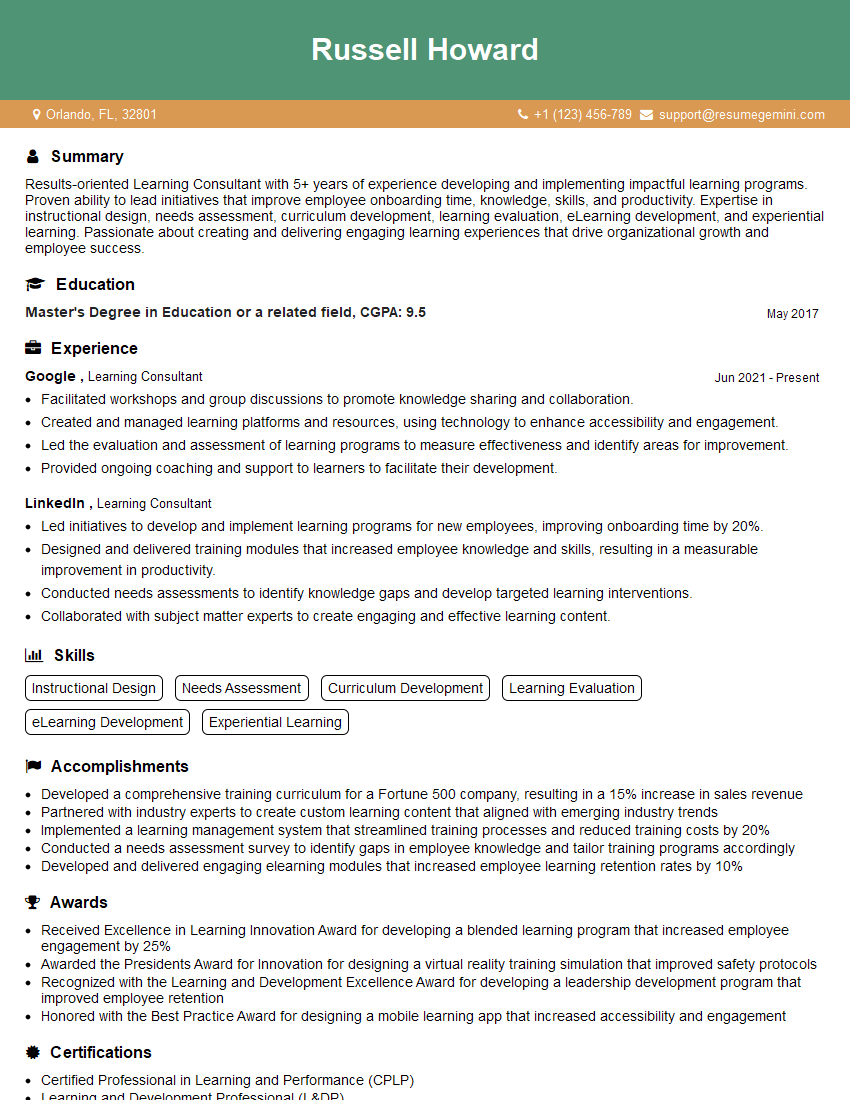
Learning Consultant Resume Sample
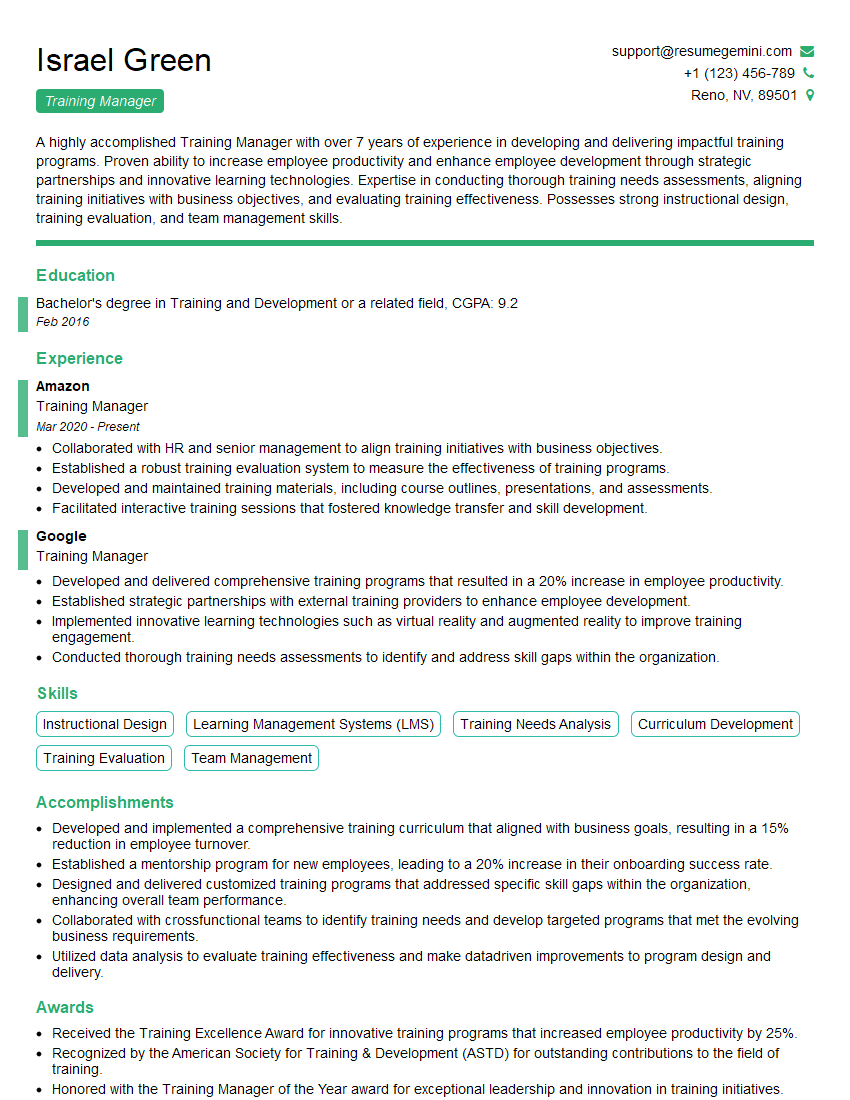
Training Manager Resume Sample
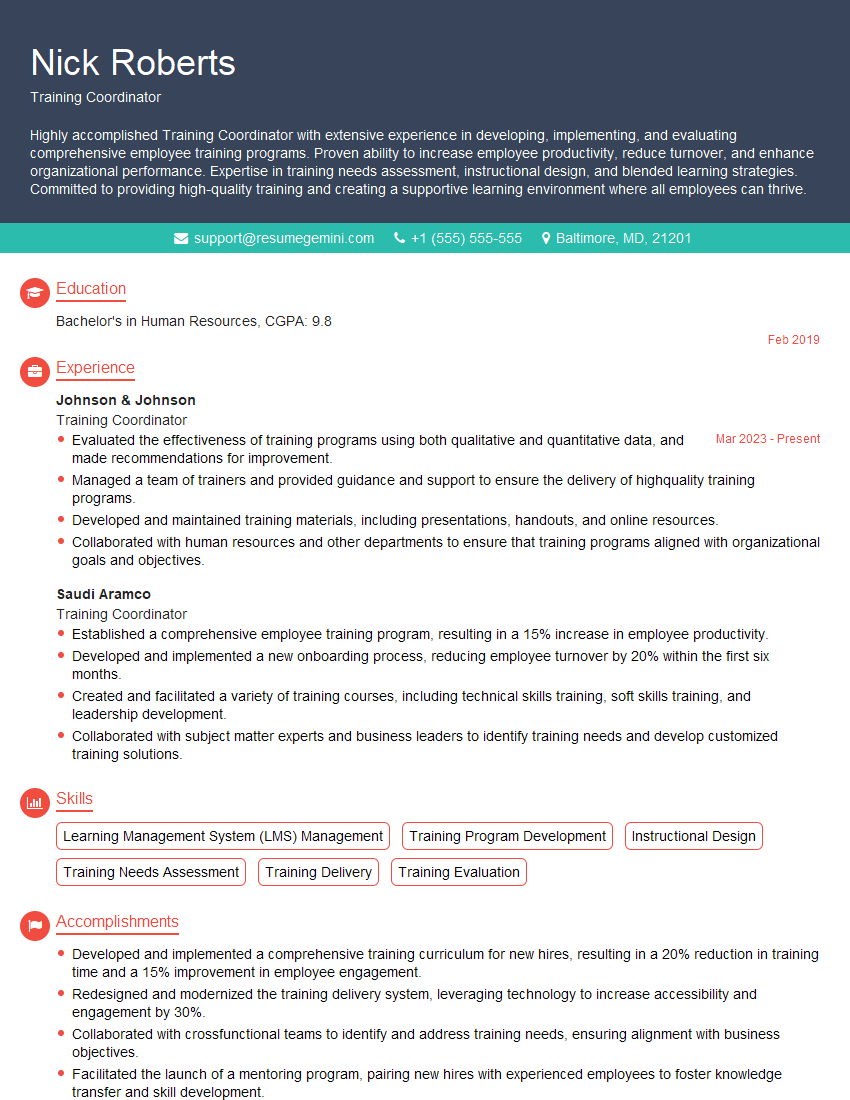
Training Coordinator Resume Sample
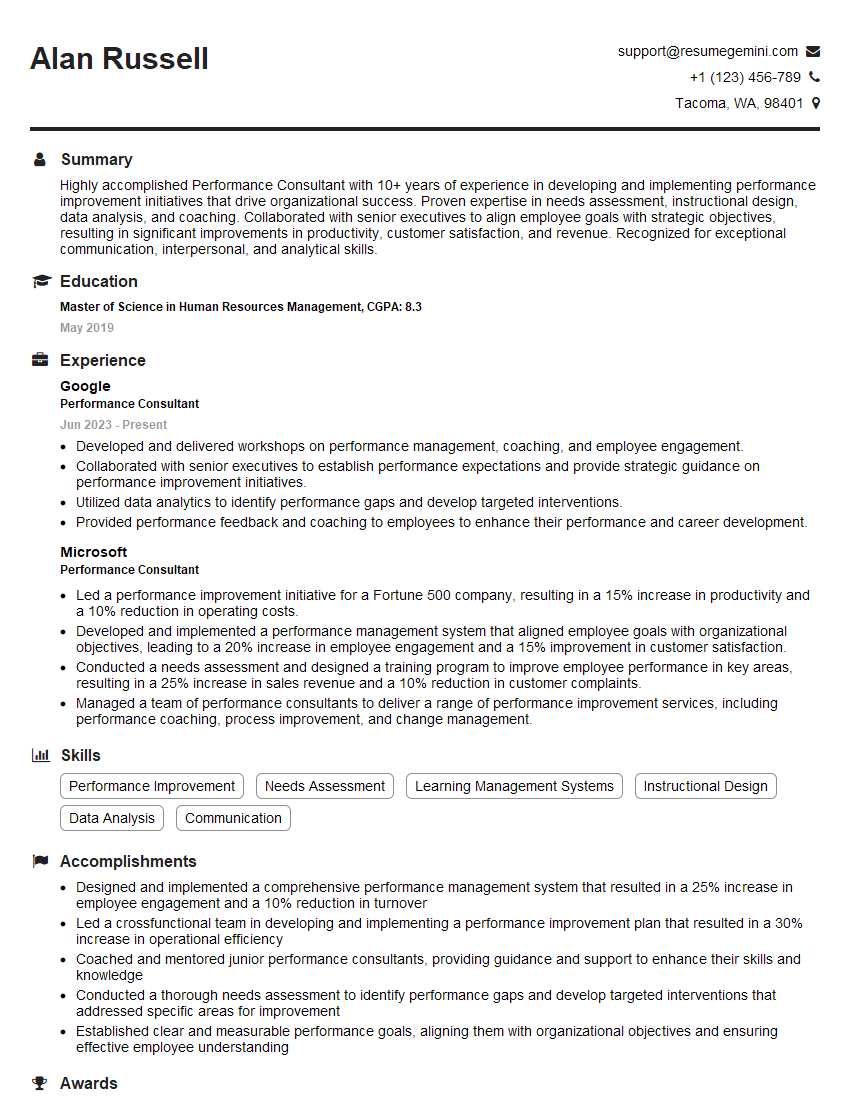
Performance Consultant Resume Sample
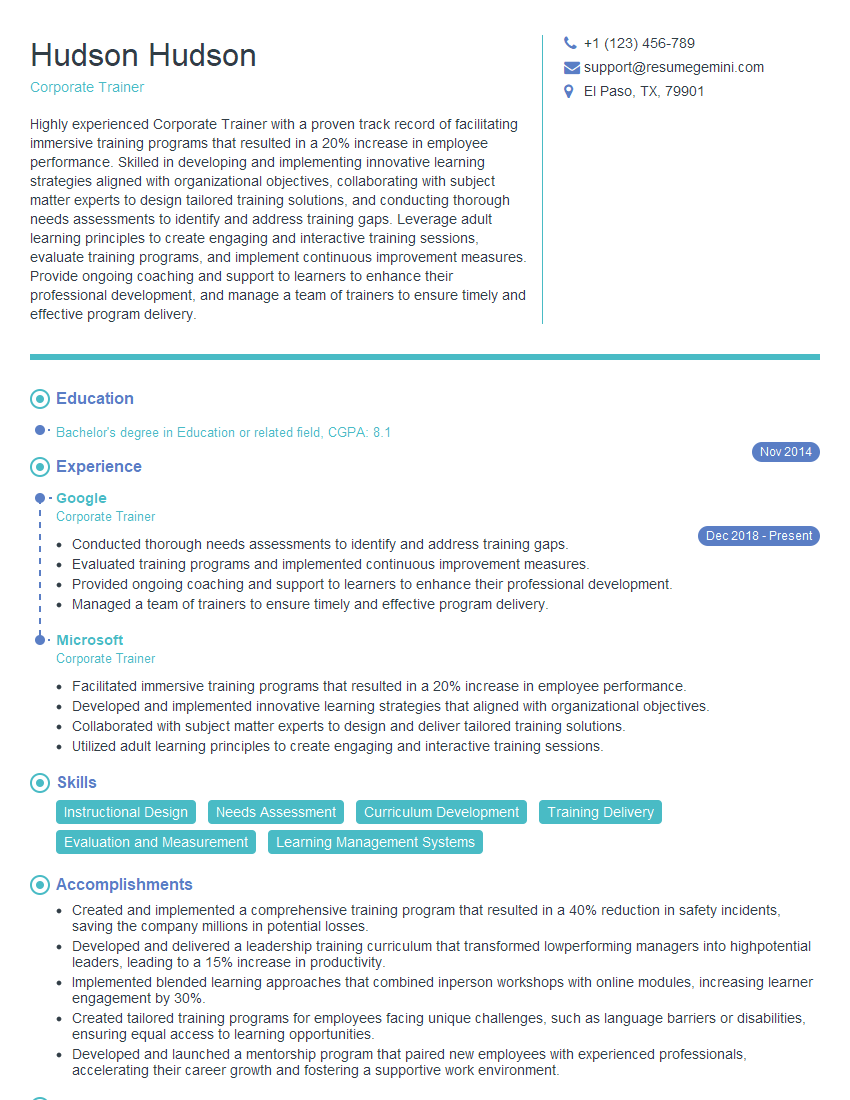
Corporate Trainer Resume Sample

Curriculum Developer Resume Sample
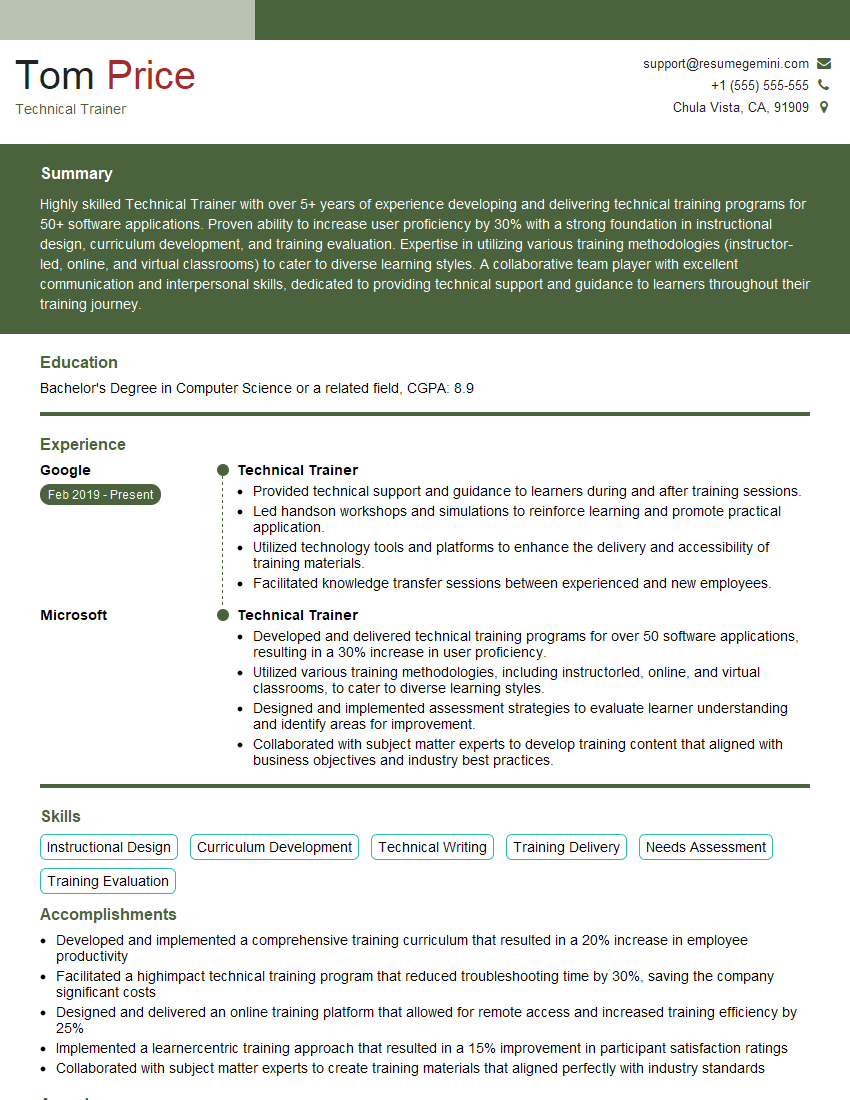
Technical Trainer Resume Sample

Training Specialist Resume Sample
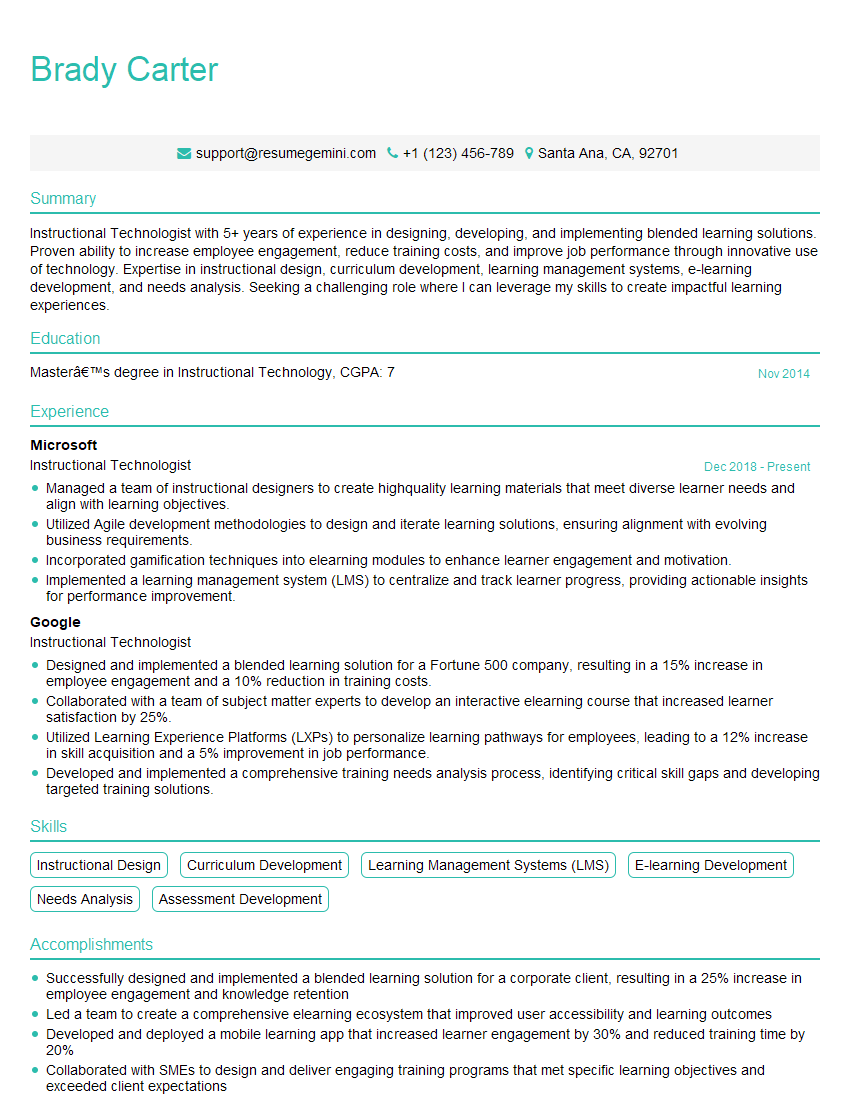
Instructional Technologist Resume Sample
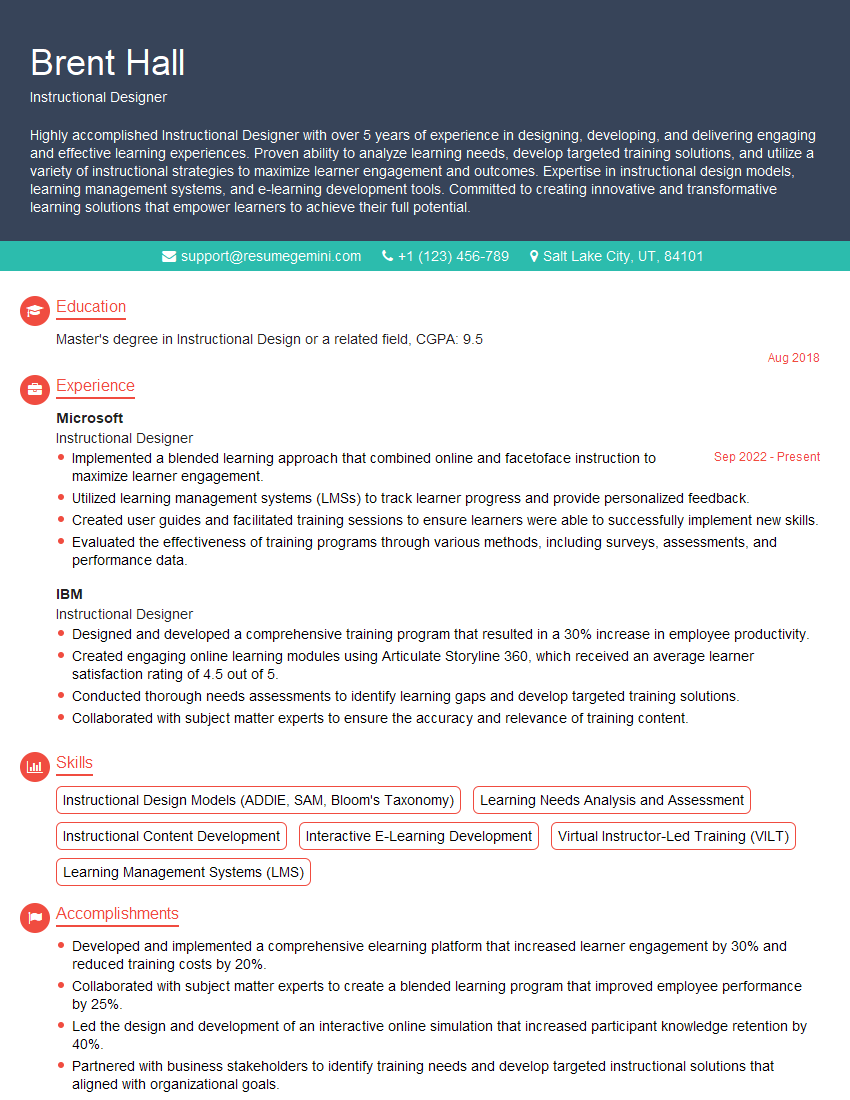
Instructional Designer Resume Sample

Educational Technologist Resume Sample
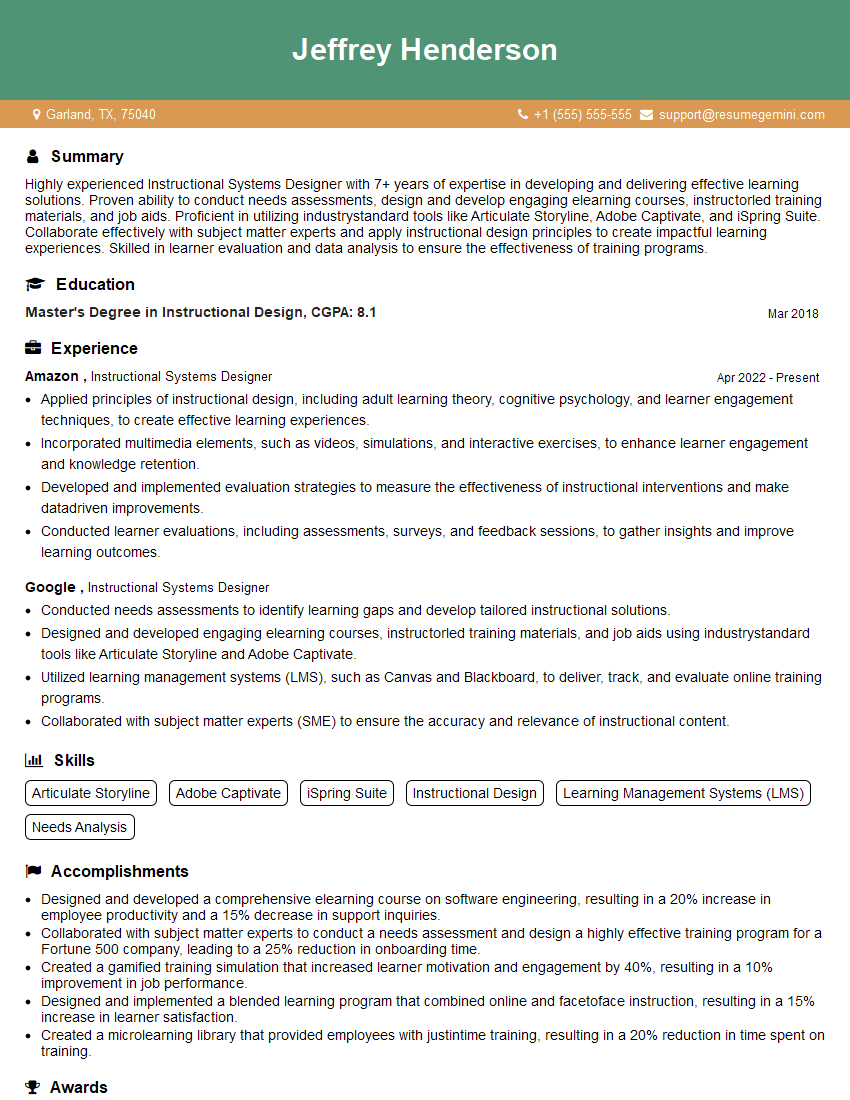
Instructional Systems Designer Resume Sample
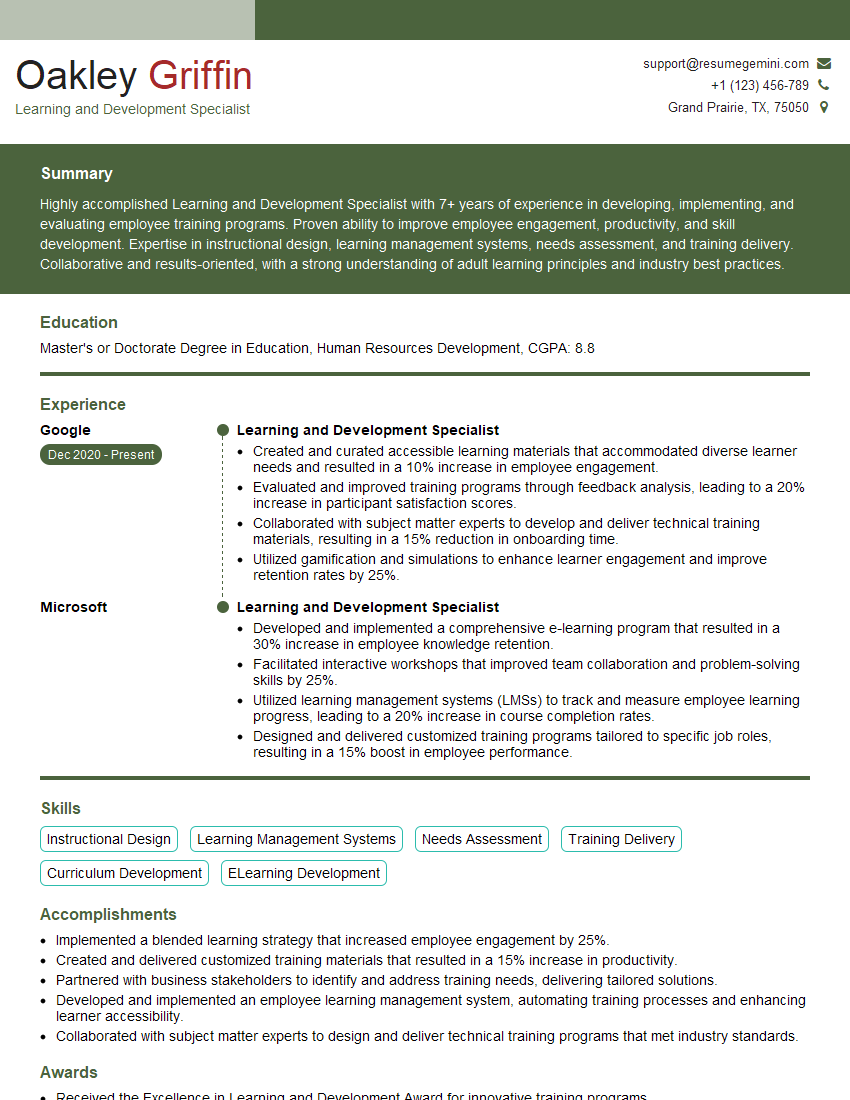
Learning and Development Specialist Resume Sample
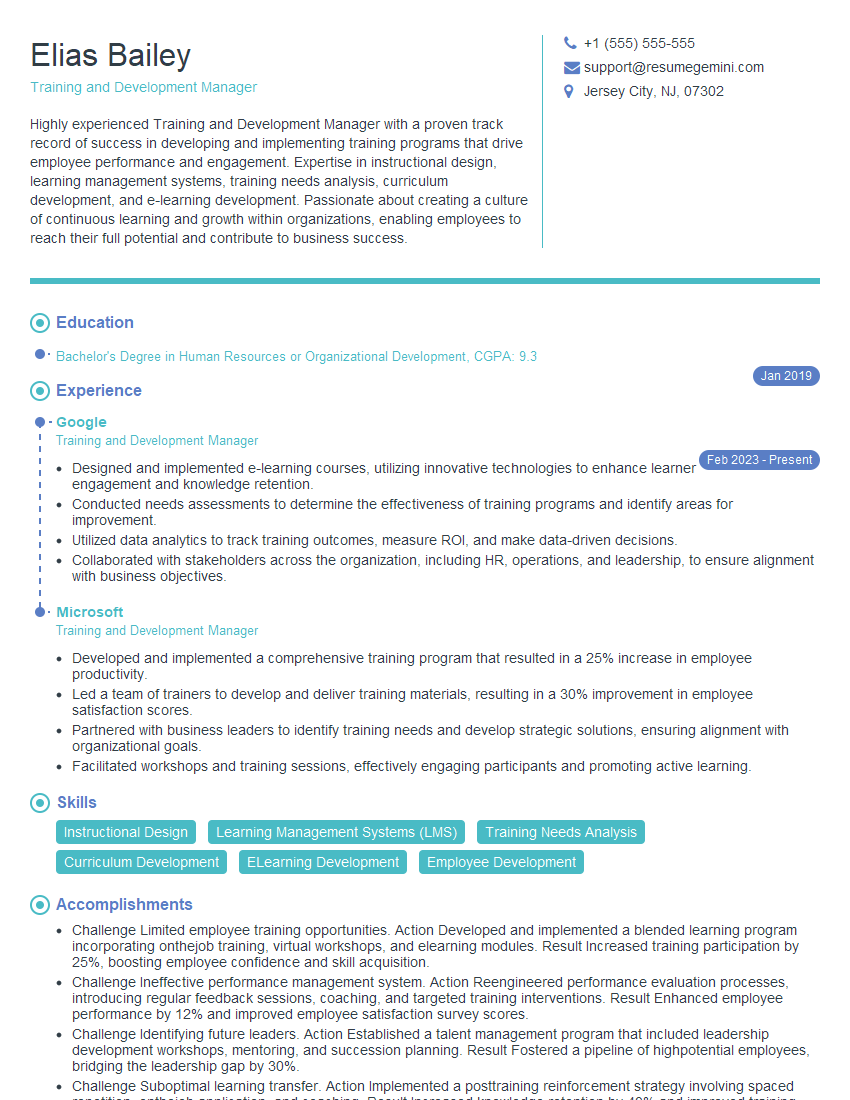
Training and Development Manager Resume Sample
- Training Director
- Learning Consultant
- Training Manager
- Training Coordinator
- Performance Consultant
- Corporate Trainer
- Curriculum Developer
- Technical Trainer
- Training Specialist
- Instructional Technologist
- Instructional Designer
- Educational Technologist
- Instructional Systems Designer
- Learning and Development Specialist
- Training and Development Manager
Explore more articles
Users Rating of Our Blogs
Share Your Experience
We value your feedback! Please rate our content and share your thoughts (optional).
What Readers Say About Our Blog
Very informative content, great job.
good