The right preparation can turn an interview into an opportunity to showcase your expertise. This guide to Engineering Budget Management interview questions is your ultimate resource, providing key insights and tips to help you ace your responses and stand out as a top candidate.
Questions Asked in Engineering Budget Management Interview
Q 1. Explain the different budgeting methods used in engineering projects.
Several budgeting methods are employed in engineering projects, each with its strengths and weaknesses. The choice depends on project complexity, available data, and organizational preferences.
- Bottom-up budgeting: This method starts with detailed cost estimates for individual tasks or work packages. These are aggregated to form the overall project budget. It’s highly accurate but time-consuming. Imagine building a house; you’d estimate the cost of materials (wood, bricks, etc.), labor for each stage (foundation, framing, etc.), and then add everything up. This approach ensures all aspects are considered.
- Top-down budgeting: This is a quicker, more high-level approach where the overall budget is determined first, often based on historical data or similar projects. This is then broken down into smaller allocations. It’s useful for early-stage planning but may lack the granular detail of bottom-up budgeting. Think of setting a budget for a whole department – you start with the overall amount and then allocate funds to various teams.
- Activity-based budgeting: This method links budget allocation to specific project activities. Each activity is assigned a cost driver, such as labor hours or material usage. This provides a good understanding of cost-activity relationships, aiding in cost control. For example, a software project might budget for specific development sprints, testing cycles, and bug fixes.
- Value engineering: This isn’t a budgeting method in itself, but a crucial technique *within* budgeting. It involves systematically analyzing project elements to identify ways to reduce costs without sacrificing performance or quality. This could involve using alternative materials, optimizing designs, or streamlining processes.
Q 2. How do you develop a realistic engineering project budget?
Developing a realistic engineering project budget requires a systematic approach. It’s not just about guessing numbers; it’s about meticulous planning and data analysis.
- Define the scope: Clearly specify all deliverables, tasks, and milestones. Any ambiguity here will lead to budget overruns.
- Work Breakdown Structure (WBS): Break down the project into smaller, manageable tasks. This provides a granular view of the work required.
- Cost estimation: Use historical data, expert judgment, and parametric estimation techniques to estimate the cost of each task. Consider contingency for unforeseen issues.
- Resource allocation: Identify and estimate the cost of all resources: labor, materials, equipment, software, and subcontractor services. Factor in potential salary increases or material price fluctuations.
- Indirect costs: Include overhead, administrative expenses, and other indirect costs.
- Contingency planning: Allocate a percentage (typically 10-20%) of the total budget as a contingency to account for unforeseen events or cost increases. This helps avoid budget crises.
- Review and approval: The budget should be reviewed by stakeholders and formally approved before project commencement.
For example, building a bridge involves estimating costs for concrete, steel, labor, design, permits, and testing, alongside a contingency for potential delays or material shortages.
Q 3. Describe your experience with Earned Value Management (EVM).
Earned Value Management (EVM) is a powerful project management technique for measuring project performance and managing costs. I have extensive experience using EVM throughout my career, applying it to both small and large-scale engineering projects. It provides a clear picture of project health based on comparing planned work, work actually completed, and the costs involved.
My experience includes using EVM to:
- Track schedule and cost performance: Calculating Earned Value (EV), Planned Value (PV), and Actual Cost (AC) to determine Schedule Variance (SV), Cost Variance (CV), Schedule Performance Index (SPI), and Cost Performance Index (CPI).
- Forecast future performance: Using EVM data to predict potential cost overruns or schedule delays early in the project lifecycle, allowing for proactive mitigation strategies.
- Improve communication and transparency: Presenting EVM data to stakeholders clearly communicates project status and potential risks, fostering collaborative problem-solving.
- Identify and address issues: EVM provides the data needed to pinpoint problem areas requiring immediate attention, preventing minor issues from escalating into major problems.
In one particular project, we used EVM to identify a potential cost overrun due to unexpected geological conditions. By utilizing the EVM data, we could quickly adapt our plans, renegotiate contracts with suppliers, and efficiently manage the cost implications, avoiding a significant budget crisis.
Q 4. What are some common cost overruns in engineering projects, and how can they be prevented?
Cost overruns are a common challenge in engineering projects, often stemming from several sources:
- Incomplete scope definition: Unclear project requirements lead to additional work and costs.
- Inaccurate cost estimations: Underestimating the resources or time needed for tasks.
- Unforeseen site conditions: Unexpected geological challenges or environmental factors.
- Design changes: Frequent changes to the design increase costs and potentially delay the project.
- Poor risk management: Inadequate identification and mitigation of potential risks.
- Lack of communication: Poor communication between stakeholders can lead to misunderstandings and delays.
- Unrealistic schedules: Overly optimistic schedules may lead to rushed work and increased costs.
Prevention involves:
- Detailed scope definition: Meticulously defining project requirements upfront.
- Robust cost estimation: Utilizing various estimation techniques and including ample contingency.
- Thorough risk assessment: Identifying and planning for potential risks.
- Effective change management: Establishing a formal process for managing design changes.
- Regular monitoring and reporting: Closely tracking project progress and costs.
- Open communication: Maintaining clear and constant communication among stakeholders.
- Realistic scheduling: Developing schedules based on realistic assessments of task durations.
Q 5. How do you track and control engineering project costs?
Tracking and controlling engineering project costs requires a multi-faceted approach that integrates various tools and techniques. This involves proactive monitoring, regular reporting, and responsive adjustments.
- Budgeting software: Using specialized software to track actual costs against the budget.
- Time tracking systems: Accurately recording time spent on each task to understand labor costs.
- Invoice processing and management: Efficiently tracking and managing invoices from suppliers and subcontractors.
- Regular progress meetings: Holding regular meetings to review progress, identify potential issues, and make necessary adjustments to the budget.
- Variance analysis: Regularly analyzing the difference between actual and planned costs to identify areas of concern.
- Performance reporting: Creating regular reports to communicate project costs and progress to stakeholders.
- Contingency reserve management: Carefully managing the contingency reserve, using it only for justified and approved changes.
For instance, we use a project management software that integrates with our accounting system, enabling real-time tracking of project expenses and automated reporting. This streamlines the process and provides early warning of potential overruns.
Q 6. Explain the process of performing a cost-benefit analysis for an engineering project.
A cost-benefit analysis (CBA) is a crucial step in evaluating the economic viability of an engineering project. It systematically compares the total costs and benefits associated with the project over its lifespan. The goal is to determine whether the project’s benefits outweigh its costs.
- Identify costs: This includes initial investment costs, operational costs, maintenance costs, and decommissioning costs.
- Identify benefits: These may include increased efficiency, improved safety, reduced environmental impact, and increased revenue.
- Quantify costs and benefits: Express costs and benefits in monetary terms, ideally using a consistent time frame (present value). This often involves estimating future cash flows.
- Select a discount rate: This reflects the opportunity cost of investing in the project. It’s used to discount future cash flows to their present value.
- Calculate Net Present Value (NPV): This is the sum of the present values of all costs and benefits. A positive NPV indicates that the project is financially worthwhile.
- Calculate Internal Rate of Return (IRR): This is the discount rate that makes the NPV equal to zero. A higher IRR is better.
- Sensitivity analysis: Test how sensitive the results are to changes in key assumptions, such as material costs or project duration.
For instance, in evaluating a new water treatment plant, we’d compare the costs of construction, operation, and maintenance against the benefits of improved water quality, reduced healthcare costs from waterborne illnesses, and increased property values.
Q 7. How do you handle unexpected cost increases during a project?
Handling unexpected cost increases requires a calm, methodical approach. Panicking won’t solve the problem; a strategic response is essential.
- Identify the cause: Determine the precise reason for the cost increase. Was it due to unforeseen site conditions, design changes, material price increases, or something else?
- Assess the impact: Evaluate the financial impact of the increase on the overall project budget and schedule.
- Develop mitigation strategies: Brainstorm potential solutions to address the cost increase. This might involve value engineering, negotiating with suppliers, adjusting the project scope, or seeking additional funding.
- Document everything: Maintain meticulous records of the cost increase, the proposed solutions, and the decision-making process.
- Communicate proactively: Keep stakeholders informed of the situation and proposed solutions. Transparency is crucial to maintaining trust and support.
- Implement chosen solution: Once a mitigation strategy is agreed upon, implement it efficiently.
- Monitor progress: Track the effectiveness of the solution and make further adjustments if necessary.
In one instance, unexpected soil conditions increased excavation costs significantly. We used value engineering to modify some aspects of the design that reduced the overall quantity of earthworks needed while maintaining structural integrity. This mitigated the cost increase without compromising project quality.
Q 8. What software or tools do you use for budget management?
Effective engineering budget management relies heavily on robust software and tools. My experience encompasses a range of solutions, tailored to project size and complexity. For smaller projects, I often utilize spreadsheet software like Microsoft Excel or Google Sheets, leveraging their built-in functions for budgeting, tracking, and reporting. This allows for a high degree of customization and transparency. For larger, more complex projects, I prefer dedicated project management software such as Microsoft Project or Primavera P6. These platforms offer advanced features like resource allocation, cost baseline tracking, earned value management (EVM), and powerful reporting capabilities, facilitating better control and forecasting.
For collaborative work and real-time updates, I also integrate cloud-based solutions like Smartsheet or Asana, promoting seamless team communication and data accessibility. The choice of tool always depends on the project’s specific requirements and the stakeholder’s preferences, prioritizing ease of use and data integrity.
Q 9. How do you communicate budget updates to stakeholders?
Communicating budget updates effectively is crucial for maintaining stakeholder trust and project success. My approach involves a multi-faceted strategy, combining regular meetings with clear, concise reports. Regular meetings—weekly or bi-weekly, depending on the project’s criticality—allow for interactive discussions, clarifying doubts and promptly addressing concerns. These meetings involve visual aids such as charts and graphs, making complex data readily understandable.
Formal reports, distributed electronically, provide a detailed overview of budget performance, including variances, risks, and mitigation plans. I tailor these reports to the audience, ensuring the information is relevant and presented in a way that is easily digestible. For executive-level stakeholders, I focus on high-level summaries and key performance indicators (KPIs), while more detailed reports are provided to project teams. Transparency is key; I make sure all stakeholders have access to the information they need to make informed decisions.
Q 10. Describe your experience with variance analysis in budget management.
Variance analysis is a critical component of effective budget management. It involves comparing actual costs to the budgeted amounts, identifying deviations, and determining their causes. I employ both simple and sophisticated techniques. A simple approach involves calculating the difference between budgeted and actual costs, expressed as a percentage or monetary value. This highlights areas where spending is over or under budget.
More advanced techniques, like Earned Value Management (EVM), provide a deeper understanding of project performance. EVM considers the planned value (PV), earned value (EV), and actual cost (AC) to calculate metrics like Schedule Variance (SV) and Cost Variance (CV). For example, a negative CV indicates a cost overrun, while a negative SV points to schedule delays. By analyzing these variances, we can pinpoint areas requiring corrective actions. A recent project involving the development of a new robotic arm highlighted a significant cost variance due to unforeseen material shortages. Through variance analysis, we were able to identify the root cause, adjust our procurement strategy, and mitigate further cost escalation.
Q 11. How do you prioritize projects based on budget constraints?
Prioritizing projects under budget constraints requires a structured approach. I typically use a combination of methods to rank projects based on their strategic alignment, potential return on investment (ROI), and risk profile. One effective method is a weighted scoring system, assigning weights to different criteria based on their importance to the organization. For example, a high weight might be assigned to projects aligning with strategic goals, while ROI and risk receive lower weights.
Each project receives a score based on its performance in each criterion, and the projects are then ranked accordingly. This provides a transparent and objective basis for prioritization. Another approach is to use a decision matrix, which helps to visualize the trade-offs between different projects. This approach is particularly useful when dealing with conflicting priorities. In a recent project portfolio selection exercise, we used a weighted scoring system to prioritize projects based on their alignment with the company’s long-term growth strategy, ultimately leading to a financially sound and strategically focused project pipeline.
Q 12. How do you identify and mitigate risks that could impact the project budget?
Risk management is integral to budget control. I utilize a proactive approach, identifying potential risks early in the project lifecycle and developing mitigation strategies. This typically involves a thorough risk assessment, involving brainstorming sessions with the project team to identify potential cost overruns. These risks are categorized by likelihood and impact, allowing for a focused response.
Common risks might include material cost increases, schedule delays, resource availability issues, or unforeseen technical challenges. Mitigation strategies are developed for each significant risk. These strategies may involve securing price guarantees from suppliers, implementing contingency buffers in the schedule, securing additional resources upfront, or developing detailed technical plans to reduce uncertainty. Regular monitoring of risks and their potential impact ensures that adjustments are made proactively to keep the project on track and within budget.
Q 13. What is your experience with contingency planning in project budgeting?
Contingency planning is crucial for absorbing unexpected events that could impact the project budget. I incorporate contingency reserves into the budget to handle unforeseen expenses. The size of the contingency reserve depends on several factors, including the project’s complexity, the level of uncertainty, and the organization’s risk tolerance. Typically, I allocate a percentage of the total budget as a contingency reserve, ranging from 5% to 20% depending on the risk profile.
It’s essential to clearly define how and when the contingency reserve can be used, preventing arbitrary spending. A documented process for approving withdrawals from the reserve helps ensure accountability and transparency. The contingency plan should also outline triggers for utilizing the reserve, such as specific cost overruns or schedule delays. This proactive approach safeguards the project from unexpected setbacks and protects the overall budget.
Q 14. Describe your experience with forecasting future engineering project costs.
Forecasting future engineering project costs requires a blend of historical data, expert judgment, and analytical techniques. I leverage various methods, including parametric estimating, analogy estimating, and bottom-up estimating, to create accurate cost forecasts. Parametric estimating utilizes historical data and statistical models to predict costs based on project parameters like size, complexity, and duration.
Analogy estimating involves comparing the project to similar past projects to estimate costs. Bottom-up estimating breaks down the project into individual tasks and estimates the cost of each task, aggregating them to determine the total project cost. For instance, when forecasting the cost of a new bridge construction project, I would consider the historical costs of similar bridge projects, adjust for inflation, and incorporate specific factors influencing the new project’s cost. Expert judgment plays a significant role, especially when dealing with uncertain factors or novel technologies. Combining these methods provides a robust and comprehensive cost forecast, minimizing uncertainty and facilitating better decision-making.
Q 15. How do you ensure accuracy in cost estimations?
Ensuring accuracy in cost estimations is crucial for successful project delivery. It involves a multi-faceted approach combining detailed planning, historical data analysis, and risk assessment. I typically start by breaking down the project into its smallest, manageable components – a Work Breakdown Structure (WBS). This allows for granular cost estimation for each task. Then, I utilize various estimation techniques, such as parametric estimating (using historical data and statistical models), bottom-up estimating (detailed cost estimation of individual tasks), and analogous estimating (comparing the project to similar past projects).
For example, if we’re building a bridge, I wouldn’t just estimate the total cost; I’d break it down into costs for materials (steel, concrete, etc.), labor (skilled trades, engineers, etc.), equipment rental, permits, and contingency for unforeseen circumstances. Each of these sub-components is individually estimated, leveraging the most appropriate technique. This approach minimizes error and enhances accuracy. Finally, thorough review and validation by other engineers and stakeholders is a vital step in confirming the estimations before finalization.
Beyond the initial estimate, regular monitoring and updates are critical. As the project progresses and more information becomes available, the initial estimates can be refined to reflect the real-world situation. This iterative process ensures the budget remains aligned with the project’s reality throughout its lifecycle.
Career Expert Tips:
- Ace those interviews! Prepare effectively by reviewing the Top 50 Most Common Interview Questions on ResumeGemini.
- Navigate your job search with confidence! Explore a wide range of Career Tips on ResumeGemini. Learn about common challenges and recommendations to overcome them.
- Craft the perfect resume! Master the Art of Resume Writing with ResumeGemini’s guide. Showcase your unique qualifications and achievements effectively.
- Don’t miss out on holiday savings! Build your dream resume with ResumeGemini’s ATS optimized templates.
Q 16. What are the key performance indicators (KPIs) you use to monitor project budgets?
Key Performance Indicators (KPIs) for monitoring project budgets are essential for proactive management and timely intervention. My typical KPIs include:
- Budget Variance: This tracks the difference between the planned budget and actual spending. A significant variance warrants immediate investigation to identify causes and corrective actions.
- Cost Performance Index (CPI): This ratio (Earned Value/Actual Cost) indicates the efficiency of spending. A CPI below 1 suggests cost overruns, while a CPI above 1 signifies efficiency.
- Schedule Performance Index (SPI): While not directly related to the budget, SPI (Earned Value/Planned Value) informs about potential schedule impacts. Schedule delays often lead to cost overruns, making SPI a crucial indirect KPI.
- Estimate to Complete (ETC): This forecast predicts the remaining cost required to finish the project, based on the current performance. Regular ETC updates provide visibility into potential budget issues.
- Actual Cost of Work Performed (ACWP): This represents the actual costs incurred on completed tasks, helping track progress against the budget.
These KPIs, analyzed regularly, provide a comprehensive overview of the project’s financial health. I typically use dashboards and reporting tools to visualize these metrics, making them easily understandable and actionable for stakeholders.
Q 17. How do you handle budget conflicts between different project stakeholders?
Budget conflicts among stakeholders are common, especially in large-scale projects. My approach is to prioritize open communication and collaborative problem-solving. I begin by facilitating a meeting involving all relevant parties to openly discuss the conflicting needs and priorities.
I encourage each stakeholder to clearly articulate their requirements and budget justification. Then, I guide them through a process of prioritization, using techniques like weighted scoring or pairwise comparison. This allows us to objectively evaluate the relative importance of each requirement.
Sometimes, compromises are necessary. I might suggest alternative solutions or explore value engineering to find ways to achieve similar outcomes at a reduced cost. The key is to find a solution that is acceptable to all major stakeholders, while keeping the project’s overall goals in sight. Documentation of the agreed-upon solution and its rationale is crucial for transparency and future reference.
Q 18. Explain your experience with different types of engineering cost models.
My experience encompasses various engineering cost models, each suited to different project types and complexities. These include:
- Parametric Cost Estimating: This statistical approach uses historical data and relationships between project parameters (e.g., size, weight, complexity) to estimate costs. It’s efficient for early-stage estimations but requires reliable historical data.
- Bottom-up Cost Estimating: This detailed method involves estimating costs for each individual task or work package and summing them to get the total project cost. It’s more accurate than parametric estimating but requires significant time and effort.
- Analogous Cost Estimating: This technique uses data from similar past projects as a basis for estimating the current project’s cost. It’s quick but less accurate than bottom-up estimating, requiring careful selection of analogous projects.
- Engineering, Procurement, and Construction (EPC) Cost Model: This is a widely used model in large-scale infrastructure projects, breaking down costs into separate categories for engineering, procurement, and construction phases, allowing for more precise management of each stage.
The choice of model depends heavily on the project’s specifics, available data, and the desired level of accuracy. For instance, for a new type of bridge, bottom-up estimating might be preferable for greater accuracy, while for a similar bridge design, analogous estimating could suffice as a quick initial assessment.
Q 19. How do you manage budget changes during the project lifecycle?
Managing budget changes during a project’s lifecycle is an iterative process. A formal change management process is essential. Any proposed change requires a documented Change Request (CR) outlining the reasons for the change, its impact on the scope, schedule, and budget, and a proposed solution.
The CR is reviewed by a Change Control Board (CCB), typically comprising key stakeholders, to evaluate its feasibility and implications. The CCB assesses the cost-benefit ratio and approves or rejects the change. If approved, the budget is updated accordingly, and the project plan is revised to reflect the changes. This structured approach ensures that budget modifications are carefully considered, documented, and controlled.
Transparency is paramount. All stakeholders should be informed about any budget changes and their rationale. Regular reporting on budget performance, including the impact of approved changes, helps keep everyone aligned and prevents unexpected cost overruns.
Q 20. How do you allocate resources effectively within a given budget?
Effective resource allocation within a given budget is critical for project success. I use a combination of techniques to optimize resource utilization. First, I establish clear priorities based on the project’s critical path, allocating more resources to high-priority tasks that directly impact the project schedule.
Then, I leverage resource leveling techniques to even out resource demands over time, minimizing peaks and valleys. This reduces the need for significant temporary resource increases which can be expensive. I utilize software tools to model resource allocation and identify potential bottlenecks or over-allocation.
For example, if a skilled welder is needed for multiple tasks, I’d analyze the schedule and possibly adjust tasks to prevent overlapping demands. If this is not possible, additional staffing or subcontracting could be considered within budget constraints. Regular monitoring of resource utilization and timely adjustments based on project progress are crucial for optimizing cost-effectiveness.
Q 21. Describe your experience using different budgeting software (e.g., MS Project, Primavera P6).
I have extensive experience with several budgeting and project management software tools, including MS Project and Primavera P6. MS Project is a versatile tool for smaller to medium-sized projects, offering excellent features for scheduling, resource allocation, and cost tracking. I use its built-in cost management features to create budgets, track expenditures, and monitor cost variances.
For larger, more complex projects requiring advanced scheduling and resource management capabilities, Primavera P6 is my preferred choice. Its sophisticated features, including multi-project management and advanced reporting, enhance efficiency and accuracy in managing budgets across numerous projects and teams. I’ve used Primavera P6 to manage complex projects with multiple work packages, resource dependencies, and intricate cost breakdowns, ensuring effective budgeting and control. Both tools have been invaluable in my experience, allowing for detailed budgeting, forecasting, and insightful reporting for better decision-making.
Q 22. How do you ensure compliance with budget regulations and guidelines?
Ensuring compliance with budget regulations and guidelines is paramount in engineering budget management. This involves a multi-faceted approach that begins with a thorough understanding of all applicable rules and regulations, whether they are internal company policies, industry standards (like those from ASME or IEEE), or government regulations.
My approach involves several key steps:
- Regular Audits: Conducting regular internal audits to verify adherence to these guidelines. This includes reviewing purchase orders, expense reports, and project timelines against the approved budget and relevant regulations. For example, we might audit all travel expenses to ensure compliance with company’s travel policy and tax regulations.
- Documentation & Traceability: Maintaining meticulous documentation for every budgetary decision and expenditure. This ensures traceability and facilitates quick identification of any non-compliant activities. Every purchase order needs a justification linked to the approved budget.
- Training & Communication: Providing regular training to the project team on budgeting policies and guidelines. Clear communication channels are crucial to ensuring everyone understands their responsibilities and the consequences of non-compliance.
- Software & Tools: Utilizing specialized budgeting and project management software that incorporates built-in compliance checks. This automation significantly reduces the risk of human error and ensures adherence to predefined rules and limits.
Ultimately, compliance is not just about avoiding penalties; it’s about maintaining the integrity of the project and building trust among stakeholders.
Q 23. What is your experience with bottom-up and top-down budgeting?
Both bottom-up and top-down budgeting approaches have their strengths and weaknesses, and I’ve had significant experience with both.
Top-down budgeting starts with high-level estimations from management, defining the overall budget for a department or project. This approach is efficient, providing a quick overview, but can lead to inaccurate cost estimations at the granular level if managers are not intimately familiar with ground-level realities. For example, a top-down budget might allocate a certain amount for software licenses without considering specific software needs and associated costs.
Bottom-up budgeting, conversely, involves individual project teams providing detailed cost estimates which are then aggregated. This approach is more accurate because it leverages the expertise of those directly involved. However, it can be time-consuming and might lead to unrealistic budget requests if team members don’t understand resource constraints. Think of this as each team meticulously itemizing their costs, which ensures better detail but also might exceed the overall available funds.
In practice, a combination of both is often the most effective. We typically use a hybrid approach: Management provides a high-level budget (top-down) that guides the process. Then, project teams develop detailed bottom-up budgets that are reviewed and adjusted collaboratively with management, ensuring a balance between accuracy and feasibility.
Q 24. How do you integrate budgeting with project scheduling and resource allocation?
Integrating budgeting with project scheduling and resource allocation is crucial for effective project management. This integration ensures that the budget accurately reflects the planned activities, timelines, and resources required.
I use a project management methodology like Earned Value Management (EVM) which directly links budget, schedule, and resources. EVM allows for monitoring cost and schedule performance by tracking the work completed against the planned budget.
The process involves:
- Work Breakdown Structure (WBS): Breaking down the project into smaller, manageable tasks. Each task has a corresponding budget allocation, schedule duration and resource requirements (e.g., personnel, equipment, materials).
- Resource Allocation: Assigning resources to each task based on their skill sets, availability and cost. This might involve optimization techniques to balance cost-effectiveness and project timeline.
- Budget Baseline: Creating a baseline budget approved by all stakeholders which serves as the benchmark for comparing actual costs. Any deviation triggers further investigation and potential corrective action.
- Progress Monitoring: Regularly tracking actual costs and schedule progress against the baseline using tools like MS Project or Primavera P6. This enables early detection of any potential cost overruns or schedule delays.
By tightly integrating these elements, we can proactively manage risks, identify potential problems early and make informed decisions to stay on track.
Q 25. Explain your understanding of different types of engineering costs (direct, indirect, fixed, variable).
Understanding different types of engineering costs is fundamental for accurate budgeting and cost control. Let’s define each:
- Direct Costs: Directly attributable to a specific project. Examples include materials (steel, concrete, software licenses), labor costs (engineers, technicians), and equipment rentals specifically used on the project.
- Indirect Costs: Not directly attributable to a specific project, but necessary for the overall operation. Examples include rent for office space, utilities, administrative salaries, and general overhead.
- Fixed Costs: Remain constant regardless of the project’s size or scope. Examples include rent, salaries (of permanent staff), insurance premiums.
- Variable Costs: Change depending on the project’s size or output. Examples include materials, labor costs (for temporary or project-based staff), and energy consumption.
For example, in a bridge construction project, the cost of cement would be a direct and variable cost, while the rent for the office used by the project manager would be an indirect and fixed cost. Careful categorization of these costs is crucial for accurate cost estimation and efficient resource allocation.
Q 26. How do you utilize historical data to improve future budgeting accuracy?
Historical data is a goldmine for improving future budgeting accuracy. By analyzing past projects, we can identify trends, patterns, and potential biases in previous estimates.
My approach involves:
- Data Collection & Cleaning: Gathering comprehensive data from previous projects, including costs, schedules, resources, and any relevant contextual information. This data needs to be thoroughly cleaned and validated to ensure accuracy and consistency.
- Trend Analysis: Identifying trends in cost fluctuations over time. For example, we can analyze the historical cost of specific materials to anticipate future price changes.
- Variance Analysis: Examining the difference between actual costs and budgeted costs from past projects. This helps identify areas where our estimation methods have been inaccurate. Root cause analysis for significant variances is essential.
- Regression Analysis: Employing statistical methods to predict future costs based on historical data. For example, if there’s a linear relationship between project size and total cost, we can use linear regression to estimate costs for future projects of different sizes.
- Database Management: Utilizing a structured database (e.g., SQL) to store and manage the historical data, making it easily searchable and analyzable.
By systematically analyzing past performance, we can develop more realistic and accurate budget estimations, reducing the risk of cost overruns and improving project profitability.
Q 27. Describe your experience with developing and implementing a cost control system.
Developing and implementing a robust cost control system is essential for any engineering project. My experience involves designing and deploying systems that integrate multiple aspects of cost management.
A key element is the establishment of a clear cost control framework. This includes:
- Budget Preparation Process: Establishing a well-defined process for creating accurate and detailed budgets. This starts with a clear understanding of project scope and requirements and continues through detailed task breakdown, resource allocation, and cost estimation.
- Cost Tracking and Reporting System: Implementing a system for monitoring actual costs against the budgeted amounts. This might involve specialized project management software, spreadsheets, or a combination thereof. Regular reporting to stakeholders is crucial.
- Change Management Procedure: Establishing a process for managing and controlling any changes to the project scope or requirements which will invariably affect the budget. This ensures any cost increases due to changes are properly documented and approved.
- Performance Evaluation & Corrective Actions: Regularly evaluating the cost performance of the project and identifying any deviations from the budget. This leads to corrective actions, which might involve adjusting the project schedule or resource allocation.
In a recent project, I implemented a system using MS Project integrated with a cost tracking spreadsheet. This allowed for automated generation of cost reports and enabled proactive identification and resolution of budget issues.
Q 28. How do you handle budget deviations and implement corrective actions?
Budget deviations are inevitable, and my approach focuses on early detection, thorough investigation, and timely corrective actions.
The process involves:
- Early Detection: Regularly monitoring actual costs against the baseline budget. Automated reporting tools, coupled with regular review meetings, are invaluable for early identification of variances.
- Variance Investigation: If a deviation is detected, conduct a thorough investigation to understand the root cause. This might involve reviewing invoices, analyzing project schedules, and interviewing team members.
- Corrective Actions: Based on the investigation, implement appropriate corrective actions. This could involve adjusting the project schedule, reallocating resources, renegotiating contracts, or identifying alternative solutions to reduce costs.
- Communication: Keep stakeholders informed about any budget deviations and the actions being taken to address them. Transparency is key in maintaining trust and managing expectations.
- Contingency Planning: Having a contingency plan in place for dealing with unexpected cost increases. This might involve identifying areas where budget cuts can be made without significantly impacting the project’s quality or scope.
For instance, if material costs increased unexpectedly, we might explore alternative materials or renegotiate prices with suppliers. If there’s a schedule slip, we might look at streamlining certain processes or adjusting resource allocation to get the project back on track. The key is a proactive and data-driven approach.
Key Topics to Learn for Engineering Budget Management Interview
- Budget Forecasting and Planning: Understanding different forecasting methods, developing realistic budgets based on project scope and resource allocation, and incorporating contingency planning.
- Cost Estimation Techniques: Applying various estimation methods (parametric, bottom-up, analogous) to accurately predict project costs and justifying estimations to stakeholders.
- Budget Tracking and Control: Implementing effective monitoring systems, analyzing variances between planned and actual costs, and proactively addressing cost overruns or under-runs.
- Resource Allocation and Management: Optimizing the allocation of personnel, equipment, and materials to maximize efficiency and minimize costs within budget constraints.
- Financial Reporting and Analysis: Creating clear and concise financial reports, interpreting key performance indicators (KPIs), and communicating budget status effectively to management.
- Risk Management and Contingency Planning: Identifying potential risks that could impact the budget, developing mitigation strategies, and allocating funds for unforeseen circumstances.
- Software and Tools for Budget Management: Demonstrating familiarity with common budgeting software and tools used in engineering projects (e.g., spreadsheets, project management software).
- Ethical Considerations in Budget Management: Understanding and upholding ethical principles related to transparency, accuracy, and accountability in budget management practices.
- Communication and Collaboration: Effectively communicating budget information to diverse stakeholders, collaborating with project teams, and negotiating budget adjustments as needed.
Next Steps
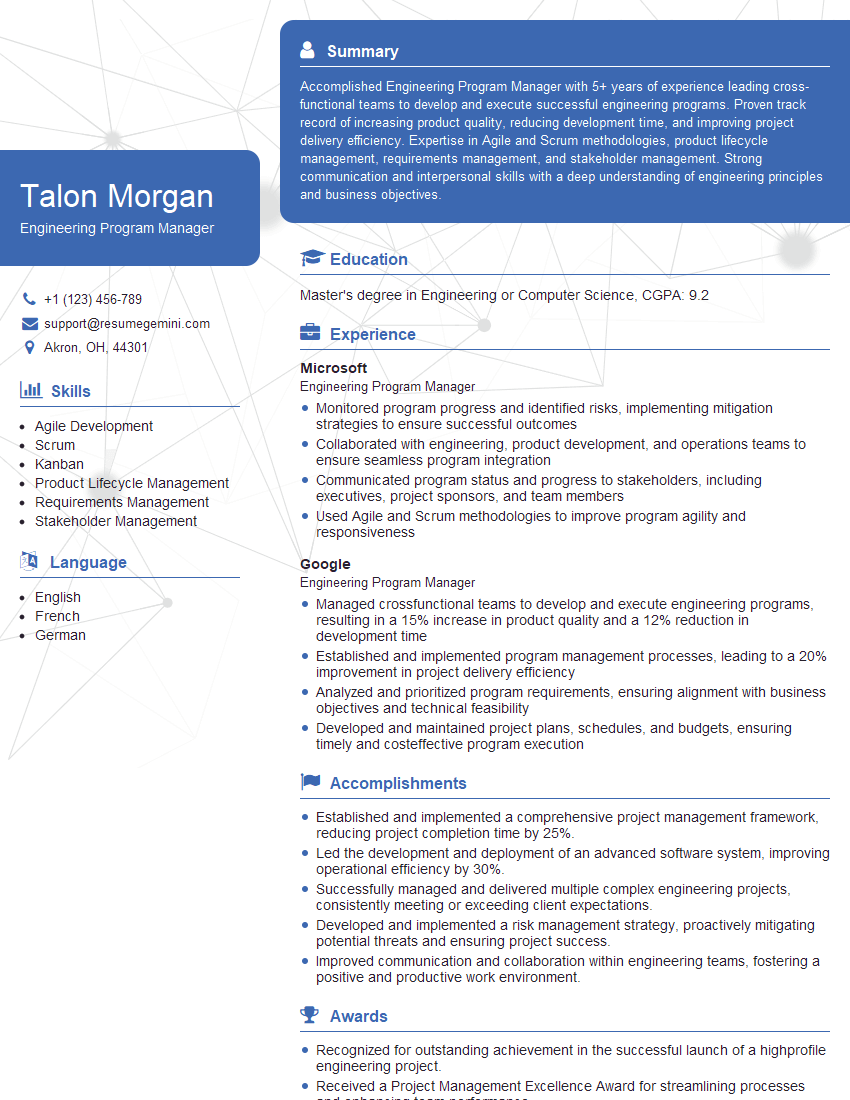
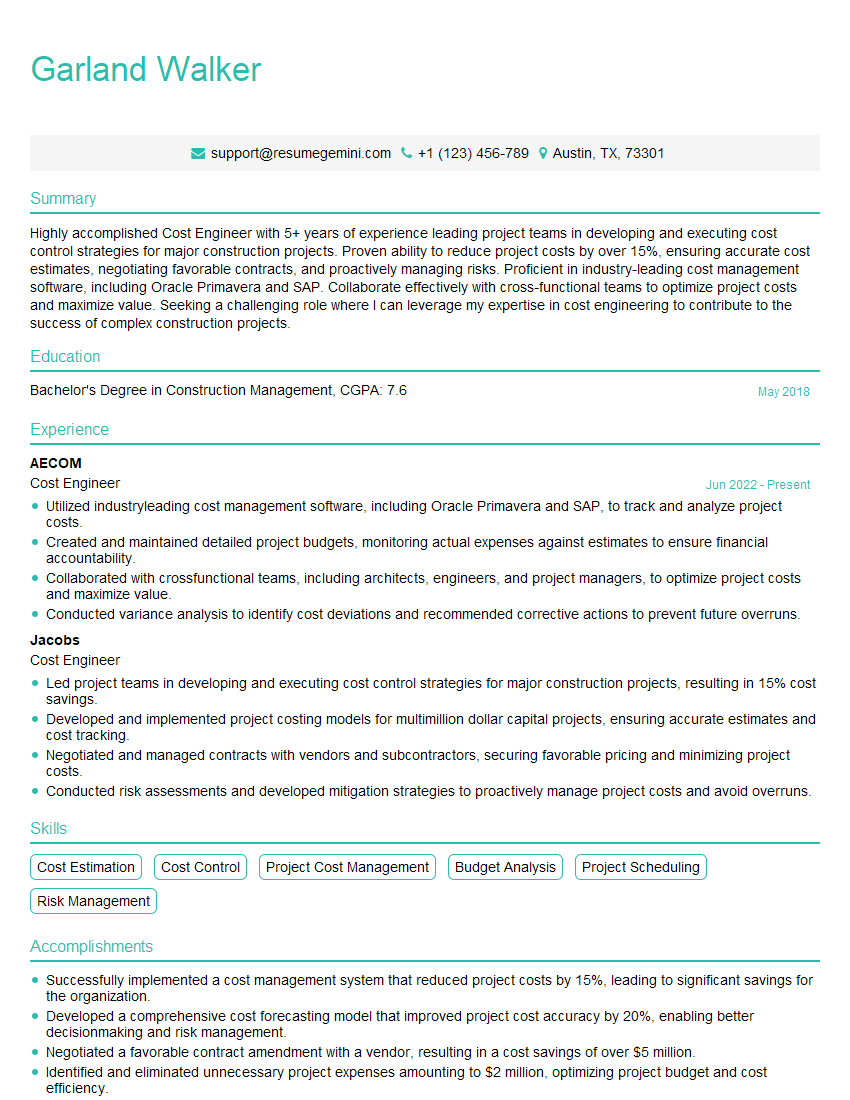
Mastering Engineering Budget Management is crucial for career advancement in engineering and project management. It demonstrates valuable skills in financial planning, resource allocation, and problem-solving – highly sought after by employers. To maximize your job prospects, crafting an ATS-friendly resume is essential. ResumeGemini is a trusted resource that can help you build a professional and impactful resume. We offer examples of resumes tailored to Engineering Budget Management to guide you through the process. Invest time in perfecting your resume – it’s your first impression with potential employers.
Explore more articles
Users Rating of Our Blogs
Share Your Experience
We value your feedback! Please rate our content and share your thoughts (optional).
What Readers Say About Our Blog
Very informative content, great job.
good