Unlock your full potential by mastering the most common Understanding of different musical instruments and their notation interview questions. This blog offers a deep dive into the critical topics, ensuring you’re not only prepared to answer but to excel. With these insights, you’ll approach your interview with clarity and confidence.
Questions Asked in Understanding of different musical instruments and their notation Interview
Q 1. Explain the difference between a major and minor key.
Major and minor keys are the fundamental building blocks of harmony in Western music. They differ primarily in their characteristic sound and emotional impact. A major key sounds bright, happy, and optimistic, while a minor key generally sounds darker, more melancholic, or even mysterious.
The difference lies in the intervals between the notes within the scale. A major scale is built using the intervals: whole step, whole step, half step, whole step, whole step, whole step, half step. A natural minor scale uses the intervals: whole step, half step, whole step, whole step, half step, whole step, whole step. This seemingly small difference in the arrangement of half and whole steps profoundly alters the overall feeling of the music. Think of a simple melody played in C major versus C minor – the change in the third note alone creates a vastly different emotional response.
For instance, a piece in C major (with notes C-D-E-F-G-A-B-C) will sound significantly brighter than the same melody in C minor (C-D-Eb-F-G-Ab-Bb-C). The lowered third (Eb instead of E) is the key distinguishing characteristic.
Q 2. Describe the function of a clef in musical notation.
A clef is a musical symbol placed at the beginning of a staff that indicates the pitch of the notes on that staff. It essentially serves as a reference point, telling the musician which line or space corresponds to which note. Without a clef, the notes on the staff would be meaningless.
The most common clefs are the treble clef (often called the ‘G clef’), the bass clef (the ‘F clef’), and the alto clef (sometimes used for viola or alto voice parts). The treble clef is typically used for higher-pitched instruments or voices, while the bass clef is used for lower-pitched ones. The position of the clef symbol on the staff determines the pitch of the notes.
Imagine a map – the clef is like the legend that tells you what each symbol represents. Without it, you wouldn’t know how to read the musical ‘landscape’.
Q 3. Identify the time signature 3/4 and explain its meaning.
The time signature 3/4 indicates that there are three beats per measure, and each beat is a quarter note. This is a common time signature for waltzes and other pieces with a moderate, flowing feel.
The top number (3) specifies the number of beats per measure. The bottom number (4) indicates that a quarter note gets one beat. Therefore, in a 3/4 time signature, three quarter notes would fill one measure of music. This rhythm often creates a gentle, swaying feel.
For example, imagine counting ‘one-two-three’ repeatedly. Each ‘one’, ‘two’, and ‘three’ would represent a quarter note in 3/4 time.
Q 4. What are the common symbols used to indicate dynamics in music?
Dynamics in music refer to the loudness or softness of the sound. Several symbols are used to indicate dynamic levels:
p(piano): softmp(mezzo piano): moderately softmf(mezzo forte): moderately loudf(forte): loudff(fortissimo): very loudppp(pianississimo): very, very softfff(fortississimo): extremely loudcresc.(crescendo): gradually getting louderdim.(diminuendo): gradually getting softer
These symbols provide instructions to the performer about how to shape the emotional expression and overall impact of the music. A composer might use a crescendo to build tension before a climax, or a diminuendo to create a sense of calm and resolution.
Q 5. How do you interpret articulation markings like staccato and legato?
Articulation markings specify how notes should be played regarding their length and attack. Staccato and legato are two of the most common articulation markings.
Staccato notes are short and detached. They are typically played with a short, crisp attack and a quick release. A dot placed above or below a note often indicates staccato. Think of a staccato note like a short, sharp punch.
Legato notes are connected and smooth. They are played without any noticeable gaps between them. A curved line (slur) connecting notes usually indicates legato. A legato phrase sounds fluid and flowing, like a smoothly flowing stream.
The difference between a staccato and legato passage can drastically alter the feeling of a piece. A staccato passage might sound playful or energetic, while a legato passage could create a feeling of serenity or romance.
Q 6. Explain the difference between a sharp and a flat.
Sharps and flats are symbols used to raise or lower the pitch of a note by a half step.
A sharp (#) raises the pitch of a note by a half step. For example, C# is a half step higher than C.
A flat (♭) lowers the pitch of a note by a half step. For example, Bb is a half step lower than B.
These symbols are crucial for building scales and chords beyond the basic diatonic scales. They help create different musical colors and moods. Think of them as adding spices to your musical dish, adding a little more flavour and intrigue.
Q 7. What are the different types of rests and how are they notated?
Rests represent silence in music. Different rests represent different durations of silence, corresponding to the note values they replace. Here are some common rests and their notations:
- Whole rest: Looks like a rectangle placed on the fourth line of the staff. Represents a whole note’s duration of silence.
- Half rest: A rectangle placed on the third line of the staff. Represents a half note’s duration of silence.
- Quarter rest: A filled-in rectangle with a stem pointing down. Represents a quarter note’s duration of silence.
- Eighth rest: A filled-in rectangle with a stem pointing down and a flag. Represents an eighth note’s duration of silence.
- Sixteenth rest: A filled-in rectangle with a stem pointing down and two flags. Represents a sixteenth note’s duration of silence.
Understanding rests is just as important as understanding note values. Silence is an integral part of musical expression, shaping the phrasing, rhythm, and overall character of a piece.
Q 8. How do you read and interpret a chord chart?
Reading a chord chart is fundamental for musicians, particularly those accompanying singers or other instrumentalists. A chord chart simplifies a musical score, showing only the chord symbols above the lyrics or melody line. Each symbol represents a chord, indicating the root note and its quality (major, minor, diminished, augmented, etc.).
For example, a ‘Cmaj7’ indicates a C major seventh chord, while ‘Am’ represents an A minor chord. The chart might also include information about rhythm (e.g., strumming patterns) and inversions. Interpreting a chord chart involves understanding the implied harmony and voicings. You’ll need to know how to build each chord from its root and then arrange the notes for a pleasing sound on your instrument.
Let’s say you see ‘G7’ followed by ‘Cmaj7’. You immediately know the progression is moving from a dominant seventh chord (G7) to a tonic major seventh chord (Cmaj7), a common cadence in many musical styles. This understanding allows you to play the correct chords and contribute meaningfully to the overall musical context. Proficiency involves being able to quickly identify chord symbols, understand their implications, and translate them into a practical performance.
Q 9. What are the characteristics of different musical periods (e.g., Baroque, Classical, Romantic)?
Different musical periods are characterized by distinct stylistic features, including harmony, melody, rhythm, form, and instrumentation. Let’s look at three prominent periods:
- Baroque (roughly 1600-1750): Characterized by elaborate ornamentation, complex counterpoint (multiple independent melodic lines), basso continuo (a continuous bass line supporting the harmony), and terraced dynamics (sudden shifts in volume). Composers like Bach and Handel exemplify this era. Think of the grandeur and intricate detail in a Bach fugue.
- Classical (roughly 1730-1820): Known for its clarity, balance, and formal structure. Homophonic texture (a single melody supported by chords) predominates. Forms like sonata form, symphony, and string quartet became standardized. Composers like Haydn, Mozart, and Beethoven represent this period. Their music often displays a sense of elegance and order.
- Romantic (roughly 1820-1900): Emphasized emotional expression, individualism, and expansive forms. Harmony became more chromatic (using notes outside the key), and dynamics were more nuanced. Larger orchestras and expressive melodies are hallmarks. Think of the passionate melodies of Chopin or the dramatic power of Wagner’s operas.
Understanding these periods allows musicians to appreciate the evolution of musical style and the specific elements that define each era.
Q 10. Describe the construction and function of a basic triad.
A triad is a three-note chord, the fundamental building block of harmony in Western music. Its construction involves stacking thirds. A third is an interval of three notes within a scale (e.g., C-E is a major third, C-Eb is a minor third).
To build a major triad, you stack a major third on top of a root, followed by a minor third. For example, a C major triad consists of C-E-G. A minor triad is built by stacking a minor third on the root, followed by a major third: C-Eb-G is a C minor triad. The function of a triad depends on its context within a musical piece. In a simple context, a major triad often sounds happy or stable, while a minor triad often sounds sad or unstable.
For example, in a C major scale, the C major triad (C-E-G) is the tonic chord, providing a sense of resolution and stability. The G major triad (G-B-D) is the dominant, creating tension that typically resolves to the tonic. Understanding the construction and function of triads is crucial for composing, improvising, and analyzing music.
Q 11. Explain the difference between a melodic and harmonic minor scale.
Both melodic and harmonic minor scales are based on the minor scale pattern, but they differ in the interval between the 6th and 7th degrees.
The natural minor scale (often referred to as harmonic or melodic when discussing the distinction) has a characteristic pattern of whole and half steps: W-H-W-W-H-W-W (where W represents a whole step and H represents a half step). However, the 7th degree of the natural minor scale is a whole step below the tonic, creating a potentially unstable sound.
The harmonic minor scale alters the 7th degree, raising it by a half step, making it a major seventh. This creates a stronger pull towards the tonic. The pattern is: W-H-W-W-H-WH-H. This added tension-resolution is often exploited in compositions.
The melodic minor scale has two forms: ascending and descending. In the ascending form, both the 6th and 7th degrees are raised by a half step, creating a smoother and more major-like sound as the scale ascends. The descending form usually reverts to the natural minor scale. This makes the melodic minor more suitable for melodic lines.
The choice between these scales significantly affects the mood and harmonic possibilities within a composition.
Q 12. Identify the different types of musical textures (e.g., monophonic, homophonic, polyphonic).
Musical texture describes the way different musical lines or voices interact. The primary categories are:
- Monophonic: A single melodic line without harmonic accompaniment. Think of a Gregorian chant or a single-line melody on a flute. It’s the simplest texture.
- Homophonic: A single melody supported by chords. This is the most common texture in popular music and many classical works. A singer accompanied by a piano or guitar is homophonic.
- Polyphonic: Two or more independent melodic lines of equal importance sounding simultaneously. Fugues and canons are prime examples of polyphonic texture. Think of the intricate interplay of voices in a Bach fugue.
Beyond these main categories, textures can be combined and layered to create rich and complex musical experiences. Understanding texture is crucial for analyzing and appreciating musical works, particularly the way composers create and shape musical ideas.
Q 13. How do you decipher a complex musical score?
Deciphering a complex musical score requires a systematic approach. It’s like solving a puzzle, piecing together different elements to understand the composer’s intentions.
Step-by-step process:
- Identify the key signature and time signature: This provides the foundational context for understanding the harmonies and rhythms.
- Analyze the individual parts: Examine each instrument or voice separately to understand its melodic contour, rhythm, and role within the overall composition.
- Identify the harmonic progression: Analyze the chord changes to understand the harmonic structure and emotional flow.
- Interpret the dynamics and articulation markings: These provide crucial information about the expressiveness and phrasing of the music.
- Consider the form and structure: Many classical pieces follow established forms (e.g., sonata form, rondo form) which provide a framework for understanding the overall architecture.
- Listen to a recording (if available): Hearing a performance can greatly aid understanding.
Practice and experience are key. The more scores you analyze, the more proficient you’ll become at deciphering complex musical language.
Q 14. What software or programs are you proficient in for music notation?
I am proficient in several music notation software programs, including:
- Sibelius: A powerful and versatile program for creating professional-quality scores. Its features include advanced notation capabilities, scoring tools, and playback functionalities.
- Finale: Another industry-standard notation software, similar to Sibelius in its capabilities, offering robust tools for composing, arranging, and engraving scores.
- MuseScore: A free and open-source alternative that provides a user-friendly interface while still offering a wide range of features for creating and editing musical scores.
My experience with these programs extends to creating scores for various ensembles and instruments, including orchestral scores, chamber music, and solo works. My proficiency in these programs allows me to seamlessly translate musical ideas into written notation and vice versa.
Q 15. Describe your experience with transcribing music from audio to notation.
Transcribing music from audio to notation is a meticulous process requiring a strong musical ear and familiarity with various musical styles and instrument timbres. It involves listening repeatedly to the audio recording, identifying pitches, rhythms, and articulations, and then representing them accurately on musical staff paper or using notation software. I use a combination of software like Sibelius or MuseScore, along with careful listening using headphones and often slow-motion playback to capture subtle nuances.
My process typically involves:
- Initial Analysis: Determining the key, time signature, and overall structure of the piece.
- Pitch Recognition: Accurately notating the melody and harmony using my knowledge of intervals and chord progressions. I might use a pitch detection tool as a guide, but I always verify and refine the results manually.
- Rhythm Transcription: Capturing the rhythmic patterns, including rests and syncopation, precisely. This often requires slowing the audio down significantly.
- Articulation and Dynamics: Notating dynamics (e.g., piano, forte) and articulation markings (e.g., legato, staccato) to reflect the expressive qualities of the performance. These details often require careful listening and understanding of the musical context.
- Final Review and Editing: A thorough review and proofreading of the transcribed notation to ensure accuracy and musicality. This often involves several listening iterations and revisions.
For example, I recently transcribed a solo piano improvisation. This required intense focus on identifying intricate rhythmic patterns and rapidly shifting harmonies. The experience not only resulted in accurate notation but also sharpened my skills in perceiving musical nuances.
Career Expert Tips:
- Ace those interviews! Prepare effectively by reviewing the Top 50 Most Common Interview Questions on ResumeGemini.
- Navigate your job search with confidence! Explore a wide range of Career Tips on ResumeGemini. Learn about common challenges and recommendations to overcome them.
- Craft the perfect resume! Master the Art of Resume Writing with ResumeGemini’s guide. Showcase your unique qualifications and achievements effectively.
- Don’t miss out on holiday savings! Build your dream resume with ResumeGemini’s ATS optimized templates.
Q 16. Explain your understanding of different musical forms (e.g., sonata form, rondo form).
Musical forms provide a blueprint for structuring musical compositions. They define the order and repetition of thematic material, creating a sense of unity and coherence. Two common forms are Sonata Form and Rondo Form.
Sonata Form: Typically used in instrumental movements, it consists of three sections: Exposition (presentation of two contrasting themes), Development (exploration and transformation of themes), and Recapitulation (return of themes, often in the tonic key).
Example: Many of Beethoven’s piano sonatas utilize sonata form, exhibiting a clear structural pattern and thematic interplay.
Rondo Form: Characterized by a recurring main theme (A) alternating with contrasting episodes (B, C, etc.). The main theme returns several times, providing a sense of familiarity and stability amidst the contrasting sections.
Example: Mozart’s numerous piano sonatas often incorporate rondo form, creating a lively and memorable structure.
Other common forms include Theme and Variations, Fugue, and Binary Form. Understanding these forms is crucial for analyzing, interpreting, and even composing music. It allows one to grasp the composer’s overall design and the relationships between different sections of the work.
Q 17. How do you approach teaching or explaining complex musical concepts to beginners?
Teaching complex musical concepts to beginners requires patience, creativity, and a deep understanding of pedagogical principles. I focus on building a strong foundation before tackling more challenging topics.
- Start with the Basics: Begin with fundamental concepts like rhythm, pitch, and basic notation before introducing more complex elements such as harmony or counterpoint.
- Use Analogies and Real-World Examples: To make abstract concepts more concrete, I employ analogies that relate to the students’ experiences. For instance, rhythm can be compared to the beat of a heart or the regular ticking of a clock.
- Hands-on Activities and Games: Incorporating interactive activities and games helps to make learning more engaging and memorable. Rhythm games, ear-training exercises, and collaborative composition projects are all effective tools.
- Progressive Learning: Break down complex concepts into smaller, more manageable steps. Start with the simplest elements and gradually introduce more complex layers. Regular assessment and feedback are essential to monitor progress.
- Individualized Approach: Recognizing that students learn at different paces and have different learning styles, I adapt my teaching methodology to suit individual needs. Some students respond well to visual aids, while others benefit from kinesthetic learning.
For example, when explaining harmony, I might begin with simple triads played on a piano before moving on to more intricate chord progressions. I always encourage experimentation and exploration, fostering a sense of ownership and discovery in the learning process.
Q 18. What are the different families of orchestral instruments?
The modern orchestra is typically divided into four families of instruments: strings, woodwinds, brass, and percussion.
- Strings: Violins (1st and 2nd), violas, cellos, and double basses. These instruments produce sound through the vibration of strings.
- Woodwinds: Flutes, oboes, clarinets, bassoons, and saxophones. They primarily use a vibrating column of air within a tube to produce sound, though some, like saxophones, use a reed.
- Brass: Trumpets, French horns, trombones, tubas, and euphoniums. These use a vibrating column of air within a tube, but the vibration is initiated by buzzing the player’s lips.
- Percussion: A diverse group encompassing instruments that produce sound through being struck, shaken, or scraped. Examples include timpani (kettledrums), snare drums, cymbals, xylophones, and marimbas.
Each family has its own unique sonic characteristics, and the interplay between these families contributes significantly to the overall sound and texture of an orchestral piece.
Q 19. Describe the range and timbre of different woodwind instruments.
Woodwind instruments are characterized by their wide range of timbres and tonal colors. The range and timbre vary significantly between different woodwind instruments.
- Flute: Typically has a bright, clear, and relatively high range, spanning several octaves. Its timbre is generally described as airy and ethereal.
- Oboe: Possesses a rich, somewhat nasal and mellow timbre, with a mid-range that often provides a lyrical and expressive quality.
- Clarinet: Known for its versatile and expressive timbre, capable of both a bright, lyrical tone and a darker, more somber sound, ranging from low bass notes to high register.
- Bassoon: Has a lower range than the other woodwinds, offering a warm, mellow, and often humorous or slightly rustic quality.
- Saxophone: A comparatively newer addition to the orchestra, it boasts a rich, powerful, and jazzy character; its range varies across different saxophone types (soprano, alto, tenor, baritone).
The specific timbre of each instrument is influenced by factors such as the material of the instrument, its construction, and the player’s technique.
Q 20. Describe the range and timbre of different brass instruments.
Brass instruments are known for their powerful sound and wide dynamic range. The range and timbre of brass instruments are largely determined by their size and shape.
- Trumpet: Has a brilliant, penetrating tone with a relatively high range. Its timbre can be described as bright, assertive, and powerful.
- French Horn: Characterized by a mellow, warm, and somewhat mysterious tone, capable of subtle nuances and a wide dynamic range.
- Trombone: Produces a rich, full-bodied sound, with a wide range and expressive capabilities. Its timbre can be warm and mellow or bold and powerful, depending on the technique.
- Tuba: The lowest-pitched brass instrument, characterized by its deep, resonant tone. Its timbre can be majestic and powerful or soft and subtle.
- Euphonium: A lower-pitched brass instrument with a mellower and richer timbre than the trumpet, often used for more lyrical melodies.
The timbre of brass instruments can be further modified by the use of mutes, which alter the sound’s resonance and character.
Q 21. Describe the range and timbre of different string instruments.
String instruments produce sound through the vibration of their strings, offering a diverse range of timbres and expressive capabilities. Their range and timbre vary considerably depending on the instrument’s size and construction.
- Violin: Known for its bright, clear, and versatile tone, it has a wide range spanning several octaves, able to produce both delicate and powerful sounds.
- Viola: Slightly larger than the violin, it possesses a richer, warmer, and more somber timbre, often described as having a more introspective quality.
- Cello: A larger instrument with a lower range than the violin or viola, it offers a wide range of expressive possibilities, from lyrical melodies to rich, powerful bass lines.
- Double Bass: The largest and lowest-pitched string instrument, it provides a deep, resonant tone forming the foundation of the string section’s sound.
The timbre of string instruments can be modified using various bowing techniques, affecting the intensity, articulation, and overall character of the sound. The choice of strings also slightly affects the sound produced.
Q 22. Describe the range and timbre of different percussion instruments.
The range and timbre of percussion instruments are incredibly diverse, varying wildly depending on the instrument’s material, size, and playing technique. Think of it like this: a tiny triangle has a much higher pitch and thinner, more delicate sound than a massive bass drum, which booms at a very low frequency with a rich, resonant timbre.
- High Range & Bright Timbre: Instruments like the triangle, cymbals (especially high-hats and crash cymbals), and woodblocks produce high-pitched sounds with a bright, shimmering, or metallic quality. Their range is typically limited, but their impact is significant.
- Mid-Range & Varied Timbre: Instruments like snare drums, tom-toms, and bongos occupy a middle range. Their timbre is diverse; snare drums can be crisp and snappy or warm and resonant, depending on the drumhead and playing style. Tom-toms and bongos offer a wider variety of tones and pitches depending on their size and construction.
- Low Range & Deep Timbre: Bass drums, timpani (kettledrums), and large gongs generate deep, low-frequency sounds with a full, resonant, or booming timbre. Their range is generally limited to the low end of the frequency spectrum, but they provide crucial rhythmic and harmonic depth.
- Indeterminate Pitch: Many percussion instruments, like most cymbals, woodblocks, and shakers, are considered to have indeterminate pitch. This means their sound doesn’t correspond directly to a specific note on a musical staff. Instead, their sonic character contributes to the overall texture and atmosphere of the music.
Understanding the range and timbre of percussion instruments is critical for orchestrating and arranging music, ensuring a balanced and effective sonic landscape.
Q 23. Explain the difference between standard notation and tablature.
Standard notation and tablature are two distinct systems for representing musical information. Standard notation, using a staff, notes, clefs, and other symbols, represents pitch and rhythm precisely. Tablature, or ‘tab,’ simplifies the notation process, particularly for fretted instruments like guitars, basses, and some other string instruments. It focuses on the finger positions on the instrument’s fretboard, rather than directly representing pitch.
Standard Notation uses a five-line staff, with notes placed on the lines and spaces to represent pitch. Rhythm is indicated by note values (whole, half, quarter, etc.) and rests. It’s versatile and can accurately depict the music for virtually any instrument.
Tablature, on the other hand, usually consists of multiple horizontal lines representing strings (or voices, in the case of some lute tablatures). Numbers on these lines indicate the fret to be pressed, and placement indicates rhythm. It is highly specific to the instrument and doesn’t show dynamics, articulation, or other expressive elements as comprehensively as standard notation.
For example, a C major chord in standard notation might be written as three notes on the staff, each with its pitch clearly defined. In guitar tablature, the same chord might be represented simply as ‘x32010’, indicating the frets to be pressed on each string.
The choice between standard notation and tablature depends on the instrument, the level of musical detail required, and the musician’s familiarity with the notation systems. Many musicians use both, leveraging the strengths of each system.
Q 24. Describe your experience with different types of music notation software.
Throughout my career, I’ve worked extensively with various music notation software packages, each with its strengths and weaknesses. My experience includes:
- Sibelius: A powerful and industry-standard software known for its precision and advanced features. I’ve used Sibelius to create complex orchestral scores, chamber music arrangements, and solo pieces, utilizing its extensive libraries and customization options. Its capabilities in engraving are exceptional, enabling creation of professional-quality printed scores.
- Finale: Another widely used software package, Finale offers a comprehensive suite of tools for music notation and composition. I find its workflow intuitive, and its extensive plugin support increases functionality. I’ve particularly appreciated its score-printing features and its ability to handle large, complex scores with ease.
- MuseScore: This open-source option is a great choice for accessibility. It’s powerful enough for many projects while being more user-friendly and cost-effective for beginners. I’ve used it for personal projects and to create scores for educational purposes, highlighting its value for budget-conscious users and educators.
My experience allows me to adapt quickly to various notation software and choose the best tool for each specific project based on its requirements and budget.
Q 25. How do you handle inconsistencies or errors in a musical score?
Inconsistencies and errors in musical scores are a common challenge. My approach involves a methodical process:
- Identification: Carefully review the score, identifying any discrepancies in notation, rhythm, or phrasing. This often involves playing the music and listening for anomalies that might not be immediately apparent visually.
- Analysis: Determine the nature of the error. Is it a simple typographical error, a notational inconsistency, or a more substantial flaw in the musical structure?
- Contextualization: Consider the musical context. Is the error isolated, or part of a larger pattern? This helps decide on the best method for correction, potentially involving consultation of the composer’s intentions if available.
- Research: If the error is difficult to resolve, additional research may be needed. This might involve comparing with recordings, consulting other editions of the piece, or searching for scholarly analyses of the work.
- Correction: Make the necessary changes, ensuring consistency and maintaining the integrity of the musical structure. Documentation of changes is crucial for transparency.
Handling inconsistencies requires a combination of technical skill, musical knowledge, and meticulous attention to detail. A deep understanding of music theory and composition greatly assists in resolving these challenges.
Q 26. Describe your approach to editing and correcting a musical score.
Editing and correcting a musical score is a process that demands precision and a deep understanding of musical structure. My approach is iterative and incorporates the following steps:
- Preparation: Begin by carefully reviewing the score, identifying areas needing attention. Make notes on required changes; a printed copy with annotations can be invaluable.
- Proofreading: Perform thorough proofreading, checking for obvious errors such as wrong notes, incorrect rhythms, and missing rests. Consider using software’s spell-check and find-replace functions to aid efficiency.
- Structural Review: Analyze the overall structure of the piece. Ensure logical flow, correct harmonic progressions, and well-balanced phrasing. This often involves playing through the piece to identify any inconsistencies that aren’t visually obvious.
- Refining the Notation: Correct any issues with note spacing, slurring, articulation markings, and dynamic markings. Ensure the score meets professional standards for layout and readability.
- Final Review: Perform a final review, including playtesting, to verify the correctness of the edited score. Seek feedback from others if possible; a fresh pair of eyes can catch subtle errors.
Throughout the process, it’s crucial to maintain a backup of the original score to revert to if needed, and to meticulously document any edits made.
Q 27. How familiar are you with copyright laws concerning musical works?
I am very familiar with copyright laws concerning musical works. I understand that musical compositions, including their arrangements and recordings, are protected by copyright, granting the copyright holder exclusive rights to reproduce, distribute, perform, and display the work. This protection extends to both published and unpublished works. Unauthorized use constitutes copyright infringement and carries significant legal consequences.
My understanding includes knowledge of:
- Copyright ownership: Typically held by the composer or arranger, though this can be transferred through assignment or licensing agreements.
- Duration of copyright: The duration varies depending on jurisdiction and the date of publication.
- Fair use exceptions: Specific limited uses that may be permissible without permission, such as criticism, commentary, news reporting, and teaching. However, these exceptions are strictly defined and must be carefully considered.
- Licensing: Obtaining permission through licensing agreements to use copyrighted material, often involving payment of royalties or fees.
I always adhere to copyright laws in my professional work, ensuring that any use of copyrighted material is either properly licensed or falls under a recognized exception. I am diligent about source attribution and always obtain necessary permissions before using any protected material in my projects.
Q 28. How do you ensure accuracy and detail in your music notation work?
Ensuring accuracy and detail in music notation work requires a multi-faceted approach. It’s not just about correct notes; it’s about accurately conveying the composer’s intentions and creating a readable, professional product:
- Meticulous Attention to Detail: This is paramount. I double- and triple-check every detail, from note values and rests to articulation marks and dynamics. Regular proofreading and playtesting are integral.
- Deep Musical Understanding: A thorough understanding of music theory, harmony, counterpoint, and form is essential to identify potential inconsistencies or errors. Knowing the context behind the music is important for interpretation and accurate representation.
- Technical Proficiency: Proficiency in music notation software is crucial. The software is just a tool, but skilled use optimizes workflow and minimizes errors. Understanding advanced features—such as custom palettes and scripting—enhances accuracy and efficiency.
- Collaboration: When appropriate, collaborating with performers, conductors, or other musicians provides valuable feedback and helps to identify areas that need improvement.
- Standard Practices: Adhering to industry standards and guidelines for notation ensures consistency, readability, and professional presentation of the finished score. This includes using appropriate fonts, spacing, and layout conventions.
By combining these approaches, I strive to produce meticulously accurate and detailed music notation, reflecting the highest standards of professionalism.
Key Topics to Learn for Understanding of Different Musical Instruments and Their Notation Interview
- Instrument Families: A thorough understanding of the major instrument families (strings, woodwinds, brass, percussion, keyboards) and their unique characteristics, including sound production mechanisms and common playing techniques.
- Music Notation Basics: Mastering the fundamentals of musical notation, including clefs, key signatures, time signatures, note values, rests, and accidentals. Practice reading and writing simple melodies in different keys.
- Specific Instrument Notation: Deep dive into the notation specific to instruments you’re most familiar with. This includes understanding any unique symbols or conventions used for those instruments (e.g., tablature for guitar, specific articulations for wind instruments).
- Transposition: Develop a solid understanding of transposition and how it applies to different instruments. Be prepared to discuss how to transpose melodies between instruments in different keys.
- Rhythm and Meter: Demonstrate a strong understanding of rhythm and meter, including complex rhythmic patterns and syncopation. Practice analyzing and performing rhythmically challenging passages.
- Harmony and Theory: A foundational understanding of basic music theory, including scales, chords, and chord progressions, is crucial. Be able to apply this knowledge to analyze musical scores and understand the harmonic structure of pieces.
- Practical Application: Be prepared to discuss practical applications of your knowledge, such as arranging music for different instrument combinations, transcribing music from audio, or analyzing the musical characteristics of different compositions.
- Problem-Solving: Practice analyzing musical excerpts, identifying potential challenges in performance or notation, and proposing solutions. This might involve understanding rhythmic ambiguities, interpreting complex harmonic progressions, or suggesting appropriate fingerings or articulations.
Next Steps
Mastering the understanding of different musical instruments and their notation is vital for career advancement in various music-related fields, enhancing your ability to collaborate effectively with musicians, analyze musical scores, and contribute creatively to musical projects. To significantly increase your job prospects, create a compelling and ATS-friendly resume that highlights your skills and experience. ResumeGemini is a trusted resource to help you build a professional resume that stands out. ResumeGemini provides examples of resumes tailored to roles requiring a deep understanding of different musical instruments and their notation, helping you showcase your expertise effectively.

Music Publisher Resume Sample
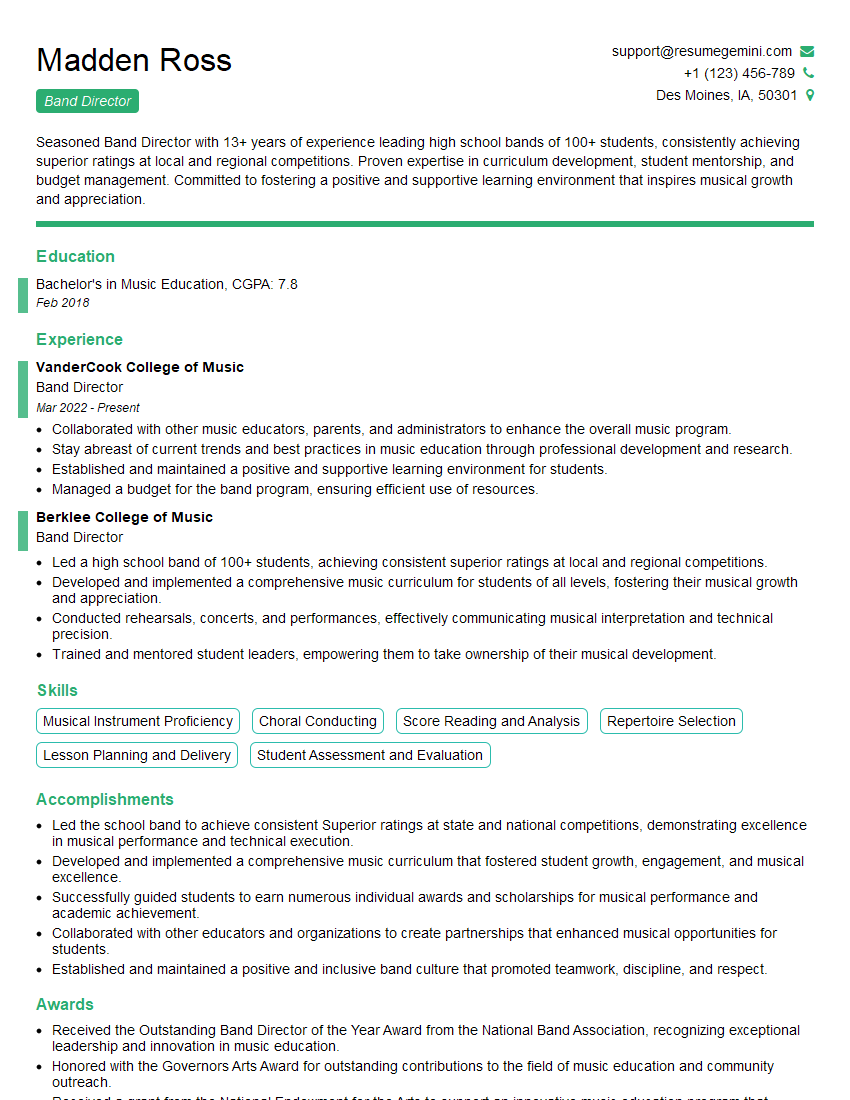
Band Director Resume Sample
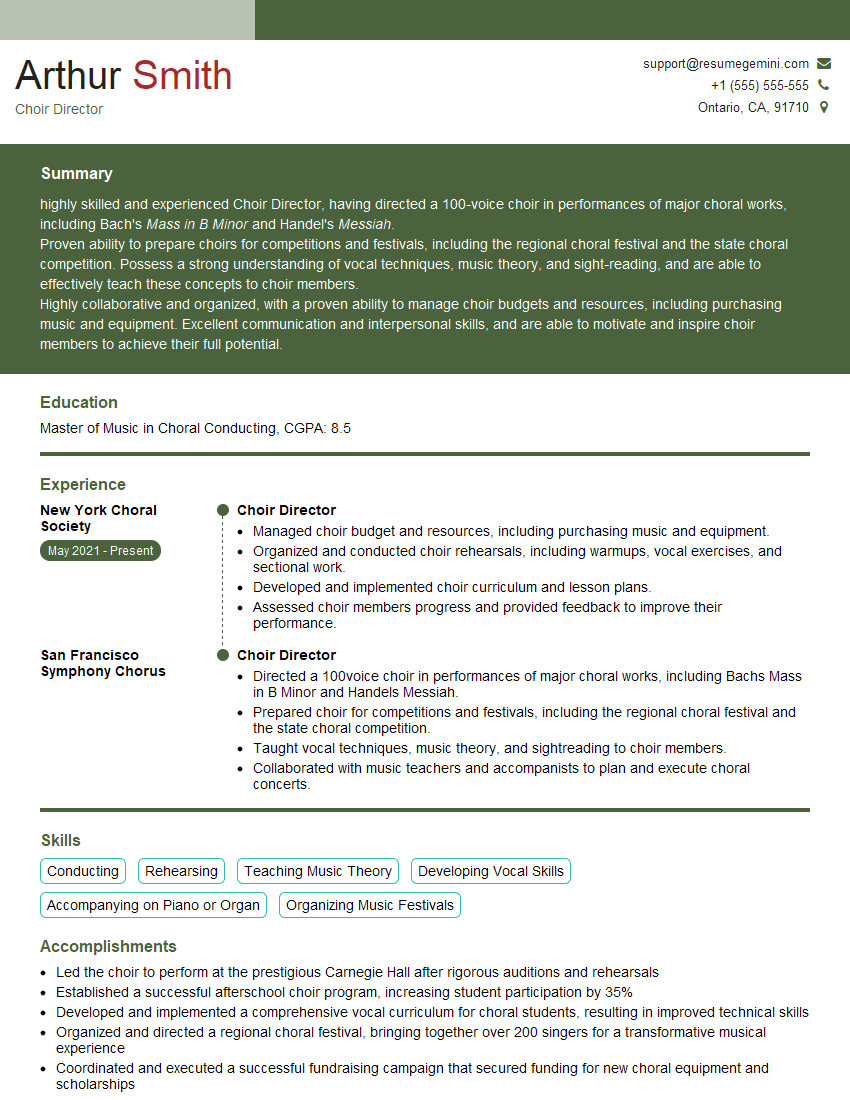
Choir Director Resume Sample
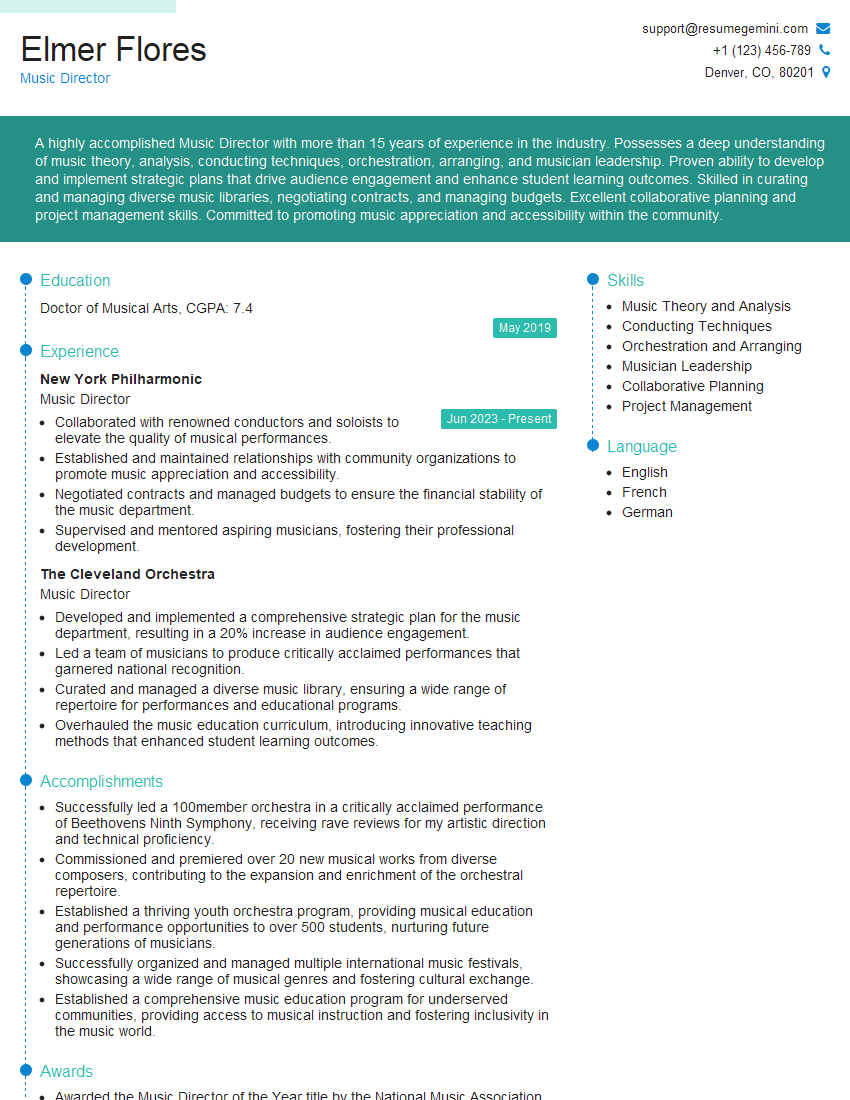
Music Director Resume Sample

Music Instructor Resume Sample

Music Teacher Resume Sample
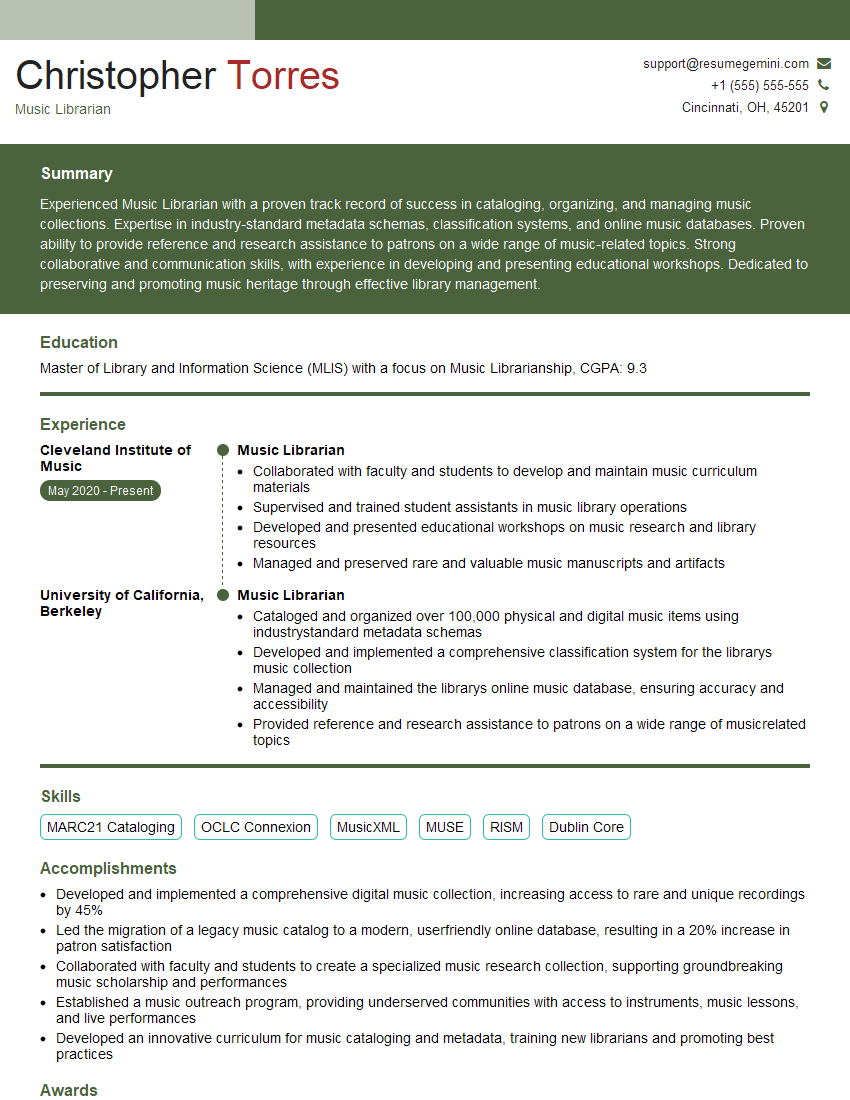
Music Librarian Resume Sample
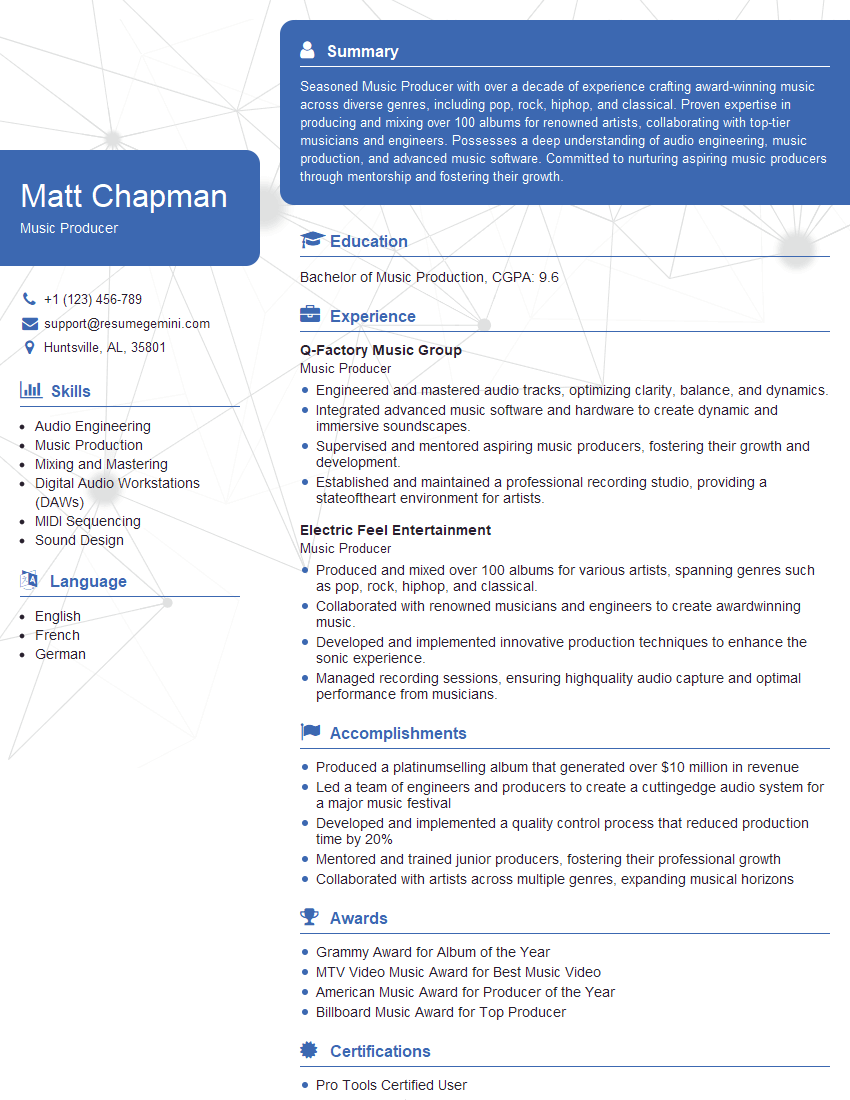
Music Producer Resume Sample
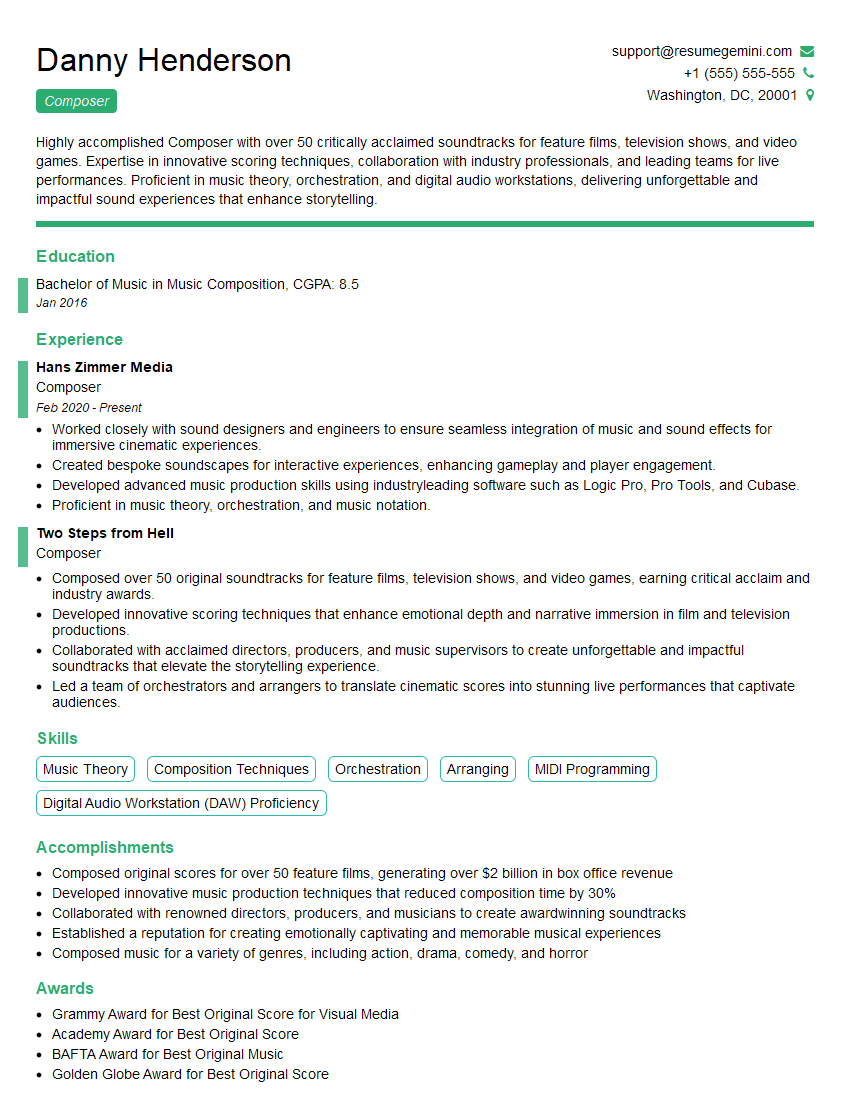
Composer Resume Sample
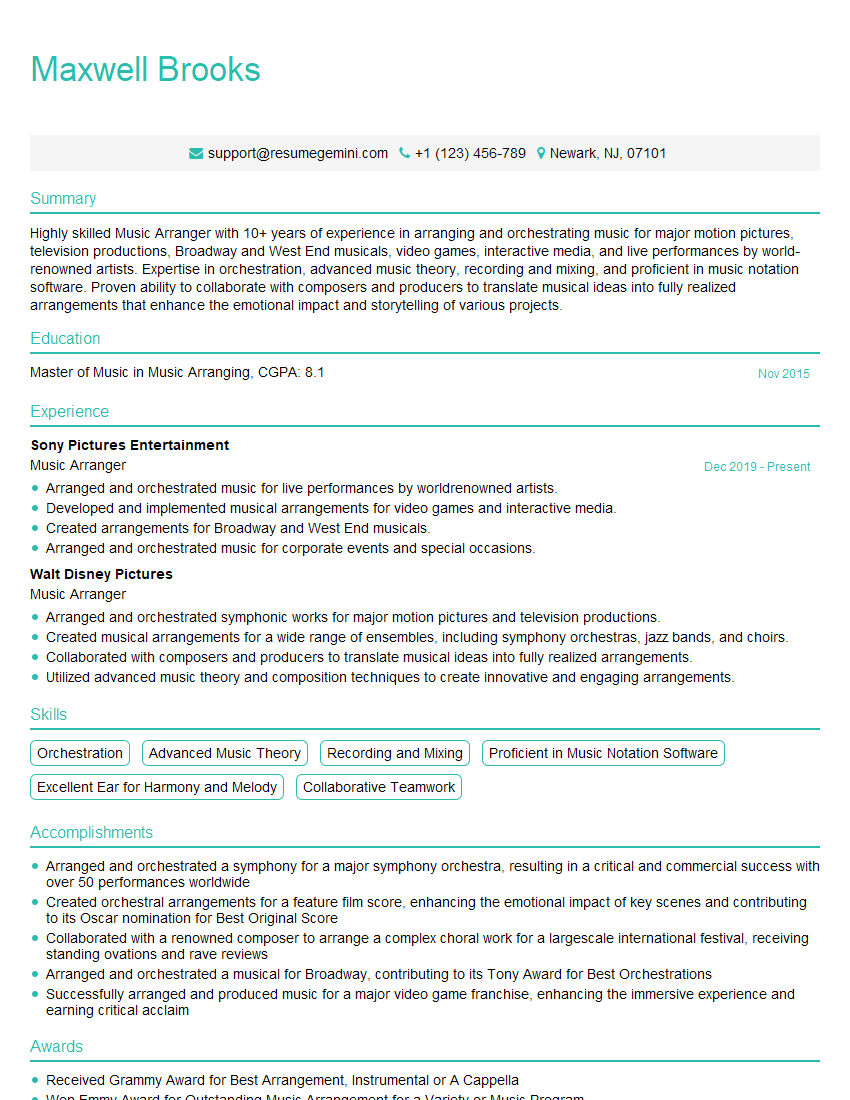
Music Arranger Resume Sample
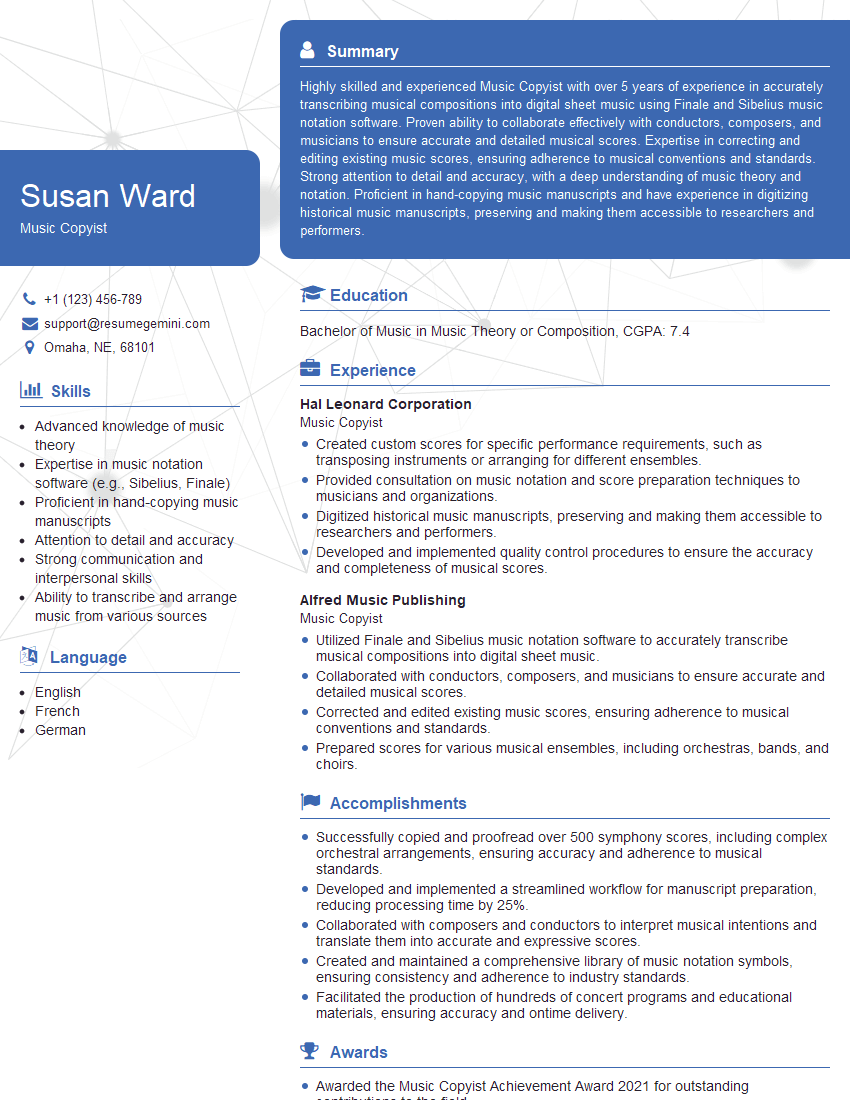
Music Copyist Resume Sample

Sound Engineer Resume Sample
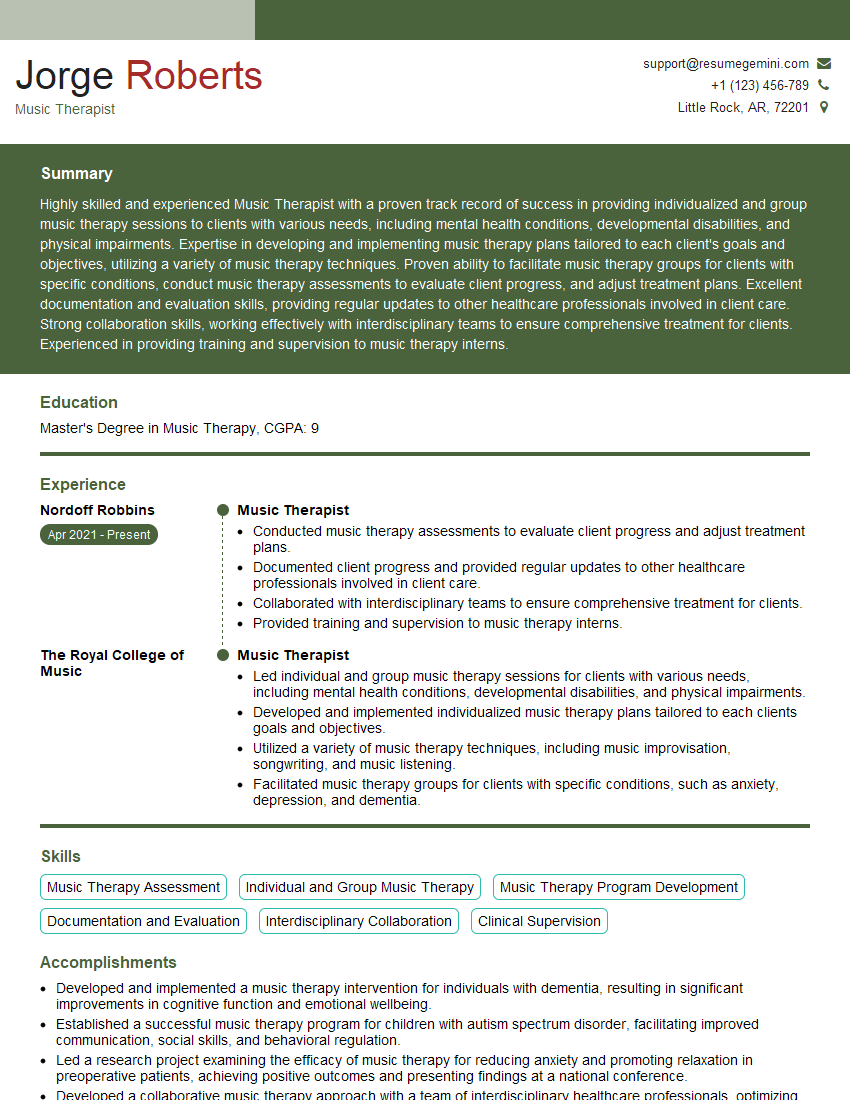
Music Therapist Resume Sample
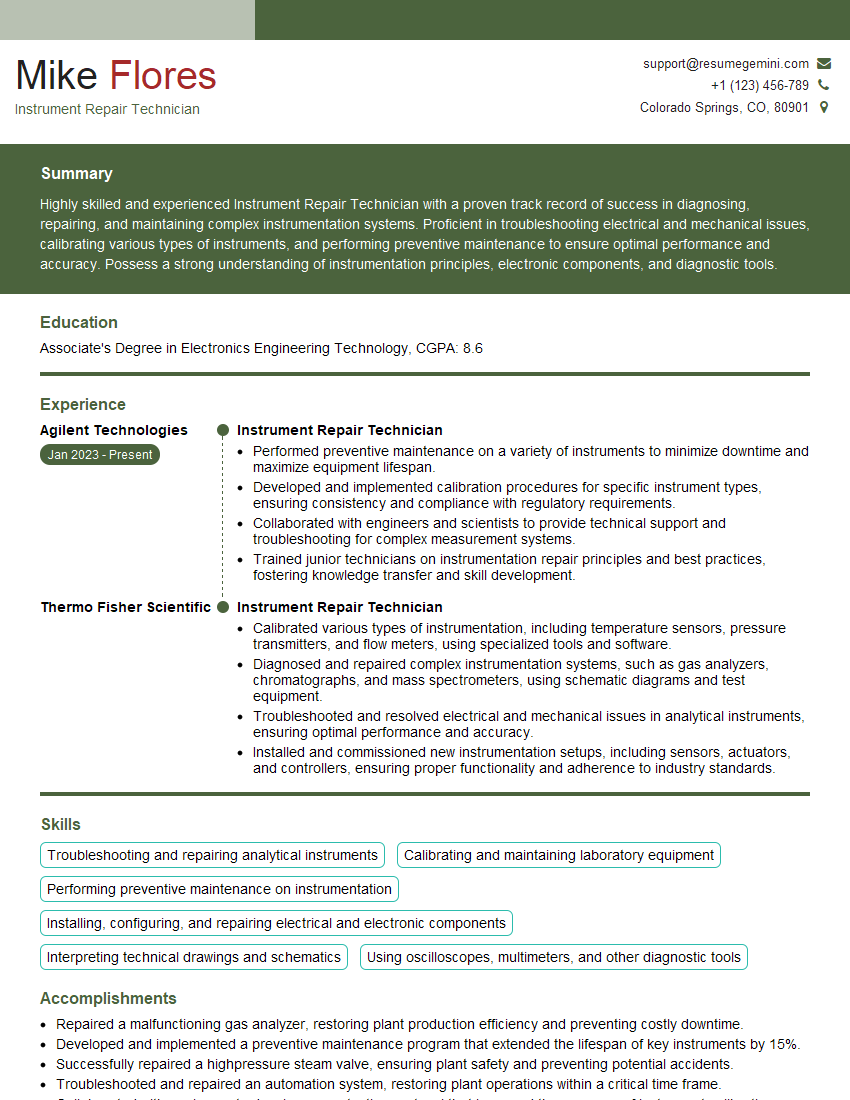
Instrument Repair Technician Resume Sample
Explore more articles
Users Rating of Our Blogs
Share Your Experience
We value your feedback! Please rate our content and share your thoughts (optional).
What Readers Say About Our Blog
Very informative content, great job.
good