The right preparation can turn an interview into an opportunity to showcase your expertise. This guide to Thermal Solar System Design interview questions is your ultimate resource, providing key insights and tips to help you ace your responses and stand out as a top candidate.
Questions Asked in Thermal Solar System Design Interview
Q 1. Explain the different types of thermal solar collectors.
Thermal solar collectors are devices that absorb solar radiation and convert it into heat. There are several types, each with its own design and applications. The main categories are:
- Flat-Plate Collectors: These are the most common type, consisting of a flat absorber plate covered with a transparent glazing material (usually glass). They’re relatively simple and inexpensive, suitable for lower temperature applications like domestic hot water heating. Think of them as a simple, insulated box that traps the sun’s heat.
- Evacuated Tube Collectors: These collectors use individual glass tubes under vacuum. The vacuum significantly reduces heat loss, allowing for higher operating temperatures and efficiency, even in colder climates. They’re more expensive than flat-plate collectors but offer superior performance.
- Concentrating Collectors: These collectors use mirrors or lenses to concentrate sunlight onto a smaller receiver, achieving much higher temperatures. They are categorized further into parabolic trough, linear Fresnel, and parabolic dish collectors, each with its unique geometry and application.
The choice of collector depends on factors like the application’s temperature requirements, climate, budget, and available space.
Q 2. Describe the working principle of a parabolic trough solar collector.
A parabolic trough collector uses a parabolic-shaped mirror to focus sunlight onto a receiver tube running along the focal line. The receiver tube, typically containing a heat transfer fluid (like oil or molten salt), absorbs the concentrated solar radiation and heats up. This heated fluid is then circulated to a storage tank or heat exchanger to provide heat for various applications.
Imagine a satellite dish, but instead of receiving radio waves, it focuses sunlight onto a central pipe. The sun’s rays, reflected by the parabolic mirror, are concentrated onto a small area, significantly increasing the temperature in the receiver tube.
The system usually incorporates a tracking mechanism to ensure that the mirrors continuously follow the sun’s movement across the sky, maximizing solar energy collection throughout the day.
Q 3. What are the advantages and disadvantages of using evacuated tube collectors?
Evacuated tube collectors offer several advantages but also have some disadvantages:
- Advantages:
- High Efficiency: The vacuum significantly reduces heat loss, leading to higher efficiencies even at lower ambient temperatures.
- Higher Operating Temperatures: They can achieve higher temperatures compared to flat-plate collectors, making them suitable for higher-temperature applications.
- Durability: The individual tubes are relatively resistant to damage from hail or wind.
- Disadvantages:
- Higher Cost: They are significantly more expensive than flat-plate collectors.
- Fragility: The tubes can be fragile and prone to breakage if mishandled.
- Maintenance: While generally low-maintenance, individual tube replacement can be necessary if damaged.
For example, a system installed in a cold climate might justify the higher cost of evacuated tubes due to their improved efficiency in low-temperature conditions.
Q 4. How do you calculate the thermal efficiency of a solar thermal system?
The thermal efficiency of a solar thermal system is calculated by comparing the useful heat output to the total solar energy incident on the collector. The formula is:
η = Qu / (Ac * Gt)
where:
ηis the thermal efficiencyQuis the useful heat output (e.g., in kW or kWh)Acis the collector area (e.g., in m²)Gtis the total solar irradiance on the collector plane (e.g., in W/m² or kWh/m²/day)
The efficiency is typically expressed as a percentage. Several factors influence the thermal efficiency, including solar irradiance, ambient temperature, collector type, and fluid flow rate. Detailed thermal modeling software often incorporates these factors for more accurate estimations in specific scenarios. For example, you might use this equation to compare the performance of different collectors under identical conditions.
Q 5. Explain the concept of thermal stratification in storage tanks.
Thermal stratification in a storage tank refers to the temperature gradient within the tank. Hotter water tends to stay at the top, while cooler water settles at the bottom. This natural layering can improve system efficiency by providing readily available hot water. However, it also presents challenges in maintaining consistent temperature across the entire storage volume.
Think of it like a layered cake. The top layers are the hottest, and as you go down, the temperature gradually decreases. This stratification is beneficial because you draw the hottest water from the top, maintaining a higher average output temperature for longer periods.
Proper tank design and potentially internal baffles help to enhance or control this stratification for optimal performance.
Q 6. What are the different types of thermal storage systems?
Thermal storage systems are crucial for storing solar thermal energy collected during the day for use when the sun isn’t shining or demand is high. The main types include:
- Sensible Heat Storage: This is the most common type, using the heat capacity of a material (like water, rocks, or molten salt) to store heat. Water is commonly used for domestic hot water systems, while molten salt is preferred for large-scale solar thermal power plants.
- Latent Heat Storage: This type utilizes phase-change materials (PCMs) that absorb heat as they change phase (e.g., from solid to liquid). PCMs offer high energy density but often have limitations regarding cycle life and cost.
- Thermochemical Storage: This more advanced method stores energy by chemical reactions that absorb or release heat. While offering high energy density, it’s currently less mature than other storage technologies and has higher complexity.
The choice depends on factors like cost, temperature requirements, and storage duration.
Q 7. How do you size a solar thermal system for a specific application?
Sizing a solar thermal system involves determining the appropriate collector area and storage capacity to meet a specific application’s energy demand. This is a complex process that depends heavily on local climate data, energy demand, and system efficiency. It typically involves these steps:
- Determine Energy Demand: Calculate the daily or annual hot water or heating demand in kWh.
- Estimate Solar Irradiance: Obtain local solar irradiance data to determine the average daily solar energy available.
- Choose Collector Type and Efficiency: Select a collector type based on application requirements and estimate its efficiency based on manufacturer’s data or simulations.
- Calculate Required Collector Area: Divide the total energy demand by the daily solar irradiance and the collector’s efficiency to determine the required collector area.
- Size Storage Tank: Calculate the appropriate storage capacity to meet the periods when solar energy isn’t available (e.g., nighttime).
- System Simulation and Optimization: Use specialized software for a detailed thermal simulation to optimize system performance based on diverse parameters.
Accurate sizing is critical to avoid over- or under-designing the system, ensuring it meets the user’s needs economically and efficiently. Software tools and engineering expertise are usually essential for achieving this goal.
Q 8. What are the factors to consider when selecting a heat exchanger for a solar thermal system?
Selecting the right heat exchanger is crucial for efficient solar thermal system performance. The choice depends on several interacting factors. Think of the heat exchanger as the heart of the system, transferring heat from the solar collector to the working fluid (often water) which then provides heat for your application (space heating, domestic hot water etc.).
- Temperature Differential: The temperature difference between the hot solar fluid and the working fluid influences the heat transfer rate and therefore the heat exchanger type. Larger temperature differences generally necessitate higher efficiency heat exchangers.
- Flow Rate and Pressure: The volume of fluid needing to be heated and the system’s operating pressure significantly impact the heat exchanger’s design. High flow rates may require larger surface areas or specific designs to prevent pressure drops.
- Fluid Compatibility: The materials of the heat exchanger must be compatible with the fluids used – both the solar fluid (e.g., water, glycol mixture) and the working fluid – to prevent corrosion or degradation. For example, using copper pipes with certain corrosive fluids would be unwise.
- Cost and Maintenance: The initial cost of the heat exchanger, along with its expected lifespan and maintenance requirements, should be considered. A more expensive, but longer lasting, heat exchanger might be more cost-effective in the long run.
- Heat Transfer Area: The surface area available for heat exchange directly relates to the efficiency of the process. Larger areas allow for more effective heat transfer, but also increase cost and size.
- Fouling: Over time, deposits can build up on the heat exchanger surfaces (fouling), reducing efficiency. Choosing a design that’s easy to clean or resistant to fouling is important.
For instance, in a domestic hot water system, a shell-and-tube heat exchanger might be suitable, while a larger-scale industrial application might utilize a plate heat exchanger for its higher efficiency and compact design.
Q 9. Explain the concept of solar thermal energy storage and its importance.
Solar thermal energy storage is essential because solar irradiance is intermittent – the sun doesn’t shine constantly. Storage allows you to use collected solar heat even when the sun isn’t shining. Imagine trying to cook only when the sun is out – inconvenient, right? Storage solves this.
Several storage methods exist:
- Sensible Heat Storage: This involves storing heat by raising the temperature of a material (water, rocks, molten salts). Water tanks are common for domestic applications. Molten salts are often used in large-scale power plants due to their high heat capacity and ability to store heat at high temperatures.
- Latent Heat Storage: This exploits the energy required to change a material’s phase (e.g., melting ice). Phase-change materials (PCMs) absorb significant energy during phase transitions, providing high energy density storage, but they can be more expensive and complex to implement.
- Thermochemical Storage: This involves storing energy through reversible chemical reactions. It’s a promising technology but still under development for widespread use.
The importance of storage stems from its ability to increase system efficiency, ensuring consistent heat supply, and reducing reliance on backup energy sources. A well-designed storage system can significantly enhance the economic viability and sustainability of a solar thermal installation.
Q 10. Describe the different control strategies for a solar thermal system.
Solar thermal systems require sophisticated control strategies to optimize performance and efficiency. These strategies aim to maximize solar heat capture while meeting load demands and preventing damage.
- On/Off Control: A simple strategy where the system operates at full capacity when sufficient solar energy is available, then shuts off otherwise. This is suitable for smaller, less complex systems.
- Proportional-Integral-Derivative (PID) Control: This advanced control method continually adjusts the system’s operation based on feedback to maintain the desired temperature. It’s more complex but provides much better precision and efficiency.
- Predictive Control: This strategy utilizes weather forecasts and load predictions to anticipate energy needs and optimize system operation proactively. This minimizes energy waste and improves system response.
- Stratification Control: For systems with storage tanks, this strategy maintains temperature gradients within the tank, ensuring hot water is readily available at the top and allowing for better energy utilization.
- Pump Control: Pumping strategies are vital for moving fluids through the system. They are often controlled to minimize energy consumption while maintaining efficient operation. Strategies like variable speed pumps can reduce energy waste significantly.
The best control strategy depends on the system’s complexity, size, and specific application. Sophisticated systems may even incorporate multiple strategies combined for enhanced performance.
Q 11. How do you address issues like freezing in a solar thermal system?
Freezing is a serious threat to solar thermal systems, potentially causing damage to pipes and components. Here’s how we address it:
- Glycol-Water Mixtures: Adding a glycol (e.g., propylene glycol) to the working fluid lowers the freezing point, preventing ice formation. The glycol concentration must be carefully chosen based on the anticipated minimum temperature.
- Proper System Drainage: For systems that are susceptible to freezing and are not constantly in use, provisions for complete draining during periods of inactivity are critical. This might involve drain valves and slopes in piping.
- Insulation: Sufficient insulation of pipes and storage tanks is essential to minimize heat loss and prevent temperatures from dropping below freezing.
- Circulation Pumps: Using a circulation pump to keep the fluid moving, even at low flow rates, helps distribute heat and prevents freezing in sections of the pipework. This is particularly important at night or during periods of low solar irradiance.
- Freeze Protection Devices: Electric heating elements or heat tracing cables can be installed on pipes in particularly vulnerable locations to provide localized heating and prevent freezing.
The approach depends on the climate, system design and budget. In colder climates, a combination of these measures is usually necessary to ensure reliable operation.
Q 12. Explain the importance of proper system insulation in solar thermal applications.
Proper insulation is paramount in solar thermal systems. It minimizes heat losses from the collector, pipes, and storage tank, significantly improving system efficiency. Think of it like keeping a thermos bottle hot – the better the insulation, the longer it stays warm.
Benefits of proper insulation include:
- Increased Efficiency: Reduced heat losses translate directly into more usable heat and a higher return on investment.
- Reduced Energy Consumption: Less heat loss means lower demand on auxiliary heating systems and lower energy bills.
- Improved Performance: Maintaining higher operating temperatures leads to better performance in the heat transfer process.
- Extended Lifespan of Components: Lower temperature fluctuations reduce thermal stress on components, prolonging their lifespan.
- Enhanced Freeze Protection: Insulation assists in preventing freezing, protecting pipes and components from damage.
The type and thickness of insulation depend on the specific application, local climate, and cost considerations. Common insulation materials include fiberglass, polyurethane foam, and mineral wool. Proper installation is equally vital to ensure effectiveness.
Q 13. What are the common causes of performance degradation in solar thermal systems?
Performance degradation in solar thermal systems can arise from several sources:
- Collector Degradation: Over time, collectors can suffer from weathering, dust accumulation, and deterioration of the absorber surface, reducing their ability to absorb solar radiation.
- Fouling: Scale buildup, dirt, and other deposits on the collector and heat exchanger surfaces reduce their heat transfer efficiency.
- Insulation Degradation: Insulation materials can degrade over time, losing their effectiveness and increasing heat loss.
- Pump Wear: Pump failure or reduced efficiency due to wear and tear impacts circulation and heat transfer.
- Control System Malfunction: Issues with the control system can lead to suboptimal operation and energy waste.
- Leaks: Leaks in pipes or the collector can result in fluid loss and reduced performance.
Regular maintenance, including cleaning, inspection, and testing, is crucial for mitigating these issues and maintaining optimal system performance. This might involve regular visual inspections, thermal imaging, and testing of fluid flow and pressure.
Q 14. How do you troubleshoot problems in a solar thermal system?
Troubleshooting solar thermal systems involves a systematic approach:
- Visual Inspection: Begin with a thorough visual inspection of all components, checking for obvious issues such as leaks, damaged insulation, or signs of corrosion.
- Temperature Measurements: Use thermocouples or infrared cameras to measure temperatures at various points in the system. Unexpectedly low or high temperatures can pinpoint problem areas.
- Flow Rate Measurement: Measure the flow rate of the working fluid to identify any blockages or pump issues. A flow meter is a helpful tool here.
- Pressure Checks: Check pressures at different points in the system to identify any pressure drops indicating leaks or blockages.
- Collector Performance Test: Assess the collector’s efficiency by measuring its output temperature under various solar conditions.
- Control System Diagnosis: If control system issues are suspected, thoroughly inspect sensors, actuators, and the controller itself.
- Chemical Analysis: For potential fouling, consider water or fluid chemical analysis to identify potential causes and implement appropriate remediation.
This methodical approach will lead to efficient identification of the problem. Remember that safety procedures should always be followed, particularly when working with hot fluids and potentially hazardous chemicals. If you’re unsure about any step, consult a qualified professional.
Q 15. Describe your experience with solar thermal system design software.
My experience with solar thermal system design software spans over a decade, encompassing various platforms. I’m proficient in using industry-leading software such as TRNSYS, PVsyst (for hybrid systems), and custom-developed in-house tools. These tools allow me to model and simulate the performance of various solar thermal system configurations, considering factors like solar irradiance, ambient temperature, fluid properties, and system losses. For example, I recently used TRNSYS to optimize the design of a large-scale solar thermal power plant in the Mojave Desert, accurately predicting its annual energy output and identifying potential performance bottlenecks. This involved detailed modeling of the heliostat field, receiver, and thermal storage components. I am also experienced with using software for 3D modeling of solar thermal components and complete systems, ensuring optimal placement and minimizing shading and interference.
Beyond the use of commercial software, I possess a deep understanding of the underlying thermodynamic principles and algorithms that govern these simulations. This allows me to validate the software’s results and assess their accuracy for various design scenarios. I’m confident in adapting to new software as needed, as the field is continuously evolving.
Career Expert Tips:
- Ace those interviews! Prepare effectively by reviewing the Top 50 Most Common Interview Questions on ResumeGemini.
- Navigate your job search with confidence! Explore a wide range of Career Tips on ResumeGemini. Learn about common challenges and recommendations to overcome them.
- Craft the perfect resume! Master the Art of Resume Writing with ResumeGemini’s guide. Showcase your unique qualifications and achievements effectively.
- Don’t miss out on holiday savings! Build your dream resume with ResumeGemini’s ATS optimized templates.
Q 16. Explain the process of commissioning a solar thermal system.
Commissioning a solar thermal system is a crucial step to ensure its safe and efficient operation. It involves a systematic process of testing and verification, starting from individual components and culminating in the entire system’s performance evaluation.
- Pre-commissioning: This stage involves inspecting and testing individual components like pumps, valves, sensors, and collectors before they are integrated into the system. This includes verifying proper installation and functionality, checking for leaks, and calibrating sensors.
- System Integration and Testing: Once components are assembled, the entire system is tested under simulated conditions. This often includes pressure tests to check for leaks in the piping system, and functional tests to ensure all components work together as designed.
- Performance Testing: This stage involves operating the system under real-world conditions, recording and analyzing key parameters like temperature, flow rate, and energy output to ensure compliance with design specifications. Performance testing might be done over several days, including cloudy conditions, to evaluate the system’s robustness.
- Documentation: Thorough documentation of all testing procedures, results, and any necessary adjustments is crucial for future maintenance and troubleshooting.
Consider a recent project involving a domestic hot water system. Pre-commissioning involved individual testing of the solar collector’s efficiency, ensuring proper functioning of the circulation pump, and confirming the accuracy of the temperature sensors. The system was then integrated, pressure-tested, and finally subjected to performance testing over a week, confirming its ability to provide the desired hot water output even on partially cloudy days.
Q 17. What are the safety considerations when working with solar thermal systems?
Safety is paramount when working with solar thermal systems, especially those utilizing high-temperature fluids. Key safety considerations include:
- High Temperatures: Solar thermal systems can operate at extremely high temperatures, posing risks of burns. Appropriate personal protective equipment (PPE), including heat-resistant gloves, clothing, and eyewear, must always be used. Clearly marked warning signs indicating high-temperature surfaces should also be installed.
- Pressure: Pressurized systems can lead to serious injuries or property damage if a leak or rupture occurs. Regular pressure testing and inspections are needed to maintain system integrity. Pressure relief valves are crucial to prevent excessive pressure buildup.
- Hazardous Fluids: Some thermal fluids may be toxic or flammable. Proper handling, storage, and disposal procedures must be strictly followed. Spills should be immediately cleaned up using appropriate methods.
- Electrical Hazards: Solar thermal systems often include electrical components like pumps and controllers. All electrical work should be performed by qualified personnel, adhering to all relevant electrical safety codes and practices.
- UV Radiation: Exposure to ultraviolet (UV) radiation from the sun is also a concern. Workers should wear appropriate protective clothing and eyewear when working near the collectors, especially during peak sunlight hours.
For instance, during the installation of a large-scale solar thermal system, we used specialized thermal cameras to locate potential hotspots and ensure uniform heating across the collector field, mitigating the risk of thermal stress and potential failure. Rigorous safety training was mandatory for all personnel involved.
Q 18. How do you ensure the long-term reliability and maintainability of a solar thermal system?
Ensuring the long-term reliability and maintainability of a solar thermal system requires a multi-faceted approach.
- Proper Design and Material Selection: Selecting high-quality, durable materials resistant to corrosion and degradation is essential. The system design should also account for thermal cycling, expansion, and potential freeze damage in colder climates.
- Regular Inspection and Maintenance: Implementing a schedule for routine inspections and maintenance is crucial. This includes checking for leaks, corrosion, and any signs of degradation. Regular cleaning of solar collectors is also essential to maintain optimal performance.
- Advanced Monitoring and Diagnostics: Installing sensors and data loggers allows for real-time monitoring of key system parameters, enabling early detection of anomalies and preventing potential failures. Data analysis can reveal patterns that predict future issues.
- Preventive Maintenance: Following a proactive maintenance plan that addresses potential issues before they become major problems greatly increases longevity. This might include replacing components that show signs of wear and tear before they fail.
- Proper Fluid Management: For systems using thermal fluids, regular fluid analysis and replacement are essential to prevent degradation and maintain efficient heat transfer.
For example, we implemented a remote monitoring system for a large commercial solar thermal system, which sends real-time data to our monitoring center. This allows us to detect potential problems early, such as abnormal pump pressure or temperature fluctuations, allowing for timely intervention and preventing costly downtime.
Q 19. What are the environmental impacts of solar thermal systems?
Solar thermal systems offer significant environmental benefits compared to fossil fuel-based systems. However, it’s important to consider their entire life-cycle impacts.
- Reduced Greenhouse Gas Emissions: The most significant environmental advantage is the reduction in greenhouse gas emissions. Solar thermal systems provide clean energy, reducing reliance on fossil fuels that contribute to climate change.
- Land Use: The land required for solar thermal plants can impact ecosystems. Careful site selection and minimization of land disturbance are crucial for mitigating this impact.
- Water Consumption: Some solar thermal systems, especially those using cooling towers, require water for cooling. The water consumption should be carefully considered and efficient cooling technologies should be implemented to minimize water usage.
- Manufacturing Impacts: The manufacturing process of solar thermal components requires energy and resources. Choosing sustainable manufacturing practices and using recycled materials can help reduce the environmental footprint.
- Waste Management: At the end of their lifespan, components of the system must be properly recycled or disposed of to minimize environmental damage.
Life cycle assessment (LCA) studies are increasingly used to evaluate the overall environmental impact of solar thermal systems, ensuring that design and operational choices are environmentally responsible. For instance, using locally sourced materials for construction can significantly reduce transportation-related emissions.
Q 20. Describe your experience with different types of solar thermal fluids.
My experience encompasses a wide range of solar thermal fluids, each with its own advantages and disadvantages.
- Water: Water is the most common and readily available fluid. It’s relatively inexpensive, non-toxic, and has good heat transfer properties. However, it’s prone to corrosion, scaling, and freezing at low temperatures, limiting its application in certain climates.
- Ethylene Glycol (EG) and Propylene Glycol (PG): These are commonly used antifreeze solutions that prevent freezing and corrosion. They offer better freeze protection than water, but have lower heat transfer capacity and can be slightly more corrosive to some materials. PG is generally preferred due to its lower toxicity.
- Synthetic Thermal Oils: These oils are designed for high-temperature applications and offer excellent thermal stability and corrosion resistance. They are often used in concentrating solar power (CSP) systems but are more expensive than water-based solutions.
- Molten Salts: These are used in high-temperature CSP systems for thermal storage. They offer superior heat storage capabilities, but require specialized materials due to their high operating temperatures and corrosive nature.
The selection of a suitable thermal fluid depends on several factors, including the operating temperature range, the system’s design, environmental considerations, and cost-effectiveness. For a recent project utilizing a high-temperature parabolic trough system, we opted for a synthetic thermal oil due to its excellent high-temperature stability and corrosion resistance. For a domestic hot water system, however, a propylene glycol solution was the more economical and suitable choice.
Q 21. How do you account for shading and orientation in solar thermal system design?
Shading and orientation are critical considerations in solar thermal system design, directly affecting the system’s energy output and efficiency.
- Orientation: Solar collectors should be optimally oriented to maximize solar irradiance throughout the year. This typically involves facing the collectors towards the equator (south in the northern hemisphere, north in the southern hemisphere) with an angle that corresponds to the latitude of the location. The optimal tilt angle often needs to be adjusted for the specific location and season to compensate for variations in solar altitude.
- Shading Analysis: A thorough shading analysis is crucial to identify potential shading from nearby buildings, trees, or other obstructions. This involves using software or manual methods to determine the extent and duration of shading on the collectors during the day and throughout the year. The analysis results directly inform collector placement and system design.
- Shading Mitigation: If shading is unavoidable, strategies to mitigate its impact must be incorporated. This could involve adjusting the collector orientation and tilt angle, selecting collectors with a wider acceptance angle, or adding supplementary energy sources to offset the energy loss from shading.
- Software Tools: Specialized software programs are available for detailed shading analysis, allowing for accurate modeling of the shading effects on system performance. These tools often incorporate geographical data, building models, and solar irradiance data.
For a recent project, we used 3D modeling software along with solar irradiance data to analyze shading effects from surrounding buildings on a rooftop solar thermal system. This analysis helped us optimize the collector placement and orientation, ensuring minimal shading and maximizing energy output. We even incorporated a shadow-mitigating design that allowed us to overcome limitations posed by existing structures.
Q 22. Explain the impact of different weather conditions on solar thermal system performance.
Weather significantly impacts solar thermal system performance. Think of it like this: your solar collectors are like solar-powered water heaters; they need sunlight to work effectively. Different weather conditions affect the amount of solar radiation reaching the collectors, thus influencing the system’s ability to heat water or air.
Sunshine: Abundant sunshine is ideal, leading to high energy collection. Cloudy days drastically reduce performance, sometimes to near zero.
Temperature: High ambient temperatures can reduce the temperature difference between the collector and the surroundings, lowering the efficiency of heat transfer. Conversely, very low temperatures can enhance performance as the temperature difference increases, but freezing can damage the system.
Wind: Strong winds increase heat loss from the collectors through convection, reducing efficiency. Windbreaks can help mitigate this effect.
Precipitation: Rain, snow, or hail can reduce solar radiation reaching the collectors and potentially damage them. Proper system design with durable materials and good drainage is crucial.
For example, a system designed for sunny Arizona will perform differently in cloudy Seattle. Accurate solar irradiance data specific to the location is essential for proper system sizing and performance prediction.
Q 23. How do you integrate a solar thermal system with an existing heating system?
Integrating a solar thermal system with an existing heating system involves careful consideration of the system’s components and energy flow. The integration method depends on the type of existing system (e.g., boiler, heat pump).
Parallel Integration: The solar thermal system acts as a supplementary heat source. The solar energy preheats the water or air, and the existing system takes over when solar input is insufficient. This is like having both a gas stove and a solar oven – you use the solar oven first, then switch to the gas stove if necessary.
Series Integration: The solar thermal system is placed in series with the existing system, preheating the water before it reaches the main heater. This approach maximizes the use of solar energy, but requires careful control to prevent overheating. Imagine this like a water purification system where multiple filters work consecutively.
A crucial element is a properly sized and controlled mixing valve to regulate the temperature of the combined water flow from both systems. Furthermore, appropriate piping, pumps, and controls are necessary. Detailed heat load calculations are performed to ensure optimal system sizing and integration.
Q 24. What are the economic factors to consider when designing a solar thermal system?
Economic factors are paramount in solar thermal system design. We need to balance the initial investment with long-term savings.
Initial Cost: This includes the cost of collectors, storage tanks, pumps, piping, controls, installation, and permits. Different technologies have varying initial costs.
Operating Costs: These are typically low for solar thermal systems, primarily involving maintenance and occasional repairs.
Incentives and Rebates: Government incentives, tax credits, and utility rebates can significantly reduce the initial investment cost. It’s essential to investigate available incentives in the specific region.
Fuel Savings: Solar thermal systems reduce reliance on conventional fuels (gas, electricity), leading to significant cost savings over the system’s lifetime. This is a key factor for long-term return on investment.
Payback Period: This is the time it takes for the accumulated fuel savings to equal the initial investment. A shorter payback period is desirable.
System Lifespan: A longer lifespan translates to greater overall savings. Proper maintenance and material selection are vital for extending the system’s lifespan.
A detailed cost-benefit analysis is crucial in assessing the economic viability of a solar thermal system for a specific application. Software tools and financial models are commonly used to conduct these analyses.
Q 25. Describe your experience with solar thermal system monitoring and data analysis.
My experience with solar thermal system monitoring and data analysis involves utilizing various techniques to ensure optimal system performance and identify potential issues. We use data loggers to collect data on key parameters such as solar irradiance, collector inlet and outlet temperatures, flow rates, and storage tank temperatures.
This data is then analyzed using software tools to generate performance reports. These reports help us identify areas for improvement, such as adjusting pump speeds or optimizing the control strategy. For instance, I worked on a project where monitoring revealed that shading from a nearby tree was significantly impacting performance during certain times of the day. We subsequently implemented solutions to mitigate this issue, resulting in substantial performance improvements. Data analysis also allows for predictive maintenance, enabling us to anticipate potential problems and prevent costly repairs.
Q 26. How do you evaluate the performance of a solar thermal system?
Evaluating solar thermal system performance requires a multi-faceted approach, combining theoretical calculations with real-world measurements.
Thermal Efficiency: This measures the system’s ability to convert solar energy into usable heat. It’s calculated by comparing the actual heat output to the solar energy input.
Energy Yield: This represents the total amount of useful heat produced over a specific period, often expressed in kilowatt-hours (kWh). We compare this against expected yield based on design calculations and local solar radiation data.
System Losses: Analyzing heat losses due to various factors (e.g., conduction, convection, radiation) is essential for identifying areas of improvement. We use specialized software and thermal imaging to pinpoint these losses. For instance, poor insulation can lead to significant heat losses.
Comparative Analysis: Comparing the actual performance with the design specifications allows us to assess the system’s effectiveness and pinpoint any deviations. Statistical methods such as regression analysis may be applied.
Key performance indicators (KPIs) are tracked regularly and compared to historical data. This provides insights into long-term trends and enables proactive maintenance.
Q 27. Explain your understanding of building codes and regulations related to solar thermal systems.
Building codes and regulations concerning solar thermal systems vary by location but generally address safety, performance, and integration aspects. My understanding covers various areas such as:
Safety Standards: Regulations concerning pressure relief valves, freeze protection, electrical safety, and proper insulation are crucial to ensure the safety of occupants. These standards ensure the systems are safe and reliable.
Installation Requirements: Specific requirements for mounting and securing collectors, proper pipe sizing, and the use of approved materials are outlined in local building codes. This includes aspects like roof load bearing capacity, wind resistance, and seismic considerations.
Performance Standards: Some codes specify minimum performance requirements, focusing on efficiency and energy output. Testing and certification of components are often necessary.
Permitting and Inspections: Obtaining the necessary permits and undergoing inspections to ensure code compliance are essential. This guarantees proper installation and adherence to safety standards.
Staying updated on local codes and regulations is essential. These vary across jurisdictions; we work closely with local authorities to ensure all designs comply with the relevant standards.
Q 28. What are the future trends in solar thermal technology?
The future of solar thermal technology is dynamic, driven by ongoing research and development aimed at increasing efficiency, reducing costs, and improving integration with other renewable energy sources.
Advanced Materials: The development of new materials with enhanced optical and thermal properties for solar collectors will significantly improve efficiency. This includes materials with improved absorptivity and reduced thermal losses.
Concentrated Solar Power (CSP): CSP systems, which use mirrors or lenses to concentrate sunlight onto a receiver, are becoming increasingly sophisticated, offering higher temperatures and efficiencies for electricity generation and process heat applications.
Hybrid Systems: Combining solar thermal with other renewable energy sources, such as photovoltaic (PV) systems or geothermal, offers enhanced energy security and improved performance. This integrated approach leads to more resilient and efficient energy systems.
Smart Controls and IoT: Integration of smart controls and the Internet of Things (IoT) will allow for optimized operation and remote monitoring of solar thermal systems, improving their efficiency and reducing maintenance costs. This also allows for predictive maintenance strategies based on real-time data analysis.
Thermal Storage: Advanced thermal storage solutions, such as molten salts or phase-change materials, will extend the operational hours of solar thermal systems, enabling continuous heat supply even during periods of low solar radiation.
Overall, the future trends point toward more efficient, cost-effective, and intelligent solar thermal systems that are seamlessly integrated into smart grids and sustainable energy solutions.
Key Topics to Learn for Thermal Solar System Design Interview
- Solar Collector Technologies: Understanding various collector types (e.g., flat-plate, evacuated tube, parabolic trough), their performance characteristics, and suitability for different applications.
- Heat Transfer and Fluid Dynamics: Analyzing heat transfer mechanisms within the system (conduction, convection, radiation), modeling fluid flow, and optimizing system efficiency through proper fluid selection and pipe sizing.
- Storage Systems: Evaluating different thermal energy storage options (e.g., sensible heat storage, latent heat storage), their capacity, efficiency, and cost-effectiveness.
- System Control and Optimization: Familiarity with control strategies for maximizing energy capture and efficient energy delivery, including the use of sensors and actuators.
- Economic Analysis and Lifecycle Assessment: Performing cost-benefit analyses, understanding the financial implications of different design choices, and evaluating the environmental impact of the system.
- Practical Applications: Understanding real-world applications like industrial process heating, district heating, desalination, and solar thermal power generation. Be prepared to discuss case studies and specific examples.
- Troubleshooting and Problem Solving: Demonstrate your ability to identify and solve common problems related to system performance, maintenance, and safety.
- Renewable Energy Integration: Discuss the integration of thermal solar systems with other renewable energy sources and the grid.
- Sustainability and Environmental Impact: Be prepared to discuss the environmental benefits and potential drawbacks of thermal solar systems.
Next Steps
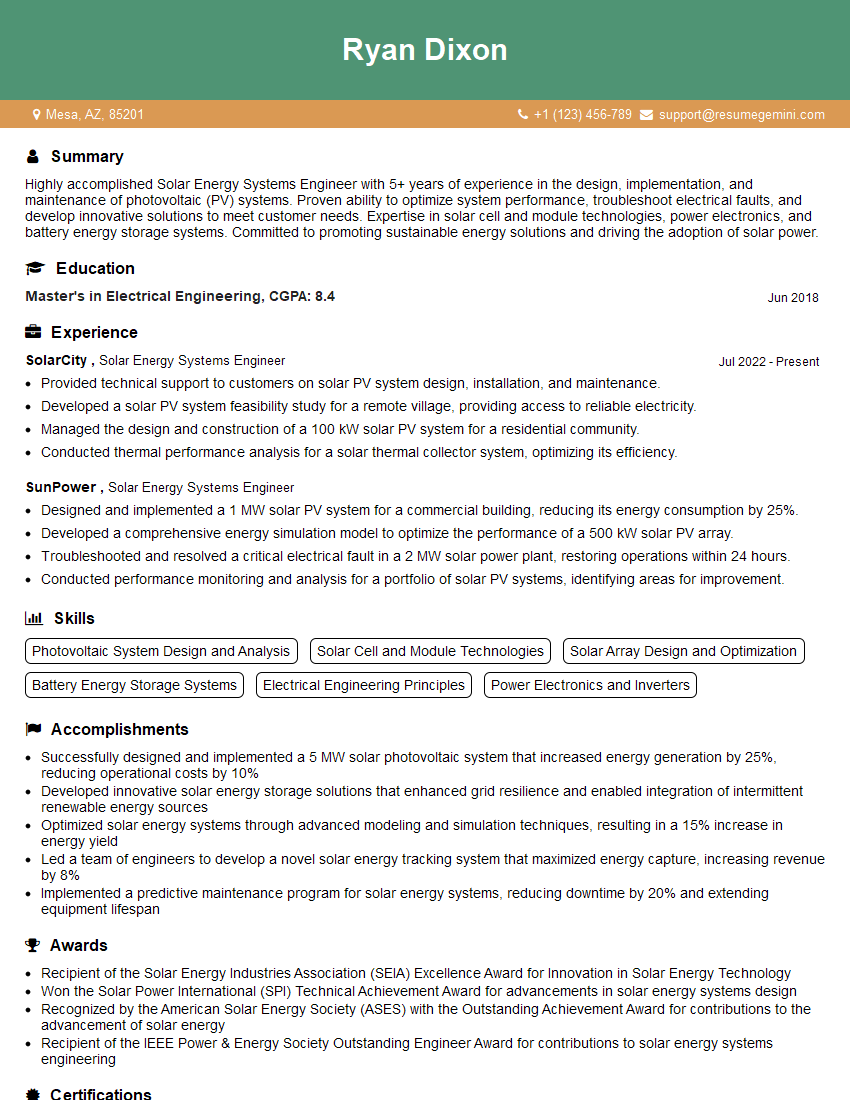
Mastering Thermal Solar System Design is crucial for a successful and rewarding career in the rapidly growing renewable energy sector. It opens doors to exciting opportunities in research, development, engineering, and project management. To significantly improve your job prospects, it’s vital to create a compelling and ATS-friendly resume that showcases your skills and experience effectively. ResumeGemini is a trusted resource that can help you build a professional and impactful resume tailored to the specific requirements of your target roles. Examples of resumes tailored to Thermal Solar System Design are available through ResumeGemini to guide your process. Take this opportunity to present yourself in the best possible light and land your dream job!
Explore more articles
Users Rating of Our Blogs
Share Your Experience
We value your feedback! Please rate our content and share your thoughts (optional).
What Readers Say About Our Blog
Very informative content, great job.
good