Interviews are opportunities to demonstrate your expertise, and this guide is here to help you shine. Explore the essential Python or Perl Scripting for Automation interview questions that employers frequently ask, paired with strategies for crafting responses that set you apart from the competition.
Questions Asked in Python or Perl Scripting for Automation Interview
Q 1. Explain the difference between `==` and `is` in Python.
In Python, both == and is are used for comparison, but they operate differently. == checks for equality in value, while is checks for equality in object identity (whether two variables point to the same memory location).
Think of it like this: == compares the contents of two containers, while is compares whether the containers themselves are the same container.
Example:
a = [1, 2, 3] b = [1, 2, 3] c = a print(a == b) # Output: True (same value) print(a is b) # Output: False (different objects) print(a is c) # Output: True (same object) This distinction is crucial when dealing with mutable objects like lists. Modifying one list won’t affect the other if they’re only equal in value (==), but it will if they refer to the same object (is).
Q 2. Describe how you would handle exceptions in Python or Perl.
Exception handling is crucial for robust scripts. In Python, we use try...except blocks. Perl uses a similar construct with eval and die.
Python Example:
try: result = 10 / 0 # Potential ZeroDivisionError except ZeroDivisionError: print("Error: Cannot divide by zero.") except Exception as e: # Catch other exceptions print(f"An unexpected error occurred: {e}") else: # Executes if no exception occurs print(f"Result: {result}") finally: # Always executes, regardless of exceptions print("This always runs.") Perl Example:
eval { my $result = 10 / 0; }; if ($@) { print "Error: $@\n"; # $@ holds the error message } else { print "Result: $result\n"; } These blocks allow your script to gracefully handle errors, prevent crashes, and provide informative error messages, making debugging and maintenance significantly easier.
Q 3. What are list comprehensions and generator expressions in Python?
List comprehensions and generator expressions are concise ways to create lists and iterators in Python. They’re powerful tools for writing cleaner, more efficient code.
List Comprehensions: Create a new list based on an existing iterable. They’re evaluated immediately.
numbers = [1, 2, 3, 4, 5] squares = [x**2 for x in numbers] # List comprehension print(squares) # Output: [1, 4, 9, 16, 25] Generator Expressions: Similar to list comprehensions, but they create an iterator instead of a list. They’re evaluated lazily, generating values on demand, making them memory-efficient for large datasets.
numbers = [1, 2, 3, 4, 5] squares_gen = (x**2 for x in numbers) # Generator expression print(list(squares_gen)) # Output: [1, 4, 9, 16, 25] (Needs to be converted to a list to see the result) Imagine processing a huge log file: a generator expression would be ideal as it wouldn’t load the entire file into memory at once.
Q 4. Explain the concept of closures in Python or Perl.
A closure in Python (and similarly in Perl) is a function that remembers and has access to variables from its surrounding lexical scope, even after that scope has finished executing.
Think of it as a function carrying a ‘backpack’ of variables with it. This backpack contains variables from the environment where the function was created, not where it’s called.
Python Example:
def outer_function(x): def inner_function(y): return x + y # inner_function 'remembers' x from outer_function return inner_function my_closure = outer_function(5) # x is 5 result = my_closure(3) # y is 3; result is 8 print(result) Here, inner_function is a closure; it ‘closes over’ the variable x from outer_function. This pattern is useful for creating functions that maintain state or have access to specific data without making it globally available.
Q 5. What are modules and packages in Python?
In Python, modules and packages are fundamental for organizing code. Modules are single Python files (.py) containing functions, classes, and variables. Packages are a way to group related modules into directories.
Modules: Let’s say you have a module named my_math_functions.py containing functions for mathematical operations. You can import and use these functions in other scripts.
# my_math_functions.py def add(x, y): return x + y # main.py import my_math_functions result = my_math_functions.add(5, 3) Packages: If you have many modules related to math (e.g., geometry.py, algebra.py), you could put them in a directory named math_package and create an __init__.py file inside it (even an empty one will do). This directory now becomes a package.
This modular approach improves code organization, reusability, and maintainability, especially in larger projects.
Q 6. How do you perform unit testing in Python or Perl?
Unit testing is the process of verifying individual components of your code in isolation. Python’s unittest module (or the pytest framework) is commonly used. Perl uses modules like Test::More.
Python (unittest) Example:
import unittest def add(x, y): return x + y class TestAdd(unittest.TestCase): def test_add_positive(self): self.assertEqual(add(2, 3), 5) def test_add_negative(self): self.assertEqual(add(-2, 3), 1) if __name__ == '__main__': unittest.main() This ensures each function behaves as expected, making debugging and refactoring safer. A well-tested codebase reduces the likelihood of regressions (introducing bugs when modifying existing code).
Q 7. What are some common design patterns used in automation scripts?
Several design patterns prove beneficial in automation scripting. Here are a few:
- Singleton: Ensures only one instance of a class exists (e.g., managing a database connection).
- Factory: Creates objects without specifying the exact class (useful when the type of object is determined at runtime).
- Observer: One object notifies others about changes in its state (e.g., monitoring system status and triggering alerts).
- Command: Encapsulates requests as objects (helpful for logging, undo/redo functionality).
Choosing the right pattern depends on the specific automation task. For example, the Singleton pattern is perfect for managing shared resources like a database connection in a multi-threaded environment, while the Observer pattern is ideal for creating a monitoring system that triggers alerts based on events.
Q 8. Explain the concept of polymorphism in Python or Perl.
Polymorphism, meaning “many forms,” is a powerful concept in object-oriented programming where objects of different classes can be treated as objects of a common type. This allows you to write code that can work with a variety of objects without needing to know their specific class. In Python, this is achieved through inheritance and duck typing.
Inheritance: A subclass can inherit methods from its superclass. If the subclass overrides a method from the superclass, the subclass’s version will be called, demonstrating polymorphism.
class Animal:
    def speak(self):
        print("Generic animal sound")

class Dog(Animal):
    def speak(self):
        print("Woof!")

class Cat(Animal):
    def speak(self):
        print("Meow!")

animal = Animal()
animal.speak()  # Output: Generic animal sound
dog = Dog()
dog.speak()      # Output: Woof!
cat = Cat()
cat.speak()      # Output: Meow!
Duck Typing: Python doesn’t strictly enforce type checking; if an object has the necessary methods, it can be used polymorphically, regardless of its class. This is very flexible.
def make_sound(animal):
    animal.speak()

make_sound(dog)  # Output: Woof!
make_sound(cat)  # Output: Meow!
In Perl, polymorphism is achieved similarly, leveraging inheritance and method overriding within a class structure. Perl’s flexibility allows for a more dynamic approach, but careful design is essential to maintain code readability and maintainability.
Q 9. How do you handle file I/O operations efficiently in Python or Perl?
Efficient file I/O is crucial for performance. In Python, the with statement ensures files are automatically closed, even if errors occur. Using buffered I/O significantly improves speed, especially with large files.
with open("myfile.txt", "r") as f:
    contents = f.read() #Reading the whole file at once
    # or for line-by-line reading:
    #for line in f:
        #process line
For large files, process them line by line or in chunks using f.readlines(size) to avoid loading everything into memory at once. The mmap module allows memory mapping for faster random access.
Perl offers similar features. The open function handles file opening, and using lexical filehandles improves code clarity and avoids potential namespace clashes.
open(my $fh, "<", "myfile.txt") or die "Could not open file: $!";
while (my $line = <$fh>) {
    #process each line
}
close $fh;
Similar to Python, Perl benefits from line-by-line processing or using techniques to read in chunks for efficiency with large datasets. Always remember to close files using close to free up resources.
Q 10. Describe different ways to debug Python or Perl scripts.
Debugging Python and Perl scripts involves a combination of techniques. The simplest is using print statements to check variable values at various points in your code. This is effective for basic debugging but can become cumbersome for complex issues.
Python Debuggers: The pdb (Python Debugger) module is a powerful tool that allows you to step through your code line by line, inspect variables, and set breakpoints. IDEs like PyCharm offer integrated debuggers with advanced features like variable watches and call stack visualization.
Perl Debuggers: Perl offers the perlbug tool for reporting bugs and Devel::ptkdb and perl -d which provide interactive debugging capabilities, letting you step through the code and examine variables.
Logging: Implementing a logging system provides a more organized and persistent record of your script’s execution. Libraries like Python’s logging module offer different log levels (DEBUG, INFO, WARNING, ERROR, CRITICAL) and allow you to output logs to files or consoles, useful for tracking down issues over time.
Unit Testing: Writing unit tests using frameworks like Python’s unittest or Perl’s Test::More is crucial. They verify that individual components of your code work correctly, making it easier to isolate and fix bugs.
Modern IDEs greatly enhance debugging, offering features like breakpoints, variable inspection, and stepping through code. By combining these methods, debugging is efficient and reliable.
Q 11. What are regular expressions and how do you use them in Python or Perl?
Regular expressions (regex or regexp) are powerful tools for pattern matching within text. They provide a concise and flexible way to search, extract, and manipulate strings.
Python: Python’s re module provides functions for working with regular expressions.
import re
text = "My phone number is 123-456-7890."
match = re.search(r"\d{3}-\d{3}-\d{4}", text)
if match:
    print(match.group(0))  # Output: 123-456-7890
Here, r"\d{3}-\d{3}-\d{4}" is a regular expression matching a phone number pattern. re.search searches for the first match.
Perl: Perl is renowned for its powerful built-in regular expression engine. The m// operator is used for matching patterns.
my $text = "My phone number is 123-456-7890.";
if ($text =~ m/(\d{3}-\d{3}-\d{4})/) {
    print $1;  # Output: 123-456-7890
}
The $1 variable holds the captured group from the regular expression. Perl’s regex syntax is very similar but often more concise.
Regular expressions are extensively used in tasks like data validation, text processing, log file analysis, and web scraping. Learning regex is an invaluable skill for any programmer.
Q 12. How would you automate a repetitive task using Python or Perl?
Automating repetitive tasks significantly improves efficiency. Both Python and Perl are well-suited for this. The general approach involves identifying the repetitive steps, breaking them down into smaller, manageable units, and then using scripting to execute those units automatically.
Example: Imagine you need to rename hundreds of files in a directory, adding a prefix to each filename. A Python script can efficiently handle this:
import os
import re
dir = "/path/to/files/"
prefix = "new_"
for filename in os.listdir(dir):
    base, ext = os.path.splitext(filename)
    new_filename = prefix + filename
    os.rename(os.path.join(dir, filename), os.path.join(dir, new_filename))
Perl can achieve the same task with similar ease.
use strict;
use warnings;
my $dir = "/path/to/files/";
my $prefix = "new_";
for my $file (glob "$dir/*") {
    my $new_file = $prefix . $file;
    rename($file, $new_file) or die "Could not rename $file: $!";
}
Automation can save considerable time and effort in tasks like file manipulation, data processing, system administration, and testing. The key is to design your script to be modular, robust, and easily adaptable to changes.
Q 13. Explain your experience with version control systems (e.g., Git).
Version control systems (VCS) are essential for managing code changes. Git is the most popular VCS. I have extensive experience using Git for individual and collaborative projects. My workflow includes:
- Initializing a repository:
git initto create a new repository orgit cloneto copy an existing one. - Staging changes:
git add .orgit addto add modifications to the staging area. - Committing changes:
git commit -m "Commit message"to save changes with a descriptive message. - Branching:
git branchto create new branches for feature development or bug fixes. - Merging branches:
git checkout masterandgit mergeto integrate changes from a branch into the main branch. - Resolving conflicts: Manually editing conflicted files and then staging and committing the resolutions.
- Pushing changes to remote repositories:
git push originto share changes with collaborators. - Pulling changes from remote repositories:
git pull originto update the local repository with changes from the remote. - Using Git for collaboration: I regularly work with remote repositories, leveraging Git’s features for conflict resolution and collaborative development.
I am proficient in using Git’s command-line interface as well as GUI tools such as Sourcetree or GitKraken to visualize and manage repositories. I understand the importance of maintaining a clean and well-documented commit history for effective version control.
Q 14. Describe your experience with CI/CD pipelines.
CI/CD (Continuous Integration/Continuous Delivery or Deployment) pipelines automate the software development lifecycle. My experience involves setting up and managing CI/CD pipelines using tools like Jenkins, GitLab CI, or GitHub Actions.
Typical pipeline stages include:
- Source Code Management: The pipeline starts by fetching the latest code changes from a version control system (e.g., Git).
- Building: Compiling the code, running tests, and creating deployable artifacts.
- Testing: Executing unit tests, integration tests, and potentially other types of automated tests.
- Deployment: Deploying the application to various environments (e.g., development, staging, production).
My experience includes:
- Configuration as code: Defining pipeline configurations using YAML or similar languages for better reproducibility and maintainability.
- Automated testing: Integrating various testing frameworks into the pipeline.
- Infrastructure as code: Using tools like Terraform or Ansible to provision and manage the infrastructure needed for the CI/CD process.
- Monitoring and logging: Implementing mechanisms to monitor pipeline performance and track build logs.
I understand the importance of a well-structured CI/CD pipeline for faster feedback loops, reduced risk, and more efficient software delivery. I am comfortable working with different CI/CD tools and adapting them to the specific requirements of a project.
Q 15. What are some common libraries/modules used for automation in Python or Perl?
Python and Perl offer a rich ecosystem of libraries for automation. The choice depends heavily on the task at hand. In Python, some standouts include:
requests: For interacting with web services (APIs), fetching data, and automating web tasks. It’s incredibly versatile and easy to use.selenium: A powerful library for automating web browsers. Ideal for testing web applications or scraping data from websites. Think of it as a programmable browser.paramiko: For secure SSH connections, allowing automation of tasks on remote servers. Essential for managing infrastructure or deploying applications.psutil: Provides an interface for retrieving information on running processes and system utilization, perfect for monitoring and managing system resources.subprocess: Allows you to run shell commands from within your Python script, enabling integration with existing command-line tools.
In Perl, popular modules include:
LWP::UserAgent: Similar to Python’srequests, it facilitates web interactions and data retrieval.WWW::Mechanize: Provides more advanced web automation capabilities, including form filling and cookie management, akin to Selenium’s functionalities.Net::SSH::Perl: Enables secure SSH connections, mirroringparamiko‘s role in Python.IO::Socket: Allows for low-level network communication, useful for custom protocols or specialized tasks.
The selection of libraries hinges on the specific automation needs. For example, if I’m automating a web scraping task, I’d choose requests and BeautifulSoup (Python) or LWP::UserAgent and HTML::TreeBuilder (Perl). For server management, paramiko (Python) or Net::SSH::Perl (Perl) would be the go-to choices.
Career Expert Tips:
- Ace those interviews! Prepare effectively by reviewing the Top 50 Most Common Interview Questions on ResumeGemini.
- Navigate your job search with confidence! Explore a wide range of Career Tips on ResumeGemini. Learn about common challenges and recommendations to overcome them.
- Craft the perfect resume! Master the Art of Resume Writing with ResumeGemini’s guide. Showcase your unique qualifications and achievements effectively.
- Don’t miss out on holiday savings! Build your dream resume with ResumeGemini’s ATS optimized templates.
Q 16. Explain your experience with different databases and their interaction with automation scripts.
My experience spans several database systems, including relational databases like MySQL, PostgreSQL, and Oracle, as well as NoSQL databases like MongoDB. Automation scripts frequently interact with databases for tasks such as data extraction, transformation, loading (ETL), data validation, and database administration.
For relational databases, I often use database connectors like MySQLdb (Python) or DBI (Perl) to execute SQL queries programmatically. This allows me to fetch data, update records, or perform complex database operations within the automation workflow. For example, I might use a Python script with MySQLdb to extract data from a MySQL database, transform it using pandas, and then load it into a CSV file or another database.
With NoSQL databases like MongoDB, I utilize drivers like pymongo (Python) or MongoDB::Collection (Perl) to interact with the database’s JSON-like documents. This involves operations such as inserting, querying, updating, and deleting documents. I might use a Perl script with the MongoDB driver to automate the process of backing up a MongoDB database to an external storage location.
Security is paramount when connecting to databases. I always ensure I use secure connection methods (e.g., SSL/TLS) and store database credentials securely, often using environment variables or dedicated secrets management systems to avoid hardcoding sensitive information directly into the scripts.
Q 17. How do you ensure the scalability and maintainability of your automation scripts?
Scalability and maintainability are crucial for long-term success. I prioritize these by adhering to several best practices:
- Modular Design: Breaking down large scripts into smaller, reusable modules improves organization and simplifies debugging. Each module focuses on a specific task, making it easier to understand, test, and maintain.
- Version Control (Git): Using Git is essential for tracking changes, collaborating with others, and easily reverting to previous versions if necessary. This is like having a detailed history of your script’s evolution.
- Consistent Coding Style: Following a consistent coding style (e.g., PEP 8 for Python) ensures readability and reduces errors. It’s like writing with good grammar and punctuation—it makes your code much easier to understand.
- Comprehensive Documentation: Well-written documentation, including comments within the code and separate documentation files, is crucial for understanding the script’s purpose, functionality, and usage. Think of it as a user manual for your script.
- Testing: Writing unit tests and integration tests verifies the correctness of individual modules and the overall system. This prevents unexpected behavior and ensures reliability.
- Configuration Files: Storing configurable parameters (e.g., database credentials, file paths) in separate configuration files allows easy modification without altering the script’s core logic. This separates the code from its environment, improving flexibility.
By following these principles, scripts become easier to understand, modify, and scale to handle larger workloads or more complex tasks. Imagine trying to maintain a huge, monolithic script versus a well-structured collection of smaller, independent modules—the difference is night and day!
Q 18. Describe a challenging automation project you worked on and the solution you implemented.
One challenging project involved automating the deployment of a large-scale web application across multiple servers. The challenge was ensuring zero downtime during the deployment process. The existing process was manual and prone to errors, resulting in frequent downtime.
My solution involved a multi-stage rolling deployment strategy using paramiko (Python) to manage SSH connections and orchestrate the deployment process across servers. The script first updated a single server, then performed health checks to confirm its proper functioning before proceeding to the next server. If any issues were detected, the script automatically rolled back the changes to the previous stable state.
The script also incorporated robust logging and error handling to monitor the deployment process and identify any potential problems. This minimized disruption and greatly improved the reliability of the deployment process. Furthermore, I implemented a notification system that alerted the operations team in case of errors or unexpected events. This project demonstrated the power of automation in streamlining complex tasks and reducing operational risks.
Q 19. What are some security considerations when writing automation scripts?
Security is paramount in automation. Several key considerations include:
- Input Validation: Always validate user inputs to prevent injection attacks (e.g., SQL injection, command injection). Never trust the data you receive.
- Secure Credentials: Avoid hardcoding credentials directly into scripts. Use environment variables, configuration files, or dedicated secrets management systems.
- Authentication and Authorization: Implement proper authentication and authorization mechanisms when interacting with external systems or databases. Use strong passwords and avoid default credentials.
- Least Privilege Principle: Run scripts with the least privilege necessary. Avoid running scripts as root or administrator unless absolutely required.
- Regular Updates: Keep all software dependencies (libraries, operating systems) up-to-date to patch known vulnerabilities. Vulnerabilities are often patched quickly, so staying current is a significant security improvement.
- Secure Communication: Use secure protocols (e.g., HTTPS, SSH) when interacting with remote systems or services.
Neglecting these precautions can lead to serious security breaches, making secure coding practices essential.
Q 20. How do you handle errors and logging in your automation scripts?
Error handling and logging are critical for reliable automation. I use a combination of techniques:
try...exceptblocks (Python) orevalwith error handling (Perl): These structures gracefully handle anticipated errors, preventing script crashes. They allow me to perform alternative actions or log errors without halting the entire process.- Structured Logging: I utilize logging libraries like Python’s
loggingmodule or Perl’sLog::Log4perlto record events, errors, warnings, and debug information. This provides a detailed audit trail for troubleshooting and monitoring the script’s execution. - Log Rotation: Implement log rotation to manage log file size. Older log files are archived to prevent the log files from becoming excessively large.
- Custom Exception Handling: For specific scenarios, I create custom exception classes to handle unique error conditions more effectively. This provides a more structured and easier-to-understand error reporting system.
Imagine a script processing thousands of files. Robust error handling ensures that even if one file fails to process, the rest continue to run. Structured logging helps to pinpoint the exact cause of the failure for quicker resolution.
Q 21. What is your experience with scripting languages other than Python or Perl?
Beyond Python and Perl, I have experience with several other scripting languages, including Bash, JavaScript (Node.js), and PowerShell. Each has its strengths and weaknesses, making them suitable for different types of automation tasks.
Bash is excellent for system administration tasks and shell scripting. JavaScript (Node.js) is a strong choice for web-based automation and asynchronous operations. PowerShell is well-suited for Windows system administration and automation. My experience with these languages allows me to choose the most appropriate tool for the job based on the specific requirements and context of the project.
Q 22. Explain the concept of object-oriented programming and its applications in automation.
Object-Oriented Programming (OOP) is a programming paradigm that organizes code around objects rather than actions and data rather than logic. In essence, it’s like building with LEGOs – you have individual blocks (objects) with specific properties (data) and behaviors (methods), which you can combine to create complex structures. In automation, this is incredibly powerful.
Applications in Automation:
- Modular Design: OOP allows you to create reusable components. For example, you could create an object representing a web browser, with methods for navigating to URLs, filling forms, and clicking buttons. This object can then be used across many different automation scripts.
- Maintainability: Changes to one part of the system are less likely to break other parts. If you need to modify how the web browser object handles cookies, you only need to change the code within that object, not throughout your entire automation suite.
- Testability: Objects can be easily tested in isolation, ensuring each component works correctly before integrating them.
- Scalability: OOP makes it easier to expand and adapt automation scripts as your needs grow. New features can be added by creating new objects or extending existing ones.
Example (Python):
class WebBrowser:
    def __init__(self, url):
        self.url = url

    def navigate(self):
        print(f"Navigating to {self.url}")

    def fill_form(self, data):
        print(f"Filling form with data: {data}")

browser = WebBrowser("https://www.example.com")
browser.navigate()
browser.fill_form({"username":"testuser","password":"password"})
Q 23. How do you manage dependencies in your projects?
Managing dependencies is crucial for reproducible and reliable automation. It ensures everyone working on the project uses the same versions of libraries, preventing unexpected behavior. I typically use tools like pip (for Python) and cpanm (for Perl) along with virtual environments.
Process:
- Virtual Environments: I always create a virtual environment for each project. This isolates the project’s dependencies from the global Python or Perl installation, preventing conflicts.
python3 -m venv .venv(Python) orcpanm --installdeps .(Perl) are my go-to commands. - Requirements Files: A
requirements.txtfile (Python) or similar dependency management within the Perl build system, lists all project dependencies and their versions. This file ensures consistent setups across different machines. - Dependency Managers:
piporcpanmhandles downloading and installing the specified dependencies. - Containerization (Docker): For complex projects, containerization with Docker offers an even more robust solution. It packages the entire application and its dependencies into a portable container, guaranteeing consistent execution across different environments.
This approach makes it easy to share projects, collaborate, and deploy them consistently across different systems.
Q 24. How do you approach performance optimization of automation scripts?
Performance optimization is vital for automation scripts, especially those handling large datasets or interacting with many systems. My approach involves profiling, algorithmic improvements, and efficient resource usage.
Strategies:
- Profiling: I use profiling tools (like
cProfilein Python or Devel::DProf in Perl) to identify performance bottlenecks. This pinpoints the specific parts of the script consuming the most time or resources. - Algorithmic Optimization: After identifying bottlenecks, I refactor the code to use more efficient algorithms. For example, replacing nested loops with more efficient data structures or algorithms can drastically improve performance.
- Efficient Data Structures: Choosing the right data structures is key. For instance, using sets for membership checks or dictionaries for fast lookups significantly improves speed over linear searches.
- Asynchronous Operations: For I/O-bound tasks (like network requests), using asynchronous programming techniques (
asyncioin Python) can dramatically improve performance by allowing the script to perform other tasks while waiting for I/O operations to complete. - Batch Processing: Instead of processing data item by item, processing in batches can reduce overhead.
- Code Optimization: Removing redundant computations, avoiding unnecessary function calls, and minimizing memory allocations can lead to performance improvements.
Remember that premature optimization is a bad practice; focus on clear, functional code first, then optimize only the critical parts identified through profiling.
Q 25. What are your preferred methods for testing and validating automation scripts?
Thorough testing is paramount for reliable automation. I employ a multi-pronged approach, combining different testing methodologies.
Testing Methods:
- Unit Testing: I write unit tests to verify the functionality of individual components (functions or classes) in isolation. Frameworks like
unittest(Python) andTest::More(Perl) are invaluable here. - Integration Testing: After unit tests, I conduct integration tests to verify how the different components interact with each other. This helps catch issues that might not be apparent in unit tests.
- System Testing: System tests validate the entire automation system’s functionality from end to end, simulating real-world scenarios.
- Regression Testing: As the project evolves, I run regression tests to ensure that new code doesn’t break existing functionality.
- Test-Driven Development (TDD): For some projects, I use TDD, where tests are written before the code. This ensures that the code is built to meet specific requirements from the start.
Example (Python):
import unittest

def add(x, y):
    return x + y

class TestAdd(unittest.TestCase):
    def test_add_positive(self):
        self.assertEqual(add(2, 3), 5)

    def test_add_negative(self):
        self.assertEqual(add(-2, 3), 1)

if __name__ == '__main__':
    unittest.main()
Q 26. Describe your understanding of different automation frameworks.
Automation frameworks provide a structured approach to building and managing automation projects. Different frameworks cater to various needs and project scales.
Frameworks:
- Keyword-Driven Frameworks: These frameworks use keywords or actions defined in a separate file or spreadsheet. This makes it easier for non-programmers to create and maintain tests.
- Data-Driven Frameworks: Test data is separated from the test scripts, enabling easy modification and reuse of test cases with different data sets.
- Page Object Model (POM): This pattern improves test code maintainability, particularly for UI automation, by creating reusable objects to represent different pages or components of an application.
- Behavioral-Driven Development (BDD): Frameworks like Cucumber (with support for Python and other languages) allow writing tests in a more human-readable, domain-specific language, facilitating collaboration between developers and non-technical stakeholders.
- Robot Framework: A generic test automation framework that is suitable for acceptance testing, acceptance test-driven development (ATDD), and robotic process automation (RPA).
The choice of framework depends on project complexity, team expertise, and specific requirements. Simple projects might not need a full-fledged framework, while larger, complex projects benefit from the structure and organization that frameworks provide.
Q 27. How do you stay updated with the latest technologies and trends in automation?
Staying current in automation requires continuous learning. I use a multi-faceted approach:
- Online Courses and Tutorials: Platforms like Coursera, Udemy, and edX offer excellent courses on various automation technologies and best practices.
- Industry Blogs and Websites: I regularly follow blogs and websites focusing on automation, software testing, and related fields. This keeps me abreast of new tools, techniques, and trends.
- Conferences and Workshops: Attending industry conferences and workshops offers valuable insights and networking opportunities. It’s a chance to learn from experts and exchange ideas with peers.
- Open-Source Contributions: Contributing to open-source projects allows me to engage with cutting-edge technologies and learn from experienced developers.
- Professional Networking: Engaging with the automation community through online forums and groups helps me learn about emerging trends and solve challenging problems collaboratively.
- Reading Books and Documentation: I regularly consult relevant documentation for tools and languages and also explore literature around specific topics, such as software design patterns and best practices.
Continuous learning ensures I remain proficient and adopt the most efficient tools and methods for automation.
Q 28. Describe a time you had to troubleshoot a complex automation issue.
I once encountered a challenging issue with an automation script interacting with a legacy system. The system had inconsistent responses, occasionally returning unexpected data formats or error codes. This made it difficult for my script to reliably process the data.
Troubleshooting Steps:
- Detailed Logging: I first implemented extensive logging throughout the script to capture all interactions with the legacy system, including HTTP requests, responses, and data transformations.
- Reproducing the Error: I systematically attempted to reproduce the error, noting the precise conditions under which it occurred. This helped pinpoint the problematic parts of the interaction.
- Network Analysis: I used network monitoring tools (like Wireshark) to examine the network traffic between my script and the legacy system. This revealed some hidden delays and unexpected error responses that weren’t reflected in the system’s API documentation.
- Error Handling and Retry Mechanisms: I implemented robust error handling and retry mechanisms in the script to gracefully handle intermittent failures and unexpected responses from the legacy system. This added a layer of resilience.
- Collaboration: I collaborated with the legacy system’s maintainers to understand the system’s limitations and quirks. This collaboration led to improved documentation and, ultimately, a more stable integration.
Through a combination of logging, network analysis, error handling, and collaboration, I successfully resolved the issue and ensured the automation script’s reliability.
Key Topics to Learn for Python or Perl Scripting for Automation Interview
- Fundamental Syntax and Data Structures: Mastering the basics of variables, data types (integers, strings, lists, dictionaries/hashes), operators, and control flow (loops, conditional statements) is crucial for efficient scripting. This forms the foundation for all subsequent learning.
- File I/O and System Interactions: Learn how to read from and write to files, interact with the operating system (e.g., using command-line arguments, executing shell commands), and manage file paths effectively. Automation often involves manipulating files and system resources.
- Regular Expressions (Regex): Regex is a powerful tool for pattern matching and text manipulation. Understanding regex will significantly improve your ability to process and extract information from various data sources, a common task in automation.
- Modules and Libraries (Python) / Modules (Perl): Familiarize yourself with relevant modules for automation. In Python, explore libraries like `os`, `sys`, `shutil`, `subprocess`, and potentially others depending on the specific automation tasks. In Perl, understand core modules and how to utilize CPAN for additional functionality.
- Error Handling and Debugging: Learn how to effectively handle exceptions and debug your scripts. Robust error handling is essential for creating reliable automation solutions.
- Object-Oriented Programming (OOP) Concepts (Python): While not always strictly necessary for basic scripting, understanding OOP principles like classes and objects can lead to more organized and maintainable code, especially in larger automation projects. Perl also supports OOP, but it’s less central to its common use cases.
- Testing and Version Control (Git): Understand the importance of testing your code and using version control (Git) to manage your projects. This is critical for collaboration and maintaining a history of your work.
- Problem-Solving and Algorithmic Thinking: Practice breaking down complex automation tasks into smaller, manageable steps. Develop your ability to think logically and design efficient solutions.
Next Steps
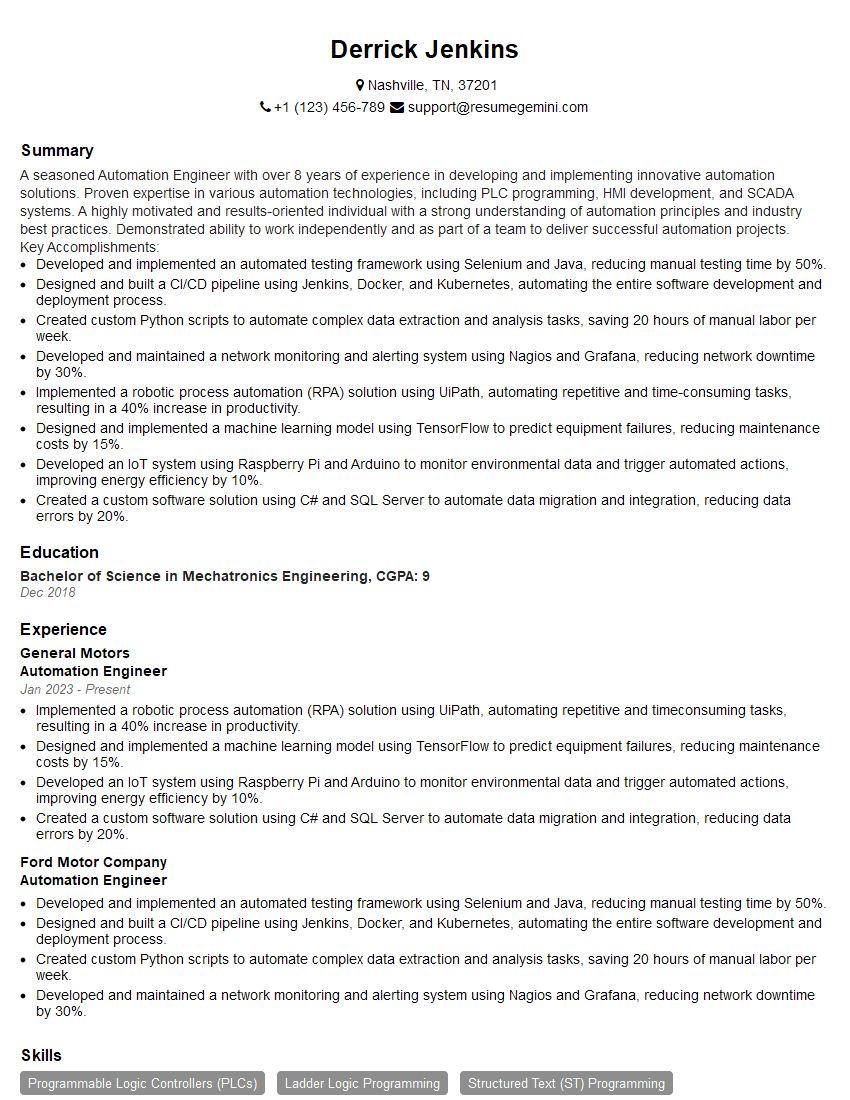
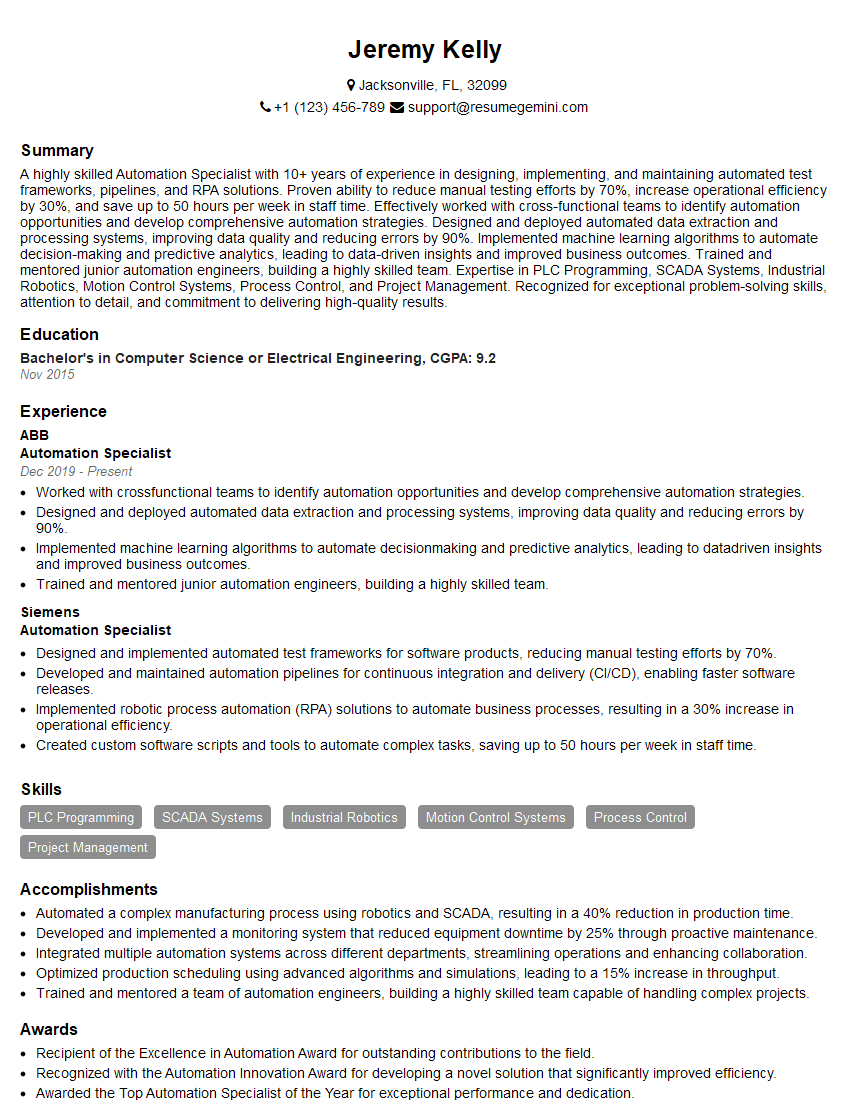
Mastering Python or Perl scripting for automation opens doors to exciting career opportunities in DevOps, system administration, data science, and more. These skills are highly sought after, leading to increased job prospects and higher earning potential. To maximize your chances, create a compelling, ATS-friendly resume that highlights your skills and experience effectively. ResumeGemini is a trusted resource that can help you build a professional resume showcasing your abilities. They even provide examples of resumes tailored to Python or Perl Scripting for Automation, giving you a head start in crafting a winning application.
Explore more articles
Users Rating of Our Blogs
Share Your Experience
We value your feedback! Please rate our content and share your thoughts (optional).
What Readers Say About Our Blog
Hello,
we currently offer a complimentary backlink and URL indexing test for search engine optimization professionals.
You can get complimentary indexing credits to test how link discovery works in practice.
No credit card is required and there is no recurring fee.
You can find details here:
https://wikipedia-backlinks.com/indexing/
Regards
NICE RESPONSE TO Q & A
hi
The aim of this message is regarding an unclaimed deposit of a deceased nationale that bears the same name as you. You are not relate to him as there are millions of people answering the names across around the world. But i will use my position to influence the release of the deposit to you for our mutual benefit.
Respond for full details and how to claim the deposit. This is 100% risk free. Send hello to my email id: [email protected]
Luka Chachibaialuka
Hey interviewgemini.com, just wanted to follow up on my last email.
We just launched Call the Monster, an parenting app that lets you summon friendly ‘monsters’ kids actually listen to.
We’re also running a giveaway for everyone who downloads the app. Since it’s brand new, there aren’t many users yet, which means you’ve got a much better chance of winning some great prizes.
You can check it out here: https://bit.ly/callamonsterapp
Or follow us on Instagram: https://www.instagram.com/callamonsterapp
Thanks,
Ryan
CEO – Call the Monster App
Hey interviewgemini.com, I saw your website and love your approach.
I just want this to look like spam email, but want to share something important to you. We just launched Call the Monster, a parenting app that lets you summon friendly ‘monsters’ kids actually listen to.
Parents are loving it for calming chaos before bedtime. Thought you might want to try it: https://bit.ly/callamonsterapp or just follow our fun monster lore on Instagram: https://www.instagram.com/callamonsterapp
Thanks,
Ryan
CEO – Call A Monster APP
To the interviewgemini.com Owner.
Dear interviewgemini.com Webmaster!
Hi interviewgemini.com Webmaster!
Dear interviewgemini.com Webmaster!
excellent
Hello,
We found issues with your domain’s email setup that may be sending your messages to spam or blocking them completely. InboxShield Mini shows you how to fix it in minutes — no tech skills required.
Scan your domain now for details: https://inboxshield-mini.com/
— Adam @ InboxShield Mini
Reply STOP to unsubscribe
Hi, are you owner of interviewgemini.com? What if I told you I could help you find extra time in your schedule, reconnect with leads you didn’t even realize you missed, and bring in more “I want to work with you” conversations, without increasing your ad spend or hiring a full-time employee?
All with a flexible, budget-friendly service that could easily pay for itself. Sounds good?
Would it be nice to jump on a quick 10-minute call so I can show you exactly how we make this work?
Best,
Hapei
Marketing Director
Hey, I know you’re the owner of interviewgemini.com. I’ll be quick.
Fundraising for your business is tough and time-consuming. We make it easier by guaranteeing two private investor meetings each month, for six months. No demos, no pitch events – just direct introductions to active investors matched to your startup.
If youR17;re raising, this could help you build real momentum. Want me to send more info?
Hi, I represent an SEO company that specialises in getting you AI citations and higher rankings on Google. I’d like to offer you a 100% free SEO audit for your website. Would you be interested?
Hi, I represent an SEO company that specialises in getting you AI citations and higher rankings on Google. I’d like to offer you a 100% free SEO audit for your website. Would you be interested?
good