Feeling uncertain about what to expect in your upcoming interview? We’ve got you covered! This blog highlights the most important Navigation and Maps interview questions and provides actionable advice to help you stand out as the ideal candidate. Let’s pave the way for your success.
Questions Asked in Navigation and Maps Interview
Q 1. Explain the difference between latitude and longitude.
Latitude and longitude are coordinates that specify the precise location of any point on the Earth’s surface. Think of it like a grid system draped over the globe.
Latitude measures the distance north or south of the Equator, ranging from 0° (Equator) to 90° (North and South Poles). Lines of latitude are parallel circles running east-west, also known as parallels. For instance, 40°N indicates a location 40 degrees north of the Equator.
Longitude measures the distance east or west of the Prime Meridian (running through Greenwich, England), ranging from 0° to 180° (east or west). Lines of longitude are half-circles converging at the poles, also known as meridians. For example, 74°W represents a location 74 degrees west of the Prime Meridian.
Together, latitude and longitude provide a unique identifier for every point on Earth. For example, New York City has an approximate latitude of 40.7°N and longitude of 74°W.
Q 2. Describe different map projections and their applications.
Map projections are methods of transforming the three-dimensional surface of the Earth onto a two-dimensional map. Since it’s impossible to flatten a sphere without distortion, different projections prioritize accuracy in different aspects (area, shape, distance, or direction).
- Mercator Projection: Preserves shape and direction but distorts area significantly, particularly at higher latitudes. It’s widely used for navigation because rhumb lines (lines of constant compass bearing) appear as straight lines. Think of how Greenland appears much larger than it actually is on a Mercator map.
- Lambert Conformal Conic Projection: Preserves shape and direction within a limited area, making it suitable for mapping regions with a relatively east-west orientation, like the United States. Distortion increases as you move away from the central standard parallels.
- Albers Equal-Area Conic Projection: Preserves area but distorts shape. It’s often used for mapping large areas where accurate representation of area is crucial, such as showing population density or land cover.
- Equirectangular Projection: A simple projection that preserves latitude and longitude lines as parallel straight lines. It’s straightforward but distorts area and shape greatly, particularly at higher latitudes. It’s often used for world maps where relative positioning is more important than accurate area or shape.
The choice of projection depends heavily on the intended use of the map. Navigation uses Mercator, while thematic mapping often prefers equal-area projections to accurately reflect quantities like population or resource distribution.
Q 3. What are the key components of a GPS system?
A Global Positioning System (GPS) comprises three main segments working together:
- Space Segment: A constellation of satellites orbiting the Earth. These satellites transmit precise timing signals and orbital data.
- Control Segment: A network of ground stations that monitor and control the satellites, ensuring their accurate positioning and timing.
- User Segment: GPS receivers (like those in smartphones or dedicated GPS devices) that receive signals from the satellites to calculate their position.
Accurate positioning relies on the precise timing of signals received from multiple satellites. The control segment plays a vital role in maintaining the accuracy and integrity of the entire system.
Q 4. How does GPS triangulation work?
GPS triangulation leverages the signals from multiple satellites to pinpoint a receiver’s location. The process works as follows:
- Signal Reception: The GPS receiver receives signals from at least four satellites (more for increased accuracy). Each signal contains information about the satellite’s position and the time it was transmitted.
- Time Difference Calculation: The receiver measures the time it took for each signal to arrive. The difference in arrival times, considering the known satellite positions and the speed of light, helps determine the distance to each satellite. These distances form spheres around the satellites’ positions.
- Intersection of Spheres: The intersection of the spheres (each defined by the distance to a satellite) pinpoints the receiver’s three-dimensional location. At least four satellites are needed because three spheres would intersect at two points, and the fourth helps resolve the ambiguity.
This process involves sophisticated calculations, often using iterative methods to account for errors in timing and signal propagation. The more satellites involved, the more accurate the positioning becomes, although atmospheric conditions can also introduce errors.
Q 5. Explain the concept of georeferencing.
Georeferencing is the process of assigning geographic coordinates (latitude and longitude) to points, lines, or polygons on a map or image. This essentially places the data onto the Earth’s coordinate system, allowing it to be spatially analyzed and integrated with other geographic information.
Imagine having a scanned historical map of a city. Georeferencing involves aligning that map to a modern coordinate system using known points (like landmarks or intersections) on both the historical map and a modern map. This allows you to overlay the historical map onto a modern map, allowing for comparative analysis, change detection, and historical context.
Georeferencing is crucial in GIS for integrating data from various sources. It ensures that different datasets can be overlaid and compared correctly, whether it’s satellite imagery, topographic maps, or census data.
Q 6. What are common data formats used in GIS?
Geographic Information Systems (GIS) employ various data formats, each with its strengths and weaknesses:
- Shapefiles (.shp): A widely used vector data format that stores geographic features as points, lines, or polygons. It often comprises multiple files (.shp, .shx, .dbf) to store geometry, index, and attribute information.
- GeoJSON: A text-based, open-standard format for representing geographic features. It’s easily readable and portable, making it ideal for data exchange on the web.
- GeoTIFF (.tif): A georeferenced raster data format that stores image data (like satellite imagery) with spatial information embedded within the file.
- KML (Keyhole Markup Language): An XML-based format used to represent geographic features in Google Earth and other GIS software. It allows embedding imagery, placemarks, and other visual elements.
- Geodatabase (.gdb): A spatial database system developed by Esri. It can store both vector and raster data in a structured and organized manner, supporting complex spatial analyses.
The best format to choose depends on the specific needs of the project, considering factors like data size, complexity, and compatibility with various software packages.
Q 7. Describe different types of spatial data.
Spatial data can be broadly classified into two main types:
- Vector Data: Represents geographic features as points, lines, or polygons. Think of points as locations (e.g., trees), lines as linear features (e.g., roads), and polygons as areas (e.g., buildings or parcels). Vector data is precise and suitable for detailed mapping.
- Raster Data: Represents geographic features as a grid of cells or pixels, each with a value representing a particular attribute. Raster data includes satellite imagery, digital elevation models (DEMs), and scanned maps. Raster data is good for representing continuous phenomena (e.g., temperature, elevation).
Some data can be represented in both formats, each having advantages and disadvantages depending on the application. For example, land cover can be represented as polygons in vector data or pixels in a raster image.
Q 8. What are the advantages and disadvantages of using raster vs. vector data?
Raster and vector data are two fundamental ways to represent geographic information in maps. Raster data uses a grid of cells (pixels) to store information, like a digital photograph. Each cell holds a value representing a specific attribute, such as land cover type or elevation. Vector data, on the other hand, uses points, lines, and polygons to represent geographic features. Think of it like a drawing, where each feature is defined by its coordinates.
- Raster Advantages: Excellent for representing continuous phenomena like elevation or temperature; relatively simple to process; readily available from satellite imagery and aerial photography.
- Raster Disadvantages: File sizes can be large; resolution is fixed; scaling can lead to pixelation and loss of detail; less precise for representing discrete features.
- Vector Advantages: Scalable without loss of detail; precise representation of features; smaller file sizes compared to raster data for the same area; easier to edit individual features.
- Vector Disadvantages: More complex to process; less suitable for representing continuous phenomena; can be more difficult to generate from raw imagery data.
Example: A satellite image of a city would be raster data, where each pixel represents a color representing land use. A street map showing individual roads (lines) and buildings (polygons) would be vector data.
Q 9. Explain the concept of spatial analysis.
Spatial analysis is the process of examining geographic data to identify patterns, relationships, and trends. It involves using geographic tools and techniques to analyze the location, shape, distribution, and spatial relationships of features. Think of it like detective work, but instead of clues, we use map data to investigate spatial phenomena.
For instance, we might use spatial analysis to determine the proximity of houses to schools, identify areas prone to flooding based on elevation and rainfall data, or analyze crime hotspots to inform resource allocation in policing. It goes beyond just visualizing locations; it focuses on understanding the ‘why’ and ‘how’ behind the spatial distribution of things.
Q 10. What are some common spatial analysis techniques?
Many spatial analysis techniques exist, depending on the questions you’re trying to answer. Some common ones include:
- Buffering: Creating zones around features (e.g., finding all houses within 1km of a school).
- Overlay Analysis: Combining multiple datasets to identify areas where features overlap (e.g., finding areas suitable for agriculture by combining soil type and climate data).
- Proximity Analysis: Measuring the distances between features (e.g., calculating the distance between hospitals and residential areas).
- Network Analysis: Finding optimal routes or paths within a network (e.g., finding the shortest route between two points in a road network).
- Spatial Interpolation: Estimating values at unsampled locations (e.g., predicting rainfall amounts across a region based on measurements at a few weather stations).
- Geostatistics: Analyzing spatial autocorrelation and spatial variability in data (e.g., understanding the clustering of disease outbreaks).
The choice of technique depends heavily on the specific research question and the type of data available.
Q 11. How do you handle map scale and resolution?
Map scale refers to the ratio between the distance on a map and the corresponding distance on the ground. Resolution refers to the level of detail in the data. These two are intrinsically linked. A large-scale map (e.g., 1:1000) shows a smaller area with greater detail, while a small-scale map (e.g., 1:1,000,000) shows a larger area with less detail. Higher resolution data allows for more detailed maps at larger scales.
Handling scale and resolution involves several considerations:
- Data selection: Choosing data with appropriate resolution for the intended map scale and analysis.
- Data aggregation: Combining data to reduce resolution when working with smaller scales or larger areas.
- Generalization: Simplifying features to avoid visual clutter at smaller scales.
- Data resampling: Changing the resolution of raster data (e.g., upscaling to increase resolution, downscaling to decrease resolution). This needs to be done carefully to minimize errors.
Proper handling of scale and resolution is crucial for producing accurate and meaningful maps.
Q 12. Describe your experience with GIS software (e.g., ArcGIS, QGIS).
I have extensive experience using both ArcGIS and QGIS. In ArcGIS, I’ve worked extensively with geoprocessing tools for spatial analysis, data management, and cartography. For example, I used ArcGIS Pro to create detailed land use/land cover maps from satellite imagery, applying image classification and overlay analysis techniques. I utilized its geodatabase management capabilities to build and maintain complex spatial datasets.
QGIS, with its open-source nature and flexibility, has proven invaluable for tasks like data exploration, visualization, and rapid prototyping. I’ve employed QGIS to perform network analyses for optimizing delivery routes, using its plugin ecosystem for specialized tasks. My proficiency in both systems allows me to choose the most appropriate tool for the job, leveraging their individual strengths. I’m also familiar with other GIS software packages like MapInfo and Google Earth Pro.
Q 13. Explain your experience with different map design principles.
Map design is critical for effective communication of spatial information. My experience encompasses various map design principles, including:
- Clarity and Simplicity: Ensuring the map is easy to understand and interpret, avoiding unnecessary clutter.
- Visual Hierarchy: Using different sizes, colors, and symbols to emphasize important features.
- Legibility: Selecting appropriate fonts and sizes for labels and legends.
- Color Selection: Choosing colors that are visually appealing, easily distinguishable, and meaningful in context.
- Scale and Projection: Using appropriate map scales and projections for the area and application.
- Balance and Composition: Creating a visually balanced and aesthetically pleasing map layout.
I’m adept at creating various map types, including thematic maps, choropleth maps, isarithmic maps, and dot distribution maps, selecting the most appropriate type for the data and intended audience. I prioritize designing maps that are both informative and visually engaging.
Q 14. How do you ensure the accuracy and reliability of geospatial data?
Ensuring the accuracy and reliability of geospatial data is paramount. This involves a multi-faceted approach:
- Data Source Evaluation: Critically assessing the quality and reliability of the source data. This includes checking metadata for accuracy, precision, completeness, and currency.
- Data Validation and Cleaning: Identifying and correcting errors in the data. This can involve visual inspection, spatial queries, and statistical analysis to detect outliers or inconsistencies.
- Data Transformation and Projection: Using appropriate coordinate systems and projections to ensure accurate spatial representation.
- Error Propagation Assessment: Understanding how errors in the input data can propagate through spatial analyses and affect the results.
- Quality Control and Assurance (QA/QC): Implementing a systematic QA/QC process, including regular data checks and validation steps.
- Metadata Management: Maintaining comprehensive metadata, documenting data sources, processing steps, and limitations.
In practice, I often use a combination of these techniques to ensure data quality and build robust workflows. For instance, I’d verify the positional accuracy of data by comparing it against independent high-accuracy data sources and flag any inconsistencies for further investigation. A thorough QA/QC process is essential for producing credible and reliable geospatial products.
Q 15. What are some common challenges in working with geospatial data?
Working with geospatial data presents numerous challenges, primarily stemming from its inherent complexity and scale. One major hurdle is data heterogeneity: geospatial datasets often come in various formats (shapefiles, GeoJSON, GeoTIFF, etc.), projections, and coordinate reference systems (CRSs), requiring significant preprocessing and standardization before analysis. Imagine trying to combine a map of city streets in latitude/longitude with a raster image of elevation data in a different projection – a nightmare without proper data transformation!
Another significant challenge is data volume. Global datasets, like satellite imagery or worldwide road networks, can be massive, demanding efficient storage, processing, and querying techniques. Processing terabytes of geospatial data requires specialized hardware and optimized algorithms.
Data accuracy and quality are also critical concerns. Inaccuracies in GPS data, inconsistencies in map features, or outdated information can lead to errors in analysis and application. For example, a slightly misplaced point on a building footprint might lead to inaccurate emergency response routing. Lastly, data privacy needs to be carefully considered, particularly when working with location-based data which can reveal sensitive information about individuals.
Career Expert Tips:
- Ace those interviews! Prepare effectively by reviewing the Top 50 Most Common Interview Questions on ResumeGemini.
- Navigate your job search with confidence! Explore a wide range of Career Tips on ResumeGemini. Learn about common challenges and recommendations to overcome them.
- Craft the perfect resume! Master the Art of Resume Writing with ResumeGemini’s guide. Showcase your unique qualifications and achievements effectively.
- Don’t miss out on holiday savings! Build your dream resume with ResumeGemini’s ATS optimized templates.
Q 16. Describe your experience with data visualization techniques for maps.
My experience with data visualization for maps is extensive, encompassing various techniques to effectively communicate geospatial information. I’ve used tools like Leaflet, Mapbox GL JS, and ArcGIS API for JavaScript to create interactive maps with various layers and features.
For instance, I once developed an interactive map displaying real-time traffic flow using color-coded lines on a road network. This helped users quickly identify congested areas and choose alternative routes. In another project, I used choropleth maps to visualize population density across a region, effectively highlighting areas of high and low population concentration. The choice of visualization technique heavily depends on the data and the story you want to tell – a simple point layer might suffice for displaying locations, while a heatmap is better for density visualization.
Beyond simple point and line features, I’ve implemented custom styling to enhance visual clarity, incorporating dynamic labeling, and using interactive pop-ups to provide detailed information upon user interaction. I also have experience generating static map images using libraries like matplotlib and GeoPandas for report generation and presentations.
Q 17. How do you handle large geospatial datasets?
Handling large geospatial datasets requires a multi-pronged approach focusing on efficient data storage, processing, and querying. I regularly employ techniques like spatial indexing (e.g., R-trees, Quadtrees) to accelerate spatial queries. Think of it like having a well-organized library catalog – finding a specific book (geospatial feature) is much faster when you have an index.
Data partitioning and distributed processing frameworks like Apache Spark are also essential when dealing with datasets that exceed the capacity of a single machine. This involves breaking down the large dataset into smaller, manageable chunks, processing them in parallel, and then combining the results. Cloud-based solutions, such as AWS S3 and Google Cloud Storage, provide scalable and cost-effective storage for large geospatial datasets.
Finally, selecting appropriate data formats and compression techniques is critical to minimize storage space and improve I/O performance. Using optimized data structures and algorithms tailored for geospatial data is equally important to speed up calculations and improve overall efficiency. For instance, using vector tiles instead of rendering a massive raster image provides a significant performance boost, especially on mobile devices.
Q 18. Explain the concept of map projections and their impact on distance and area calculations.
Map projections are mathematical transformations that represent the three-dimensional surface of the Earth onto a two-dimensional plane. Because it’s impossible to perfectly flatten a sphere without distortion, all map projections introduce some level of compromise, affecting distances and areas.
Different projections emphasize accuracy in various aspects. For example, Mercator projection preserves angles (shapes of small areas) but significantly distorts areas, making Greenland appear much larger than it actually is relative to Africa. Equal-area projections (e.g., Albers Equal-Area Conic) prioritize accurate area representation, but shapes can be distorted. The choice of projection significantly impacts distance and area calculations. Using a Mercator projection to calculate the distance between two points will yield an inaccurate result compared to using a projection that maintains accurate distances along certain lines.
In my work, I carefully choose the appropriate projection based on the specific application. For tasks requiring accurate area calculations, I opt for an equal-area projection. For navigation systems, where accurate distances are critical along certain routes, I’ll select a projection that minimizes distance distortion along those paths. Understanding the limitations and characteristics of different projections is crucial for reliable geospatial analysis and application development.
Q 19. Describe your experience with routing algorithms and navigation systems.
I have extensive experience with various routing algorithms and navigation systems. I’ve worked with both shortest-path algorithms (like Dijkstra’s algorithm and A*) and more sophisticated algorithms considering factors like traffic conditions, road restrictions, and elevation. Dijkstra’s algorithm finds the shortest path between two nodes, but A* enhances efficiency by employing a heuristic function to prioritize exploration of more promising paths.
In real-world applications, we often need to go beyond simple shortest paths. For instance, when incorporating real-time traffic data, I’ve implemented algorithms that adapt routes dynamically based on congestion levels to minimize travel time. This typically involves using graph data structures, representing roads as nodes and intersections as edges, and employing efficient search algorithms to compute optimal routes in real time.
I also have experience working with turn-by-turn navigation systems, where I’ve focused on generating clear and concise instructions, handling various scenarios like lane changes, U-turns, and dealing with ambiguous road networks.
Q 20. How do you incorporate real-time data into navigation systems?
Incorporating real-time data into navigation systems is crucial for providing users with accurate and up-to-date information. This typically involves integrating data feeds from various sources, such as traffic sensors, GPS trackers, and weather services. These feeds usually come in various formats and frequencies, so data preprocessing and standardization are essential. For instance, traffic data might be received as updates to edge weights (travel times) in our road network graph.
Efficiently processing and updating the navigation system with real-time information is vital for avoiding delays. Using techniques like incremental updates to the routing algorithm, rather than recomputing from scratch, helps minimize latency. Additionally, efficient data structures and algorithms are essential to ensure quick responses to user queries. The challenge is balancing the frequency of data updates with the computational cost of route recalculation; too frequent updates might overwhelm the system, while infrequent updates would sacrifice accuracy.
Error handling and fallback mechanisms are essential parts of this process. If real-time data sources become unavailable, the system needs to gracefully degrade to using static data or predictive models to provide a reasonable alternative.
Q 21. Explain your experience with different mapping APIs (e.g., Google Maps API, Mapbox API).
I’m proficient in using several popular mapping APIs, including Google Maps Platform and Mapbox GL JS. Both offer robust functionalities for map display, geocoding, routing, and location-based services. Google Maps Platform excels at user-friendly features and extensive coverage, while Mapbox allows greater customization and control over the visual style of the maps.
My experience with these APIs includes developing custom map applications, integrating various map layers (e.g., satellite imagery, terrain data, custom vector data), and implementing routing functionality. I’ve also used their geocoding services to convert addresses to coordinates and vice versa. Choosing between APIs often depends on the specific project requirements – for quick development with broad coverage, Google Maps might be preferred, while Mapbox is better suited for highly customized maps with a specific brand aesthetic.
Beyond these two, I’ve also explored other APIs like OpenLayers and Leaflet, which are open-source and offer flexibility in map customization, though they might require more development effort compared to commercial options.
Q 22. How do you ensure the accessibility of your maps and navigation systems?
Ensuring accessibility in maps and navigation systems is crucial for inclusivity. It means designing systems usable by everyone, regardless of their abilities. This involves several key strategies:
- Alternative Text for Images: Providing descriptive alt text for all map images ensures screen reader users understand the map’s content.
- Keyboard Navigation: All map controls must be operable using only a keyboard, essential for users who cannot use a mouse.
- Sufficient Color Contrast: Using colors with enough contrast between text and background makes the map readable for users with visual impairments.
- Screen Reader Compatibility: The map’s structure and data must be properly formatted to be interpreted accurately by screen readers.
- Zoom and Pan Capabilities: Allowing users to zoom in and out, and pan across the map, makes it accessible to users with varying visual acuity.
- Customizable Display Options: Offering options to adjust text size, font, and map style caters to diverse needs.
- Multimodal Interaction: Supporting various input methods, such as voice commands, simplifies navigation for users with motor impairments.
For example, in a public transportation app, accessible features might include auditory cues for approaching stops, large font options for schedules, and keyboard controls for route planning.
Q 23. What are the ethical considerations related to geospatial data?
Ethical considerations in geospatial data are paramount. The data often reveals sensitive information about individuals and communities, requiring careful handling. Key ethical concerns include:
- Privacy: Geospatial data can inadvertently expose location history, revealing sensitive personal information. Anonymization and aggregation techniques are vital.
- Bias and Discrimination: Algorithms used to process geospatial data can perpetuate existing biases, leading to unfair or discriminatory outcomes. Careful data auditing and algorithm design are crucial.
- Transparency and Accountability: The collection, use, and sharing of geospatial data should be transparent and accountable. Clear policies and mechanisms for redress are essential.
- Data Security: Geospatial data is a valuable asset, vulnerable to theft and misuse. Robust security measures are required to protect its integrity and confidentiality.
- Informed Consent: Individuals should be informed about how their data is being collected and used, and given the opportunity to provide informed consent.
For instance, a city using geospatial data to allocate resources must ensure the data doesn’t inadvertently discriminate against specific neighborhoods. Transparency in data sources and methodology is key to building public trust.
Q 24. How do you address data privacy issues in geospatial applications?
Addressing data privacy in geospatial applications necessitates a multi-faceted approach. The core principles involve minimizing data collection, anonymizing data when possible, and ensuring data security.
- Data Minimization: Collect only the necessary data. Avoid collecting unnecessary personal information.
- Anonymization and Aggregation: Techniques like differential privacy and data generalization can obscure individual identities while preserving overall patterns.
- Encryption: Data at rest and in transit should be encrypted to protect it from unauthorized access.
- Access Control: Implement strict access controls to limit data access to authorized personnel only.
- Data Retention Policies: Establish clear policies for how long geospatial data is stored and when it is deleted.
- Compliance with Regulations: Adhere to relevant data privacy regulations, such as GDPR and CCPA.
For example, a ride-sharing app can anonymize location data by aggregating trip information and removing personally identifiable details before using it for traffic analysis.
Q 25. Describe your experience with spatial databases (e.g., PostGIS, Oracle Spatial).
I have extensive experience with spatial databases, particularly PostGIS and Oracle Spatial. PostGIS, being an open-source extension for PostgreSQL, offers powerful spatial functions and data types for managing geospatial data efficiently. I’ve utilized its functions for geometric operations (ST_Intersects, ST_Distance), spatial queries, and geoprocessing tasks.
-- Example PostGIS query to find points within a polygon SELECT * FROM points WHERE ST_Contains(polygon_geom, point_geom);
Oracle Spatial, while a commercial product, provides a robust and scalable solution for large-scale geospatial applications. I’ve leveraged its advanced spatial indexing and optimized query processing for managing and querying vast datasets, particularly within enterprise-level GIS projects.
My experience encompasses schema design, data loading, query optimization, and spatial analysis using both systems. I’m comfortable working with various spatial data formats (Shapefiles, GeoJSON, etc.) and integrating them within these database systems.
Q 26. How do you handle inconsistencies and errors in geospatial data?
Handling inconsistencies and errors in geospatial data is a crucial aspect of any geospatial project. It requires a combination of data validation, cleaning, and reconciliation techniques.
- Data Validation: Implementing data validation rules to ensure data integrity before it enters the database. This includes checking for valid coordinate ranges, consistent data types, and topological errors (e.g., overlapping polygons).
- Data Cleaning: Identifying and correcting errors in existing data. This may involve removing duplicate records, resolving inconsistencies in attribute data, and smoothing noisy geometry.
- Spatial Data Quality Assessment: Employing tools and techniques to assess the overall quality of the geospatial data, including accuracy, completeness, and consistency.
- Geoprocessing Tools: Using geoprocessing tools (e.g., ArcGIS, QGIS) to automate data cleaning and error correction tasks.
- Reconciliation: Comparing and merging data from multiple sources to resolve discrepancies and create a unified dataset.
For example, identifying and correcting dangling lines in a road network using topology rules and automated cleaning tools is a standard practice. Similarly, comparing elevation data from different sources and applying statistical methods to identify and resolve conflicting values is essential for creating accurate elevation models.
Q 27. Explain your experience with different coordinate reference systems (CRS).
My experience with coordinate reference systems (CRS) is extensive. I understand the importance of selecting and managing appropriate CRS for different applications. A CRS defines how coordinates are represented on the Earth’s surface. Different CRS exist for various projections and datums.
- Geographic Coordinate Systems (GCS): These use latitude and longitude to define locations on the Earth’s surface (e.g., WGS 84).
- Projected Coordinate Systems (PCS): These project the Earth’s curved surface onto a flat plane, suitable for mapping and analysis (e.g., UTM, State Plane).
- Datum Transformations: I am proficient in performing datum transformations, which are necessary to convert coordinates between different datums (e.g., NAD83 to NAD27).
- Software Proficiency: I’m skilled in using GIS software and programming tools to manage and transform coordinates between various CRS.
For instance, I’ve worked on projects where using the appropriate UTM zone was crucial to ensure accurate distance calculations. Similarly, transforming historical data from a legacy datum to a modern one was essential for creating a consistent and accurate geospatial dataset.
Q 28. What are your strategies for optimizing navigation performance and efficiency?
Optimizing navigation performance and efficiency requires a multi-pronged approach focusing on data management, algorithm optimization, and user experience.
- Data Preprocessing: Efficient data structuring and indexing are fundamental. Using spatial indexes (e.g., R-trees) significantly speeds up spatial queries. Data compression techniques can reduce storage and transmission times.
- Algorithm Optimization: Employing efficient algorithms for route planning (e.g., A*, Dijkstra’s algorithm) is crucial. Utilizing heuristics and pre-computed data can reduce processing time. Multi-threading and parallel processing can further accelerate computations.
- Caching: Caching frequently accessed data (e.g., road network segments, points of interest) minimizes database queries and improves response times.
- Network Simplification: For routing, simplification of road networks (while maintaining accuracy) can reduce the computational burden of pathfinding algorithms.
- User Experience Optimization: Efficient data visualization and interface design help users quickly understand and interact with the navigation system. Minimizing unnecessary loading times and providing clear, concise information improve overall efficiency.
For example, in a real-time traffic navigation system, efficient data streaming from traffic sensors, coupled with optimized algorithms for rerouting, is vital to provide timely and relevant navigation updates to the user.
Key Topics to Learn for Navigation and Maps Interview
- Map Projections and Coordinate Systems: Understanding different map projections (e.g., Mercator, Lambert) and coordinate systems (e.g., latitude/longitude, UTM) is crucial for accurate data representation and spatial analysis. Consider the strengths and weaknesses of each system in various applications.
- Spatial Data Structures and Algorithms: Familiarize yourself with data structures like quadtrees, R-trees, and their application in efficient spatial searching and indexing. Explore algorithms for pathfinding (e.g., Dijkstra’s, A*), geocoding, and spatial queries.
- Geographic Information Systems (GIS): Gain a solid understanding of GIS principles, including data acquisition, processing, analysis, and visualization. Practice working with common GIS software packages and their functionalities.
- Navigation Technologies: Explore different navigation technologies like GPS, inertial navigation systems, and their integration with mapping systems. Understand the challenges and limitations of these technologies and how to address them.
- Mapping APIs and SDKs: Develop proficiency in using popular mapping APIs and SDKs (e.g., Google Maps Platform, Mapbox) for building location-based applications. Focus on practical application and integration.
- Data Visualization and Cartography: Master effective techniques for visualizing spatial data. Learn about map design principles, symbolization, and creating clear and informative maps.
- Spatial Databases and SQL: Understand how to store and query spatial data within a database environment using spatial SQL extensions (e.g., PostGIS). Practice writing efficient spatial queries.
- Problem-Solving and Algorithm Design: Prepare to discuss your approach to solving complex spatial problems. Be ready to analyze algorithmic efficiency and optimize solutions for performance.
Next Steps
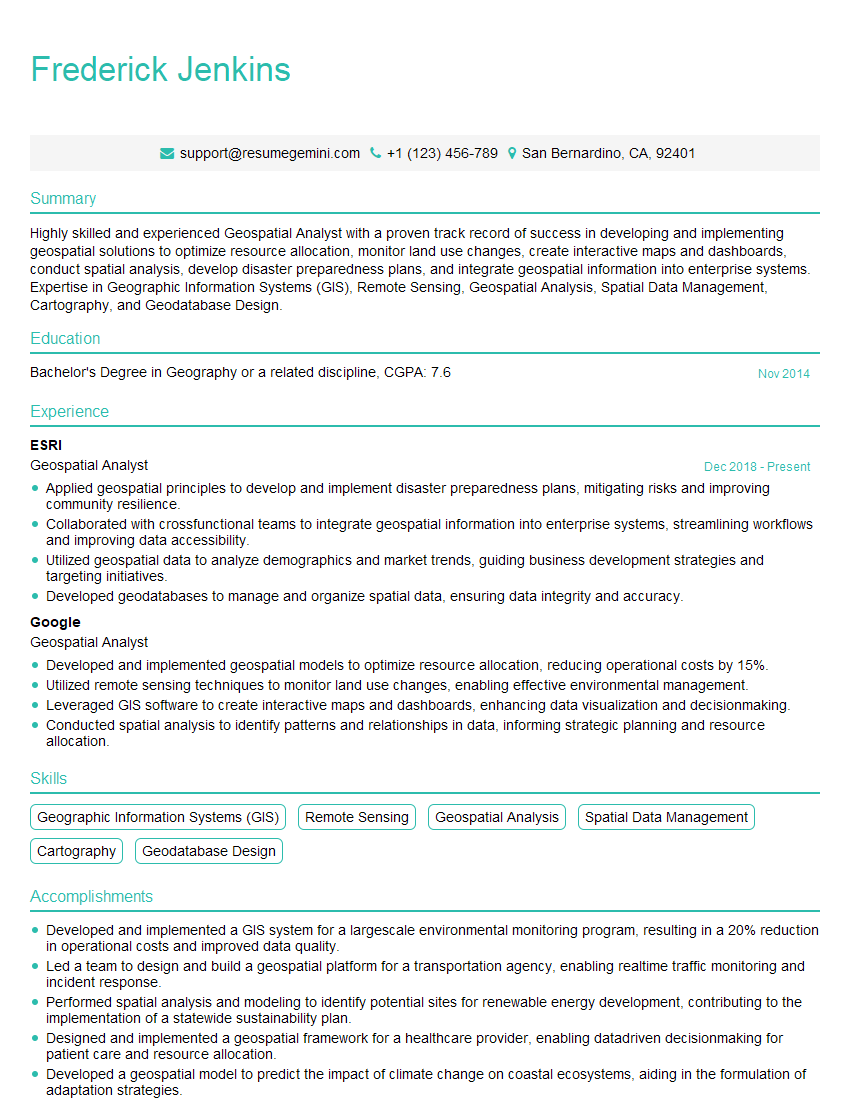
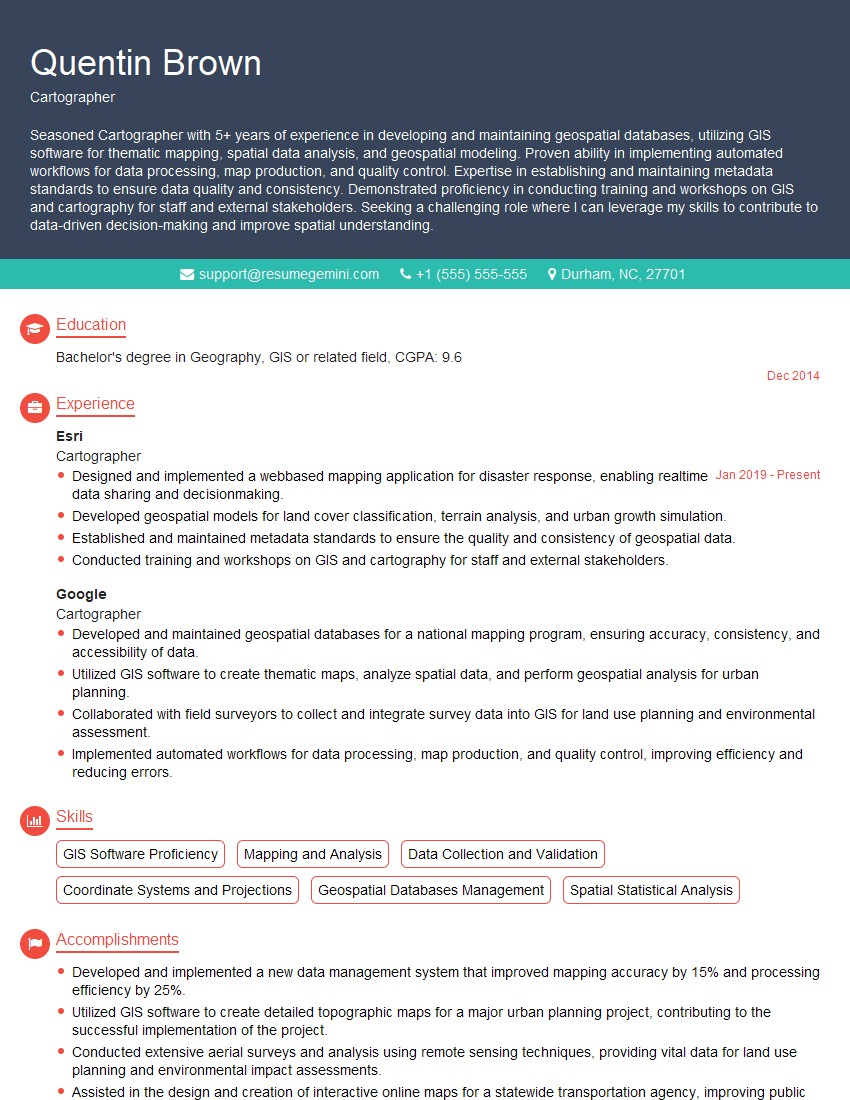
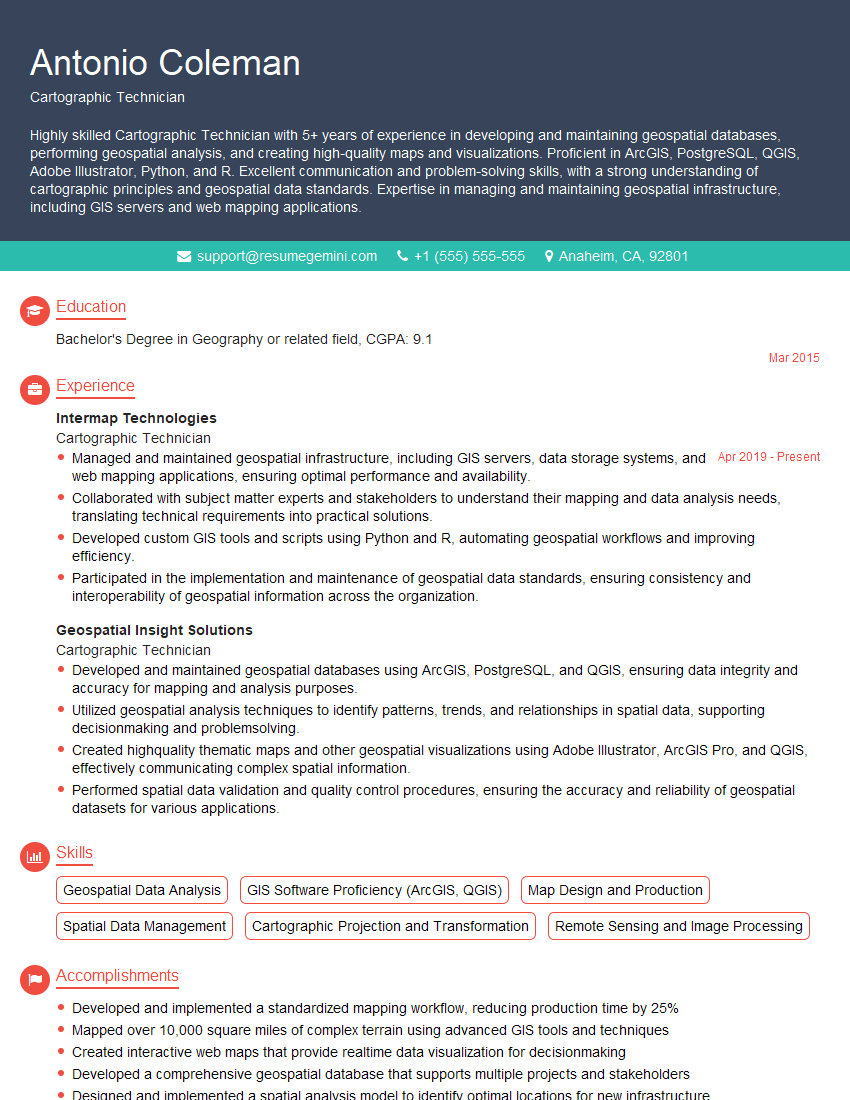
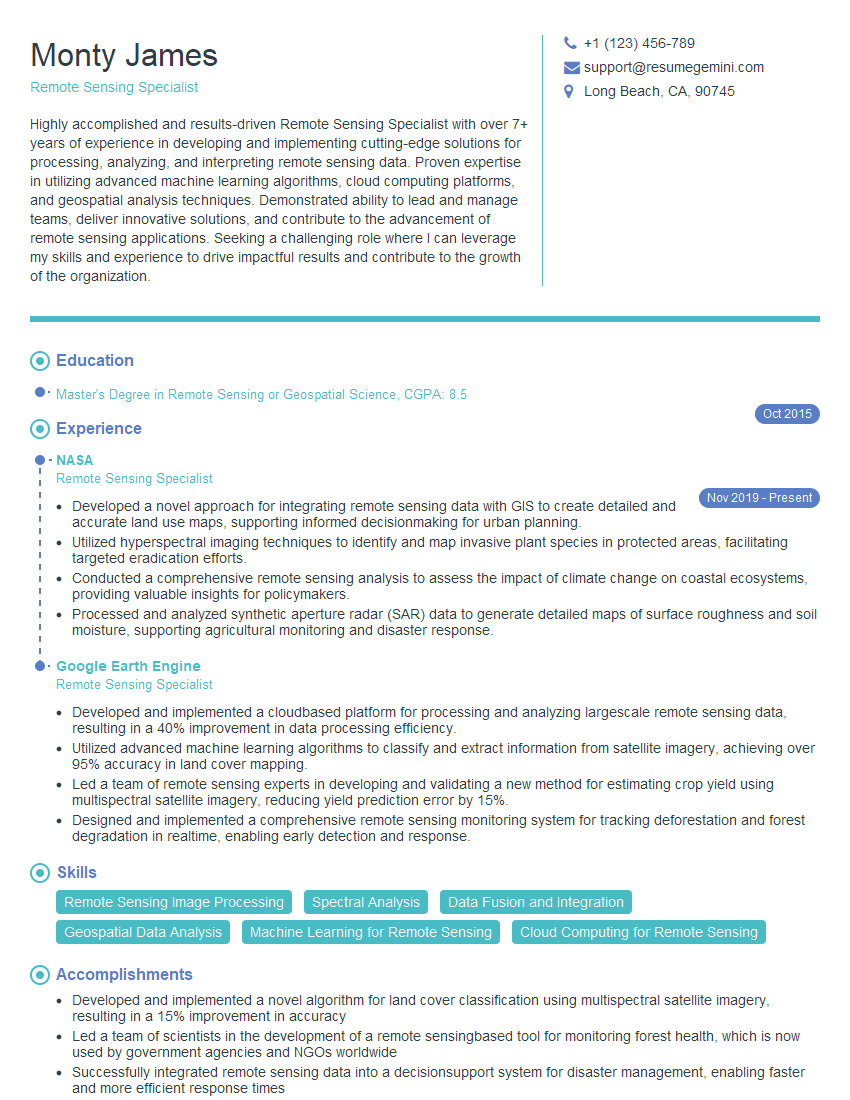
Mastering Navigation and Maps opens doors to exciting careers in various fields, from autonomous vehicles and logistics to urban planning and environmental science. To maximize your job prospects, create a compelling and ATS-friendly resume that highlights your skills and experience. ResumeGemini is a trusted resource to help you build a professional and impactful resume. We provide examples of resumes tailored to the Navigation and Maps field to guide you in showcasing your qualifications effectively.
Explore more articles
Users Rating of Our Blogs
Share Your Experience
We value your feedback! Please rate our content and share your thoughts (optional).
What Readers Say About Our Blog
Hello,
we currently offer a complimentary backlink and URL indexing test for search engine optimization professionals.
You can get complimentary indexing credits to test how link discovery works in practice.
No credit card is required and there is no recurring fee.
You can find details here:
https://wikipedia-backlinks.com/indexing/
Regards
NICE RESPONSE TO Q & A
hi
The aim of this message is regarding an unclaimed deposit of a deceased nationale that bears the same name as you. You are not relate to him as there are millions of people answering the names across around the world. But i will use my position to influence the release of the deposit to you for our mutual benefit.
Respond for full details and how to claim the deposit. This is 100% risk free. Send hello to my email id: [email protected]
Luka Chachibaialuka
Hey interviewgemini.com, just wanted to follow up on my last email.
We just launched Call the Monster, an parenting app that lets you summon friendly ‘monsters’ kids actually listen to.
We’re also running a giveaway for everyone who downloads the app. Since it’s brand new, there aren’t many users yet, which means you’ve got a much better chance of winning some great prizes.
You can check it out here: https://bit.ly/callamonsterapp
Or follow us on Instagram: https://www.instagram.com/callamonsterapp
Thanks,
Ryan
CEO – Call the Monster App
Hey interviewgemini.com, I saw your website and love your approach.
I just want this to look like spam email, but want to share something important to you. We just launched Call the Monster, a parenting app that lets you summon friendly ‘monsters’ kids actually listen to.
Parents are loving it for calming chaos before bedtime. Thought you might want to try it: https://bit.ly/callamonsterapp or just follow our fun monster lore on Instagram: https://www.instagram.com/callamonsterapp
Thanks,
Ryan
CEO – Call A Monster APP
To the interviewgemini.com Owner.
Dear interviewgemini.com Webmaster!
Hi interviewgemini.com Webmaster!
Dear interviewgemini.com Webmaster!
excellent
Hello,
We found issues with your domain’s email setup that may be sending your messages to spam or blocking them completely. InboxShield Mini shows you how to fix it in minutes — no tech skills required.
Scan your domain now for details: https://inboxshield-mini.com/
— Adam @ InboxShield Mini
Reply STOP to unsubscribe
Hi, are you owner of interviewgemini.com? What if I told you I could help you find extra time in your schedule, reconnect with leads you didn’t even realize you missed, and bring in more “I want to work with you” conversations, without increasing your ad spend or hiring a full-time employee?
All with a flexible, budget-friendly service that could easily pay for itself. Sounds good?
Would it be nice to jump on a quick 10-minute call so I can show you exactly how we make this work?
Best,
Hapei
Marketing Director
Hey, I know you’re the owner of interviewgemini.com. I’ll be quick.
Fundraising for your business is tough and time-consuming. We make it easier by guaranteeing two private investor meetings each month, for six months. No demos, no pitch events – just direct introductions to active investors matched to your startup.
If youR17;re raising, this could help you build real momentum. Want me to send more info?
Hi, I represent an SEO company that specialises in getting you AI citations and higher rankings on Google. I’d like to offer you a 100% free SEO audit for your website. Would you be interested?
Hi, I represent an SEO company that specialises in getting you AI citations and higher rankings on Google. I’d like to offer you a 100% free SEO audit for your website. Would you be interested?
good