Cracking a skill-specific interview, like one for Radar Maintenance and Repair, requires understanding the nuances of the role. In this blog, we present the questions you’re most likely to encounter, along with insights into how to answer them effectively. Let’s ensure you’re ready to make a strong impression.
Questions Asked in Radar Maintenance and Repair Interview
Q 1. Describe your experience troubleshooting radar system malfunctions.
Troubleshooting radar malfunctions requires a systematic approach. I begin by gathering information – reviewing system logs, checking for error messages, and interviewing operators to understand the nature of the problem. Then, I use a process of elimination, focusing on the most likely causes first. For instance, if the radar isn’t transmitting, I might first check power supply, then the magnetron (in a pulse radar), transmitter modulator, and finally the antenna itself. I use specialized test equipment like spectrum analyzers, oscilloscopes, and network analyzers to pinpoint faulty components. One time, a seemingly simple issue of low signal strength turned out to be a loose connection at the waveguide junction, highlighting the importance of meticulous checks. I meticulously document every step, using schematics and diagnostic flowcharts to guide the repair. My goal is always to get the system back online quickly and efficiently while ensuring its reliable performance.
Q 2. Explain the process of calibrating a radar system.
Radar calibration ensures accurate range, angle, and velocity measurements. The process is specific to the type of radar but generally involves adjusting the system to known standards. For example, with a weather radar, this might involve using a known target at a precise distance, adjusting internal parameters to ensure the measured distance aligns with the known distance. This often includes adjusting timing circuits, signal gains, and antenna positioning using specialized calibration tools and software. Calibration also includes testing for linearity, accuracy, and consistency across the radar’s operational range. For instance, a precise calibration target, like a corner reflector, at various distances is used to generate a test data set which is compared to the expected response, revealing any discrepancies. Post-calibration, comprehensive performance tests are carried out, verifying that the system meets all performance specifications.
Q 3. What are the common causes of radar signal degradation?
Radar signal degradation can stem from various sources. Environmental factors like heavy rain, snow, or atmospheric interference can scatter or absorb the radar signal, reducing its strength and clarity. Equipment malfunctions, such as a faulty high-power amplifier, a degraded antenna, or problems with the receiver, can also significantly impact signal quality. Clutter from ground reflections or other objects can mask the target signal, making it difficult to detect. Finally, interference from other radar systems or radio frequency sources can contaminate the radar signal, leading to false alarms or missed detections. For example, I once worked on a case where significant signal degradation was due to unexpected interference from a newly installed nearby radio transmitter operating at a frequency close to the radar’s operating frequency. Identifying the source of interference through careful signal analysis was critical in resolving the issue.
Q 4. How do you diagnose and repair faulty radar antennas?
Diagnosing faulty radar antennas involves a multi-step approach. I begin with a visual inspection, checking for physical damage like corrosion, dents, or loose elements. Next, I measure the antenna’s impedance using a network analyzer, to ensure it matches the system’s requirements. Any significant mismatch can indicate a fault. I then check for any internal shorts or open circuits. A pattern of signal strength degradation at specific angles can point to imperfections in the antenna surface or feed network. Sometimes, more specialized equipment such as antenna pattern measurement systems might be necessary to thoroughly characterize antenna performance. Repair can include replacing damaged components, repairing waveguide sections, or even requiring complete antenna refurbishment in severe cases. A common problem is water ingress into the antenna’s feed system, leading to corrosion and signal degradation; addressing this requires careful cleaning, drying, and possibly replacing damaged components.
Q 5. What safety precautions do you take when working with high-power radar systems?
Safety is paramount when working with high-power radar systems. I always adhere to strict safety protocols, including wearing appropriate personal protective equipment (PPE) like safety glasses and gloves to protect against high voltage and potential RF burns. I only work with the system powered down when performing maintenance or repair involving internal components. Before powering up, I verify that all safety interlocks are functioning correctly. Furthermore, I ensure that the radar beam is not directed towards populated areas during testing or operation. Understanding the potential hazards associated with high-power RF radiation is crucial. If working on a system that has high-power transmitter, I might use specialized RF shielding and monitoring equipment to ensure safety. A detailed safety plan is always prepared and implemented before commencing any work.
Q 6. Explain your understanding of different types of radar systems (e.g., pulse Doppler, FMCW).
My experience encompasses various radar systems. Pulse Doppler radar transmits short pulses of energy and analyzes the frequency shift of the returned signal to determine target velocity. This is commonly used in weather radar and air traffic control. Frequency-Modulated Continuous Wave (FMCW) radar continuously transmits a signal whose frequency changes over time. By comparing the transmitted and received signals, range and velocity can be determined. FMCW radars are frequently employed in automotive applications and short-range sensing. I’ve also worked with other types, including monopulse radars known for their high accuracy in angle measurements and synthetic aperture radars (SAR) which utilize signal processing techniques to create high-resolution images. Each type presents unique challenges and opportunities in maintenance and repair, requiring a deep understanding of their specific principles and architecture.
Q 7. Describe your experience with radar signal processing techniques.
Radar signal processing is fundamental to interpreting radar data. I’m proficient in techniques like pulse compression, which improves range resolution, and moving target indication (MTI), which filters out stationary clutter. I’m familiar with digital signal processing (DSP) techniques used for clutter rejection, target detection, and tracking. For instance, I have experience using Fast Fourier Transforms (FFTs) to analyze frequency components of radar returns and applying digital filters to reduce noise and interference. This often involves using specialized software and hardware platforms to process the massive amounts of data generated by modern radar systems. One project involved developing custom algorithms to improve the detection of small, low-observable targets in a cluttered environment, showcasing my ability to apply signal processing expertise to practical radar problems.
Q 8. How do you perform preventative maintenance on a radar system?
Preventative maintenance on a radar system is crucial for ensuring its reliable operation and extending its lifespan. It’s akin to regularly servicing your car – preventing small issues from becoming major breakdowns. My approach is systematic and follows a checklist tailored to the specific radar model. This typically involves several key steps:
- Visual Inspection: A thorough examination of all components for signs of wear, corrosion, loose connections, or physical damage. This includes checking cabling, antennas, and the main unit itself.
- Calibration and Alignment: Precise calibration of the system to maintain accuracy in range, bearing, and elevation measurements. This might involve using specialized equipment to align the antenna and ensure the proper signal transmission and reception.
- Testing and Diagnostics: Running built-in self-tests and employing specialized test equipment to assess the performance of various subsystems, such as the transmitter, receiver, signal processor, and display. We look for deviations from the manufacturer’s specifications.
- Cleaning and Lubrication: Cleaning components to remove dust and debris which can affect performance. Applying appropriate lubricants to moving parts, such as antenna drive mechanisms, helps to prevent wear and tear.
- Software Updates: Updating the system’s software to the latest version often includes bug fixes, performance improvements, and new features. This is vital for maintaining optimal functionality and security.
- Documentation: Meticulous record-keeping of all maintenance activities, including dates, findings, and actions taken. This forms a crucial history for future troubleshooting and preventative maintenance scheduling.
For instance, during a recent preventative maintenance check on a weather radar, we discovered a slightly loose connection in the antenna assembly. Addressing this minor issue prevented a potential major malfunction later on.
Q 9. What software and tools are you proficient in using for radar maintenance?
My proficiency extends to various software and tools used in radar maintenance and repair. This includes specialized test equipment and software packages specific to different radar manufacturers. I’m adept at using:
- Radar Signal Analyzers: These sophisticated instruments allow me to analyze the transmitted and received radar signals, identifying any anomalies or signal degradation.
- Spectrum Analyzers: These are essential for examining the frequency spectrum of the radar signal, detecting unwanted interference or spurious emissions.
- Network Analyzers: Crucial for diagnosing problems in the radar’s internal networks and communication interfaces.
- Oscilloscope: Used for observing waveforms and identifying timing issues within the system’s various electronic components.
- Manufacturer-Specific Software: I am experienced with diagnostic and configuration software provided by leading radar manufacturers, enabling me to test, calibrate, and configure the radar system efficiently. This often involves specialized programming languages for controlling the radar and interpreting data.
For example, I recently used a network analyzer to pinpoint a faulty Ethernet connection affecting the data transfer from a weather radar to the remote monitoring station, resolving a significant data outage.
Q 10. Explain your experience working with radar transmitters and receivers.
My experience with radar transmitters and receivers is extensive. I understand the intricate workings of high-power transmitters, the challenges of managing high-voltage components, and the delicate balance needed for optimal signal reception. I’ve worked on various types of radar systems, from low-power to high-power units.
Transmitters: My work includes troubleshooting magnetrons (in older systems), klystrons, solid-state amplifiers, and their associated power supplies. I’m familiar with high voltage safety procedures and the use of specialized test equipment to measure power output, pulse shape, and frequency stability. Repair work often involves component-level replacements, adjustments to power levels, and impedance matching.
Receivers: I understand the intricacies of low-noise amplifiers, mixers, intermediate frequency (IF) stages, and detectors. My experience includes diagnosing and repairing issues with receiver sensitivity, signal-to-noise ratio, and dynamic range. I am proficient in using various test equipment to evaluate receiver performance and pinpoint faulty components.
In one instance, I successfully diagnosed and repaired a faulty high-power amplifier in a marine radar transmitter, preventing a significant navigational safety hazard.
Q 11. Describe your understanding of radar frequency bands and their applications.
Understanding radar frequency bands and their applications is fundamental to radar maintenance. Different bands have different characteristics that make them suitable for various applications. Here are some examples:
- L band (1-2 GHz): Often used in weather radar, air traffic control, and some maritime applications due to its ability to penetrate rain and clouds.
- S band (2-4 GHz): Commonly used in air traffic control, weather radar, and shipborne radars. Offers a good balance between range and resolution.
- C band (4-8 GHz): Frequently used in weather radar, maritime applications, and some military radars. Provides higher resolution than L band but is more susceptible to atmospheric attenuation.
- X band (8-12 GHz): Widely used in short-range applications such as automotive radar, collision avoidance systems, and police radar due to its higher resolution.
- Ku band (12-18 GHz): Often used in satellite communication and some meteorological applications, offering even higher resolution than X band.
- Ka band (18-27 GHz): Used in advanced weather radar systems, satellite communications, and high-resolution imaging systems. Offers the highest resolution of common bands, but its signals are easily attenuated by atmospheric conditions.
The choice of frequency band depends heavily on the specific application’s requirements. For example, a weather radar needing to penetrate heavy rainfall would benefit from an L-band system, while a short-range automotive radar would utilize an X-band system.
Q 12. How do you interpret radar data and identify anomalies?
Interpreting radar data and identifying anomalies requires a keen eye for detail and a deep understanding of radar principles. The process involves several steps:
- Data Acquisition: Retrieving radar data through the system’s interface or logging systems.
- Visual Inspection: Examining raw radar data displays for unusual patterns, missing data points, or unexpected echoes.
- Statistical Analysis: Analyzing key parameters such as signal strength, signal-to-noise ratio, and range/bearing information to detect inconsistencies or trends deviating from normal operating parameters.
- Comparison with historical data: Comparing current data with historical data to identify deviations from established baselines.
- Signal Processing analysis: Investigating any distortions or inconsistencies in the processed signals, considering the effects of noise, interference, and clutter.
- Cross-referencing with other data sources: When appropriate, correlating radar data with other data sources (weather reports, flight information, etc.) to understand the context of anomalies.
An example: During routine monitoring, I noticed an unusual increase in noise levels on a specific azimuth segment of a maritime radar. This anomaly, combined with a slight decrease in signal strength, pointed towards a possible problem with the antenna or its associated waveguide. Further investigation confirmed a partial blockage due to seagull droppings.
Q 13. How familiar are you with different types of radar modulators?
I’m familiar with a variety of radar modulators, the devices that shape the radar signal’s pulse. The type of modulator used often depends on the radar’s power requirements and the desired signal characteristics. My experience includes working with:
- Hard-tube Modulators: These older systems use vacuum tubes (like magnetrons) for pulse generation and require high-voltage power supplies. Maintenance often involves high-voltage safety protocols and specialized testing for tube health and performance.
- Solid-state Modulators: These more modern systems use solid-state devices (transistors, etc.) for pulse generation. They are generally more reliable and efficient than hard-tube modulators, but require a good understanding of power electronics and high-speed digital circuitry.
- Magnetron Modulators: Specifically designed to drive magnetrons, these modulators often involve high-voltage pulse forming networks and pulse transformers.
- Thyratron Modulators: These use thyratron tubes to generate high-power pulses, requiring expertise in gas-discharge tube technology.
Understanding the different types is vital for proper troubleshooting. A faulty modulator can significantly impact the radar’s performance, leading to decreased range, distorted signals, or even system failure.
Q 14. Explain your experience with repairing radar indicators and displays.
Repairing radar indicators and displays involves troubleshooting both the hardware and software aspects of the display system. These displays provide the visual representation of the radar data, making their functionality critical. My experience includes working with:
- CRT-based Displays (older systems): These require knowledge of high-voltage circuits, electron gun adjustments, and troubleshooting issues related to image quality, such as brightness, focus, and geometric distortion.
- LCD/LED Displays (modern systems): These involve understanding the digital interface, backlight systems, and image processing circuitry. Troubleshooting often focuses on signal integrity, display driver issues, and communication protocols.
- Touchscreen Displays: These require expertise in both the display technology and the touchscreen controller, addressing issues related to responsiveness, calibration, and digitizer functionality.
In a recent repair, a faulty display driver board in a weather radar’s LCD display caused a significant portion of the screen to remain blank. I successfully replaced the faulty board and restored the display’s full functionality, ensuring accurate weather data visualization.
Q 15. Describe your knowledge of radar system power supplies.
Radar system power supplies are crucial for the proper functioning of the entire system. They provide the high-voltage, high-current power necessary for the magnetron (the heart of many radar systems) and other components like the transmitter, receiver, and signal processing units. My understanding encompasses various types, including high-voltage DC power supplies, AC-to-DC converters, and regulated power supplies. I’m familiar with their specifications, such as voltage, current, and ripple, and their importance in maintaining system stability and efficiency. For example, a faulty high-voltage power supply can lead to reduced transmission power, resulting in decreased range and accuracy. I also have experience troubleshooting issues such as voltage regulation problems, over-current protection failures, and component malfunctions within these power supplies, often utilizing oscilloscopes and multimeters for diagnosis and repair.
One case I remember involved a system where intermittent power supply failure led to sporadic radar signal dropouts. Through careful inspection and testing, I identified a failing capacitor within the high-voltage section. Replacing the capacitor resolved the issue completely, demonstrating the importance of routine maintenance and proactive component replacement.
Career Expert Tips:
- Ace those interviews! Prepare effectively by reviewing the Top 50 Most Common Interview Questions on ResumeGemini.
- Navigate your job search with confidence! Explore a wide range of Career Tips on ResumeGemini. Learn about common challenges and recommendations to overcome them.
- Craft the perfect resume! Master the Art of Resume Writing with ResumeGemini’s guide. Showcase your unique qualifications and achievements effectively.
- Don’t miss out on holiday savings! Build your dream resume with ResumeGemini’s ATS optimized templates.
Q 16. How do you troubleshoot problems with radar data acquisition systems?
Troubleshooting radar data acquisition problems requires a systematic approach. It begins with understanding the data flow: from the antenna, through the receiver, the signal processor, and finally to the display or storage system. I start by examining the overall system health – are there any obvious errors or warnings displayed? Then, I move to isolating the problem by checking each stage of the data path. This may involve checking signal levels, using spectrum analyzers to verify signal integrity, and examining data logs for anomalies. If the problem lies within the digital processing, I’ll utilize diagnostic software to pinpoint the fault.
For instance, if the radar displays inconsistent or noisy data, I would first verify the antenna is correctly aligned and free from obstructions. Then I’d check the receiver’s gain settings and look for any sign of signal saturation or distortion using a spectrum analyzer. Finally, I’d examine the digital signal processing chain for errors, potential software bugs, or corrupted data streams. This systematic approach, combining hardware and software diagnostics, is crucial in quickly identifying the root cause of data acquisition issues.
Q 17. What are the common causes of radar system noise and how do you mitigate them?
Radar system noise is a common issue that can severely impact performance. Common sources include thermal noise from components, interference from external sources (other radars, electronic devices), and internal noise generated within the receiver itself. Mitigation techniques are diverse and depend on the noise source.
- Thermal Noise: This is inherent in electronic components and can be reduced by using low-noise amplifiers (LNAs) and components with appropriate thermal characteristics.
- External Interference: This might be addressed by using filters (e.g., bandpass filters) to attenuate unwanted frequencies, improving the signal-to-noise ratio. Careful site selection and shielding can also reduce external interference.
- Internal Noise: This often requires detailed analysis using specialized equipment like spectrum analyzers to pinpoint the noise source (e.g., a faulty component within the receiver). Replacing the problematic component or employing noise cancellation techniques are potential solutions.
For example, I once worked on a system plagued by significant noise at a specific frequency. Through spectral analysis, we discovered it was interference from a nearby radio transmitter. The solution was to implement a narrowband notch filter, specifically designed to attenuate the interfering frequency, significantly improving data quality.
Q 18. Explain your experience with radar system testing and alignment procedures.
Radar system testing and alignment are critical for optimal performance. This involves a series of procedures to verify that the system meets its specifications and operates correctly. Alignment procedures focus on ensuring the antenna is accurately pointed and the various components are properly phased to maximize signal strength and minimize side lobes. This typically involves using specialized test equipment such as network analyzers, signal generators, and alignment tools.
Testing typically includes checking the transmitter output power, receiver sensitivity, range accuracy, and beam pattern. Alignment may involve adjusting the antenna position, using calibration signals, and performing phased array adjustments. I have extensive experience in performing these tests and alignments, ensuring the radar system is operating at its peak efficiency. I have used various methods, including automated test equipment (ATE) and manual procedures, adapting the approach to the specific type of radar system.
Q 19. How familiar are you with various types of radar waveguides and their maintenance?
I am well-versed in various radar waveguide types, including rectangular, circular, and coaxial waveguides, and their associated maintenance. Understanding the properties of each type is essential for effective maintenance and repair. Rectangular waveguides are common in many radar systems, and their maintenance often involves cleaning and inspecting for corrosion or damage. Circular waveguides are used in some specialized radar applications and may require more complex maintenance procedures. Coaxial waveguides offer advantages in certain circumstances, but their maintenance focuses on ensuring good electrical contact and preventing signal loss.
Maintenance of waveguides includes regular inspection for physical damage, such as dents or cracks, checking for proper connections and ensuring a good vacuum seal (where applicable). Cleaning involves removing any dust, moisture or other contaminants that could affect signal transmission. For example, a waveguide with a poor connection could significantly reduce signal strength. Therefore, regular inspection and maintenance are essential for maintaining the radar system’s performance.
Q 20. Describe your experience with troubleshooting radar magnetrons.
Troubleshooting radar magnetrons requires a careful and systematic approach due to the high voltages and potential hazards involved. Magnetrons are high-power vacuum tubes that generate microwave energy. Common problems include reduced output power, arcing, and high-voltage leaks. Diagnosing these issues typically involves using high-voltage probes, spectrum analyzers, and specialized test equipment.
I’ve encountered various magnetron problems, ranging from simple filament failures to complex cathode issues. My approach involves systematically checking the magnetron’s operating parameters, such as anode voltage, cathode current, and microwave output power, using appropriate safety precautions. For example, a reduction in output power could indicate a problem with the cathode, filament, or resonant cavity. I have experience in safely replacing faulty magnetrons and performing necessary adjustments to restore the system’s operation. Safety is paramount in this area, and I always follow strict safety protocols when working with high-voltage components.
Q 21. Explain your experience with different types of radar duplexers.
Radar duplexers are crucial components that allow a single antenna to be used for both transmission and reception. I am familiar with various types, including gas-discharge duplexers, ferrite duplexers, and solid-state duplexers, each with its unique characteristics and maintenance requirements. Gas-discharge duplexers rely on the properties of a gas plasma to switch between transmission and reception. Ferrite duplexers use the properties of magnetic materials to achieve the same function. Solid-state duplexers offer advantages in terms of reliability and size.
Troubleshooting duplexers might involve checking for proper switching action, identifying RF leakage, or examining for signs of component failure. Maintenance may involve checking for gas pressure levels (in gas-discharge duplexers), inspecting for damage or wear, and verifying proper electrical connections. For example, a faulty gas-discharge duplexer might result in RF leakage during reception, degrading the performance of the radar system. My experience ensures I can identify the specific type of duplexer, diagnose the problem correctly, and carry out the necessary repairs or replacements safely and efficiently.
Q 22. How do you document your radar maintenance and repair activities?
Thorough documentation is crucial for effective radar maintenance and repair. My approach involves a multi-faceted system ensuring traceability and accountability. This includes creating detailed maintenance logs using a digital system, incorporating both preventative and corrective actions. Each entry specifies the date, time, performed actions (including component replacements and adjustments), observed issues, used tools and equipment, and the technician’s identification. We also use checklists to confirm tasks are completed correctly, minimizing human error. Additionally, all schematics, parts lists, and test results are meticulously archived, allowing for easy review and future troubleshooting. This ensures compliance with safety and regulatory standards, facilitates future maintenance, and provides a valuable record for auditing and analysis.
For example, if I replace a faulty high-voltage power supply in a weather radar, the log entry will include the specific model of the replacement, its serial number, the readings before and after replacement, and photographs of the faulty and new components. This level of detail allows for precise tracking of component lifespan and identifying potential recurring issues.
Q 23. What are your methods for ensuring the accuracy and reliability of radar measurements?
Accuracy and reliability in radar measurements are paramount. We achieve this through a rigorous calibration and verification process involving multiple steps. First, we conduct regular self-tests and internal diagnostics built into the radar system itself. These tests check for component functionality, signal strength, and overall system performance. Next, we perform external calibrations using traceable standards, ensuring our measurements align with recognized industry benchmarks. We might use precision signal generators and test equipment, cross-referencing the results against known values. Regular antenna alignment checks are crucial for accurate beam steering and reducing errors. Finally, we compare radar data with other independent data sources (if available), like weather reports or other sensors, to verify its accuracy. A comprehensive data logging and analysis system helps us identify any systematic errors or anomalies, providing us insight for necessary adjustments and system improvements.
For instance, in air traffic control radar, we routinely verify the accuracy of range and bearing measurements using known target positions or test signals. Discrepancies trigger a more thorough investigation and calibration.
Q 24. Describe a challenging radar repair you encountered and how you solved it.
One of the most challenging repairs I faced involved a marine radar system experiencing intermittent signal dropouts. Initial diagnostics pointed towards a faulty receiver, but replacing it didn’t solve the problem. The signal dropouts were sporadic and seemingly random. I systematically eliminated other potential causes: cabling, power supply, and antenna. Finally, I discovered that the issue stemmed from a poorly soldered connection within the main processing unit, causing intermittent short circuits that only appeared under specific environmental conditions (high humidity). The solution required meticulous rework of the solder joint under a microscope, ensuring a clean and stable connection. Post-repair, the system underwent rigorous testing to confirm its stability and reliability under varying conditions. The key to solving this was a patient, systematic approach, combined with meticulous troubleshooting and attention to detail – a classic case of “it’s always the last thing you check!”
Q 25. Explain your understanding of radar system environmental considerations.
Environmental considerations are critically important in radar system design and maintenance. Factors like temperature, humidity, and precipitation directly influence the performance and lifespan of radar components. Extreme temperatures can affect the efficiency of electronic components, leading to malfunction or reduced lifespan. Humidity can cause corrosion and degrade insulation, while precipitation can directly impact antenna performance. Salt spray in coastal environments is especially corrosive and demanding. We mitigate these effects through proper site selection, environmental protection measures (e.g., weatherproof enclosures, climate control systems), and the use of ruggedized, corrosion-resistant components designed for harsh environments. Regular inspections and maintenance are crucial to identify and address any environmental damage before it leads to significant system failures.
For example, in a desert environment, we would focus on preventing overheating and sand ingress; whereas in a coastal location, our focus would shift towards mitigating corrosion from salt spray and wind-driven moisture.
Q 26. How do you stay updated on the latest advancements in radar technology?
Staying updated in this rapidly evolving field is critical. I actively participate in professional organizations like IEEE (Institute of Electrical and Electronics Engineers) and attend industry conferences and workshops focused on radar technology. This provides opportunities to learn about cutting-edge developments, interact with leading experts, and learn about new techniques. I regularly read industry journals and publications, such as specialized magazines and online resources which contain articles on the latest advancements in radar technology, and I also participate in online forums and communities for radar engineers, sharing information and discussing industry challenges. Keeping my knowledge current allows me to maintain and repair a wider range of radar systems with increased efficiency and effectiveness.
Q 27. Describe your experience with working on phased array radar systems.
I have extensive experience working with phased array radar systems. These systems are significantly more complex than traditional mechanically scanned radars, requiring specialized skills in RF engineering, digital signal processing, and software-defined radio techniques. My experience includes troubleshooting and repairing both the RF front-end (transmit/receive modules, phase shifters) and the backend processing units. This involves advanced diagnostic techniques including spectrum analysis, signal integrity testing, and utilizing specialized software tools for system configuration and calibration. The modular nature of phased array systems allows for component-level repair, reducing downtime and improving overall cost-effectiveness. However, it also requires a deep understanding of the system architecture and inter-module communication.
For example, I’ve successfully repaired faulty transmit/receive modules in a phased array weather radar by identifying and replacing defective components within the module itself, rather than needing to replace the entire module, which would have been much more expensive and time-consuming.
Q 28. What are your strengths and weaknesses related to radar maintenance and repair?
My strengths lie in my systematic troubleshooting approach, my in-depth understanding of radar systems, and my ability to quickly learn and adapt to new technologies. I’m adept at working both independently and as part of a team, effectively communicating technical information to both technical and non-technical audiences. One area for improvement I’m actively working on is expanding my familiarity with the newest generation of software-defined radars; while I’m proficient in the fundamentals, keeping up with the rapid pace of software-defined radar advancements is an ongoing process. I am proactively engaging with online courses and literature to address this.
Key Topics to Learn for Radar Maintenance and Repair Interview
- Radar System Fundamentals: Understanding the basic principles of radar operation, including transmission, reception, and signal processing. This includes familiarity with different radar types (e.g., pulse Doppler, phased array).
- RF and Microwave Theory: Practical application of RF and microwave principles to troubleshoot and repair radar systems. This involves working with components like waveguides, antennas, and high-power amplifiers.
- Digital Signal Processing (DSP) in Radar: Understanding the role of DSP in modern radar systems, including signal filtering, detection, and tracking. This might involve familiarity with specific algorithms or software used in radar processing.
- Troubleshooting and Diagnostics: Developing systematic approaches to identify and resolve faults in radar systems. This includes using test equipment, interpreting diagnostic data, and applying logical problem-solving skills.
- Component-Level Repair: Hands-on experience repairing and replacing individual components within a radar system, including power supplies, transmitters, receivers, and antennas. This requires both practical skills and a deep understanding of electronic circuits.
- Safety Procedures and Regulations: Understanding and adhering to safety protocols when working with high-voltage equipment and potentially hazardous RF radiation. This is crucial for both personal safety and regulatory compliance.
- System Integration and Testing: Knowledge of integrating repaired or replaced components back into the overall radar system and performing comprehensive tests to ensure proper functionality. This involves understanding system architecture and interoperability.
- Preventive Maintenance: Understanding and performing routine maintenance tasks to prevent failures and extend the lifespan of radar systems. This involves scheduling, inspections, and cleaning procedures.
Next Steps
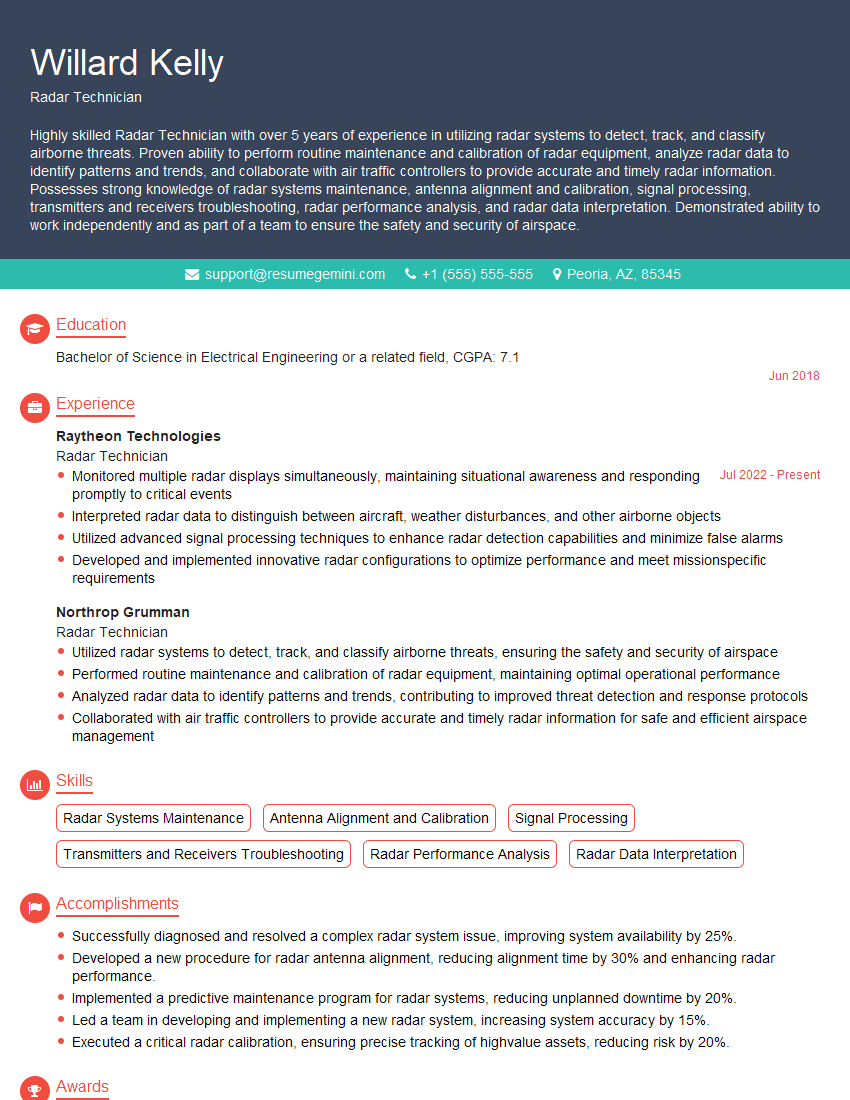
Mastering Radar Maintenance and Repair opens doors to a rewarding career with excellent growth potential in a technologically advanced field. Demand for skilled technicians is consistently high, making this a highly sought-after skillset. To maximize your job prospects, invest time in crafting an ATS-friendly resume that showcases your expertise effectively. ResumeGemini is a trusted resource that can help you build a professional and impactful resume tailored to the specific requirements of the Radar Maintenance and Repair industry. Examples of resumes tailored to this field are available to help you get started.
Explore more articles
Users Rating of Our Blogs
Share Your Experience
We value your feedback! Please rate our content and share your thoughts (optional).
What Readers Say About Our Blog
Very informative content, great job.
good