Are you ready to stand out in your next interview? Understanding and preparing for Laser Cutting Techniques interview questions is a game-changer. In this blog, we’ve compiled key questions and expert advice to help you showcase your skills with confidence and precision. Let’s get started on your journey to acing the interview.
Questions Asked in Laser Cutting Techniques Interview
Q 1. Explain the different types of lasers used in laser cutting.
Laser cutting utilizes various laser types, each with unique properties influencing its application. The choice depends heavily on the material being cut and the desired outcome. Here are some of the most common:
- CO2 Lasers: These lasers excel at cutting non-metallic materials like wood, acrylic, fabric, and paper. They use a gas mixture primarily containing carbon dioxide to generate infrared laser beams. The longer wavelength makes them effective in absorbing energy from these materials, leading to efficient cutting.
- Fiber Lasers: Fiber lasers utilize a fiber optic cable to generate high-power, short-wavelength beams. This makes them ideal for cutting metals, particularly stainless steel, aluminum, and mild steel. Their high power density and efficiency translate to faster cutting speeds and better edge quality.
- YAG Lasers (Nd:YAG and Yb:YAG): These solid-state lasers use a crystal doped with neodymium or ytterbium to generate laser light. They are versatile and can cut both metals and non-metals, though often at a slower speed compared to fiber lasers. Nd:YAG is suitable for a wider range of materials, and Yb:YAG is preferred for higher power applications.
The selection of the laser type is a crucial step in the process. For example, attempting to cut stainless steel with a CO2 laser would be inefficient and likely unsuccessful due to the metal’s low absorption of the CO2 laser’s wavelength. Conversely, a fiber laser would struggle to efficiently cut delicate fabrics due to its high power density.
Q 2. Describe the process of laser cutting, including the steps involved.
Laser cutting is a subtractive manufacturing process that utilizes a highly focused laser beam to melt, vaporize, or burn away material, leaving behind a precisely cut shape. Here’s a breakdown of the steps:
- Design & Preparation: The desired design is created using CAD software and then converted into a format readable by the laser cutting machine (typically DXF or AI).
- Material Loading: The material to be cut is securely placed on the machine’s bed, ensuring proper alignment and stability.
- Parameter Setting: The operator sets the laser parameters based on the material type, thickness, and desired cut quality. This involves selecting power, speed, frequency, and focus point.
- Cutting Process: The laser beam precisely traces the design, cutting through the material. Auxiliary gases such as compressed air or nitrogen are often used to assist in removing the molten or vaporized material from the cut.
- Unloading & Finishing (Optional): Once the cutting is complete, the finished part is unloaded. Further finishing, such as sanding or polishing, may be necessary depending on the application.
Think of it like a highly precise, controlled heat-based ‘scalpel’. The accuracy and speed are far superior to traditional cutting methods, enabling complex designs and intricate details.
Q 3. What safety precautions are essential when operating a laser cutting machine?
Safety is paramount when operating a laser cutting machine. Several precautions must be strictly followed:
- Eye Protection: Always wear appropriate laser safety glasses rated for the laser wavelength being used. This is perhaps the most crucial precaution to prevent severe eye damage.
- Enclosure & Barriers: The laser cutting area should be enclosed or shielded to prevent accidental exposure to the laser beam. Interlocks ensure the laser shuts down when the enclosure is opened.
- Fire Safety: Many materials can ignite during laser cutting. Fire extinguishers appropriate for the materials being processed should be readily available.
- Ventilation: Laser cutting often generates fumes and dust, which may be harmful. Proper ventilation is crucial to remove these from the work area.
- Personal Protective Equipment (PPE): In addition to eye protection, other PPE such as gloves, hearing protection, and respiratory protection may be required depending on the materials and processes.
- Training & Certification: Operators should receive thorough training on the safe operation of the laser cutting machine before handling it independently. Certification programs exist for laser safety.
Ignoring these precautions can lead to severe injuries, including blindness and burns. Safety should always be the top priority.
Q 4. How do you select the appropriate laser parameters (power, speed, etc.) for a given material?
Selecting the correct laser parameters is critical for achieving optimal cutting quality and efficiency. The process involves careful consideration of several factors:
- Material Type: Different materials require different laser power levels and speeds. Thicker materials generally require higher power and slower speeds.
- Material Thickness: As mentioned, thicker materials necessitate higher power settings to ensure complete penetration. Thinner materials can be cut at higher speeds with lower power.
- Desired Cut Quality: Smoother cuts typically require lower power and slower speeds. Faster speeds may result in rougher edges, but improve efficiency.
- Assist Gas: The type and pressure of the assist gas (e.g., air, oxygen, nitrogen) influence the cutting process and the quality of the cut. Oxygen enhances combustion, ideal for cutting steel, while nitrogen provides a cleaner cut in certain materials.
Trial and error, combined with experience and manufacturer recommendations, often helps refine these settings. Many machines offer test-cut functions which let the user fine-tune the parameters before committing to the full cut. For example, cutting a complex design in a thick piece of acrylic requires considerably more power compared to cutting the same design out of thin paper.
Q 5. Explain the concept of kerf width and its significance in laser cutting.
Kerf width refers to the width of the cut created by the laser beam. It’s essentially the amount of material removed during the cutting process. Understanding kerf width is vital for precise part design.
Its significance lies in its impact on dimensional accuracy. Because the laser removes material, the final dimensions of the cut part will be slightly smaller than the design dimensions by the width of the kerf. This difference must be accounted for during the design phase to ensure the final product meets the specifications. A larger kerf width implies more material has been removed, potentially influencing part strength.
The kerf width is influenced by factors such as laser power, speed, material type, and assist gas. For instance, higher laser power tends to result in a wider kerf, while faster speeds often lead to a narrower one, though this might also impact the quality.
Q 6. What are the common materials processed using laser cutting technology?
Laser cutting is a versatile technology capable of processing a wide range of materials. The specific materials will depend on the type of laser used (CO2, fiber, etc.). Here are some commonly processed materials:
- Metals: Stainless steel, aluminum, mild steel, brass, copper
- Non-Metals: Wood (various types), acrylic, plastics (various types), paper, cardboard, fabrics, leather
- Other Materials: Glass (with specific laser parameters), ceramics (with specific laser parameters)
The ability to cut such diverse materials, coupled with the precision of the process, contributes to the extensive use of laser cutting across various industries, from manufacturing and prototyping to arts and crafts.
Q 7. Describe your experience with different types of laser cutting machines (e.g., CO2, fiber).
My experience encompasses extensive work with both CO2 and fiber laser cutting machines. I’ve worked on a variety of machines from different manufacturers, giving me a broad perspective on the capabilities and limitations of each technology.
CO2 Lasers: I’ve used CO2 lasers extensively for cutting intricate designs in wood, acrylic, and fabric for various applications including signage, prototypes, and artistic projects. My experience includes optimizing parameters for different thicknesses and types of wood, achieving consistently clean cuts with minimal charring or burning.
Fiber Lasers: My work with fiber lasers has primarily focused on metal cutting, specifically stainless steel and aluminum. I’ve been involved in projects requiring high-precision cuts for industrial applications. I’ve gained expertise in optimizing cutting parameters to achieve fine edge quality and high throughput, especially for complex geometries.
The differences in handling each type of laser are significant. CO2 lasers require careful handling of the optics and beam path to prevent contamination, while fiber lasers are robust and require less frequent maintenance.
Q 8. How do you troubleshoot common laser cutting machine issues?
Troubleshooting a laser cutting machine involves a systematic approach. It starts with identifying the symptom – is it a poor cut quality, a machine error code, or a complete shutdown? Then, we isolate the potential cause.
- Poor Cut Quality: This could stem from various issues. I would first check the laser power settings and ensure they are appropriate for the material thickness. Next, I’d examine the focusing lens for any damage or misalignment. Dust buildup on the lens is a common culprit. Incorrect focal length also leads to poor cuts. Finally, I would inspect the material itself – inconsistencies in the material can affect the cut.
- Machine Error Codes: These are usually clearly indicated on the machine’s display and provide clues to the problem. Consulting the machine’s manual will provide guidance on the cause and resolution of the specific code. Common error codes might point towards issues like low air pressure (critical for assisted cutting), problems with the drive system or motor malfunctions, or issues with the chiller system maintaining the correct laser temperature.
- Complete Shutdown: This suggests a more severe issue, potentially involving power supply problems, cooling system failure, or even a safety sensor malfunction. In these cases, I would check for tripped breakers, examine the cooling system, and ensure all safety interlocks are functioning correctly. A safety inspection is often necessary.
Troubleshooting is often iterative; I might need to repeat steps or try different solutions until the problem is resolved. Careful documentation of the process is crucial for future reference and for efficient problem-solving.
Q 9. Explain the importance of proper material handling and preparation before laser cutting.
Proper material handling and preparation are paramount for achieving consistent and high-quality laser cuts. Neglecting this step can lead to wasted materials, damaged equipment, and poor results.
- Material Selection: Choosing the right material for the application is fundamental. The material’s properties (thickness, composition, flammability) directly impact the laser cutting parameters.
- Material Cleaning: Any dirt, dust, or grease on the material’s surface can interfere with the laser beam, leading to inconsistent cutting, burning, or even damage to the laser head. A thorough cleaning process, often involving compressed air or a specialized cleaning solution, is essential.
- Material Fixturing: Securely holding the material in place during cutting prevents movement, which can cause inaccurate or inconsistent cuts. Proper fixturing also minimizes material deformation. Using tape, clamps, or specialized vacuum tables are common methods depending on material and design.
- Material Arrangement: Optimizing material placement on the cutting bed can minimize wasted material and cutting time. Efficient nesting software is often used to arrange parts optimally for maximum material utilization.
For instance, a piece of acrylic with dust on it might lead to inconsistent cutting, whereas proper cleaning ensures a clean, precise cut. Similarly, if a thin piece of wood is not properly secured, it might move during cutting, resulting in a warped or misshapen final product. In short, proper preparation ensures quality output and maximizes efficiency.
Q 10. Describe your experience with CAD/CAM software for laser cutting applications.
I have extensive experience with various CAD/CAM software packages, including AutoCAD, SolidWorks, and dedicated laser cutting software like LaserCut. These programs are essential for preparing designs for laser cutting. They allow for creating vector-based designs, which are crucial for laser cutting, as the laser follows the path defined by the vector lines.
My workflow typically involves:
- Design Creation: Designing the part in a CAD program, ensuring precision and attention to detail.
- Vectorization: Converting the design into vector format, ensuring clean lines and smooth curves. Raster images aren’t directly usable and often need to be converted.
- Parameter Setting: Defining laser cutting parameters in the CAM software—including power, speed, frequency, and passes—specific to the material being used. These settings are critical for optimal cut quality.
- Nesting: Arranging the parts efficiently on the material sheet to minimize material waste using the software’s nesting functions.
- G-code Generation: The CAM software converts the design and parameters into G-code, which is the machine-readable instruction set that tells the laser cutting machine precisely how to cut.
For example, in a recent project involving intricate metal components, I used SolidWorks to create the design, then imported the design into LaserCut to optimize the cutting parameters for stainless steel and generate the G-code. The precise parameters and vector design ensure consistent, high-quality results.
Q 11. How do you ensure the accuracy and precision of laser cut parts?
Ensuring accuracy and precision involves a multi-faceted approach, starting even before the laser is fired:
- Calibration: Regularly calibrating the laser cutting machine is vital to ensure the laser beam is accurately positioned. This often involves using calibration tools provided by the manufacturer.
- Focus Adjustment: Precise focusing of the laser beam is crucial for achieving high-quality cuts. The focal length should be adjusted to match the thickness of the material. Incorrect focus can lead to inconsistent kerf width (the width of the cut) and poor cut quality.
- Material Consistency: Using consistent materials of uniform thickness and quality is essential. Variations in material thickness can affect cut depth and accuracy.
- G-code Verification: Before initiating the cutting process, verifying the generated G-code is essential. This can be done by simulating the cutting process within the CAM software to identify potential errors or overlaps.
- Test Cuts: Performing test cuts on a scrap piece of material helps verify the settings and allows for adjustments before cutting the final parts. This is crucial for fine-tuning parameters and ensuring the desired cut quality is achieved.
For instance, a misaligned lens can cause the cut to be off by several millimeters, whereas proper calibration avoids this issue. Regular checks and test cuts ensure that the machine is working optimally, delivering accurate results.
Q 12. How do you maintain and perform preventative maintenance on a laser cutting machine?
Preventative maintenance is crucial for ensuring the longevity and consistent performance of a laser cutting machine. This involves regular cleaning, inspections, and component replacements as needed. My routine typically includes:
- Daily Cleaning: Removing dust and debris from the cutting bed, lens, and surrounding areas is vital to prevent contamination and ensure accurate cuts. Compressed air is often used for this task.
- Weekly Inspections: Checking for any loose connections, worn parts, or signs of damage. This includes inspecting the laser tube, mirrors, lens, and the air assist system.
- Monthly Maintenance: This might involve more intensive cleaning, such as cleaning the mirrors and the lens more thoroughly, possibly using specialized cleaning solutions. Depending on usage, this is where I’d check the cooling system.
- Regular Component Replacements: Certain components have a limited lifespan and need to be replaced periodically. This includes the laser tube, the nozzles, and possibly some optical components, following the manufacturer’s recommendations.
- Documentation: Meticulous record-keeping of maintenance activities, including dates, actions taken, and any issues identified, is essential.
Think of it like servicing a car; regular maintenance prevents major breakdowns and ensures optimal performance. Ignoring maintenance can lead to costly repairs or even machine failure.
Q 13. What are the advantages and disadvantages of laser cutting compared to other cutting methods?
Laser cutting offers several advantages over traditional cutting methods such as waterjet cutting, plasma cutting, or mechanical cutting (e.g., using a router).
- High Precision and Accuracy: Laser cutting offers exceptional precision and accuracy, capable of creating intricate designs with minimal kerf width.
- Versatility: Laser cutters can process a wide range of materials, including wood, acrylic, metals, and fabrics.
- Non-Contact Cutting: The non-contact nature of laser cutting minimizes material deformation, and it prevents tool wear, unlike mechanical methods.
- Fast Cutting Speed: Laser cutting can be much faster than some mechanical methods, particularly for intricate designs.
- Automation Capabilities: Laser cutting is easily automated for higher throughput and reduced labor costs.
However, laser cutting also has some limitations:
- Material Restrictions: Some materials are not suitable for laser cutting, either due to their composition or their flammability.
- Higher Initial Investment: Laser cutting machines represent a significant upfront capital investment compared to some other methods.
- Safety Concerns: Laser cutting requires specialized safety precautions due to the potential hazards of high-powered lasers. Proper safety training and equipment are critical.
- Edge Quality: While precise, the edge quality of laser cut parts might sometimes require additional finishing depending on the material and application.
The choice of cutting method depends on the specific application, material, budget, and desired level of precision. For complex designs requiring high precision and versatility, laser cutting often provides the best solution. For simpler projects with less stringent requirements, alternative methods might be more cost-effective.
Q 14. Explain your understanding of laser beam quality and its impact on the cutting process.
Laser beam quality is a critical factor impacting the cutting process. It’s characterized by parameters like beam mode (typically TEM00 for optimal performance), beam divergence, and power stability. These properties significantly influence the accuracy, speed, and quality of the cuts.
A high-quality beam, characterized by a low divergence and a stable power output, leads to:
- Precise Cuts: Minimal heat-affected zones (HAZ) and less material deformation.
- Faster Cutting Speeds: A focused, consistent beam allows for quicker material removal.
- Improved Edge Finish: Reduced tapering and burring.
Conversely, a poor-quality beam, with high divergence or fluctuating power, leads to:
- Inconsistent Cuts: Variations in kerf width and depth.
- Reduced Cutting Speed: The inconsistent beam requires more time to cut through the material.
- Rough Edges: Increased material deformation and burring.
The beam quality is often affected by factors like the condition of the laser tube, the cleanliness of the optical components, and the overall alignment of the optical path. Regular maintenance and calibration are essential for maintaining optimal beam quality and achieving consistent, high-quality cuts. For example, a dirty lens or misaligned mirror will scatter the beam, resulting in a poorer quality cut and potentially damaging the machine. Maintaining a clean optical path is fundamental to good laser beam quality.
Q 15. How do you deal with material warping or distortion during the laser cutting process?
Material warping during laser cutting is a common challenge, primarily caused by the heat generated during the process. Different materials react differently to this heat; some expand significantly, leading to distortion. The key to mitigating warping is to control the heat input and material stress.
- Proper Fixturing: Securely clamping the material to the cutting bed is crucial. This prevents movement during cutting and minimizes warping. Think of it like holding a piece of metal in a vise – it prevents it from flexing under pressure.
- Optimized Cutting Parameters: Reducing the laser power and increasing the cutting speed can lessen the heat impact. Experimentation is key to finding the balance between cutting speed and quality. Too slow, and you risk burning and warping; too fast, and you might get an incomplete cut.
- Material Selection: Certain materials are more prone to warping than others. For example, thin sheets of acrylic are more susceptible than thicker ones, or steel compared to plywood. Selecting an appropriate material for the design is important. Consider using materials specifically designed for laser cutting to minimize warping issues.
- Multiple Passes: For thicker materials, using multiple passes with lower power can distribute the heat more evenly and reduce warping. Think of it like slowly carving wood with a chisel instead of hacking at it with an axe.
- Post-Processing Techniques: In some cases, post-processing techniques like annealing (heat treating) can alleviate warping that occurs after cutting. This carefully controlled heating process can reduce internal stresses.
For instance, when cutting intricate designs in thin plywood, I’ve found that using a honeycomb cutting bed alongside optimized settings, and in some cases, a second pass with reduced power, is very effective. Each material and design presents a unique challenge, requiring careful attention to detail and a methodical approach to parameter adjustments.
Career Expert Tips:
- Ace those interviews! Prepare effectively by reviewing the Top 50 Most Common Interview Questions on ResumeGemini.
- Navigate your job search with confidence! Explore a wide range of Career Tips on ResumeGemini. Learn about common challenges and recommendations to overcome them.
- Craft the perfect resume! Master the Art of Resume Writing with ResumeGemini’s guide. Showcase your unique qualifications and achievements effectively.
- Don’t miss out on holiday savings! Build your dream resume with ResumeGemini’s ATS optimized templates.
Q 16. Describe your experience with different focusing lenses and their applications.
Focusing lenses are essential for laser cutting, determining the spot size and, consequently, the quality and precision of the cut. Different focal lengths are suited for various material thicknesses and desired cut quality.
- Short Focal Length Lenses (e.g., 1.5 inches): These lenses create a smaller spot size, ideal for intricate cuts on thinner materials. They offer greater precision but require more power to cut thicker materials and are generally more susceptible to damage from debris.
- Longer Focal Length Lenses (e.g., 2 inches or more): These lenses provide a larger spot size, making them better suited for thicker materials. They reduce the power density, therefore reducing the likelihood of burning the material, but might lead to slightly less precise cuts.
My experience includes extensive work with both short and long focal length lenses. I’ve used 1.5-inch lenses for intricate designs in acrylic and thin metals, achieving high-detail cuts. For thicker materials like 1/4-inch steel, I’ve typically opted for longer focal lengths, ensuring a clean cut while minimizing thermal damage. The choice of lens is always a compromise between cut quality and material thickness, and understanding this trade-off is crucial for successful laser cutting.
Q 17. How do you determine the optimal cutting settings for different thicknesses of material?
Determining optimal cutting settings for different material thicknesses involves a systematic approach combining knowledge, experimentation, and the use of the laser cutter’s software capabilities. It’s not simply a case of throwing numbers at it; precision is paramount.
- Material Properties: The type of material plays a significant role. For instance, the power and speed required for cutting steel will be considerably higher than for cutting wood or acrylic.
- Test Cuts: Begin with a test piece of similar material thickness to determine a starting point. Adjust the settings iteratively, observing the quality of the cut – looking for clean edges and minimal charring.
- Software Parameters: Most laser cutters use software that allows you to input parameters like power, speed, frequency (pulses per second), and assist gas pressure. These need adjustment based on test cut results.
- Incremental Adjustments: Make small changes to one parameter at a time, noting the impact. For example, start by adjusting power. If the cut is incomplete, increase the power. If it is too ragged, decrease it. Then move to speed, and repeat this process until the cut is optimal.
- Documentation: Carefully document successful settings for future reference. This builds a valuable database of optimal parameters for different materials and thicknesses.
For example, when working with a client who had 1/8-inch and 1/4-inch plywood, I performed several test cuts to find the optimal settings. The 1/8-inch required less power and speed than the thicker 1/4-inch, and each received different settings for frequency and air assist. This process, while requiring time investment, ensures consistent high-quality results and minimizes material waste.
Q 18. Explain your understanding of assist gases and their role in laser cutting.
Assist gases play a vital role in laser cutting, primarily by removing molten material from the cutting kerf (the cut itself) and protecting the laser lens from damage. The type of gas used depends on the material being cut.
- Compressed Air: Commonly used for most materials like wood, acrylic, and some plastics. It removes debris from the cutting zone, preventing re-ignition and improving cut quality. Think of it as a continuous ‘blowtorch’ that keeps the cut clean.
- Oxygen: Used for cutting metals, particularly steel and stainless steel. It facilitates oxidation, which helps to support the cutting process and speeds it up. This process effectively ‘burns’ through the metal.
- Nitrogen: Used with materials sensitive to oxidation, such as aluminum or certain plastics. It provides an inert atmosphere and minimizes the risk of material discoloration or reaction.
The correct gas pressure is just as important as the gas type. Too much pressure can blow the cut material away prematurely, and too little will not effectively remove the debris. Choosing the wrong gas can lead to poor cut quality, damage to the lens, or even fire hazards. In my work, I always ensure the correct gas type and pressure are set for each specific material, based on the manufacturer’s recommendations and my experience.
Q 19. How do you ensure the safety and environmental compliance of laser cutting operations?
Safety and environmental compliance are paramount in laser cutting. It involves adhering to strict protocols and regulations to ensure the well-being of operators and the environment.
- Safety Glasses/Eye Protection: Essential to protect eyes from the intense laser beam and potential debris.
- Enclosure: Laser cutters should ideally be enclosed to contain laser emissions and airborne particles. Proper ventilation is crucial to prevent the buildup of harmful fumes.
- Fire Safety: Combustible materials should never be left unattended during cutting. Fire extinguishers and smoke detectors should be readily available. Fire-resistant materials can also be used.
- Proper Ventilation: Effective exhaust systems are necessary to remove smoke, fumes, and other airborne particles. This protects both operators and the environment.
- Waste Disposal: Proper disposal of by-products, including leftover materials and dust, must comply with local and national regulations.
- Regular Maintenance: Regular servicing and inspection of the laser cutting equipment is essential to prevent malfunctions and ensure safe operation.
I always prioritize safety by ensuring all safety equipment is in place and functioning correctly before starting any operation. I maintain detailed records of maintenance checks and follow strict procedures for waste disposal, ensuring environmental compliance and operator safety remain at the forefront of my operations.
Q 20. Describe your experience with quality control procedures for laser cut parts.
Quality control is crucial for ensuring the consistent production of high-quality laser-cut parts. My procedures involve a multi-stage approach encompassing both visual inspection and precise measurements.
- Visual Inspection: A thorough visual examination is conducted for signs of charring, uneven cuts, or other defects. Clear, clean cuts are essential.
- Dimensional Accuracy: Precise measurements are taken using calipers, micrometers, and other measuring tools. This verifies that the cut parts meet the specified dimensions.
- Sampling: A statistical sampling method is utilized; this involves inspecting a small representative subset of parts from a larger batch to assess overall quality.
- Data Logging: The laser cutting parameters (power, speed, etc.) are documented for each production run. This helps to trace any quality issues back to specific settings.
- Defect Analysis: Any identified defects are carefully analyzed to determine their root causes. This might involve adjusting parameters or identifying necessary equipment maintenance.
In one instance, I detected a recurring minor discrepancy in the cut dimensions of a large batch of metal components. By analyzing the data logs and performing additional testing, I traced the issue back to a slight misalignment in the laser head. This timely detection prevented significant waste and ensured high-quality deliverables for the client.
Q 21. How do you handle unexpected events or emergencies during laser cutting operation?
Handling unexpected events during laser cutting requires a calm, methodical approach, prioritizing safety and minimizing damage.
- Emergency Stop Button: Immediately use the emergency stop button if a problem occurs – this is the first and most important step.
- Assess the Situation: Carefully assess the nature of the emergency, whether it involves a fire, equipment malfunction, or material-related issue.
- Follow Emergency Procedures: Follow established emergency procedures, which should include evacuation protocols and contact information for emergency services.
- Isolate the Problem: If possible, isolate the affected area to prevent further problems.
- Preventative Measures: After the immediate emergency is resolved, carefully examine the equipment and process to identify any contributing factors and prevent future occurrences.
Once, during a particularly long run, I encountered a power surge that caused a temporary shutdown of the laser cutter. By swiftly implementing the emergency procedures – which included switching the machine off, checking for any damage and confirming all safety systems were functional – I prevented a potential fire hazard and ensured a smooth resumption of work once the power was restored. Regular maintenance and drills can minimize the impact of unexpected events.
Q 22. How do you interpret technical drawings and specifications for laser cutting projects?
Interpreting technical drawings for laser cutting requires a keen eye for detail and a solid understanding of manufacturing processes. I begin by carefully examining the drawing for dimensions, tolerances, material specifications, and any special instructions. This includes identifying the type of cut required (e.g., through-cut, engrave, score) and the desired finish. I check for inconsistencies or ambiguities, and if any are present, I immediately seek clarification from the design team to prevent errors and costly rework. For instance, I might check for proper kerf allowance (the width of the cut made by the laser) to ensure the final cut parts match the design specifications. I’m proficient in reading various file formats such as DXF, AI, and SVG, each requiring a slightly different approach to ensuring accurate interpretation. Any special markings, like bevel angles or intricate detailing, receive particular attention as they demand precision in the laser cutting parameters.
Q 23. Explain your experience with different types of laser cutting nozzles.
My experience encompasses a variety of laser cutting nozzles, each suited for different materials and cutting styles. I’ve worked extensively with nozzles optimized for cutting various metals, including stainless steel and aluminum, where a focus on durability and heat dissipation is crucial. These nozzles often employ materials like ceramic or sapphire to withstand the extreme temperatures involved. For non-metallic materials like acrylic or wood, I’ve utilized nozzles designed for clean, precise cuts and optimized for different levels of power and air assist pressure. The choice of nozzle is crucial; using the wrong nozzle can result in poor cut quality, reduced efficiency, and even damage to the nozzle itself. For example, a nozzle designed for thin acrylic might be quickly worn down or even melt when used to cut thicker materials. Experience lets me quickly choose the correct nozzle for the job, leading to greater efficiency and superior results.
Q 24. How do you ensure the alignment and calibration of a laser cutting machine?
Alignment and calibration are paramount for accurate laser cutting. The process typically starts with a visual inspection to ensure the laser head is correctly positioned and no physical obstructions exist. Then, I use the machine’s built-in alignment tools to precisely align the laser beam with the cutting bed. This often involves adjusting mirrors and lenses within the optical path. Calibration involves using test pieces, or known material samples, to fine-tune laser power, speed, and focus. Precise calibration is crucial because even minor misalignments can lead to significant deviations in the final product. For example, an uncalibrated machine might create cuts that are too wide or narrow, or have inconsistent depths. Regular calibration, typically performed daily or after major maintenance, ensures consistently high-quality output.
Q 25. What are the limitations of laser cutting technology?
While laser cutting offers many advantages, it’s essential to acknowledge its limitations. One significant constraint is the material compatibility. Not all materials can be effectively cut by laser. Certain materials may produce hazardous fumes or require specialized safety precautions. The thickness of the material also plays a role; exceeding the machine’s capacity can lead to poor cuts or even damage to the equipment. Moreover, laser cutting can create heat-affected zones (HAZ) around the cut edges which can alter material properties. Intricate designs with very fine details can also be challenging due to the beam’s diameter and potential for heat buildup. In my experience, understanding these limitations beforehand is crucial for successful project planning and selecting appropriate alternative methods if needed.
Q 26. Describe your experience with automated laser cutting systems.
I have extensive experience operating automated laser cutting systems, including those controlled by CAD/CAM software. These systems drastically improve efficiency and repeatability. The process typically involves importing designs from CAD software into the machine’s control system, setting cutting parameters, and initiating the automated cutting cycle. I’m comfortable with programming these systems to optimize cutting sequences, reducing production time and material waste. For example, nesting software can arrange multiple parts on a sheet of material to minimize material usage. Working with automated systems also requires proficiency in troubleshooting and preventative maintenance; being able to quickly diagnose and resolve machine errors is crucial to maintaining production efficiency.
Q 27. How do you manage and track production data and efficiency in a laser cutting environment?
Effective production data management is vital for efficiency and quality control in laser cutting. We utilize a combination of software and manual tracking. The machine itself often records data such as cutting time, material usage, and any errors encountered. This data is then integrated into our production management system. We track key performance indicators (KPIs) like cutting speed, waste rate, and overall efficiency. This allows us to identify bottlenecks and implement improvements. For example, tracking material waste helps us optimize nesting strategies to reduce costs. Regular analysis of this data helps us continuously refine our processes and improve productivity. We also document all maintenance and calibration procedures to maintain the machine’s optimal performance.
Q 28. Describe your experience troubleshooting and resolving laser cutting defects.
Troubleshooting laser cutting defects requires a systematic approach. I start by visually inspecting the cut parts, identifying the nature of the defect (e.g., uneven edges, incomplete cuts, burn marks). This informs further investigation. Possible causes include incorrect laser parameters (power, speed, focus), nozzle issues, material inconsistencies, or mechanical problems within the machine. I then systematically check each potential cause, making adjustments and retesting as needed. For example, if the cuts are too wide, I might lower the laser power or increase the air assist. If the edges are burnt, I would adjust the speed or focus. Maintaining detailed logs of defects and their resolutions is critical to prevent recurring problems and enhance the overall quality of the laser cutting process. Detailed documentation helps train others on the machine.
Key Topics to Learn for Laser Cutting Techniques Interview
- Laser Types and their Applications: Understand the differences between CO2, fiber, and UV lasers, including their respective material compatibility and applications in various industries (e.g., manufacturing, prototyping, art).
- Material Selection and Preparation: Learn about appropriate material selection for laser cutting based on thickness, type (wood, metal, acrylic, etc.), and desired outcome. Explore surface preparation techniques to optimize cutting quality and minimize defects.
- Laser Cutting Parameters: Master the understanding and adjustment of key parameters like power, speed, frequency, and focal length to achieve precise cuts and prevent issues such as burning, scorching, or incomplete cuts.
- Safety Procedures and Regulations: Demonstrate knowledge of laser safety protocols, including the use of personal protective equipment (PPE) and awareness of potential hazards. Understand relevant industry safety regulations.
- Software and Design Principles: Showcase familiarity with CAD/CAM software used for designing and generating laser cutting files (e.g., AutoCAD, CorelDRAW). Explain the importance of vector graphics and kerf considerations in design.
- Troubleshooting and Maintenance: Be prepared to discuss common issues encountered during laser cutting (e.g., alignment problems, nozzle clogging) and how to troubleshoot and resolve them. Understanding basic laser maintenance procedures is also crucial.
- Quality Control and Inspection: Explain methods for inspecting cut parts for quality and identifying potential defects. Discuss techniques for ensuring dimensional accuracy and surface finish.
- Advanced Techniques: Explore advanced laser cutting techniques such as engraving, marking, and perforating. Understanding these expands your capabilities and demonstrates a deeper understanding of the process.
Next Steps
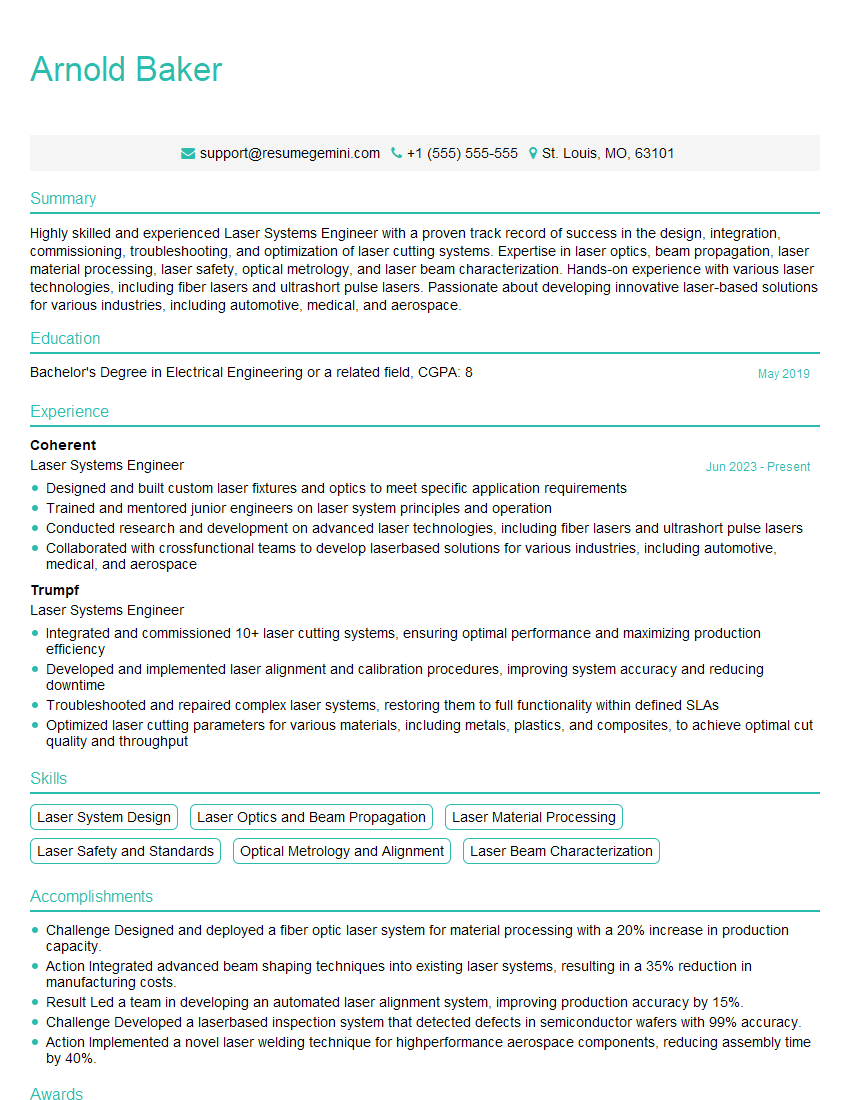
Mastering laser cutting techniques opens doors to exciting career opportunities in diverse industries. A strong understanding of these principles significantly enhances your job prospects. To maximize your chances, focus on building an ATS-friendly resume that highlights your skills and experience effectively. ResumeGemini is a trusted resource that can help you create a professional and impactful resume. We provide examples of resumes tailored to Laser Cutting Techniques to guide you in showcasing your expertise. Take advantage of these resources to present yourself as the ideal candidate.
Explore more articles
Users Rating of Our Blogs
Share Your Experience
We value your feedback! Please rate our content and share your thoughts (optional).
What Readers Say About Our Blog
Very informative content, great job.
good