Unlock your full potential by mastering the most common Knowledge of Sustainable Construction Practices interview questions. This blog offers a deep dive into the critical topics, ensuring you’re not only prepared to answer but to excel. With these insights, you’ll approach your interview with clarity and confidence.
Questions Asked in Knowledge of Sustainable Construction Practices Interview
Q 1. Explain the principles of sustainable construction.
Sustainable construction, also known as green building, centers around minimizing the negative environmental impact of the built environment throughout its entire lifecycle. This encompasses everything from material sourcing and construction processes to the building’s operation and eventual demolition. The core principles revolve around:
- Minimizing environmental impact: Reducing carbon emissions, water usage, waste generation, and pollution throughout the building’s lifecycle.
- Resource efficiency: Optimizing the use of materials, energy, and water through careful design and construction methods.
- Protecting occupant health: Creating a healthy and productive indoor environment by selecting low-emission materials and improving indoor air quality.
- Economic viability: Balancing environmental considerations with cost-effectiveness and ensuring long-term value for the building owner and occupants.
- Social responsibility: Considering the social impacts of the project, such as providing equitable access to resources and creating jobs in the community.
Imagine building a house with recycled materials, using energy-efficient appliances, and incorporating natural light to reduce electricity consumption. That’s a practical application of these principles.
Q 2. What are the key benefits of using sustainable building materials?
Sustainable building materials offer numerous benefits beyond just environmental protection. They contribute to a healthier building and a more resilient built environment. Key advantages include:
- Reduced environmental impact: Lower carbon footprint due to reduced manufacturing emissions and embodied carbon.
- Improved indoor air quality: Many sustainable materials are low-VOC (volatile organic compounds), contributing to healthier indoor environments.
- Enhanced durability and longevity: Certain sustainable materials, like bamboo or reclaimed wood, can be incredibly durable, reducing the need for frequent replacements and minimizing waste in the long run.
- Cost savings: While initial costs might sometimes be higher, sustainable materials often lead to lower long-term operational costs due to increased energy efficiency.
- Improved thermal performance: Materials like straw bale or hempcrete provide superior insulation, reducing energy consumption for heating and cooling.
For instance, using reclaimed wood for flooring not only reduces waste but also adds character and value to a building. Similarly, bamboo, a rapidly renewable resource, provides a strong and sustainable alternative to traditional hardwoods.
Q 3. Describe your experience with LEED certification.
I have extensive experience with LEED (Leadership in Energy and Environmental Design) certification. I’ve been involved in several projects achieving LEED Gold and even Platinum certifications. My role typically involves:
- Strategic planning: Identifying opportunities to meet LEED requirements early in the design phase.
- Material selection: Specifying sustainable materials that contribute to LEED points.
- Waste management planning: Developing strategies to minimize construction waste and achieve LEED credits for waste diversion.
- Documentation and submission: Preparing and submitting all necessary documentation for LEED certification.
In one project, we achieved LEED Platinum by focusing on water efficiency, energy performance, and sustainable site development. We implemented rainwater harvesting, used high-performance insulation, and prioritized local sourcing of materials. The detailed documentation and diligent tracking throughout the project were key to our success.
Q 4. How do you incorporate life-cycle assessment (LCA) into your projects?
Life Cycle Assessment (LCA) is crucial for evaluating the environmental impact of a building material or project from cradle to grave. I incorporate LCA into my projects by:
- Early-stage assessments: Conducting preliminary LCAs during the design phase to compare different material options and design strategies.
- Software utilization: Employing LCA software to quantify the environmental impacts of materials and processes.
- Data collection: Gathering data on material production, transportation, construction, operation, and end-of-life disposal.
- Impact evaluation: Analyzing the results to identify areas for improvement and optimization.
For example, during a recent project, we used LCA software to compare the environmental impact of using locally sourced lumber versus imported materials. The LCA demonstrated that despite a slightly higher initial cost, the local lumber option significantly reduced transportation emissions, resulting in a more sustainable overall impact.
Q 5. What strategies do you employ to minimize construction waste?
Minimizing construction waste is paramount to sustainable construction. My strategies include:
- Careful planning and design: Optimizing design to minimize material waste and over-ordering.
- Prefabrication: Utilizing prefabricated components to reduce on-site waste and improve efficiency.
- Waste segregation and recycling: Implementing a robust waste management plan to separate and recycle materials.
- Material reuse and repurposing: Finding ways to reuse and repurpose materials whenever possible.
- Construction waste tracking: Monitoring waste generation to identify areas for improvement.
On a recent project, we implemented a color-coded waste segregation system and achieved a 90% waste diversion rate by carefully planning material quantities and utilizing a local recycling facility.
Q 6. Explain your understanding of embodied carbon and its significance in sustainable construction.
Embodied carbon refers to the greenhouse gas emissions associated with the manufacturing, transportation, and installation of building materials. It’s a significant contributor to the overall carbon footprint of a building. Understanding and reducing embodied carbon is essential for sustainable construction because:
- It contributes significantly to overall emissions: Embodied carbon can account for a substantial portion of a building’s total life cycle emissions.
- It’s a ‘locked-in’ impact: Once a building is constructed, the embodied carbon is largely fixed, highlighting the importance of getting it right from the start.
- It influences long-term sustainability goals: Reducing embodied carbon is crucial for achieving net-zero or carbon-neutral building targets.
We address this by using low-embodied carbon materials like recycled steel, timber from sustainably managed forests, and locally sourced materials. We also carefully consider material durability and longevity to reduce the need for replacements later on, minimizing the ongoing environmental footprint.
Q 7. How would you approach reducing water consumption in a construction project?
Reducing water consumption during construction is critical for both environmental and economic reasons. My approach involves:
- Water-efficient equipment: Using low-flow equipment for concrete mixing and dust suppression.
- Rainwater harvesting: Collecting rainwater for non-potable uses like dust control or toilet flushing.
- Greywater recycling: Considering the use of greywater (water from sinks and showers) for irrigation.
- Leak prevention and detection: Implementing regular leak checks and prompt repairs to minimize water loss.
- Water-efficient landscaping: Selecting drought-tolerant plants for landscaping to reduce irrigation needs.
In a recent project, we implemented rainwater harvesting to supply water for dust control, reducing our reliance on potable water and minimizing our impact on local water resources. We also educated the construction crew on the importance of water conservation to promote responsible practices on site.
Q 8. Describe your experience with renewable energy integration in buildings.
Renewable energy integration in buildings is crucial for sustainable construction. It involves incorporating systems that harness renewable sources like solar, wind, geothermal, and biomass to reduce reliance on fossil fuels. My experience encompasses designing and implementing various renewable energy systems in diverse projects. For example, I worked on a project where we integrated a photovoltaic (PV) array on the building’s roof to generate electricity, coupled with a battery storage system to manage energy fluctuations. In another project, we utilized geothermal heat pumps for heating and cooling, significantly lowering energy consumption and carbon footprint. I also have extensive experience specifying and overseeing the installation of solar thermal systems for domestic hot water heating. Success in these projects hinges on careful site analysis, system design optimized for energy yield and building integration, and robust monitoring to ensure optimal performance.
Q 9. What are the main challenges faced in implementing sustainable construction practices?
Implementing sustainable construction practices faces numerous challenges. High upfront costs compared to traditional methods are a major hurdle. Many sustainable materials and technologies are more expensive initially. Lack of awareness and skilled labor also presents significant obstacles. Contractors and builders may not be familiar with sustainable techniques, leading to inadequate implementation or higher costs due to a lack of experience. Regulatory hurdles and complex codes can further complicate the process, delaying projects and increasing administrative costs. Finally, supply chain limitations can impact the availability of sustainable materials, potentially delaying construction or forcing compromises on the desired sustainability goals. For example, sourcing certified timber can be difficult in certain regions, affecting the choice of materials.
Q 10. How do you ensure that sustainable construction aligns with budget constraints?
Aligning sustainable construction with budget constraints requires a strategic approach. It’s not about compromising sustainability but about finding cost-effective solutions. This involves lifecycle cost analysis, identifying areas where initial investment yields long-term savings, and exploring value engineering opportunities. For example, choosing energy-efficient windows might have a higher upfront cost but significantly reduce energy bills over the building’s lifespan, justifying the investment. Using locally sourced materials reduces transportation costs, and incorporating passive design strategies minimizes the need for complex and costly HVAC systems. Prioritizing energy efficiency reduces operational costs and potentially qualifies for incentives and rebates, further offsetting initial expenses. Careful planning, thorough material analysis and utilizing life cycle assessment tools are essential for successfully balancing sustainability and budget.
Q 11. What are some innovative sustainable construction technologies you’re familiar with?
Several innovative sustainable construction technologies are transforming the industry. Cross-laminated timber (CLT) is gaining popularity as a sustainable and high-performance structural material. It’s strong, lightweight, and requires less energy to produce than traditional concrete or steel. 3D-printed concrete is another exciting development, allowing for complex designs and reduced material waste. Self-healing concrete incorporates bacteria that repair micro-cracks, extending the lifespan of structures and reducing maintenance needs. Bamboo construction utilizes a rapidly renewable resource and offers a lightweight yet strong alternative to traditional materials. These technologies, along with advancements in building automation and smart grids, are driving significant improvements in sustainability.
Q 12. Explain your understanding of passive design strategies.
Passive design strategies focus on minimizing energy consumption by optimizing the building’s relationship with its environment. These strategies leverage natural elements like sunlight, wind, and shade to reduce the need for mechanical heating, cooling, and lighting. Examples include optimal building orientation to maximize solar gain in winter and minimize it in summer, natural ventilation through strategically placed windows and vents, thermal mass using materials that absorb and release heat slowly to regulate indoor temperatures, and high-performance insulation to minimize heat transfer. Passive design is not just about individual elements but a holistic approach to building design that integrates several strategies to create an energy-efficient and comfortable space. It’s a crucial part of achieving net-zero energy buildings.
Q 13. How do you manage and mitigate environmental risks during construction?
Managing and mitigating environmental risks during construction requires a proactive approach. This starts with a thorough site assessment identifying potential hazards like contaminated soil, endangered species habitats, or proximity to water bodies. Developing a comprehensive environmental management plan is crucial, outlining procedures for waste management, pollution control, and erosion prevention. This includes specifying the use of low-VOC (volatile organic compounds) paints and adhesives, proper disposal of hazardous waste, and employing erosion control measures on the construction site. Regular monitoring and compliance audits are essential to ensure adherence to environmental regulations and minimize any negative impacts. Open communication with regulatory bodies and stakeholders is vital for addressing potential issues promptly and transparently.
Q 14. What are your preferred methods for monitoring and measuring the environmental performance of a building?
Monitoring and measuring the environmental performance of a building involves a multifaceted approach. Energy modeling during design provides initial predictions, but post-occupancy monitoring is crucial for validating predictions and identifying areas for improvement. Tools like building management systems (BMS) provide real-time data on energy consumption, water usage, and indoor environmental quality. Environmental impact indicators such as embodied carbon, operational carbon, and water usage are tracked and compared against benchmarks. Life cycle assessment (LCA) provides a comprehensive overview of environmental impacts from material extraction to building demolition. Regularly collected data allows for informed decision-making on operational optimization and future sustainable design improvements. Transparency and clear reporting are crucial for demonstrating environmental performance and accountability.
Q 15. How do you ensure compliance with relevant environmental regulations and building codes?
Ensuring compliance with environmental regulations and building codes is paramount in sustainable construction. My approach involves a multi-step process starting with thorough research and identification of all applicable regulations at the local, regional, and national levels. This includes reviewing documents like LEED (Leadership in Energy and Environmental Design), BREEAM (Building Research Establishment Environmental Assessment Method), or local equivalents. I then integrate these requirements into every stage of the project, from initial design to final construction and occupancy. This involves selecting materials with appropriate certifications, implementing waste management plans that meet or exceed legal mandates, and ensuring all contractors are aware of and adhere to these regulations. We utilize specialized software and regularly conduct compliance audits throughout the project to catch potential issues early. For example, on a recent project, we proactively identified a potential conflict between the proposed building height and local zoning ordinances, allowing us to adjust the design before construction commenced, avoiding costly delays and potential legal challenges.
Furthermore, we maintain meticulous documentation of all compliance efforts, including permits, inspections, and material certifications. This not only ensures adherence to regulations but also safeguards against potential liabilities. It’s like building a house with a solid foundation – compliance is the bedrock upon which the sustainability of the entire project rests.
Career Expert Tips:
- Ace those interviews! Prepare effectively by reviewing the Top 50 Most Common Interview Questions on ResumeGemini.
- Navigate your job search with confidence! Explore a wide range of Career Tips on ResumeGemini. Learn about common challenges and recommendations to overcome them.
- Craft the perfect resume! Master the Art of Resume Writing with ResumeGemini’s guide. Showcase your unique qualifications and achievements effectively.
- Don’t miss out on holiday savings! Build your dream resume with ResumeGemini’s ATS optimized templates.
Q 16. Describe your approach to incorporating sustainable practices in the design phase of a project.
Incorporating sustainable practices during the design phase is crucial for maximizing their impact. My approach involves a holistic strategy that considers the entire lifecycle of the building, from material sourcing and construction to operation and eventual demolition. We employ several key strategies:
- Life Cycle Assessment (LCA): We conduct LCAs to evaluate the environmental impact of different materials and construction methods. This helps us identify the most sustainable options, comparing embodied carbon, energy consumption, and waste generation throughout the building’s life.
- Passive Design Strategies: We optimize building orientation, window placement, and insulation to minimize energy consumption for heating and cooling. This often involves using sophisticated modeling software to simulate building performance under various climate conditions. For example, we recently used simulations to determine optimal shading strategies for a building in a hot climate, reducing cooling loads by 20%.
- Sustainable Material Selection: We prioritize locally sourced, recycled, and rapidly renewable materials with low embodied carbon. We also focus on materials with high recycled content, durable properties to extend the lifespan of the structure and reduce replacement needs.
- Water Efficiency: Implementing rainwater harvesting systems, low-flow fixtures, and greywater recycling systems to minimize water usage.
Early integration of sustainability into the design ensures that it’s not an afterthought but a fundamental part of the project’s core concept, improving the bottom line, minimizing risks, and creating a more environmentally friendly outcome.
Q 17. How do you communicate the importance of sustainability to stakeholders?
Communicating the importance of sustainability requires tailored approaches for different stakeholders. For clients, we emphasize the long-term cost savings through reduced energy bills, increased property value, and improved operational efficiency. We present compelling data, such as projected ROI and comparative analyses of sustainable versus conventional options. We also highlight the positive brand image and reputation that comes with building sustainably.
For contractors and subcontractors, we focus on the practicality of sustainable practices. We explain how using eco-friendly materials can lead to improved worker health and safety, streamlined processes, and reduced waste disposal costs. We also provide training on appropriate sustainable construction techniques.
With the community, we emphasize the wider environmental and social benefits, such as reduced carbon emissions, improved air and water quality, and the creation of green spaces. Transparency is key: we keep stakeholders informed throughout the project, using progress reports, presentations, and site tours to showcase the positive impact of our sustainable choices.
Q 18. Explain your experience with building commissioning for sustainable performance.
Building commissioning for sustainable performance is a critical aspect of my work. It involves a systematic process of verifying that all building systems are designed, installed, and operated to meet their intended performance requirements, particularly those related to energy efficiency, water conservation, and indoor environmental quality.
My experience involves developing and implementing comprehensive commissioning plans that include functional testing, performance measurements, and ongoing monitoring of systems such as HVAC, lighting, and plumbing. We often use advanced monitoring technologies to track energy consumption and identify areas for optimization. For example, in a recent project, commissioning revealed that a faulty sensor was causing the HVAC system to operate inefficiently. Identifying and fixing this issue resulted in significant energy savings. The process not only ensures that the building meets its sustainable design goals but also prevents future problems and maximizes operational efficiency. It’s like a thorough check-up for a newly constructed building, ensuring it’s functioning optimally and sustainably for years to come.
Q 19. How would you handle a situation where sustainable practices conflict with project deadlines?
Conflicts between sustainable practices and project deadlines require careful negotiation and prioritization. The first step is to identify the specific conflict. Is it a material procurement delay, a change in design, or a constraint in available resources?
Once identified, we work collaboratively with stakeholders to find creative solutions. This might involve exploring alternative sustainable materials with shorter lead times, optimizing construction schedules to accommodate sustainable processes, or identifying areas where compromises can be made without sacrificing the overall sustainability goals. Prioritization involves assessing the relative importance of different sustainable features and finding a balance between environmental impact and project completion. Transparent communication and collaborative decision-making are crucial to finding mutually agreeable solutions. Sometimes, minor delays are acceptable if they result in significantly improved long-term sustainability.
Q 20. How do you select and specify sustainable building materials for a project?
Selecting and specifying sustainable building materials is a multi-faceted process that involves considering several factors.
- Environmental Impact: We prioritize materials with low embodied carbon, recycled content, and renewable sources. We utilize tools like Environmental Product Declarations (EPDs) and Health Product Declarations (HPDs) to compare the environmental impacts of different materials.
- Durability and Longevity: Choosing durable, long-lasting materials minimizes the need for future replacements and reduces waste in the long run.
- Local Sourcing: Whenever feasible, we opt for locally sourced materials to reduce transportation costs and emissions.
- Recyclability and Reusability: Selecting materials that can be easily recycled or reused at the end of the building’s life helps minimize waste.
- Health and Safety: Prioritizing materials with low volatile organic compound (VOC) emissions to create a healthy indoor environment.
The process is iterative, involving careful analysis, comparison, and collaboration with suppliers and manufacturers to ensure the best possible choices are made. It’s a balance between sustainability, performance, cost, and aesthetics, always prioritizing the long-term environmental and economic viability of the project.
Q 21. Describe your knowledge of different green building rating systems (e.g., BREEAM, Green Star).
I have a strong understanding of various green building rating systems, including BREEAM, LEED, and Green Star. Each system provides a framework for evaluating the sustainability of buildings, but they differ in their specific criteria and weighting of various factors.
LEED (Leadership in Energy and Environmental Design): Widely used in North America, LEED focuses on energy efficiency, water conservation, material selection, and indoor environmental quality. It employs a points-based system, with projects earning different levels of certification (e.g., Certified, Silver, Gold, Platinum).
BREEAM (Building Research Establishment Environmental Assessment Method): Primarily used in Europe, BREEAM assesses buildings across a broader range of sustainability aspects, including land use, ecology, waste management, and health and wellbeing. It offers a similar tiered certification system.
Green Star: A prominent system in Australia and New Zealand, Green Star evaluates the sustainability performance of various building types, from residential to commercial developments. Like LEED and BREEAM, it provides a points-based rating system leading to different certification levels.
My expertise includes selecting the most appropriate rating system for a project based on its location, building type, and client requirements. Knowing these systems allows me to design buildings that meet specific sustainability standards and demonstrate a commitment to environmentally responsible practices.
Q 22. What are some key metrics used to assess the sustainability performance of a building?
Assessing the sustainability performance of a building requires a multifaceted approach, utilizing key metrics across various environmental and social impact categories. We don’t just look at one factor; it’s about the holistic picture.
- Energy Efficiency: Measured by Energy Use Intensity (EUI), which represents the energy consumed per square foot per year. Lower EUI indicates better efficiency. For example, a building designed with passive solar heating and high-performance windows will have a significantly lower EUI than a conventional building.
- Water Consumption: Tracked through litres per square metre per year. Strategies like rainwater harvesting and low-flow fixtures drastically reduce this figure. A green roof, for instance, can dramatically reduce stormwater runoff and subsequent potable water demands.
- Carbon Footprint: Calculated by assessing embodied carbon (from material manufacturing) and operational carbon (from energy use). Using recycled materials and renewable energy sources significantly lowers the carbon footprint. Life Cycle Assessment (LCA) studies are invaluable in quantifying this.
- Waste Generation: Measured by the amount of construction and demolition waste diverted from landfills. Lean construction practices and careful material selection dramatically minimize waste. Pre-fabrication, for instance, leads to less on-site waste.
- Indoor Environmental Quality (IEQ): Assessed through factors like air quality, lighting, and thermal comfort. Natural ventilation, the use of non-toxic materials, and daylighting improve IEQ. Green building certifications like LEED often require IEQ testing to ensure standards are met.
- Sustainable Site Development: This considers aspects like land use efficiency, protection of natural habitats, and minimizing the building’s impact on surrounding ecosystems. We use metrics such as impervious surface area, percentage of green space, and proximity to public transportation.
These metrics, often combined with building certifications like LEED or BREEAM, provide a comprehensive evaluation of a building’s sustainability.
Q 23. Explain the concept of circular economy and its relevance to construction.
The circular economy is a model of production and consumption that aims to keep resources in use for as long as possible, extracting maximum value from them while in use, then recovering and regenerating products and materials at the end of each service life. In construction, this means designing buildings for deconstruction, using recycled and renewable materials, and minimizing waste.
Its relevance is immense. Traditional construction is highly linear – ‘take, make, dispose.’ This depletes natural resources and generates massive waste. A circular approach reverses this. Think of it like this: instead of demolishing a building and sending materials to landfill, we carefully deconstruct it, reclaiming materials for reuse in future projects. This reduces landfill burden, conserves resources, and lowers the carbon footprint. We can also design buildings with components easily disassembled and repurposed.
Implementing a circular economy in construction requires collaboration across the entire value chain, from material suppliers to designers, contractors, and building owners. Designing for disassembly, using modular construction, and employing digital twins to track materials throughout their lifecycle are crucial elements.
Q 24. How do you address the potential trade-offs between cost and sustainability in a project?
Balancing cost and sustainability is a crucial challenge. It’s not an either/or situation; rather, it’s about finding the optimal balance that delivers long-term value. Often, upfront investments in sustainability translate into significant long-term savings.
My approach involves:
- Life-cycle cost analysis (LCCA): This compares the total cost of a building over its entire lifespan, including initial construction, operation, maintenance, and demolition. LCCA reveals that many sustainable options – like high-performance windows or efficient HVAC systems – offer significant long-term savings despite higher initial costs.
- Prioritizing cost-effective measures: We focus on low-hanging fruit first. Simple, cost-effective measures like proper insulation, water-efficient fixtures, and energy-efficient lighting can make a substantial impact with minimal investment.
- Value engineering: This involves critically evaluating design elements and finding cost-effective alternatives without compromising performance or sustainability targets. This could involve exploring different materials, construction techniques, or systems.
- Incentives and financing: Exploring available green building incentives, rebates, and financing options can help offset the initial cost of sustainable investments. Governments often offer financial incentives to encourage sustainable construction.
- Whole-building design approach: Integrating sustainability from the initial design phase minimizes costly retrofits or modifications later in the project.
By thoughtfully considering the total cost of ownership and employing strategic approaches, we can successfully navigate the trade-offs and deliver projects that are both sustainable and financially viable.
Q 25. How would you integrate sustainable practices into the operation and maintenance phase of a building?
Sustainable practices shouldn’t end with construction completion. The operational and maintenance phase significantly impacts a building’s environmental performance. We need to ensure that the building operates as efficiently as possible and maintains its sustainability features over time.
- Smart building management systems: Implementing Building Management Systems (BMS) enables real-time monitoring and control of energy use, water consumption, and other operational aspects. This allows for proactive adjustments and identification of inefficiencies.
- Regular maintenance and inspections: Scheduling regular inspections and preventative maintenance helps to ensure that building systems operate efficiently and avoid premature failures. This extends the lifespan of equipment and reduces waste.
- Sustainable cleaning and landscaping practices: Using eco-friendly cleaning products and employing water-wise landscaping strategies minimize the building’s environmental footprint during operation.
- Tenant engagement: Educating occupants on sustainable building practices—such as turning off lights, conserving water, and properly disposing of waste—can substantially improve efficiency and reduce the environmental impact.
- Data collection and analysis: Continuously monitoring and analyzing operational data identifies opportunities for further improvements in energy, water, and waste management. This allows for ongoing optimization and refinement of sustainability strategies.
A well-planned operation and maintenance strategy is essential for maximizing the long-term sustainability benefits of a building.
Q 26. Describe your experience with sustainable site development practices (e.g., stormwater management).
I have extensive experience in sustainable site development, with a particular focus on stormwater management. In one project, we implemented a bioretention system to manage stormwater runoff. This involved creating vegetated areas that filter and absorb rainwater, reducing the burden on municipal drainage systems and mitigating flooding risks.
Another project incorporated permeable pavements and green roofs to reduce impervious surfaces, allowing rainwater to infiltrate the ground naturally. This approach not only minimized stormwater runoff but also reduced the urban heat island effect. The green roof acted as an insulator, reducing energy needs for cooling in the summer. We also considered the preservation of existing trees and minimized site disturbance during construction to protect natural habitats.
In each project, we carefully assessed site conditions, considered local regulations, and selected appropriate solutions to minimize the building’s environmental footprint. We always engage with landscape architects and environmental consultants to ensure the best possible integration of sustainable practices from the very start of the project.
Q 27. What are some effective strategies for promoting sustainable construction practices within a construction company?
Promoting sustainable practices within a construction company requires a multi-pronged approach focusing on education, incentives, and leadership.
- Training and education: Providing comprehensive training to all staff on sustainable construction practices, including green building materials, energy efficiency, waste management, and site sustainability, is fundamental.
- Incentive programs: Implementing bonus programs or other incentives for teams and individuals who demonstrate excellence in sustainable practices encourages adoption and innovation.
- Leadership commitment: Senior management needs to visibly champion sustainability initiatives and integrate them into the company’s overall strategic goals and values. This sends a clear message of the company’s commitment.
- Collaboration and knowledge sharing: Fostering a culture of collaboration and knowledge sharing allows for the exchange of best practices and innovative solutions. This could be through internal workshops, conferences, and mentorship programs.
- Benchmarking and reporting: Tracking and reporting sustainability performance allows for continuous improvement and accountability. This helps identify areas needing further focus and improvement.
- Supply chain engagement: Working with suppliers who share the company’s commitment to sustainability ensures the use of responsible materials and practices throughout the entire supply chain.
Successful implementation requires persistent effort and a company-wide commitment. It’s about transforming the culture of the company from a traditional, linear approach to a more holistic, environmentally aware one.
Q 28. How would you evaluate the long-term environmental impact of a building project?
Evaluating the long-term environmental impact of a building project necessitates a comprehensive approach that goes beyond initial construction. We use several key tools and strategies:
- Life Cycle Assessment (LCA): This is a crucial tool that assesses the environmental impacts of a building from cradle to grave, encompassing material extraction, manufacturing, transportation, construction, operation, maintenance, and demolition. It quantifies the impacts related to greenhouse gas emissions, energy use, water consumption, and waste generation.
- Embodied Carbon Calculation: This specifically focuses on the carbon emissions associated with the materials used in the construction, manufacturing processes, and transportation. Reducing embodied carbon is a key objective of sustainable design.
- Operational Energy Modeling: This utilizes software to simulate the building’s energy performance over its lifetime, enabling accurate predictions of energy consumption and carbon emissions during operation.
- Post-Occupancy Evaluation (POE): This involves assessing the building’s actual performance after occupancy, providing valuable feedback for future projects and identifying areas for operational improvements.
- Scenario Planning: Exploring various future scenarios (e.g., changes in energy prices, climate patterns) helps in understanding the long-term adaptability and resilience of the building design.
By combining these methods, we obtain a detailed picture of the building’s environmental impact throughout its entire life cycle. This provides crucial information for decision-making and for driving ongoing improvements in sustainable building design and construction.
Key Topics to Learn for Knowledge of Sustainable Construction Practices Interview
- Sustainable Building Materials: Understanding the lifecycle assessment of materials, exploring alternatives like recycled content, bamboo, and timber, and their impact on embodied carbon.
- Energy Efficiency in Design: Discussing passive design strategies (e.g., natural ventilation, daylighting), active systems (e.g., solar panels, heat pumps), and building performance simulations to minimize energy consumption.
- Water Conservation Strategies: Analyzing water usage in construction and operation, exploring rainwater harvesting, greywater recycling, and low-flow fixtures to reduce water footprint.
- Waste Management and Reduction: Implementing strategies for minimizing construction waste through design optimization, material selection, and efficient on-site waste management practices. Understanding the principles of circular economy in construction.
- Indoor Environmental Quality (IEQ): Knowing the importance of healthy indoor air quality, minimizing VOC emissions from building materials, and optimizing natural ventilation and lighting for occupant well-being.
- Lifecycle Cost Analysis (LCCA): Understanding how to perform LCCA to compare the long-term costs of different sustainable design options, considering initial costs, operational costs, and potential savings.
- Green Building Certifications (LEED, BREEAM, etc.): Familiarity with various green building rating systems, their requirements, and the implications for design and construction.
- Sustainable Site Development: Understanding principles of minimizing land disturbance, protecting natural habitats, managing stormwater runoff, and incorporating green infrastructure.
- Problem-solving in Sustainable Construction: Demonstrate your ability to analyze challenges related to sustainability in construction projects and propose practical, innovative solutions.
Next Steps
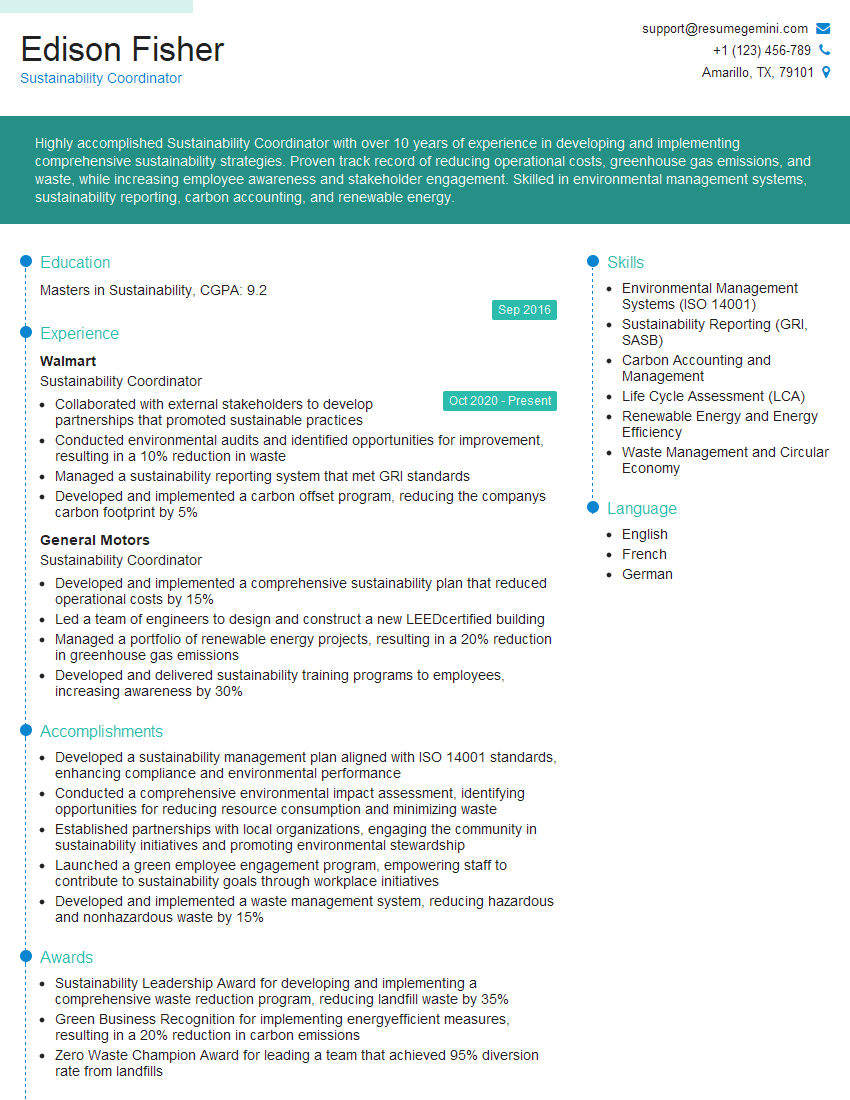
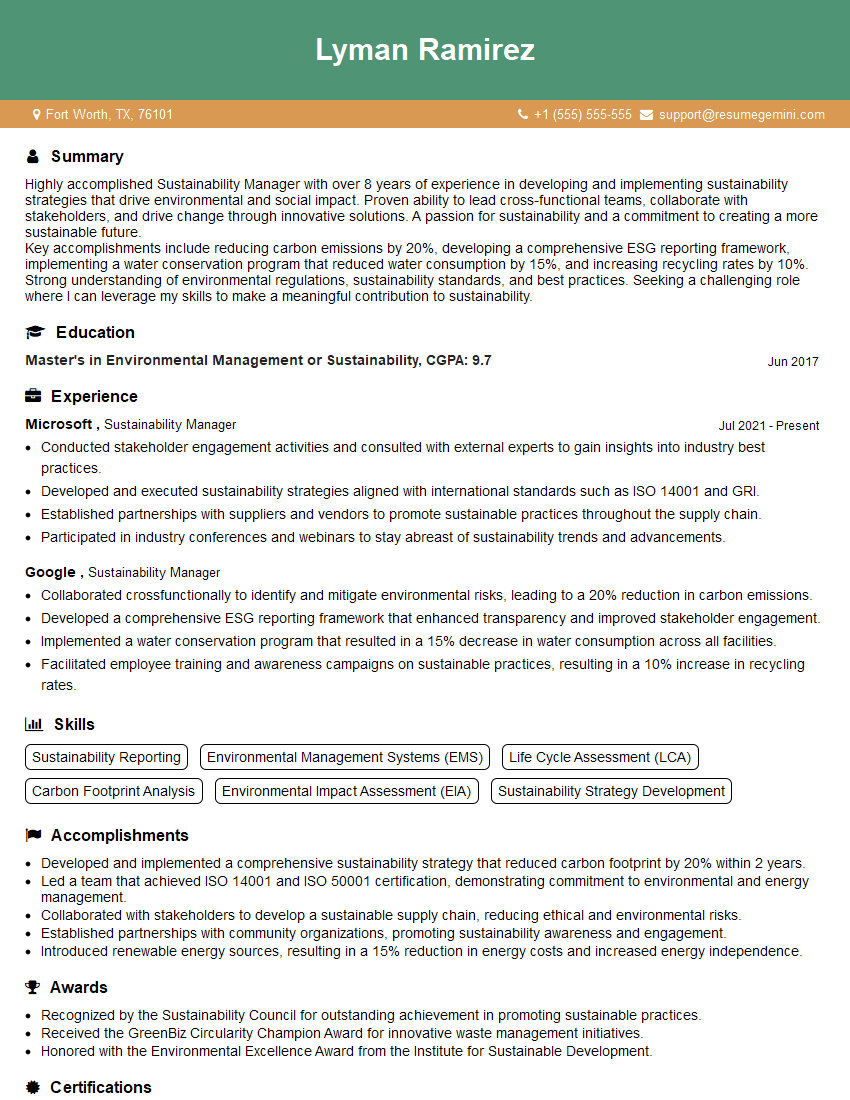
Mastering sustainable construction practices is crucial for career advancement in a rapidly evolving industry. Demonstrating this expertise through a strong resume is essential. Create an ATS-friendly resume that highlights your skills and experience in these key areas to increase your chances of landing your dream role. ResumeGemini is a trusted resource for building professional, impactful resumes. They offer examples of resumes tailored to Knowledge of Sustainable Construction Practices to help you craft a compelling application. Use their expertise to make your resume stand out and showcase your commitment to sustainable building.
Explore more articles
Users Rating of Our Blogs
Share Your Experience
We value your feedback! Please rate our content and share your thoughts (optional).
What Readers Say About Our Blog
Very informative content, great job.
good