The right preparation can turn an interview into an opportunity to showcase your expertise. This guide to 3D Modeling and Animation Basics interview questions is your ultimate resource, providing key insights and tips to help you ace your responses and stand out as a top candidate.
Questions Asked in 3D Modeling and Animation Basics Interview
Q 1. What 3D modeling software are you proficient in?
I’m proficient in several industry-standard 3D modeling software packages. My core expertise lies in Blender, a powerful open-source tool offering a vast array of features and a strong community support system. I’m also experienced with Autodesk Maya, particularly for its robust animation capabilities and industry-standard workflow, and I have working knowledge of Cinema 4D, known for its user-friendly interface and excellent rendering capabilities. This diverse skillset allows me to adapt to various project needs and client preferences.
Q 2. Explain the difference between polygon and NURBS modeling.
Polygon and NURBS modeling represent two fundamentally different approaches to creating 3D shapes. Polygon modeling utilizes polygons (triangles, quads, etc.) to construct surfaces. Think of it like building with LEGOs – you assemble many small pieces to create a larger form. It’s generally preferred for hard-surface modeling, such as buildings or vehicles, because it’s efficient and allows for detailed control over geometry. NURBS (Non-Uniform Rational B-Splines) modeling, on the other hand, uses mathematical curves and surfaces to define shapes. It’s like sculpting with clay – you work with smooth, flowing forms that can be easily manipulated. NURBS is often preferred for organic modeling, such as characters or vehicles with smooth curves, due to its ability to create incredibly smooth, precise surfaces.
Consider a car model: The body panels would likely be modeled using polygons for sharp edges and details, while the curved surfaces like the hood and fenders might benefit from NURBS for smoother transitions. The choice depends entirely on the object’s characteristics and the desired level of detail.
Q 3. Describe your experience with UV unwrapping and texturing.
UV unwrapping and texturing are crucial steps in bringing a 3D model to life. UV unwrapping is the process of ‘flattening’ a 3D model’s surface onto a 2D plane. Think of it as taking a map of the Earth and laying it flat – it distorts the shape, but it makes it possible to apply images. These flattened surfaces are called UV maps. These UV maps are then used to apply textures, or 2D images, onto the 3D model. Texturing involves selecting or creating images (diffuse, normal, specular maps, etc.) that provide the surface detail, color, and reflectivity properties of the model.
In a recent project, I modeled a character and created a detailed UV map to avoid distortion in areas like the face. I then applied high-resolution textures that accurately captured skin pores, clothing wrinkles and accessories. Proper UV unwrapping minimizes distortion and ensures efficient texture mapping across the entire model for optimal visual quality.
Q 4. How do you optimize 3D models for game engines?
Optimizing 3D models for game engines is vital to ensure smooth performance. The key is to strike a balance between visual fidelity and efficiency. Here’s my approach:
- Polygon Reduction: Reducing the polygon count of a model significantly improves performance. Tools like Decimation Masters or Blender’s decimate modifier help achieve this without sacrificing too much visual detail. For example, a high-poly model of a tree might be reduced to a low-poly version for use in a game scene.
- Texture Optimization: Using appropriately sized textures is important. Larger textures consume more memory. You want to find the sweet spot where detail is preserved, while file sizes remain manageable. Texture compression techniques are also helpful.
- Level of Detail (LOD): Implementing LODs allows the game engine to swap out high-detail models for lower-detail ones based on the camera’s distance. Faraway objects can use simpler geometry, improving frame rate without noticeably affecting the visual quality.
- Normal Maps: These maps store surface details in a small file size to create the illusion of more geometry than is actually present. Normal maps are essential for creating detailed surfaces without increasing polygon count.
By carefully implementing these techniques, I can create visually appealing models that run smoothly even on less powerful hardware.
Q 5. What are your preferred animation principles?
My preferred animation principles are rooted in the twelve principles of animation established by Disney animators. These principles, while seemingly simple, are fundamental to creating believable and engaging animation. I prioritize the following:
- Squash and Stretch: Giving objects a sense of weight and volume through deformation.
- Anticipation: Preparing the audience for an action with a subtle movement.
- Staging: Clearly presenting an idea or action to the viewer.
- Follow Through and Overlapping Action: Creating realistic movement by having different parts of an object move at different speeds.
- Arcs: Animating movement along curved paths for natural fluidity.
These principles guide me to create animations that are both visually appealing and emotionally resonant.
Q 6. Explain the concept of keyframing and tweening.
Keyframing involves setting specific poses or positions at key moments in an animation. Think of it like creating the milestones of a journey. These keyframes are then connected by tweening, which is the process of automatically generating intermediate frames between the keyframes. Tweening creates smooth transitions between the key poses. The software interpolates the data between those keyframes, filling in the gaps to create fluid movement.
For example, to animate a bouncing ball, I would keyframe the highest and lowest points of the bounce. The software would then tween the intermediate frames, creating the smooth arc of the ball’s trajectory. The type of tweening (linear, ease-in, ease-out) controls the speed and timing of the animation.
Q 7. Describe your experience with rigging characters.
Rigging is the process of creating a skeletal structure within a 3D model to allow for posing and animation. This skeletal structure consists of joints and bones, which are linked together to mimic the movement of a real-world object. I’m experienced in creating both simple and complex rigs, from basic character rigs to more intricate setups for facial animation. I pay close attention to the character’s anatomy to achieve realistic and believable movements. The process involves creating controls that allow animators to manipulate different parts of the model, like arms, legs, fingers, and facial features.
In a recent project, I created a character rig that allowed for precise control of facial expressions, including subtle nuances like eyebrow movements and lip syncing. This required a detailed understanding of human anatomy and the creation of custom controls to facilitate complex facial animations.
Q 8. How do you approach creating realistic skin shaders?
Creating realistic skin shaders involves a multi-layered approach, mimicking the complexities of real skin. It’s not just about color; it’s about subsurface scattering, pores, imperfections, and the way light interacts with different layers.
I typically start with a base color, then add layers for subsurface scattering. This simulates how light penetrates the skin and scatters beneath the surface, giving it a translucent quality. I use a variety of maps – diffuse, normal, specular, and roughness – to control the appearance. The diffuse map provides the overall skin tone, the normal map adds detail like pores and wrinkles, the specular map controls highlights (shininess), and the roughness map dictates how rough or smooth the surface appears.
For advanced realism, I incorporate additional maps such as a translucency map to fine-tune subsurface scattering in different areas (like the ears or lips), and a displacement map to add micro-geometry for increased detail. I also might use procedural textures to generate realistic-looking pores and imperfections. Finally, I carefully adjust the shader parameters, experimenting with different values to achieve the desired level of realism and match reference images.
For example, when creating a character for a fantasy film, I might use a subsurface scattering shader with a slightly bluish tint under the skin for an otherworldly effect. Conversely, for a photorealistic character in a commercial, I would focus on achieving natural-looking skin tones and subtle variations in texture.
Q 9. What is your experience with motion capture data?
I have extensive experience with motion capture (mocap) data, utilizing it across several projects. My workflow usually involves importing the mocap data into my animation software (e.g., Autodesk MotionBuilder, Maya) and then retargeting it to my character rig. This process involves mapping the mocap data’s joints to the corresponding joints in my 3D character’s skeleton.
Retargeting is crucial because mocap data is rarely perfectly compatible with a pre-existing rig. It often requires adjustments and cleaning. I address issues like pops and jitters by using tools and techniques within the animation software to smooth the motion and refine the animation curves. Sometimes, I need to manually adjust keyframes to maintain character consistency and style. Furthermore, I frequently blend mocap animation with traditional keyframe animation, leveraging the strengths of each method.
For instance, I might use mocap data for realistic walk cycles, but then manually animate subtle facial expressions or hand gestures to convey specific emotions or actions that are not accurately captured by the mocap data. The integration of mocap data allows for a realistic base, which I can enhance with artistry to add life and nuance to the character’s performance.
Q 10. How do you handle feedback during the animation process?
Handling feedback is integral to a successful animation project. My approach involves actively seeking and incorporating feedback at various stages of the process. First, I establish clear communication channels with the client or director. Regular updates and presentations are essential to ensure that everyone is on the same page.
I encourage early feedback, even during the initial blocking phase of animation. This allows me to address major issues early on, avoiding time-consuming revisions later. When receiving feedback, I actively listen and ask clarifying questions to fully understand the intent. I then meticulously review the feedback, comparing it to my own assessment of the animation.
Sometimes, feedback might be subjective, and there might be differing opinions. In such cases, I aim to find a compromise that meets the artistic vision while maintaining the technical integrity of the animation. I document all feedback and revisions in a clear and organized manner, tracking progress and changes effectively. This detailed tracking is crucial for accountability and efficient iteration.
Q 11. Describe your workflow for creating a 3D model from concept art.
My workflow for creating a 3D model from concept art typically starts with gathering references and understanding the design intent. This includes analyzing proportions, details, and the overall style of the concept art. I then use this information to create a 3D base mesh, often using a low-poly approach for efficiency.
I utilize modeling software like ZBrush or Maya to sculpt the model, adding detail and refining the form based on the concept art. This phase might involve techniques like retopology (recreating a clean mesh from a high-resolution sculpt), sculpting details, and creating UV maps (preparing the model for texturing).
Once the model is sculpted, I usually begin the texturing process. This involves creating or sourcing textures (diffuse, normal, specular, etc.) and applying them to the model. This is where I strive for visual fidelity to the original concept art. The final steps involve rigging (creating a skeleton for animation) and posing the model to ensure correct proportions and accuracy. This iterative process ensures the final 3D model aligns perfectly with the concept art’s vision.
For instance, when creating a character model from a concept, I will frequently zoom in on sections of the concept artwork to capture subtle details like wrinkles on clothing or unique textures on the character’s skin. This detailed attention ensures accuracy and faithfulness to the design.
Q 12. What lighting techniques are you familiar with?
I’m proficient in various lighting techniques, including:
- Three-Point Lighting: This classic technique utilizes key, fill, and back lights to control the mood and highlight features.
- HDRI Lighting (High Dynamic Range Imaging): I leverage HDRI environments to create realistic reflections and ambient lighting, significantly reducing the time spent manually setting lights.
- Photorealistic Lighting: This involves using techniques to achieve a highly accurate rendering that closely mimics real-world lighting conditions, often utilizing reference images and physically based renderers.
- Stylized Lighting: I am experienced in employing stylized lighting approaches for specific aesthetics, such as using rim lighting to highlight silhouettes or using color gradients to create a specific mood.
- Global Illumination: Understanding and utilizing global illumination techniques (such as path tracing or radiosity) is critical for achieving realistic lighting interactions and bounce light.
My choice of lighting technique depends heavily on the project’s style and requirements. A photorealistic project will benefit from HDRI and global illumination, whereas a stylized project might employ more selective and artistic lighting choices.
Q 13. Explain your experience with rendering software.
I possess extensive experience with several rendering software packages, including Arnold, V-Ray, and RenderMan. My familiarity extends beyond simply pushing buttons; I deeply understand the underlying principles of each renderer, allowing me to optimize settings for maximum quality and efficiency.
I can leverage the strengths of each renderer depending on the project’s demands. For instance, Arnold excels in its physically-based rendering capabilities and ease of use, making it ideal for complex scenes. V-Ray offers a vast array of features and excellent performance, making it a versatile choice. RenderMan is known for its high-quality outputs and its ability to handle extremely complex scenes.
Beyond the software itself, I have a comprehensive understanding of rendering concepts such as global illumination, ray tracing, and shadow techniques. This enables me to troubleshoot rendering issues effectively and optimize render times without compromising image quality. I’m also adept at using render layers and compositing techniques to fine-tune the final image in post-processing.
Q 14. How do you troubleshoot technical issues in your 3D pipeline?
Troubleshooting technical issues in my 3D pipeline involves a systematic approach. I start by identifying the specific problem. Is it a rendering issue, a modeling problem, or an animation glitch? Then, I systematically isolate the source of the issue. This often involves checking the scene’s structure, examining logs, and trying simplified scenarios to pinpoint the root cause.
I rely heavily on online resources, forums, and documentation. Often, the solution lies in a simple setting change or a forgotten step. If the problem persists, I might break down the problem into smaller, manageable parts. This allows me to analyze each segment separately until the issue is identified. Collaboration with colleagues is also important; discussing problems with others can often spark new ideas and solutions.
For example, if a texture isn’t appearing correctly, I’d first check the material assignments and ensure the texture path is accurate. Then, I might check the UV mapping to rule out problems with how the texture is applied. If the problem persists, I may simplify the model and materials to rule out conflicts before exploring more complex issues. Version control is essential for quickly reverting to a stable version of my work if necessary.
Q 15. What is your experience with version control systems (e.g., Git)?
Version control systems, like Git, are indispensable for managing 3D projects, especially collaborative ones. Think of Git as a sophisticated ‘undo’ button for your entire project, allowing you to track changes, revert to previous versions, and collaborate efficiently with others. My experience includes using Git for branching, merging, resolving conflicts, and using platforms like GitHub and Bitbucket for remote repositories. I regularly utilize Git’s features, such as committing changes with descriptive messages, creating branches for new features or bug fixes, and utilizing pull requests for code review before merging changes into the main branch. This ensures a well-organized, traceable, and manageable workflow, preventing data loss and facilitating teamwork.
For example, on a recent project involving a complex character rig, I used branching to develop different rigging approaches simultaneously. This allowed me to test different methods without disrupting the main project workflow, and ultimately merge the most successful approach back into the main branch.
Career Expert Tips:
- Ace those interviews! Prepare effectively by reviewing the Top 50 Most Common Interview Questions on ResumeGemini.
- Navigate your job search with confidence! Explore a wide range of Career Tips on ResumeGemini. Learn about common challenges and recommendations to overcome them.
- Craft the perfect resume! Master the Art of Resume Writing with ResumeGemini’s guide. Showcase your unique qualifications and achievements effectively.
- Don’t miss out on holiday savings! Build your dream resume with ResumeGemini’s ATS optimized templates.
Q 16. Describe your experience with collaborative workflows.
Collaborative workflows are central to most animation and modeling projects. My experience spans various approaches, from using cloud-based collaborative platforms to employing local network sharing and project management tools like Jira or Asana. I’m comfortable working within established pipelines and adapting my workflow to suit team needs. Communication is key – I actively participate in regular check-ins, utilize clear naming conventions for assets, and provide constructive feedback during peer reviews. I’m proficient in managing file conflicts, resolving discrepancies, and ensuring consistent project versions across team members. This is critical to avoid redundancy and ensure a smooth and efficient process. For instance, in a recent team project, we used a cloud-based storage system to work on different aspects of the same scene concurrently. Regular check-ins and clear communication ensured that every update was integrated seamlessly without conflicts.
Q 17. What is your understanding of different file formats (e.g., FBX, OBJ)?
Understanding different file formats is crucial for interoperability between software packages. FBX (Filmbox) is a versatile format supporting animation data, textures, and mesh data. It’s often the preferred choice for exchanging models between different 3D applications. OBJ (Wavefront OBJ) is a simpler format primarily focused on geometry, making it suitable for exchanging static mesh data. Other formats I’m familiar with include Alembic (for complex cached animation data), and various proprietary formats specific to certain software (like Maya’s MA file). The choice of file format depends on the specific project needs; FBX is usually best for complex scenes with animation, whereas OBJ may suffice for simpler static geometry. Choosing the wrong format can lead to loss of information or compatibility issues. For example, if exporting an animated character from Maya to Unreal Engine, FBX is the optimal choice to preserve the animation data; using OBJ would only provide the static mesh geometry, losing all animation information.
Q 18. How do you approach creating believable character animations?
Creating believable character animation requires a strong understanding of anatomy, physics, and acting principles. My process begins with thorough reference gathering – studying video footage, photographs, and even observing people in real life. I focus on conveying emotion and personality through subtle nuances in movement. This includes utilizing techniques like squash and stretch, anticipation, follow-through, and overlapping action. I use keyframing and motion capture data strategically, relying on keyframing for precise control of nuanced movements and using motion capture as a starting point for complex actions, often refining it manually to add more personality and realism. It’s an iterative process; I frequently render and review animation to identify areas needing refinement. This blend of technical skill and artistic sensitivity is what makes animation truly come alive.
For instance, animating a character’s walk involves careful attention to weight shift, foot placement, and subtle arm movements. Overlapping actions like the torso continuing to swing after the legs have stopped create a much more natural and lifelike animation.
Q 19. What is your process for creating realistic hair and fur?
Realistic hair and fur simulation is a computationally intensive task, often requiring specialized tools and techniques. I typically use a combination of particle systems and specialized hair and fur plugins. These systems allow me to control parameters like hair length, density, stiffness, and gravity to achieve a natural look. I’ll carefully groom individual strands or use guide curves to shape and style the hair. For achieving realism, attention to detail is paramount; this includes considering factors like wind effects, gravity, and interactions with the character’s body. Rendering realistic hair often requires high-resolution simulations and sophisticated rendering techniques to handle the complexity of individual strands. For complex simulations, I will often use specialized hair simulation software and then import the results into my main animation pipeline.
Q 20. How do you optimize your models for performance?
Optimizing models for performance is crucial, particularly in real-time applications such as games or virtual reality. My approach involves a multi-pronged strategy: I begin by reducing polygon count, simplifying geometry wherever possible without significantly impacting visual quality. I also use techniques like level of detail (LOD) to dynamically switch between lower-poly models at a distance and high-poly models up close, improving rendering efficiency. I also optimize textures by reducing resolution while maintaining acceptable visual quality, and using compression techniques to minimize file sizes. Finally, I carefully consider the use of materials and shaders, opting for efficient shaders that minimize rendering overhead. These combined strategies ensure that the models run smoothly, even on low-end systems, without compromising visual fidelity.
Q 21. What is your experience with particle systems?
Particle systems are essential for creating a wide range of effects in 3D animation, from simple dust and smoke to complex simulations of liquids and fire. I’m experienced in using particle systems to generate realistic effects by adjusting parameters such as particle size, speed, lifespan, and emission rate. I’m also familiar with different particle behaviors, such as gravity, wind, collisions, and turbulence. I understand the trade-off between realism and performance when using particle systems; complex simulations can be computationally expensive, so I carefully balance the level of detail with the performance requirements of the project. For example, in a scene depicting a volcanic eruption, I would use particle systems to simulate ash and lava flows, carefully adjusting parameters to create a convincing and visually stunning effect while maintaining acceptable frame rates.
Q 22. Explain your understanding of animation curves and graph editors.
Animation curves, often visualized in graph editors, are the backbone of controlling movement and changes in 3D animation. They define how a property, like an object’s position, rotation, or scale, changes over time. Think of them as a detailed roadmap for your animation, specifying the precise value of a property at each frame. Graph editors provide a visual interface to manipulate these curves, allowing for precise control and fine-tuning.
For example, a simple linear curve would create uniform movement, while a curve with sharp peaks and valleys would generate jerky or abrupt changes. Bezier curves, common in most 3D software, offer more nuanced control, allowing animators to create smooth, realistic movements with ease. You can adjust tangents to control the speed and acceleration at different points in the animation, achieving subtle variations in movement that greatly impact the final quality. Imagine animating a ball bouncing: a simple linear animation would be unrealistic, while a Bezier curve allows you to model the deceleration upon impact and the acceleration of the rebound accurately.
- Ease In/Ease Out: This technique uses curved animation to create natural-looking acceleration and deceleration, common in realistic movements.
- Keyframes: These are points along the animation curve where you define specific values for a property. The software interpolates between keyframes to create the animation.
- Tangents: These control the slope of the curve at each keyframe, influencing the speed and acceleration of the animation.
Q 23. Describe your experience with different types of cameras and lenses.
My experience encompasses a wide range of camera types and lenses, crucial for establishing mood, perspective, and storytelling within a 3D animation. Understanding focal length is key – a wide-angle lens (short focal length) creates a sense of vastness, while a telephoto lens (long focal length) compresses depth and isolates subjects. I’m proficient in using:
- Wide-angle lenses: Excellent for establishing shots, showing vast environments or emphasizing scale.
- Medium lenses: Provide a natural perspective, often preferred for dialogue scenes and character interaction.
- Telephoto lenses: Ideal for close-ups, creating dramatic impact and isolating details.
- Fish-eye lenses: Used for extreme wide-angle shots, creating a distorted perspective with a unique stylistic effect.
Beyond focal length, I’m experienced with camera movement techniques like dolly shots (smooth camera movement along a track), panning (rotating the camera horizontally), tilting (rotating the camera vertically), and cranes (camera movement on a large arm providing dynamic angles), all of which contribute to dynamic storytelling. I understand the interplay between camera settings and lighting to create compelling visuals and enhance the narrative impact.
Q 24. How do you create realistic water or other fluids?
Creating realistic water or other fluids requires understanding and utilizing specialized simulation tools often found within advanced 3D packages. It’s not just about visual appearance but accurate physics. Several approaches exist:
- Fluid Simulation Software: Many applications offer dedicated fluid dynamics solvers (e.g., RealFlow, Houdini). These use computational fluid dynamics (CFD) to accurately model the behavior of liquids based on physical principles like pressure, viscosity, and surface tension. This method is computationally intensive but produces highly realistic results.
- Particle Systems: By simulating a massive number of individual particles, you can create an approximation of fluid behavior. While not as accurate as CFD, it’s more efficient for less demanding scenarios. Parameters like particle size, density, and interaction forces are key to fine-tuning the visual effect.
- Procedural Techniques: Advanced shading techniques combined with procedural noise functions can be used to create the visual appearance of water surfaces, such as ripples and reflections, without full fluid simulation. This approach offers a balance between realism and computational cost.
Combining these techniques often yields the best results. For instance, you might use CFD for the bulk movement of water and particle systems for splashes and foam. Careful attention to shading, lighting, and subsurface scattering is crucial for achieving photorealistic results.
Q 25. How do you manage a large number of assets in a project?
Managing a large number of assets in a project is crucial for maintaining organization, efficiency, and preventing errors. My approach involves a multi-faceted strategy:
- Asset Management Software: Using dedicated software like Shotgun or FTrack provides centralized organization, version control, and streamlined workflows. This helps track assets, revisions, and tasks, enhancing collaboration.
- Folder Structure: Implementing a well-defined folder structure is critical. I typically group assets by type (models, textures, animations), project stage, and character or environment. Clear and consistent naming conventions are essential.
- Libraries and Collections: Most 3D software allows the creation of libraries and collections, making frequently used assets easily accessible. This streamlines the process of reusing elements within a project.
- Proxy Geometry: Using lower-poly proxy versions of assets during early stages improves scene performance. High-resolution models are then swapped in for rendering.
Regular backups and version control are paramount to protect against data loss. These practices ensure smooth collaboration, efficient workflow, and the ability to handle projects of significant scale without compromising productivity.
Q 26. What is your experience with creating and using custom shaders?
I have extensive experience creating and utilizing custom shaders, which allows me to achieve a level of visual fidelity and artistic control that’s often impossible with pre-built shaders. Shaders are programs that define how surfaces appear in a 3D scene. They control properties like color, reflectivity, transparency, and more. My expertise covers various shading languages, particularly:
- HLSL (High-Level Shading Language): Commonly used in DirectX-based applications.
- GLSL (OpenGL Shading Language): Used in OpenGL applications.
For instance, I’ve created custom shaders to simulate realistic subsurface scattering for skin, creating convincing translucency, or to develop stylized shaders that mimic the look of a specific art style. I understand the principles of lighting models (e.g., Phong, Blinn-Phong) and can implement them within custom shaders to achieve desired effects. I also have experience optimizing shaders for performance to ensure smooth rendering in complex scenes. Creating a custom shader involves understanding the underlying mathematics and programming skills. It’s a powerful tool for creating unique visuals that truly stand out.
Q 27. Describe your approach to solving complex animation problems.
My approach to complex animation problems is systematic and iterative. I break down challenges into smaller, manageable parts, focusing on understanding the core issues first. This often involves:
- Storyboarding and Previsualization: I thoroughly plan the animation sequence beforehand. Storyboards help visualize the action, while previsualization (previz) creates a rough animation to identify potential problems early on.
- Reference Gathering: I gather real-world video or photographic references of the movement I’m aiming for. This provides a crucial point of comparison and helps ensure realism.
- Experimentation and Iteration: Animation is an iterative process. I experiment with different techniques and approaches, refining the animation through multiple revisions until the desired effect is achieved.
- Collaboration: Complex animations frequently require teamwork. I’m adept at collaborating with other animators, technical artists, and directors to solve challenges collectively.
When facing a particularly difficult animation, I’ll often start with a simplified version to grasp the fundamental principles, then gradually add detail and complexity. For example, when animating complex character interactions, I might start with simple block models before refining the animation with the final character model. This iterative approach ensures that I can address the core issues first and build upon them for a polished final result.
Q 28. What are your future goals in 3D modeling and animation?
My future goals revolve around pushing the boundaries of realistic and expressive animation. I aim to expand my expertise in:
- Advanced Simulation Techniques: Mastering advanced fluid simulations, cloth simulations, and other physics-based effects to achieve an even higher level of realism.
- Character Animation: Improving my skills in creating believable and emotionally compelling character animations, utilizing advanced techniques like motion capture and procedural animation.
- Real-Time Animation: Exploring the application of my skills in real-time environments, such as video games or virtual reality, leveraging new technologies to create interactive and dynamic experiences.
- Mentorship and Education: Sharing my knowledge and experience with others through mentorship and teaching.
Ultimately, I’m driven by a passion for storytelling through 3D animation and striving to continuously improve my skills and expand my creative capabilities.
Key Topics to Learn for Your 3D Modeling and Animation Basics Interview
Ace your interview by mastering these fundamental concepts. Remember, a strong understanding of the theory combined with practical application showcases your skills effectively.
- 3D Modeling Fundamentals: Understanding polygon modeling, NURBS surfaces, and different modeling techniques (ex: box modeling, sculpting). Be prepared to discuss the strengths and weaknesses of each approach.
- UV Mapping and Texturing: Explain the process of unwrapping models, creating seamless textures, and applying them effectively for realistic rendering. Consider discussing different texture types and workflows.
- Animation Principles: Demonstrate your knowledge of the 12 principles of animation and how they apply to character animation, object animation, and realistic movement. Be ready to discuss timing, spacing, and ease of motion.
- Rigging and Skinning: Explain the process of creating a character rig, weighting skins, and the importance of a well-structured rig for efficient animation. Be prepared to discuss different rigging techniques.
- Software Proficiency: Showcase your expertise in industry-standard software (mention specific software you’re proficient in, e.g., Maya, Blender, 3ds Max). Highlight your experience with key features and workflows within these programs.
- Lighting and Rendering: Discuss various lighting techniques (e.g., three-point lighting, ambient occlusion) and rendering methods, focusing on achieving realistic and visually appealing results. Be ready to discuss different render engines and their capabilities.
- Problem-Solving and Workflow: Prepare examples demonstrating your ability to troubleshoot technical challenges during the modeling and animation process. Emphasize your efficient and organized workflow.
Next Steps: Launch Your 3D Career
Mastering these 3D Modeling and Animation Basics is crucial for securing your dream role. A strong foundation opens doors to exciting opportunities in game development, film, visual effects, and more! To make a powerful first impression, invest time in crafting a professional, ATS-friendly resume that highlights your skills and experience.
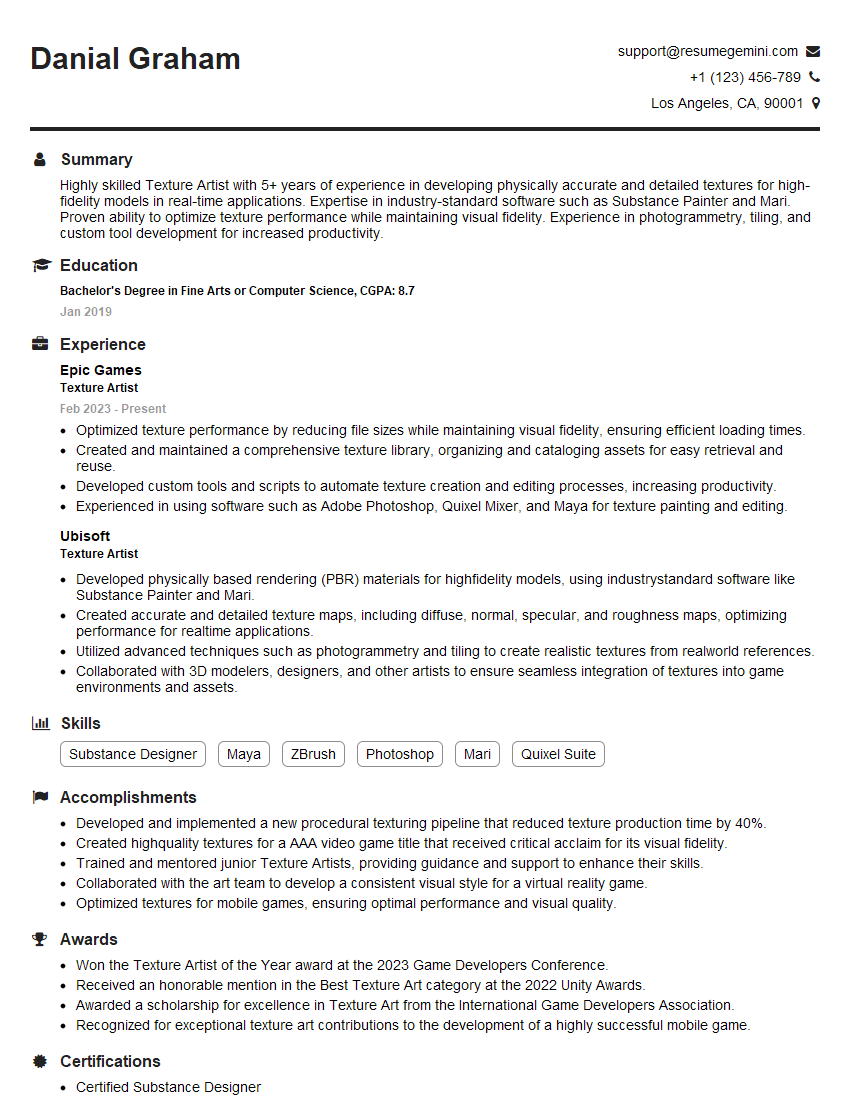
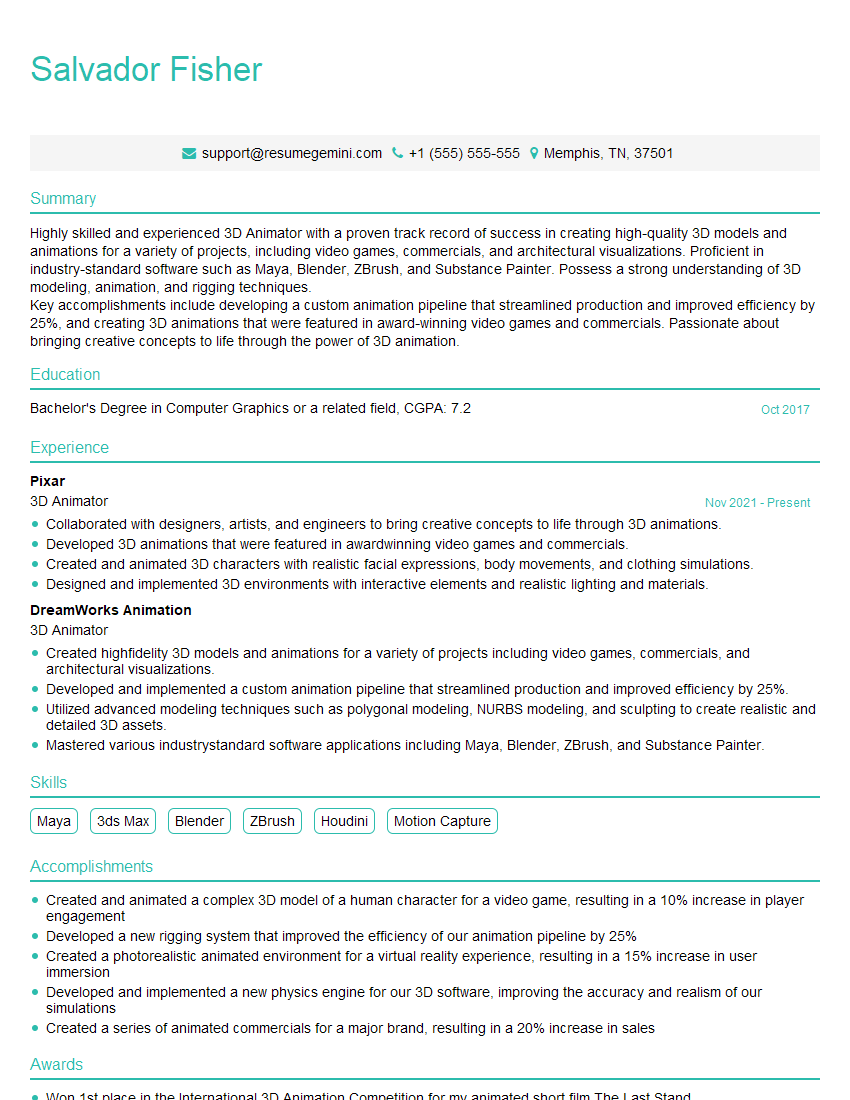
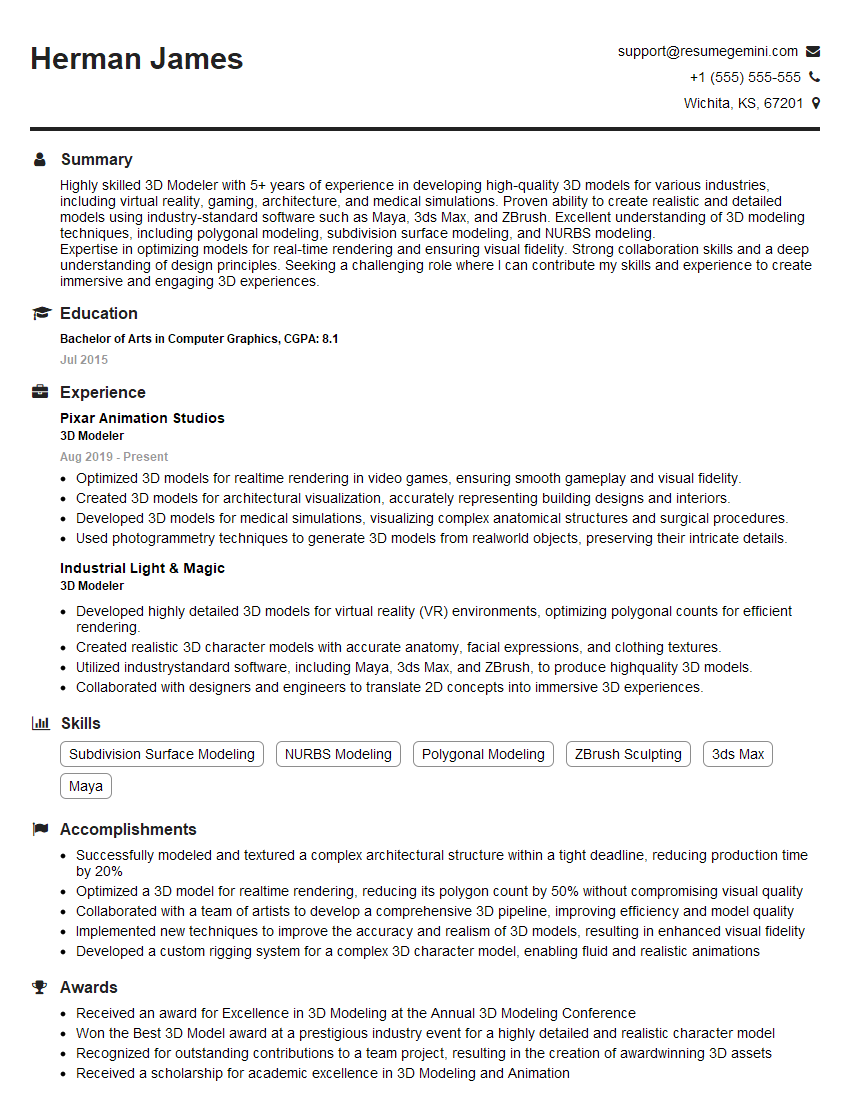
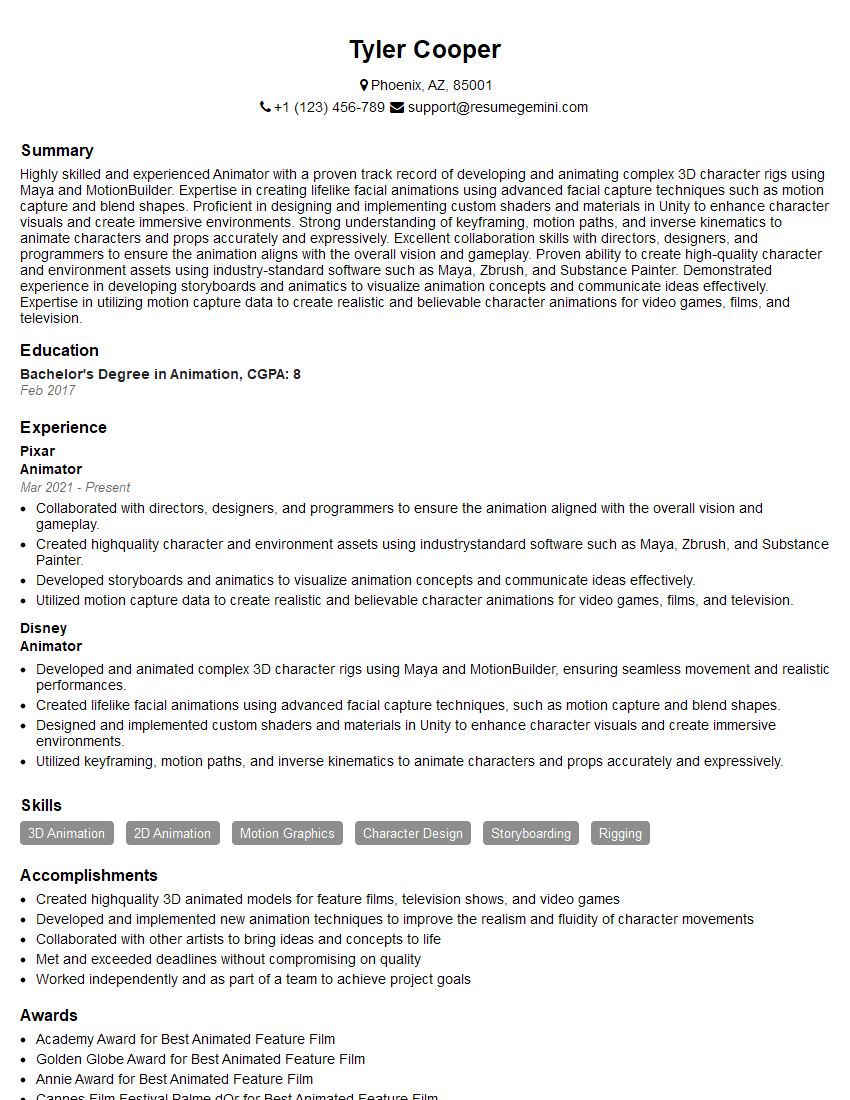
ResumeGemini is a trusted resource that can help you build a compelling resume that stands out. They offer examples of resumes specifically tailored for 3D Modeling and Animation Basics professionals, making the process easy and effective. Take advantage of these resources to boost your job prospects and confidently navigate the interview process.

Explore more articles
Users Rating of Our Blogs
Share Your Experience
We value your feedback! Please rate our content and share your thoughts (optional).
What Readers Say About Our Blog
Hello,
we currently offer a complimentary backlink and URL indexing test for search engine optimization professionals.
You can get complimentary indexing credits to test how link discovery works in practice.
No credit card is required and there is no recurring fee.
You can find details here:
https://wikipedia-backlinks.com/indexing/
Regards
NICE RESPONSE TO Q & A
hi
The aim of this message is regarding an unclaimed deposit of a deceased nationale that bears the same name as you. You are not relate to him as there are millions of people answering the names across around the world. But i will use my position to influence the release of the deposit to you for our mutual benefit.
Respond for full details and how to claim the deposit. This is 100% risk free. Send hello to my email id: [email protected]
Luka Chachibaialuka
Hey interviewgemini.com, just wanted to follow up on my last email.
We just launched Call the Monster, an parenting app that lets you summon friendly ‘monsters’ kids actually listen to.
We’re also running a giveaway for everyone who downloads the app. Since it’s brand new, there aren’t many users yet, which means you’ve got a much better chance of winning some great prizes.
You can check it out here: https://bit.ly/callamonsterapp
Or follow us on Instagram: https://www.instagram.com/callamonsterapp
Thanks,
Ryan
CEO – Call the Monster App
Hey interviewgemini.com, I saw your website and love your approach.
I just want this to look like spam email, but want to share something important to you. We just launched Call the Monster, a parenting app that lets you summon friendly ‘monsters’ kids actually listen to.
Parents are loving it for calming chaos before bedtime. Thought you might want to try it: https://bit.ly/callamonsterapp or just follow our fun monster lore on Instagram: https://www.instagram.com/callamonsterapp
Thanks,
Ryan
CEO – Call A Monster APP
To the interviewgemini.com Owner.
Dear interviewgemini.com Webmaster!
Hi interviewgemini.com Webmaster!
Dear interviewgemini.com Webmaster!
excellent
Hello,
We found issues with your domain’s email setup that may be sending your messages to spam or blocking them completely. InboxShield Mini shows you how to fix it in minutes — no tech skills required.
Scan your domain now for details: https://inboxshield-mini.com/
— Adam @ InboxShield Mini
Reply STOP to unsubscribe
Hi, are you owner of interviewgemini.com? What if I told you I could help you find extra time in your schedule, reconnect with leads you didn’t even realize you missed, and bring in more “I want to work with you” conversations, without increasing your ad spend or hiring a full-time employee?
All with a flexible, budget-friendly service that could easily pay for itself. Sounds good?
Would it be nice to jump on a quick 10-minute call so I can show you exactly how we make this work?
Best,
Hapei
Marketing Director
Hey, I know you’re the owner of interviewgemini.com. I’ll be quick.
Fundraising for your business is tough and time-consuming. We make it easier by guaranteeing two private investor meetings each month, for six months. No demos, no pitch events – just direct introductions to active investors matched to your startup.
If youR17;re raising, this could help you build real momentum. Want me to send more info?
Hi, I represent an SEO company that specialises in getting you AI citations and higher rankings on Google. I’d like to offer you a 100% free SEO audit for your website. Would you be interested?
Hi, I represent an SEO company that specialises in getting you AI citations and higher rankings on Google. I’d like to offer you a 100% free SEO audit for your website. Would you be interested?
good