Are you ready to stand out in your next interview? Understanding and preparing for 3D Modelling interview questions is a game-changer. In this blog, we’ve compiled key questions and expert advice to help you showcase your skills with confidence and precision. Let’s get started on your journey to acing the interview.
Questions Asked in 3D Modelling Interview
Q 1. Explain your experience with different 3D modeling software (e.g., Maya, 3ds Max, Blender, ZBrush).
My 3D modeling experience spans several industry-standard software packages. I’m highly proficient in Autodesk Maya, a powerhouse for animation and complex modeling, and 3ds Max, excellent for architectural visualization and game asset creation. I’ve also extensively used Blender, a versatile and open-source option that’s incredibly powerful, especially for its sculpting capabilities and ease of use for beginners. Finally, I have considerable experience with ZBrush, a digital sculpting application unmatched for creating high-resolution organic models. Each software has its strengths; Maya excels in rigging and animation, 3ds Max in polygon modeling, Blender in its community support and readily available tutorials, and ZBrush in its sculpting workflow. My experience allows me to choose the best tool for a particular project, maximizing efficiency and results.
Q 2. Describe your workflow for creating a 3D model, from concept to final render.
My workflow generally follows these steps: First, I begin with concept art or a clear brief, outlining the model’s purpose, style, and key features. Next is blocking, where I create a rough, low-poly representation of the model’s overall form, focusing on proportions and silhouette. This phase is crucial for establishing the fundamental structure. Then comes modeling, where I refine the model’s details, adding edges, curves, and surface features. This stage might involve different techniques depending on the object type (explained further in the next question). Following modeling is UV unwrapping and texturing, where I prepare the model’s surface for realistic rendering by assigning UV coordinates (essentially mapping the 3D model onto a 2D texture) and applying surface details through textures. Finally, lighting, rendering, and post-processing create the final image. Throughout, constant iteration and refinement are key.
Q 3. What are your preferred techniques for modeling organic vs. hard-surface objects?
Modeling organic and hard-surface objects requires different approaches. For organic modeling (like characters or creatures), I primarily rely on sculpting techniques in ZBrush, leveraging its intuitive brushes and tools to create intricate forms and details. I might start with a simple base mesh and then gradually sculpt details, using tools like Clay Buildup, Smooth, and Dam Standard. For hard-surface modeling (like vehicles or buildings), I prefer polygonal modeling in Maya or 3ds Max. Here, I focus on clean topology, precise edge loops, and Boolean operations to create sharp, defined shapes. Think of it this way: sculpting is like molding clay, while polygon modeling is more like building with LEGOs. Each technique requires a distinct skill set and approach but both are vital in my work.
Q 4. How do you handle high-poly models and optimize them for game engines or real-time applications?
High-poly models, while visually rich, are computationally expensive. For game engines or real-time applications, optimization is critical. My strategy involves creating a high-poly model for detail, then generating a low-poly model optimized for performance. I often use techniques like retopology, manually or automatically creating a new, optimized mesh over the high-poly model, while preserving its shape. I then use techniques like normal mapping and displacement mapping to project the high-poly details onto the low-poly model, delivering a high-fidelity appearance without the performance cost. This allows the game engine to render a visually appealing model efficiently. Careful consideration of polygon count and texture resolution is key to achieving the right balance between visual quality and performance.
Q 5. Explain your understanding of topology and its importance in 3D modeling.
Topology refers to the arrangement of polygons in a 3D model. It’s the underlying structure that dictates how the model deforms and behaves. Good topology is crucial because it directly impacts the model’s flexibility, rendering performance, and overall quality. For example, quad-dominant topology (using four-sided polygons) is generally preferred over triangle-heavy meshes due to its smoother deformation and better suitability for animation. Non-manifold geometry (where polygons share edges in an inconsistent manner) causes rendering issues and should be avoided. Think of topology like the skeleton of a model – a well-structured skeleton enables smooth movements and prevents unnatural deformations. A poorly constructed skeleton results in a rigid and awkward model.
Q 6. What is your experience with UV unwrapping and texturing?
UV unwrapping is the process of flattening a 3D model’s surface into a 2D space to apply textures. I’m proficient in various unwrapping techniques, such as planar, cylindrical, spherical, and automated unwrapping using software tools. The goal is to create UV maps that minimize distortion and ensure efficient texture usage. After unwrapping, I use various software, like Substance Painter or Photoshop, to create and apply textures to the model, adding color, detail, and surface properties. Careful consideration of texture resolution and tiling is important to achieve high-quality results while managing file sizes. My experience includes creating both hand-painted and procedural textures, allowing me to adapt to diverse artistic styles and project requirements.
Q 7. How do you troubleshoot common modeling issues, such as overlapping geometry or non-manifold edges?
Troubleshooting modeling issues often involves a combination of visual inspection and software tools. Overlapping geometry can be identified using the model’s display options; many software packages highlight such errors. Fixing it often involves manually adjusting vertices or using boolean operations. Non-manifold edges, which indicate inconsistencies in polygon connections, are frequently detected through model checking tools. These are usually resolved by cleaning up geometry, re-meshing affected areas, or using specialized modeling tools. Systematic debugging, using software tools and manual inspection, is my approach to resolve these issues efficiently. Experience enables quick identification of the problem’s root cause, leading to a fast and efficient solution.
Q 8. Describe your experience with different modeling techniques (e.g., box modeling, sculpting, retopology).
My experience encompasses a wide range of 3D modeling techniques, each with its own strengths and applications. I’m highly proficient in box modeling, a fundamental technique where you build complex shapes from simple primitives like cubes and cylinders. This method is excellent for creating hard-surface models like vehicles or buildings, offering precise control over geometry and topology. For instance, I recently used box modeling to create a highly detailed spaceship model, starting with a basic cube and iteratively refining the shape through extrusion, beveling, and loop cuts.
Sculpting, on the other hand, is perfect for organic forms. Using tools like ZBrush or Blender’s sculpting mode, I can freely manipulate digital clay to create characters, creatures, or environments with intricate details and flowing forms. A recent project involved sculpting a realistic dragon, taking advantage of sculpting’s dynamic brushes and tools to achieve realistic scales and musculature.
Finally, retopology is crucial for bridging the gap between sculpted high-poly models and game-ready low-poly models. This process involves creating a clean, efficient low-poly mesh that retains the form of the high-poly model, which is then used for animation and texturing. My experience with retopology ensures optimized models that are suitable for real-time rendering while maintaining visual fidelity.
Q 9. Explain your experience with normal maps, displacement maps, and other texture types.
Normal maps, displacement maps, and other texture types are essential for adding surface detail and realism to 3D models without increasing polygon count significantly. Normal maps store surface normal information, creating the illusion of bumps and grooves. They’re computationally inexpensive and ideal for adding fine details like scratches or wrinkles.
Displacement maps, however, actually displace the geometry of the model itself, creating true 3D detail. They are more computationally expensive but produce more realistic results, especially for larger-scale details. Think of a rocky terrain; a displacement map would be far more effective than a normal map in representing the depth and crevices.
Beyond these, I’m experienced with various other texture types, including diffuse maps (color information), specular maps (shininess), roughness maps (surface roughness), and ambient occlusion maps (shadowing in crevices). Understanding how these maps interact is crucial for achieving photorealistic results. For example, combining a high-resolution diffuse map with a detailed normal map and a subtle roughness map can dramatically enhance the realism of a material.
Q 10. How familiar are you with rigging and animation principles?
Rigging and animation are integral parts of my 3D pipeline. Rigging involves creating a skeleton of bones and joints that allows for the manipulation of a 3D model. I’m proficient in creating both simple and complex rigs, utilizing techniques like inverse kinematics (IK) and forward kinematics (FK) to achieve realistic and controlled movement. I use industry-standard software like Maya and Blender to achieve this.
My understanding of animation principles, including keyframing, tweening, and weight painting, ensures that I can bring my models to life. I can create believable character animations, including realistic walk cycles, facial expressions, and complex actions. I also understand the importance of timing, spacing, and squash and stretch principles to enhance the believability and impact of the animation.
Q 11. How do you approach creating realistic materials and lighting?
Creating realistic materials and lighting is crucial for conveying mood, atmosphere, and believability. My approach involves a deep understanding of both physical and artistic principles. For materials, I start with understanding the fundamental properties of real-world materials – their reflectivity, roughness, and color. Then, I leverage software features like physically-based rendering (PBR) workflows to accurately simulate these properties. This includes using tools like Substance Painter and Designer to create realistic textures. For a recent project, I meticulously recreated the look of weathered stone using layered textures, normal maps, and roughness maps, ensuring accurate reflections and shadows.
Lighting is equally important. I’m adept at using various lighting techniques, including three-point lighting, ambient occlusion, and global illumination to create believable scenes. I’m familiar with different light types, from point lights and spotlights to area lights and HDRI images. I understand the importance of balancing light and shadow to create depth, form, and mood in the scene. By carefully adjusting light intensity, color, and direction, I can create dynamic and engaging visuals.
Q 12. What is your understanding of different file formats used in 3D modeling?
A solid grasp of various file formats is fundamental to efficient collaboration. I’m well-versed in commonly used formats such as FBX (a versatile interchange format compatible with many software packages), OBJ (a simple polygon mesh format), 3DS (an older format, but still relevant), and blend (Blender’s native file format). I also work with various texture formats like JPEG, PNG, TIFF, and EXR (OpenEXR, a high dynamic range format ideal for compositing and rendering). Understanding the strengths and limitations of each format enables me to select the most appropriate one for specific tasks and workflows.
Q 13. Describe your experience with version control systems for 3D projects (e.g., Perforce, Git).
Version control is essential for managing large and complex 3D projects. While I’ve used Perforce extensively in studio environments for collaborative projects, my understanding of Git is also strong. I recognize that Perforce is typically favored in larger studios due to its superior handling of large binary files, while Git’s distributed nature is advantageous for smaller teams or individual projects. I’m proficient in branching, merging, and resolving conflicts within both systems. This guarantees that multiple artists can simultaneously work on a project without overwriting each other’s changes, preserving version history, and allowing for easy rollback if needed. In essence, I ensure a streamlined workflow that maintains project integrity and collaboration efficiency.
Q 14. How do you collaborate with other artists and team members on 3D projects?
Effective collaboration is key in 3D projects. I prioritize clear communication and a well-defined workflow. Before commencing a project, I participate actively in brainstorming sessions, providing input on design choices and technical feasibility. During production, I maintain open communication with other artists, utilizing project management tools and regular check-ins to ensure everyone remains aligned and informed. I actively share my work, soliciting feedback, and incorporating it to enhance the final product. I also ensure that my deliverables adhere to the project’s technical specifications and pipelines, facilitating a smooth integration with other artists’ work. My aim is to be a collaborative team member, contributing to a positive and productive environment that delivers high-quality results.
Q 15. Explain your approach to receiving constructive criticism on your work.
I embrace constructive criticism as an invaluable tool for growth. My approach is threefold: Firstly, I actively listen to the feedback, ensuring I understand the points raised. I avoid becoming defensive and instead focus on the intent behind the critique. Secondly, I analyze the feedback, separating subjective opinions from objective observations. For instance, a comment like “the texture feels off” is subjective, requiring further clarification, while “the UV mapping is inconsistent” is objective and points to a specific technical issue. Finally, I implement the feedback, experimenting with different solutions if needed, and then test the results. This iterative process ensures I not only correct identified flaws but also learn from them. I document my revisions, noting what worked and what didn’t for future reference. For example, if feedback suggests a model is too detailed, I might experiment with different levels of detail for future projects, learning to balance realism with performance needs.
Career Expert Tips:
- Ace those interviews! Prepare effectively by reviewing the Top 50 Most Common Interview Questions on ResumeGemini.
- Navigate your job search with confidence! Explore a wide range of Career Tips on ResumeGemini. Learn about common challenges and recommendations to overcome them.
- Craft the perfect resume! Master the Art of Resume Writing with ResumeGemini’s guide. Showcase your unique qualifications and achievements effectively.
- Don’t miss out on holiday savings! Build your dream resume with ResumeGemini’s ATS optimized templates.
Q 16. How do you stay up-to-date with the latest advancements in 3D modeling technology and trends?
Staying current in the dynamic field of 3D modeling demands a proactive approach. I leverage several resources: I subscribe to industry publications like 3D World and CGMagazine, which keep me abreast of new software releases and industry trends. I actively participate in online communities like forums and social media groups dedicated to 3D modeling, engaging in discussions and learning from experienced professionals. I regularly attend webinars and online courses offered by companies like Blender, Autodesk, and Pixologic to refine my skills and learn about cutting-edge techniques. Finally, I dedicate time to experimenting with new software and plugins, evaluating their capabilities and efficiency within the context of my current workflow. For example, recently I explored using a new noise generation plugin that significantly improved the realism of some of my surface textures.
Q 17. Describe a challenging 3D modeling project and how you overcame its difficulties.
One particularly challenging project involved creating a highly detailed, photorealistic model of a medieval cathedral for a virtual reality experience. The complexity stemmed from the intricate architectural details, the massive scale requiring optimized geometry, and the need for realistic texturing and lighting. Overcoming the difficulties required a structured approach. First, I divided the model into manageable sections – the main structure, the towers, the gargoyles – allowing for focused work on specific aspects. To optimize geometry, I used techniques like level-of-detail (LOD) modeling and carefully chosen polygon counts. For the texturing, I combined hand-painted textures with procedural textures to achieve high fidelity without overly increasing file size. Finally, I utilized advanced lighting techniques, including global illumination, to simulate realistic light scattering and shadowing within the cathedral’s interior. The final result showcased the intricate details accurately while ensuring smooth performance within the VR environment. This project significantly improved my skills in large-scale modeling, optimization, and the creation of photorealistic textures.
Q 18. What are your strengths and weaknesses as a 3D modeler?
My strengths lie in my attention to detail, my ability to create highly realistic models, and my proficiency in multiple 3D modeling software packages including Blender, Maya, and ZBrush. I’m also adept at optimizing models for different platforms and rendering engines. My understanding of anatomy and topology allows me to create highly accurate and believable human and animal models. However, I’m always striving for improvement. One area I’m focusing on developing is animation. While I understand the principles, I am aiming to enhance my proficiency in character animation to expand my skillset and project capabilities.
Q 19. What are your salary expectations?
My salary expectations are commensurate with my experience and skillset, and aligned with the industry standard for a 3D modeler with my level of expertise. I’m open to discussing a specific range based on the full details of the position and compensation package.
Q 20. Why are you interested in this specific 3D modeling position?
This specific 3D modeling position excites me because of [mention specific aspects, e.g., the company’s reputation, the project’s scope, the opportunity to work with a specific technology]. The opportunity to contribute to [mention specific project or team] aligns perfectly with my career aspirations and provides a platform to leverage my skills in [mention specific skills] in a challenging and rewarding environment. The team’s focus on [mention company values or culture] resonates with my own professional values, and I’m confident that I can make a significant contribution to your team’s success.
Q 21. What are your long-term career goals in 3D modeling?
My long-term career goals involve becoming a lead 3D modeler, mentoring junior artists and contributing to the development of innovative workflows and pipelines. I’m also interested in exploring opportunities in the development of virtual and augmented reality applications, applying my skills to create immersive and engaging experiences. Ultimately, I aim to contribute to the advancement of 3D modeling as a creative and technical discipline.
Q 22. What is your experience with creating photorealistic renders?
Photorealistic rendering aims to create 3D images that are indistinguishable from photographs. This involves meticulous attention to detail in modeling, texturing, lighting, and rendering settings. My experience encompasses creating photorealistic renders for architectural visualizations, product design, and marketing materials. For instance, I once worked on a project visualizing a luxury apartment complex. Achieving photorealism required careful consideration of materials – accurately representing the reflectivity of glass, the subtle textures of marble, and the warmth of wood – and realistic lighting conditions, mimicking the soft glow of sunrise or the harshness of midday sun. The final renders were so convincing they were used directly in marketing brochures, eliminating the need for expensive photography.
This process often involves using high-resolution textures, advanced lighting techniques like global illumination and ray tracing, and post-processing in tools like Photoshop to refine details and enhance realism. I’m proficient in using techniques like subsurface scattering to create realistic skin and materials, and I frequently utilize HDRI (High Dynamic Range Imaging) for accurate and immersive lighting.
Q 23. Describe your experience with creating stylized renders.
Stylized rendering departs from strict realism, prioritizing artistic expression and a specific visual style. My experience ranges from creating cartoonish, cel-shaded renders to more painterly or illustrative styles. For example, I’ve worked on a game project where the style called for a slightly exaggerated, almost toy-like aesthetic. This involved using simplified geometry, bold color palettes, and stylized shaders to achieve a consistent visual language throughout the game’s environments and characters. The key difference from photorealism lies in the intentional departure from physical accuracy. Instead of aiming for perfect reflections and shadows, the focus shifts to conveying mood, emotion, and artistic vision.
Achieving this involves mastering techniques like toon shading (creating a cell-shaded effect), using non-photorealistic lighting techniques, and experimenting with post-processing effects like bloom and chromatic aberration to enhance the stylistic choices. I’m adept at creating custom shaders and materials to support specific stylistic needs, tailoring them to the project’s requirements.
Q 24. How familiar are you with rendering software (e.g., V-Ray, Arnold, Octane Render)?
I’m highly proficient in several leading rendering software packages. My expertise includes V-Ray, Arnold, and Octane Render. Each offers unique strengths: V-Ray excels in its versatility and broad industry adoption; Arnold is known for its physically accurate rendering capabilities and excellent integration with Autodesk Maya; and Octane Render leverages GPU acceleration for remarkably fast rendering times. I’ve used each extensively across various projects, selecting the best tool based on project needs and rendering requirements.
For example, in a recent architectural visualization project requiring high-quality, photorealistic images with complex materials and global illumination, V-Ray was the ideal choice. Another project with extremely tight deadlines benefited from Octane Render’s speed, allowing us to iterate quickly on design changes. My skillset extends beyond basic rendering; I’m confident in optimizing scene settings for maximum performance, troubleshooting rendering issues, and implementing advanced rendering techniques such as volumetric lighting and caustics in all three.
Q 25. Explain your understanding of polygon reduction techniques.
Polygon reduction, also known as mesh simplification, is crucial for optimizing 3D models, especially for real-time applications like video games or mobile devices. It involves reducing the number of polygons (triangles or quads) in a 3D model without significantly impacting its visual fidelity. This is achieved through various techniques, each with its trade-offs.
- Decimation: This is a common method that strategically removes vertices and edges, aiming to maintain the model’s overall shape. Tools often employ algorithms that prioritize removing less visually significant polygons.
- Quadric Error Metrics (QEM): This algorithm minimizes the geometric error introduced by polygon reduction, resulting in a higher quality reduction with fewer artifacts.
- Progressive Meshes: This technique creates a hierarchy of different levels of detail (LODs), allowing the application to switch between simpler and more complex versions of the model depending on the viewing distance or system performance.
My approach involves selecting the appropriate technique based on the project’s needs and the desired level of detail. I regularly use tools built into modeling software and dedicated polygon reduction plugins to achieve optimal results. For instance, when working on mobile game assets, I would aggressively reduce polygon counts to ensure smooth performance on lower-end devices, while maintaining an acceptable level of visual quality.
Q 26. What is your experience with creating assets for different platforms (e.g., mobile, console, PC)?
Creating assets for different platforms requires a deep understanding of the limitations and capabilities of each target. Mobile devices often have significantly less processing power and memory compared to PCs or consoles, demanding optimized models with low polygon counts and simplified textures. Consoles, while more powerful than mobile, still require optimization to ensure smooth frame rates, and specific formats might be required. PCs, on the other hand, offer the most flexibility but still benefit from optimization to prevent unnecessary performance overhead.
My experience includes creating assets for a variety of platforms. I know how to optimize models for different hardware architectures, create textures at appropriate resolutions and compression levels, and handle different file formats. For example, when working on an asset for a mobile game, I would focus on reducing polygon count, using smaller texture maps with optimized compression, and employing techniques like level of detail (LOD) switching. For a PC game, I could use more complex models and textures, but still optimize them for efficiency.
Q 27. How do you ensure the quality and accuracy of your 3D models?
Ensuring quality and accuracy is paramount in 3D modeling. My approach involves a multi-step process:
- Reference Gathering: Thoroughly researching and collecting reference images and data to ensure accuracy in proportions, details, and materials.
- Clean Modeling: Employing clean modeling techniques like edge loops and proper topology to create models that are easy to work with and have fewer issues during texturing, rigging, and animation.
- UV Unwrapping: Creating efficient UV maps to minimize texture distortion and ensure even texture distribution.
- Rigorous Texturing: Using high-quality textures with appropriate resolution and creating seamless textures to avoid visual artifacts.
- Regular Checks: Frequently checking models for errors in geometry, topology, and UVs, using tools like normal maps and render passes to identify problems.
- Peer Review: Collaborating with other artists for feedback and quality assurance.
For instance, when modeling a complex character, I would use multiple reference images from different angles to ensure anatomical accuracy. I would then use a variety of tools and techniques to check for and correct any issues in the model’s topology before moving on to texturing and rigging. This meticulous approach helps guarantee the final product meets the highest quality standards.
Q 28. Describe your experience with procedural modeling techniques.
Procedural modeling involves using algorithms and mathematical functions to generate 3D models automatically. It’s a powerful technique for creating complex and intricate designs, repetitive elements, or variations of a base model without manual intervention. This contrasts with manual modeling, where every detail is created by hand.
My experience includes using procedural modeling techniques for generating landscapes, creating repetitive patterns, and designing organic shapes. For instance, I’ve used procedural techniques to create realistic terrain for a game environment. This involves using noise functions to generate height maps, which are then used to create a detailed mesh. This method allowed for rapid iteration and the generation of varied terrains, avoiding tedious manual sculpting.
I’m proficient in using various procedural modeling tools and plugins, including those found in software like Houdini, Blender, and even within other modeling packages. I understand the principles behind noise functions, fractals, and other mathematical concepts used in procedural generation, allowing me to tailor the algorithms to specific needs and create unique and complex results.
Key Topics to Learn for Your 3D Modelling Interview
- Fundamentals of 3D Modelling: Understanding polygon modelling, NURBS surfaces, and the differences between various modelling techniques. Consider practical application in different software packages.
- Texturing and Materials: Mastering the creation and application of textures, understanding different material properties (diffuse, specular, roughness), and optimizing textures for performance. Explore examples of PBR (Physically Based Rendering) workflows.
- Lighting and Rendering: Grasping the principles of lighting, including key, fill, and rim lighting. Familiarize yourself with different render engines and their strengths. Understand the importance of light bounces and global illumination.
- Software Proficiency: Demonstrate a strong understanding of at least one major 3D modelling software (e.g., Maya, Blender, 3ds Max, ZBrush). Highlight your skills in specific tools and workflows within your chosen software.
- Workflow and Pipeline: Discuss your experience with efficient 3D modelling workflows, including asset creation, organization, and version control. Understanding common industry pipelines is crucial.
- Problem-Solving and Troubleshooting: Be prepared to discuss how you approach technical challenges during the modelling process. Showcase examples of how you’ve overcome difficult modelling situations.
- Anatomy and Topology: For character modelling, a solid understanding of human or animal anatomy and the importance of clean topology is vital. Explore efficient retopology techniques.
- UV Mapping and Unwrapping: Understanding UV mapping techniques and their impact on texture application and rendering efficiency. Practice different unwrapping methods for various model types.
Next Steps
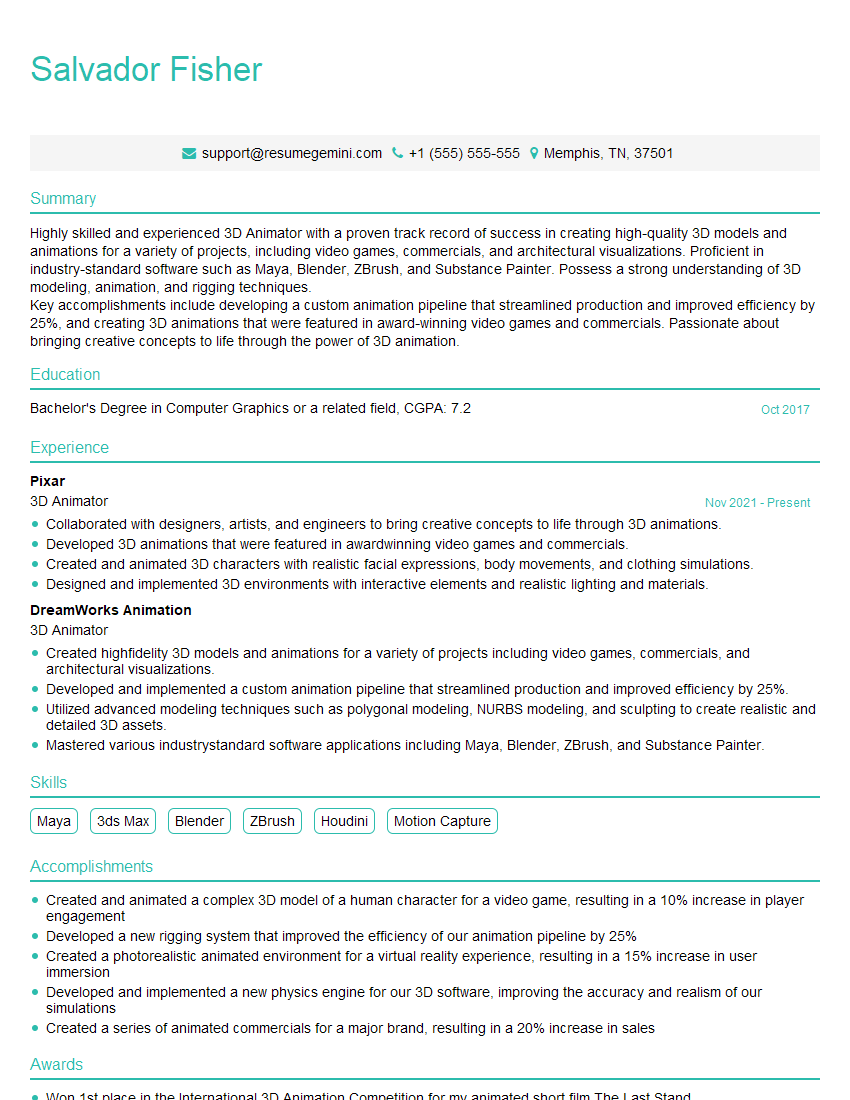
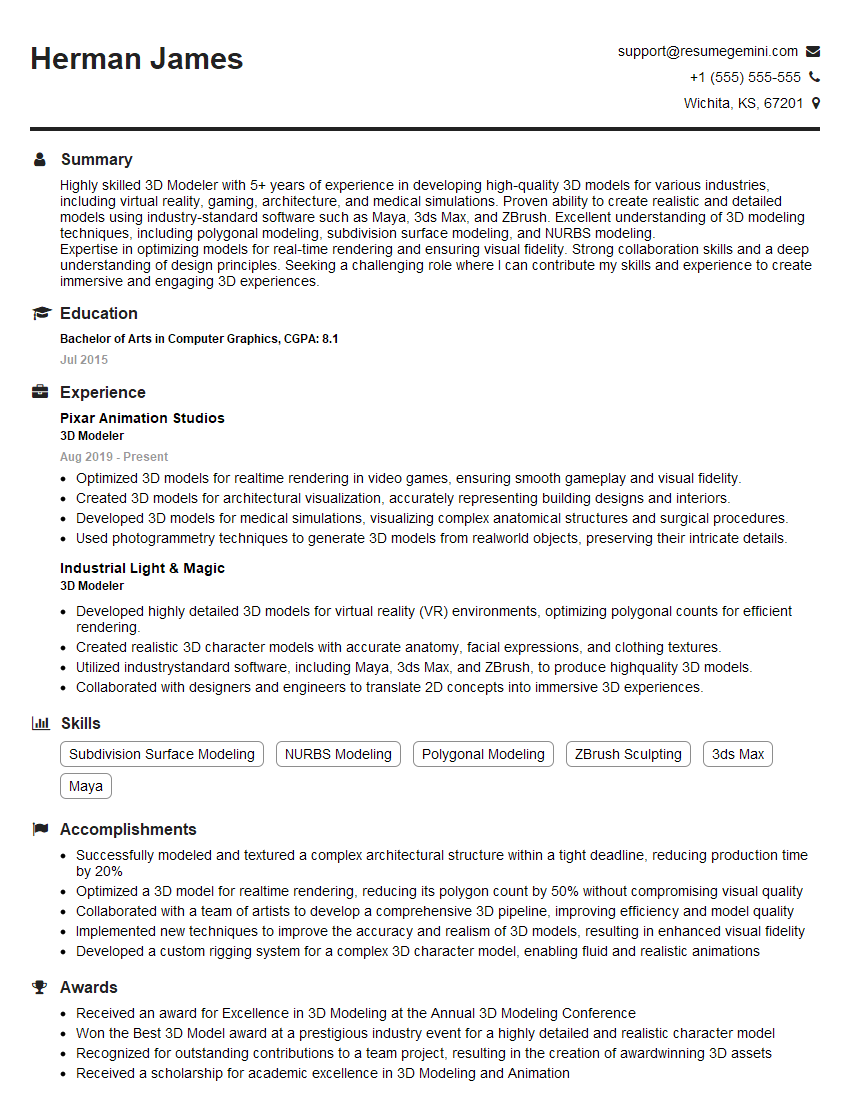
Mastering 3D modelling opens doors to exciting and rewarding careers in various industries, from games and animation to architecture and product design. To significantly boost your job prospects, creating a strong, ATS-friendly resume is essential. ResumeGemini is a trusted resource to help you build a professional and impactful resume that gets noticed. They offer examples of resumes tailored specifically to 3D Modelling professionals, providing you with a head start in showcasing your skills effectively. Take advantage of this resource to elevate your job search!
Explore more articles
Users Rating of Our Blogs
Share Your Experience
We value your feedback! Please rate our content and share your thoughts (optional).
What Readers Say About Our Blog
Attention music lovers!
Wow, All the best Sax Summer music !!!
Spotify: https://open.spotify.com/artist/6ShcdIT7rPVVaFEpgZQbUk
Apple Music: https://music.apple.com/fr/artist/jimmy-sax-black/1530501936
YouTube: https://music.youtube.com/browse/VLOLAK5uy_noClmC7abM6YpZsnySxRqt3LoalPf88No
Other Platforms and Free Downloads : https://fanlink.tv/jimmysaxblack
on google : https://www.google.com/search?q=22+AND+22+AND+22
on ChatGPT : https://chat.openai.com?q=who20jlJimmy20Black20Sax20Producer
Get back into the groove with Jimmy sax Black
Best regards,
Jimmy sax Black
www.jimmysaxblack.com
Hi I am a troller at The aquatic interview center and I suddenly went so fast in Roblox and it was gone when I reset.
Hi,
Business owners spend hours every week worrying about their website—or avoiding it because it feels overwhelming.
We’d like to take that off your plate:
$69/month. Everything handled.
Our team will:
Design a custom website—or completely overhaul your current one
Take care of hosting as an option
Handle edits and improvements—up to 60 minutes of work included every month
No setup fees, no annual commitments. Just a site that makes a strong first impression.
Find out if it’s right for you:
https://websolutionsgenius.com/awardwinningwebsites
Hello,
we currently offer a complimentary backlink and URL indexing test for search engine optimization professionals.
You can get complimentary indexing credits to test how link discovery works in practice.
No credit card is required and there is no recurring fee.
You can find details here:
https://wikipedia-backlinks.com/indexing/
Regards
NICE RESPONSE TO Q & A
hi
The aim of this message is regarding an unclaimed deposit of a deceased nationale that bears the same name as you. You are not relate to him as there are millions of people answering the names across around the world. But i will use my position to influence the release of the deposit to you for our mutual benefit.
Respond for full details and how to claim the deposit. This is 100% risk free. Send hello to my email id: [email protected]
Luka Chachibaialuka
Hey interviewgemini.com, just wanted to follow up on my last email.
We just launched Call the Monster, an parenting app that lets you summon friendly ‘monsters’ kids actually listen to.
We’re also running a giveaway for everyone who downloads the app. Since it’s brand new, there aren’t many users yet, which means you’ve got a much better chance of winning some great prizes.
You can check it out here: https://bit.ly/callamonsterapp
Or follow us on Instagram: https://www.instagram.com/callamonsterapp
Thanks,
Ryan
CEO – Call the Monster App
Hey interviewgemini.com, I saw your website and love your approach.
I just want this to look like spam email, but want to share something important to you. We just launched Call the Monster, a parenting app that lets you summon friendly ‘monsters’ kids actually listen to.
Parents are loving it for calming chaos before bedtime. Thought you might want to try it: https://bit.ly/callamonsterapp or just follow our fun monster lore on Instagram: https://www.instagram.com/callamonsterapp
Thanks,
Ryan
CEO – Call A Monster APP
To the interviewgemini.com Owner.
Dear interviewgemini.com Webmaster!
Hi interviewgemini.com Webmaster!
Dear interviewgemini.com Webmaster!
excellent
Hello,
We found issues with your domain’s email setup that may be sending your messages to spam or blocking them completely. InboxShield Mini shows you how to fix it in minutes — no tech skills required.
Scan your domain now for details: https://inboxshield-mini.com/
— Adam @ InboxShield Mini
Reply STOP to unsubscribe
Hi, are you owner of interviewgemini.com? What if I told you I could help you find extra time in your schedule, reconnect with leads you didn’t even realize you missed, and bring in more “I want to work with you” conversations, without increasing your ad spend or hiring a full-time employee?
All with a flexible, budget-friendly service that could easily pay for itself. Sounds good?
Would it be nice to jump on a quick 10-minute call so I can show you exactly how we make this work?
Best,
Hapei
Marketing Director
Hey, I know you’re the owner of interviewgemini.com. I’ll be quick.
Fundraising for your business is tough and time-consuming. We make it easier by guaranteeing two private investor meetings each month, for six months. No demos, no pitch events – just direct introductions to active investors matched to your startup.
If youR17;re raising, this could help you build real momentum. Want me to send more info?
Hi, I represent an SEO company that specialises in getting you AI citations and higher rankings on Google. I’d like to offer you a 100% free SEO audit for your website. Would you be interested?
Hi, I represent an SEO company that specialises in getting you AI citations and higher rankings on Google. I’d like to offer you a 100% free SEO audit for your website. Would you be interested?