Feeling uncertain about what to expect in your upcoming interview? We’ve got you covered! This blog highlights the most important 5 Why Analysis interview questions and provides actionable advice to help you stand out as the ideal candidate. Let’s pave the way for your success.
Questions Asked in 5 Why Analysis Interview
Q 1. Explain the 5 Whys technique and its purpose.
The 5 Whys technique is a simple yet powerful iterative interrogative technique used to explore the cause-and-effect relationships underlying a particular problem. Its purpose is to peel back layers of superficial explanations to uncover the root cause of a problem, not just its symptoms. It’s based on the idea that by repeatedly asking “Why?” about a problem, you can drill down to its fundamental origin. Each answer informs the next question, guiding you toward a deeper understanding.
Think of it like peeling an onion – each layer you remove reveals another layer until you reach the core. This core represents the root cause of the issue, allowing for effective and targeted solutions.
Q 2. What are the limitations of the 5 Whys method?
While the 5 Whys is a valuable tool, it does have limitations. Firstly, it assumes a relatively straightforward linear cause-and-effect relationship. Many problems, especially complex ones within organizational contexts, stem from multiple interwoven factors rather than a single root cause. The 5 Whys might struggle to uncover such intricate webs of causation.
Secondly, the quality of the analysis heavily depends on the knowledge and experience of the individuals asking the questions. Bias, preconceived notions, and lack of information can lead to inaccurate conclusions. Finally, the “5” in 5 Whys is arbitrary. Sometimes, fewer or more iterations might be necessary to reach the root cause effectively. Sticking rigidly to five questions can be counterproductive.
Q 3. Describe a situation where you successfully used the 5 Whys analysis.
In a previous role, we experienced a significant drop in customer satisfaction scores for our new software release. We used the 5 Whys to investigate.
- Why did customer satisfaction scores drop? Because users reported frequent crashes.
- Why were there frequent crashes? Because of a memory leak in the core module.
- Why was there a memory leak? Because insufficient memory management practices were used during development.
- Why were insufficient memory management practices used? Because developers lacked adequate training on memory management best practices.
- Why did developers lack adequate training? Because the training budget was insufficient, prioritizing other areas.
This analysis revealed the root cause was a lack of training, not a technical flaw in the software itself. This allowed us to address the issue by investing in developer training and ultimately improve product quality and customer satisfaction.
Q 4. How do you ensure objectivity when conducting a 5 Whys analysis?
Objectivity is crucial in a 5 Whys analysis. To ensure this, we need a structured approach. First, assembling a diverse team with varied perspectives minimizes individual biases. Second, documentation is key; recording each question and answer prevents subjective interpretation later. Third, actively seek contradictory evidence; don’t accept the first answer as definitive. Finally, consider external data to validate the conclusions. Using metrics, customer feedback, and technical logs can provide objective support for the identified root cause.
Q 5. When is the 5 Whys technique most effective?
The 5 Whys is most effective when dealing with problems that have a relatively clear, linear causal chain. It’s ideal for identifying the root cause of straightforward operational issues, simple defects in processes or products, or recurring problems that can be traced to a specific source. It works well when dealing with relatively isolated events rather than systemic or complex issues.
Q 6. When is the 5 Whys technique least effective?
The 5 Whys is least effective when dealing with complex problems with multiple interacting causes, systemic issues embedded within larger organizational structures, or situations with insufficient information or data. Problems stemming from human error, organizational culture, or external factors can be particularly difficult to analyze effectively using only the 5 Whys technique. In such cases, more sophisticated root cause analysis methods would be necessary.
Q 7. How can you prevent the 5 Whys from becoming circular?
To prevent circularity, it is important to carefully phrase questions and ensure that each answer genuinely addresses the previous one, progressing toward a more fundamental cause. If the answers start repeating or revisiting the same points, it’s a clear sign that the analysis is going in circles. In such cases, it might be helpful to review previous answers, consider additional information, or involve someone with a fresh perspective to guide the questioning towards a more effective path. Using visual aids like a cause-and-effect diagram can also help prevent repetitive questioning.
Q 8. What are some alternatives to the 5 Whys technique?
While the 5 Whys is a simple and effective tool, it’s not always the best fit. Alternatives depend on the complexity of the problem. For simpler issues, a simple brainstorming session might suffice. For more complex problems requiring a structured approach, consider these:
- Fishbone Diagram (Ishikawa Diagram): This visual tool helps brainstorm potential root causes categorized by different factors (e.g., people, methods, machines, materials). It’s great for collaborative problem-solving and identifying multiple contributing factors, unlike the linear 5 Whys.
- Fault Tree Analysis (FTA): FTA uses a top-down approach, starting with the undesired event and working backward to identify the underlying causes and their probabilities. It’s excellent for complex systems where multiple failure modes can lead to the same outcome.
- Root Cause Analysis (RCA) using A3 reports: This structured approach provides a clear, concise, and focused method for tackling complex issues. It blends problem-solving steps with visualization.
- 5 Whys with additional techniques: The 5 Whys can be combined with other methods like process mapping to gain a more detailed and comprehensive understanding of the problem and its root causes.
The choice depends on the context. For quick, informal investigations, the 5 Whys might be sufficient. However, for critical issues or complex systems, a more robust technique like FTA or A3 reporting will provide a more thorough and reliable root cause analysis.
Q 9. How do you document the findings of a 5 Whys analysis?
Documenting 5 Whys findings is crucial for reproducibility and future reference. A simple table is often sufficient:
| Why? | Answer |
|---|---|
| Why did the system crash? | The database server overloaded. |
| Why did the database server overload? | Unexpected high traffic volume. |
| Why was there unexpectedly high traffic? | A viral social media post. |
| Why did the social media post go viral? | It contained engaging content. |
| Why was the content so engaging? | It tapped into a current social trend. |
Alternatively, use a flowchart to visually represent the causal chain, making it easier to understand the relationships between causes. Regardless of the format, ensure you:
- Clearly state the initial problem.
- Number each ‘why’ and its corresponding answer.
- Include the date and participants involved.
- Save the document in a centralized, easily accessible location.
Q 10. How do you present the results of a 5 Whys analysis to stakeholders?
Presenting 5 Whys results to stakeholders requires clarity and conciseness. Avoid overwhelming them with details. Focus on the key findings and recommended actions. Consider these options:
- Visual aids: Flowcharts, tables (like the one above), or even a simple narrative summary are effective.
- Concise summary: Start with the initial problem, then progressively reveal the ‘whys’ leading to the root cause. Emphasize the ‘so what?’ – the impact of the root cause and the recommended solutions.
- Interactive presentation: If appropriate, involve stakeholders in the discussion to ensure they understand the process and the reasoning behind the conclusions.
- Actionable recommendations: The conclusion should include specific, measurable, achievable, relevant, and time-bound (SMART) recommendations to address the root cause.
Remember to tailor your presentation to your audience. Technical stakeholders might appreciate a more detailed explanation, while executive stakeholders might prefer a high-level summary focusing on impact and solutions.
Q 11. How do you handle situations where the ‘5th why’ is not easily identified?
Sometimes, you won’t reach a satisfying root cause after five ‘whys’. This doesn’t mean the technique failed; it simply means you might need to:
- Continue asking ‘why’: If the fifth ‘why’ still doesn’t feel conclusive, keep asking. The goal is to identify the root cause, not necessarily stop at five questions.
- Refine your questions: Ensure each ‘why’ is specific and targeted to uncover a deeper level of understanding. Avoid vague or generic questions.
- Gather more data: You may need additional information to understand the root cause. This could involve interviews, data analysis, or reviewing relevant documentation.
- Use additional techniques: Consider integrating other root cause analysis methods (as discussed in answer 1) to gain a more holistic understanding.
- Accept systemic issues: Sometimes, the root cause is a systemic problem that requires organizational changes rather than simple fixes.
The key is persistence and a willingness to adapt your approach as needed. Remember, the goal is to improve understanding and identify solutions, not to rigidly adhere to a fixed number of questions.
Q 12. How can you use visual aids to improve the effectiveness of a 5 Whys analysis?
Visual aids significantly improve the effectiveness of 5 Whys analysis by making it more engaging and easier to understand. Consider these:
- Flowcharts: Visually represent the causal chain, connecting each ‘why’ to its answer, providing a clear picture of the cause-and-effect relationships.
- Fishbone diagrams: Although not strictly 5 Whys, a fishbone diagram can complement the analysis by visually categorizing and prioritizing the root causes identified.
- Mind maps: These can be used to brainstorm and organize ideas and capture broader context around the problem.
- Tables: As described earlier, tables provide a structured way to document the ‘whys’ and answers.
Use colors, shapes, and concise language to make the visuals clear and easy to interpret. Choose the visual aid that best suits the audience and the complexity of the problem. For instance, a simple flowchart might suffice for a straightforward problem, while a fishbone diagram may be more appropriate for a complex issue with multiple contributing factors.
Q 13. Explain the difference between 5 Whys and other root cause analysis techniques.
The 5 Whys is a simple, iterative root cause analysis technique. It’s easy to learn and apply, making it suitable for quick investigations. However, its simplicity can be a limitation. Other techniques offer a more structured and comprehensive approach:
- Difference from Fishbone Diagram: The 5 Whys is linear and focuses on a single causal chain. The Fishbone Diagram is more holistic, allowing for exploration of multiple contributing factors categorized systematically.
- Difference from Fault Tree Analysis (FTA): FTA is more rigorous and quantitative. It’s used for complex systems where probabilities of failure are considered. The 5 Whys is qualitative and less detailed.
- Difference from A3 reporting: A3 reporting is a structured problem-solving framework encompassing various root cause analysis techniques. The 5 Whys can be *part* of an A3 report, but the A3 framework is significantly broader and more comprehensive.
In essence, the 5 Whys is a good starting point for simple problem-solving, but for complex issues or when a formal, documented analysis is needed, more sophisticated methods are often preferred.
Q 14. How do you determine the appropriate level of detail when conducting a 5 Whys analysis?
Determining the appropriate level of detail in a 5 Whys analysis requires balancing thoroughness with practicality. Too much detail can be overwhelming and time-consuming, while too little might miss critical information.
Consider these factors:
- Problem complexity: A simple problem requires less detail than a complex one.
- Time constraints: A quick investigation might necessitate a more superficial analysis.
- Available resources: The amount of data and expertise available will influence the depth of the analysis.
- Stakeholder needs: The level of detail should be appropriate for the audience and their need for information.
Start with a high-level understanding and gradually delve deeper as needed. If a ‘why’ leads to a very complex issue, it might be better to treat that as a separate 5 Whys analysis. Remember that the goal is to identify the *root* cause, not necessarily every single contributing factor.
Q 15. How do you involve stakeholders effectively in a 5 Whys analysis?
Effective stakeholder involvement in a 5 Whys analysis is crucial for its success. It ensures buy-in, diverse perspectives, and accurate information. I start by clearly explaining the purpose and methodology to all relevant stakeholders. This involves a brief overview of the problem and how the 5 Whys approach will help uncover the root cause. Then, I facilitate a collaborative session, ensuring everyone has a voice and feels comfortable contributing. This might involve using visual aids like a whiteboard or shared document to track the ‘why’ chain. Importantly, I actively encourage challenging questions and different interpretations, as this can often lead to deeper insights. For instance, if we’re analyzing a drop in sales, I’d invite the sales team, marketing team, and even customer service to participate, ensuring we consider all potential angles.
A key technique is to actively listen and avoid prematurely jumping to conclusions. The goal is to build a shared understanding of the problem and its potential root causes. Finally, I ensure that the conclusions are documented and shared with all stakeholders, fostering transparency and ownership of the identified solution.
Career Expert Tips:
- Ace those interviews! Prepare effectively by reviewing the Top 50 Most Common Interview Questions on ResumeGemini.
- Navigate your job search with confidence! Explore a wide range of Career Tips on ResumeGemini. Learn about common challenges and recommendations to overcome them.
- Craft the perfect resume! Master the Art of Resume Writing with ResumeGemini’s guide. Showcase your unique qualifications and achievements effectively.
- Don’t miss out on holiday savings! Build your dream resume with ResumeGemini’s ATS optimized templates.
Q 16. Describe a time you had to modify your approach during a 5 Whys analysis.
During a 5 Whys analysis for a manufacturing defect, we initially focused on the immediate problem: faulty welds on a product. Five ‘whys’ later, we still hadn’t reached a satisfactory root cause. We kept circling back to issues with operator training or equipment malfunction without finding a truly underlying issue. We realized we were getting stuck in a loop of symptoms rather than addressing the systemic issues.
To modify our approach, we shifted from focusing solely on the weld defect to examining the broader manufacturing process. We brought in process engineers and utilized process mapping to visualize the entire flow. This broader perspective revealed a significant bottleneck earlier in the process, causing rushed work later on and leading to the faulty welds. This wouldn’t have been apparent by just focusing on the immediate weld problem. This experience highlighted the importance of expanding the scope of the analysis when the 5 Whys approach seems to stagnate, and to consider using complementary tools like process mapping.
Q 17. How do you prioritize the root causes identified through a 5 Whys analysis?
Prioritizing root causes identified through 5 Whys involves a multi-step process. First, I ensure we have a clear and documented list of all potential root causes identified during the analysis. Then, we evaluate each root cause based on factors like its impact (how significantly does this cause affect the problem?), probability (how likely is it to occur?), and cost of mitigation (how much would it cost to fix this cause?). I often use a simple matrix or scoring system to visualize this evaluation.
For instance, a root cause with high impact, high probability, and low mitigation cost should be prioritized over one with low impact, low probability, and high cost. This prioritization ensures we focus our resources and efforts on the most impactful and feasible solutions. Open discussion among stakeholders is crucial in this step to ensure agreement on the prioritization.
Q 18. How do you verify the accuracy of the root cause identified using 5 Whys?
Verifying the accuracy of the root cause is crucial to avoid implementing ineffective solutions. While 5 Whys is a powerful tool, it’s essential to validate its findings. I use several methods for this validation. First, data analysis is key. We look at historical data to see if the identified root cause correlates with the problem’s frequency or severity. This could involve examining production logs, customer feedback data, or other relevant metrics.
Second, I conduct interviews and observations to confirm our understanding of the root cause. Talking to those directly involved in the process, observing the process in action, and conducting further investigations can help corroborate our findings. Finally, a pilot test or small-scale implementation of a solution based on the identified root cause is a great way to validate its effectiveness before a full-scale rollout. This iterative approach allows for adjustments based on the initial results.
Q 19. Can you explain how 5 Whys relates to other problem-solving methodologies like DMAIC?
5 Whys is a simple, effective tool that can be used as part of larger problem-solving methodologies like DMAIC (Define, Measure, Analyze, Improve, Control). It’s most closely related to the ‘Analyze’ phase of DMAIC. Within DMAIC, 5 Whys can be used as a preliminary tool to generate hypotheses about root causes. These hypotheses then need to be further validated and investigated through more rigorous methods within the ‘Analyze’ phase, perhaps including statistical analysis or process mapping.
Think of 5 Whys as the initial brainstorming step—it helps quickly uncover potential root causes. However, DMAIC uses more sophisticated statistical tools and a more structured approach to fully understand and solve the problem. In short, 5 Whys provides a starting point, which is then followed by the more detailed analysis of DMAIC.
Q 20. What are the key benefits of using the 5 Whys approach?
The 5 Whys approach offers several key benefits. It’s simple and easy to understand, making it accessible to individuals across different roles and levels of technical expertise. This simplicity allows for quick identification of potential root causes, reducing the time spent on lengthy problem investigations. Its collaborative nature encourages teamwork and shared understanding of the problem and its solution.
Furthermore, it promotes a proactive approach to problem-solving by guiding individuals to look beyond immediate symptoms and delve deeper to identify underlying issues, thus leading to more sustainable solutions. It’s also a cost-effective tool, requiring minimal resources and training.
Q 21. What are the potential drawbacks of relying solely on the 5 Whys method?
Relying solely on the 5 Whys method can have drawbacks. It’s a relatively simple technique and may not be sufficient to address complex problems with multiple interacting factors. It can also be prone to bias, as the line of questioning can be influenced by the preconceived notions of the individuals involved. The answers obtained may be overly simplistic and fail to capture the nuanced aspects of a complex problem.
Moreover, the ‘5’ in 5 Whys is arbitrary. Sometimes more, or fewer, ‘whys’ are needed. It’s not a guaranteed path to the root cause, and it requires critical thinking and verification of the findings through other methods. Finally, it can lead to a lack of objectivity if the team isn’t diverse or if there is a dominant voice guiding the questioning.
Q 22. How can you use data to support your findings from a 5 Whys analysis?
The 5 Whys is a powerful brainstorming technique, but relying solely on intuition can be misleading. Data strengthens the analysis by providing objective evidence to support your conclusions. For example, after identifying a root cause using the 5 Whys, you can validate it using relevant data.
Let’s say the 5 Whys reveals that inadequate training is the root cause of high error rates in a process. To support this, you could present data showing a correlation between employee training hours and error rates. Perhaps employees with less than 10 hours of training have an error rate of 15%, while those with over 20 hours have a rate of only 5%. This quantifiable data significantly strengthens the argument for improved training as the solution.
Other data sources could include defect logs, customer feedback surveys, operational downtime records, or even performance metrics from software applications. The key is to find data that directly relates to the problem and the potential root causes identified through the 5 Whys.
Q 23. How would you apply 5 Whys to a software development problem?
Applying the 5 Whys to software development often involves identifying the source of bugs or performance issues. Let’s imagine a software application experiencing frequent crashes.
- Why 1: The application is crashing frequently.
- Why 2: A memory leak is occurring.
- Why 3: The garbage collection mechanism isn’t functioning correctly.
- Why 4: A recent code update introduced a bug in the garbage collector module.
- Why 5: Insufficient testing of the garbage collector module before deployment.
This analysis shows that insufficient testing is the root cause. Data such as crash logs, memory usage reports, and test coverage metrics could be used to substantiate these findings. The solution would involve implementing more rigorous testing procedures for future code releases.
Q 24. How would you apply 5 Whys to a manufacturing process issue?
In manufacturing, the 5 Whys is used to pinpoint inefficiencies or defects in production processes. Imagine a production line experiencing a high rate of defective products.
- Why 1: The product defect rate is unacceptably high.
- Why 2: Many units are failing the final quality inspection.
- Why 3: A significant portion of the defective products have improperly aligned components.
- Why 4: The automated alignment machine is miscalibrated.
- Why 5: Regular preventative maintenance on the alignment machine has been neglected.
This points to a lack of preventative maintenance as the root cause. Supporting data could include production logs showing defect rates, maintenance records indicating missed services, and possibly even cost data associated with wasted materials and rework.
Q 25. How would you apply 5 Whys to a customer service problem?
In customer service, the 5 Whys helps uncover the underlying reasons for customer dissatisfaction. Suppose there’s a surge in negative customer reviews regarding a product’s usability.
- Why 1: Customers are leaving negative reviews.
- Why 2: Customers find the product difficult to use.
- Why 3: The product’s instructions are unclear and confusing.
- Why 4: The instructional designers lacked sufficient subject matter expertise.
- Why 5: There was insufficient investment in user experience (UX) testing and iterative design.
The root cause here is the lack of investment in UX testing. Data to support this could include customer survey results showing high levels of confusion regarding the product’s functionality, analysis of user support tickets highlighting repeated usability problems, and perhaps even A/B testing data comparing different versions of the instructions.
Q 26. Explain how to use the 5 Whys to identify systemic issues.
Identifying systemic issues requires going beyond the immediate cause. A single 5 Whys analysis might only uncover a surface-level problem. To identify systemic issues, you need to look for patterns and recurring themes.
If multiple 5 Whys analyses on different problems lead to the same root cause (e.g., inadequate training, insufficient resource allocation, or poor communication), that points to a systemic issue requiring a more substantial organizational change. For instance, consistently finding inadequate training as the root cause across several departments suggests a broader problem with the company’s training program. This requires a systemic solution like a revamped training curriculum, improved training methods, or increased investment in training resources.
Q 27. How can you improve the efficiency of a 5 Whys analysis session?
Improving the efficiency of a 5 Whys session involves careful planning and execution.
- Clearly Define the Problem: Begin with a precise and concise statement of the problem. Ambiguity leads to wasted time.
- Assemble the Right Team: Include individuals with diverse perspectives and relevant expertise. Their combined knowledge can lead to faster and more insightful analyses.
- Use Visual Aids: Whiteboards, sticky notes, or mind maps can help visualize the process and facilitate collaboration.
- Timeboxing: Allocate a specific timeframe for the session to prevent it from dragging on.
- Document Everything: Keep a detailed record of the questions and answers to avoid losing crucial information.
- Focus on Root Cause, Not Blame: Remember that the goal is to solve the problem, not to assign blame. A blame-free environment encourages open and honest participation.
By following these steps, you can significantly enhance the efficiency and effectiveness of your 5 Whys analyses, ensuring that you reach the root cause quickly and efficiently.
Key Topics to Learn for 5 Why Analysis Interview
- Understanding the Fundamentals: Grasp the core principle of 5 Whys – iteratively asking “why” to uncover the root cause of a problem. Learn to differentiate between symptoms and root causes.
- Practical Application in Different Scenarios: Explore how 5 Why Analysis can be applied across various industries and contexts, such as manufacturing, software development, project management, and customer service. Consider real-world examples of its successful implementation.
- Effective Questioning Techniques: Practice formulating insightful “why” questions that elicit valuable information and avoid leading questions. Learn to navigate challenging conversations and overcome obstacles in the process.
- Identifying Root Causes Accurately: Master techniques to distinguish between superficial and underlying causes. Understand how biases can influence the analysis and learn methods to mitigate them.
- Documenting and Communicating Findings: Learn how to effectively document the 5 Why process, visually represent the findings (e.g., using a flowchart), and clearly communicate your conclusions to stakeholders.
- Limitations and Alternatives: Recognize the limitations of 5 Why Analysis and explore alternative root cause analysis techniques that can complement it. Be prepared to discuss when 5 Whys might not be the most suitable approach.
Next Steps
Mastering 5 Why Analysis demonstrates strong analytical and problem-solving skills – highly valued attributes in today’s competitive job market. This technique is frequently used in interviews to assess a candidate’s ability to approach challenges systematically and effectively. To further enhance your job prospects, create an ATS-friendly resume that highlights your analytical abilities and problem-solving experience. ResumeGemini is a trusted resource that can help you build a professional and impactful resume. Examples of resumes tailored to showcase 5 Why Analysis proficiency are available within ResumeGemini to guide you. Take this opportunity to craft a resume that truly reflects your skills and experience.
Program Manager Resume Sample

Operations Manager Resume Sample
Product Manager Resume Sample
Quality Assurance Manager Resume Sample

Project Manager Resume Sample

Compliance Officer Resume Sample
Reliability Engineer Resume Sample
Supply Chain Analyst Resume Sample
Business Analyst Resume Sample
Management Consultant Resume Sample
Technical Consultant Resume Sample
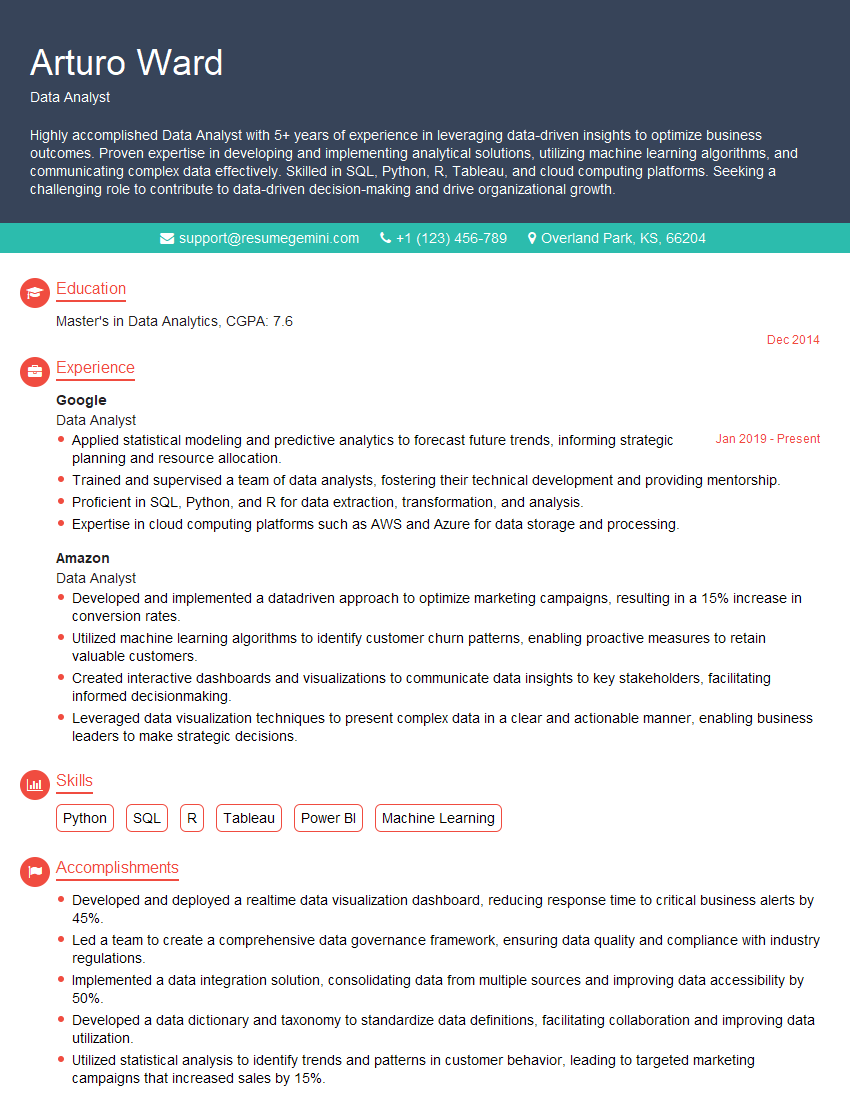
Data Analyst Resume Sample
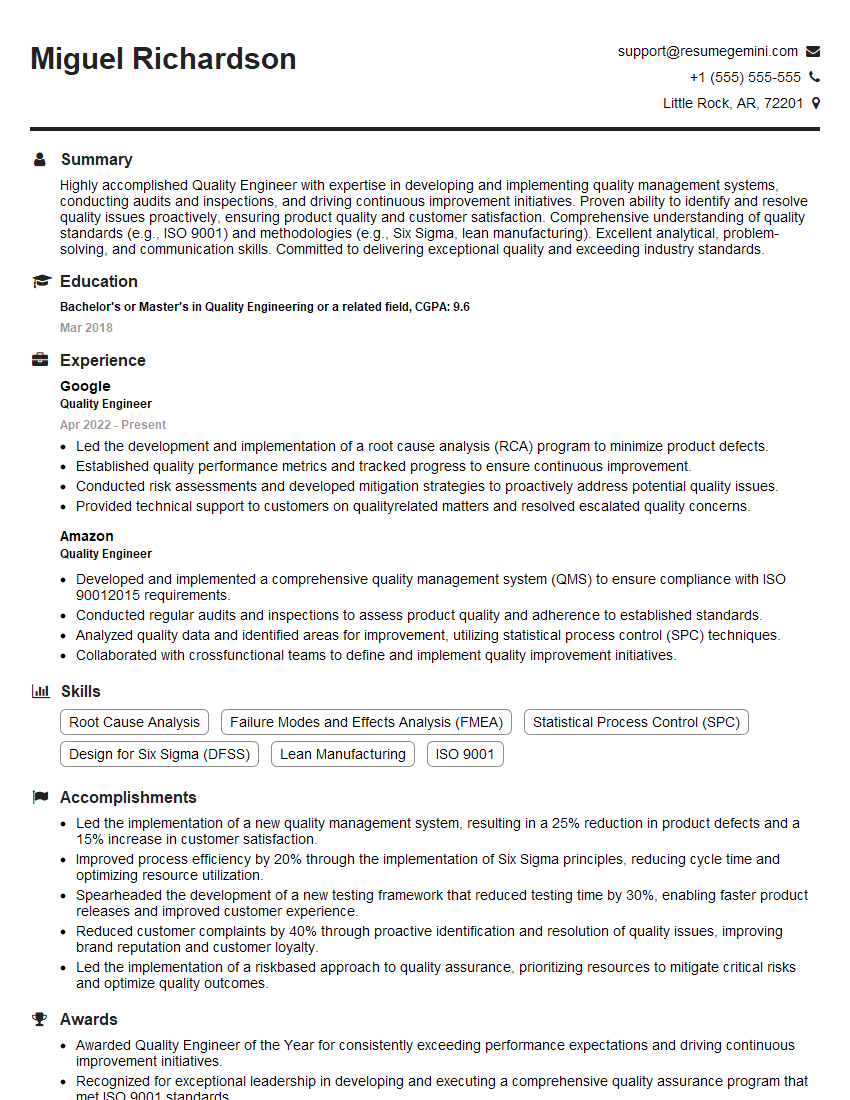
Quality Engineer Resume Sample
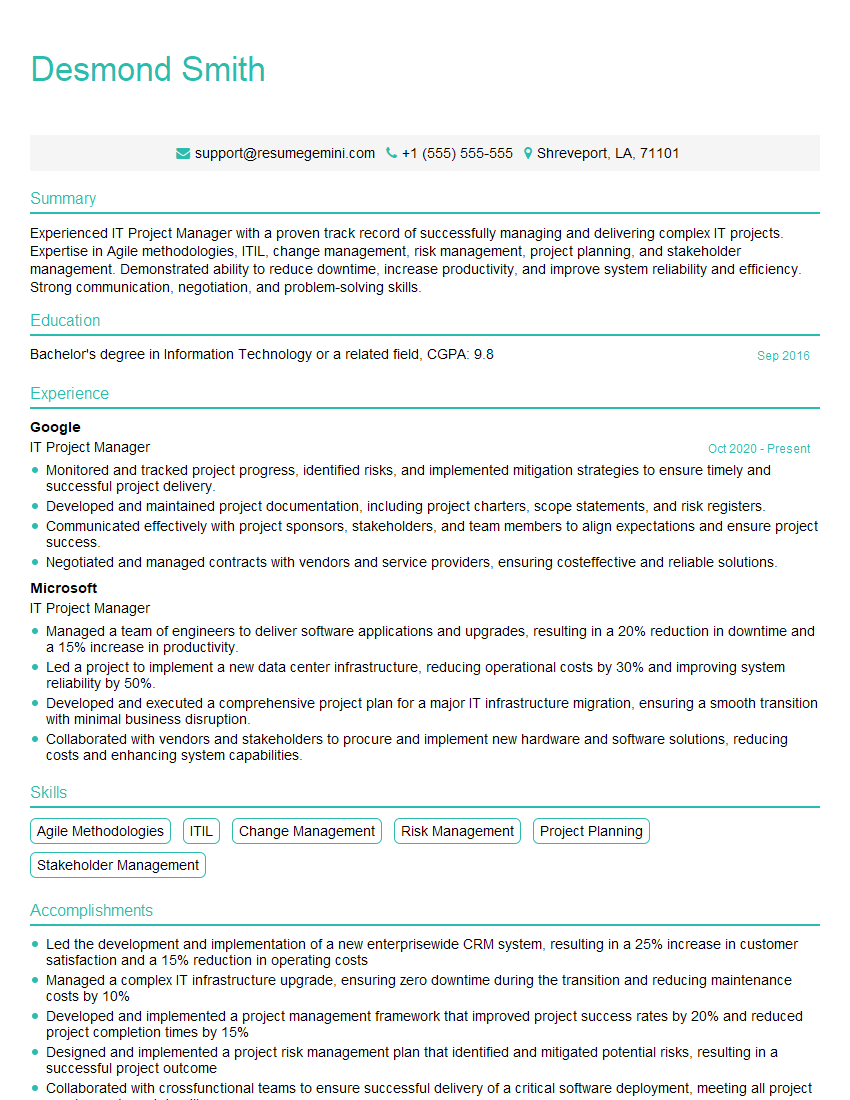
IT Project Manager Resume Sample
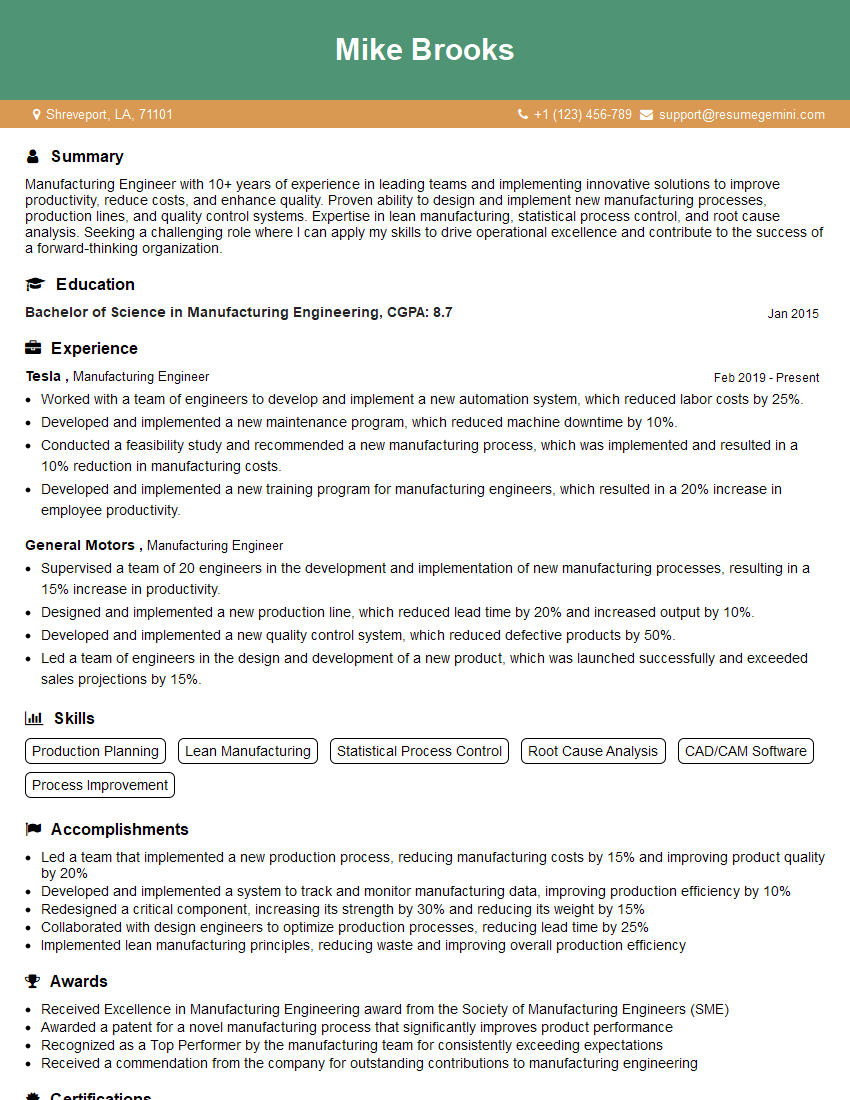
Manufacturing Engineer Resume Sample
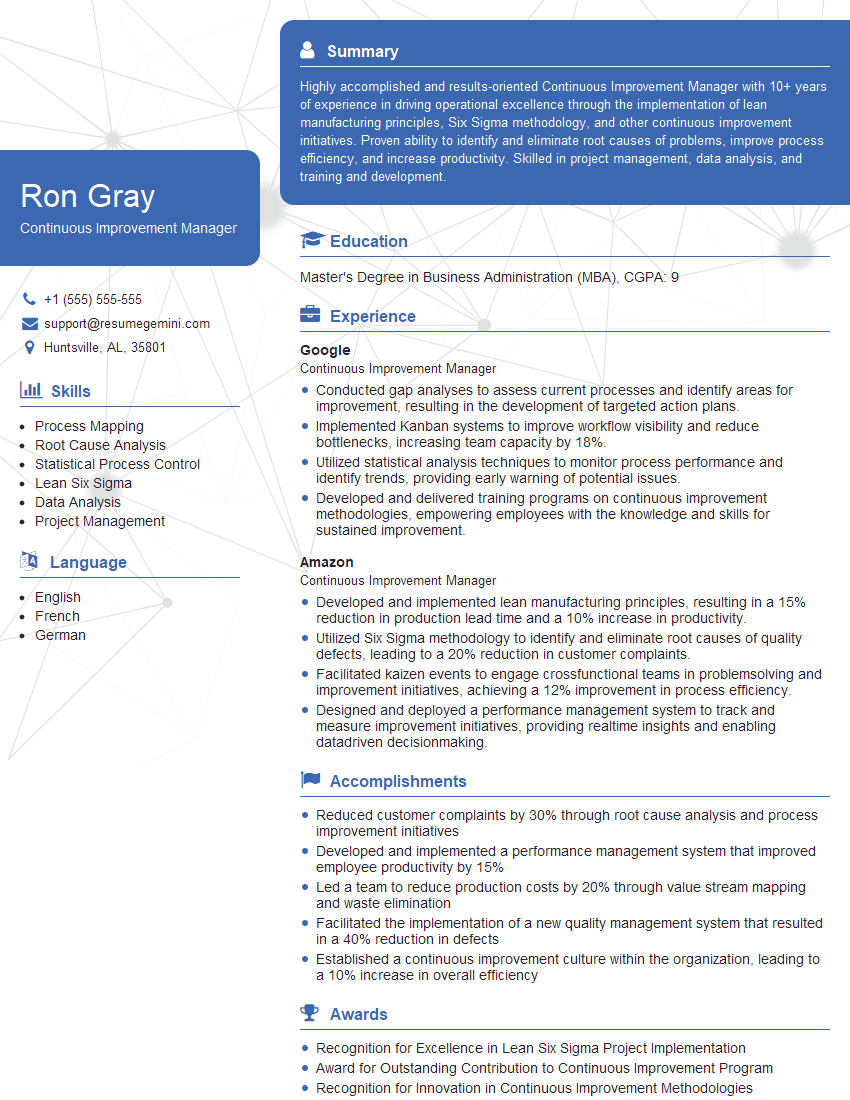
Continuous Improvement Manager Resume Sample
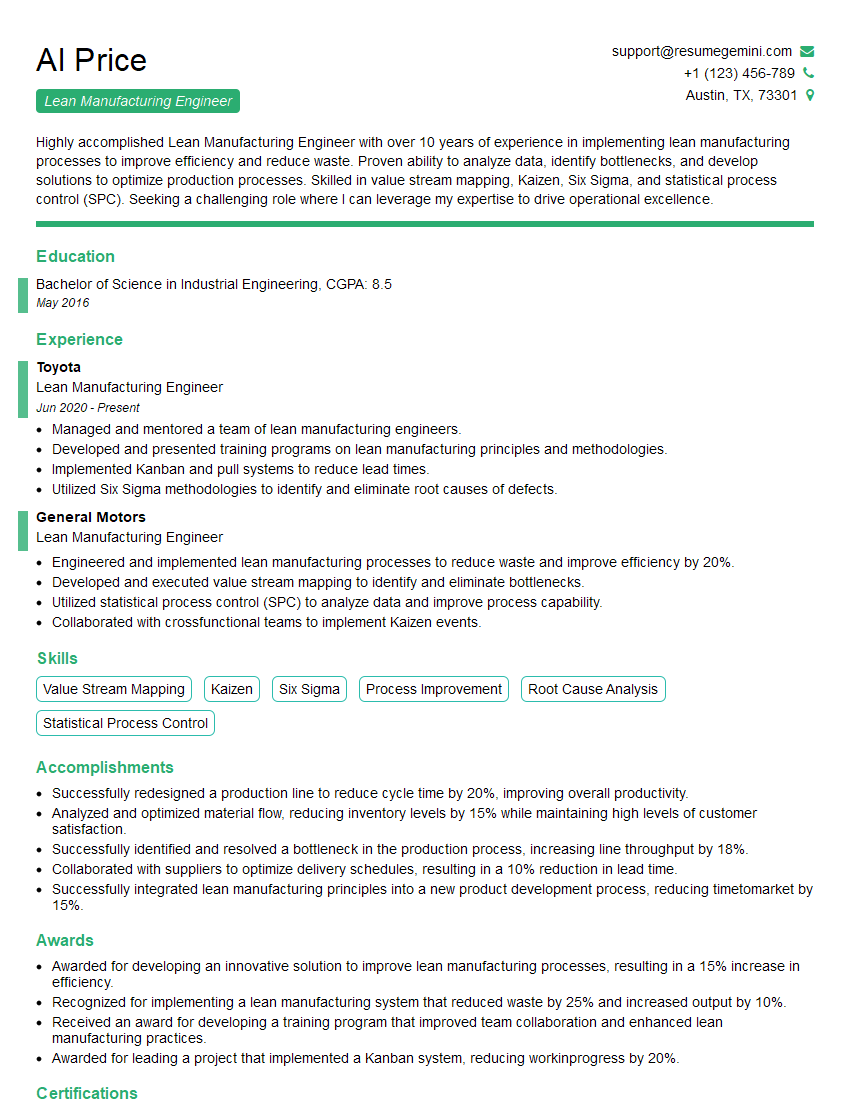
Lean Manufacturing Engineer Resume Sample

Technical Writer Resume Sample
- Program Manager
- Operations Manager
- Product Manager
- Quality Assurance Manager
- Project Manager
- Compliance Officer
- Reliability Engineer
- Supply Chain Analyst
- Business Analyst
- Management Consultant
- Technical Consultant
- Data Analyst
- Quality Engineer
- IT Project Manager
- Manufacturing Engineer
- Continuous Improvement Manager
- Lean Manufacturing Engineer
- Technical Writer
Explore more articles
Users Rating of Our Blogs
Share Your Experience
We value your feedback! Please rate our content and share your thoughts (optional).
What Readers Say About Our Blog
Hello,
we currently offer a complimentary backlink and URL indexing test for search engine optimization professionals.
You can get complimentary indexing credits to test how link discovery works in practice.
No credit card is required and there is no recurring fee.
You can find details here:
https://wikipedia-backlinks.com/indexing/
Regards
NICE RESPONSE TO Q & A
hi
The aim of this message is regarding an unclaimed deposit of a deceased nationale that bears the same name as you. You are not relate to him as there are millions of people answering the names across around the world. But i will use my position to influence the release of the deposit to you for our mutual benefit.
Respond for full details and how to claim the deposit. This is 100% risk free. Send hello to my email id: [email protected]
Luka Chachibaialuka
Hey interviewgemini.com, just wanted to follow up on my last email.
We just launched Call the Monster, an parenting app that lets you summon friendly ‘monsters’ kids actually listen to.
We’re also running a giveaway for everyone who downloads the app. Since it’s brand new, there aren’t many users yet, which means you’ve got a much better chance of winning some great prizes.
You can check it out here: https://bit.ly/callamonsterapp
Or follow us on Instagram: https://www.instagram.com/callamonsterapp
Thanks,
Ryan
CEO – Call the Monster App
Hey interviewgemini.com, I saw your website and love your approach.
I just want this to look like spam email, but want to share something important to you. We just launched Call the Monster, a parenting app that lets you summon friendly ‘monsters’ kids actually listen to.
Parents are loving it for calming chaos before bedtime. Thought you might want to try it: https://bit.ly/callamonsterapp or just follow our fun monster lore on Instagram: https://www.instagram.com/callamonsterapp
Thanks,
Ryan
CEO – Call A Monster APP
To the interviewgemini.com Owner.
Dear interviewgemini.com Webmaster!
Hi interviewgemini.com Webmaster!
Dear interviewgemini.com Webmaster!
excellent
Hello,
We found issues with your domain’s email setup that may be sending your messages to spam or blocking them completely. InboxShield Mini shows you how to fix it in minutes — no tech skills required.
Scan your domain now for details: https://inboxshield-mini.com/
— Adam @ InboxShield Mini
Reply STOP to unsubscribe
Hi, are you owner of interviewgemini.com? What if I told you I could help you find extra time in your schedule, reconnect with leads you didn’t even realize you missed, and bring in more “I want to work with you” conversations, without increasing your ad spend or hiring a full-time employee?
All with a flexible, budget-friendly service that could easily pay for itself. Sounds good?
Would it be nice to jump on a quick 10-minute call so I can show you exactly how we make this work?
Best,
Hapei
Marketing Director
Hey, I know you’re the owner of interviewgemini.com. I’ll be quick.
Fundraising for your business is tough and time-consuming. We make it easier by guaranteeing two private investor meetings each month, for six months. No demos, no pitch events – just direct introductions to active investors matched to your startup.
If youR17;re raising, this could help you build real momentum. Want me to send more info?
Hi, I represent an SEO company that specialises in getting you AI citations and higher rankings on Google. I’d like to offer you a 100% free SEO audit for your website. Would you be interested?
Hi, I represent an SEO company that specialises in getting you AI citations and higher rankings on Google. I’d like to offer you a 100% free SEO audit for your website. Would you be interested?
good