Every successful interview starts with knowing what to expect. In this blog, we’ll take you through the top Artillery Fire Planning interview questions, breaking them down with expert tips to help you deliver impactful answers. Step into your next interview fully prepared and ready to succeed.
Questions Asked in Artillery Fire Planning Interview
Q 1. Explain the process of calculating firing solutions for artillery.
Calculating firing solutions for artillery involves determining the precise aiming data needed to hit a target. It’s a complex process that takes into account several factors, and it’s often assisted by sophisticated fire control systems. The core principle lies in applying basic ballistic equations, considering factors such as projectile characteristics, atmospheric conditions, and the target’s location.
The process generally involves these steps:
- Target Location Determination: Precise coordinates (latitude, longitude, and elevation) of the target are crucial. This might come from forward observers, intelligence reports, or even GPS.
- Weapon Location Determination: Similarly, the exact location (latitude, longitude, and elevation) of the artillery piece is needed. This is often surveyed beforehand.
- Meteorological Data Input: Atmospheric conditions, including temperature, air pressure, wind speed, and direction, significantly impact projectile trajectory. This data is fed into the firing solution calculation.
- Ballistic Calculations: These calculations consider the projectile’s characteristics (weight, size, propellant charge), the distance to the target, and the meteorological data to determine the necessary angle of elevation and azimuth (direction). This usually involves complex ballistic tables or computer algorithms.
- Firing Data Computation: The final calculation provides the precise aiming data, including the elevation angle, azimuth, and sometimes fuse settings (for time-fused munitions), which the gun crew will use to fire.
- Verification and Adjustments: After the first shot, adjustments are typically made based on the observed impact point, to fine-tune the accuracy. This iterative process, known as ‘registration,’ ensures the subsequent rounds land closer to the target.
Imagine it like throwing a ball – you need to account for wind, distance, and the angle at which you throw. Artillery is the same, but with far more precision and complexity, often using sophisticated computer systems to handle the calculations.
Q 2. Describe the different types of artillery ammunition and their applications.
Artillery ammunition varies widely in type and application, designed for different effects and target types. Some key types include:
- High-Explosive (HE): The most common type, designed to create a blast and fragmentation effect. Effective against personnel, lightly armored vehicles, and fortifications.
- High-Explosive Incendiary (HEI): Similar to HE but includes an incendiary component to ignite fires. Useful against fuel dumps or other flammable targets.
- White Phosphorus (WP): Creates a dense, burning cloud of white phosphorus, used for illumination, obscuration (creating smoke screens), or as an anti-personnel weapon (due to the burns it causes).
- Smoke: Generates a smoke cloud for obscuring enemy observation or movement. Crucial for battlefield deception and cover.
- Illumination: Produces bright illumination for night operations, allowing for target identification and observation.
- Guided Munitions: These incorporate guidance systems to improve accuracy significantly, reducing the need for numerous rounds. Examples include precision-guided munitions (PGMs) like laser-guided projectiles or GPS-guided artillery shells.
- Cluster Munitions: These contain multiple smaller bomblets or submunitions, designed to cover a larger area and saturate the target. However, due to the potential for civilian harm from unexploded ordnance, their use is increasingly restricted.
The choice of ammunition depends on the mission, the target, and the desired effect. For instance, HE would be suitable for a bunker, while WP could be used for illumination or to screen troop movements.
Q 3. What are the key factors to consider when selecting targets for artillery fire?
Target selection for artillery is a critical aspect of fire planning, demanding careful consideration of various factors to maximize effectiveness and minimize collateral damage.
- Military Significance: Prioritizing targets that have a significant impact on the enemy’s capabilities, such as command posts, ammunition dumps, or armored concentrations.
- Vulnerability: Assessing the target’s vulnerability to artillery fire. A heavily fortified position may require more ammunition than a lightly defended one.
- Accessibility: Considering the ability to effectively engage the target. Obstructions or terrain features might limit the effectiveness of artillery fire.
- Collateral Damage: Minimizing harm to civilians and friendly forces. This requires careful assessment of the surrounding area and potential civilian presence.
- Time Sensitivity: Considering the urgency of the situation and the need for immediate fire support. High-value, fleeting targets might require immediate action.
For example, choosing to target a bridge that is critical to enemy logistics makes military sense but demands accurate fire to minimize damage to the bridge’s immediate surroundings and nearby civilian areas. Selecting a less crucial, isolated target, while less impactful, is a safer alternative if minimizing civilian casualties is paramount.
Q 4. How do you ensure the accuracy of artillery fire?
Ensuring the accuracy of artillery fire is paramount and relies on a combination of factors:
- Precise Survey Data: Accurate location data for both the artillery piece and the target is fundamental. Modern GPS technology significantly aids this process.
- Accurate Meteorological Data: Real-time weather information is essential to compensate for wind, temperature, and air pressure effects on the projectile’s trajectory.
- Sophisticated Fire Control Systems: These systems, often computer-based, automate calculations and take into account all relevant variables.
- Proper Gunnery Techniques: Well-trained gun crews are vital for precise aiming and efficient loading procedures.
- Registration: This process involves firing initial rounds and adjusting the firing solution based on observed impacts. This iterative process refines the aiming data until acceptable accuracy is achieved.
- Regular Maintenance: Ensuring the artillery piece and associated equipment are in optimal condition reduces inaccuracies.
- Use of Precision Guided Munitions (PGMs): PGMs incorporate guidance systems for increased accuracy, significantly reducing the need for multiple adjustment shots.
Think of it like a marksman adjusting their aim after each shot to hit a distant target. Accuracy is an iterative process refined through observation and adjustment.
Q 5. Explain the role of forward observers in artillery fire planning.
Forward Observers (FOs) play a crucial role in artillery fire planning, acting as the eyes and ears on the ground. Their primary function is to locate and identify enemy targets and relay that information to the artillery unit for fire missions.
Their responsibilities include:
- Target Acquisition: Locating and identifying enemy targets, determining their coordinates using various methods (GPS, maps, laser rangefinders).
- Target Description: Providing detailed information about the target, including its type, size, and location.
- Communication: Relaying target information to the artillery unit through secure communication channels.
- Adjusting Fire: Observing the impact of artillery rounds and providing feedback to the artillery unit to adjust fire for greater accuracy.
- Liaison: Acting as the link between ground troops and the artillery unit.
The FO acts as the critical link between the tactical situation on the ground and the artillery’s ability to deliver accurate and timely fire support. They are trained to work under pressure, using advanced observation techniques and communication protocols to ensure the timely delivery of effective fire support.
Q 6. Describe the communication systems used in artillery fire support.
Artillery fire support relies on robust and secure communication systems to ensure accurate and timely information transfer. Systems used vary but generally include:
- Radio Systems: These are essential for rapid communication between the forward observers, fire direction centers, and artillery units. Secure, encrypted communication is preferred to prevent interception by the enemy.
- Digital Message Systems: These provide more efficient communication of complex data, such as target coordinates and meteorological information, reducing errors caused by manual transcription.
- Satellite Communication: Satellite communication ensures reliable communication even in challenging terrain or during periods of high interference.
- Data Links: These allow for the real-time transmission of data and information, often integrated into fire control systems for automatic data processing.
Reliability and security are paramount, as timely and accurate communication is critical to effective artillery support. A breakdown in communication can lead to significant delays, inaccuracies, and potentially endanger friendly forces.
Q 7. What are the limitations of artillery fire?
Despite its power, artillery fire has limitations:
- Limited Accuracy (without PGMs): Conventional artillery has inherent limitations in accuracy, particularly at longer ranges. This is affected by meteorological conditions and projectile characteristics.
- Time Delay: There is a time delay between requesting a fire mission and the arrival of rounds. This is exacerbated by longer ranges and complex target acquisition processes.
- Collateral Damage Risk: The wide area of effect of artillery rounds increases the risk of collateral damage if not precisely targeted. Civilian casualties must be carefully weighed against military objectives.
- Vulnerability to Counter-Battery Fire: Artillery units are vulnerable to enemy counter-battery fire, which seeks to suppress or destroy artillery systems. This is why artillery units frequently change position.
- Dependence on Weather: Extreme weather conditions such as heavy rain or fog can significantly hamper effectiveness and accuracy.
- Range Limitations: Each artillery piece has a maximum effective range. Targets beyond this range cannot be engaged without repositioning.
Effective artillery use requires careful planning, precise execution, and a strong awareness of these limitations to maximize effectiveness while minimizing risk.
Q 8. How do you integrate artillery fire with other combat arms?
Integrating artillery fire with other combat arms is crucial for achieving synchronized, decisive effects on the battlefield. It’s not about artillery acting in isolation, but as a key component of a larger combined arms maneuver.
This integration involves close coordination with infantry, armor, and air assets. Infantry units often call for artillery support to suppress enemy positions before an assault. Armor units might use artillery to soften enemy defenses before a breakthrough. Air power can provide close air support in conjunction with artillery strikes, creating a devastating combined arms effect.
Effective integration relies on robust communication networks, shared situational awareness, and a clear understanding of each arm’s capabilities and limitations. For example, artillery can provide sustained suppressive fire while infantry assaults, while air power offers precision strikes against high-value targets identified by forward observers.
Consider a scenario where an infantry unit is pinned down by enemy machine gun fire. They would request artillery support, providing the artillery with target coordinates and a description of the threat. The artillery would then engage the target, suppressing the enemy fire, allowing the infantry to advance. The coordination is key – the artillery must be aware of the infantry’s location to prevent fratricide.
Q 9. Explain the concept of ‘danger close’ and its implications.
Danger close refers to the firing of artillery rounds within a specified distance of friendly forces. This distance is determined by the type of munition used and the potential for unintended casualties or collateral damage. It inherently involves a high level of risk.
The implications of ‘danger close’ are significant. While it can be incredibly effective in providing immediate fire support, the potential for friendly fire incidents is greatly increased. Strict procedures, meticulous target confirmation, and exceptional communication are absolutely vital to minimize this risk.
Before authorizing a danger close mission, commanders must carefully weigh the tactical benefits against the potential for casualties. They must ensure that all necessary safety measures are in place, including the use of accurate targeting data and constant communication between the artillery unit and the friendly forces in the danger close area. A miscalculation can have devastating consequences.
For instance, an inaccurate target designation in a danger close situation could result in friendly casualties. This emphasizes the need for robust procedures and continuous training.
Q 10. Describe the different types of artillery fire missions.
Artillery fire missions can be categorized in several ways, depending on the objectives and tactics employed. Some common types include:
- Suppressive Fire: This aims to neutralize enemy fire by saturating a target area with artillery rounds, preventing effective enemy action.
- Interdiction Fire: Targets enemy forces moving between objectives or hindering friendly operations.
- Counter-battery Fire: This focuses on destroying enemy artillery systems based on the location of incoming fire.
- Harassment and Interdiction Fire: Inflicts casualties and degrades enemy morale through irregular, unpredictable shelling.
- Close Support Fire: Provided in direct support of a specific friendly unit engaging in a close-quarters battle.
- Destruction Fire: This targets a specific enemy asset or position to destroy it.
The specific type of mission chosen will depend on the overall battle plan and the commander’s assessment of the situation. For instance, suppressive fire might be used to cover an infantry advance, while destruction fire might be employed to take out an enemy command post.
Q 11. How do you account for meteorological conditions when planning artillery fire?
Meteorological conditions, such as wind speed, wind direction, air temperature, air pressure, and humidity significantly impact artillery fire accuracy. These factors affect the trajectory and range of projectiles, necessitating adjustments in firing solutions.
Meteorological data is gathered using various means, including ground-based sensors, weather balloons, and meteorological reports. This data is then input into fire control computers that calculate the necessary corrections to the firing solution to compensate for these environmental influences. These corrections ensure that the projectile lands as accurately as possible on the target.
Imagine firing a projectile on a windy day without adjusting for wind. The wind would push the projectile off course, potentially missing the target completely. By accurately measuring and accounting for wind speed and direction, we ensure the projectile lands within the desired area.
Inaccuracies caused by not accounting for meteorological conditions can result in missed targets, friendly fire incidents, or ineffective artillery support overall. Hence, this step is crucial for the success of any artillery mission.
Q 12. Explain the process of conducting a fire mission using a fire direction center.
The Fire Direction Center (FDC) is the nerve center for coordinating and executing artillery fire missions. The process typically involves the following steps:
- Target Acquisition: The target is identified and located, often using forward observers or other intelligence sources.
- Target Designation: The target’s coordinates, description, and priority are transmitted to the FDC.
- Fire Mission Request: The FDC receives the fire mission request, which includes all necessary details for firing.
- Data Input and Computation: The FDC inputs the target information, along with meteorological and ballistic data, into its computer system. This system calculates the required firing data (angles, charges, etc.).
- Firing Data Transmission: The firing data is transmitted to the artillery batteries.
- Fire Control: The FDC monitors the mission, making adjustments as needed based on feedback and observations.
- Post-Mission Analysis: After the mission, the FDC evaluates the results and identifies areas for improvement.
The entire process relies on precise communication and meticulous attention to detail. Errors in any step can drastically affect the accuracy and effectiveness of the fire mission. For instance, a small error in the target coordinates can result in a significant miss.
Q 13. What are the key elements of an artillery fire plan?
A comprehensive artillery fire plan includes several key elements:
- Mission Objectives: Clearly defined goals of the artillery fire support.
- Target Acquisition Plan: How targets will be identified and located.
- Fire Support Coordination Measures (FSCMs): Procedures for controlling and coordinating artillery fire to prevent fratricide.
- Engagement Priorities: Order of precedence for engaging targets.
- Contingency Plans: Alternatives if the primary plan fails.
- Meteorological Data: Current and forecasted weather conditions.
- Communication Plan: Methods for exchanging information between artillery units and other elements.
- Risk Assessment: Identification and mitigation of potential risks, including danger close situations.
These elements work together to ensure effective and safe artillery fire support. A poorly conceived plan can lead to ineffective fire support or friendly casualties.
Q 14. Describe the different types of artillery systems and their capabilities.
Artillery systems vary widely in caliber, range, mobility, and accuracy. Some common types include:
- Towed Howitzers: Relatively low cost and easily transportable, but require time to set up.
- Self-Propelled Howitzers: Combine mobility with firepower, capable of quick deployment and relocation.
- Rocket Artillery: Long-range systems with high volume of fire, but lower accuracy than howitzers.
- Mortars: Shorter range, high-angle fire systems often used for close support.
Each system has its own strengths and weaknesses, and the choice depends on the specific mission requirements. For instance, towed howitzers might be suitable for a static defense, while self-propelled howitzers offer greater flexibility in a dynamic battlefield. Rocket artillery is often used for area suppression, while mortars excel in close support roles.
Modern artillery systems are increasingly incorporating precision guidance systems and advanced fire control capabilities, enhancing accuracy and reducing collateral damage.
Q 15. How do you assess the effectiveness of artillery fire?
Assessing the effectiveness of artillery fire involves a multi-faceted approach, going beyond simply observing explosions. We need to determine if the mission objectives were achieved. This relies on a combination of pre- and post-fire assessments.
Pre-fire assessment: This involves meticulously planning the mission. Factors such as target location, type, and anticipated enemy defenses are crucial for choosing the right ammunition and fire plan. We’d consider the terrain, weather, and potential collateral damage.
Post-fire assessment: This involves gathering data to verify the impact of the fire mission. Methods include:
Spot reports: Forward observers or other units in the area provide real-time feedback on the effects of the artillery fire – confirming hits, assessing damage, and observing enemy reactions.
Damage assessment: Post-mission reconnaissance, either through drone footage or ground patrols, assesses the extent of damage to the target and the surrounding area. This helps quantify the success of the strike in achieving its objective.
Enemy reaction: Observing changes in enemy activity, like decreased fire or movement away from the targeted area, is a key indicator of successful suppression or neutralization.
For instance, if the mission objective was to suppress an enemy strongpoint, post-fire assessment might show a significant reduction in enemy fire and movement. Conversely, a lack of observed effects would indicate potential issues with targeting, ammunition, or the fire plan itself. A thorough analysis is crucial to understand what worked, what didn’t, and how to improve future missions.
Career Expert Tips:
- Ace those interviews! Prepare effectively by reviewing the Top 50 Most Common Interview Questions on ResumeGemini.
- Navigate your job search with confidence! Explore a wide range of Career Tips on ResumeGemini. Learn about common challenges and recommendations to overcome them.
- Craft the perfect resume! Master the Art of Resume Writing with ResumeGemini’s guide. Showcase your unique qualifications and achievements effectively.
- Don’t miss out on holiday savings! Build your dream resume with ResumeGemini’s ATS optimized templates.
Q 16. What are the safety procedures for handling artillery ammunition?
Safety is paramount when handling artillery ammunition. It’s a complex process requiring strict adherence to established procedures. A single mistake can have catastrophic consequences.
Handling with care: Ammunition should always be treated with utmost respect. Avoid dropping, jarring, or subjecting it to unnecessary stress. Proper lifting techniques are essential, especially for heavier rounds.
Storage and transportation: Ammunition must be stored and transported in designated areas and containers, compliant with safety regulations. This protects against environmental factors like humidity and temperature extremes, which could affect stability. Appropriate vehicles and handling equipment are used.
Inspection: Thorough inspections of ammunition are crucial before use. Look for any signs of damage, corrosion, or tampering. Any suspect ammunition should be immediately reported and handled according to established procedures.
Personal protective equipment (PPE): Proper PPE, including gloves, eye protection, and hearing protection, is mandatory. Depending on the task, additional protection, such as protective clothing, might be required.
Emergency procedures: Personnel need training on how to respond to accidents or emergencies, including procedures for dealing with unexploded ordnance (UXO).
Failing to adhere to these procedures can lead to misfires, explosions, or accidental injuries. Safety is not just a guideline; it’s a fundamental requirement ingrained in every aspect of artillery operations.
Q 17. Explain the concept of suppressive fire and its application in artillery.
Suppressive fire aims to reduce or eliminate an enemy’s ability to effectively engage friendly forces. In artillery, this is achieved by delivering a concentrated volume of fire onto a specific area, preventing the enemy from acting openly.
Think of it like this: if you’re trying to cross a road with heavy traffic, you wouldn’t just walk out; you’d wait for a break in the flow. Suppressive fire creates that ‘break’ for friendly forces, suppressing the enemy’s ability to fire back effectively.
Application in artillery:
Protecting advancing troops: Suppressive fire can be used to cover advancing infantry, allowing them to move forward with reduced risk.
Disrupting enemy operations: It can disrupt enemy movements, supply lines, or other operations, impeding their ability to fight effectively.
Covering withdrawals or maneuvers: Suppressive fire can provide cover during a withdrawal or a tactical maneuver, allowing friendly units to reposition with reduced risk.
The key is to use a sufficient volume of fire to overwhelm the enemy’s defenses without unduly endangering friendly troops or civilians.
Q 18. Describe the process of target acquisition for artillery fire.
Target acquisition for artillery is a critical process involving pinpointing the enemy’s location precisely. It demands coordination, accuracy, and speed.
Target identification: This involves positively identifying the target, ensuring it’s the intended one and not a civilian structure or friendly unit. Intelligence and reconnaissance play crucial roles here.
Target location: Precise coordinates of the target are essential. Methods include:
Forward observers (FOs): Ground-based observers, often equipped with advanced observation devices, provide real-time target location and information.
Unmanned aerial vehicles (UAVs): Drones provide aerial reconnaissance, offering real-time imagery and target location information.
Intelligence reports: Information gathered from intelligence sources can help in identifying and locating enemy positions.
Target description: Detailed information about the target, including its size, type, and surrounding terrain, is transmitted to the fire direction center (FDC).
Communication: Clear and concise communication between the FOs, the FDC, and the artillery units is paramount to ensure accurate targeting. Modern systems rely on digital communication for speed and precision.
Imagine trying to hit a specific tree in a large forest from miles away; target acquisition is like that, but on a much larger scale and with potentially deadly consequences. Accuracy is essential to minimize collateral damage and maximize effectiveness.
Q 19. How do you coordinate artillery fire with air support?
Coordinating artillery fire with air support requires seamless integration and precise communication to prevent fratricide (friendly fire) and maximize effectiveness.
Joint fire support coordination center (JFCSC): A central hub that coordinates all fire support assets, including artillery and air power. It ensures deconfliction to avoid friendly fire.
Detailed communication: Precise target locations, types of munitions used, and the planned timeline are shared across all involved units. This commonly utilizes digital communication networks for near real-time updates.
Combined arms planning: Joint operations are meticulously planned ahead of time. This ensures the artillery and air support work together effectively, achieving a synergistic effect.
Real-time updates: Continuous communication allows for adjustments to fire plans based on real-time developments on the battlefield.
Clear rules of engagement (ROE): ROEs are critical to prevent fratricide and unintended consequences. Strict adherence is a necessity.
Imagine air support as a hammer and artillery as a chisel; both tools are needed for the job. Effective coordination ensures these tools work in concert to destroy the target.
Q 20. Explain the use of digital fire control systems in artillery.
Digital fire control systems have revolutionized artillery, dramatically increasing accuracy, speed, and effectiveness. These systems replace older manual methods, offering significant advantages.
Automated calculations: Digital systems automatically calculate firing solutions, taking into account factors such as weather, terrain, and ammunition type. This significantly reduces human error and the time required for fire missions.
Improved communication: Digital communication ensures swift and accurate data transmission between FOs, FDCs, and artillery units. This speeds up the response time.
Real-time adjustments: Changes to the fire plan, based on real-time data or changes in the battlefield, can be implemented quickly and accurately.
Enhanced targeting precision: Integration with GPS and other advanced technologies allows for pinpoint accuracy in targeting.
Data recording and analysis: Digital systems allow for detailed recording and analysis of fire missions, improving future operations and training.
Think of it as upgrading from a manual typewriter to a powerful computer. The increase in efficiency and accuracy is immense. These systems allow for faster response, better accuracy, and a significant reduction in the time from target acquisition to effective fire.
Q 21. What are the ethical considerations in employing artillery fire?
Ethical considerations in employing artillery fire are crucial, given its destructive power and potential for collateral damage. The principles of proportionality and distinction are central.
Proportionality: The harm caused by the artillery strike should be proportionate to the anticipated military advantage gained. Excessive force is unethical and unacceptable.
Distinction: Care must be taken to distinguish between military objectives and civilians. Strikes that endanger civilians are unethical, even if unintentional. This necessitates careful target selection and intelligence gathering.
Precaution: All necessary precautions must be taken to minimize harm to civilians. This could involve avoiding populated areas, using less destructive ammunition, or employing specific firing techniques.
Accountability: Those responsible for ordering or executing artillery strikes should be held accountable for their actions. This involves thorough post-mission analysis and any necessary investigations.
The destructive nature of artillery demands that ethical considerations should be given the utmost priority. Every decision should involve a careful weighing of the military gains against potential human cost.
Q 22. How do you account for terrain effects when planning artillery fire?
Accurately predicting where an artillery shell will land requires considering terrain effects, which significantly influence projectile trajectory. These effects include changes in elevation, obscuration (hills blocking the line of sight), and the effects of wind moving differently over varied terrain. We use sophisticated software and digital elevation models (DEMs) to model this.
For example, imagine firing uphill. Gravity’s pull on the shell is less significant than if firing on a flat plain, leading to a longer range. Conversely, firing downhill, gravity increases the shell’s velocity, shortening the range. These factors aren’t simply added or subtracted; their complex interplay needs to be calculated. This is usually done using ballistic calculators that input data like shell type, muzzle velocity, angle of elevation, and the DEM to determine the precise point of impact.
Obscuration is equally critical. A hill blocking the line of sight may mean the shell can’t reach its intended target. The system must account for this by calculating potential trajectory alterations or selecting different firing positions for optimal line of sight. Furthermore, wind speed and direction vary across different terrains. A valley might have a different wind pattern from an exposed ridge, necessitating wind corrections based on specific locations. The artillery fire direction center meticulously accounts for all these elements to ensure accuracy.
Q 23. Describe the importance of maintaining accurate maps and geospatial data in artillery.
Accurate maps and geospatial data are the bedrock of successful artillery operations. They provide the fundamental information for calculating firing solutions, determining the location of targets and friendly forces, and managing artillery assets. Without accurate maps, you’re flying blind.
Imagine trying to hit a target several kilometers away without knowing the precise elevation of your gun position, the target’s location, or the terrain between them. The resulting inaccuracy would render artillery fire ineffective and potentially dangerous. Accurate maps, integrated with geospatial data such as DEMs, allow fire planners to determine the precise range, azimuth (direction), and elevation required to hit the target, accounting for all terrain features.
Furthermore, the use of real-time geospatial data, such as GPS coordinates from UAVs or forward observers, allows for dynamic target acquisition and continuous adjustment of fire plans to respond to changing battlefield conditions. This is crucial in fast-moving combat scenarios. In essence, accurate geospatial data is to artillery what a precise map is to a pilot: absolutely vital for safe and efficient operations.
Q 24. Explain the role of artillery in combined arms operations.
Artillery plays a crucial role in combined arms operations, providing the destructive power needed to suppress enemy positions, break up enemy formations, and create opportunities for maneuver elements (such as infantry and armor). It’s the ‘deep fire’ element, capable of engaging targets beyond the immediate reach of other units.
For instance, artillery can soften enemy defenses prior to an infantry assault, suppressing enemy artillery or air defenses, or destroying key enemy infrastructure to impede their movement. It supports advances by delivering precision strikes on enemy strongpoints or chokepoints, and can rapidly shift fire to different locations, responding quickly to dynamic battlefield changes. The coordination between artillery and other arms is essential. Forward observers embedded with infantry units relay target information to the artillery batteries, which then conduct fire missions based on the evolving needs of the maneuver units. This synchronized effort ensures maximum battlefield effect.
Imagine an infantry unit pinned down by enemy machine gun fire. Artillery can provide immediate suppressing fire, allowing the infantry to advance and secure their objective. The close coordination and effective communication between these forces are vital to success in combined arms combat. Effective artillery support is not just about firepower, but also about precision and timely execution to maximize the efficiency of the overall operation.
Q 25. What are the different types of artillery surveys and their purpose?
Artillery surveys are essential to establish accurate firing data and ensure precise targeting. There are several types, each serving a specific purpose:
- Plane Table Survey: A traditional method using a plane table, alidade, and map sheet to determine the coordinates of artillery positions and targets. It’s less common now but remains valuable in situations where electronic systems are unavailable or unreliable.
- Traverse Survey: This method relies on measuring angles and distances to determine the coordinates of points relative to a known starting point, offering high accuracy over shorter ranges.
- Resection Survey: This uses the bearings to known points to fix the position of the survey instrument (e.g., theodolite). It’s useful when occupying an unknown location.
- Electronic Survey (GPS): Modern methods use GPS receivers to rapidly and accurately determine the coordinates of artillery positions and targets. This method is widely used for its speed and precision. This data then feeds into ballistic computers.
The choice of survey method depends on the available equipment, the required accuracy, and the time constraints of the operation. Regardless of the method, the goal is to determine the precise coordinates necessary for calculating accurate firing solutions, ensuring that artillery rounds land where intended and minimizing collateral damage.
Q 26. How do you address potential counter-battery fire?
Addressing potential counter-battery fire is a paramount concern in artillery operations. The enemy will try to locate and neutralize our artillery batteries. We implement a layered defense approach:
- Dispersion and Camouflage: Batteries are dispersed to reduce the impact of a single strike and camouflaged to make detection difficult. This is a first line of defense, making us harder targets.
- Radar and Acoustic Sensors: These detect incoming fire and pinpoint its origin, providing early warning of attack and enabling countermeasures.
- Counter-battery Fire: Once the enemy’s artillery positions are located, we can return fire to suppress or destroy them. This is the immediate response.
- Rapid Relocation: Batteries are prepared for rapid relocation to new, pre-selected firing positions, minimizing exposure to enemy fire.
- Electronic Warfare: Utilizing jamming techniques to disrupt the enemy’s ability to locate our artillery positions.
This multi-layered approach significantly increases survivability, while ensuring that our artillery can continue to support ground operations even under counter-battery fire.
Q 27. Describe the process of conducting a post-fire mission analysis.
A post-fire mission analysis is a crucial step to identify lessons learned and improve future performance. It’s a systematic review of the entire artillery mission, from planning to execution and impact. This analysis is not just about counting hits and misses; it’s about improving the whole process.
The process typically involves gathering data from various sources: Forward Observer reports detailing accuracy and effectiveness, meteorological data for validation of ballistic calculations, sensor readings about the environment, and any feedback from affected units. This information is then analyzed to assess:
- Accuracy: How close did the rounds land to the target? What factors influenced accuracy?
- Effectiveness: Did the fire achieve the desired effect? If not, why not?
- Timeliness: Was the fire delivered in a timely manner? Were there any delays?
- Communication: Were all communication channels functioning properly?
- Coordination: Was the coordination between different units optimal?
The findings from this analysis are used to improve future fire missions, refine techniques, improve training, and update standard operating procedures. Essentially, it’s continuous improvement applied to artillery fire planning and execution.
Q 28. How do you maintain situational awareness during artillery fire missions?
Maintaining situational awareness during artillery fire missions is critical for both safety and effectiveness. It requires a constant flow of information from multiple sources and a robust command and control system.
This is achieved through:
- Intelligence Reports: Understanding enemy capabilities, locations, and intentions.
- Forward Observer Reports: Real-time updates on target locations and effects of fire.
- Radar and Sensor Data: Detection of enemy fire and potential threats.
- Communication Networks: Maintaining continuous communication between all elements of the artillery system, and other supporting units.
- Battlefield Management Systems: Integrated systems providing a common operational picture, displaying the location of friendly and enemy forces, and the status of artillery assets.
By integrating data from these sources, the artillery fire direction center maintains a constantly updated picture of the battlefield, allowing for rapid responses to changing conditions. Any lapse in situational awareness can have severe consequences, from wasted ammunition to potential fratricide (friendly fire). Therefore, maintaining an accurate and real-time picture of the battlefield is the highest priority.
Key Topics to Learn for Artillery Fire Planning Interview
- Mission Analysis and Target Acquisition: Understanding the mission objectives, identifying suitable targets, and employing appropriate intelligence gathering techniques.
- Fire Support Coordination: Practical application of procedures for coordinating fire support with maneuver elements, ensuring accurate target location and minimizing collateral damage.
- Fire Planning & Calculations: Mastering ballistic calculations, adjusting for meteorological conditions, and selecting appropriate ammunition types to achieve desired effects.
- Digital Fire Control Systems: Familiarity with various fire control systems and software, including data entry, mission planning, and real-time adjustments.
- Ammunition Selection and Effects: Understanding the characteristics of different artillery munitions and their effects on various target types.
- Safety Procedures and Risk Mitigation: Implementing safety protocols to prevent fratricide and minimize civilian casualties. Understanding risk assessment and mitigation strategies.
- Communication and Coordination: Effective communication procedures between fire support teams, forward observers, and command elements.
- Troubleshooting and Problem Solving: Diagnosing and resolving issues related to fire control systems, ammunition, and communication failures under pressure.
- Legal and Ethical Considerations: Understanding the rules of engagement and the legal framework governing the use of artillery fire.
Next Steps
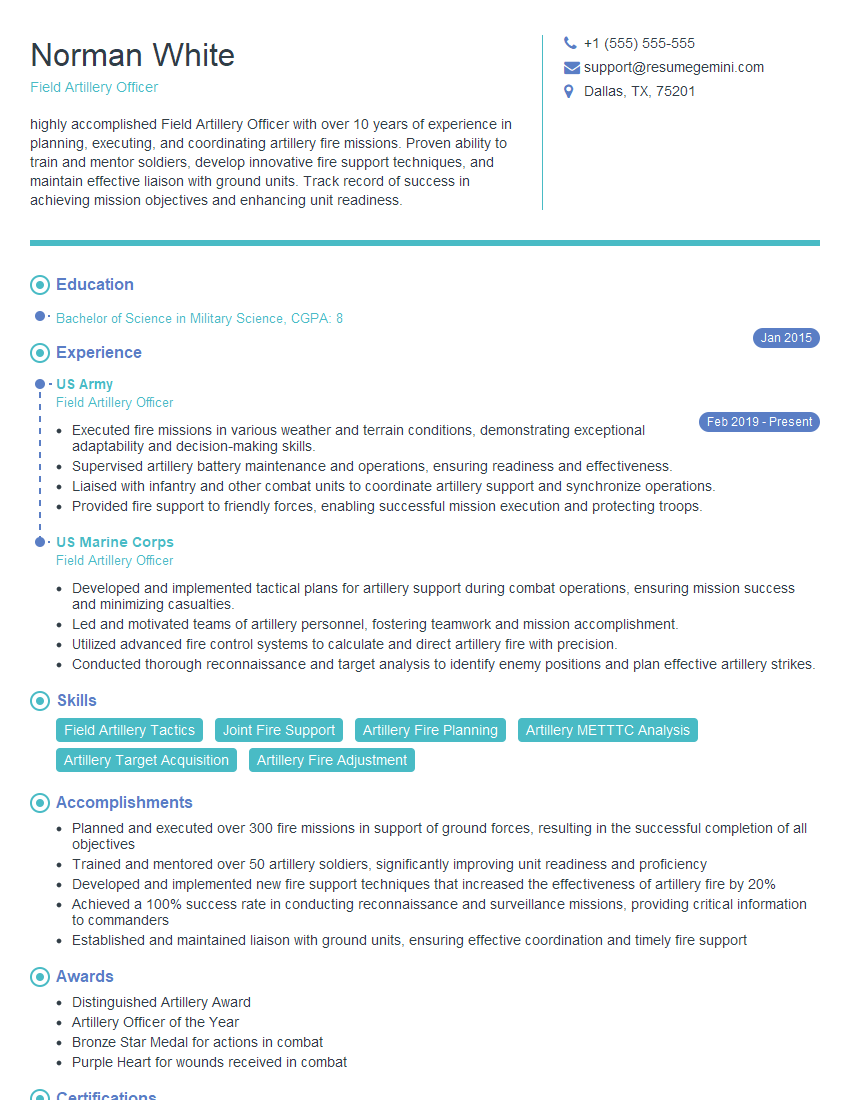
Mastering Artillery Fire Planning is crucial for career advancement in the military and related fields, opening doors to leadership roles and specialized assignments. A strong resume is your key to unlocking these opportunities. Creating an ATS-friendly resume is essential for getting your application noticed by recruiters. ResumeGemini can help you build a compelling and effective resume that highlights your skills and experience in Artillery Fire Planning. We provide examples of resumes tailored specifically to this field to guide you through the process. Invest the time to craft a professional resume—it’s an investment in your future success.
Explore more articles
Users Rating of Our Blogs
Share Your Experience
We value your feedback! Please rate our content and share your thoughts (optional).
What Readers Say About Our Blog
Hello,
we currently offer a complimentary backlink and URL indexing test for search engine optimization professionals.
You can get complimentary indexing credits to test how link discovery works in practice.
No credit card is required and there is no recurring fee.
You can find details here:
https://wikipedia-backlinks.com/indexing/
Regards
NICE RESPONSE TO Q & A
hi
The aim of this message is regarding an unclaimed deposit of a deceased nationale that bears the same name as you. You are not relate to him as there are millions of people answering the names across around the world. But i will use my position to influence the release of the deposit to you for our mutual benefit.
Respond for full details and how to claim the deposit. This is 100% risk free. Send hello to my email id: [email protected]
Luka Chachibaialuka
Hey interviewgemini.com, just wanted to follow up on my last email.
We just launched Call the Monster, an parenting app that lets you summon friendly ‘monsters’ kids actually listen to.
We’re also running a giveaway for everyone who downloads the app. Since it’s brand new, there aren’t many users yet, which means you’ve got a much better chance of winning some great prizes.
You can check it out here: https://bit.ly/callamonsterapp
Or follow us on Instagram: https://www.instagram.com/callamonsterapp
Thanks,
Ryan
CEO – Call the Monster App
Hey interviewgemini.com, I saw your website and love your approach.
I just want this to look like spam email, but want to share something important to you. We just launched Call the Monster, a parenting app that lets you summon friendly ‘monsters’ kids actually listen to.
Parents are loving it for calming chaos before bedtime. Thought you might want to try it: https://bit.ly/callamonsterapp or just follow our fun monster lore on Instagram: https://www.instagram.com/callamonsterapp
Thanks,
Ryan
CEO – Call A Monster APP
To the interviewgemini.com Owner.
Dear interviewgemini.com Webmaster!
Hi interviewgemini.com Webmaster!
Dear interviewgemini.com Webmaster!
excellent
Hello,
We found issues with your domain’s email setup that may be sending your messages to spam or blocking them completely. InboxShield Mini shows you how to fix it in minutes — no tech skills required.
Scan your domain now for details: https://inboxshield-mini.com/
— Adam @ InboxShield Mini
Reply STOP to unsubscribe
Hi, are you owner of interviewgemini.com? What if I told you I could help you find extra time in your schedule, reconnect with leads you didn’t even realize you missed, and bring in more “I want to work with you” conversations, without increasing your ad spend or hiring a full-time employee?
All with a flexible, budget-friendly service that could easily pay for itself. Sounds good?
Would it be nice to jump on a quick 10-minute call so I can show you exactly how we make this work?
Best,
Hapei
Marketing Director
Hey, I know you’re the owner of interviewgemini.com. I’ll be quick.
Fundraising for your business is tough and time-consuming. We make it easier by guaranteeing two private investor meetings each month, for six months. No demos, no pitch events – just direct introductions to active investors matched to your startup.
If youR17;re raising, this could help you build real momentum. Want me to send more info?
Hi, I represent an SEO company that specialises in getting you AI citations and higher rankings on Google. I’d like to offer you a 100% free SEO audit for your website. Would you be interested?
Hi, I represent an SEO company that specialises in getting you AI citations and higher rankings on Google. I’d like to offer you a 100% free SEO audit for your website. Would you be interested?
good