The right preparation can turn an interview into an opportunity to showcase your expertise. This guide to Bike Handling interview questions is your ultimate resource, providing key insights and tips to help you ace your responses and stand out as a top candidate.
Questions Asked in Bike Handling Interview
Q 1. Explain the process of properly inflating bicycle tires.
Proper tire inflation is crucial for optimal bike performance, safety, and tire lifespan. Underinflation leads to increased rolling resistance, making pedaling harder and potentially causing pinch flats. Overinflation can lead to a harsher ride and increased risk of rim damage.
The correct pressure is printed on the tire sidewall, usually in PSI (pounds per square inch) and sometimes in bars. Find your tire’s maximum pressure and your minimum pressure. The ideal pressure will generally fall somewhere in the middle, depending on your weight and riding style. Lighter riders might opt for the lower end of the range, and heavier riders, the higher end.
To Inflate:
- Use a high-quality floor pump for accurate inflation. Hand pumps are less accurate and more strenuous for higher pressures.
- Remove the valve cap and attach the pump head securely to the valve (Presta or Schrader).
- Pump steadily until you reach the desired pressure. Use a gauge to monitor the pressure.
- Once at the desired pressure, remove the pump and replace the valve cap.
Example: My mountain bike tires recommend 30-45 PSI. As a 170lb rider, I choose 40 PSI for a good balance of comfort and efficiency.
Q 2. Describe different types of bicycle brakes and their maintenance.
Bicycle brakes are crucial for safe stopping. There are several types:
- Rim Brakes: These use brake pads that squeeze against the rim of the wheel. They are simple, lightweight, and relatively inexpensive. Maintenance involves regularly cleaning and adjusting the pads, and occasionally replacing the pads when they wear down. You’ll also need to check for proper cable tension.
- Disc Brakes (Mechanical and Hydraulic): These use calipers that squeeze a rotor (disc) attached to the wheel hub. Mechanical disc brakes use cables like rim brakes. Hydraulic disc brakes use fluid pressure for more powerful braking. Maintenance includes periodically checking for fluid levels (hydraulic), bleeding the system if necessary (hydraulic), and occasionally replacing pads.
Maintenance Tips for all brake types:
- Regularly inspect brake pads for wear and tear. Replace them when they become too thin or show significant wear.
- Keep the brake surfaces clean and free from dirt and debris.
- Ensure proper cable tension (for cable-actuated brakes). Loose cables lead to poor braking performance.
- For hydraulic brakes, check fluid levels regularly and bleed the system if necessary. If you are not comfortable with this process, it is best to take your bike to a professional.
Ignoring brake maintenance can lead to dangerous situations. Regular checks are essential for safety.
Q 3. How do you troubleshoot a derailleur that is not shifting correctly?
A derailleur that’s not shifting correctly is a frustrating problem, but often easily solved. The issue usually stems from cable tension, derailleur adjustment, or bent parts.
Troubleshooting Steps:
- Check Cable Tension: Too loose or too tight cables prevent smooth shifting. Adjust the barrel adjuster on the shifter or the cable tension at the derailleur itself. A slight turn of the barrel adjuster can make a significant difference. Too much tension can make shifting difficult or cause the chain to jump.
- Inspect Derailleur Alignment: Ensure the derailleur hanger is straight. A bent hanger is a common cause of shifting problems. If it is bent, it will usually need to be replaced.
- Limit Screw Adjustment: The derailleur has limit screws (high and low). These screws limit the derailleur’s movement to prevent the chain from falling off the cassette or chainrings. Adjust these screws carefully, using small increments to fine-tune the shifting. This requires good understanding of how the derailleur works, and how the screws will affect its movement. Consult your bike’s manual for instructions, or consult a mechanic.
- Clean the Derailleur and Cassette: Dirt and grit can interfere with smooth shifting. Thoroughly clean the derailleur and cassette with a degreaser and brush.
- Check for Bent or Damaged Parts: Inspect the derailleur cage and jockey wheels for damage. Bent or worn jockey wheels can cause poor shifting.
If the problem persists after these steps, a professional bike mechanic might be needed.
Q 4. What are the common causes of flat tires and how to prevent them?
Flat tires are a common cyclist’s woe. They’re mainly caused by punctures from sharp objects (glass, thorns, etc.) or pinch flats (tire being squeezed between the rim and an obstacle).
Common Causes:
- Punctures: Sharp objects embedded in the tire casing.
- Pinch Flats: Happens when the tire is under-inflated and the wheel impacts a pothole or obstacle.
- Wear and tear: Old tires are more prone to punctures.
Prevention:
- Proper Inflation: Keep tires inflated to the recommended pressure. This reduces the chance of pinch flats.
- Regular Inspection: Check tires frequently for embedded objects or excessive wear.
- Tire Liners or Puncture-Resistant Tires: These add an extra layer of protection.
- Careful Riding: Avoid riding over sharp debris or rough terrain whenever possible.
- Regular tire rotations: Rotate your tires regularly to spread the wear evenly.
Prevention is often far easier than repair. Regular checks save time and effort.
Q 5. Explain the process of adjusting bicycle gears.
Adjusting bicycle gears ensures smooth and efficient shifting. Modern bikes usually use indexed shifting systems. This process involves setting up the index shifting so the derailleur correctly moves to each gear.
Gear Adjustment Process:
- Cable Tension: The first step is to adjust the cable tension at the derailleur. A cable tension tool is usually needed for precision adjustment. Fine adjustments usually involve using a barrel adjuster near the shifter.
- Limit Screws: These screws prevent the derailleur from moving too far, ensuring the chain doesn’t fall off the cassette or chainrings. These are adjusted using small increments. Too much adjustment can cause problems. A slight change can make a big difference.
- Index Shifting: Index shifting systems are designed for precision shifting into specific gears. It’s generally not necessary to adjust this system unless you’ve worked on the derailleur or cable.
- Testing: After making any adjustment, always test the gears thoroughly to ensure smooth shifting across the entire range.
If you’re not comfortable working on your derailleur, it’s best to take your bike to a professional mechanic.
Q 6. How do you identify and repair a broken spoke?
A broken spoke is a common issue requiring repair. A spoke tensioning tool, a spoke wrench, and replacement spokes are necessary. Identifying the broken spoke is usually straightforward; the wheel will be noticeably out of true and may not feel solid.
Repair Process:
- Identify the broken spoke: Locate the broken spoke by visual inspection and feel.
- Remove the broken spoke: Use a spoke wrench to carefully unscrew the spoke nipple from the rim.
- Prepare the replacement spoke: Measure the length of the broken spoke and use it to get the correct length replacement.
- Install the new spoke: Insert the new spoke into the hub and thread the nipple onto the rim.
- Tighten the spoke nipple: Use a spoke wrench to carefully tighten the spoke nipple. Don’t over-tighten.
- True the wheel: After replacing the spoke, the wheel will need to be trued, ensuring the wheel is perfectly round and runs true. This requires a wheel truing stand and skill. It is best left to a professional if you lack experience.
Attempting a spoke repair without the necessary tools and knowledge can be risky. A poorly repaired wheel may be unsafe to ride.
Q 7. Describe the different types of bicycle chains and their lubrication needs.
Bicycle chains are usually made of steel, and the most common type is a roller chain, comprised of interlocking plates and rollers.
Types:
- Single-speed Chains: Simpler design with less complexity. These are simpler to maintain.
- Multi-speed Chains: Designed to work with derailleurs and multiple gears. These are more complex and must be compatible with the cassette and chainrings.
Lubrication Needs:
Regular lubrication is essential to extend the lifespan of the chain and maintain smooth shifting. Using the wrong lubricant can damage the chain. A good bicycle chain lubricant, applied frequently, can minimize wear and tear.
Lubrication Process:
- Clean the Chain: Use a degreaser to remove old lubricant and dirt.
- Apply Lubricant: Apply a thin layer of lubricant to the chain’s rollers, and let it soak in.
- Wipe off Excess: Wipe away excess lubricant to prevent attracting dirt.
Neglecting chain lubrication will eventually lead to a damaged chain. Regular maintenance ensures the chain performs well and lasts longer.
Q 8. How do you true a bicycle wheel?
Truing a bicycle wheel involves adjusting the spoke tension to make the rim perfectly round and true, ensuring the wheel runs smoothly and safely. It’s a skill that requires patience and precision.
Here’s a step-by-step process:
- Assessment: Use a truing stand (highly recommended) or carefully rotate the wheel, observing any lateral (side-to-side) or radial (wobble) runout. Note which spokes need adjustment.
- Tools: You’ll need a spoke wrench that fits your spokes. A truing stand significantly simplifies the process.
- Adjusting Spokes: Tightening a spoke pulls the rim towards that spoke. Loosening pushes it away. Make small adjustments (1/4 to 1/2 turn at a time), always working in small increments to avoid over-tightening or damaging spokes.
- Lateral Adjustment: Address side-to-side wobble first. Identify the high spot and tighten the spokes on the opposite side of the rim, a little at a time.
- Radial Adjustment: Once lateral trueness is achieved, focus on radial runout (wobble). Tighten spokes on the high spots of the wobble.
- Re-Assessment: After each adjustment, rotate the wheel to check your progress. Continue making small adjustments until the wheel is true and runs smoothly.
- Stress Relieving: After truing, it’s recommended to gently ride the wheel for a short distance to allow the spokes to settle. Then re-check.
Important Note: If you are not comfortable performing this task yourself, it’s best to take your wheel to a professional bike mechanic. Improper truing can lead to wheel damage or even failure.
Q 9. What are the safety checks you perform before a bike ride?
Safety checks before a bike ride are crucial for preventing accidents. They’re a quick routine I perform before every ride, no matter the distance.
- Tires: Check tire pressure using a gauge. Under-inflated tires increase rolling resistance and risk of punctures. Inspect for cuts or embedded objects.
- Brakes: Test both brakes thoroughly. Ensure they engage firmly and smoothly, stopping the bike quickly and effectively.
- Wheels: Give the wheels a spin and check for any wobble or unusual noises. Listen carefully for any clicking or grinding.
- Quick Release Skewers/Axles: Ensure these are securely fastened to avoid wheel detachment during the ride.
- Gears: Shift through all gears, ensuring smooth transitions. Listen for any unusual noises or resistance.
- Chain: Check the chain for proper lubrication and for any sign of damage or excessive wear.
- Handlebars: Make sure the handlebars are securely fastened and not loose.
- Lights (if applicable): For night riding, ensure lights are functioning and batteries are charged.
- Helmet: Always wear a properly fitted helmet.
- Clothing: Wear clothing appropriate for the weather and visibility.
I treat this pre-ride check as a mini-bike maintenance routine – keeping my bike in top condition prevents unexpected problems during my ride.
Q 10. Explain the importance of regular bicycle maintenance.
Regular bicycle maintenance is critical for safety, performance, and longevity. Neglecting maintenance can lead to component failure, accidents, and costly repairs.
- Safety: Regular checks prevent catastrophic failures like brake cable snapping or wheel disintegration, directly impacting rider safety.
- Performance: A well-maintained bike shifts smoothly, brakes reliably, and runs efficiently, enhancing the overall riding experience. Proper lubrication reduces wear and tear.
- Longevity: Regular cleaning and lubrication extend the life of your bicycle components, saving you money on replacements in the long run.
- Cost-effectiveness: Addressing small issues early often prevents them from becoming major, expensive problems later. A simple chain cleaning is much less costly than a full chain replacement.
I recommend a schedule that includes daily checks (tires, brakes), weekly cleaning and lubrication (chain, derailleurs), and monthly more thorough inspections of components and adjustments (gears, brakes).
Q 11. Describe the different types of bicycle lubricants and their applications.
Bicycle lubricants are crucial for smooth operation and reduced wear. Different lubricants suit different applications and conditions.
- Dry Lubricants (Wax-based): These are ideal for dry, dusty conditions. They attract less dirt than wet lubricants but offer less immediate lubrication and should be applied more often.
- Wet Lubricants (Oil-based): These work better in wet conditions, providing more lubrication and protection against corrosion. They attract more dirt, requiring more frequent cleaning.
- Teflon-based Lubricants: Offer excellent lubrication and water resistance, but can be more expensive.
- Chain Lubricants: Specialized for bicycle chains, designed to penetrate links and reduce friction. Choose based on weather conditions.
- Cable Lubricants: Lubricate brake and gear cables to ensure smooth shifting and braking.
Choosing the right lubricant depends on your riding conditions and personal preferences. Experiment to find what works best for your climate and riding style.
Q 12. How do you diagnose and repair a punctured inner tube?
Diagnosing and repairing a punctured inner tube is a common task for cyclists. It involves finding the puncture, patching or replacing the tube, and reinstalling it.
- Locate the Puncture: Remove the wheel, deflate the tube completely. Submerge the tube in water to find air bubbles escaping, indicating the puncture location.
- Prepare for Repair: Use tire levers (carefully!) to remove the tire from the rim. If using a patch kit, prepare a clean, flat surface for patching. Clean the puncture area with sandpaper included in the kit.
- Apply the Patch: Follow the manufacturer’s instructions for applying the patch, ensuring a good seal. Apply glue and then press down the patch. Give ample time for the glue to set.
- Inflate and Reinstall: Carefully inflate the patched tube, checking for any further leaks. Reinstall the tube into the tire, ensuring it sits correctly in the tire bed. Reinstall the tire onto the rim, making sure the tire bead snaps into the rim channel.
- Reinstall the wheel: Make sure the wheel is properly secured in the frame.
If the puncture is too large or you are struggling with the repair, replacing the tube is the better and safer approach.
Q 13. What are the signs of a worn-out bicycle chain?
A worn-out bicycle chain shows several telltale signs:
- Stiffness: The chain feels stiff and difficult to move, indicating excessive wear and lack of lubrication.
- Rusty Links: Rust formation on the chain links, especially in the roller areas, shows significant deterioration.
- Elongated Links: Carefully measure the chain length – an elongated chain shows that it’s stretched and needs replacement.
- Missing Lubricant: The chain looks dry and dark, meaning it hasn’t been lubricated in a while.
- Noisy Chain: A noisy chain, especially a clicking or grinding sound, implies wear on the chain and/or chainrings or cassette.
Ignoring these signs can lead to premature wear on other drivetrain components (cassette, chainrings), increasing maintenance costs. It is essential to replace a worn chain to maintain efficient shifting and avoid costly damages.
Q 14. How do you adjust bicycle handlebars?
Adjusting bicycle handlebars involves changing their height, reach, or angle to optimize rider comfort and control.
- Handlebar Height: This is typically adjusted by changing the stem height. Loosen the stem bolts and reposition the stem. Tighten the bolts securely after adjustment.
- Handlebar Reach: This is adjusted by swapping out the stem for one with a different length. A shorter stem moves the handlebars closer; a longer stem moves them farther.
- Handlebar Angle: Some handlebars allow for angle adjustment. This typically involves loosening bolts and rotating the bars.
Important Note: Ensure all bolts are securely tightened after any adjustments. Improper tightening can result in handlebar looseness, potentially leading to accidents. If you are not confident, it is recommended that a professional bike mechanic makes any adjustments.
Finding the perfect handlebar position is a personal preference, often determined through trial and error. Consider experimenting with different positions to find what feels most comfortable and gives you the best control.
Q 15. Explain the process of changing a bicycle cassette.
Changing a bicycle cassette involves replacing the cluster of gears on the rear wheel. It’s a crucial maintenance task that impacts shifting performance and overall drivetrain efficiency. Think of it like changing the gears in a car’s transmission – different cassettes offer different gear ratios, suited for varied terrain and riding styles.
- Gather Tools: You’ll need a cassette lockring tool (specific to your cassette type), chain whip, adjustable wrench, and possibly degreaser.
- Remove the Wheel: Take the rear wheel off the bike.
- Remove the Old Cassette: Secure the chain whip to the smallest cog of the cassette and the lockring tool to the lockring. Using the tools together, unscrew the lockring counter-clockwise. Once loose, the cassette should slide off the freehub body.
- Clean the Freehub: Thoroughly clean the freehub body to remove any old grease or debris.
- Install the New Cassette: Carefully slide the new cassette onto the freehub body, ensuring it’s seated correctly. Tighten the lockring clockwise using the lockring tool and chain whip, applying firm, even pressure to avoid damaging the freehub.
- Reinstall the Wheel: Put the wheel back on the bike and check the shifting performance. Fine tuning may be needed to get smooth shifting.
Important Note: Cassette lockring tools are specific to the type of lockring; using the wrong tool can damage both the cassette and the freehub body.
Career Expert Tips:
- Ace those interviews! Prepare effectively by reviewing the Top 50 Most Common Interview Questions on ResumeGemini.
- Navigate your job search with confidence! Explore a wide range of Career Tips on ResumeGemini. Learn about common challenges and recommendations to overcome them.
- Craft the perfect resume! Master the Art of Resume Writing with ResumeGemini’s guide. Showcase your unique qualifications and achievements effectively.
- Don’t miss out on holiday savings! Build your dream resume with ResumeGemini’s ATS optimized templates.
Q 16. What are the common problems with bicycle bottom brackets and how to fix them?
The bottom bracket (BB) is the crucial part connecting the crankset to the frame. Problems arise from wear, damage, or incorrect installation. Common issues include creaking, play (wobble), and stiffness. Think of it as the engine block of your bike, supporting all the power transfer from the pedals.
- Creaking: Often caused by loose components, worn bearings, or a dirty BB. Try tightening the crank arms and BB cup bolts first. If it persists, it indicates a more serious issue requiring a complete BB overhaul or replacement.
- Play/Wobble: This indicates worn bearings or loose BB cups. This compromises pedaling efficiency and creates stress on other components. A new BB is typically the solution.
- Stiffness: Can be due to tight bearings, damaged BB cups, or poor installation. A thorough cleaning and relubrication might help; however, replacement might be necessary.
Fixing the problem involves disassembling the BB, cleaning the components, inspecting for damage, and replacing worn parts or the entire BB depending on the extent of wear and tear. Specialized tools are typically required, the type depending on the BB type (e.g., threaded, press-fit, cartridge). A bike mechanic’s expertise is often beneficial for this repair, especially if you are unfamiliar with the process or dealing with an unusual BB type.
Q 17. How do you assess the condition of bicycle tires?
Assessing tire condition is crucial for safety and performance. Inspecting your tires regularly can prevent flats, improve grip, and enhance your overall riding experience.
- Tread Depth: Check the tread for wear. Worn tires have significantly reduced grip, especially in wet conditions. A penny test (inserting a penny into the tread) can help determine the remaining tread depth. If the top of Lincoln’s head is visible, it’s time for new tires.
- Sidewall Inspection: Check for cuts, cracks, bulges, or embedded objects. These can compromise the structural integrity of the tire and lead to a sudden failure. Any damage should warrant replacement.
- Pressure Check: Ensure your tires are inflated to the recommended pressure (printed on the tire sidewall). Underinflation leads to increased rolling resistance and risk of pinch flats, while overinflation can lead to discomfort and a higher risk of tire failure.
- Visual Inspection: Look for any embedded objects, like glass or thorns. These often only cause problems later so removing them is important preventative maintenance.
For optimal safety and performance, always replace tires when they show significant wear and tear or any signs of damage.
Q 18. Explain the importance of proper bicycle fit.
Proper bicycle fit is paramount for comfort, performance, and injury prevention. An improperly fitted bike can lead to discomfort, pain, and reduced efficiency. It’s like wearing shoes that are too small or too big – it impacts your overall performance and well-being.
A proper fit considers several factors:
- Saddle Height: Incorrect saddle height can cause knee pain and reduced power transfer. A leg extension test can help determine the optimal height.
- Reach and Handlebar Position: Reach affects back and neck posture. An improper reach can cause discomfort and strain. Handlebar height and width also impact rider posture and comfort.
- Frame Size: Selecting the right frame size is vital for comfortable reach and overall body position.
- Cleat Placement (for clipless pedals): Incorrect cleat placement can lead to knee pain and reduced power efficiency.
Professional bike fitting services can provide a detailed assessment and adjustments for optimal comfort and performance. It’s a worthwhile investment for serious cyclists.
Q 19. Describe the different types of bicycle pedals and their compatibility.
Bicycle pedals come in various types, each with different functionalities and compatibility. The choice depends on personal preference and riding style. The two major categories are platform and clipless pedals.
- Platform Pedals: These are the simplest type, with a flat platform for the feet. They are generally compatible with any type of shoe. They offer ease of use and accessibility.
- Clipless Pedals: These pedals engage with special cleats attached to cycling shoes. They offer increased power transfer and efficiency, but require practice to use and disengage safely. There are different cleat systems (e.g., SPD, Look, Shimano-compatible) and you must ensure your pedals and cleats match.
- Hybrid Pedals: Offer a combination of both platforms and clipless interfaces on each side to offer versatility.
Compatibility mainly refers to the cleat system for clipless pedals. Make sure to choose pedals and cleats from the same system (SPD to SPD, Look to Look etc.). Platform pedals are generally compatible with any type of shoe. Consider whether you need a comfortable ride or need the efficiency of clipless pedals when making your choice.
Q 20. How do you identify and repair a broken cable?
Identifying and repairing a broken bicycle cable requires careful attention to detail. The cable is the lifeline of your braking and shifting systems. If a cable breaks, it compromises your bike’s safety and function.
- Identify the Break: Carefully trace the cable to locate the point of failure. It could be a snapped cable, frayed ends, or a disconnected cable housing.
- Gather Tools and Materials: You will need a new cable of appropriate length, cable cutters, housing cutters (if the housing needs replacement), and potentially a cable housing lubricant.
- Remove the Broken Cable: This depends on the location, often requiring careful detachment from the brake or derailleur mechanism.
- Install the New Cable: Feed the new cable through the cable housing or replace the housing entirely as needed. Ensure the cable is properly seated and not frayed or bent.
- Adjust and Test: Once the cable is replaced, adjust the braking or shifting system according to the manufacturer’s instructions or using standard techniques. Test the brakes and gears thoroughly to ensure proper function.
Important: If you’re not comfortable performing this repair, take it to a bike shop. Improper cable installation can affect your braking and shifting performance, compromising safety.
Q 21. What are the safety considerations for working on bicycles?
Safety is paramount when working on bicycles. Ignoring safety precautions can lead to injury. Always prioritize safety when working on bikes.
- Work in a Well-Lit Area: This will help you see what you’re doing and prevent accidents.
- Use Appropriate Tools: Using the wrong tools can damage your bike or cause injury.
- Wear Safety Glasses: This will protect your eyes from flying debris.
- Use Gloves: Gloves protect your hands from grease and sharp objects.
- Secure the Bike: A bike stand or clamps securely support your bike, preventing it from falling and causing injury.
- Dispose of Materials Properly: Dispose of old parts and chemicals in an environmentally friendly manner.
- Be Mindful of Sharp Objects: Many bike parts have sharp edges; handle them with care.
- Consult a Manual or Professional: If unsure, refer to instructions or consult a professional.
By following these safety precautions, you can minimize the risks associated with bike maintenance and repair.
Q 22. Explain the process of cleaning and lubricating a bicycle chain.
Cleaning and lubricating your bike chain is crucial for smooth operation and longevity. Think of it like regular oil changes for a car – neglecting it leads to premature wear and tear. The process involves several steps:
- Cleaning: First, use a degreaser specifically designed for bicycle chains. Apply it generously, allowing it to soak for a few minutes. Then, use a chain cleaning tool (or a rag wrapped around an old toothbrush) to scrub the chain thoroughly, removing all dirt, grime, and old lubricant. Rinse the chain with a solvent like isopropyl alcohol to remove all traces of degreaser.
- Drying: Thoroughly dry the chain with a clean cloth. Moisture can interfere with lubrication and promote rust.
- Lubrication: Apply a high-quality bicycle chain lubricant, ensuring the lubricant penetrates all the links. Less is more; a few drops per link is sufficient. Rotate the pedals as you lubricate to ensure even coverage.
- Wiping Excess: Wipe away any excess lubricant with a clean cloth. Excess lubricant can attract dirt and grime, negating the benefits of lubrication.
Pro Tip: Different lubricants are suited to different conditions (wet, dry). Choose the right one for your riding environment. Regular cleaning, ideally after every muddy ride or every few weeks, will keep your chain running smoothly and extend its lifespan.
Q 23. How do you perform a bicycle wheel alignment?
Wheel alignment, or truing, ensures your wheels run smoothly and safely. A misaligned wheel can cause poor handling, reduced efficiency, and even dangerous wobbles. Here’s how to check and adjust:
- Visual Inspection: Spin the wheel and observe it closely. Look for any noticeable hops or wobbles.
- Trueing Stand (Optional but Recommended): A truing stand holds the wheel securely and allows precise adjustments. If you don’t own one, you can try to true the wheel in the frame, but it’s much harder.
- Using a Truing Tool: Use spoke wrenches to carefully tighten or loosen spokes to correct any lateral or radial deviations. Small adjustments are key; make many tiny adjustments rather than a few large ones.
- Tensioning: Ensure all spokes are relatively equally tensioned. An improperly tensioned spoke can break under stress.
- Testing: After each adjustment, spin the wheel and re-check for alignment. Repeat until the wheel spins true.
Important Note: Truing a wheel requires practice and patience. If you’re unsure, consult a professional bike mechanic. Improper truing can damage your wheel.
Q 24. Describe the different types of bicycle frames and their materials.
Bicycle frames come in various shapes and materials, each impacting the bike’s ride quality, durability, and weight. Some common types include:
- Diamond Frame: The most common type, offering a stiff and efficient ride. Typically made from steel, aluminum, carbon fiber, or titanium.
- Step-Through/Dutch Frame: Designed for ease of mounting and dismounting, typically made from steel or aluminum.
- Cruiser Frame: Characterized by a relaxed geometry, often made from steel.
- Recumbent Frame: The rider sits in a reclined position, requiring a unique frame design, usually made from aluminum or steel.
Materials:
- Steel: Durable and relatively inexpensive, but heavier than other options. Offers a comfortable ride feel.
- Aluminum: Lightweight and stiff, a popular choice for many types of bikes.
- Carbon Fiber: Extremely lightweight and stiff, offering high performance, but typically more expensive.
- Titanium: Extremely strong and lightweight, offering excellent corrosion resistance, but it’s the most expensive option.
The choice of frame type and material depends on the intended use of the bicycle. Road bikes often prioritize lightweight frames (carbon fiber or high-end aluminum), while mountain bikes benefit from durable and robust frames (aluminum or steel).
Q 25. What tools are essential for basic bicycle repair?
Basic bicycle repair requires a modest set of tools. Here’s a list of essentials:
- Set of Allen Wrenches (Hex Keys): For tightening and loosening bolts of various sizes.
- Screwdrivers (Phillips and Flathead): For various screws.
- Adjustable Wrench: For nuts and bolts that don’t fit Allen wrenches.
- Tire Levers: For removing and installing tires.
- Pump: To inflate tires.
- Chain Lubricant: To keep the chain running smoothly.
- Multi-Tool: A compact tool with various wrenches, screwdrivers, and other useful implements.
Having these tools on hand allows you to handle many common repairs and adjustments on your bike, saving you time and money in the long run. Remember safety first – always wear appropriate safety glasses when working on your bike.
Q 26. How do you diagnose and repair a slipping clutch?
A slipping clutch on a bicycle, typically referring to a derailleur clutch mechanism, indicates a problem with the mechanism’s ability to keep the chain securely on the cassette under load. This usually results in chain skipping or dropping.
- Diagnosis: The most common reason is simply a clutch that needs to be tightened. Look for a small adjustment knob or dial on the derailleur usually labeled “clutch.”
- Repair: Tighten this dial until the slipping stops. If the clutch is already fully tightened and the chain is still slipping, it suggests a potential issue with the clutch mechanism itself, requiring a closer inspection. This could involve worn clutch components or a misalignment. A professional mechanic may need to adjust or replace parts.
Note: If the problem persists despite proper adjustment, it could indicate other problems such as a worn or damaged cassette, chain, or derailleur hanger. Examine these parts carefully for wear and tear.
Q 27. Explain the different types of bicycle headsets and their adjustments.
Bicycle headsets are the bearings that allow the fork to rotate smoothly within the head tube. There are mainly two types:
- Threaded Headset: A traditional design where the headset cups screw into the frame. Adjustment is simple, usually involving tightening the top cap to adjust the headset’s preload.
- Threadless Headset: A more modern design using a compression bolt or clamp to secure the fork. Adjustment is done by loosening the top cap and adjusting the compression bolt to achieve the correct amount of preload. If done incorrectly, you can bind the headset and lead to poor steering performance or even damage your fork.
Adjustment: In both cases, the goal is to achieve a balance between smooth rotation and sufficient stiffness. Too loose, and the headset will feel sloppy; too tight, and it will feel stiff and difficult to turn. Proper adjustment ensures smooth steering and prevents premature wear on the headset bearings.
Q 28. What are the signs of a worn-out bicycle brake pad?
Worn-out brake pads are a significant safety concern. Here’s how to identify them:
- Reduced Thickness: The most obvious sign. Measure your pads against the manufacturer’s minimum thickness specification and replace them if they’re too thin. A good rule of thumb is to replace them when they are about half their original thickness.
- Glazed Surface: Overheating can cause the braking surface to become glassy and slick. These pads are no longer very effective at braking and must be replaced.
- Excessive Noise: Squealing or grinding noises during braking indicate that the pads have worn down.
- Reduced Braking Performance: If you notice your brakes take longer to stop or feel less effective, it’s time for new pads.
Safety First: Worn brake pads significantly reduce braking power, leading to dangerous situations. Always replace them promptly when signs of wear appear.
Key Topics to Learn for Your Bike Handling Interview
- Bicycle Mechanics and Maintenance: Understanding basic bicycle components, common malfunctions, and preventative maintenance procedures. This includes tire changes, brake adjustments, and derailleur tuning.
- Safe Riding Techniques: Mastering fundamental riding skills such as braking, cornering, and shifting gears smoothly and efficiently. Consider how to adapt these techniques to various terrain and weather conditions.
- Bicycle Handling in Different Environments: Discuss experience with riding on various surfaces (pavement, gravel, trails), in different weather conditions (rain, wind), and navigating obstacles (traffic, pedestrians).
- Troubleshooting and Repair: Demonstrate your ability to diagnose and solve common bike problems on the spot. Be ready to discuss your problem-solving approach and relevant experience.
- Safety Regulations and Procedures: Knowledge of relevant safety regulations, including traffic laws and best practices for safe riding. This demonstrates a commitment to safety and responsibility.
- Communication and Teamwork: If the role involves guiding others, be prepared to discuss your communication and teamwork skills in a group riding context. How do you effectively communicate instructions or collaborate with others to achieve a common goal?
Next Steps
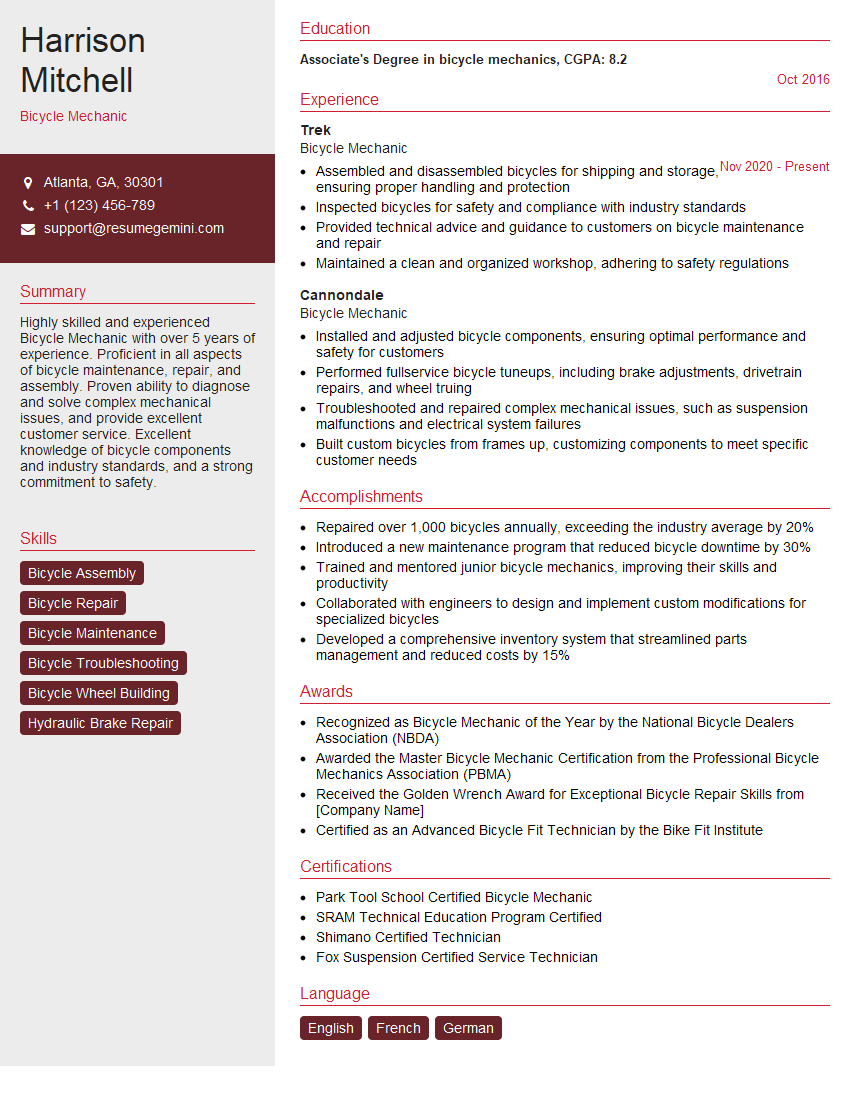
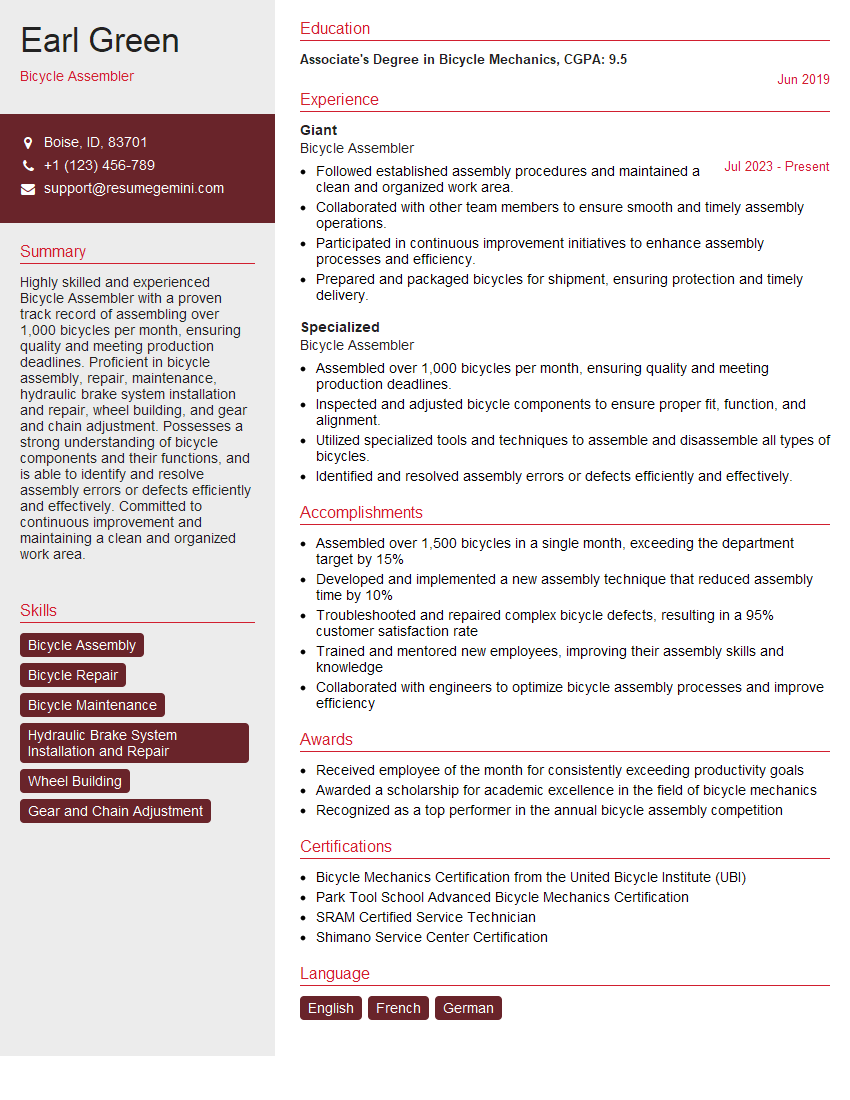
Mastering bike handling skills opens doors to exciting career opportunities in industries ranging from cycling tourism to bike repair and maintenance. A strong understanding of these principles is crucial for showcasing your expertise and landing your dream job. To maximize your job prospects, create a compelling and ATS-friendly resume that highlights your skills and experience effectively. ResumeGemini is a trusted resource for building professional resumes that stand out. We provide examples of resumes tailored to Bike Handling to help you create a winning application. Take the next step towards your career success today!


Explore more articles
Users Rating of Our Blogs
Share Your Experience
We value your feedback! Please rate our content and share your thoughts (optional).
What Readers Say About Our Blog
Attention music lovers!
Wow, All the best Sax Summer music !!!
Spotify: https://open.spotify.com/artist/6ShcdIT7rPVVaFEpgZQbUk
Apple Music: https://music.apple.com/fr/artist/jimmy-sax-black/1530501936
YouTube: https://music.youtube.com/browse/VLOLAK5uy_noClmC7abM6YpZsnySxRqt3LoalPf88No
Other Platforms and Free Downloads : https://fanlink.tv/jimmysaxblack
on google : https://www.google.com/search?q=22+AND+22+AND+22
on ChatGPT : https://chat.openai.com?q=who20jlJimmy20Black20Sax20Producer
Get back into the groove with Jimmy sax Black
Best regards,
Jimmy sax Black
www.jimmysaxblack.com
Hi I am a troller at The aquatic interview center and I suddenly went so fast in Roblox and it was gone when I reset.
Hi,
Business owners spend hours every week worrying about their website—or avoiding it because it feels overwhelming.
We’d like to take that off your plate:
$69/month. Everything handled.
Our team will:
Design a custom website—or completely overhaul your current one
Take care of hosting as an option
Handle edits and improvements—up to 60 minutes of work included every month
No setup fees, no annual commitments. Just a site that makes a strong first impression.
Find out if it’s right for you:
https://websolutionsgenius.com/awardwinningwebsites
Hello,
we currently offer a complimentary backlink and URL indexing test for search engine optimization professionals.
You can get complimentary indexing credits to test how link discovery works in practice.
No credit card is required and there is no recurring fee.
You can find details here:
https://wikipedia-backlinks.com/indexing/
Regards
NICE RESPONSE TO Q & A
hi
The aim of this message is regarding an unclaimed deposit of a deceased nationale that bears the same name as you. You are not relate to him as there are millions of people answering the names across around the world. But i will use my position to influence the release of the deposit to you for our mutual benefit.
Respond for full details and how to claim the deposit. This is 100% risk free. Send hello to my email id: [email protected]
Luka Chachibaialuka
Hey interviewgemini.com, just wanted to follow up on my last email.
We just launched Call the Monster, an parenting app that lets you summon friendly ‘monsters’ kids actually listen to.
We’re also running a giveaway for everyone who downloads the app. Since it’s brand new, there aren’t many users yet, which means you’ve got a much better chance of winning some great prizes.
You can check it out here: https://bit.ly/callamonsterapp
Or follow us on Instagram: https://www.instagram.com/callamonsterapp
Thanks,
Ryan
CEO – Call the Monster App
Hey interviewgemini.com, I saw your website and love your approach.
I just want this to look like spam email, but want to share something important to you. We just launched Call the Monster, a parenting app that lets you summon friendly ‘monsters’ kids actually listen to.
Parents are loving it for calming chaos before bedtime. Thought you might want to try it: https://bit.ly/callamonsterapp or just follow our fun monster lore on Instagram: https://www.instagram.com/callamonsterapp
Thanks,
Ryan
CEO – Call A Monster APP
To the interviewgemini.com Owner.
Dear interviewgemini.com Webmaster!
Hi interviewgemini.com Webmaster!
Dear interviewgemini.com Webmaster!
excellent
Hello,
We found issues with your domain’s email setup that may be sending your messages to spam or blocking them completely. InboxShield Mini shows you how to fix it in minutes — no tech skills required.
Scan your domain now for details: https://inboxshield-mini.com/
— Adam @ InboxShield Mini
Reply STOP to unsubscribe
Hi, are you owner of interviewgemini.com? What if I told you I could help you find extra time in your schedule, reconnect with leads you didn’t even realize you missed, and bring in more “I want to work with you” conversations, without increasing your ad spend or hiring a full-time employee?
All with a flexible, budget-friendly service that could easily pay for itself. Sounds good?
Would it be nice to jump on a quick 10-minute call so I can show you exactly how we make this work?
Best,
Hapei
Marketing Director
Hey, I know you’re the owner of interviewgemini.com. I’ll be quick.
Fundraising for your business is tough and time-consuming. We make it easier by guaranteeing two private investor meetings each month, for six months. No demos, no pitch events – just direct introductions to active investors matched to your startup.
If youR17;re raising, this could help you build real momentum. Want me to send more info?
Hi, I represent an SEO company that specialises in getting you AI citations and higher rankings on Google. I’d like to offer you a 100% free SEO audit for your website. Would you be interested?
Hi, I represent an SEO company that specialises in getting you AI citations and higher rankings on Google. I’d like to offer you a 100% free SEO audit for your website. Would you be interested?