The right preparation can turn an interview into an opportunity to showcase your expertise. This guide to Boat Engine Overhaul interview questions is your ultimate resource, providing key insights and tips to help you ace your responses and stand out as a top candidate.
Questions Asked in Boat Engine Overhaul Interview
Q 1. Describe the process of a complete outboard engine overhaul.
A complete outboard engine overhaul is a comprehensive process involving a meticulous disassembly, inspection, cleaning, repair, and reassembly of all engine components. Think of it like giving your engine a thorough medical checkup and a complete body makeover. It’s far more extensive than routine maintenance.
- Disassembly: This involves carefully removing all components, from the carburetor and fuel system to the powerhead, lower unit, and even internal parts like pistons and crankshaft. Each part is tagged and documented for correct reassembly.
- Inspection and Cleaning: Every part is thoroughly inspected for wear, tear, corrosion, or damage. This involves careful visual checks, measurements with precision instruments (like calipers and micrometers), and potentially non-destructive testing for cracks or internal damage. All parts are meticulously cleaned using appropriate solvents and techniques.
- Repair and Replacement: Worn or damaged parts are replaced with genuine OEM or high-quality replacement parts. This might include new pistons, rings, bearings, seals, gaskets, and more. Any necessary machining or repair work (e.g., cylinder honing, crankshaft grinding) is performed by a qualified technician.
- Reassembly: The engine is reassembled following the manufacturer’s specifications. This requires precise attention to detail and torque specifications to ensure proper function and prevent damage. New gaskets and seals are crucial to prevent leaks.
- Testing and Commissioning: Once reassembled, the engine undergoes rigorous testing to ensure proper compression, lubrication, and cooling. This often includes a dynamometer test to evaluate performance.
For example, during an overhaul of a two-stroke outboard, I once discovered a severely corroded crankshaft bearing. Replacing it was crucial to prevent catastrophic engine failure. The entire process took several days, highlighting the intensive nature of a complete overhaul.
Q 2. Explain the function of a marine engine’s cooling system.
A marine engine’s cooling system is vital for preventing overheating, which can lead to severe damage or failure. It’s designed to dissipate the considerable heat generated during combustion. Most marine engines use a closed-loop cooling system, meaning coolant circulates within a confined system, rather than relying directly on seawater.
- Coolant Circulation: A water pump circulates coolant (often a mixture of antifreeze and water) through the engine block and cylinder head, absorbing heat.
- Heat Exchanger: The heated coolant then passes through a heat exchanger (often a raw-water-cooled unit), where it transfers heat to the surrounding seawater. This is a crucial step, as it prevents the hot coolant from damaging other engine components.
- Thermostat: A thermostat regulates coolant flow, ensuring the engine reaches optimal operating temperature efficiently. It opens once the engine reaches a specific temperature.
- Raw Water Pump: A raw-water pump draws seawater through the heat exchanger, carrying away the heat absorbed by the coolant.
- Pressure Relief Valve: Prevents excessive pressure buildup within the cooling system.
Imagine the cooling system as a radiator in a car, but with the crucial addition of the raw-water system to exchange heat with the ocean, protecting the engine from the corrosive effects of salt water.
Q 3. How do you diagnose a loss of compression in a diesel marine engine?
Diagnosing a loss of compression in a diesel marine engine requires a systematic approach. Compression loss indicates a problem preventing the cylinder from building adequate pressure during the combustion stroke. This can lead to reduced power, difficult starting, and excessive smoke.
- Compression Test: The most crucial step is a compression test. This involves using a compression gauge to measure the pressure in each cylinder. Low readings in one or more cylinders pinpoint the problem areas. A significant difference in readings between cylinders further aids in identifying the problem.
- Leakdown Test: A leakdown test complements the compression test. It involves pressurizing the cylinder and listening for air escaping. This helps pinpoint the source of the leak (e.g., past piston rings, valves, or head gasket).
- Visual Inspection: Inspecting the engine for external leaks, cracked components, or signs of damage can give further clues.
- Cylinder Condition: Check for scoring, wear, or damage to the cylinder walls. Use a borescope for a thorough internal inspection.
- Valve Inspection: Examine the valves for wear, sticking, or improper seating. This might require removing the cylinder head.
For example, a consistently low compression reading in one cylinder might indicate worn piston rings, requiring their replacement. A leakdown test might confirm this by revealing air escaping past the piston rings.
Q 4. What are the common causes of overheating in a boat engine?
Overheating in a boat engine is a serious issue that can cause significant damage. Several factors can contribute to this problem.
- Cooling System Problems: A clogged heat exchanger, faulty water pump, malfunctioning thermostat, or insufficient raw-water flow are common culprits. These prevent the engine from effectively dissipating heat.
- Low Coolant Levels: Low coolant levels reduce the system’s capacity to absorb heat, leading to overheating. Regular checks are crucial.
- Exhaust System Blockage: A restricted exhaust system can hinder the dissipation of heat from the engine.
- Faulty Thermostat: A stuck-closed thermostat prevents coolant from circulating properly.
- Improper Antifreeze Mix: Using the wrong antifreeze mixture or neglecting to use it can lead to corrosion and reduced cooling efficiency.
- Heavy Load and High RPM: Operating the engine under heavy load at high RPMs for extended periods generates more heat than the cooling system can handle.
I once encountered a case where a boat experienced overheating due to a small piece of seaweed clogging the raw-water intake. A simple cleaning resolved the problem; highlighting the importance of regular maintenance.
Q 5. Describe the steps involved in replacing a marine engine fuel pump.
Replacing a marine engine fuel pump is a relatively straightforward process, but requires careful attention to detail to prevent leaks and ensure proper function. The steps involved typically include:
- Disconnect the Fuel Lines: Carefully disconnect the fuel supply and return lines from the fuel pump, using appropriate tools and taking precautions to avoid spills.
- Remove the Fuel Pump: Depending on the engine and fuel pump design, this may involve removing bolts, clamps, or other fasteners. Note the location and orientation of the fuel pump for accurate reinstallation.
- Install the New Fuel Pump: Mount the new fuel pump in the same position and orientation as the old one. Ensure it is securely fastened.
- Reconnect the Fuel Lines: Reconnect the fuel supply and return lines, making sure they are securely attached and free of leaks.
- Prime the Fuel System: Before starting the engine, prime the fuel system to ensure the new pump is functioning correctly and the fuel lines are filled. This may involve using a manual primer bulb or a similar method.
- Inspect for Leaks: Once the engine is running, inspect the fuel pump and connections for any signs of fuel leaks.
Always remember to follow the manufacturer’s instructions for your specific engine model. Using the wrong type of fuel pump or improper installation can lead to engine damage.
Q 6. How do you troubleshoot a problem with a boat’s electrical system affecting the engine?
Troubleshooting electrical problems affecting a boat engine requires a systematic approach, combining visual inspection, testing, and diagnostic tools.
- Visual Inspection: Start by visually inspecting all wiring, connections, and components for any obvious signs of damage, corrosion, or loose connections. Pay special attention to the battery connections, starter motor wiring, and alternator.
- Voltage Testing: Use a multimeter to check the battery voltage, alternator output voltage, and voltage at various points in the electrical system. Low battery voltage or lack of alternator output can indicate the source of the problem.
- Continuity Testing: Test the continuity of various circuits to ensure there are no breaks in the wiring. This helps pinpoint any broken wires or faulty switches.
- Component Testing: Test individual components, such as the starter motor, alternator, and ignition switch, using appropriate procedures and tools.
- Wiring Diagrams: Refer to the boat’s electrical wiring diagrams for troubleshooting. These diagrams show how the components are connected, facilitating tracing the problem.
For example, a boat failing to start could result from a bad battery connection, a faulty starter solenoid, or a problem with the ignition switch. Systematic testing can pinpoint the faulty component.
Q 7. Explain the difference between two-stroke and four-stroke outboard motors.
Two-stroke and four-stroke outboard motors differ significantly in their combustion cycles and operational characteristics.
- Combustion Cycle: A two-stroke engine completes a power stroke with every two strokes of the piston, while a four-stroke engine requires four strokes. This means that a two-stroke engine produces power more frequently but with less power per cycle. A four-stroke provides smoother operation and more power.
- Lubrication: Two-stroke engines typically mix oil directly with the fuel, while four-stroke engines have a separate lubrication system with an oil sump and pump.
- Efficiency: Four-stroke engines are generally more fuel-efficient and produce less emissions than two-stroke engines.
- Maintenance: Four-stroke engines generally require more complex maintenance, such as oil changes, than two-stroke engines.
- Complexity: Four-stroke engines have more complex internal components compared to two-stroke engines.
- Sound and Vibration: Four-stroke engines generally run quieter and smoother than two-stroke engines.
Think of it this way: a two-stroke engine is like a simpler, less efficient, but more immediate engine. A four-stroke engine is like a more refined, fuel-efficient car engine – more power and smoother operation.
Q 8. What are the safety precautions you take when working on a boat engine?
Safety is paramount when working on a boat engine. Think of it like this: you’re dealing with potentially dangerous substances like fuel, oil, and battery acid, along with powerful moving parts. Before even touching the engine, disconnect the battery’s negative terminal to prevent accidental shorts. Always work in a well-ventilated area, as fumes from gasoline or diesel fuel are highly flammable and toxic. Wear appropriate personal protective equipment (PPE), including safety glasses, gloves, and closed-toe shoes. If you’re working with pressurized systems, relieve the pressure before disconnecting any lines to avoid injury from sudden releases. Never work alone; have a buddy nearby in case of emergencies. Finally, consult the engine’s service manual for specific safety precautions related to your particular model.
- Disconnect the battery: This prevents electrical shocks and accidental starting.
- Ventilation is key: Work in open air or a well-ventilated space.
- PPE is essential: Protect yourself with safety glasses, gloves, and sturdy footwear.
- Pressure relief: Release pressure from systems before disconnecting lines.
- Buddy system: Never work alone.
Q 9. How do you inspect and maintain a marine engine’s propeller?
Propeller inspection and maintenance are crucial for safety and performance. A damaged propeller can not only reduce efficiency but also pose a significant hazard. Start by visually inspecting the propeller for any damage, such as nicks, bends, or cracks. Check for corrosion, especially in saltwater environments. Pay close attention to the leading edge of the blades, as this is the area that typically experiences the most wear and tear. If you find any damage, you may need to replace or repair the propeller, depending on the severity. Regular cleaning is also essential; remove any marine growth or debris that can accumulate on the propeller. Finally, ensure that the propeller nut is properly tightened and secured to prevent loosening and potential loss of the propeller while underway.
- Visual inspection: Check for nicks, bends, cracks, and corrosion.
- Clean regularly: Remove marine growth and debris.
- Secure nut: Ensure the propeller nut is tightly fastened.
Q 10. Describe the process of replacing a sterndrive bellows.
Replacing a sterndrive bellows is a critical maintenance task to prevent water ingress into the engine compartment. This is a job best left to experienced mechanics, but understanding the process is helpful. First, disconnect the battery. Support the engine properly and disconnect the bellows from the gimbal housing and the outdrive. Carefully remove the old bellows, noting its orientation and any clamps or hose connections. Install the new bellows, ensuring it’s properly seated and oriented. Reconnect all components, paying close attention to the alignment of the bellows to the gimbal housing. Before re-starting the engine, check for leaks by running a hose around the bellows while observing for any water leakage. This process requires specific tools and a good understanding of sterndrive mechanics.
- Disconnect battery: Essential safety precaution.
- Remove old bellows: Carefully note orientation and connections.
- Install new bellows: Ensure correct orientation and seating.
- Reconnect components: Carefully reattach all parts.
- Leak test: Check for water leaks before restarting engine.
Q 11. Explain how to properly adjust the valve clearances in a marine diesel engine.
Valve clearance adjustment is crucial for optimal performance and longevity of a marine diesel engine. Incorrect clearances lead to poor combustion, reduced power, and potential damage. This process usually involves using feeler gauges to measure the gap between the valve stem and the rocker arm when the valve is fully closed. The engine’s service manual will specify the correct clearances for your engine. You’ll typically need to loosen the rocker arm adjusting nuts, insert the feeler gauge to check the clearance, and then adjust the nuts until the specified clearance is achieved. After making the adjustments, re-check the clearances to ensure accuracy. This job requires precision and a firm understanding of diesel engine mechanics.
- Consult service manual: Find the correct valve clearance specifications for your engine.
- Use feeler gauges: Accurately measure the valve clearance.
- Adjust rocker arm nuts: Adjust the nuts to achieve the correct clearance.
- Recheck clearances: Verify the adjustments for accuracy.
Q 12. How do you identify and resolve a problem with a marine engine’s carburetor?
Carburetor problems are common in older marine engines and can manifest in various ways, such as poor starting, rough running, or lack of power. Troubleshooting begins with a visual inspection – check for fuel leaks, clogged jets, or damaged parts. Often, a simple cleaning can resolve many issues. Use carburetor cleaner to spray out any debris. If the problem persists, you might need to check the float level, as an incorrect level can affect fuel delivery. A faulty choke can also cause starting problems. Testing for proper spark and fuel delivery is crucial to pinpoint the exact cause. Remember, carburetor repair requires specialized knowledge and tools. If you’re not comfortable, seek professional help.
- Visual inspection: Look for fuel leaks, debris, and damaged parts.
- Cleaning: Use carburetor cleaner to remove debris.
- Float level check: Ensure the float level is correct.
- Choke operation: Check the choke for proper function.
- Spark and fuel tests: Verify proper spark and fuel delivery.
Q 13. What tools and equipment are essential for a boat engine overhaul?
Overhauling a boat engine requires a comprehensive set of tools. You’ll need basic hand tools like wrenches, screwdrivers, and pliers, along with specialized tools depending on the engine type. A torque wrench is vital for ensuring proper tightening of bolts to prevent damage. Engine stands and hoists are often necessary for easier access and removal of components. A complete set of feeler gauges is essential for valve clearance adjustments. Specialized tools for specific tasks, such as propeller pullers, injector removal tools, and fuel system pressure testers, may also be needed. Remember that safety equipment is critical: safety glasses, gloves, and a well-ventilated workspace are always necessary.
- Basic hand tools: Wrenches, screwdrivers, pliers.
- Torque wrench: Crucial for precise tightening.
- Engine stand and hoist: For easier component access and removal.
- Feeler gauges: For valve clearance adjustments.
- Specialized tools: Propeller pullers, injector removal tools, etc.
- Safety equipment: Safety glasses, gloves, and a well-ventilated workspace.
Q 14. What are the common types of marine engine lubricants and their applications?
Marine engine lubricants are specifically formulated to withstand the harsh conditions of marine environments, including saltwater corrosion and high temperatures. Common types include: Two-stroke oil: Used in two-stroke outboard motors, it’s mixed with fuel for lubrication. Four-stroke oil: Used in four-stroke outboard and inboard engines, it lubricates the engine’s moving parts. Gear oil: Lubricates gearboxes and sterndrives. Grease: Used for lubricating various components, reducing friction and wear. The choice of lubricant depends on the engine type, operating conditions, and manufacturer recommendations. Always consult your engine’s manual for the correct lubricant specifications. Using the wrong lubricant can lead to reduced engine life and potential damage.
- Two-stroke oil: Mixed with fuel for lubrication in two-stroke engines.
- Four-stroke oil: Lubricates internal components in four-stroke engines.
- Gear oil: Lubricates gearboxes and sterndrives.
- Grease: Reduces friction and wear on various components.
Q 15. How do you identify and repair cracks in a marine engine block?
Identifying cracks in a marine engine block is crucial for preventing catastrophic engine failure. We typically use a combination of visual inspection and more advanced techniques. A thorough visual inspection, often with a magnifying glass and strong light, can reveal surface cracks. However, many cracks are hidden. Dye penetrant testing is a common method; a dye is applied to the surface, drawn into cracks, and then a developer reveals the cracks. Magnetic particle inspection is another useful technique, especially for detecting subsurface cracks in ferrous metals. This involves magnetizing the block and applying magnetic particles; cracks disrupt the magnetic field, causing the particles to accumulate, indicating the crack’s location. Repairing cracks depends on their severity and location. Small, surface cracks might be repaired by welding, but this requires expertise to avoid warping the block. Larger or deeper cracks often necessitate more extensive repairs, potentially including specialized welding techniques, sleeving, or, as a last resort, block replacement. Remember, safety is paramount. Always disconnect the battery before starting any repair work.
For example, I once worked on a diesel engine where dye penetrant testing revealed a hairline crack near a critical coolant passage. We carefully welded the crack, ensuring proper preheating and post-weld cooling to prevent distortion. Subsequent pressure testing verified the repair’s success.
Career Expert Tips:
- Ace those interviews! Prepare effectively by reviewing the Top 50 Most Common Interview Questions on ResumeGemini.
- Navigate your job search with confidence! Explore a wide range of Career Tips on ResumeGemini. Learn about common challenges and recommendations to overcome them.
- Craft the perfect resume! Master the Art of Resume Writing with ResumeGemini’s guide. Showcase your unique qualifications and achievements effectively.
- Don’t miss out on holiday savings! Build your dream resume with ResumeGemini’s ATS optimized templates.
Q 16. Describe the procedure for balancing a marine engine propeller.
Balancing a marine engine propeller is essential for smooth operation, reduced vibration, and extended lifespan. An unbalanced propeller generates vibrations that can damage the engine mounts, shaft, and even the hull. The process typically involves using a propeller balancing machine. This machine spins the propeller and measures its vibration. The machine identifies the areas of imbalance, usually indicated by high vibration points. Small weights are then carefully added to the propeller’s blades at specific locations to counteract the imbalance. The process is iterative; the propeller is rebalanced until the vibration is minimized to acceptable levels. Improper balancing can lead to excessive vibration and premature component wear. Imagine trying to ride a bicycle with a wobbly wheel – that’s similar to the effect of an unbalanced propeller.
In a real-world scenario, I once balanced a propeller for a large fishing boat. The initial imbalance was significant, causing noticeable vibrations throughout the vessel. After a careful balancing procedure, the vibrations were virtually eliminated, resulting in a smoother, quieter ride and a happy client.
Q 17. Explain the importance of proper engine alignment in a boat.
Proper engine alignment in a boat is crucial for smooth operation, reduced wear, and preventing premature component failure. Misalignment puts extra stress on the engine, transmission, and shaft, leading to increased vibration, overheating, and potential damage to seals and bearings. Think of it like trying to force two misaligned pipes together – it creates friction and stress. Alignment is achieved through precise measurements and adjustments of the engine mounts and the shaft alignment. Laser alignment tools are frequently used to ensure precise alignment, minimizing the angular and axial misalignment between the engine’s output shaft and the propeller shaft. This process involves checking the alignment at various points along the drivetrain and making adjustments to ensure everything is perfectly in line. Failure to properly align the engine can cause significant damage and costly repairs.
In my experience, I’ve seen boats with improperly aligned engines experience excessive vibration, leading to premature failure of bearings and seals. Correcting the alignment dramatically improved the boat’s performance and longevity.
Q 18. How do you troubleshoot a problem with a marine engine’s starting system?
Troubleshooting a marine engine starting system involves a systematic approach. First, check the battery voltage; a low voltage can prevent the starter motor from engaging. Next, inspect the battery cables for corrosion or loose connections. A corroded connection can hinder current flow. Test the starter motor itself; a faulty starter might be clicking but not cranking the engine. Then, examine the starter solenoid; this is an electromagnetic switch that activates the starter motor. A faulty solenoid will prevent the starter from engaging. Finally, check the ignition system, ensuring that it’s delivering sufficient power to the starter motor. A weak ignition system could also prevent the engine from starting. Often, using a multimeter to measure voltage and current at various points in the starting circuit can pinpoint the problem.
For example, I once encountered a boat with a starting problem. Initial checks revealed good battery voltage. However, further investigation discovered a loose connection at the starter motor cable, causing a voltage drop and preventing the engine from starting. Tightening the connection resolved the issue.
Q 19. What are the common causes of excessive engine noise?
Excessive engine noise in a marine engine can have several causes. Loose engine mounts can cause noticeable vibrations and noise. Worn bearings in the engine or transmission will generate characteristic noises, often a rumbling or grinding sound. Problems with the propeller, such as an imbalance or damage, will also create noise. A failing exhaust system, with leaks or obstructions, can lead to increased noise. Low oil levels or low oil pressure can also cause unusual noises as components rub against each other. Internal engine problems, such as piston slap or connecting rod issues, are more serious causes of engine noise and require immediate attention.
A rumbling noise, for instance, might point towards a bearing issue, while a high-pitched squeal could suggest a belt problem. Careful listening and observation are key to identifying the source of the noise.
Q 20. How do you diagnose and repair a leak in a marine engine’s exhaust system?
Diagnosing and repairing a leak in a marine engine’s exhaust system begins with locating the leak. This often involves visual inspection, carefully checking all joints, hoses, and the exhaust manifold for any signs of leakage, including water stains or escaping exhaust gases. Pressure testing the exhaust system can help pinpoint leaks that aren’t immediately obvious. Once the leak is located, the repair method depends on the cause. A small leak in a hose might be fixed with a clamp or hose replacement. Larger leaks or cracks in the exhaust manifold may require welding or even manifold replacement. Remember that exhaust systems operate under pressure and high temperatures; proper safety precautions, including using appropriate protective gear, are essential. Ignoring exhaust leaks can lead to dangerous carbon monoxide buildup, and the resulting corrosion can damage other engine components.
I recall a situation where a boat owner reported an exhaust leak. After a thorough inspection, we found a corroded section in the exhaust riser. Replacing the riser eliminated the leak and prevented further damage.
Q 21. Explain the function of a marine engine’s fuel injector system.
A marine engine’s fuel injector system is responsible for delivering precisely measured amounts of fuel to the engine’s cylinders. In modern marine engines, this is typically achieved through electronic fuel injectors, controlled by an engine control unit (ECU). The ECU monitors various engine parameters, such as engine speed, load, and air intake, to determine the optimal amount of fuel needed for each cylinder. The fuel injectors then atomize the fuel, creating a fine spray that mixes with the air for efficient combustion. The precise control provided by electronic fuel injection systems improves fuel efficiency, reduces emissions, and enhances engine performance. Malfunctioning fuel injectors can lead to rough running, poor fuel economy, and increased emissions. Diagnosing injector problems usually involves using specialized diagnostic tools to check fuel pressure, injector pulse width, and fuel flow.
Imagine a perfectly functioning fuel injector system like a precise water sprinkler system, evenly distributing water (fuel) to each section of a garden (cylinder). If any part of the system is faulty, the whole garden won’t receive the right amount of water, leading to poor growth (engine performance).
Q 22. Describe the process of replacing a marine engine’s water pump impeller.
Replacing a marine engine’s water pump impeller is a crucial maintenance task that prevents overheating and engine damage. Think of the impeller as the heart of the cooling system, pumping coolant through the engine. Failure leads to catastrophic engine failure. The process typically involves these steps:
- Preparation: Disconnect the battery’s negative terminal for safety. Drain the cooling system to minimize spillage.
- Access: Locate the water pump; this varies greatly depending on the engine model. Often, it’s near the engine’s front. You might need to remove belts, hoses, or other components for access.
- Removal: Carefully remove the pump housing cover, usually secured by screws or clamps. The old impeller will be visible within the housing.
- Impeller Replacement: Remove the old impeller, noting its orientation. Install the new impeller, ensuring it’s correctly seated and oriented – improper installation can lead to pump failure.
- Reassembly: Reinstall the pump housing cover, ensuring a proper seal. Reconnect any hoses or belts that were removed.
- Testing: Reconnect the battery and carefully run the engine, checking for leaks and verifying proper coolant flow.
Example: On a MerCruiser engine, accessing the impeller often requires removing the raw water intake hose and possibly the engine’s front cover.
Q 23. How do you interpret a marine engine’s performance data?
Interpreting marine engine performance data involves analyzing various parameters to assess its health and efficiency. Key data points include:
- Engine Temperature: Consistently high temperatures indicate cooling system issues, possibly a faulty impeller or thermostat.
- Oil Pressure: Low oil pressure suggests potential lubrication problems, such as low oil levels, a faulty oil pump, or worn bearings.
- Fuel Consumption: Increased fuel consumption may indicate issues like air leaks in the fuel system, fouled injectors, or poor engine tuning.
- Exhaust Emissions: Excessive white smoke often indicates a head gasket leak or coolant intrusion, while blue smoke signals oil burning.
- RPM and Horsepower: Comparing these readings to the engine’s specifications helps identify performance discrepancies.
Practical Application: Regularly monitoring these parameters, using engine monitoring gauges or diagnostic tools, allows for early detection of potential problems, preventing costly repairs down the line. For instance, noticing a gradual increase in fuel consumption can prompt an investigation into the fuel system.
Q 24. What are the common causes of marine engine corrosion?
Marine engine corrosion is a significant concern due to the corrosive nature of saltwater. Several factors contribute:
- Saltwater Exposure: Saltwater is highly corrosive, accelerating oxidation and pitting.
- Electrolysis: Dissimilar metals in contact with each other in the presence of saltwater create an electrolytic cell, leading to corrosion.
- Lack of Maintenance: Neglecting regular cleaning and protective coatings accelerates corrosion.
- Poor Ventilation: Insufficient ventilation allows moisture to accumulate, promoting corrosion.
- Stray Electrical Currents: Improper grounding or electrical faults can lead to electrolysis and accelerated corrosion.
Example: Zinc anodes are often used as sacrificial anodes; they corrode instead of other engine components, protecting the engine’s more valuable parts. Regularly inspecting and replacing these anodes is crucial.
Q 25. Describe the procedure for winterizing a marine engine.
Winterizing a marine engine protects it from damage during periods of inactivity. The goal is to remove all water from the engine’s cooling system to prevent freezing and cracking.
- Flush the System: Run fresh water through the engine’s cooling system to remove salt and debris.
- Drain the Block: Drain all water from the engine block and manifolds.
- Add Antifreeze: Introduce RV or marine-grade antifreeze into the cooling system, ensuring it reaches all components. Follow the manufacturer’s recommendations for the correct antifreeze concentration.
- Protect Other Components: Spray lubricating oil onto exposed components to prevent corrosion.
- Remove Batteries: Remove batteries and store them properly to prevent damage.
- Cover the Engine: Cover the engine with a waterproof cover to protect it from the elements.
Important Note: Improper winterization can cause serious damage. Always consult your engine’s manual for specific instructions.
Q 26. How do you identify and replace a faulty crankshaft seal?
Identifying and replacing a faulty crankshaft seal requires mechanical expertise and precision. A leaking crankshaft seal will usually manifest as oil leakage around the crankshaft. It is vital to identify the leak’s source definitively.
- Inspection: Carefully inspect the engine for oil leaks, focusing on the area around the crankshaft. Cleaning the area thoroughly helps pinpoint the exact leak location.
- Removal: Disassemble the necessary engine components to access the seal. This usually involves removing the oil pan, timing cover, or other parts depending on the engine’s design.
- Seal Removal: Carefully remove the old seal, avoiding damage to the crankshaft surface. Specialized tools often aid in this process.
- Installation: Install the new seal, paying close attention to its orientation and ensuring it’s properly seated.
- Reassembly: Reassemble the engine, ensuring all parts are correctly installed and tightened to the manufacturer’s specifications.
- Testing: Run the engine and carefully check for leaks. The engine should not show oil leaks from the repaired area.
Safety Note: This is a complex procedure requiring advanced mechanical knowledge. Consult a qualified marine mechanic for assistance if unsure.
Q 27. Explain the importance of regular marine engine maintenance.
Regular marine engine maintenance is paramount for ensuring optimal performance, preventing costly repairs, and maximizing the engine’s lifespan. Think of it as preventative medicine for your engine.
- Extended Lifespan: Regular maintenance reduces wear and tear, preventing premature engine failure.
- Improved Fuel Efficiency: A well-maintained engine runs more efficiently, reducing fuel consumption.
- Enhanced Performance: Regular servicing ensures the engine performs at its peak potential.
- Safety: Regular checks help identify potential safety hazards before they become major problems.
- Reduced Downtime: Preventive maintenance minimizes unexpected breakdowns and downtime.
Example: Neglecting oil changes can lead to sludge buildup, damaging engine components, which can be far more costly than regular oil change.
Q 28. Describe your experience with troubleshooting and repairing various types of marine engines.
Throughout my career, I’ve worked on a wide variety of marine engines, from small outboard motors to large inboard diesel engines. My troubleshooting experience includes diagnosing and repairing issues such as:
- Cooling System Problems: Identifying and resolving issues like impeller failures, thermostat malfunctions, and raw water pump issues.
- Fuel System Issues: Diagnosing and repairing fuel leaks, injector problems, and carburetor malfunctions.
- Lubrication System Problems: Identifying and repairing low oil pressure, oil leaks, and bearing wear.
- Electrical System Issues: Troubleshooting starting problems, alternator failures, and wiring issues.
- Engine Overheating: Diagnosing and repairing causes such as thermostat failure, impeller issues, and cooling jacket blockages.
Example: I once diagnosed a seemingly complex problem on a diesel inboard engine as a simple corroded connection in the starting circuit. This highlights the importance of thorough systematic diagnostics.
Key Topics to Learn for Boat Engine Overhaul Interview
- Engine Disassembly and Inspection: Understanding the systematic process of disassembling a boat engine, identifying wear and tear, and assessing the condition of individual components. Practical application includes documenting findings and identifying parts requiring replacement or repair.
- Cylinder Head and Valve Train Overhaul: This includes valve lapping, valve guide replacement, and inspecting the cylinder head for cracks or warping. Practical application focuses on precision and understanding tolerances.
- Piston and Connecting Rod Service: Knowledge of piston ring replacement, honing cylinders, and inspecting connecting rod bearings for wear. Practical application includes understanding piston clearance and ring gap measurements.
- Crankshaft and Bearing Inspection: Diagnosing crankshaft issues, understanding bearing clearances, and performing necessary repairs or replacements. Practical application requires a strong understanding of engine balancing and alignment.
- Lubrication System Overhaul: Cleaning and flushing the lubrication system, inspecting oil pumps and filters, and understanding oil pressure regulation. Practical application involves ensuring proper oil flow and pressure.
- Cooling System Overhaul: Inspecting and servicing the cooling system, including the impeller, thermostat, and water passages. Practical application requires understanding different cooling system types and troubleshooting leaks.
- Fuel System Overhaul: Cleaning and inspecting fuel injectors, carburetors (if applicable), and fuel lines. Practical application includes understanding fuel pressure regulation and identifying fuel delivery issues.
- Engine Reassembly and Testing: Proper reassembly procedures, torque specifications, and engine break-in procedures. Practical application focuses on meticulous attention to detail and troubleshooting during the initial run.
- Troubleshooting and Diagnostics: Applying diagnostic techniques to identify and resolve engine malfunctions. Practical application includes using diagnostic tools and interpreting engine performance data.
- Safety Procedures and Regulations: Understanding and adhering to all relevant safety procedures during engine overhaul. Practical application involves working safely with hazardous materials and tools.
Next Steps
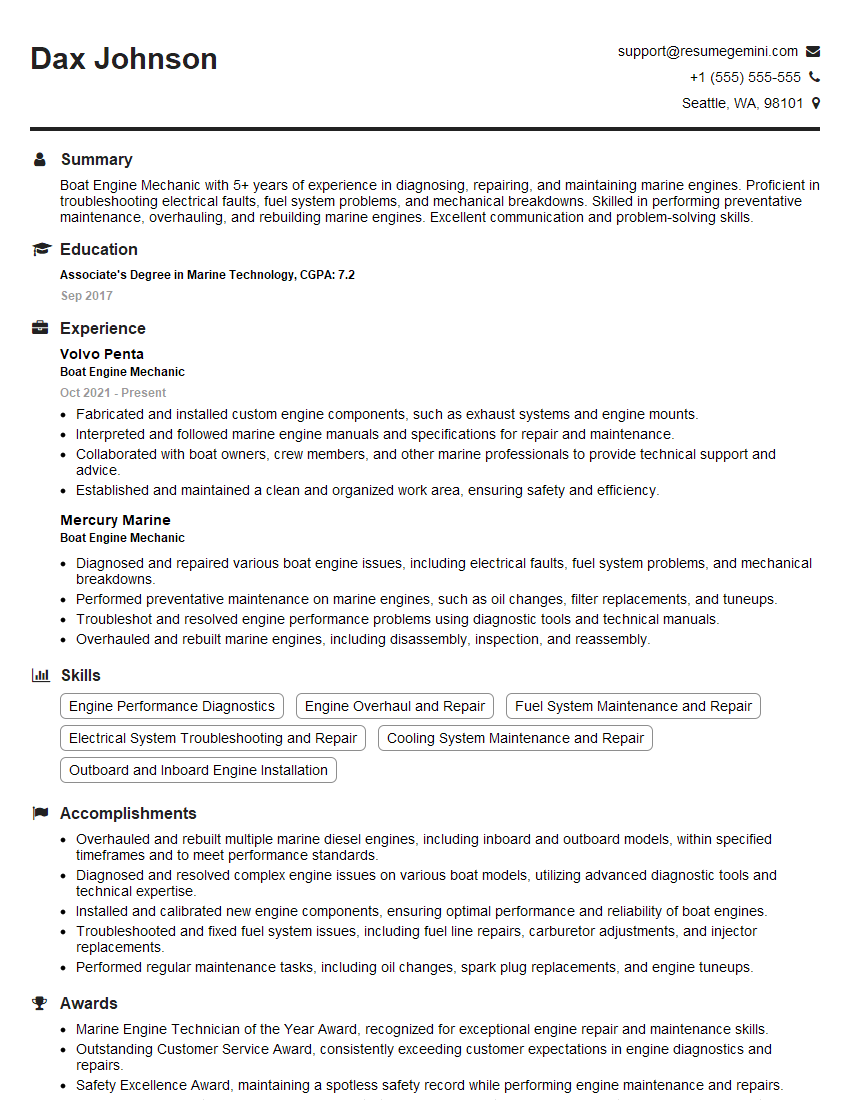
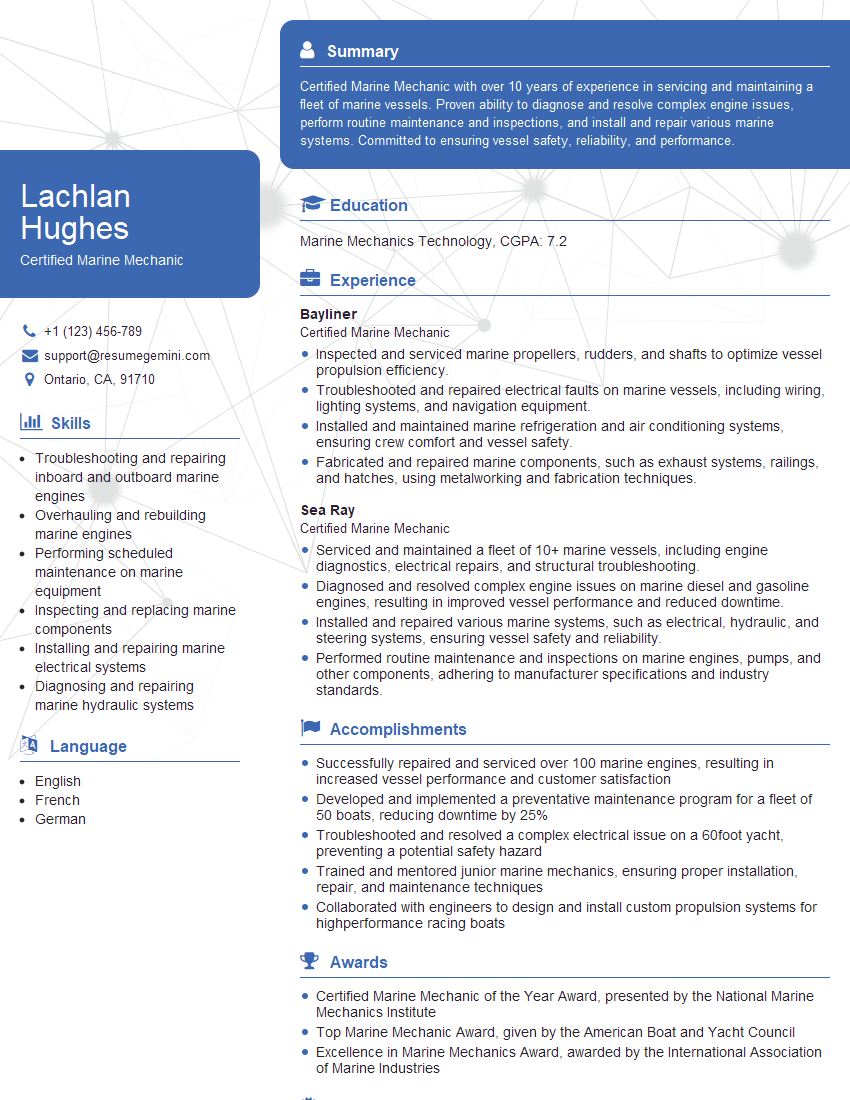
Mastering boat engine overhaul opens doors to exciting career opportunities in marine mechanics, boat repair, and related fields. A strong understanding of these skills demonstrates your technical expertise and problem-solving abilities. To significantly boost your job prospects, create an ATS-friendly resume that highlights your key skills and experience. ResumeGemini is a trusted resource to help you build a professional and impactful resume. Examples of resumes tailored to Boat Engine Overhaul are available to guide you. Invest time in crafting a compelling resume – it’s your first impression on potential employers.
Explore more articles
Users Rating of Our Blogs
Share Your Experience
We value your feedback! Please rate our content and share your thoughts (optional).
What Readers Say About Our Blog
Attention music lovers!
Wow, All the best Sax Summer music !!!
Spotify: https://open.spotify.com/artist/6ShcdIT7rPVVaFEpgZQbUk
Apple Music: https://music.apple.com/fr/artist/jimmy-sax-black/1530501936
YouTube: https://music.youtube.com/browse/VLOLAK5uy_noClmC7abM6YpZsnySxRqt3LoalPf88No
Other Platforms and Free Downloads : https://fanlink.tv/jimmysaxblack
on google : https://www.google.com/search?q=22+AND+22+AND+22
on ChatGPT : https://chat.openai.com?q=who20jlJimmy20Black20Sax20Producer
Get back into the groove with Jimmy sax Black
Best regards,
Jimmy sax Black
www.jimmysaxblack.com
Hi I am a troller at The aquatic interview center and I suddenly went so fast in Roblox and it was gone when I reset.
Hi,
Business owners spend hours every week worrying about their website—or avoiding it because it feels overwhelming.
We’d like to take that off your plate:
$69/month. Everything handled.
Our team will:
Design a custom website—or completely overhaul your current one
Take care of hosting as an option
Handle edits and improvements—up to 60 minutes of work included every month
No setup fees, no annual commitments. Just a site that makes a strong first impression.
Find out if it’s right for you:
https://websolutionsgenius.com/awardwinningwebsites
Hello,
we currently offer a complimentary backlink and URL indexing test for search engine optimization professionals.
You can get complimentary indexing credits to test how link discovery works in practice.
No credit card is required and there is no recurring fee.
You can find details here:
https://wikipedia-backlinks.com/indexing/
Regards
NICE RESPONSE TO Q & A
hi
The aim of this message is regarding an unclaimed deposit of a deceased nationale that bears the same name as you. You are not relate to him as there are millions of people answering the names across around the world. But i will use my position to influence the release of the deposit to you for our mutual benefit.
Respond for full details and how to claim the deposit. This is 100% risk free. Send hello to my email id: lukachachibaialuka@gmail.com
Luka Chachibaialuka
Hey interviewgemini.com, just wanted to follow up on my last email.
We just launched Call the Monster, an parenting app that lets you summon friendly ‘monsters’ kids actually listen to.
We’re also running a giveaway for everyone who downloads the app. Since it’s brand new, there aren’t many users yet, which means you’ve got a much better chance of winning some great prizes.
You can check it out here: https://bit.ly/callamonsterapp
Or follow us on Instagram: https://www.instagram.com/callamonsterapp
Thanks,
Ryan
CEO – Call the Monster App
Hey interviewgemini.com, I saw your website and love your approach.
I just want this to look like spam email, but want to share something important to you. We just launched Call the Monster, a parenting app that lets you summon friendly ‘monsters’ kids actually listen to.
Parents are loving it for calming chaos before bedtime. Thought you might want to try it: https://bit.ly/callamonsterapp or just follow our fun monster lore on Instagram: https://www.instagram.com/callamonsterapp
Thanks,
Ryan
CEO – Call A Monster APP
To the interviewgemini.com Owner.
Dear interviewgemini.com Webmaster!
Hi interviewgemini.com Webmaster!
Dear interviewgemini.com Webmaster!
excellent
Hello,
We found issues with your domain’s email setup that may be sending your messages to spam or blocking them completely. InboxShield Mini shows you how to fix it in minutes — no tech skills required.
Scan your domain now for details: https://inboxshield-mini.com/
— Adam @ InboxShield Mini
support@inboxshield-mini.com
Reply STOP to unsubscribe
Hi, are you owner of interviewgemini.com? What if I told you I could help you find extra time in your schedule, reconnect with leads you didn’t even realize you missed, and bring in more “I want to work with you” conversations, without increasing your ad spend or hiring a full-time employee?
All with a flexible, budget-friendly service that could easily pay for itself. Sounds good?
Would it be nice to jump on a quick 10-minute call so I can show you exactly how we make this work?
Best,
Hapei
Marketing Director
Hey, I know you’re the owner of interviewgemini.com. I’ll be quick.
Fundraising for your business is tough and time-consuming. We make it easier by guaranteeing two private investor meetings each month, for six months. No demos, no pitch events – just direct introductions to active investors matched to your startup.
If youR17;re raising, this could help you build real momentum. Want me to send more info?
Hi, I represent an SEO company that specialises in getting you AI citations and higher rankings on Google. I’d like to offer you a 100% free SEO audit for your website. Would you be interested?
Hi, I represent an SEO company that specialises in getting you AI citations and higher rankings on Google. I’d like to offer you a 100% free SEO audit for your website. Would you be interested?