Cracking a skill-specific interview, like one for Boat Woodworking, requires understanding the nuances of the role. In this blog, we present the questions you’re most likely to encounter, along with insights into how to answer them effectively. Let’s ensure you’re ready to make a strong impression.
Questions Asked in Boat Woodworking Interview
Q 1. Describe your experience with different types of wood used in boat construction.
My experience with boatbuilding woods spans decades and encompasses a wide variety of species, each with unique properties. Think of it like choosing the right tool for the job – some woods are better suited for certain applications than others. For example, I’ve extensively used oak for its strength and durability in structural components like keels and frames. Its density makes it resistant to wear and tear, perfect for areas subject to high stress. Then there’s mahogany, a classic choice valued for its beauty, workability, and stability. It’s ideal for planking and interior finishings because of its rich color and ability to hold a smooth finish. I’ve also worked with cedar, particularly for its rot resistance in areas exposed to moisture like decks and cabins. Choosing the right wood always involves balancing aesthetics, performance, and cost. And let’s not forget about the less traditional choices like teak, known for its exceptional weather resistance, or plywood, a cost-effective engineered wood ideal for bulkheads and less visible components.
Q 2. Explain the process of selecting appropriate wood for a specific boat project.
Selecting the right wood is crucial. I approach it systematically. First, I carefully analyze the boat design: its size, type (sailboat, powerboat, etc.), intended use, and the level of exposure to water. A small, sheltered sailboat might use lighter, less expensive woods, while a large ocean-going vessel requires robust, durable timbers. Then, I consider the wood’s properties: strength, density, stiffness, grain pattern, workability, and cost. For example, a keel needs exceptionally strong wood like oak or even laminated timbers, while interior paneling could employ a more aesthetically pleasing but possibly less durable wood like mahogany. Finally, I consider the environmental impact and sustainability of the chosen wood, favoring certified sources where possible. The process is a delicate balance of engineering, aesthetics, and environmental responsibility.
Q 3. What are the key differences between epoxy and polyurethane resin systems in boat building?
Epoxy and polyurethane resin systems are both crucial in boatbuilding, serving as adhesives and coatings, but have key differences. Epoxy is known for its superior strength, adhesion to various substrates (including wood), and resistance to water and chemicals. It’s often the preferred choice for structural bonding and laminating, where high strength is paramount. However, it can be more expensive and requires more careful mixing and application. Polyurethane is generally less expensive and easier to work with, offering good water resistance and a beautiful, durable finish. It’s often used for coatings and less critical bonding applications. Choosing between the two depends on the specific application. For instance, I’d choose epoxy for a structural repair or laminating a hull, while polyurethane might suffice for a deck coating or interior finishing. The ultimate decision is a careful consideration of budget, required strength, and ease of application.
Q 4. How do you ensure proper wood moisture content for optimal performance?
Maintaining the correct wood moisture content is essential to prevent warping, cracking, and rot. Ideally, wood used in boat construction should be at or near equilibrium moisture content (EMC) for its environment – typically around 6-12% for marine environments. I use a moisture meter to accurately measure the wood’s moisture content at various stages of the project. Before construction, I’ll often kiln-dry lumber to reduce its moisture content. During the construction process, I ensure proper ventilation to avoid trapping moisture inside laminated components. After construction, I’ll use a slow drying process and potentially seal the wood to further control moisture absorption. Think of it like a sponge; if you add too much water to a dry sponge, it expands and distorts, similarly, wood expands and contracts with changes in moisture content. Proper moisture control is key to a long-lasting, stable boat.
Q 5. Describe your experience with different wood joining techniques (e.g., scarf joints, mortise and tenon).
My experience includes a wide range of wood joining techniques. Scarf joints are incredibly strong and almost invisible when properly executed, perfect for joining long, straight pieces of wood for things like keels or planking. It’s a challenging join but a beautiful one. Mortise and tenon joints are excellent for strong, rigid connections in frames and structural components. The precision and strength they offer are unparalleled, although they are more time-consuming to create. I also frequently use splines and dowels for added strength and alignment in less critical joints. The choice depends on the load, location, visibility, and time constraints. For example, a hidden joint inside a bulkhead might utilize dowels, whereas the visible joints in a deck would benefit from more aesthetically pleasing techniques like mortise and tenon or perhaps even a carefully crafted scarf joint.
Q 6. Explain the importance of proper wood finishing techniques for durability and aesthetics.
Proper wood finishing is vital for both aesthetics and longevity. It protects the wood from the elements, UV degradation, and moisture damage, dramatically extending the boat’s lifespan. I typically begin with sanding to achieve a smooth surface, paying close attention to grain direction. Then, I apply several coats of a high-quality marine-grade varnish or paint. Each coat is carefully applied, allowing ample drying time between coats. The choice of finish depends on the boat’s intended use and aesthetic. A traditional varnish finish offers beautiful depth and highlights the wood grain, while paint provides a tougher and more easily maintained surface. The quality of the finish is directly related to the boat’s durability and visual appeal; a well-finished boat is a joy to behold and maintain.
Q 7. How do you troubleshoot common wood rot or damage issues in boat repair?
Troubleshooting wood rot or damage requires careful inspection and targeted solutions. First, I identify the extent and cause of the damage. Is it dry rot (fungal decay), wet rot (decay in consistently wet conditions), or simply physical damage? For minor rot, I may carefully remove the affected area and replace it with sound wood, often using epoxy for bonding. Severe rot might necessitate more extensive repairs, even replacing large sections. It’s critical to address the underlying cause of the rot—poor ventilation, leaks, or inadequate sealing. I might use a biocide to kill any remaining fungi before applying new wood and sealant. Think of it like treating a wound – you have to clean it thoroughly and address the source of infection before repairing it. Thorough inspection, careful removal of affected material, and the proper use of sealants and epoxy are key to successful repair.
Q 8. Describe your experience with different types of boat construction methods (e.g., plank-on-frame, stitch-and-glue).
My experience spans a variety of boat construction methods, each with its unique strengths and challenges. Plank-on-frame, a classic technique, involves building a skeleton of ribs and frames, then meticulously attaching planks to create the hull. This method allows for intricate shaping and beautiful curves but is labor-intensive and requires advanced skills in timber selection, shaping, and fastening. I’ve worked on several projects using this method, including a 25-foot classic yacht, where careful attention to detail ensured a watertight and structurally sound vessel.
Stitch-and-glue, a more modern approach, uses pre-cut plywood or composite panels joined together with stitches that are later sealed with epoxy resin. This is a faster and more accessible method, particularly for smaller boats. I’ve built several kayaks and dinghies using stitch-and-glue, appreciating its efficiency and suitability for smaller projects. The precision required in cutting and alignment is critical, but the reduced labor time allows for faster project completion. Other methods I’ve worked with include strip-planking, offering a balance between the traditional and modern, using thin strips of wood for the hull. Each technique demands different skills and tools but understanding the principles of each helps inform the optimal choice for a specific project.
Q 9. Explain the importance of understanding boat design principles in boat woodworking.
Understanding boat design principles is paramount in boat woodworking. It’s not just about aesthetics; it’s about ensuring the boat is safe, seaworthy, and performs as intended. Ignoring design principles can lead to structural weaknesses, poor handling, and even catastrophic failure. For example, improper hull design can result in instability or excessive drag, impacting speed and safety. Knowledge of buoyancy, stability, hydrostatics, and hydrodynamics is essential. A well-designed boat will consider factors like displacement, center of gravity, and metacentric height to ensure stability and safe operation. My experience has taught me that every decision in the building process, from timber selection to the final finish, must be informed by a thorough understanding of these principles, otherwise the boat may be beautiful to look at, yet dangerous to sail.
Q 10. How do you ensure accurate measurements and cuts in boat construction?
Accuracy in measurements and cuts is critical for a successful boatbuilding project. Even minor errors can compound and lead to significant problems later on. I use a combination of techniques to ensure precision. Firstly, meticulous planning and lofting – creating full-scale drawings of the boat’s components – is essential. This allows for careful verification of measurements before any cutting begins. Then, I rely on high-quality measuring tools, including accurate tape measures, squares, and bevels. For cutting, I utilize a variety of tools from hand saws for fine work to power tools where appropriate, always ensuring the tools are sharp and well-maintained. To double-check critical cuts, I use jigs and templates – custom-made guides ensuring consistent cuts. This layered approach to accuracy minimises errors and allows for a precise, structurally sound vessel.
Q 11. What safety precautions do you take while working with woodworking tools and materials?
Safety is my top priority in boat woodworking. Working with sharp tools and potentially hazardous materials demands strict adherence to safety protocols. This includes always wearing appropriate safety gear, such as eye protection, hearing protection, dust masks, and work gloves. I make sure the workspace is well-lit and organized to prevent accidents. Before operating any power tool, I thoroughly inspect it for damage and ensure I understand its proper use. I use push sticks and featherboards to maintain safe distances from blades, and ensure the tools are securely clamped and stable during use. I also take precautions to avoid inhaling wood dust by using dust collection systems or working in a well-ventilated area. Regular tool maintenance is also crucial – a dull blade is far more dangerous than a sharp one.
Q 12. Describe your experience with using power tools (e.g., routers, planers, jointers) in boatbuilding.
Power tools are indispensable in efficient boatbuilding. I’m proficient in using a variety of power tools, including routers, planers, and jointers. Routers are crucial for creating intricate shapes and curves, from shaping frames to creating decorative elements. I use jigs and templates with my router to ensure consistent results and precision. Planers are essential for smoothing and shaping large pieces of wood to precise thicknesses. Jointers are vital for creating perfectly flat and square edges. Before using any power tool, I carefully check for defects, making sure it is properly maintained and adjusted. Safety precautions are paramount, always wearing the appropriate PPE and ensuring the workpiece is securely clamped. My skill in using these tools effectively significantly enhances both the speed and quality of my work. For instance, using a planer to prepare planks ensures a consistent thickness critical for the structural integrity of a plank-on-frame vessel.
Q 13. How do you manage a project timeline and budget in boat construction?
Managing project timelines and budgets in boat construction requires careful planning and organization. I begin by creating a detailed work breakdown structure, dividing the project into smaller, manageable tasks. Each task is assigned an estimated time and cost. This allows for realistic budgeting and scheduling. I use project management software to track progress, identify potential delays, and manage resources. Regular reviews and adjustments ensure the project stays on track. Unexpected issues, such as material shortages or equipment malfunctions, are inevitable. Therefore, I always include a contingency buffer in both the budget and the schedule. Open communication with the client is crucial, keeping them informed about progress and any potential challenges. Transparency and realistic expectations are key to successful project completion within the defined timeframe and budget.
Q 14. Describe your experience with fiberglass and composite materials in boat repair or construction.
Fiberglass and composite materials are increasingly important in boat repair and construction. I have extensive experience working with these materials, from applying fiberglass cloth and resin for repairs to building entire hulls using composite techniques. Fiberglass offers strength and water resistance, making it ideal for repairing damaged hulls and decks. Composite construction, using a combination of fiberglass, carbon fiber, or other reinforcement materials within a resin matrix, allows for lightweight yet strong structures. Working with these materials requires careful attention to safety, as they involve working with volatile chemicals. Proper ventilation is crucial, and appropriate safety gear like respirators and gloves are always used. Layup techniques – the process of applying layers of fiberglass cloth to a mold or structure – require skill and precision. My experience includes both small repairs such as patching a dinghy and more complex projects involving the full layup of a small boat’s hull. The strength and durability of the resulting structure highlight the value of this modern approach in boat construction.
Q 15. Explain your experience in working with different types of marine fasteners.
Selecting the right marine fastener is crucial for the longevity and structural integrity of a wooden boat. My experience spans a wide range, from traditional bronze screws and nails to modern stainless steel and silicon bronze options. The choice depends heavily on the wood type, location within the boat (above or below the waterline), and the specific stress the fastener will endure.
- Bronze screws: A classic choice, offering good corrosion resistance, particularly in saltwater environments. I often use them for exterior applications where strength and longevity are paramount.
- Stainless steel fasteners: These are increasingly popular due to their strength and corrosion resistance. However, it’s critical to choose the correct grade of stainless steel (like 316 marine grade) to avoid issues with crevice corrosion.
- Silicon bronze: This alloy offers superior corrosion resistance compared to regular bronze, making it ideal for underwater applications. It’s often my go-to for through-hull fittings and critical structural elements below the waterline.
- Wood screws vs. Nails: I carefully consider whether to use screws or nails, depending on the application. Screws generally offer superior holding power, particularly in hardwoods, whereas nails might be preferable for speed in some less critical areas.
For example, I recently restored a classic sailboat where I replaced all the deteriorated bronze screws in the deck with high-grade stainless steel screws, ensuring the deck remained watertight and structurally sound. Proper pre-drilling and countersinking are always vital regardless of fastener type to avoid wood splitting.
Career Expert Tips:
- Ace those interviews! Prepare effectively by reviewing the Top 50 Most Common Interview Questions on ResumeGemini.
- Navigate your job search with confidence! Explore a wide range of Career Tips on ResumeGemini. Learn about common challenges and recommendations to overcome them.
- Craft the perfect resume! Master the Art of Resume Writing with ResumeGemini’s guide. Showcase your unique qualifications and achievements effectively.
- Don’t miss out on holiday savings! Build your dream resume with ResumeGemini’s ATS optimized templates.
Q 16. How do you address challenges related to working with curved or irregular shapes in boat construction?
Working with curves and irregular shapes in boat building is a core skill. It requires a blend of precision, experience, and often, some creative problem-solving. The key is to break down complex shapes into manageable sections.
- Steam bending: This traditional technique allows for shaping wood planks into graceful curves. It involves carefully steaming the wood to soften its fibers, then bending it around a form until it cools and sets in the desired shape. I’ve used this extensively to create curved ribs and frames.
- Using flexible materials: For less extreme curves, I might choose flexible wood species like oak or cedar, which can be bent more readily. Careful selection and understanding of wood grain orientation are essential to avoid cracking.
- Pattern making and lofting: Accurate patterns and lofting (full-scale drawings) are essential for complex shapes. These patterns act as templates, allowing me to accurately cut and shape the pieces. I use a combination of traditional methods and digital design for this process, ensuring precision.
- Piece-by-piece construction: Rather than trying to create one large curved component, I often build complex shapes from smaller, simpler pieces, carefully joining them together to form the overall curvature. This technique minimizes the risk of warping or cracking.
For instance, when constructing a clinker-built hull (overlapping planks), I use carefully shaped molds and patterns to ensure each plank sits perfectly against its neighbor, creating the curved hull form.
Q 17. Explain the importance of maintaining accurate drawings and plans throughout a project.
Accurate drawings and plans are the foundation of any successful boatbuilding project. They’re not simply blueprints; they’re a living document that evolves as the project progresses. Maintaining accuracy is critical for several reasons:
- Precision and Fit: Accurate plans ensure all components fit together perfectly, preventing costly rework and frustration.
- Structural Integrity: Incorrect dimensions can compromise the structural integrity of the boat, leading to safety hazards.
- Time and Cost Savings: Accurate plans streamline the construction process, reducing material waste and labor costs.
- Record Keeping: Detailed plans serve as a record of the boat’s design and construction, valuable for future repairs or maintenance.
I usually start with a well-defined set of plans (either traditional paper or digital), and I meticulously document any changes or modifications made during the building process. This includes sketching any improvised solutions, labeling parts, and adding notes. This detailed documentation is essential for replication or future restoration.
Q 18. Describe your experience in restoring antique or classic wooden boats.
Restoring antique and classic wooden boats is a deeply rewarding but challenging endeavor. It requires a unique blend of historical knowledge, woodworking skills, and a deep respect for the craftsmanship of the past. My experience includes working on various boat types, from small rowboats to larger sailing vessels.
- Assessment and Documentation: The process begins with a thorough assessment of the boat’s condition, documenting all damages and deterioration. Photography, detailed drawings, and even video recording are essential for capturing the original state.
- Careful Removal and Repair: Damaged parts are carefully removed, and repairs are made using traditional techniques and materials whenever possible. This often involves replacing rotted wood, repairing broken frames, and carefully cleaning and restoring existing components.
- Preservation and Protection: Once repairs are complete, the focus shifts to preserving the restored boat. This might involve applying multiple coats of traditional marine varnish, using appropriate sealant and caulking, and carefully selecting hardware consistent with the boat’s original design.
For example, I once worked on a vintage Chris-Craft runabout. The restoration involved painstakingly repairing the hull planking, replacing some deteriorated ribs, and meticulously refinishing the hull and the varnish. The result was a beautifully restored vessel, returned to its former glory.
Q 19. How do you ensure the structural integrity of a boat during repair or construction?
Ensuring structural integrity during boat repair or construction is paramount for safety and longevity. It’s a multi-faceted process that involves meticulous attention to detail at every stage.
- Proper Material Selection: Using appropriate marine-grade wood that is properly seasoned and free from defects is critical. I always inspect the wood carefully before using it in construction or repair.
- Strong Joints and Fasteners: I use robust joinery techniques (like mortise and tenon, scarf joints, etc.) and appropriate marine-grade fasteners to create strong and durable connections. Proper pre-drilling and countersinking are crucial to prevent wood splitting.
- Reinforcement: When necessary, I incorporate structural reinforcement using fiberglass cloth or epoxy to add strength to weakened areas. This is particularly important in older boats.
- Regular Inspection and Maintenance: Regular inspections are crucial for early detection of any problems, allowing for timely repairs before they become major issues.
For instance, when repairing a damaged keel, I would not only replace the damaged section but also reinforce the surrounding area to prevent future problems. This might involve adding internal supports or using epoxy and fiberglass to strengthen the joint.
Q 20. What software or CAD programs are you proficient in using for boat design or construction?
Proficiency in CAD software is essential for modern boat design and construction. I’m adept at using several programs to create accurate designs and produce detailed construction drawings.
- Autodesk AutoCAD: I frequently use AutoCAD for precise 2D drawings, creating detailed plans for cutting, assembly, and lofting.
- Rhino 3D: For more complex three-dimensional modeling, Rhino 3D allows me to design and visualize boats in detail, allowing me to see potential problems before construction begins.
- SketchUp: This program is excellent for creating quick conceptual designs and 3D visualizations, useful for communicating ideas to clients.
While I value the traditional skills of hand drafting, the use of CAD programs allows for greater precision, easier modification of designs, and the ability to share digital plans easily with collaborators.
Q 21. Explain your knowledge of marine varnish and its application.
Marine varnish is the crucial final layer of protection for a wooden boat, guarding against the harsh effects of sun, water, and the elements. My knowledge extends to various types of varnish and their application.
- Types of Varnish: I use both oil-based and polyurethane-based marine varnishes, each with its own strengths and weaknesses. Oil-based varnishes offer a classic, warm look and are often preferred for their traditional aesthetic, while polyurethane varnishes are more durable and water-resistant.
- Application Techniques: Proper application is key to a long-lasting finish. This involves meticulous surface preparation, ensuring the wood is clean, smooth, and properly sealed. I use thin, even coats, allowing adequate drying time between each coat to avoid runs and drips. I carefully sand between coats for a seamless, smooth finish.
- Maintenance: Even the best marine varnish requires regular maintenance. This might involve occasional light sanding and the application of touch-up coats to repair minor scratches or wear. Regular cleaning helps prevent dirt and grime from dulling the finish.
Choosing the right varnish and applying it correctly is critical for protecting a boat’s investment. For example, I might choose a varnish with UV protection for areas of the boat that are exposed to direct sunlight.
Q 22. How do you handle customer communication and expectations during a boat building or repair project?
Open and honest communication is the cornerstone of any successful boatbuilding project. From the initial consultation, I work with clients to clearly define their needs, budget, and expectations. This includes discussing design options, materials, timelines, and potential challenges. I provide regular updates throughout the process, using photos, videos, and progress reports to keep them informed. For example, if a client requests a specific type of wood that is unexpectedly unavailable, I proactively communicate alternative options, explaining the pros and cons of each. I encourage questions and address concerns promptly, striving to build trust and transparency. Finally, I clearly outline payment schedules and any potential cost variations, ensuring complete financial transparency.
Q 23. What are your strategies for quality control and inspection in boat construction?
Quality control is integrated into every stage of construction. It begins with the careful selection of materials; I meticulously inspect each piece of wood for defects like knots, cracks, and warping. During construction, I follow precise measurements and joinery techniques, frequently checking for accuracy using various tools. Regular inspections are conducted throughout the build process, examining the structural integrity, alignment, and overall craftsmanship. This includes checking for proper caulking, fastener tightness, and the overall fairness of the hull. A final inspection, often with the client present, ensures that the boat meets all specifications and standards before delivery. For example, if a slight imperfection is discovered during an inspection, I immediately rectify it, preventing minor issues from escalating into major problems.
Q 24. Describe your experience with caulking and sealing techniques in wooden boat construction.
Caulking and sealing are critical for a wooden boat’s longevity. My experience encompasses a range of techniques, including traditional methods like cotton caulking with oakum and modern approaches using polysulfide or polyurethane sealants. The choice of technique depends on factors such as the boat’s age, design, and the specific area requiring sealing. For instance, I might use cotton caulking on a classic wooden sailboat, meticulously packing and tooling the oakum to ensure a watertight seam. On a more modern design, I might opt for a flexible polyurethane sealant for its ease of application and durability. Proper preparation is paramount; I always ensure the surfaces are clean, dry, and properly prepared before applying any sealant. I understand the importance of using compatible sealants and correctly following manufacturer’s instructions to ensure the effectiveness of the seal. For example, working on a traditional clinker-built boat demands meticulous attention to detail when caulking each seam.
Q 25. Explain your familiarity with different types of marine plywood.
Marine plywood is essential in boatbuilding, offering strength, stability, and resistance to moisture. I’m familiar with various types, including Okoume, which is a common choice for its lightness and strength; and Meranti, known for its durability and affordability. The choice of plywood depends on the specific application and the boat’s design. For example, Okoume plywood might be ideal for interior paneling due to its lightweight nature, while Meranti might be a better choice for structural components requiring greater strength and resistance to rot. I also consider the grade of plywood, ensuring that the chosen grade meets the required specifications for strength and appearance. The glue used in the plywood’s construction is equally critical; using a waterproof marine-grade adhesive is paramount for the long-term performance of the boat.
Q 26. How do you identify and address potential issues with wood movement or expansion?
Wood movement due to changes in humidity and temperature is a significant consideration in boatbuilding. I address this by designing the boat’s structure to accommodate expansion and contraction. This includes incorporating features like expansion joints, using appropriate fastening techniques that allow for movement, and selecting wood species with known stability properties. For example, in a traditional carvel-built hull, I would allow for the slight movement of planks by using countersunk fasteners that provide sufficient holding power while not restricting the movement of the wood. I also pay close attention to the storage and handling of materials before construction to minimize the risk of rapid moisture changes that could cause problems. Understanding the characteristics of each wood type, and correctly acclimating it before use are essential for minimizing issues. Careful planning and construction techniques are vital to minimizing the potential for damage or structural failure caused by wood movement.
Q 27. What is your experience with the use of traditional boatbuilding techniques?
My experience encompasses a wide range of traditional boatbuilding techniques. I’m proficient in several construction methods, including carvel, clinker, and lapstrake, which are all critical aspects of the craft. I am familiar with traditional woodworking joinery techniques like scarf joints, mortise and tenon, and half-lap joints, vital for the construction of strong and durable structures. I utilize traditional tools and materials whenever appropriate, for instance, using hand-planed wood for a superior finish or employing traditional caulking methods to maintain historical accuracy. I’ve worked on restoration projects of classic wooden boats, requiring in-depth knowledge of traditional methods and materials to ensure the boat’s historical accuracy and structural integrity. This knowledge of traditional skills allows me to approach any modern build with informed choices regarding materials and structure, leading to more durable and sustainable results.
Q 28. Describe your proficiency in using hand tools for fine woodworking in boat construction.
Hand tools are integral to fine woodworking in boat construction. My proficiency extends to a wide range of tools, including planes, chisels, saws, spokeshaves, and specialized boatbuilding tools. These tools allow for precise shaping, fitting, and finishing of wood components, resulting in superior craftsmanship and fit. For instance, I use a variety of planes to achieve smooth, precisely-shaped surfaces, and chisels for accurate joinery. The skill lies not just in using the tools but in understanding their nuances and selecting the right tool for each task. For example, using a spokeshave to create fine curves on a tiller requires a delicate touch and years of experience, something that cannot be replicated easily with power tools. The ability to skillfully use hand tools is essential in achieving that high-quality, traditional boatbuilding finish.
Key Topics to Learn for Your Boat Woodworking Interview
- Wood Selection and Properties: Understanding different wood types (e.g., mahogany, cedar, oak) and their suitability for various boat components. Knowing how grain orientation impacts strength and durability.
- Boat Construction Techniques: Familiarity with traditional and modern boatbuilding methods, including plank-on-frame, stitch-and-glue, and fiberglass-reinforced polyester resin applications. Be prepared to discuss the pros and cons of each.
- Joinery and Fastening: Mastering different joinery techniques (e.g., mortise and tenon, scarf joints) and appropriate fastening methods for various applications (screws, nails, bolts, adhesives). Understanding the importance of strong, watertight joints.
- Marine Finishes and Coatings: Knowledge of different types of varnishes, paints, and epoxy systems used to protect wooden boats from the elements. Understanding the application process and the importance of proper preparation.
- Boat Design and Plans: Familiarity with reading and interpreting boat plans, understanding scale drawings, and visualizing the construction process from blueprints.
- Troubleshooting and Repair: Experience in identifying and resolving common problems encountered during boat construction or repair, such as rot, warping, and leaks. Demonstrate problem-solving skills.
- Safety Procedures: Understanding and adhering to safety regulations and best practices in a woodworking environment, including the use of power tools and personal protective equipment (PPE).
- Tools and Equipment: Familiarity with a range of woodworking tools and equipment, both hand tools and power tools, and their proper use and maintenance.
Next Steps
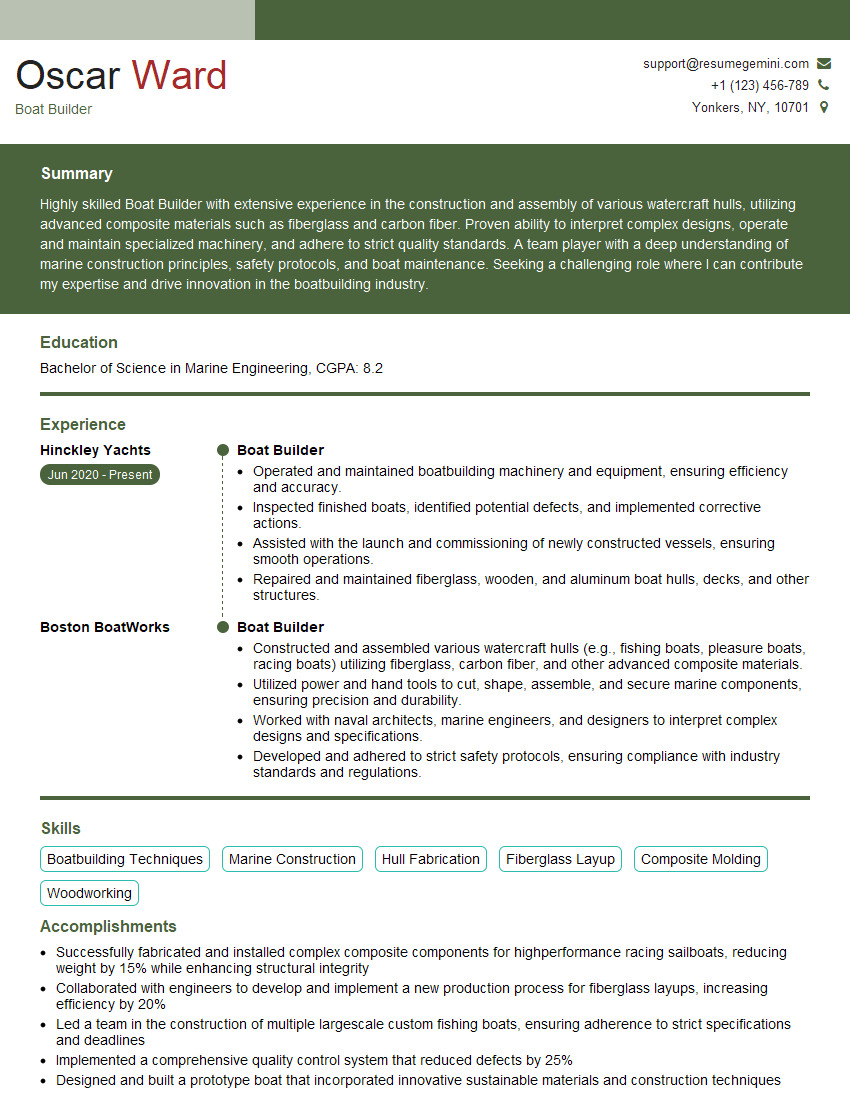
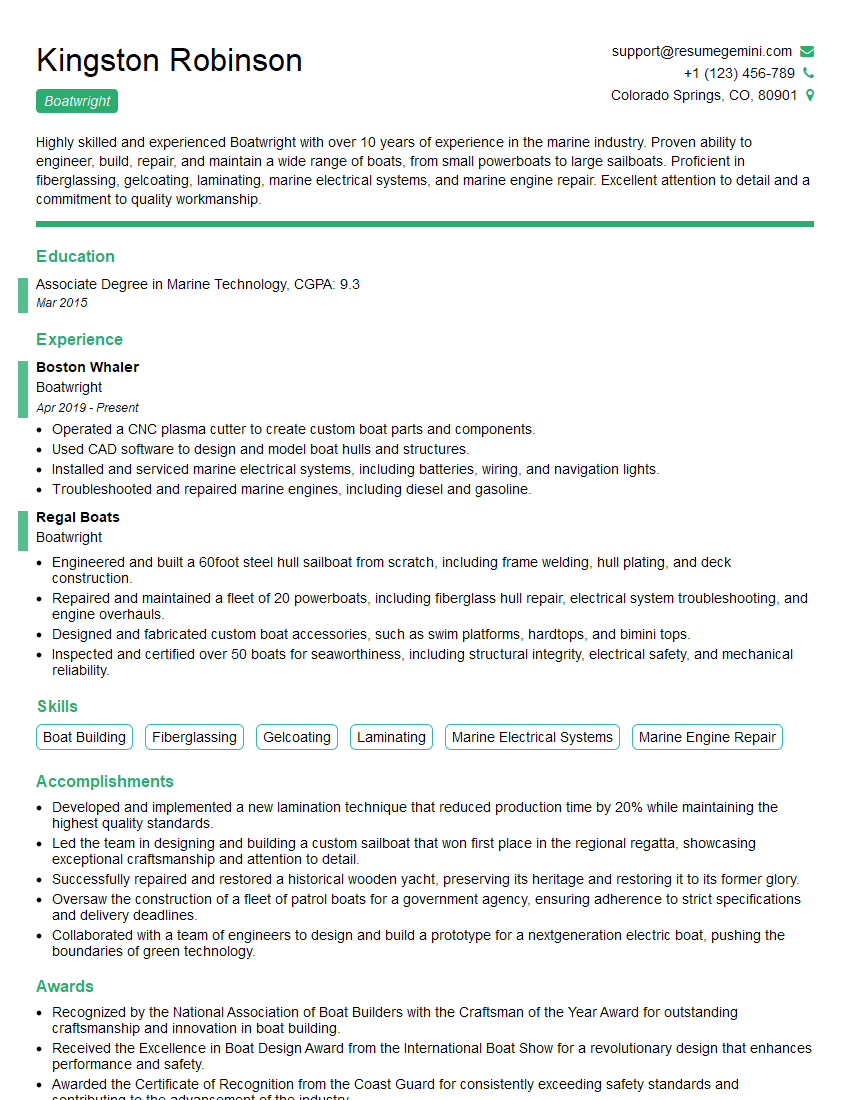
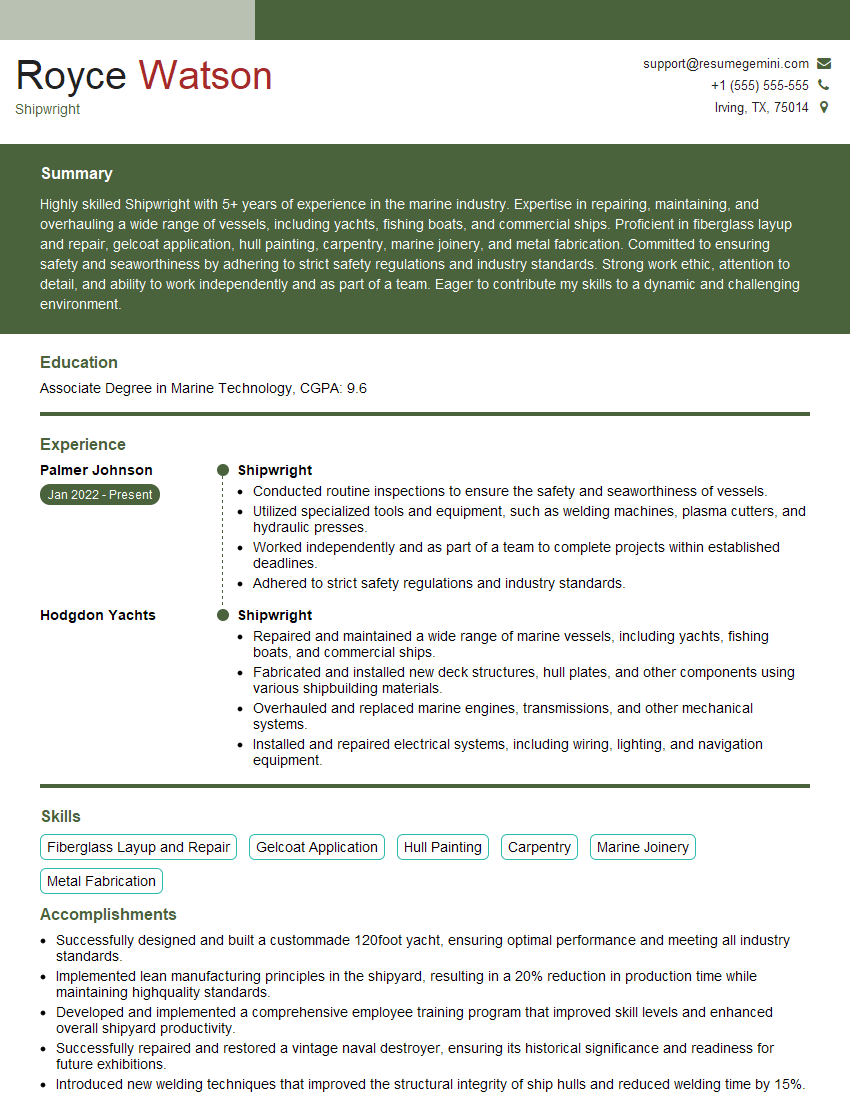
Mastering boat woodworking skills opens doors to a rewarding career with diverse opportunities for growth and specialization. To maximize your chances of securing your dream role, it’s crucial to present yourself effectively. Creating an ATS-friendly resume is paramount in getting your application noticed by recruiters and hiring managers. ResumeGemini is a trusted resource to help you build a professional and impactful resume. They provide examples of resumes tailored specifically to the Boat Woodworking industry, ensuring your qualifications shine through.
Explore more articles
Users Rating of Our Blogs
Share Your Experience
We value your feedback! Please rate our content and share your thoughts (optional).
What Readers Say About Our Blog
Attention music lovers!
Wow, All the best Sax Summer music !!!
Spotify: https://open.spotify.com/artist/6ShcdIT7rPVVaFEpgZQbUk
Apple Music: https://music.apple.com/fr/artist/jimmy-sax-black/1530501936
YouTube: https://music.youtube.com/browse/VLOLAK5uy_noClmC7abM6YpZsnySxRqt3LoalPf88No
Other Platforms and Free Downloads : https://fanlink.tv/jimmysaxblack
on google : https://www.google.com/search?q=22+AND+22+AND+22
on ChatGPT : https://chat.openai.com?q=who20jlJimmy20Black20Sax20Producer
Get back into the groove with Jimmy sax Black
Best regards,
Jimmy sax Black
www.jimmysaxblack.com
Hi I am a troller at The aquatic interview center and I suddenly went so fast in Roblox and it was gone when I reset.
Hi,
Business owners spend hours every week worrying about their website—or avoiding it because it feels overwhelming.
We’d like to take that off your plate:
$69/month. Everything handled.
Our team will:
Design a custom website—or completely overhaul your current one
Take care of hosting as an option
Handle edits and improvements—up to 60 minutes of work included every month
No setup fees, no annual commitments. Just a site that makes a strong first impression.
Find out if it’s right for you:
https://websolutionsgenius.com/awardwinningwebsites
Hello,
we currently offer a complimentary backlink and URL indexing test for search engine optimization professionals.
You can get complimentary indexing credits to test how link discovery works in practice.
No credit card is required and there is no recurring fee.
You can find details here:
https://wikipedia-backlinks.com/indexing/
Regards
NICE RESPONSE TO Q & A
hi
The aim of this message is regarding an unclaimed deposit of a deceased nationale that bears the same name as you. You are not relate to him as there are millions of people answering the names across around the world. But i will use my position to influence the release of the deposit to you for our mutual benefit.
Respond for full details and how to claim the deposit. This is 100% risk free. Send hello to my email id: lukachachibaialuka@gmail.com
Luka Chachibaialuka
Hey interviewgemini.com, just wanted to follow up on my last email.
We just launched Call the Monster, an parenting app that lets you summon friendly ‘monsters’ kids actually listen to.
We’re also running a giveaway for everyone who downloads the app. Since it’s brand new, there aren’t many users yet, which means you’ve got a much better chance of winning some great prizes.
You can check it out here: https://bit.ly/callamonsterapp
Or follow us on Instagram: https://www.instagram.com/callamonsterapp
Thanks,
Ryan
CEO – Call the Monster App
Hey interviewgemini.com, I saw your website and love your approach.
I just want this to look like spam email, but want to share something important to you. We just launched Call the Monster, a parenting app that lets you summon friendly ‘monsters’ kids actually listen to.
Parents are loving it for calming chaos before bedtime. Thought you might want to try it: https://bit.ly/callamonsterapp or just follow our fun monster lore on Instagram: https://www.instagram.com/callamonsterapp
Thanks,
Ryan
CEO – Call A Monster APP
To the interviewgemini.com Owner.
Dear interviewgemini.com Webmaster!
Hi interviewgemini.com Webmaster!
Dear interviewgemini.com Webmaster!
excellent
Hello,
We found issues with your domain’s email setup that may be sending your messages to spam or blocking them completely. InboxShield Mini shows you how to fix it in minutes — no tech skills required.
Scan your domain now for details: https://inboxshield-mini.com/
— Adam @ InboxShield Mini
support@inboxshield-mini.com
Reply STOP to unsubscribe
Hi, are you owner of interviewgemini.com? What if I told you I could help you find extra time in your schedule, reconnect with leads you didn’t even realize you missed, and bring in more “I want to work with you” conversations, without increasing your ad spend or hiring a full-time employee?
All with a flexible, budget-friendly service that could easily pay for itself. Sounds good?
Would it be nice to jump on a quick 10-minute call so I can show you exactly how we make this work?
Best,
Hapei
Marketing Director
Hey, I know you’re the owner of interviewgemini.com. I’ll be quick.
Fundraising for your business is tough and time-consuming. We make it easier by guaranteeing two private investor meetings each month, for six months. No demos, no pitch events – just direct introductions to active investors matched to your startup.
If youR17;re raising, this could help you build real momentum. Want me to send more info?
Hi, I represent an SEO company that specialises in getting you AI citations and higher rankings on Google. I’d like to offer you a 100% free SEO audit for your website. Would you be interested?
Hi, I represent an SEO company that specialises in getting you AI citations and higher rankings on Google. I’d like to offer you a 100% free SEO audit for your website. Would you be interested?