Interviews are opportunities to demonstrate your expertise, and this guide is here to help you shine. Explore the essential CAD/CAM Pattern Design interview questions that employers frequently ask, paired with strategies for crafting responses that set you apart from the competition.
Questions Asked in CAD/CAM Pattern Design Interview
Q 1. Explain the difference between 2D and 3D pattern design in CAD/CAM.
The core difference between 2D and 3D pattern design lies in how the garment is represented. 2D pattern design utilizes flat, two-dimensional representations of garment pieces. Think of it like a traditional paper pattern – you have individual pieces, like the bodice front and back, sleeves, and collar, that are cut out and sewn together. This method relies heavily on draping and fitting techniques to ensure the final garment’s shape.
3D pattern design, however, uses computer software to create a three-dimensional virtual model of the garment. This allows for a much more accurate representation of how the fabric will drape and fit on a 3D avatar, which can be adjusted to various sizes and body shapes. It’s like having a virtual mannequin where you can directly manipulate the design and see the impact in real-time. This reduces the need for numerous physical prototypes and allows for faster iteration and design adjustments.
For example, in 2D, you might adjust a seam allowance by hand, whereas in 3D you could make the same adjustment virtually and instantly see how it affects the garment’s overall shape. The 3D approach dramatically reduces the time and material costs associated with traditional pattern making.
Q 2. Describe your experience with various CAD/CAM software packages (e.g., Optitex, Gerber, Lectra).
Throughout my career, I’ve extensively utilized several industry-leading CAD/CAM software packages. My experience with Optitex includes developing patterns for complex woven and knit garments, leveraging its advanced grading and marker-making capabilities. I’ve successfully used its 3D design tools to simulate fabric drape and fit, minimizing the need for physical prototypes and significantly speeding up the design process. For instance, I used Optitex to design a collection of tailored women’s suits, efficiently creating various sizes and styles with consistent accuracy.
With Gerber Accumark, I’ve honed my skills in creating highly efficient markers, utilizing its nesting and auto-grading features to optimize fabric usage and minimize waste. I’ve worked on large-scale production projects using Gerber, where optimizing marker efficiency translates directly to significant cost savings. A recent project involved using Gerber to create markers for a high-volume sportswear line, reducing fabric consumption by 8%.
My expertise also extends to Lectra Modaris. Its advanced features in simulating fabric behavior have allowed me to work on projects involving complex, structured garments. I often rely on Lectra’s advanced grading options when dealing with high-volume production runs. A project using Lectra involved creating a collection of technical outerwear, where accurate grading was paramount to ensure consistent sizing across various sizes.
Q 3. How do you handle pattern grading and scaling in your workflow?
Pattern grading and scaling are critical for creating a range of sizes from a base pattern. My workflow incorporates both manual and automated methods. I usually begin by creating a well-fitting base pattern in my chosen CAD software. Then, I leverage the software’s automated grading tools, defining grading rules based on industry standards or specific brand requirements. This includes specifying measurements that need to be scaled for each size, like bust circumference, waist circumference, and sleeve length.
However, I don’t solely rely on automation. Manual adjustments are often necessary to ensure aesthetic consistency across sizes. This involves carefully reviewing the graded patterns, making fine-tuning adjustments to maintain style lines and overall garment proportions. For instance, while automated grading may increase the length of a sleeve uniformly, I might need to manually adjust the sleeve cap to maintain the intended fit. For complex designs, I’ll often create and save grading rules that can be applied consistently across multiple styles.
Quality checks at each stage are vital. I always physically check a few graded patterns to ensure the accuracy of the measurements and the aesthetic integrity of the design. This blend of automated efficiency and manual precision ensures both speed and quality.
Q 4. What methods do you use for creating accurate and efficient markers?
Creating efficient markers is crucial for minimizing fabric waste and maximizing production output. My approach involves a combination of software tools and strategic planning. I start by carefully organizing the pattern pieces within the CAD software to determine the best orientation and arrangement. This process, called nesting, aims to maximize the use of the fabric width while minimizing the amount of unusable space left over.
I leverage the automated nesting features of CAD/CAM software, like Gerber Accumark or Optitex, but I also refine the arrangements manually to optimize the result. The software algorithms can be improved upon by human expertise; experience helps to visualize the best arrangement. Specific factors, like fabric grain direction and pattern matching requirements, heavily influence nesting strategies. For example, a large-scale floral print requires careful placement of pieces to maintain the flow of the pattern.
Beyond software, I employ strategic methods like using different cutting layouts for different fabric widths. I also take into account the manufacturing process and the limitations of the cutting equipment to avoid common issues during production. This proactive approach greatly enhances marker efficiency and minimizes waste, resulting in lower material costs and improved profitability.
Q 5. Explain your process for troubleshooting pattern design issues.
Troubleshooting pattern design issues requires a systematic approach. I typically start by precisely identifying the problem. Is there a fit issue? An aesthetic problem? Or a technical difficulty with the CAD software? Once identified, I use a process of elimination to pinpoint the cause.
For fit issues, I revisit the original measurements, body scans, or digital avatars used to create the base pattern. I then carefully analyze the graded pattern pieces for potential distortions. I might need to go back to the original 2D or 3D design and adjust the underlying shape to better fit the model. If it’s a technical issue, like a software error, I consult the software documentation or reach out to technical support.
Visual inspection plays a crucial role. I often physically mock up the problematic areas using inexpensive fabric to determine if the issue is in the pattern itself or in the sewing construction. Documentation is key, carefully noting each step and the changes made to prevent repeating the same errors.
For example, if a sleeve cap is pulling, I’d analyze the sleeve cap’s shape, the armhole depth, and the ease allowance. By systematically checking each element, I can find the exact source of the issue and make the necessary corrections.
Q 6. How do you ensure the accuracy and consistency of your patterns?
Ensuring accuracy and consistency in pattern design is paramount. My approach is multifaceted and begins with meticulous measurement and data management. I utilize accurate body scans and detailed specifications to create the base patterns. Then, I thoroughly check the dimensions and proportions at each stage of the design process, using both automated checks within the software and manual verification.
Consistency is maintained through standardized procedures and consistent use of the same tools and techniques across projects. This includes using defined grading rules, specific seam allowances, and consistent marking conventions. Regularly calibrating the digital equipment and using version control for patterns and related documentation are essential for maintaining accuracy and minimizing errors.
Internal checks are critical. I always have a second pair of eyes review the designs before they’re finalized. This helps to catch subtle errors that might be overlooked during the initial design phase. Finally, rigorous testing on physical prototypes helps to validate the digital patterns, further ensuring accuracy and consistency.
Q 7. Describe your experience with different types of fabrics and their impact on pattern design.
Different fabrics possess unique properties that significantly impact pattern design. Understanding these properties is crucial for creating well-fitting and aesthetically pleasing garments. For example, woven fabrics, like cotton or linen, tend to have more structure and drape less dramatically than knit fabrics, like jersey or rib knit. This influences how I create my patterns. Woven fabrics may require more precise seam allowances and less ease to avoid wrinkles, while knit fabrics often allow for more design flexibility, forgiving some precision because of their inherent stretch.
Drape and stretch are two crucial considerations. Fabrics with poor drape may require additional shaping or support in the pattern. High stretch fabrics might need adjustments to account for the extra give, for example, reducing the seam allowances in a jersey dress compared to a linen dress.
The fabric’s weight also impacts the design. Heavy fabrics, such as denim or wool, might require additional design considerations to support their weight. This may require reinforcement in stress areas or modifications to maintain a desired silhouette. Conversely, lightweight fabrics allow for more flowing and fluid silhouettes.
I always consider the fabric’s texture and hand. A rough textured fabric might require larger seam allowances to prevent unraveling, while smooth fabrics might allow for closer tolerances. I frequently create prototypes using the target fabric to test the pattern’s performance and make any necessary adjustments before committing to production.
Q 8. Explain your understanding of seam allowances and their importance.
Seam allowances are the extra fabric added to the raw edges of pattern pieces before sewing. Think of them as the buffer zone that prevents your finished garment from being too small. They’re crucial for proper fit and professional finish.
The importance of seam allowances goes beyond just size. They allow for ease in sewing, providing enough fabric to manipulate while stitching. Incorrect seam allowances can lead to ill-fitting garments or even make sewing impossible. Different garments, and even different areas within a garment, may require different seam allowances (e.g., 5/8” for a dress, 1/2” for a shirt cuff).
For instance, a dress pattern might call for a 5/8” seam allowance for the bodice and skirt seams, but only a 1/4” allowance for the inner facing seams for a cleaner finish. Managing seam allowance correctly is foundational to a well-made garment.
Q 9. How do you incorporate fit adjustments into your pattern designs?
Incorporating fit adjustments is a critical step in pattern design, transforming a base pattern into a garment that fits a specific body type. This often involves grading (adjusting the size of a pattern), making ease adjustments, or altering specific areas like the bust, waist, or hip. The process usually involves both digital and physical adjustments.
I use a combination of techniques. I often start with digital adjustments using CAD software. For example, if I need to adjust the waist dart placement, I’ll precisely alter the pattern piece using the software’s manipulation tools, making note of the exact changes so that I can later reference them.
After making digital adjustments, I create a test garment (muslin) and make further adjustments physically, pinning, and cutting on the muslin until the fit is perfect. Then, I use these physical adjustments to further refine the digital pattern. This iterative process of digital and physical refinement ensures an accurate and well-fitting final pattern.
Q 10. Describe your experience with creating patterns for various garment types (e.g., dresses, shirts, trousers).
My experience spans a wide range of garment types, including dresses, shirts, trousers, jackets, and skirts. I’ve worked with various styles and designs, from simple A-line dresses to complex tailored jackets.
- Dresses: I’m proficient in creating patterns for various dress styles, including fit-and-flare, sheath, A-line, and wrap dresses, considering factors like dart placement, ease, and neckline variations.
- Shirts: My shirt patterns range from basic button-downs to more complex designs with intricate details like pleats, yokes, and different sleeve styles.
- Trousers: I’ve designed patterns for a variety of trousers, including slim-fit, wide-leg, and tailored styles. This includes understanding the subtleties of fly front construction and pant leg adjustments.
Each garment type presents unique challenges and requires specialized knowledge of construction techniques. For example, creating a well-fitting trouser pattern requires a deep understanding of the different components (waistband, fly front, pockets, etc.), and how they interact to create a comfortable and flattering fit.
Q 11. What are the best practices for managing and organizing digital pattern files?
Efficient pattern file management is crucial for a streamlined workflow. I use a hierarchical folder structure, naming files consistently and logically. This helps in quickly locating patterns and reduces confusion.
My system incorporates:
- Consistent Naming Convention: I use a system like
GarmentType_Style_Size_Version.ext(e.g.,Dress_A-line_M_v2.ai). - Version Control: I always keep multiple versions of a pattern, enabling easy rollback if necessary. I typically use a date-based version control system or increment version numbers (v1, v2, v3).
- Metadata Tags: Each file contains detailed metadata, including garment type, size range, date created, and any significant modifications.
- Cloud Storage & Backup: I store patterns in a cloud storage service for easy access and backups to avoid data loss.
A well-organized digital system greatly increases efficiency, enabling easy retrieval and use of patterns for future projects.
Q 12. How do you collaborate with other team members in a pattern design workflow?
Collaboration is essential in pattern design. I typically use a combination of communication and software tools to effectively collaborate with other team members.
- Version Control Software: We use version control software (like Git) to manage pattern files collaboratively, ensuring everyone works with the latest version and tracks changes.
- Project Management Software: We utilize project management tools to set deadlines, assign tasks, and monitor progress, ensuring everyone is informed and aligned.
- Regular Meetings and Communication: Frequent communication, including regular team meetings and digital correspondence, is vital to discuss progress, feedback, and challenges.
- Shared Cloud Storage: We employ shared cloud storage for easy access and collaboration, ensuring everyone has the latest versions of the design assets.
Effective communication and well-defined roles contribute to a seamless and productive collaborative workflow.
Q 13. What is your experience with generating tech packs from your patterns?
Generating tech packs is a vital part of my process. A tech pack is a comprehensive document that provides all the necessary information for manufacturing a garment. It includes the pattern pieces, measurements, material specifications, construction details, and other essential information.
My process involves:
- Pattern Measurements: I meticulously measure each pattern piece and record them in the tech pack.
- Bill of Materials: I specify the required fabrics, trims, and other materials, including quantities.
- Construction Specifications: I detail sewing instructions, including seam allowances, stitch types, and finishing techniques.
- Graphics: I include clear images and diagrams of the garment, pattern pieces, and construction details.
A well-prepared tech pack ensures that the manufacturing process runs smoothly and accurately, resulting in a high-quality finished product that adheres to the design specifications.
Q 14. Describe your process for creating a prototype pattern.
Creating a prototype pattern is a crucial step to validate the design and ensure a proper fit. My process is iterative, focusing on refinement and adjustment.
The steps involved are:
- Base Pattern Creation: I begin with a base pattern, either drafted from scratch or sourced from a pattern library, scaled to the required size.
- Muslin Mock-up: I create a muslin (inexpensive fabric mock-up) using the base pattern, paying close attention to fit and adjustments.
- Fit Adjustments: I carefully assess the fit of the muslin on a mannequin or a live model, making necessary alterations for fit, ease, and style. This frequently involves pinning and marking adjustments.
- Pattern Refinement: Based on the muslin fitting, I make corresponding adjustments to the digital pattern in my CAD software, ensuring precision and accuracy.
- Final Prototype: I create a final prototype using the refined pattern, using the intended fabric for the garment. This serves as a benchmark for the final production pattern.
This iterative process ensures the final pattern reflects the intended design, fit, and construction details.
Q 15. How do you address pattern inconsistencies during the production process?
Addressing pattern inconsistencies during production requires a systematic approach, combining meticulous pre-production checks with robust quality control measures. Inconsistencies can stem from various sources, including inaccurate measurements, faulty cutting, or errors in the pattern itself.
My strategy begins with a thorough review of the digital pattern before cutting. This involves verifying the grading accuracy, checking for any unexpected distortions in the pattern pieces, and ensuring all markings are correctly placed. I utilize specialized software tools to perform automated checks for these inconsistencies, significantly reducing human error.
During the cutting process, I implement a strict quality control system. This includes regular checks on the cutting machine’s precision, careful monitoring of material placement, and rigorous inspection of cut pieces before they proceed to the next stage of production. Any detected discrepancies are immediately documented and addressed. I also employ statistical process control techniques to track and analyze potential sources of variation, allowing us to proactively identify and prevent future inconsistencies.
Finally, a comprehensive final inspection of the assembled garment confirms the pattern’s integrity. This process helps us to identify any lingering inconsistencies that may have slipped through earlier checks and helps us refine our processes for future production runs.
Career Expert Tips:
- Ace those interviews! Prepare effectively by reviewing the Top 50 Most Common Interview Questions on ResumeGemini.
- Navigate your job search with confidence! Explore a wide range of Career Tips on ResumeGemini. Learn about common challenges and recommendations to overcome them.
- Craft the perfect resume! Master the Art of Resume Writing with ResumeGemini’s guide. Showcase your unique qualifications and achievements effectively.
- Don’t miss out on holiday savings! Build your dream resume with ResumeGemini’s ATS optimized templates.
Q 16. Explain your understanding of different pattern design techniques (e.g., draping, flat pattern making).
Pattern design techniques are broadly categorized into draping and flat pattern making. Draping is a three-dimensional process where fabric is manipulated directly on a dress form to create the desired shape and fit. It’s particularly useful for complex silhouettes and designs with flowing lines, offering a more intuitive approach to design. Think of sculpting with fabric!
Flat pattern making, conversely, is a two-dimensional method where the pattern pieces are created on paper or digitally, using precise measurements and calculations. This approach offers greater control over the precise dimensions of the garment and lends itself to more standardized production. It’s like creating a blueprint for your design.
I am proficient in both techniques and frequently combine them depending on the design’s requirements. For instance, I might use draping to achieve a specific drape on a sleeve and then translate that draped form into a flat pattern for efficient production. This hybrid approach allows me to benefit from the strengths of each method.
Q 17. What are your preferred methods for creating a first sample?
Creating a first sample, or prototype, requires a strategic combination of precision and efficiency. My preferred method starts with producing a digital prototype using CAD software. This allows for rapid iteration and modification of the design based on initial feedback.
Once the digital pattern is finalized, I create a muslin sample – a trial garment using a less expensive fabric. This allows for a ‘hands-on’ assessment of fit, drape, and overall design aesthetics. I carefully note all necessary adjustments – ease, length, width, etc. – directly onto the muslin before transferring them back into the digital pattern.
The muslin sample is crucial, as it provides valuable insights that cannot be readily obtained from a digital model alone. After making adjustments based on the muslin, a final sample is produced using the intended fabric to evaluate the final product’s appearance and performance.
Q 18. How do you utilize CAD/CAM to improve efficiency in pattern making?
CAD/CAM software revolutionizes pattern making, significantly improving efficiency and accuracy. The digital environment allows for quick design changes, pattern grading across multiple sizes, and precise marker making.
In my workflow, I use CAD software to create the initial pattern, allowing me to experiment with different design options without the time-consuming and expensive process of cutting and sewing multiple physical patterns. The software also facilitates precise grading, automatically adjusting the pattern for different sizes, ensuring consistency across the size range.
Furthermore, CAD/CAM systems integrate directly with automated cutting machines, minimizing handling errors and maximizing material utilization. The integration streamlines the entire production process, from design concept to final product, significantly reducing lead times and costs.
For example, instead of manually grading a pattern for ten sizes, CAD software can automate this process in minutes, resulting in considerable time savings and reducing the chances of human error.
Q 19. What is your experience with automated pattern grading systems?
I have extensive experience with automated pattern grading systems, utilizing them to streamline the process of creating multiple sizes from a single base pattern. These systems significantly improve accuracy and efficiency, eliminating the need for manual grading which is time-consuming and prone to errors.
I’m proficient in various software packages that offer advanced grading capabilities, including options for different grading rules and adjustments. For instance, I can define specific grading rules based on design requirements, body shapes or design features. This precise control ensures that the fit and proportions remain consistent across all sizes.
The use of these systems not only reduces labor costs and lead times but also enhances the consistency and quality of the final product. It allows for the creation of a broader range of sizes with accuracy, improving overall customer satisfaction.
Q 20. Describe your experience with different types of pattern adjustments (e.g., ease, grainline).
Pattern adjustments are fundamental in achieving the desired fit and aesthetics. Ease, which is added to the pattern, accounts for the difference between the body’s measurements and the garment’s final measurements, providing comfort and movement. This includes ease allowances for different areas like chest, waist, and hips.
Grainline adjustment is crucial for the garment’s drape and appearance. Correct alignment of the grainline ensures that the fabric hangs correctly and that the pattern’s details are displayed appropriately. For example, a bias-cut garment will require careful consideration of grainline to achieve its intended effect.
Other common adjustments include length adjustments, width adjustments, and fitting adjustments based on the sample’s fit. I use both digital and manual techniques for these adjustments, relying on my experience and the software tools at my disposal to achieve the most accurate and effective results. I find that understanding the fabric properties, construction techniques and the final silhouette are all key to effectively adjusting a pattern.
Q 21. How familiar are you with different cutting techniques (e.g., laser cutting, traditional cutting)?
My familiarity with various cutting techniques is extensive. I am proficient in traditional manual cutting methods as well as modern automated cutting technologies like laser cutting.
Traditional methods using manual cutting tables and electric shears are still valuable for smaller production runs, prototypes, or specialized fabrics that require delicate handling. They allow for greater control over the cutting process, enabling intricate cuts and adjustments as needed.
However, for larger-scale production, automated cutting, particularly laser cutting, offers significant advantages. Laser cutting provides superior accuracy and consistency, minimizing material waste and significantly speeding up the process. It also allows for intricate details and complex cuts that would be difficult or impossible with traditional methods. I am comfortable working with both methods, selecting the most appropriate technique based on the project’s requirements and production volume.
Q 22. How would you handle a situation where a pattern doesn’t fit correctly after sampling?
If a pattern doesn’t fit correctly after sampling, it’s crucial to systematically identify the issue. This isn’t simply about adjusting seam allowances; it requires a deeper understanding of the garment construction and the wearer’s measurements.
My approach involves a multi-step process: First, I’d meticulously compare the sample garment’s measurements against the original specifications. This might involve using a measuring tape, digital measuring tools, or even 3D body scanning data if available. Any discrepancies are noted and categorized (e.g., too tight in the bust, too long in the sleeve).
Next, I’d analyze the fit issues. Are they consistent across multiple samples? Is the problem localized to a specific area, or is it a global fit issue? This helps determine if the problem stems from the initial pattern design, grading (sizing), or even fabric choice.
The next step is to use my CAD/CAM software to adjust the pattern. I would modify the relevant pattern pieces based on my findings, potentially using grading rules to ensure consistent adjustments across sizes. This might involve manipulating control points to reshape curves, adjusting seam allowances, or adding darts or ease.
After making adjustments, I would create a new sample and repeat the fitting process, iterating until the fit is satisfactory. Documenting each step, including changes made to the pattern and the results of each sampling, is crucial for future reference and for understanding the design-to-fit process.
For example, if the sleeve was too tight, I might use the CAD software to increase the sleeve cap height, adjust the sleeve width, or both. The crucial point is a systematic approach, using data-driven analysis rather than guesswork.
Q 23. What are some common challenges in CAD/CAM pattern design, and how have you overcome them?
Common challenges in CAD/CAM pattern design often involve balancing technical accuracy with design aesthetics. One significant challenge is managing complex 3D shapes and drape simulations. Getting the virtual representation to accurately predict how a fabric will hang and behave on a body is difficult.
Another frequent challenge is data management. Handling large datasets for different patterns, sizes, and variations can be cumbersome if not organized efficiently within the CAD/CAM software. Integrating data from different sources, such as 3D body scans or digitized patterns, also presents a challenge.
I overcome these challenges by leveraging the full capabilities of my CAD/CAM software, such as utilizing advanced drape simulation tools, and implementing robust data management systems within the software. I also regularly back up my work to prevent data loss. For complex 3D shapes, I sometimes divide the garment into smaller, easier-to-manage sections that I then assemble. For data management, I use a combination of named files, version control, and detailed documentation within the CAD system. This is like organizing a complex building project—a well-structured plan prevents chaos.
Q 24. Describe your experience with pattern simulation and virtual prototyping.
My experience with pattern simulation and virtual prototyping is extensive. I regularly utilize advanced CAD/CAM software that allows for virtual draping, 3D modeling, and fit simulation. This enables me to test different pattern variations and fabric types before physically cutting and sewing a sample.
Using virtual prototyping, I can detect potential fit issues, such as excessive strain or wrinkling, early in the design process. This significantly reduces the need for multiple physical samples, saving time and resources. I frequently use these simulations to experiment with different fabric weights and stretch properties, helping predict how the final garment will behave.
For example, when designing a tailored jacket, I might create a virtual model of the jacket in my CAD/CAM software, using a simulated fabric with similar properties to the chosen material. Then, I can virtually drape the jacket onto a 3D body scan to identify any potential problems, such as a pulling seam across the shoulder or a loose fit around the waist, before proceeding to the physical sampling stage. This ensures a much smoother and more efficient design process.
Q 25. How do you stay up-to-date with the latest advancements in CAD/CAM technology?
Staying current in CAD/CAM technology is crucial in this field. I actively engage in several strategies to keep my skills sharp. I regularly attend industry conferences and workshops, where I learn about the latest software updates, techniques, and best practices. Many of these offer hands-on training with new features.
I subscribe to industry publications and online forums, allowing me to read about advancements and new techniques from other experts in the field. Additionally, I actively participate in online communities and training courses offered by CAD/CAM software vendors. This keeps me abreast of the latest algorithms, modeling techniques, and software updates. I also work on personal projects using advanced techniques to experiment and refine my abilities.
Think of it as continuous professional development. Just like a doctor keeps up with medical advances, so too must I stay current with the tools and technologies that define my profession.
Q 26. Explain your understanding of sustainable practices in pattern making.
Sustainable practices are becoming increasingly important in pattern making. My approach focuses on minimizing waste and maximizing efficiency throughout the design and production process. This begins with the digital realm: efficient pattern design minimizes fabric consumption during sampling and production.
I prioritize using virtual prototyping to reduce the number of physical samples needed. Each sample represents wasted fabric. By accurately predicting fit and drape virtually, I can significantly reduce this waste. Furthermore, I carefully consider the fabric choices themselves, opting for sustainable materials whenever possible. This considers both the environmental impact of production and the end-of-life disposal options.
By selecting fabrics with reduced environmental impact, I can contribute to a more sustainable fashion industry. This is a holistic approach, considering the entire life cycle of the garment from design to disposal. It’s about making conscious decisions that benefit both the environment and the business.
Q 27. How would you approach designing a pattern for a complex garment with multiple components?
Designing a pattern for a complex garment requires a systematic, modular approach. I would begin by breaking down the garment into its individual components—sleeves, bodice, skirt, lining, etc. Each component would be designed as a separate pattern piece in my CAD/CAM software.
I’d then focus on creating accurate and detailed 2D patterns for each section, utilizing the software’s capabilities to model intricate shapes and ensure proper grading (sizing) across sizes. This might involve the use of specialized tools for creating darts, pleats, or other design elements.
The next crucial step is virtual assembly. I’d use the 3D capabilities of my CAD/CAM software to digitally assemble the individual pattern pieces. This allows me to visualize the overall fit and identify any potential issues before proceeding to the physical sampling phase. This is similar to using building blocks—you can see how the pieces fit together before actually constructing the building.
Once the virtual assembly is satisfactory, I’d then generate cutting files for each pattern piece, ready for cutting and assembling the physical sample. Thorough documentation throughout the process is essential, so any changes or adjustments made along the way can be easily tracked and replicated.
Q 28. What is your preferred method for documenting your pattern design process?
My preferred method for documenting the pattern design process is a combination of digital and physical records. Digitally, I extensively use the annotation and version control features within my CAD/CAM software. Every change made to a pattern is meticulously recorded, including the date, time, and a brief description of the alteration.
This creates a comprehensive history of the pattern’s development. In addition to the software’s built-in documentation, I also maintain a detailed digital log, often using spreadsheets or project management software, to record key decisions, material choices, and any challenges encountered. This log is a living record, evolving alongside the pattern.
Physical documentation also plays a role. I often keep physical copies of key pattern pieces and sample garments. These are annotated with notes and measurements, supplementing the digital record and providing a tangible representation of the design process. This combined digital and physical approach ensures that I can trace the evolution of a pattern from concept to completion.
Key Topics to Learn for Your CAD/CAM Pattern Design Interview
Ace your interview by mastering these key areas of CAD/CAM Pattern Design. We’ve broken down the essentials to help you shine.
- 2D Pattern Design Principles: Understand fundamental drafting techniques, grading rules, and the creation of accurate base patterns. Be prepared to discuss your experience with various pattern types and their applications.
- 3D CAD Modeling for Pattern Making: Demonstrate your proficiency in using 3D CAD software to create and manipulate patterns, including manipulating 3D models to create accurate 2D patterns. Discuss your experience with different 3D modeling techniques and software.
- CAM Software & Automation: Explain your experience with CAM software for automating pattern cutting, grading, and marker making. Highlight your understanding of efficient nesting techniques and production optimization strategies.
- Material Selection & Properties: Discuss the impact of fabric properties on pattern design and construction. Be ready to explain how you select appropriate materials for specific garment styles and applications.
- Pattern Grading & Adjustments: Explain your understanding of the grading process and how you adapt patterns for different sizes and body types. Discuss different grading methods and their suitability for various projects.
- Problem-solving & Troubleshooting: Be prepared to discuss how you approach and resolve issues encountered during the pattern design and manufacturing process. Examples of resolving fit issues or technical difficulties are highly valuable.
- Industry Best Practices & Standards: Showcase your knowledge of industry standards and best practices in pattern design and manufacturing. This demonstrates a commitment to quality and efficiency.
Next Steps: Unlock Your Career Potential
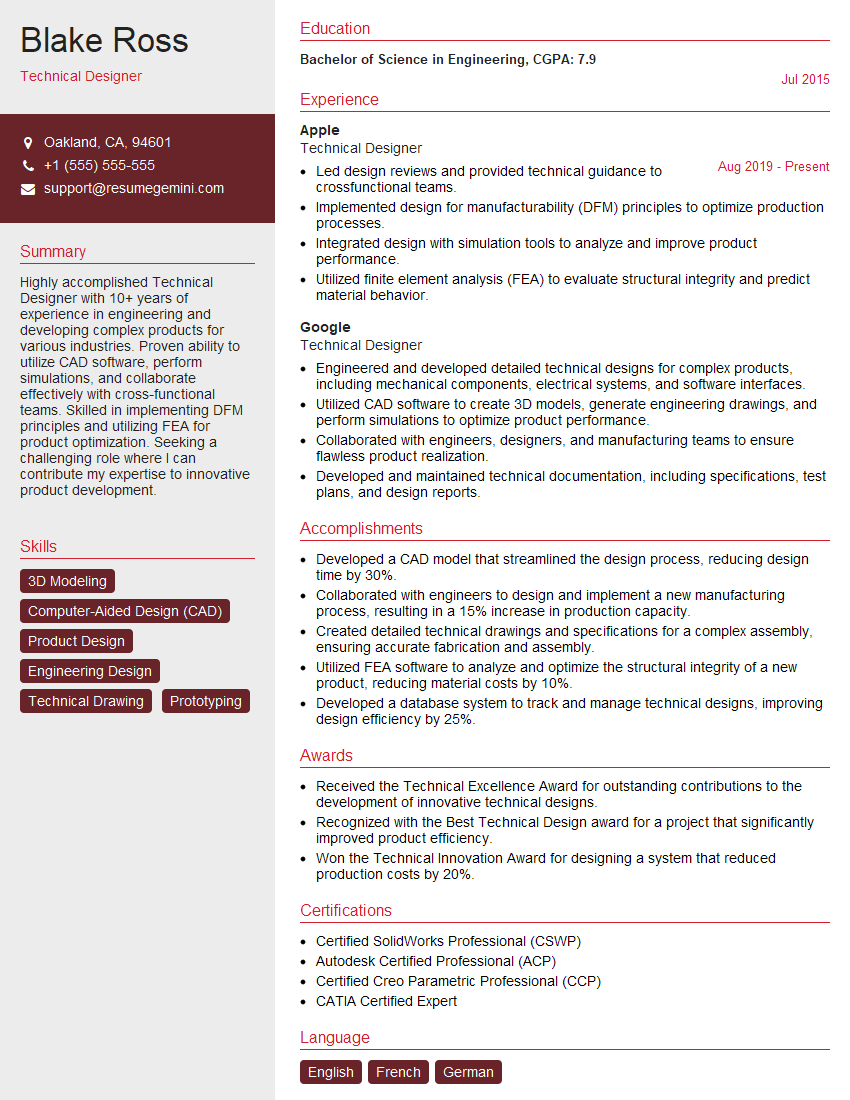
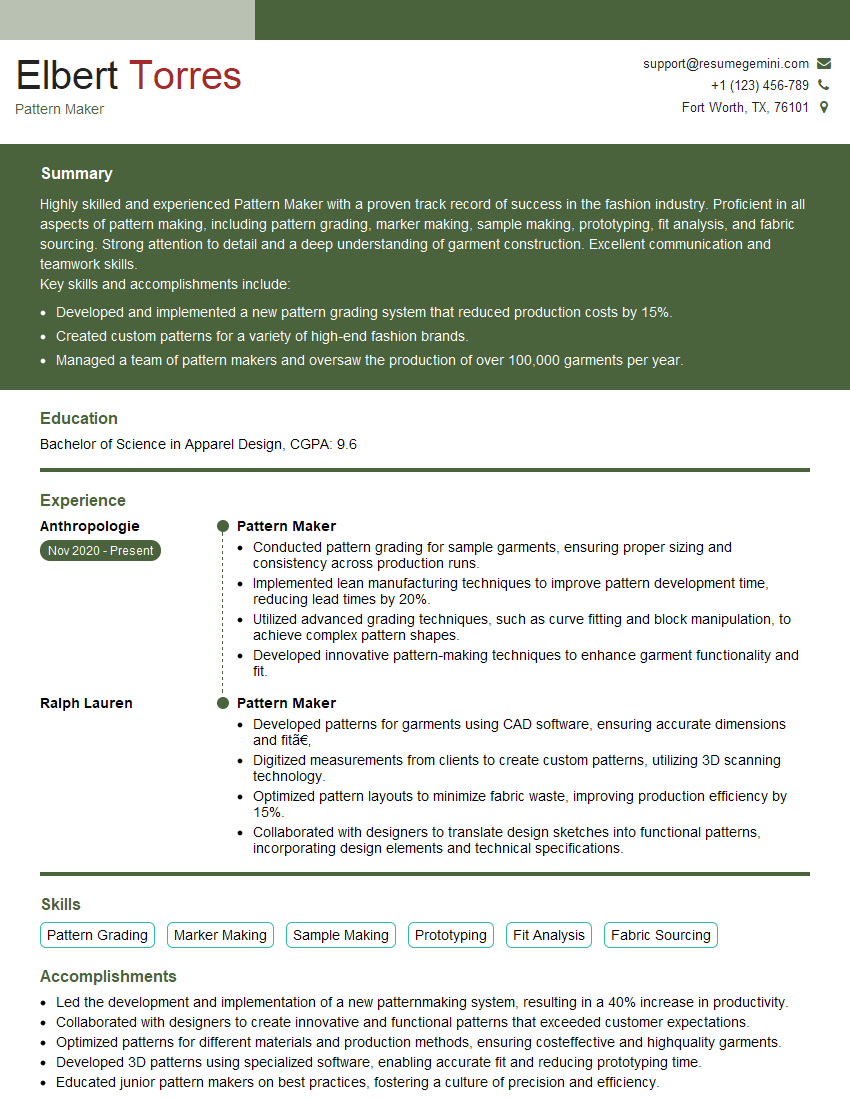
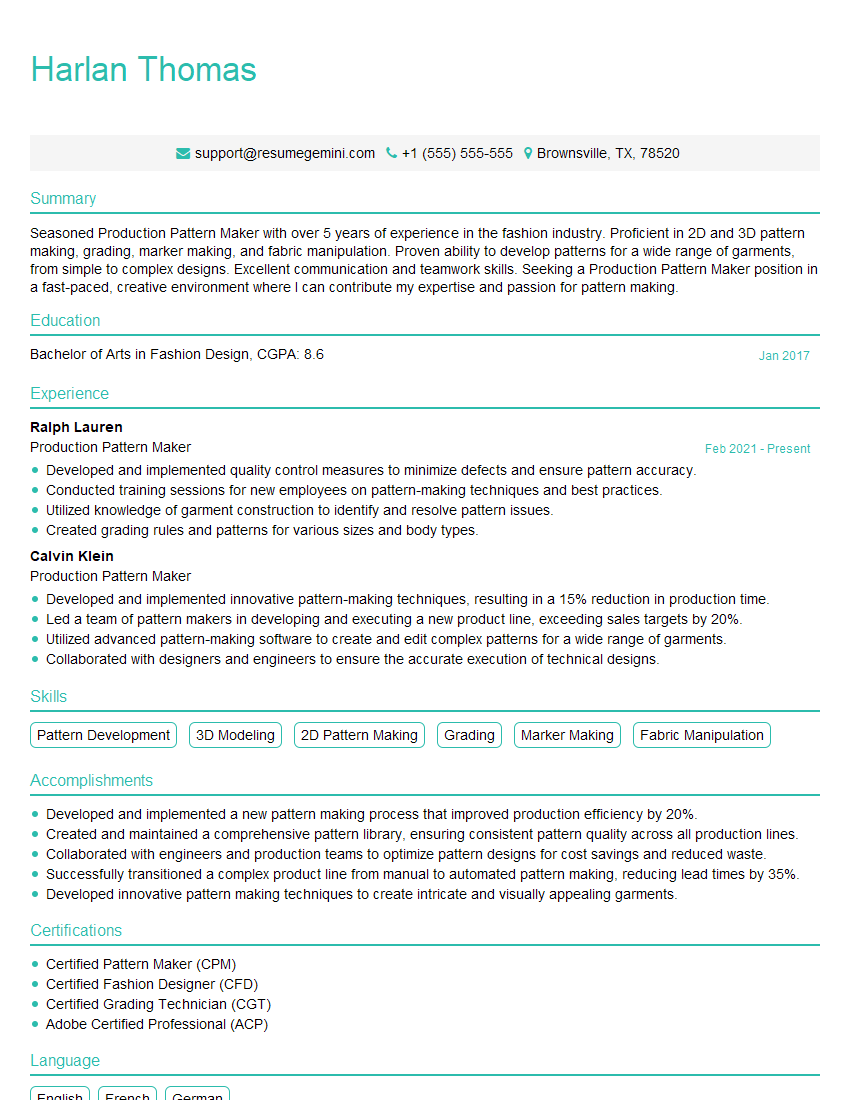
Mastering CAD/CAM Pattern Design opens doors to exciting opportunities in the fashion and manufacturing industries. To maximize your job prospects, a well-crafted resume is crucial. An ATS-friendly resume ensures your qualifications are effectively communicated to potential employers. We highly recommend using ResumeGemini to create a professional and impactful resume that highlights your skills and experience. ResumeGemini provides examples of resumes tailored specifically to CAD/CAM Pattern Design roles, helping you stand out from the competition.
Explore more articles
Users Rating of Our Blogs
Share Your Experience
We value your feedback! Please rate our content and share your thoughts (optional).
What Readers Say About Our Blog
Attention music lovers!
Wow, All the best Sax Summer music !!!
Spotify: https://open.spotify.com/artist/6ShcdIT7rPVVaFEpgZQbUk
Apple Music: https://music.apple.com/fr/artist/jimmy-sax-black/1530501936
YouTube: https://music.youtube.com/browse/VLOLAK5uy_noClmC7abM6YpZsnySxRqt3LoalPf88No
Other Platforms and Free Downloads : https://fanlink.tv/jimmysaxblack
on google : https://www.google.com/search?q=22+AND+22+AND+22
on ChatGPT : https://chat.openai.com?q=who20jlJimmy20Black20Sax20Producer
Get back into the groove with Jimmy sax Black
Best regards,
Jimmy sax Black
www.jimmysaxblack.com
Hi I am a troller at The aquatic interview center and I suddenly went so fast in Roblox and it was gone when I reset.
Hi,
Business owners spend hours every week worrying about their website—or avoiding it because it feels overwhelming.
We’d like to take that off your plate:
$69/month. Everything handled.
Our team will:
Design a custom website—or completely overhaul your current one
Take care of hosting as an option
Handle edits and improvements—up to 60 minutes of work included every month
No setup fees, no annual commitments. Just a site that makes a strong first impression.
Find out if it’s right for you:
https://websolutionsgenius.com/awardwinningwebsites
Hello,
we currently offer a complimentary backlink and URL indexing test for search engine optimization professionals.
You can get complimentary indexing credits to test how link discovery works in practice.
No credit card is required and there is no recurring fee.
You can find details here:
https://wikipedia-backlinks.com/indexing/
Regards
NICE RESPONSE TO Q & A
hi
The aim of this message is regarding an unclaimed deposit of a deceased nationale that bears the same name as you. You are not relate to him as there are millions of people answering the names across around the world. But i will use my position to influence the release of the deposit to you for our mutual benefit.
Respond for full details and how to claim the deposit. This is 100% risk free. Send hello to my email id: lukachachibaialuka@gmail.com
Luka Chachibaialuka
Hey interviewgemini.com, just wanted to follow up on my last email.
We just launched Call the Monster, an parenting app that lets you summon friendly ‘monsters’ kids actually listen to.
We’re also running a giveaway for everyone who downloads the app. Since it’s brand new, there aren’t many users yet, which means you’ve got a much better chance of winning some great prizes.
You can check it out here: https://bit.ly/callamonsterapp
Or follow us on Instagram: https://www.instagram.com/callamonsterapp
Thanks,
Ryan
CEO – Call the Monster App
Hey interviewgemini.com, I saw your website and love your approach.
I just want this to look like spam email, but want to share something important to you. We just launched Call the Monster, a parenting app that lets you summon friendly ‘monsters’ kids actually listen to.
Parents are loving it for calming chaos before bedtime. Thought you might want to try it: https://bit.ly/callamonsterapp or just follow our fun monster lore on Instagram: https://www.instagram.com/callamonsterapp
Thanks,
Ryan
CEO – Call A Monster APP
To the interviewgemini.com Owner.
Dear interviewgemini.com Webmaster!
Hi interviewgemini.com Webmaster!
Dear interviewgemini.com Webmaster!
excellent
Hello,
We found issues with your domain’s email setup that may be sending your messages to spam or blocking them completely. InboxShield Mini shows you how to fix it in minutes — no tech skills required.
Scan your domain now for details: https://inboxshield-mini.com/
— Adam @ InboxShield Mini
support@inboxshield-mini.com
Reply STOP to unsubscribe
Hi, are you owner of interviewgemini.com? What if I told you I could help you find extra time in your schedule, reconnect with leads you didn’t even realize you missed, and bring in more “I want to work with you” conversations, without increasing your ad spend or hiring a full-time employee?
All with a flexible, budget-friendly service that could easily pay for itself. Sounds good?
Would it be nice to jump on a quick 10-minute call so I can show you exactly how we make this work?
Best,
Hapei
Marketing Director
Hey, I know you’re the owner of interviewgemini.com. I’ll be quick.
Fundraising for your business is tough and time-consuming. We make it easier by guaranteeing two private investor meetings each month, for six months. No demos, no pitch events – just direct introductions to active investors matched to your startup.
If youR17;re raising, this could help you build real momentum. Want me to send more info?
Hi, I represent an SEO company that specialises in getting you AI citations and higher rankings on Google. I’d like to offer you a 100% free SEO audit for your website. Would you be interested?
Hi, I represent an SEO company that specialises in getting you AI citations and higher rankings on Google. I’d like to offer you a 100% free SEO audit for your website. Would you be interested?