The right preparation can turn an interview into an opportunity to showcase your expertise. This guide to Ceiling Installation interview questions is your ultimate resource, providing key insights and tips to help you ace your responses and stand out as a top candidate.
Questions Asked in Ceiling Installation Interview
Q 1. What types of ceiling materials are you familiar with?
I’m familiar with a wide range of ceiling materials, each offering unique properties and aesthetics. These include:
- Gypsum board (drywall): A common and versatile material, often used for its affordability and ease of installation. It’s readily available in various thicknesses and can be finished with paint or wallpaper.
- Acoustic ceiling tiles: Designed to absorb sound, these tiles are frequently used in offices, theaters, and recording studios. They come in different materials like mineral fiber, fiberglass, or metal, and offer varying levels of sound absorption.
- Metal ceiling tiles: Durable and aesthetically pleasing, metal tiles (often aluminum or steel) are popular in commercial settings due to their longevity and resistance to damage. They can create a modern or industrial look.
- Wood paneling: Provides a warm and classic aesthetic, ideal for residential or high-end commercial spaces. Different wood types and finishes offer varied appearances.
- Suspended ceiling systems (grid ceilings): These systems use a grid of metal channels to support ceiling tiles, providing easy access to utilities above. Common types include T-bar grids and exposed grid systems.
- Stretch ceilings: Made from a thin, PVC-based membrane that is stretched and fixed to a perimeter track. They offer a seamless, sleek appearance and are available in a wide array of colors and finishes.
My experience encompasses working with all these materials, understanding their strengths and limitations, and selecting the appropriate material based on project requirements and budget.
Q 2. Describe your experience with installing suspended ceilings.
I have extensive experience installing suspended ceilings. This involves a meticulous process, starting with the careful layout and installation of the grid system. The grid, typically made of metal channels, forms a framework that supports the ceiling tiles. Precision is key here, ensuring the grid is perfectly level and aligned to avoid any imperfections in the finished ceiling.
Once the grid is installed, the actual ceiling tiles are carefully fitted into the grid. I pay close attention to ensuring each tile is properly seated and aligned with the surrounding tiles, creating a smooth, even surface. This includes dealing with different tile shapes and sizes and managing cuts and seams to create a professional finish. I’ve worked on a variety of projects, from small office spaces to large commercial buildings, and I’m experienced in installing various suspended ceiling systems and materials.
For instance, I recently completed a project involving a large-scale suspended ceiling in a new office building. We used a T-bar grid system with acoustic tiles. The careful planning and execution of the installation resulted in a perfectly level and visually appealing ceiling, contributing to the overall high quality of the office space.
Q 3. How do you ensure proper alignment and levelness during installation?
Maintaining proper alignment and levelness is paramount for a professional-looking and structurally sound ceiling. I use several methods to ensure this:
- Laser levels: These provide precise horizontal and vertical references, ensuring the grid system is installed perfectly level across the entire ceiling area. This is especially critical for large spaces where even slight deviations can become noticeable.
- Measuring tapes and levels: Used in conjunction with laser levels for double-checking measurements and confirming levelness in different sections of the ceiling.
- Grid leveling tools: Specialized tools available to help ensure the grid framework is perfectly aligned and level before tile installation.
- Careful planning and layout: Before beginning installation, I meticulously measure and plan the layout of the grid, accounting for any obstructions or irregularities in the ceiling structure. This pre-planning minimizes the likelihood of errors during the installation process.
Think of it like building a house – a slightly off-kilter foundation will create problems throughout the entire structure. The same holds true for ceilings. A perfectly level starting point makes the rest of the installation much easier and ensures a flawless outcome.
Q 4. Explain the process of installing acoustic ceiling tiles.
Installing acoustic ceiling tiles involves several steps:
- Prepare the area: Ensure the area is clean and free of obstructions. Wear appropriate personal protective equipment (PPE).
- Install the grid system (if applicable): If using a suspended ceiling, the grid must be installed first, ensuring proper levelness and alignment.
- Layout the tiles: Plan the tile layout carefully, considering any cuts or patterns needed for a seamless finish. Often, it’s beneficial to lay out the tiles dry first to check fit before attaching them.
- Install the tiles: Carefully press each tile into the grid, ensuring proper seating and alignment with surrounding tiles. Use appropriate tools to ensure a tight, secure fit.
- Cut and install border tiles: If necessary, cut tiles to fit around obstacles or to complete the edges of the ceiling.
- Inspect the finished work: Once installation is complete, carefully inspect the ceiling for any misalignments or gaps. Make any necessary adjustments to ensure a quality finish.
Different types of acoustic tiles may have slightly different installation methods, but these steps generally apply. I emphasize precision at each stage to ensure a professional, acoustically effective finish.
Q 5. What safety precautions do you take when working at heights?
Safety is my top priority when working at heights. I consistently adhere to the following precautions:
- Use appropriate fall protection equipment: This includes harnesses, lanyards, and anchor points, always complying with OSHA regulations.
- Proper scaffolding and ladders: Using stable and appropriately sized scaffolding and ladders, ensuring they are positioned correctly and secured.
- Regular inspections: Checking equipment for damage or wear before each use.
- Teamwork: Working with a spotter or partner whenever possible, particularly for tasks involving lifting heavy materials.
- Proper training and certification: I’m properly trained and certified in fall protection and working at heights.
- Appropriate footwear: Wearing safety shoes with good grip to prevent slips and falls.
Working at heights carries inherent risks, and neglecting safety measures can have severe consequences. My approach prioritizes careful planning, proper equipment, and a team-focused approach to minimize risks.
Q 6. How do you handle unexpected issues during a ceiling installation?
Unexpected issues during ceiling installation are common. My approach involves:
- Careful assessment: First, I carefully assess the nature of the problem. This might involve identifying structural issues, material defects, or unexpected obstructions.
- Problem-solving: I’ll draw upon my experience to develop creative solutions to address the issue. This may involve modifying the installation plan, using alternative materials, or consulting with other specialists if necessary.
- Communication: Open communication with the client is crucial. I’ll explain the issue, the proposed solution, and any potential impacts on the timeline or budget.
- Documentation: Thorough documentation of the issue, the solution implemented, and any changes to the original plan.
For example, I once encountered unforeseen electrical wiring during a suspended ceiling installation. I immediately stopped work, notified the client, and worked with an electrician to safely reroute the wiring before continuing the installation. This meticulous approach ensured a safe and successful project completion.
Q 7. What are the common causes of ceiling sag or collapse?
Ceiling sag or collapse can stem from several factors:
- Improper installation: Incorrect grid installation in suspended ceilings or inadequate support for drywall ceilings are major culprits.
- Overloading: Placing excessive weight on the ceiling, such as heavy light fixtures or poorly supported HVAC systems, can lead to sagging.
- Moisture damage: Water damage weakens the ceiling materials, making them prone to sagging or collapse. This is a significant issue in areas susceptible to leaks or high humidity.
- Structural issues: Underlying structural problems in the building itself can transfer stress to the ceiling, causing sagging or even collapse.
- Material defects: Using low-quality or defective materials can compromise the strength and integrity of the ceiling.
Regular inspections and maintenance can help prevent many of these issues. Addressing any signs of water damage or structural problems promptly is crucial to prevent more significant and potentially dangerous problems.
Q 8. Describe your experience with different ceiling grid systems.
My experience with ceiling grid systems spans a wide range, encompassing various materials, designs, and applications. I’m proficient with the most common types, including T-bar grids (the standard 2′ x 2′ and 2′ x 4′ grids), and more specialized systems like linear grids for a modern aesthetic, and exposed grid systems where the grid itself becomes a design element. I’ve worked extensively with different materials, including galvanized steel, aluminum (for its lightweight and corrosion-resistant qualities), and even wood for more rustic designs. My expertise extends beyond simple installation; I understand the importance of proper grid layout for load-bearing capacity, ensuring levelness, and accommodating lighting fixtures and HVAC systems. For instance, on a recent project involving a large open-plan office, we utilized a 2′ x 4′ grid system to maximize efficiency and minimize visible grid lines. Another project in a high-humidity environment required using aluminum grids for corrosion resistance, demonstrating my ability to select the appropriate system for the given circumstances.
Q 9. How do you measure and cut ceiling materials accurately?
Accurate measurement and cutting are crucial for a seamless ceiling. I begin by carefully measuring the room dimensions, accounting for any obstructions or irregularities. For drop ceilings, I always double-check the measurements before cutting any materials. I utilize a variety of tools, from measuring tapes and speed squares to laser levels ensuring precision. When cutting ceiling tiles or panels, I use a sharp utility knife or a specialized tile cutter, depending on the material. For example, cutting gypsum board requires a smooth, even cut to avoid chipping. I often use a scoring method where I score the board first and then snap it along the score line for a cleaner cut. For more intricate designs, I might use a jigsaw or circular saw with a fine-tooth blade. Prior to cutting, I always mark my cuts clearly, considering expansion and contraction spaces necessary for some materials. Finally, I always check my cuts multiple times for accuracy, verifying against the pre-measured dimensions before proceeding with installation.
Q 10. What tools and equipment are essential for ceiling installation?
The tools and equipment required for ceiling installation vary depending on the project’s scale and complexity. However, some essentials include: a measuring tape, level (both a standard level and a laser level are beneficial), utility knife, drywall saw or circular saw (with appropriate blades), tin snips (for metal grids), screwdriver set, pliers, safety glasses, work gloves, a ladder or scaffolding (appropriate for the ceiling height), and a suspension system (wires or other hanging devices for drop ceilings).
- For suspended ceiling systems, I also use T-bar connectors, ceiling tiles or panels, and suspension wires or hangers.
- For plasterboard ceilings, I might use a drywall lift for larger sheets.
- Power drills are often needed for fixing fixtures and supports.
Maintaining and regularly inspecting tools is crucial for safety and efficiency. A dull blade leads to inaccurate cuts, and faulty equipment can create safety hazards. Therefore, I prioritize tool maintenance and replacement whenever necessary.
Q 11. Explain your understanding of building codes related to ceilings.
Understanding and adhering to building codes is paramount. My knowledge encompasses codes related to fire safety (fire-resistant materials, proper spacing for fire suppression systems), structural integrity (load-bearing capacity of the ceiling structure), accessibility (compliance with ADA regulations for clearances and heights), and insulation requirements (to meet energy efficiency standards). For example, I’m aware of the specific requirements for fire-rated ceilings in commercial buildings and the use of appropriate fire-rated materials. I frequently consult local building codes and relevant standards to ensure all installations meet the legal requirements. Ignoring building codes can result in safety hazards, project delays, and legal issues. I always keep updated on changes to building codes and am diligent in applying the relevant regulations to every project.
Q 12. How do you manage your time effectively on a ceiling installation project?
Effective time management on ceiling installation projects requires meticulous planning and execution. I begin by thoroughly reviewing the project blueprints and specifications, creating a detailed schedule that breaks down tasks into manageable steps. This includes allocating time for material acquisition, preparation, installation, and cleanup. I also factor in potential delays, such as unforeseen issues or material shortages. On-site, I prioritize tasks based on their dependency, starting with the most critical aspects, such as installing the support structure. I work efficiently and methodically, ensuring a smooth workflow. Effective communication with the team and clients is crucial for keeping the project on schedule. This includes regular updates and proactive communication about any potential delays or challenges encountered. Utilizing checklists and task management tools further enhances efficiency. For example, in a recent renovation, creating a detailed schedule with specific timeframes for each phase helped complete the project ahead of schedule.
Q 13. Describe your experience working with different types of lighting fixtures.
My experience encompasses a wide variety of lighting fixtures, from recessed lighting to chandeliers, track lighting, and surface-mounted fixtures. I’m familiar with the electrical requirements for each type, including voltage and amperage, and understand the necessary safety precautions when working with electrical components. I am well-versed in installing different types of lighting fixture, understanding the unique installation procedures for each type. For example, recessed lighting requires precise cutting of the ceiling material and careful consideration of insulation and wiring. Chandelier installation involves working with heavier fixtures and securing them properly to the ceiling structure. I also account for the weight of the fixture and the necessary support structure, ensuring proper installation. Working with lighting design elements allows me to help create aesthetically beautiful and functional spaces. Safety is always my top priority when working with electrical systems; I always ensure power is disconnected before working on any electrical components.
Q 14. How do you ensure a clean and professional finish on the ceiling?
Achieving a clean and professional finish is a hallmark of my work. This starts with meticulous preparation. I ensure the ceiling surface is clean and free of debris before installation begins. Throughout the process, I take care to avoid damaging the ceiling materials. During installation, I pay close attention to detail, ensuring all joints are aligned and the grid system is level. After installation, I thoroughly clean up any excess materials or debris, leaving the work area tidy. For exposed grid systems, I ensure all the grid members are aligned and the panels are neatly fitted. For seamless ceilings, I pay special attention to the finishing touches, ensuring that all joints and seams are neatly finished. If any minor imperfections are present, I use appropriate filling compounds and sanding techniques to achieve a smooth, uniform surface. Finally, I conduct a thorough final inspection to confirm that the ceiling meets the highest standards of quality and professionalism.
Q 15. What are the different types of insulation used in ceilings?
Ceiling insulation plays a crucial role in energy efficiency and sound dampening. Several types are commonly used, each with its own pros and cons.
- Fiberglass Batts: These are the most common type, affordable and easy to install. They come in various thicknesses and R-values (a measure of thermal resistance). Think of them as fluffy blankets for your ceiling.
- Loose-fill Insulation: This type, often made of cellulose or mineral wool, is blown into the ceiling cavity. It’s great for filling irregular spaces and hard-to-reach areas, ensuring complete coverage. Imagine it like filling a cavity with a fine, insulating powder.
- Spray Foam Insulation: This expands to fill every nook and cranny, creating an airtight seal and excellent insulation. It’s more expensive but highly effective, especially in combating air leaks. It acts like a protective, insulating shell.
- Rigid Foam Boards: These are used for added insulation and often for thermal bridging – stopping heat transfer through the structure – particularly in colder climates. They’re like strong, insulating tiles that you can fit together.
The choice of insulation depends on factors like budget, climate, the ceiling structure, and desired R-value. For instance, in a hot climate, spray foam might be preferred for its air sealing properties, while in a colder region, thicker fiberglass batts combined with rigid foam could be the best solution.
Career Expert Tips:
- Ace those interviews! Prepare effectively by reviewing the Top 50 Most Common Interview Questions on ResumeGemini.
- Navigate your job search with confidence! Explore a wide range of Career Tips on ResumeGemini. Learn about common challenges and recommendations to overcome them.
- Craft the perfect resume! Master the Art of Resume Writing with ResumeGemini’s guide. Showcase your unique qualifications and achievements effectively.
- Don’t miss out on holiday savings! Build your dream resume with ResumeGemini’s ATS optimized templates.
Q 16. How do you deal with difficult or challenging ceiling installations?
Challenging ceiling installations require careful planning and problem-solving skills. These challenges can range from difficult access to complex ceiling designs.
- Difficult Access: Working in attics with low headroom or navigating cramped spaces demands extra caution and the use of specialized tools like scissor lifts or smaller cutting tools. Safety is paramount! We always use proper harnesses and spotters.
- Complex Designs: Vaulted ceilings, curved surfaces, or intricate designs necessitate precise measurements, careful cutting, and potentially custom fabrication of ceiling components. This often involves creating templates and working closely with the design team.
- Existing Obstructions: Pipes, wiring, and ductwork need to be carefully identified and accommodated. This often requires coordination with other trades and sometimes creative solutions to work around existing installations. We use specialized tools for marking out safe cutting areas.
- Unstable Structures: If a ceiling is old or damaged, we might need to reinforce it before installing new components. This could involve structural repairs or the installation of additional supports. This often requires a thorough structural assessment by a qualified professional.
In such situations, meticulous preparation, thorough safety measures, and a flexible approach are crucial. We always prioritize safety and communicate effectively with the project team to ensure a smooth installation.
Q 17. Describe your experience with installing fire-rated ceilings.
I have extensive experience with installing fire-rated ceilings, which are essential for safety in commercial and some residential buildings. These ceilings use specific materials and construction methods to meet fire codes and limit the spread of flames.
My experience includes working with fire-rated gypsum boards (often referred to as fire-resistant drywall), which have a higher density and improved fire resistance compared to standard drywall. We pay close attention to proper joint taping and finishing to maintain the fire rating’s integrity. Any gaps or holes in the ceiling must be sealed properly to maintain the fire barrier.
I’m also familiar with different fire-rated ceiling systems, including those involving suspended ceilings with fire-rated tiles and grids. Each system has specific installation requirements and testing standards that must be adhered to. We always carefully review the manufacturer’s installation instructions and ensure compliance with all relevant building codes and standards.
Proper documentation is crucial, and we maintain detailed records of the materials used and the installation process. This is essential for compliance and warranty purposes. A properly installed fire-rated ceiling is a critical element of building safety and a crucial aspect of my work.
Q 18. What are the differences between residential and commercial ceiling installations?
Residential and commercial ceiling installations differ significantly in scale, complexity, and code requirements.
- Scale: Residential projects are generally smaller and less complex than commercial ones. Commercial projects often involve larger areas, multiple levels, and more intricate designs.
- Complexity: Commercial projects may involve specialized systems such as integrated lighting, acoustic treatments, or sprinkler systems that require additional coordination and expertise. Residential projects typically involve more standard construction.
- Code Requirements: Commercial buildings are subject to more stringent building codes and fire safety regulations. Fire-rated materials and stricter installation practices are frequently mandatory in commercial settings.
- Materials: While both may use similar materials, the choice of finish and the overall aesthetic will differ widely. Commercial spaces may feature suspended ceilings for better access to utilities, while residential ceilings often opt for simpler plasterboard or wood finishes.
For example, a residential project might involve installing drywall on a simple ceiling, whereas a commercial project could involve a complex suspended ceiling with integrated lighting and soundproofing.
Q 19. How do you manage materials and waste on a ceiling installation project?
Efficient material management and waste reduction are key to successful ceiling installation projects. We follow a systematic approach:
- Accurate Measurement and Ordering: Precise measurements are essential to avoid over-ordering materials and minimize waste. We use laser measuring tools for accuracy. This helps us avoid unnecessary costs and reduces waste from leftover materials.
- Material Storage: Materials are stored on site in a way that prevents damage and keeps them organized and accessible. This protects the materials from damage and makes them easy to find.
- Waste Minimization Techniques: We use techniques such as careful cutting and efficient layout to reduce material waste. Larger sheets are cut in such a way to make optimal use of the material. Offcuts are reused or collected and disposed of responsibly.
- Waste Disposal: We work closely with responsible waste disposal companies, adhering to all environmental regulations. We separate recyclable materials like cardboard and metal from general waste. This ensures environmentally conscious waste management.
By implementing these strategies, we minimize material costs, reduce waste sent to landfills, and ensure efficient project management.
Q 20. Explain your knowledge of different types of ceiling joints and seams.
Understanding different types of ceiling joints and seams is essential for achieving a seamless and aesthetically pleasing finish. These joints need to be strong and durable, offering a smooth finish, and may require specific techniques depending on the type of material used.
- Butt Joints: These are the simplest, where two pieces of material meet edge to edge. They require careful alignment and usually involve using joint compound or adhesive.
- Lap Joints: One piece of material overlaps the other, creating a stronger and more aesthetically pleasing joint, often used for covering seams.
- Miter Joints: The edges of the materials are cut at an angle to meet, creating a sharper, more defined joint. This requires precise cutting and is commonly used for decorative moldings.
- Tongue and Groove Joints: This involves a protruding section (tongue) on one piece fitting into a recessed section (groove) on the other, providing a strong and secure joint. Commonly found in wood paneling.
Proper preparation and use of appropriate joint compounds are crucial to achieve strong, smooth, and aesthetically pleasing seams, especially with drywall where taping and sanding are critical steps. We always ensure proper tooling and techniques to achieve professional, high-quality results.
Q 21. How do you work effectively as part of a team on ceiling installations?
Effective teamwork is crucial for successful ceiling installations. It involves clear communication, mutual respect, and a shared commitment to safety and quality.
- Clear Roles and Responsibilities: We establish clear roles and responsibilities from the outset. For example, one team member may focus on measurements and cutting, while another focuses on installation and finishing. This keeps work organized.
- Open Communication: Open and honest communication is vital. We discuss challenges, potential problems, and solutions proactively. Effective communication helps in resolving issues quickly and ensures everyone is on the same page.
- Respectful Collaboration: We work respectfully and collaboratively, valuing the expertise and contributions of each team member. A collaborative approach creates a better working environment and ensures a smoother project.
- Safety First: Teamwork emphasizes safety. We constantly monitor each other’s safety practices, and everyone is expected to contribute to a safe work environment. A supportive and collaborative team ensures the safety of every worker.
In one recent project, we had a complex vaulted ceiling. By working collaboratively, with one person focusing on accurate template creation, another on cutting the drywall to fit the template, and another on the final installation, we completed the project safely and efficiently, resulting in a stunning outcome.
Q 22. Describe your experience with troubleshooting ceiling installation problems.
Troubleshooting ceiling installation problems requires a systematic approach. I begin by carefully assessing the issue, looking for visible signs like sagging, cracks, or unevenness. This visual inspection often points towards the root cause. For instance, sagging might indicate inadequate support structures or overloaded grids. Cracks could be due to improper drywall installation or movement in the building. Unevenness often points to inaccurate measurements or improper installation of the ceiling grid.
Next, I delve into the specifics. If the problem isn’t immediately apparent, I might check the original blueprints and specifications to ensure the installation process aligns with the design. This may involve verifying the type of ceiling material used, the spacing of support members, or the installation techniques employed.
My experience involves dealing with everything from minor inconsistencies in the grid to more complex issues like water damage impacting the integrity of the ceiling. I’ve successfully rectified problems involving incorrect fastener selection leading to premature failure, as well as instances where improper sealing allowed for moisture intrusion. In each case, my approach is to methodically identify the problem’s source before implementing the appropriate solution, meticulously documenting each step.
For instance, I once encountered a seemingly inexplicable gap between ceiling tiles in a large office space. After careful examination, I discovered a slight misalignment in the main grid, a seemingly minor error that had propagated across the entire installation. By carefully realigning the grid section by section, I restored the integrity and visual appeal of the ceiling.
Q 23. What is your experience with using blueprints and specifications?
Blueprint and specification reading is fundamental to my work. I’m proficient in interpreting architectural drawings, understanding ceiling plans, and deciphering material specifications. This includes identifying the type of ceiling system (e.g., drop ceiling, plaster ceiling, suspended ceiling), the specific materials to be used, the dimensions of the space, the location of lighting fixtures, and any other relevant details. I regularly use these documents throughout the project, from initial planning and material ordering to verifying installation accuracy and addressing unexpected challenges.
For example, I recently worked on a project with a complex integrated lighting system embedded within the ceiling. The blueprints clearly indicated the precise locations for recessed lighting, HVAC vents, and fire sprinklers, which required meticulous planning and execution to ensure the ceiling’s structural integrity while accommodating these essential components. Accurately interpreting the specifications for each element – from the type of drywall to the specific fire-rated materials – was crucial for the project’s success.
My experience includes using various software packages to assist in reviewing and interpreting these documents, further enhancing my ability to provide accurate cost estimates and complete projects within budget and time constraints. I find that a thorough understanding of blueprints and specifications is key to avoiding costly mistakes and ensuring a seamless installation.
Q 24. How do you maintain quality control during ceiling installation?
Maintaining quality control throughout a ceiling installation is paramount. My approach involves a multi-layered strategy that begins even before the first sheet of drywall goes up. This includes rigorous pre-installation checks to ensure the structural integrity of the ceiling support system and that the chosen materials meet the project specifications.
During the installation itself, I maintain a strict adherence to manufacturer’s instructions and industry best practices. Regular quality checks are conducted at each stage. This includes verifying the alignment of ceiling tiles, checking for gaps or inconsistencies, and ensuring proper fastening. Any discrepancies are immediately addressed to prevent compounding issues.
After completion, a final inspection is mandatory. This includes evaluating the overall appearance of the ceiling, ensuring the functionality of integrated systems, and checking for any potential safety hazards. I meticulously document all inspections, recording any observations or remedial actions taken. This meticulous documentation allows for effective tracking of quality and facilitates swift problem resolution should any unforeseen issues arise. This ensures that the final product meets the highest standards of quality and safety.
For instance, I once implemented a system of numbered checkpoints during a large-scale commercial ceiling installation. Each checkpoint corresponded to a specific task (e.g., grid installation, tile placement, lighting fixture installation), ensuring that every step was properly reviewed and documented. This methodical approach led to a flawless installation, greatly enhancing client satisfaction.
Q 25. Describe your experience with different types of ceiling finishes.
My experience encompasses a wide range of ceiling finishes, from standard drywall and acoustic tiles to more specialized materials like metal panels and suspended fabric ceilings. Each finish has unique properties and installation requirements, demanding a nuanced understanding of their handling and application.
Drywall ceilings are common and require precise taping, mudding, and sanding for a smooth, even finish. Acoustic tiles, on the other hand, offer sound absorption and are installed within a suspended grid system. Metal panels, often used in commercial settings, demand precision cutting and alignment for a seamless look. Fabric ceilings, with their elegant appearance, involve intricate tensioning and fastening techniques.
I’m adept at handling the challenges associated with each material. For example, ensuring proper ventilation behind drywall ceilings to prevent moisture buildup is crucial. With acoustic tiles, maintaining consistent spacing within the grid is essential for optimal sound absorption. Metal panels may require special tools and techniques for precise cuts and secure fastenings. Fabric ceilings demand careful attention to avoid wrinkles or sagging. My familiarity with these variations allows me to deliver high-quality results that meet both functional and aesthetic needs.
I recently completed a project where we used a combination of materials: drywall for the main ceiling, acoustic tiles in a conference room to reduce noise, and metal panels in the restroom for durability and easy cleaning. This demonstrates my ability to adapt to diverse material requirements, creating a cohesive and aesthetically pleasing overall design.
Q 26. What is your experience with installing integrated ceiling systems?
Installing integrated ceiling systems requires a high degree of precision and coordination. These systems involve the incorporation of various components within the ceiling structure, such as lighting fixtures, HVAC diffusers, sprinklers, and speakers. The successful installation necessitates detailed planning, careful execution, and a thorough understanding of the interactions between these different elements.
My experience includes working with various integrated systems, from simple recessed lighting to complex networks involving multiple integrated components. I am adept at coordinating the installation of these elements with the overall ceiling structure, ensuring that all components are properly positioned, secured, and functional. This process involves careful measurements, precise cutting, and the use of specialized tools and techniques.
Proper coordination with electricians, HVAC technicians, and other tradespeople is vital for the seamless integration of these systems. I communicate effectively with these specialists to ensure the timely and accurate installation of all components. For example, the exact location of HVAC diffusers must be meticulously planned and communicated to the HVAC team to avoid conflicts with lighting fixtures or other components. Miscommunication can result in costly rework and delays.
I recently completed a project featuring an integrated ceiling system that incorporated LED lighting, acoustic panels, and fire sprinklers. By effectively coordinating with the various trades, we managed to install all components seamlessly, ensuring both the aesthetic appeal and the operational integrity of the ceiling.
Q 27. How do you handle client requests or changes during a project?
Handling client requests and changes during a project requires a proactive and flexible approach. Open communication is key. I always encourage clients to express their preferences and concerns throughout the process. I listen carefully, understanding their needs and priorities. When changes are requested, I assess their feasibility, evaluating any impact on the project schedule, budget, and the overall design integrity.
If a change is deemed feasible, I provide a detailed explanation of the implications, including any potential cost or time adjustments. I then work collaboratively with the client to find the optimal solution, ensuring that all parties understand the implications of their decisions. This transparent and collaborative approach reduces misunderstandings and maintains a positive working relationship.
However, if a requested change is not feasible due to structural limitations, code compliance issues, or other technical constraints, I explain this clearly and professionally, offering alternative solutions where possible. My focus is always on providing the client with the best possible outcome while maintaining the highest standards of workmanship and safety.
For example, I once had a client request a significant alteration to the lighting layout halfway through the project. While challenging, through careful planning and collaboration, we were able to implement the changes with minimal disruption to the project schedule and budget.
Q 28. How do you stay updated on the latest advancements in ceiling installation techniques?
Staying updated on the latest advancements in ceiling installation techniques is a continuous process. I actively engage in professional development activities to stay at the forefront of this field. This includes attending industry conferences, workshops, and training sessions, allowing me to learn about new materials, tools, and installation techniques.
I maintain memberships in relevant professional organizations to access industry publications and resources, keeping me abreast of the latest trends and best practices. I regularly review trade journals and online resources to stay informed about technological innovations and regulatory updates.
Furthermore, I actively seek out opportunities to work on diverse projects, exposing me to different materials, techniques, and challenges. This hands-on experience provides valuable insights and practical knowledge. Continuous learning is integral to my professional growth and enhances my ability to deliver high-quality, efficient, and innovative ceiling installations.
For instance, I recently attended a workshop on the installation of advanced acoustic ceiling systems, expanding my knowledge and skillset in this specialized area. This allowed me to offer clients innovative sound control solutions that enhanced the functionality and comfort of their spaces.
Key Topics to Learn for Your Ceiling Installation Interview
- Types of Ceiling Systems: Understanding different ceiling materials (e.g., drywall, acoustic tile, metal panels) and their respective installation methods.
- Safety Procedures and Regulations: Familiarity with OSHA safety standards, fall protection techniques, and proper use of tools and equipment.
- Measuring and Planning: Accurate calculation of materials needed, understanding blueprints and architectural drawings, and planning efficient installation strategies.
- Installation Techniques: Mastering the practical skills of installing various ceiling types, including framing, suspension systems, and finishing techniques.
- Troubleshooting and Problem-Solving: Identifying and resolving common installation issues, such as uneven surfaces, damaged materials, and alignment problems.
- Tools and Equipment: Demonstrating knowledge of the tools necessary for ceiling installation and their proper usage (e.g., measuring tapes, drills, saws, levels).
- Working with Other Trades: Understanding the coordination required with electricians, plumbers, and HVAC technicians during ceiling installation projects.
- Finishing and Detailing: Applying finishing touches, such as taping, mudding, and painting, to ensure a professional and aesthetically pleasing result.
Next Steps: Level Up Your Career
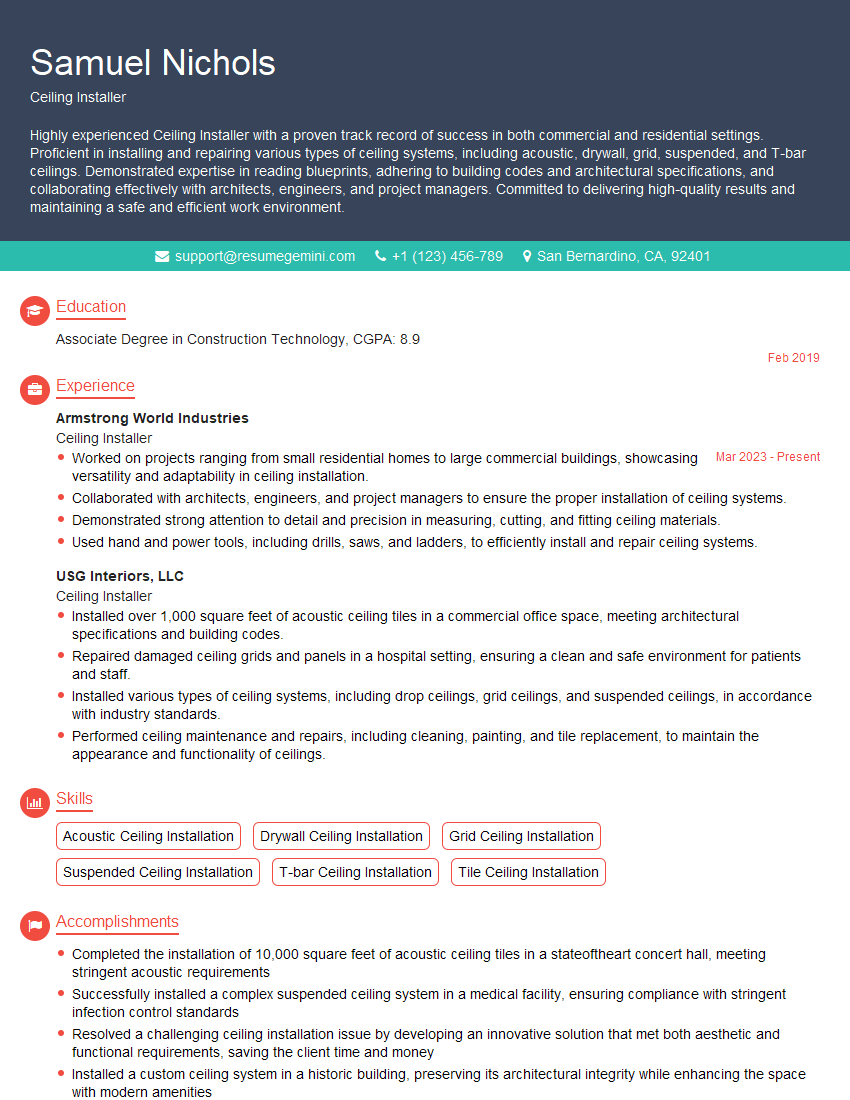
Mastering ceiling installation opens doors to a rewarding career with opportunities for advancement and specialization. To maximize your job prospects, it’s crucial to have a resume that effectively showcases your skills and experience to Applicant Tracking Systems (ATS). An ATS-friendly resume is your key to getting noticed by recruiters and landing interviews. ResumeGemini is a trusted resource that can help you create a professional and impactful resume tailored to the ceiling installation industry. We provide examples of resumes specifically designed for this field to help you present yourself in the best possible light. Take the next step towards your dream job – build your winning resume with ResumeGemini today!
Explore more articles
Users Rating of Our Blogs
Share Your Experience
We value your feedback! Please rate our content and share your thoughts (optional).
What Readers Say About Our Blog
Attention music lovers!
Wow, All the best Sax Summer music !!!
Spotify: https://open.spotify.com/artist/6ShcdIT7rPVVaFEpgZQbUk
Apple Music: https://music.apple.com/fr/artist/jimmy-sax-black/1530501936
YouTube: https://music.youtube.com/browse/VLOLAK5uy_noClmC7abM6YpZsnySxRqt3LoalPf88No
Other Platforms and Free Downloads : https://fanlink.tv/jimmysaxblack
on google : https://www.google.com/search?q=22+AND+22+AND+22
on ChatGPT : https://chat.openai.com?q=who20jlJimmy20Black20Sax20Producer
Get back into the groove with Jimmy sax Black
Best regards,
Jimmy sax Black
www.jimmysaxblack.com
Hi I am a troller at The aquatic interview center and I suddenly went so fast in Roblox and it was gone when I reset.
Hi,
Business owners spend hours every week worrying about their website—or avoiding it because it feels overwhelming.
We’d like to take that off your plate:
$69/month. Everything handled.
Our team will:
Design a custom website—or completely overhaul your current one
Take care of hosting as an option
Handle edits and improvements—up to 60 minutes of work included every month
No setup fees, no annual commitments. Just a site that makes a strong first impression.
Find out if it’s right for you:
https://websolutionsgenius.com/awardwinningwebsites
Hello,
we currently offer a complimentary backlink and URL indexing test for search engine optimization professionals.
You can get complimentary indexing credits to test how link discovery works in practice.
No credit card is required and there is no recurring fee.
You can find details here:
https://wikipedia-backlinks.com/indexing/
Regards
NICE RESPONSE TO Q & A
hi
The aim of this message is regarding an unclaimed deposit of a deceased nationale that bears the same name as you. You are not relate to him as there are millions of people answering the names across around the world. But i will use my position to influence the release of the deposit to you for our mutual benefit.
Respond for full details and how to claim the deposit. This is 100% risk free. Send hello to my email id: lukachachibaialuka@gmail.com
Luka Chachibaialuka
Hey interviewgemini.com, just wanted to follow up on my last email.
We just launched Call the Monster, an parenting app that lets you summon friendly ‘monsters’ kids actually listen to.
We’re also running a giveaway for everyone who downloads the app. Since it’s brand new, there aren’t many users yet, which means you’ve got a much better chance of winning some great prizes.
You can check it out here: https://bit.ly/callamonsterapp
Or follow us on Instagram: https://www.instagram.com/callamonsterapp
Thanks,
Ryan
CEO – Call the Monster App
Hey interviewgemini.com, I saw your website and love your approach.
I just want this to look like spam email, but want to share something important to you. We just launched Call the Monster, a parenting app that lets you summon friendly ‘monsters’ kids actually listen to.
Parents are loving it for calming chaos before bedtime. Thought you might want to try it: https://bit.ly/callamonsterapp or just follow our fun monster lore on Instagram: https://www.instagram.com/callamonsterapp
Thanks,
Ryan
CEO – Call A Monster APP
To the interviewgemini.com Owner.
Dear interviewgemini.com Webmaster!
Hi interviewgemini.com Webmaster!
Dear interviewgemini.com Webmaster!
excellent
Hello,
We found issues with your domain’s email setup that may be sending your messages to spam or blocking them completely. InboxShield Mini shows you how to fix it in minutes — no tech skills required.
Scan your domain now for details: https://inboxshield-mini.com/
— Adam @ InboxShield Mini
support@inboxshield-mini.com
Reply STOP to unsubscribe
Hi, are you owner of interviewgemini.com? What if I told you I could help you find extra time in your schedule, reconnect with leads you didn’t even realize you missed, and bring in more “I want to work with you” conversations, without increasing your ad spend or hiring a full-time employee?
All with a flexible, budget-friendly service that could easily pay for itself. Sounds good?
Would it be nice to jump on a quick 10-minute call so I can show you exactly how we make this work?
Best,
Hapei
Marketing Director
Hey, I know you’re the owner of interviewgemini.com. I’ll be quick.
Fundraising for your business is tough and time-consuming. We make it easier by guaranteeing two private investor meetings each month, for six months. No demos, no pitch events – just direct introductions to active investors matched to your startup.
If youR17;re raising, this could help you build real momentum. Want me to send more info?
Hi, I represent an SEO company that specialises in getting you AI citations and higher rankings on Google. I’d like to offer you a 100% free SEO audit for your website. Would you be interested?
Hi, I represent an SEO company that specialises in getting you AI citations and higher rankings on Google. I’d like to offer you a 100% free SEO audit for your website. Would you be interested?