Every successful interview starts with knowing what to expect. In this blog, we’ll take you through the top Circle Saw Operation interview questions, breaking them down with expert tips to help you deliver impactful answers. Step into your next interview fully prepared and ready to succeed.
Questions Asked in Circle Saw Operation Interview
Q 1. What safety precautions must be followed when operating a circle saw?
Safety is paramount when operating a circle saw. Think of it like this: a circle saw is a powerful tool, capable of serious injury if not handled correctly. Therefore, a multi-layered approach to safety is crucial.
- Personal Protective Equipment (PPE): Always wear safety glasses, hearing protection, a dust mask (especially when cutting wood), and work gloves. Consider a face shield for added protection from flying debris. Appropriate clothing – long sleeves and pants – is also vital.
- Machine Setup and Inspection: Before each use, inspect the saw blade for damage (cracks, chips, or dullness), ensure the blade is securely mounted, and check that the guard is correctly positioned and functioning. Verify that the saw is properly grounded and connected to a GFCI outlet.
- Work Area Safety: Keep the work area clean, well-lit, and free of clutter. Ensure adequate space around the saw to allow for safe movement and prevent accidental contact with other objects. Secure the workpiece firmly to prevent movement during cutting.
- Cutting Techniques: Never force the cut. Let the saw do the work. Feed the material into the blade smoothly and steadily. Avoid reaching over the blade. Use push sticks for small pieces to keep your hands a safe distance from the blade.
- Emergency Preparedness: Know the location of the nearest first aid kit and understand how to use it. Be familiar with the emergency shutdown procedure for the saw.
Remember, safety is not just a set of rules, it’s a mindset. Consistent adherence to these precautions is essential for preventing accidents and protecting yourself and others.
Q 2. Explain the different types of circle saw blades and their applications.
Circle saw blades come in a variety of types, each designed for specific materials and cutting applications. Think of them as specialized tools for different jobs.
- General-Purpose Blades: These are versatile blades suitable for a wide range of softwoods and hardwoods. They have a medium tooth count and are ideal for general carpentry tasks.
- Fine-Tooth Blades: These blades have more teeth, resulting in smoother, cleaner cuts, perfect for finishing work or cutting delicate materials like plywood or veneers. However, they are not as suitable for thicker, harder woods.
- Coarse-Tooth Blades: These blades have fewer, larger teeth, making them excellent for rough cuts in thicker hardwoods or materials like composite materials. They can cut through material quickly but produce a coarser finish.
- Abrasive Blades: Used for cutting materials such as metal, tile, or masonry. These blades have a diamond or carbide grit embedded in them to handle tough, non-wood materials.
- Dado Blades (Stackable Blades): Used for creating wider cuts, like grooves or dadoes, usually in woodworking. These consist of multiple blades stacked together to create the desired width.
Choosing the right blade is crucial for both the quality of the cut and your safety. A mismatched blade can lead to poor performance, damaged material, or even kickback.
Q 3. How do you adjust the blade tension and depth of cut on a circle saw?
Adjusting blade tension and depth of cut is vital for achieving accurate and safe cuts. It’s like fine-tuning an instrument for optimal performance.
Blade Tension: Most modern circle saws have automatic blade tensioning. However, some older models may require manual adjustment. Refer to your saw’s manual for specific instructions. Incorrect tension can lead to blade wobble or damage.
Depth of Cut: The depth of cut is usually adjusted using a depth-of-cut adjustment lever or knob located on the saw. This lever allows you to control how deeply the blade cuts into the material. To adjust, loosen the locking mechanism, set the desired depth using the scale, and then tighten the mechanism. Always ensure the depth is appropriate for the material’s thickness to prevent binding or kickback.
Practicing safe adjustments is critical. Always ensure the saw is unplugged and the blade is stationary before any adjustments.
Q 4. Describe the process of changing a circle saw blade.
Changing a circle saw blade is a straightforward but crucial process that requires careful attention to safety. Imagine it like changing a tire – a precise procedure is needed.
- Disconnect Power: Always unplug the saw from the power source before starting.
- Blade Removal: Locate the blade retaining mechanism (usually a wrench or lever). Following the manufacturer’s instructions, carefully loosen and remove the mechanism. Some saws require a special wrench or key.
- Blade Handling: Handle the blade carefully; it’s sharp. Use gloves to protect your hands. Never drop the blade.
- Installation of New Blade: Align the new blade with the saw arbor (the shaft the blade rotates on). Make sure the teeth are pointed in the correct direction (usually indicated on the blade or in the owner’s manual).
- Securely Tighten: Use the retaining mechanism to securely tighten the blade onto the arbor. Ensure it’s firmly secured before operating the saw.
- Test: Before using, do a test cut on a scrap piece of material to ensure the blade runs smoothly and the cut is correct.
Always refer to your saw’s manual for specific instructions, as mechanisms can vary between models.
Q 5. What are the common causes of circle saw blade kickback and how can they be prevented?
Kickback is a dangerous phenomenon where the blade is thrown back towards the operator. It’s like a sudden, forceful recoil. Understanding its causes is vital for prevention.
- Pinching or Binding: This occurs when the blade becomes trapped between the workpiece and another object or when the material is fed too quickly, causing the blade to bind and throw back.
- Improper Material Handling: Incorrectly supported or improperly positioned material can lead to the blade grabbing and kicking back.
- Dull or Damaged Blade: A dull or damaged blade is more prone to binding and kickback, as it loses its cutting efficiency.
- Touching the Blade: Never touch the blade while the saw is running, as it can quickly cause injury.
Prevention:
- Use sharp blades and replace them when needed.
- Properly secure the workpiece and ensure free movement of the material.
- Avoid pinching the blade by using proper cutting techniques and feeding speed.
- Never force the cut and ensure the saw is running at the correct speed.
- Maintain a firm grip on the saw, and be prepared to react if kickback occurs.
Q 6. How do you maintain and lubricate a circle saw?
Regular maintenance and lubrication are essential for the long-term performance and safety of your circle saw. Think of it as preventative care for a valuable tool.
- Blade Cleaning: After each use, carefully clean the blade with a wire brush or appropriate cleaning solution to remove sawdust and debris. This will help prevent rust and extend the blade’s life.
- Lubrication: Lubricate moving parts according to the manufacturer’s instructions. This usually involves applying a few drops of oil to the arbor and other moving components. This reduces friction and wear, extending the life of the saw.
- Inspection: Regularly inspect all parts of the saw for wear and tear, loose connections, or damage. Replace or repair any damaged parts immediately.
- Storage: Store the saw in a dry, clean place to prevent rust and damage.
- Professional Service: Consider scheduling periodic professional service for a thorough inspection and maintenance.
Consistent maintenance ensures the saw functions efficiently and safely, reducing the risk of accidents and extending its lifespan.
Q 7. What are the signs of a dull or damaged circle saw blade?
Recognizing the signs of a dull or damaged blade is vital for safety and efficient cutting. A dull blade is like a blunt knife – it requires more force, increases the risk of kickback, and produces poor cuts.
- Rough Cuts: A dull blade will produce rough, uneven cuts, as opposed to the smooth cuts of a sharp blade.
- Increased Vibration: A dull or damaged blade will cause increased vibration in the saw, making it harder to control and increasing the risk of kickback.
- Burning or Scorching: A dull blade can cause the material to burn or scorch, due to friction.
- Visible Damage: Check for chips, cracks, or bends in the blade’s teeth. Any damage should be reason enough for replacement.
- Slow Cutting Speed: A dull blade requires more force to cut through material, slowing the cutting speed.
Replacing a dull or damaged blade is not just about improved cutting quality; it’s about safety. A damaged blade greatly increases the risk of kickback and injury.
Q 8. How do you measure and mark wood for accurate cuts using a circle saw?
Accurate measurement and marking are paramount for precise cuts. I always start by carefully planning the cut, visualizing the final product. For straight cuts, I use a combination of measuring tapes, speed squares, and marking pencils. I ensure the measuring tape is taut to avoid inaccuracies. For more complex cuts, I might use a marking gauge or even a template depending on the complexity and repeatability required.
For instance, if I’m cutting a board to a specific length, I’ll measure twice and mark once, using a sharp pencil to create a clear, crisp line. I always double-check my measurements before making the cut. This simple, yet crucial step prevents costly mistakes and ensures efficient material usage. For angled cuts, a speed square is invaluable for marking the correct angle along the measuring line. Proper marking is the foundation of any successful cut.
Q 9. Explain the difference between ripping and crosscutting with a circle saw.
Ripping and crosscutting are fundamental techniques in woodworking, representing different orientations of the cut relative to the wood grain. Ripping involves cutting along the length of the wood grain, think of slicing a loaf of bread. Crosscutting, on the other hand, cuts across the grain, like slicing a bagel. The differences extend beyond orientation; they also impact safety and technique.
Ripping requires a more stable setup as the saw blade is more prone to kickback due to the alignment with the wood fibers. A good support system, such as a fence or guide, is vital during ripping to ensure a straight cut and minimize the risk of injury. Crosscutting, while potentially safer, still demands precise marking and a firm grip to avoid any shifting during the cut. Choosing the right blade for each operation is also crucial: rip blades have more teeth for smoother cuts along the grain, while crosscut blades have fewer, larger teeth for cleaner cuts across the grain.
Q 10. How do you ensure the accuracy and precision of cuts with a circle saw?
Accuracy and precision in circle saw operation demand a combination of careful technique and proper equipment maintenance. First, a sharp blade is essential. A dull blade will cause tear-out and inaccurate cuts. Regular blade sharpening or replacement is a non-negotiable part of my workflow. Secondly, proper setup is crucial. I always ensure the saw is properly aligned, the fence is securely clamped, and the material is firmly supported.
Using a guide or fence for straight cuts is a must. For angled cuts, a miter gauge or adjustable fence is vital for accuracy. Slow and steady wins the race; I avoid rushing the cut, maintaining a controlled speed and even pressure. Finally, I always check the cut after completion to ensure accuracy, making any necessary corrections before proceeding with further work. This focus on detail ensures consistent, high-quality results.
Q 11. What are the different types of circle saws used in industry?
The industry utilizes various types of circle saws, each tailored to specific applications. Common types include:
- Worm Drive Saws: Known for their power and ability to handle demanding cuts, often used in construction.
- Sidewinder Saws: More compact and lighter, ideal for finer work and portability. Often preferred by finish carpenters or hobbyists.
- Sliding Compound Miter Saws: Provide precise angled and miter cuts, essential for cabinetry and trim work.
- Circular Table Saws: Large, stationary saws optimized for repetitive and precise cuts, especially in production environments.
The choice of saw depends on factors like the type of wood, the complexity of the cut, and the scale of the project. My experience encompasses working with all of these, allowing me to select the best tool for the job.
Q 12. Describe your experience with different types of wood and their specific cutting requirements.
My experience spans a broad range of wood types, each presenting unique cutting requirements. Hardwoods like oak and maple require sharper blades and potentially slower cutting speeds to avoid tear-out. Softer woods like pine and fir are easier to cut but may require adjustments to blade selection to prevent chipping. Exotic hardwoods often require specialized blades due to their density and potentially abrasive properties.
For example, cutting through dense, figured maple necessitates a very sharp blade with a high tooth count to achieve a smooth, clean finish. Conversely, cutting pine for framing may utilize a more aggressive blade with fewer teeth for speed and efficiency. Understanding the characteristics of the wood and selecting the appropriate blade and cutting technique is crucial for achieving high-quality results and minimizing waste.
Q 13. How do you handle different thicknesses of wood while using a circle saw?
Handling different wood thicknesses requires adjusting the depth of cut on the circle saw. This is usually accomplished by adjusting the height of the blade. It’s crucial to ensure that the blade extends just slightly beyond the thickness of the wood, avoiding unnecessary cutting depth and potential kickback. For very thick pieces, multiple passes might be necessary to avoid overloading the saw motor or causing the blade to bind.
When cutting thicker materials, I pay close attention to supporting the wood adequately, preventing it from flexing or pinching the blade. Using appropriate supports under the material throughout the entire cut prevents unwanted bending and ensures a clean, straight line across the entire thickness of the wood.
Q 14. What are the procedures for dealing with a jammed or malfunctioning circle saw?
A jammed or malfunctioning circle saw requires immediate attention, prioritizing safety above all else. First, I would disconnect the power source immediately. Never attempt to work on a plugged-in saw.
For a jammed saw, I would carefully assess the situation. If the blade is bound by the wood, gently try to free it using a suitable tool, ensuring my hands are clear of the blade path. If I can’t free it easily, I would likely disassemble the saw to extract the cause of the jam. For malfunctions, if I can identify the problem, I will attempt to rectify the issue; if not, or if the repair is beyond my skill level, I would call for professional repair services. Regular maintenance, including blade sharpening and lubrication, significantly reduces the risk of these situations.
Q 15. How do you inspect a circle saw for any damage or wear before operation?
Before operating a circle saw, a thorough inspection is crucial for safety and efficient cutting. Think of it like a pre-flight check for an airplane – you wouldn’t take off without one! My inspection process always starts with a visual check of the blade. I look for any cracks, chips, or significant wear on the teeth. A dull or damaged blade can lead to kickback, inaccurate cuts, or even injury. I then check the blade guard to ensure it’s securely attached and functioning correctly. A faulty blade guard is a major safety hazard. Next, I examine the saw’s motor housing for any damage or loose parts. I also check the power cord for any fraying or damage. Finally, I test the saw’s on/off switch to ensure it operates smoothly. I even check the underside of the saw for any debris that could interfere with its operation. If I find any issues, I report them immediately and have the saw repaired or replaced before continuing. For example, once I noticed a small crack on a blade during inspection, preventing a potentially dangerous situation. Replacing the blade immediately is always the safest course of action.
Career Expert Tips:
- Ace those interviews! Prepare effectively by reviewing the Top 50 Most Common Interview Questions on ResumeGemini.
- Navigate your job search with confidence! Explore a wide range of Career Tips on ResumeGemini. Learn about common challenges and recommendations to overcome them.
- Craft the perfect resume! Master the Art of Resume Writing with ResumeGemini’s guide. Showcase your unique qualifications and achievements effectively.
- Don’t miss out on holiday savings! Build your dream resume with ResumeGemini’s ATS optimized templates.
Q 16. Describe your experience with various safety equipment used while operating a circle saw.
Safety is paramount when operating a circle saw. Over the years, I’ve become proficient in using various safety equipment. This includes, but is not limited to: safety glasses to protect my eyes from flying debris, hearing protection (earplugs or muffs) to reduce noise-induced hearing loss, and work gloves to improve grip and protect my hands. I always wear long sleeves and sturdy closed-toe shoes to prevent exposed skin from getting caught in the blade or being injured by falling objects. Furthermore, I always ensure the work area is well-lit and free of clutter to prevent tripping hazards. Before making a cut, I secure the workpiece using clamps or a vise, preventing it from moving unexpectedly and causing a kickback. I also use a push stick whenever possible to keep my hands at a safe distance from the blade. Using a dust mask or respirator is crucial when cutting materials that produce fine dust, like wood or certain plastics. Each piece of equipment serves a critical role in protecting me from potential harm. Think of this as a layered defense system for safety.
Q 17. What are the common maintenance tasks you perform on a circle saw?
Regular maintenance is essential for keeping a circle saw in optimal condition. This involves more than just occasional checks. I perform several routine maintenance tasks, including regular blade cleaning and sharpening. A sharp blade ensures cleaner, more precise cuts and reduces the risk of kickback. I also lubricate the moving parts according to the manufacturer’s instructions; this reduces friction and extends the life of the saw. I inspect and clean the air vents to prevent overheating. If the saw requires any adjustments, such as the blade tension or depth adjustment, I carefully perform these adjustments following the manufacturer’s recommendations. After every use, I thoroughly clean the saw, removing any sawdust or debris. This prevents rust or damage to the motor. Furthermore, I keep a detailed log of the maintenance procedures performed on the saw, along with dates and any observations made. This log aids in predictive maintenance, preventing unexpected breakdowns during critical projects. It’s like servicing your car regularly; preventative measures prevent costly repairs and downtime.
Q 18. How do you troubleshoot common problems encountered while using a circle saw?
Troubleshooting circle saw problems requires a systematic approach. If the saw doesn’t start, I first check the power supply and the on/off switch. If the blade binds or the saw stalls, I check for any obstructions. I’ll carefully examine the blade to make sure it’s not damaged and is properly installed. If the cuts are inaccurate, I inspect the blade for damage, check the blade alignment, and ensure the fence or guide is correctly positioned and secured. Vibrations during operation could indicate a loose component. I would systematically inspect all connections and fasteners. In case of excessive noise or unusual smells, it’s critical to stop using the saw immediately and have it inspected by a qualified technician. My systematic approach mirrors that of a mechanic diagnosing a vehicle issue; pinpointing the cause systematically avoids more significant problems down the line. Remember to always prioritize safety—never attempt repairs unless you are qualified.
Q 19. What are the different types of materials you have cut with a circle saw?
Over my career, I’ve used a circle saw to cut a wide variety of materials. This includes various types of wood, from softwoods like pine and fir to hardwoods like oak and maple. I’ve also worked with engineered wood products such as plywood and MDF. I have experience cutting plastics, though this requires specific blades and safety precautions. Certain metals like aluminum are also possible but need a specialized metal-cutting blade. Choosing the right blade for the material is crucial for both safety and the quality of the cut; using the wrong blade can lead to poor cuts, blade damage, and even accidents. Each material requires its own unique approach in terms of blade selection, cutting speed, and safety precautions. It is always vital to consult the manufacturer’s recommendations for your specific blade and the material being cut.
Q 20. How do you ensure the quality and consistency of cuts?
Ensuring consistent and high-quality cuts involves a multi-faceted approach. First, I always use a sharp blade appropriate for the material I’m cutting. A dull blade will tear the material, resulting in rough edges and inaccurate cuts. I also ensure the blade is properly aligned and tensioned. Next, I use a firm grip on the saw and maintain a steady pace while making the cut. I avoid forcing the saw through the material, which can lead to binding and inaccurate cuts. Using guides, fences, or jigs adds precision, especially for repetitive cuts. I also ensure the workpiece is firmly secured to prevent movement during cutting. Finally, after each cut, I inspect the quality of the cut, looking for any imperfections. If necessary, I adjust the saw or my technique to achieve the desired results. Consistency relies on precision in technique and tool maintenance. It’s similar to a chef consistently following a recipe to produce quality dishes.
Q 21. Explain your understanding of the circle saw’s operational limits.
Understanding a circle saw’s operational limits is crucial for safe and effective use. Each saw has specific specifications, including the maximum cutting depth, blade diameter, and motor power. Exceeding these limits can lead to equipment damage, injury, or even catastrophic failure. The material being cut also plays a significant role; harder materials require more power and potentially a different type of blade. The operator’s skill level is also a critical factor. Beginners should start with slower speeds and simpler cuts before attempting more complex tasks. Environmental factors also influence operational limits; for instance, extreme temperatures can affect the performance and longevity of the saw. It’s imperative to always consult the manufacturer’s manual for the exact specifications of the saw being used and to always stay within those limits. Just as a vehicle has speed limits, a circle saw also has operational limits designed for safety and performance.
Q 22. What are the different types of guards and safety mechanisms used on circle saws?
Circle saws, especially those used in professional settings, incorporate a range of safety features to minimize risks. These safeguards are crucial for preventing accidents and ensuring the operator’s well-being.
Upper Blade Guard: This pivoting guard covers the upper portion of the blade when not in use. It’s designed to retract automatically as the saw begins cutting, ensuring the blade is only exposed during the actual cutting process. Think of it as a shield that quickly moves out of the way but is always there for protection.
Lower Blade Guard: The lower blade guard protects the operator’s hands and feet from the blade’s lower portion. It often incorporates a riving knife, a thin metal blade that prevents the wood from pinching the saw blade and causing kickback. It’s like a second layer of defense right at the cutting area.
Anti-Kickback Pawls: These small, toothed components help prevent the wood from forcefully kicking back towards the operator. They provide a crucial layer of control, helping to mitigate the risk of unexpected movement that can cause severe injuries. These work in conjunction with the riving knife to keep the workpiece stable.
Blade Brake: A blade brake swiftly stops the blade’s rotation once the saw is switched off. This reduces the risk of accidental injury while the blade is still spinning. It’s an important safety feature, especially in situations where quick stopping is necessary.
Safety Switch: A well-designed safety switch prevents accidental starts and often features a locking mechanism to prevent unauthorized use. These switches are often ergonomically placed for easy access but designed to prevent accidental activation.
Q 23. How do you clean and store a circle saw after use?
Cleaning and storing a circle saw properly extends its lifespan and ensures its continued safe operation. This is a crucial aspect of maintaining a professional workshop environment.
Cleaning: After each use, unplug the saw and allow it to cool completely. Use a brush or compressed air to remove sawdust and debris from the saw’s body, blade, and guards. Never use water or solvents on electrical components. Wipe down the entire saw with a slightly damp cloth, and carefully clean the blade with a dedicated cleaning brush. It’s important to ensure the blade is free from any pitch or resin.
Storage: Store the saw in a dry, secure location out of reach of children. Ideally, store the saw in its carrying case or on a dedicated workbench, where it is protected from moisture, dust, and impact. The blade should ideally be either dismounted or stored securely covered.
Q 24. Describe your experience with using a circle saw in a production environment.
In my previous role at a cabinet-making facility, I extensively used circle saws in a high-volume production setting. My responsibilities included cutting various wood types and sizes for cabinets, shelving, and other furniture components. I was responsible for meeting daily production targets, ensuring all cuts were precisely to specification while adhering strictly to safety protocols.
I became proficient in optimizing cutting sequences to minimize waste and maximize efficiency. My experience involved working with both manual and automated feeding systems, adapting my technique based on the material and production needs. I was also involved in regular maintenance and safety checks of the saws, ensuring optimal operational performance and the overall safety of the workspace.
Q 25. How do you work efficiently and productively when operating a circle saw?
Efficiency and productivity with a circle saw are achieved through a combination of skill, preparation, and attention to detail. This isn’t just about speed; it’s about safety and precision.
Proper Setup: Ensure the saw is correctly set up with the appropriate blade for the material being cut. A sharp blade dramatically improves cutting speed and precision.
Workpiece Preparation: Prepare the material beforehand, ensuring it’s securely clamped or supported to prevent movement during cutting. This prevents inaccurate cuts and reduces the risk of accidents.
Cutting Technique: Utilize smooth, controlled movements. Avoid forcing the saw; let the blade do the work. Maintain a firm grip but avoid excessive pressure.
Waste Management: Organize your workspace to minimize movement and maximize waste disposal efficiency. This prevents interruptions to workflow.
Regular Maintenance: A well-maintained saw is a more efficient saw. Regular cleaning, blade changes, and safety checks greatly improve productivity and prevent downtime.
Q 26. Explain your understanding of different cutting techniques with a circle saw.
Different cutting techniques optimize results depending on the material and desired outcome. Mastering these techniques is crucial for efficient and safe circle saw operation.
Crosscutting: Cutting across the grain of the wood. This requires a sharp blade and steady hand to prevent tearing or splintering. It’s common for cutting boards to length.
Ripping: Cutting along the grain of the wood. A ripping blade is often necessary for smoother cuts, especially in longer pieces. It’s crucial for getting parallel cuts.
Mitering: Cutting at an angle. A miter saw is generally preferred for accurate miter cuts; however, a circular saw can be used with a miter gauge for less precise angles. It is frequently used in joinery to form angled corners.
Beveling: Cutting at a compound angle (a combination of a miter and a bevel angle). This requires a blade capable of bevel cutting and a high degree of skill and precision. It is common when creating decorative edges or custom profiles.
Q 27. How do you manage waste materials while operating a circle saw?
Managing waste materials is crucial for safety and efficiency. It’s an important consideration in any professional setting.
Designated Area: A dedicated area for waste materials is essential, keeping the workspace clear and preventing accidents. This should be clearly defined, ensuring safety and ease of disposal.
Waste Container: Using a sturdy container for wood scraps helps in efficient disposal and prevents hazards. Ensure the container is appropriately sized and can handle the volume of waste.
Disposal Method: Follow local regulations and guidelines for the disposal of waste wood. This might involve recycling or proper landfill disposal.
Q 28. Describe a time you had to solve a problem related to circle saw operation.
During a particularly demanding project, we encountered a problem with a circle saw’s blade binding repeatedly on a batch of unusually dense hardwood. This resulted in stalling and jerky movements which was a significant safety concern.
My first step was to carefully assess the situation, making sure the saw was turned off and unplugged. I then inspected the blade for damage or dullness. It was still sharp, but it was clear that the density of the wood was exceeding the saw’s capacity given the speed and settings.
I then altered the cutting technique to reduce the cutting speed and increased the number of passes. I also adjusted the angle of attack of the blade to allow for a more controlled cut. This slower, more deliberate approach allowed me to cut the hardwood with far less strain on the equipment and reduced the risks of kickback. This experience underscored the importance of adapting techniques to suit the material and environmental conditions.
Key Topics to Learn for Circle Saw Operation Interview
- Safety Procedures and Regulations: Understanding and applying all relevant safety protocols, including lockout/tagout procedures, personal protective equipment (PPE) usage, and emergency response plans.
- Machine Operation and Maintenance: Demonstrating proficiency in starting, stopping, adjusting, and maintaining the circle saw, including blade changes, tension adjustments, and lubrication procedures. Practical experience with troubleshooting minor malfunctions is crucial.
- Material Handling and Selection: Knowledge of different wood types and their properties, appropriate blade selection based on material, and safe techniques for handling and feeding materials into the saw.
- Precision Cutting Techniques: Understanding and applying techniques for achieving accurate cuts, minimizing waste, and maintaining consistent quality throughout the operation. This includes adjusting settings for different cut depths and angles.
- Quality Control and Inspection: Ability to identify defects in materials and finished products, and understanding the importance of adhering to quality standards and specifications.
- Production Efficiency and Optimization: Demonstrating an understanding of optimizing cutting speeds, minimizing downtime, and maximizing output while maintaining safety and quality.
- Problem-Solving and Troubleshooting: Ability to diagnose and resolve common operational issues, including blade malfunctions, material jams, and adjustments for different cutting needs.
Next Steps
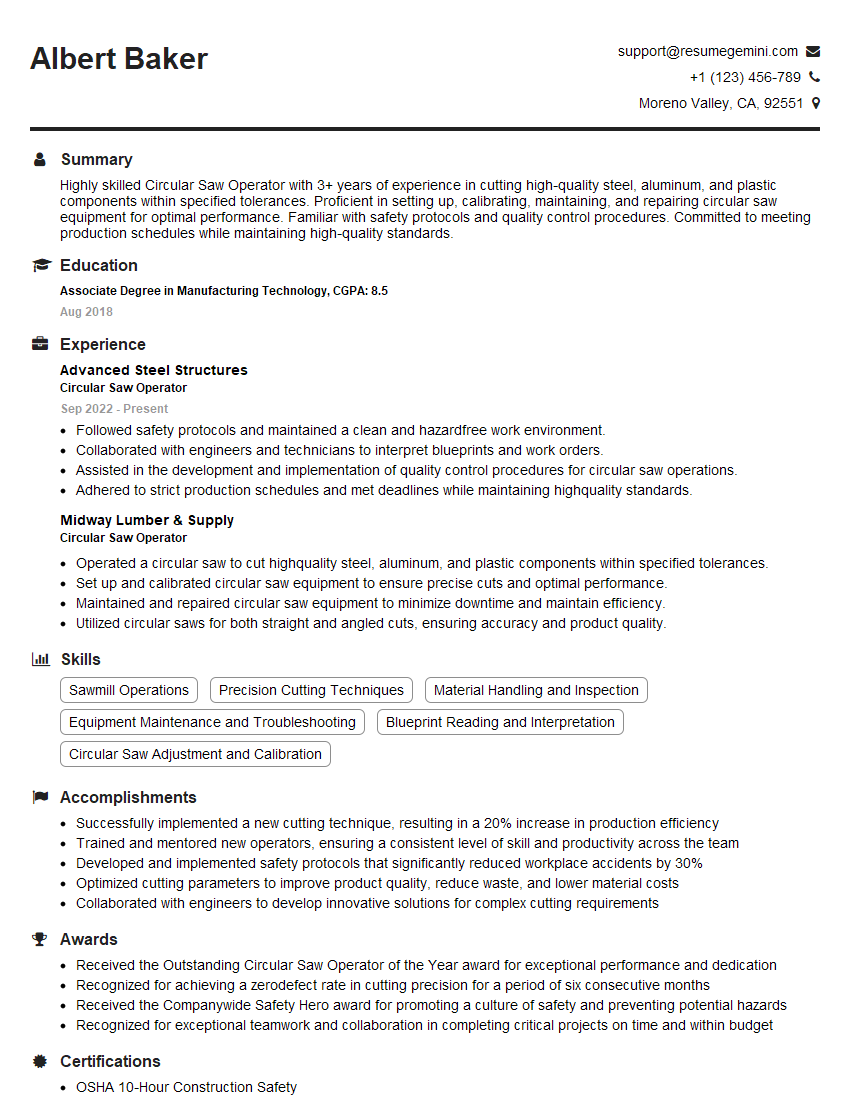
Mastering Circle Saw Operation opens doors to exciting career opportunities within the manufacturing and woodworking industries, offering potential for advancement and increased earning potential. To stand out from the competition, crafting an ATS-friendly resume is essential. ResumeGemini is a trusted resource to help you build a professional and impactful resume that highlights your skills and experience effectively. Examples of resumes tailored specifically to Circle Saw Operation are available to guide you, ensuring your application makes a strong first impression.


Explore more articles
Users Rating of Our Blogs
Share Your Experience
We value your feedback! Please rate our content and share your thoughts (optional).
What Readers Say About Our Blog
Attention music lovers!
Wow, All the best Sax Summer music !!!
Spotify: https://open.spotify.com/artist/6ShcdIT7rPVVaFEpgZQbUk
Apple Music: https://music.apple.com/fr/artist/jimmy-sax-black/1530501936
YouTube: https://music.youtube.com/browse/VLOLAK5uy_noClmC7abM6YpZsnySxRqt3LoalPf88No
Other Platforms and Free Downloads : https://fanlink.tv/jimmysaxblack
on google : https://www.google.com/search?q=22+AND+22+AND+22
on ChatGPT : https://chat.openai.com?q=who20jlJimmy20Black20Sax20Producer
Get back into the groove with Jimmy sax Black
Best regards,
Jimmy sax Black
www.jimmysaxblack.com
Hi I am a troller at The aquatic interview center and I suddenly went so fast in Roblox and it was gone when I reset.
Hi,
Business owners spend hours every week worrying about their website—or avoiding it because it feels overwhelming.
We’d like to take that off your plate:
$69/month. Everything handled.
Our team will:
Design a custom website—or completely overhaul your current one
Take care of hosting as an option
Handle edits and improvements—up to 60 minutes of work included every month
No setup fees, no annual commitments. Just a site that makes a strong first impression.
Find out if it’s right for you:
https://websolutionsgenius.com/awardwinningwebsites
Hello,
we currently offer a complimentary backlink and URL indexing test for search engine optimization professionals.
You can get complimentary indexing credits to test how link discovery works in practice.
No credit card is required and there is no recurring fee.
You can find details here:
https://wikipedia-backlinks.com/indexing/
Regards
NICE RESPONSE TO Q & A
hi
The aim of this message is regarding an unclaimed deposit of a deceased nationale that bears the same name as you. You are not relate to him as there are millions of people answering the names across around the world. But i will use my position to influence the release of the deposit to you for our mutual benefit.
Respond for full details and how to claim the deposit. This is 100% risk free. Send hello to my email id: lukachachibaialuka@gmail.com
Luka Chachibaialuka
Hey interviewgemini.com, just wanted to follow up on my last email.
We just launched Call the Monster, an parenting app that lets you summon friendly ‘monsters’ kids actually listen to.
We’re also running a giveaway for everyone who downloads the app. Since it’s brand new, there aren’t many users yet, which means you’ve got a much better chance of winning some great prizes.
You can check it out here: https://bit.ly/callamonsterapp
Or follow us on Instagram: https://www.instagram.com/callamonsterapp
Thanks,
Ryan
CEO – Call the Monster App
Hey interviewgemini.com, I saw your website and love your approach.
I just want this to look like spam email, but want to share something important to you. We just launched Call the Monster, a parenting app that lets you summon friendly ‘monsters’ kids actually listen to.
Parents are loving it for calming chaos before bedtime. Thought you might want to try it: https://bit.ly/callamonsterapp or just follow our fun monster lore on Instagram: https://www.instagram.com/callamonsterapp
Thanks,
Ryan
CEO – Call A Monster APP
To the interviewgemini.com Owner.
Dear interviewgemini.com Webmaster!
Hi interviewgemini.com Webmaster!
Dear interviewgemini.com Webmaster!
excellent
Hello,
We found issues with your domain’s email setup that may be sending your messages to spam or blocking them completely. InboxShield Mini shows you how to fix it in minutes — no tech skills required.
Scan your domain now for details: https://inboxshield-mini.com/
— Adam @ InboxShield Mini
support@inboxshield-mini.com
Reply STOP to unsubscribe
Hi, are you owner of interviewgemini.com? What if I told you I could help you find extra time in your schedule, reconnect with leads you didn’t even realize you missed, and bring in more “I want to work with you” conversations, without increasing your ad spend or hiring a full-time employee?
All with a flexible, budget-friendly service that could easily pay for itself. Sounds good?
Would it be nice to jump on a quick 10-minute call so I can show you exactly how we make this work?
Best,
Hapei
Marketing Director
Hey, I know you’re the owner of interviewgemini.com. I’ll be quick.
Fundraising for your business is tough and time-consuming. We make it easier by guaranteeing two private investor meetings each month, for six months. No demos, no pitch events – just direct introductions to active investors matched to your startup.
If youR17;re raising, this could help you build real momentum. Want me to send more info?
Hi, I represent an SEO company that specialises in getting you AI citations and higher rankings on Google. I’d like to offer you a 100% free SEO audit for your website. Would you be interested?
Hi, I represent an SEO company that specialises in getting you AI citations and higher rankings on Google. I’d like to offer you a 100% free SEO audit for your website. Would you be interested?