The thought of an interview can be nerve-wracking, but the right preparation can make all the difference. Explore this comprehensive guide to Circular Interpolation interview questions and gain the confidence you need to showcase your abilities and secure the role.
Questions Asked in Circular Interpolation Interview
Q 1. Explain the concept of circular interpolation in CNC machining.
Circular interpolation in CNC machining is a powerful technique that allows a machine tool to move along a circular path. Instead of programming each tiny point on the circle, you specify the starting point, the endpoint, and the center of the circle (or a radius and direction). The CNC controller then automatically calculates the intermediate points, creating a smooth, precise arc. Think of it like drawing a perfect circle with a compass – you define the key parameters, and the tool does the rest.
This significantly reduces programming time and data size, while improving the accuracy and efficiency of machining complex curved shapes, especially for intricate parts in industries like aerospace or automotive manufacturing.
Q 2. Describe the different types of circular interpolation (e.g., clockwise, counter-clockwise).
Circular interpolation comes in two main flavors: clockwise and counter-clockwise. The direction of the arc is crucial for generating the correct shape.
- Clockwise: The tool moves along the circular path in a clockwise direction. Imagine turning a clock’s hands.
- Counter-clockwise: The tool moves along the circular path in a counter-clockwise direction. Imagine reversing the clock’s hands.
Selecting the wrong direction results in the wrong part geometry. The specific G-code commands discussed later will incorporate the direction specification.
Q 3. How is circular interpolation programmed using G-code?
Circular interpolation is programmed using specific G-codes, which are essentially instructions for the CNC machine. These codes define the starting point, the endpoint, the center of the circle, and the direction of the arc. The controller uses this information to calculate the path and execute the cut.
The programming process usually involves defining the coordinates of the start and end points, and either the coordinates of the center or the radius, alongside a direction indicator (clockwise or counterclockwise). The machine then seamlessly interpolates the points between the start and end points, creating the arc.
Q 4. What are the G-codes used for defining circular interpolation arcs?
The most common G-codes for defining circular interpolation arcs are G02 (clockwise) and G03 (counter-clockwise). These codes are usually followed by coordinates specifying the start point, end point, and center point or radius.
For example: G02 X10 Y20 I5 J0 This code instructs the machine to move in a clockwise arc from the current position to X10, Y20, with the center of the arc located 5 units in the X-direction from the start point (I5), and 0 units in the Y-direction (J0).
Q 5. Explain the difference between IJK and R-plane circular interpolation.
Both IJK and R-plane methods define the center of the circle, but they do so differently:
- IJK method: This method specifies the coordinates of the circle’s center relative to the starting point of the arc.
Irepresents the X-offset from the starting point to the center, andJrepresents the Y-offset from the starting point to the center.Kis used for 3D circular interpolation, representing the Z-offset. - R-plane method: This method uses a single value,
R, which represents the radius of the circle. The center location is implicitly defined based on the starting point, endpoint and radius. It’s simpler but can be ambiguous for certain arcs with multiple possible center locations.
The IJK method provides more control and precision, especially when dealing with complex curves. The R method is simpler, but requires careful consideration of possible ambiguities.
Q 6. How do you determine the center coordinates for circular interpolation?
Determining the center coordinates is fundamental for accurate circular interpolation. There are several ways to do this depending on the available information.
- Geometric Calculation: If you know the starting point, endpoint, and radius, you can use geometry to calculate the coordinates of the center. This involves solving a system of equations based on the distance formula and circle properties.
- CAD Software: CAD software packages offer tools to design circles and arcs directly, providing the center coordinates as part of the design process. This is a widely used approach that reduces manual calculations.
- Manual Measurement: In simpler cases, you might be able to measure the center coordinates directly from the part’s drawing or physical model. This method is suited for simple geometries but may not be suitable for intricate parts.
Regardless of the method, accuracy is paramount. Errors in center coordinate determination directly translate to errors in the machined part.
Q 7. Describe the limitations of circular interpolation.
While powerful, circular interpolation has limitations:
- Radius Limitations: Some CNC machines have limitations on the minimum and maximum radius of the circles they can interpolate. Very small or very large radii might cause issues or require specific machine configurations.
- Sharp Corners: Circular interpolation isn’t ideal for creating sharp corners. Small radius arcs can approximate corners, but true sharp corners are usually created using line segments.
- Computational Complexity: The CNC controller needs to perform calculations to create the circular path. Extremely complex curves might exceed the controller’s processing capabilities, leading to errors or slow machining speeds.
- Interference Issues: The toolpath needs to be carefully planned to avoid collisions with the fixture or other parts of the machine. Circular interpolation often requires more meticulous collision avoidance planning than linear interpolation.
Understanding these limitations is crucial for successful programming and to avoid machining errors or unexpected behavior.
Q 8. What are the potential errors associated with circular interpolation and how can they be avoided?
Circular interpolation, while efficient for machining curves, is susceptible to several errors. These errors can stem from inaccuracies in the machine’s mechanical components, control system limitations, or programming mistakes.
- Mechanical Errors: Backlash in the machine’s axes, wear and tear on bearings, and inaccuracies in the lead screws can all contribute to deviations from the intended circular path. Imagine trying to draw a perfect circle with a slightly wobbly compass – the result won’t be ideal.
- Control System Errors: The CNC controller’s resolution and interpolation algorithm directly influence accuracy. A lower resolution might lead to a polygonal approximation of the circle rather than a smooth curve. Similarly, limitations in the controller’s processing speed can affect the smoothness of the interpolation.
- Programming Errors: Incorrectly specifying the center coordinates, radius, or arc angle in the G-code program can result in significant errors. A simple typo can lead to a completely wrong shape.
To minimize these errors, regular machine maintenance is crucial. This includes lubrication, calibration, and periodic checks for wear and tear. Selecting a CNC controller with high resolution and a robust interpolation algorithm is also vital. Finally, meticulous programming practices, including thorough verification of G-code before execution, are paramount.
Q 9. How does the feed rate affect the accuracy of circular interpolation?
The feed rate, or the speed at which the tool moves along the circular path, directly impacts the accuracy of circular interpolation. A very high feed rate can lead to overshoot or undershoot, causing the tool to deviate from the intended path, resulting in a rough or inaccurate circle.
Think of it like trying to draw a circle quickly with a pen – the faster you move, the more likely you are to make mistakes. Conversely, an extremely slow feed rate might increase the overall machining time without significantly improving accuracy, though it can be beneficial to reduce other error sources.
The ideal feed rate depends on several factors, including the machine’s capabilities, the material being machined, the tool’s geometry, and the desired surface finish. Experimentation and careful consideration of these factors are crucial to finding the optimal feed rate for a given application.
Q 10. How is arc interpolation handled in different CNC controllers?
Different CNC controllers handle arc interpolation using varying algorithms and methods. While the fundamental principle remains the same – generating a series of closely spaced points along the circular arc – the implementation details can differ significantly.
- Incremental Interpolation: Some controllers use incremental interpolation, calculating each point’s position relative to the previous one. This is a simple but potentially less accurate method, especially for large arcs.
- Direct Interpolation: Other controllers use direct interpolation, calculating the position directly from the center coordinates, radius, and angular position. This is generally more accurate and efficient for large arcs.
- Linear Interpolation with Small Segments: A common strategy, especially in simpler controllers, is to approximate the arc using a series of short linear segments. The smaller the segments, the better the approximation but the higher the processing load.
Modern controllers often employ sophisticated algorithms that optimize the interpolation process, minimizing the number of calculated points while maintaining high accuracy and smooth toolpaths. The specific implementation details are generally proprietary and vary between manufacturers and controller models.
Q 11. Explain the role of tool radius compensation in circular interpolation.
Tool radius compensation (TRC) is crucial in circular interpolation, especially when machining features that require a specific tool path relative to the programmed geometry. It ensures that the actual tool path correctly accounts for the tool’s physical diameter, preventing errors where the cut is either too wide or too narrow.
Imagine trying to cut a hole with a drill bit. The center of the drill bit needs to be slightly offset from the intended hole’s center to account for the bit’s radius. TRC automatically handles this offset, ensuring the final hole’s diameter matches the desired dimensions.
There are two main types of TRC: G41 (left compensation) and G42 (right compensation). The choice depends on whether the tool path should be to the left or right of the programmed geometry. Incorrectly using TRC can result in the cut being off target, potentially damaging the workpiece or requiring rework.
Q 12. How do you program a full circle using circular interpolation?
Programming a full circle using circular interpolation typically involves specifying the start point, center point, and the end point (which is the same as the start point in a full circle). The CNC controller then automatically calculates the necessary intermediate points to generate the circular path.
A common G-code example (depending on the CNC controller):
G01 X10 Y0 F50 ; Move to start point
G02 X10 Y0 I0 J0 R10 F50 ; Full circle clockwise, radius 10
Here, G02 indicates clockwise circular interpolation. I and J are the coordinates of the center relative to the start point (0, 0 in this case because the start point is also the center) and R is the radius.
Some controllers might use a different format, for instance, specifying the arc’s end point directly, but the principle remains the same: define the start point, center, radius, and direction.
Q 13. How do you program a partial circle using circular interpolation?
Programming a partial circle requires specifying the start point, center point, and the end point of the arc. The CNC controller will then generate the toolpath for the arc between the specified start and end points.
Example of programming a 90-degree arc clockwise:
G01 X10 Y0 F50 ; Move to start point
G02 X10 Y10 I0 J10 R10 F50 ; 90-degree arc clockwise, radius 10
Here, the arc will start at (10,0) and end at (10,10) with the center at (10,10). The I and J values define the center position relative to the start position, and R denotes the radius. The controller infers the arc length from the provided start and end points.
For counter-clockwise arcs, G03 is used instead of G02. Note that the specific G-code might vary depending on the CNC controller’s dialect.
Q 14. How is circular interpolation implemented in robotic systems?
Circular interpolation is implemented in robotic systems to enable smooth and precise movements along curved paths. Robotic arms often need to perform complex maneuvers, such as welding, painting, or assembly operations, which frequently involve circular or arc-like trajectories.
The implementation typically involves advanced control algorithms that handle the kinematics of the robot arm. The desired circular path is broken down into a sequence of points, and the control system calculates the joint angles required to move the end-effector (the robot’s hand or tool) along that path. This process often utilizes techniques such as cubic splines or other higher-order polynomial interpolation to ensure smooth and continuous motion.
Similar to CNC machines, factors such as the robot’s speed, accuracy, and payload capacity influence the choice of algorithms and the planning of circular trajectories. Sophisticated robotic control systems will often incorporate collision avoidance and path optimization algorithms to enhance the safety and efficiency of the robot’s movements.
Q 15. What are the challenges of implementing circular interpolation in real-time systems?
Implementing circular interpolation in real-time systems presents several challenges. Primarily, it’s the need for precise and fast calculations within strict time constraints. Each interpolated point needs to be computed and sent to the actuator (e.g., a motor in a CNC machine) before the next time step, or the movement will appear jerky. This is particularly demanding when dealing with high-resolution arcs or fast movements.
- Computational Load: Calculating trigonometric functions (sine and cosine) for each point is computationally expensive. Real-time systems often have limited processing power, demanding efficient algorithms and potentially specialized hardware.
- Timing Constraints: Missing a deadline in a real-time system can lead to catastrophic failures. Careful consideration of the computational load and system clock is crucial to guarantee timely execution.
- Accuracy Requirements: Maintaining high accuracy is essential. Small errors in calculation can accumulate, leading to significant deviations from the intended circular path, especially for large arcs. This necessitates robust numerical methods and careful consideration of floating-point precision.
- Interrupts and External Factors: Real-time systems are often susceptible to interruptions from other processes or external events. The interpolation algorithm must be designed to handle these interruptions gracefully without compromising accuracy or timing.
Imagine a robotic arm painting a circle. If the calculations are too slow, the arm will move in a jagged, inaccurate circle. Efficient algorithms are critical to creating a smooth, perfectly circular path.
Career Expert Tips:
- Ace those interviews! Prepare effectively by reviewing the Top 50 Most Common Interview Questions on ResumeGemini.
- Navigate your job search with confidence! Explore a wide range of Career Tips on ResumeGemini. Learn about common challenges and recommendations to overcome them.
- Craft the perfect resume! Master the Art of Resume Writing with ResumeGemini’s guide. Showcase your unique qualifications and achievements effectively.
- Don’t miss out on holiday savings! Build your dream resume with ResumeGemini’s ATS optimized templates.
Q 16. How does the interpolation method impact the smoothness of the generated path?
The interpolation method directly influences the smoothness of the generated path. Different methods offer varying degrees of precision and computational efficiency.
- Linear Interpolation: This is the simplest approach but produces a polygon approximation of the circle. More points are needed for a smoother path, but this increases the computational burden. The resulting path is composed of short line segments, leading to visible corners at higher speeds.
- Circular Interpolation (True Circular Interpolation): This generates points directly on the circle’s circumference, offering the smoothest path. The result is inherently smooth and accurate but requires more complex calculations.
- Spline Interpolation: Splines, while not directly generating a circle, can approximate a circular arc with high accuracy and smoothness, especially when dealing with complex curves including arcs.
For instance, using linear interpolation with only four points would produce a square. Increasing the number of points leads to better approximations; however, true circular interpolation is the only method to get a perfectly smooth and accurate circle.
Q 17. Explain the significance of coordinate systems in circular interpolation.
Coordinate systems are fundamental to circular interpolation. The choice of coordinate system impacts how the circle is defined and how the interpolation algorithm computes points on its circumference.
- Cartesian Coordinate System (X-Y): This system defines the circle using its center coordinates (xc, yc) and radius (r). Interpolation algorithms calculate (x, y) coordinates along the circumference using trigonometric functions like sine and cosine.
- Polar Coordinate System (r, θ): This system is more intuitive for defining circular motion, as the circle is defined by a radius and angle. Interpolation directly computes the angle and uses it with the radius to derive Cartesian coordinates.
Imagine trying to draw a circle on a map. You can either use Cartesian coordinates (longitude and latitude of the center and radius) or the polar approach (a center and angle). Each approach facilitates different aspects of the interpolation process. The choice depends on the specific application and how the circle is defined in the input data.
Q 18. Describe the relationship between circular interpolation and spline interpolation.
Circular interpolation and spline interpolation are related but distinct techniques. Circular interpolation specifically deals with generating points along the arc of a circle. Spline interpolation is a more general method used to create smooth curves through a set of points, which can include circular arcs but also handles more complex shapes.
Splines can approximate a circular arc with high precision, particularly when representing curves with varying curvatures. However, dedicated circular interpolation offers better performance and efficiency when dealing with arcs exclusively because it utilizes optimized trigonometric calculations instead of the more computationally intensive matrix operations used by many spline algorithms.
In essence, circular interpolation is a specialized case within the broader context of spline interpolation. You might use a spline if you have a series of points, some of which are meant to approximate a circle while others are non-circular. Circular interpolation is the most appropriate when you know the circle’s parameters explicitly.
Q 19. How is the accuracy of circular interpolation verified?
Verifying the accuracy of circular interpolation involves comparing the generated points to the ideal circle’s equation. Several methods can be employed:
- Distance from Center: Calculate the distance of each interpolated point from the circle’s center. The distance should be within an acceptable tolerance of the specified radius.
- Geometric Verification: Compare the generated points to a mathematically defined circle using error metrics like mean squared error (MSE) or root mean squared error (RMSE). Smaller errors indicate better accuracy.
- Visual Inspection (for simple cases): Plot the generated points to visually assess if they closely resemble a circle. This is a simple method for debugging, but less robust for precision assessment.
- Comparison with Reference Data: If reference data for the ideal circle is available (perhaps from CAD software), compare the generated data against this to assess the error.
For example, you could programmatically calculate the distance of each interpolated point from the circle’s center. If the distance falls outside a predefined tolerance, it indicates a problem with the interpolation algorithm or its parameters. More sophisticated methods quantify the error in a more precise way.
Q 20. Explain how to handle transitions between linear and circular interpolation.
Transitions between linear and circular interpolation require careful handling to avoid abrupt changes in velocity or acceleration. This is crucial for smooth movement and prevents jerky motions or damage to the machinery.
A common method involves introducing a ‘blend’ region where the transition occurs. This region uses a curve, often a spline, to smoothly connect the linear segment to the circular arc. The shape and length of this blend region depend on the application’s requirements and the desired smoothness. This blend can be parameterized, for instance, by specifying a transition distance or time.
Another approach would be to employ velocity profiles to manage the acceleration during the change between linear and circular motion. This may require careful calculation of the velocities and accelerations at the transition point to avoid sudden changes or jerk. These calculations often take into account the maximum allowable velocities and accelerations of the system to ensure that the transition doesn’t exceed the system’s capabilities.
Think of a car smoothly turning a corner. The transition from straight motion to a circular arc needs to be graceful to avoid a sudden change of direction that could be uncomfortable or unsafe. Similarly, in CNC machining, the transition needs to be smooth to avoid damaging the workpiece.
Q 21. What are the common issues encountered when implementing circular interpolation in CNC machines?
Implementing circular interpolation in CNC machines can present several issues:
- Backlash: Mechanical backlash in the machine’s axes can lead to inaccuracies in the generated circle. This is especially noticeable at slower speeds. Compensation techniques, like pre-loading or advanced control algorithms, are often needed.
- Machine Vibrations: Vibrations during machining can cause deviations from the intended path. Rigid machine structures and vibration damping mechanisms help to mitigate this problem.
- Feedrate Control: Maintaining a constant feedrate along a circular path requires precise control of the motors. Errors in feedrate can result in irregular circles.
- Overruns and Undershoots: Overshoots or undershoots can occur due to insufficient sampling rate of the control loop or inaccuracies in the interpolation algorithm. This can manifest as inaccurate final positions or incorrect circular path geometry.
- Tool Radius Compensation: The radius of the cutting tool must be accounted for to achieve the desired workpiece dimensions. Incorrect compensation leads to errors in the final shape.
For example, backlash can cause the actual path to deviate from the intended circular path, leading to a slightly deformed circle. Proper machine calibration, precise feedrate control, and advanced control algorithms are essential to minimize these issues and ensure accuracy.
Q 22. How can you optimize the efficiency of circular interpolation routines?
Optimizing circular interpolation efficiency involves minimizing computational overhead and maximizing the smoothness of the generated path. This is crucial for applications requiring high speed and precision, like CNC machining or robotics. Key strategies include:
Using optimized algorithms: Instead of calculating each point individually, employ algorithms that leverage trigonometric identities or pre-computed lookup tables to reduce redundant calculations. This can significantly speed up the process, especially for large circles or high resolutions.
Reducing interpolation steps: While higher resolution leads to smoother curves, it also increases the computational burden. Finding the optimal balance between smoothness and efficiency is key. Techniques like adaptive step size control, where the step size is adjusted based on the curvature of the circle, can help.
Hardware acceleration: Leveraging specialized hardware like GPUs or DSPs can offload computationally intensive parts of the interpolation process, freeing up the main processor for other tasks. This is particularly beneficial in real-time applications.
Data pre-processing: If the circle parameters are known beforehand, pre-calculating interpolation data and storing it in memory can significantly reduce runtime computation. This is especially useful in scenarios with repetitive circular movements.
For example, consider a CNC milling machine cutting a complex part with numerous circular arcs. Using optimized algorithms and adaptive step size control will ensure the machine moves smoothly and efficiently, reducing machining time and improving part quality.
Q 23. Discuss the differences between incremental and absolute programming in the context of circular interpolation.
Incremental and absolute programming differ in how they define the coordinates for circular interpolation. Imagine you’re giving instructions to a robot arm:
Absolute Programming: Each point on the circle’s path is defined by its absolute coordinates (X, Y) relative to a fixed origin. The robot knows exactly where it needs to be at each point in relation to the entire workspace. This is like providing a map with exact locations.
Incremental Programming: Each point is defined by its relative displacement (ΔX, ΔY) from the previous point. The robot moves a specific distance and direction from its current position. It’s like giving a series of directional instructions: ‘walk 10 meters north,’ then ‘turn 30 degrees and walk 5 meters east’, etc.
In circular interpolation, absolute programming involves specifying the center coordinates (Xc, Yc) and the radius (R) along with the start and end angles of the arc. Incremental programming would involve specifying the initial point and then subsequent incremental movements to trace out the arc. The choice depends on the application and control system. Absolute programming is often easier to understand and manage, while incremental programming can be more efficient for complex paths involving multiple connected arcs.
Q 24. Describe the concept of ‘look-ahead’ in circular interpolation.
Look-ahead in circular interpolation is a technique used to improve the smoothness and accuracy of motion control by anticipating future path segments. Instead of processing one interpolation step at a time, the controller looks ahead at the upcoming portion of the circular path. Think of it like a driver who looks ahead while driving a car to anticipate curves and adjust their speed accordingly.
This anticipation allows the controller to adjust the feed rate and acceleration in advance, resulting in smoother transitions between segments and reducing jerkiness, particularly at the transition points of multiple arcs. Look-ahead algorithms typically involve a buffer containing information on the next few points in the path. The farther the look-ahead, the smoother the motion, but it also increases the computational burden.
For instance, in a high-speed CNC machine, look-ahead allows the controller to smoothly transition between circular arcs and linear segments, reducing vibrations and increasing machining accuracy. Without look-ahead, the rapid changes in direction could cause overshoots or oscillations.
Q 25. How is circular interpolation implemented in different programming languages (e.g., Python) ?
Circular interpolation can be implemented in various programming languages. In Python, libraries like NumPy and SciPy provide tools for generating circular paths.
Here’s a simple example using NumPy to generate points on a circle:
import numpy as np
import matplotlib.pyplot as plt

center_x, center_y = 0, 0
radius = 5
num_points = 100

theta = np.linspace(0, 2*np.pi, num_points)
x = center_x + radius * np.cos(theta)
y = center_y + radius * np.sin(theta)

plt.plot(x, y)
plt.show()
This code generates 100 points evenly spaced on a circle with a radius of 5 centered at the origin. More sophisticated implementations would involve handling incremental or absolute positioning, feed rate control, and look-ahead algorithms, often requiring libraries tailored to specific hardware interfaces and control systems.
Q 26. How to deal with sharp corners during circular interpolation?
Sharp corners in circular interpolation are problematic because they require abrupt changes in velocity and acceleration, leading to jerky motion, inaccuracies, and potential damage to the equipment (e.g., a CNC machine). The solution lies in smoothing those corners.
Filleting: Replace the sharp corner with a small circular arc (a fillet). This smooths the transition and makes the path more continuous. The radius of the fillet determines the degree of smoothing.
Chamfering: Similar to filleting, but instead of a circular arc, a chamfer uses a short linear segment to connect two lines. This is less computationally expensive but might not provide as smooth a transition as filleting.
The choice between filleting and chamfering depends on the specific application and the acceptable tolerance of the final path. For instance, in high-precision machining, a small radius fillet might be preferred for higher accuracy, whereas chamfering may suffice for applications where the precision requirements are less stringent.
Consider the scenario of a robot arm needing to move from one point to another forming a sharp angle. Introducing a fillet will dramatically improve the smooth movement and reduce strain on the robot.
Q 27. What are the safety considerations associated with circular interpolation?
Safety considerations in circular interpolation are paramount, especially in applications involving moving machinery or robots:
Overtravel prevention: Ensure the interpolated path remains within the safe operating limits of the machine. This requires careful planning and programming, considering the physical constraints of the system.
Collision avoidance: Implement collision detection and avoidance algorithms to prevent collisions between the moving object (robot arm, CNC tool, etc.) and its surroundings. This might involve using sensors or sophisticated path planning.
Emergency stops: Robust emergency stop mechanisms must be integrated to allow immediate halting of the interpolation process in case of unexpected events or errors.
Feed rate control: Proper feed rate control is critical to avoid excessive forces or speeds that could cause damage or injury.
Software verification and validation: Rigorous testing and simulation of the circular interpolation routines are essential to identify and address potential safety hazards before deployment.
Imagine a robotic arm painting a car. Improper implementation of safety features could result in the arm colliding with the car, causing damage. Comprehensive safety protocols are essential.
Q 28. Describe the role of feed rate control in maintaining precision during circular interpolation.
Feed rate control plays a crucial role in maintaining precision during circular interpolation. It determines the speed at which the tool or mechanism moves along the circular path. Accurate feed rate control ensures:
Consistent surface finish: A constant feed rate ensures a consistent surface quality in machining applications. Variations in speed can lead to uneven surfaces or tool marks.
Reduced vibrations: Sudden changes in feed rate can cause vibrations, leading to inaccuracies and potential damage to the machine or workpiece. Smooth and controlled feed rate changes minimize vibrations.
Improved accuracy: A well-controlled feed rate ensures that the path is followed accurately, avoiding overshoots or undershoots. This is especially important in high-precision applications.
Prevention of damage: Excessive feed rates can overload the machine or tool, causing damage or breakage. Careful feed rate selection is critical for safety and longevity.
Consider a CNC machine cutting a delicate metal component. An improperly controlled feed rate could lead to tool chatter (vibrations), creating a poor surface finish and potentially breaking the tool. Precise feed rate management is crucial for maintaining both accuracy and operational safety.
Key Topics to Learn for Circular Interpolation Interview
- Fundamental Concepts: Understand the mathematical basis of circular interpolation, including parametric equations, vector representation, and trigonometric functions relevant to circular motion.
- Algorithms and Implementations: Familiarize yourself with common algorithms used for circular interpolation, such as linear interpolation, constant angular velocity interpolation, and spline-based methods. Consider their computational efficiency and accuracy.
- Coordinate Systems and Transformations: Grasp the role of different coordinate systems (Cartesian, polar) and the transformations between them in the context of circular interpolation. Be prepared to discuss rotations and translations.
- Practical Applications: Explore real-world applications of circular interpolation in robotics (robot arm movement), CNC machining (toolpath generation), computer graphics (animation), and other relevant fields. Be ready to discuss specific examples.
- Error Analysis and Optimization: Understand potential sources of error in circular interpolation (e.g., quantization, numerical precision) and techniques for minimizing these errors. Discuss optimization strategies for speed and accuracy.
- Advanced Topics (Optional): Depending on the seniority of the role, you may want to explore more advanced topics such as non-uniform circular interpolation, interpolation with constraints, or real-time applications and their performance considerations.
Next Steps
Mastering circular interpolation opens doors to exciting career opportunities in various high-tech industries. A strong understanding of this fundamental concept significantly enhances your profile and demonstrates valuable problem-solving skills to potential employers. To maximize your job prospects, create an ATS-friendly resume that highlights your expertise effectively. We recommend using ResumeGemini, a trusted resource, to build a professional and impactful resume tailored to your specific skills and experience. Examples of resumes tailored to Circular Interpolation are available, showcasing how to best present your qualifications. Take the next step and craft a resume that truly represents your capabilities – your dream job is waiting!

Automation Engineer Resume Sample
Systems Integration Engineer Resume Sample
Manufacturing Engineer Resume Sample
Control Systems Engineer Resume Sample
Mechatronics Engineer Resume Sample
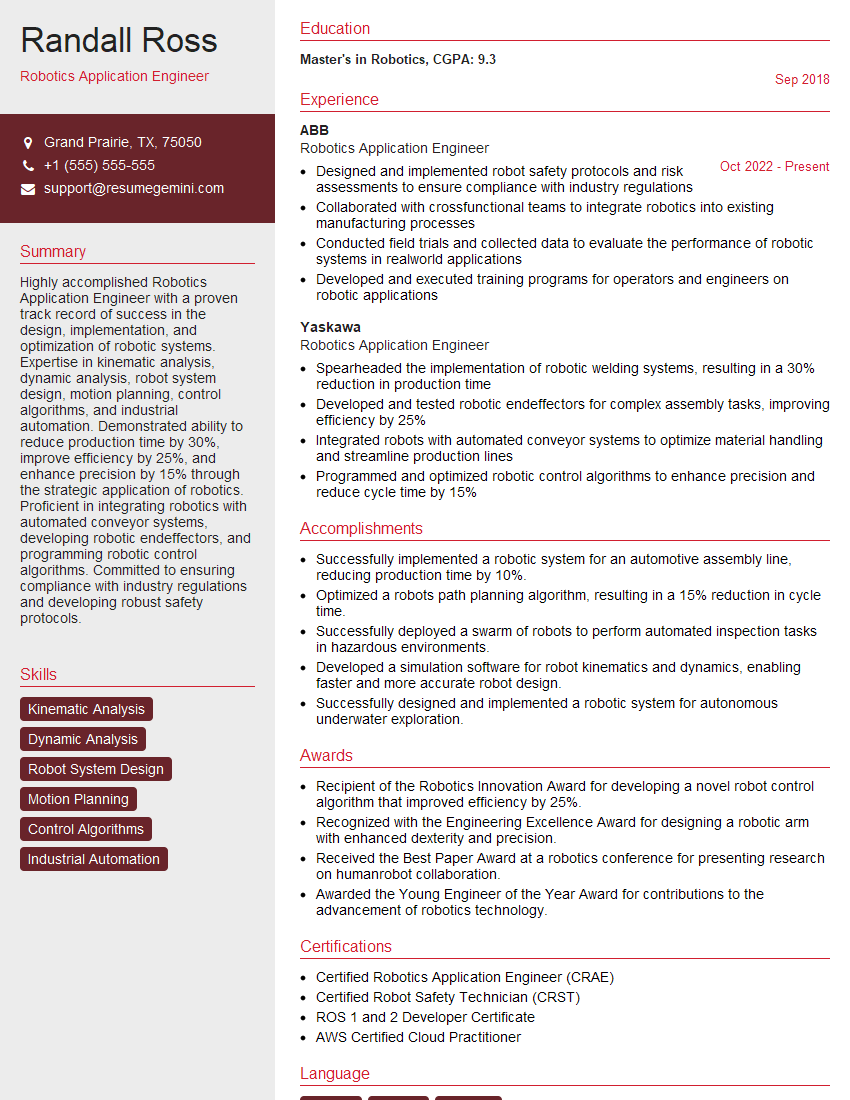
Robotics Application Engineer Resume Sample
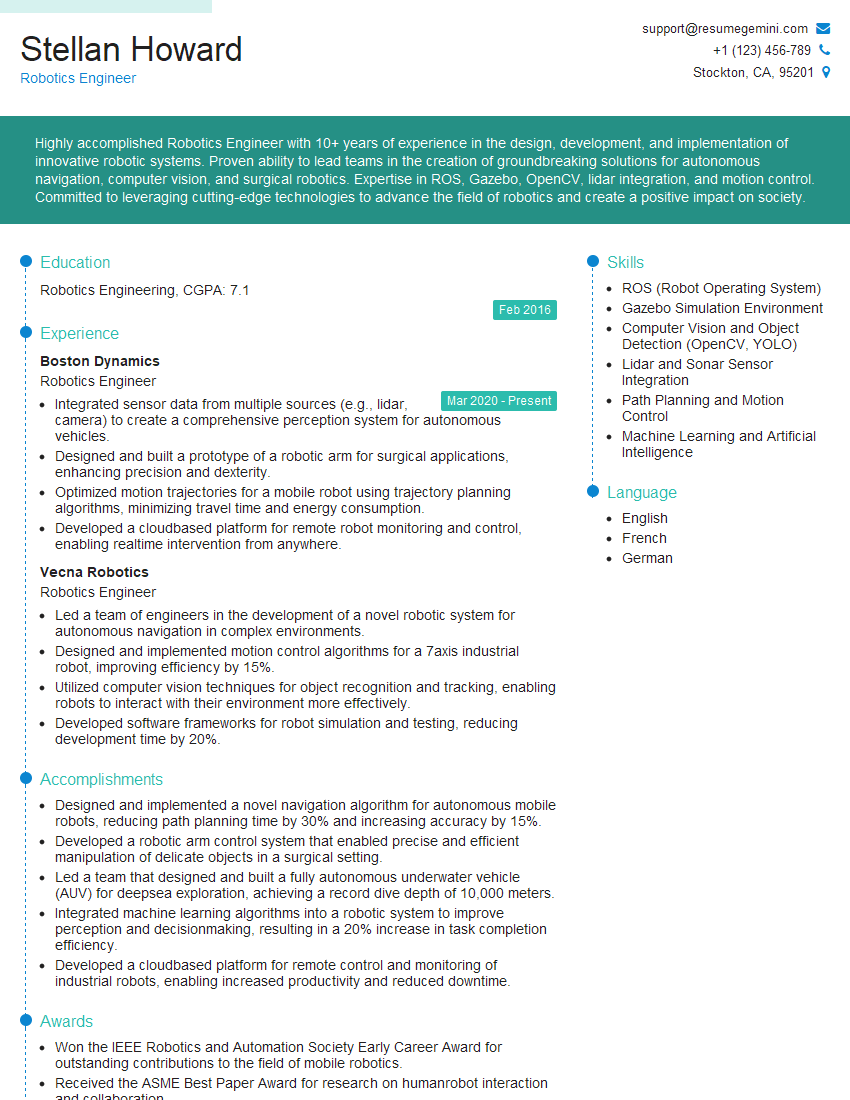
Robotics Engineer Resume Sample
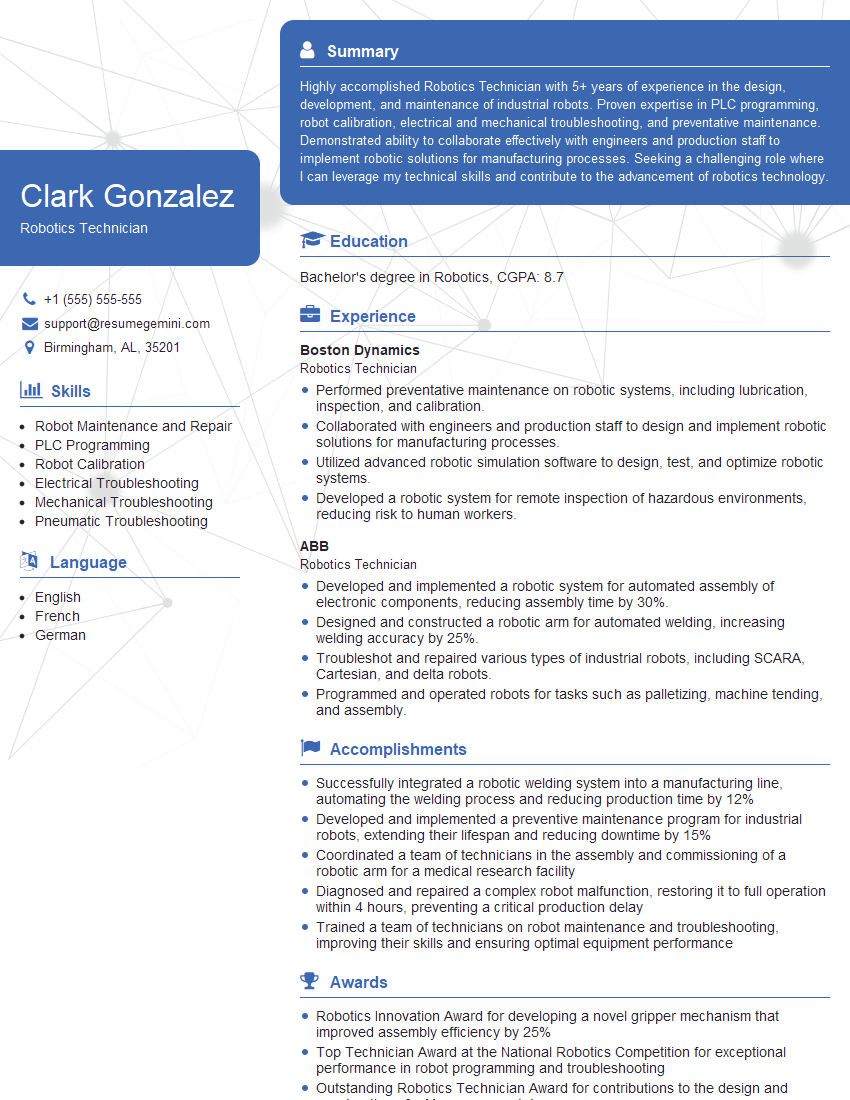
Robotics Technician Resume Sample
Explore more articles
Users Rating of Our Blogs
Share Your Experience
We value your feedback! Please rate our content and share your thoughts (optional).
What Readers Say About Our Blog
Hello,
we currently offer a complimentary backlink and URL indexing test for search engine optimization professionals.
You can get complimentary indexing credits to test how link discovery works in practice.
No credit card is required and there is no recurring fee.
You can find details here:
https://wikipedia-backlinks.com/indexing/
Regards
NICE RESPONSE TO Q & A
hi
The aim of this message is regarding an unclaimed deposit of a deceased nationale that bears the same name as you. You are not relate to him as there are millions of people answering the names across around the world. But i will use my position to influence the release of the deposit to you for our mutual benefit.
Respond for full details and how to claim the deposit. This is 100% risk free. Send hello to my email id: [email protected]
Luka Chachibaialuka
Hey interviewgemini.com, just wanted to follow up on my last email.
We just launched Call the Monster, an parenting app that lets you summon friendly ‘monsters’ kids actually listen to.
We’re also running a giveaway for everyone who downloads the app. Since it’s brand new, there aren’t many users yet, which means you’ve got a much better chance of winning some great prizes.
You can check it out here: https://bit.ly/callamonsterapp
Or follow us on Instagram: https://www.instagram.com/callamonsterapp
Thanks,
Ryan
CEO – Call the Monster App
Hey interviewgemini.com, I saw your website and love your approach.
I just want this to look like spam email, but want to share something important to you. We just launched Call the Monster, a parenting app that lets you summon friendly ‘monsters’ kids actually listen to.
Parents are loving it for calming chaos before bedtime. Thought you might want to try it: https://bit.ly/callamonsterapp or just follow our fun monster lore on Instagram: https://www.instagram.com/callamonsterapp
Thanks,
Ryan
CEO – Call A Monster APP
To the interviewgemini.com Owner.
Dear interviewgemini.com Webmaster!
Hi interviewgemini.com Webmaster!
Dear interviewgemini.com Webmaster!
excellent
Hello,
We found issues with your domain’s email setup that may be sending your messages to spam or blocking them completely. InboxShield Mini shows you how to fix it in minutes — no tech skills required.
Scan your domain now for details: https://inboxshield-mini.com/
— Adam @ InboxShield Mini
Reply STOP to unsubscribe
Hi, are you owner of interviewgemini.com? What if I told you I could help you find extra time in your schedule, reconnect with leads you didn’t even realize you missed, and bring in more “I want to work with you” conversations, without increasing your ad spend or hiring a full-time employee?
All with a flexible, budget-friendly service that could easily pay for itself. Sounds good?
Would it be nice to jump on a quick 10-minute call so I can show you exactly how we make this work?
Best,
Hapei
Marketing Director
Hey, I know you’re the owner of interviewgemini.com. I’ll be quick.
Fundraising for your business is tough and time-consuming. We make it easier by guaranteeing two private investor meetings each month, for six months. No demos, no pitch events – just direct introductions to active investors matched to your startup.
If youR17;re raising, this could help you build real momentum. Want me to send more info?
Hi, I represent an SEO company that specialises in getting you AI citations and higher rankings on Google. I’d like to offer you a 100% free SEO audit for your website. Would you be interested?
Hi, I represent an SEO company that specialises in getting you AI citations and higher rankings on Google. I’d like to offer you a 100% free SEO audit for your website. Would you be interested?
good