Are you ready to stand out in your next interview? Understanding and preparing for COMINT Analysis interview questions is a game-changer. In this blog, we’ve compiled key questions and expert advice to help you showcase your skills with confidence and precision. Let’s get started on your journey to acing the interview.
Questions Asked in COMINT Analysis Interview
Q 1. Explain the difference between COMINT, ELINT, and HUMINT.
COMINT, ELINT, and HUMINT are all types of intelligence gathering, but they differ significantly in their methods and sources. Think of them as three different ways to listen in on a conversation.
- COMINT (Communications Intelligence): This focuses on intercepting and analyzing communications, like phone calls, radio transmissions, and internet data. It’s about listening to what people are *saying* to each other. For example, intercepting a terrorist group’s radio chatter to plan an operation.
- ELINT (Electronic Intelligence): This deals with intercepting and analyzing non-communication electronic signals, such as radar emissions, satellite signals, and weapon system emissions. This isn’t about the message; it’s about understanding the technology itself. Imagine identifying the type and location of enemy radar systems based on their signal characteristics.
- HUMINT (Human Intelligence): This involves gathering intelligence from human sources, like spies, informants, and defectors. It’s about what people *know* – their motivations, plans, capabilities. An example would be recruiting an insider to reveal information about a company’s upcoming product launch.
In short: COMINT is about the conversation, ELINT is about the technology, and HUMINT is about the people.
Q 2. Describe the process of intercepting and analyzing a radio frequency signal.
Intercepting and analyzing a radio frequency (RF) signal is a multi-step process. It starts with the interception, which is usually done using specialized antennas and receivers tuned to the frequency of interest.
- Signal Acquisition: A directional antenna focuses on the target signal, filtering out noise and interference from other signals. The receiver then amplifies the weak signal.
- Signal Processing: Raw signals are rarely useful. Techniques like filtering, modulation recognition, and demodulation are used to extract information from the raw signal. This often involves sophisticated digital signal processing (DSP) algorithms.
- Traffic Analysis: Even without fully decoding the signal, analyzing transmission patterns – who is talking to whom, how often, and for how long – can yield valuable intelligence. For example, increased communication between two known adversaries might indicate impending hostile action.
- Decoding and Transcription: Depending on the type of modulation and encryption used, decoding the signal may be straightforward or extremely challenging. This often involves specialized software and a deep understanding of cryptographic techniques.
- Data Analysis and Interpretation: Once the signal is decoded and transcribed, the data is analyzed to extract meaningful intelligence. This requires linguistic skills, technical expertise, and a good understanding of the target’s communication methods and objectives. For instance, analysts might detect patterns within communications that indicate potential cyberattacks.
Imagine it like receiving a coded message. First you have to receive the message, then decipher the code, and finally understand its meaning.
Q 3. What are some common challenges in COMINT analysis?
COMINT analysis faces numerous challenges, many stemming from the inherent nature of communications and the constant technological evolution.
- Encryption: Sophisticated encryption techniques make it increasingly difficult to decode intercepted communications. Breaking encryption often requires significant computational resources and expertise.
- Noise and Interference: Background noise and interference from other signals can obscure the target signal, making analysis difficult. Think of trying to hear a conversation amidst a crowded marketplace.
- Data Volume: The sheer volume of data intercepted can be overwhelming, requiring efficient data management and analysis techniques. This demands sophisticated data mining and machine learning techniques.
- Signal Obscuration Techniques: Adversaries employ various techniques like spread-spectrum techniques and frequency hopping to make their signals harder to detect and analyze.
- Legal and Ethical Considerations: The interception and analysis of communications must always comply with relevant laws and ethical guidelines, requiring careful consideration and oversight.
Overcoming these challenges requires advanced technology, highly skilled analysts, and a robust understanding of both communication technologies and adversary tactics.
Q 4. How do you identify and prioritize targets for COMINT operations?
Targeting in COMINT is crucial for efficient resource allocation. It’s a strategic process based on intelligence assessments and prioritization matrices.
- Intelligence Requirements: The process begins by identifying specific intelligence needs. What information is required? What are the critical questions that need to be answered?
- Target Identification: Based on intelligence needs, potential targets are identified. This might involve known adversaries, suspected criminal organizations, or entities of strategic interest.
- Prioritization: Targets are prioritized based on factors like their value to the intelligence objective, the likelihood of success in intercepting their communications, and the risk associated with the operation.
- Resource Allocation: Resources, including personnel, equipment, and time, are allocated based on the prioritized target list. High-value targets receive the greatest attention.
- Assessment and Adjustment: The effectiveness of the targeting process is continually assessed and adjustments are made as needed. Intelligence gathered may lead to the identification of new targets or the re-prioritization of existing ones.
Imagine it like a detective investigating a crime. They don’t just randomly listen in on everyone; they focus their efforts on individuals and locations that are most likely to provide relevant information.
Q 5. Explain your understanding of signal processing techniques used in COMINT.
Signal processing is the backbone of COMINT analysis. It involves a wide array of techniques to extract information from raw signals.
- Filtering: Removing unwanted noise and interference from the signal, allowing for better signal clarity.
- Modulation Recognition: Identifying the type of modulation used (e.g., Amplitude Modulation, Frequency Modulation) to determine the appropriate demodulation technique.
- Demodulation: Extracting the information-bearing signal from the carrier wave. This might involve using algorithms to retrieve and interpret data, voice, or other information from the signal.
- Spectral Analysis: Examining the frequency content of the signal to identify characteristics like bandwidth, carrier frequency, and the presence of spread-spectrum techniques.
- Digital Signal Processing (DSP): Using digital algorithms to perform various signal processing operations, including filtering, modulation recognition, and demodulation. This can often involve algorithms designed using tools like MATLAB or specialized software.
- Machine Learning: Applying machine learning algorithms to automate the analysis of large datasets and identify patterns that might be missed by human analysts.
These techniques are applied in a cascade of processes. For example, the output of modulation recognition feeds into the demodulation process, ensuring that the right decoding method is applied. The sophistication of these signal processing techniques is constantly evolving to counter the increasing sophistication of encryption and signal obfuscation techniques.
Q 6. Describe your experience with different types of communication systems (e.g., satellite, radio, fiber optic).
My experience encompasses a wide range of communication systems, each presenting unique challenges and opportunities for COMINT analysis.
- Satellite Communications: These offer broad coverage and high bandwidth but can be challenging to intercept due to the high altitudes involved and the use of sophisticated encryption. Analyzing satellite transmissions requires specialized antennas and signal processing techniques.
- Radio Communications: These are often easier to intercept than satellite communications but are vulnerable to noise and interference. The type of radio system (e.g., VHF, UHF, HF) dictates the appropriate interception and analysis techniques.
- Fiber Optic Communications: These are increasingly difficult to intercept due to the use of light as the transmission medium and the high bandwidth capability. Accessing fiber optic communications usually requires physical access to the cable, greatly restricting interception possibilities, although specialized techniques do exist.
Understanding the strengths and weaknesses of each communication system is crucial for selecting the right interception and analysis methods. This is vital in developing an efficient and effective COMINT strategy.
Q 7. How do you handle large volumes of COMINT data?
Handling large volumes of COMINT data requires a combination of technological and organizational approaches.
- Data Storage and Management: Efficient data storage solutions, often employing cloud-based systems and distributed databases, are essential. Metadata management is key to rapidly searching and filtering for relevant data.
- Data Mining and Analytics: Sophisticated data mining techniques, including machine learning algorithms, are used to identify patterns and anomalies within large datasets. This reduces the reliance on manual analysis of huge amounts of data.
- Automated Analysis Tools: Software tools automate various aspects of the analysis process, such as signal processing, decoding, and transcription. These tools help reduce analysis time and improve efficiency.
- Human-Machine Collaboration: The most effective approach combines automated analysis tools with human expertise. Analysts focus on interpreting the results of automated analysis and identifying areas that require further investigation.
- Data Visualization: Visualizing the data helps analysts quickly identify trends, patterns, and anomalies. This can involve graphical representations of communications networks, timelines, or other relevant data points.
Think of it as sifting through a mountain of sand to find a few grains of gold. Automated tools help sift through the sand, but human expertise is necessary to identify and assess the value of the gold.
Q 8. What software and tools are you familiar with for COMINT analysis?
My experience encompasses a wide range of software and tools used in COMINT analysis. This includes signal processing software like MATLAB and specialized packages for analyzing various communication protocols. For example, I’m proficient in using MATLAB for digital signal processing to demodulate and analyze intercepted signals. I’ve also worked extensively with dedicated COMINT analysis platforms, which often integrate signal processing, data mining, and visualization tools into a single interface. These platforms allow for efficient management of large datasets and collaborative analysis. Further, I’m experienced with tools for traffic analysis, network mapping, and protocol decoding, all essential for understanding the context of intercepted communications. Finally, database management systems like SQL Server are crucial for organizing and querying the massive amounts of data generated in COMINT.
Specific examples of software I’m familiar with include: SIGINT Explorer (a hypothetical platform, representing a class of tools), CommView (a network monitoring tool illustrating data acquisition), and OmniPeek (for protocol analysis, illustrating deeper packet inspection).
Q 9. Explain your experience with data mining and pattern recognition in COMINT.
Data mining and pattern recognition are fundamental to COMINT analysis. We’re often dealing with massive datasets of intercepted communications, and manually analyzing them is impossible. My experience involves using various techniques to identify meaningful patterns and anomalies. For instance, I’ve used clustering algorithms to group similar communication patterns, potentially indicating coordinated activity. Similarly, anomaly detection techniques help identify unusual communication events that might warrant further investigation, such as sudden increases in communication volume or changes in communication protocols. I’ve also applied machine learning algorithms, such as neural networks, to classify communications based on their content or metadata. Imagine trying to find a specific type of communication in a sea of data – pattern recognition is like having a sophisticated metal detector to find the target amidst the noise.
In one project, I used a combination of k-means clustering and anomaly detection to identify a covert communication network hidden within seemingly innocuous internet traffic. The clustering helped group communications with similar characteristics, and the anomaly detection highlighted unusual patterns within those groups, eventually revealing the secret communication channel.
Q 10. How do you ensure the accuracy and reliability of COMINT analysis?
Ensuring accuracy and reliability is paramount in COMINT. We employ several strategies to achieve this. First, we always use multiple independent sources of information whenever possible – corroboration is key. Second, meticulous data validation is performed at every stage of the process, from signal acquisition to analysis and reporting. We utilize signal integrity checks, error correction codes, and data validation routines to maintain data quality. We also use cross-referencing and triangulation of data points to ensure consistency and reduce the risk of error. Third, comprehensive quality control procedures are implemented, which includes rigorous peer review of analyses and findings. It is akin to double-checking your calculations and asking a colleague to verify your findings before presenting to a client.
For example, if we’re geolocating a communication source, we might use multiple methods – signal triangulation, IP address geolocation, and possibly even open-source intelligence (OSINT) – to verify the location. This multi-layered approach helps to minimize errors and increase confidence in our conclusions.
Q 11. Describe your experience with report writing and presenting findings from COMINT analysis.
Report writing and presentation are crucial for communicating findings effectively. I’ve extensive experience crafting clear, concise, and well-supported reports that detail my analyses and conclusions. My reports typically follow a standardized structure, including a clear executive summary, a detailed methodology section, a presentation of findings, and a concluding section with recommendations. I utilize visual aids like charts and graphs to illustrate complex data and make it easier for non-technical audiences to grasp. In presentations, I tailor my approach to the audience, ensuring that the information is presented in a way that is both informative and understandable. I focus on articulating the significance of the findings clearly and avoiding unnecessary technical jargon. Think of it as translating complex technical details into a clear and understandable narrative.
For instance, I recently presented findings on a suspected illicit arms trafficking network to senior intelligence officials. My presentation focused on visual representations of communication patterns to clearly demonstrate the relationships between key individuals and organizations.
Q 12. How do you maintain confidentiality and security in handling COMINT data?
Maintaining confidentiality and security is of utmost importance. We adhere to strict protocols and procedures throughout the entire process. This includes secure handling of data, access control measures, and regular security audits. Data is encrypted both in transit and at rest, and access is granted on a need-to-know basis only. We use secure communication channels and encrypted storage systems to prevent unauthorized access. Furthermore, we regularly update our security systems and protocols to adapt to evolving threats. The entire process is designed with a security mindset from the outset, mirroring a highly secure banking system where every transaction and data point is diligently protected.
Specifically, we use strong encryption algorithms like AES-256, implement multi-factor authentication, and leverage secure network infrastructure to protect COMINT data. Regular vulnerability assessments and penetration testing help us proactively identify and address any security weaknesses.
Q 13. What is your experience with geolocation techniques used in COMINT?
Geolocation techniques are crucial for determining the origin of intercepted communications. My experience includes using a variety of methods, including triangulation based on signal strength, analysis of network metadata like IP addresses, and the use of specialized geolocation databases. Triangulation involves using the signal strength received at multiple listening stations to pinpoint the location of the source. IP address geolocation provides an approximate location based on the IP address assigned to the communication device. Specialized databases contain information about cell towers and other infrastructure that can help refine location estimates. The more data you have available, the more accurate your geolocation will be, much like using GPS signals from multiple satellites to determine your location.
For example, in a recent investigation, we used signal triangulation combined with IP address geolocation to identify the location of a clandestine communication hub. This required careful analysis of the signal propagation characteristics and the associated uncertainties, to define a plausible geographic zone for the target.
Q 14. Explain your understanding of different types of encryption and decryption techniques.
Understanding encryption and decryption is fundamental to COMINT. I’m familiar with a wide range of techniques, from simple substitution ciphers to sophisticated public-key cryptography. Symmetric encryption, such as AES (Advanced Encryption Standard), uses the same key for encryption and decryption. Asymmetric encryption, like RSA (Rivest-Shamir-Adleman), employs separate keys for encryption and decryption. I’m also knowledgeable about various hashing algorithms used for data integrity checks. Furthermore, I understand how different encryption techniques are used in various communication protocols, and the challenges involved in breaking various types of encryption. It’s like understanding the various locks and keys used to secure different doors and the techniques used to bypass those protections.
For example, I’ve worked on projects involving cryptanalysis of intercepted communications secured with various encryption algorithms, ranging from older, less secure algorithms to more modern, robust ones. This involves understanding the mathematical principles underlying the encryption and utilizing various cryptanalytic techniques to potentially break the encryption.
Q 15. How do you stay current with advances in communication technologies and their implications for COMINT?
Staying current in the rapidly evolving world of communication technologies is paramount for effective COMINT analysis. It’s a continuous learning process that involves a multi-pronged approach.
Industry Publications and Journals: I regularly read publications like IEEE Communications Magazine, and specialized journals focusing on cybersecurity and telecommunications to understand emerging technologies and vulnerabilities.
Conferences and Workshops: Attending conferences like Black Hat, DEF CON, and RSA Conference provides invaluable insights into the latest hacking techniques and security advancements, which directly impact how we intercept and analyze communications.
Online Courses and Webinars: Platforms like Coursera and edX offer excellent courses on cryptography, network security, and various communication protocols, keeping my skills sharp and up-to-date.
Open-Source Intelligence (OSINT): Actively monitoring online forums, blogs, and technical documentation related to communication technologies allows me to uncover new trends and potential weaknesses before they become widely known.
Collaboration with Peers: Regular interaction with colleagues and experts in the field, through discussions and knowledge sharing, is essential for staying informed about the latest advancements and their implications for COMINT.
For example, the rise of quantum computing necessitates an understanding of post-quantum cryptography and its implications for our signal processing and decryption capabilities. This requires proactive learning and adaptation to ensure we remain effective.
Career Expert Tips:
- Ace those interviews! Prepare effectively by reviewing the Top 50 Most Common Interview Questions on ResumeGemini.
- Navigate your job search with confidence! Explore a wide range of Career Tips on ResumeGemini. Learn about common challenges and recommendations to overcome them.
- Craft the perfect resume! Master the Art of Resume Writing with ResumeGemini’s guide. Showcase your unique qualifications and achievements effectively.
- Don’t miss out on holiday savings! Build your dream resume with ResumeGemini’s ATS optimized templates.
Q 16. Describe a situation where you had to solve a complex COMINT problem.
During an operation targeting a suspected transnational criminal organization, we intercepted heavily encrypted communications using a proprietary protocol. Initial attempts at decryption proved fruitless. This was a complex problem because we needed to understand the protocol’s inner workings to decode the messages.
My approach involved a multi-step process:
Protocol Reverse Engineering: We began by analyzing the network traffic patterns, identifying the protocol’s structure, and attempting to reverse engineer the algorithm.
Data Mining and Correlation: We cross-referenced the intercepted data with other intelligence sources, including OSINT and HUMINT, to identify potential patterns and contextual clues that could help us understand the meaning of the encrypted messages.
Collaboration and Expertise: We brought in specialists in cryptography and network protocols to leverage their specialized skills and perspectives. Their insights were crucial in breaking through the encryption.
Simulation and Testing: We created a simulated environment to test various decryption hypotheses and refined our understanding of the protocol through trial and error.
Ultimately, we successfully decrypted a significant portion of the communications, uncovering crucial information about the organization’s activities, financial transactions, and future plans. This success highlighted the importance of a collaborative approach and the application of diverse skills in solving complex COMINT challenges.
Q 17. How do you collaborate with other analysts and intelligence professionals?
Collaboration is the cornerstone of successful COMINT analysis. I actively participate in collaborative efforts through various methods:
Regular briefings and meetings: Sharing findings, discussing interpretations, and coordinating analysis with other analysts and intelligence professionals within my team and across different agencies.
Data sharing platforms: Utilizing secure platforms designed for the collaborative analysis of intelligence data. This ensures efficient information flow and minimizes redundancy.
Joint analysis projects: Working in cross-functional teams to leverage diverse expertise and perspectives on complex intelligence challenges. This includes collaborating with signal intelligence (SIGINT), human intelligence (HUMINT), and open-source intelligence (OSINT) analysts.
Knowledge management systems: Contributing to and utilizing knowledge bases and databases to consolidate information, share best practices, and avoid duplicated efforts.
Effective communication is paramount. This includes clear and concise reporting, active listening during discussions, and respectfully considering different viewpoints. I believe in fostering a collaborative environment where everyone feels comfortable sharing ideas and challenging assumptions.
Q 18. What is your experience with different types of communication protocols (e.g., TCP/IP, VoIP)?
My experience encompasses a broad range of communication protocols, including both legacy and modern systems.
TCP/IP: I possess in-depth knowledge of the TCP/IP suite, including protocols like TCP, UDP, ICMP, and HTTP. I am proficient in analyzing network traffic captured using tools like Wireshark to identify communication patterns, extract relevant data, and determine the type of communication taking place (e.g., email, file transfer, web browsing).
VoIP: I have extensive experience analyzing VoIP protocols such as SIP and RTP. This involves understanding call signaling, media streams, and the various methods used to encrypt VoIP communications. I am familiar with techniques for extracting voice and metadata from VoIP traffic.
Other protocols: My experience extends to other protocols like SSL/TLS, SSH, and various proprietary protocols. This includes analyzing encrypted communications and identifying weaknesses in encryption methods.
Understanding these protocols is essential for accurately interpreting intercepted communications. The specific analysis techniques employed vary depending on the protocol; however, the overarching goal is always to extract meaningful intelligence from the raw data.
Q 19. How do you handle conflicting or ambiguous data in COMINT analysis?
Conflicting or ambiguous data is a common challenge in COMINT analysis. Handling it effectively requires a methodical approach:
Data Triangulation: Cross-referencing the ambiguous data with information from multiple sources (OSINT, HUMINT, SIGINT) to identify corroborating evidence and resolve inconsistencies.
Contextual Analysis: Carefully considering the context in which the data was collected, including the time, location, and source of the communication. This helps to interpret the data within its proper framework.
Source Assessment: Evaluating the credibility and reliability of the various data sources. This includes considering the potential biases, motivations, and capabilities of each source.
Statistical Analysis: Applying statistical methods to identify patterns and trends in the data that can help to resolve inconsistencies or ambiguities.
Collaboration and Discussion: Sharing the ambiguous data with colleagues and seeking their input and perspectives. This can help to uncover alternative interpretations or identify previously overlooked information.
For example, if we have conflicting reports about a planned event from two different sources, we would analyze the credibility of each source, look for corroborating evidence from other sources, and contextualize the information within the overall intelligence picture before reaching a conclusion.
Q 20. Explain your experience with using open-source intelligence (OSINT) to support COMINT analysis.
OSINT plays a crucial supporting role in COMINT analysis. It provides valuable context, background information, and helps validate or refute interpretations drawn from intercepted communications.
Identifying Targets: OSINT can help identify potential targets for COMINT collection, including individuals, organizations, and locations. For example, social media profiles can reveal communication patterns and associated networks.
Contextualizing Intercepted Data: OSINT can provide valuable background information that helps to interpret the meaning of intercepted communications. For instance, news reports, social media posts, and financial records can provide context for financial transactions discovered during COMINT analysis.
Validating Findings: OSINT can be used to corroborate or refute findings derived from COMINT analysis. For example, we can use OSINT to verify the location of a target based on their communication metadata.
Identifying Communication Patterns: Analyzing public communication on platforms like social media and forums can reveal communication patterns or trends that might not be apparent from solely intercepted data.
In practice, I frequently use OSINT to build profiles of individuals or organizations, understand their communication networks, and validate the intelligence gained through COMINT interception.
Q 21. How do you assess the credibility and reliability of different sources of COMINT data?
Assessing the credibility and reliability of COMINT data sources is a critical aspect of the analysis process. This involves a multi-faceted approach:
Source Identification: Determining the origin and nature of the data. This includes identifying the technical characteristics of the communication, the type of equipment used, and the potential vulnerabilities of the source.
Signal Strength and Quality: Analyzing the signal quality to determine the reliability of the interception. Weak or degraded signals may lead to incomplete or inaccurate data.
Data Integrity: Assessing the data for any signs of manipulation or alteration. This involves verifying the authenticity and integrity of the data.
Historical Performance: Considering the past performance and reliability of the source. A source with a proven track record of providing accurate and reliable information will be given greater weight.
Contextual Analysis: Considering the broader context in which the data was obtained, including the geopolitical situation, the motivations of the actors involved, and the potential biases of the source.
For instance, if we intercept communications from a known unreliable source, we would treat the data with greater skepticism and verify it through other channels before using it to support a conclusion. Rigorous source assessment is essential for ensuring the accuracy and reliability of the intelligence produced.
Q 22. Describe your experience with data visualization and presentation of COMINT findings.
Data visualization is crucial for effectively communicating COMINT findings. Instead of simply presenting raw data, I transform complex intercepts into easily understandable charts, graphs, and maps. This allows decision-makers to quickly grasp key insights and trends. For instance, I might use a network graph to illustrate communication patterns between suspected individuals, highlighting key players and relationships. Alternatively, a heatmap could display the geographic distribution of intercepted communications, revealing potential operational areas or targets. My experience includes using tools like Tableau and Power BI to create interactive dashboards that enable stakeholders to explore the data at various levels of detail. I also tailor the visualization method to the audience; a technical audience might appreciate a detailed statistical representation while leadership may prefer a high-level summary with key takeaways highlighted. For example, I’ve presented a timeline visualization of intercepted communications to demonstrate a chronological sequence of events leading to a significant intelligence breakthrough.
Q 23. How do you use COMINT to support strategic decision-making?
COMINT plays a vital role in supporting strategic decision-making by providing timely and actionable intelligence. For example, intercepting communications between rival businesses could reveal an impending hostile takeover, allowing our client to adjust their strategies proactively. Similarly, monitoring communications related to terrorist groups can provide crucial information about planned attacks, enabling preemptive measures. I leverage COMINT data to identify patterns, predict future actions, and assess risks. This process often involves analyzing large datasets to uncover anomalies and correlations that might otherwise be missed. My approach involves a combination of technical analysis, human interpretation, and close collaboration with other intelligence analysts. For instance, in a previous role, our team’s COMINT analysis uncovered a previously unknown smuggling operation, leading to the disruption of a significant criminal network. This wouldn’t have been possible without combining technical expertise with strong analytical and critical thinking skills.
Q 24. What ethical considerations are important in COMINT analysis?
Ethical considerations are paramount in COMINT analysis. We must adhere to strict guidelines regarding privacy, data security, and the legality of our operations. This includes ensuring that all interceptions are conducted in accordance with relevant laws and regulations, and that data is only accessed and used for legitimate purposes. We must carefully balance the need for national security with the fundamental rights of individuals. Before analyzing any data, I ensure that all legal and ethical protocols have been strictly followed, and that appropriate authorizations are in place. Minimizing the collection of personal data that is not directly relevant to the investigation is also critical. Data minimization and proper anonymization techniques are crucial aspects of my workflow. I am always mindful of the potential impact of our work and strive to act responsibly and ethically in all my endeavors. Any ethical dilemmas are immediately escalated through the appropriate channels within the organization.
Q 25. Explain your understanding of the legal framework surrounding COMINT operations.
My understanding of the legal framework surrounding COMINT operations is extensive. I’m familiar with laws such as the Foreign Intelligence Surveillance Act (FISA) and the Communications Assistance for Law Enforcement Act (CALEA) – and their international equivalents. These laws outline the legal basis for intercepting communications, the required warrants and authorizations, and the restrictions on accessing and using data. I understand the importance of adhering to these regulations and the potential consequences of violating them. My experience includes working within established legal frameworks and ensuring that all activities are conducted in a fully compliant manner. I’m also knowledgeable about the implications of international treaties and agreements related to signals intelligence. Maintaining compliance is a top priority, and I consistently consult with legal counsel to ensure all operations are conducted legally and ethically.
Q 26. How do you manage your time and prioritize tasks in a fast-paced COMINT environment?
Managing time and prioritizing tasks in a fast-paced COMINT environment requires strong organizational skills and the ability to adapt to changing priorities. I utilize project management techniques, such as breaking down large tasks into smaller, manageable components, setting realistic deadlines, and utilizing task management software. I also prioritize tasks based on urgency and importance, focusing on the most critical intelligence requirements first. For example, using a Kanban board helps me visually track progress and manage my workflow. Effective communication with team members is vital to ensure seamless collaboration and avoid bottlenecks. Regularly reviewing my schedule and adjusting priorities as needed is essential to remain flexible and efficient in this dynamic environment.
Q 27. Describe your experience with working under pressure and meeting deadlines.
I thrive under pressure and consistently meet deadlines. I’ve handled high-stakes situations requiring quick turnaround times and precise analysis. My experience includes working on time-sensitive projects where the timely delivery of accurate intelligence was paramount. I employ strategies such as meticulous planning, effective time management, and clear communication to navigate demanding situations successfully. For example, during a major cyber-attack investigation, our team worked around the clock to analyze intercepted communications and provide crucial intelligence to respond effectively. The pressure was immense, but effective teamwork and prioritisation allowed us to deliver timely and actionable insights.
Q 28. What are your salary expectations for this COMINT Analyst position?
My salary expectations for this COMINT Analyst position are commensurate with my experience, skills, and the market rate for similar roles. I’m confident that my expertise and proven track record in COMINT analysis make me a valuable asset to your team. I am open to discussing a compensation package that reflects my contributions and aligns with the organization’s compensation structure. I’d prefer to discuss this further during a subsequent meeting after we have had the opportunity to delve into the specifics of the role and my responsibilities.
Key Topics to Learn for COMINT Analysis Interview
- Signal Processing Fundamentals: Understanding basic signal processing techniques like filtering, modulation, and demodulation is crucial for interpreting intercepted communications.
- Data Collection and Acquisition: Familiarize yourself with the various methods used to collect COMINT data, including satellite imagery, radio frequency monitoring, and network traffic analysis. Consider the practical challenges in each method.
- Traffic Analysis: Learn to identify patterns and anomalies in communication traffic to infer the intentions and capabilities of adversaries. This includes analyzing call durations, frequency hopping patterns, and communication networks.
- SIGINT Analysis Techniques: Explore various methods for analyzing intercepted communications, including linguistic analysis, metadata analysis, and network protocol analysis. Practice identifying relevant information within noisy datasets.
- Geolocation and Targeting: Understanding techniques to pinpoint the geographical location of communication sources is key. Consider the limitations and potential errors in geolocation methods.
- Reporting and Presentation: Practice concisely and accurately presenting your findings, both verbally and in written reports. Strong communication skills are essential in this field.
- Security and Ethical Considerations: Understand the legal and ethical implications of COMINT analysis and the importance of maintaining confidentiality.
- Problem-Solving and Critical Thinking: Develop your ability to analyze complex data sets, identify critical information, and draw logical conclusions under pressure. Practice working with incomplete or ambiguous data.
Next Steps
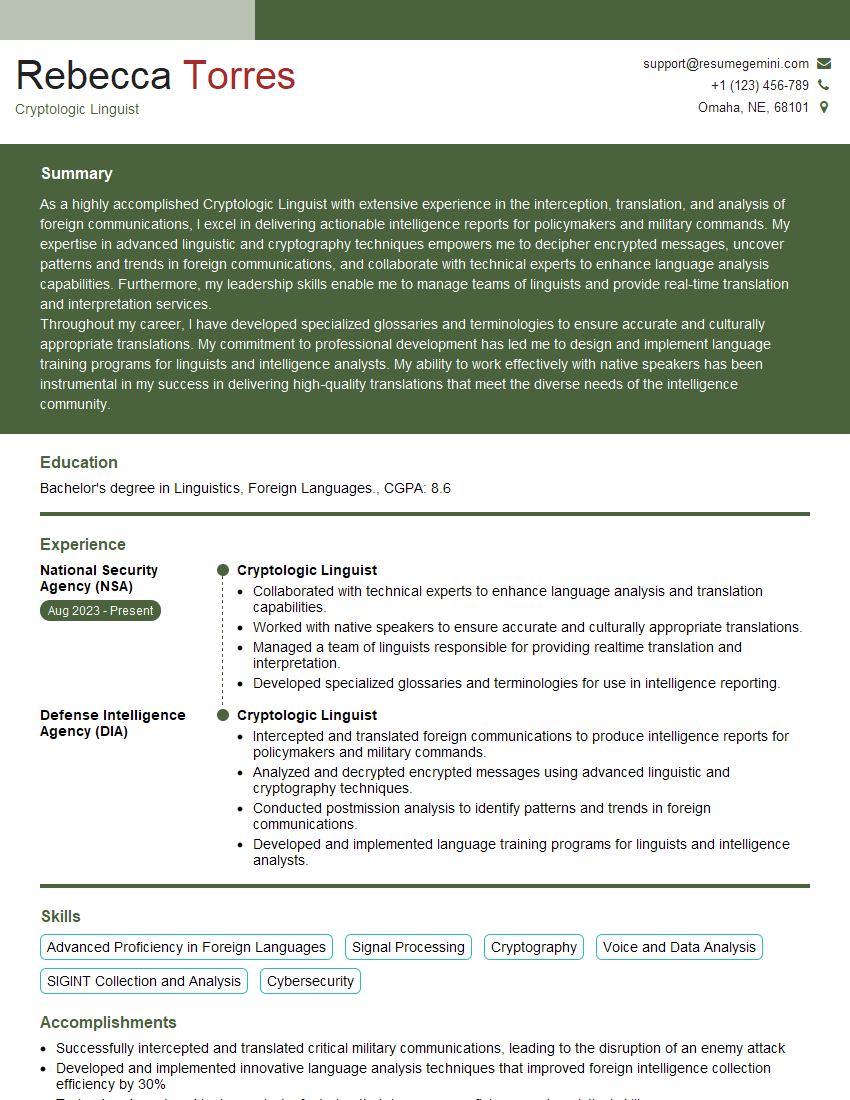
Mastering COMINT analysis opens doors to a rewarding career with significant growth potential in national security, intelligence, and cybersecurity. To maximize your job prospects, creating a compelling and ATS-friendly resume is paramount. ResumeGemini offers a trusted platform to build a professional resume that highlights your skills and experience effectively. Examples of resumes tailored to COMINT Analysis are available on ResumeGemini, showcasing best practices for this competitive field. Invest time in crafting a strong resume – it’s your first impression with potential employers.
Explore more articles
Users Rating of Our Blogs
Share Your Experience
We value your feedback! Please rate our content and share your thoughts (optional).
What Readers Say About Our Blog
Hello,
we currently offer a complimentary backlink and URL indexing test for search engine optimization professionals.
You can get complimentary indexing credits to test how link discovery works in practice.
No credit card is required and there is no recurring fee.
You can find details here:
https://wikipedia-backlinks.com/indexing/
Regards
NICE RESPONSE TO Q & A
hi
The aim of this message is regarding an unclaimed deposit of a deceased nationale that bears the same name as you. You are not relate to him as there are millions of people answering the names across around the world. But i will use my position to influence the release of the deposit to you for our mutual benefit.
Respond for full details and how to claim the deposit. This is 100% risk free. Send hello to my email id: [email protected]
Luka Chachibaialuka
Hey interviewgemini.com, just wanted to follow up on my last email.
We just launched Call the Monster, an parenting app that lets you summon friendly ‘monsters’ kids actually listen to.
We’re also running a giveaway for everyone who downloads the app. Since it’s brand new, there aren’t many users yet, which means you’ve got a much better chance of winning some great prizes.
You can check it out here: https://bit.ly/callamonsterapp
Or follow us on Instagram: https://www.instagram.com/callamonsterapp
Thanks,
Ryan
CEO – Call the Monster App
Hey interviewgemini.com, I saw your website and love your approach.
I just want this to look like spam email, but want to share something important to you. We just launched Call the Monster, a parenting app that lets you summon friendly ‘monsters’ kids actually listen to.
Parents are loving it for calming chaos before bedtime. Thought you might want to try it: https://bit.ly/callamonsterapp or just follow our fun monster lore on Instagram: https://www.instagram.com/callamonsterapp
Thanks,
Ryan
CEO – Call A Monster APP
To the interviewgemini.com Owner.
Dear interviewgemini.com Webmaster!
Hi interviewgemini.com Webmaster!
Dear interviewgemini.com Webmaster!
excellent
Hello,
We found issues with your domain’s email setup that may be sending your messages to spam or blocking them completely. InboxShield Mini shows you how to fix it in minutes — no tech skills required.
Scan your domain now for details: https://inboxshield-mini.com/
— Adam @ InboxShield Mini
Reply STOP to unsubscribe
Hi, are you owner of interviewgemini.com? What if I told you I could help you find extra time in your schedule, reconnect with leads you didn’t even realize you missed, and bring in more “I want to work with you” conversations, without increasing your ad spend or hiring a full-time employee?
All with a flexible, budget-friendly service that could easily pay for itself. Sounds good?
Would it be nice to jump on a quick 10-minute call so I can show you exactly how we make this work?
Best,
Hapei
Marketing Director
Hey, I know you’re the owner of interviewgemini.com. I’ll be quick.
Fundraising for your business is tough and time-consuming. We make it easier by guaranteeing two private investor meetings each month, for six months. No demos, no pitch events – just direct introductions to active investors matched to your startup.
If youR17;re raising, this could help you build real momentum. Want me to send more info?
Hi, I represent an SEO company that specialises in getting you AI citations and higher rankings on Google. I’d like to offer you a 100% free SEO audit for your website. Would you be interested?
Hi, I represent an SEO company that specialises in getting you AI citations and higher rankings on Google. I’d like to offer you a 100% free SEO audit for your website. Would you be interested?
good