The thought of an interview can be nerve-wracking, but the right preparation can make all the difference. Explore this comprehensive guide to Composite Material Design interview questions and gain the confidence you need to showcase your abilities and secure the role.
Questions Asked in Composite Material Design Interview
Q 1. Explain the difference between thermoset and thermoplastic polymers in composite materials.
The key difference between thermoset and thermoplastic polymers lies in their response to heat. Think of it like this: thermosets are like eggs – once cooked (cured), they can’t be easily reshaped. Thermoplastics are more like playdough – you can heat them up, mold them, and cool them down repeatedly without altering their fundamental structure.
Thermosets undergo an irreversible chemical change during curing, forming a rigid, cross-linked network. This makes them extremely strong and resistant to high temperatures but also brittle and difficult to recycle. Examples include epoxy resins and phenolic resins, commonly used in aerospace and automotive parts.
Thermoplastics, on the other hand, soften when heated and harden when cooled. This process is reversible, allowing for repeated molding and recycling. They are generally more flexible and impact-resistant than thermosets but may not have the same high-temperature resistance. Examples include polyethylene (PE) and polypropylene (PP), often found in less demanding applications.
In composites, the choice between thermoset and thermoplastic matrices significantly impacts the final product’s properties and processing methods.
Q 2. Describe the various types of fiber reinforcement used in composite materials.
Fiber reinforcement is crucial in composites as it provides the strength and stiffness. Several types exist, each with its own advantages and disadvantages:
- Carbon Fiber: Known for its exceptionally high strength-to-weight ratio, making it ideal for aerospace, automotive, and sporting goods applications. It’s expensive but offers superior performance.
- Glass Fiber: A cost-effective option providing good strength and stiffness. Widely used in construction, marine, and automotive applications where high strength-to-weight ratio is less critical.
- Aramid Fiber (e.g., Kevlar): Offers high strength and excellent impact resistance, making it suitable for ballistic protection and high-performance sporting goods. It has lower stiffness compared to carbon fiber.
- Basalt Fiber: A relatively new entrant with properties similar to glass fiber but with higher tensile strength and better resistance to high temperatures. It’s gaining traction as a sustainable alternative.
- Natural Fibers (e.g., Flax, Hemp, Sisal): Environmentally friendly options offering moderate strength and stiffness. Used in niche applications where sustainability is paramount.
The choice of fiber depends on the required properties, cost considerations, and environmental impact.
Q 3. What are the advantages and disadvantages of using composite materials compared to traditional materials?
Composite materials offer significant advantages over traditional materials like metals and wood:
- High Strength-to-Weight Ratio: Composites are much lighter than metals for the same strength, leading to fuel efficiency in vehicles and reduced structural weight in buildings.
- Design Flexibility: Complex shapes can be easily manufactured, allowing for optimized designs not possible with traditional materials.
- Corrosion Resistance: Many composites are resistant to corrosion, eliminating maintenance issues in harsh environments.
- Tailorable Properties: The properties of a composite can be tailored by selecting different fiber types, matrix materials, and processing methods.
However, there are also disadvantages:
- Higher Manufacturing Costs: Composite manufacturing can be more complex and expensive than traditional methods.
- Damage Tolerance: While strong, composites can be susceptible to damage from impacts, and the damage may not be easily visible.
- Limited Temperature Resistance: The temperature range over which some composites maintain their properties can be limited.
- Recycling Challenges: Recycling composites can be difficult, depending on the materials used.
The decision to use composites depends on a careful weighing of these advantages and disadvantages in the context of the specific application.
Q 4. Explain the concept of fiber volume fraction and its impact on composite properties.
Fiber volume fraction (Vf) refers to the proportion of the composite’s volume occupied by the reinforcing fibers. It’s a crucial parameter because it significantly impacts the composite’s mechanical properties.
A higher Vf generally leads to increased strength, stiffness, and modulus. Imagine a bundle of straws (fibers) embedded in glue (matrix). The more straws you pack in (higher Vf), the stronger and stiffer the bundle becomes. However, there’s a limit. Excessively high Vf can lead to poor matrix distribution, resulting in defects and reduced performance.
The relationship between Vf and composite properties isn’t always linear. It is often described using micromechanical models, such as the rule of mixtures, which provide estimates of overall composite properties based on the properties of the constituents and their volume fractions. Determining the optimal Vf requires careful consideration of processing constraints and the desired properties.
Q 5. How do you select the appropriate composite material for a specific application?
Selecting the appropriate composite material is a multi-step process involving careful consideration of several factors:
- Define the application requirements: What are the load conditions, environmental exposure, and performance targets (strength, stiffness, weight, cost)?
- Identify candidate materials: Based on the requirements, narrow down potential fiber and matrix combinations. Consider factors like cost, availability, and processing suitability.
- Evaluate material properties: Use available data (from literature, manufacturers, or testing) to assess the mechanical, thermal, and chemical properties of candidate materials.
- Perform simulations (if needed): Finite element analysis (FEA) or other simulations can help predict the performance of the composite under different loading conditions.
- Prototype and test: Build prototypes and test their performance under real-world conditions to validate the design and material selection.
This iterative process ensures the selected composite material meets the application’s needs while optimizing cost and performance.
Q 6. Describe the different methods for manufacturing composite parts (e.g., hand layup, autoclave molding, pultrusion).
Several methods exist for manufacturing composite parts, each with its own advantages and limitations:
- Hand Layup: A simple and cost-effective method for small-scale production. Layers of fiber reinforcement are manually placed in a mold, impregnated with resin, and cured. It’s labor-intensive and may lead to inconsistencies in fiber distribution.
- Autoclave Molding: A more advanced method used for high-performance applications. Prepreg (pre-impregnated) materials are placed in a mold, and the part is cured under high pressure and temperature in an autoclave. This results in high-quality parts with excellent mechanical properties, but it’s expensive and requires specialized equipment.
- Pultrusion: A continuous process for manufacturing long, constant-cross-section profiles. Reinforcement fibers are pulled through a resin bath and then shaped and cured. It’s highly efficient for large-volume production of simple parts.
- Resin Transfer Molding (RTM): Resin is injected into a closed mold containing the dry reinforcement fibers. It provides good control over fiber distribution and reduces resin waste.
- Filament Winding: Continuous fibers are wound onto a mandrel, forming a composite structure. It’s suitable for creating cylindrical shapes, like pressure vessels.
The selection of the manufacturing method depends on factors such as part geometry, production volume, desired quality, and cost constraints.
Q 7. Explain the concept of stress-strain curves for composite materials.
Stress-strain curves for composite materials are more complex than those for isotropic materials (materials with uniform properties in all directions). This is because composite properties vary significantly depending on the direction of loading relative to the fiber orientation.
A typical stress-strain curve for a unidirectional composite (fibers aligned in one direction) will show a higher stiffness and strength in the fiber direction (longitudinal) compared to the transverse (perpendicular) direction. The curve may exhibit different behaviors in tension and compression. The curve may also exhibit non-linear behavior, particularly at higher stress levels. The presence of failure mechanisms, such as fiber breakage or matrix cracking, can also be evident in the curve.
Understanding these curves is crucial for predicting the failure behavior of composite components and designing for optimal performance. Testing methods, such as tensile testing and flexural testing, are used to obtain these curves for various fiber orientations, providing the necessary data for structural analysis and design.
Q 8. How do you analyze the failure mechanisms of composite materials?
Analyzing the failure mechanisms of composite materials requires a multi-faceted approach, considering the complex interplay between the fiber reinforcement and the matrix resin. Failure isn’t usually a sudden catastrophic event but rather a progressive degradation. We look for several key mechanisms:
- Fiber Failure: This can involve fiber breakage due to tensile overload, compressive buckling, or shear stresses. Think of it like a single thread breaking in a woven fabric; if enough break, the whole thing weakens.
- Matrix Cracking: The resin matrix, being less strong than the fibers, is prone to cracking under tensile, compressive, or shear loads. These cracks can propagate, reducing the overall stiffness and strength.
- Fiber-Matrix Debonding: The interface between the fiber and the matrix is critical. Poor bonding can lead to debonding, reducing load transfer and creating weak points. Imagine glue failing to hold the thread to the fabric.
- Delamination: This involves separation between the layers of a laminated composite. This can occur due to impact damage or manufacturing defects. It’s like the layers of a cake separating.
- Buckling: Compressive loads can cause buckling of fibers or layers, reducing the structural integrity. Like a column collapsing under its own weight.
We use various techniques to analyze these mechanisms, including microscopy (optical and electron), mechanical testing, and computational modeling (finite element analysis). Understanding these failure modes is crucial for designing robust and reliable composite structures.
Q 9. Describe different types of non-destructive testing (NDT) methods used for composites.
Non-destructive testing (NDT) is crucial for assessing the integrity of composite components without causing damage. Several methods are commonly used:
- Ultrasonic Testing (UT): Uses high-frequency sound waves to detect internal flaws like voids, delaminations, or cracks. Think of it like an echolocation system, but for materials.
- Radiographic Testing (RT): Employs X-rays or gamma rays to penetrate the material and reveal internal defects. This is similar to a medical X-ray, showing density variations within the composite.
- Thermographic Testing (TT): Measures temperature variations on the surface to detect internal defects. Heat generated from friction at a flaw can be detected.
- Acoustic Emission Testing (AE): Detects acoustic signals emitted by a material under stress, indicating the presence of growing cracks or other flaws. It’s like listening for tiny cracks forming.
- Visual Inspection: A simple yet crucial step involving careful visual examination of the surface for visible defects. Often this is the first test performed.
The choice of NDT method depends on the specific composite material, the type of defect being sought, and the accessibility of the component. Often a combination of methods is employed for a thorough evaluation.
Q 10. Explain the importance of quality control in composite manufacturing.
Quality control in composite manufacturing is paramount because defects can significantly reduce the performance and lifespan of the final product. This involves rigorous control at every stage of the process.
- Raw Material Inspection: Ensuring the quality of fibers and resins used, including their chemical composition, physical properties, and surface cleanliness.
- Process Monitoring: Closely monitoring parameters like curing temperature, pressure, and time during the manufacturing process. Variations can lead to defects.
- In-Process Inspection: Regular inspections during manufacturing to identify defects early and prevent them from propagating. This can involve visual checks or NDT methods.
- Final Product Testing: Conducting mechanical testing, such as tensile, compressive, and flexural tests, on finished components to verify their properties meet design specifications.
- Documentation and Traceability: Maintaining detailed records of the entire manufacturing process, including materials used, parameters monitored, and test results. This allows for troubleshooting and improvement.
Failure to maintain stringent quality control can lead to costly repairs, product recalls, or even catastrophic failures in critical applications like aerospace and automotive.
Q 11. How do you design for damage tolerance in composite structures?
Designing for damage tolerance in composite structures means creating designs that can withstand some level of damage without catastrophic failure. This involves several strategies:
- Redundancy: Incorporating multiple load paths so that failure in one area doesn’t lead to complete structural collapse. Think of a bridge with multiple support beams.
- Toughened Matrix: Using resins that are more resistant to cracking and damage propagation. A tougher resin can absorb more energy before failure.
- Fiber Architecture: Designing the fiber orientation and arrangement to optimize load distribution and resist specific failure modes. A clever arrangement of fibers distributes stress and minimizes weak points.
- Damage Mitigation Strategies: Incorporating features such as stitching or z-pinning to improve interlaminar strength and prevent delamination. These act like reinforcement stitches to hold the layers together.
- Incorporation of Sensors: Embedding sensors within the composite to monitor the state of health and detect the onset of damage. These allow for proactive maintenance and prevent unexpected failures.
Damage tolerance design significantly improves the safety and reliability of composite structures, especially in high-consequence applications.
Q 12. What are the environmental effects on composite materials?
Environmental factors can significantly affect the performance and lifespan of composite materials. Key considerations include:
- Moisture Absorption: Many resins absorb moisture from the environment, leading to swelling, reduced stiffness, and increased susceptibility to damage. This is like a sponge absorbing water and becoming less rigid.
- Temperature Effects: Temperature changes can affect the mechanical properties of both the fibers and the matrix, leading to dimensional changes and reduced strength. This is analogous to how metal expands and contracts with temperature.
- UV Degradation: Exposure to ultraviolet (UV) radiation from sunlight can degrade the matrix resin, causing discoloration, embrittlement, and loss of strength. Think of how sunlight can fade fabric colors.
- Chemical Degradation: Composites can be susceptible to chemical attack from various substances, such as acids, bases, or solvents. This is similar to how certain materials rust or corrode.
Understanding these environmental effects is crucial for selecting appropriate materials, designing protective coatings, and predicting the long-term performance of composite structures. Designing for these factors is critical for durability and maintaining structural integrity.
Q 13. Describe various types of matrix resins used in composites.
The matrix resin is a crucial component of composite materials, binding the reinforcing fibers together and transferring loads between them. Various types are used, each with its own advantages and disadvantages:
- Polyester Resins: Relatively inexpensive, easy to process, but less strong and less resistant to moisture compared to other options.
- Vinyl Ester Resins: Offer improved chemical resistance and mechanical properties compared to polyesters, making them suitable for more demanding applications.
- Epoxy Resins: Provide excellent mechanical strength, chemical resistance, and adhesion to fibers, making them popular in high-performance composites.
- Phenolic Resins: Known for their high temperature resistance and excellent electrical insulation properties, making them useful in high-temperature applications.
- Polyimide Resins: Exhibit exceptional high-temperature resistance and are used in aerospace and high-tech applications where extreme conditions are encountered.
The choice of matrix resin depends on the specific application requirements, balancing cost, performance, and environmental factors. For instance, epoxy resins are frequently used in aerospace components due to their high strength-to-weight ratio, while polyesters are often preferred for less demanding applications due to their lower cost.
Q 14. Explain the concept of laminate theory in composite mechanics.
Laminate theory provides a simplified yet powerful way to analyze the mechanical behavior of laminated composite structures. It assumes that the laminate is composed of thin layers (laminae) with unidirectional fiber orientations. Each lamina is considered to be orthotropic, meaning its mechanical properties are different in different directions.
The theory uses the concept of stress and strain transformations to determine the overall stiffness and strength of the laminate based on the individual lamina properties and their orientation. It allows for the calculation of the laminate’s elastic constants, such as Young’s modulus, shear modulus, and Poisson’s ratio. This is critical for predicting the laminate’s response under various loading conditions.
Classical Laminate Theory (CLT) makes several simplifying assumptions, such as linear elasticity, perfect bonding between laminae, and neglecting transverse shear effects. While these assumptions limit its accuracy in some cases, CLT provides a valuable tool for preliminary design and analysis of composite laminates. More advanced theories, such as First-order Shear Deformation Theory (FSDT) and Higher-order Shear Deformation Theory (HSDT), can account for some of these limitations, increasing accuracy at the expense of increased complexity.
Laminate theory is essential for optimizing the fiber orientation and stacking sequence to achieve desired mechanical properties in composite structures. Software tools based on laminate theory are widely used by engineers to design and analyze composite structures for various applications.
Q 15. How do you account for material anisotropy in composite design?
Material anisotropy in composites refers to the direction-dependent mechanical properties. Unlike isotropic materials (like steel) which exhibit the same properties in all directions, composites have different strengths, stiffnesses, and other properties depending on the orientation of the reinforcing fibers within the matrix. This is because the fibers are much stronger and stiffer than the matrix material along their length but weaker and more compliant in the transverse direction.
Accounting for anisotropy is crucial in design. We use advanced techniques to model the material’s behavior accurately. This often involves using a material stiffness matrix that describes the material’s properties in a specific coordinate system aligned with the fiber orientation. For example, a unidirectional carbon fiber composite will have a much higher stiffness along the fiber direction (0°) than perpendicular to it (90°). We define this through engineering constants like E11 (longitudinal modulus), E22 (transverse modulus), G12 (shear modulus), and Poisson’s ratios ν12 and ν21. These constants are incorporated into Finite Element Analysis (FEA) simulations to predict the overall structural response of the composite component under various loads.
Imagine trying to build a bridge. If you ignore anisotropy and use an isotropic model, your bridge design might drastically underestimate the stresses in certain areas leading to failure. By properly accounting for anisotropy, we can optimize the fiber orientation within each layer of the laminate to achieve the desired strength and stiffness in specific directions, resulting in a safer and more efficient structure.
Career Expert Tips:
- Ace those interviews! Prepare effectively by reviewing the Top 50 Most Common Interview Questions on ResumeGemini.
- Navigate your job search with confidence! Explore a wide range of Career Tips on ResumeGemini. Learn about common challenges and recommendations to overcome them.
- Craft the perfect resume! Master the Art of Resume Writing with ResumeGemini’s guide. Showcase your unique qualifications and achievements effectively.
- Don’t miss out on holiday savings! Build your dream resume with ResumeGemini’s ATS optimized templates.
Q 16. What software are you familiar with for composite material analysis (e.g., ANSYS, ABAQUS)?
My expertise encompasses several industry-standard software packages for composite material analysis. I’m proficient in ANSYS, ABAQUS, and LS-DYNA. ANSYS is particularly strong in linear and non-linear finite element analysis, allowing for detailed stress and strain analysis of complex composite structures. ABAQUS excels in handling large-scale simulations and complex material models, making it ideal for analyzing highly non-linear behavior like delamination or fiber breakage. LS-DYNA is my go-to for explicit dynamic analysis, especially crucial when simulating impact events or crashworthiness.
In my work, I often use the built-in composite material models within these packages, which allow me to define the properties of each lamina (individual layer of the composite) and then assemble them into a laminate. This allows for accurate modeling of the overall behavior of complex composite structures, and also allows me to easily change material properties and test various orientations to optimize performance.
Q 17. Explain the difference between unidirectional, woven, and non-crimp fabrics in composites.
These terms describe different ways of arranging reinforcing fibers within a composite material. The choice depends on the required mechanical properties and manufacturing process.
- Unidirectional (UD) fabrics: Fibers run in a single direction, creating exceptionally high strength and stiffness along that axis. This is great for applications where strength in one specific direction is paramount, like aerospace components. Think of it like a tightly packed bundle of strands.
- Woven fabrics: Fibers are interlaced in a regular pattern (like a basket weave), providing strength and stiffness in multiple directions. However, the strength isn’t as high as UD in the primary fiber direction. Woven fabrics are popular for their drapability and ease of manufacturing. Imagine the fabric in a shirt; woven structure provides flexibility.
- Non-crimp fabrics (NCF): These fabrics use continuous fibers arranged in a complex, multidirectional pattern without the crimping (bending) found in woven fabrics. This offers a good balance between strength, stiffness, and impact resistance, superior to woven fabrics in this regard. NCF often allows for tailored architectures. Think of it like meticulously organized strands providing strength in multiple directions without the weaving.
The selection among these options involves carefully considering the application. A high-performance aircraft part might prefer UD fabrics for maximum strength along the loading direction, while a car body panel might benefit from the multidirectional strength of woven or NCF fabrics to withstand impacts from various angles.
Q 18. How do you determine the mechanical properties of a composite material?
Determining the mechanical properties of a composite material involves a combination of analytical methods, experimental testing, and numerical simulations.
Experimental methods are crucial. Tensile, flexural, and shear tests are frequently employed to measure strength and stiffness properties along various directions. These tests are typically performed on specimens cut from the composite at specific angles to the fiber direction to capture the anisotropic nature. Data from these tests are used to determine the engineering constants mentioned earlier (E11, E22, etc.).
Analytical methods, like micromechanical models, predict composite properties based on the properties of the individual constituents (fiber and matrix) and their volume fractions. These models provide estimations before experimental testing. The rule of mixtures is a simplified micromechanical model used to estimate composite properties.
Numerical simulations, such as FEA, utilize the experimentally determined or analytically predicted properties to analyze the structural behavior of complex composite components under various load conditions. This allows for virtual testing and optimization before physical prototyping.
Once these methods are integrated, a comprehensive understanding of the mechanical behavior is obtained. For instance, if we are designing a pressure vessel, a combination of hydrostatic pressure testing and FEA would give us the necessary insight into how it will handle various pressures and loading conditions.
Q 19. Describe the different types of joining techniques for composite materials.
Joining composite materials presents unique challenges due to their anisotropic nature and sensitivity to damage. Several techniques are used, each with its advantages and disadvantages:
- Bolting and riveting: Common methods, but require careful consideration of hole preparation to avoid delamination (separation of layers) and stress concentrations. Appropriate fastener size and spacing are crucial.
- Adhesive bonding: Offers excellent weight savings and can distribute loads more effectively than mechanical fasteners. Careful surface preparation and selection of appropriate adhesives are critical for ensuring strong and durable bonds. The adhesive must be compatible with both the composite and the joining material.
- Welding (e.g., ultrasonic welding): Suitable for thermoplastic composites. This method creates a strong joint without the need for additional materials, but it’s restricted to certain composite types.
- Fusion bonding: Used for thermoplastic composites. It employs heat and pressure to melt the composite material at the joining interface, creating a strong bond.
- Mechanical fastening using inserts: Metal or composite inserts are embedded in the composite during manufacturing to provide a reliable attachment point for screws or rivets, offering high strength.
The best joining technique depends on factors such as the type of composite, the geometry of the parts, the loading conditions, and the overall design requirements. For example, a high-performance aircraft might utilize bonded joints to minimize weight, while a heavy-duty industrial component might opt for mechanical fasteners for superior strength.
Q 20. What are the challenges in recycling composite materials?
Recycling composite materials is challenging due to their heterogeneous nature. The strong bond between the fibers and the matrix makes it difficult to separate the components effectively for reuse. The following points highlight these challenges:
- Material separation: The matrix and fiber materials often have different chemical compositions, which makes separating them challenging. It may require energy-intensive methods, increasing the environmental impact.
- Fiber degradation: During the recycling process, the fibers can be damaged, reducing their mechanical properties and limiting their potential for reuse in high-performance applications.
- Cost-effectiveness: The recycling processes for composites can be expensive compared to recycling metals or other materials. The economic viability depends on the efficiency of the recycling technique.
- Contamination: Composites might contain different components or contaminants, which make recycling complicated and may require advanced separation techniques.
Research is ongoing to develop efficient and cost-effective recycling methods, such as pyrolysis, solvolysis, and mechanical recycling. The goal is to develop closed-loop systems where composite materials can be recycled and reused without significant loss of material properties, promoting a more sustainable approach to composite material usage.
Q 21. What is the difference between a lamina and a laminate?
A lamina and a laminate are closely related but distinct concepts in composite material science.
Lamina: A single layer of composite material with unidirectional or other fiber orientations. It’s the basic building block of a composite structure. Think of it as a single sheet of plywood.
Laminate: A stack of multiple laminae bonded together. Each lamina can have a different fiber orientation, thickness, or material properties, allowing for tailored mechanical characteristics in the overall structure. This is analogous to stacking multiple sheets of plywood at different orientations to create a stronger, more structurally sound object. The fiber orientation of each lamina can be optimized to resist specific loading conditions – this stacking sequence is crucial for the laminate’s overall performance.
For example, a simple laminate could consist of three laminae: one with fibers oriented at 0°, one at 90°, and one at 45°. This stacking sequence would provide improved strength and stiffness in multiple directions compared to a single lamina. The design of the stacking sequence (layup) is a critical aspect of composite design.
Q 22. How do you determine the cure cycle for a thermoset composite?
Determining the cure cycle for a thermoset composite is crucial for achieving optimal mechanical properties. It’s essentially a recipe that dictates the temperature and time profile needed to fully crosslink the resin system. This process transforms the liquid resin into a solid, insoluble polymer matrix.
The process typically involves several stages:
- Ramp-up: A gradual increase in temperature to reach the desired cure temperature, avoiding thermal shock and ensuring uniform heating.
- Isothermal hold: Maintaining a constant temperature for a specific duration, allowing the crosslinking reaction to proceed to completion. This duration is highly dependent on the resin chemistry and thickness of the composite part.
- Cool-down: A controlled decrease in temperature to prevent residual stresses and warping. The rate of cool-down is also critical.
The cure cycle is determined through a combination of:
- Rheological testing: This assesses the viscosity changes of the resin during the cure process. We use rheometers to identify the gel point (transition from liquid to solid) and the optimal cure temperature.
- Differential Scanning Calorimetry (DSC): This technique measures the heat flow associated with the curing reaction, allowing us to determine the degree of cure and optimize the isothermal hold time.
- Thermogravimetric Analysis (TGA): TGA helps to assess the weight loss during curing, identifying volatile components and their release kinetics, ensuring complete curing without excessive degradation.
- Experience and literature data: Existing data on similar resin systems and manufacturers’ recommendations provide a valuable starting point.
For instance, during my work on a carbon fiber/epoxy prepreg system for an aerospace application, we utilized DSC and rheological data to fine-tune the cure cycle, achieving a final composite with superior mechanical performance and minimal void content.
Q 23. Explain the concept of void content in composites and its influence on mechanical properties.
Void content refers to the presence of empty spaces or pores within a composite material. These voids are detrimental to mechanical properties, acting as stress concentrators. Think of it like Swiss cheese – the more holes, the weaker and less reliable the structure.
The influence of void content is significant:
- Reduced strength: Voids interrupt the continuous fiber reinforcement, reducing the load-bearing capacity of the composite. The stress is concentrated around the voids, leading to premature failure under load.
- Lower stiffness: Voids decrease the overall stiffness of the material, making it more flexible and prone to deformation.
- Decreased fatigue life: Cyclic loading causes stress concentration at void sites, accelerating fatigue crack initiation and propagation, thus shortening the lifespan of the component.
- Increased moisture absorption: Voids provide pathways for moisture to penetrate the composite, leading to degradation and reduced mechanical properties.
Minimizing void content is achieved through careful control of processing parameters: proper resin impregnation, vacuum bagging to remove air, and optimized cure cycles. In one project, we improved our vacuum bagging process, which reduced void content from 4% to less than 1%, resulting in a 15% increase in tensile strength.
Q 24. What are the common failure modes of fiber-reinforced composites?
Fiber-reinforced composites exhibit various failure modes, often dependent on the loading conditions and material properties.
- Fiber breakage: This occurs when the fibers are subjected to high tensile stresses exceeding their ultimate strength. It’s a brittle failure often characterized by a sudden snap.
- Matrix cracking: The resin matrix can crack under tensile, compressive, or shear stresses. These cracks often initiate at voids or fiber-matrix interfaces.
- Fiber-matrix debonding: Poor adhesion between the fibers and the matrix leads to separation, reducing load transfer and weakening the composite.
- Delamination: Separation along the planes of the composite layers occurs under shear or impact loading, greatly reducing its structural integrity. Think of it like peeling layers off a cake.
- Buckling: In compression, fibers or layers can buckle, leading to instability and loss of strength.
Understanding these failure modes is essential for designing robust composite components. For example, in the design of a wind turbine blade, careful consideration of the potential for delamination and fiber breakage under cyclic loading is crucial.
Q 25. Describe your experience with finite element analysis (FEA) of composite structures.
I have extensive experience using finite element analysis (FEA) to simulate the behavior of composite structures under various loading conditions. FEA software packages like Abaqus and ANSYS are my primary tools. I’m proficient in generating accurate finite element models of composite laminates, incorporating material properties, fiber orientations, and boundary conditions.
My experience encompasses:
- Linear and nonlinear analysis: Simulating both static and dynamic loading scenarios to predict stress, strain, and displacement fields within the composite component.
- Failure prediction: Using various failure criteria (e.g., Tsai-Wu, Hashin) to assess the likelihood of different failure modes.
- Optimization: Modifying design parameters (fiber orientation, ply thickness, stacking sequence) to improve structural performance and reduce weight.
- Meshing techniques: Employing appropriate meshing strategies to accurately represent the geometry and material properties of the composite structure.
In a recent project, I utilized FEA to optimize the design of a composite pressure vessel, resulting in a 20% reduction in weight while maintaining required pressure resistance. The simulations guided iterative design changes, reducing the need for costly and time-consuming physical prototyping.
Q 26. How would you approach the design of a lightweight, high-strength composite component?
Designing a lightweight, high-strength composite component requires a multi-faceted approach.
The process typically involves:
- Material selection: Choosing the right fiber (carbon fiber, aramid fiber, glass fiber) and resin system to achieve the desired strength-to-weight ratio. High-strength carbon fiber is often preferred for demanding applications.
- Layup optimization: Strategically arranging the fiber layers (plies) to maximize strength and stiffness in critical directions. This involves considering the orientation of fibers in each ply to align with the dominant stress directions. For example, a 0°/90° layup is often suitable for uniaxial loading.
- Topology optimization: Using FEA to optimize the shape and geometry of the component, minimizing material usage while maintaining structural integrity. This can lead to significant weight reduction without compromising strength.
- Manufacturing process selection: Selecting appropriate manufacturing techniques like autoclave molding, resin transfer molding (RTM), or filament winding, each with their advantages and limitations depending on the complexity and scale of production.
For instance, in the design of a lightweight bicycle frame, we would use high-strength carbon fibers and a carefully optimized layup to minimize weight while maximizing stiffness and strength, ensuring rider safety and performance.
Q 27. Explain your experience with composite material testing standards and procedures.
I am familiar with a wide range of composite material testing standards and procedures, including ASTM and ISO standards. My experience encompasses both destructive and non-destructive testing methods.
My expertise includes:
- Tensile testing: Determining the tensile strength, modulus, and elongation at break.
- Flexural testing: Assessing the flexural strength and modulus.
- Compressive testing: Evaluating the compressive strength and modulus.
- Shear testing: Determining the in-plane and interlaminar shear strength.
- Impact testing: Measuring the impact resistance of the composite material (e.g., Izod or Charpy tests).
- Ultrasonic C-scan: Detecting internal flaws such as voids and delaminations.
- X-ray inspection: Visualizing internal structures and identifying defects.
Adherence to these standards ensures reliable and consistent testing results, allowing for accurate assessment of material properties and quality control throughout the manufacturing process. In my previous role, we implemented a rigorous quality control program based on these standards, leading to a significant reduction in defects and improved product reliability.
Q 28. Describe a situation where you had to troubleshoot a problem related to composite material processing or performance.
During the development of a large-scale wind turbine blade, we encountered a problem with delamination occurring during the curing process. The initial cure cycle, while effective for smaller samples, led to significant delamination in the larger components due to uneven heating and resulting thermal stresses.
To troubleshoot this issue, we followed these steps:
- Detailed analysis of the failed components: Microscopic examination and ultrasonic C-scanning revealed the location and extent of delamination.
- Finite element modeling: We simulated the temperature distribution and resulting stresses during the cure cycle, pinpointing areas of high thermal gradients.
- Cure cycle optimization: Based on the FEA results, we adjusted the ramp-up and cool-down rates to minimize thermal stresses and ensure more uniform heating throughout the blade. This involved using more heating zones and sensors to better monitor and control temperatures.
- Material characterization: We revisited the properties of the resin and fiber used in the blade, checking for any inconsistencies that may have contributed to the problem.
By implementing these changes, we successfully eliminated the delamination issue, resulting in a robust and reliable wind turbine blade. The experience highlighted the importance of carefully considering scale effects and performing thorough process validation.
Key Topics to Learn for Composite Material Design Interview
- Material Selection and Characterization: Understanding the properties of fibers (carbon, glass, aramid), matrices (polymers, metals, ceramics), and their interaction to achieve desired composite performance. Consider factors like strength, stiffness, weight, and cost.
- Manufacturing Processes: Familiarize yourself with various composite manufacturing techniques such as hand layup, autoclave molding, pultrusion, filament winding, and resin transfer molding. Be prepared to discuss the advantages and limitations of each process in relation to specific applications.
- Structural Analysis and Design: Grasp the fundamental concepts of stress, strain, and failure modes in composite materials. Understand how to use Finite Element Analysis (FEA) or other computational tools for structural optimization and design.
- Failure Mechanisms and Durability: Learn about common failure modes in composites, such as delamination, fiber breakage, and matrix cracking. Understand the influence of environmental factors (temperature, humidity, chemicals) on composite durability and lifespan.
- Testing and Quality Control: Be prepared to discuss various non-destructive testing (NDT) methods used to evaluate the quality and integrity of composite structures, such as ultrasonic inspection and X-ray radiography.
- Applications and Case Studies: Explore diverse applications of composite materials across various industries (aerospace, automotive, wind energy, marine) and be ready to discuss specific case studies demonstrating the advantages of using composites in those applications.
- Advanced Topics (depending on experience level): Consider exploring topics like micromechanics, damage mechanics, fatigue analysis, and advanced manufacturing techniques such as 3D printing of composites.
Next Steps
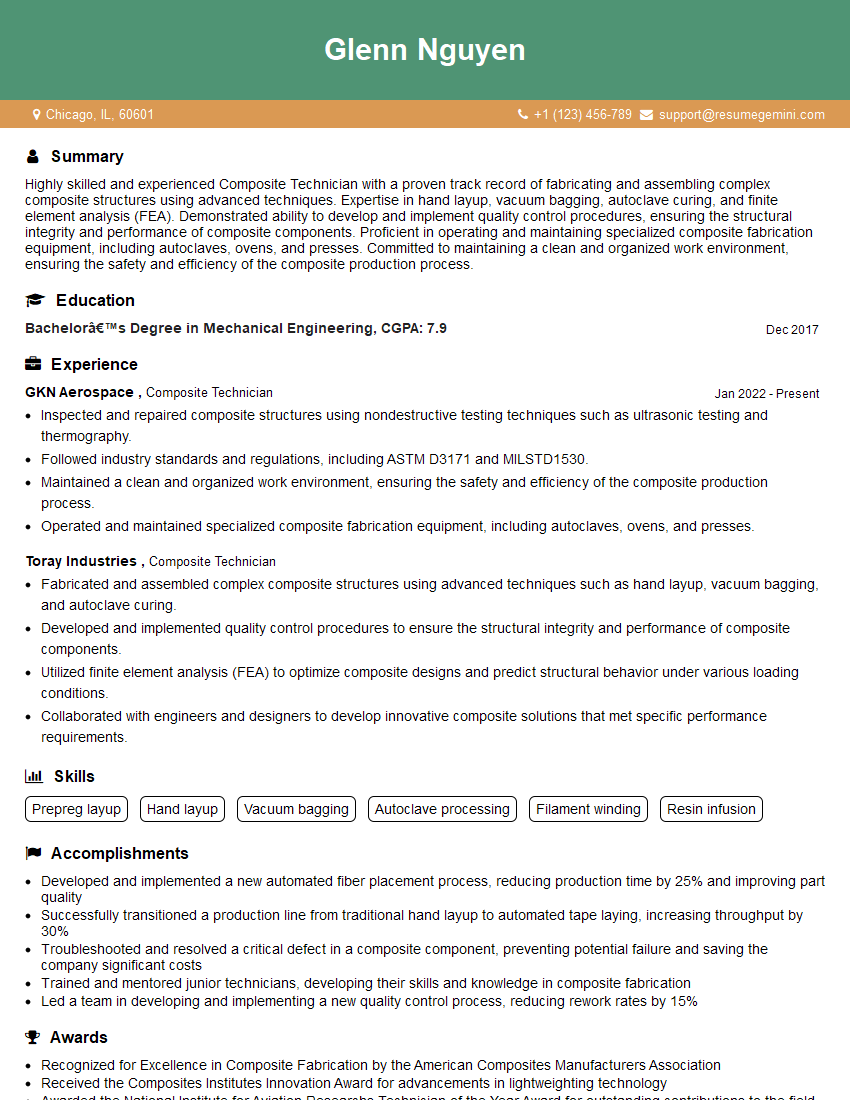
Mastering Composite Material Design opens doors to exciting and rewarding careers in innovative industries. To maximize your job prospects, invest time in crafting a strong, ATS-friendly resume that showcases your skills and experience effectively. ResumeGemini is a trusted resource that can help you build a professional and impactful resume. We provide examples of resumes tailored to Composite Material Design to guide you through the process. Let ResumeGemini help you present yourself as the ideal candidate for your dream role.
Explore more articles
Users Rating of Our Blogs
Share Your Experience
We value your feedback! Please rate our content and share your thoughts (optional).
What Readers Say About Our Blog
Hi I am a troller at The aquatic interview center and I suddenly went so fast in Roblox and it was gone when I reset.
Hi,
Business owners spend hours every week worrying about their website—or avoiding it because it feels overwhelming.
We’d like to take that off your plate:
$69/month. Everything handled.
Our team will:
Design a custom website—or completely overhaul your current one
Take care of hosting as an option
Handle edits and improvements—up to 60 minutes of work included every month
No setup fees, no annual commitments. Just a site that makes a strong first impression.
Find out if it’s right for you:
https://websolutionsgenius.com/awardwinningwebsites
Hello,
we currently offer a complimentary backlink and URL indexing test for search engine optimization professionals.
You can get complimentary indexing credits to test how link discovery works in practice.
No credit card is required and there is no recurring fee.
You can find details here:
https://wikipedia-backlinks.com/indexing/
Regards
NICE RESPONSE TO Q & A
hi
The aim of this message is regarding an unclaimed deposit of a deceased nationale that bears the same name as you. You are not relate to him as there are millions of people answering the names across around the world. But i will use my position to influence the release of the deposit to you for our mutual benefit.
Respond for full details and how to claim the deposit. This is 100% risk free. Send hello to my email id: [email protected]
Luka Chachibaialuka
Hey interviewgemini.com, just wanted to follow up on my last email.
We just launched Call the Monster, an parenting app that lets you summon friendly ‘monsters’ kids actually listen to.
We’re also running a giveaway for everyone who downloads the app. Since it’s brand new, there aren’t many users yet, which means you’ve got a much better chance of winning some great prizes.
You can check it out here: https://bit.ly/callamonsterapp
Or follow us on Instagram: https://www.instagram.com/callamonsterapp
Thanks,
Ryan
CEO – Call the Monster App
Hey interviewgemini.com, I saw your website and love your approach.
I just want this to look like spam email, but want to share something important to you. We just launched Call the Monster, a parenting app that lets you summon friendly ‘monsters’ kids actually listen to.
Parents are loving it for calming chaos before bedtime. Thought you might want to try it: https://bit.ly/callamonsterapp or just follow our fun monster lore on Instagram: https://www.instagram.com/callamonsterapp
Thanks,
Ryan
CEO – Call A Monster APP
To the interviewgemini.com Owner.
Dear interviewgemini.com Webmaster!
Hi interviewgemini.com Webmaster!
Dear interviewgemini.com Webmaster!
excellent
Hello,
We found issues with your domain’s email setup that may be sending your messages to spam or blocking them completely. InboxShield Mini shows you how to fix it in minutes — no tech skills required.
Scan your domain now for details: https://inboxshield-mini.com/
— Adam @ InboxShield Mini
Reply STOP to unsubscribe
Hi, are you owner of interviewgemini.com? What if I told you I could help you find extra time in your schedule, reconnect with leads you didn’t even realize you missed, and bring in more “I want to work with you” conversations, without increasing your ad spend or hiring a full-time employee?
All with a flexible, budget-friendly service that could easily pay for itself. Sounds good?
Would it be nice to jump on a quick 10-minute call so I can show you exactly how we make this work?
Best,
Hapei
Marketing Director
Hey, I know you’re the owner of interviewgemini.com. I’ll be quick.
Fundraising for your business is tough and time-consuming. We make it easier by guaranteeing two private investor meetings each month, for six months. No demos, no pitch events – just direct introductions to active investors matched to your startup.
If youR17;re raising, this could help you build real momentum. Want me to send more info?
Hi, I represent an SEO company that specialises in getting you AI citations and higher rankings on Google. I’d like to offer you a 100% free SEO audit for your website. Would you be interested?
Hi, I represent an SEO company that specialises in getting you AI citations and higher rankings on Google. I’d like to offer you a 100% free SEO audit for your website. Would you be interested?
good