Cracking a skill-specific interview, like one for Computer and Avionics Systems, requires understanding the nuances of the role. In this blog, we present the questions you’re most likely to encounter, along with insights into how to answer them effectively. Let’s ensure you’re ready to make a strong impression.
Questions Asked in Computer and Avionics Systems Interview
Q 1. Explain the principles of DO-178C software development.
DO-178C is a standard developed by RTCA, Inc., defining software considerations in airborne systems and equipment certification. It’s all about ensuring the software in your airplane doesn’t cause it to fall out of the sky! The core principle is to manage risk through a systematic process. This involves defining software requirements meticulously, designing robust architectures, implementing rigorous testing procedures, and maintaining meticulous documentation throughout the entire lifecycle. The level of rigor depends on the software’s criticality – a software component controlling the flight controls would require a much higher level of assurance (e.g., DO-178C Level A) than, say, an in-flight entertainment system (which might only need Level C).
The standard lays out specific objectives for each development phase, including requirements, design, coding, integration, verification, and validation. For example, code reviews, static analysis, and unit, integration, and system testing are all critical parts. Traceability between requirements, design, code, and tests is absolutely paramount, allowing you to prove that every requirement has been adequately addressed. Think of it like a meticulously detailed map, showing precisely how each piece of software fits into the overall system and how it behaves.
- Requirements: Precisely defining what the software must do.
- Design: Creating the architecture and detailed design of the software components.
- Coding: Writing the code in a clear and maintainable manner, following coding standards.
- Integration: Combining individual software components into a complete system.
- Verification: Demonstrating that the software meets its requirements.
- Validation: Ensuring that the software meets the overall system needs.
Q 2. Describe your experience with ARINC standards (e.g., ARINC 429, ARINC 664).
I have extensive experience with ARINC standards, particularly ARINC 429 and ARINC 664. ARINC 429 is a widely used data bus in avionics, known for its simplicity and robustness. It’s a point-to-point, high-speed, digital communication protocol that facilitates data exchange between different avionics systems. I’ve worked on projects where we used ARINC 429 to integrate flight management systems, air data computers, and other critical subsystems. A common task was dealing with data word formats, ensuring correct data encoding, and troubleshooting communication issues using bus analyzers.
ARINC 664, on the other hand, is a more modern standard providing a high-bandwidth, Ethernet-based communication infrastructure. It offers features like deterministic communication, time synchronization, and error detection, making it suitable for high-performance and safety-critical applications. I’ve worked on projects leveraging its capabilities in the development of integrated modular avionics (IMA) architectures. This involved designing the network topology, managing network traffic, and developing software components adhering to the protocol’s specifications. One memorable challenge involved optimizing network performance to meet stringent latency requirements for critical data transfer.
Q 3. What are the key differences between embedded systems and general-purpose computing?
The key difference lies in their purpose and constraints. Embedded systems are designed to perform specific tasks within a larger system, often with limited resources (memory, processing power) and real-time constraints. Think of the flight control computer in an aircraft – it has a very specific job and must perform it within strict deadlines. General-purpose computers, in contrast, are designed to perform a wide variety of tasks and are characterized by their flexibility and extensive resources. Your laptop, for instance, is far more powerful and versatile than a flight control computer, but it doesn’t need to meet the same stringent timing requirements.
- Resource Constraints: Embedded systems often have limited memory and processing power compared to general-purpose computers.
- Real-Time Constraints: Embedded systems must respond to events within specific time limits; general-purpose computers don’t always have these constraints.
- Dedicated Function: Embedded systems perform specific tasks; general-purpose computers are highly flexible.
- Power Consumption: Embedded systems often need to be power-efficient.
For example, an embedded system in a washing machine controls the various functions, while a general-purpose computer can be used for a wide array of applications, from gaming to data science.
Q 4. How do you ensure data integrity and redundancy in an avionics system?
Data integrity and redundancy are paramount in avionics systems where failure can have catastrophic consequences. We use several strategies:
- Error Detection and Correction Codes: Techniques like checksums, cyclic redundancy checks (CRCs), and more advanced forward error correction (FEC) codes are used to detect and correct data corruption. These are added to the data stream, enabling detection of errors during transmission or storage.
- Redundancy: Multiple independent channels or systems are used to perform the same function. If one fails, others take over. This might involve triple modular redundancy (TMR), where three identical systems operate in parallel, with a voter deciding which output is correct.
- Data Validation: Data from multiple sensors is compared to detect inconsistencies. If a sensor’s data deviates significantly from the others, it’s flagged as faulty and potentially ignored.
- Watchdog Timers: These timers monitor the activity of critical processes and trigger a fail-safe mechanism if the process stops responding.
- Memory Protection: Hardware and software mechanisms prevent unauthorized access to critical data and code, reducing the risk of corruption.
For instance, in a flight control system, a TMR configuration ensures that even if one computer fails, the others continue to control the aircraft’s flight surfaces. The voting mechanism ensures system integrity.
Q 5. Explain the concept of real-time operating systems (RTOS) in avionics.
Real-time operating systems (RTOS) are crucial in avionics because they guarantee that critical tasks are executed within specific deadlines. Unlike general-purpose operating systems, RTOSes prioritize deterministic behavior – predictable and timely execution. This is critical in safety-critical systems where a delay could have disastrous consequences. An RTOS manages tasks with priority levels, ensuring that high-priority tasks (like responding to sensor input for flight control) are executed before lower-priority tasks (like displaying information on the cockpit screen). They also have features like interrupt handling and scheduling algorithms designed for predictability.
Examples of RTOSes commonly used in avionics include VxWorks, Integrity, and QNX. These offer features designed for safety-critical systems, including memory protection, task synchronization, and real-time clock mechanisms for precise timing. The RTOS is a key component in orchestrating the complex interactions between different avionics systems.
Q 6. What are the challenges of developing safety-critical software?
Developing safety-critical software presents unique challenges. The most significant is the need for extremely high reliability and availability. A single bug can have catastrophic consequences. This requires a rigorous development process with extensive testing and verification, often using formal methods and rigorous analysis techniques. Another challenge is managing the complexity of these systems. Avionics systems are highly intricate, integrating numerous hardware and software components that interact in complex ways.
- Meeting stringent certification standards: Compliance with standards like DO-178C demands significant effort and expertise.
- High reliability and availability: The software must be virtually flawless.
- Handling complexity: Managing the intricate interactions between different components.
- Dealing with legacy systems: Integrating modern technology with older systems is a major challenge.
- Cost and time constraints: The development process is expensive and time-consuming.
Imagine the complexity of writing software to control the flight surfaces of a large aircraft – a single error could be catastrophic. This necessitates exhaustive testing and verification procedures and a systematic approach throughout the development cycle.
Q 7. Describe your experience with different communication protocols used in avionics.
My experience encompasses various communication protocols in avionics. As previously mentioned, I’ve worked extensively with ARINC 429 and ARINC 664. Beyond these, I’m familiar with other protocols such as:
- AFDX (Avionics Full Duplex Switched Ethernet): A high-speed Ethernet-based network designed for avionics, emphasizing determinism and reliability.
- CAN (Controller Area Network): A robust and widely used communication bus for automotive and industrial applications, also finding use in some avionics systems.
- RS-232/422/485: Serial communication protocols used for less demanding applications.
- Discrete signals: Simple on/off signals used for control and status indications.
The choice of protocol depends on factors like bandwidth requirements, latency constraints, and the level of fault tolerance needed. For instance, AFDX is preferred for high-bandwidth, time-critical data, while CAN might be suitable for lower-bandwidth applications requiring robust performance.
Selecting and implementing the appropriate protocol requires a deep understanding of their strengths and weaknesses, along with careful consideration of the system’s specific needs. I’ve encountered situations where optimizing network performance and managing data flow between various protocols became a central focus of the development process.
Q 8. How do you handle version control in a safety-critical software development environment?
Version control in safety-critical software development is paramount. We use robust systems like Git, but with crucial additions for traceability and auditability. Instead of a simple branching strategy, we employ a more rigorous approach, often involving dedicated branches for requirements, design, implementation, testing, and release. Each commit is meticulously documented with detailed descriptions, linking to specific requirements and test cases. This allows us to track every change made throughout the software lifecycle, enabling easy rollback to previous versions if necessary. Furthermore, we utilize tools that integrate with our version control system to enforce code reviews for every change, ensuring multiple pairs of eyes examine every modification before it’s merged into the main branch. This level of control helps avoid accidental introduction of bugs and improves code quality significantly. For instance, in a previous project developing flight control software, a rigorous version control process ensured we could quickly revert to a stable version when a minor bug was discovered during integration testing, preventing a potential major delay.
- Branching Strategy: Highly structured branching, often adopting a model tailored to the specific safety standard (e.g., DO-178C).
- Commit Messaging: Clear, concise, and detailed messages linked to requirements and test cases.
- Code Reviews: Mandatory code reviews before merging changes into the main branch.
- Automated Builds and Testing: Integration with CI/CD pipelines for automated builds, testing, and reporting.
Q 9. Explain your experience with testing methodologies for avionics systems.
Testing avionics systems demands a multi-layered approach, starting with unit testing of individual modules, progressing through integration testing of subsystems, and culminating in system-level testing. We employ various methodologies including:
- Unit Testing: Each software module is tested independently to verify its functionality. We use techniques like test-driven development (TDD) to ensure high test coverage and early detection of issues. For example, a unit test would ensure a specific algorithm for calculating airspeed produces accurate results given a set of input parameters.
- Integration Testing: Tested modules are integrated and tested as a group to verify the interactions between different modules.
- System Testing: The complete system is tested to ensure that it meets all requirements. This often involves simulation, as well as real-world or lab-based tests.
- Verification and Validation (V&V): A rigorous process to ensure that the software meets its requirements and behaves as expected. We extensively document the V&V process and provide detailed traceability between requirements, test cases, and results. This ensures compliance with DO-178C or other relevant safety standards.
In addition to these standard methodologies, we incorporate formal methods and model checking techniques to provide additional assurance for critical functions. For example, model checking can help verify properties such as deadlock freedom and real-time behavior of the flight control system. The overall goal is to achieve a very high level of confidence in the safety and reliability of the avionics system.
Q 10. What is your experience with hardware-in-the-loop (HIL) simulation?
Hardware-in-the-loop (HIL) simulation is a critical part of my experience in avionics development. It allows us to test the avionics software in a realistic environment, interacting with simulated hardware components. This is essential for testing real-time interactions and ensuring that the system responds correctly to various scenarios, including fault conditions.
In my experience, HIL simulation involves a real-time simulation of the aircraft or system being controlled, coupled with a real-time execution of the software under test. The software interacts with the simulated hardware through a real-time interface, allowing us to simulate a wide range of flight conditions, sensor inputs, and malfunctions. For example, I’ve been involved in projects using HIL simulation to test the response of flight control systems to various environmental factors like wind gusts or engine failures. The results are crucial in verifying the safety and robustness of the system under stressed conditions.
HIL simulation typically employs specialized hardware and software tools that can accurately replicate the behavior of the real system. Data acquisition and analysis is a key aspect to record simulation parameters and software performance metrics, providing valuable insights into the system’s behavior under test. We use this data to identify areas for improvement, resolve design flaws, and verify safety requirements.
Q 11. Describe your understanding of fault tolerance and fail-operational systems.
Fault tolerance and fail-operational systems are cornerstones of safety-critical systems like those in avionics. Fault tolerance refers to the ability of a system to continue operating correctly despite the presence of faults or failures. A fail-operational system is one that can continue to operate at a reduced level of functionality even when a major component fails. This distinction is crucial for ensuring safety and avoiding catastrophic failures.
Techniques employed for fault tolerance and fail-operational capabilities include redundancy (having multiple copies of critical components), error detection and correction codes, and robust algorithms designed to tolerate errors. For example, a flight control system might utilize triple-modular redundancy (TMR), where three independent computers perform the same calculations, and a voting mechanism selects the most likely correct result. If one computer fails, the system continues to operate correctly. Another example is the use of diverse software components, where independent teams develop different implementations of the same functionality, further increasing the likelihood of system survival.
Designing for fault tolerance requires careful consideration of failure modes and the development of mechanisms to detect and mitigate these failures. This process includes formal analysis methods, rigorous testing, and detailed safety analysis documentation. The outcome is a system that is much more resilient to failures, significantly improving overall safety and reliability. For instance, aircraft using fail-operational flight controls can maintain some degree of controllability even with the failure of a critical component like an actuator.
Q 12. How do you ensure compliance with regulatory standards in avionics?
Ensuring compliance with regulatory standards in avionics is a critical and ongoing process. It’s not a one-time effort, but an integral part of every stage of the development lifecycle. The specific standards depend on the application and its criticality, but commonly include DO-178C (Software Considerations in Airborne Systems and Equipment Certification) and its associated documents like DO-330 (Software Tool Qualification Considerations) and DO-254 (Design Assurance Guidance for Airborne Electronic Hardware).
Compliance involves meticulous documentation at every stage, starting with requirement analysis and design, through implementation, testing, and verification. We meticulously track traceability between requirements, design specifications, code, test cases, and test results. This ensures that every aspect of the development process is documented and auditable, allowing regulators to verify that the system meets the necessary safety requirements. Independent verification and validation (IV&V) is often conducted by a third-party organization to provide an independent assessment of the development process and the resulting system. This ensures impartiality and strengthens the confidence in the system’s safety. Regular audits and inspections are also part of maintaining compliance.
Moreover, we use tools and processes that support compliance, such as requirements management tools, configuration management systems, and static and dynamic analysis tools for code verification. The whole process is designed not just to meet the minimum regulatory requirements but also to instill a culture of safety and quality throughout the development process, fostering a proactive approach to avoiding hazards rather than just reacting to them.
Q 13. What are the different types of sensors commonly used in avionics?
Avionics systems rely on a variety of sensors to provide critical data for navigation, flight control, and other functions. Here are some common types:
- Inertial Measurement Units (IMUs): Measure the aircraft’s acceleration and rotation rates, used for navigation and attitude control. They typically comprise accelerometers and gyroscopes.
- Global Navigation Satellite System (GNSS) Receivers (e.g., GPS): Provide precise position, velocity, and time information.
- Air Data Systems (ADS): Measure airspeed, altitude, and outside air temperature (OAT). These are crucial for flight control and performance calculations.
- Pitot-Static Systems: These older systems also measure airspeed, altitude, and static air pressure. They are still common, particularly in simpler aircraft.
- Magnetic Compass: Measures the aircraft’s heading relative to magnetic north.
- Altimeters: Measure altitude, either using barometric pressure or GNSS data.
- Angle of Attack (AOA) Sensors: Measure the angle between the aircraft’s wing and the oncoming airflow.
- Temperature Sensors: Monitor various temperatures within the aircraft and its systems.
- Pressure Sensors: Measure various pressures within the aircraft’s hydraulic and fuel systems.
The selection of sensors depends on the specific needs of the aircraft and its systems. Redundancy and fault tolerance are often implemented to ensure system reliability and safety. For instance, many modern aircraft use multiple GNSS receivers to improve accuracy and provide backup in case of satellite signal loss.
Q 14. Explain your experience with data acquisition and processing in avionics systems.
Data acquisition and processing are fundamental to modern avionics systems. My experience involves the design, implementation, and testing of systems that collect data from various sensors, process it in real-time, and make it available to other systems. This process includes the selection of appropriate hardware and software components, the development of algorithms for data filtering and processing, and the implementation of robust error handling mechanisms.
A significant aspect of my work has involved designing data buses and communication protocols for data transfer between different components. This often involves using industry-standard protocols like ARINC 429 or AFDX to ensure interoperability and compliance with relevant standards. Data acquisition and processing for avionics often involves specialized hardware, such as data acquisition units (DAUs) capable of high-speed sampling and signal conditioning. The data processing frequently involves sophisticated algorithms for signal filtering, sensor fusion, and fault detection.
For example, I worked on a project that involved integrating data from multiple sensors, including IMUs, GNSS, and ADS, to provide accurate navigation and flight control data. This required developing algorithms to fuse data from multiple sources, account for sensor noise and biases, and handle potential sensor failures. The resulting system had to be highly reliable and meet stringent real-time performance requirements. The rigorous testing process ensures that the data acquisition and processing system is robust and capable of providing accurate and reliable data in all flight conditions.
Q 15. Describe your experience with different types of aircraft buses.
My experience encompasses a wide range of aircraft buses, crucial for communication between avionics systems. These buses differ significantly in speed, bandwidth, and data integrity requirements. I’ve worked extensively with:
- ARINC 429: A high-speed, point-to-point, data bus commonly used for transmitting high-integrity data like airspeed and altitude. Its simplicity and robustness make it ideal for critical systems. I’ve used it in projects involving flight control system integration, where its low latency is essential.
- ARINC 629/664: These are high-speed, data buses that use a packet-switching architecture, offering greater flexibility and bandwidth than ARINC 429. I’ve worked with these on projects incorporating more complex systems, such as advanced flight management systems requiring extensive data exchange.
- AFDX (Avionics Full Duplex Switched Ethernet): A high-bandwidth, Ethernet-based network widely adopted in modern aircraft. Its features like redundancy and quality-of-service guarantees are crucial for ensuring data integrity in demanding environments. My experience includes designing and implementing AFDX networks for integrated modular avionics (IMA) architectures.
- CAN (Controller Area Network): A robust, cost-effective bus used for lower-bandwidth applications, such as engine monitoring and control. I’ve utilized CAN in various projects where its reliability and simpler implementation are prioritized.
Understanding the strengths and limitations of each bus is paramount for effective system design. For instance, choosing ARINC 429 over AFDX for a simple sensor data transmission would be more cost-effective and easier to maintain.
Career Expert Tips:
- Ace those interviews! Prepare effectively by reviewing the Top 50 Most Common Interview Questions on ResumeGemini.
- Navigate your job search with confidence! Explore a wide range of Career Tips on ResumeGemini. Learn about common challenges and recommendations to overcome them.
- Craft the perfect resume! Master the Art of Resume Writing with ResumeGemini’s guide. Showcase your unique qualifications and achievements effectively.
- Don’t miss out on holiday savings! Build your dream resume with ResumeGemini’s ATS optimized templates.
Q 16. How do you troubleshoot issues in an avionics system?
Troubleshooting avionics systems requires a systematic approach. My process typically involves:
- Initial Assessment: Gather information about the issue – what failed, when, and under what conditions. This often involves reviewing fault logs, talking to pilots or maintenance personnel, and examining the system documentation.
- Isolation: Use built-in test equipment (BITE) and diagnostic tools to isolate the faulty component or subsystem. This might involve monitoring bus traffic, checking sensor outputs, and running self-tests.
- Diagnosis: Based on the isolated problem area, identify the root cause. This could involve inspecting wiring, analyzing data logs for anomalies, or conducting further testing.
- Repair/Replacement: Once the root cause is identified, the faulty component is repaired or replaced. This step might also involve updating software or configuration settings.
- Verification: After the repair, the system is thoroughly tested to ensure the problem is resolved and that no new issues have been introduced. This often entails running comprehensive functional tests and ensuring compliance with safety standards.
For example, if a flight display shows incorrect altitude, I might initially check the altitude sensor itself, then the ARINC 429 data link between the sensor and display, and finally the display unit’s processing capabilities. This layered approach is critical for efficient and effective troubleshooting in safety-critical systems.
Q 17. Explain your experience with debugging embedded systems.
Debugging embedded systems for avionics demands specialized skills and tools due to the real-time nature and stringent safety requirements. My experience involves using a combination of techniques:
- JTAG Debuggers: These allow low-level access to the processor’s registers and memory, enabling me to step through code, examine variables, and set breakpoints. I’ve used JTAG extensively to pinpoint hardware and software issues in flight control systems.
- Logic Analyzers: These capture the digital signals on various busses and pins, enabling me to analyze timing and data integrity problems. This is particularly useful for identifying intermittent faults or communication errors.
- Oscilloscope: Used to analyze analog signals and identify issues in sensor interfaces or power supply problems.
- Software Tracing and Logging: Implementing carefully placed logging statements within the embedded software helps to track the flow of execution and pinpoint problematic sections of code. I often use circular buffers for efficient memory management in real-time applications.
- Simulation and Emulation: Simulating the system environment, both at the hardware and software level, helps to reproduce faults and test solutions without affecting the actual flight system.
A memorable instance involved tracking down a rare intermittent fault in a flight management system’s GPS receiver. By using a combination of JTAG debugging and logic analysis, we were able to identify a timing issue related to the GPS signal processing that manifested only under specific temperature and load conditions.
Q 18. What are your experiences with different programming languages for avionics?
My experience spans several programming languages commonly used in avionics, each chosen based on project requirements and certification needs. These include:
- C/C++: These are dominant languages due to their performance, control over hardware resources, and suitability for real-time applications. I’ve used them extensively in the development of flight control, navigation, and communication systems. I’m proficient in using memory management techniques essential for embedded systems, ensuring adherence to MISRA C guidelines for safety-critical systems.
- Ada: Often used for high-integrity applications due to its strong typing and built-in features supporting concurrent programming. I have experience in developing Ada-based components for flight management systems, focusing on rigorous code verification and validation.
- Assembly Language: This low-level language is used for performance-critical sections of code or direct hardware manipulation. While less common for entire systems, it’s a valuable skill for optimizing critical processes or interfacing with specialized hardware.
- Python: While not usually used for real-time flight control, Python is increasingly prevalent in ground support tools, test equipment software, and data analysis tasks related to avionics development.
The choice of language always considers factors like certification standards (e.g., DO-178C), maintainability, and the skillsets within the development team.
Q 19. How do you manage complex avionics projects?
Managing complex avionics projects requires a structured approach. My methodology centers around:
- Agile Development: I prefer iterative development methodologies, allowing for flexibility and early detection of potential issues. This includes regular sprints, frequent reviews, and close collaboration with stakeholders.
- Requirements Management: Precisely defining and managing project requirements is critical. Tools like DOORS are employed to trace requirements throughout the development lifecycle, ensuring traceability and compliance with standards.
- Configuration Management: Robust version control systems are essential to track changes, manage code releases, and prevent conflicts. Git is a cornerstone of our workflow.
- Risk Management: Identifying and mitigating potential risks is crucial, especially in safety-critical systems. Formal risk assessments are conducted throughout the project, with mitigation plans developed and implemented.
- Teamwork and Communication: Successful project management relies on effective communication and collaboration among engineers, testers, and stakeholders. Regular meetings, clear reporting, and utilizing collaboration tools are vital.
For instance, on a recent project involving the modernization of a flight management system, we employed an Agile approach, breaking down the development into manageable sprints and incorporating continuous integration and testing. This enabled us to deliver functionalities iteratively, respond to changing requirements effectively, and ultimately ensure a successful project outcome.
Q 20. Explain your experience with different avionics architectures.
My experience covers several avionics architectures, each with its own advantages and disadvantages:
- Integrated Modular Avionics (IMA): This architecture utilizes a set of standardized hardware modules and a high-speed data network (like AFDX) to consolidate multiple functions onto fewer platforms, reducing weight, cost, and complexity. I’ve worked on projects migrating from legacy systems to IMA, benefiting from improved modularity, reduced wiring, and better maintainability.
- Legacy Architectures: These are typically distributed systems with multiple independent Line Replaceable Units (LRUs) interconnected via various buses like ARINC 429. I’ve worked extensively with these systems, understanding their complexities and limitations, and often involved in upgrading or modifying them while maintaining their integrity and safety.
- Data Concentrator Architectures: These employ data concentrators to consolidate data from multiple sources, reducing the amount of data transmitted across the network. This reduces the network traffic and enhances performance. My experience includes designing and implementing such architectures to handle the large datasets generated by modern sensors.
The choice of architecture depends heavily on the aircraft type, mission requirements, and cost-benefit considerations. Modern aircraft are increasingly adopting IMA due to its scalability and benefits for system integration.
Q 21. How do you approach software verification and validation in avionics?
Software verification and validation (V&V) in avionics is paramount, ensuring that the software meets its requirements and operates safely. My approach incorporates:
- Requirements-Based Testing: All testing activities are directly linked to specific requirements. This ensures comprehensive coverage and traceability.
- Unit Testing: Each module or component is tested individually to verify its functionality and correctness. This often involves using automated test frameworks and code coverage tools.
- Integration Testing: Modules are integrated and tested together to verify their interaction and communication. This might involve simulating interactions with other systems or using hardware-in-the-loop simulation.
- System Testing: The entire system is tested as a whole to ensure that all components work together correctly and meet the overall system requirements. This often involves extensive flight simulation or real-world flight testing.
- Formal Methods: In high-integrity systems, formal methods such as model checking or static analysis are employed to prove the absence of certain types of errors. This provides higher confidence in the safety and reliability of the system.
- DO-178C Compliance: All development activities must strictly adhere to the DO-178C standard (Software Considerations in Airborne Systems and Equipment Certification), ensuring compliance with safety requirements throughout the software lifecycle.
Comprehensive documentation and traceability are crucial. Every test case, result, and deviation must be meticulously documented and linked to the corresponding requirements. This ensures that audits can be conducted effectively and that the software meets the required safety levels.
Q 22. Describe your experience with model-based design in avionics systems.
Model-Based Design (MBD) is a crucial methodology in avionics development, leveraging models to design, simulate, and verify systems before physical implementation. My experience involves using tools like MATLAB/Simulink extensively to create models of various avionics subsystems, including flight control systems, navigation systems, and communication systems. These models allow for early detection of design flaws and performance issues, leading to significant cost and time savings. For example, I was involved in a project where we modeled a new autopilot system using Simulink. Through simulations, we identified a critical stability issue that would have only been discovered during expensive flight testing otherwise. The MBD process involved creating detailed block diagrams representing each component’s functionality, defining the system’s architecture using Stateflow charts for complex logic, and running simulations to verify performance under various conditions, including fault injection analysis. This rigorous approach ensures the safety and reliability vital in avionics.
Q 23. Explain your understanding of cybersecurity in the context of avionics systems.
Cybersecurity in avionics is paramount given the criticality of these systems. My understanding encompasses various aspects, from hardware to software, focusing on mitigating risks associated with unauthorized access, data breaches, and malicious attacks. This involves implementing robust authentication and authorization mechanisms, encrypting sensitive data both in transit and at rest, employing intrusion detection and prevention systems, and adhering to industry-standard security protocols like DO-178C (for software) and DO-330 (for security). For instance, in one project, we implemented a secure communication protocol using digital signatures and encryption to protect data transmitted between the flight management system and the ground control station, thus preventing unauthorized access and ensuring data integrity. A crucial element is also understanding and addressing vulnerabilities throughout the system’s lifecycle, from design to decommissioning. Regular security audits and penetration testing help identify and address potential weaknesses before they can be exploited.
Q 24. How do you ensure the maintainability of avionics software?
Maintaining avionics software requires a multi-faceted approach, prioritizing code readability, modularity, and thorough documentation. We use coding standards (like MISRA C) that enforce best practices to improve the maintainability of our code. Using version control systems (like Git) is essential for tracking changes and enabling easy rollback if needed. Furthermore, modular design ensures that changes in one part of the system have minimal impact on other sections, simplifying updates and bug fixes. Clear and concise comments within the codebase and comprehensive documentation are also critical for engineers who may need to maintain the system in the future. Finally, employing automated testing frameworks enables rapid regression testing to ensure that new changes don’t introduce unintended consequences. Think of it like building with Lego blocks – each block (module) has a specific function and can be replaced or modified without affecting the entire structure, making maintenance much easier.
Q 25. What is your experience with flight simulation software?
My experience with flight simulation software spans various levels of fidelity, from simple desktop simulators used for initial testing to high-fidelity hardware-in-the-loop (HIL) simulators used for rigorous testing of complex systems. I’ve worked with software such as X-Plane, FlightGear, and specialized avionics simulators from companies like dSPACE and The MathWorks. In one project, we developed a high-fidelity HIL simulation environment to test the newly designed flight control system. This allowed us to simulate realistic flight conditions, including turbulence and various failure scenarios, and assess the system’s response without risking damage to an aircraft. The use of HIL simulation drastically reduced the time and cost required for aircraft certification. The ability to create and modify different scenarios in the simulator provided valuable insights into the system’s robustness and performance.
Q 26. Describe your experience with different avionics hardware components.
My experience encompasses a wide range of avionics hardware components, including inertial navigation systems (INS), air data computers (ADC), GPS receivers, flight management systems (FMS), and various communication systems (e.g., VHF, ADS-B). I’m familiar with both traditional analog components and modern digital systems, including embedded processors, memory chips, and data acquisition systems. I understand the intricacies of integrating these components into a complete system, considering factors like power consumption, weight, reliability, and electromagnetic compatibility (EMC). For example, I’ve worked on projects involving the integration of new GPS receivers, requiring careful consideration of signal processing, data formatting, and interface compatibility with existing systems. This involved understanding the hardware specifications, conducting interface testing, and ensuring seamless data flow between the new GPS and other onboard systems.
Q 27. How do you integrate new avionics systems into existing aircraft?
Integrating new avionics systems into existing aircraft is a complex process demanding careful planning and execution. It involves a thorough assessment of the aircraft’s existing architecture, the new system’s requirements, and any potential compatibility issues. This often requires extensive testing and validation to ensure the new system integrates seamlessly and doesn’t compromise the aircraft’s safety or performance. The process typically includes detailed system design, software development, hardware integration, extensive ground testing, and flight testing to verify compliance with regulatory standards. We might employ techniques like Software Defined Radios (SDRs) to enable flexibility and easier integration of new communication protocols. Careful consideration of weight and balance changes, power requirements, and any required modifications to the aircraft’s structure are also critical. A thorough certification process is mandatory to ensure airworthiness.
Q 28. Explain your approach to resolving conflicts between different avionics subsystems.
Resolving conflicts between avionics subsystems requires a systematic approach prioritizing safety and system integrity. The first step is to thoroughly identify the nature and cause of the conflict. This might involve analyzing system logs, reviewing operational data, and conducting simulations to recreate the conflicting scenario. Once the root cause is identified, the solution will depend on the nature of the conflict. It might involve modifying software algorithms to prioritize critical functions, implementing arbitration mechanisms to manage conflicting requests, or reconfiguring hardware interfaces. In some cases, a redesign of specific subsystems or communication protocols may be necessary. A robust conflict resolution strategy must be defined upfront during the system design phase, taking into account potential failure modes and their impact on safety. A structured approach, using established conflict resolution frameworks, ensures a safe and efficient solution.
Key Topics to Learn for Computer and Avionics Systems Interview
- Embedded Systems Design: Understand the principles of designing and implementing real-time embedded systems, focusing on hardware-software interaction and resource management within the constraints of avionics environments.
- Avionics Communication Protocols: Master protocols like ARINC 429, ARINC 653, and Ethernet, understanding their applications in data transmission and network management within aircraft systems. Practical application includes analyzing network performance and troubleshooting communication issues.
- Flight Control Systems: Familiarize yourself with the architecture and functionality of flight control systems, including sensor integration, actuator control, and flight dynamics. Problem-solving approaches might involve analyzing system failures and proposing solutions.
- Software Development for Avionics: Gain proficiency in programming languages commonly used in avionics (e.g., C, Ada, C++), focusing on safety-critical coding practices and adherence to relevant standards like DO-178C.
- Hardware Design and Interfacing: Understand the basics of hardware design, including microcontrollers, sensors, and actuators, and their integration into avionics systems. Practical application: designing and implementing an interface between a sensor and a microcontroller.
- Real-Time Operating Systems (RTOS): Develop a strong understanding of RTOS principles, including scheduling algorithms, task management, and inter-process communication. Explore different RTOS architectures and their suitability for various avionics applications.
- Fault Tolerance and Safety: Learn about techniques for designing fault-tolerant and safe avionics systems, including redundancy, error detection, and recovery mechanisms. This includes understanding relevant safety standards and certifications.
- Data Acquisition and Processing: Explore methods for acquiring and processing sensor data in real-time, including signal conditioning, filtering, and data fusion. This involves understanding the implications of data accuracy and reliability in flight-critical systems.
Next Steps
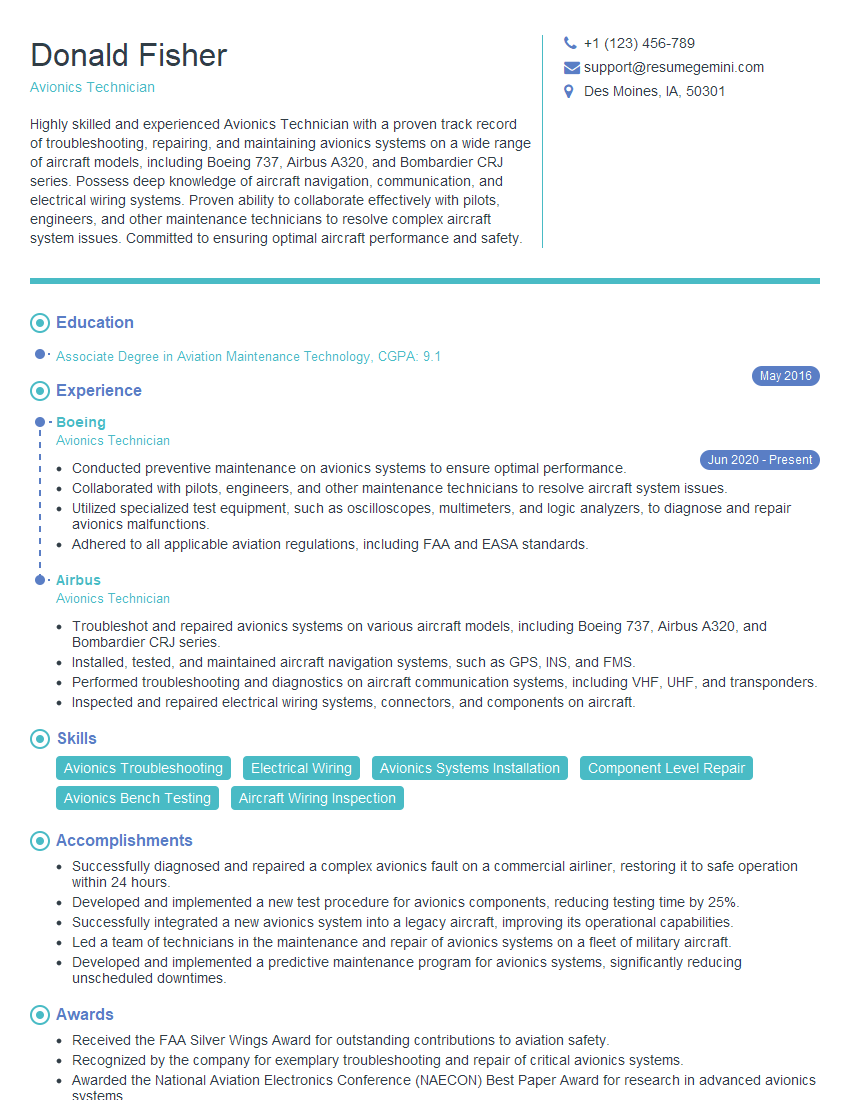
Mastering Computer and Avionics Systems opens doors to exciting and impactful careers in the aerospace industry, offering opportunities for innovation and contributing to cutting-edge technologies. To maximize your job prospects, creating an ATS-friendly resume is crucial. This ensures your qualifications are effectively highlighted to potential employers. We recommend using ResumeGemini, a trusted resource for building professional resumes that stand out. ResumeGemini provides examples of resumes tailored to Computer and Avionics Systems, helping you showcase your skills and experience effectively. Invest in your future – invest in a strong resume.
Explore more articles
Users Rating of Our Blogs
Share Your Experience
We value your feedback! Please rate our content and share your thoughts (optional).
What Readers Say About Our Blog
Hello,
we currently offer a complimentary backlink and URL indexing test for search engine optimization professionals.
You can get complimentary indexing credits to test how link discovery works in practice.
No credit card is required and there is no recurring fee.
You can find details here:
https://wikipedia-backlinks.com/indexing/
Regards
NICE RESPONSE TO Q & A
hi
The aim of this message is regarding an unclaimed deposit of a deceased nationale that bears the same name as you. You are not relate to him as there are millions of people answering the names across around the world. But i will use my position to influence the release of the deposit to you for our mutual benefit.
Respond for full details and how to claim the deposit. This is 100% risk free. Send hello to my email id: [email protected]
Luka Chachibaialuka
Hey interviewgemini.com, just wanted to follow up on my last email.
We just launched Call the Monster, an parenting app that lets you summon friendly ‘monsters’ kids actually listen to.
We’re also running a giveaway for everyone who downloads the app. Since it’s brand new, there aren’t many users yet, which means you’ve got a much better chance of winning some great prizes.
You can check it out here: https://bit.ly/callamonsterapp
Or follow us on Instagram: https://www.instagram.com/callamonsterapp
Thanks,
Ryan
CEO – Call the Monster App
Hey interviewgemini.com, I saw your website and love your approach.
I just want this to look like spam email, but want to share something important to you. We just launched Call the Monster, a parenting app that lets you summon friendly ‘monsters’ kids actually listen to.
Parents are loving it for calming chaos before bedtime. Thought you might want to try it: https://bit.ly/callamonsterapp or just follow our fun monster lore on Instagram: https://www.instagram.com/callamonsterapp
Thanks,
Ryan
CEO – Call A Monster APP
To the interviewgemini.com Owner.
Dear interviewgemini.com Webmaster!
Hi interviewgemini.com Webmaster!
Dear interviewgemini.com Webmaster!
excellent
Hello,
We found issues with your domain’s email setup that may be sending your messages to spam or blocking them completely. InboxShield Mini shows you how to fix it in minutes — no tech skills required.
Scan your domain now for details: https://inboxshield-mini.com/
— Adam @ InboxShield Mini
Reply STOP to unsubscribe
Hi, are you owner of interviewgemini.com? What if I told you I could help you find extra time in your schedule, reconnect with leads you didn’t even realize you missed, and bring in more “I want to work with you” conversations, without increasing your ad spend or hiring a full-time employee?
All with a flexible, budget-friendly service that could easily pay for itself. Sounds good?
Would it be nice to jump on a quick 10-minute call so I can show you exactly how we make this work?
Best,
Hapei
Marketing Director
Hey, I know you’re the owner of interviewgemini.com. I’ll be quick.
Fundraising for your business is tough and time-consuming. We make it easier by guaranteeing two private investor meetings each month, for six months. No demos, no pitch events – just direct introductions to active investors matched to your startup.
If youR17;re raising, this could help you build real momentum. Want me to send more info?
Hi, I represent an SEO company that specialises in getting you AI citations and higher rankings on Google. I’d like to offer you a 100% free SEO audit for your website. Would you be interested?
Hi, I represent an SEO company that specialises in getting you AI citations and higher rankings on Google. I’d like to offer you a 100% free SEO audit for your website. Would you be interested?
good