Feeling uncertain about what to expect in your upcoming interview? We’ve got you covered! This blog highlights the most important Concrete Countertops interview questions and provides actionable advice to help you stand out as the ideal candidate. Let’s pave the way for your success.
Questions Asked in Concrete Countertops Interview
Q 1. Describe the process of creating a concrete countertop mold.
Creating a concrete countertop mold is crucial for achieving the desired shape and size. Think of it like baking a cake – you need the right pan! The process typically involves building a framework, usually from melamine-coated MDF (medium-density fiberboard), to contain the concrete. This framework is meticulously assembled to the exact dimensions of the finished countertop.
Next, a release agent is applied to the inside of the framework. This prevents the concrete from sticking to the mold and allows for easy removal once cured. Common release agents include mold release wax or silicone-based sprays. After the release agent application, a strong, flexible plastic membrane (like polyethylene sheeting) is carefully placed inside the framework to form the actual mold, ensuring a smooth countertop surface.
For intricate designs or edges, additional steps might be needed. This could involve using templates, creating forms from other materials, or using specialized mold-making techniques. The key is precision – any imperfections in the mold will be reflected in the finished countertop.
Q 2. What are the different types of concrete mixes used for countertops?
The type of concrete mix significantly impacts the final appearance and durability of the countertop. While a simple cement-sand-water mix is possible, it’s rarely used for countertops due to its limited aesthetic possibilities and susceptibility to cracking. Most professionals opt for specialized mixes incorporating high-performance ingredients.
- High-strength concrete mixes: These mixes use high-quality Portland cement and carefully graded aggregates (sand and gravel) to maximize strength and minimize shrinkage, which reduces cracking.
- Polymer-modified concrete: Adding polymers enhances the mix’s flexibility and durability, improving its resistance to cracking and staining. This leads to a more user-friendly and long-lasting countertop.
- Colored concrete mixes: Integrates pigments directly into the mix, providing even color throughout the countertop. This eliminates the need for surface staining and creates a consistent look.
The specific mix ratio is crucial and often determined by the desired finish, the project’s complexity, and local climate conditions. Experienced concrete countertop fabricators usually develop their own proprietary mixes based on years of experience.
Q 3. Explain the importance of proper curing for concrete countertops.
Proper curing is arguably the most critical step in creating a durable and visually appealing concrete countertop. Curing involves maintaining the concrete’s moisture content at optimal levels during the initial hardening period. This prevents rapid drying, which can lead to cracking, shrinking, and reduced strength. Think of it as nurturing a delicate plant – it needs the right environment to grow strong and healthy.
Methods include:
- Wet curing: Keeping the concrete consistently moist by covering it with plastic sheeting and misting it regularly for several days.
- Membrane curing: Applying a curing compound that seals the surface, preventing moisture loss.
- Controlled environment curing: Curing in a temperature- and humidity-controlled space for optimal results.
The duration of the curing process depends on several factors, including the type of concrete mix, the ambient temperature, and humidity. Inadequate curing can result in a weaker, more prone-to-damage countertop, impacting its overall longevity.
Q 4. How do you achieve a specific color or pattern in a concrete countertop?
Achieving specific colors and patterns is where the artistry of concrete countertops truly shines. Several techniques exist, each offering unique results.
- Integral color: This involves adding pigments directly to the concrete mix before pouring. It results in even, consistent coloration throughout the slab.
- Surface staining: Applying acid stains after the concrete has cured creates mottled, translucent effects and brings out the aggregates’ natural beauty.
- Venetian plaster techniques: Incorporates layers of pigmented concrete, creating depth and visual interest. This technique requires a high level of skill and precision.
- Aggregate variations: Using different sizes, colors, and types of aggregates (like pebbles, glass, or recycled materials) creates unique textures and patterns.
- Stamping and texturing: Using stamps or textured rollers creates imprinted patterns on the concrete surface before it sets.
Experimentation and a keen eye for design are key. Many fabricators use sample boards to test different pigment combinations and techniques before applying them to the actual countertop.
Q 5. What are the different types of sealers used for concrete countertops and their pros/cons?
Sealers are essential for protecting concrete countertops from stains, moisture damage, and wear and tear. Several types are available, each with its pros and cons:
- Penetrating sealers: These sealers soak into the concrete, protecting it from within. They’re generally less prone to peeling or chipping but offer less surface protection than topical sealers. Pros: Enhanced durability, breathable. Cons: Less shine, may require more frequent applications.
- Topical sealers: These form a protective film on the concrete’s surface, providing a higher level of stain resistance and shine. However, they can wear down over time and require reapplication. Pros: Enhanced shine, superior stain resistance. Cons: Can peel or chip, less breathable.
- Epoxy sealers: These are highly durable and offer excellent protection, but they can be challenging to apply and may yellow over time. Pros: Excellent protection, durable. Cons: Difficult application, may yellow.
The choice of sealer depends on the countertop’s intended use, desired aesthetic, and budget. Always follow the manufacturer’s instructions for proper application.
Q 6. How do you repair cracks or chips in a concrete countertop?
Repairing cracks or chips in a concrete countertop requires precision and the right materials. Small chips can often be filled with an epoxy resin matched to the countertop’s color. Larger cracks require more extensive repair.
Step-by-step repair (for cracks):
- Clean the crack thoroughly, removing any loose debris.
- Apply a crack sealant or epoxy resin, ensuring complete penetration into the crack.
- Allow the sealant to cure fully according to the manufacturer’s instructions.
- Sand the repaired area smooth, feathering the edges to blend seamlessly with the surrounding surface.
- Reapply sealer if necessary.
For significant damage or large chips, it’s best to consult a professional concrete restoration specialist. Improper repairs can worsen the damage or compromise the countertop’s integrity.
Q 7. What are the safety precautions involved in working with concrete?
Working with concrete involves several safety hazards. It’s essential to prioritize safety throughout the process.
- Respiratory protection: Always wear a dust mask or respirator to prevent inhaling cement dust, which can be harmful to the lungs.
- Eye protection: Safety glasses are crucial to prevent eye irritation or injury from flying debris or splashes.
- Skin protection: Wear gloves and long sleeves to protect your skin from contact with cement, which can cause irritation or allergic reactions.
- Proper ventilation: Work in a well-ventilated area to prevent the buildup of harmful fumes from concrete sealers or other chemicals.
- Handling chemicals safely: Follow the manufacturer’s safety instructions for all chemicals used, such as sealers, pigments, and release agents.
Remember, safety is paramount. If you’re unsure about any aspect of the process, seek guidance from experienced professionals or consult relevant safety data sheets (SDS) before starting the work.
Q 8. Describe your experience with different edge profiles for concrete countertops.
Edge profiles are crucial for the aesthetic appeal and functionality of concrete countertops. They represent the finished edge of the countertop and can significantly impact the overall design. I’ve worked extensively with a wide variety of profiles, each offering a distinct look and feel.
- Simple profiles: These include square, eased, and bevelled edges, which are relatively straightforward to create and are suitable for modern or minimalist designs. A square edge is a clean, sharp 90-degree angle, while an eased edge is slightly rounded for a softer look. A bevelled edge has a sloped edge, creating a subtle chamfer.
- Complex profiles: These require more skill and precision and can add a touch of elegance or sophistication. Examples include ogee, cove, and double ogee edges. An ogee profile is an S-shaped curve, while a cove edge is a concave curve. A double ogee combines two ogee curves for a more intricate design. I’ve even created custom profiles based on client sketches, adding a truly unique element to their kitchen or bathroom.
- Custom profiles: Working with clients to create unique edge profiles is a highlight of my work. For example, I recently crafted a countertop with an edge that incorporated a subtle wave pattern, echoing the design of the backsplash tiles.
The choice of edge profile depends heavily on the overall design aesthetic and the client’s preferences. I always discuss the various options with my clients, offering samples and visuals to help them visualize the final product.
Q 9. How do you handle undercuts and complex countertop shapes?
Undercuts and complex shapes present unique challenges, demanding precision and meticulous planning. I approach these projects by breaking down the process into manageable steps.
- Detailed Templates: Accurate templates are paramount. I use high-quality materials and precision measuring techniques to ensure the template perfectly represents the desired shape, including all undercuts. Any discrepancies at this stage will be amplified during fabrication.
- Form Construction: The formwork needs to accurately mirror the template. This may require the use of multiple pieces of plywood, meticulously assembled and reinforced to withstand the weight of the concrete. For undercuts, I often utilize flexible materials or create custom form inserts to achieve the desired shape.
- Vibration and Consolidation: Proper vibration is critical to eliminate air pockets and ensure a dense, strong concrete pour, especially in complex shapes. I use a variety of vibrators, from internal vibrators for deep undercuts to surface vibrators to consolidate the concrete across the entire surface.
- Finishing and Polishing: Finishing complex shapes requires careful attention to detail and often involves hand-finishing techniques to achieve a smooth, even surface in all areas, including the undercuts. Polishing can be more challenging, requiring customized tools and techniques to access all areas.
I’ve successfully completed many projects with significant undercuts and complex shapes, including a curved island countertop with a waterfall edge and integrated sink, which required careful planning and execution.
Q 10. What tools and equipment are essential for fabricating concrete countertops?
Fabricating concrete countertops requires a range of specialized tools and equipment. Safety is always my top priority, so I ensure all equipment is properly maintained and operated according to safety regulations.
- Mixers: A high-quality concrete mixer is essential for achieving a consistent mix. I prefer mixers that are powerful enough to handle the demanding nature of concrete.
- Formwork Materials: Plywood, melamine, and other suitable materials are needed to create the forms for pouring the concrete. I also use silicone caulk to create watertight seals.
- Vibrator: A concrete vibrator is used to eliminate air bubbles from the concrete mix, crucial for a strong and durable countertop.
- Grinders and Polishers: Grinders with diamond grinding pads of various grits are necessary for initial smoothing and shaping. Variable-speed polishers with diamond polishing pads are used for achieving a high-gloss finish. This might include both wet and dry polishing systems depending on the desired outcome and the concrete mix utilized.
- Safety Equipment: This includes respirators, safety glasses, gloves, and hearing protection.
- Measuring and Cutting Tools: Precise measuring tools like tape measures, levels, and squares are essential, as well as tools for cutting the concrete, including specialized concrete saws with diamond blades.
Investing in quality tools significantly impacts the final product’s quality and the efficiency of the fabrication process.
Q 11. Explain the process of polishing a concrete countertop to a high gloss finish.
Polishing concrete countertops to a high-gloss finish is a multi-step process requiring patience and precision. The goal is to achieve a smooth, reflective surface with a consistent sheen.
- Initial Grinding: Begin with coarser grit diamond grinding pads (e.g., 50-100 grit) to remove any imperfections from the surface. This removes any high spots, ensuring a consistent base before moving to finer grits. Work in sections, ensuring consistent pressure to avoid uneven grinding. Use plenty of water to keep the surface wet to reduce dust and heat buildup.
- Progressive Refinement: Gradually move to finer grit diamond grinding pads (e.g., 100-300, 300-500, 1500-3000 grit) to progressively refine the surface. Each grit stage removes finer imperfections, resulting in a smoother surface with each step. Always ensure the previous stage’s scratches are completely removed before moving to the next finer grit.
- Polishing: Use diamond polishing pads (e.g., 8000 grit or higher) to achieve the final high-gloss finish. Apply minimal pressure and use plenty of water. This stage focuses on creating a highly reflective surface with minimal imperfections.
- Sealing (optional): Once polished, sealing the countertop helps to protect it from stains and water damage. A high-quality sealer is essential, and I always follow the manufacturer’s instructions carefully.
The final polish is a testament to the attention to detail and skill involved. A beautifully polished concrete countertop is a true showcase of craftsmanship.
Q 12. How do you ensure the proper installation of a concrete countertop?
Proper installation is crucial for ensuring the longevity and functionality of the concrete countertop. I follow a rigorous process to guarantee a successful installation.
- Precise Measurement and Template Creation: Accurate measurements are taken of the cabinet openings, and a template is created to ensure a perfect fit. This process involves detailed planning and precise cutting to accommodate any curves or irregularities.
- Support Structure: A strong and stable support structure is critical. Existing cabinetry should be assessed to ensure it can adequately support the weight of the concrete countertop. Reinforcements may be necessary in some cases.
- Installation Method: The countertop is carefully positioned and secured, usually using appropriate adhesive and mechanical fasteners (like screws or bolts). The method is dependent on the countertop’s size, shape, and the supporting structure.
- Finishing Touches: Once in place, any final adjustments are made. This may involve minor grouting or caulking to seal gaps between the countertop and the surrounding surfaces.
I always communicate closely with the client throughout the installation process, keeping them informed of each step and ensuring they are satisfied with the final product.
Q 13. What are the common problems encountered during concrete countertop installation?
Several common problems can occur during concrete countertop installation. Anticipating and addressing these issues is crucial for a successful project.
- Improper Support: Inadequate support can lead to cracking or sagging of the countertop. This requires careful assessment of the underlying structure before installation.
- Incorrect Mixing or Pouring: Issues such as air pockets, uneven thickness, or improper consolidation can affect the countertop’s strength and appearance. Careful mixing and vibration are vital to address this.
- Poor Sealing: Inadequate sealing can lead to staining and water damage. Using high-quality sealant and applying it correctly is essential.
- Incorrect Measurement and Cutting: Errors in measuring and cutting the countertop can lead to gaps or poor fit with the cabinetry. Precise templates and careful measurements are key.
- Damage during Transportation or Handling: Concrete countertops can be susceptible to damage during transport or handling. Careful handling and proper protection are crucial.
Thorough planning, precise execution, and attention to detail are essential to minimize these problems. I proactively address these potential challenges during every stage of the process.
Q 14. How do you troubleshoot common issues like staining or discoloration?
Staining and discoloration are common concerns with concrete countertops. The approach to troubleshooting depends on the cause and type of stain.
- Surface Stains: Many surface stains can be removed by cleaning with a mild detergent and water. For more stubborn stains, specialized concrete cleaners may be necessary. Always test any cleaning solution on an inconspicuous area first.
- Penetration Stains: Penetration stains, where the stain has penetrated the concrete, are more challenging to remove. Depending on the stain, professional restoration techniques or grinding might be needed. In some cases, the affected area may need to be repaired or replaced.
- Discoloration: Discoloration can sometimes be due to the concrete mix itself, improper curing, or the use of certain sealers. In this case, the best solution is preventative maintenance – using high quality materials and employing proper curing techniques. In some instances, a re-polish of the affected area may be enough.
Prevention is always better than cure. Proper sealing and regular maintenance are crucial for preventing staining and discoloration. I always advise clients on proper care and cleaning techniques to help maintain the beauty of their concrete countertops.
Q 15. Describe your experience working with different types of sinks and backsplashes.
My experience with sinks and backsplashes for concrete countertops is extensive. I’ve worked with a wide variety of materials and installation methods. For sinks, I frequently integrate undermount sinks, which require precise cutting and sealing to ensure a seamless, watertight fit. The sink material itself can range from stainless steel, which is durable and classic, to more modern options like fireclay or composite materials. Proper preparation of the countertop edge is crucial for a successful undermount installation; any imperfections could lead to leaks. I also have experience with drop-in sinks, which offer a simpler installation process, but require careful consideration of the sink’s dimensions and the countertop’s overall design.
Regarding backsplashes, I’ve used various materials including glass tile, natural stone (like marble or granite), and even matching concrete to create a cohesive look. When using concrete for the backsplash, the process involves creating smaller, easier-to-handle forms to avoid large pours. The key is ensuring consistency in color and texture between the countertop and the backsplash. One project involved a custom-designed glass tile backsplash that complemented the countertop’s swirling pattern. It added an element of visual interest and elevated the overall look of the kitchen.
Career Expert Tips:
- Ace those interviews! Prepare effectively by reviewing the Top 50 Most Common Interview Questions on ResumeGemini.
- Navigate your job search with confidence! Explore a wide range of Career Tips on ResumeGemini. Learn about common challenges and recommendations to overcome them.
- Craft the perfect resume! Master the Art of Resume Writing with ResumeGemini’s guide. Showcase your unique qualifications and achievements effectively.
- Don’t miss out on holiday savings! Build your dream resume with ResumeGemini’s ATS optimized templates.
Q 16. What are the differences between using pigments and stains in concrete?
Pigments and stains are both used to color concrete, but they achieve this in fundamentally different ways. Pigments are incorporated directly into the concrete mix before pouring. This creates a consistent, throughout color that’s integral to the countertop itself. Think of it like adding food coloring to batter – the color is permanently baked in. Stains, on the other hand, are applied after the concrete has cured. They penetrate the surface and react with the concrete’s chemical makeup to create color variation. Imagine staining wood – the color will vary based on the wood’s grain and density.
The choice depends on the desired aesthetic. Pigments provide a more uniform and predictable color, ideal for solid colors or subtle variations. Stains, with their capacity for unique patterns and depth, are great for achieving more dramatic effects, such as mimicking the look of natural stone. For example, a client once requested a countertop with a ‘terrazzo’ effect. We used multiple pigments throughout the mix to mimic the chips of color, creating a natural look, not possible using only stains.
Q 17. Explain the concept of proper vibration consolidation in concrete countertop production.
Vibration consolidation is a critical step in concrete countertop production. It’s the process of using a vibrating table or other vibratory equipment to remove trapped air bubbles from the freshly poured concrete. These air bubbles, if left unchecked, can weaken the countertop, creating potential for cracking or porosity, and affecting the overall finish.
The process involves carefully placing the freshly poured concrete into the mold and then placing the mold onto a vibrating table. The vibrations cause the air bubbles to rise to the surface, resulting in a denser, stronger, and more uniform countertop. The duration of vibration depends on the concrete mix and the mold’s size and shape; it’s a judgement call based on observation of the surface’s smoothness. Insufficient vibration can lead to a weak, porous countertop prone to chipping, while excessive vibration can cause segregation of the aggregate (the larger pieces of rock in the concrete mix).
Q 18. How do you determine the appropriate thickness for a concrete countertop?
Determining the appropriate thickness of a concrete countertop is crucial for both aesthetics and structural integrity. A countertop that’s too thin will be prone to cracking and flexing, while one that’s too thick will be unnecessarily heavy and expensive.
Several factors influence the ideal thickness: the size of the countertop, the type of support system (cabinets, etc.), and the desired design features. Generally, a minimum thickness of 1.5 inches is recommended for most standard applications. For larger countertops or those with significant overhangs, thicker pours (up to 2.5 inches or even more) may be necessary. I usually consult with structural engineers or other structural experts, especially for non-standard projects and unusual configurations, to ensure the structural integrity of the design. Proper reinforcement with rebar (steel reinforcing bars) embedded in the concrete is another factor to consider for thicker countertops to prevent cracking.
Q 19. What are the best practices for maintaining and cleaning concrete countertops?
Proper maintenance and cleaning are essential for preserving the beauty and longevity of concrete countertops. Concrete is surprisingly durable, but it’s not indestructible. Regular cleaning is best done with a simple mixture of warm water and mild dish soap, and a soft cloth or sponge. Avoid abrasive cleaners or scouring pads, as they can scratch the surface.
For tougher stains, a paste of baking soda and water can be used, but always test in an inconspicuous area first. Sealing the countertop is vital for protection against stains and water damage. A high-quality sealant should be applied according to the manufacturer’s instructions, and reapplied periodically (usually every 1-3 years, depending on the sealant and usage). Periodically, apply a concrete countertop sealer to maintain the integrity of your countertop’s surface.
It’s also important to use trivets or hot pads under hot dishes and pans to prevent thermal shock. Avoid cutting directly on the surface with knives and use cutting boards. Remember to always be conscious of the surface and its susceptibility to surface damage.
Q 20. Describe your experience with different types of concrete countertop molds (wood, metal, etc.)
I have experience working with a variety of concrete countertop molds. Wood molds are a popular choice due to their cost-effectiveness and ease of customization. They allow for complex shapes and designs, but require careful sealing to prevent the concrete from sticking. Wood molds must also be constructed with precision to create a flawless countertop. I’ve used plywood, treated lumber, and even custom-milled wood for intricate designs.
Metal molds, usually made from aluminum or steel, offer superior durability and reusability. They provide consistent results and are less prone to warping or damage than wood molds, but they are more expensive to purchase. The smooth, non-porous surfaces give a superior finish. I’ve used metal molds for projects requiring a large number of identical countertops. In certain projects I even combined wood and metal in the mold to optimize the construction process, incorporating strength where needed and the flexibility and cost-effectiveness of wood elsewhere. Choosing the right mold depends heavily on the project’s scale, budget, and design requirements.
Q 21. How do you ensure the structural integrity of a concrete countertop?
Ensuring the structural integrity of a concrete countertop involves several key considerations. First, the concrete mix itself must be properly proportioned with adequate cement, aggregate, and water to achieve the desired strength and workability. Using a well-graded aggregate mixture is also important for optimal strength and durability. Too little cement weakens the concrete and too much makes it brittle. This involves careful attention to the mix design and using high-quality ingredients.
Proper vibration consolidation, as discussed earlier, is crucial for eliminating air pockets that can weaken the concrete. Furthermore, the use of reinforcement, such as rebar (steel reinforcing bars) or fiber reinforcement, is often necessary, especially for larger countertops or those with significant overhangs. These reinforcements help to prevent cracking and increase the overall strength. Finally, the support structure beneath the countertop, whether it’s cabinets or a custom-built framework, must be adequate to support the weight of the concrete slab.
Careful planning and execution, including proper curing and sealing of the concrete, are all critical elements in achieving long-term structural integrity. In any complex or unusual project, consultation with a structural engineer is crucial to guarantee the countertop’s structural soundness. For example, in one recent project with an unusually large cantilevered section, we brought in a structural engineer to specify the necessary reinforcement to prevent sagging.
Q 22. What are the environmental considerations when working with concrete?
Environmental considerations in concrete countertop fabrication are significant. The primary concern revolves around the cement itself, a major contributor to carbon emissions during its production. We mitigate this by using responsibly sourced cement, prioritizing low-embodied carbon options whenever possible. This often involves opting for Portland cement alternatives like supplementary cementitious materials (SCMs) such as fly ash or slag, which reduce the overall carbon footprint.
Beyond cement, the aggregate (the small rocks and sand in the concrete mix) should be locally sourced to minimize transportation emissions. Water usage is another crucial factor; we implement water-efficient mixing techniques and recycle water whenever feasible. Finally, proper disposal of waste materials, including any unused concrete mix or packaging, is paramount. We strictly adhere to local regulations and strive for responsible waste management practices to minimize landfill impact.
Q 23. Describe your experience with working with different countertop designs and styles.
My experience encompasses a wide range of countertop designs. I’ve worked on everything from sleek, minimalist designs with polished concrete finishes, ideal for modern kitchens, to rustic, textured surfaces incorporating exposed aggregate for a more traditional feel. We’ve even created countertops with integrated sinks and drainboards, seamlessly integrating functionality and aesthetics. Color customization is a key aspect; we achieve this by incorporating pigments directly into the concrete mix, allowing for a virtually limitless palette. I’ve worked on projects incorporating various edge profiles, ranging from simple square edges to more elaborate ogee or beveled edges, tailored to the client’s specific preferences and architectural style.
For example, one memorable project involved creating a concrete countertop with a custom inlay of reclaimed wood, blending modern industrial elements with a touch of rustic charm. Another involved replicating the look of marble using specialized techniques and pigments, offering a high-end look at a more competitive price point. Each project presents a unique challenge and opportunity to showcase creative design solutions.
Q 24. How do you manage a project timeline and budget for concrete countertop installation?
Managing project timelines and budgets for concrete countertop installation is critical. It begins with a detailed initial consultation to understand the client’s vision, scope of the project (including size, design complexity, and finishing), and budget constraints. From there, we create a comprehensive project proposal outlining all phases, including design, fabrication, installation, and finishing. This proposal includes a detailed timeline with specific milestones and deadlines.
Budget management involves providing a clear breakdown of all costs—materials, labor, and any additional services. We use project management software to track expenses, ensuring transparency and accountability. We maintain regular communication with the client throughout the project, providing updates on progress and addressing any potential delays or cost overruns promptly. Contingency plans are built into the timeline and budget to handle unexpected issues, like material shortages or unforeseen site challenges, ensuring a smooth and successful project completion.
Q 25. What are the different types of reinforcement used in concrete countertops?
Several reinforcement methods are used to enhance the strength and durability of concrete countertops. The most common is fiberglass mesh, providing tensile strength and preventing cracking, especially in larger countertops. Steel rebar, while less common due to potential rusting concerns (unless using stainless steel), can be incorporated for high-strength applications or unusually large spans. Other options include fiber reinforcement, such as polypropylene or steel fibers, which are mixed directly into the concrete mix for increased impact resistance and overall toughness.
The choice of reinforcement depends on factors like the countertop’s size, design, and intended use. For example, a large island countertop might require fiberglass mesh combined with steel fibers for optimal strength and crack prevention. Smaller countertops might only need fiberglass mesh. Proper placement and layering of reinforcement are crucial to ensure effective support and prevent structural failures.
Q 26. How do you handle customer requests and concerns during the installation process?
Handling customer requests and concerns is a critical aspect of the process. Open communication is key. We encourage clients to voice their concerns or changes promptly. We actively listen to their feedback, providing transparent explanations of potential impacts on the timeline, budget, or design. We document all requests and changes formally to avoid misunderstandings. If a request requires significant alterations, we present updated proposals and timelines for review and approval.
For example, if a client wants a design change midway through fabrication, we’ll assess its feasibility, provide potential solutions, and outline any associated costs and time implications. Our goal is to create a collaborative environment where the client feels involved and heard throughout the project, leading to mutual satisfaction.
Q 27. Explain your experience with different types of epoxy resins and their applications.
Epoxy resins play a vital role in concrete countertop finishing, primarily as sealants and pigments. I have extensive experience with various epoxy types, including water-based and solvent-based options. Water-based epoxies are preferred for their lower VOC (volatile organic compounds) content, making them environmentally friendlier. Solvent-based epoxies offer superior hardness and durability but require more careful handling due to their volatile nature.
The choice depends on several factors including the desired finish, the application method (brushing, rolling, pouring), and environmental considerations. For instance, a high-gloss finish often necessitates a solvent-based epoxy for a deeper, more lustrous appearance. A more matte finish might utilize a water-based epoxy. In addition to sealants, epoxies also carry pigments to create custom colors or color effects within the concrete itself. Proper mixing ratios and application techniques are critical to ensure a flawless, durable finish.
Q 28. What are your strategies for quality control during the production and installation of concrete countertops?
Quality control is paramount. It begins with meticulous material selection, ensuring high-quality cement, aggregates, and pigments are used consistently. During fabrication, we closely monitor the concrete mix’s consistency and workability. We use standardized procedures for mixing, pouring, and vibrating the concrete to prevent air pockets and ensure a uniform density. Regular inspections are carried out throughout the fabrication process to detect and address any potential issues such as cracks, inconsistencies, or imperfections.
Once the countertop is cured, it undergoes rigorous quality checks before finishing. This includes inspecting for surface defects, ensuring proper edge profiles, and checking for any structural weaknesses. The final finishing process, including grinding, polishing, and sealing, is meticulously carried out, with regular checks to ensure a high-quality, even surface. Finally, we conduct a thorough final inspection before installation, ensuring the countertop meets our stringent quality standards and client expectations.
Key Topics to Learn for Concrete Countertops Interview
- Concrete Mix Design: Understanding the ratios of cement, aggregates, water, and admixtures to achieve desired strength, workability, and finish.
- Formwork and Molding Techniques: Practical knowledge of building and preparing forms, including techniques for achieving complex shapes and smooth surfaces.
- Finishing and Polishing Methods: Mastering various grinding, polishing, and sealing techniques to achieve the desired aesthetic finish (e.g., honed, polished, stained).
- Color Pigmentation and Staining: Understanding the process of adding color to the concrete mix and applying stains for unique designs and effects.
- Installation and Repair Procedures: Knowledge of proper installation methods, including edge detailing, and troubleshooting common problems like cracks or discoloration.
- Health and Safety Regulations: Familiarity with OSHA and other relevant safety regulations pertaining to concrete work, including handling hazardous materials.
- Cost Estimation and Project Management: Ability to estimate material costs, labor, and project timelines effectively.
- Troubleshooting and Problem-Solving: Practical experience in identifying and resolving common issues encountered during the fabrication and installation process.
- Understanding Different Concrete Types: Knowledge of various concrete mixes suitable for countertops, including their properties and applications (e.g., high-performance concrete, fiber-reinforced concrete).
Next Steps
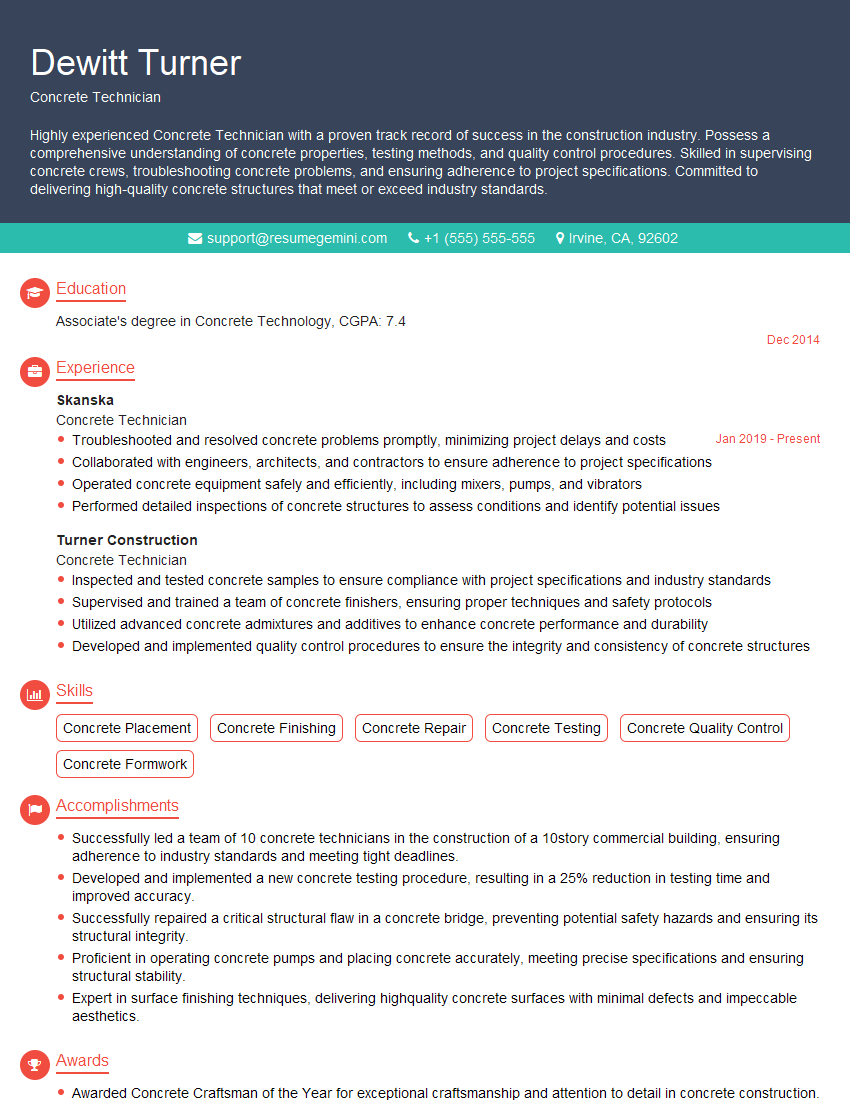
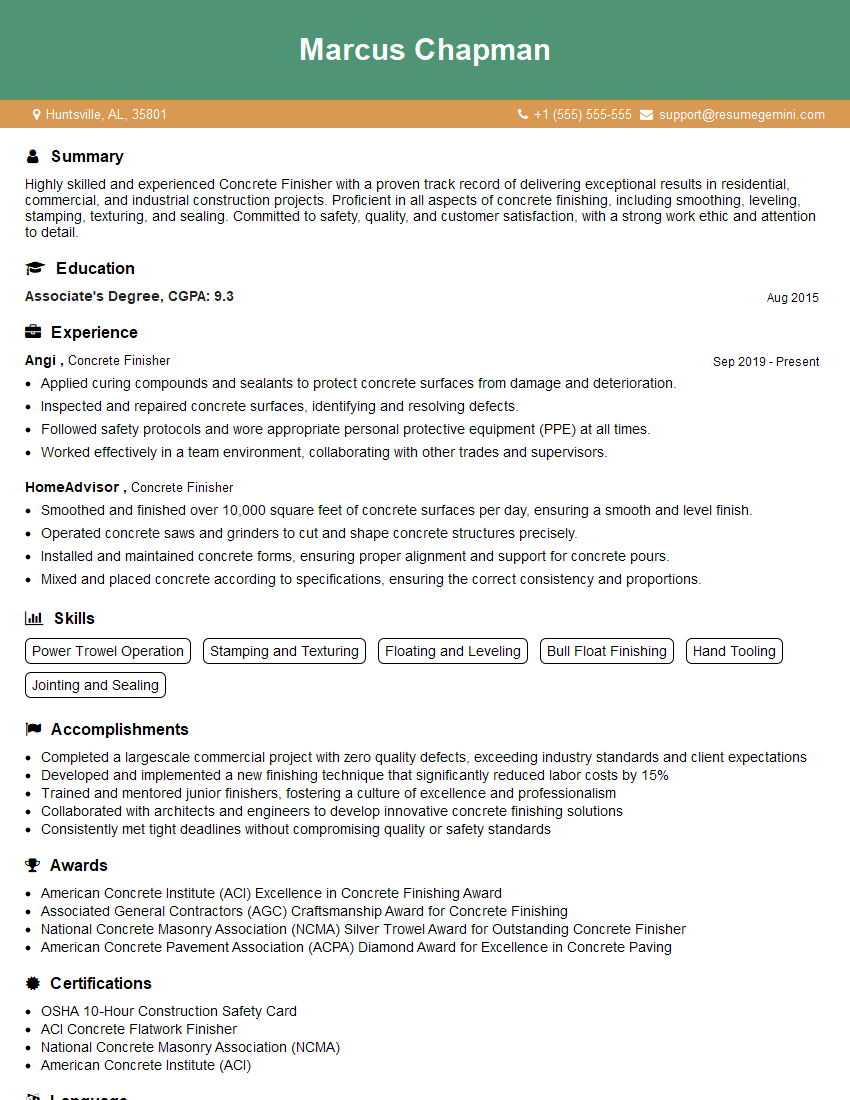
Mastering the art of concrete countertop fabrication opens doors to exciting career opportunities in a growing industry. Demand for skilled professionals is high, offering excellent prospects for growth and advancement. To maximize your job search success, create a compelling and ATS-friendly resume that highlights your skills and experience. ResumeGemini is a trusted resource to help you build a professional resume that truly showcases your qualifications. Examples of resumes tailored specifically for Concrete Countertops professionals are available to guide you. Take the next step and craft a resume that gets noticed!


Explore more articles
Users Rating of Our Blogs
Share Your Experience
We value your feedback! Please rate our content and share your thoughts (optional).
What Readers Say About Our Blog
Attention music lovers!
Wow, All the best Sax Summer music !!!
Spotify: https://open.spotify.com/artist/6ShcdIT7rPVVaFEpgZQbUk
Apple Music: https://music.apple.com/fr/artist/jimmy-sax-black/1530501936
YouTube: https://music.youtube.com/browse/VLOLAK5uy_noClmC7abM6YpZsnySxRqt3LoalPf88No
Other Platforms and Free Downloads : https://fanlink.tv/jimmysaxblack
on google : https://www.google.com/search?q=22+AND+22+AND+22
on ChatGPT : https://chat.openai.com?q=who20jlJimmy20Black20Sax20Producer
Get back into the groove with Jimmy sax Black
Best regards,
Jimmy sax Black
www.jimmysaxblack.com
Hi I am a troller at The aquatic interview center and I suddenly went so fast in Roblox and it was gone when I reset.
Hi,
Business owners spend hours every week worrying about their website—or avoiding it because it feels overwhelming.
We’d like to take that off your plate:
$69/month. Everything handled.
Our team will:
Design a custom website—or completely overhaul your current one
Take care of hosting as an option
Handle edits and improvements—up to 60 minutes of work included every month
No setup fees, no annual commitments. Just a site that makes a strong first impression.
Find out if it’s right for you:
https://websolutionsgenius.com/awardwinningwebsites
Hello,
we currently offer a complimentary backlink and URL indexing test for search engine optimization professionals.
You can get complimentary indexing credits to test how link discovery works in practice.
No credit card is required and there is no recurring fee.
You can find details here:
https://wikipedia-backlinks.com/indexing/
Regards
NICE RESPONSE TO Q & A
hi
The aim of this message is regarding an unclaimed deposit of a deceased nationale that bears the same name as you. You are not relate to him as there are millions of people answering the names across around the world. But i will use my position to influence the release of the deposit to you for our mutual benefit.
Respond for full details and how to claim the deposit. This is 100% risk free. Send hello to my email id: lukachachibaialuka@gmail.com
Luka Chachibaialuka
Hey interviewgemini.com, just wanted to follow up on my last email.
We just launched Call the Monster, an parenting app that lets you summon friendly ‘monsters’ kids actually listen to.
We’re also running a giveaway for everyone who downloads the app. Since it’s brand new, there aren’t many users yet, which means you’ve got a much better chance of winning some great prizes.
You can check it out here: https://bit.ly/callamonsterapp
Or follow us on Instagram: https://www.instagram.com/callamonsterapp
Thanks,
Ryan
CEO – Call the Monster App
Hey interviewgemini.com, I saw your website and love your approach.
I just want this to look like spam email, but want to share something important to you. We just launched Call the Monster, a parenting app that lets you summon friendly ‘monsters’ kids actually listen to.
Parents are loving it for calming chaos before bedtime. Thought you might want to try it: https://bit.ly/callamonsterapp or just follow our fun monster lore on Instagram: https://www.instagram.com/callamonsterapp
Thanks,
Ryan
CEO – Call A Monster APP
To the interviewgemini.com Owner.
Dear interviewgemini.com Webmaster!
Hi interviewgemini.com Webmaster!
Dear interviewgemini.com Webmaster!
excellent
Hello,
We found issues with your domain’s email setup that may be sending your messages to spam or blocking them completely. InboxShield Mini shows you how to fix it in minutes — no tech skills required.
Scan your domain now for details: https://inboxshield-mini.com/
— Adam @ InboxShield Mini
support@inboxshield-mini.com
Reply STOP to unsubscribe
Hi, are you owner of interviewgemini.com? What if I told you I could help you find extra time in your schedule, reconnect with leads you didn’t even realize you missed, and bring in more “I want to work with you” conversations, without increasing your ad spend or hiring a full-time employee?
All with a flexible, budget-friendly service that could easily pay for itself. Sounds good?
Would it be nice to jump on a quick 10-minute call so I can show you exactly how we make this work?
Best,
Hapei
Marketing Director
Hey, I know you’re the owner of interviewgemini.com. I’ll be quick.
Fundraising for your business is tough and time-consuming. We make it easier by guaranteeing two private investor meetings each month, for six months. No demos, no pitch events – just direct introductions to active investors matched to your startup.
If youR17;re raising, this could help you build real momentum. Want me to send more info?
Hi, I represent an SEO company that specialises in getting you AI citations and higher rankings on Google. I’d like to offer you a 100% free SEO audit for your website. Would you be interested?
Hi, I represent an SEO company that specialises in getting you AI citations and higher rankings on Google. I’d like to offer you a 100% free SEO audit for your website. Would you be interested?