Cracking a skill-specific interview, like one for Concrete Grinding and Polishing, requires understanding the nuances of the role. In this blog, we present the questions you’re most likely to encounter, along with insights into how to answer them effectively. Let’s ensure you’re ready to make a strong impression.
Questions Asked in Concrete Grinding and Polishing Interview
Q 1. What types of concrete grinders are you familiar with?
Concrete grinders come in various types, each suited for different applications and scales of projects. The most common categories include:
- Walk-behind grinders: These are smaller, manually operated machines ideal for smaller areas or intricate work. They’re versatile and easy to maneuver in tight spaces.
- Ride-on grinders: Larger and more powerful, these machines are used for extensive projects requiring high productivity. They significantly reduce labor time and effort on large floor areas.
- Planetary grinders: These utilize multiple grinding heads rotating simultaneously around a central axis, providing very even and consistent grinding. They are excellent for achieving a perfectly level surface.
- Hand grinders: Small, handheld tools used for detailed work, edge grinding, or repairing small areas that larger machines can’t access. These are crucial for finishing touches and spot repairs.
The choice of grinder depends heavily on the project scope, budget, and the desired level of surface finish. For instance, a small retail space might only require a walk-behind grinder, while a large warehouse floor would necessitate a ride-on or planetary grinder.
Q 2. Explain the process of concrete grinding from start to finish.
Concrete grinding is a multi-step process involving careful preparation, grinding, and often polishing. Here’s a breakdown:
- Preparation: This involves cleaning the concrete surface to remove any debris, loose material, coatings, or contaminants. Proper cleaning is crucial for ensuring a uniform grind.
- Rough Grinding: Using coarse-grit diamond tooling (e.g., 30-40 grit), we initially remove surface irregularities, levelling the floor and removing any significant imperfections. This is a high-power, aggressive step. Think of it like shaping a piece of clay before finer details are added.
- Intermediate Grinding: Progressively finer grits (e.g., 50-100 grit) are used to refine the surface, eliminating scratches and achieving a smoother texture. Multiple passes are generally needed at each grit stage.
- Fine Grinding: This uses very fine-grit tooling (e.g., 200-400 grit) resulting in a smooth, even surface ready for polishing. This is essential for ensuring a quality finish and reduces future maintenance.
- Polishing (Optional): If a high-gloss finish is desired, polishing is applied using increasingly fine polishing pads to create a mirror-like surface. This stage uses resin-bonded abrasives and is often accompanied by densifiers to enhance the concrete’s durability and shine.
- Sealing (Optional): Depending on the desired level of protection and appearance, a sealer might be added to protect the polished concrete from stains and damage.
The entire process requires careful planning, meticulous execution, and attention to detail to achieve the desired outcome. Each step plays a critical role in the overall success of the project.
Q 3. Describe the different types of polishing pads and their uses.
Polishing pads are graded by grit size, just like grinding tools, determining their abrasiveness. They are typically made of resin-bonded diamonds and come in various colors to denote their grit. Here are a few examples:
- Coarse pads (e.g., 50 grit): Used for initial polishing to remove significant scratches left from grinding. This is comparable to using a coarser sandpaper.
- Medium pads (e.g., 100-200 grit): Further refines the surface, creating a smoother texture and removing the more prominent surface imperfections from the coarse polishing step.
- Fine pads (e.g., 400-800 grit): Removes finer scratches, leaving a smooth, matte finish. This is essentially a very fine sanding of the surface.
- Ultra-fine pads (e.g., 1500-3000 grit): Creates a high-gloss, almost mirror-like finish. This step is similar to using polishing compound on a car.
The choice of polishing pad depends on the desired level of shine and the condition of the concrete after grinding. A highly damaged floor might require multiple passes with coarser pads, while a floor in excellent condition after grinding may only need fine and ultra-fine pads.
Q 4. How do you determine the appropriate grit for a concrete grinding project?
Grit selection depends entirely on the condition of the concrete and the desired final finish. It’s not just about a single grit but a sequence of grits.
- Severely damaged concrete: May require starting with very coarse grits (30-40 grit) to remove deep scratches, pits, or surface irregularities.
- Moderately damaged concrete: Might start with 50-80 grit and progressively move towards finer grits.
- Lightly damaged concrete: Could possibly start directly with medium or fine grits (100-200 grit).
I often conduct a visual inspection of the concrete surface before recommending a grit sequence. The goal is to systematically remove imperfections while minimizing unnecessary grinding time. A more damaged surface naturally requires more aggressive initial grinding. Consider it like sanding wood – if it’s very rough, you start with coarse sandpaper and then gradually move to finer ones.
Q 5. What safety precautions are essential when operating concrete grinding equipment?
Safety is paramount in concrete grinding. Here are essential precautions:
- Respiratory Protection: Always wear a NIOSH-approved respirator to prevent inhaling silica dust, which is a serious health hazard.
- Eye Protection: Safety glasses or a face shield are mandatory to protect against flying debris.
- Hearing Protection: Grinding equipment generates significant noise; earplugs or earmuffs are essential.
- Dust Control: Use a HEPA vacuum system to capture and remove dust during the grinding process. This minimizes airborne silica dust significantly.
- Proper Clothing: Wear durable clothing, long pants, and sturdy shoes to protect your skin and feet.
- Training and Expertise: Operators should be properly trained and experienced in using the equipment.
- Machine Maintenance: Regular maintenance is important. Check for loose parts or defects in the grinding equipment before each use.
Ignoring safety can lead to serious injuries, so it’s not something to be taken lightly. Safety should always be the top priority.
Q 6. How do you ensure consistent surface level during grinding?
Maintaining a consistent surface level during grinding is crucial for a professional finish. Here are some techniques:
- Multiple Passes: Use overlapping passes to ensure even grinding across the entire surface. Think of it like mowing a lawn – you don’t go in one straight line, you overlap.
- Regular Monitoring: Frequently check the surface level using a straight edge or laser level to detect any high or low spots.
- Adjusting Machine Settings: Adjust the grinder’s settings as needed to compensate for variations in the concrete surface.
- Experienced Operator: A skilled operator is essential for maintaining consistent pressure and speed, ensuring even grinding.
- Proper Tool Selection: Using appropriate diamond segments or tooling for your grinder helps a lot in providing even grinding.
Without consistent monitoring and adjustments, the final surface may appear uneven, requiring additional work, compromising the overall project quality.
Q 7. What are the common challenges faced during concrete polishing?
Concrete polishing, while rewarding, presents some common challenges:
- Uneven Concrete Slabs: Variations in the concrete’s thickness or composition can create uneven surfaces, making grinding and polishing more challenging.
- Cracks and Surface Defects: Existing cracks, pits, or other surface imperfections can make achieving a uniform polish difficult and may necessitate additional repairs.
- Dust Control: Managing dust generation during the grinding and polishing processes is a constant concern, requiring appropriate equipment and procedures.
- Achieving Uniform Gloss: Maintaining a consistent level of shine across the entire floor can be tricky, requiring careful attention to technique and equipment.
- Time and Labor: Polishing concrete is time-consuming, especially for large areas, often requiring multiple steps and passes.
Addressing these challenges requires a combination of careful planning, skilled workmanship, appropriate equipment, and a thorough understanding of the concrete’s properties.
Q 8. How do you address uneven surfaces before polishing?
Addressing uneven surfaces before polishing is crucial for achieving a smooth, professional finish. Think of it like preparing a canvas for a painting – you wouldn’t start painting on a bumpy surface! The process usually involves grinding. We use progressively coarser diamond grinding pads, starting with a very coarse grit to remove significant high spots and level out the major inconsistencies. This is followed by increasingly finer grits to achieve a progressively smoother surface. For extremely uneven concrete, we might even employ a concrete leveling compound before grinding begins. The goal is to create a consistent, even plane before we begin the polishing process itself.
For example, if we encounter a concrete slab with significant lippage (unevenness between adjacent slabs), we’d use a heavier grinder and coarser diamond tooling to grind down the high points until the surface is level. We monitor the progress regularly using a straight edge and level to ensure consistency.
Q 9. Explain the process of densifying concrete.
Densifying concrete is a process that hardens and strengthens the surface, making it more resistant to wear and tear. Imagine it like compressing sand into a solid block – the individual particles are pushed closer together, creating a more durable material. We achieve this through a chemical reaction using a densifier which penetrates the concrete’s pores. This densifier reacts with the calcium hydroxide within the concrete, forming calcium carbonate crystals. These crystals fill the pores, essentially sealing them and creating a denser, harder surface. The result is a more durable, stain-resistant, and easier-to-maintain floor.
The process usually involves applying the densifier evenly to the clean, ground concrete surface. We allow it to penetrate for a specific time, as indicated by the manufacturer’s instructions, before any excess is removed. The densification process enhances the concrete’s inherent properties, improving its longevity and appearance.
Q 10. What are the different types of concrete sealers and their applications?
There are several types of concrete sealers, each with specific applications. The choice depends on the desired outcome and the type of concrete being sealed.
- Penetrating Sealers: These sealers soak into the concrete’s pores, preventing moisture from entering. They’re excellent for enhancing the natural look of the concrete and providing some stain resistance. They are ideal for polished concrete where you want to maintain a natural look.
- Topical Sealers: These form a film or coating on top of the concrete, providing a barrier against moisture and stains. They offer better stain protection than penetrating sealers, but they may alter the appearance of the concrete, adding gloss or sheen. These are useful for high-traffic areas or where superior stain resistance is needed.
- Epoxy Sealers: Epoxy sealers are very durable, highly resistant to chemicals and abrasion, and offer superior protection. They are a good option for industrial settings or areas subjected to heavy wear and tear. However, they are more expensive and often require a professional application.
The application varies depending on the sealer type, but generally involves careful and even application using appropriate tools like rollers or sprayers.
Q 11. How do you determine the correct amount of sealer to apply?
Determining the correct amount of sealer is crucial; too little provides inadequate protection, and too much can lead to uneven coating or longer drying times. The manufacturer’s instructions are the most reliable guide. They typically specify the coverage rate per gallon or liter, often expressed as square feet or square meters per coat. We always test a small, inconspicuous area first to check for compatibility and desired effects. The porosity of the concrete also plays a role; more porous concrete requires more sealer. Factors like the type of sealer, temperature, and humidity also influence the application rate. Careful planning and measuring are essential for efficient and effective sealing.
Q 12. What are the factors influencing the drying time of sealers?
Several factors influence the drying time of concrete sealers. Think of it like drying laundry – a humid day will take much longer! Temperature is a primary factor; warmer temperatures accelerate drying, while cooler temperatures slow it down. Humidity also plays a role; high humidity slows drying. The type of sealer itself greatly impacts drying time; thicker, more viscous sealers dry slower than thinner sealers. The porosity of the concrete also matters; more porous concrete absorbs the sealer more slowly, leading to longer drying times. Good ventilation helps accelerate the drying process by removing moisture from the air. The manufacturer’s recommendations should always be followed regarding drying time.
Q 13. How do you troubleshoot common issues during the polishing process?
Troubleshooting is a crucial aspect of concrete polishing. Common issues include uneven polishing, scratches, or discoloration. Uneven polishing often results from insufficient grinding, inconsistent pressure application, or uneven concrete. We address this by re-evaluating the grinding process, adjusting our techniques or, sometimes, by employing additional grinding steps. Scratches often occur due to improper use of grinding pads or the presence of debris. Careful cleaning and the use of proper grinding techniques help mitigate this. Discoloration can result from staining or improper sealer application; proper cleaning and selection of appropriate sealers help solve this problem. Regular inspection and timely intervention minimize issues and ensure a quality finish.
Q 14. Describe your experience with different types of concrete (e.g., stamped, polished).
My experience encompasses a wide range of concrete types. I’ve worked extensively with both stamped and polished concrete. Stamped concrete offers a decorative finish achieved by stamping patterns into the freshly poured concrete. Polishing, however, focuses on grinding and polishing the concrete to bring out its natural beauty or achieve a high-gloss finish. I am proficient in preparing both for polishing, though the initial steps differ significantly. With stamped concrete, preserving the intricate details of the stamped patterns is key during the grinding process, requiring a delicate and precise approach. In contrast, polished concrete may require more aggressive grinding to achieve the desired levelness and smoothness before the polishing stages begin. Each type requires a tailored approach based on its properties and the desired final outcome.
I’ve also worked on various other concrete types, including those with different aggregate sizes and compositions, understanding that each poses unique challenges and requires specialized techniques.
Q 15. What are the different methods for removing stains from polished concrete?
Removing stains from polished concrete depends heavily on the type of stain. Oil-based stains, for instance, require different treatment than water-based stains. Generally, a multi-step approach is best.
- Identification: First, accurately identify the stain. Is it oil, grease, paint, dye, or something else? This dictates the cleaning method.
- Gentle Cleaning: Begin with a mild detergent and water solution. Scrub gently with a soft-bristled brush or mop. Avoid abrasive cleaners that could scratch the surface. For tougher stains, consider a specialized concrete cleaner following the manufacturer’s instructions.
- Abrasive Cleaning (if necessary): For stubborn stains that don’t respond to gentle cleaning, you might need to use increasingly finer grits of diamond abrasive pads or powders. This should be done with caution to avoid damaging the polish. Always start with a coarser grit and work your way to finer grits. Think of it like sanding wood—you start rough and progressively get smoother.
- Professional Help: For extremely difficult or extensive staining, it’s best to consult a professional concrete restoration specialist. They have access to specialized equipment and chemicals that can handle the most challenging situations.
Example: I once dealt with a coffee spill that left a significant dark stain on a newly polished concrete floor in a cafe. Gentle cleaning didn’t work. I carefully used a very fine diamond pad with a polishing machine, gradually removing the stain without marring the existing polish. The key was patience and a gradual approach.
Career Expert Tips:
- Ace those interviews! Prepare effectively by reviewing the Top 50 Most Common Interview Questions on ResumeGemini.
- Navigate your job search with confidence! Explore a wide range of Career Tips on ResumeGemini. Learn about common challenges and recommendations to overcome them.
- Craft the perfect resume! Master the Art of Resume Writing with ResumeGemini’s guide. Showcase your unique qualifications and achievements effectively.
- Don’t miss out on holiday savings! Build your dream resume with ResumeGemini’s ATS optimized templates.
Q 16. How do you maintain the quality and longevity of a polished concrete floor?
Maintaining a polished concrete floor’s quality and longevity involves a proactive approach focusing on regular cleaning and protective measures.
- Regular Cleaning: Daily sweeping or vacuuming removes loose dirt and debris, preventing scratches. Damp mopping with a pH-neutral cleaner should be done regularly. Avoid harsh chemicals.
- Protective Coatings (Sealers): Applying a high-quality concrete sealer is crucial. It protects against staining, wear, and degradation caused by chemicals or moisture. Different sealers offer varying levels of gloss and protection; the choice depends on the specific application and desired look.
- Preventative Measures: Use mats at entrances to reduce dirt tracked in. Address spills promptly. Avoid dragging heavy objects across the surface, and use floor protection during construction or renovations.
- Periodic Refinishing: Even with proper maintenance, polished concrete may eventually require refinishing. This involves light grinding and polishing to restore shine and remove minor surface damage. The frequency depends on traffic and wear.
Example: I’ve worked on several large commercial projects where regular scheduled maintenance—including sealing, cleaning, and occasional light polishing—has resulted in floors that have looked great for years, well beyond the initial warranty periods.
Q 17. What are the various types of concrete grinding equipment you have experience with?
My experience encompasses a wide range of concrete grinding equipment, from smaller hand-held grinders for localized repairs to large, powerful ride-on machines for extensive projects.
- Hand-held Grinders: These are versatile for small areas, edges, and repairs. They are ideal for detail work.
- Walk-behind Grinders: These are suitable for medium-sized projects and offer more power and efficiency than hand-held grinders.
- Ride-on Grinders: These are best for large commercial spaces, warehouses, and industrial facilities. They significantly increase productivity, especially for large surface areas.
- Planer Grinders: These specialized machines are used for leveling uneven concrete surfaces before polishing.
Specific brands I’ve worked with extensively include Husqvarna, HTC, and Lägler, but I’m familiar with many others on the market.
Q 18. What are the differences between wet and dry grinding methods?
Wet and dry grinding methods differ primarily in how they manage dust and slurry.
- Wet Grinding: This method uses water to lubricate the diamond tooling and suppress dust. The water mixes with the ground concrete to create a slurry that is then collected and disposed of. It’s generally cleaner and produces less airborne dust.
- Dry Grinding: This method doesn’t use water. It generates significantly more dust, requiring robust dust collection systems. Dry grinding is often faster, but requires careful attention to safety and dust containment.
Key Differences Summarized:
| Feature | Wet Grinding | Dry Grinding |
|---|---|---|
| Dust | Minimal | Significant |
| Speed | Slower | Faster |
| Cleanup | More involved (slurry removal) | Less involved (dust collection) |
| Cost | Generally higher (water, disposal) | Generally lower (less equipment) |
Q 19. How do you choose the appropriate grinding method for a specific project?
Choosing the appropriate grinding method hinges on several factors:
- Project Size: Large projects often benefit from the speed and efficiency of dry grinding with powerful equipment, though appropriate dust containment is paramount. Smaller projects might allow for the cleaner approach of wet grinding.
- Environmental Concerns: Wet grinding is environmentally preferable in areas with strict dust control regulations.
- Concrete Condition: The condition of the existing concrete dictates the tooling and method. Severely damaged concrete might require aggressive dry grinding initially followed by finer polishing with wet grinding.
- Desired Finish: The final desired polish level influences the choice. Achieving a high-gloss polish typically uses wet grinding techniques throughout the process.
- Budget: Dry grinding is generally less expensive upfront, but wet grinding might be cheaper in the long run due to reduced labor and disposal costs for large projects.
Example: In a residential garage conversion, wet grinding was preferred due to its cleanliness and the smaller size of the space. For a large warehouse renovation, a combination of dry and wet grinding was used – dry for the initial leveling and wet for the final polishing.
Q 20. Explain your experience with diamond tooling maintenance and replacement.
Diamond tooling is the heart of concrete grinding and polishing. Proper maintenance and timely replacement are critical for optimal performance and a quality finish.
- Inspection: Regularly inspect tooling for wear and tear. Look for segment loss, uneven wear, or glazing. Glazing occurs when the diamonds are dulled and no longer cutting effectively.
- Cleaning: After each use, clean tooling thoroughly to remove debris. Compressed air is excellent for this purpose.
- Storage: Store tooling in a dry place to prevent rust and corrosion.
- Replacement: Replace tooling when segments are significantly worn or glazing is evident. Continuing to use worn tooling can lead to uneven grinding, scratches, and reduced efficiency.
- Matching Tooling: Using the correct tooling for each stage of the process (e.g., coarse grit for initial grinding, fine grit for polishing) is crucial for achieving the desired outcome.
Example: On a recent large commercial project, we meticulously tracked tooling usage and replacement, which ensured consistent results and minimized downtime. We also trained our team on proper inspection and maintenance, preventing unexpected problems on-site.
Q 21. Describe your experience with dust collection systems during grinding.
Effective dust collection is paramount for worker safety and environmental compliance during dry grinding. My experience involves working with various dust collection systems, ranging from simple shop vacuums for small jobs to large, industrial-grade systems for large projects.
- HEPA Filtration: HEPA (High-Efficiency Particulate Air) filter systems are essential for capturing fine concrete dust particles that are harmful to breathe.
- Negative Air Pressure: Creating negative air pressure within the workspace helps contain dust and prevents it from spreading to other areas.
- Proper Connections: Ensuring proper connections between the grinding equipment and the dust collection system is crucial for maximum efficiency.
- Regular Maintenance: Filters need to be regularly cleaned or replaced to maintain optimal performance. Neglecting filter maintenance reduces effectiveness and can damage the equipment.
- Local Regulations: Compliance with local regulations regarding dust control and worker safety is mandatory. Different regions have different standards and requirements.
Example: On one project in a densely populated area, we used a large, industrial-grade dust collection system that also incorporated negative air pressure, ensuring that we met all local regulations and minimized any disturbance to the surrounding community. This proactive approach was key to ensuring the project’s successful completion.
Q 22. How do you assess the condition of concrete before starting a project?
Assessing the condition of concrete before a grinding and polishing project is crucial for planning and ensuring a successful outcome. It’s like getting a thorough medical check-up before starting any treatment. My assessment involves a multi-step process:
- Visual Inspection: I carefully examine the concrete surface for cracks, spalling (chipping), delamination (layers separating), stains, and other surface imperfections. This helps determine the severity of damage and the need for repairs before grinding.
- Hardness Testing: Using a Shore Durometer, I measure the concrete’s surface hardness. This helps determine the appropriate grinding process and the type of polishing pads needed. Harder concrete requires more aggressive grinding.
- Moisture Content Testing: Excessive moisture can lead to problems during and after polishing. I use a moisture meter to assess the concrete’s moisture content and determine if any drying measures are necessary before proceeding.
- Flatness Measurement: For large areas, I use a laser level or straight edge to check the floor’s flatness. Significant unevenness might require more extensive grinding to achieve a level surface.
- Concrete Type Identification: Determining the type of concrete (e.g., standard mix, high-strength, or specialized mix) is vital. The composition affects its grindability and suitability for polishing.
For example, I once encountered a floor with significant surface cracking. My assessment revealed that some areas needed repair before grinding could begin. By identifying and addressing this issue beforehand, we prevented costly rework later.
Q 23. What is your experience with different types of resins and coatings for concrete?
My experience encompasses a wide range of resins and coatings used in concrete grinding and polishing. Choosing the right one depends on the desired finish, the level of durability required, and the intended use of the floor. It’s like choosing the right paint for a wall – the wrong choice won’t give you the desired results.
- Epoxy Coatings: These provide excellent durability, chemical resistance, and are suitable for high-traffic areas. I’ve used them in industrial settings like warehouses and manufacturing plants.
- Polyurethane Coatings: Offering good abrasion and stain resistance, these are often used in commercial settings with moderate traffic, like retail stores or offices. They also provide a beautiful, glossy finish.
- Acrylic Coatings: These are more economical options offering decent protection and are suitable for low to medium traffic areas. They’re often used in residential settings.
- Densifiers: These penetrate the concrete, hardening the surface and improving its durability and stain resistance. They are frequently used as a base before applying other coatings.
For a recent project in a food processing facility, we used a specialized epoxy coating with exceptional chemical resistance to withstand harsh cleaning agents. In contrast, for a residential garage, a more economical acrylic sealer was sufficient.
Q 24. How do you estimate the time and cost required for a concrete grinding project?
Estimating time and cost for a concrete grinding project is a meticulous process, combining experience, site assessment, and detailed calculations. It’s not just about the area; it’s about the condition of the concrete.
- Square Footage: The total area to be ground is the starting point.
- Concrete Condition: The level of damage and required preparation significantly impacts time and cost. Heavily damaged concrete requires more time for repairs and grinding.
- Desired Finish: Achieving a high-polish finish requires more steps and time than a simple grind.
- Accessibility: Limited access to the site can slow down the process and increase costs.
- Labor Costs: This includes the number of workers, their hourly rates, and the project duration.
- Equipment Costs: Grinding equipment rental or ownership, transportation, and maintenance are factored in.
- Material Costs: This includes the cost of resins, densifiers, coatings, and other consumables.
We use specialized software to generate accurate estimates. We’ll also provide clients with a detailed breakdown of the costs, including contingency plans for unexpected issues. Transparency is key for building trust.
Q 25. What is your experience with working from blueprints and specifications?
Working from blueprints and specifications is fundamental to our process. It’s like following a detailed recipe to ensure the final product meets expectations. I have extensive experience interpreting architectural and engineering drawings to accurately plan and execute projects.
- Understanding Drawings: I can decipher various drawings, including floor plans, cross-sections, and details, to understand the scope of the project and identify potential challenges.
- Identifying Specifications: I carefully review specifications related to the concrete type, desired finish, and required coatings to ensure that the project aligns with the client’s requirements.
- Planning the Process: Blueprints help me plan the grinding and polishing process, including the sequence of operations and the equipment needed.
- Communication: Blueprints ensure effective communication between the team, the client, and other contractors involved in the project.
In a recent project, the blueprints specified a specific type of epoxy coating. Careful review of these specs ensured we used the correct material, preventing potential issues with compatibility and performance.
Q 26. How do you manage a team during a large-scale concrete grinding project?
Managing a team during a large-scale project involves clear communication, delegation, and maintaining a safe work environment. It’s like conducting an orchestra, where each member plays their part to create a harmonious outcome.
- Clear Roles and Responsibilities: I assign roles based on individual expertise, ensuring every team member understands their tasks and responsibilities.
- Effective Communication: Regular meetings and updates keep everyone informed about project progress and any potential issues.
- Safety First: Strict adherence to safety protocols is non-negotiable. I ensure everyone uses appropriate personal protective equipment (PPE) and follows safety guidelines.
- Motivation and Teamwork: Creating a positive and collaborative work environment boosts team morale and productivity.
- Problem Solving: I promptly address any challenges or conflicts that arise, ensuring the project remains on schedule.
On a recent large hospital project, effective team management allowed us to complete the work ahead of schedule and within budget, while maintaining a flawless safety record.
Q 27. Describe your experience with working under pressure and meeting deadlines.
Working under pressure and meeting deadlines is part of the job. I thrive in such environments. My approach involves meticulous planning, efficient resource allocation, and proactive problem-solving. It’s like being a firefighter – quick thinking and decisive action are crucial.
- Prioritization: I prioritize tasks based on urgency and importance to ensure timely completion.
- Contingency Planning: I anticipate potential delays or problems and develop backup plans to minimize their impact.
- Resource Management: Efficient allocation of personnel and equipment prevents bottlenecks and delays.
- Communication: Keeping clients and stakeholders updated on progress and potential challenges helps manage expectations and prevent conflicts.
On one occasion, we faced a tight deadline due to unexpected weather delays. By adapting our schedule and working extra hours, we managed to complete the project on time without compromising quality.
Q 28. How do you address customer concerns and expectations effectively?
Addressing customer concerns and expectations is vital for client satisfaction and project success. It’s about building trust and demonstrating that their needs are our priority. I believe in open communication and proactive problem-solving.
- Active Listening: I patiently listen to the client’s concerns and understand their perspective.
- Clear Communication: I explain technical aspects in clear, simple language, avoiding jargon.
- Realistic Expectations: I set realistic expectations about timelines, costs, and possible outcomes.
- Problem Solving: I collaborate with the client to find solutions to any issues that arise.
- Follow-up: I follow up with the client after project completion to ensure their satisfaction.
I once had a client concerned about the potential noise during the grinding process. By explaining our noise reduction techniques and scheduling the work during off-peak hours, we alleviated their concerns and ensured a smooth project completion.
Key Topics to Learn for Your Concrete Grinding and Polishing Interview
- Concrete Surface Preparation: Understanding different concrete types, assessing surface conditions (e.g., cracks, stains, levelness), and selecting appropriate preparation methods.
- Grinding Techniques and Equipment: Familiarity with various grinding tools (e.g., planetary grinders, HTC grinders), diamond tooling selection, and understanding the principles of progressive grinding stages.
- Polishing Processes: Knowledge of the steps involved in achieving different levels of polish (e.g., honed, satin, high-gloss), including resin application and burnishing techniques.
- Safety Procedures and Regulations: Understanding and adhering to relevant safety protocols, including personal protective equipment (PPE) usage and dust control measures.
- Defect Identification and Remediation: Ability to recognize common concrete grinding and polishing issues (e.g., lippage, uneven grinding, staining) and implement effective solutions.
- Project Management and Estimation: Experience with job site assessments, material estimations, and scheduling for efficient project completion.
- Concrete Chemistry and Materials: Basic understanding of concrete composition, curing processes, and the impact of different materials on grinding and polishing outcomes.
- Maintenance and Repair: Knowledge of maintaining grinding and polishing equipment, troubleshooting malfunctions, and performing minor repairs.
Next Steps
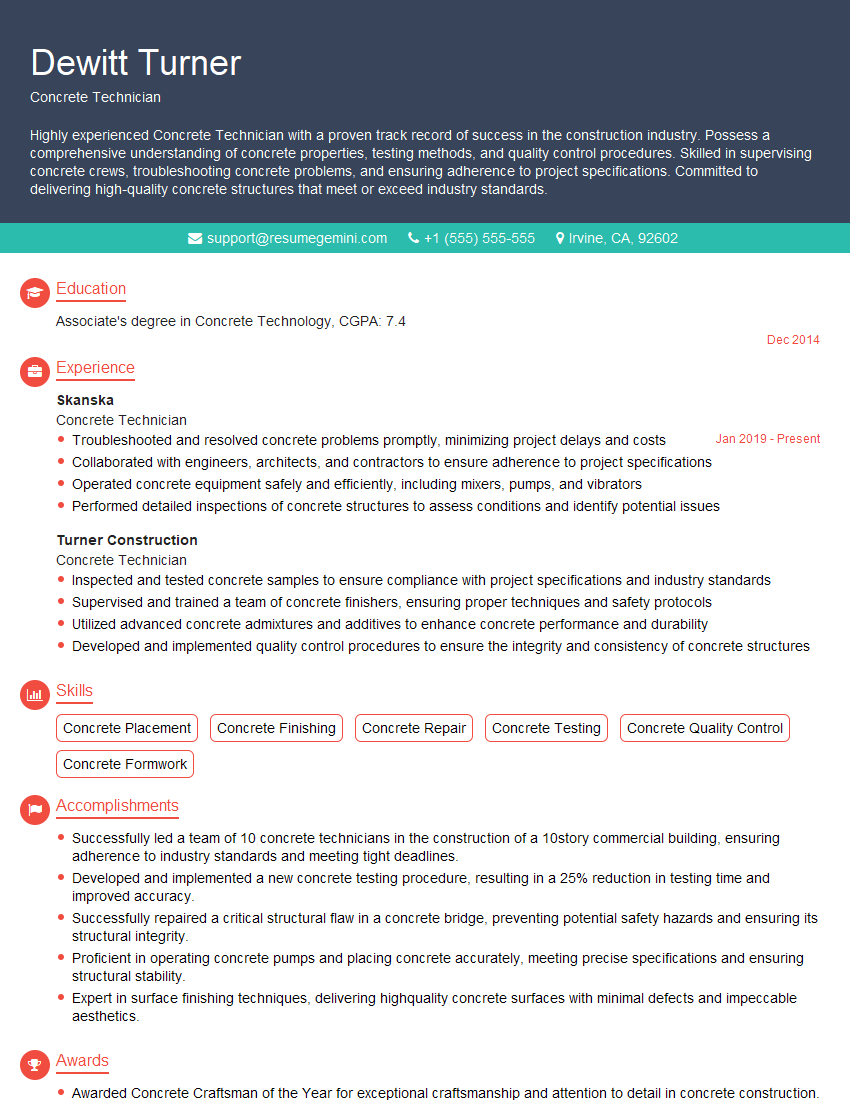
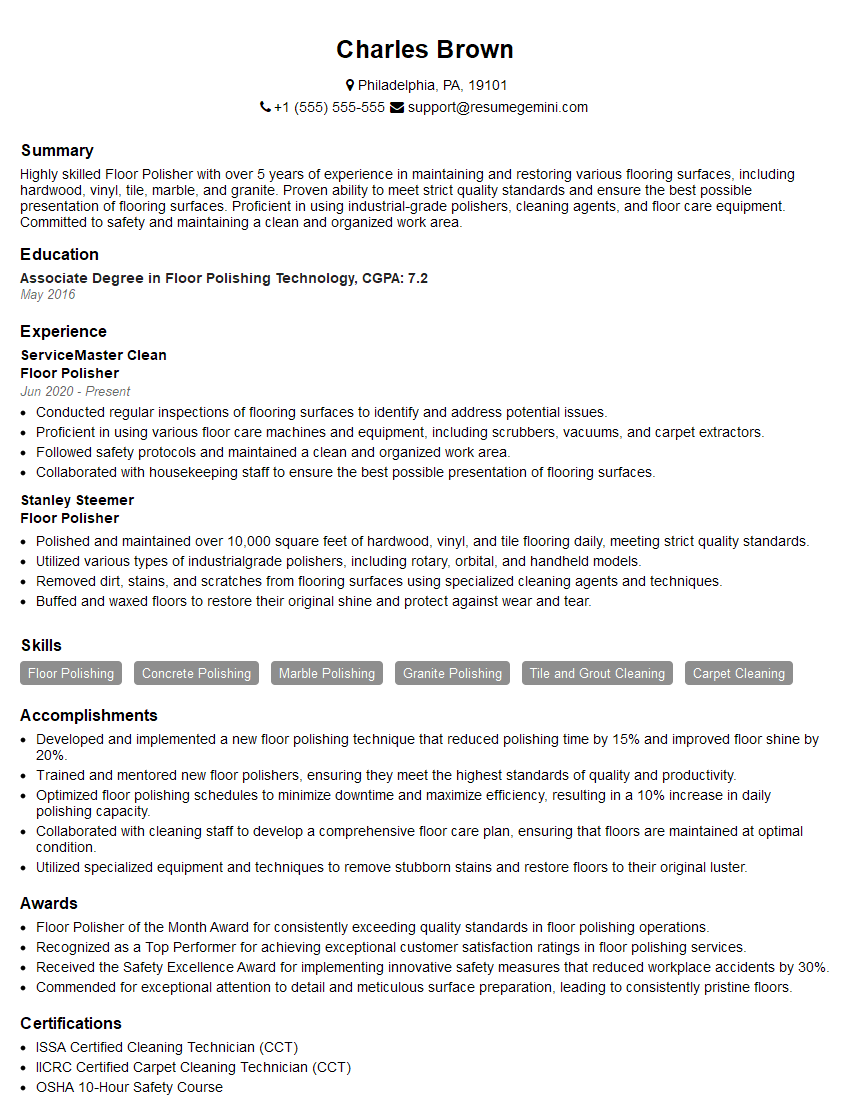
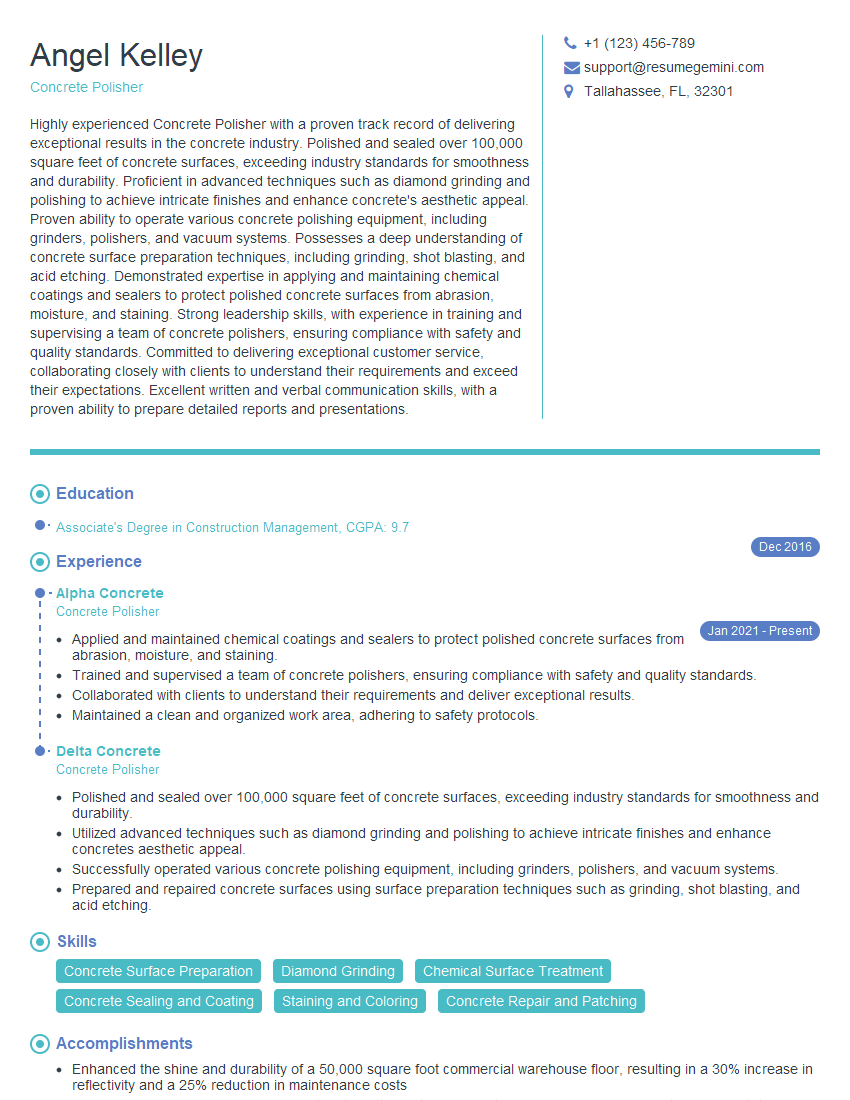
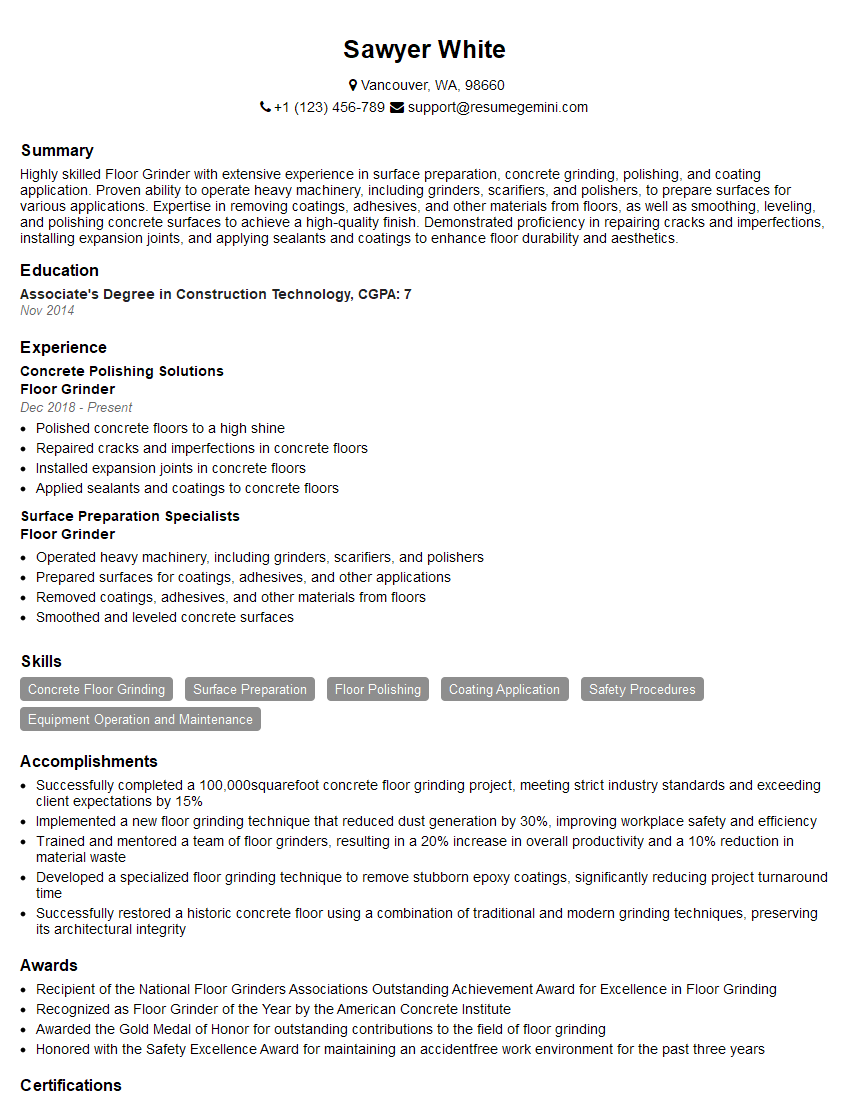
Mastering concrete grinding and polishing opens doors to a rewarding career with excellent earning potential and diverse project opportunities. This specialized skill is highly sought after in construction, restoration, and industrial settings, offering continuous learning and advancement possibilities. To maximize your job prospects, crafting a compelling and ATS-friendly resume is crucial. ResumeGemini is a valuable resource to help you build a professional and effective resume that highlights your skills and experience. Examples of resumes tailored specifically to the concrete grinding and polishing industry are available to guide you. Invest time in building a strong resume; it’s your first impression with potential employers.
Explore more articles
Users Rating of Our Blogs
Share Your Experience
We value your feedback! Please rate our content and share your thoughts (optional).
What Readers Say About Our Blog
Attention music lovers!
Wow, All the best Sax Summer music !!!
Spotify: https://open.spotify.com/artist/6ShcdIT7rPVVaFEpgZQbUk
Apple Music: https://music.apple.com/fr/artist/jimmy-sax-black/1530501936
YouTube: https://music.youtube.com/browse/VLOLAK5uy_noClmC7abM6YpZsnySxRqt3LoalPf88No
Other Platforms and Free Downloads : https://fanlink.tv/jimmysaxblack
on google : https://www.google.com/search?q=22+AND+22+AND+22
on ChatGPT : https://chat.openai.com?q=who20jlJimmy20Black20Sax20Producer
Get back into the groove with Jimmy sax Black
Best regards,
Jimmy sax Black
www.jimmysaxblack.com
Hi I am a troller at The aquatic interview center and I suddenly went so fast in Roblox and it was gone when I reset.
Hi,
Business owners spend hours every week worrying about their website—or avoiding it because it feels overwhelming.
We’d like to take that off your plate:
$69/month. Everything handled.
Our team will:
Design a custom website—or completely overhaul your current one
Take care of hosting as an option
Handle edits and improvements—up to 60 minutes of work included every month
No setup fees, no annual commitments. Just a site that makes a strong first impression.
Find out if it’s right for you:
https://websolutionsgenius.com/awardwinningwebsites
Hello,
we currently offer a complimentary backlink and URL indexing test for search engine optimization professionals.
You can get complimentary indexing credits to test how link discovery works in practice.
No credit card is required and there is no recurring fee.
You can find details here:
https://wikipedia-backlinks.com/indexing/
Regards
NICE RESPONSE TO Q & A
hi
The aim of this message is regarding an unclaimed deposit of a deceased nationale that bears the same name as you. You are not relate to him as there are millions of people answering the names across around the world. But i will use my position to influence the release of the deposit to you for our mutual benefit.
Respond for full details and how to claim the deposit. This is 100% risk free. Send hello to my email id: lukachachibaialuka@gmail.com
Luka Chachibaialuka
Hey interviewgemini.com, just wanted to follow up on my last email.
We just launched Call the Monster, an parenting app that lets you summon friendly ‘monsters’ kids actually listen to.
We’re also running a giveaway for everyone who downloads the app. Since it’s brand new, there aren’t many users yet, which means you’ve got a much better chance of winning some great prizes.
You can check it out here: https://bit.ly/callamonsterapp
Or follow us on Instagram: https://www.instagram.com/callamonsterapp
Thanks,
Ryan
CEO – Call the Monster App
Hey interviewgemini.com, I saw your website and love your approach.
I just want this to look like spam email, but want to share something important to you. We just launched Call the Monster, a parenting app that lets you summon friendly ‘monsters’ kids actually listen to.
Parents are loving it for calming chaos before bedtime. Thought you might want to try it: https://bit.ly/callamonsterapp or just follow our fun monster lore on Instagram: https://www.instagram.com/callamonsterapp
Thanks,
Ryan
CEO – Call A Monster APP
To the interviewgemini.com Owner.
Dear interviewgemini.com Webmaster!
Hi interviewgemini.com Webmaster!
Dear interviewgemini.com Webmaster!
excellent
Hello,
We found issues with your domain’s email setup that may be sending your messages to spam or blocking them completely. InboxShield Mini shows you how to fix it in minutes — no tech skills required.
Scan your domain now for details: https://inboxshield-mini.com/
— Adam @ InboxShield Mini
support@inboxshield-mini.com
Reply STOP to unsubscribe
Hi, are you owner of interviewgemini.com? What if I told you I could help you find extra time in your schedule, reconnect with leads you didn’t even realize you missed, and bring in more “I want to work with you” conversations, without increasing your ad spend or hiring a full-time employee?
All with a flexible, budget-friendly service that could easily pay for itself. Sounds good?
Would it be nice to jump on a quick 10-minute call so I can show you exactly how we make this work?
Best,
Hapei
Marketing Director
Hey, I know you’re the owner of interviewgemini.com. I’ll be quick.
Fundraising for your business is tough and time-consuming. We make it easier by guaranteeing two private investor meetings each month, for six months. No demos, no pitch events – just direct introductions to active investors matched to your startup.
If youR17;re raising, this could help you build real momentum. Want me to send more info?
Hi, I represent an SEO company that specialises in getting you AI citations and higher rankings on Google. I’d like to offer you a 100% free SEO audit for your website. Would you be interested?
Hi, I represent an SEO company that specialises in getting you AI citations and higher rankings on Google. I’d like to offer you a 100% free SEO audit for your website. Would you be interested?