Interviews are more than just a Q&A session—they’re a chance to prove your worth. This blog dives into essential Control Systems Engineering interview questions and expert tips to help you align your answers with what hiring managers are looking for. Start preparing to shine!
Questions Asked in Control Systems Engineering Interview
Q 1. Explain the difference between open-loop and closed-loop control systems.
The core difference between open-loop and closed-loop control systems lies in their feedback mechanisms. An open-loop system operates without feedback; it simply executes a pre-programmed sequence of actions based on its input. Think of a toaster: you set the time, and it runs for that duration regardless of whether the bread is actually toasted. The output is entirely dependent on the input and is not adjusted based on the actual outcome.
In contrast, a closed-loop system, also known as a feedback control system, uses feedback from the output to continuously adjust its input to achieve a desired outcome. Imagine a cruise control system in a car: the system monitors the car’s speed and adjusts the throttle to maintain the set speed despite variations in incline or wind resistance. The feedback loop ensures the output (speed) stays close to the desired setpoint.
In summary: Open-loop systems are simple but less accurate, while closed-loop systems are more complex but provide better accuracy and robustness against disturbances.
- Open-loop Example: A simple timer controlling a motor’s runtime.
- Closed-loop Example: A thermostat regulating room temperature.
Q 2. Describe the characteristics of a PID controller and its tuning methods.
A PID controller (Proportional-Integral-Derivative controller) is the workhorse of many control systems. It uses three terms to adjust the control signal:
- Proportional (P): This term is proportional to the error (difference between the desired setpoint and the actual output). A larger error results in a larger corrective action. It addresses the current error effectively but may lead to steady-state error (a persistent difference between the setpoint and the actual value).
- Integral (I): This term integrates the error over time. It eliminates steady-state error by continuously adjusting the control signal based on the accumulated error. However, it can cause overshoot or oscillations if not properly tuned.
- Derivative (D): This term considers the rate of change of the error. It anticipates future errors and helps to dampen oscillations, improving stability and response time. It’s particularly useful in systems prone to rapid changes.
Tuning methods for PID controllers are crucial for optimal performance. Some common methods include:
- Ziegler-Nichols method: A simple empirical method that determines the controller parameters based on the system’s ultimate gain and period. It’s quick but may not always produce optimal results.
- Cohen-Coon method: Another empirical method, similar to Ziegler-Nichols, but generally providing less aggressive tuning.
- Auto-tuning: Many modern controllers offer automatic tuning capabilities that adjust the PID parameters iteratively based on the system’s response. This is a convenient approach but requires careful monitoring.
Proper tuning requires understanding the system dynamics and trade-offs between speed of response, overshoot, and stability. Trial and error, combined with these methods, often proves necessary.
Q 3. What is the role of a transfer function in control system analysis?
A transfer function is a mathematical representation of a system’s input-output relationship in the Laplace domain (or Z-domain for discrete-time systems). It describes how a system transforms an input signal into an output signal. This is typically represented as a ratio of polynomials:
G(s) = Y(s) / U(s)
Where:
G(s)is the transfer functionY(s)is the Laplace transform of the output signalU(s)is the Laplace transform of the input signal
Transfer functions are fundamental in control system analysis because they allow us to:
- Analyze system stability: By examining the poles (roots of the denominator) of the transfer function, we can determine whether the system is stable or unstable.
- Design controllers: Transfer functions help in designing controllers to achieve desired performance characteristics.
- Simulate system behavior: Using transfer functions, we can easily simulate a system’s response to various inputs using tools like MATLAB or Simulink.
For example, understanding the transfer function of a motor allows us to design a controller that accurately controls its speed or position.
Q 4. Explain the concept of stability in control systems and how to analyze it.
Stability in a control system means that the system’s output will eventually settle to a steady state after any disturbance or input change. An unstable system will exhibit unbounded oscillations or grow indefinitely, potentially leading to damage or failure.
Analyzing stability involves several techniques:
- Pole-zero analysis: Examining the location of the poles (roots of the denominator) of the system’s transfer function in the complex s-plane. If all poles have negative real parts, the system is stable. Poles in the right-half plane indicate instability.
- Routh-Hurwitz criterion: An algebraic method that determines stability by evaluating the coefficients of the characteristic polynomial of the system. This doesn’t provide information about the degree of stability.
- Nyquist stability criterion (discussed in more detail below): A graphical method using the Nyquist plot of the open-loop transfer function to assess stability by looking at encirclements of the -1 point.
- Bode plot analysis (discussed in more detail below): Uses frequency response data to evaluate gain and phase margins, providing insights into stability and robustness.
Stability analysis is crucial for ensuring the safe and reliable operation of any control system. Consider an aircraft’s flight control system: instability could lead to catastrophic consequences.
Q 5. What are the different types of control system responses (e.g., underdamped, overdamped)?
The response of a control system to a step input (a sudden change in the input signal) is categorized based on its damping characteristics:
- Underdamped: The system oscillates around the setpoint before settling. This indicates a fast response but with some overshoot and oscillations.
- Critically damped: The system reaches the setpoint in the shortest possible time without any oscillation. This represents the optimal response.
- Overdamped: The system responds slowly and sluggishly, without any oscillation. Although stable, this response is slow and may not be desirable.
- Undamped: The system continues to oscillate indefinitely, indicating instability.
These classifications are determined by the system’s damping ratio (ζ). Underdamped systems have 0 < ζ < 1, critically damped systems have ζ = 1, and overdamped systems have ζ > 1.
For instance, a suspension system in a car aims for a critically damped response, minimizing oscillations and providing a smooth ride. However, other systems, such as a robotic arm’s precise positioning, might tolerate slight underdamped responses for speed.
Q 6. Describe the Nyquist stability criterion.
The Nyquist stability criterion is a graphical method used to assess the stability of a closed-loop control system based on the frequency response of its open-loop transfer function. It involves plotting the open-loop transfer function G(jω) in the complex plane (Nyquist plot) as the frequency ω varies from 0 to ∞.
The criterion states that the number of unstable closed-loop poles is equal to the number of unstable open-loop poles plus the number of clockwise encirclements of the point (-1, 0) by the Nyquist plot. If there are no unstable open-loop poles, then clockwise encirclements of (-1, 0) indicate instability in the closed-loop system. Conversely, counterclockwise encirclements suggest additional closed-loop stability.
The Nyquist plot provides a visual representation of the system’s gain and phase margins, which are important indicators of stability robustness. A large gain margin and phase margin signify a system that is less sensitive to variations in system parameters or external disturbances. The criterion is a powerful tool because it doesn’t require an explicit calculation of the closed-loop poles, making it applicable to complex systems where finding poles might be mathematically difficult.
Q 7. Explain the Bode plot and its significance in control system design.
A Bode plot is a graphical representation of the frequency response of a control system. It consists of two plots:
- Magnitude plot: Shows the magnitude (gain) of the system’s transfer function as a function of frequency, typically plotted in decibels (dB).
- Phase plot: Shows the phase shift (in degrees) of the system’s transfer function as a function of frequency.
Significance in control system design: Bode plots are invaluable because they provide insights into:
- System stability: The gain and phase margins can be directly read from the Bode plot, giving an indication of the system’s robustness to variations in parameters or external disturbances. Low gain or phase margins suggest a system that’s close to instability.
- Frequency response analysis: Bode plots allow for the analysis of how a system responds to sinusoidal inputs at different frequencies. This is important in understanding the system’s behavior under various operating conditions.
- Controller design: The Bode plot helps in designing controllers by visualizing the effect of the controller on the open-loop transfer function and adjusting its parameters to achieve desired stability and performance characteristics. For example, adding a compensator’s frequency response can be graphically added to shape the system’s response.
For instance, in designing a feedback control system for a robotic arm, Bode plots help determine appropriate controller gains and filter characteristics to provide accurate and stable movement.
Q 8. What is the root locus method, and how is it used?
The root locus method is a graphical technique used in control systems engineering to analyze the behavior of a closed-loop system as a gain parameter is varied. It shows how the poles of the closed-loop transfer function move in the complex s-plane as the gain changes. This is crucial because the location of the poles directly impacts the system’s stability and transient response.
Imagine you’re adjusting the sensitivity of a thermostat. The root locus helps visualize how increasing the sensitivity (gain) affects the system’s stability – will it oscillate wildly, settle smoothly, or even become unstable?
Here’s how it’s used:
- Determine the open-loop transfer function: This describes the system’s behavior without feedback.
- Identify the poles and zeros: These are the roots of the numerator and denominator of the transfer function.
- Sketch the root locus: This involves following rules that govern where the locus lies in the s-plane. These rules consider the number of poles and zeros, the angles between poles and zeros, and the real axis symmetry.
- Analyze the system response for different gain values: Based on the locus, you can determine the closed-loop poles’ locations for specific gains and assess the resulting stability and performance.
For instance, if the root locus crosses the imaginary axis, it indicates a change from stable to unstable behavior at that specific gain. The closer the poles are to the imaginary axis, the more oscillatory the response will be. The further to the left in the left-half plane they are, the faster the system will respond and settle.
Q 9. Explain the concept of state-space representation of a control system.
State-space representation provides a powerful mathematical framework for modeling dynamic systems, including control systems. Instead of using transfer functions, it describes the system using a set of first-order differential equations. This representation uses state variables (internal variables reflecting the system’s condition), input variables (control signals), and output variables (measurable quantities).
Think of a car: its speed, position, and engine RPM could be state variables. The accelerator pedal input affects these states. The car’s speed is an output we can measure.
The general form is:
ẋ = Ax + Bu
y = Cx + Du
where:
xis the state vectoruis the input vectoryis the output vectorAis the state matrix (describes how states change)Bis the input matrix (describes how inputs affect states)Cis the output matrix (describes how states relate to outputs)Dis the direct transmission matrix (describes direct input-output relationship, often 0)
State-space representation is particularly useful for systems with multiple inputs and outputs and for handling complex dynamic behavior, which may be challenging to model with transfer functions. It also readily allows the use of modern control techniques like optimal control and state feedback.
Q 10. How do you handle nonlinearities in control systems?
Nonlinearities are inherent in many real-world systems. They challenge linear control techniques because linear analysis doesn’t accurately capture their behavior. Handling them requires a multi-pronged approach.
- Linearization: For systems that are nearly linear around an operating point, linearization approximates the nonlinear system with a linear model. This involves finding the Jacobian matrix of partial derivatives at the operating point.
- Describing Function Method: This approach uses a describing function to represent a nonlinearity as an equivalent linear gain, allowing analysis with frequency-response methods.
- Gain Scheduling: This technique involves designing multiple linear controllers for different operating points, switching between them as the system’s operating conditions change.
- Nonlinear Control Techniques: These directly address the nonlinearity. Examples include sliding mode control, feedback linearization, and model predictive control (MPC) which can handle constraints and nonlinearities explicitly.
- Simulation and Experimentation: Using tools like Simulink to simulate the nonlinear model and experimental tests on a physical system are crucial to validate controller performance and tune parameters.
For example, consider a robotic arm. Friction is a significant nonlinearity. Linearization might work adequately for small movements around a specific joint angle, but gain scheduling might be needed for broader operation, or a robust nonlinear control strategy such as feedback linearization would allow a broader range of operation.
Q 11. Describe different types of sensors and actuators used in control systems.
Sensors and actuators are the interface between the controlled process and the controller. Sensors measure the system’s state or output, while actuators apply the control signal.
Sensors:
- Temperature Sensors: Thermocouples, RTDs (Resistance Temperature Detectors), thermistors.
- Pressure Sensors: Strain gauge pressure sensors, piezoelectric sensors.
- Position Sensors: Potentiometers, encoders (rotary and linear), LVDTs (Linear Variable Differential Transformers).
- Velocity Sensors: Tachometers, optical encoders.
- Flow Sensors: Differential pressure flow meters, ultrasonic flow meters.
- Light Sensors: Photodiodes, phototransistors.
Actuators:
- Electric Motors: DC motors, AC motors (induction, servo), stepper motors.
- Hydraulic Actuators: Hydraulic cylinders, hydraulic motors.
- Pneumatic Actuators: Pneumatic cylinders, pneumatic motors.
- Valves: Solenoid valves, proportional valves.
- Heaters/Coolers: Resistor heaters, thermoelectric coolers.
The choice depends on the application’s requirements, such as accuracy, range, speed, power consumption, and environmental conditions. A high-precision robotic arm might use laser distance sensors and servo motors, while a simple temperature control system might use a thermistor and a solenoid valve.
Q 12. Explain the concept of system identification.
System identification is the process of determining a mathematical model of a dynamic system from its input-output data. Imagine trying to understand how a black box system behaves – system identification helps create that model from experimental data.
It’s done through a series of steps:
- Experiment Design: Selecting appropriate inputs (e.g., step, impulse, random signals) to excite the system and obtain informative data.
- Data Acquisition: Measuring the system’s input and output signals using appropriate sensors.
- Model Structure Selection: Choosing a suitable model structure (e.g., ARX, ARMAX, state-space models). This is guided by prior knowledge about the system.
- Parameter Estimation: Using algorithms (e.g., least squares, maximum likelihood) to estimate the model parameters that best fit the measured data.
- Model Validation: Verifying the model’s accuracy and predicting its performance using new data.
System identification is crucial in applications where an analytical model is unavailable or too complex to develop. For example, you could identify the dynamic model of a building’s response to wind loads from sensors measuring wind speed and building sway, enabling the design of a robust structural control system.
Q 13. What are the advantages and disadvantages of different control strategies (e.g., PID, MPC)?
Several control strategies exist, each with advantages and disadvantages:
PID (Proportional-Integral-Derivative) Control:
- Advantages: Simple to understand and implement, widely applicable, relatively inexpensive.
- Disadvantages: Tuning can be challenging, performance might be suboptimal for complex systems with significant nonlinearities or time delays.
MPC (Model Predictive Control):
- Advantages: Can handle constraints, nonlinearities, and multivariable systems, often provides better performance than PID.
- Disadvantages: Computationally intensive, requires a reasonably accurate system model, tuning can be complex.
Other Strategies:
- State-Space Control: Offers advanced control design capabilities but requires a state-space model of the system.
- Robust Control: Aims to provide performance despite uncertainties in the system model but might be more complex to design.
The choice depends on the application. A simple temperature control system might benefit from a PID controller, while a complex process like an aircraft flight control system or a chemical plant might use MPC for better performance and constraint handling.
Q 14. How do you design a robust control system?
Designing a robust control system means ensuring it performs well despite uncertainties and disturbances in the system. This can be achieved through several techniques:
- Robust Control Design Methods: H-infinity control, μ-synthesis, and LQG/LTR (Linear Quadratic Gaussian/Loop Transfer Recovery) techniques explicitly consider uncertainties during controller design.
- Feedback Linearization: Compensates for nonlinearities and uncertainties by transforming the nonlinear system into a linear one.
- Adaptive Control: Continuously adjusts the controller parameters based on real-time system identification to adapt to changing conditions.
- Gain Margin and Phase Margin: Ensuring sufficient gain and phase margins in the frequency response provides robustness against gain variations and phase shifts due to uncertainties.
- Robust Parameterization: Parameterizing uncertainties and designing the controller to provide acceptable performance within the uncertainty bounds.
For example, a robot arm operating in an unpredictable environment requires a robust control system to account for variations in payload weight, friction, and external forces. An H-infinity controller might be designed to minimize the effect of these uncertainties on the robot’s trajectory.
Q 15. What is the role of feedback in control systems?
Feedback is the cornerstone of any effective control system. It’s the process of measuring the output of a system and comparing it to the desired output (the setpoint). This comparison, or error signal, is then used to adjust the system’s input, thus driving the output closer to the desired value. Think of it like a thermostat: the sensor measures the room temperature (output), compares it to the setpoint temperature you’ve programmed, and adjusts the heater (input) accordingly. Without feedback, the system would operate blindly, potentially leading to significant errors and instability.
A simple example is a cruise control system in a car. The speed sensor provides feedback on the car’s actual speed. The controller compares this to the desired speed set by the driver. If the car is going slower than the setpoint, the controller increases the throttle; if it’s going faster, it reduces the throttle. This continuous feedback loop ensures the car maintains a consistent speed.
Career Expert Tips:
- Ace those interviews! Prepare effectively by reviewing the Top 50 Most Common Interview Questions on ResumeGemini.
- Navigate your job search with confidence! Explore a wide range of Career Tips on ResumeGemini. Learn about common challenges and recommendations to overcome them.
- Craft the perfect resume! Master the Art of Resume Writing with ResumeGemini’s guide. Showcase your unique qualifications and achievements effectively.
- Don’t miss out on holiday savings! Build your dream resume with ResumeGemini’s ATS optimized templates.
Q 16. Explain the concept of controllability and observability.
Controllability and observability are fundamental concepts in control system analysis, determining if we can effectively manipulate and monitor a system’s behavior.
- Controllability refers to the ability to steer the system to a desired state using available inputs. If a system is controllable, we can find a sequence of inputs that will transfer the system from any initial state to any final state within a finite time. Imagine trying to park a car: if your steering wheel and brakes are functioning correctly (your control inputs), the car is controllable, meaning you can maneuver it into the parking spot.
- Observability, conversely, describes our ability to determine the system’s internal state by observing its outputs. If a system is observable, we can infer its complete internal state by measuring its outputs. Consider a black box with unknown internal workings; if we can determine the internal state based on the box’s outputs, it is observable. Poor observability can lead to inaccurate control actions.
These properties are often checked using mathematical tests, such as the controllability and observability matrices. Systems that are both controllable and observable are generally easier to design effective controllers for.
Q 17. Describe your experience with control system simulation software (e.g., MATLAB, Simulink).
I have extensive experience using MATLAB and Simulink for control system design, simulation, and analysis. I’ve leveraged Simulink’s block diagram environment to model various systems, from simple PID controllers to complex nonlinear systems incorporating feedback control strategies. This includes building models for different types of actuators and sensors, designing controllers, running simulations, and analyzing results for performance, stability and robustness. I’m proficient in using the Control System Toolbox for tasks such as root locus analysis, Bode plots, Nyquist plots and frequency response analysis, allowing for the systematic design and tuning of controllers. For example, I recently used Simulink to model and simulate a robotic arm control system, incorporating a Kalman filter for state estimation and a LQR (Linear Quadratic Regulator) controller for optimal trajectory tracking. The simulations helped refine the controller parameters before implementation on the actual robot.
Q 18. Explain your experience with different control system hardware.
My experience encompasses a range of control system hardware, including microcontrollers (like Arduino and Raspberry Pi), Programmable Logic Controllers (PLCs), and embedded systems. I’ve worked with various actuators such as DC motors, servo motors, pneumatic cylinders, and stepper motors. On the sensor side, my experience includes encoders, accelerometers, gyroscopes, pressure sensors, and temperature sensors. In one project, I designed and implemented a temperature control system for an industrial oven using a PLC, thermocouples for temperature sensing, and a PID controller to maintain a precise temperature setpoint. The experience involved programming the PLC, calibrating the sensors, and ensuring the system’s safety and reliability.
Q 19. How do you handle system disturbances in a control system?
System disturbances are inevitable in any real-world control system. These can be external factors (like wind gusts affecting a drone) or internal variations (like component aging). Handling them effectively is crucial for maintaining performance. Several strategies exist:
- Feedback control: This is the most common approach. By continuously measuring the output and comparing it to the setpoint, the controller can adjust the input to compensate for disturbances. The stronger the feedback gain, the better the rejection of disturbance.
- Feedforward control: If the disturbance is predictable (e.g., a known load change), we can anticipate its effect and proactively adjust the input to mitigate its impact before it affects the output.
- Robust control design: Techniques like H-infinity control or L1 adaptive control are designed to explicitly handle uncertainty and disturbances. These methods aim to design controllers that are less sensitive to disturbances and model uncertainties.
- Disturbance observers: These estimate the disturbances affecting the system, which allows the controller to actively compensate for their effects.
The choice of strategy often depends on the nature and characteristics of the disturbance and the system’s specifications.
Q 20. How do you approach debugging a control system?
Debugging a control system is a systematic process. My approach typically involves:
- Analyze the symptoms: Carefully observe the system’s behavior to identify the problem. Are there oscillations? Is the response too slow or too fast? Is the system unstable?
- Check the hardware: Ensure all sensors, actuators, and wiring are functioning correctly. Calibrate sensors if necessary. This includes verifying power supply voltages and signal integrity.
- Review the control algorithm: Examine the controller’s parameters and logic for errors or inconsistencies. Simulation can be invaluable here to test different scenarios and controller settings.
- Use diagnostic tools: Utilize debugging tools like oscilloscopes, logic analyzers, and data loggers to monitor signals and identify anomalies. For software-based controllers, utilize debugging tools like print statements or integrated debuggers.
- Employ systematic testing: Test the system incrementally to isolate the source of the problem. Start with simple test cases and gradually increase complexity.
A crucial aspect is maintaining good documentation and logging. Thorough records facilitate faster troubleshooting and prevent future issues.
Q 21. Describe your experience with different control system architectures.
My experience includes various control system architectures, including:
- Centralized control: A single controller manages all aspects of the system. This is suitable for simpler systems but can become complex and less robust for larger systems.
- Decentralized control: Multiple controllers manage different parts of the system independently. This is more robust and scalable, often used in large industrial processes.
- Hierarchical control: Controllers are arranged in a hierarchy, with higher-level controllers supervising lower-level ones. This is common in complex systems, enabling efficient management and coordination.
- Distributed control systems (DCS): These utilize a network of controllers communicating with each other and sharing information. DCS is preferred for large-scale, geographically dispersed systems like power grids and pipelines.
The choice of architecture depends on the system’s complexity, scalability requirements, and reliability needs. I’ve designed and implemented systems using each of these architectures, adapting my approach to meet the specific requirements of each project.
Q 22. What are your experiences with real-time control systems?
Real-time control systems are systems that react to inputs and produce outputs within a strictly defined timeframe. Think of it like a perfectly timed dance; every step must be taken precisely when the music dictates. My experience encompasses designing and implementing such systems for various applications, from industrial automation (robotic arms in a manufacturing plant, precisely controlling their movements and speeds) to aerospace (autopilot systems needing to respond immediately to changing atmospheric conditions).
In one project, I worked on developing a real-time control system for a high-speed automated guided vehicle (AGV) used in a warehouse. The system had to ensure collision avoidance, precise navigation, and efficient path planning, all while operating within very tight timing constraints. This involved careful consideration of hardware selection (processing power, communication protocols), software design (using real-time operating systems and programming paradigms), and rigorous testing (latency measurements and jitter analysis).
Another crucial aspect of my experience involves handling the challenges inherent to real-time constraints: ensuring deterministic behavior, managing deadlines, and optimizing for low latency. The knowledge gained in these projects ensures that I approach each new real-time control challenge with practical experience and problem-solving proficiency.
Q 23. How do you design a control system for a specific application?
Designing a control system is an iterative process, starting with a clear understanding of the system’s requirements and constraints. Imagine building a house – you wouldn’t start laying bricks without a blueprint! The process involves several key steps:
- System Definition: Clearly defining the system’s goals, inputs, outputs, and performance specifications. This involves understanding the desired behavior, limitations, and potential disturbances.
- Modeling: Creating a mathematical model of the system’s dynamics. This could range from simple linear models to complex non-linear models, depending on the system’s complexity. For example, a simple model for a temperature control system might be a first-order differential equation.
- Controller Design: Selecting and designing an appropriate controller based on the system model and performance requirements. This often involves choosing a control algorithm (PID, MPC, etc.) and tuning its parameters to achieve optimal performance.
- Implementation: Implementing the control algorithm using appropriate hardware and software. This includes choosing sensors, actuators, and a suitable microcontroller or PLC.
- Testing and Validation: Rigorously testing the implemented system to verify that it meets the specified requirements. This includes simulations and real-world testing.
For example, when designing a control system for a robotic arm, the system definition would involve specifying the desired accuracy and speed of movement, the range of motion, and the types of tasks it needs to perform. The model would capture the arm’s dynamics, including inertia, friction, and gravity. The controller would then be designed to accurately position and control the arm’s movements.
Q 24. Explain the concept of Kalman filtering.
Kalman filtering is a powerful technique for estimating the state of a dynamic system from noisy measurements. Think of it like trying to find a lost friend in a crowded room – you’re getting many imperfect glimpses (measurements) but using the Kalman filter, you can intelligently combine these glimpses to get the best estimate of their location.
It’s a recursive algorithm that uses a model of the system’s dynamics and a model of the measurement noise to predict the system’s state and update the prediction based on new measurements. The algorithm involves two main steps: prediction and update. The prediction step uses the system model to predict the state at the next time step, while the update step incorporates the new measurement to correct the prediction.
The Kalman filter is particularly useful in situations where there’s significant noise in the measurements or where the system dynamics are not perfectly known. Applications include GPS navigation, robotics, and aerospace.
A simple example: Consider tracking the position of a vehicle using noisy GPS data. The Kalman filter uses the vehicle’s known dynamics (e.g., constant velocity) and the noisy GPS readings to estimate the vehicle’s current position and velocity with higher accuracy than using the GPS data alone.
Q 25. Describe your experience with model predictive control (MPC).
Model Predictive Control (MPC) is an advanced control strategy that uses a model of the system to predict its future behavior and optimize the control actions over a prediction horizon. Imagine planning a road trip using a map – MPC is like planning the best route by looking ahead and adjusting the route based on current traffic conditions.
My experience with MPC includes designing and implementing MPC controllers for various processes, including chemical processes, power systems, and autonomous vehicles. It involves creating a dynamic model of the system (often using linear or nonlinear techniques), defining a cost function to optimize (e.g., minimizing energy consumption or maximizing throughput), and solving an optimization problem at each time step to find the optimal control actions. The optimization problem considers the predicted future behavior of the system over the prediction horizon.
A key advantage of MPC is its ability to handle constraints on the system’s inputs and outputs, which makes it suitable for applications where safety and operational limits are crucial. For instance, I implemented an MPC controller for a water treatment plant that maintained water quality within specified limits while minimizing energy consumption, while respecting pump power limits and chemical dosage constraints.
Q 26. What are some common challenges faced in control systems engineering?
Control systems engineering faces several common challenges. These challenges often intertwine and require a holistic approach to resolve them efficiently.
- Model Uncertainty: Real-world systems are often complex and difficult to model accurately. Uncertainties in the model can lead to poor controller performance or instability.
- Noise and Disturbances: External disturbances and measurement noise can significantly impact system performance. Robust control techniques are needed to mitigate these effects.
- Nonlinearities: Many real-world systems exhibit non-linear behavior, making linear control techniques inadequate. Advanced control strategies, such as nonlinear control or gain scheduling are needed.
- Constraints: Physical limitations (actuator limits, safety constraints) often restrict the range of possible control actions. Controllers must be designed to respect these constraints.
- Real-time Constraints: Many control applications require real-time operation, meaning that computations must be completed within strict time deadlines.
For instance, in the aerospace industry, dealing with model uncertainties due to aerodynamic variations, external disturbances (wind gusts), and real-time constraints related to flight stability poses a significant design challenge. Overcoming these challenges requires a combination of advanced control algorithms, robust design techniques, and efficient computation.
Q 27. How do you ensure the safety and reliability of a control system?
Ensuring safety and reliability in control systems is paramount. It’s not just about achieving desired performance; it’s about preventing catastrophic failures that could lead to accidents, injuries, or environmental damage. Imagine the consequences of a faulty control system in a nuclear power plant or a self-driving car!
Several strategies contribute to achieving this:
- Redundancy: Employing redundant components and control loops so that the system can continue operating even if one component fails. For example, using dual processors or having backup systems in place.
- Fault Detection and Isolation (FDI): Implementing mechanisms to detect and diagnose faults in the system. This helps in identifying the source of a problem and taking corrective actions before it escalates.
- Safety Instrumented Systems (SIS): Developing independent safety systems to handle critical situations. These systems are designed to operate even in the presence of major faults and to mitigate hazards.
- Formal Verification: Using formal methods to mathematically prove the correctness of the control system design and implementation. This provides a high level of confidence in the system’s safety.
- Rigorous Testing: Performing extensive testing and simulation to evaluate the system’s performance under various conditions, including fault scenarios.
In my experience, safety and reliability are integral considerations, not afterthoughts, in the design process. It starts from requirements gathering, model verification, and thorough testing during all phases of development and deployment. It’s a comprehensive approach to ensure the reliability and safety of the control system throughout its entire lifecycle.
Q 28. Describe your experience with control system testing and validation.
Control system testing and validation are critical to ensuring the system’s performance and reliability. It’s like test-driving a car before buying it – you wouldn’t buy a car without a test drive!
My experience encompasses various testing methodologies:
- Simulation: Using computer simulations to test the control system’s performance under various operating conditions. This allows for testing scenarios that might be difficult or impossible to reproduce in a real-world setting.
- Hardware-in-the-loop (HIL) testing: Integrating the control system with a simulated plant model to test its performance in a realistic environment. This helps identify issues that might not be apparent in pure software simulation.
- Real-world testing: Testing the control system in its actual operational environment. This provides valuable insights into the system’s performance under real-world conditions and helps identify unforeseen issues.
- Unit testing: Testing individual components or modules of the control system to ensure they function correctly. This is crucial for isolating problems and simplifying debugging.
- Integration testing: Testing the interactions between different components of the control system to ensure they work together correctly.
A crucial aspect of validation is verifying that the system meets the requirements outlined in the initial design phase. This includes checking the performance against metrics like accuracy, speed, stability, and robustness. Comprehensive testing and validation provide confidence in the system’s reliability and safety, ensuring its successful deployment and operation.
Key Topics to Learn for Control Systems Engineering Interview
- System Modeling & Representation: Understanding state-space, transfer function, and block diagram representations. Practice translating between these different models.
- Classical Control Techniques: Mastering concepts like PID control, root locus analysis, Bode plots, and Nyquist stability criteria. Be prepared to discuss their applications in real-world scenarios.
- Modern Control Techniques: Familiarize yourself with state-space design, optimal control, and robust control strategies. Consider exploring examples in areas like robotics or process control.
- Digital Control Systems: Understand the principles of digital-to-analog and analog-to-digital conversion and their impact on controller design. Explore Z-transforms and discrete-time system analysis.
- Control System Design & Implementation: Practice designing controllers for specific applications, considering factors like stability, performance, and robustness. Be prepared to discuss your approach to problem-solving.
- Stability Analysis & Robustness: Deepen your understanding of system stability and how to design controllers that are robust to uncertainties and disturbances. Be ready to discuss various stability criteria and robustness measures.
- Applications & Case Studies: Familiarize yourself with real-world applications of control systems across various industries, such as aerospace, automotive, robotics, and process control. Prepare examples to showcase your understanding.
Next Steps
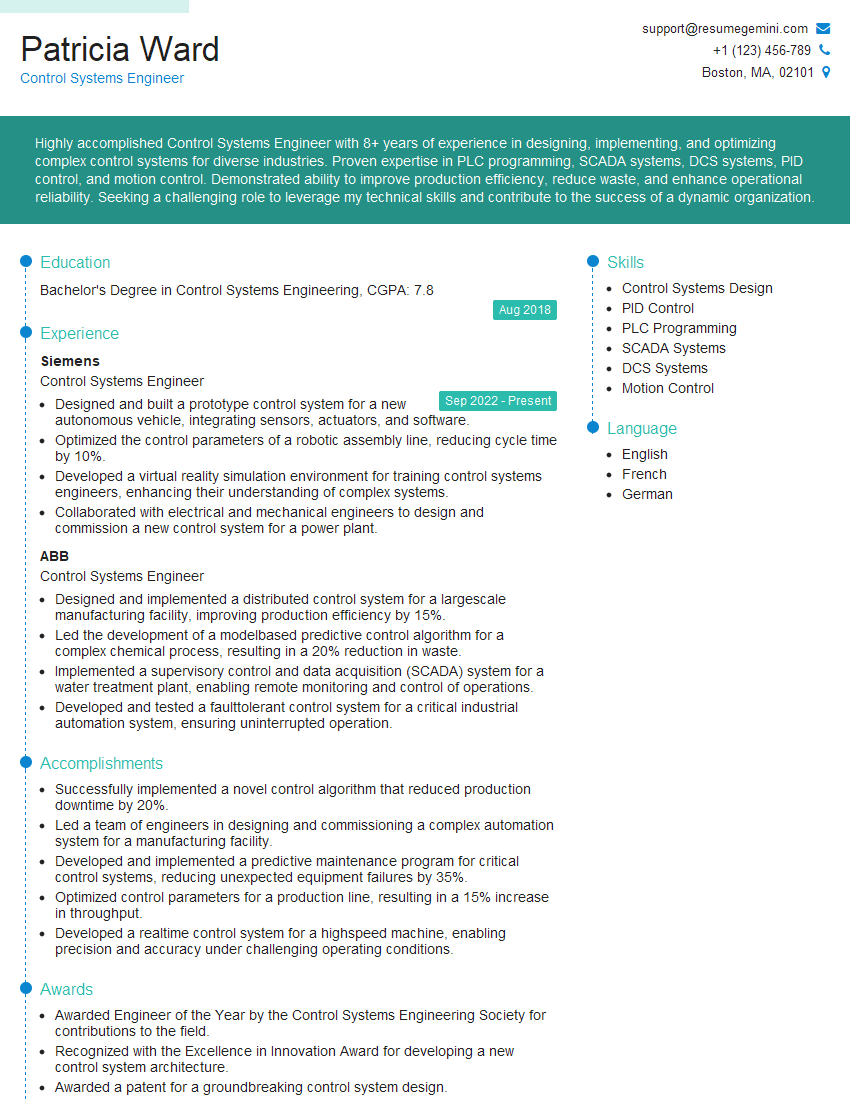
Mastering Control Systems Engineering opens doors to exciting and impactful careers in a wide range of industries. A strong foundation in these principles is crucial for innovation and leadership in this rapidly evolving field. To maximize your job prospects, it’s essential to present your skills effectively. Crafting an ATS-friendly resume is key to getting your application noticed by recruiters. ResumeGemini can help you build a professional and impactful resume that highlights your accomplishments and technical expertise. Examples of resumes tailored to Control Systems Engineering are available to guide you, ensuring your qualifications shine through.
Explore more articles
Users Rating of Our Blogs
Share Your Experience
We value your feedback! Please rate our content and share your thoughts (optional).
What Readers Say About Our Blog
Attention music lovers!
Wow, All the best Sax Summer music !!!
Spotify: https://open.spotify.com/artist/6ShcdIT7rPVVaFEpgZQbUk
Apple Music: https://music.apple.com/fr/artist/jimmy-sax-black/1530501936
YouTube: https://music.youtube.com/browse/VLOLAK5uy_noClmC7abM6YpZsnySxRqt3LoalPf88No
Other Platforms and Free Downloads : https://fanlink.tv/jimmysaxblack
on google : https://www.google.com/search?q=22+AND+22+AND+22
on ChatGPT : https://chat.openai.com?q=who20jlJimmy20Black20Sax20Producer
Get back into the groove with Jimmy sax Black
Best regards,
Jimmy sax Black
www.jimmysaxblack.com
Hi I am a troller at The aquatic interview center and I suddenly went so fast in Roblox and it was gone when I reset.
Hi,
Business owners spend hours every week worrying about their website—or avoiding it because it feels overwhelming.
We’d like to take that off your plate:
$69/month. Everything handled.
Our team will:
Design a custom website—or completely overhaul your current one
Take care of hosting as an option
Handle edits and improvements—up to 60 minutes of work included every month
No setup fees, no annual commitments. Just a site that makes a strong first impression.
Find out if it’s right for you:
https://websolutionsgenius.com/awardwinningwebsites
Hello,
we currently offer a complimentary backlink and URL indexing test for search engine optimization professionals.
You can get complimentary indexing credits to test how link discovery works in practice.
No credit card is required and there is no recurring fee.
You can find details here:
https://wikipedia-backlinks.com/indexing/
Regards
NICE RESPONSE TO Q & A
hi
The aim of this message is regarding an unclaimed deposit of a deceased nationale that bears the same name as you. You are not relate to him as there are millions of people answering the names across around the world. But i will use my position to influence the release of the deposit to you for our mutual benefit.
Respond for full details and how to claim the deposit. This is 100% risk free. Send hello to my email id: [email protected]
Luka Chachibaialuka
Hey interviewgemini.com, just wanted to follow up on my last email.
We just launched Call the Monster, an parenting app that lets you summon friendly ‘monsters’ kids actually listen to.
We’re also running a giveaway for everyone who downloads the app. Since it’s brand new, there aren’t many users yet, which means you’ve got a much better chance of winning some great prizes.
You can check it out here: https://bit.ly/callamonsterapp
Or follow us on Instagram: https://www.instagram.com/callamonsterapp
Thanks,
Ryan
CEO – Call the Monster App
Hey interviewgemini.com, I saw your website and love your approach.
I just want this to look like spam email, but want to share something important to you. We just launched Call the Monster, a parenting app that lets you summon friendly ‘monsters’ kids actually listen to.
Parents are loving it for calming chaos before bedtime. Thought you might want to try it: https://bit.ly/callamonsterapp or just follow our fun monster lore on Instagram: https://www.instagram.com/callamonsterapp
Thanks,
Ryan
CEO – Call A Monster APP
To the interviewgemini.com Owner.
Dear interviewgemini.com Webmaster!
Hi interviewgemini.com Webmaster!
Dear interviewgemini.com Webmaster!
excellent
Hello,
We found issues with your domain’s email setup that may be sending your messages to spam or blocking them completely. InboxShield Mini shows you how to fix it in minutes — no tech skills required.
Scan your domain now for details: https://inboxshield-mini.com/
— Adam @ InboxShield Mini
Reply STOP to unsubscribe
Hi, are you owner of interviewgemini.com? What if I told you I could help you find extra time in your schedule, reconnect with leads you didn’t even realize you missed, and bring in more “I want to work with you” conversations, without increasing your ad spend or hiring a full-time employee?
All with a flexible, budget-friendly service that could easily pay for itself. Sounds good?
Would it be nice to jump on a quick 10-minute call so I can show you exactly how we make this work?
Best,
Hapei
Marketing Director
Hey, I know you’re the owner of interviewgemini.com. I’ll be quick.
Fundraising for your business is tough and time-consuming. We make it easier by guaranteeing two private investor meetings each month, for six months. No demos, no pitch events – just direct introductions to active investors matched to your startup.
If youR17;re raising, this could help you build real momentum. Want me to send more info?
Hi, I represent an SEO company that specialises in getting you AI citations and higher rankings on Google. I’d like to offer you a 100% free SEO audit for your website. Would you be interested?
Hi, I represent an SEO company that specialises in getting you AI citations and higher rankings on Google. I’d like to offer you a 100% free SEO audit for your website. Would you be interested?