Feeling uncertain about what to expect in your upcoming interview? We’ve got you covered! This blog highlights the most important Data Acquisition and Signal Processing interview questions and provides actionable advice to help you stand out as the ideal candidate. Let’s pave the way for your success.
Questions Asked in Data Acquisition and Signal Processing Interview
Q 1. Explain the Nyquist-Shannon sampling theorem and its implications.
The Nyquist-Shannon sampling theorem is a fundamental principle in signal processing that dictates the minimum sampling rate required to accurately reconstruct a continuous-time signal from its discrete-time samples. It states that to perfectly capture a signal containing frequencies up to a maximum frequency fmax (also known as the bandwidth), you must sample it at a rate at least twice that frequency: fs ≥ 2fmax. This minimum sampling rate, 2fmax, is called the Nyquist rate.
Implications: If you sample below the Nyquist rate, you risk encountering aliasing, where higher frequencies ‘masquerade’ as lower frequencies in the sampled data, leading to inaccurate signal reconstruction. Imagine trying to capture a spinning wheel with a camera. If the camera’s frame rate is too slow, the wheel might appear to be spinning backward—that’s aliasing. This has significant repercussions in various applications, from audio recording (avoiding distortion) to medical imaging (ensuring accurate representation of physiological signals).
Example: If you have an audio signal with a maximum frequency of 20 kHz (typical for human hearing), you need a sampling rate of at least 40 kHz to avoid aliasing. CDs, for instance, use a 44.1 kHz sampling rate.
Q 2. Describe different types of analog-to-digital converters (ADCs) and their characteristics.
Analog-to-digital converters (ADCs) transform continuous analog signals into discrete digital representations. Several types exist, each with distinct characteristics:
- Flash ADC: The fastest type, employing parallel comparators to simultaneously compare the input voltage to multiple reference voltages. High speed comes at the cost of high power consumption and increased complexity, making them suitable for high-speed applications but less common for general-purpose use.
- Successive Approximation ADC: A common type that uses a binary search approach, sequentially comparing the input voltage to successively finer approximations. Offers a good balance between speed, resolution, and power consumption, making them prevalent in many applications.
- Sigma-Delta ADC: Over-samples the input signal at a much higher rate than the Nyquist rate and uses digital signal processing techniques to achieve high resolution. Favored for applications requiring high resolution and low power, especially in medical and industrial settings. It’s less suited for very high speed applications.
- Pipeline ADC: These ADCs divide the conversion process into multiple stages, each performing a part of the conversion, improving speed compared to successive approximation ADCs. They tend to be more complex and expensive.
Characteristics to consider when selecting an ADC include resolution (number of bits), sampling rate, conversion time, linearity (accuracy of conversion), and power consumption. The choice depends entirely on the specific application requirements.
Q 3. What are the common sources of noise in data acquisition systems, and how can they be mitigated?
Data acquisition systems are susceptible to various noise sources that can corrupt signals. Here are some common ones and mitigation strategies:
- Thermal Noise (Johnson-Nyquist Noise): Inherent in all resistive components due to thermal agitation of electrons. Mitigation: Use low-noise components, minimize resistor values, and operate at lower temperatures.
- Shot Noise: Arises from the discrete nature of charge carriers (electrons or holes) in electronic devices. Mitigation: Use low-noise operational amplifiers and careful circuit design.
- Power Supply Noise: Fluctuations in the power supply voltage can couple into the signal. Mitigation: Use well-regulated power supplies with adequate filtering (capacitors and inductors).
- Electromagnetic Interference (EMI) and Radio Frequency Interference (RFI): External electromagnetic fields can induce noise. Mitigation: Shielding, grounding, twisted-pair wiring, and filtering.
- Quantization Noise: Inherent in ADCs due to the finite number of bits used to represent the analog signal. Mitigation: Increase the resolution of the ADC.
Effective noise mitigation often requires a combination of these techniques. Proper grounding and shielding are crucial for minimizing external interference.
Q 4. Explain the concept of aliasing and how to avoid it.
Aliasing occurs when a signal is sampled at a rate below the Nyquist rate, resulting in the misrepresentation of higher frequencies as lower frequencies in the sampled data. Imagine trying to draw a fast-spinning fan blade with a pen; if you can’t draw fast enough, the blades may appear stationary or spinning slowly in the opposite direction. This ‘false’ frequency is an alias.
Avoiding Aliasing: The primary method is to ensure that the sampling rate is at least twice the highest frequency component in the signal (Nyquist rate). This requires careful consideration of the signal’s bandwidth. Another crucial step is employing an anti-aliasing filter before the ADC. This filter attenuates frequencies above half the sampling rate, preventing these higher frequencies from being sampled and causing aliasing.
Q 5. Discuss various anti-aliasing filter designs and their trade-offs.
Anti-aliasing filters are crucial for preventing aliasing. Several designs exist, each with trade-offs:
- Butterworth Filter: Maximally flat in the passband, providing a smooth transition, but relatively slow roll-off (attenuation of unwanted frequencies). Simple to design.
- Chebyshev Filter (Type I and Type II): Steeper roll-off than Butterworth, achieving better attenuation with fewer stages. However, they exhibit ripples (variations) in either the passband (Type I) or stopband (Type II).
- Elliptic Filter: The steepest roll-off for a given number of filter stages, offering maximum attenuation with minimal ripple in both passband and stopband. However, they are more complex to design.
The choice depends on the application’s specific needs. If a sharp cutoff is paramount, even at the cost of ripple, a Chebyshev or Elliptic filter might be preferred. If a smooth response is essential, a Butterworth filter is suitable. The trade-off is always between the sharpness of the cutoff (steep roll-off) and the smoothness of the response in the passband (ripple).
Q 6. Describe different windowing techniques used in signal processing and their effects.
Windowing techniques are applied to finite-length segments of signals to reduce spectral leakage—the smearing of energy from one frequency bin to another during the Discrete Fourier Transform (DFT). This happens because a truncated signal is implicitly multiplied by a rectangular window, which introduces significant sidelobes in the frequency domain.
Common Windowing Techniques:
- Rectangular Window: The simplest, but suffers from significant spectral leakage.
- Hamming Window: Reduces spectral leakage compared to rectangular, offering a good balance between main lobe width and sidelobe attenuation.
- Hanning (Hann) Window: Similar to Hamming, but with slightly less attenuation of the main lobe.
- Blackman Window: Provides better sidelobe attenuation than Hamming or Hanning, but with a wider main lobe.
- Kaiser Window: A versatile window with a parameter to adjust the trade-off between main lobe width and sidelobe attenuation.
The choice of window depends on the specific application. If reducing spectral leakage is crucial, windows like Blackman or Kaiser are preferable. If main lobe width is a concern, Hamming or Hanning might be better choices. The effect is seen in the resulting spectrum, with different windows providing varying levels of spectral leakage and resolution.
Q 7. What are the advantages and disadvantages of using FIR and IIR filters?
Both Finite Impulse Response (FIR) and Infinite Impulse Response (IIR) filters are used for digital signal processing, but they differ significantly in their characteristics:
| Feature | FIR Filter | IIR Filter |
|---|---|---|
| Impulse Response | Finite duration | Infinite duration (decays) |
| Stability | Always stable | Can be unstable (requires careful design) |
| Phase Response | Can be designed to have linear phase (no phase distortion) | Generally non-linear phase (phase distortion) |
| Implementation Complexity | Generally more complex to implement (requires more memory) | Generally less complex (requires less memory) |
| Frequency Response Design | More flexible | Less flexible |
Advantages of FIR filters: Always stable, can have linear phase, easier to design for specific frequency responses, better for applications where phase distortion is critical.
Disadvantages of FIR filters: Requires more memory and computational power, especially for high-order filters (filters with a sharp transition).
Advantages of IIR filters: Requires less memory and computational power, can achieve steeper roll-off for a given order.
Disadvantages of IIR filters: Can be unstable if not designed carefully, generally exhibits non-linear phase, complex design for specific frequency responses.
In summary, the choice between FIR and IIR depends on the application’s specific needs. If stability and linear phase are crucial, FIR is preferred. If computational resources are limited, IIR might be a better option, but careful design is necessary to ensure stability.
Q 8. Explain the Fast Fourier Transform (FFT) algorithm and its applications.
The Fast Fourier Transform (FFT) is an algorithm that efficiently computes the Discrete Fourier Transform (DFT). The DFT decomposes a signal into its constituent frequencies, revealing the frequency spectrum. Imagine trying to identify the individual notes played in a complex chord – the FFT is like a sophisticated ear, separating the frequencies (notes) from the combined sound. Instead of taking O(N²) time like the direct DFT calculation, FFT algorithms achieve O(N log N) complexity, making them incredibly useful for large datasets.
Applications: FFTs are ubiquitous in signal processing:
- Audio processing: Analyzing audio signals to identify frequencies, perform equalization, or compress audio data (MP3 encoding uses FFTs).
- Image processing: Analyzing images in the frequency domain for tasks like image compression (JPEG uses a related transform), noise reduction, and edge detection. High frequencies represent sharp changes, low frequencies represent smoother areas.
- Telecommunications: Analyzing signals in communication systems for modulation and demodulation, as well as identifying interference and noise.
- Medical imaging: MRI and other medical imaging techniques heavily rely on FFTs for reconstructing images from raw data.
- Seismology: Analyzing seismic waves to understand earthquakes and geological structures. Different frequencies represent different types of waves.
For example, consider analyzing an audio recording of a musical instrument. An FFT would reveal the fundamental frequency of the instrument (the pitch) and its various harmonics (overtones), providing a detailed spectral representation.
Q 9. How do you handle missing data in a signal processing application?
Handling missing data is crucial in signal processing, as it can significantly impact analysis accuracy. Several methods exist:
- Interpolation: This technique estimates the missing data points based on the surrounding values. Simple linear interpolation connects adjacent points with a straight line, while more sophisticated methods like cubic spline interpolation use curves to better approximate the missing data. The choice depends on the noise level and the nature of the signal.
- Mean/Median imputation: Replacing missing values with the mean or median of the available data is a simple approach. It’s useful for signals with relatively low variance, but it can lead to bias and distort the signal’s characteristics if the missing data is not random.
- Regression: If you have other relevant data correlated with your signal, you can use regression techniques to predict the missing values based on these correlated variables. For instance, if you have missing temperature readings but have other environmental data, you might use regression to predict the missing temperature based on these other factors.
- Wavelet transform-based methods: These techniques can effectively handle missing data in non-stationary signals. They can locally adapt to the signal’s characteristics, making them more robust to missing data compared to simpler methods.
The best approach depends on the specific application and the nature of the missing data. If the missing data is random and the signal is relatively smooth, simple interpolation or mean/median imputation might be sufficient. If the data is non-random or the signal is complex, more advanced methods are necessary. It’s crucial to carefully evaluate the effect of the chosen method on the subsequent signal processing steps.
Q 10. Describe different methods for signal de-noising.
Signal de-noising aims to remove unwanted noise from a signal while preserving its essential features. Various techniques exist, each with its strengths and weaknesses:
- Moving average filtering: This simple method smooths the signal by replacing each data point with the average of its neighboring points. It effectively reduces high-frequency noise but can also blur sharp features. A weighted moving average can provide better results.
- Median filtering: This replaces each data point with the median of its neighboring points. It is robust against outliers and impulsive noise but can still blur sharp features.
- Kalman filtering: A powerful technique that estimates the state of a dynamic system (the signal) from noisy measurements. It works particularly well for signals with known dynamics (e.g., tracking a moving object).
- Wavelet denoising: Wavelet transforms decompose a signal into different frequency bands. Noise usually resides in high-frequency bands, which can be selectively attenuated or removed. Thresholding techniques are commonly used to determine which wavelet coefficients represent noise.
- Fourier transform-based methods: Similar to wavelet denoising, this involves transforming the signal to the frequency domain, attenuating the frequency components corresponding to noise (e.g., through band-stop filtering), and then transforming it back to the time domain.
Choosing the right technique depends on the type of noise and the desired level of signal preservation. For example, if the noise is primarily impulsive, median filtering is a good option. If the signal has known dynamics, Kalman filtering might be more suitable. Often, a combination of methods is used to achieve optimal results.
Q 11. Explain the concept of correlation and its applications in signal processing.
Correlation measures the similarity between two signals as a function of a time delay (or shift) between them. Imagine comparing two recordings of the same musical piece played slightly out of sync – correlation helps find the optimal time shift to align them.
Types of Correlation:
- Cross-correlation: Measures the similarity between two different signals.
- Autocorrelation: Measures the similarity of a signal with itself at different time lags. This is useful for identifying periodicities or repetitive patterns within a signal.
Applications:
- Signal detection: Identifying a known signal (e.g., a specific radar pulse) within a noisy background. The correlation will be high when the known signal is present.
- Time delay estimation: Determining the time difference between arrival times of a signal at different sensors. This is crucial in applications like sonar and radar.
- Pattern recognition: Finding similar patterns within a signal (e.g., detecting a particular sound or image). This is used in speech recognition and image processing.
- Channel equalization: Compensating for distortions introduced by a communication channel. The correlation between the transmitted and received signals helps estimate the channel’s characteristics.
For instance, in radar systems, the received signal is correlated with a reference pulse to detect the presence and range of targets. The peak in the correlation function indicates the target’s range.
Q 12. What are different techniques for signal compression?
Signal compression reduces the amount of data required to represent a signal while minimizing information loss. This is crucial for efficient storage and transmission. Techniques include:
- Lossless compression: These methods achieve compression without any loss of information. Examples include:
- Run-length encoding (RLE): Replaces consecutive repeating values with a single value and its count.
- Huffman coding: Assigns shorter codes to frequently occurring values and longer codes to less frequent ones.
- Lempel-Ziv (LZ) compression: Identifies and replaces repeating patterns with shorter codes.
- Lossy compression: These methods achieve higher compression ratios but at the cost of some information loss. Examples include:
- Discrete Cosine Transform (DCT): Similar to FFT but uses cosine functions. Used in JPEG image compression, it removes high-frequency information that is often less perceptible to the human eye.
- Wavelet compression: Decomposes the signal into different frequency bands and selectively discards less important components.
- MP3 encoding: Uses a combination of techniques, including psychoacoustic modeling to discard perceptually irrelevant information.
The choice of compression method depends on factors such as the type of signal, the desired compression ratio, and the acceptable level of information loss. Lossless compression is suitable for applications where preserving all information is critical, while lossy compression is preferred when higher compression ratios are needed even at the expense of some information loss.
Q 13. How do you design a real-time data acquisition system?
Designing a real-time data acquisition system involves careful consideration of hardware and software aspects to ensure timely data capture and processing. The process typically includes these steps:
- Define requirements: Determine the type of sensors, sampling rate, data resolution, storage capacity, and processing needs.
- Select hardware: Choose appropriate sensors, analog-to-digital converters (ADCs), microcontrollers or DSPs for signal processing, memory, and storage devices based on the requirements. The system needs to handle the required data rates and have sufficient processing power.
- Design the data acquisition interface: Design the hardware and software interface for connecting the sensors to the data acquisition system. This may involve signal conditioning circuits (e.g., amplifiers, filters) to prepare the sensor signals for the ADC.
- Develop software: Write firmware or software for data acquisition, preprocessing, and storage. Real-time operating systems (RTOS) are often used to manage timing constraints.
- Implement data synchronization: Ensure that data from multiple sensors are synchronized if necessary. This may involve hardware or software synchronization methods.
- Test and calibrate: Thoroughly test the entire system and calibrate the sensors and data acquisition hardware to ensure accuracy and reliability.
Consider using a modular design to allow for easy expansion or modification in the future. Effective error handling and data integrity checks are critical for a reliable system. For example, a system monitoring industrial machinery might use accelerometers, temperature sensors, and vibration sensors to detect anomalies in real time. The acquired data would be immediately processed to identify potential problems before they lead to failures.
Q 14. Describe different methods for data synchronization in a multi-sensor system.
Data synchronization in multi-sensor systems is crucial when accurate time correlation between data from different sensors is needed. Methods include:
- Hardware synchronization: Uses hardware components like a global clock signal or a common trigger to synchronize data acquisition across sensors. This provides high accuracy but can be more complex to implement. For instance, a single clock signal might be distributed to multiple ADCs.
- Software synchronization: Uses timestamps generated by each sensor or a central system. This approach requires careful consideration of clock drifts and delays. Sophisticated algorithms might be necessary to correct for these timing discrepancies. GPS time synchronization is a common technique used in many distributed sensor networks.
- Pulse-per-second (PPS) synchronization: Uses a pulse-per-second signal from a GPS receiver or a highly accurate clock to synchronize sensors. This method provides good accuracy and is relatively easy to implement.
- Network Time Protocol (NTP): A widely used protocol for synchronizing computer clocks over a network. While typically not precise enough for some high-speed applications, it can provide a common time base across sensors communicating via a network.
The best method depends on the application’s requirements for synchronization accuracy and complexity. For instance, in a system measuring high-speed events, hardware synchronization would likely be necessary. If less precise synchronization is acceptable, software methods or NTP might suffice. Consider factors like latency, precision, and cost when choosing a method. Accurate synchronization is crucial for sensor fusion and accurate event reconstruction in many applications, such as motion tracking, robotics and environmental monitoring.
Q 15. Explain different types of digital signal processing (DSP) architectures.
Digital Signal Processing (DSP) architectures can be broadly classified into general-purpose processors, Digital Signal Processors (DSPs), and Application-Specific Integrated Circuits (ASICs). Each has its strengths and weaknesses.
- General-purpose processors (GPPs): Like CPUs in your computer, these are versatile but may lack the specialized instructions and parallel processing capabilities optimized for DSP tasks. They are suitable for prototyping and applications with low real-time constraints.
- Digital Signal Processors (DSPs): These are specifically designed for signal processing, boasting features like multiple multipliers, accumulators, and efficient memory access. They offer a balance between performance and flexibility, making them ideal for many real-time applications, such as audio and image processing. Think of them as specialized tools in a workshop, designed for specific tasks but still adaptable.
- Application-Specific Integrated Circuits (ASICs): ASICs are custom-designed chips tailored to a particular application. They offer the highest performance and power efficiency but come with high development costs and lack flexibility. ASICs are used where performance is paramount, such as in high-speed communication systems or sophisticated medical imaging devices. They are like bespoke tools, incredibly efficient for their specific job but not easily repurposed.
The choice depends on factors like processing speed requirements, cost constraints, power consumption, and the complexity of the algorithm.
Career Expert Tips:
- Ace those interviews! Prepare effectively by reviewing the Top 50 Most Common Interview Questions on ResumeGemini.
- Navigate your job search with confidence! Explore a wide range of Career Tips on ResumeGemini. Learn about common challenges and recommendations to overcome them.
- Craft the perfect resume! Master the Art of Resume Writing with ResumeGemini’s guide. Showcase your unique qualifications and achievements effectively.
- Don’t miss out on holiday savings! Build your dream resume with ResumeGemini’s ATS optimized templates.
Q 16. How do you choose the appropriate sampling rate for a given application?
Choosing the appropriate sampling rate is crucial for accurate signal representation. The Nyquist-Shannon sampling theorem dictates that the sampling rate must be at least twice the highest frequency component present in the signal to avoid aliasing – the distortion caused by under-sampling.
For instance, if you’re recording audio intended for human hearing (roughly 20kHz), your sampling rate should be at least 40kHz (often 44.1kHz or 48kHz are used). However, if you are capturing data from a sensor that operates at much higher frequencies, then much higher sampling rates will be needed to faithfully capture its response.
The process involves:
- Identifying the highest frequency of interest: This requires an understanding of the signal’s characteristics and the application’s needs.
- Determining the desired accuracy: Higher sampling rates provide finer detail but require more storage and processing power. Often a tradeoff is made between the highest frequency and how accurately that frequency needs to be represented
- Applying the Nyquist-Shannon theorem: The minimum sampling rate is twice the highest frequency. In practice, a safety margin is often added to account for unforeseen frequencies or noise.
Ignoring this theorem can lead to inaccurate or even meaningless results. Imagine trying to sketch a fast-spinning wheel – if you take pictures too slowly, it may appear to be stationary or spinning in the opposite direction – that’s aliasing.
Q 17. What is the difference between time-domain and frequency-domain analysis?
Time-domain analysis and frequency-domain analysis are two different perspectives on the same signal.
- Time-domain analysis shows how the signal’s amplitude varies over time. Think of an oscilloscope display – a graph showing voltage versus time. This is direct and intuitive, but may obscure underlying periodicities or hidden frequencies
- Frequency-domain analysis shows the signal’s composition in terms of its constituent frequencies and their amplitudes. This is typically represented as a spectrum, like a bar graph showing the amplitude of each frequency component. This reveals patterns and underlying frequencies, but the time information is lost
For example, a musical chord in the time domain looks like a complex waveform, but in the frequency domain, it reveals the individual frequencies of the notes played simultaneously. The choice depends on what aspects of the signal are important. Time-domain analysis is best for studying transient events, while frequency-domain analysis is better for identifying periodicities and understanding spectral characteristics.
Q 18. Explain the concept of signal-to-noise ratio (SNR) and its importance.
The Signal-to-Noise Ratio (SNR) is a measure of the strength of a signal relative to the background noise. It’s expressed in decibels (dB) and calculated as 10 * log10(Powersignal / Powernoise).
A high SNR indicates a strong signal with little noise, while a low SNR means the signal is weak and heavily contaminated by noise. SNR is critically important because noise can mask the signal, making it difficult or impossible to extract meaningful information.
For example, in a radio communication system, a low SNR means the message is difficult to understand due to static. In medical imaging, a low SNR results in blurry or noisy images, making diagnosis challenging. Maximizing SNR is crucial for many applications to ensure high-fidelity data and accurate interpretations. Techniques like filtering and averaging help improve the SNR.
Q 19. Describe different methods for signal segmentation and feature extraction.
Signal segmentation and feature extraction are crucial preprocessing steps in many signal processing applications. The goal is to isolate relevant parts of the signal and represent them compactly using a set of features.
- Signal Segmentation: Dividing a continuous signal into smaller, meaningful segments. Techniques include thresholding (based on amplitude), change point detection (identifying points where the signal’s characteristics change), and using time windows (simple fixed-length segments).
- Feature Extraction: Extracting relevant features from each segment that capture essential characteristics. Examples include:
- Time-domain features: Mean, variance, standard deviation, maximum, minimum, etc.
- Frequency-domain features: Power spectral density (PSD), dominant frequencies, frequency bands power, etc.
- Time-frequency features: Wavelet coefficients, Short-Time Fourier Transform (STFT), etc.
For example, in electrocardiography (ECG), segmentation would separate individual heartbeats, and feature extraction would measure parameters like heart rate variability or QRS complex duration. The choice of features depends heavily on the application and the type of signal.
Q 20. How do you perform signal classification using machine learning techniques?
Signal classification using machine learning involves training a model to categorize signals based on their features. The process typically involves these steps:
- Data Collection and Preprocessing: Gather a labeled dataset of signals, segment them, and extract features.
- Feature Selection/Engineering: Choose the most relevant features that best discriminate between different signal classes. Often dimensionality reduction techniques are employed.
- Model Selection: Select a suitable machine learning algorithm, such as Support Vector Machines (SVMs), k-Nearest Neighbors (k-NN), Neural Networks (NNs), or decision trees. The choice depends on the data and the desired performance.
- Model Training: Train the chosen model using the labeled data. This involves adjusting the model’s parameters to minimize classification errors.
- Model Evaluation: Evaluate the trained model’s performance using metrics such as accuracy, precision, recall, and F1-score. Techniques like cross-validation are used to ensure the model generalizes well to unseen data.
- Deployment: Deploy the trained model to classify new, unseen signals.
For example, machine learning can classify ECG signals into normal and abnormal heartbeats, speech signals into different speakers, or seismic signals into earthquakes and other events. The success of the classification depends heavily on the quality of the data, the appropriateness of the features, and the choice of the machine learning model.
Q 21. Explain different methods for signal filtering.
Signal filtering aims to remove unwanted frequency components (noise) from a signal while preserving the desired components. Common methods include:
- Linear Filters: These filters use linear operations to modify the signal’s frequency content. Examples include:
- Moving Average Filter: Simple, reduces high-frequency noise by averaging nearby samples.
- Finite Impulse Response (FIR) filters: These filters have a finite impulse response, meaning their output returns to zero after a finite time. They are generally more stable than IIR filters.
- Infinite Impulse Response (IIR) filters: These filters have an infinite impulse response, which can lead to instability if not designed carefully. They can achieve steeper frequency roll-offs than FIR filters with fewer coefficients.
- Nonlinear Filters: These filters use nonlinear operations to remove noise while preserving edges and details. Examples include:
- Median Filter: Replaces each sample with the median of its neighbors, effective in removing impulse noise (spikes).
- Adaptive Filters: These filters adjust their parameters based on the input signal characteristics, making them adaptable to changing noise conditions.
The choice of filter depends on the type of noise, the desired frequency response, and computational constraints. For example, a moving average filter might be sufficient for removing high-frequency noise from a slowly varying signal, while a more sophisticated filter might be needed for removing complex noise from a high-frequency signal.
Q 22. How do you handle outliers in your data?
Outliers, those data points significantly deviating from the rest, can severely skew analysis. Handling them requires a careful strategy combining detection and mitigation. My approach involves a multi-step process.
Detection: I employ various statistical methods like the Z-score or Interquartile Range (IQR) to identify potential outliers. The Z-score measures how many standard deviations a data point is from the mean. Points with a Z-score exceeding a predefined threshold (e.g., 3) are flagged. IQR, the difference between the 75th and 25th percentiles, helps identify outliers beyond 1.5 times the IQR from the quartiles. Visual inspection using box plots is also crucial for spotting unusual patterns.
Investigation: Once outliers are detected, I don’t automatically discard them. Instead, I investigate the cause. Was there a sensor malfunction? Was there an unusual event during data acquisition? Understanding the root cause is key to making informed decisions.
Mitigation: Based on the investigation, I choose an appropriate mitigation strategy. Options include:
- Removal: If the outlier is due to a clear error (e.g., sensor failure), removal is justified. However, this should be done cautiously and documented.
- Transformation: Techniques like log transformation can sometimes reduce the impact of outliers by compressing the data range.
- Winsorizing/Trimming: Replacing outliers with less extreme values (Winsorizing) or simply removing a percentage of the most extreme values (Trimming) are other options.
- Robust Statistical Methods: Using methods less sensitive to outliers, such as median instead of mean, or robust regression techniques.
For example, while working on a project analyzing vibration data from a jet engine, I identified several outliers using the IQR method. Investigation revealed that these corresponded to instances of bird strikes. Instead of removing the data, I categorized them separately to analyze the impact of bird strikes on engine performance.
Q 23. Describe your experience with different data acquisition hardware.
My experience encompasses a wide range of data acquisition hardware, from simple sensors to complex, high-speed data acquisition systems. I’ve worked with:
Analog-to-Digital Converters (ADCs): Experience with various ADC resolutions (e.g., 12-bit, 16-bit, 24-bit), sampling rates, and architectures (e.g., successive approximation, sigma-delta). I understand the trade-offs between resolution, speed, and noise performance.
Sensors: Extensive experience with various sensor types including accelerometers, gyroscopes, strain gauges, thermocouples, pressure sensors, and microphones. I’m familiar with their respective specifications, calibration procedures, and noise characteristics.
Data Acquisition Systems (DAQ): Proficiency with National Instruments (NI) DAQ systems, including both hardware (e.g., NI cDAQ, NI CompactRIO) and software (e.g., LabVIEW). I have also used other vendor’s DAQ systems like those from Measurement Computing and Analog Devices. This includes experience with configuring various input/output channels, triggering mechanisms, and data streaming.
High-Speed Data Acquisition: Experience with systems capable of acquiring data at rates exceeding 1 MHz, including considerations for signal integrity, impedance matching, and anti-aliasing filters.
In one project involving structural health monitoring of a bridge, I used a network of accelerometers connected to a NI cDAQ system to acquire vibration data at a high sampling rate. The data was then processed to detect any structural anomalies.
Q 24. What software and programming languages are you proficient in for signal processing?
My signal processing expertise is underpinned by proficiency in several software packages and programming languages.
MATLAB: Extensive experience using MATLAB’s Signal Processing Toolbox for tasks such as filtering, spectral analysis (FFT, power spectral density), time-frequency analysis (wavelets), and signal feature extraction.
Python: I utilize Python with libraries like NumPy, SciPy, and pandas for data manipulation, analysis, and visualization. Scikit-learn is used for machine learning applications in signal processing. I’m also comfortable with matplotlib and seaborn for creating insightful visualizations.
LabVIEW: Proficient in LabVIEW for data acquisition, instrument control, and signal processing tasks, especially in real-time applications. I can develop graphical user interfaces (GUIs) for interacting with the data acquisition system and presenting processed data.
C/C++: I use C/C++ for low-level programming in embedded systems or when performance is critical, particularly for real-time signal processing in resource-constrained environments.
For instance, in a project involving acoustic signal analysis, I used Python’s SciPy library to perform wavelet transforms to extract time-frequency features for identifying different types of sounds.
Q 25. Explain your experience with real-time operating systems (RTOS) in data acquisition systems.
Real-time operating systems (RTOS) are crucial for data acquisition systems requiring deterministic timing and low latency. My experience with RTOS includes working with:
VxWorks: Developed embedded systems using VxWorks for high-speed data acquisition and control applications. I have experience with task scheduling, inter-process communication (IPC), and real-time scheduling algorithms.
FreeRTOS: Used FreeRTOS in smaller, resource-constrained embedded systems. I have implemented real-time data acquisition and processing tasks while managing memory efficiently.
The key considerations when using RTOS in data acquisition systems are task prioritization, interrupt handling, and efficient memory management. A well-designed RTOS allows data to be acquired and processed at the required speed and with predictable timing, ensuring data integrity.
For example, in a project involving a high-speed vibration monitoring system, I utilized VxWorks to ensure precise synchronization between data acquisition and processing, enabling the detection of transient events.
Q 26. Describe a challenging data acquisition or signal processing problem you solved and how you approached it.
One challenging project involved analyzing high-frequency vibration data from a wind turbine to detect early signs of bearing failure. The challenge was threefold:
High-volume data: The turbine generated massive amounts of data requiring efficient storage and processing techniques.
Noise: The signal was heavily contaminated by wind noise and other environmental factors.
Faint fault signatures: The early indicators of bearing failure were subtle, making detection difficult.
My approach involved:
Data reduction: I employed wavelet denoising techniques to filter out the noise while preserving the relevant fault features. This significantly reduced the data volume.
Feature extraction: I extracted time-domain and frequency-domain features from the denoised signal, including statistical measures, spectral characteristics, and wavelet coefficients.
Machine learning: I used a Support Vector Machine (SVM) classifier trained on a labelled dataset to identify bearing failures based on the extracted features.
The result was a system capable of detecting early-stage bearing failures with high accuracy, allowing for preventative maintenance and reducing downtime.
Q 27. How do you ensure the accuracy and reliability of your data acquisition system?
Ensuring the accuracy and reliability of a data acquisition system is paramount. My strategies include:
Calibration: Regular calibration of sensors and instruments using traceable standards is critical. I maintain detailed calibration logs and ensure traceability to national standards.
Sensor Selection: Choosing the right sensors for the application is key. I consider factors like accuracy, precision, resolution, range, and environmental robustness.
Signal Conditioning: Proper signal conditioning, including amplification, filtering, and impedance matching, minimizes noise and distortion.
Error Analysis: I conduct a thorough error analysis to identify and quantify potential sources of error, including sensor noise, quantization error, and systematic errors.
Redundancy: In critical applications, redundant sensors and data acquisition channels are employed to improve reliability and robustness against failures.
Data Validation: I implement data validation checks to detect and flag errors or inconsistencies in the acquired data. This can include range checks, plausibility checks, and consistency checks between multiple sensors.
For example, in a critical process monitoring system, implementing redundancy allowed for continued operation even when one sensor failed, ensuring system reliability.
Q 28. What are your strategies for debugging and troubleshooting data acquisition problems?
Debugging and troubleshooting data acquisition problems requires a systematic approach. My strategy involves:
Systematic Investigation: I start by carefully examining the system’s components, including sensors, signal conditioning circuitry, DAQ hardware, and software. I use a top-down approach, starting with the overall system and then progressively investigating individual components.
Data Inspection: I visually inspect the acquired data using plots and histograms to identify anomalies or inconsistencies. I also check for artifacts or noise patterns.
Signal Tracing: Using oscilloscopes and other test equipment, I trace the signals throughout the system to identify sources of noise or distortion.
Software Debugging: I use debugging tools to step through the code, identify errors, and verify the correctness of algorithms and data processing steps.
Logging and Monitoring: I implement logging mechanisms to record system events and sensor readings for later analysis. This helps in identifying intermittent issues or patterns in the data.
Documentation: Maintaining comprehensive documentation of the system’s hardware, software, and procedures is crucial for debugging and troubleshooting. It ensures that others can understand the system and its functionality.
For example, while working on a project involving high-speed data acquisition, I used an oscilloscope to identify a ground loop issue that was causing significant noise in the signal. Solving the ground loop issue significantly improved data quality.
Key Topics to Learn for Data Acquisition and Signal Processing Interview
- Sampling and Quantization: Understanding the Nyquist-Shannon sampling theorem, aliasing effects, and the impact of different quantization methods on signal fidelity. Practical application: Designing an appropriate data acquisition system for a specific sensor and application, considering noise and bandwidth limitations.
- Signal Conditioning: Mastering techniques like amplification, filtering (low-pass, high-pass, band-pass), and noise reduction. Practical application: Improving the signal-to-noise ratio (SNR) of a weak biomedical signal before processing.
- Digital Signal Processing (DSP) Fundamentals: Familiarize yourself with the Discrete Fourier Transform (DFT), Fast Fourier Transform (FFT), convolution, and correlation. Practical application: Analyzing frequency components of a vibration signal to diagnose machine faults.
- Sensor Technologies: Gain a working knowledge of various sensor types (e.g., accelerometers, pressure sensors, thermocouples) and their characteristics. Practical application: Selecting the most appropriate sensor for a specific measurement task.
- Data Acquisition Systems (DAQ): Understand the architecture and components of a typical DAQ system, including analog-to-digital converters (ADCs), digital-to-analog converters (DACs), and their specifications. Practical application: Troubleshooting issues in a data acquisition setup.
- Signal Processing Algorithms: Explore common algorithms like filtering (FIR, IIR), wavelet transforms, and spectral analysis techniques. Practical application: Developing algorithms for signal denoising, feature extraction, and classification.
- Real-time Processing: Understand the challenges and techniques involved in processing signals in real-time, considering latency and computational constraints. Practical application: Designing a real-time system for monitoring and controlling industrial processes.
Next Steps
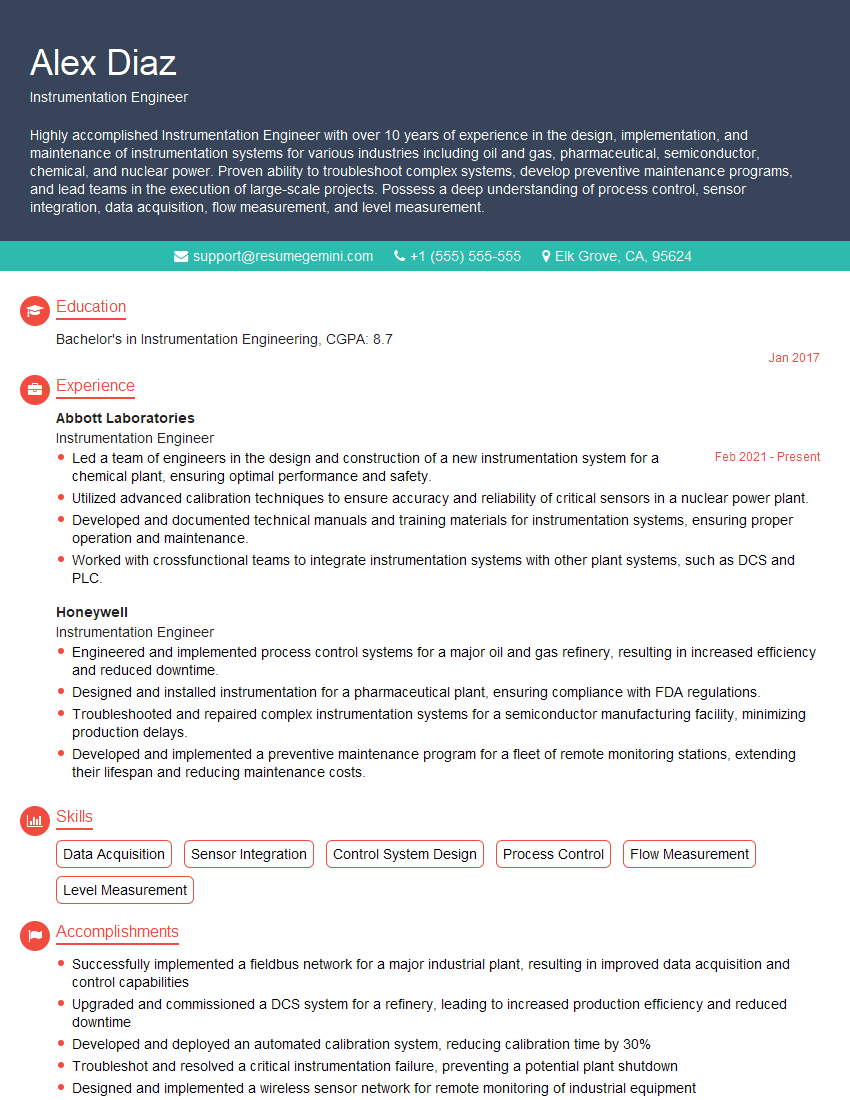
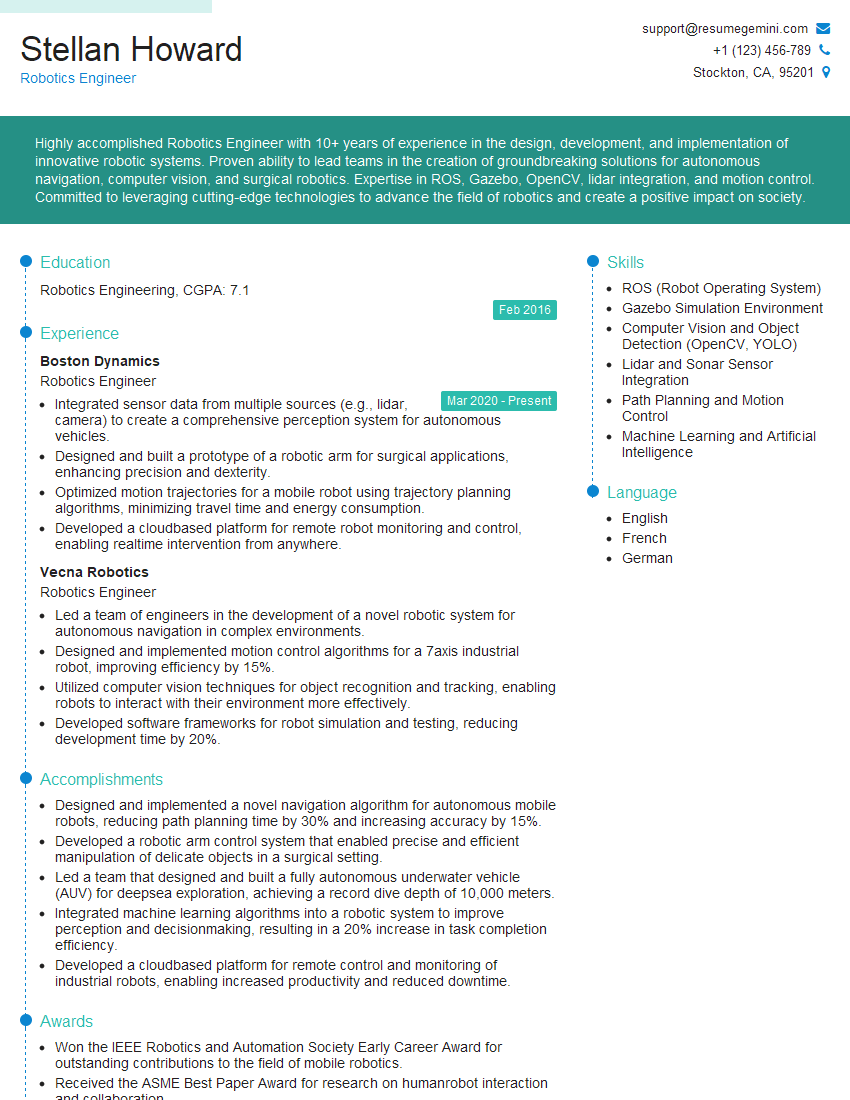
Mastering Data Acquisition and Signal Processing opens doors to exciting careers in various fields, from aerospace and automotive to biomedical engineering and telecommunications. To maximize your job prospects, invest time in crafting an ATS-friendly resume that highlights your skills and experience effectively. ResumeGemini is a trusted resource that can help you build a professional and impactful resume tailored to the specific requirements of Data Acquisition and Signal Processing roles. Examples of resumes optimized for this field are available to guide your process.




Explore more articles
Users Rating of Our Blogs
Share Your Experience
We value your feedback! Please rate our content and share your thoughts (optional).
What Readers Say About Our Blog
Hello,
we currently offer a complimentary backlink and URL indexing test for search engine optimization professionals.
You can get complimentary indexing credits to test how link discovery works in practice.
No credit card is required and there is no recurring fee.
You can find details here:
https://wikipedia-backlinks.com/indexing/
Regards
NICE RESPONSE TO Q & A
hi
The aim of this message is regarding an unclaimed deposit of a deceased nationale that bears the same name as you. You are not relate to him as there are millions of people answering the names across around the world. But i will use my position to influence the release of the deposit to you for our mutual benefit.
Respond for full details and how to claim the deposit. This is 100% risk free. Send hello to my email id: [email protected]
Luka Chachibaialuka
Hey interviewgemini.com, just wanted to follow up on my last email.
We just launched Call the Monster, an parenting app that lets you summon friendly ‘monsters’ kids actually listen to.
We’re also running a giveaway for everyone who downloads the app. Since it’s brand new, there aren’t many users yet, which means you’ve got a much better chance of winning some great prizes.
You can check it out here: https://bit.ly/callamonsterapp
Or follow us on Instagram: https://www.instagram.com/callamonsterapp
Thanks,
Ryan
CEO – Call the Monster App
Hey interviewgemini.com, I saw your website and love your approach.
I just want this to look like spam email, but want to share something important to you. We just launched Call the Monster, a parenting app that lets you summon friendly ‘monsters’ kids actually listen to.
Parents are loving it for calming chaos before bedtime. Thought you might want to try it: https://bit.ly/callamonsterapp or just follow our fun monster lore on Instagram: https://www.instagram.com/callamonsterapp
Thanks,
Ryan
CEO – Call A Monster APP
To the interviewgemini.com Owner.
Dear interviewgemini.com Webmaster!
Hi interviewgemini.com Webmaster!
Dear interviewgemini.com Webmaster!
excellent
Hello,
We found issues with your domain’s email setup that may be sending your messages to spam or blocking them completely. InboxShield Mini shows you how to fix it in minutes — no tech skills required.
Scan your domain now for details: https://inboxshield-mini.com/
— Adam @ InboxShield Mini
Reply STOP to unsubscribe
Hi, are you owner of interviewgemini.com? What if I told you I could help you find extra time in your schedule, reconnect with leads you didn’t even realize you missed, and bring in more “I want to work with you” conversations, without increasing your ad spend or hiring a full-time employee?
All with a flexible, budget-friendly service that could easily pay for itself. Sounds good?
Would it be nice to jump on a quick 10-minute call so I can show you exactly how we make this work?
Best,
Hapei
Marketing Director
Hey, I know you’re the owner of interviewgemini.com. I’ll be quick.
Fundraising for your business is tough and time-consuming. We make it easier by guaranteeing two private investor meetings each month, for six months. No demos, no pitch events – just direct introductions to active investors matched to your startup.
If youR17;re raising, this could help you build real momentum. Want me to send more info?
Hi, I represent an SEO company that specialises in getting you AI citations and higher rankings on Google. I’d like to offer you a 100% free SEO audit for your website. Would you be interested?
Hi, I represent an SEO company that specialises in getting you AI citations and higher rankings on Google. I’d like to offer you a 100% free SEO audit for your website. Would you be interested?
good