Preparation is the key to success in any interview. In this post, we’ll explore crucial DevOps and Continuous Integration (CI) interview questions and equip you with strategies to craft impactful answers. Whether you’re a beginner or a pro, these tips will elevate your preparation.
Questions Asked in DevOps and Continuous Integration (CI) Interview
Q 1. Explain the core principles of DevOps.
DevOps is a set of practices, tools, and a cultural philosophy that automates and integrates the processes between software development and IT operations teams. Its core principles revolve around collaboration, automation, and continuous improvement. Think of it as a bridge connecting traditionally siloed teams, enabling faster and more reliable software delivery.
- Collaboration: Breaking down the walls between development and operations teams fosters shared responsibility and a unified approach to software delivery. This often involves shared goals, metrics, and even shared tools.
- Automation: Automating repetitive tasks, such as building, testing, deployment, and infrastructure management, reduces human error, increases efficiency, and allows for faster release cycles. Think of it like an assembly line for software.
- Continuous Improvement: Embracing a culture of continuous learning and improvement through feedback loops, monitoring, and data-driven decision-making. This involves constantly seeking ways to optimize processes and improve the quality of software delivery.
- Continuous Integration/Continuous Delivery/Continuous Deployment (CI/CD): This is a crucial practice within DevOps, focusing on automating the software release pipeline. We’ll delve deeper into this in the next answer.
In essence, DevOps aims to improve the speed, quality, and reliability of software delivery by breaking down silos and leveraging automation and continuous feedback.
Q 2. Describe your experience with CI/CD pipelines.
I have extensive experience designing, implementing, and maintaining CI/CD pipelines using various tools. In my previous role at [Previous Company Name], I was instrumental in building a CI/CD pipeline that reduced our deployment time from weeks to hours. This involved several key steps:
- Version Control: We used Git for version control, employing branching strategies like Gitflow to manage features and releases effectively.
- Continuous Integration: Every code commit triggered automated builds, unit tests, and static code analysis. This ensured that integration issues were caught early.
- Continuous Delivery: Automated deployment to a staging environment allowed us to test the changes in a production-like environment before releasing them to end-users.
- Continuous Deployment: For specific projects with automated tests and high confidence, we implemented continuous deployment, automatically pushing verified changes directly to production.
- Monitoring and Feedback: We integrated monitoring tools to track the performance and stability of our application in production. This data informed future improvements and helped us quickly identify and resolve issues.
I’ve worked with tools like Jenkins, GitLab CI/CD, and Azure DevOps for building and managing these pipelines, tailoring the specific tools to the project’s needs and infrastructure.
Q 3. What are the key differences between Continuous Integration, Continuous Delivery, and Continuous Deployment?
While the terms are often used interchangeably, there are subtle yet significant differences between Continuous Integration (CI), Continuous Delivery (CD), and Continuous Deployment (CD):
- Continuous Integration (CI): Focuses on automating the process of integrating code changes from multiple developers into a shared repository. Each integration is verified by an automated build and automated tests, identifying integration problems early in the development cycle. Think of it as frequently merging small changes to prevent big conflicts later.
- Continuous Delivery (CD): Builds upon CI by automating the release process. Code changes that pass all automated tests in CI are automatically prepared for deployment to a production-like environment (staging). This doesn’t necessarily mean automatic deployment to production, but rather ensures the software is always ‘release-ready’. It’s like having your car fully inspected and ready to drive, but you’re not necessarily driving it yet.
- Continuous Deployment (CD): This is the most aggressive approach; every code change that passes all tests in CI and CD is automatically deployed to the production environment. This requires a high degree of confidence in the automated testing and monitoring infrastructure. This is like automatically driving your car once the inspection is complete.
The key distinction lies in the automation level: CI automates integration, CD automates release preparation, and continuous deployment automates the actual deployment to production.
Q 4. How do you ensure code quality in a CI/CD pipeline?
Ensuring code quality in a CI/CD pipeline is paramount. It’s not just about automated tests; it’s about a holistic approach that starts early in the development cycle and continues throughout the process. Here’s how I approach it:
- Static Code Analysis: Integrating tools like SonarQube or ESLint into the CI pipeline to automatically analyze code for potential bugs, security vulnerabilities, and style inconsistencies.
- Unit Tests: Developers write unit tests to verify the functionality of individual components. These tests are integrated into CI to ensure that every commit doesn’t break existing functionality.
- Integration Tests: These tests verify the interaction between different components or modules of the application. They are crucial for catching integration issues that might not be apparent in unit tests.
- System Tests/End-to-End Tests: These tests check the entire system’s functionality from the user’s perspective. This ensures that the application functions correctly as a whole.
- Code Reviews: Code reviews are an essential part of maintaining code quality. They provide an opportunity for peer feedback and knowledge sharing, improving the overall code quality and reducing bugs.
- Automated Security Testing: Integrating security scanning tools into the pipeline helps identify vulnerabilities early. This helps prevent security breaches and protects the application.
By combining these strategies, we can significantly increase code quality and reduce the risk of deploying buggy or insecure code.
Q 5. What tools have you used for version control (e.g., Git)?
My primary version control system is Git. I’m proficient in using various Git commands and workflows, including:
- Branching Strategies: I have extensive experience using Gitflow and GitHub Flow branching models to manage feature development, bug fixes, and releases effectively.
- Merging and Rebasing: I’m comfortable merging and rebasing branches to integrate changes cleanly and resolve conflicts efficiently.
- Collaboration: I’m proficient in using Git for collaborative development, leveraging features like pull requests and code reviews to ensure code quality and consistency.
- Version Tagging: I utilize version tags to mark significant milestones, such as releases, allowing for easy rollback or referencing specific versions.
- Git Hooks: I’ve utilized Git hooks to automate tasks such as pre-commit checks and post-commit notifications.
Beyond Git, I have also used Mercurial and SVN in past projects, showcasing my adaptability to different version control systems.
Q 6. Explain your experience with Infrastructure as Code (IaC). What tools have you used?
Infrastructure as Code (IaC) is a crucial element of modern DevOps. It treats infrastructure as software, allowing you to manage and provision infrastructure through code instead of manual processes. This increases consistency, reproducibility, and reduces human error.
I have experience using Terraform and Ansible extensively. With Terraform, I’ve provisioned and managed cloud infrastructure on AWS, Azure, and GCP, defining infrastructure as code in HCL (HashiCorp Configuration Language). This allows for version control, automated provisioning, and easy infrastructure scaling.
Ansible, on the other hand, allows me to manage and configure existing servers, automating tasks such as installing software, configuring services, and managing users. Its agentless architecture makes it simple to deploy and manage.
For example, I used Terraform to automatically create and configure a complete three-tier application environment on AWS, including EC2 instances, VPCs, load balancers, and RDS databases. Changes to infrastructure were then managed by updating the Terraform configuration and applying the changes, simplifying infrastructure management significantly.
Q 7. Describe your experience with containerization technologies (e.g., Docker, Kubernetes).
Containerization technologies are essential for modern software delivery. I’ve worked extensively with Docker and Kubernetes to build, deploy, and manage containerized applications.
With Docker, I’ve created Dockerfiles to package applications and their dependencies into containers, ensuring consistent execution across various environments. This solves the infamous ‘it works on my machine’ problem. I use Docker Compose to manage multi-container applications, simplifying development and testing.
Kubernetes is a powerful container orchestration platform that I utilize to deploy and manage containerized applications at scale. I’ve used Kubernetes to automate deployment, scaling, and management of applications across clusters of machines. Features like rolling updates, health checks, and self-healing capabilities ensure high availability and resilience.
In a previous project, we migrated a monolithic application to a microservices architecture using Docker and Kubernetes. This resulted in increased scalability, improved resilience, and easier deployment and maintenance. Each microservice ran in its own Docker container, orchestrated by Kubernetes, simplifying the management and deployment of the entire application.
Q 8. How do you monitor and troubleshoot CI/CD pipelines?
Monitoring and troubleshooting CI/CD pipelines is crucial for ensuring smooth and reliable software delivery. It involves proactive observation and reactive problem-solving. Think of it like monitoring the health of a patient – you need regular checkups and immediate attention when something goes wrong.
My approach involves several key steps:
- Logging and Monitoring Tools: I leverage tools like Prometheus, Grafana, and Datadog to collect logs and metrics from all stages of the pipeline. This provides real-time visibility into build times, test results, deployment success rates, and resource utilization. For example, a sudden spike in build times might indicate a resource bottleneck or a problem with a specific dependency.
- Alerting Systems: I configure alerts based on predefined thresholds. For instance, if a build fails, a deployment takes longer than expected, or a specific test fails consistently, automated alerts notify the relevant team members immediately, allowing for rapid response. This is akin to a doctor’s alarm system for critical patient issues.
- Tracing and Debugging: When an issue arises, I use tools like Jaeger or Zipkin for distributed tracing to pinpoint the exact stage or component causing the problem. This allows me to quickly narrow down the source of the error, instead of blindly searching through logs. Think of this as using an X-ray machine in medicine to pinpoint an exact issue.
- Version Control and Rollbacks: Using robust version control (Git) allows for easy rollbacks to previous stable versions if a deployment causes problems. This mitigates risk and enables quick recovery.
- Post-Mortem Analysis: After resolving a significant incident, I conduct a post-mortem analysis to understand the root cause, implement preventative measures, and improve the pipeline’s resilience. This is crucial for continuous improvement and preventing future occurrences.
Q 9. Explain your experience with configuration management tools (e.g., Ansible, Puppet, Chef).
Configuration management tools are essential for automating infrastructure provisioning and management. I have extensive experience with Ansible, Puppet, and Chef, each with its own strengths and weaknesses. Think of them as the architects and builders of our digital infrastructure.
- Ansible: I prefer Ansible for its simplicity and agentless architecture. Its YAML-based configuration is human-readable and easy to manage. I’ve used it extensively for automating tasks like deploying applications, configuring servers, and managing databases. For example, I used Ansible to automate the deployment of a web application across multiple servers, ensuring consistency and reducing manual effort.
- Puppet: Puppet is a powerful tool suited for larger, more complex infrastructures. Its declarative approach allows for defining the desired state of the system, and Puppet handles the process of reaching that state. I’ve used it in projects requiring intricate configurations and robust change management.
- Chef: Chef offers a robust infrastructure-as-code solution. Its emphasis on cookbooks and recipes promotes code reusability and maintainability. I found it particularly useful in environments with complex recipes and extensive automation needs.
My choice of tool depends on the project’s scale, complexity, and specific requirements. I often find myself combining aspects of these tools for optimal results.
Q 10. How do you handle code deployments in a production environment?
Handling code deployments in a production environment requires a methodical and cautious approach. The goal is to minimize disruption and ensure a smooth transition. It’s like performing a delicate surgery – precision and planning are paramount.
- Blue/Green Deployments: I often utilize blue/green deployments. This involves having two identical environments (blue and green). The new code is deployed to the green environment, thoroughly tested, and then traffic is switched to the green environment, making the blue environment the backup. This minimizes downtime and allows for quick rollbacks.
- Canary Deployments: For lower-risk deployments, I use canary deployments. A small subset of users is routed to the new version, allowing for monitoring and validation before a full rollout. This is like testing a new drug on a small group of patients before widespread use.
- Rolling Deployments: In rolling deployments, new versions are deployed incrementally to a set of servers, gradually replacing older versions. This minimizes the impact of a potential failure.
- Automated Rollbacks: Automated rollbacks are essential. If issues arise, the system should automatically revert to the previous stable version, minimizing downtime and preventing widespread problems.
- Monitoring and Alerting: Continuous monitoring and alerting are critical during and after deployments to quickly identify and address any issues.
Q 11. What are some common challenges in implementing DevOps, and how have you overcome them?
Implementing DevOps presents several challenges, but overcoming them is key to successful software delivery. It’s like building a high-performance team – collaboration, communication, and a shared vision are crucial.
- Resistance to Change: Often, teams are resistant to adopting new processes and tools. I address this by focusing on the benefits of DevOps, providing training, and demonstrating the value through tangible improvements.
- Lack of Skills and Expertise: DevOps requires a diverse skillset. I tackle this by mentoring team members, providing training opportunities, and hiring individuals with relevant experience.
- Tooling Complexity: Managing a complex ecosystem of tools can be overwhelming. I strive for simplicity by selecting appropriate tools, automating integration, and creating clear documentation.
- Collaboration and Communication: Effective communication and collaboration between development and operations teams are paramount. I encourage regular meetings, cross-functional collaboration, and the use of shared communication channels.
- Security Concerns: DevOps practices need to prioritize security throughout the pipeline. I incorporate security best practices, use automated security testing tools, and implement robust access controls.
Q 12. Describe your experience with testing methodologies in a CI/CD pipeline (e.g., unit, integration, system).
Testing is an integral part of a successful CI/CD pipeline. Think of it as quality control in a manufacturing process – you wouldn’t release a product without thorough checks.
- Unit Testing: Unit tests verify individual components or units of code. I encourage developers to write unit tests as they code, ensuring high code quality and early detection of bugs. Frameworks like JUnit (Java) or pytest (Python) are commonly used.
- Integration Testing: Integration tests verify the interaction between different components or modules. I employ integration tests to ensure that different parts of the system work together seamlessly.
- System Testing: System tests validate the entire system as a whole, ensuring it meets requirements. This involves testing various scenarios and user flows to ensure the system behaves as expected.
- Automated Testing: Automation is critical. I use tools like Selenium for UI testing, and various testing frameworks to automate the execution and reporting of test results.
- Test-Driven Development (TDD): In many cases, I advocate for TDD, where tests are written before the code, driving the development process and ensuring testability.
Q 13. How do you manage dependencies in your projects?
Managing dependencies is crucial for maintaining project stability and preventing conflicts. It’s like managing ingredients in a complex recipe – you need the right amount of each ingredient at the right time.
- Dependency Management Tools: I utilize tools like npm (Node.js), Maven (Java), or pip (Python) to manage project dependencies. These tools define, download, and manage the versions of libraries and packages used in a project.
- Virtual Environments: I create isolated virtual environments for each project to prevent conflicts between dependencies. This ensures that each project has its own set of dependencies, avoiding version mismatches.
- Dependency Locking: I use dependency locking mechanisms to ensure that the exact versions of dependencies are used across different environments (development, testing, production). This eliminates inconsistencies and unexpected behavior.
- Regular Dependency Updates: I establish a process for regularly updating dependencies to patch security vulnerabilities and take advantage of new features. This balance between stability and up-to-dateness is critical.
Q 14. What are your preferred scripting languages for automation?
My preferred scripting languages for automation are Python and Bash. They are powerful and versatile, each with its own strengths.
- Python: Python is my go-to language for most automation tasks. Its readability, extensive libraries (like Ansible and Fabric), and ease of use make it ideal for complex automation scripts. For example, I’ve used Python to build custom scripts for monitoring, deploying, and managing infrastructure.
- Bash: Bash is essential for system administration and shell scripting. I use it for automating tasks related to the Linux operating system, such as managing users, automating backups, and running system checks. Its integration with Linux commands makes it very powerful.
The choice between Python and Bash depends on the specific task. Python is often preferred for more complex logic, while Bash is more efficient for simple, system-level tasks.
Q 15. Describe your experience with cloud platforms (e.g., AWS, Azure, GCP).
I have extensive experience working with major cloud platforms like AWS, Azure, and GCP. My experience spans across various services, including compute (EC2, Azure VMs, Compute Engine), storage (S3, Azure Blob Storage, Cloud Storage), databases (RDS, Azure SQL Database, Cloud SQL), and orchestration (EKS, AKS, GKE). I’ve built and managed infrastructure as code (IaC) using tools like Terraform and CloudFormation, ensuring consistent and repeatable deployments. For instance, in a recent project on AWS, I leveraged EC2 Auto Scaling groups and Elastic Load Balancing to create a highly available and scalable microservice architecture. On Azure, I utilized Azure DevOps pipelines for CI/CD, seamlessly integrating with our existing infrastructure. My experience extends to optimizing cloud costs and leveraging serverless technologies like AWS Lambda and Azure Functions for cost-effective solutions.
I’m also proficient in using various cloud-native tools and services to manage and monitor cloud resources, contributing to overall infrastructure efficiency and resilience.
Career Expert Tips:
- Ace those interviews! Prepare effectively by reviewing the Top 50 Most Common Interview Questions on ResumeGemini.
- Navigate your job search with confidence! Explore a wide range of Career Tips on ResumeGemini. Learn about common challenges and recommendations to overcome them.
- Craft the perfect resume! Master the Art of Resume Writing with ResumeGemini’s guide. Showcase your unique qualifications and achievements effectively.
- Don’t miss out on holiday savings! Build your dream resume with ResumeGemini’s ATS optimized templates.
Q 16. Explain your understanding of immutable infrastructure.
Immutable infrastructure is a paradigm shift in IT operations where servers and other infrastructure components are treated as immutable entities. Once an instance is created, it’s never modified directly. Instead, any changes are implemented by creating a new instance with the desired configuration. This contrasts with mutable infrastructure, where instances are updated in place.
Think of it like this: instead of fixing a broken chair, you simply replace it with a new one. This approach significantly simplifies management, reduces risks associated with configuration drift, and makes rollbacks much easier. If something goes wrong, you simply revert to the previous immutable instance. This significantly improves stability and reduces downtime. Tools like Docker and container orchestration platforms like Kubernetes are key enablers of immutable infrastructure.
In practice, this means using tools like Ansible, Puppet, Chef, or Terraform to define infrastructure as code, ensuring consistency and repeatability. This allows for automated deployments and rollbacks, significantly increasing the reliability and speed of deployments.
Q 17. How do you ensure security throughout the CI/CD pipeline?
Security is paramount in any CI/CD pipeline. My approach to ensuring security involves a multi-layered strategy. Firstly, I advocate for implementing secure coding practices from the start. This includes using static and dynamic code analysis tools to identify vulnerabilities early in the development process. Secondly, I enforce least privilege access control at every stage of the pipeline, ensuring that only authorized users and services have access to sensitive information and resources. This often involves leveraging role-based access control (RBAC) and fine-grained permissions.
Thirdly, I utilize secrets management tools like HashiCorp Vault or AWS Secrets Manager to securely store and manage sensitive credentials and API keys, removing them from version control. Furthermore, I implement code signing and verification to ensure that only trusted code is deployed. Finally, regular security audits and penetration testing are crucial to identify and address potential vulnerabilities proactively.
Continuous monitoring of the pipeline itself for any unusual activity is critical. We use intrusion detection and prevention systems and regularly review logs for suspicious patterns. This holistic approach ensures comprehensive security throughout the entire CI/CD process.
Q 18. Describe your experience with monitoring and logging tools.
I have extensive experience with various monitoring and logging tools, adapting my choices to the specific needs of the project. For centralized logging, I often use tools like ELK stack (Elasticsearch, Logstash, Kibana), Splunk, or Graylog, allowing for efficient aggregation, analysis, and visualization of logs from diverse sources. These tools provide valuable insights into application performance, identify errors and exceptions, and aid in troubleshooting issues quickly.
For monitoring, I leverage tools such as Prometheus, Grafana, Datadog, or CloudWatch, depending on the environment. These tools provide real-time visibility into key metrics like CPU utilization, memory usage, request latency, and error rates. Setting up appropriate alerts based on predefined thresholds allows for proactive identification and resolution of performance bottlenecks or failures. In a recent project, we used Datadog to monitor our Kubernetes cluster, providing us with invaluable insights into resource utilization and overall cluster health. This allowed us to proactively scale our resources based on demand and prevent performance degradation.
Q 19. What are some common metrics you use to measure the success of a CI/CD pipeline?
Measuring the success of a CI/CD pipeline involves tracking several key metrics. These include:
- Deployment Frequency: How often are deployments happening? Higher frequency usually indicates a more efficient and robust pipeline.
- Lead Time for Changes: How long does it take to go from code commit to deployment? Shorter lead times signify faster delivery cycles.
- Mean Time To Recovery (MTTR): How quickly can we recover from failures? A lower MTTR demonstrates better resilience.
- Change Failure Rate: What percentage of deployments result in failures requiring rollback? Lower rates show increased stability.
- Deployment Success Rate: The percentage of successful deployments without any issues. Aim for a rate as close to 100% as possible.
By regularly monitoring these metrics, we can identify areas for improvement and optimize the pipeline for greater efficiency and reliability. This data-driven approach helps us continuously enhance our processes.
Q 20. How do you handle rollback scenarios in a deployment?
Handling rollback scenarios is critical for maintaining system stability. My approach centers on having a robust rollback strategy in place before a deployment. This typically involves using immutable infrastructure, as previously discussed. This allows us to easily revert to a known good state by deploying a previous version of the application. We achieve this through automated rollback mechanisms integrated directly into our CI/CD pipeline.
This could involve a simple script that deploys a previous version from a known good artifact repository. Alternatively, more advanced techniques include using canary deployments or blue/green deployments, allowing for phased rollouts and the ability to quickly switch back to the previous version if issues arise. Detailed logging and monitoring are crucial for quickly diagnosing the cause of any failures and making informed decisions during rollback scenarios. Post-mortem analysis is also essential to understand the root cause of the failure and prevent similar incidents in the future.
Q 21. Explain your understanding of different branching strategies.
Choosing the right branching strategy is essential for efficient collaboration and managing code changes. Several strategies exist, each with its own strengths and weaknesses:
- Gitflow: This is a more complex workflow suitable for larger teams and projects requiring rigorous release management. It involves distinct branches for development, feature development, releases, and hotfixes.
- GitHub Flow: A simpler workflow well-suited for smaller teams and faster-paced projects. It relies primarily on the
mainbranch, with feature branches merging directly into it. - GitLab Flow: A flexible model built upon GitHub Flow, but adding support for environments and release branches. It allows for easier management of multiple deployments to different environments.
- Trunk-Based Development: Emphasizes frequent integration and short-lived feature branches. This keeps the main branch always deployable.
The choice depends on the team’s size, project complexity, and release cadence. A larger team working on a long-term project might benefit from Gitflow, while a smaller, agile team might prefer GitHub Flow or Trunk-Based Development. It’s crucial to select and consistently follow a strategy to avoid conflicts and ensure efficient code management.
Q 22. Describe your experience with build tools (e.g., Maven, Gradle).
I have extensive experience with both Maven and Gradle, two of the most popular build tools in the Java ecosystem. Maven, with its XML-based configuration, is great for straightforward projects and offers a very mature ecosystem of plugins. However, its rigidity can become a challenge in larger, more complex projects. Gradle, on the other hand, utilizes Groovy or Kotlin for configuration, providing much greater flexibility and allowing for highly customized build processes. I’ve used Gradle extensively for building complex multi-module projects, leveraging its dependency management capabilities to streamline the build process and reduce conflicts. For instance, in a recent project involving microservices built with Spring Boot, Gradle’s support for parallel task execution significantly reduced our build times, improving our CI/CD pipeline efficiency. I’m comfortable working with both tools and selecting the optimal one depending on project requirements.
In a previous role, we migrated from Maven to Gradle for a large enterprise application. The flexibility of Gradle’s configuration allowed us to implement custom tasks for specific needs, such as generating dynamic reports and automating deployments to different environments. This improved build reproducibility and reduced manual intervention, ultimately leading to faster release cycles.
Q 23. How do you manage secrets in a CI/CD pipeline?
Managing secrets securely within a CI/CD pipeline is paramount. Hardcoding secrets directly into scripts or configuration files is a major security risk. Instead, I advocate for using dedicated secrets management solutions. These solutions often integrate with your CI/CD tools, allowing you to retrieve secrets securely during the pipeline execution without exposing them in plain text. Popular solutions include HashiCorp Vault, AWS Secrets Manager, and Azure Key Vault. These services offer features like encryption at rest and in transit, access control lists, and auditing capabilities.
For example, in a recent project, we used AWS Secrets Manager to store database credentials. Our CI/CD pipeline (using Jenkins) was configured to retrieve these credentials using the AWS CLI, which authenticated securely using IAM roles. This ensured that the credentials never appeared in the pipeline’s logs or build artifacts, minimizing the risk of exposure.
# Example (Conceptual):
aws secretsmanager get-secret-value --secret-id my-database-secret | jq -r '.SecretString' | base64 --decode | sh
(Note: This is a simplified conceptual example. Actual implementation would involve more robust error handling and security best practices.)
Q 24. What is your approach to automating infrastructure provisioning?
I am a strong proponent of Infrastructure as Code (IaC). IaC allows for the automated provisioning and management of infrastructure through code, ensuring consistency, repeatability, and version control. My preferred tools include Terraform and Ansible. Terraform excels at managing multi-cloud and hybrid environments, defining infrastructure as declarative code. Ansible is excellent for configuring and managing existing infrastructure through automated playbooks. I have used both extensively in various projects.
For instance, in a recent project, we used Terraform to provision and manage our entire AWS infrastructure, including EC2 instances, VPCs, S3 buckets, and databases. This automated process not only drastically reduced our infrastructure setup time but also enabled us to easily replicate our environment across different regions and easily version our infrastructure configurations for rollbacks.
Ansible, on the other hand, has been valuable for tasks like deploying applications to servers and configuring network devices. Its agentless architecture and straightforward syntax made it efficient and easy to use for both infrastructure and application deployment.
Q 25. Explain your experience with Agile methodologies.
My experience with Agile methodologies, particularly Scrum and Kanban, is extensive. I’ve actively participated in Agile teams, working in iterative sprints with daily stand-ups, sprint reviews, and retrospectives. I understand the importance of continuous improvement and adapting to changing requirements. My role often involves bridging the gap between development and operations, ensuring that the CI/CD pipeline aligns with Agile principles. I’ve found that Agile’s emphasis on collaboration and feedback loops is crucial for successful DevOps implementations.
In a previous project, we adopted a Kanban approach to manage our CI/CD pipeline. This allowed us to visualize the workflow, identify bottlenecks, and continuously improve our processes based on data-driven insights. The flexible nature of Kanban enabled us to respond efficiently to urgent requests and prioritize tasks dynamically.
Q 26. Describe a time you had to troubleshoot a failed deployment. What was the root cause, and how did you resolve it?
During a recent deployment, a seemingly innocuous change in a configuration file caused a cascading failure. Our application, deployed using Kubernetes, started reporting database connection errors. Initial investigation suggested a database issue, but after closer examination of the logs, we discovered a subtle error in the deployment manifest: a typo in the environment variable referencing the database connection string. This caused the application to use a default, incorrect connection string, leading to the failures.
The root cause was the simple typo, compounded by insufficient testing of the configuration change in a staging environment. The resolution involved correcting the typo in the deployment manifest and redeploying the application. We also implemented more stringent validation checks on configuration files during our CI/CD pipeline to prevent similar issues in the future. Crucially, we introduced a more robust integration testing phase to simulate production scenarios and catch such errors early on. This incident highlighted the importance of rigorous testing and careful attention to detail even in minor configuration changes.
Q 27. How do you handle conflicts during code merging?
Handling code merge conflicts efficiently requires a combination of good practices and tooling. I always prefer to keep branches small and focused on specific features or bug fixes, minimizing the likelihood of large, complex merge conflicts. I advocate for frequent integration and utilizing a robust version control system like Git. When conflicts do arise, I carefully examine the changes in the conflicting sections, understanding the intent of each change before resolving them.
My approach involves reviewing both the local and remote changes using a diff tool, understanding the context and resolving the conflicts manually by choosing the appropriate changes or creating a custom merge. I’m proficient with Git’s merge and rebase commands and understand the implications of each. I always thoroughly test the merged code before committing and pushing it to prevent introducing new bugs.
Clear and concise commit messages are paramount for understanding and resolving conflicts later on. I ensure that every commit message describes the purpose and outcome of each change, making it easier to trace the source of conflicts during merge operations.
Q 28. What are your strategies for improving team collaboration in a DevOps environment?
Improving team collaboration in a DevOps environment requires fostering a culture of shared responsibility, open communication, and continuous learning. This starts with establishing clear communication channels, using tools like Slack or Microsoft Teams for quick updates and discussions, and regular team meetings for planning, retrospectives, and knowledge sharing. We also utilize collaborative tools like shared documentation (e.g., Confluence or Notion) and collaborative code editing platforms (e.g., GitHub, GitLab) to foster a culture of knowledge sharing.
Implementing a robust incident management process with clearly defined roles and responsibilities also plays a crucial role in fostering collaboration. Postmortems following incidents allow the team to learn from mistakes, identify areas for improvement, and collaborate on solutions. Encouraging pair programming or code reviews helps improve code quality and shares knowledge across the team. A strong DevOps culture emphasizes continuous learning and improvement, so regularly providing opportunities for training and skill development is also vital.
Key Topics to Learn for DevOps and Continuous Integration (CI) Interview
- Version Control Systems (VCS): Understanding Git, branching strategies (Gitflow, GitHub Flow), merging, and resolving conflicts is fundamental. Practical application: Explain your experience managing codebases using Git in a team environment.
- CI/CD Pipelines: Learn the principles behind automated build, test, and deployment processes. Practical application: Describe your experience building and maintaining CI/CD pipelines using tools like Jenkins, GitLab CI, or Azure DevOps. Discuss challenges overcome and solutions implemented.
- Containerization (Docker & Kubernetes): Master the concepts of containerization, orchestration, and deployment using Docker and Kubernetes. Practical application: Explain how you’ve used containers to improve application deployment and scalability.
- Infrastructure as Code (IaC): Familiarize yourself with tools like Terraform or Ansible for automating infrastructure provisioning and management. Practical application: Describe a scenario where you used IaC to automate infrastructure setup and configuration.
- Monitoring and Logging: Understand the importance of monitoring application performance and system health using tools like Prometheus, Grafana, ELK stack, or similar. Practical application: Discuss your experience setting up and interpreting monitoring dashboards to identify and resolve issues.
- Cloud Platforms (AWS, Azure, GCP): Gain a solid understanding of at least one major cloud provider, including their services relevant to DevOps and CI/CD. Practical application: Describe your experience deploying and managing applications on a chosen cloud platform.
- Security in DevOps: Understand security best practices throughout the CI/CD pipeline, including secure coding, vulnerability scanning, and secrets management. Practical application: Explain how you’ve integrated security measures into your CI/CD workflows.
- Testing Strategies: Understand various testing methodologies (unit, integration, system, end-to-end) and their role in a CI/CD pipeline. Practical application: Discuss your experience implementing and improving testing processes to ensure code quality.
Next Steps
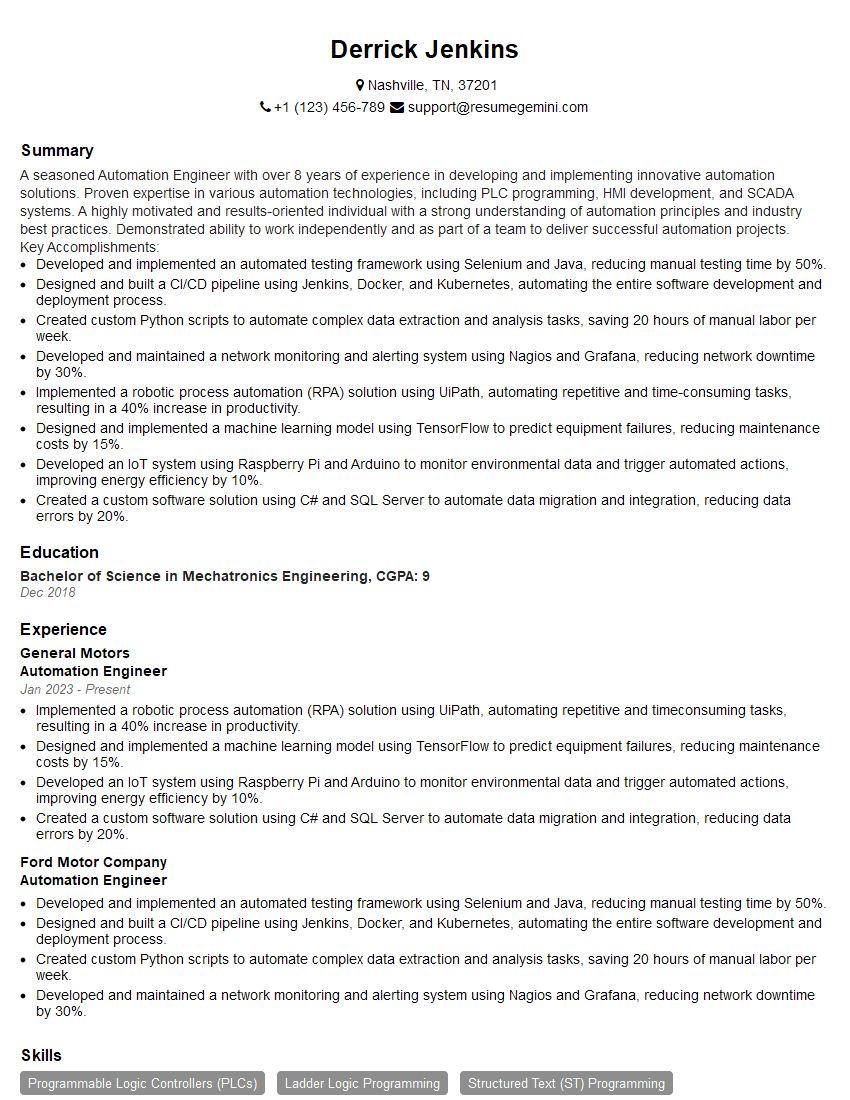
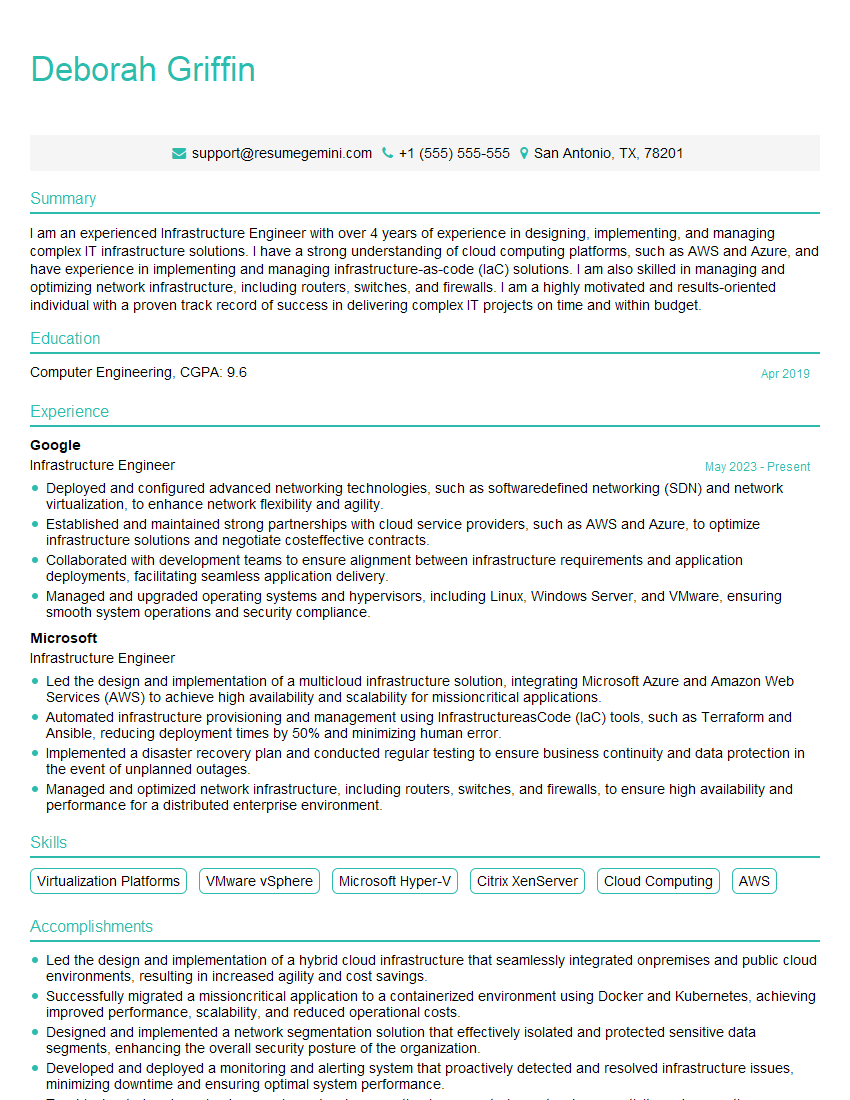
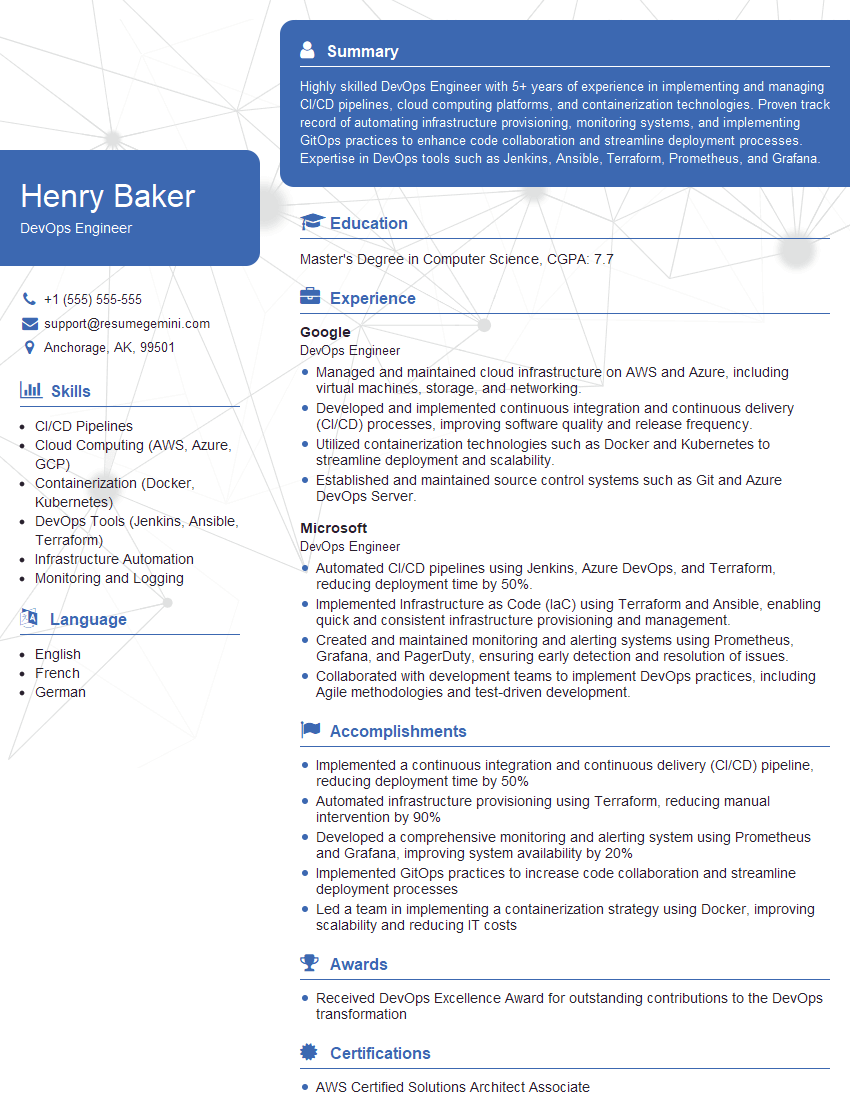
Mastering DevOps and Continuous Integration (CI) significantly enhances your career prospects, opening doors to high-demand roles with excellent compensation and growth opportunities. To maximize your job search success, create a strong, ATS-friendly resume that highlights your skills and experience effectively. ResumeGemini is a trusted resource to help you build a professional resume that stands out. Examples of resumes tailored to DevOps and Continuous Integration (CI) roles are available to guide you.
Explore more articles
Users Rating of Our Blogs
Share Your Experience
We value your feedback! Please rate our content and share your thoughts (optional).
What Readers Say About Our Blog
Hello,
we currently offer a complimentary backlink and URL indexing test for search engine optimization professionals.
You can get complimentary indexing credits to test how link discovery works in practice.
No credit card is required and there is no recurring fee.
You can find details here:
https://wikipedia-backlinks.com/indexing/
Regards
NICE RESPONSE TO Q & A
hi
The aim of this message is regarding an unclaimed deposit of a deceased nationale that bears the same name as you. You are not relate to him as there are millions of people answering the names across around the world. But i will use my position to influence the release of the deposit to you for our mutual benefit.
Respond for full details and how to claim the deposit. This is 100% risk free. Send hello to my email id: [email protected]
Luka Chachibaialuka
Hey interviewgemini.com, just wanted to follow up on my last email.
We just launched Call the Monster, an parenting app that lets you summon friendly ‘monsters’ kids actually listen to.
We’re also running a giveaway for everyone who downloads the app. Since it’s brand new, there aren’t many users yet, which means you’ve got a much better chance of winning some great prizes.
You can check it out here: https://bit.ly/callamonsterapp
Or follow us on Instagram: https://www.instagram.com/callamonsterapp
Thanks,
Ryan
CEO – Call the Monster App
Hey interviewgemini.com, I saw your website and love your approach.
I just want this to look like spam email, but want to share something important to you. We just launched Call the Monster, a parenting app that lets you summon friendly ‘monsters’ kids actually listen to.
Parents are loving it for calming chaos before bedtime. Thought you might want to try it: https://bit.ly/callamonsterapp or just follow our fun monster lore on Instagram: https://www.instagram.com/callamonsterapp
Thanks,
Ryan
CEO – Call A Monster APP
To the interviewgemini.com Owner.
Dear interviewgemini.com Webmaster!
Hi interviewgemini.com Webmaster!
Dear interviewgemini.com Webmaster!
excellent
Hello,
We found issues with your domain’s email setup that may be sending your messages to spam or blocking them completely. InboxShield Mini shows you how to fix it in minutes — no tech skills required.
Scan your domain now for details: https://inboxshield-mini.com/
— Adam @ InboxShield Mini
Reply STOP to unsubscribe
Hi, are you owner of interviewgemini.com? What if I told you I could help you find extra time in your schedule, reconnect with leads you didn’t even realize you missed, and bring in more “I want to work with you” conversations, without increasing your ad spend or hiring a full-time employee?
All with a flexible, budget-friendly service that could easily pay for itself. Sounds good?
Would it be nice to jump on a quick 10-minute call so I can show you exactly how we make this work?
Best,
Hapei
Marketing Director
Hey, I know you’re the owner of interviewgemini.com. I’ll be quick.
Fundraising for your business is tough and time-consuming. We make it easier by guaranteeing two private investor meetings each month, for six months. No demos, no pitch events – just direct introductions to active investors matched to your startup.
If youR17;re raising, this could help you build real momentum. Want me to send more info?
Hi, I represent an SEO company that specialises in getting you AI citations and higher rankings on Google. I’d like to offer you a 100% free SEO audit for your website. Would you be interested?
Hi, I represent an SEO company that specialises in getting you AI citations and higher rankings on Google. I’d like to offer you a 100% free SEO audit for your website. Would you be interested?
good