Are you ready to stand out in your next interview? Understanding and preparing for Digital Workflow and Color Correction interview questions is a game-changer. In this blog, we’ve compiled key questions and expert advice to help you showcase your skills with confidence and precision. Let’s get started on your journey to acing the interview.
Questions Asked in Digital Workflow and Color Correction Interview
Q 1. Explain your experience with different color spaces (e.g., sRGB, Adobe RGB, Rec.709, Rec.2020).
Color spaces define the range of colors that can be represented digitally. Different color spaces are optimized for different purposes, and understanding their nuances is crucial for accurate color reproduction. I have extensive experience working with several key color spaces:
- sRGB: The standard color space for the internet and most consumer displays. It’s a relatively small color gamut, meaning it can’t represent the full range of colors visible to the human eye. Think of it as a basic palette – good for web images and everyday viewing.
- Adobe RGB: A wider gamut color space than sRGB, offering a broader range of colors, particularly in the greens and blues. This is frequently used in print production where a wider color range is important for accurate color reproduction on professional printers. It’s like having a professional-grade palette with more vibrant options.
- Rec.709: The standard color space for HDTV. It’s designed for video display and provides a good balance between color accuracy and display capabilities. It’s what you see on your television screen.
- Rec.2020: A much wider gamut color space than Rec.709, aiming to encompass a larger portion of the colors visible to the human eye. It’s the future of video and is becoming increasingly relevant in high-end productions, but display support is still expanding. Imagine this as the ultimate artist’s palette, offering unparalleled color richness.
My experience includes managing projects involving conversions between these spaces, understanding the limitations of each, and choosing the appropriate space based on the final output. For instance, I would always start with a wider gamut space like Adobe RGB during post-production to preserve maximum color information and then convert to sRGB for web publication to avoid clipping.
Q 2. Describe your workflow for color grading a project from start to finish.
My color grading workflow is a meticulous process that prioritizes efficiency and consistency. It typically follows these steps:
- Ingest and Organization: I begin by organizing my footage using a robust media management system, ensuring all files are properly named and backed up. This avoids wasting time searching for specific shots later.
- Initial Color Correction: I perform a thorough color correction to address any inconsistencies across clips, ensuring white balance, exposure, and contrast are consistent. This establishes a neutral foundation before any creative adjustments.
- Color Grading (Creative Adjustments): This is where I add creative flair. I use tools to adjust the overall mood and tone of the project, selectively targeting specific shots or areas. This phase involves experimentation with color curves, primary and secondary color correction, and potentially LUTs (Look Up Tables).
- Review and Refinement: Regular reviews on different displays are critical. I check for consistency across various screen types and lighting conditions. Client feedback is incorporated into iterative refinement.
- Output and Delivery: I carefully export the final graded project in the correct color space and format specified by the client or platform, ensuring proper metadata is included.
Throughout the entire process, meticulous note-keeping and version control are maintained, so I can easily track changes and revert to previous versions if needed. I also frequently leverage proxies for faster processing during editing and grading of higher resolution content.
Q 3. How do you handle color inconsistencies between different cameras or sources?
Color inconsistencies between cameras or sources are a common challenge. My approach involves a multi-faceted strategy:
- Camera Profiles: Using camera-specific color profiles (like those in Adobe Camera Raw or similar software) helps to create a more consistent starting point. These profiles help to correct for the unique color characteristics of different camera sensors.
- Color Matching Tools: Software often includes dedicated color matching tools. These tools analyze footage from multiple sources and attempt to find common ground, reducing the intensity of manual adjustment.
- Careful Adjustments: Manual color balancing is sometimes required. I might employ techniques such as using a common neutral point across clips to align exposure and white balance. This is like using a color reference chart to make fine-tune adjustments.
- LUTs: Custom LUTs can be created to match the color of one source to another, ensuring a smooth transition and preventing jarring shifts in tone.
For example, when dealing with footage from a RED camera and a Sony camera, I would first apply their respective camera profiles. If the difference is too significant, I would proceed with color matching tools and possibly create a custom LUT to bridge the gap. The aim is to maintain visual coherence without losing individual camera characteristics, which can sometimes add stylistic interest.
Q 4. What are your preferred color grading tools and why?
My preferred color grading tools depend on the project’s scale and complexity, but my go-to options are usually:
- DaVinci Resolve: This is my primary choice for its robust features, versatility, and intuitive interface. Its node-based system provides great control and allows for non-destructive editing, which is crucial for flexibility. Its color science is exceptionally strong.
- Adobe Premiere Pro/After Effects: I use these for smaller projects or when integration with other Adobe Creative Cloud applications is needed. Premiere Pro offers efficient color correction capabilities, and After Effects can assist in advanced compositing and color effects.
The reason I gravitate towards these tools is their industry-standard status, extensive community support, and the vast array of tutorials and learning resources available. This ensures I can readily find solutions to challenges and expand my skillset.
Q 5. Explain the difference between color correction and color grading.
While both color correction and color grading involve manipulating color, they serve distinct purposes:
- Color Correction: This is the process of fixing technical color issues in footage. It aims to ensure accurate color representation, addressing problems like white balance, exposure, and color casts. Think of this as ‘fixing’ any inaccuracies or inconsistencies to obtain a neutral representation.
- Color Grading: This is a more creative process, focusing on enhancing the mood, tone, and artistic style of the project. It uses color to tell a story, establishing the aesthetic of the visuals. Think of this as ‘styling’ the footage to convey emotion and build a specific mood.
For example, color correction might involve fixing a green tint from an improperly white-balanced shot, while color grading might involve shifting the entire scene to a cooler palette to convey a sense of melancholy.
Q 6. How do you manage large media files and ensure efficient workflow?
Managing large media files efficiently requires a multi-pronged approach:
- High-Performance Storage: Investing in fast storage solutions, such as RAID arrays or NVMe SSDs, is crucial to reduce bottlenecks. This greatly speeds up access times, enabling smoother workflows.
- Proxy Workflows: Using lower-resolution proxies for editing and initial grading helps to significantly reduce processing demands, especially when working with 4K or higher resolution footage. I can quickly make editing decisions and refine the grading before rendering to the final resolution.
- Organized File Structures: A clear and consistent file structure makes it much easier to locate and manage footage. Using standardized naming conventions and folder organization is essential.
- Media Management Software: Utilizing specialized media management software, such as Adobe Bridge or similar systems, helps to streamline file management, creating a visual representation of the project’s assets.
- Cloud Storage: Cloud storage can provide scalable and accessible backups, ensuring data safety and enabling remote collaboration.
By combining these methods, I can effectively manage even the largest projects and keep rendering times to a minimum. For example, working with several terabytes of 8K footage requires careful planning and investment in infrastructure, but careful selection of storage and intelligent use of proxies ensures a manageable workflow.
Q 7. Describe your experience with color management systems (CMS).
Color Management Systems (CMS) are essential for ensuring accurate color reproduction across different devices and workflows. My experience involves utilizing CMS features within software applications to:
- Profile Displays and Printers: I accurately profile my monitors and printers to match their color capabilities. This means that the colors on my screen accurately represent what will appear on print, avoiding surprises.
- Manage Color Spaces: I leverage CMS capabilities to convert between color spaces, avoiding color shifts and data loss during transformations.
- Soft Proofing: Before finalizing work, I use soft proofing to simulate how my images will appear on different output devices. This eliminates potential color errors before printing or distributing.
- Maintain Color Consistency: By using a consistent workflow that leverages CMS, I can maintain color accuracy across different stages of a project, regardless of the tools and hardware used.
Without a robust CMS, you’re likely to encounter discrepancies, leading to wasted time and resources on corrections. For instance, if I don’t profile my monitor, the color on my screen might differ significantly from the printed product, requiring costly reprints. A well-managed CMS is an integral part of my professional workflow.
Q 8. How do you troubleshoot common color problems?
Troubleshooting color problems involves a systematic approach. It starts with identifying the nature of the issue – is it a global color cast (e.g., everything is too warm or too cool), localized color problems (e.g., a specific area is desaturated), or an issue with skin tones? Then, I work through a series of checks.
- Check the source material: Is the problem inherent in the footage itself (e.g., poorly exposed footage, camera settings), or is it a result of the post-production workflow?
- Review the color space: Ensure consistency throughout the pipeline. Mixing different color spaces (e.g., Rec.709 and Rec.2020) can lead to unexpected color shifts.
- Examine the monitor calibration: An improperly calibrated monitor can lead to inaccurate color perception and adjustments. I rely on regular calibration using a colorimeter to ensure accuracy.
- Analyze the color grading steps: If working with nodes or adjustments layers, examine each step for potential conflicts or unintended consequences. Sometimes, a simple adjustment like reducing saturation in a specific area can resolve a complex issue.
- Use waveform monitors and vectorscopes: These tools provide objective measurements of luminance and color information, helping pinpoint the source of the color problem. For instance, a vectorscope can quickly reveal a color cast by showing a deviation from the neutral gray point.
For instance, I once encountered footage with a persistent green tint. After ruling out camera settings and color space issues, I used the vectorscope to isolate the problem to a specific area in the image. A careful selection of that region and a targeted color correction effectively removed the tint without affecting the rest of the image.
Q 9. What is LUT (Look Up Table) and how do you use it in your workflow?
A Look Up Table (LUT) is a file that maps one set of colors to another. Imagine it as a translation guide for colors. It’s incredibly useful for streamlining color grading and maintaining consistent looks across different projects. In my workflow, LUTs play a crucial role.
- Creating consistent looks: I can create a custom LUT for a specific project or even a ‘signature’ LUT to instantly apply a consistent style to various projects. For example, a film-like LUT might reduce contrast and add a subtle grain to achieve a vintage aesthetic.
- Speeding up the grading process: Applying a LUT is a non-destructive way to quickly establish a baseline color grade, allowing for more targeted adjustments later on. It’s like having a starting point for further refinements.
- Recreating looks: I often use LUTs provided by camera manufacturers or developed by colleagues to match the look of a specific camera or film stock. This is particularly helpful when working with footage from various sources.
- Color space conversion: LUTs can also facilitate conversions between color spaces, smoothly transforming footage from one space (like Log) to another (like Rec.709).
I typically use LUTs in my NLE or color grading software (DaVinci Resolve, for example), often applying them as the first step of color grading, before making further fine-tuned adjustments.
Q 10. Explain your understanding of gamma correction.
Gamma correction is a crucial process that adjusts the brightness levels of an image to match human perception. Our eyes don’t perceive brightness linearly; we’re more sensitive to changes in darker areas than brighter ones. Gamma correction addresses this non-linearity.
A gamma value typically ranges from 1.8 to 2.4, with different values for different standards (e.g. sRGB, Rec.709). A higher gamma value will brighten the midtones and darken shadows, while a lower value will do the opposite. Incorrect gamma can result in an image that looks either too dark or too bright, with crushed blacks or washed-out highlights.
Think of it like this: a computer monitors colors using a numerical scale, while our eyes use a different one. Gamma is the key to bridging that gap and making the image look accurate and natural. Gamma correction is often applied during image capture and playback to ensure a good representation.
Q 11. How do you handle client feedback on color grading?
Handling client feedback on color grading requires clear communication and a collaborative approach. I find it vital to set expectations early in the process, showing the client examples of my style and understanding their vision. I use these steps:
- Active listening: I pay close attention to their feedback, asking clarifying questions to ensure I fully understand their concerns.
- Demonstrating adjustments: Rather than simply arguing, I show them how different adjustments affect the image. This allows them to see the impact of their feedback in real-time and make informed decisions. For example, if they request a warmer tone, I’ll show incremental adjustments until we find the perfect balance.
- Technical explanation: I may also briefly explain the technical implications of certain color adjustments, so that they understand the trade-offs involved. Keeping them informed keeps the process transparent.
- Version control: I maintain multiple versions of the project to allow for easy revisits of different color options.
- Respectful discussion: Ultimately, it’s the client’s project, and their approval is crucial. I strive to guide them towards achieving their artistic vision, even if it involves deviating from my initial preferences.
For example, I had a client who felt the color was too saturated. Instead of arguing that it looked fine, I showed them different desaturation levels and explained the effect of reducing saturation on the overall mood and tone. Together, we arrived at a version that satisfied their needs and maintained the visual integrity of the project.
Q 12. Describe your experience with different file formats (e.g., ProRes, DNxHD, H.264).
My experience spans various file formats, each with its strengths and weaknesses. Here are some key ones:
- ProRes: A high-quality, lossless or near-lossless codec ideal for editing and intermediate workflows. It offers great image quality but results in larger file sizes.
- DNxHD: Another high-quality codec, offering a balance between quality and file size. Often a preferable choice for projects with storage constraints.
- H.264: A highly compressed codec, leading to smaller file sizes but potentially some loss of image quality. Suitable for distribution and delivery. Its high compression often means it’s less ideal for extensive color grading adjustments.
The choice of codec is determined by factors such as project requirements (quality versus storage), editing software capabilities, and the intended delivery platform. For instance, a high-end feature film may benefit from the exceptional quality of ProRes, whereas a YouTube video might utilize H.264 for optimal streaming compatibility.
Q 13. What is your experience with HDR (High Dynamic Range) workflows?
HDR (High Dynamic Range) workflows involve capturing and displaying images with a significantly wider range of brightness levels than Standard Dynamic Range (SDR). This translates to greater detail in both shadows and highlights, a richer color palette, and an overall more realistic image. My experience with HDR workflows involves:
- Shooting in Log: Capturing footage in a logarithmic color space (like Log-C or S-Log) preserves a greater range of luminance information for later HDR grading.
- HDR grading software: Familiarity with color grading software that supports HDR workflows, using tools that deal with higher bit-depth and wider color gamut (like Rec.2020). This usually involves working in a scene-referred color space rather than a display-referred color space.
- HDR mastering: Understanding HDR metadata and mastering techniques to optimize the content for various HDR display technologies.
- Tone mapping: Mastering the techniques of tone mapping for converting HDR to SDR, ensuring a smooth transition without significant loss of information or visual artifacts.
Working with HDR requires a deeper understanding of color science and display technologies, as the goal is to recreate the intended visual experience across different HDR displays. I have used different HDR workflows depending on the project demands, paying close attention to the specifications of the platform where the content would be delivered. For example, a project destined for Dolby Vision would require a different mastering process compared to HDR10.
Q 14. Explain your knowledge of color temperature and white balance.
Color temperature refers to the warmth or coolness of light, measured in Kelvin (K). Lower Kelvin values (e.g., 2000K) indicate warmer light (more orange/yellow), while higher values (e.g., 10000K) indicate cooler light (more blue). White balance is the process of adjusting the colors in an image to make white appear white under different lighting conditions.
An image taken under tungsten light (warm, around 3200K) will appear orange if the camera’s white balance is set to daylight (cooler, around 5600K), and vice versa. White balancing is crucial to achieving accurate color representation. In post-production, if the white balance wasn’t set correctly during shooting, I utilize color grading tools to adjust the white point, often using a neutral grey area of the footage as a reference, ensuring consistency throughout the image. Incorrect white balance leads to a pervasive color cast which is easily corrected in most software.
For instance, during a recent project, footage shot indoors under incandescent lighting had a significant orange cast. By carefully setting the white balance to approximately 3200K, I corrected the image and ensured the other colors appeared natural and realistic.
Q 15. How do you collaborate with other members of the post-production team?
Collaboration in post-production is key. I thrive in a team environment, actively participating in dailies, providing feedback on footage and offering color suggestions even before the formal grading process begins. I use a combination of verbal communication, detailed notes, and shared cloud-based project files to ensure everyone is on the same page. For instance, on a recent documentary project, I collaborated closely with the editor to refine the pacing, ensuring the color grading enhanced the narrative flow. Regular check-ins, sharing intermediate renders, and open discussions on creative vision are vital to achieve a unified vision.
- Daily feedback sessions: Discussing shots and creative direction with the director and editor.
- Shared cloud storage: Using platforms like Dropbox or Google Drive for easy access to project files and renders.
- Version control systems: Utilizing dedicated software (like those embedded within DaVinci Resolve) to track and manage changes.
Career Expert Tips:
- Ace those interviews! Prepare effectively by reviewing the Top 50 Most Common Interview Questions on ResumeGemini.
- Navigate your job search with confidence! Explore a wide range of Career Tips on ResumeGemini. Learn about common challenges and recommendations to overcome them.
- Craft the perfect resume! Master the Art of Resume Writing with ResumeGemini’s guide. Showcase your unique qualifications and achievements effectively.
- Don’t miss out on holiday savings! Build your dream resume with ResumeGemini’s ATS optimized templates.
Q 16. How do you manage version control in your color grading workflow?
Version control is paramount in color grading to avoid irreversible mistakes and maintain creative flexibility. I consistently use a version control system integrated into my chosen software, usually DaVinci Resolve’s built-in versioning. This allows me to save multiple versions of the project with descriptive names. For example, I might save versions as “Version 1 – Initial Grade,” “Version 2 – Adjusted Skin Tones,” and “Version 3 – Final Grade.” This detailed approach ensures easy tracking and allows for quick revisits to previous stages if needed. Furthermore, I maintain a meticulous logging system documenting all changes and decisions made to each version. This approach is similar to how developers manage code, ensuring that no change is lost or forgotten.
Example naming convention: ProjectName_Scene01_v01_InitialGrade.drpQ 17. Describe your experience with color profiling.
Color profiling is crucial for ensuring consistent and accurate color reproduction across different devices and stages of the workflow. I’m deeply familiar with ICC profiles (International Color Consortium), using them to characterize monitors, printers, and even cameras to minimize color discrepancies. Before starting a project, I carefully profile my monitor using a colorimeter, ensuring it meets industry standards like Rec.709 or DCI-P3. This is like calibrating a scale to ensure accuracy before weighing ingredients – you need the correct baseline to ensure consistent output. If the source footage is provided with embedded color profiles, I take those into account during the grading process, meticulously adapting my workflow. Inconsistent profiling can lead to significant color shifts, making this a vital aspect of my workflow.
Q 18. What are some common color grading techniques you use?
My color grading toolbox is diverse, adapted to the specific requirements of each project. I frequently utilize techniques such as:
- Primary color correction: Adjusting lift, gamma, and gain to establish a proper exposure and tonal range.
- Secondary color correction: Utilizing power windows and masks to isolate specific areas of the frame for targeted adjustments. For example, isolating the sky for color adjustments without affecting the skin tones.
- Color curves: To perform fine-grained adjustments to the color balance, saturation, and hue.
- LUTs (Look-Up Tables): To apply pre-designed looks or create stylistic effects quickly and efficiently.
- Grading for mood and storytelling: Utilizing color to communicate emotions and enhance the narrative. For a horror film, I might use cooler, desaturated colors to create a sense of unease.
Q 19. How do you achieve a consistent look across multiple shots?
Consistency across multiple shots is achieved through careful planning and execution. I often create a reference shot, grading it meticulously to establish a baseline look. I then use this shot as a guide, referring back to it frequently to ensure that subsequent shots maintain a cohesive visual style. Using DaVinci Resolve’s power windows and tracking capabilities greatly simplifies this process. I also leverage the power of color palettes and LUTs, creating custom palettes from my reference shots and applying them strategically. It’s similar to painting a large canvas; you need a consistent base color and then build variations upon that theme. This approach ensures a visual harmony and avoids jarring shifts between cuts, improving the overall viewing experience.
Q 20. What software are you proficient in (e.g., DaVinci Resolve, Adobe Premiere Pro, Photoshop)?
My proficiency extends across several industry-standard software packages. I’m highly proficient in DaVinci Resolve, considering it my primary tool for color grading, leveraging its extensive features for complex projects. I’m also experienced with Adobe Premiere Pro for editing and basic color correction, and Photoshop for occasional image adjustments and matte creation. My versatility ensures I can adapt seamlessly to different project requirements and team preferences.
Q 21. How do you optimize your workflow for speed and efficiency?
Optimizing workflow for speed and efficiency is crucial. I accomplish this through various strategies:
- Pre-grading organization: I organize my project files methodically before starting the color correction process, ensuring easy access to all necessary assets.
- Efficient use of keyboard shortcuts: Mastering shortcuts in my software drastically reduces mouse movements, saving valuable time.
- Leveraging project templates: I create custom templates to streamline common grading tasks, ensuring consistency and efficiency across projects.
- Utilizing LUTs for rapid stylistic changes: Experimenting with LUTs allows me to quickly explore different aesthetics without performing numerous manual adjustments.
- Smart organization of nodes in DaVinci Resolve: Utilizing nodes appropriately and strategically naming them improves workflow management and collaboration.
By focusing on these areas, I consistently meet deadlines while delivering high-quality color grading work.
Q 22. Describe your experience with different color grading monitors.
My experience with color grading monitors spans a wide range of technologies and manufacturers. I’ve worked extensively with both consumer-grade and professional-grade monitors, recognizing the crucial role they play in achieving accurate and consistent color representation. Professional-grade monitors, such as those from Eizo, NEC, and FSI, typically offer features like wider color gamuts (covering a larger spectrum of colors), higher resolution, and better uniformity, reducing variations in color and brightness across the screen. These features are paramount for ensuring that the colors I see on the monitor faithfully represent what will be seen in the final output, whether it’s on a TV, in a cinema, or online. I’ve specifically used models with hardware calibration capabilities, allowing for precise adjustments to match industry standards like DCI-P3 or Rec.709, ensuring color accuracy throughout the project.
For example, I’ve found Eizo’s ColorEdge series exceptionally reliable for its consistency and accuracy, crucial when working on projects with demanding color requirements. In contrast, I’ve also experimented with more budget-friendly options to understand their limitations, which helps me communicate effectively with clients who may have diverse budget constraints.
Q 23. How do you approach color grading for different genres (e.g., documentary, drama, comedy)?
Color grading approaches vary significantly depending on the genre. Documentaries often prioritize a naturalistic look, maintaining realistic skin tones and subtle color variations to convey a sense of authenticity. The goal is generally not to dramatically alter the colors, but rather to enhance them, ensuring clarity and consistency. Think of it as fine-tuning rather than a complete overhaul.
Dramas, on the other hand, may employ a more stylized approach, using color to enhance mood and atmosphere. Cool blues and deep shadows might be used to create suspense, while warm oranges and yellows could evoke feelings of joy or nostalgia. The color palette becomes a key storytelling tool, carefully selected to support the narrative.
Comedies frequently adopt a brighter, more saturated look, often with bolder color choices and a higher contrast range. This contributes to the overall upbeat and playful tone of the film. The goal is often vibrancy and energy; think of the bright, almost cartoonish colors seen in many comedic productions.
Ultimately, the genre dictates the general direction, but within those guidelines, creative flexibility remains crucial. Even within a documentary, subtle adjustments in color temperature can significantly affect the overall mood.
Q 24. How do you handle difficult color situations, such as those with poor lighting or challenging skin tones?
Handling difficult color situations requires a combination of technical skill and creative problem-solving. Poor lighting often results in uneven exposure, dull colors, and noisy images. My approach involves using a combination of techniques. First, I analyze the footage carefully, identifying the areas most affected by poor lighting. Then, I may employ tools like color wheels and curves in my color grading software (DaVinci Resolve, for example) to subtly adjust the color balance and brightness in affected areas, selectively targeting specific regions.
Challenging skin tones, often caused by inconsistent lighting or camera settings, require a nuanced approach. I rely on tools to address skin tones individually, using masks and selective color correction to ensure a natural appearance. Avoiding overly saturated or unnatural-looking skin is paramount. I may also leverage the power of primary and secondary color wheels to carefully adjust the colors, applying slight adjustments to hue, saturation, and luminance, ensuring the skin tones match across the entire piece. Sometimes subtle changes to highlight and shadow color can significantly improve the skin tones’ realism.
Finally, noise reduction techniques are often essential in poor lighting scenarios. These tools help to clean up the image, improving its overall quality. This multi-faceted approach ensures a balanced adjustment that enhances realism while addressing technical imperfections.
Q 25. What is your experience with automated color correction tools?
Automated color correction tools, such as those integrated into software like Adobe Premiere Pro and DaVinci Resolve, can be incredibly useful for streamlining the initial stages of color grading. They offer quick, automated adjustments to balance exposure, white balance, and color temperature, saving considerable time and effort. However, I view these tools as starting points rather than final solutions. Automated tools are great at tackling simple adjustments, but for achieving nuanced and artistic color grading, manual adjustments and creative choices are essential. Over-reliance on automation can often result in a flattened, less engaging look, losing the unique character of the footage.
My workflow typically begins with employing automated tools to establish a baseline, after which I carefully analyze and fine-tune the colors using manual adjustments. This combined approach blends the efficiency of automation with the precision of manual control.
Q 26. Describe a time you had to solve a difficult color problem. What was your approach?
In one project, we encountered footage with severe color casts caused by mixed lighting sources (tungsten and fluorescent) on a historical documentary. The resulting footage had inconsistent, muddy colors, particularly on the subject’s skin tones. The automated tools couldn’t sufficiently address this complexity.
My solution involved a multi-step process. First, I carefully isolated specific sections of the footage using masks in DaVinci Resolve. Next, I used the primary and secondary color wheels to selectively correct the color casts within those masked regions. I focused on balancing the skin tones by precisely adjusting the hue, saturation, and luminance in different areas. The key was to make these corrections subtle and gradual, avoiding abrupt transitions. This meticulous process, working area by area, ultimately resulted in consistent, natural-looking skin tones throughout the entire scene. The scene’s improved color consistency greatly enhanced the viewer’s experience. The challenge illustrated the importance of careful assessment and selective correction rather than applying blanket adjustments.
Q 27. How do you stay up-to-date with the latest trends and technologies in color grading?
Staying updated in the dynamic field of color grading requires a multi-pronged approach. I regularly attend industry conferences and workshops to learn about new technologies and techniques from leading professionals in the field. These events provide invaluable opportunities for networking and hands-on experience with new software and hardware.
Online resources are another crucial element of my continued learning. I actively follow influential colorists on social media platforms and subscribe to newsletters and online publications that feature articles, tutorials, and interviews. These platforms provide insights into new trends and methodologies. I also dedicate time to exploring new software updates and experimenting with various techniques in my personal projects, allowing me to continuously expand my skillset.
Q 28. Explain your understanding of color science principles relevant to digital workflows.
My understanding of color science is fundamental to my work. It encompasses knowledge of color spaces (such as Rec.709, DCI-P3, and Adobe RGB), color gamuts (the range of colors a specific system can reproduce), and color temperature (the warmth or coolness of a light source, measured in Kelvin).
Understanding color spaces is crucial for ensuring that the colors I grade are accurately represented across different display devices and output formats. For instance, mastering the differences between Rec.709 (used for HDTV) and DCI-P3 (used for digital cinema) helps me prepare footage for various platforms. Similarly, a solid grasp of color gamuts ensures the colors are within the reproducible range of the target platform, preventing unexpected results. Color temperature is crucial for establishing a consistent and accurate mood across a project.
I also understand the fundamental concepts of additive and subtractive color mixing and how these affect the final output. Additive color (light) mixing, crucial in digital workflows, involves combining different light sources (red, green, and blue) to create a wider range of colors. Subtractive mixing, relevant in printing, involves subtracting from white light through absorption. Understanding these concepts helps in predicting the final output and making informed adjustments.
Key Topics to Learn for Digital Workflow and Color Correction Interview
- Understanding Color Spaces: Explore the differences between RGB, CMYK, and LAB color spaces, and when to use each in your workflow. Practical application: Knowing when to convert between spaces to avoid color shifts during printing or web publication.
- Non-Destructive Editing Techniques: Master the principles of non-destructive editing in software like Photoshop or DaVinci Resolve. Practical application: Explain how layer masks, adjustment layers, and curves allow for flexibility and easy corrections.
- Color Grading and Correction: Differentiate between color correction (fixing inaccuracies) and color grading (creating a specific mood or look). Practical application: Describe your process for achieving a consistent look across a project.
- Workflow Optimization: Discuss efficient file management, organization, and processing techniques to streamline your workflow. Practical application: Explain how you handle large projects and maintain version control.
- Hardware and Software Knowledge: Demonstrate familiarity with various cameras, monitors (including calibration), and relevant software (Photoshop, After Effects, DaVinci Resolve, etc.). Practical application: Explain your preferred setup and why it’s effective.
- Troubleshooting and Problem-Solving: Be prepared to discuss common color issues (e.g., banding, color casts) and your approach to troubleshooting them. Practical application: Describe a situation where you had to solve a complex color problem.
- File Formats and Compression: Understand the implications of different file formats (e.g., TIFF, JPEG, PNG) and compression techniques on image quality and file size. Practical application: Explain your choice of file format for different project needs.
Next Steps
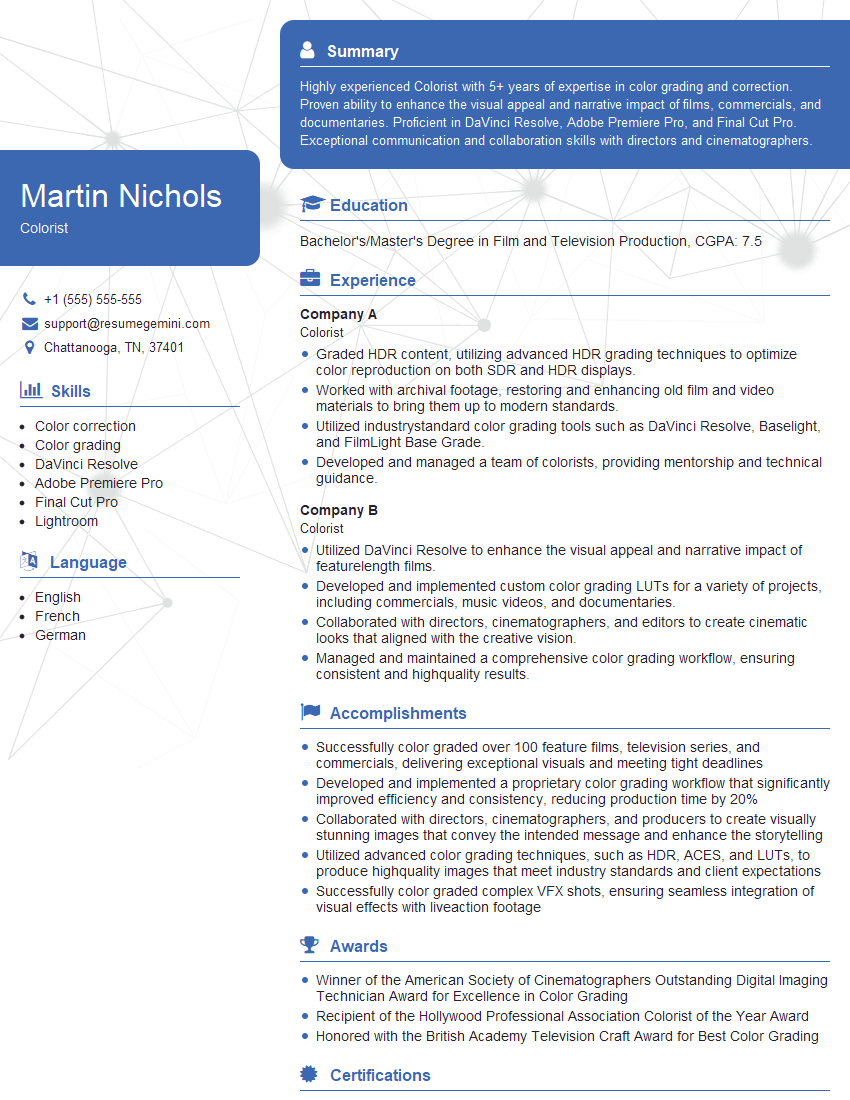
Mastering Digital Workflow and Color Correction is crucial for career advancement in the visual arts and media industries. A strong understanding of these skills demonstrates your technical proficiency and problem-solving abilities, making you a highly valuable asset. To significantly boost your job prospects, create an ATS-friendly resume that highlights your expertise effectively. ResumeGemini is a trusted resource to help you build a professional and impactful resume tailored to your skills and experience. Examples of resumes tailored to Digital Workflow and Color Correction are available to help you craft a compelling application.
Explore more articles
Users Rating of Our Blogs
Share Your Experience
We value your feedback! Please rate our content and share your thoughts (optional).
What Readers Say About Our Blog
Hello,
we currently offer a complimentary backlink and URL indexing test for search engine optimization professionals.
You can get complimentary indexing credits to test how link discovery works in practice.
No credit card is required and there is no recurring fee.
You can find details here:
https://wikipedia-backlinks.com/indexing/
Regards
NICE RESPONSE TO Q & A
hi
The aim of this message is regarding an unclaimed deposit of a deceased nationale that bears the same name as you. You are not relate to him as there are millions of people answering the names across around the world. But i will use my position to influence the release of the deposit to you for our mutual benefit.
Respond for full details and how to claim the deposit. This is 100% risk free. Send hello to my email id: [email protected]
Luka Chachibaialuka
Hey interviewgemini.com, just wanted to follow up on my last email.
We just launched Call the Monster, an parenting app that lets you summon friendly ‘monsters’ kids actually listen to.
We’re also running a giveaway for everyone who downloads the app. Since it’s brand new, there aren’t many users yet, which means you’ve got a much better chance of winning some great prizes.
You can check it out here: https://bit.ly/callamonsterapp
Or follow us on Instagram: https://www.instagram.com/callamonsterapp
Thanks,
Ryan
CEO – Call the Monster App
Hey interviewgemini.com, I saw your website and love your approach.
I just want this to look like spam email, but want to share something important to you. We just launched Call the Monster, a parenting app that lets you summon friendly ‘monsters’ kids actually listen to.
Parents are loving it for calming chaos before bedtime. Thought you might want to try it: https://bit.ly/callamonsterapp or just follow our fun monster lore on Instagram: https://www.instagram.com/callamonsterapp
Thanks,
Ryan
CEO – Call A Monster APP
To the interviewgemini.com Owner.
Dear interviewgemini.com Webmaster!
Hi interviewgemini.com Webmaster!
Dear interviewgemini.com Webmaster!
excellent
Hello,
We found issues with your domain’s email setup that may be sending your messages to spam or blocking them completely. InboxShield Mini shows you how to fix it in minutes — no tech skills required.
Scan your domain now for details: https://inboxshield-mini.com/
— Adam @ InboxShield Mini
Reply STOP to unsubscribe
Hi, are you owner of interviewgemini.com? What if I told you I could help you find extra time in your schedule, reconnect with leads you didn’t even realize you missed, and bring in more “I want to work with you” conversations, without increasing your ad spend or hiring a full-time employee?
All with a flexible, budget-friendly service that could easily pay for itself. Sounds good?
Would it be nice to jump on a quick 10-minute call so I can show you exactly how we make this work?
Best,
Hapei
Marketing Director
Hey, I know you’re the owner of interviewgemini.com. I’ll be quick.
Fundraising for your business is tough and time-consuming. We make it easier by guaranteeing two private investor meetings each month, for six months. No demos, no pitch events – just direct introductions to active investors matched to your startup.
If youR17;re raising, this could help you build real momentum. Want me to send more info?
Hi, I represent an SEO company that specialises in getting you AI citations and higher rankings on Google. I’d like to offer you a 100% free SEO audit for your website. Would you be interested?
Hi, I represent an SEO company that specialises in getting you AI citations and higher rankings on Google. I’d like to offer you a 100% free SEO audit for your website. Would you be interested?
good