Cracking a skill-specific interview, like one for Display Market Analysis and Trends, requires understanding the nuances of the role. In this blog, we present the questions you’re most likely to encounter, along with insights into how to answer them effectively. Let’s ensure you’re ready to make a strong impression.
Questions Asked in Display Market Analysis and Trends Interview
Q 1. Explain the difference between programmatic and direct display advertising.
The core difference between programmatic and direct display advertising lies in how ad inventory is purchased and managed. Think of it like buying groceries: direct advertising is like going to the store and negotiating a price for a specific shelf space, while programmatic advertising is using an online marketplace to bid on ad space in real-time.
Direct display advertising involves direct negotiations between the advertiser and the publisher (website or app owner). This allows for more control over placement, creative, and targeting, but it’s often more expensive and less efficient for reaching broad audiences. Imagine securing a prime billboard location – high cost but high visibility. Contracts are typically pre-negotiated, and you get guaranteed placement.
Programmatic display advertising uses automated systems and algorithms to buy and sell ad space. It’s more efficient for targeting specific audiences and optimizing campaigns in real-time. Think of it like using an online auction to acquire ad space – you bid against others based on criteria like demographics and location, and only pay if your bid wins. This offers scale and efficiency, but may require more technical expertise.
Q 2. Describe your experience with different ad formats (e.g., banner ads, video ads, native ads).
My experience spans a wide range of display ad formats, each with its strengths and weaknesses. I’ve worked extensively with:
- Banner Ads: These are the classic rectangular ads you see on websites. Their effectiveness hinges on compelling visuals and concise messaging. I’ve found success optimizing banner ads by A/B testing different creative variations and focusing on high-impact visuals.
- Video Ads: Video ads are incredibly effective at capturing attention and conveying complex messages. I’ve worked with both pre-roll (before a video plays) and in-stream (during a video) ads, utilizing various lengths and formats to match the platform and audience. Tracking view completion rates and engagement metrics are crucial here.
- Native Ads: Native ads blend seamlessly into the surrounding content, providing a less disruptive user experience. I’ve managed native ad campaigns across various publishers, finding that their success relies on creating content that’s relevant and valuable to the user, rather than overtly promotional. The key is to blend in but not be hidden.
In each instance, I’ve emphasized data-driven decision-making, using analytics to refine targeting and creative strategies.
Q 3. How do you measure the success of a display advertising campaign?
Measuring the success of a display advertising campaign requires a multifaceted approach, focusing on both quantitative and qualitative data. It depends heavily on the campaign’s objectives.
We usually start with defining clear goals – are we aiming for brand awareness, lead generation, or driving sales? Once goals are defined, key metrics are selected. We analyze metrics such as:
- Click-Through Rate (CTR): What percentage of impressions resulted in clicks? A low CTR might suggest issues with creative or targeting.
- Conversion Rate: What percentage of clicks resulted in desired actions (e.g., purchases, form submissions)? This is a crucial indicator of campaign effectiveness.
- Cost Per Click (CPC) and Cost Per Acquisition (CPA): How much are we spending for each click and each conversion? Analyzing these helps optimize spending and ROI.
- Viewability: What percentage of ads were actually seen by users? Low viewability indicates potential issues with ad placement or inventory quality.
Beyond numbers, we also analyze user feedback, brand mentions, and changes in brand perception to assess qualitative impacts.
Q 4. What key performance indicators (KPIs) are most important for display advertising?
The most important KPIs for display advertising vary based on campaign objectives, but some consistently stand out:
- Return on Ad Spend (ROAS): This is the ultimate measure of campaign success, indicating the return for every dollar spent. A high ROAS signifies efficiency and profitability.
- Conversion Rate: As mentioned earlier, this directly reflects how effectively the campaign is driving desired actions.
- Cost Per Acquisition (CPA): Crucial for understanding the cost of acquiring a customer or lead. Lower CPA indicates greater efficiency.
- Click-Through Rate (CTR): While not always a direct indicator of conversions, a high CTR suggests that the ads are engaging and relevant to the audience.
- Viewability: Ensuring that ads are actually seen by users is critical, as unseen ads generate no value.
Monitoring these KPIs allows for data-driven optimization and adjustment of strategies throughout the campaign lifecycle.
Q 5. What are some common challenges in display advertising, and how do you address them?
Display advertising comes with its set of challenges:
- Ad Blindness: Users often ignore display ads, leading to low engagement. This is countered by creating compelling and relevant creative, utilizing interactive elements, and employing advanced targeting techniques.
- Ad Fraud: Malicious actors can inflate impressions and clicks, leading to wasted ad spend. Working with reputable ad platforms and employing fraud detection tools is essential.
- Brand Safety Concerns: Ads might appear alongside inappropriate or offensive content, damaging brand reputation. Strict brand safety protocols and careful selection of ad placements are crucial.
- Measuring ROI: Attributing conversions solely to display ads can be challenging, particularly for brand awareness campaigns. Employing multi-touch attribution models helps understand the entire customer journey.
Addressing these challenges requires a proactive approach involving thorough planning, robust monitoring, and the use of advanced technology and analytics.
Q 6. How do you analyze display advertising data to identify areas for improvement?
Analyzing display advertising data involves a systematic process. I typically follow these steps:
- Data Collection: Gather data from various sources – ad platforms, analytics tools, and CRM systems.
- Data Cleaning and Preparation: Ensure data accuracy and consistency by addressing missing values and outliers.
- KPI Analysis: Evaluate key performance indicators such as CTR, CPA, ROAS, and viewability. Identify areas performing above or below expectations.
- Segment Analysis: Analyze performance across different audience segments (e.g., demographics, interests, device type). This helps identify high-performing and underperforming segments.
- Attribution Modeling: Determine the contribution of display ads across the entire customer journey. This clarifies which channels are most effective.
- A/B Testing Analysis: Evaluate the results of A/B testing on different creative variations, landing pages, and targeting strategies.
- Reporting and Recommendations: Summarize findings, identify areas for improvement, and suggest data-driven recommendations for optimization.
By meticulously analyzing data, actionable insights emerge, informing future campaign strategies and maximizing ROI.
Q 7. Describe your experience with various display ad platforms (e.g., Google Ads, DV360).
I have extensive experience with various display ad platforms, each with its strengths:
- Google Ads: A comprehensive platform offering a wide range of targeting options and robust reporting features. I’ve utilized its various features, including audience targeting, remarketing, and campaign optimization tools, effectively. Its ease of use and broad reach make it a go-to platform.
- DV360 (Display & Video 360): A powerful platform for enterprise-level programmatic advertising. Its advanced features for campaign management, data integration, and cross-channel optimization provide significant advantages for large-scale campaigns. It is ideal for complex targeting and large budgets.
- Other Platforms: My experience also includes working with other platforms depending on client needs and campaign goals. The choice of platform often depends on budget, specific targeting requirements, and the publisher ecosystem being targeted.
My familiarity with these platforms enables me to select the most effective platform for each specific client and campaign objective.
Q 8. Explain the concept of audience targeting in display advertising.
Audience targeting in display advertising is the process of selecting specific groups of people to show your ads to. Instead of blasting your message to everyone, you focus on those most likely to be interested, increasing the effectiveness and efficiency of your campaign. This involves using various data points to create detailed audience segments.
- Demographic Targeting: Targeting based on age, gender, location, income, education, etc. For example, targeting women aged 25-45 interested in fashion.
- Behavioral Targeting: Focusing on past online behavior like website visits, purchases, or interactions with specific content. This might involve showing ads for hiking gear to someone who frequently visits outdoor equipment websites.
- Contextual Targeting: Placing ads on websites or within apps relevant to your product or service. Showing ads for gardening tools on a gardening blog is a great example.
- Retargeting: Showing ads to users who have previously interacted with your website or brand, but haven’t converted. This is crucial for reminding potential customers about your products.
- Custom Audience Targeting: Leveraging your own first-party data to create highly targeted segments based on your customer relationship management (CRM) system or other internal data sources. Imagine showing exclusive offers to your loyal customers.
Effective audience targeting significantly reduces wasted ad spend and boosts conversion rates by showing your ads to the right people at the right time.
Q 9. How do you optimize display ad creative for maximum impact?
Optimizing display ad creatives for maximum impact involves a multi-faceted approach focused on grabbing attention, conveying a clear message, and driving desired actions. Think of it as crafting a visually compelling story that resonates with your target audience within a split second.
- Visually Appealing Design: Use high-quality images or videos, vibrant colors (but avoid being overwhelming), and a clean layout. Think about the overall aesthetic and how it aligns with your brand.
- Compelling Headline and Copy: Keep your messaging concise and benefit-driven, highlighting the value proposition of your product or service. Use strong action verbs and avoid jargon.
- Clear Call to Action (CTA): Make it obvious what you want users to do (e.g., ‘Shop Now’, ‘Learn More’, ‘Sign Up’). Use visually prominent buttons or links.
- A/B Testing Different Elements: Experiment with different headlines, images, CTAs, and color schemes to see what resonates best with your audience. This iterative process is key to continuous improvement.
- Ad Size and Placement: Consider the various ad sizes and placements available to ensure your creative is optimized for each format. A poorly formatted ad can be detrimental to your campaign’s success.
- Mobile Optimization: Ensure your creative is responsive and looks great on all devices, particularly mobile, as a large portion of display ad traffic is from mobile devices.
By focusing on these elements, you can create ads that not only capture attention but also effectively communicate your message and drive conversions.
Q 10. What is your experience with A/B testing in display advertising?
A/B testing is an indispensable part of my display advertising strategy. It’s the only way to definitively determine which creative variations, targeting options, or bidding strategies perform best. I’ve extensively used A/B testing to optimize campaigns across various platforms like Google Display Network and social media advertising platforms.
For instance, I once ran an A/B test comparing two different display ad creatives for a client selling skincare products. One ad featured a close-up image of a product, while the other showed a person using the product with a happy expression. The latter significantly outperformed the former, demonstrating the power of storytelling and emotional connection in display advertising. I always aim to test at least two variations simultaneously, controlling for other variables to ensure accurate results.
My process involves meticulously planning the test, selecting relevant metrics (click-through rate, conversion rate, cost per acquisition), monitoring performance closely, and analyzing the results statistically. I then iterate based on the findings, continuously refining the campaign until it achieves optimal performance.
Q 11. How do you handle ad fraud in display advertising?
Ad fraud is a serious threat in display advertising, potentially wasting significant budget and compromising campaign effectiveness. My approach to handling ad fraud is multi-layered and proactive.
- Choosing Reputable Ad Platforms and Vendors: I prioritize working with established platforms and ad networks that have robust anti-fraud measures in place. This significantly reduces the risk of encountering fraudulent traffic.
- Utilizing Fraud Detection Tools: Many ad platforms offer built-in fraud detection tools, and I leverage these features to monitor for suspicious activity like invalid traffic (IVT). I also explore third-party fraud detection solutions for a more comprehensive approach.
- Regular Monitoring and Analysis: I carefully analyze campaign performance data looking for anomalies such as unusually high click-through rates with low conversion rates, or traffic originating from suspicious sources.
- Blacklisting Suspicious Websites and IPs: If I identify fraudulent activity, I immediately blacklist the offending websites, IPs, or publishers to prevent further losses.
- Employing Advanced Targeting Techniques: Advanced targeting techniques, like contextual targeting and retargeting, can help reduce the vulnerability to certain types of ad fraud because they are less susceptible to bot traffic.
Addressing ad fraud is an ongoing process requiring vigilance, proactive measures, and a commitment to constantly evaluating and adapting strategies.
Q 12. What are some common display advertising metrics and their importance?
Several key metrics are crucial for evaluating the success of a display advertising campaign. Understanding these metrics and their interplay is essential for effective optimization.
- Click-Through Rate (CTR): The percentage of users who click on your ad after seeing it. A high CTR indicates a compelling ad creative and relevant targeting.
- Conversion Rate: The percentage of users who complete a desired action (e.g., purchase, sign-up) after clicking on your ad. This is a crucial indicator of campaign effectiveness.
- Cost Per Click (CPC): The amount you pay each time a user clicks on your ad. Optimizing CPC is key to managing ad spend effectively.
- Cost Per Acquisition (CPA): The amount you pay each time a user completes a desired action. CPA is a critical metric for evaluating the return on investment (ROI).
- Viewability: The percentage of time your ad is actually viewable on the screen. Low viewability indicates potential wasted ad spend.
- Impression Share: The percentage of times your ad was eligible to show compared to the number of times it actually showed. A low impression share may indicate insufficient budget or bid strategy issues.
By monitoring these metrics, you can gain valuable insights into campaign performance, identify areas for improvement, and make data-driven decisions to maximize ROI.
Q 13. Explain the concept of viewability in display advertising.
Viewability in display advertising refers to the percentage of time an ad is visible on a user’s screen. An ad is generally considered viewable if at least 50% of its pixels are visible for at least one continuous second. This metric is critical because paying for impressions that are never seen represents wasted ad spend.
Think of it like this: if you’re showing someone a movie poster that’s completely hidden behind another poster, they can’t see it and thus can’t react to it. Similarly, if a display ad is not viewable, it’s unlikely to generate clicks or conversions. The industry is increasingly focused on viewable impressions to ensure that advertising dollars are spent on ads that have a genuine chance of being seen.
Viewability is influenced by several factors including ad placement, website design, and user behavior. Advertisers need to strategically target placements where viewability is likely to be high to optimize their campaigns.
Q 14. How do you interpret display advertising reports and dashboards?
Interpreting display advertising reports and dashboards requires a methodical approach focusing on key metrics and their interrelationships. I typically follow these steps:
- Understand the Reporting Structure: Familiarize yourself with the platform’s reporting features and how data is organized. Different platforms may present data in slightly different ways.
- Focus on Key Metrics: Pay close attention to the core metrics such as CTR, conversion rate, CPC, CPA, viewability, and impression share. Don’t get lost in the detail. What is the overall story this data is telling you?
- Identify Trends and Anomalies: Look for patterns in the data, such as upward or downward trends in key metrics. Anomalies, like sudden drops in CTR or spikes in CPA, might signal problems that require investigation.
- Segment Data: Analyze data across different segments (e.g., devices, locations, audiences) to identify areas of high and low performance. This allows for more precise optimization.
- Compare Data Across Campaigns: Compare performance across multiple campaigns to benchmark success and identify best practices. What can you learn from your successes and failures?
- Correlate Metrics: Look for relationships between different metrics. For example, is a high CTR correlated with a high conversion rate? Understanding these relationships provides deeper insights.
By systematically analyzing reports and dashboards, you can gain a comprehensive understanding of campaign performance, pinpoint areas for improvement, and make data-driven decisions to optimize your display advertising strategy for maximum impact.
Q 15. What are your preferred methods for attribution modeling in display advertising?
Attribution modeling in display advertising aims to understand which ad exposures contribute to conversions. My preferred methods are a blend of approaches, depending on the campaign goals and data availability. I often start with a multi-touch attribution (MTA) model, such as a time-decay or position-based model. Time-decay gives more credit to touchpoints closer to conversion, reflecting recency bias. Position-based models prioritize the first and last touchpoints. For campaigns focused on brand building, where immediate conversions aren’t the primary metric, I might utilize algorithmic models that leverage machine learning to weigh the importance of various touchpoints more holistically. Finally, I always supplement these models with data-driven analysis, examining conversion paths and user journeys to identify crucial touchpoints unique to each campaign.
For example, in a recent campaign for a luxury watch brand, we used a time-decay MTA model to assess the contribution of various display ad placements. This revealed that while initial brand awareness campaigns had a significant role in driving awareness, more targeted retargeting ads played a crucial role in final conversions. This insight allowed us to optimize our budget allocation and improve ROI.
Career Expert Tips:
- Ace those interviews! Prepare effectively by reviewing the Top 50 Most Common Interview Questions on ResumeGemini.
- Navigate your job search with confidence! Explore a wide range of Career Tips on ResumeGemini. Learn about common challenges and recommendations to overcome them.
- Craft the perfect resume! Master the Art of Resume Writing with ResumeGemini’s guide. Showcase your unique qualifications and achievements effectively.
- Don’t miss out on holiday savings! Build your dream resume with ResumeGemini’s ATS optimized templates.
Q 16. How do you ensure brand safety in display advertising campaigns?
Brand safety is paramount in display advertising. My strategy involves a multi-layered approach. Firstly, I meticulously select reputable ad exchanges and platforms known for their robust brand safety controls. This includes leveraging pre-bid filters to exclude inappropriate contexts, such as websites containing hate speech or illegal content. Secondly, I utilize keyword blocking to prevent ads from appearing alongside undesirable content or topics. Thirdly, I employ post-campaign analysis to continuously monitor brand safety. This involves regular reviews of ad placement reports to identify any accidental placements that require immediate action. Finally, I maintain a whitelist of approved websites and publishers, ensuring ads appear only in environments consistent with the brand’s image. This proactive, multi-layered approach minimizes the risk of negative brand associations.
Think of it like choosing a neighborhood for your business; you wouldn’t open a high-end boutique in a rundown area. Similarly, carefully choosing ad placements is crucial for maintaining brand image and protecting reputation.
Q 17. Describe your experience with different bidding strategies in display advertising.
My experience encompasses various bidding strategies, and the optimal choice depends heavily on campaign objectives. Cost-per-thousand impressions (CPM) is suitable for building brand awareness and reaching a wide audience. Cost-per-click (CPC) is more suitable when driving direct engagement and website traffic. Cost-per-acquisition (CPA) is ideal when the goal is driving specific conversions. Automated bidding strategies, such as Maximize Conversions or Target CPA, offered by platforms like Google Ads and others, leverage machine learning to optimize bids automatically based on real-time data. However, I always find it beneficial to combine automated bidding with manual adjustments, particularly for newly launched campaigns or niche targeting, ensuring the algorithm is guided effectively.
For instance, in a recent campaign for a software company, we initially used a Target CPA strategy. While effective, we found manual bid adjustments for specific audience segments yielded a significant improvement in conversion rates. This demonstrates the value of combining automated efficiency with expert oversight.
Q 18. What are some of the latest trends in display advertising technology?
The display advertising landscape is constantly evolving. Some key trends include the rise of programmatic guaranteed deals offering transparency and premium inventory alongside automated buying, connected TV (CTV) advertising gaining significant traction, and the increasing use of AI-powered creative optimization. Additionally, privacy-focused solutions are becoming more prominent, with a shift towards contextual targeting and privacy-preserving technologies. The integration of first-party data and cookieless solutions are also shaping the future of display advertising, demanding more focus on alternative identifiers and audience modeling techniques.
For example, the increasing popularity of CTV advertising presents opportunities to reach audiences on larger screens with richer ad formats. However, it requires a different strategy than traditional display advertising due to the unique viewing habits associated with CTV.
Q 19. How do you stay updated on the latest changes and trends in the display advertising industry?
Staying updated in this dynamic field requires a multi-pronged approach. I regularly follow industry publications like AdExchanger and Adweek. I actively participate in industry events and webinars, connecting with peers and experts. I closely monitor the platform updates from major players like Google, Meta, and others. Furthermore, I subscribe to relevant newsletters and podcasts covering the latest advancements and trends. This continuous learning process ensures I remain informed and adaptable to the ever-changing landscape of display advertising.
Think of it as ongoing professional development; just like a doctor stays abreast of medical advances, a display advertising specialist must stay updated on technological changes and industry shifts.
Q 20. Explain the concept of frequency capping in display advertising.
Frequency capping is a crucial strategy to manage ad exposure and prevent ad fatigue. It limits the number of times a user sees the same ad within a specified timeframe (e.g., a day, week, or month). This helps maintain audience engagement and avoid negative user experiences associated with repetitive ads. You can set frequency caps at the campaign, ad group, or even individual creative level. For example, you might cap a campaign at 3 impressions per user per day. This ensures that while the message reaches the target audience, it doesn’t become overly intrusive.
Imagine seeing the same billboard every day on your commute – it would likely lose its impact. Frequency capping prevents this from happening in the digital world.
Q 21. How do you manage a display advertising budget effectively?
Effective display advertising budget management requires a data-driven and strategic approach. First, I establish clear campaign objectives and KPIs to guide budget allocation. Then, I allocate budget based on the relative importance and potential of each campaign. A/B testing is essential to optimize spending; comparing different creative assets, targeting strategies, or bidding approaches to identify the most effective methods. Regular performance monitoring and analysis are crucial for identifying underperforming campaigns or segments, allowing for prompt adjustments and budget reallocation. Finally, it’s crucial to factor in contingency for unexpected expenses or opportunities, ensuring sufficient flexibility within the budget.
Think of it as financial planning; you need a budget, you need to track expenses, and you need to adapt to changes along the way to maximize efficiency and return on investment.
Q 22. Describe your experience with real-time bidding (RTB).
Real-Time Bidding (RTB) is the automated process of buying and selling online display ad inventory through programmatic advertising. Think of it like an auction happening in milliseconds. Advertisers bid on ad impressions (opportunities to show an ad) in real-time, competing against others to have their ad shown to a specific user based on various criteria. My experience with RTB spans several years, working with platforms like Google Ad Manager and DV360. I’ve managed campaigns across various industries, optimizing bids based on factors like user demographics, website context, and past performance. For example, I once significantly improved the ROI of a client’s campaign by implementing a sophisticated bid strategy using machine learning within the RTB platform, which dynamically adjusted bids based on real-time user engagement and conversion rates.
I’ve also worked extensively on RTB optimization, focusing on areas like frequency capping (limiting the number of times a user sees the same ad), viewability (ensuring the ad is actually seen by the user), and brand safety (preventing ads from appearing next to inappropriate content).
Q 23. How do you incorporate data analytics to inform display advertising strategies?
Data analytics is the backbone of effective display advertising strategies. We use data to understand audience behavior, measure campaign performance, and optimize our approaches. This involves collecting and analyzing data from multiple sources, including campaign performance metrics (clicks, impressions, conversions), website analytics (user behavior on the advertiser’s site), CRM data (customer information), and third-party data providers (audience segmentation data).
For instance, let’s say we’re running a campaign for a new skincare product. We’d analyze website analytics to identify the pages most visited by interested users and then target ads to those users who visit similar pages on other websites. If we find a particular ad creative performs significantly better than others, we’ll allocate more budget to it. Furthermore, by analyzing conversion data, we can identify the most valuable audience segments and optimize our targeting parameters accordingly.
Tools like Google Analytics, Adobe Analytics, and various data visualization platforms are crucial in this process. By visualizing the data, we gain actionable insights into what’s working and what’s not, enabling data-driven decision-making.
Q 24. Explain the role of third-party cookies in display advertising and how you plan to adapt to the changing landscape.
Third-party cookies have traditionally been used to track users across multiple websites, allowing advertisers to build detailed profiles and target ads more effectively. However, with increasing concerns about user privacy, browsers are phasing out third-party cookies. This presents a significant challenge to display advertising.
To adapt, we are focusing on several strategies:
- First-party data: Prioritizing the collection and utilization of data directly from our clients’ websites and customer databases. This ensures better data privacy compliance and creates a more accurate user profile based on direct interaction.
- Contextual targeting: Targeting ads based on the content of the website where they appear, rather than user-specific data. This is a privacy-friendly approach that can still deliver relevant advertising.
- Privacy-preserving technologies: Exploring and implementing technologies like federated learning and differential privacy, which allow for data analysis without compromising individual user identities.
- Alternative identifiers: Utilizing alternative identifiers, like contextual signals and hashed email addresses, to maintain some level of audience targeting without relying heavily on third-party cookies.
The shift away from third-party cookies necessitates a more privacy-centric approach, focusing on transparent data practices and user consent. It also requires a move towards more contextual and first-party data-driven strategies.
Q 25. How do you identify and target specific audience segments for display advertising?
Identifying and targeting specific audience segments is critical for effective display advertising. We use a combination of techniques to achieve this:
- Demographic targeting: Targeting ads based on user age, gender, location, income, etc. This is a foundational approach for reaching broad audiences.
- Behavioral targeting: Targeting users based on their online behavior, such as browsing history, purchase history, and website interactions. This allows for more precise targeting of users interested in specific products or services.
- Interest-based targeting: Targeting ads based on users’ expressed interests, often gathered from their online activity. This technique allows for the delivery of highly relevant ads to individuals demonstrating a clear affinity for specific topics.
- Custom audience targeting: Targeting ads to users who have previously interacted with a company’s website or social media pages. This is excellent for retargeting previous visitors or customers.
- Lookalike audiences: Building audiences similar to existing high-value customers, expanding reach to new potential clients.
For example, we might target a campaign for a luxury car to a specific geographic area, focusing on high-income demographics and users who frequently visit automotive review websites. By layering these targeting options, we create highly focused campaigns that maximize efficiency and ROI.
Q 26. What are your thoughts on the future of display advertising in a privacy-conscious world?
The future of display advertising in a privacy-conscious world is evolving toward a more transparent and user-centric model. The decline of third-party cookies will necessitate a greater reliance on first-party data and contextual targeting. Privacy-preserving technologies and user consent will become increasingly important.
I believe we’ll see a rise in:
- Contextual advertising: More sophisticated methods of aligning ads with the relevant content of the website.
- Personalized advertising with user consent: Users will have greater control over the data used to personalize their advertising experience, opting in or out of specific tracking mechanisms.
- Increased focus on user experience: Advertisers will place more emphasis on creating non-intrusive, relevant, and high-quality ads that provide value to users.
- Transparency and accountability: Increased transparency in data collection and usage practices, with greater accountability for advertisers’ compliance with privacy regulations.
The overall goal will be to deliver relevant advertising without compromising user privacy, creating a win-win situation for advertisers and consumers alike. This transition requires innovation and adaptation within the industry, but the ultimate result will be a more sustainable and trustworthy advertising ecosystem.
Q 27. Discuss your experience with using data visualization tools to present display advertising performance.
Data visualization is essential for communicating the performance of display advertising campaigns effectively. I use various tools, including Google Data Studio, Tableau, and Power BI, to create insightful dashboards and reports. These tools allow me to present complex data in a clear and concise manner, easily digestible for both technical and non-technical audiences.
For example, I might create a dashboard showing key metrics such as impressions, clicks, click-through rates (CTR), conversion rates, and cost per acquisition (CPA) over time. Using charts and graphs, I can visually represent trends and identify areas for improvement. I’ll also create geographic maps to showcase performance across different regions, and use heatmaps to highlight the most effective ad creatives or audience segments.
The goal is to transform raw data into actionable insights. By presenting the data visually, I can facilitate informed decision-making, allowing clients to quickly grasp the effectiveness of their campaigns and identify areas requiring adjustments. Effective data visualization is critical in justifying the ROI of display advertising and ensuring the campaign aligns with overall business objectives.
Key Topics to Learn for Display Market Analysis and Trends Interview
- Market Sizing and Forecasting: Understanding methodologies for estimating market size, analyzing growth trends, and predicting future performance of the display advertising market. Practical application: Developing a market sizing model for a specific region or demographic.
- Competitive Landscape Analysis: Identifying key players, analyzing their strategies, strengths, and weaknesses, and understanding market share dynamics. Practical application: Creating a competitive matrix to compare different ad tech companies.
- Ad Format Trends: Staying abreast of evolving ad formats (e.g., video, native, interactive), their effectiveness, and their impact on campaign performance. Practical application: Evaluating the ROI of different ad formats for a given campaign.
- Programmatic Advertising: Deep understanding of programmatic buying, including real-time bidding (RTB), demand-side platforms (DSPs), and supply-side platforms (SSPs). Practical application: Optimizing a programmatic campaign for better efficiency and reach.
- Measurement and Attribution: Understanding key metrics (e.g., impressions, clicks, conversions), attribution models, and how to measure the effectiveness of display advertising campaigns. Practical application: Analyzing campaign data to identify areas for improvement.
- Data Analysis and Interpretation: Proficiency in using data analysis tools and techniques to extract insights from large datasets, identify trends, and support decision-making. Practical application: Creating dashboards and reports to visualize key performance indicators (KPIs).
- Emerging Technologies: Familiarity with emerging technologies impacting the display advertising market, such as AI, machine learning, and blockchain. Practical application: Researching and evaluating the potential impact of a new technology on the display advertising landscape.
Next Steps
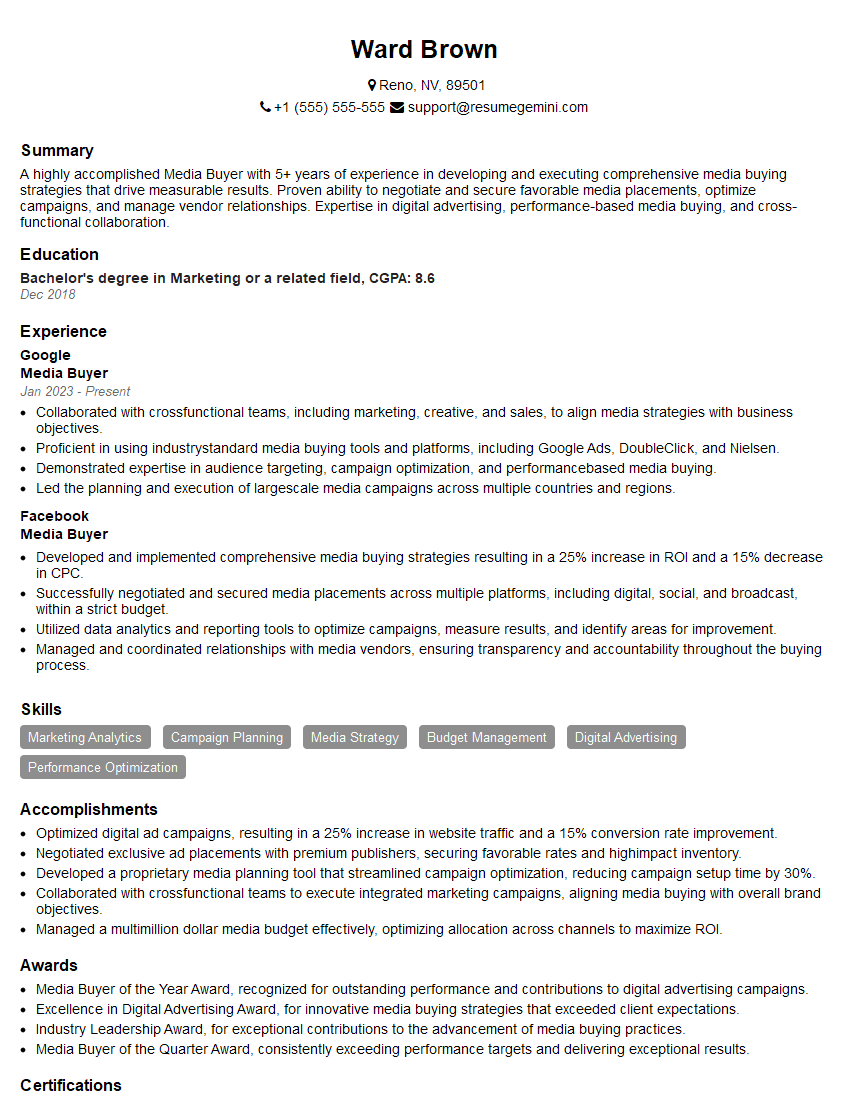
Mastering Display Market Analysis and Trends is crucial for career advancement in the dynamic digital advertising world. A strong understanding of these concepts will significantly enhance your interview performance and open doors to exciting opportunities. To maximize your job prospects, focus on building an ATS-friendly resume that effectively highlights your skills and experience. We highly recommend using ResumeGemini, a trusted resource for crafting professional and impactful resumes. ResumeGemini provides examples of resumes tailored to Display Market Analysis and Trends to help you create a compelling application that stands out from the competition.

Explore more articles
Users Rating of Our Blogs
Share Your Experience
We value your feedback! Please rate our content and share your thoughts (optional).
What Readers Say About Our Blog
Attention music lovers!
Wow, All the best Sax Summer music !!!
Spotify: https://open.spotify.com/artist/6ShcdIT7rPVVaFEpgZQbUk
Apple Music: https://music.apple.com/fr/artist/jimmy-sax-black/1530501936
YouTube: https://music.youtube.com/browse/VLOLAK5uy_noClmC7abM6YpZsnySxRqt3LoalPf88No
Other Platforms and Free Downloads : https://fanlink.tv/jimmysaxblack
on google : https://www.google.com/search?q=22+AND+22+AND+22
on ChatGPT : https://chat.openai.com?q=who20jlJimmy20Black20Sax20Producer
Get back into the groove with Jimmy sax Black
Best regards,
Jimmy sax Black
www.jimmysaxblack.com
Hi I am a troller at The aquatic interview center and I suddenly went so fast in Roblox and it was gone when I reset.
Hi,
Business owners spend hours every week worrying about their website—or avoiding it because it feels overwhelming.
We’d like to take that off your plate:
$69/month. Everything handled.
Our team will:
Design a custom website—or completely overhaul your current one
Take care of hosting as an option
Handle edits and improvements—up to 60 minutes of work included every month
No setup fees, no annual commitments. Just a site that makes a strong first impression.
Find out if it’s right for you:
https://websolutionsgenius.com/awardwinningwebsites
Hello,
we currently offer a complimentary backlink and URL indexing test for search engine optimization professionals.
You can get complimentary indexing credits to test how link discovery works in practice.
No credit card is required and there is no recurring fee.
You can find details here:
https://wikipedia-backlinks.com/indexing/
Regards
NICE RESPONSE TO Q & A
hi
The aim of this message is regarding an unclaimed deposit of a deceased nationale that bears the same name as you. You are not relate to him as there are millions of people answering the names across around the world. But i will use my position to influence the release of the deposit to you for our mutual benefit.
Respond for full details and how to claim the deposit. This is 100% risk free. Send hello to my email id: lukachachibaialuka@gmail.com
Luka Chachibaialuka
Hey interviewgemini.com, just wanted to follow up on my last email.
We just launched Call the Monster, an parenting app that lets you summon friendly ‘monsters’ kids actually listen to.
We’re also running a giveaway for everyone who downloads the app. Since it’s brand new, there aren’t many users yet, which means you’ve got a much better chance of winning some great prizes.
You can check it out here: https://bit.ly/callamonsterapp
Or follow us on Instagram: https://www.instagram.com/callamonsterapp
Thanks,
Ryan
CEO – Call the Monster App
Hey interviewgemini.com, I saw your website and love your approach.
I just want this to look like spam email, but want to share something important to you. We just launched Call the Monster, a parenting app that lets you summon friendly ‘monsters’ kids actually listen to.
Parents are loving it for calming chaos before bedtime. Thought you might want to try it: https://bit.ly/callamonsterapp or just follow our fun monster lore on Instagram: https://www.instagram.com/callamonsterapp
Thanks,
Ryan
CEO – Call A Monster APP
To the interviewgemini.com Owner.
Dear interviewgemini.com Webmaster!
Hi interviewgemini.com Webmaster!
Dear interviewgemini.com Webmaster!
excellent
Hello,
We found issues with your domain’s email setup that may be sending your messages to spam or blocking them completely. InboxShield Mini shows you how to fix it in minutes — no tech skills required.
Scan your domain now for details: https://inboxshield-mini.com/
— Adam @ InboxShield Mini
support@inboxshield-mini.com
Reply STOP to unsubscribe
Hi, are you owner of interviewgemini.com? What if I told you I could help you find extra time in your schedule, reconnect with leads you didn’t even realize you missed, and bring in more “I want to work with you” conversations, without increasing your ad spend or hiring a full-time employee?
All with a flexible, budget-friendly service that could easily pay for itself. Sounds good?
Would it be nice to jump on a quick 10-minute call so I can show you exactly how we make this work?
Best,
Hapei
Marketing Director
Hey, I know you’re the owner of interviewgemini.com. I’ll be quick.
Fundraising for your business is tough and time-consuming. We make it easier by guaranteeing two private investor meetings each month, for six months. No demos, no pitch events – just direct introductions to active investors matched to your startup.
If youR17;re raising, this could help you build real momentum. Want me to send more info?
Hi, I represent an SEO company that specialises in getting you AI citations and higher rankings on Google. I’d like to offer you a 100% free SEO audit for your website. Would you be interested?
Hi, I represent an SEO company that specialises in getting you AI citations and higher rankings on Google. I’d like to offer you a 100% free SEO audit for your website. Would you be interested?