Are you ready to stand out in your next interview? Understanding and preparing for Distribution System Modeling and Simulation interview questions is a game-changer. In this blog, we’ve compiled key questions and expert advice to help you showcase your skills with confidence and precision. Let’s get started on your journey to acing the interview.
Questions Asked in Distribution System Modeling and Simulation Interview
Q 1. Explain the difference between steady-state and transient stability analysis in power systems.
Steady-state and transient stability analyses are both crucial for ensuring the reliable operation of power systems, but they focus on different timescales and phenomena. Steady-state analysis examines the system’s behavior under normal operating conditions, focusing on voltage magnitudes and angles, power flows, and frequency, assuming a relatively slow change in system parameters. Think of it as taking a snapshot of the system at a particular moment in time, assuming everything is relatively stable.
Transient stability analysis, on the other hand, investigates the system’s response to large disturbances, such as faults or sudden loss of generation. It models the dynamic behavior of generators, loads, and other system components over a short period following the disturbance, typically seconds to tens of seconds. This analysis helps determine whether the system can maintain synchronism and avoid cascading outages after a major event. Imagine it as observing how the system reacts and recovers from a significant shock.
In short: Steady-state analysis looks at the ‘picture’ at a moment, while transient analysis observes the ‘movie’ of the system’s response to a major event. Steady-state is concerned with whether the system is operating within its limits, while transient stability focuses on whether the system can survive a significant upset without collapsing.
Q 2. Describe various modeling techniques used for distribution transformers.
Modeling distribution transformers accurately is essential for comprehensive distribution system analysis. Several techniques exist, each with its own level of detail and computational complexity:
- Ideal Transformer Model: This is the simplest model, representing the transformer as a perfect coupling with a turns ratio. It ignores losses and other characteristics, making it suitable for preliminary studies but not detailed analysis.
- Equivalent Circuit Model: This model uses an equivalent circuit incorporating winding resistances (Req), leakage reactances (Xeq), and magnetizing reactance (Xm). The core losses are often represented by a resistance in parallel with Xm. This model provides a balance between accuracy and computational efficiency.
- Detailed Model: These incorporate more detailed aspects like saturation effects of the core, hysteresis losses, and temperature dependence of parameters. These models are computationally intensive and are typically used only when high accuracy is required for specific components or operating conditions.
- State-Space Model: These models represent the transformer’s dynamic behavior through a set of differential and algebraic equations, suitable for transient stability studies. This level of modeling accounts for dynamic effects that are not visible in equivalent circuit models.
The choice of model depends on the application. For example, load flow studies might only require an equivalent circuit model, while transient stability studies need a more detailed or state-space model.
Q 3. What are the key challenges in modeling distributed generation (DG) sources?
Modeling Distributed Generation (DG) sources presents unique challenges due to their intermittent and unpredictable nature, their diverse characteristics, and their impact on distribution system operations. Key challenges include:
- Intermittency and Variability: The output of renewable DG sources like solar and wind is inherently variable, requiring sophisticated models to accurately predict their power output. Forecasting techniques and probabilistic methods are often employed.
- Control Characteristics: DG sources often have different control strategies impacting voltage and frequency regulation. Modeling these control systems is crucial for accurate simulation results.
- Voltage Regulation Issues: High penetration of DG sources can cause voltage violations, necessitating detailed modeling of voltage regulation mechanisms, such as tap changers on transformers and voltage regulators.
- Protection and Coordination: DG sources can impact the operation of protective devices. Accurate modeling of DG protection schemes and their interaction with the distribution system protection is critical for ensuring system safety and reliability.
- Islanding Operation: The ability of a DG source to operate independently when the grid is disconnected (islanding) requires specific modeling to ensure safety and prevent grid synchronization issues when the main grid is restored.
Overcoming these challenges often involves the use of advanced modeling techniques, including probabilistic methods, detailed control models, and time-domain simulations.
Q 4. How do you model the impact of renewable energy sources on distribution networks?
Modeling the impact of renewable energy sources (RES) on distribution networks is crucial for planning and operating modern power grids. Key aspects include:
- Power Output Modeling: This involves using historical data, weather forecasts, and probabilistic models to represent the variability of RES output. This could involve using time series analysis or Monte Carlo simulations to account for uncertainty.
- Power Quality Impacts: RES sources can introduce harmonics and voltage fluctuations, requiring models to assess their impacts on sensitive loads. This may use harmonic analysis techniques.
- Grid Integration Studies: Models are needed to assess the impact of RES on system stability, voltage profiles, and protection coordination. These studies usually involve load flow and transient stability analysis.
- Energy Storage Integration: Modeling energy storage systems along with RES is critical for mitigating intermittency and improving grid stability. This often involves modeling the energy storage dynamics and control strategies.
- Control System Integration: Advanced models are required to account for the interaction between RES, storage systems, and the grid control systems. This could involve co-simulation of power system and control system models.
For example, a typical study might involve simulating a distribution feeder with high penetration of solar PV, using a probabilistic model to represent solar output and examining its impact on voltage profiles using a load flow analysis software.
Q 5. Explain the importance of load flow studies in distribution system planning.
Load flow studies are fundamental in distribution system planning because they provide a detailed snapshot of the system’s operating conditions under various scenarios. This information is crucial for several aspects of planning:
- Capacity Planning: Load flow studies help determine the required capacity of transformers, lines, and other equipment to meet anticipated demand without overloading components.
- Voltage Profile Analysis: They analyze voltage magnitudes at various buses, identifying potential voltage violations and the need for voltage regulation equipment.
- Loss Minimization: Load flow studies can help evaluate the impact of different system configurations on power losses and identify ways to reduce them.
- Optimal Placement of DG: These studies assist in determining the optimal location and size of distributed generation sources to enhance system performance and reduce reliance on central generation.
- Feeder Planning: Load flow analysis plays a critical role in planning new feeders and substations, ensuring sufficient capacity and proper voltage regulation.
Without accurate load flow studies, distribution system planning would be speculative and potentially lead to costly oversights, system failures, or inefficient operation.
Q 6. What are the different types of load flow analysis methods?
Several methods are used for load flow analysis, each with advantages and disadvantages:
- Gauss-Seidel Method: This iterative method is relatively simple to understand and implement but can be slow to converge, particularly for large systems.
- Newton-Raphson Method: This is a more advanced iterative method that generally converges faster than Gauss-Seidel, particularly for larger systems and when closer to the solution. It’s more computationally expensive per iteration, however.
- Fast Decoupled Method: This method simplifies the Newton-Raphson method by decoupling the real and reactive power equations, significantly reducing computational effort without significant loss of accuracy. This is a popular choice for larger systems.
- Z-Bus Method: This method uses the impedance matrix of the network to directly calculate the bus voltages. It’s particularly useful for radial distribution systems but can be less efficient for meshed networks.
The choice of method depends on the size and complexity of the system, the required accuracy, and computational resources. Many modern power system simulation software packages use advanced variations of these methods or employ hybrid approaches to optimize performance.
Q 7. How do you model faults in a distribution system?
Modeling faults in distribution systems is crucial for assessing system reliability and designing appropriate protection schemes. Faults are typically modeled as:
- Symmetrical Faults: These are relatively straightforward to model, representing a three-phase short circuit. The fault current can be calculated using impedance matrices or other network analysis techniques. These provide a baseline for fault current calculations.
- Asymmetrical Faults: These are more complex, representing single-line-to-ground, line-to-line, or double-line-to-ground faults. They require more sophisticated models that account for the system’s grounding impedance and the sequence impedances of the network elements. They are far more common than symmetrical faults in reality.
- Fault Impedance: The fault impedance reflects the resistance and reactance at the fault location. This impedance can significantly affect the magnitude of the fault current. The precise value of this impedance is often uncertain, requiring sensitivity studies.
- Fault Location: Accurate modeling of the fault location is essential for proper coordination of protective relays and circuit breakers. The placement of the fault significantly impacts the magnitude of fault current at various points in the network.
Software packages often use sophisticated algorithms to model fault currents, including considering the effects of arc resistance, fault clearing times, and the dynamic behavior of system components during a fault. These models are crucial for evaluating the performance of protection schemes and ensuring system safety.
Q 8. Explain the concept of power system protection and its role in distribution system modeling.
Power system protection is the crucial mechanism that safeguards electrical equipment and personnel from damage caused by faults or abnormal operating conditions. Think of it as the immune system of your power grid. In distribution system modeling, accurately representing protection schemes is essential for assessing the system’s reliability and resilience. If a fault occurs (like a short circuit), protective relays need to quickly isolate the faulty section, preventing cascading failures and minimizing downtime. Modeling this allows us to simulate how the system responds to various fault scenarios and evaluate the effectiveness of the protection system. This helps engineers design and optimize protection schemes before they are implemented in the real world.
For example, a poorly designed protection scheme could lead to prolonged outages or damage to expensive equipment, resulting in significant financial losses and disruption of service.
Q 9. Describe the various types of protective relays used in distribution systems.
Distribution systems employ various protective relays, each tailored for specific fault types and locations. Common types include:
- Overcurrent Relays: These are the workhorses of distribution protection, tripping when the current exceeds a preset threshold. They can be directional, responding only to currents flowing in a specific direction, or non-directional. Imagine these as security guards checking for excessive traffic flow.
- Distance Relays: These measure the impedance to the fault location. They are particularly useful for protecting long transmission lines. Think of these as more sophisticated guards with advanced measuring tools that can pinpoint the exact location of trouble.
- Differential Relays: These compare the currents entering and leaving a protected zone. Any significant difference indicates an internal fault. These are like internal auditors, comparing incoming and outgoing resources to spot irregularities.
- Overvoltage and Undervoltage Relays: These protect equipment from voltage fluctuations that can be harmful. They are like voltage monitors ensuring the system stays within safe operating limits.
- Pilot Wire Relays: These use communication links between two substations to detect faults on a transmission line. It’s like having a hotline between guards on each side of a monitored area to rapidly report problems.
The specific type of relay used depends on factors like the system’s configuration, equipment characteristics, and the level of protection required.
Q 10. What are the advantages and disadvantages of using different simulation software packages for distribution system modeling?
Several simulation software packages cater to distribution system modeling, each with its own strengths and weaknesses. Choosing the right one depends on the project’s specific needs and budget.
- Advantages and Disadvantages might include:
- OpenDSS (Open Distribution System Simulator): Advantages: Open-source, widely used, good documentation, large community support. Disadvantages: Can have a steeper learning curve than commercial packages, may require more customization for advanced features.
- PSCAD: Advantages: Powerful electromagnetic transient simulation capabilities, suitable for detailed studies including fault analysis and protection coordination. Disadvantages: Expensive, requires advanced knowledge and expertise to use effectively.
- PowerWorld Simulator: Advantages: User-friendly interface, strong in power flow and stability analysis. Disadvantages: Can be less powerful than specialized packages for detailed electromagnetic transient analysis.
For example, if you need to perform a quick power flow analysis, PowerWorld Simulator might be suitable. However, for a detailed study of protection coordination during a fault, PSCAD might be necessary. The choice always comes down to balancing cost, required functionalities, and the expertise of the modeling team.
Q 11. How do you model voltage regulation in a distribution system?
Voltage regulation in distribution systems is crucial for maintaining voltage levels within acceptable limits for connected loads. Poor voltage regulation can lead to equipment malfunction, reduced efficiency, and even damage. Modeling voltage regulation involves representing the various control mechanisms that maintain this stability.
Methods include:
- Tap-changing transformers: These transformers adjust their turns ratio to regulate voltage. In the model, we would represent this with a variable turns ratio depending on the voltage level.
- Voltage regulators: These devices automatically adjust the voltage by controlling the current flowing through them. Models incorporate control algorithms that simulate this behavior.
- Switched capacitor banks: These capacitors are switched on or off based on voltage levels to improve voltage profile. The model should reflect the switching logic.
The models use mathematical equations that describe the relationship between voltage, current, and impedance of the components within the network and how they interact with the voltage regulators. The models might also consider the dynamics of the regulation process – how quickly the regulators respond to voltage changes.
Q 12. Explain the role of capacitor banks in improving distribution system voltage profiles.
Capacitor banks are effective in improving distribution system voltage profiles primarily by offsetting the lagging reactive power demand of inductive loads (like motors). These loads cause voltage drops along the lines. By supplying reactive power locally, capacitor banks reduce these voltage drops and improve the voltage profile.
Think of it like this: inductive loads are like water sinks, drawing current (water) away. Capacitor banks are like water pumps, boosting the flow (current) and keeping the pressure (voltage) high. By strategically placing capacitor banks along the distribution system, we can improve voltage levels and reduce voltage fluctuations, ensuring reliable operation for consumers.
In modeling, we represent capacitor banks as shunt admittance elements in the network model, whose value may change based on switching actions in a real system.
Q 13. What are the key considerations for modeling distributed energy resources (DERs)?
Modeling Distributed Energy Resources (DERs), such as solar PV systems, wind turbines, and batteries, presents unique challenges due to their intermittent and distributed nature. Key considerations include:
- Intermittency: Solar and wind power are inherently variable, requiring models to account for their fluctuating output based on weather conditions. This may involve integrating weather forecasts or using stochastic models to simulate their behavior.
- Location: DERs are distributed across the network, impacting voltage profiles and power flows locally. Detailed network models are necessary to capture these localized impacts.
- Control strategies: DERs often incorporate sophisticated control systems to regulate their output and participate in grid services. These control systems must be accurately modeled.
- Protection coordination: Integrating DERs can alter fault currents and impact the operation of protection devices, requiring careful protection coordination studies.
- Power quality: Some DERs can introduce harmonic distortion or voltage fluctuations, which should be accounted for in the model.
For instance, a model might need to simulate the impact of a sudden drop in solar generation due to cloud cover on the voltage levels of a nearby distribution feeder.
Q 14. Describe the impact of harmonic distortion on distribution system components.
Harmonic distortion, the presence of non-fundamental frequency components in the voltage or current waveform, negatively impacts distribution system components. These harmonics are typically generated by nonlinear loads, like computers and variable-speed drives.
Impacts include:
- Overheating of transformers and cables: Harmonics contribute to increased current and power loss, leading to overheating and reduced lifespan.
- Malfunctioning of sensitive equipment: Harmonics can disrupt the operation of electronic devices, causing malfunctions or damage.
- Resonance problems: The interaction of harmonics with the system’s natural frequencies can cause resonance, leading to excessive voltage or current magnitudes.
- Increased maintenance costs: The accelerated degradation of equipment caused by harmonics translates to increased maintenance and replacement costs.
In distribution system modeling, harmonics are incorporated through specialized harmonic analysis tools or by creating detailed models of nonlinear loads. This allows engineers to evaluate the impact of harmonic distortion and implement mitigation strategies, such as harmonic filters, to improve system reliability and efficiency.
Q 15. How do you model the impact of distributed energy resources on distribution system voltage stability?
Modeling the impact of Distributed Energy Resources (DERs), like solar panels and wind turbines, on distribution system voltage stability involves simulating their power injection and how this affects voltage levels across the network. We typically use power flow analysis software, often employing iterative methods like Newton-Raphson, to solve the power flow equations considering the DERs’ characteristics.
Think of it like a water pipe system. Before DERs, the water pressure (voltage) is largely controlled by the main pump (generation). Now, imagine adding smaller pumps (DERs) along the pipes. These can either boost or decrease the pressure depending on their output. To accurately model voltage stability, we need to incorporate the variable power output of these smaller pumps (intermittency of renewables), their control strategies (e.g., voltage regulation), and their location within the network. We then assess voltage magnitude at various points and ensure they stay within acceptable limits to avoid instability, which could lead to voltage collapse or equipment damage.
For example, a high penetration of photovoltaic (PV) systems may lead to increased voltage levels during peak solar generation. Modeling tools allow us to investigate scenarios like this by incorporating PV power output profiles, voltage regulation capabilities of inverters, and the network topology. This helps us determine the need for reactive power compensation devices or other voltage control strategies to maintain voltage stability.
Career Expert Tips:
- Ace those interviews! Prepare effectively by reviewing the Top 50 Most Common Interview Questions on ResumeGemini.
- Navigate your job search with confidence! Explore a wide range of Career Tips on ResumeGemini. Learn about common challenges and recommendations to overcome them.
- Craft the perfect resume! Master the Art of Resume Writing with ResumeGemini’s guide. Showcase your unique qualifications and achievements effectively.
- Don’t miss out on holiday savings! Build your dream resume with ResumeGemini’s ATS optimized templates.
Q 16. Explain the concept of state estimation in distribution system monitoring.
State estimation in distribution system monitoring is the process of estimating the system’s operating state (voltages, currents, and power flows at various points) based on limited measurements from smart meters or other sensors. Unlike transmission systems, distribution systems are typically less observable, meaning we have fewer measurement points compared to the number of buses or nodes in the network.
Imagine trying to figure out the water flow in a complex network of pipes with only a few flow meters installed. State estimation uses advanced algorithms, often based on weighted least squares or Kalman filtering, to combine these limited measurements with a model of the distribution network (its topology and parameters) to estimate the entire system’s state. This estimation handles measurement errors and missing data, providing a comprehensive picture of the system’s operating condition. The output is then used for various applications, including fault detection, load forecasting, and optimal power flow calculations.
An example could be detecting a faulty line. While we might not have direct current measurements on that specific line, state estimation can infer its status by analyzing the voltages and currents at nearby buses. The discrepancy between the measured data and the estimated state would highlight the fault, allowing for quicker isolation and restoration.
Q 17. What are the challenges in implementing advanced metering infrastructure (AMI) in distribution systems?
Implementing Advanced Metering Infrastructure (AMI) in distribution systems faces several challenges:
- High Initial Costs: Replacing millions of traditional meters with smart meters can be expensive.
- Communication Network Infrastructure: Establishing reliable and robust communication networks (e.g., cellular, power line communication) to connect all meters to a central system can be complex and expensive, particularly in remote or geographically challenging areas.
- Data Security and Privacy: Protecting sensitive customer data transmitted through the AMI network is crucial. Cybersecurity threats and data privacy concerns need careful consideration.
- Data Management and Storage: AMI generates vast amounts of data, requiring significant investment in data storage, processing, and analytics capabilities.
- Interoperability: Ensuring different smart meter models and communication systems can seamlessly work together is vital for efficient system operation.
- Integration with Existing Systems: Integrating AMI data with existing distribution management systems (DMS) often requires significant software modifications and upgrades.
For example, a utility might face difficulties communicating with meters in areas with poor cellular coverage, requiring expensive alternative communication infrastructure.
Q 18. How do you model the impact of AMI data on distribution system operations?
AMI data significantly impacts distribution system operations by providing real-time information on electricity consumption, voltage levels, and power quality. This granular data can be used for various purposes:
- Improved Load Forecasting: Accurate load forecasts are essential for efficient grid management. AMI data allows for more precise predictions, minimizing the risk of outages due to unexpected load surges.
- Fault Detection and Isolation: By monitoring voltage and current fluctuations, AMI data can help detect and isolate faults quickly, reducing downtime and improving service reliability.
- Optimized Volt/Var Control: Real-time voltage and reactive power information allows for optimized control of voltage regulators and capacitor banks, enhancing voltage stability and power quality.
- Outage Management: AMI provides immediate notification of outages, allowing for faster restoration times and improved customer service.
- Demand Response Programs: AMI enables effective implementation of demand response programs, encouraging customers to shift their energy consumption to off-peak hours.
Imagine a scenario where a large industrial load unexpectedly trips. Without AMI, this could cause a cascading outage. With AMI, the utility can detect the disturbance instantly, initiate localized voltage control actions, and even alert nearby customers to potentially reduce their consumption, mitigating the impact.
Q 19. Explain the concept of microgrids and their integration into distribution networks.
Microgrids are localized grids that can operate independently or be connected to the main distribution network. They typically include distributed generation (DG), storage, and load management systems. The key feature is their ability to island—disconnect from the main grid during emergencies—and provide power locally. This enhances resilience and reliability.
Integrating microgrids into distribution networks involves careful planning and coordination. The key aspects include:
- Control Systems: Implementing robust control systems to manage the seamless transition between grid-connected and islanded modes of operation.
- Protection Schemes: Developing protection schemes to ensure the safety of both the microgrid and the main grid during islanding and reconnection.
- Power Flow Analysis: Conducting thorough power flow studies to assess the impact of microgrid operation on the overall distribution network.
- Frequency and Voltage Control: Maintaining stable frequency and voltage within the microgrid and ensuring compatibility with the main grid.
Imagine a hospital that has a microgrid. If the main grid fails, the hospital can continue operating using its own generation sources, ensuring critical services are not interrupted. During normal operation, the hospital can sell excess power to the main grid, improving grid stability and making the system more resilient.
Q 20. Describe the challenges of integrating renewable energy resources into existing distribution systems.
Integrating renewable energy resources (RERs) like solar and wind into existing distribution systems presents several challenges:
- Intermittency: RERs produce power based on weather conditions, leading to fluctuating power output. This variability needs to be carefully managed to avoid voltage instability and grid frequency deviations.
- Power Quality Issues: RERs can inject harmonics and other power quality disturbances into the grid, requiring appropriate filtering and control measures.
- Grid Infrastructure Limitations: Existing distribution grids were often designed for unidirectional power flow from generation to load. Integrating bidirectional power flow from RERs requires upgrades to transformers, switches, and protection systems.
- Lack of Storage: The intermittent nature of RERs necessitates energy storage solutions to provide backup power and balance supply and demand.
- Cost: Upgrading infrastructure to accommodate higher RER penetration can be expensive.
For example, a sudden increase in solar generation might cause voltage rise at the point of connection. Adequate grid infrastructure and reactive power compensation are essential to mitigate this. Furthermore, the intermittent nature of wind power requires sophisticated forecasting and grid management techniques to ensure a reliable power supply.
Q 21. What are the key performance indicators (KPIs) used to evaluate the performance of distribution systems?
Key Performance Indicators (KPIs) used to evaluate distribution system performance include:
- System Average Interruption Duration Index (SAIDI): The average duration of interruptions experienced by each customer.
- System Average Interruption Frequency Index (SAIFI): The average number of interruptions experienced by each customer.
- Customer Average Interruption Duration Index (CAIDI): The average duration of interruptions per customer interruption.
- Voltage Deviation: Measures how much the voltage deviates from the nominal value, impacting power quality.
- Power Quality Events: Frequency and duration of voltage sags, swells, and harmonics.
- Energy Losses: Percentage of energy lost in the distribution network due to transmission and distribution.
- Load Factor: Ratio of average load to peak load, indicating efficiency of grid utilization.
- Renewable Energy Penetration: Percentage of electricity generated from renewable sources.
- Grid Resilience: Ability to withstand and recover from disturbances like natural disasters or cyberattacks.
These KPIs help utilities to assess their system’s performance, identify areas for improvement, and demonstrate their reliability and efficiency to customers and regulatory bodies. For instance, a high SAIDI value indicates poor reliability, prompting investigations into potential causes and implementation of improvements.
Q 22. How do you use simulation to optimize the operation of distribution networks?
Simulation is invaluable for optimizing distribution network operation. We use it to model various scenarios – from routine load variations to extreme events like faults or storms – and predict system behavior before implementing changes in the real world. This avoids costly mistakes and ensures reliable power delivery.
For example, we can simulate different placement strategies for new renewable energy sources (like solar farms or wind turbines), examining their impact on voltage profiles, power losses, and overall network stability. The simulation can then guide us to the optimal placement that minimizes losses and maximizes renewable integration. Similarly, we can evaluate the performance of different control strategies, like advanced Volt/VAR optimization, to identify the most effective approach for managing voltage levels and reactive power flow.
Imagine it like a flight simulator for power grids. Before making significant changes to a real distribution network, we test various scenarios in the simulated environment. This predictive capability enables informed decision-making, leading to cost savings, improved efficiency, and enhanced reliability.
Q 23. What are the different types of power system stabilizers (PSS) used in distribution systems?
Power System Stabilizers (PSS) in distribution systems are primarily used to enhance the stability of generators and improve the damping of low-frequency oscillations. While large-scale power systems utilize more sophisticated PSS designs, distribution systems often employ simpler, yet effective, versions.
- Lead-Lag PSS: This is a common type, using a lead-lag compensator to adjust the generator excitation based on frequency and rotor speed deviations. It’s relatively simple to implement and effective in damping oscillations within a certain frequency range. Think of it as a carefully tuned shock absorber, preventing the generator from swinging wildly.
- Power System Stabilizer with Power Measurement: This type utilizes active power measurements to enhance damping. By considering the real power output, it can better respond to load changes and maintain system stability.
- Adaptive PSS: More advanced distribution systems might employ adaptive PSS which automatically adjust their parameters based on real-time system conditions. This self-adjustment improves performance across diverse operating conditions.
The choice of PSS depends on the specific characteristics of the distribution system, including the size and type of generators, load characteristics, and the presence of other control devices.
Q 24. Explain the role of FACTS devices in improving power system stability.
Flexible AC Transmission Systems (FACTS) devices play a crucial role in enhancing power system stability, particularly in distribution systems increasingly integrating renewable energy sources. They provide dynamic control over power flow, voltage, and reactive power, making them vital tools for mitigating instability issues.
For instance, Static Synchronous Compensators (STATCOMs) can quickly inject or absorb reactive power to regulate voltage, maintaining stable voltage profiles even with fluctuating renewable generation. Thyristor-Controlled Series Compensators (TCSCs) control the impedance of transmission lines, enhancing power transfer capabilities and damping oscillations. This is like adding a dynamic ‘adjustable resistance’ to transmission lines, optimizing power flow and stabilizing the system.
In practice, FACTS devices increase the transmission capacity of existing lines, improve transient stability, and enhance the overall grid’s ability to accommodate fluctuating renewable energy sources without compromising stability. Their speed and precision make them effective in mitigating oscillations and preventing cascading failures.
Q 25. Describe your experience with different power system simulation software tools.
My experience encompasses a range of power system simulation software, each with its strengths and weaknesses. I’ve extensively used:
- PSS/E: A powerful and industry-standard software for comprehensive power system analysis, including steady-state and dynamic simulations. Its detailed modeling capabilities are essential for large-scale system studies.
- PowerWorld Simulator: A user-friendly software particularly well-suited for distribution system analysis. Its intuitive interface and efficient algorithms make it efficient for various simulations, from planning to operational studies.
- OpenDSS (Open Source Distribution System Simulator): This open-source platform allows for flexible customization and is highly useful for simulating specific aspects of distribution networks. Its extensive library of components makes it versatile and adaptable to various projects.
My proficiency extends to using these tools for various tasks, including load flow analysis, fault calculations, dynamic simulations, and harmonic analysis, allowing me to choose the most appropriate tool based on the project’s specific needs and constraints.
Q 26. How do you validate the accuracy of your distribution system models?
Validating the accuracy of distribution system models is paramount. We employ a multi-pronged approach:
- Comparison with historical data: We compare simulation results (voltage profiles, power flows, etc.) with historical measurements from the actual distribution network. This provides a direct assessment of the model’s accuracy in replicating past behavior.
- Field measurements: We conduct targeted field measurements to validate specific aspects of the model, such as the impedance of transmission lines or the characteristics of specific loads. This helps refine the model based on actual field conditions.
- Sensitivity analysis: We perform sensitivity analysis to identify model parameters that significantly impact the simulation results. This helps focus validation efforts on the most critical aspects of the model.
- Peer review and expert validation: Before finalizing a model, it undergoes thorough review by other experts in the field to identify potential errors or inconsistencies. This collaborative approach increases confidence in the model’s reliability.
This iterative validation process helps ensure that the simulation results accurately reflect the behavior of the real-world distribution network, providing confidence in the decisions made based on these simulations.
Q 27. Explain your approach to troubleshooting and resolving issues encountered during distribution system modeling and simulation.
Troubleshooting in distribution system modeling and simulation often involves a systematic approach. I typically follow these steps:
- Reproduce the issue: First, we need to consistently reproduce the problem to ensure it’s not a random occurrence.
- Examine the input data: We carefully review the input data, looking for errors or inconsistencies that might be causing the issue. Incorrect load data, inaccurate line parameters, or errors in the network topology are common culprits.
- Simplify the model: If the issue persists, we simplify the model gradually to isolate the source of the problem. This systematic reduction helps pinpoint the problematic component or parameter.
- Review the simulation settings: Incorrect simulation settings (e.g., convergence tolerances, solution algorithms) can lead to inaccurate or erroneous results.
- Compare with known good models: Comparing the model with similar, successfully validated models can highlight differences or inconsistencies.
- Seek expert consultation: For complex issues, I leverage the expertise of colleagues or consult relevant literature to find solutions.
This systematic debugging approach allows us to efficiently identify and resolve issues, ensuring the accuracy and reliability of the simulation results.
Q 28. Discuss your experience with distribution system automation and its impact on system reliability.
Distribution system automation (DSA) significantly impacts system reliability. By automating various operations – from switching and capacitor control to fault detection and isolation – DSA enhances operational efficiency and resilience.
For example, automated fault detection and isolation systems rapidly isolate faults, minimizing the number of customers affected and reducing outage duration. Advanced control systems, employing data analytics and machine learning, can predict and prevent potential outages. This proactive approach improves the overall reliability and stability of the system.
My experience with DSA includes working on projects that integrated advanced metering infrastructure (AMI) data with distribution management systems (DMS) for enhanced situational awareness and improved decision-making. The improved data quality and real-time monitoring capabilities enabled more effective fault management, leading to a reduction in outage times and improved customer satisfaction. This illustrates how DSA isn’t just about automation for automation’s sake but about leveraging technology to enhance the reliability and responsiveness of power distribution systems.
Key Topics to Learn for Distribution System Modeling and Simulation Interview
- Power Flow Analysis: Understand different power flow methods (e.g., Gauss-Seidel, Newton-Raphson) and their applications in analyzing voltage profiles and power losses within distribution networks. Be prepared to discuss their strengths and weaknesses.
- State Estimation: Learn the principles and algorithms used in state estimation, including bad data detection and handling. Discuss practical applications like improving the accuracy of network models and identifying faulty equipment.
- Optimal Power Flow (OPF): Familiarize yourself with different OPF techniques and their applications in optimizing network operation, such as minimizing losses or improving voltage stability. Be ready to discuss constraints and objective functions.
- Transient Stability Analysis: Understand the modeling and simulation of transient events, such as faults and switching operations, and their impact on system stability. Discuss different simulation techniques and their limitations.
- Distribution System Planning and Expansion: Explore methods for planning future network expansion to meet increasing demand, considering economic and technical factors. Discuss relevant optimization techniques and considerations.
- Protection and Control Schemes: Understand the principles of protection and control systems in distribution networks, including relaying, fault detection, and automation. Be prepared to discuss their interaction with the simulation models.
- Renewable Energy Integration: Explore the challenges and solutions associated with integrating renewable energy sources (solar, wind) into distribution systems. Discuss modeling techniques for intermittent renewable generation.
- Software and Tools: Be familiar with commonly used software packages for distribution system modeling and simulation (mentioning specific software is best avoided to keep the content universally applicable). Demonstrate your ability to apply your knowledge using a range of tools.
Next Steps
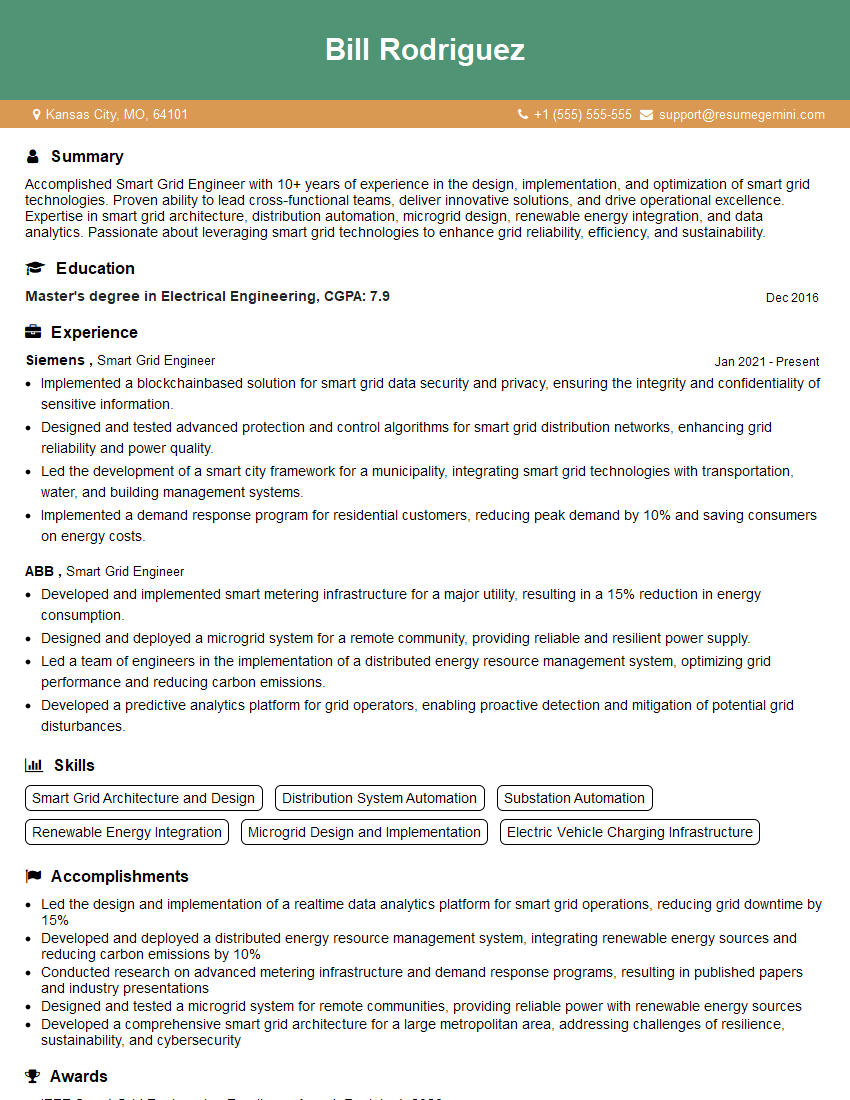
Mastering Distribution System Modeling and Simulation opens doors to exciting and impactful careers in the energy sector, offering opportunities for innovation and problem-solving. To enhance your job prospects, it’s crucial to present your skills effectively. Crafting an ATS-friendly resume is essential for getting your application noticed by recruiters. ResumeGemini is a trusted resource that can help you build a powerful and professional resume that highlights your expertise in this field. Examples of resumes tailored specifically to Distribution System Modeling and Simulation are available to guide you – take advantage of these valuable resources to showcase your qualifications and land your dream job.
Explore more articles
Users Rating of Our Blogs
Share Your Experience
We value your feedback! Please rate our content and share your thoughts (optional).
What Readers Say About Our Blog
Hello,
we currently offer a complimentary backlink and URL indexing test for search engine optimization professionals.
You can get complimentary indexing credits to test how link discovery works in practice.
No credit card is required and there is no recurring fee.
You can find details here:
https://wikipedia-backlinks.com/indexing/
Regards
NICE RESPONSE TO Q & A
hi
The aim of this message is regarding an unclaimed deposit of a deceased nationale that bears the same name as you. You are not relate to him as there are millions of people answering the names across around the world. But i will use my position to influence the release of the deposit to you for our mutual benefit.
Respond for full details and how to claim the deposit. This is 100% risk free. Send hello to my email id: [email protected]
Luka Chachibaialuka
Hey interviewgemini.com, just wanted to follow up on my last email.
We just launched Call the Monster, an parenting app that lets you summon friendly ‘monsters’ kids actually listen to.
We’re also running a giveaway for everyone who downloads the app. Since it’s brand new, there aren’t many users yet, which means you’ve got a much better chance of winning some great prizes.
You can check it out here: https://bit.ly/callamonsterapp
Or follow us on Instagram: https://www.instagram.com/callamonsterapp
Thanks,
Ryan
CEO – Call the Monster App
Hey interviewgemini.com, I saw your website and love your approach.
I just want this to look like spam email, but want to share something important to you. We just launched Call the Monster, a parenting app that lets you summon friendly ‘monsters’ kids actually listen to.
Parents are loving it for calming chaos before bedtime. Thought you might want to try it: https://bit.ly/callamonsterapp or just follow our fun monster lore on Instagram: https://www.instagram.com/callamonsterapp
Thanks,
Ryan
CEO – Call A Monster APP
To the interviewgemini.com Owner.
Dear interviewgemini.com Webmaster!
Hi interviewgemini.com Webmaster!
Dear interviewgemini.com Webmaster!
excellent
Hello,
We found issues with your domain’s email setup that may be sending your messages to spam or blocking them completely. InboxShield Mini shows you how to fix it in minutes — no tech skills required.
Scan your domain now for details: https://inboxshield-mini.com/
— Adam @ InboxShield Mini
Reply STOP to unsubscribe
Hi, are you owner of interviewgemini.com? What if I told you I could help you find extra time in your schedule, reconnect with leads you didn’t even realize you missed, and bring in more “I want to work with you” conversations, without increasing your ad spend or hiring a full-time employee?
All with a flexible, budget-friendly service that could easily pay for itself. Sounds good?
Would it be nice to jump on a quick 10-minute call so I can show you exactly how we make this work?
Best,
Hapei
Marketing Director
Hey, I know you’re the owner of interviewgemini.com. I’ll be quick.
Fundraising for your business is tough and time-consuming. We make it easier by guaranteeing two private investor meetings each month, for six months. No demos, no pitch events – just direct introductions to active investors matched to your startup.
If youR17;re raising, this could help you build real momentum. Want me to send more info?
Hi, I represent an SEO company that specialises in getting you AI citations and higher rankings on Google. I’d like to offer you a 100% free SEO audit for your website. Would you be interested?
Hi, I represent an SEO company that specialises in getting you AI citations and higher rankings on Google. I’d like to offer you a 100% free SEO audit for your website. Would you be interested?
good