Interviews are opportunities to demonstrate your expertise, and this guide is here to help you shine. Explore the essential Electrochemical Corrosion Testing interview questions that employers frequently ask, paired with strategies for crafting responses that set you apart from the competition.
Questions Asked in Electrochemical Corrosion Testing Interview
Q 1. Explain the principles of electrochemical corrosion.
Electrochemical corrosion is fundamentally an oxidation-reduction (redox) process where a metal loses electrons (oxidation) at anodic sites, and these electrons are gained (reduction) at cathodic sites on the same or a different metal surface. This electron flow constitutes an electric current, causing metal dissolution and the formation of corrosion products. Imagine it like a tiny battery within the metal; the anodic region is the negative terminal, where the metal dissolves, and the cathodic region is the positive terminal, where a reduction reaction occurs (like oxygen reduction in the presence of moisture).
For example, rusting of iron involves the oxidation of iron (Fe → Fe2+ + 2e–) at anodic sites and the reduction of oxygen (O2 + 2H2O + 4e– → 4OH–) at cathodic sites. The electrons flow through the metal, creating an electric current that drives the corrosion process.
Q 2. Describe different types of electrochemical corrosion (e.g., uniform, pitting, crevice).
Electrochemical corrosion manifests in various forms, each with distinct characteristics.
- Uniform Corrosion: This is the most common type, where corrosion occurs relatively evenly across the entire metal surface. Think of a piece of iron uniformly rusting in a humid environment. It’s predictable, but can still lead to significant material loss.
- Pitting Corrosion: Highly localized corrosion that forms small pits or holes on the metal surface. These pits can penetrate deep into the material, compromising its structural integrity, even if the overall material loss appears minimal. Stainless steel in chloride-containing environments is prone to pitting.
- Crevice Corrosion: Corrosion concentrated within narrow gaps or crevices where stagnant solutions accumulate. The oxygen depletion within the crevice creates a difference in potential, accelerating corrosion. Think of the corrosion occurring under a gasket or bolt head.
- Galvanic Corrosion: Occurs when two dissimilar metals are in electrical contact in an electrolyte. The more active metal (the anode) corrodes preferentially, while the less active metal (the cathode) is protected. A common example is the corrosion of zinc in contact with copper in seawater.
- Stress Corrosion Cracking (SCC): Occurs when a metal is subjected to tensile stress in a corrosive environment. The combination of stress and corrosion leads to crack initiation and propagation, often leading to catastrophic failure.
Q 3. What are the factors influencing corrosion rate?
Numerous factors influence the rate of corrosion. These can be broadly classified as:
- Material Properties: The type of metal (its electrochemical potential), its purity, microstructure, and surface finish all play significant roles. Noble metals like gold are highly corrosion-resistant, whereas reactive metals like sodium corrode readily.
- Environmental Factors: The most significant environmental factors include temperature, pH, oxygen concentration, the presence of aggressive ions (chlorides, sulfates), and the humidity of the environment. Higher temperatures generally accelerate corrosion.
- Electrolyte Properties: The conductivity, pH, and the presence of aggressive ions in the surrounding electrolyte (the solution in contact with the metal) directly impact the corrosion rate. Highly conductive solutions typically accelerate corrosion.
- Presence of Inhibitors: Corrosion inhibitors are substances that slow down corrosion by interacting with the metal surface or the electrolyte, creating a barrier or modifying the electrode reactions. They are extensively used in various industrial applications.
Q 4. Explain the concept of polarization curves and their significance.
Polarization curves are graphical representations of the relationship between the electrode potential and the current density of an electrochemical cell. They are crucial for understanding the corrosion behavior of a material. The curve depicts the anodic (oxidation) and cathodic (reduction) reactions, showing how the electrode potential changes as the current density changes. The intersection of the anodic and cathodic polarization curves defines the corrosion potential (Ecorr) and corrosion current density (icorr), which directly relate to the rate of corrosion.
Their significance lies in the ability to predict the corrosion rate and effectiveness of corrosion prevention strategies. A lower corrosion current density indicates a lower corrosion rate. By analyzing polarization curves, we can determine the most effective method for corrosion control—for example, the application of a protective coating or the use of cathodic protection.
Q 5. Describe the Tafel equation and its application.
The Tafel equation is an empirical relationship that describes the relationship between the overpotential (η) and the current density (i) at a given electrode. It’s expressed as: η = ±β log10(i/i0) where:
- η is the overpotential (the deviation of the electrode potential from its equilibrium potential)
- β is the Tafel slope (a constant that depends on the electrode reaction)
- i is the current density
- i0 is the exchange current density (the current density at equilibrium)
The Tafel equation is used to determine the Tafel slopes from polarization curves. These slopes provide valuable information about the kinetics of the anodic and cathodic reactions. This information is then used to determine the corrosion rate (icorr) at the corrosion potential (Ecorr).
Application: The Tafel equation is extensively used in corrosion studies to determine corrosion rates, understand reaction mechanisms, and evaluate the effects of corrosion inhibitors.
Q 6. What are the different electrochemical techniques used for corrosion testing?
Several electrochemical techniques are employed for corrosion testing. Some of the most common include:
- Potentiodynamic Polarization: Measures the current-potential curve by sweeping the electrode potential at a constant scan rate.
- Potentiostatic Polarization: Maintains a constant potential and measures the resulting current.
- Linear Polarization Resistance (LPR): Measures the slope of the polarization curve near the corrosion potential to determine the corrosion rate.
- Electrochemical Impedance Spectroscopy (EIS): Uses small AC signals to analyze the electrochemical impedance of the system, providing information about the corrosion process and the protective properties of coatings.
- Open Circuit Potential (OCP) Measurements: Monitors the potential of a material in a given environment over time to assess its corrosion susceptibility.
The choice of technique depends on the specific application and the information required. For example, EIS is highly suitable for studying complex corrosion systems, while LPR is a simple and rapid method for corrosion rate determination.
Q 7. Explain the principles of potentiodynamic polarization.
Potentiodynamic polarization involves imposing a controlled potential sweep on a working electrode immersed in an electrolyte while monitoring the resulting current. The potential is typically scanned linearly from a potential negative to the corrosion potential to a potential positive to the corrosion potential. This produces a polarization curve. It provides valuable information about the anodic and cathodic reactions occurring at the electrode surface.
During the scan, the anodic reaction (metal oxidation) is observed at increasingly positive potentials, and the cathodic reaction (reduction) is observed at increasingly negative potentials. The intersection of the anodic and cathodic branches of the polarization curve gives the corrosion potential (Ecorr) and corrosion current density (icorr), which can be used to calculate the corrosion rate. The shape of the polarization curves also helps determine the type of corrosion that might be occurring.
Q 8. Explain the principles of potentiostatic polarization.
Potentiostatic polarization is an electrochemical technique where a constant potential (voltage) is applied to a working electrode, and the resulting current is measured as a function of time. Imagine it like controlling the voltage of a battery connected to a metal sample submerged in a solution. We’re forcing the metal to either corrode faster (by applying a more positive potential) or protect itself from corrosion (by applying a more negative potential). The measured current reflects the rate of the electrochemical reactions occurring at the electrode surface, providing information about the corrosion rate and the electrode’s electrochemical behavior. This technique allows us to construct polarization curves, which show the relationship between potential and current density. These curves are crucial for determining corrosion potential (Ecorr) and corrosion current density (icorr), key parameters for assessing material corrosion resistance.
For example, if we apply an increasingly positive potential to a steel sample in seawater, we’ll initially observe a small increase in anodic current (oxidation of iron). At a certain point, we’ll reach the passivation region, where a protective oxide layer forms on the steel’s surface, drastically reducing the corrosion rate. Further increasing the potential can break down this protective layer, resulting in a sharp increase in current representing pitting or other localized corrosion.
Q 9. Explain the principles of electrochemical impedance spectroscopy (EIS).
Electrochemical Impedance Spectroscopy (EIS) is a powerful technique used to study the electrochemical behavior of materials and interfaces. It involves applying a small amplitude sinusoidal AC voltage to a working electrode and measuring the resulting current response. Think of it as gently tapping the metal surface with an electrical signal and listening to its response – the way it vibrates reveals information about its structure and properties. The impedance, the opposition to the flow of AC current, is frequency-dependent. This frequency dependence provides detailed information about various electrochemical processes occurring at the electrode-electrolyte interface, such as charge transfer, diffusion, and capacitance. The impedance data are typically plotted as Nyquist plots (imaginary vs. real impedance) or Bode plots (logarithmic impedance vs. frequency) which reveal various features representing the corrosion processes. These features can be fitted with equivalent circuit models to extract parameters like charge transfer resistance (Rct) and double-layer capacitance (Cdl), which directly relate to corrosion resistance.
Q 10. How is EIS data analyzed and interpreted?
EIS data analysis involves fitting the experimental impedance data to an equivalent circuit model. This model represents the electrochemical system as a combination of resistors, capacitors, and other elements that correspond to various physical processes occurring at the interface. Software packages specifically designed for EIS analysis are used to perform this fitting. The goodness of fit is assessed using statistical measures like chi-squared (χ2). Each element in the model reflects a particular aspect of the electrochemical behavior. For example, a resistor represents charge transfer resistance, a capacitor represents the double-layer capacitance, and a Warburg element represents diffusion processes. By fitting the data and obtaining the values of the equivalent circuit elements, we can quantify the contribution of each process to the overall impedance and understand the corrosion mechanisms at play.
For instance, a large charge transfer resistance indicates a high degree of corrosion resistance, while a smaller value indicates a higher corrosion rate. Similarly, the double-layer capacitance provides insights into the interfacial properties and can be related to surface roughness or the presence of an oxide film. The detailed analysis allows for the identification and quantification of corrosion mechanisms, thereby allowing to predict the lifetime of a material or system under specific conditions.
Q 11. Describe the use of linear polarization resistance (LPR) in corrosion testing.
Linear Polarization Resistance (LPR) is a simple and rapid electrochemical technique used to estimate corrosion rates. It involves applying a small potential perturbation (a few millivolts) around the corrosion potential and measuring the resulting current response. The slope of the resulting current-potential curve near the corrosion potential is inversely proportional to the polarization resistance (Rp). The corrosion current density (icorr) can then be estimated using Stern-Geary equation, icorr = B / Rp, where B is a constant dependent on the Tafel slopes (which describe the kinetics of the anodic and cathodic reactions). The LPR technique is relatively straightforward and less time-consuming compared to other techniques like EIS or potentiodynamic polarization.
Q 12. What are the advantages and limitations of LPR?
Advantages of LPR:
- Simplicity and speed: Requires minimal equipment and short measurement time.
- Ease of interpretation: Results are relatively easy to understand and interpret.
- In-situ measurements: Can be performed in situ, mimicking real-world conditions.
Limitations of LPR:
- Approximation: It’s based on the linear approximation of the Tafel region, which may not always be valid, especially for complex corrosion systems.
- Sensitivity to experimental error: The accuracy of the corrosion rate estimate is sensitive to the precision of the potential and current measurements.
- Limited information: Only provides an estimate of the corrosion rate; it does not give detailed information about the corrosion mechanism.
- Not suitable for all systems: LPR is unsuitable for systems with significant polarization effects or non-linear behavior.
Q 13. What is the difference between anodic and cathodic protection?
Both anodic and cathodic protection are electrochemical methods used to prevent corrosion. They differ in how they achieve this protection:
Anodic protection involves applying a positive potential to the metal structure to make it the anode of an electrochemical cell. This forces the metal to passivate (form a protective oxide layer), inhibiting corrosion. This technique is selective and needs to be carefully controlled because excessive anodic polarization can lead to passivity breakdown. It is mostly employed for metals that can passivate, for example, stainless steel.
Cathodic protection involves applying a negative potential to the metal structure to make it the cathode of an electrochemical cell. This prevents oxidation and corrosion by making the metal electrochemically inert. A sacrificial anode (e.g., zinc or magnesium) is often used which corrodes preferentially in place of the protected structure. Cathodic protection is widely used for pipelines, ship hulls, and other large structures. The most common method is galvanic protection where a more active metal is connected to the protected structure.
Q 14. Explain the concept of Pourbaix diagrams.
A Pourbaix diagram, also known as a potential-pH diagram, is a graphical representation of the thermodynamic stability of a metal or metal ion species as a function of potential and pH. Imagine it as a map showing the most stable form of a metal under different conditions of acidity and voltage. The diagram shows regions of immunity (no corrosion), corrosion (metal dissolution), and passivity (formation of a protective oxide layer). These regions are defined by equilibrium reactions between the metal and its ions in aqueous solution. The boundaries between these regions are determined by the Nernst equation, which describes the relationship between the electrode potential, the concentration of the involved species, and the standard electrode potential.
Pourbaix diagrams are valuable tools for predicting the corrosion behavior of metals in various environments. They are especially useful for determining the pH and potential ranges where a metal is immune or prone to corrosion. For instance, analyzing the Pourbaix diagram of iron, one can identify conditions under which iron is susceptible to rust formation or protected by the formation of a stable oxide layer. The application of Pourbaix diagrams helps in material selection, designing corrosion mitigation strategies and understanding corrosion processes in diverse conditions.
Q 15. How do you select appropriate corrosion testing methods for a specific application?
Selecting the right corrosion testing method is crucial for accurate and reliable results. The choice depends heavily on the specific application, the material being tested, and the anticipated corrosive environment. It’s a bit like choosing the right tool for a job – you wouldn’t use a hammer to screw in a screw!
- Consider the environment: Will the material be exposed to seawater, soil, atmospheric conditions, or a specific chemical solution? This dictates whether you need immersion tests, atmospheric corrosion tests, or electrochemical techniques.
- Material properties: Different materials corrode at different rates and through different mechanisms. A simple weight loss measurement might suffice for a relatively inert material, while electrochemical impedance spectroscopy (EIS) might be necessary for a more complex alloy.
- Test objectives: Are you interested in the corrosion rate, the corrosion mechanism, the effect of inhibitors, or long-term durability? Each objective requires a different approach.
For example, if you’re testing a pipeline’s resistance to soil corrosion, you might use soil burial tests, combined with electrochemical measurements at intervals to monitor the corrosion process. If you’re designing a new stainless steel alloy for medical implants, you’d likely employ a combination of electrochemical tests (potentiodynamic polarization, EIS) and accelerated corrosion tests in simulated body fluid to mimic the conditions inside the body.
Career Expert Tips:
- Ace those interviews! Prepare effectively by reviewing the Top 50 Most Common Interview Questions on ResumeGemini.
- Navigate your job search with confidence! Explore a wide range of Career Tips on ResumeGemini. Learn about common challenges and recommendations to overcome them.
- Craft the perfect resume! Master the Art of Resume Writing with ResumeGemini’s guide. Showcase your unique qualifications and achievements effectively.
- Don’t miss out on holiday savings! Build your dream resume with ResumeGemini’s ATS optimized templates.
Q 16. Describe different types of corrosion inhibitors and their mechanisms.
Corrosion inhibitors are substances added to a corrosive environment to reduce the rate of corrosion. Think of them as tiny guardians protecting the metal surface. They work through various mechanisms:
- Passivation: These inhibitors form a protective layer on the metal surface, isolating it from the corrosive environment. This layer can be a thin, passive film like the chromium oxide layer on stainless steel, or a more complex chemical film.
- Adsorption: Some inhibitors adsorb (stick) onto the metal surface, blocking reactive sites and preventing the corrosion reaction. Think of it like covering a surface with a protective blanket.
- Precipitation: These inhibitors form insoluble precipitates that coat the metal surface, shielding it from corrosion. This is similar to painting the metal, only at the molecular level.
- Scavengers: These inhibitors react with corrosive species (e.g., oxygen or chloride ions) in the environment, reducing their concentration and thereby slowing down the corrosion rate.
Examples: Chromates were historically used, but their toxicity led to their replacement in many applications. Organic inhibitors, such as amines and imidazolines, are now common, as are inorganic inhibitors like phosphates and silicates. The choice of inhibitor depends strongly on the specific metal, environment, and safety considerations.
Q 17. How do you interpret corrosion data and report results?
Interpreting corrosion data requires careful analysis and understanding of the chosen test method. It’s like deciphering a code to understand what the metal is ‘telling us’.
- Corrosion rate determination: From weight loss measurements, we calculate the corrosion rate (e.g., mm/year). Electrochemical techniques provide corrosion current density, which is then converted into a corrosion rate using Faraday’s law.
- Corrosion mechanism identification: Potentiodynamic polarization curves reveal information about the corrosion process, such as active-passive transitions or pitting corrosion. EIS provides insights into the nature and properties of protective films.
- Statistical analysis: Corrosion data often exhibit variability. Statistical analysis, including mean, standard deviation, and confidence intervals, is crucial to determine the reliability of results.
The results are then reported in a structured manner, including details of the test method, environmental conditions, material specifications, and the determined corrosion rate, along with supporting data such as graphs and tables. Clear and concise reporting ensures that the findings are easily understandable and repeatable.
Q 18. Explain the role of environmental factors (temperature, pH, etc.) in corrosion.
Environmental factors play a significant role in corrosion, often acting as catalysts or inhibitors. Imagine it as a recipe – you need the right ingredients (the metal and environment) to get the ‘corrosion’ dish.
- Temperature: Higher temperatures generally increase the rate of corrosion by increasing the rate of chemical reactions.
- pH: A highly acidic or alkaline environment can significantly accelerate corrosion. For instance, acids tend to dissolve metals, while strong alkalis can cause other forms of degradation.
- Oxygen concentration: Oxygen is a crucial component in many corrosion processes (e.g., rusting). Higher oxygen levels usually accelerate corrosion.
- Chloride ions: Chlorides are particularly aggressive, often causing pitting corrosion (small holes in the metal surface). This is why saltwater is so corrosive.
- Humidity: High humidity accelerates atmospheric corrosion by providing a medium for electrochemical reactions.
Understanding these factors allows for better predictions of corrosion behavior and the design of effective corrosion control strategies. For instance, a coating is critical in environments with high humidity and chloride concentrations.
Q 19. Describe the importance of material selection in corrosion prevention.
Material selection is paramount in corrosion prevention. Choosing the right material is like selecting the right foundation for a house; a poor choice will lead to structural failure.
Factors to consider include:
- Corrosion resistance: Certain materials naturally resist corrosion better than others. For example, stainless steel is more corrosion-resistant than mild steel.
- Cost: High corrosion resistance often comes at a higher cost.
- Mechanical properties: The material must also satisfy mechanical requirements for the application.
- Processability: The material must be easy to fabricate and weld.
For instance, for a seawater application, you’d likely choose a corrosion-resistant alloy like titanium or a high-alloy stainless steel instead of mild steel which will corrode rapidly. The selection process balances corrosion resistance with other material characteristics.
Q 20. What are the common methods used for corrosion prevention?
Corrosion prevention involves a multifaceted approach, encompassing various techniques. It’s like protecting a valuable asset with multiple layers of security.
- Protective coatings: Paints, polymers, and metallic coatings (e.g., galvanization) act as barriers, isolating the metal from the environment.
- Corrosion inhibitors: Adding inhibitors to the environment reduces the corrosion rate.
- Cathodic protection: This method involves using an external current to make the metal structure cathodic, preventing corrosion. Think of it as giving the metal an electric shield.
- Anodic protection: This method maintains the metal in a passive state by applying an appropriate anodic potential. This is more specialized and is used in specific cases.
- Material selection: Choosing corrosion-resistant materials is a primary strategy.
- Design modifications: Optimizing design to avoid crevices, sharp corners, and stagnant areas where corrosion can concentrate is critical.
Often, a combination of methods is employed for maximum effectiveness. For example, a pipeline might be protected by a coating, cathodic protection, and periodic inspection.
Q 21. How do you assess the effectiveness of corrosion prevention strategies?
Assessing the effectiveness of corrosion prevention strategies involves monitoring the corrosion rate over time and comparing it to the rate before the strategy was implemented. It’s like tracking the effectiveness of a medicine – you need to see if it works.
Methods include:
- Periodic inspections: Visual inspections, measurements of coating thickness, and electrochemical measurements help track corrosion behavior.
- Weight loss measurements: Regularly weighing components provides a direct measure of material loss due to corrosion.
- Electrochemical techniques: EIS and potentiodynamic polarization are powerful tools to monitor the changes in the corrosion process.
- Non-destructive testing: Techniques like ultrasonic testing can detect corrosion beneath coatings.
The choice of method depends on the specific application and the type of corrosion prevention strategy. For instance, if a pipeline is protected with cathodic protection, regular potential measurements are crucial. A combination of methods often gives a comprehensive assessment.
Q 22. Describe your experience with different corrosion testing equipment and software.
My experience with electrochemical corrosion testing equipment spans a wide range of instruments, from potentiostats and galvanostats – the workhorses of electrochemical measurements – to specialized tools like electrochemical impedance spectroscopy (EIS) systems and scanning reference electrode techniques (SRET). I’m proficient in using different brands of potentiostats, including Gamry, BioLogic, and Solartron, each with its unique software interface and capabilities. I’m also experienced with software packages for data acquisition, analysis, and modeling, including Gamry Framework, EC-Lab, and ZView. For example, I’ve used Gamry Framework to analyze Tafel plots to determine corrosion rates and ZView to fit EIS data to equivalent circuits, providing crucial insights into the corrosion mechanisms at play. My experience extends beyond basic operation; I’m adept at troubleshooting equipment malfunctions, optimizing experimental parameters for different materials and environments, and ensuring data accuracy and reproducibility.
Q 23. What are some common challenges in electrochemical corrosion testing?
Electrochemical corrosion testing, while powerful, presents several challenges. One major hurdle is the influence of environmental factors. Minute variations in temperature, pH, oxygen concentration, or even the cleanliness of the testing solution can significantly impact results. Another challenge lies in accurately representing real-world conditions in a laboratory setting. Simplifying complex scenarios can lead to inaccurate predictions of corrosion behavior in service. Furthermore, data interpretation can be complex, especially when dealing with complex corrosion mechanisms. For instance, distinguishing between different types of corrosion (e.g., pitting, crevice, uniform) from electrochemical data requires experience and careful analysis. Finally, surface preparation is critical. Imperfect surface preparation can introduce artifacts and inconsistencies into the results, making it essential to establish meticulous sample preparation protocols.
Q 24. How do you address data inconsistencies or anomalies in corrosion testing?
Data inconsistencies or anomalies in corrosion testing require a systematic approach. First, I carefully review the experimental procedure for any errors. This includes checking the accuracy of the applied potential/current, the stability of the reference electrode, and the cleanliness of the electrochemical cell. Next, I examine the data for systematic trends or patterns. Are there outliers that consistently appear at certain points in the experiment? If so, it suggests a potential procedural flaw or environmental factor. Statistical analysis, such as outlier detection algorithms, can help to identify and potentially remove data points that are significantly different from the others. Visual inspection of the data plots is also crucial, often revealing subtle anomalies that statistical methods might miss. If inconsistencies persist, further investigation may involve repeating the experiment under carefully controlled conditions or performing complementary tests, such as microscopy or surface analysis, to understand the underlying cause of the anomaly. For instance, if pitting corrosion is suspected, microscopy could confirm the presence and severity of pits, providing a clearer picture of the corrosion process.
Q 25. Describe a situation where you had to troubleshoot a corrosion problem.
In a previous project involving stainless steel components in a chloride-rich environment, we observed unexpectedly high corrosion rates. Initial electrochemical tests, specifically potentiodynamic polarization curves, showed significantly higher corrosion current densities than expected. Our initial troubleshooting involved verifying the solution chemistry, electrode preparation, and equipment calibration. After eliminating those possibilities, we used scanning electron microscopy (SEM) to analyze the corroded surface. The SEM images revealed the presence of large-scale crevice corrosion, undetectable with electrochemical measurements alone. This highlighted the importance of combining electrochemical techniques with surface analysis to fully understand corrosion mechanisms. Subsequently, we redesigned the component to reduce crevice formation, thereby resolving the corrosion problem.
Q 26. Explain your experience with different types of corrosion standards and specifications.
My experience with corrosion standards and specifications includes extensive familiarity with ASTM, ISO, and NACE standards. I’m proficient in applying various standards related to electrochemical corrosion testing, including those for corrosion rate determination (e.g., ASTM G1-15), electrochemical impedance spectroscopy (e.g., ASTM G106), and potentiodynamic polarization (e.g., ASTM G5). I understand the significance of following these standards for ensuring data reproducibility and comparability across different laboratories and research groups. For example, I have experience with ASTM G106-19 in performing EIS measurements and analyzing the impedance data using equivalent circuit models, allowing us to determine the corrosion resistance and other important parameters. Understanding the nuances of these standards is crucial for accurate and reliable corrosion data, which is directly applicable to material selection, component design, and preventative maintenance.
Q 27. How do you stay up-to-date with advancements in electrochemical corrosion testing?
Keeping abreast of advancements in electrochemical corrosion testing involves a multi-pronged approach. I regularly attend conferences and workshops, such as those organized by NACE International and ASTM International. I actively follow leading scientific journals (e.g., Corrosion Science, Journal of the Electrochemical Society) and industry publications to stay informed about new techniques, software advancements, and research findings. Participation in professional organizations, such as NACE, provides valuable networking opportunities and access to the latest information through webinars, training programs, and technical publications. Additionally, I leverage online resources and databases, such as those offered by scientific publishers and academic institutions, to search for relevant publications and technical reports. This holistic approach ensures my skills and knowledge remain relevant and up-to-date within the ever-evolving field of corrosion science.
Q 28. Describe your experience with Failure Analysis related to corrosion
My experience with failure analysis related to corrosion is extensive. I have conducted numerous investigations into failed components to determine the root cause of corrosion-related failures. This involves a comprehensive approach, starting with a thorough visual inspection of the failed component, often followed by detailed microscopic analysis (SEM, optical microscopy) to identify the type of corrosion and its severity. Electrochemical techniques, such as potentiodynamic polarization and EIS, are then used to characterize the corrosion behavior of the material under conditions simulating the service environment. Chemical analysis (e.g., X-ray diffraction, energy-dispersive X-ray spectroscopy) is often employed to determine the composition of corrosion products and identify potential contaminants that might have contributed to the failure. Based on the findings, I develop comprehensive reports outlining the failure mechanism, contributing factors, and recommendations for preventative measures. For example, in one investigation, we determined that stress corrosion cracking was responsible for a component failure by correlating visual inspections, SEM analysis, and electrochemical data. This resulted in recommendations for material substitution and changes in the operating parameters to prevent future incidents.
Key Topics to Learn for Electrochemical Corrosion Testing Interview
- Fundamentals of Electrochemical Corrosion: Understand the electrochemical principles behind corrosion, including oxidation, reduction, and the electrochemical cell. Explore different types of corrosion (uniform, pitting, crevice, etc.).
- Electrochemical Techniques: Master the theory and practical application of techniques like potentiodynamic polarization, electrochemical impedance spectroscopy (EIS), and linear polarization resistance (LPR). Know their strengths and limitations.
- Data Interpretation and Analysis: Develop strong skills in analyzing electrochemical data. Learn to interpret Tafel plots, Nyquist plots, and Bode plots to determine corrosion rates and mechanisms.
- Material Selection and Corrosion Prevention: Understand how material properties influence corrosion behavior and explore various corrosion prevention techniques (coatings, inhibitors, cathodic protection).
- Practical Applications: Be prepared to discuss real-world applications of electrochemical corrosion testing in various industries (e.g., oil and gas, aerospace, automotive). Consider examples from your own experience or research.
- Troubleshooting and Problem-Solving: Practice identifying potential sources of error in electrochemical measurements and developing solutions. Be able to explain how experimental conditions affect results.
- Advanced Concepts (Optional): Depending on the seniority of the role, you may want to explore more advanced topics such as localized corrosion modeling, stress corrosion cracking, or high-temperature corrosion.
Next Steps
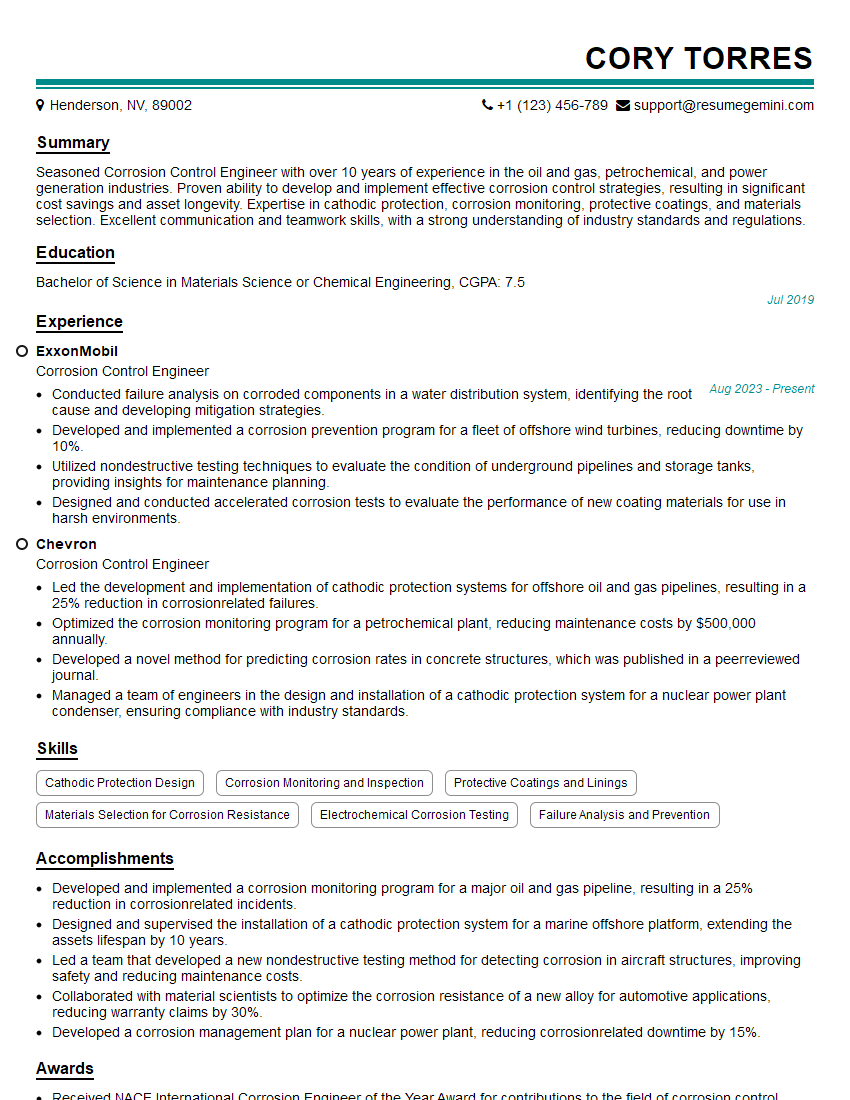
Mastering electrochemical corrosion testing opens doors to exciting career opportunities in materials science, engineering, and various industries. A strong understanding of these principles is highly valued by employers and demonstrates your technical expertise. To maximize your job prospects, it’s crucial to have an ATS-friendly resume that showcases your skills and experience effectively. ResumeGemini is a trusted resource that can help you create a professional and impactful resume tailored to the specific requirements of electrochemical corrosion testing roles. Examples of resumes specifically designed for this field are available to help you get started.

Explore more articles
Users Rating of Our Blogs
Share Your Experience
We value your feedback! Please rate our content and share your thoughts (optional).
What Readers Say About Our Blog
Hello,
we currently offer a complimentary backlink and URL indexing test for search engine optimization professionals.
You can get complimentary indexing credits to test how link discovery works in practice.
No credit card is required and there is no recurring fee.
You can find details here:
https://wikipedia-backlinks.com/indexing/
Regards
NICE RESPONSE TO Q & A
hi
The aim of this message is regarding an unclaimed deposit of a deceased nationale that bears the same name as you. You are not relate to him as there are millions of people answering the names across around the world. But i will use my position to influence the release of the deposit to you for our mutual benefit.
Respond for full details and how to claim the deposit. This is 100% risk free. Send hello to my email id: [email protected]
Luka Chachibaialuka
Hey interviewgemini.com, just wanted to follow up on my last email.
We just launched Call the Monster, an parenting app that lets you summon friendly ‘monsters’ kids actually listen to.
We’re also running a giveaway for everyone who downloads the app. Since it’s brand new, there aren’t many users yet, which means you’ve got a much better chance of winning some great prizes.
You can check it out here: https://bit.ly/callamonsterapp
Or follow us on Instagram: https://www.instagram.com/callamonsterapp
Thanks,
Ryan
CEO – Call the Monster App
Hey interviewgemini.com, I saw your website and love your approach.
I just want this to look like spam email, but want to share something important to you. We just launched Call the Monster, a parenting app that lets you summon friendly ‘monsters’ kids actually listen to.
Parents are loving it for calming chaos before bedtime. Thought you might want to try it: https://bit.ly/callamonsterapp or just follow our fun monster lore on Instagram: https://www.instagram.com/callamonsterapp
Thanks,
Ryan
CEO – Call A Monster APP
To the interviewgemini.com Owner.
Dear interviewgemini.com Webmaster!
Hi interviewgemini.com Webmaster!
Dear interviewgemini.com Webmaster!
excellent
Hello,
We found issues with your domain’s email setup that may be sending your messages to spam or blocking them completely. InboxShield Mini shows you how to fix it in minutes — no tech skills required.
Scan your domain now for details: https://inboxshield-mini.com/
— Adam @ InboxShield Mini
Reply STOP to unsubscribe
Hi, are you owner of interviewgemini.com? What if I told you I could help you find extra time in your schedule, reconnect with leads you didn’t even realize you missed, and bring in more “I want to work with you” conversations, without increasing your ad spend or hiring a full-time employee?
All with a flexible, budget-friendly service that could easily pay for itself. Sounds good?
Would it be nice to jump on a quick 10-minute call so I can show you exactly how we make this work?
Best,
Hapei
Marketing Director
Hey, I know you’re the owner of interviewgemini.com. I’ll be quick.
Fundraising for your business is tough and time-consuming. We make it easier by guaranteeing two private investor meetings each month, for six months. No demos, no pitch events – just direct introductions to active investors matched to your startup.
If youR17;re raising, this could help you build real momentum. Want me to send more info?
Hi, I represent an SEO company that specialises in getting you AI citations and higher rankings on Google. I’d like to offer you a 100% free SEO audit for your website. Would you be interested?
Hi, I represent an SEO company that specialises in getting you AI citations and higher rankings on Google. I’d like to offer you a 100% free SEO audit for your website. Would you be interested?
good