Interviews are more than just a Q&A session—they’re a chance to prove your worth. This blog dives into essential Encryption Decryption interview questions and expert tips to help you align your answers with what hiring managers are looking for. Start preparing to shine!
Questions Asked in Encryption Decryption Interview
Q 1. Explain the difference between symmetric and asymmetric encryption.
Symmetric and asymmetric encryption differ fundamentally in how they handle keys. Imagine you have a secret message you want to send to a friend.
Symmetric Encryption: Think of this as using the same key to both lock (encrypt) and unlock (decrypt) the message. Both you and your friend need the *same* secret key. It’s like using a single padlock with a shared key. This is fast and efficient but requires a secure way to share that key beforehand. Examples include AES and DES.
Asymmetric Encryption: This is like having two separate keys: a public key (think of it as a mailbox slot) and a private key (the key to your house). You share your public key widely. Anyone can use it to encrypt a message to you, but only you, with your private key, can unlock (decrypt) it. This solves the key exchange problem of symmetric encryption, making it ideal for secure communication over networks. RSA is a prime example.
- Symmetric: One key for encryption and decryption; fast but key exchange is a challenge.
- Asymmetric: Two keys (public and private); secure key exchange, but slower than symmetric.
Q 2. Describe the RSA algorithm and its applications.
RSA (Rivest-Shamir-Adleman) is a widely used asymmetric encryption algorithm. It’s based on the mathematical difficulty of factoring large numbers. The process involves generating a pair of keys: a public key and a private key.
How it works (simplified):
- Key Generation: The algorithm uses two large prime numbers to generate the public and private keys. The mathematical relationship between these numbers ensures that only the private key can decrypt messages encrypted with the public key.
- Encryption: The sender uses the recipient’s public key to encrypt the message.
- Decryption: The recipient uses their private key to decrypt the message. Only they possess this key.
Applications:
- Secure Communication: Securing emails, online transactions, and other sensitive data exchanged over networks.
- Digital Signatures: Verifying the authenticity and integrity of digital documents.
- Secure Key Exchange: As a part of hybrid encryption systems where RSA is used to exchange a symmetric key, which is then used for faster bulk encryption/decryption.
Imagine sending a postcard with your address on it. Anyone (public key) can write the postcard and send it. Only you (private key), with access to your mailbox, can read it.
Q 3. What are the strengths and weaknesses of AES encryption?
AES (Advanced Encryption Standard) is a symmetric block cipher widely considered one of the most secure encryption algorithms. It’s used extensively to protect sensitive data globally.
Strengths:
- Security: AES has withstood extensive cryptanalysis and is considered highly secure for appropriately chosen key lengths (128, 192, or 256 bits).
- Speed and Efficiency: It’s relatively fast and efficient to implement in both hardware and software.
- Widely Adopted: It’s a standard used by governments and organizations worldwide, making interoperability easier.
Weaknesses:
- Key Management: Like all symmetric algorithms, secure key distribution and management remain a crucial challenge. Compromised keys lead to compromised data.
- Side-Channel Attacks: While AES is strong cryptographically, it can be vulnerable to side-channel attacks (e.g., timing attacks, power analysis) if not implemented correctly. These attacks exploit information leaked during the encryption/decryption process.
- Brute-Force Attacks (theoretically possible): Although practically infeasible with sufficiently long keys (256-bit keys are considered virtually unbreakable), brute-force attacks remain a theoretical possibility.
Think of a high-security safe. AES is the strong lock, but you need to protect the combination (key) carefully, and ensure no one can observe how you open it (side-channel attacks).
Q 4. Explain the concept of a digital signature and its purpose.
A digital signature is a cryptographic technique used to verify the authenticity and integrity of digital data. It’s like a digital fingerprint that uniquely identifies the signer and ensures the message hasn’t been tampered with. It leverages asymmetric encryption.
How it works:
- Hashing: The message is first passed through a hash function, producing a unique fingerprint (hash).
- Signing: The sender then encrypts the hash using their private key. This encrypted hash is the digital signature.
- Verification: The recipient decrypts the signature using the sender’s public key. They also hash the received message. If the two hashes match, it verifies the message’s integrity and authenticity, confirming the sender’s identity.
Purpose:
- Authentication: Verifying the sender’s identity.
- Integrity: Ensuring the message hasn’t been altered during transmission.
- Non-Repudiation: Preventing the sender from denying they sent the message.
Imagine a signed letter. The signature confirms the author and ensures the letter’s content hasn’t been changed.
Q 5. How does a digital certificate work?
A digital certificate is an electronic document that verifies the identity of a website or individual. Think of it as an online passport or driver’s license. It’s issued by a trusted third party called a Certificate Authority (CA).
How it works:
- Issuance: The CA verifies the applicant’s identity and issues a certificate containing the applicant’s public key and other identifying information. The CA’s digital signature confirms the authenticity of the certificate itself.
- Verification: When you visit a website (or use a digital certificate for another purpose), your browser or software checks the certificate’s validity and authenticity by verifying the CA’s signature. If valid, it trusts the public key associated with the certificate.
Purpose:
- Website Authentication: Ensuring you’re connecting to the genuine website and not an imposter (e.g., avoiding phishing attacks).
- Secure Communication: Enabling secure communication through HTTPS by establishing trust between your browser and the website.
- Software Authentication: Verifying the authenticity and integrity of software downloads.
Websites showing a padlock icon usually have a valid digital certificate, assuring you of their identity.
Q 6. What is a hash function and how is it used in cryptography?
A hash function is a one-way cryptographic function that takes an input (message of any size) and produces a fixed-size output called a hash value or digest. This process is irreversible; you can’t get the original message back from the hash.
How it works:
The hash function applies a deterministic algorithm to the input, generating a unique hash for each unique input. Even a tiny change in the input results in a significantly different hash.
Use in cryptography:
- Data Integrity: Comparing the hash of a received message with the original hash ensures the message hasn’t been altered.
- Password Storage: Storing the hash of passwords instead of the plain text passwords; a compromise doesn’t reveal the actual passwords.
- Digital Signatures: As discussed earlier, hashing is a fundamental step in creating and verifying digital signatures.
Imagine a checksum for data; if the checksums don’t match, you know the data has been corrupted. A hash function is a more sophisticated and cryptographically secure version of a checksum.
Q 7. Explain the concept of key exchange and mention at least two methods.
Key exchange is the process of securely sharing a secret key between two parties. This is crucial for symmetric encryption, as both parties need the same key to encrypt and decrypt data.
Methods:
- Diffie-Hellman Key Exchange: This algorithm allows two parties to establish a shared secret key over an insecure channel without exchanging the key directly. It’s based on the mathematical properties of modular arithmetic.
- RSA Key Exchange: As mentioned earlier, RSA can be used for key exchange. One party can encrypt a symmetric key using the other party’s public key, securely transmitting the key.
Why it’s important: Directly transmitting a symmetric key over an insecure network is extremely risky. Key exchange protocols ensure that only the intended recipients can access the secret key, even if someone intercepts the communication.
Think of two people needing to share a code word for a secret meeting. Key exchange protocols provide a secure way to share that code word without revealing it to eavesdroppers.
Q 8. What are the different types of cryptographic attacks?
Cryptographic attacks aim to break encryption, compromising the confidentiality, integrity, or authenticity of data. They can be broadly categorized as follows:
- Ciphertext-only attacks: The attacker only has access to the encrypted ciphertext. They try to deduce the plaintext or the key through statistical analysis or known plaintext attacks.
- Known-plaintext attacks: The attacker has access to both the plaintext and its corresponding ciphertext. This allows them to analyze the encryption algorithm and potentially deduce the key.
- Chosen-plaintext attacks: The attacker can choose specific plaintexts to encrypt and obtain their corresponding ciphertexts. This provides more control over the analysis process.
- Chosen-ciphertext attacks: The attacker can choose specific ciphertexts to decrypt and obtain their corresponding plaintexts. This is a more powerful attack than chosen-plaintext.
- Side-channel attacks: These attacks exploit information leaked during the encryption/decryption process, such as power consumption, timing, or electromagnetic emissions. They don’t directly target the algorithm itself but rather the implementation.
- Brute-force attacks: The attacker tries every possible key until the correct one is found. This is computationally expensive but becomes more feasible with weaker keys or algorithms.
Imagine a thief trying to open a safe. A ciphertext-only attack is like trying to guess the combination by observing the safe. A known-plaintext attack is like knowing what’s inside the safe and observing the combination used to open it. A chosen-plaintext attack is like being able to put specific things in the safe and observe how the combination changes.
Q 9. Describe the process of encrypting and decrypting data using a symmetric key.
Symmetric-key encryption uses the same secret key for both encryption and decryption. Think of it like a shared secret code between two people. The process involves these steps:
- Encryption: The plaintext (original data) is transformed using an encryption algorithm and the secret key into ciphertext (unreadable data).
- Decryption: The ciphertext is transformed back into plaintext using the same encryption algorithm and the same secret key.
Example (conceptual): Let’s say our key is ‘123’ and our algorithm shifts each letter by three positions. Plaintext ‘ABC’ becomes ciphertext ‘DEF’ after encryption. Decryption of ‘DEF’ using the same key ‘123’ and algorithm would return ‘ABC’.
//Illustrative example only, not actual cryptographic code
plaintext = "ABC";
key = 123;
ciphertext = encrypt(plaintext, key); //ciphertext would be "DEF"
decryptedText = decrypt(ciphertext, key); //decryptedText would be "ABC"
Real-world applications include secure communication channels (like VPNs) and data storage (file encryption).
Q 10. What is public key infrastructure (PKI)?
Public Key Infrastructure (PKI) is a system for creating, managing, distributing, storing, and revoking digital certificates and managing public-key cryptography. It’s the foundation for secure online communication and transactions.
Imagine a digital passport for online identities. Each entity (individual or organization) has a pair of keys: a public key (freely distributed) and a private key (kept secret). The public key is used to encrypt messages, while only the corresponding private key can decrypt them. PKI uses Certificate Authorities (CAs) – trusted third parties – to vouch for the authenticity of these digital passports (certificates), ensuring that the public key truly belongs to the claimed entity.
This is crucial for secure email (S/MIME), secure web browsing (HTTPS), and digital signatures, allowing us to trust the websites and individuals we interact with online.
Q 11. Explain the concept of perfect secrecy.
Perfect secrecy, as defined by Claude Shannon, means that the ciphertext reveals absolutely no information about the plaintext beyond the length of the message. This implies that even with unlimited computing power, an attacker cannot gain any advantage in guessing the plaintext from the ciphertext.
Essentially, the ciphertext looks like random noise regardless of the actual plaintext. While theoretically possible (the one-time pad achieves this), it’s extremely challenging to implement in practice due to the requirement of using a truly random, secret key as long as the message itself, and securely managing that key.
The one-time pad is a perfect example, where a truly random key is used only once and is as long as the message, making cryptanalysis impossible. However, secure key distribution and management are the major hurdles in its real-world applicability.
Q 12. What is a nonce and why is it important in cryptography?
A nonce is an arbitrary number used only once in a cryptographic communication. It’s crucial for preventing replay attacks and ensuring the integrity of messages.
Imagine a secure ATM. Every time you use your card, the system generates a unique nonce. This nonce is included in the communication between your card and the bank’s system. If someone intercepts the communication and tries to replay it later, the nonce will be different, preventing the fraudulent transaction. Without the nonce, a recorded transaction could be replayed successfully.
Nonces are widely used in protocols like TLS/SSL, ensuring that each communication session is unique and protected against replay attacks. They’re essential for the security and integrity of many cryptographic systems.
Q 13. What are the security implications of using weak encryption algorithms?
Using weak encryption algorithms has severe security implications, as they are easily broken by modern computing power and sophisticated cryptanalysis techniques. This leads to several vulnerabilities:
- Data breaches: Sensitive information, such as passwords, financial data, or medical records, can be easily accessed by attackers.
- Identity theft: Weak encryption can facilitate identity theft through the exposure of personally identifiable information.
- Financial losses: Compromised financial information can lead to significant financial losses for individuals and organizations.
- Reputational damage: Security breaches due to weak encryption can severely damage an organization’s reputation and erode customer trust.
- Legal consequences: Organizations might face legal repercussions and hefty fines for failing to adequately protect sensitive data.
For example, using outdated algorithms like DES or RC4 leaves data highly vulnerable. Attackers can easily decrypt data protected with these methods.
Q 14. How do you choose the right encryption algorithm for a specific application?
Choosing the right encryption algorithm depends on several factors:
- Security requirements: How sensitive is the data? What level of security is needed?
- Performance requirements: How much computational overhead can the application tolerate? Some algorithms are faster than others.
- Implementation constraints: Are there limitations on hardware, software, or key management? Some algorithms are easier to implement than others.
- Legal and regulatory compliance: Does the application need to comply with specific regulations or standards (e.g., HIPAA, GDPR)?
- Key size: Longer keys generally provide stronger security.
For example, AES (Advanced Encryption Standard) is a widely used and robust algorithm suitable for many applications. For high-security situations, you might consider algorithms like ChaCha20 or curve-based cryptography. However, always stay updated with the latest security advisories and recommendations from reputable sources like NIST.
A thorough risk assessment is always crucial before choosing an encryption algorithm. It’s about finding the optimal balance between security, performance, and practical implementation considerations.
Q 15. Describe the differences between confidentiality, integrity, and authentication.
Confidentiality, integrity, and authentication are three core principles of cybersecurity, each addressing a distinct aspect of data security. Think of them as the three legs of a stool – if one is weak, the whole system is unstable.
- Confidentiality: This ensures that only authorized individuals or systems can access sensitive information. It’s like having a locked safe – only those with the key can open it. Encryption is the primary mechanism used to achieve confidentiality.
- Integrity: This guarantees that data remains unchanged and accurate during storage and transmission. It’s like having a tamper-evident seal on a package – if it’s broken, you know something’s been altered. Hash functions and digital signatures are commonly used to ensure integrity.
- Authentication: This verifies the identity of a user, device, or system. It’s like showing your ID card to gain access to a building. Passwords, biometrics, and digital certificates are all authentication methods.
For example, an online banking system needs all three: encryption to protect the transaction details (confidentiality), digital signatures to ensure the transaction wasn’t altered (integrity), and a username/password system to verify the user’s identity (authentication).
Career Expert Tips:
- Ace those interviews! Prepare effectively by reviewing the Top 50 Most Common Interview Questions on ResumeGemini.
- Navigate your job search with confidence! Explore a wide range of Career Tips on ResumeGemini. Learn about common challenges and recommendations to overcome them.
- Craft the perfect resume! Master the Art of Resume Writing with ResumeGemini’s guide. Showcase your unique qualifications and achievements effectively.
- Don’t miss out on holiday savings! Build your dream resume with ResumeGemini’s ATS optimized templates.
Q 16. Explain the concept of a message authentication code (MAC).
A Message Authentication Code (MAC) is a small piece of data generated using a secret key and appended to a message. It acts as a digital fingerprint, verifying both the message’s integrity and authenticity. Think of it as a unique seal for a document; anyone can check the seal, but only someone with the secret key can create it.
Here’s how it works: A MAC algorithm takes the message and a secret key as input. It then produces a fixed-size MAC. The receiver uses the same secret key and the received message to compute the MAC. If the computed MAC matches the received MAC, it confirms that the message hasn’t been tampered with and that it came from someone possessing the secret key. Different MAC algorithms exist, including HMAC (Hash-based Message Authentication Code) which is widely used and considered robust.
For instance, in secure file transfers, a MAC ensures that the file hasn’t been altered during transmission and that it originates from the claimed sender. This provides both integrity and authentication.
Q 17. What is a digital envelope?
A digital envelope is a technique used to encrypt a message using both symmetric and asymmetric encryption. Imagine you have a valuable letter (the message) you want to send securely. You put the letter in a box (symmetric encryption), lock the box with a padlock (session key), and send the key to the recipient separately in a locked strongbox (asymmetric encryption).
Here’s the breakdown: The message is encrypted using a symmetric encryption algorithm (like AES) with a randomly generated session key. This symmetric key, which is relatively short and fast to use, is then encrypted using the recipient’s public key (asymmetric encryption). The encrypted message and the encrypted session key are transmitted. The recipient uses their private key to decrypt the session key, and then uses the decrypted session key to decrypt the message. Digital envelopes combine the speed of symmetric encryption with the key management benefits of asymmetric encryption.
This is useful in situations where you need strong encryption but want to avoid the overhead of directly using asymmetric encryption for large messages. The symmetric key encrypts the data, while the asymmetric encryption deals with the secure exchange of this key.
Q 18. What are the security considerations when implementing encryption in a cloud environment?
Implementing encryption in a cloud environment presents several unique security challenges:
- Key Management: Securely storing and managing encryption keys is paramount. Cloud providers offer key management services (KMS), but proper configuration and access controls are crucial to prevent unauthorized access.
- Data at Rest and in Transit: Encryption must protect data both while it’s stored (at rest) and while it’s being transmitted (in transit). This requires robust encryption algorithms and secure communication protocols.
- Data Loss and Recovery: Measures are needed to ensure data recovery in case of data loss, while maintaining the confidentiality and integrity of the recovered data. This often involves careful planning around key backups and recovery procedures.
- Compliance and Regulations: Cloud environments must adhere to relevant data protection regulations like GDPR or HIPAA, which impose specific requirements on data encryption and security.
- Cloud Provider Security: It’s essential to thoroughly vet the security practices of the cloud provider and ensure they meet your organization’s security requirements.
For instance, neglecting proper key management can leave your encrypted data vulnerable even if you’ve used a strong encryption algorithm. A thorough risk assessment and a well-defined security policy are essential for secure cloud encryption.
Q 19. How does a VPN (Virtual Private Network) use encryption?
A Virtual Private Network (VPN) uses encryption to create a secure tunnel over an insecure network, like the public internet. Think of it as a secure pipe within a larger, less secure system. Data is encrypted before it leaves your device and decrypted upon arrival at the destination.
The VPN client on your device establishes a secure connection to a VPN server. All your internet traffic is routed through this encrypted tunnel. This protects your data from eavesdropping and tampering, masking your IP address and encrypting your communications. Common encryption protocols used by VPNs include IPSec (Internet Protocol Security) and OpenVPN, employing encryption algorithms like AES.
For example, when you use a VPN to access your company network remotely, your login credentials and all subsequent data transmissions are encrypted, protecting them from interception by malicious actors on the public Wi-Fi network you may be using.
Q 20. Explain the concept of key management and best practices.
Key management encompasses all aspects of handling cryptographic keys, from generation and storage to use, rotation, and destruction. It’s arguably the most crucial part of any encryption system – a weak key management system can compromise even the strongest encryption algorithms.
- Key Generation: Keys should be generated using cryptographically secure random number generators.
- Key Storage: Keys should be stored securely, ideally using hardware security modules (HSMs) or other secure enclaves.
- Key Access Control: Strict access control mechanisms should be implemented to limit access to authorized personnel.
- Key Rotation: Keys should be regularly rotated (replaced) to mitigate the risk of compromise.
- Key Destruction: When keys are no longer needed, they should be securely destroyed.
Best practices include using centralized key management systems, implementing strong access controls, and adhering to industry standards and best practices such as NIST guidelines. Failure to properly manage keys can lead to disastrous security breaches, rendering your encryption efforts useless.
Q 21. Discuss the challenges of implementing encryption in a large-scale system.
Implementing encryption at scale presents significant challenges:
- Performance Overhead: Encryption and decryption processes can be computationally expensive, particularly with strong algorithms. In large-scale systems, this can impact performance significantly. Optimization techniques and hardware acceleration may be necessary.
- Key Management Complexity: Managing a large number of keys across a distributed system is incredibly complex. A robust, scalable key management infrastructure is crucial.
- Interoperability: Ensuring that different systems and applications can seamlessly interoperate with various encryption methods and protocols can be challenging.
- Integration with Existing Systems: Integrating encryption into legacy systems can be difficult and costly, requiring significant modification and testing.
- Cost: Implementing and maintaining a robust encryption system across a large-scale system can be expensive, encompassing hardware, software, and personnel costs.
For example, a global banking system needs to balance the need for strong security with the need for fast transaction processing speeds. Careful planning, selection of appropriate algorithms and hardware, and ongoing monitoring are essential to successfully address these challenges.
Q 22. What are some common vulnerabilities related to encryption?
Encryption vulnerabilities stem from weaknesses in the algorithm itself, its implementation, or the key management practices. Common vulnerabilities include:
- Weak or poorly chosen keys: Short keys or keys generated using predictable methods are easily cracked. Imagine using a simple, easily guessable combination on a padlock – it offers minimal security.
- Algorithm weaknesses: Some algorithms may have inherent flaws that can be exploited by attackers. This is why regular updates and algorithm retirement are vital. Think of it like finding a design flaw in a car that allows someone to easily steal it.
- Side-channel attacks: These attacks exploit information leaked during encryption/decryption, such as timing variations or power consumption. This is like observing someone’s actions to deduce the combination to their safe.
- Implementation flaws: Bugs or vulnerabilities in the software or hardware implementing the encryption can compromise security. This is like having a crack in the wall of your safe, even if the lock is strong.
- Key management issues: Improper storage, distribution, or handling of cryptographic keys are significant vulnerabilities. A compromised key is like losing the key to your house – everything is accessible.
- Insufficient randomness: Using predictable or insufficiently random numbers for key generation or initialization vectors leads to weaker encryption. This is like using a predictable pattern to open your safe.
Addressing these vulnerabilities requires a multi-layered approach including using strong algorithms, proper key management, secure coding practices, regular security audits, and rigorous testing.
Q 23. How does a certificate authority (CA) work?
A Certificate Authority (CA) is a trusted third party that issues digital certificates. Think of it as a trusted notary public for the digital world. It verifies the identity of website owners and other entities and binds their identity to a public key.
Here’s how it works:
- Identity Verification: The CA rigorously verifies the identity of the applicant (e.g., a website owner) through various means, ensuring they are who they claim to be.
- Certificate Generation: Once verified, the CA generates a digital certificate. This certificate contains the applicant’s public key, their identity information, and the CA’s digital signature.
- Digital Signature: The CA’s digital signature confirms the certificate’s authenticity and integrity. It’s like an official stamp ensuring the document is genuine.
- Distribution: The certificate is then distributed to the applicant, who can use it to secure their website or other online services.
- Verification: When a user connects to a website using a certificate, their browser verifies the certificate’s signature using the CA’s public key. If the signature is valid, the user trusts the website’s identity.
The hierarchy of CAs, with root CAs at the top and subordinate CAs beneath, ensures trust and scalability. Browser vendors pre-install trusted root CAs, forming the foundation of the web’s Public Key Infrastructure (PKI).
Q 24. Explain the concept of elliptic curve cryptography (ECC).
Elliptic Curve Cryptography (ECC) is a public-key cryptography system based on the algebraic structure of elliptic curves over finite fields. Compared to traditional systems like RSA, ECC offers similar security levels with smaller key sizes, making it more efficient for resource-constrained devices like smartphones and embedded systems.
The core idea is that it’s computationally hard to find discrete logarithms on an elliptic curve, forming the basis of its security. Imagine a complex maze where finding the exit (private key) from a given point (public key) is incredibly difficult, but following a known path (encryption/decryption) is straightforward.
Key features of ECC include:
- Shorter Key Lengths: ECC requires smaller key sizes for the same level of security compared to RSA, saving processing power and bandwidth.
- Faster Computations: The mathematical operations involved in ECC are generally faster, resulting in quicker encryption and decryption processes.
- Scalability: ECC is well-suited for applications requiring large-scale encryption, such as secure communication networks.
ECC is widely used in various applications, including TLS/SSL (for securing HTTPS websites), digital signatures, and cryptocurrency.
Q 25. What is a key derivation function (KDF) and how does it work?
A Key Derivation Function (KDF) is a cryptographic algorithm that transforms a master secret (like a password or a randomly generated key) into one or more strong cryptographic keys suitable for various cryptographic operations. Think of it as a sophisticated key-generating machine that takes raw material (master secret) and creates specialized tools (cryptographic keys).
It works by employing a secure, one-way function to generate a key from the master secret. This process incorporates a salt (a random value) and often uses iterative hashing to ensure even minor changes to the master secret result in significantly different keys. This makes it computationally infeasible to reverse-engineer the master secret from the derived keys.
Example: PBKDF2 (Password-Based Key Derivation Function 2) is a popular KDF that uses a pseudo-random function (like HMAC-SHA256) iteratively to stretch the master secret into a longer, stronger key. The number of iterations controls the computational cost and security strength.
KDFs are crucial for:
- Password Security: Deriving keys from passwords makes brute-force attacks much harder.
- Key Derivation from Master Keys: Generating multiple keys from a single master key for different purposes (e.g., encryption, authentication).
- Enhancing Key Strength: Transforming relatively weak keys into stronger, more secure ones.
Q 26. How do you handle key compromise in an encryption system?
Key compromise is a serious security event. Handling it involves several steps:
- Immediate Action: Revoke all compromised keys immediately. This prevents further unauthorized access or data breaches.
- Damage Assessment: Determine the extent of the compromise. Identify which systems and data were affected.
- Key Rotation: Generate new keys and replace all compromised keys across affected systems. This is like changing the locks on your house after losing your keys.
- System Updates and Patches: Address any vulnerabilities that allowed the compromise to occur. This could involve patching software, strengthening firewalls, or improving security protocols.
- Data Recovery and Remediation: Recovering data may require restoring from backups. Remediation steps may include data sanitization or re-encryption.
- Security Audit: Conduct a thorough security audit to identify the root cause of the compromise and implement preventive measures to avoid similar events in the future.
- Incident Reporting: In the case of significant data breaches or sensitive data compromise, legal and regulatory reporting may be required.
Prevention is key. Implementing strong key management practices, including secure key storage, access control, and regular key rotation, is crucial to mitigating the impact of key compromise.
Q 27. Describe different modes of operation for block ciphers.
Block ciphers operate on fixed-size blocks of data. Different modes of operation determine how these blocks are processed to encrypt larger amounts of data. Here are some common modes:
- Electronic Codebook (ECB): Each block is encrypted independently using the same key. This is simple but insecure because identical plaintext blocks result in identical ciphertext blocks, revealing patterns. Avoid ECB for anything beyond very small amounts of data.
- Cipher Block Chaining (CBC): Each plaintext block is XORed with the previous ciphertext block before encryption. This introduces dependence between blocks, making it much more secure than ECB. An Initialization Vector (IV) is crucial for starting the chain.
- Cipher Feedback (CFB): The cipher operates in stream cipher mode, using the output of the previous encryption operation to encrypt the next block. This mode is suitable for encrypting data streams.
- Output Feedback (OFB): Similar to CFB, but the output feedback is generated independently of the plaintext, making it suitable for applications requiring error propagation control.
- Counter (CTR): A counter value is incremented for each block, which is then encrypted to generate a key stream. This mode allows parallel encryption and random access to ciphertext blocks, making it efficient and flexible.
The choice of mode depends on the specific application’s security requirements and performance constraints. CTR is often preferred for its efficiency and security in modern systems.
Q 28. What are your preferred methods for testing encryption implementations?
Testing encryption implementations involves a multi-pronged approach:
- Unit Testing: Testing individual components of the encryption system, such as key generation, encryption/decryption functions, and padding schemes. This helps identify and fix bugs at the code level.
- Integration Testing: Testing the interaction between different parts of the system to ensure they work seamlessly together. For instance, checking that the key management system interacts correctly with the encryption engine.
- Security Audits: Having independent security experts review the code and system design for vulnerabilities and weaknesses. This helps identify potential exploits that might not be caught through automated testing.
- Penetration Testing: Simulating real-world attacks to test the system’s resilience against various threats, including brute-force attacks, side-channel attacks, and exploits related to key management practices.
- Formal Verification: Using formal methods and mathematical proofs to verify the correctness and security properties of the encryption system. This is a rigorous, but very effective method to increase confidence in the correctness of the algorithm.
- Compliance Testing: Ensuring that the implementation adheres to relevant standards and regulations, such as NIST SP 800-series publications or FIPS 140-2.
Utilizing a combination of these methods provides a comprehensive approach to validating the security and reliability of encryption implementations.
Key Topics to Learn for Encryption Decryption Interview
- Symmetric vs. Asymmetric Encryption: Understand the core differences, advantages, and disadvantages of each approach. Consider algorithms like AES and RSA.
- Hashing Algorithms: Learn about their use in data integrity and password storage. Explore algorithms like SHA-256 and MD5, and their strengths and weaknesses.
- Public Key Infrastructure (PKI): Grasp the concepts of digital certificates, certificate authorities, and their role in securing online communication.
- Key Management: Discuss the critical importance of secure key generation, storage, and distribution. Understand the risks associated with compromised keys.
- Digital Signatures: Explain how digital signatures provide authentication and non-repudiation. Understand their role in ensuring data integrity and authenticity.
- Practical Applications: Explore real-world examples like HTTPS, TLS/SSL, VPNs, and email encryption to solidify your understanding.
- Common Attacks and Vulnerabilities: Familiarize yourself with common cryptographic attacks (e.g., brute-force, man-in-the-middle) and how to mitigate them.
- Problem-Solving Approaches: Practice breaking down complex encryption/decryption problems into smaller, manageable steps. Consider scenarios involving different encryption types and attack vectors.
Next Steps
Mastering encryption and decryption is crucial for a successful career in cybersecurity, software development, and numerous other technology fields. A strong understanding of these concepts demonstrates valuable skills highly sought after by employers. To maximize your job prospects, create an ATS-friendly resume that highlights your expertise effectively. ResumeGemini can help you build a professional, impactful resume that gets noticed. We provide examples of resumes tailored to Encryption Decryption roles to guide you through the process. Take the next step towards your dream job – build your best resume with ResumeGemini today!

Compliance Officer Resume Sample
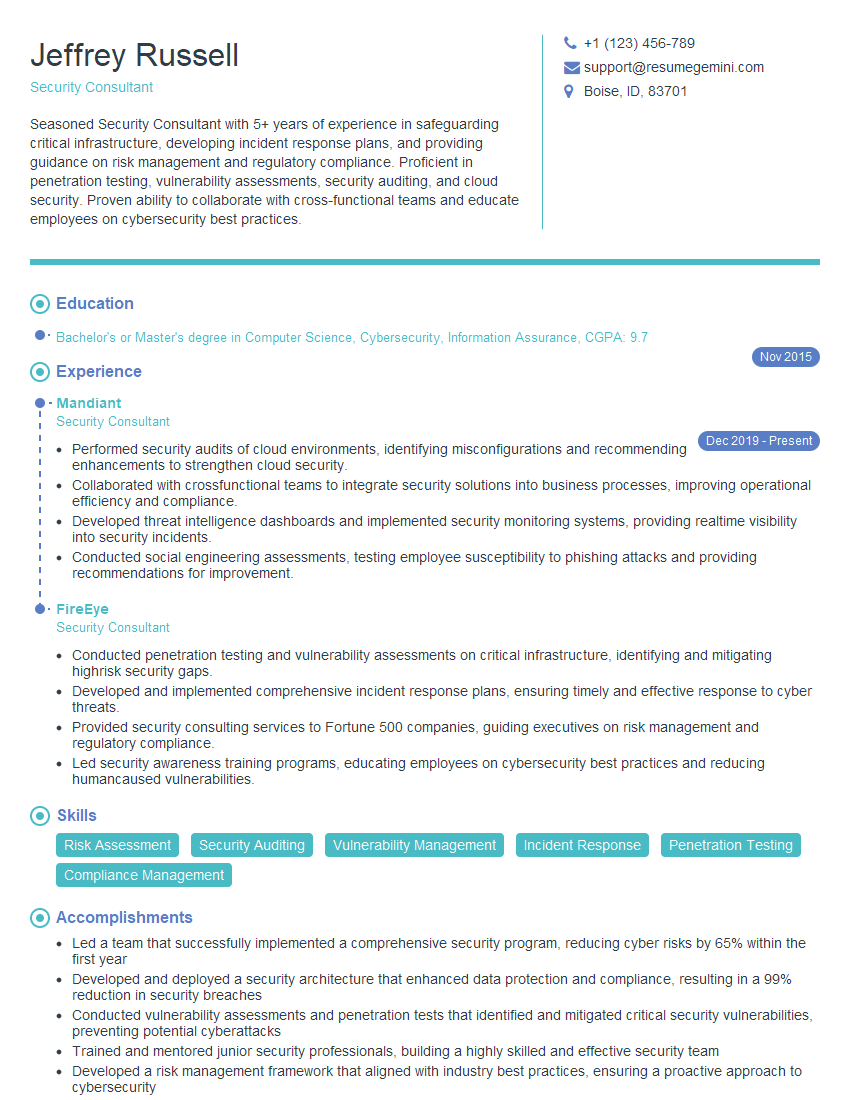
Security Consultant Resume Sample
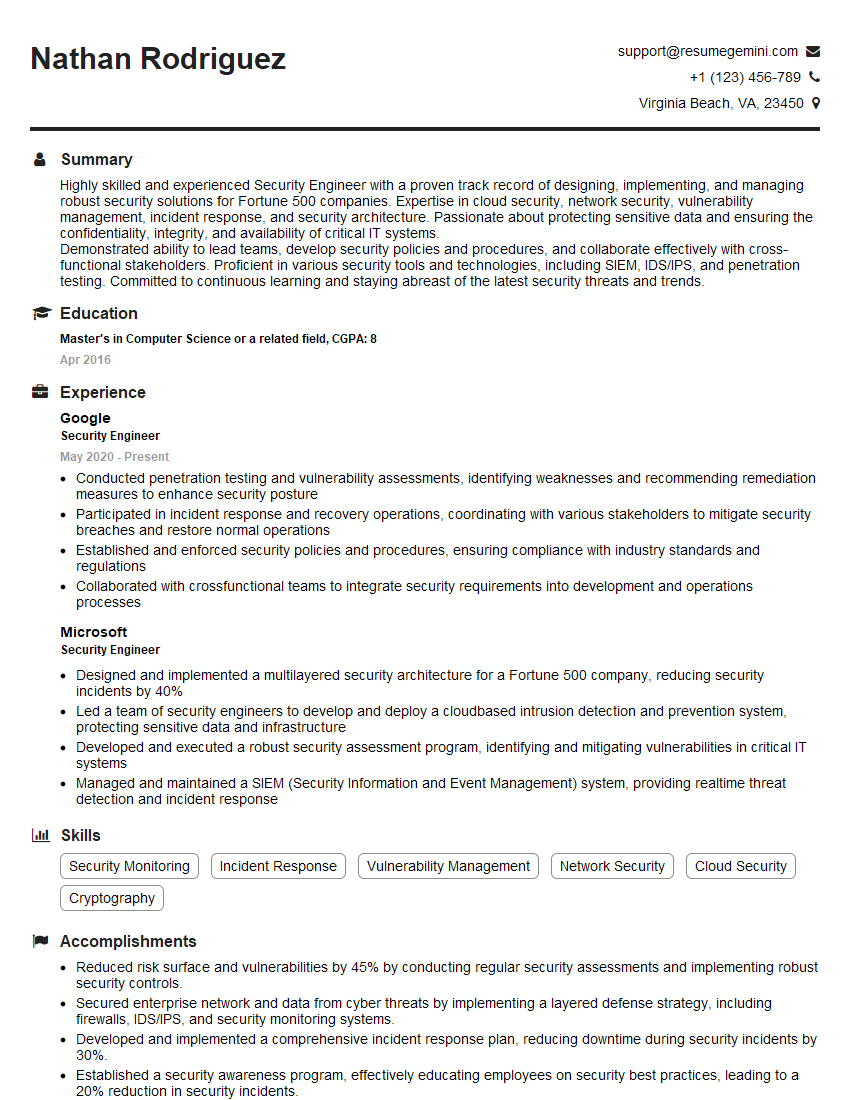
Security Engineer Resume Sample
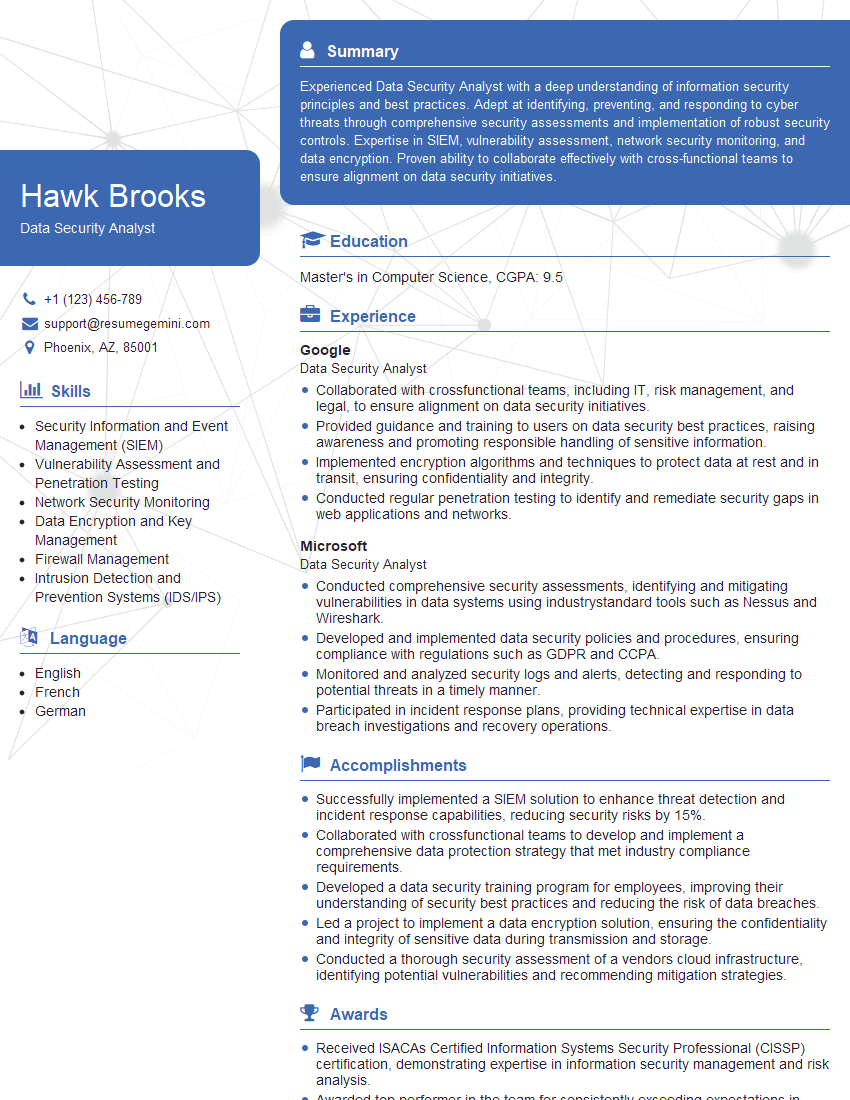
Data Security Analyst Resume Sample
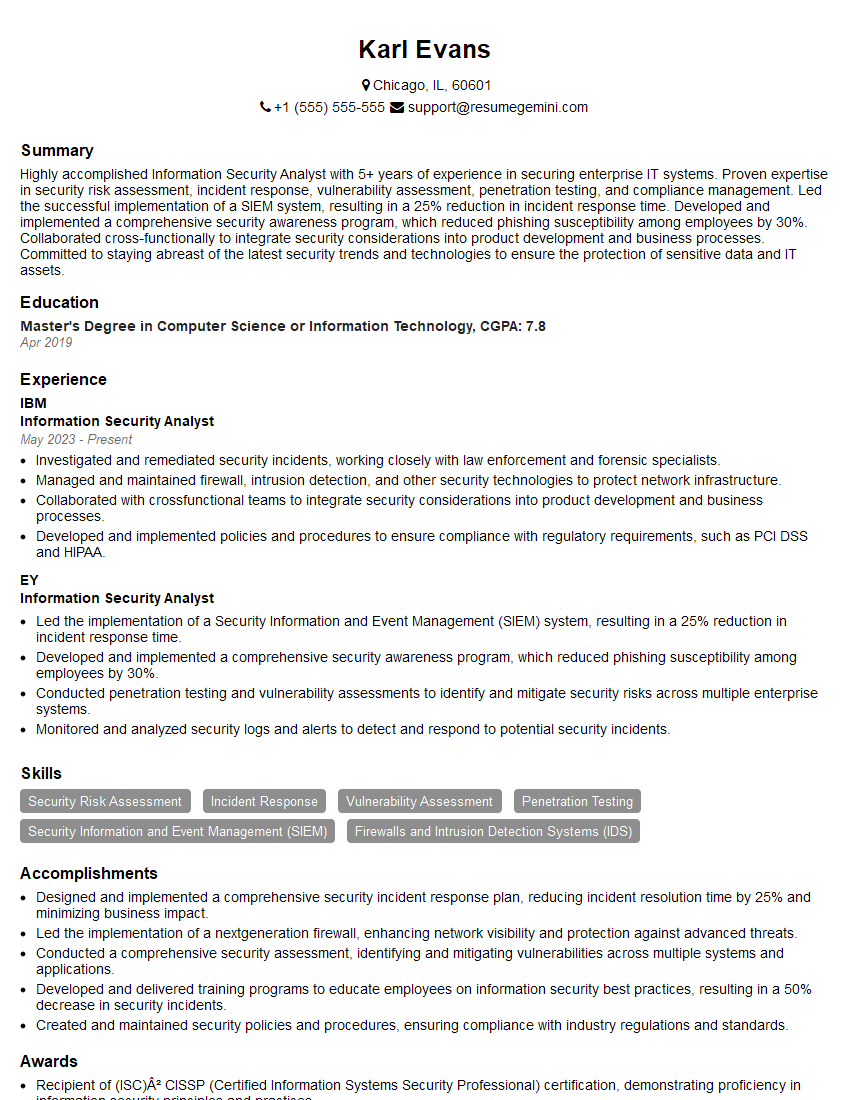
Information Security Analyst Resume Sample
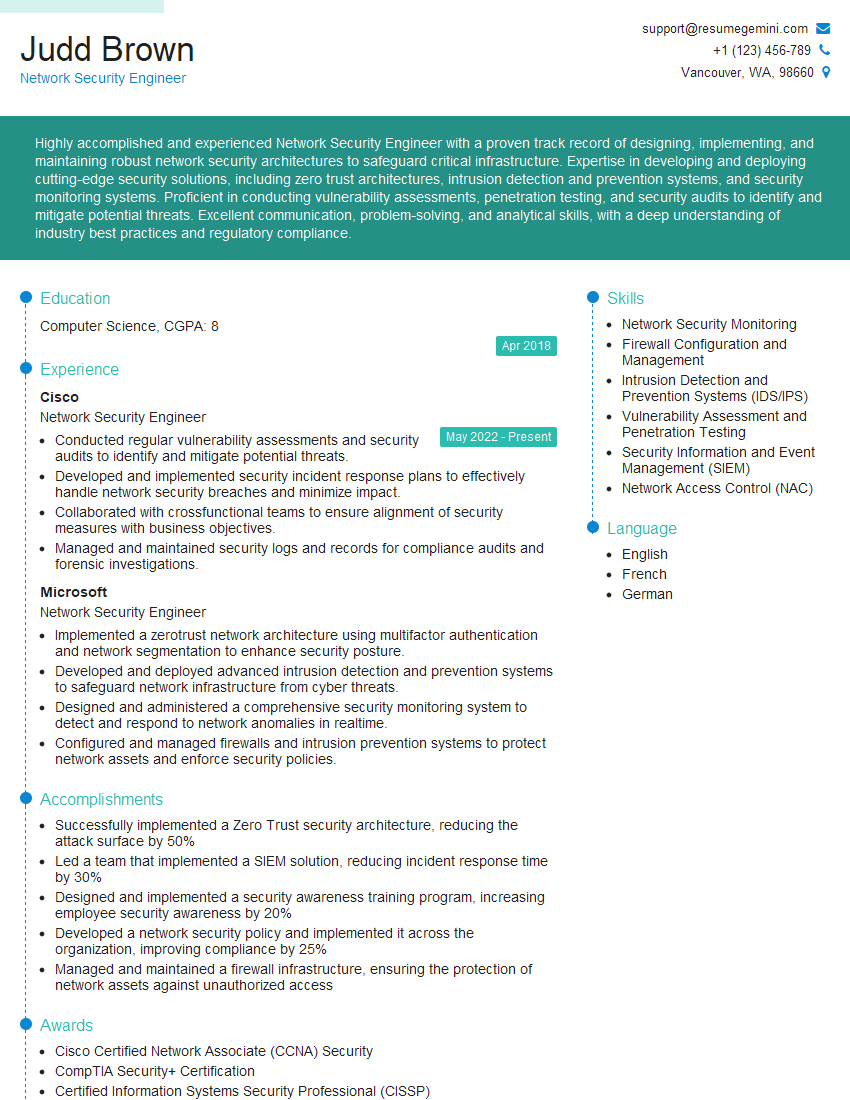
Network Security Engineer Resume Sample
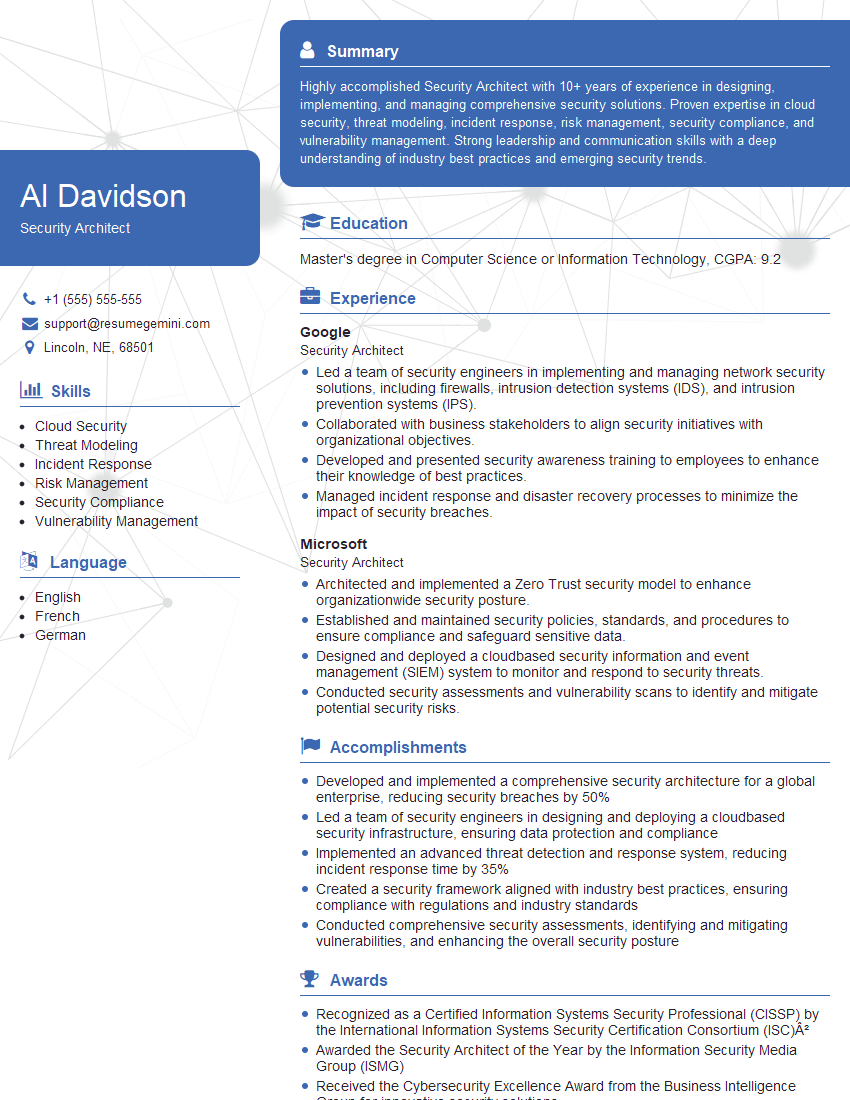
Security Architect Resume Sample

Cryptographer Resume Sample
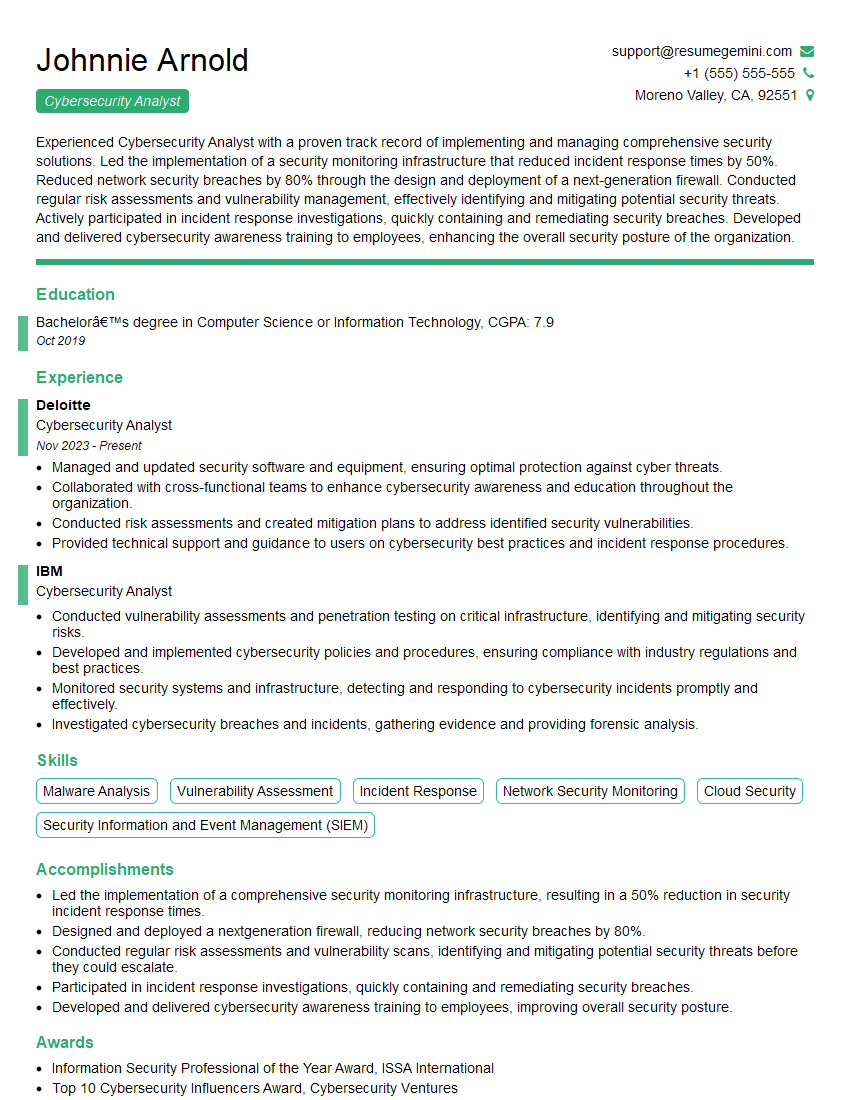
Cybersecurity Analyst Resume Sample
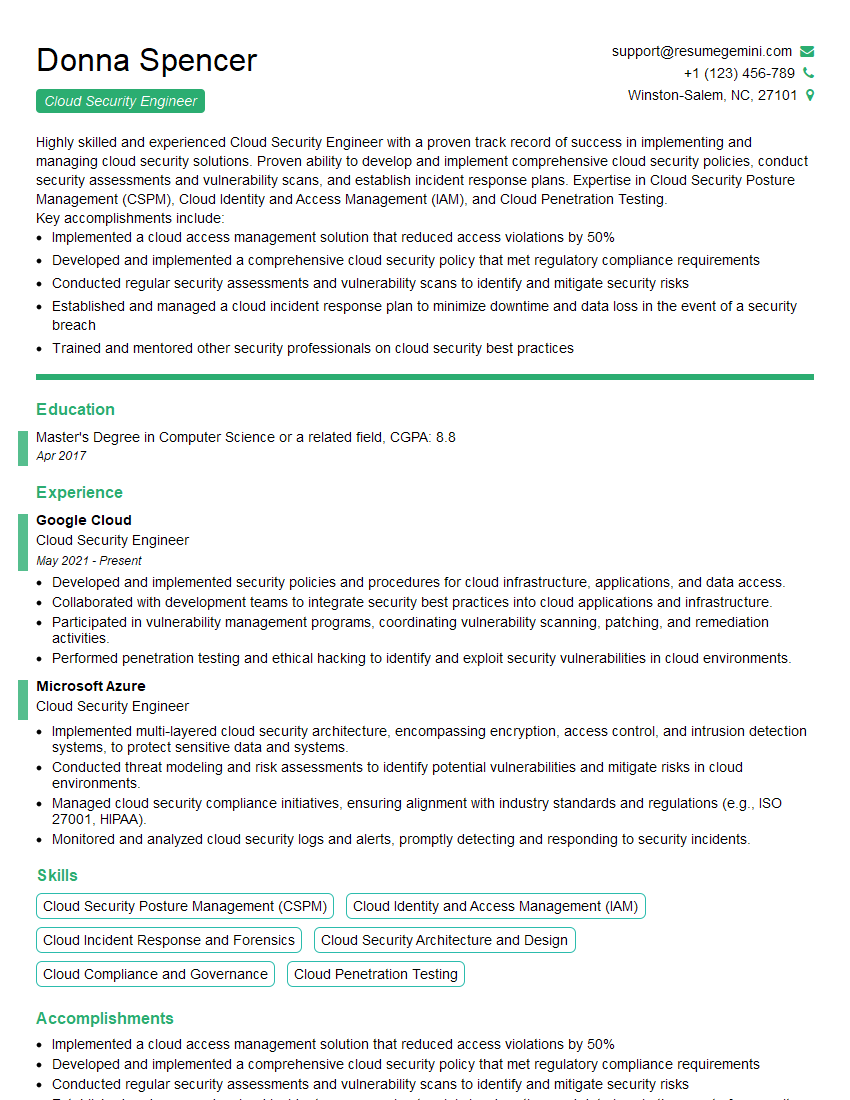
Cloud Security Engineer Resume Sample
Explore more articles
Users Rating of Our Blogs
Share Your Experience
We value your feedback! Please rate our content and share your thoughts (optional).
What Readers Say About Our Blog
Hello,
we currently offer a complimentary backlink and URL indexing test for search engine optimization professionals.
You can get complimentary indexing credits to test how link discovery works in practice.
No credit card is required and there is no recurring fee.
You can find details here:
https://wikipedia-backlinks.com/indexing/
Regards
NICE RESPONSE TO Q & A
hi
The aim of this message is regarding an unclaimed deposit of a deceased nationale that bears the same name as you. You are not relate to him as there are millions of people answering the names across around the world. But i will use my position to influence the release of the deposit to you for our mutual benefit.
Respond for full details and how to claim the deposit. This is 100% risk free. Send hello to my email id: [email protected]
Luka Chachibaialuka
Hey interviewgemini.com, just wanted to follow up on my last email.
We just launched Call the Monster, an parenting app that lets you summon friendly ‘monsters’ kids actually listen to.
We’re also running a giveaway for everyone who downloads the app. Since it’s brand new, there aren’t many users yet, which means you’ve got a much better chance of winning some great prizes.
You can check it out here: https://bit.ly/callamonsterapp
Or follow us on Instagram: https://www.instagram.com/callamonsterapp
Thanks,
Ryan
CEO – Call the Monster App
Hey interviewgemini.com, I saw your website and love your approach.
I just want this to look like spam email, but want to share something important to you. We just launched Call the Monster, a parenting app that lets you summon friendly ‘monsters’ kids actually listen to.
Parents are loving it for calming chaos before bedtime. Thought you might want to try it: https://bit.ly/callamonsterapp or just follow our fun monster lore on Instagram: https://www.instagram.com/callamonsterapp
Thanks,
Ryan
CEO – Call A Monster APP
To the interviewgemini.com Owner.
Dear interviewgemini.com Webmaster!
Hi interviewgemini.com Webmaster!
Dear interviewgemini.com Webmaster!
excellent
Hello,
We found issues with your domain’s email setup that may be sending your messages to spam or blocking them completely. InboxShield Mini shows you how to fix it in minutes — no tech skills required.
Scan your domain now for details: https://inboxshield-mini.com/
— Adam @ InboxShield Mini
Reply STOP to unsubscribe
Hi, are you owner of interviewgemini.com? What if I told you I could help you find extra time in your schedule, reconnect with leads you didn’t even realize you missed, and bring in more “I want to work with you” conversations, without increasing your ad spend or hiring a full-time employee?
All with a flexible, budget-friendly service that could easily pay for itself. Sounds good?
Would it be nice to jump on a quick 10-minute call so I can show you exactly how we make this work?
Best,
Hapei
Marketing Director
Hey, I know you’re the owner of interviewgemini.com. I’ll be quick.
Fundraising for your business is tough and time-consuming. We make it easier by guaranteeing two private investor meetings each month, for six months. No demos, no pitch events – just direct introductions to active investors matched to your startup.
If youR17;re raising, this could help you build real momentum. Want me to send more info?
Hi, I represent an SEO company that specialises in getting you AI citations and higher rankings on Google. I’d like to offer you a 100% free SEO audit for your website. Would you be interested?
Hi, I represent an SEO company that specialises in getting you AI citations and higher rankings on Google. I’d like to offer you a 100% free SEO audit for your website. Would you be interested?
good