Cracking a skill-specific interview, like one for Experience in Performing in Different Ensembles, requires understanding the nuances of the role. In this blog, we present the questions you’re most likely to encounter, along with insights into how to answer them effectively. Let’s ensure you’re ready to make a strong impression.
Questions Asked in Experience in Performing in Different Ensembles Interview
Q 1. Describe your experience adapting to different musical styles within various ensembles.
Adapting to diverse musical styles is fundamental to ensemble performance. It requires a deep understanding of musical theory, a willingness to learn, and the ability to quickly internalize different rhythmic, melodic, and harmonic approaches. My experience spans from classical chamber music, where precision and nuanced phrasing are paramount, to jazz ensembles demanding improvisation and spontaneous creativity. In classical settings, I’ve honed my skills in Baroque ornamentation, mastering the subtle variations required by different composers. For example, playing a Bach sonata requires a very different approach compared to a Mozart string quartet. In jazz, I’ve learned to listen intently to my fellow musicians, to respond to their improvisations, and to develop my own distinctive improvisational style within the context of the ensemble. This adaptability translates to a broader understanding of musical expression and the ability to contribute effectively regardless of genre.
- Classical: Focusing on precise articulation, historical performance practices, and dynamic contrasts.
- Jazz: Developing improvisational skills, listening actively to bandmates, and understanding harmonic structures.
- Pop/Rock: Adapting to studio techniques, understanding the role of amplification and effects, and maintaining a consistent groove.
Q 2. How have you dealt with conflicting musical interpretations within an ensemble setting?
Conflicting interpretations are inevitable in ensemble work. My approach emphasizes open communication and mutual respect. Instead of viewing differing opinions as confrontational, I see them as opportunities for enriching the performance. I start by carefully listening to each musician’s perspective, understanding their reasoning, and identifying the core of the disagreement. Then, we engage in a collaborative discussion, exploring different interpretive possibilities while keeping the overall musical narrative in mind. We might analyze the score together, referencing historical recordings or scholarly articles if necessary. Sometimes, we’ll compromise, finding a middle ground that satisfies everyone. Other times, we’ll experiment, trying different approaches to see what works best, always with the final goal of creating the most compelling and cohesive performance. For example, in a recent performance of a Beethoven quartet, we had differing views on the tempo of a particular movement. Through careful discussion and several rehearsals experimenting with different tempos, we arrived at a consensus that enhanced the overall dramatic arc of the piece.
Q 3. Explain your process for balancing individual performance with ensemble cohesion.
Balancing individual expression with ensemble cohesion is a delicate dance. It’s not about sacrificing individuality; rather, it’s about channeling it within the framework of the ensemble’s overall sound. I believe in listening intently to others, always being mindful of blend, intonation, and balance. This involves regularly checking my own playing against the group, ensuring that my part contributes to a unified whole rather than detracting from it. Simultaneously, I strive to bring my unique musical voice to the ensemble, adding my own personal touch to the interpretation without disrupting the overall coherence. Think of it like a tapestry – each thread (individual musician) contributes its unique color and texture, but the overall design (the ensemble’s sound) must be unified and harmonious. I often use recording sessions as a tool for self-assessment. Listening back to recordings helps me identify areas where I can improve my blend with the ensemble and where my individual contribution might be strengthened without upsetting the balance.
Q 4. Detail a situation where you had to resolve a conflict within your ensemble.
In a university jazz band, a disagreement arose concerning the improvisation section of a challenging Charlie Parker tune. One soloist consistently played outside the harmonic structure, disrupting the ensemble’s cohesion. Instead of directly confronting him, I initiated a one-on-one conversation, explaining that while his creativity was admirable, it was affecting the overall balance. I suggested we work together on his improvisation, guiding him towards appropriate harmonic choices while encouraging his individual style. We spent extra rehearsal time exploring the harmony, and he began to incorporate it more effectively into his improvisations. The resolution wasn’t about stifling his creativity; it was about finding a way to integrate it harmoniously within the ensemble’s performance.
Q 5. How do you contribute to the overall sound and performance of an ensemble?
My contributions to an ensemble go beyond simply playing my part accurately. I actively contribute to the overall sound and performance through careful listening, precise intonation, and a strong rhythmic foundation. I strive to be a supportive and collaborative musician, always mindful of the blend and balance within the ensemble. I am equally comfortable leading sections, offering constructive feedback, and actively participating in discussions about interpretation and performance style. Beyond technique, I bring a positive and collaborative attitude to rehearsals and performances, fostering a supportive environment where everyone feels comfortable expressing their musical ideas.
Q 6. Describe your experience working with diverse musical personalities.
Working with diverse musical personalities has been one of the most enriching aspects of my musical journey. Each musician brings a unique set of skills, experiences, and perspectives to the ensemble. Learning to understand and appreciate these differences is key to creating a cohesive and productive working environment. I’ve worked with musicians who are highly meticulous and detail-oriented, others who are more spontaneous and intuitive, and still others who possess exceptional technical skills but might struggle with collaboration. By fostering an atmosphere of mutual respect and open communication, I’ve learned to navigate these differences effectively. This involves celebrating the strengths of each musician, offering support where needed, and always focusing on the shared goal of creating a compelling musical experience.
Q 7. How do you maintain professionalism and respect within a dynamic ensemble environment?
Maintaining professionalism and respect in a dynamic ensemble environment requires consistent effort. It’s about treating every member of the ensemble with courtesy and consideration, regardless of their experience level or personality. This includes punctuality for rehearsals and performances, active listening during discussions, and constructive feedback. I believe in fostering a collaborative spirit, respecting different opinions, and valuing the contributions of each musician. I avoid gossip and maintain a positive attitude, even when faced with challenges. When conflicts arise, I address them directly and respectfully, seeking collaborative solutions rather than engaging in confrontational behavior. My approach is always to prioritize the collective goals of the ensemble over personal preferences, ensuring that we are all working towards the shared success of the performance.
Q 8. How have you improved your musical skills by participating in different ensembles?
Participating in diverse ensembles has dramatically honed my musical skills in several ways. It’s like learning a language – each ensemble is a unique dialect. For example, playing in a string quartet necessitates incredibly precise intonation and nuanced phrasing, skills less crucial in a larger orchestra. Conversely, orchestral work develops my ability to blend my sound within a larger sonic texture and react instantly to the conductor’s interpretation. Playing in a jazz combo, on the other hand, fostered improvisation skills and a deep understanding of rhythmic complexity, something classical settings often lack. This cross-pollination of experiences has broadened my musical palette and improved my adaptability as a musician.
- Intonation and Phrasing: String quartet work significantly refined my ability to achieve perfect intonation and articulate nuanced musical phrasing.
- Blending and Dynamics: Orchestral playing honed my skills in blending my sound effectively with others and responding dynamically to the conductor.
- Improvisation and Rhythm: Jazz ensembles dramatically improved my improvisational abilities and rhythmic precision.
Q 9. Explain your understanding of ensemble dynamics and their impact on performance.
Ensemble dynamics are the invisible forces that shape a performance; they’re the glue that holds everything together. They encompass the interplay between musicians, their individual contributions, and the collective musical output. Understanding these dynamics is paramount for success. Positive dynamics foster collaboration and trust, allowing individual musicians to contribute freely and effectively. Negative dynamics, such as conflicts or a lack of communication, can lead to an uneven, disjointed performance. For instance, a lack of balanced dynamics between sections in an orchestra can lead to some sections overpowering others, obscuring the overall musical texture. Conversely, a strong sense of mutual support and understanding in a chamber ensemble allows for a powerful and emotionally resonant performance. My experience has taught me the importance of active listening, clear communication, and mutual respect in building positive ensemble dynamics.
The impact on performance is significant. Positive dynamics result in a cohesive, expressive, and emotionally impactful performance. Negative dynamics, on the other hand, lead to an uneven, uninspired, and potentially frustrating experience for both the performers and the audience.
Q 10. Describe your approach to rehearsing and performing with different ensembles.
My approach to rehearsing and performing with different ensembles is adaptable, but always grounded in preparation, communication, and a willingness to learn. Before each rehearsal, I thoroughly prepare the music, analyzing the score for challenges and potential problems. During rehearsals, I actively listen to others, offering constructive feedback and readily accepting it. I always strive to understand the director’s vision and contribute to a shared musical goal. Performance is about more than technical precision. It involves interpreting the music emotionally, connecting with my fellow musicians, and conveying that connection to the audience. With larger ensembles, I focus on listening carefully to my section and the broader ensemble to ensure a cohesive sound. In smaller groups, the emphasis shifts to more nuanced communication and a heightened awareness of individual dynamics and phrasing.
Q 11. How do you handle constructive criticism from fellow ensemble members?
Constructive criticism is invaluable for growth. I approach feedback from fellow ensemble members with an open mind, seeing it as an opportunity to improve. I listen actively, clarifying any points I don’t understand. I try to see the criticism from their perspective, understanding that it’s usually intended to enhance the overall performance, not to attack my abilities. For example, if a fellow musician suggests a different bowing technique, I won’t take it personally. Instead, I’ll analyze their suggestion, try it out, and assess whether it improves my playing and contributes to the overall sound of the ensemble. Even if I don’t immediately agree, I value the perspective and will consider its merits carefully. Open communication and mutual respect are key to handling constructive criticism positively.
Q 12. Discuss your experience with sight-reading in different ensemble settings.
Sight-reading proficiency varies greatly across ensembles. In some groups, sight-reading is a regular occurrence, like in community orchestras where new repertoire is frequently introduced. In others, like professional ensembles, the focus is on meticulous preparation and polish of pre-selected pieces. My approach adapts to the situation. In situations requiring frequent sight-reading, I prioritize understanding the overall structure and harmonic progressions of the piece, focusing on accuracy and rhythmic precision rather than perfection of nuance. I also practice my sight-reading skills regularly, utilizing various resources and strategies to maintain fluency and improve my accuracy. In settings where polished performances are paramount, the focus shifts entirely to careful preparation and practice.
Q 13. Describe a time you had to quickly learn a new piece for an ensemble performance.
One memorable instance involved a last-minute substitution in a regional orchestra. A flutist fell ill the day before a concert, and as a capable substitute, I was thrust into playing a challenging concerto I’d never seen before. My approach was systematic: I first analyzed the score to identify technical hurdles and melodic passages, then practiced sections focusing on clarity and accuracy. I prioritized memorizing the overall structure and harmonic flow rather than every note. I focused on the most crucial sections and worked with the conductor to adjust any challenging parts. Despite the time constraint, the performance went well. This experience taught me the importance of quick musical analysis and efficient practice techniques under pressure. It also reinforced the value of adaptability and collaboration within an ensemble setting.
Q 14. How do you manage your time effectively while participating in multiple ensembles?
Managing multiple ensemble commitments requires meticulous planning and time management skills. I utilize a digital calendar to track rehearsals, performances, and individual practice time, ensuring I have a clear overview of my commitments. I prioritize tasks, focusing on deadlines and the urgency of each commitment. I also dedicate specific blocks of time for each ensemble, avoiding scheduling conflicts wherever possible. Efficient practice techniques—targeted practice of challenging passages rather than mindlessly running through the entire piece—also help me make the most of my limited practice time. Furthermore, open communication with conductors and fellow musicians regarding scheduling conflicts ensures a smooth and collaborative experience across all my ensembles.
Q 15. Explain your experience with improvisation within an ensemble context.
Improvisation in an ensemble setting is a dynamic process requiring quick thinking, active listening, and a deep understanding of musical context. It’s not simply about playing random notes; it’s about contributing meaningfully to the collective musical narrative. My experience spans various genres, from jazz combos to contemporary chamber groups. In jazz, for instance, I’ve honed my skills in responding to chord changes and melodic improvisations from other musicians, building solos that both complement and contrast their contributions. This involves constant listening, interpreting the musical direction, and offering my own voice within the existing harmonic framework. In contemporary settings, improvisation often involves exploring textural and rhythmic ideas collaboratively, creating spontaneous musical landscapes that evolve organically through group interaction. A memorable example is a performance with a string quartet where we improvised a response to a spoken word poem, developing a rich sonic tapestry that reflected the poem’s emotional trajectory.
In both jazz and contemporary settings, successful improvisation relies heavily on understanding the musical ‘conversation’ happening in real-time. It’s a delicate balance between individual expression and ensemble cohesion. I’ve found that effective improvisation hinges on strong foundational skills in harmony, rhythm, and melody, coupled with a willingness to take risks and respond intuitively to the musical flow.
Career Expert Tips:
- Ace those interviews! Prepare effectively by reviewing the Top 50 Most Common Interview Questions on ResumeGemini.
- Navigate your job search with confidence! Explore a wide range of Career Tips on ResumeGemini. Learn about common challenges and recommendations to overcome them.
- Craft the perfect resume! Master the Art of Resume Writing with ResumeGemini’s guide. Showcase your unique qualifications and achievements effectively.
- Don’t miss out on holiday savings! Build your dream resume with ResumeGemini’s ATS optimized templates.
Q 16. How have you learned from your mistakes while performing with ensembles?
Mistakes are inevitable in ensemble performance, but they are invaluable learning opportunities. I approach them as a chance for growth rather than a setback. For example, during a particularly challenging performance of a complex orchestral piece, I missed an entrance, throwing off the balance of my section. Instead of dwelling on the error, I immediately focused on recovering, listening intently to the other players to re-establish my place, and ensuring I didn’t compound the mistake. Post-performance, I analyzed the situation, identifying the factors that contributed to the error – perhaps insufficient rehearsal time focusing on that specific passage or a lack of attention to detail during the performance itself. This self-reflection informs my preparation for future performances, leading to more meticulous rehearsal strategies and an increased focus on mental preparation and mindfulness during performance.
Learning from mistakes also often involves seeking feedback from fellow musicians and conductors. Their perspective provides valuable insight into areas for improvement. Constructive criticism helps me pinpoint specific technical issues or interpretative flaws, leading to targeted practice and refined performance.
Q 17. Describe your experience with leadership roles in ensembles.
I’ve held various leadership roles in ensembles, ranging from section leader in an orchestra to co-director of a chamber music group. In orchestral settings, leading my section involved guiding intonation, dynamics, and articulation, ensuring a cohesive and expressive sound. This role taught me the importance of clear communication, active listening, and the ability to motivate others. In the chamber music group, the co-director role involved shared responsibility for programming, rehearsal planning, and artistic vision. This collaborative leadership fostered a strong sense of shared ownership and empowered each member to contribute actively to the ensemble’s development.
Leading an ensemble requires more than just technical proficiency; it’s about fostering a positive and productive working environment. I strive to create a space where all members feel comfortable contributing their ideas, sharing concerns, and supporting one another. This involves clear communication, active listening, and a genuine respect for each member’s contributions.
Q 18. How do you contribute to the positive morale and camaraderie of an ensemble?
Positive morale and camaraderie are essential for a successful ensemble. I contribute to this by fostering an environment of mutual respect, open communication, and shared support. This involves active listening to my fellow musicians, offering constructive feedback, celebrating successes, and offering encouragement during challenging moments. I believe in the importance of social interaction outside of rehearsals and performances, such as informal gatherings, to build personal connections and strengthen the bonds between ensemble members. Sharing meals together, engaging in conversations, and simply getting to know each other on a personal level helps create a more cohesive and supportive group dynamic. Small gestures like offering a helping hand with equipment or sharing a joke can also contribute significantly to building a positive group atmosphere. A strong sense of camaraderie not only enhances the musical outcome but also creates a fulfilling and enjoyable experience for everyone involved.
Q 19. Describe your experience performing in high-pressure situations with an ensemble.
Performing in high-pressure situations, such as large concerts or competitions, requires a blend of technical proficiency, mental resilience, and teamwork. I’ve experienced these situations numerous times – from performing a concerto with a full orchestra to playing chamber music in an international competition. My strategy for managing pressure involves thorough preparation: rigorous practice, meticulous attention to detail, and mentally rehearsing performance scenarios. On the day of the performance, I focus on managing my nerves through deep breathing exercises and mindfulness techniques. Within the ensemble, mutual support and trust become even more crucial. A shared understanding and unspoken communication between players are essential for navigating unexpected challenges or overcoming collective anxieties. A supportive and encouraging atmosphere within the group can significantly reduce individual pressure and enhance the collective performance.
One memorable instance involved a sudden power outage during a performance. Through calm communication and collaborative problem-solving, our ensemble adjusted dynamically, continuing with the performance a cappella until the power was restored. This experience highlighted the importance of adaptability, teamwork, and shared responsibility under pressure.
Q 20. How do you maintain accuracy and precision while playing in a large ensemble?
Maintaining accuracy and precision in a large ensemble necessitates a multifaceted approach. Firstly, a strong foundation in fundamental musical skills is paramount. This includes impeccable rhythmic precision, accurate intonation, and a clear understanding of the musical score. Secondly, active listening is crucial. In a large group, the subtle nuances of individual parts can easily get lost. By actively listening to the other musicians, I can adjust my playing to ensure accurate balance and coordination. Thirdly, efficient rehearsal strategies are essential. This includes focused attention to detail during rehearsals, paying attention to specific challenges, and working collaboratively to address any issues with ensemble balance or clarity. Fourthly, mental preparation plays a vital role. I find that focusing my attention, employing mental imagery, and practicing mindfulness techniques help ensure a steady and accurate performance.
Q 21. Describe your experience with ensemble blending and balance.
Ensemble blending and balance is a crucial aspect of creating a unified and cohesive musical sound. It involves careful consideration of several factors: intonation, dynamics, timbre, and articulation. Achieving balance necessitates careful listening to the overall sonic texture and adjusting one’s own playing to complement and support the other instrumental voices. In a string quartet, for example, achieving balance might involve adjusting bowing techniques to control the volume of individual instruments, ensuring the melody is clearly audible while the accompaniment maintains its supportive role. In a larger ensemble, the conductor’s guidance is essential in shaping the overall balance and ensuring that no single section dominates the sonic landscape. Achieving a well-balanced sound is an iterative process, often refined through ongoing discussion, feedback, and meticulous rehearsal work. It is a collaborative effort requiring sensitivity to the nuances of each instrument and a shared artistic vision among all the players.
Q 22. How do you cope with the demands of preparing for multiple ensemble performances simultaneously?
Juggling multiple ensemble rehearsals simultaneously requires meticulous planning and prioritization. It’s akin to managing multiple projects with overlapping deadlines. My approach involves creating detailed calendars that break down rehearsals by date, time, and specific tasks. This allows me to allocate my practice time efficiently, focusing on sections requiring the most attention for each ensemble.
For example, if I’m preparing for a string quartet performance and a wind ensemble concert concurrently, I might dedicate mornings to mastering the quartet’s intricate harmonies and afternoons to practicing my wind instrument’s challenging passages. I also prioritize efficient practice strategies, such as targeted repetition and focused listening to recordings, maximizing the effectiveness of my limited practice time.
Furthermore, effective communication with conductors is crucial. Keeping them informed of potential scheduling conflicts allows for flexibility and understanding. This proactive communication helps prevent unnecessary stress and ensures I can contribute my best to each ensemble.
Q 23. How do you adapt your playing style to suit different instrumental combinations within an ensemble?
Adapting my playing style to different instrumental combinations requires a deep understanding of ensemble dynamics and timbre. It’s similar to adjusting your voice in a conversation – you speak differently to a friend than you do to a large audience. In an ensemble, the same applies.
- Balance: In a chamber ensemble, I might need to play with a lighter touch to avoid overwhelming other instruments with a stronger tone. In a larger orchestra, a bolder approach might be necessary for my part to cut through the larger sonic texture.
- Phrasing: My phrasing might need to be more concise and precise in a small ensemble to maintain clarity, while in a larger ensemble, longer, more expansive phrasing might be appropriate.
- Articulation: I adapt my articulation to enhance the overall ensemble sound. For example, I might use staccato more frequently in a piece requiring clarity and precision, while employing legato in a piece that demands a more flowing and connected tone.
For instance, playing the oboe in a string quartet demands a different approach than playing it in a full orchestra. In the quartet, my phrasing and dynamics must be meticulously balanced to integrate seamlessly with the strings. In the orchestra, I need to project my sound more powerfully to ensure my part is audible amongst the larger group of instruments.
Q 24. Explain your experience with performing contemporary music in an ensemble setting.
Performing contemporary music presents unique challenges and rewards. It often involves grappling with unconventional notation, extended techniques, and ambiguous interpretations. My experience with contemporary music ensembles has sharpened my ability to think critically and creatively about musical interpretation.
One project involved performing a piece that incorporated electronics and live instrumentation. We spent considerable time exploring the interaction between the electronic elements and the acoustic instruments, ensuring seamless integration and a cohesive performance. This required not only technical proficiency but also a deep understanding of the composer’s intentions and the overall musical narrative.
Another example involved working with a composer directly. This collaborative process allowed for a deeper understanding of the piece’s origins and nuances. The direct feedback and interpretation insights from the composer helped bring new meaning and depth to the performance. This experience highlighted the importance of communication and teamwork in contemporary music performance.
Q 25. Describe your experience with different conducting styles and their impact on ensemble performance.
Different conductors have vastly different approaches, impacting ensemble performance significantly. It’s like having different chefs preparing the same dish; the result will vary based on their unique styles and preferences.
- Precision-focused conductors emphasize accuracy and detail, often using precise gestures and verbal cues. This demands a high level of technical mastery and responsiveness from the ensemble.
- Emotionally-driven conductors focus on conveying the emotional essence of the music. This requires sensitivity and a keen awareness of the overall emotional arc of the piece.
- Collaborative conductors emphasize open communication and shared artistic vision. This fosters a sense of ownership and engagement from the ensemble members, allowing for a more dynamic and nuanced performance.
I’ve worked with conductors across the spectrum. Learning to adapt to their individual styles has been invaluable. It has fostered my adaptability and enriched my understanding of how different approaches can shape a musical interpretation. This adaptability also helps me to respond effectively to the needs of each individual conductor and ensemble.
Q 26. Discuss your experience with using technology to enhance ensemble rehearsals and performances.
Technology plays an increasingly important role in enhancing ensemble rehearsals and performances. Tools such as recording software, digital notation programs, and online collaboration platforms have revolutionized how we approach ensemble music-making.
- Recording Software: We use recording software to capture rehearsals and performances for analysis. This allows us to pinpoint areas for improvement, such as intonation issues, rhythmic inaccuracies, or balance problems. Listening back objectively to a performance aids immensely in fine-tuning.
- Digital Notation Programs: These platforms allow for efficient score sharing and annotation, facilitating collaborative rehearsal preparation and score revisions.
- Online Collaboration Platforms: These platforms facilitate communication and file sharing among ensemble members, regardless of geographical location. This is particularly useful for geographically dispersed ensembles.
For instance, during a recent project, we used video conferencing to share recordings of our individual practice sessions, allowing for immediate feedback and collaborative refinement before in-person rehearsals. This significantly streamlined the rehearsal process and improved the final product.
Q 27. How do you balance artistic expression with technical proficiency in an ensemble context?
Balancing artistic expression with technical proficiency is a constant challenge in ensemble performance. It’s like a tightrope walk – you need both skill and grace to succeed. Technical proficiency provides the foundation, allowing for confident and accurate execution of the musical ideas. Artistic expression gives life and meaning to the notes on the page.
I approach this balance through a rigorous practice regimen that combines technical drills with expressive exploration. This might involve spending time perfecting a tricky passage before focusing on shaping the phrase to convey the desired emotion. The goal is not simply to play the notes correctly, but to bring the composer’s vision to life with nuance and feeling.
For example, playing a lyrical melody demands not only accuracy in pitch and rhythm but also an understanding of the emotional arc of the melody. This understanding informs choices in phrasing, dynamics, and articulation to enhance the expressive quality of the music, ensuring both technical precision and emotional depth.
Q 28. Describe your experience with preparing for and participating in auditions for different ensembles.
Auditions for ensembles are highly competitive and require thorough preparation. My approach involves a multi-faceted strategy focusing on technical and musical elements.
- Repertoire Selection: I carefully choose audition pieces that showcase my strengths and align with the ensemble’s stylistic preferences. This requires researching the ensemble’s past performances and understanding their musical priorities.
- Technical Mastery: I dedicate significant practice time to ensure technical proficiency. This involves focused exercises on challenging passages, meticulous attention to detail, and working on any technical weaknesses.
- Musical Interpretation: I invest time in shaping a compelling musical interpretation, ensuring that my performance is not just technically accurate but also artistically engaging. This involves in-depth analysis of the chosen pieces.
- Presentation: I ensure my audition is well-organized and professional. This includes paying attention to posture, attire, and confident stage presence.
I’ve participated in numerous auditions, from small chamber groups to large orchestras. Each experience has taught me valuable lessons about effective preparation and performance under pressure. The ability to perform convincingly under pressure is crucial for any musician.
Key Topics to Learn for Experience in Performing in Different Ensembles Interview
- Adaptability and Collaboration: Discuss your experiences adjusting your performance style to suit various ensemble contexts (e.g., orchestra, chamber group, jazz band). Highlight instances of effective teamwork and communication within diverse groups.
- Role Understanding and Contribution: Explain how you understood your specific role within each ensemble and how you contributed to the overall performance. This includes understanding musical parts, dynamics, and your individual responsibility within a larger group sound.
- Problem-solving in a Collaborative Setting: Describe situations where you encountered challenges (e.g., musical disagreements, technical difficulties) within an ensemble and how you actively participated in finding solutions. Show your ability to mediate and compromise.
- Musicality and Interpretation: Explain how your approach to musical interpretation varied across different ensembles. Discuss how you adapted your personal style while maintaining the integrity of the overall performance.
- Leadership and Followership: Discuss instances where you took on a leadership role within an ensemble, and also where you effectively followed a conductor or other leader. Highlight your ability to work both independently and collaboratively.
- Technical Proficiency and Preparation: Detail your approach to practicing and preparing for performances in different ensembles, showcasing your commitment to individual and group rehearsals.
Next Steps
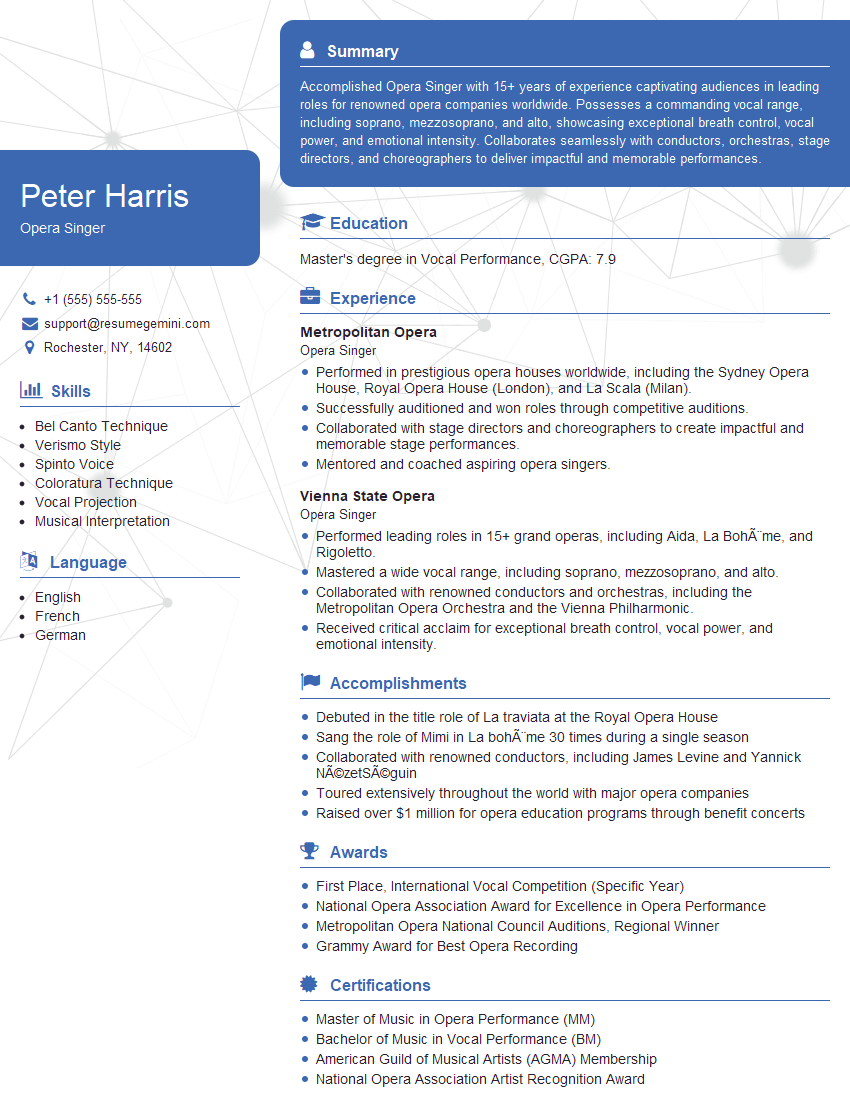
Mastering the art of performing in diverse ensembles demonstrates crucial transferable skills highly valued by employers: teamwork, adaptability, communication, and problem-solving. These skills are assets in any collaborative environment. To showcase these abilities effectively, crafting an ATS-friendly resume is critical for maximizing your job prospects. ResumeGemini can help you build a powerful, professional resume that highlights your unique experiences and skills. We provide examples of resumes tailored to showcase experience in performing in different ensembles to help you present yourself effectively.
Explore more articles
Users Rating of Our Blogs
Share Your Experience
We value your feedback! Please rate our content and share your thoughts (optional).
What Readers Say About Our Blog
Hello,
we currently offer a complimentary backlink and URL indexing test for search engine optimization professionals.
You can get complimentary indexing credits to test how link discovery works in practice.
No credit card is required and there is no recurring fee.
You can find details here:
https://wikipedia-backlinks.com/indexing/
Regards
NICE RESPONSE TO Q & A
hi
The aim of this message is regarding an unclaimed deposit of a deceased nationale that bears the same name as you. You are not relate to him as there are millions of people answering the names across around the world. But i will use my position to influence the release of the deposit to you for our mutual benefit.
Respond for full details and how to claim the deposit. This is 100% risk free. Send hello to my email id: [email protected]
Luka Chachibaialuka
Hey interviewgemini.com, just wanted to follow up on my last email.
We just launched Call the Monster, an parenting app that lets you summon friendly ‘monsters’ kids actually listen to.
We’re also running a giveaway for everyone who downloads the app. Since it’s brand new, there aren’t many users yet, which means you’ve got a much better chance of winning some great prizes.
You can check it out here: https://bit.ly/callamonsterapp
Or follow us on Instagram: https://www.instagram.com/callamonsterapp
Thanks,
Ryan
CEO – Call the Monster App
Hey interviewgemini.com, I saw your website and love your approach.
I just want this to look like spam email, but want to share something important to you. We just launched Call the Monster, a parenting app that lets you summon friendly ‘monsters’ kids actually listen to.
Parents are loving it for calming chaos before bedtime. Thought you might want to try it: https://bit.ly/callamonsterapp or just follow our fun monster lore on Instagram: https://www.instagram.com/callamonsterapp
Thanks,
Ryan
CEO – Call A Monster APP
To the interviewgemini.com Owner.
Dear interviewgemini.com Webmaster!
Hi interviewgemini.com Webmaster!
Dear interviewgemini.com Webmaster!
excellent
Hello,
We found issues with your domain’s email setup that may be sending your messages to spam or blocking them completely. InboxShield Mini shows you how to fix it in minutes — no tech skills required.
Scan your domain now for details: https://inboxshield-mini.com/
— Adam @ InboxShield Mini
Reply STOP to unsubscribe
Hi, are you owner of interviewgemini.com? What if I told you I could help you find extra time in your schedule, reconnect with leads you didn’t even realize you missed, and bring in more “I want to work with you” conversations, without increasing your ad spend or hiring a full-time employee?
All with a flexible, budget-friendly service that could easily pay for itself. Sounds good?
Would it be nice to jump on a quick 10-minute call so I can show you exactly how we make this work?
Best,
Hapei
Marketing Director
Hey, I know you’re the owner of interviewgemini.com. I’ll be quick.
Fundraising for your business is tough and time-consuming. We make it easier by guaranteeing two private investor meetings each month, for six months. No demos, no pitch events – just direct introductions to active investors matched to your startup.
If youR17;re raising, this could help you build real momentum. Want me to send more info?
Hi, I represent an SEO company that specialises in getting you AI citations and higher rankings on Google. I’d like to offer you a 100% free SEO audit for your website. Would you be interested?
Hi, I represent an SEO company that specialises in getting you AI citations and higher rankings on Google. I’d like to offer you a 100% free SEO audit for your website. Would you be interested?
good