Cracking a skill-specific interview, like one for Experience with Multiple Keyboard Instruments, requires understanding the nuances of the role. In this blog, we present the questions you’re most likely to encounter, along with insights into how to answer them effectively. Let’s ensure you’re ready to make a strong impression.
Questions Asked in Experience with Multiple Keyboard Instruments Interview
Q 1. Compare and contrast the sonic capabilities of a piano and a synthesizer.
The sonic capabilities of a piano and a synthesizer are vastly different, stemming from their fundamental sound production mechanisms. A piano produces sound acoustically; hammers strike strings, causing them to vibrate and resonate within the instrument’s soundboard. This results in a rich, complex timbre with a unique harmonic structure dependent on the string’s material, length, and tension. The sound is naturally decaying and nuanced, influenced by the pianist’s touch. Synthesizers, on the other hand, generate sound electronically. They utilize oscillators to create waveforms (sine, sawtooth, square, etc.), which are then processed through filters, amplifiers, and effects to shape the sound’s timbre. This allows for a nearly limitless range of sonic possibilities, from realistic instrument simulations to completely abstract and futuristic sounds.
Comparison: Both instruments offer a wide keyboard range for melodic and harmonic playing. Both can be used to create a wide variety of musical expressions. However, the piano offers a consistently warm, organic tone, while a synthesizer allows for manipulation of nearly every aspect of the sound’s texture and character.
Contrast: The piano’s sound is fundamentally limited by its physical construction, while a synthesizer is only limited by the creativity and technology of its user and manufacturer. A piano requires maintenance (tuning etc.), whereas synthesizers are typically more durable and require less maintenance.
Q 2. Describe your experience with different types of keyboards (e.g., acoustic piano, electric piano, synthesizer, organ).
My experience spans a wide range of keyboard instruments. I began with classical piano training on an acoustic grand piano, learning to appreciate the nuances of touch sensitivity and the instrument’s inherent resonance. This foundational training provided a strong understanding of music theory, harmony, and phrasing. Later, I explored electric pianos, valuing their versatility—the ability to layer sounds, add effects, and control volume without the limitations of an acoustic instrument. I’ve extensively used various synthesizers, from analog monosynths to digital workstations, each offering unique possibilities for sound design and manipulation. The exploration of sound design has been critical for my understanding of timbre, texture, and the creation of unique sonic landscapes. Finally, I have experience playing pipe organs, understanding the complex mechanics of stop control, registration, and the breathtaking power and range of these majestic instruments. This has significantly improved my understanding of voicing and counterpoint.
Each instrument has broadened my musical understanding, and the skills I’ve acquired on one instrument have often translated to others, enriching my overall keyboard proficiency.
Q 3. Explain your proficiency in music notation software and its use in keyboard arrangements.
I’m proficient in several music notation software packages, including Sibelius and Finale. These programs are essential tools for creating accurate scores, arranging music for multiple keyboards, and meticulously notating complex harmonic and rhythmic structures. For keyboard arrangements, I often use these programs to:
- Score creation: Notate melodies, harmonies, and rhythms accurately for both individual parts and ensembles.
- Part writing: Create individual keyboard parts with appropriate voicing, textures, and ranges.
- Layout and formatting: Ensure the score is clearly organized and easy to read.
- MIDI editing: Program and edit MIDI data for more advanced instrumental and synthesizer patches.
- Collaboration: Share my arrangements with other musicians efficiently.
For example, when arranging a piece for two pianos, I use the software’s functions to create separate staves for each piano, ensuring the voicing and dynamics complement each other. I leverage the software’s playback functionality to refine the arrangement and spot any potential issues in the overall sound.
Q 4. How do you approach learning a new keyboard instrument?
Learning a new keyboard instrument involves a structured and multifaceted approach. First, I familiarize myself with the instrument’s unique characteristics: its range, sound capabilities, and specific playing techniques. This often involves researching the instrument’s history and prominent players. Next, I start with basic exercises to develop finger dexterity and coordination, focusing on scales, arpeggios, and chords relevant to the instrument’s unique layout or design. Simultaneously, I begin learning repertoire suited to my current skill level, gradually increasing in complexity. I also try to find a good teacher or mentor who possesses experience with the particular instrument. This structured approach has helped me quickly develop proficiency on new keyboards.
Q 5. What are your preferred methods for practicing keyboard skills?
My practice methods are tailored to my goals and the specific instrument. However, some key elements remain constant: Regular, focused practice sessions, incorporating technical exercises (scales, arpeggios, chords), sight-reading, and repertoire study. I break down complex pieces into smaller, manageable sections, focusing on technical challenges and musical phrasing. I regularly record myself playing to assess progress and identify areas for improvement. Regular listening to recordings of accomplished musicians on the chosen instrument also inspires and informs my practice. Further, I believe in the importance of balanced practice — incorporating varied exercises to avoid repetitive strain injury and maintaining a healthy balance between technical skill and musical expression.
Q 6. Describe your experience with improvisation on multiple keyboard instruments.
Improvisation is a cornerstone of my keyboard playing across various instruments. My approach begins with a strong understanding of harmony and rhythm. On the piano, I might improvise using chord progressions and scales, exploring different voicings and textures. With synthesizers, I often employ sound design as a tool for improvisation, creating evolving sonic textures and manipulating parameters in real-time. The pipe organ presents a different challenge, necessitating a deeper understanding of registration and voicing to effectively create improvisational lines that blend with the instrument’s inherent characteristics. The process of improvisation always begins with an idea, and through the process of creative experimentation, the piece emerges. I regularly record my improvisation sessions to track my progress and analyze my musical ideas.
Q 7. How do you adapt your keyboard playing to different musical genres?
Adapting my keyboard playing to different musical genres involves understanding the genre’s stylistic conventions and technical requirements. For instance, playing jazz requires a different approach than playing classical music. Jazz often involves improvisation, complex chord voicings, and a swing feel, while classical music emphasizes technical precision, expressive phrasing, and a nuanced touch. I approach each genre by studying the music of leading artists in that style, analyzing their techniques, and incorporating their stylistic elements into my own playing. I also adapt my sound selection and use of effects to align with the stylistic conventions of the genre, using appropriate sounds to capture the essence and atmosphere of the music.
Q 8. Discuss your experience with live performance on multiple keyboards.
Live performance on multiple keyboards is all about seamless transitions and dynamic interplay. It’s not just playing two keyboards; it’s about orchestrating a sonic landscape. My experience involves coordinating diverse sounds and textures, often playing different parts simultaneously or layering them strategically. For instance, I might play a lush orchestral pad on one keyboard while simultaneously providing a rhythmic counterpoint on another, perhaps a synthesizer bassline. This requires meticulous planning of the setlist, sound checks to ensure each keyboard is properly balanced and that the sounds are distinct, but also blend well, and precise timing to switch between instruments smoothly. I’ve had the opportunity to perform in various settings, from intimate jazz clubs where subtleties are crucial, to large concert halls requiring powerful projections, and this has helped me develop the skill of adapting my approach to the space.
In a recent performance with a big band, I played a Rhodes electric piano for the ballad sections and switched to a Hammond B3 organ for the more upbeat numbers, using a foot pedal to smoothly change the sounds between them. The key was making the transitions as smooth as possible so the flow of the music wasn’t interrupted, while keeping the sounds appropriately distinct for each musical section.
Q 9. How do you troubleshoot technical issues with keyboards during a performance?
Troubleshooting during a live performance requires a combination of quick thinking, prior preparation, and a methodical approach. My first step is always to identify the source of the problem – is it the keyboard itself, the cables, a software issue, or something with the sound system? I use a combination of visual inspection and listening carefully. If a key isn’t working, I’ll check for physical obstructions or try switching to a different instrument quickly.
For example, if a MIDI connection fails, I have backup cables ready and know how to quickly reroute signals. I also have a clear understanding of my instruments’ limitations and know which sounds I can rely on even under pressure. If a sound card glitches, my backup plan often involves reverting to a less sophisticated sound; in these emergency cases, simplicity is key. Preparation is half the battle; by rehearsing extensively, I anticipate potential problems and plan for contingencies, so that, even if things go wrong, the show can go on with minimal disruption.
Q 10. Explain your understanding of MIDI and its applications in keyboard performance.
MIDI (Musical Instrument Digital Interface) is the backbone of modern keyboard performance. It’s a communication protocol that allows different electronic musical instruments and computers to communicate. I use MIDI extensively to control a range of synthesizers, samplers, and effects processors from a single master keyboard, simplifying live performances significantly. MIDI allows me to trigger samples, change sounds, and modify various instrument parameters on the fly.
For example, I can program a series of MIDI controller changes to seamlessly transition between different sounds during a song, or switch between different instrument patches instantly without interrupting the performance. It also facilitates the synchronization of instruments by allowing a single keyboard to control multiple instruments simultaneously, creating rich and complex soundscapes. For live performance, a strong understanding of MIDI is essential for seamless and professional execution.
I’ve built complex MIDI setups using software like Logic Pro X, which allows me to create custom controller assignments and manage intricate setups. This allows for highly dynamic performances where sounds and textures are morphing and changing according to the musical demands.Example: Using MIDI CC#1 to control filter cutoff, CC#7 to control volume of the instrument, etc.
Q 11. Describe your experience working with other musicians and adapting your keyboard playing to their styles.
Collaboration is key to successful musical performance. Adapting my keyboard playing to other musicians involves careful listening, responsiveness, and a willingness to compromise. I begin by understanding the musical style and the roles of other instrumentalists. I actively listen to their phrasing, timing, and dynamics, ensuring my keyboard parts complement their performances without overshadowing them.
In a recent project with a jazz quartet, I adjusted my playing style to match the improvisational nature of the saxophonist and guitarist, creating spontaneous harmonic and rhythmic interjections that enhanced the ensemble’s musical conversation, without getting in the way of their improvisational solos. It requires active listening and adapting in real time to what’s happening musically. Understanding each musician’s strengths is also key to finding a harmonious interplay between keyboard sounds and the other instruments.
Q 12. How do you approach arranging music for multiple keyboards?
Arranging for multiple keyboards requires a deep understanding of orchestration, voicing, and counterpoint. The process involves strategically assigning different melodic, harmonic, and rhythmic roles to each keyboard. One keyboard might focus on bass lines and rhythmic elements, while another handles melodic lines and harmonies. The arrangement should create a cohesive whole, where each keyboard’s contribution complements the others. I start with identifying the core melodic and harmonic elements of the piece and then assign these parts to the appropriate keyboard, ensuring a good balance across the frequency spectrum.
For example, I might assign a low-register bassline and rhythmic accompaniment to one keyboard using a synth bass sound, leaving the other to play lush pads and melodic counterpoint using strings or piano sounds. Then the two keyboards work together to provide harmonic depth and rhythmical drive. I often use techniques like layering, where two or more sounds from different keyboards might create a more complex and richer texture. It’s all about balancing individual parts to create a final product that’s greater than the sum of its parts.
Q 13. Explain your understanding of music theory as it applies to keyboard playing.
Music theory is the foundation of my keyboard playing. It provides the framework for understanding harmony, melody, rhythm, and form. A solid grasp of scales, chords, chord progressions, and key signatures is essential for creating interesting and effective keyboard parts. I use this knowledge to create engaging melodies, sophisticated harmonies, and rhythmic variations. For instance, understanding chord inversions allows me to create richer textures and avoid monotonous harmonic movement.
Understanding different musical forms, such as sonata form or verse-chorus structure, helps me arrange and structure my keyboard parts effectively. My knowledge of counterpoint helps in creating interwoven melodic lines that complement each other. I’m continually expanding my theoretical knowledge to incorporate new harmonic concepts and improve my improvisational skills. A deep understanding of music theory is fundamental to creating meaningful and expressive keyboard music.
Q 14. How do you approach the selection of appropriate keyboard sounds for a specific piece of music?
Selecting appropriate keyboard sounds is crucial for conveying the mood and emotion of a piece. This process is informed by my understanding of the music’s style, genre, and emotional intent. I consider the overall context and choose sounds that fit the mood. For example, a classical piece might benefit from a warm piano sound, while a more contemporary piece might require more synthetic, processed sounds.
I use a combination of acoustic and electronic instruments to access a wider range of sounds. The timbre of each sound is critical. A bright sound will be distinct from a mellower tone, and each affects the overall mood. This often means that the context of the song dictates the specific sounds. A solo section might use a very detailed and expressive piano sound to enhance the melodic phrasing, while the accompaniment could use a more textural pad sound to support the melody. Sound selection is another critical element of bringing the music to life.
Q 15. What are your strengths and weaknesses as a keyboard player?
My greatest strength as a keyboard player lies in my versatility. I’m proficient across a wide range of styles, from classical and jazz to pop and electronic music. This allows me to adapt quickly to different musical contexts and collaborate effectively with diverse musicians. I’m also a strong sight-reader and have a keen ear for harmony and improvisation. However, a weakness I’m actively working on is my speed and precision in very fast, technically demanding passages. While I can play complex pieces, pushing my technical limits consistently requires focused practice to achieve flawless execution every time.
Career Expert Tips:
- Ace those interviews! Prepare effectively by reviewing the Top 50 Most Common Interview Questions on ResumeGemini.
- Navigate your job search with confidence! Explore a wide range of Career Tips on ResumeGemini. Learn about common challenges and recommendations to overcome them.
- Craft the perfect resume! Master the Art of Resume Writing with ResumeGemini’s guide. Showcase your unique qualifications and achievements effectively.
- Don’t miss out on holiday savings! Build your dream resume with ResumeGemini’s ATS optimized templates.
Q 16. Describe your experience with recording keyboards in a studio environment.
My studio recording experience is extensive. I’m comfortable with various recording techniques, from using virtual instruments and software like Logic Pro X and Ableton Live to working with hardware synthesizers and samplers. I understand the importance of microphone placement for capturing different keyboard sounds effectively – for example, using close miking for a bright, detailed piano sound and a more distant placement for a warmer, more ambient sound. I’ve worked on numerous projects, from solo piano recordings to full-band arrangements, and I’m adept at layering sounds, editing MIDI data, and achieving the desired tone and balance in the mix. One memorable project involved recording a complex jazz arrangement where I had to carefully balance the sounds of a Rhodes piano, a Hammond organ, and a Moog synthesizer to create a rich and dynamic sonic texture.
Q 17. How do you maintain and care for your keyboard instruments?
Maintaining my keyboard instruments is crucial for their longevity and optimal performance. This involves regular dusting and cleaning to prevent dust accumulation, which can affect both sound and mechanisms. I also ensure that my instruments are kept in stable temperature and humidity conditions, avoiding extreme fluctuations that can damage the wood and internal components. For acoustic pianos, regular tuning by a qualified technician is essential, usually every six months to a year depending on usage. Digital keyboards require less maintenance, but I regularly check the connections, ensuring the keys are responsive and free of any debris. I treat all my keyboards with respect, remembering that they are instruments that respond to the care I give them.
Q 18. Describe your experience using effects pedals with keyboards.
I have extensive experience using effects pedals with keyboards. This expands the sonic possibilities significantly. For example, I use chorus pedals to thicken the sound of pads and create a wider stereo image, while delay pedals add ambience and rhythmic interest to melodies and riffs. Overdrive and distortion pedals can add grit and warmth to electric pianos or create unique textures with synthesizers. I’m particularly fond of using phaser and flanger pedals to create swirling, psychedelic soundscapes. Careful consideration of signal routing and amplifier settings is crucial to avoid unwanted noise or feedback. In a recent project, I used a combination of delay, reverb, and chorus pedals to create a spacious, ethereal soundscape for a solo keyboard performance, dramatically altering the perceived character of the instrument.
Q 19. How do you handle stage fright or performance anxiety?
Stage fright is a common experience for many performers, myself included. My strategy for managing performance anxiety involves thorough preparation – practicing not just the music but also the physical aspects of performing, such as stage movements and transitions. Visualization techniques, where I mentally rehearse the performance, also help build confidence. Deep breathing exercises before a show calm my nerves. Most importantly, I focus on the joy of sharing music with the audience. Remember that people are there to experience the music – that helps shift my focus from myself to the music itself. Over time, the experience of performing itself reduces anxiety; every show builds confidence.
Q 20. What is your preferred method for transposing music on keyboards?
My preferred method for transposing music on keyboards is to use the transpose function built into most modern instruments. This allows for quick and accurate changes to the key of a piece without having to re-learn the music. Alternatively, if the instrument doesn’t have a built-in transpose function or if I’m working with sheet music, I rely on my knowledge of musical theory. I understand the relationship between keys and can adjust the notes accordingly. For instance, transposing a piece up a major third requires increasing each note by four semitones. While the transpose function is usually faster, having a theoretical understanding allows me to quickly adjust when necessary, even with older instruments or if the technology fails.
Q 21. Discuss your understanding of different keyboard voicings and their application.
Understanding keyboard voicings is fundamental to creating effective and expressive arrangements. Voicings refer to the specific arrangement of notes within a chord. For example, a close voicing packs notes tightly together, creating a dense and full sound, suitable for powerful chords or dramatic moments. A spread voicing spreads the notes over a wider range, creating a more transparent and airy texture. Open voicings, with larger intervals between notes, emphasize the bass line. In jazz, voicings often utilize altered chords and extensions to add complexity and harmonic interest. I use different voicings to shape the harmonic character of a piece, creating tension and release or creating a particular mood. Choosing the right voicing depends on the context, instrumentation and the emotional impact I want to achieve.
Q 22. Describe your experience with layering sounds on multiple keyboards.
Layering sounds on multiple keyboards is a powerful technique for creating rich and complex textures. It involves using different keyboards, each playing a distinct part, to build a sonic tapestry. This could range from a simple bass line on one keyboard, chords on another, and melodic lines on a third, to more intricate arrangements with multiple layers of pads, textures, and effects.
For example, I might use a Rhodes piano for warm, mellow chords, a synth for a pulsing bassline, and a Hammond B3 organ for powerful rhythmic stabs, all played simultaneously. The key is careful consideration of timbre and dynamics to prevent muddiness. Proper EQ and panning are crucial to ensuring each sound has its own space in the mix.
In a live setting, this often involves using MIDI to control multiple sound modules or software instruments from a single master keyboard, allowing for real-time control and manipulation. Alternatively, I might use two or three physically separate keyboards, each with its own dedicated sound.
Q 23. How do you create a unique and memorable sound using multiple keyboard instruments?
Creating a unique and memorable sound with multiple keyboards hinges on several factors: creative sound design, thoughtful arrangement, and skilled performance. It’s about more than just layering sounds; it’s about crafting a cohesive sonic identity.
I start by considering the overall mood and genre. For instance, if I’m aiming for a dark, atmospheric soundscape, I might use heavily processed synths, layered with pads and textural elements. If I’m aiming for something bright and upbeat, I might use brighter sounds like acoustic pianos, clavinets, and sparkling synth leads.
Then comes the careful selection of sounds and their arrangement. I might experiment with unconventional combinations, contrasting textures (e.g., a harsh synth lead against a mellow string pad), or employing rhythmic variation in the layering. Finally, expressive performance is key – dynamics, articulation, and phrasing breathe life into the arrangement, making it truly memorable.
For example, I once created a unique sound by layering a distorted electric piano, a heavily delayed synth arpeggio, and a sampled harpsichord. The unexpected juxtaposition of these sounds, combined with a driving rhythm, produced a strikingly original sonic character.
Q 24. What are some of your favorite keyboard techniques or approaches?
My favorite keyboard techniques often involve a blend of traditional and contemporary approaches. I love the expressive capabilities of the Hammond B3 organ, specifically using techniques like percussion and vibrato to shape the sound. I also enjoy exploring the world of synthesis, crafting unique sounds from scratch, often using subtractive synthesis techniques to shape basic waveforms.
Beyond specific instruments, I’m deeply interested in the use of effects, particularly delay, reverb, and chorus, to manipulate sound and create space. I often use these effects to create textures, build atmosphere, and enhance the sonic impact of my playing. Additionally, I enjoy exploring extended techniques, including prepared piano and using objects to alter the sound of the keyboard.
I also find that exploring different playing styles, from delicate arpeggios to powerful chords, allows me to diversify the expressiveness of my playing and keep my performances fresh and interesting.
Q 25. Explain your understanding of different keyboard amplification and monitoring systems.
Understanding keyboard amplification and monitoring is crucial for achieving optimal sound quality and stage presence. Amplification systems can range from simple combo amps for a solo performance to complex PA systems for large venues.
For smaller gigs, a good quality keyboard amp with sufficient power and appropriate frequency response is often sufficient. However, for larger venues, a PA system is essential. This involves using microphone preamps, EQ, compression, and other signal processing tools to achieve the desired sound.
Monitoring is equally important. In-ear monitors (IEMs) allow musicians to hear themselves clearly and consistently, even in loud environments. Floor wedges (stage monitors) are another option, though they can sometimes lead to feedback problems.
The choice of system depends heavily on the context. Factors such as venue size, the specific keyboard instruments being used, and the overall mix requirements all influence the decisions about amplification and monitoring.
Q 26. Describe your experience with sound reinforcement and mixing for keyboard instruments.
Sound reinforcement and mixing for keyboard instruments involves ensuring that the keyboards blend seamlessly with the rest of the band or orchestra while maintaining clarity and presence.
My approach starts with selecting the right microphones for each instrument. Dynamic mics are typically used for louder instruments like electric pianos or organs, while condenser mics might be preferred for more delicate sounds such as acoustic pianos. Proper mic placement is vital to avoid unwanted noise and capture the best possible sound.
Next comes EQ. This allows adjusting the frequency balance of each keyboard sound, ensuring that it sits comfortably in the mix without clashing with other instruments. Compression helps to control the dynamics, preventing peaks from being too loud and troughs from being too quiet. Finally, reverb and delay can be used creatively to enhance the space and ambience.
In a live setting, working closely with the sound engineer is key. This involves discussing the desired sound, and making adjustments to the setup during soundcheck to achieve optimal results.
Q 27. How do you ensure that your keyboard playing complements the other instruments in a musical ensemble?
Complementing other instruments in an ensemble requires careful listening, musical sensitivity, and a collaborative mindset. It’s about understanding the overall sonic landscape and finding your place within it.
I prioritize listening to the other instruments to understand their rhythmic and harmonic structures. Then I carefully choose my keyboard sounds and playing style to create a cohesive and balanced ensemble. If the other instruments are using a lot of high frequencies, I might choose a sound with a lower range to avoid muddiness. Likewise, if the rhythm section is already very busy, I might opt for a more sparse and textural approach on the keyboard.
In collaborative settings, communication is key. Discussing musical ideas and preferences with band members or fellow musicians ensures a harmonious musical outcome, where the keyboard part strengthens the overall musical experience.
Q 28. What are your future goals and aspirations as a keyboard player?
My future goals encompass continued exploration of diverse musical styles and keyboard techniques. I want to deepen my understanding of sound design and composition, and collaborate with a wider range of musicians across various genres. I envision composing original scores for film and video games, as well as pursuing opportunities for live performance and recording.
Beyond technical proficiency, I strive to enhance my creative vision and musical communication, to express complex emotions and ideas through my keyboard playing. Ultimately, I hope to leave a lasting impact on the world of music, influencing listeners and inspiring fellow musicians.
Key Topics to Learn for Experience with Multiple Keyboard Instruments Interview
- Instrumental Proficiency: Demonstrate a deep understanding of the nuances of each instrument (piano, organ, synthesizer, etc.), including their unique capabilities and limitations. Practice articulating your strengths and weaknesses on each.
- Musical Theory Application: Be prepared to discuss how theoretical knowledge (harmony, counterpoint, form, analysis) informs your playing across different instruments. Practice applying these concepts in varied musical contexts.
- Sight-Reading & Transposition: Showcase your ability to quickly and accurately read music on unfamiliar instruments and transpose between keys and clefs. Practice with a variety of styles and complexities.
- Improvisation & Composition: Highlight your creative skills through examples of improvisation across different keyboard instruments and your approach to composition using keyboard instruments. Be ready to discuss your compositional process.
- Ensemble Playing: Discuss your experience playing with others, demonstrating your ability to listen, adapt, and contribute effectively within a group setting. Highlight specific collaborative experiences and your role within them.
- Technical Skills & Problem Solving: Be ready to discuss your approach to overcoming technical challenges on different instruments, mentioning specific instances where you’ve adapted your technique to solve a performance issue.
- Specific Instrument Knowledge: For each instrument you list, be prepared to discuss its unique features, common techniques, and its place within different musical genres.
- Technology Integration: If applicable, discuss your familiarity with music technology (DAWs, MIDI, virtual instruments) and how you integrate it into your keyboard playing.
Next Steps
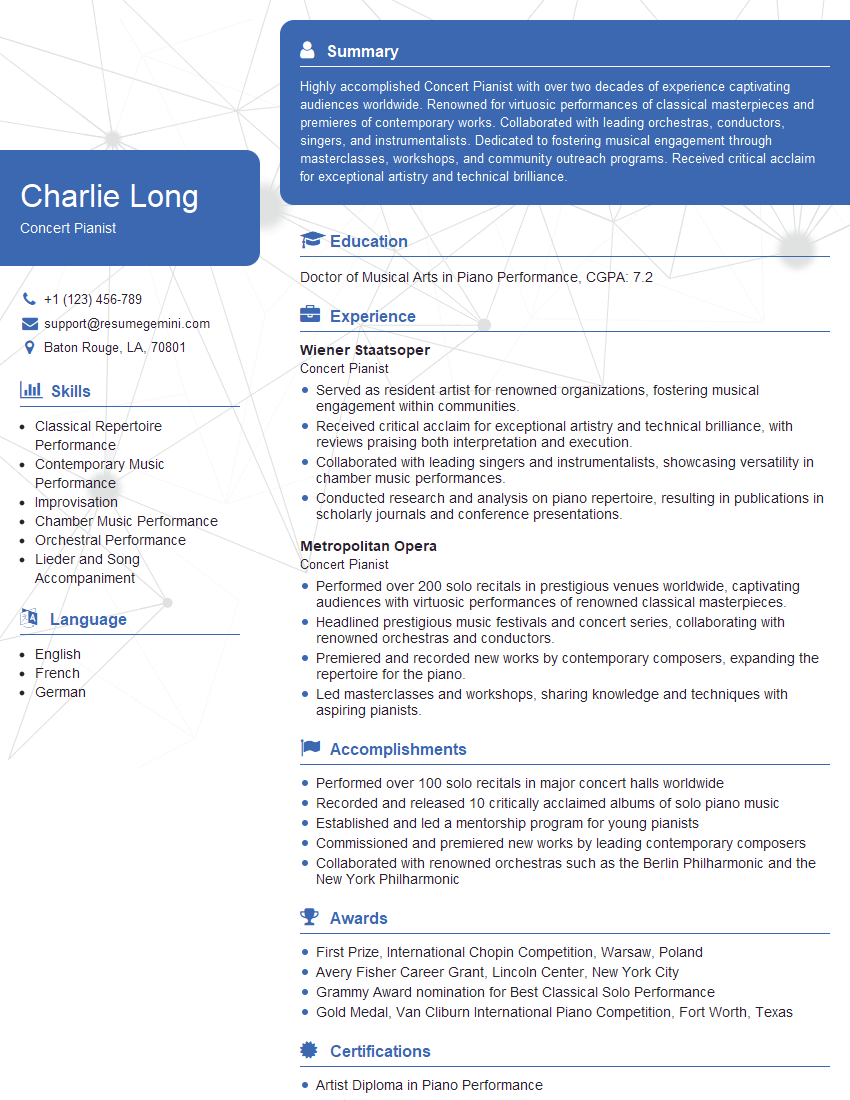
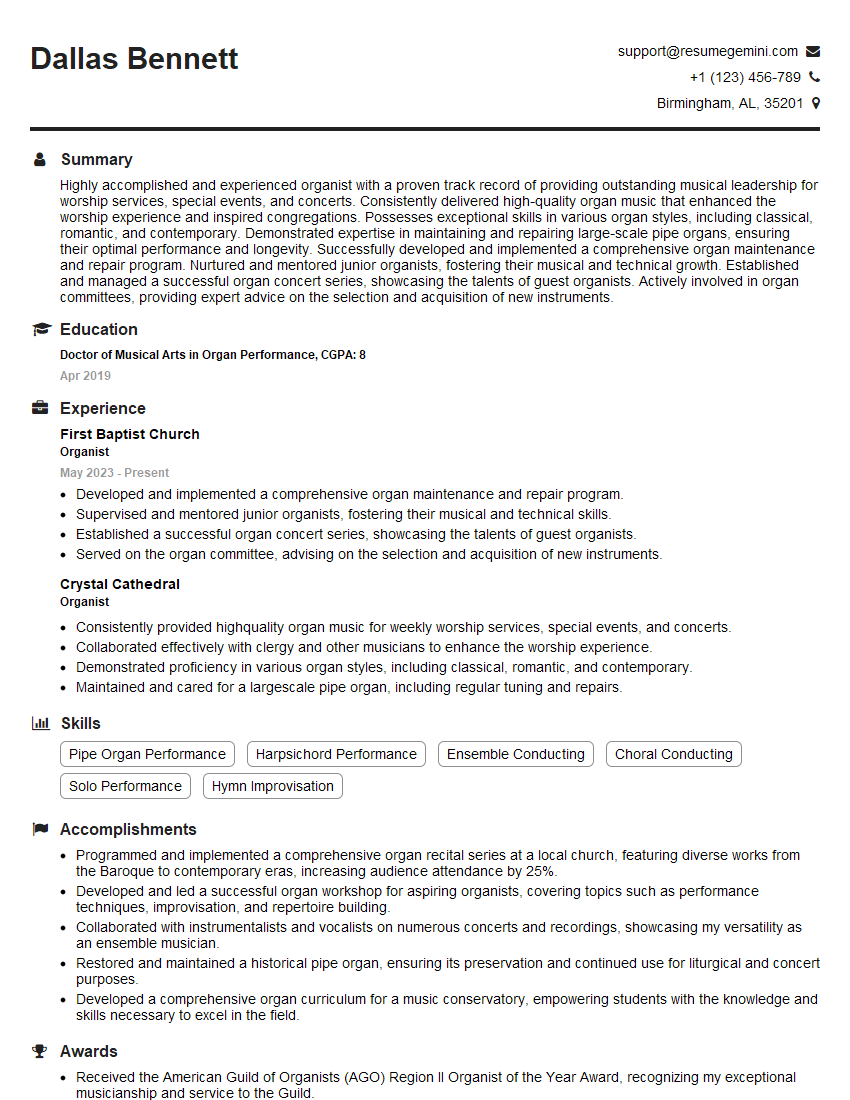
Mastering proficiency with multiple keyboard instruments significantly enhances your career prospects in diverse fields, including music performance, composition, teaching, and music technology. An ATS-friendly resume is crucial for getting your application noticed. To significantly increase your chances of landing your dream job, craft a compelling resume that highlights your unique skills and experience. ResumeGemini is a trusted resource to help you build a professional, impactful resume. Examples of resumes tailored to showcasing Experience with Multiple Keyboard Instruments are provided to guide you. Take the next step and build a resume that truly reflects your talent and potential!
Explore more articles
Users Rating of Our Blogs
Share Your Experience
We value your feedback! Please rate our content and share your thoughts (optional).
What Readers Say About Our Blog
Hello,
we currently offer a complimentary backlink and URL indexing test for search engine optimization professionals.
You can get complimentary indexing credits to test how link discovery works in practice.
No credit card is required and there is no recurring fee.
You can find details here:
https://wikipedia-backlinks.com/indexing/
Regards
NICE RESPONSE TO Q & A
hi
The aim of this message is regarding an unclaimed deposit of a deceased nationale that bears the same name as you. You are not relate to him as there are millions of people answering the names across around the world. But i will use my position to influence the release of the deposit to you for our mutual benefit.
Respond for full details and how to claim the deposit. This is 100% risk free. Send hello to my email id: [email protected]
Luka Chachibaialuka
Hey interviewgemini.com, just wanted to follow up on my last email.
We just launched Call the Monster, an parenting app that lets you summon friendly ‘monsters’ kids actually listen to.
We’re also running a giveaway for everyone who downloads the app. Since it’s brand new, there aren’t many users yet, which means you’ve got a much better chance of winning some great prizes.
You can check it out here: https://bit.ly/callamonsterapp
Or follow us on Instagram: https://www.instagram.com/callamonsterapp
Thanks,
Ryan
CEO – Call the Monster App
Hey interviewgemini.com, I saw your website and love your approach.
I just want this to look like spam email, but want to share something important to you. We just launched Call the Monster, a parenting app that lets you summon friendly ‘monsters’ kids actually listen to.
Parents are loving it for calming chaos before bedtime. Thought you might want to try it: https://bit.ly/callamonsterapp or just follow our fun monster lore on Instagram: https://www.instagram.com/callamonsterapp
Thanks,
Ryan
CEO – Call A Monster APP
To the interviewgemini.com Owner.
Dear interviewgemini.com Webmaster!
Hi interviewgemini.com Webmaster!
Dear interviewgemini.com Webmaster!
excellent
Hello,
We found issues with your domain’s email setup that may be sending your messages to spam or blocking them completely. InboxShield Mini shows you how to fix it in minutes — no tech skills required.
Scan your domain now for details: https://inboxshield-mini.com/
— Adam @ InboxShield Mini
Reply STOP to unsubscribe
Hi, are you owner of interviewgemini.com? What if I told you I could help you find extra time in your schedule, reconnect with leads you didn’t even realize you missed, and bring in more “I want to work with you” conversations, without increasing your ad spend or hiring a full-time employee?
All with a flexible, budget-friendly service that could easily pay for itself. Sounds good?
Would it be nice to jump on a quick 10-minute call so I can show you exactly how we make this work?
Best,
Hapei
Marketing Director
Hey, I know you’re the owner of interviewgemini.com. I’ll be quick.
Fundraising for your business is tough and time-consuming. We make it easier by guaranteeing two private investor meetings each month, for six months. No demos, no pitch events – just direct introductions to active investors matched to your startup.
If youR17;re raising, this could help you build real momentum. Want me to send more info?
Hi, I represent an SEO company that specialises in getting you AI citations and higher rankings on Google. I’d like to offer you a 100% free SEO audit for your website. Would you be interested?
Hi, I represent an SEO company that specialises in getting you AI citations and higher rankings on Google. I’d like to offer you a 100% free SEO audit for your website. Would you be interested?
good