Unlock your full potential by mastering the most common Experience with prepress software and workflow interview questions. This blog offers a deep dive into the critical topics, ensuring you’re not only prepared to answer but to excel. With these insights, you’ll approach your interview with clarity and confidence.
Questions Asked in Experience with prepress software and workflow Interview
Q 1. Explain your experience with different prepress software applications (e.g., Adobe Acrobat, InDesign, Photoshop, etc.).
My prepress experience spans a decade, encompassing a wide array of software. I’m highly proficient in Adobe Creative Suite applications, particularly InDesign for layout and pagination, Photoshop for image retouching and manipulation, and Illustrator for vector graphics. Adobe Acrobat is crucial for creating press-ready PDF files, ensuring proper imposition and color profiles are embedded. I’m also familiar with other industry-standard software like QuarkXPress (though less frequently used now) and various color management tools like X-Rite i1Profiler.
InDesign is my primary tool for complex layouts, managing text, images, and graphics for books, brochures, and magazines. Photoshop allows me to meticulously refine images, correcting flaws and ensuring optimal print quality. Illustrator is essential for creating and manipulating vector artwork, which scales perfectly without losing resolution, ideal for logos and illustrations. Acrobat is the final stage, where I optimize the PDF for the printer, checking for fonts, color spaces, and ensuring all elements are correctly flattened and ready for output.
Q 2. Describe your workflow for preparing files for offset printing.
My workflow for preparing files for offset printing is meticulously structured to ensure a smooth and efficient process. It begins with a thorough review of the client’s brief and design files to understand the specifications and any potential challenges. Then, I proceed with:
- File Preparation: I check the resolution of all images (ensuring at least 300dpi for print), convert color spaces to CMYK, and handle any necessary color corrections. I also optimize the file sizes for efficient processing.
- Layout and Design: InDesign is my main tool here. I create the page layout, ensuring proper bleeds, margins, and safe zones. I carefully check for any typos or design flaws.
- Imposition: I use InDesign’s imposition features or dedicated imposition software to arrange the pages for printing on sheets. This ensures efficient use of paper and minimizes waste.
- Preflight Check: I perform a rigorous preflight check using Adobe Acrobat to identify potential issues like missing fonts, low-resolution images, or color profile inconsistencies. This crucial step prevents costly errors during printing.
- Proofing: I create both soft and hard proofs for client approval, ensuring the final product meets their expectations.
- File Output: I generate a high-resolution PDF/X-1a compliant file, which is the industry standard for press-ready files. This file is optimized for color accuracy and avoids any potential issues with the printing process.
Q 3. How do you ensure color accuracy and consistency throughout the prepress process?
Color accuracy and consistency are paramount in prepress. I achieve this through a multi-faceted approach, starting with using a calibrated monitor and utilizing a color management system (CMS) throughout the process. This ensures that the colors I see on my screen accurately represent the final printed output.
- Profile Creation: I utilize a spectrophotometer to create accurate ICC profiles for my monitor and printer. This calibration ensures consistency between the digital and physical versions.
- CMYK Workflow: I always work in CMYK color space for print projects, avoiding RGB conversions at the last minute which can lead to unforeseen color shifts.
- Color Proofing: I rely on soft proofing within InDesign and Acrobat, and when critical, I utilize hard proofs using a calibrated proofing system to match the final output as closely as possible.
- Spot Color Management: I meticulously manage spot colors using Pantone or other standardized color systems, ensuring accurate replication across various printing presses.
Think of it like baking a cake – you need the right ingredients (accurate color profiles) and precise measurements (consistent workflow) to get the desired outcome (accurate color reproduction).
Q 4. What are your methods for trapping and color separation?
Trapping and color separation are critical steps for ensuring clean and accurate printing, especially with offset printing. Trapping involves creating slight overlaps between colors to prevent gaps or misregistration. Color separation prepares the files for different printing plates, one for each color (CMYK).
- Trapping: I typically use automated trapping features within InDesign or dedicated trapping software. This ensures the correct amount of overlap for different ink combinations and printing substrates. I carefully consider the type of trapping (spread or choke) based on the specific project requirements and press capabilities.
- Color Separation: My workflow uses the CMYK model, with InDesign or other RIP software handling the separation process. I ensure that proper color profiles are embedded and used consistently, for accuracy and consistency of the separated colors.
Imagine trapping like adding a thin line of glue between two pieces of colored paper before assembling them – it prevents gaps.
Q 5. Explain your experience with different file formats (e.g., PDF, TIFF, EPS, JPEG).
I have extensive experience with various file formats commonly used in prepress. Each format serves a specific purpose, and choosing the right one is vital for efficient workflow and optimal print quality.
- PDF/X-1a: The industry standard for press-ready files. It’s essential for ensuring compatibility and accurate color reproduction across different printing systems.
- TIFF: A lossless image format, ideal for high-resolution images requiring maximum quality. I use it for images that need to be pristine for printing.
- EPS: A vector-based format, useful for preserving the scalability of logos and illustrations. It helps ensure that these elements don’t lose quality when scaled.
- JPEG: A lossy format that’s mainly used for web applications. I avoid JPEGs for printing unless image quality is not critical.
Selecting the appropriate file format is like choosing the right tool for the job. A hammer is not ideal for sawing wood; similarly, a JPEG is not ideal for high-quality printing.
Q 6. How do you handle image resolution and scaling issues in prepress?
Image resolution and scaling are crucial aspects of prepress, directly impacting print quality. Low-resolution images result in blurry and pixelated prints. Scaling images inappropriately can cause distortion and loss of detail.
- Resolution Check: Before starting any project, I always verify the resolution of all images, ensuring they meet the minimum requirement (usually 300dpi) for print.
- Vector Graphics: For logos and illustrations, I primarily use vector graphics (AI or EPS) which scale without losing quality.
- Resampling Images: If resampling is absolutely necessary, I use specialized software tools to do so, ensuring the quality is maintained as much as possible. However, it’s always best to use the highest resolution images available from the outset.
- Scaling Considerations: I carefully assess if an image needs to be scaled. If possible, I avoid scaling altogether to prevent resolution issues. When unavoidable, I resample images using bicubic interpolation methods to minimize artifacts.
Think of resolution like the number of bricks in a wall. More bricks mean a smoother, more detailed wall. Similarly, higher resolution images result in smoother, more detailed prints.
Q 7. Describe your process for proofing and quality control.
My proofing and quality control process is a critical step, ensuring that the final product meets the highest standards. This process involves both soft and hard proofing techniques.
- Soft Proofing: I use soft proofing tools within Adobe InDesign and Acrobat to simulate the appearance of the final printed product. This involves accurately setting up color profiles and checking the output against a proof profile.
- Hard Proofing: I will often produce hard proofs, which are physical prints on the same type of paper stock that will be used in the final print run. This gives the most accurate representation of the final product and is especially important for critical projects. Hard proofing typically involves sending a test file to a professional print shop using the exact printing parameters of the intended final product.
- Detailed Checks: During proofing, I carefully check for color accuracy, image sharpness, text clarity, and any registration issues. I will also look for design errors and inconsistencies. This is the critical phase where the client’s feedback is incorporated.
- Client Approval: Client sign-off is essential before proceeding to final printing, to ensure everyone is on the same page and that errors or changes are avoided at later stages.
My quality control process is like a final inspection before a launch – it ensures that everything is perfect before sending to the printing press.
Q 8. How familiar are you with different printing methods (e.g., offset, digital, flexo)?
My experience encompasses a wide range of printing methods, each with its unique characteristics and prepress requirements. Offset printing, the workhorse of large-scale commercial printing, demands precise color management and high-resolution files. I’m adept at preparing files for offset, understanding the complexities of trapping, imposition, and color separations. Digital printing, on the other hand, offers flexibility and shorter turnaround times, ideal for smaller runs and personalized materials. Here, my expertise lies in managing color profiles to ensure consistent output across different digital presses. Lastly, flexographic printing, commonly used for packaging and labels, requires a different skillset, focusing on file preparation for flexo plates, including considerations for halftone screening and dot gain. I’ve worked extensively with all three, understanding the nuances of each process and adapting my prepress techniques accordingly. For instance, a recent project involved preparing artwork for both offset and digital printing of a marketing brochure – a testament to my ability to adapt to varying print demands.
Q 9. Explain your experience with color management systems (e.g., ICC profiles).
Color management is critical for ensuring consistent color reproduction across different devices and printing methods. My experience with ICC profiles is extensive. I understand how these profiles define the color characteristics of a specific device – whether it’s a monitor, printer, or scanner – allowing for accurate color transformations. I routinely use ICC profiles in my workflow to convert colors from one color space to another (e.g., RGB to CMYK), ensuring that what I see on screen closely matches the final printed output. This involves using color management software to assign and embed ICC profiles into files, conducting soft proofing to simulate the final print, and making adjustments as needed. For example, I recently resolved a color discrepancy in a client’s packaging design by carefully examining their provided ICC profile, identifying a mismatch, and generating a new profile better suited to their chosen substrate and printing method. This minimized costly reprints and maintained brand consistency.
Q 10. How do you manage and organize large volumes of digital assets?
Managing large volumes of digital assets requires a structured approach. I employ a combination of strategies including a robust file naming convention (using metadata like client name, project name, and date), a well-organized digital asset management (DAM) system (we use a cloud-based solution internally, offering collaborative features), and regular file backups. I’m proficient in using keywords and tagging systems to facilitate efficient searching and retrieval of files. This system prevents chaos and ensures quick access to assets during projects. For example, during a recent campaign involving hundreds of images, videos, and design files, I successfully organized and retrieved assets within minutes, enabling my team to meet demanding deadlines.
Q 11. What is your experience with prepress workflow automation tools?
My experience includes utilizing various prepress workflow automation tools, significantly improving efficiency and reducing manual errors. I’m proficient with tools like [mention specific software, e.g., Esko Automation Engine, PitStop Server] that automate tasks such as preflighting, trapping, and imposition. This automation ensures consistent quality control, saves time, and minimizes the risk of costly mistakes. For example, automating the preflighting process through scripting in [mention software] significantly reduced the time spent on manual checks, allowing my team to focus on more complex aspects of the project, accelerating the overall production time.
Q 12. How do you troubleshoot common prepress problems (e.g., missing fonts, incorrect color profiles)?
Troubleshooting is a daily part of prepress work. Common issues such as missing fonts are often resolved by identifying the missing fonts, locating the correct versions, and installing them on the appropriate system. Incorrect color profiles are addressed by reviewing the profile assignments, validating the profiles’ accuracy, and replacing them with appropriate profiles. More complex issues, like unexpected color shifts, require a systematic approach, analyzing factors such as the print device, ink characteristics, and substrate to pinpoint the root cause and implement a solution. I use a combination of preflight tools and my knowledge of color management to efficiently identify and solve these problems. For instance, I recently resolved a complex issue of unexpected color banding by systematically checking the color settings, the ink density on the press, and the paper type, eventually identifying a problem with the raster image processor settings.
Q 13. Describe your experience with imposition software.
Imposition software is essential for arranging pages correctly for printing. My experience includes using various imposition software packages [mention specific software, e.g., Imposition Pro, Creo Preps]. I understand the intricacies of different imposition schemes, such as signatures, booklets, and gang runs, tailoring the arrangement to optimize the printing process and minimize waste. I’m comfortable generating imposition plans for various printing methods and adjusting settings for different sheet sizes and paper types. For example, I recently created a complex imposition for a 48-page booklet, optimizing the workflow for efficient printing and binding, reducing material costs and speeding production.
Q 14. What are your skills in PDF editing and manipulation?
PDF editing and manipulation are fundamental to my prepress work. I’m proficient with advanced features of Adobe Acrobat Pro, including editing text and images, correcting errors, optimizing PDFs for printing, and fixing preflight issues. I’m experienced in handling high-resolution files, managing layers, and making precise adjustments to ensure print-ready PDFs. Moreover, my proficiency extends to using tools for PDF conversion, color management within PDFs, and applying various preflight profiles to ensure files meet print specifications before sending them to the print shop. For example, I recently had to correct a crucial typographical error in a client’s already-imposed PDF just minutes before the print run. Through Acrobat Pro, I was able to make the change without causing any delays.
Q 15. How do you manage version control in your prepress workflow?
Version control in prepress is crucial to avoid confusion and maintain the integrity of files throughout the production process. Think of it like tracking changes in a collaborative document, but for complex print projects. We typically use a combination of methods:
File naming conventions: A rigorous system using project names, version numbers (e.g., ProjectA_v1, ProjectA_v2_revised), and dates ensures easy identification and retrieval of specific versions. This is the foundation of our approach.
Version control software (e.g., Adobe Version Cue, or dedicated cloud-based solutions): These tools allow for tracked revisions, the ability to revert to previous versions, and collaborative workflows. This is especially helpful for larger teams or projects with many iterations.
Backup and archiving strategies: Regularly backing up all project files to a secure, offsite location is paramount. This protects against data loss and allows retrieval of older versions if necessary. We typically use a combination of local and cloud-based backups.
Metadata embedding: Adding metadata such as creation dates, authors, and revision details directly into the files provides additional context and traceability.
For example, on a recent packaging project, using Version Cue allowed us to quickly revert to a previous version when a client requested a minor change to the original design, saving significant time and preventing errors.
Career Expert Tips:
- Ace those interviews! Prepare effectively by reviewing the Top 50 Most Common Interview Questions on ResumeGemini.
- Navigate your job search with confidence! Explore a wide range of Career Tips on ResumeGemini. Learn about common challenges and recommendations to overcome them.
- Craft the perfect resume! Master the Art of Resume Writing with ResumeGemini’s guide. Showcase your unique qualifications and achievements effectively.
- Don’t miss out on holiday savings! Build your dream resume with ResumeGemini’s ATS optimized templates.
Q 16. What is your experience with RIP software?
RIP (Raster Image Processor) software is essential in converting vector-based files (like those created in Adobe Illustrator) into raster images (bitmaps) for printing. Think of it as the translator between your design software and the printing press. My experience encompasses several leading RIPs, including those from companies such as EFI and Kodak. I’m proficient in:
Color profile management: Ensuring accurate color reproduction across different devices and media is critical. I’m adept at using ICC profiles to calibrate the RIP to match the printer and paper being used.
Halftone screening and optimization: Fine-tuning screen angles, frequencies, and types to achieve optimal print quality, minimizing moiré patterns and other artifacts. This requires a deep understanding of the printing process.
Image processing and enhancement: Using RIP features to perform image sharpening, noise reduction, and other adjustments to enhance the final output. Understanding the limitations of the printing process is essential here.
Imposition and nesting: Using the RIP to create imposition layouts to efficiently arrange multiple pages onto a printing plate or sheet, saving time and materials.
For instance, I once used EFI Fiery’s advanced features to optimize the color reproduction of a high-end photographic print job, ensuring the client’s color-critical images were rendered accurately and vibrantly.
Q 17. Explain your understanding of different screen rulings and halftones.
Screen ruling and halftones are fundamental to representing continuous-tone images (like photographs) on a printing press, which only uses dots of ink. Imagine trying to represent the shades of gray in a photograph using only black and white dots – that’s what halftones achieve.
Screen ruling (lines per inch or LPI): This refers to the number of halftone dots per inch. Higher LPI means finer detail and smoother gradations, but requires higher printing resolution. A lower LPI might be chosen for newsprint, while a higher LPI might be used for high-quality magazines.
Halftone angles: The angle at which the halftone dots are arranged is critical to prevent moiré patterns (unwanted interference patterns). Different color separations typically use different angles to minimize this effect.
Halftone types (e.g., amplitude modulated (AM) or frequency modulated (FM)): AM uses dots of varying size to represent tone, while FM uses dots of the same size but varying spacing. FM often produces higher-quality results with less screen texture but requires more sophisticated RIP software.
Understanding these concepts helps optimize print quality. For example, choosing the wrong screen ruling for a given paper stock could result in poor image quality, while incorrect halftone angles could lead to distracting moiré patterns.
Q 18. How do you ensure print-ready files meet industry standards?
Ensuring print-ready files meet industry standards is paramount. This involves a multi-step process that includes:
Following preflight checks: Using preflight software (like PitStop or Acrobat Pro) to automatically check for potential problems such as missing fonts, incorrect color spaces, low-resolution images, and bleeds.
Color space conversion: Converting files to the appropriate color space (CMYK for most commercial printing) and ensuring consistent color management throughout the workflow.
Resolution checks: Verifying that images are at the correct resolution for the printing method and ensuring that text is sharp and clear.
Bleed and trim marks: Adding appropriate bleed (extra image area beyond the final trim size) and trim marks to guide the printing and cutting process.
Imposition and imposition checking: Verifying that the pages are correctly arranged for printing and binding, considering factors such as page count and finishing requirements.
File format compliance: Ensuring that files are in the correct format (e.g., PDF/X-1a, PDF/X-4) required by the printing press.
I meticulously review all files to catch potential issues before they reach the printing press. A missed detail could result in costly reprints or delays.
Q 19. Describe your experience with CTP (Computer-to-Plate) workflow.
CTP (Computer-to-Plate) workflows have revolutionized the printing industry, replacing the traditional film-based platemaking process. My experience involves the entire workflow, from preparing files to creating printing plates:
File preparation: Ensuring files are properly formatted (PDF/X) and optimized for the CTP system.
RIP processing: Using the RIP software to process files for output to the CTP device.
Platemaking: Directly exposing plates via the CTP imager. This involves understanding the different types of plates (thermal, violet, UV), and troubleshooting potential issues during plate exposure.
Plate quality control: Inspecting plates for any defects before mounting them on the press.
The shift to CTP has significantly improved turnaround times and reduced waste compared to traditional film methods. For example, in a recent project involving a tight deadline, the efficiency of CTP helped us deliver on time and within budget.
Q 20. How familiar are you with different types of paper and their impact on print quality?
Different paper types significantly impact print quality. Think of it like choosing the right paint for a canvas – the wrong choice can ruin the final piece. I have extensive experience with various paper types, including:
Coated papers: These have a smooth surface for vibrant colors and sharp detail, ideal for high-quality brochures and magazines. However, they can be more expensive.
Uncoated papers: These have a rougher texture, absorbing ink more readily. They offer a more natural look and feel, often preferred for invitations or letterheads. Ink may appear less vibrant.
Specialty papers: These include papers with unique textures, finishes (e.g., linen, metallic), or colors, impacting the final aesthetic significantly.
Understanding a paper’s absorbency, opacity, and weight is crucial. A thin paper might show show-through, while a heavy paper might impact the binding process. I often consult with clients to determine the best paper choice for their project, balancing aesthetics, cost, and print quality.
Q 21. What is your experience working with clients and understanding their specifications?
Working effectively with clients and understanding their specifications is a critical aspect of prepress. It’s about building a collaborative relationship to achieve their vision. My approach involves:
Thorough briefing and communication: Clearly understanding the client’s objectives, target audience, and desired aesthetic, asking clarifying questions to avoid any ambiguity.
Providing expert guidance: Offering suggestions and recommending solutions based on my experience with different printing techniques and materials.
Managing expectations: Setting realistic timelines and budgets, and keeping clients informed throughout the process.
Proofing and approvals: Providing clients with digital and hard copy proofs for approval, facilitating revisions and ensuring their complete satisfaction.
For example, I once worked with a client who had a complex vision for their packaging design. Through careful communication and collaboration, we developed a solution that met their creative goals while ensuring the print-ready files were production-ready.
Q 22. Describe a situation where you had to solve a complex prepress problem.
One particularly challenging prepress situation involved a client who submitted a complex, multi-layered InDesign file for a high-end magazine. The file contained numerous embedded images in various color spaces, several custom fonts, and intricate transparency effects. The initial output showed significant color inconsistencies and unexpected artifacts.
To resolve this, I systematically analyzed the file using preflight tools within our workflow (PitStop Server, for example). I identified the root causes: inconsistent color profiles across the images, a missing font, and improper handling of transparency. I then created a standardized color profile, ensuring all images were converted to the same color space (CMYK) before incorporating them in the InDesign file. The missing font was replaced with an appropriate substitute and the transparency issues were corrected by flattening certain elements and using the appropriate blending modes. This meticulous approach ensured that the final print matched the client’s expectations perfectly.
Q 23. How do you prioritize tasks and manage your time effectively in a fast-paced prepress environment?
In a high-pressure prepress environment, effective time management is crucial. I utilize a combination of techniques. First, I prioritize tasks based on their deadlines and importance using a Kanban-style workflow (either physical or digital). Urgent, high-impact projects naturally take precedence. I break down larger tasks into smaller, more manageable sub-tasks to avoid feeling overwhelmed.
Secondly, I actively utilize project management software (such as Basecamp or Asana) to track progress and keep myself and the team organized. Regular communication with the team and clients is key; providing updates and addressing potential roadblocks early on minimizes delays. Finally, I actively dedicate time to planning and anticipating potential issues – this proactive approach prevents last-minute scrambling and ensures that deadlines are met consistently.
Q 24. What is your experience with prepress quality control procedures and standards?
My experience encompasses all aspects of prepress quality control, starting from preflight checks and proofing to final color verification. We follow industry-standard ISO guidelines (particularly ISO 12647 for print production) in our workflow. Preflight checks using software like Acrobat Pro and PitStop ensure files adhere to the specifications (correct color spaces, fonts, resolution, bleeds, etc.). I meticulously review proofs – both soft proofs (on screen) and hard proofs (printed samples) – comparing them to the client’s approved artwork to catch any discrepancies in color, resolution, or other visual elements. We use color management systems, including ICC profiles, to ensure color accuracy throughout the entire process.
Furthermore, we maintain a rigorous record-keeping system for every job, including preflight reports and proof approvals. This documentation provides a trail of verification and facilitates efficient troubleshooting in the event of issues.
Q 25. What are your skills in using colorimeters and spectrophotometers?
I’m proficient in using colorimeters and spectrophotometers to measure and ensure color accuracy. I can calibrate these instruments regularly and perform accurate color measurements using both devices. A colorimeter measures the color from the surface, whereas a spectrophotometer measures the spectral composition of the light reflected from the surface. Spectrophotometers are more precise and offer more detailed information. Understanding the difference between these is critical.
For instance, in one project, client-approved Pantone colors needed to be matched using the CMYK process. I used a spectrophotometer to measure the Pantone colors, and used the measured values to create custom CMYK equivalents in our color management system, ensuring consistent color reproduction across the entire print run.
Q 26. How do you stay current with the latest prepress technologies and trends?
Staying current with prepress technologies is a continuous process. I regularly attend industry events (such as drupa, Graph Expo etc.), webinars, and online courses to stay abreast of the newest developments. I actively follow industry publications and blogs, and engage with other professionals on social media and through professional organizations. This constant learning helps me adapt quickly to emerging technologies and improve our workflow efficiency. For example, I’ve recently focused on learning more about automated prepress workflow systems, which can drastically reduce manual intervention and improve turnaround times. I’ve also made myself familiar with new technologies in PDF workflows such as the adoption of PDF/X-6.
Q 27. Explain your understanding of the importance of metadata in the prepress workflow.
Metadata is incredibly important in the prepress workflow because it provides critical information about the file, enabling automation and streamlining the process. Metadata allows us to easily identify, manage, and retrieve files based on different attributes. This is especially important for large-scale projects with multiple files. For instance, metadata can include information such as the client name, job number, file type, color space, creation date, and even specific instructions for processing. This data can be automatically extracted and used by prepress software to automate tasks such as color conversion, preflight checks, and output settings. Using XMP metadata embedded in PDF files, allows automation systems to dynamically adapt and optimize processes.
Q 28. Describe your experience working with different prepress systems and how you adapt to changes.
Throughout my career, I’ve worked with several prepress systems, including traditional RIP-based workflows and more modern cloud-based solutions. My experience includes using different software applications like Adobe Creative Suite, PitStop Pro, Enfocus Switch, and various RIP software. Adapting to new systems is a straightforward process for me. I approach it systematically:
- Thorough Documentation: I begin by reviewing the system’s documentation and tutorials.
- Hands-on Practice: I actively work through practice files and tutorials, replicating typical workflows.
- Troubleshooting: I proactively identify and resolve any challenges I encounter, referring to support materials or seeking guidance from colleagues or online communities.
This approach, combined with my underlying understanding of prepress principles, allows me to quickly become proficient with any new system, minimizing disruptions to workflow.
Key Topics to Learn for Experience with Prepress Software and Workflow Interview
- Color Management: Understanding color spaces (CMYK, RGB, etc.), color profiles, and color conversion processes. Practical application: Troubleshooting color discrepancies between digital files and printed output.
- Image Editing and Retouching: Proficiency in software like Adobe Photoshop for image preparation, including resolution adjustments, sharpening, and color correction. Practical application: Preparing images for high-quality print reproduction.
- Prepress Software Proficiency: Hands-on experience with software like Adobe Acrobat, PitStop, or other preflighting tools. Practical application: Identifying and resolving potential printing issues before they reach the press.
- File Preparation and Workflow: Understanding file formats (PDF, TIFF, JPEG), resolution requirements, and best practices for preparing files for different printing methods (offset, digital, etc.). Practical application: Optimizing files for efficient and cost-effective printing.
- Proofing and Quality Control: Experience with digital proofing methods and techniques for ensuring print quality and consistency. Practical application: Identifying and correcting errors before printing begins.
- Print Production Knowledge: Understanding the printing process, including different printing techniques, paper types, and finishing options. Practical application: Communicating effectively with printers and making informed decisions about print specifications.
- Troubleshooting and Problem-Solving: Ability to diagnose and resolve technical issues related to prepress software and workflow. Practical application: Quickly identifying and fixing errors to prevent delays and maintain project timelines.
Next Steps
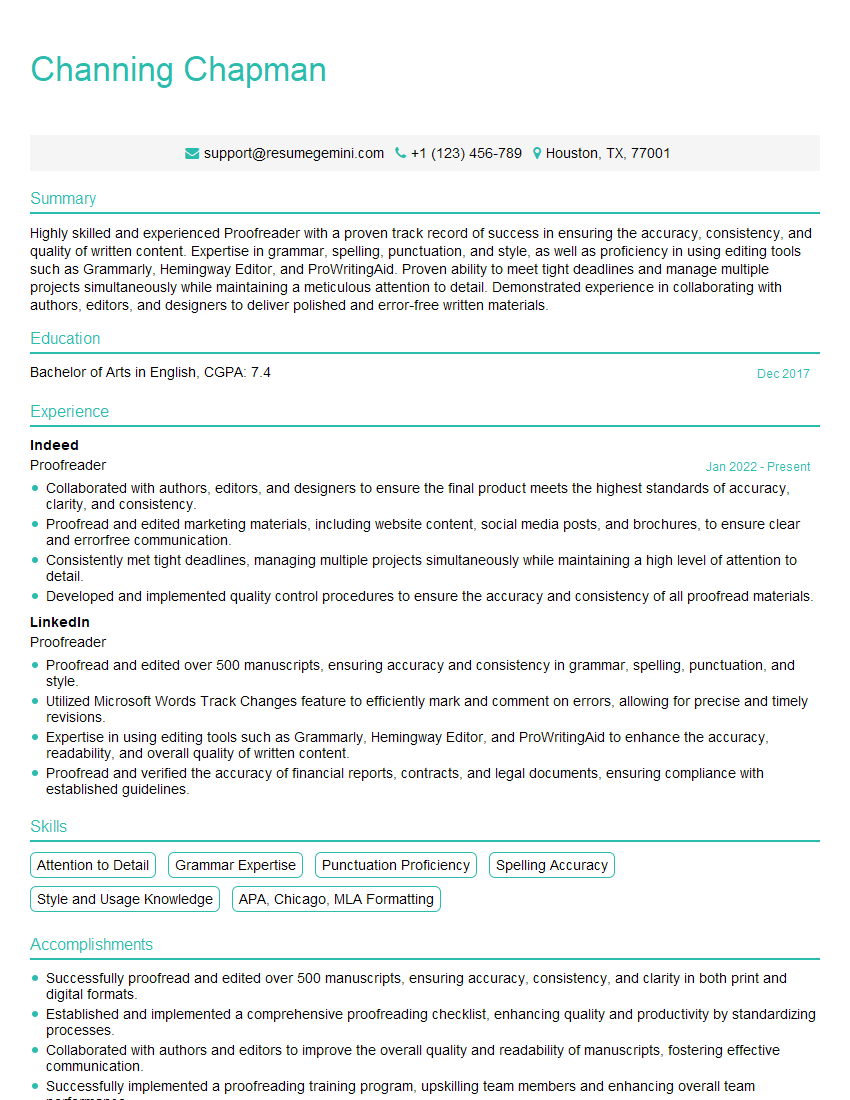
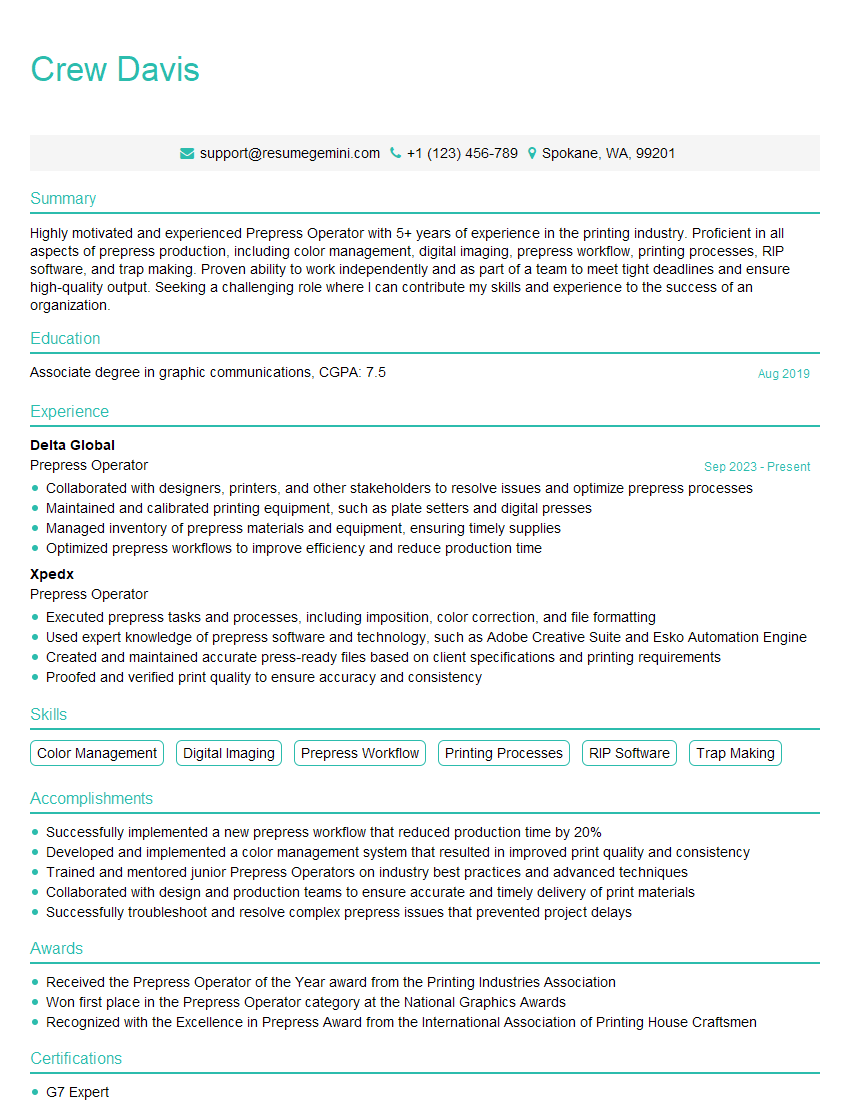
Mastering prepress software and workflow is crucial for career advancement in the printing and publishing industries. A strong understanding of these processes demonstrates valuable technical skills and problem-solving abilities, opening doors to exciting opportunities. To enhance your job prospects, creating an ATS-friendly resume is vital. ResumeGemini is a trusted resource to help you build a professional and impactful resume that highlights your expertise. Examples of resumes tailored to experience with prepress software and workflow are available to guide you. Take the next step towards your dream job today!


Explore more articles
Users Rating of Our Blogs
Share Your Experience
We value your feedback! Please rate our content and share your thoughts (optional).
What Readers Say About Our Blog
Hello,
we currently offer a complimentary backlink and URL indexing test for search engine optimization professionals.
You can get complimentary indexing credits to test how link discovery works in practice.
No credit card is required and there is no recurring fee.
You can find details here:
https://wikipedia-backlinks.com/indexing/
Regards
NICE RESPONSE TO Q & A
hi
The aim of this message is regarding an unclaimed deposit of a deceased nationale that bears the same name as you. You are not relate to him as there are millions of people answering the names across around the world. But i will use my position to influence the release of the deposit to you for our mutual benefit.
Respond for full details and how to claim the deposit. This is 100% risk free. Send hello to my email id: [email protected]
Luka Chachibaialuka
Hey interviewgemini.com, just wanted to follow up on my last email.
We just launched Call the Monster, an parenting app that lets you summon friendly ‘monsters’ kids actually listen to.
We’re also running a giveaway for everyone who downloads the app. Since it’s brand new, there aren’t many users yet, which means you’ve got a much better chance of winning some great prizes.
You can check it out here: https://bit.ly/callamonsterapp
Or follow us on Instagram: https://www.instagram.com/callamonsterapp
Thanks,
Ryan
CEO – Call the Monster App
Hey interviewgemini.com, I saw your website and love your approach.
I just want this to look like spam email, but want to share something important to you. We just launched Call the Monster, a parenting app that lets you summon friendly ‘monsters’ kids actually listen to.
Parents are loving it for calming chaos before bedtime. Thought you might want to try it: https://bit.ly/callamonsterapp or just follow our fun monster lore on Instagram: https://www.instagram.com/callamonsterapp
Thanks,
Ryan
CEO – Call A Monster APP
To the interviewgemini.com Owner.
Dear interviewgemini.com Webmaster!
Hi interviewgemini.com Webmaster!
Dear interviewgemini.com Webmaster!
excellent
Hello,
We found issues with your domain’s email setup that may be sending your messages to spam or blocking them completely. InboxShield Mini shows you how to fix it in minutes — no tech skills required.
Scan your domain now for details: https://inboxshield-mini.com/
— Adam @ InboxShield Mini
Reply STOP to unsubscribe
Hi, are you owner of interviewgemini.com? What if I told you I could help you find extra time in your schedule, reconnect with leads you didn’t even realize you missed, and bring in more “I want to work with you” conversations, without increasing your ad spend or hiring a full-time employee?
All with a flexible, budget-friendly service that could easily pay for itself. Sounds good?
Would it be nice to jump on a quick 10-minute call so I can show you exactly how we make this work?
Best,
Hapei
Marketing Director
Hey, I know you’re the owner of interviewgemini.com. I’ll be quick.
Fundraising for your business is tough and time-consuming. We make it easier by guaranteeing two private investor meetings each month, for six months. No demos, no pitch events – just direct introductions to active investors matched to your startup.
If youR17;re raising, this could help you build real momentum. Want me to send more info?
Hi, I represent an SEO company that specialises in getting you AI citations and higher rankings on Google. I’d like to offer you a 100% free SEO audit for your website. Would you be interested?
Hi, I represent an SEO company that specialises in getting you AI citations and higher rankings on Google. I’d like to offer you a 100% free SEO audit for your website. Would you be interested?
good