Are you ready to stand out in your next interview? Understanding and preparing for Experience with Print Software interview questions is a game-changer. In this blog, we’ve compiled key questions and expert advice to help you showcase your skills with confidence and precision. Let’s get started on your journey to acing the interview.
Questions Asked in Experience with Print Software Interview
Q 1. Explain your experience with different types of print software (e.g., Adobe Acrobat, InDesign, QuarkXPress, RIP software).
My experience with print software spans a wide range of applications, from design and layout to prepress and color management. I’m proficient in industry-standard software like Adobe Acrobat for PDF manipulation and creation, including optimizing files for print. I extensively use Adobe InDesign for complex layouts, especially for publications like brochures, magazines, and books, mastering its features for text and image placement, master pages, and styles. QuarkXPress, though less prevalent now, is also familiar to me, offering a comparable suite of tools for professional publishing. My experience extends into the realm of RIP (Raster Image Processor) software, where I’ve worked with various systems to manage color profiles, calibrate output, and troubleshoot print jobs directly with large-format printers and digital presses. This broad experience ensures I can handle any aspect of the print production workflow, from initial design to final output.
- Adobe Acrobat: Used for creating accessible PDFs, managing layers, correcting preflight errors, and optimizing PDF files for different printing processes (e.g., reducing file size while maintaining image quality).
- Adobe InDesign: My expertise includes using InDesign’s advanced features like imposition, creating custom templates, and effectively managing large documents with complex structures.
- QuarkXPress: While less common now, my familiarity allows seamless transition between different design software platforms should a client or project necessitate it.
- RIP Software: Hands-on experience with various RIP software solutions, including calibrating color profiles, managing spot colors, and troubleshooting printer-specific issues, leading to efficient and accurate output.
Q 2. Describe your experience with color management in print production.
Color management is critical for consistent and accurate print reproduction. My experience involves working with ICC profiles (International Color Consortium profiles) to ensure colors are accurately translated from the screen to the printed output. This includes profiling monitors, printers, and the press itself, understanding the difference between device-dependent and device-independent color spaces like CMYK and RGB. I have a deep understanding of color space conversion, ensuring accurate color reproduction across various mediums. For instance, converting from RGB (used on screens) to CMYK (used in offset printing) requires careful consideration of potential color shifts, and I use software tools to minimize these discrepancies. I often create custom color palettes to maintain brand consistency across different projects. I also handle spot colors, defining them in the design software and ensuring they are correctly interpreted and reproduced during the printing process.
I’ve addressed numerous situations where a slight color shift was noticed and corrected it by adjusting the profiles, examining the source files, and coordinating with the printer. One example involves a client who was unhappy with a specific shade of blue in their brochures. By analyzing the color profile, I discovered a mismatch between the client’s monitor profile and the press profile. Correcting this resulted in a perfect match.
Q 3. How do you troubleshoot common print-related issues, such as color mismatches or registration problems?
Troubleshooting print-related issues demands a systematic approach. For color mismatches, I start by checking the color profile, verifying that the correct one is embedded in the PDF file. Then I investigate the source file for any errors in color settings or mode conversions. For registration problems (where colors don’t align properly), I look for issues in the imposition settings within the software or potential mechanical issues during printing. This might involve checking the printer settings or contacting the printer directly to identify the root cause. I thoroughly examine the print job for flaws. I often work backward from the problem; if I see misregistration in the final print, I go back and examine the imposition file within InDesign, checking the individual pages to make sure they are set up properly.
- Color Mismatches: Verify color profiles, check for color mode inconsistencies (RGB vs. CMYK), and examine the printer calibration.
- Registration Problems: Inspect imposition settings, check for mechanical issues on the press (e.g., misaligned rollers), and verify the accuracy of the printer calibration.
- Other issues: Low resolution images, missing fonts, or improper file formats can all cause significant print issues. Careful preflighting is key to catching these before they reach the printer.
A systematic approach, using a checklist and the right software tools, is key. Documenting the steps taken during troubleshooting is also vital for future reference and efficient problem-solving.
Q 4. What is your experience with prepress procedures, including trapping, imposition, and proofing?
Prepress procedures are crucial for print quality and efficiency. My experience with trapping involves preparing artwork to prevent gaps between colored areas, ensuring clean lines in the final product. I use both manual and automated trapping techniques, depending on the complexity of the artwork and the client’s requirements. Imposition is another critical step, and I’m proficient in arranging pages for efficient printing, especially for multi-page documents. Software like InDesign or dedicated imposition software helps with this, allowing for precise page sequencing and the generation of printer-ready files. I meticulously create proofs—both digital and physical—to ensure accuracy before the job goes to press. This helps to catch any errors and make corrections before incurring expensive reprints.
For example, I once encountered a complex brochure design with thin lines between colors. Using InDesign’s trapping features, I created a spread that ensured there would be no unsightly gaps during printing. I then created a digital proof, sending it to the client for approval, before proceeding with the final print run.
Q 5. Explain your familiarity with various printing techniques (e.g., offset, digital, large format).
My familiarity extends to various printing techniques. Offset printing remains the workhorse for high-volume, high-quality projects, and I understand its intricacies, including different types of plates and inks. Digital printing offers speed and flexibility for smaller runs or personalized materials, and I’ve worked with different digital presses, understanding their capabilities and limitations. Large-format printing presents unique challenges—for example, ensuring proper media handling for banners, posters, or vehicle wraps—and I’ve been involved in projects that utilize large format printers and also have experience with specialized finishes such as laminating or UV coating.
- Offset Printing: Understanding the process, including platemaking, ink selection, and press operation.
- Digital Printing: Experience with various digital printing technologies, like toner-based and inkjet printers, for smaller to mid-volume projects.
- Large-Format Printing: Knowledge of media types, printer technologies (e.g., solvent, eco-solvent, latex), and finishing options.
Q 6. Describe your experience with print file preparation and optimization for different printing methods.
Print file preparation is crucial for optimal results. I meticulously prepare files depending on the intended printing method. For offset, this involves ensuring the file is in CMYK mode, using high-resolution images, and optimizing for the specific press capabilities. For digital printing, the requirements might be less stringent, but proper image resolution and file formats are still vital. Large-format printing often requires specific file formats and resolutions based on the printer and media. I compress images appropriately to reduce file size without sacrificing image quality. I often conduct preflight checks to identify and resolve potential problems before sending the files to the printer.
For example, when preparing a file for offset printing, I meticulously examine all elements for correct resolution and color mode. I’ll perform a preflight check on the file for any missing fonts or linked images, ensuring that the file is ready to go before it is sent to the printer.
Q 7. How do you ensure print quality and consistency across different print runs?
Ensuring consistent print quality across runs involves a multi-pronged approach. First, using accurate color management and consistent ICC profiles across the workflow is essential. Second, maintaining detailed records of each print run, including the settings used on the press, the type of paper, and the inks, helps pinpoint any deviations. Third, regular calibration of equipment, like monitors and printers, is crucial. Finally, working closely with the printing partner to establish clear communication channels and quality control checks contributes significantly to maintaining consistency. Using a standardized process ensures everyone involved understands expectations and reduces the chance of errors. Regular color tests and comparisons with earlier print runs assist in identifying any drift in color reproduction.
I’ve implemented systems in previous roles that incorporate regular color tests, and any deviations are immediately addressed. This ensures consistency not just across multiple runs of the same job but also across multiple jobs produced over time.
Q 8. What is your experience with print finishing techniques (e.g., binding, cutting, laminating)?
Print finishing techniques are crucial for enhancing the final product’s quality and aesthetics. My experience encompasses a wide range of these techniques, including:
- Binding: I’m proficient in various binding methods, such as saddle-stitch (for booklets), perfect binding (for books and magazines), wire-O binding (for notebooks and calendars), and case binding (for high-end books). For example, I’ve managed projects requiring perfect binding for high-volume client reports, selecting the appropriate adhesive and ensuring consistent spine thickness for a professional finish.
- Cutting: I’ve worked with various cutting machines, ensuring precise cuts and minimizing waste. This includes handling different paper stocks and managing tolerances for accurate die-cutting and trimming. One project involved precision cutting of intricate shapes for a promotional campaign, requiring careful setup and quality control checks.
- Laminating: I have extensive experience with both gloss and matte lamination, understanding the impact of different finishes on the final product’s appearance and durability. I’ve helped clients choose the right lamination based on factors such as the print material, usage, and desired aesthetic. A recent project involved choosing matte lamination for a high-end brochure to provide a sophisticated feel without excessive glare.
My understanding extends to the selection of appropriate finishing techniques based on the project’s requirements, budget, and desired outcome. I prioritize ensuring the chosen method complements the overall design and enhances the user experience.
Q 9. Describe your experience with managing print projects, including timelines and budgets.
Managing print projects effectively necessitates meticulous planning and execution. My experience involves:
- Timeline Management: I utilize project management tools to establish realistic timelines, incorporating all stages from initial design to final delivery. I break down projects into manageable tasks, assigning deadlines and tracking progress to ensure timely completion. For example, I once managed a complex multi-stage project involving various print components delivered in phases across multiple locations using a Gantt chart to visualize timelines and dependencies.
- Budget Management: I work closely with clients to establish a clear budget, anticipating potential costs associated with materials, printing, finishing, and shipping. I monitor expenditures closely, making adjustments as needed while maintaining transparency with clients. I’ve successfully managed projects that required stringent budget adherence by proactively identifying cost-saving measures without compromising quality.
- Risk Management: I proactively identify potential challenges and develop contingency plans to mitigate risks. This includes accounting for potential delays, material shortages, and unforeseen technical issues. For instance, anticipating potential paper shortages, I sourced alternative suppliers well in advance, ensuring a project continued uninterrupted.
Throughout the project lifecycle, I maintain open communication with all stakeholders, providing regular updates and addressing any concerns that arise promptly.
Q 10. What is your understanding of print workflows and automation?
Understanding print workflows and automation is key to efficiency and accuracy. My expertise covers:
- Prepress Workflow: I’m familiar with the entire prepress process, from file preparation and color management to trapping and imposition. I understand the importance of optimizing files for efficient printing, minimizing errors, and ensuring consistency.
- Automation: I’ve experience with automating tasks using workflow software like [mention specific software if applicable, e.g., Pitstop, Enfocus Switch]. This automation significantly reduces manual intervention, minimizing errors and saving time. For example, using automated color profile conversion prevents inconsistencies across different printing processes.
- JDF/JMF: I understand the principles of Job Definition Format (JDF) and Job Management Format (JMF) for streamlining communication and data exchange between different systems in the print production workflow. It allows for a seamless flow of information from design to print.
By optimizing workflows and leveraging automation, I’ve helped clients increase throughput, reduce costs, and improve the overall quality of their print products.
Q 11. How familiar are you with different file formats used in print production (e.g., PDF, TIFF, EPS)?
File formats are crucial for print production. My experience encompasses:
- PDF: The industry standard, I’m proficient in creating press-ready PDFs, ensuring appropriate color spaces (CMYK), resolutions, and bleed settings. I understand the nuances of different PDF versions and their compatibility with various printing systems.
- TIFF: I understand the use of TIFF files for high-resolution images, especially when working with large format printing or requiring high image quality. I am aware of the different compression options available and their effect on file size and image quality.
- EPS: I am experienced with handling EPS files, particularly vector graphics for logos and illustrations that need to be scalable without loss of quality. I understand the importance of embedding fonts and images correctly to ensure compatibility across different software.
My understanding extends to the limitations of each format and the best practices for ensuring accurate color reproduction and image quality throughout the printing process.
Q 12. Explain your experience with print estimating and costing.
Accurate print estimating and costing is critical for profitability. My process involves:
- Gathering Specifications: I meticulously collect all necessary project details, including paper type, quantity, print specifications (color, single/double-sided), finishing requirements, and shipping information.
- Cost Calculation: I utilize established pricing structures and cost-calculating tools to estimate material costs, labor, and machine time. I factor in potential waste and other variables for a comprehensive estimate.
- Profit Margin: I incorporate a reasonable profit margin into the final cost, ensuring the project’s financial viability while maintaining competitive pricing.
I regularly review and update my cost calculations to account for market fluctuations and changes in printing technology. I maintain transparency with clients regarding the cost breakdown, ensuring mutual understanding and agreement before proceeding with the project. For example, for high-volume projects I might negotiate better rates with suppliers to offer competitive pricing to the client.
Q 13. Describe your experience with client communication and managing their expectations in print projects.
Effective client communication is paramount. My approach involves:
- Active Listening: I carefully listen to the client’s needs and objectives, asking clarifying questions to ensure a thorough understanding of their vision.
- Clear Communication: I provide clear, concise updates throughout the project, utilizing various communication channels (email, phone calls, video conferencing) as appropriate.
- Managing Expectations: I set realistic expectations from the beginning, openly discussing potential challenges and timelines. I proactively address any concerns or changes to avoid misunderstandings.
I always strive to maintain a professional and collaborative relationship with clients, valuing their input and feedback throughout the process. For example, I might present design proofs with clear annotations and explain the rationale for certain design choices to ensure the client is fully informed and aligned with the project’s direction.
Q 14. How do you stay up-to-date on the latest advancements in print technology and software?
Staying current in the rapidly evolving print industry is crucial. My approach involves:
- Industry Publications: I regularly read industry publications (both print and online) such as [mention relevant publications].
- Trade Shows and Conferences: I attend industry trade shows and conferences to stay abreast of the latest technologies and trends, network with peers, and learn about new products and services.
- Online Resources and Webinars: I actively participate in online forums and webinars offered by industry leaders and software vendors.
- Vendor Relationships: I maintain strong relationships with printing equipment and software vendors to be informed about new product releases and updates.
This multi-faceted approach ensures that I remain knowledgeable about the latest advancements in print technology, software, and best practices, enabling me to consistently deliver high-quality, innovative solutions for my clients.
Q 15. Describe your experience with print quality control and inspection methods.
Print quality control is crucial for ensuring consistent, high-quality output. My experience encompasses a multi-faceted approach, starting with pre-press checks to verify the accuracy of files, color profiles, and trapping. During the printing process, I meticulously monitor the press for color consistency, registration (the alignment of different colors), and density. Post-press, I perform visual inspections for defects like smudging, color variations, and misprints, often using standardized quality control checklists and magnification tools. I’m also proficient in using densitometers to measure ink density and spectrophotometers for precise color measurement, ensuring alignment with client specifications and industry standards. For example, I once caught a subtle misregistration on a high-volume brochure run early on by using a color bar control, saving significant time and material costs. My approach is preventative, aiming to identify and rectify issues early in the process to avoid costly reprints.
Career Expert Tips:
- Ace those interviews! Prepare effectively by reviewing the Top 50 Most Common Interview Questions on ResumeGemini.
- Navigate your job search with confidence! Explore a wide range of Career Tips on ResumeGemini. Learn about common challenges and recommendations to overcome them.
- Craft the perfect resume! Master the Art of Resume Writing with ResumeGemini’s guide. Showcase your unique qualifications and achievements effectively.
- Don’t miss out on holiday savings! Build your dream resume with ResumeGemini’s ATS optimized templates.
Q 16. What is your experience with different types of printing presses?
My experience spans a range of printing presses, including offset lithographic presses (both sheet-fed and web), digital presses (like Xerox and HP Indigo), and large-format inkjet printers. Offset lithography, while requiring significant setup, offers unmatched quality and cost-effectiveness for large print runs. Digital printing excels in short-run, personalized projects, and its speed and versatility are invaluable. Large-format inkjet printers are my go-to for projects demanding high-resolution images and wide formats, such as banners and posters. I’m comfortable with the operational nuances of each technology, understanding the strengths and limitations of each press type and how to choose the optimal solution for any given project. For instance, I advised a client to use digital printing for their personalized invitation cards, avoiding the high setup costs of offset for a small quantity, while recommending offset for their annual report given its large run size and high quality requirements.
Q 17. Explain your experience with troubleshooting hardware and software issues related to print production.
Troubleshooting is a daily part of print production. My experience covers a wide spectrum of hardware and software issues. On the hardware side, I’ve diagnosed and repaired problems ranging from paper jams and misaligned rollers in offset presses to ink supply issues in digital machines. I am familiar with troubleshooting RIP (Raster Image Processor) software errors, color profile mismatches, and issues with printer drivers. I’ve also handled network connectivity issues affecting print jobs. Software troubleshooting often involves examining job logs, checking for errors, and verifying the integrity of print files. A recent example involved a recurring banding issue on a digital press. By systematically checking the fuser unit, transfer rollers, and ultimately the firmware, I identified a minor firmware glitch that was easily resolved via an update, preventing significant production delays. My methodical approach ensures timely resolution.
Q 18. How do you ensure that print projects meet deadlines and stay within budget?
Meeting deadlines and staying within budget requires meticulous planning and proactive management. I utilize project management software to track timelines, milestones, and resource allocation. This includes creating detailed project schedules, assigning tasks, and monitoring progress. Careful estimation of material costs, labor, and machine time is essential for accurate budgeting. I maintain open communication with clients and team members to address potential delays or budget overruns proactively. For example, I once identified a potential delay in procuring a specific paper stock for a large project. By suggesting an alternative, readily available paper that met the project’s needs, I ensured the project stayed on schedule without compromising quality.
Q 19. Describe a situation where you had to solve a complex print-related problem. What steps did you take?
One challenging situation involved a critical client project requiring a specific pantone color match. Initial print runs showed a significant deviation from the target color. My approach involved a systematic investigation: first, I verified the accuracy of the color profile in the design file. Then, I calibrated the press and checked the ink supply. Further investigation revealed a slight inconsistency in the ink itself – a batch issue from the supplier. My solution involved contacting the supplier, getting a replacement batch of ink, and initiating a reprint with rigorous color control monitoring. I also implemented stricter quality control checks on incoming ink supplies. This problem highlighted the importance of careful supplier selection and stringent quality control at every stage of the print production process.
Q 20. What is your experience with managing print inventories and supplies?
Managing print inventories effectively requires a combination of forecasting, ordering, and storage optimization. I utilize inventory management systems to track stock levels, predict demand, and place timely orders. This ensures that we have enough materials on hand to meet project needs while avoiding unnecessary storage costs. Proper storage conditions are crucial to maintain the quality of paper and inks. I am responsible for organizing the warehouse, implementing a system for FIFO (First In, First Out) inventory rotation, and conducting regular stock checks to prevent spoilage or obsolescence. For example, I implemented a new inventory management system, reducing our waste by 15% and optimizing our storage space. This saves the company money and improves overall efficiency.
Q 21. How familiar are you with different types of paper and their properties?
My familiarity with different types of paper extends across various weights, finishes, and compositions. I understand the properties of coated and uncoated papers, their suitability for different printing techniques (offset, digital, etc.), and their impact on color reproduction and ink absorption. I also know the properties of specialty papers, such as textured papers, recycled papers, and synthetic papers. The choice of paper significantly impacts the final print’s quality, feel, and cost. I advise clients on selecting the appropriate paper based on project requirements, budget considerations, and desired aesthetic. For example, for a high-end brochure, we might opt for a premium, heavy-weight coated stock for vibrant color reproduction, while a standard uncoated stock might be perfectly suitable for a less demanding project such as a business form.
Q 22. What is your experience with environmental considerations in print production?
Environmental considerations are paramount in modern print production. It’s no longer enough to simply produce high-quality prints; we must also minimize our environmental impact. My experience encompasses several key areas:
- Sustainable Sourcing: I prioritize using recycled paper stocks and inks from vendors committed to responsible manufacturing practices. For example, I’ve successfully integrated post-consumer recycled (PCR) paper into several large-scale projects, resulting in a significant reduction in waste and carbon footprint.
- Waste Reduction: I actively seek to minimize paper waste through careful job planning, efficient imposition, and precise cutting techniques. This includes implementing processes to track and reduce spoilage during the printing process.
- Energy Efficiency: I’m familiar with optimizing print settings to reduce energy consumption on printing devices. This includes adjusting settings like toner concentration and print speed where possible without compromising quality.
- Responsible Disposal: I ensure proper disposal of inks, solvents, and other consumables according to environmental regulations, using approved recycling and hazardous waste disposal channels.
I believe that incorporating eco-friendly practices not only benefits the planet but also enhances a company’s reputation and attracts environmentally conscious clients.
Q 23. How do you prioritize tasks in a fast-paced print production environment?
Prioritizing tasks in a fast-paced print environment requires a structured approach. I utilize a combination of techniques, including:
- Project Prioritization Matrix: I assess each job based on urgency and importance (using a matrix or similar system), focusing first on high-urgency, high-importance projects. This ensures that time-sensitive and critical tasks are completed first.
- Job Ticketing and Scheduling Software: I’m proficient in utilizing job ticketing systems that provide a clear overview of all projects and their deadlines. This helps me manage workflow effectively and identify potential bottlenecks proactively.
- Communication and Collaboration: Open communication with clients and internal teams is crucial. I frequently update stakeholders on project progress and potential delays, ensuring everyone is aligned on priorities and expectations.
- Efficient Workflow Design: Streamlining processes, automating repetitive tasks whenever possible, and optimizing the flow of jobs through the production pipeline are critical for time management.
For example, during a peak season, I once implemented a new job routing system that reduced processing time by 15%, enabling us to meet all deadlines despite the increased workload.
Q 24. Describe your experience working with different types of printing clients.
My experience spans a diverse range of clients, from small businesses to large corporations, each with unique needs and expectations:
- Small Businesses: I’ve worked with numerous small businesses requiring personalized service and guidance on print materials. This often involves advising on cost-effective solutions and managing smaller-scale projects efficiently.
- Large Corporations: I’ve collaborated with large organizations on large-volume print projects, requiring meticulous project management, close collaboration with multiple stakeholders, and adherence to strict brand guidelines.
- Marketing Agencies: I have a strong working relationship with marketing agencies, managing print components of broader marketing campaigns. This requires understanding design specifications, project timelines, and budgetary constraints.
- Educational Institutions: I’ve worked with schools and universities on projects like brochures, textbooks, and promotional materials, requiring special attention to detail and adherence to quality standards.
Adaptability is key when working with diverse clients. I strive to understand each client’s individual requirements and tailor my approach to meet their specific needs.
Q 25. How do you handle pressure and meet tight deadlines in a print production environment?
Meeting tight deadlines in a high-pressure environment demands a proactive and organized approach. I handle pressure by:
- Effective Planning and Scheduling: Detailed planning and creating realistic schedules, including buffer time for unforeseen issues, are critical.
- Prioritization and Delegation: I prioritize tasks based on urgency and delegate tasks where appropriate to utilize team resources effectively.
- Problem-Solving and Adaptability: I proactively identify and address potential problems early on and am flexible enough to adapt to changing circumstances.
- Stress Management Techniques: I utilize techniques such as time management, breaks, and mindfulness to maintain focus and prevent burnout.
For example, when facing an unexpectedly tight deadline on a major project, I successfully rallied the team, implemented a streamlined workflow, and delivered the final product on time without compromising quality.
Q 26. What are your strengths and weaknesses related to print production and software usage?
My strengths lie in my proficiency with various print production software, including Adobe Creative Suite, prepress software (like imposition and color management tools), and RIP software. I’m also a skilled project manager, capable of handling multiple projects simultaneously and meeting deadlines under pressure. My problem-solving skills and ability to adapt to new technologies are also significant assets.
One area where I could improve is expanding my knowledge of specific large-format printing techniques. While I have experience in this area, I aim to deepen my expertise in this niche. I’m actively pursuing online courses and seeking opportunities to work on more complex large-format projects to overcome this.
Q 27. What are your salary expectations for this role?
My salary expectations are in the range of $75,000 to $90,000 per year, depending on the comprehensive benefits package offered and the specific responsibilities of the role. I am open to discussing this further based on a detailed job description.
Q 28. Do you have any questions for me?
Yes, I have a few questions. Firstly, could you elaborate on the specific technologies and software used in this role? Secondly, what are the company’s long-term goals for print production, and what role would this position play in achieving them? Finally, what are the opportunities for professional development and advancement within the company?
Key Topics to Learn for Experience with Print Software Interview
- Color Management: Understanding color profiles (CMYK, RGB), color conversion, and troubleshooting color discrepancies in print output. Practical application: Explain your experience calibrating monitors or printers for accurate color reproduction.
- Prepress Techniques: Knowledge of trapping, imposition, bleed, and other preflight checks crucial for successful print production. Practical application: Describe a situation where you identified and resolved a prepress issue that prevented printing errors.
- File Formats & Resolution: Familiarity with various file formats (PDF, TIFF, JPEG) and their suitability for different print processes; understanding resolution requirements for optimal print quality. Practical application: Explain how you chose the appropriate file format and resolution for a specific print job and the reasoning behind your decision.
- Print Finishing & Binding: Understanding different finishing options (lamination, die-cutting, embossing) and binding methods (saddle stitch, perfect binding) and their impact on the final product. Practical application: Describe your experience specifying finishing and binding options for a project and the considerations that guided your choices.
- Software Proficiency: Demonstrated expertise in industry-standard software like Adobe InDesign, Illustrator, Acrobat Pro, or other relevant applications. Practical application: Detail your experience using specific features within these programs to solve design or production challenges.
- Troubleshooting & Problem-solving: Ability to diagnose and resolve common print-related issues, such as printer errors, color mismatches, and file compatibility problems. Practical application: Provide a specific example of how you effectively troubleshot a printing problem.
- Workflow & Process Optimization: Understanding efficient print production workflows and identifying opportunities for improvement. Practical application: Describe how you streamlined a print production process to improve efficiency or reduce costs.
Next Steps
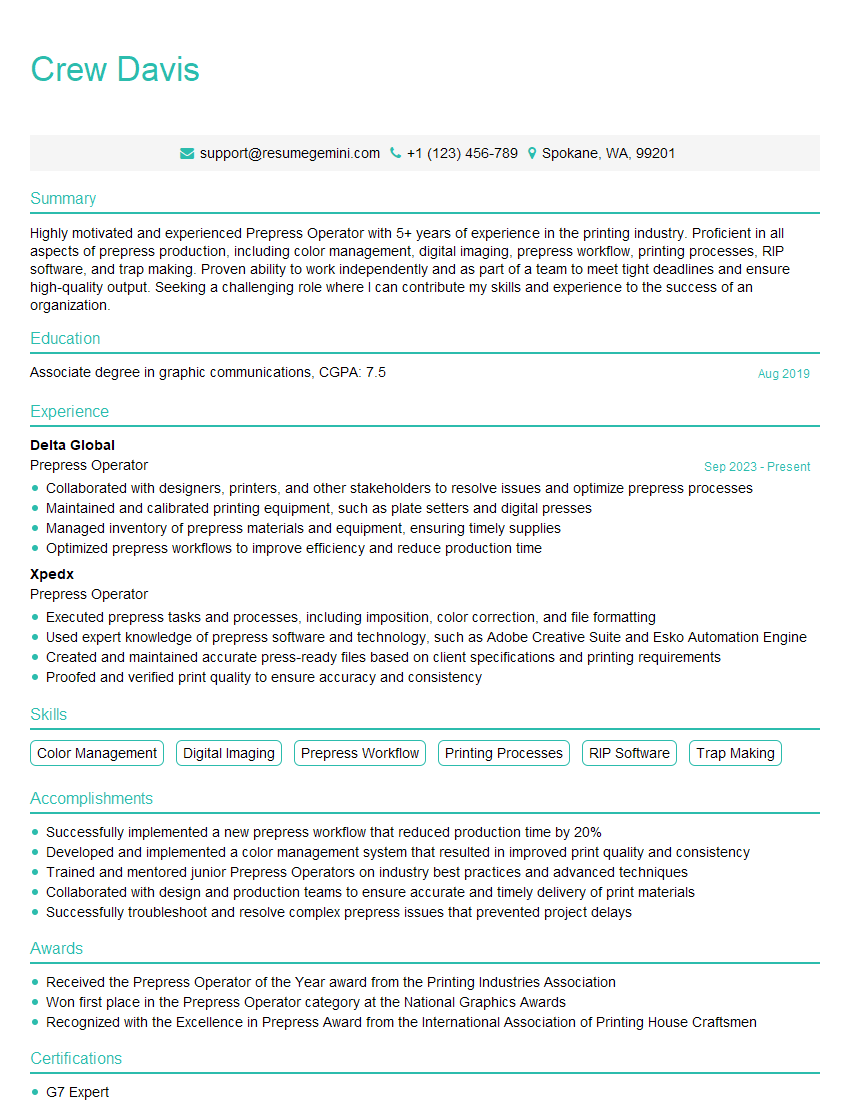
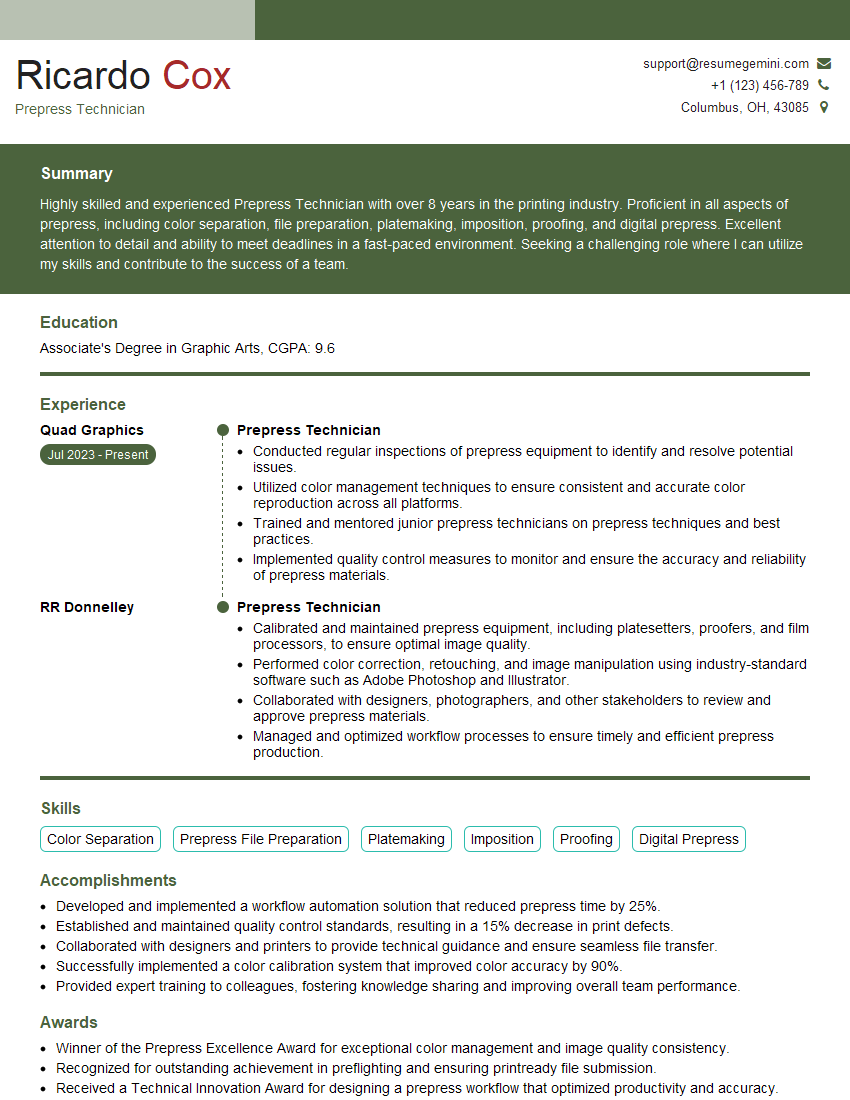
Mastering Experience with Print Software is crucial for career advancement in graphic design, publishing, and related fields. A strong understanding of these principles will significantly improve your job prospects. To stand out, create an ATS-friendly resume that highlights your skills and experience effectively. ResumeGemini is a trusted resource to help you build a professional and impactful resume. Examples of resumes tailored to Experience with Print Software are available to guide you.


Explore more articles
Users Rating of Our Blogs
Share Your Experience
We value your feedback! Please rate our content and share your thoughts (optional).
What Readers Say About Our Blog
Attention music lovers!
Wow, All the best Sax Summer music !!!
Spotify: https://open.spotify.com/artist/6ShcdIT7rPVVaFEpgZQbUk
Apple Music: https://music.apple.com/fr/artist/jimmy-sax-black/1530501936
YouTube: https://music.youtube.com/browse/VLOLAK5uy_noClmC7abM6YpZsnySxRqt3LoalPf88No
Other Platforms and Free Downloads : https://fanlink.tv/jimmysaxblack
on google : https://www.google.com/search?q=22+AND+22+AND+22
on ChatGPT : https://chat.openai.com?q=who20jlJimmy20Black20Sax20Producer
Get back into the groove with Jimmy sax Black
Best regards,
Jimmy sax Black
www.jimmysaxblack.com
Hi I am a troller at The aquatic interview center and I suddenly went so fast in Roblox and it was gone when I reset.
Hi,
Business owners spend hours every week worrying about their website—or avoiding it because it feels overwhelming.
We’d like to take that off your plate:
$69/month. Everything handled.
Our team will:
Design a custom website—or completely overhaul your current one
Take care of hosting as an option
Handle edits and improvements—up to 60 minutes of work included every month
No setup fees, no annual commitments. Just a site that makes a strong first impression.
Find out if it’s right for you:
https://websolutionsgenius.com/awardwinningwebsites
Hello,
we currently offer a complimentary backlink and URL indexing test for search engine optimization professionals.
You can get complimentary indexing credits to test how link discovery works in practice.
No credit card is required and there is no recurring fee.
You can find details here:
https://wikipedia-backlinks.com/indexing/
Regards
NICE RESPONSE TO Q & A
hi
The aim of this message is regarding an unclaimed deposit of a deceased nationale that bears the same name as you. You are not relate to him as there are millions of people answering the names across around the world. But i will use my position to influence the release of the deposit to you for our mutual benefit.
Respond for full details and how to claim the deposit. This is 100% risk free. Send hello to my email id: lukachachibaialuka@gmail.com
Luka Chachibaialuka
Hey interviewgemini.com, just wanted to follow up on my last email.
We just launched Call the Monster, an parenting app that lets you summon friendly ‘monsters’ kids actually listen to.
We’re also running a giveaway for everyone who downloads the app. Since it’s brand new, there aren’t many users yet, which means you’ve got a much better chance of winning some great prizes.
You can check it out here: https://bit.ly/callamonsterapp
Or follow us on Instagram: https://www.instagram.com/callamonsterapp
Thanks,
Ryan
CEO – Call the Monster App
Hey interviewgemini.com, I saw your website and love your approach.
I just want this to look like spam email, but want to share something important to you. We just launched Call the Monster, a parenting app that lets you summon friendly ‘monsters’ kids actually listen to.
Parents are loving it for calming chaos before bedtime. Thought you might want to try it: https://bit.ly/callamonsterapp or just follow our fun monster lore on Instagram: https://www.instagram.com/callamonsterapp
Thanks,
Ryan
CEO – Call A Monster APP
To the interviewgemini.com Owner.
Dear interviewgemini.com Webmaster!
Hi interviewgemini.com Webmaster!
Dear interviewgemini.com Webmaster!
excellent
Hello,
We found issues with your domain’s email setup that may be sending your messages to spam or blocking them completely. InboxShield Mini shows you how to fix it in minutes — no tech skills required.
Scan your domain now for details: https://inboxshield-mini.com/
— Adam @ InboxShield Mini
support@inboxshield-mini.com
Reply STOP to unsubscribe
Hi, are you owner of interviewgemini.com? What if I told you I could help you find extra time in your schedule, reconnect with leads you didn’t even realize you missed, and bring in more “I want to work with you” conversations, without increasing your ad spend or hiring a full-time employee?
All with a flexible, budget-friendly service that could easily pay for itself. Sounds good?
Would it be nice to jump on a quick 10-minute call so I can show you exactly how we make this work?
Best,
Hapei
Marketing Director
Hey, I know you’re the owner of interviewgemini.com. I’ll be quick.
Fundraising for your business is tough and time-consuming. We make it easier by guaranteeing two private investor meetings each month, for six months. No demos, no pitch events – just direct introductions to active investors matched to your startup.
If youR17;re raising, this could help you build real momentum. Want me to send more info?
Hi, I represent an SEO company that specialises in getting you AI citations and higher rankings on Google. I’d like to offer you a 100% free SEO audit for your website. Would you be interested?
Hi, I represent an SEO company that specialises in getting you AI citations and higher rankings on Google. I’d like to offer you a 100% free SEO audit for your website. Would you be interested?