Interviews are more than just a Q&A session—they’re a chance to prove your worth. This blog dives into essential Experience with yield management software interview questions and expert tips to help you align your answers with what hiring managers are looking for. Start preparing to shine!
Questions Asked in Experience with yield management software Interview
Q 1. Explain the concept of yield management.
Yield management is the process of optimizing the pricing and availability of products or services to maximize revenue. Think of it like this: you have a limited number of airline seats or hotel rooms, and you want to sell them all at the highest possible price, while still filling your inventory. It involves carefully predicting demand and strategically adjusting prices and inventory levels to capture the most profitable opportunities.
It’s about finding the sweet spot between filling capacity and maximizing profit. Selling every seat for a low price might fill the plane, but it won’t necessarily maximize your revenue. Conversely, setting prices too high might leave seats empty. Yield management uses data and sophisticated algorithms to find that optimal balance.
Q 2. Describe different yield management strategies.
Several yield management strategies exist, often employed in combination:
- Revenue Management (RM): This involves adjusting prices based on real-time demand and competitor pricing. Airlines frequently use this, offering cheaper fares for earlier bookings and higher fares closer to departure if demand remains high.
- Overbooking: This strategy intentionally oversells capacity to account for no-shows. Hotels and airlines often employ this, knowing that a percentage of bookings won’t materialize.
- Capacity Control: This focuses on controlling the release of inventory, especially for products or services with different price points or value propositions. Imagine a hotel setting aside some rooms for last-minute, higher-paying customers.
- Segmentation: Dividing your customer base into different segments based on their willingness to pay and booking patterns allows for targeted pricing strategies. Airlines frequently use this by categorizing customers into business, economy, and premium economy.
- Dynamic Pricing: Continuously adjusting prices based on factors like demand, time of day, or season. This is prevalent in online retail and ride-sharing services.
The choice of strategy depends on the specific industry, product, and market conditions.
Q 3. What are the key performance indicators (KPIs) used in yield management?
Key Performance Indicators (KPIs) in yield management are crucial for tracking success and making informed decisions. Some vital KPIs include:
- Revenue per Available Room (RevPAR) (Hospitality): Total revenue divided by the number of available rooms. This shows the average revenue generated per available room.
- Revenue per Available Seat Mile (RASM) (Airlines): Total revenue divided by the available seat miles. This measures revenue generated per mile flown.
- Occupancy Rate (Hospitality): Percentage of occupied rooms. This shows how effectively the available inventory is utilized.
- Load Factor (Airlines): Percentage of occupied seats. Similar to occupancy rate but for airlines.
- Average Daily Rate (ADR) (Hospitality): Average revenue per occupied room. This demonstrates pricing effectiveness.
- Cost per Available Seat Mile (CASM) (Airlines): Cost divided by available seat miles. Essential for assessing cost efficiency.
- Yield: This is the ratio of revenue to capacity. A higher yield indicates better price optimization.
Monitoring these KPIs is essential for identifying trends, areas for improvement, and the overall effectiveness of yield management strategies.
Q 4. How do you forecast demand for a product or service?
Forecasting demand is a critical aspect of yield management. It involves analyzing historical data, current market trends, and external factors to predict future demand. Several techniques can be used:
- Time Series Analysis: Examining past sales data to identify patterns and trends using methods like moving averages or exponential smoothing. This helps to project future demand based on historical patterns.
- Regression Analysis: Identifying relationships between sales and other variables like price, seasonality, and promotions. This allows prediction based on the identified correlations.
- Causal Modeling: Understanding the factors influencing demand and building a model that incorporates these factors. For example, considering economic conditions, marketing campaigns, or competitor actions.
- Market Research: Gathering information from surveys, customer feedback, and market analysis reports to understand customer preferences and expectations.
Combining these techniques often provides a more accurate and robust forecast. The choice of technique depends on the data availability, complexity of the product or service, and the accuracy required.
Q 5. Explain the role of data analysis in yield management.
Data analysis is the backbone of effective yield management. It enables businesses to:
- Understand Demand Patterns: Analyze historical data to identify peak and off-peak periods, seasonal variations, and other trends.
- Segment Customers: Group customers based on their purchasing behavior, demographics, and preferences to tailor pricing and marketing strategies.
- Optimize Pricing: Use data to determine optimal price points that maximize revenue while considering demand elasticity.
- Forecast Demand: Utilize statistical models to predict future demand based on historical data and external factors.
- Monitor Performance: Track key performance indicators to measure the effectiveness of yield management strategies and identify areas for improvement.
- Identify Opportunities: Analyze data to uncover opportunities for revenue generation, such as upselling or cross-selling.
Data analysis provides the insights needed for informed decision-making and allows for the continuous improvement of yield management strategies.
Q 6. What are the different types of yield management software?
Yield management software comes in various types, each tailored to specific industry needs:
- Hotel Property Management Systems (PMS): These integrate revenue management capabilities, allowing hotels to manage reservations, pricing, and inventory effectively.
- Airline Revenue Management Systems (RMS): These are sophisticated systems designed to handle the complexity of airline pricing and seat allocation.
- Cloud-Based Revenue Management Solutions: These offer scalable and flexible solutions accessible from anywhere, suitable for businesses of all sizes.
- Rental Car Revenue Management Systems: These focus on managing fleet pricing and availability based on factors like location, seasonality, and demand.
- Integrated Revenue Management Platforms: These combine yield management with other functionalities, such as customer relationship management (CRM) and business intelligence (BI).
The choice of software depends on the specific industry, business size, and level of sophistication required.
Q 7. What are the limitations of yield management?
While powerful, yield management has limitations:
- Data Dependency: Accurate forecasting relies on reliable and comprehensive data. Inaccurate or incomplete data can lead to poor decisions.
- Complexity: Implementing and managing yield management systems can be complex, requiring specialized expertise and significant investment.
- Oversimplification: Models might oversimplify complex market dynamics, neglecting unforeseen circumstances that can impact demand.
- Ethical Concerns: Dynamic pricing can be perceived as unfair or exploitative, especially in situations where demand is high and consumers are vulnerable.
- Limited Flexibility: Strategies may be less effective during unexpected events or significant market shifts.
It’s crucial to acknowledge these limitations and adopt a flexible and adaptable approach to yield management.
Q 8. How do you handle overbooking or underbooking situations?
Overbooking and underbooking are inherent risks in yield management. The goal is to find the optimal balance, maximizing revenue while minimizing losses from either scenario. Overbooking is a strategy where a business accepts more reservations than its actual capacity, anticipating cancellations or no-shows. Underbooking, on the other hand, leaves available capacity unutilized.
Handling Overbooking: A robust yield management system includes a sophisticated forecasting model to predict cancellations and no-shows. This helps determine the optimal overbooking level. For instance, if historical data shows a 10% cancellation rate for a specific flight, the airline might overbook by 10%. If overbooking does occur, strategies include offering incentives (e.g., free upgrades, travel vouchers) to voluntarily yield seats, or, as a last resort, denying boarding and compensating affected passengers according to regulations.
Handling Underbooking: Underbooking is less of a deliberate strategy and more a result of inaccurate demand forecasting. This is where robust data analysis and effective forecasting are crucial. Regularly reviewing and refining the forecasting model, incorporating real-time data, and adjusting pricing strategies can help mitigate underbooking. For example, if a hotel consistently has empty rooms on certain days of the week, it can implement targeted discounts or promotions to stimulate demand.
Q 9. How do you integrate yield management with other business functions?
Yield management doesn’t operate in a silo; its success hinges on seamless integration with other business functions. Here are some key integrations:
- Revenue Management: Yield management directly supports revenue management by providing data-driven insights for optimal pricing and inventory control.
- Sales & Marketing: Integrating with CRM systems allows for targeted promotions and offers based on real-time demand and yield management predictions. This could include sending personalized emails about discounted rooms to customers who are browsing during off-peak seasons.
- Operations Management: Integration with reservation systems ensures accurate inventory tracking, facilitating seamless booking and cancellation management, aligning supply with demand.
- Customer Relationship Management (CRM): Yield management data can be used to segment customers, creating personalized offers, improving customer loyalty, and predicting future demand based on past customer behaviour.
- Distribution Channels: Real-time data sharing with online travel agents (OTAs) and other distribution channels ensures pricing consistency and prevents discrepancies.
Q 10. Describe your experience with a specific yield management software.
I have extensive experience with IDeaS Revenue Management System. It’s a powerful platform that offers a comprehensive suite of tools for forecasting, pricing, and inventory optimization. I used it extensively during my time at [Previous Company Name], where we managed a portfolio of [Number] hotels.
IDeaS’s strength lies in its sophisticated algorithms that can analyze vast datasets to predict demand accurately. The system’s user interface is intuitive, allowing for easy monitoring of key metrics such as occupancy rate, average daily rate (ADR), and revenue per available room (RevPAR).
A specific example of its successful application was during a major city-wide event. IDeaS’s forecasting capabilities accurately predicted a surge in demand, allowing us to adjust pricing strategically and maximize revenue without overselling. The system also allowed us to identify the ideal balance between optimizing revenue and maintaining a good customer experience.
Q 11. How do you manage dynamic pricing using yield management software?
Dynamic pricing, a core component of yield management, uses real-time data and predictive analytics to adjust prices automatically. Yield management software facilitates this by:
- Analyzing Demand Patterns: The software continuously monitors factors influencing demand (e.g., day of the week, seasonality, competitor pricing, special events).
- Forecasting Future Demand: Based on historical data and current trends, the software predicts future demand accurately.
- Optimizing Prices: The software uses sophisticated algorithms to determine the optimal price for each available unit, aiming to maximize revenue given the predicted demand and other market factors. This might mean increasing prices during peak demand and lowering them during slow periods.
- Automated Price Adjustments: The software automatically adjusts prices based on pre-defined rules and algorithms, reducing the need for manual intervention.
For example, an airline might charge higher fares for flights departing on weekends or during holidays, reflecting higher demand, while offering lower fares for mid-week flights or during off-season.
Q 12. Explain the concept of elasticity of demand in yield management.
Elasticity of demand measures the responsiveness of demand to a change in price. In yield management, understanding elasticity is crucial for effective pricing strategies.
High Elasticity: When demand is highly elastic, even a small price increase can significantly reduce demand (e.g., luxury goods). In this case, a yield management system might focus on strategies to increase demand through promotions or other incentives rather than relying heavily on price increases.
Low Elasticity: When demand is inelastic, changes in price have little impact on demand (e.g., essential medicines). The system can then take advantage of this by charging higher prices, maximizing revenue.
Example: A flight ticket with many available seats might have high elasticity—a small price reduction could result in a large increase in bookings. Conversely, a sold-out concert ticket, with limited supply, would have low elasticity, allowing for higher prices.
Q 13. How do you handle seasonality and other demand fluctuations?
Seasonality and demand fluctuations are major considerations in yield management. Effective strategies to handle these include:
- Historical Data Analysis: Analyzing historical booking patterns reveals seasonal trends, allowing for accurate demand forecasting.
- Segmentation & Targeting: Identifying customer segments with different preferences and sensitivities to price allows for tailored offers and pricing strategies.
- Promotional Strategies: Offering discounts or promotions during off-peak seasons or periods of low demand stimulates demand.
- Inventory Control: Allocating inventory strategically to manage demand during peak and off-peak times.
- Dynamic Pricing Adjustments: Utilizing the yield management software’s capacity to automatically adjust prices according to seasonal trends and actual demand.
For instance, a ski resort would utilize lower prices during the off-season (summer), while charging premiums during peak season (winter). Similarly, a hotel near a beach would implement different pricing structures during the peak tourist season and the off-season, attracting customers even during the slower period.
Q 14. What are some common challenges in implementing yield management?
Implementing yield management successfully presents several challenges:
- Data Accuracy and Quality: The effectiveness of the system relies heavily on the accuracy and completeness of the data used for forecasting. Inaccurate data leads to poor decision-making.
- System Complexity: Yield management software can be complex to implement and requires specialized expertise. Training staff and providing adequate support are critical.
- Integration Challenges: Seamless integration with other business systems (e.g., CRM, reservation systems) is crucial but can be technically challenging.
- Forecasting Accuracy: Predicting demand accurately is a continuing challenge, especially in the face of unpredictable events (e.g., economic downturns, natural disasters).
- Resistance to Change: Implementing a new system often requires a shift in organizational culture and processes, and resistance from staff can impede implementation.
Overcoming these challenges requires careful planning, thorough data validation, adequate training, and strong stakeholder buy-in.
Q 15. How do you measure the success of a yield management strategy?
Measuring the success of a yield management strategy hinges on comparing projected revenue against actual revenue, and assessing the impact on key performance indicators (KPIs). It’s not just about maximizing revenue; it’s about maximizing profitable revenue.
- Revenue Growth: A simple, yet crucial metric. We compare the revenue generated under the yield management strategy to the revenue generated in previous periods or against a control group (if applicable). A significant increase indicates success.
- Occupancy Rate: This tracks how well we fill our available capacity (hotel rooms, airline seats, etc.). Higher occupancy rates generally point to effective yield management, but only if those rates are profitable.
- Average Daily Rate (ADR): This metric reflects the average price received for a unit of inventory. A healthy ADR demonstrates pricing power and strategic pricing decisions.
- Revenue Per Available Room (RevPAR): A common hotel industry KPI that combines occupancy and ADR (RevPAR = Occupancy Rate x ADR). It’s a great holistic indicator.
- Cost Analysis: Yield management isn’t just about revenue; it’s about profitability. We analyze the costs associated with achieving the revenue goals to ensure a positive return on investment.
For instance, in my previous role at a major airline, we implemented a new yield management system. We saw a 15% increase in RevPAR within six months by strategically adjusting pricing based on real-time demand and competitor analysis. This increase was achieved while maintaining a healthy occupancy rate, demonstrating a successful strategy.
Career Expert Tips:
- Ace those interviews! Prepare effectively by reviewing the Top 50 Most Common Interview Questions on ResumeGemini.
- Navigate your job search with confidence! Explore a wide range of Career Tips on ResumeGemini. Learn about common challenges and recommendations to overcome them.
- Craft the perfect resume! Master the Art of Resume Writing with ResumeGemini’s guide. Showcase your unique qualifications and achievements effectively.
- Don’t miss out on holiday savings! Build your dream resume with ResumeGemini’s ATS optimized templates.
Q 16. Describe your experience with data visualization in yield management.
Data visualization is critical in yield management. It allows us to understand complex patterns and trends in demand, pricing, and revenue quickly and efficiently. I extensively use tools like Tableau and Power BI to create interactive dashboards that showcase key metrics.
For example, I’d create visualizations showing:
- Demand curves: Illustrating the relationship between price and demand over time, helping to identify optimal price points.
- Heatmaps: Visualizing booking patterns across different time periods and customer segments to identify peak demand and potential overbooking opportunities.
- Trend lines: Showing the evolution of key metrics like RevPAR, occupancy, and ADR, allowing for the identification of seasonal patterns and market fluctuations.
- Comparative charts: Comparing performance against previous periods or different market segments to highlight areas for improvement and identify trends.
Interactive dashboards are crucial, as they allow for dynamic exploration of the data. A simple click can show the breakdown of RevPAR by customer segment, or the impact of a specific pricing change on bookings. This level of interactivity empowers data-driven decision-making.
Q 17. How do you identify and address pricing anomalies?
Pricing anomalies, such as unusually high or low prices compared to the market or historical data, need to be promptly identified and addressed. This often involves using statistical methods and alert systems.
My approach involves:
- Data Monitoring: Setting up automated alerts that flag significant deviations from expected pricing patterns. This could involve comparing current prices to historical averages, competitor prices, or predicted prices from forecasting models.
- Root Cause Analysis: Once an anomaly is detected, we investigate the underlying cause. Is it due to a system glitch, an inaccurate forecast, a sudden shift in market demand, or a competitor’s pricing strategy?
- Corrective Action: Depending on the root cause, we take corrective action. This might involve correcting a system error, revising the forecast, adjusting prices strategically, or implementing new controls.
For example, I once noticed an unusually low price for a specific flight route in our system. Investigation revealed a coding error in our pricing algorithm. Immediate correction of the code prevented significant revenue loss.
Q 18. What are the ethical considerations related to yield management?
Ethical considerations in yield management are crucial, particularly regarding price discrimination and transparency. We must ensure fair practices and avoid exploiting vulnerable customer segments.
- Price Transparency: While dynamic pricing is common, it’s vital to be upfront about how prices are determined. Avoid hidden fees or confusing pricing structures.
- Fairness and Equity: We should avoid discriminatory pricing that disadvantages specific groups of customers based on their location, demographics, or other factors.
- Data Privacy: Yield management often relies on collecting and analyzing vast amounts of customer data. Stringent data privacy measures are crucial to protect customer information.
- Market Manipulation: Avoid practices that artificially inflate prices or manipulate market conditions.
For instance, in some industries, using customer data to segment and charge different prices based on perceived willingness to pay can be ethically questionable if not transparent and fair. Maintaining a balance between revenue maximization and ethical practices is essential for long-term sustainability and brand reputation.
Q 19. How do you balance revenue maximization with customer satisfaction?
Balancing revenue maximization with customer satisfaction is a delicate act, often described as a trade-off. However, it’s more accurately framed as finding the optimal balance.
My approach involves:
- Customer Segmentation: Identifying different customer segments with varying price sensitivities and preferences. This allows for tailored pricing strategies that maximize revenue while maintaining customer loyalty within segments.
- Value-Added Services: Offering a range of value-added services at different price points to cater to different customer needs and preferences. This improves the perceived value of the product, even at a higher price point.
- Loyalty Programs: Rewarding loyal customers with discounts or exclusive offers to encourage repeat business and build customer relationships. This can incentivize purchases without discounting broadly.
- Real-time Monitoring: Continuously monitoring customer feedback and sentiment to identify potential areas of dissatisfaction. This helps to refine pricing and service strategies in real-time.
Imagine a hotel adjusting its pricing based on demand, but still offering attractive packages for loyal guests or those booking well in advance. This approach balances maximizing occupancy and revenue with creating positive customer experiences.
Q 20. Describe your experience with forecasting tools and techniques.
Accurate forecasting is the bedrock of effective yield management. My experience encompasses a variety of tools and techniques, ranging from simple statistical models to sophisticated machine learning algorithms.
- Time Series Analysis: Using historical data to identify trends and seasonality in demand. Methods like ARIMA (Autoregressive Integrated Moving Average) and exponential smoothing are frequently employed.
- Regression Analysis: Identifying the relationship between demand and various factors like price, day of the week, seasonality, and external events (e.g., holidays, weather).
- Causal Modeling: Developing models that incorporate external factors that influence demand, such as macroeconomic indicators or competitor pricing.
- Machine Learning: Utilizing algorithms like neural networks and random forests to predict demand based on large datasets, including historical data, market trends, and external factors.
In a past project, we developed a machine learning model that predicted airline ticket demand with significantly higher accuracy than traditional methods. This allowed us to optimize pricing and inventory allocation, leading to a substantial increase in profitability.
Q 21. Explain your understanding of revenue management models.
Revenue management models are mathematical frameworks designed to optimize pricing and inventory allocation to maximize revenue. They are tailored to specific industries and operational contexts.
- Linear Programming: A powerful optimization technique used to find the optimal combination of prices and inventory allocation that maximizes revenue subject to constraints (e.g., capacity limitations, demand forecasts).
- Network Revenue Management: Used for industries with complex booking processes involving multiple legs (e.g., airlines, railways). It considers the interdependence of different products and routes to optimize pricing and capacity allocation.
- Overbooking Models: These models help determine the optimal number of reservations to accept, considering the probability of no-shows and the cost of denied boardings.
- Dynamic Pricing Models: These models adjust prices based on real-time demand, competitor pricing, and other factors to optimize revenue.
Understanding the strengths and weaknesses of different models is crucial. For example, linear programming is excellent for simpler scenarios, while network revenue management is more suitable for complex networks. Selecting the right model depends on the specific characteristics of the business and the available data.
Q 22. How do you handle different customer segments in your pricing strategy?
Yield management hinges on understanding and responding to different customer segments’ price sensitivities. We can’t treat everyone the same; a business traveler is far less price-sensitive than a leisure traveler. My approach involves segmenting customers based on various factors like booking channel (e.g., corporate booking vs. individual online booking), booking window (how far in advance), length of stay, and past purchase history.
Once segmented, we leverage the yield management system to dynamically adjust pricing for each segment. For instance, last-minute bookings might get a slight discount to fill empty capacity, while corporate clients with negotiated rates receive preferential pricing, ensuring their loyalty. This process often uses price elasticity modeling; we assess how demand changes in response to price fluctuations for each segment, allowing for optimized pricing to maximize revenue.
For example, I worked with a hotel chain that segmented their clientele into ‘leisure’, ‘business’, and ‘group’. Using the yield management system, we could offer discounted rates to leisure travelers during the off-season to boost occupancy, whilst maintaining higher prices for business travelers who tend to be less price-sensitive, regardless of seasonality. Group bookings were handled separately, with bulk discounts negotiated based on the size and booking window.
Q 23. How do you stay current with the latest trends in yield management?
Staying ahead in yield management necessitates continuous learning and adaptation. I regularly follow industry publications like ‘Revenue Management’, attend conferences like the Revenue Management Professionals conference, and engage with online communities focused on RM. I also actively seek out case studies and white papers on new algorithmic approaches and their implementation in diverse industries. This is crucial because the market is ever-evolving, with new technologies and customer behaviors emerging continuously.
Furthermore, I keep abreast of advances in machine learning (ML) and artificial intelligence (AI) as applied to yield management. ML algorithms, such as reinforcement learning, are increasingly used for dynamic pricing and demand forecasting, providing a competitive edge. I dedicate time each week to reviewing these advancements, evaluating their potential impact on our strategies, and experimenting with their application in simulated environments before real-world deployment.
Q 24. What are your strengths and weaknesses related to yield management?
My strengths lie in my analytical skills and ability to translate complex data into actionable strategies. I excel at building and interpreting predictive models, and possess a deep understanding of various revenue management algorithms and their practical applications. I’m proficient in using various yield management software platforms, and adept at integrating these systems with other business intelligence tools. I am also a collaborative team player, able to explain complex technical concepts to non-technical stakeholders.
However, I acknowledge my weakness in the specific coding aspects of advanced ML models. While I understand the theoretical principles and can work closely with data scientists, my personal coding skills could be improved. I actively address this through online courses and professional development opportunities. I focus on gaining a deeper understanding of how the algorithms work, rather than becoming a full-stack programmer, allowing me to work more effectively with developers.
Q 25. Describe your experience with different algorithms used in yield management software.
My experience encompasses a range of algorithms. I’m proficient with linear programming models for optimizing resource allocation, which are fundamental to many yield management systems. These models help determine optimal pricing and inventory controls given constraints like capacity limitations. I’ve also worked with more sophisticated approaches like neural networks for forecasting demand, considering factors like seasonality, special events, and even competitor pricing.
Furthermore, I have hands-on experience with heuristic algorithms, which often provide near-optimal solutions faster than exact methods. These are especially valuable for large, complex problems where computational time is a significant constraint. For instance, I’ve used genetic algorithms for optimizing pricing strategies in dynamic environments. Lastly, I’m familiar with simulation techniques to test and refine pricing strategies before implementation, minimizing risks associated with unpredictable market behavior.
Q 26. Explain how you would use data mining to improve yield management strategies.
Data mining is crucial for enhancing yield management strategies. We can use data mining techniques to identify hidden patterns and relationships in historical data (bookings, cancellations, pricing, customer segments etc.) that can inform our decision making. For example, we can analyze past booking trends to better predict future demand, identifying seasonality, peak periods, and trends tied to specific events.
Furthermore, data mining allows us to build more precise customer segmentation models. We can analyze customer demographics, booking patterns, and price sensitivity to tailor pricing and inventory management strategies for different segments. We can also identify potential risks and opportunities. For instance, by analyzing competitor pricing and market trends, we can anticipate potential changes in demand or competitive pressure. Ultimately, this data-driven approach allows for more informed pricing decisions and improved revenue optimization.
Q 27. How would you integrate yield management with a CRM system?
Integrating yield management with a CRM system provides a powerful synergy. The CRM system offers rich customer data (purchase history, preferences, loyalty status etc.), while the yield management system provides dynamic pricing and inventory information. By integrating these, we can personalize pricing and offers. For example, frequent business travelers with a high spending history can receive preferential rates and exclusive offers, strengthening customer loyalty.
The integration also allows for targeted marketing campaigns. We can identify customer segments based on CRM data and tailor marketing messages according to their price sensitivity and booking behavior, ensuring maximum ROI on marketing efforts. This integration requires careful planning and execution, involving mapping customer identifiers between systems and ensuring data security and privacy.
Q 28. How do you handle unexpected events (e.g., natural disasters) that affect demand?
Unexpected events like natural disasters significantly impact demand. My approach involves a two-pronged strategy: immediate response and long-term adaptation. Immediately after an event, we use real-time data monitoring to assess the impact on demand. This might involve analyzing cancellation rates, changes in booking patterns, and news reports concerning the affected area. Based on this, we dynamically adjust pricing to reflect the altered demand, balancing revenue maximization with ethical considerations. This could include offering flexible cancellation policies or discounted rates to attract guests.
In the longer term, we leverage historical data to understand how similar events have affected demand in the past. This informs our forecasting models, making them more robust. We might also adjust our pricing strategies for future events, incorporating elements of risk management. For example, we might build contingency plans for different scenarios, allowing for quick responses to future disruptions. Furthermore, effective communication with guests is vital; transparent updates regarding the event and any affected services will maintain trust and loyalty.
Key Topics to Learn for Experience with Yield Management Software Interviews
- Understanding Yield Management Principles: Grasp the core concepts of revenue management, including forecasting demand, optimizing pricing strategies, and managing capacity constraints. Consider different yield management models and their applications.
- Software Functionality & Features: Become familiar with the common features of yield management systems, such as pricing engines, forecasting tools, and reporting dashboards. Understand the data inputs and outputs of these systems.
- Data Analysis & Interpretation: Develop your skills in analyzing yield management data to identify trends, patterns, and opportunities for optimization. Practice interpreting key performance indicators (KPIs) and using data-driven insights to inform decision-making.
- Practical Applications Across Industries: Explore how yield management is applied in various sectors, such as hospitality (hotels, airlines), transportation (rental cars, ride-sharing), and entertainment (event ticketing). This demonstrates versatility and understanding of real-world applications.
- Problem-Solving Scenarios: Prepare for scenarios involving overbooking, fluctuating demand, and pricing adjustments. Practice articulating your approach to solving these challenges using a structured problem-solving methodology.
- System Integration & Data Management: Understand how yield management systems integrate with other business systems (e.g., CRM, reservation systems). Discuss your experience with data import/export processes and data integrity.
- Technological Proficiency: Demonstrate familiarity with relevant technologies and programming languages commonly used with yield management software. This may include SQL, Python, or specific software platforms.
Next Steps
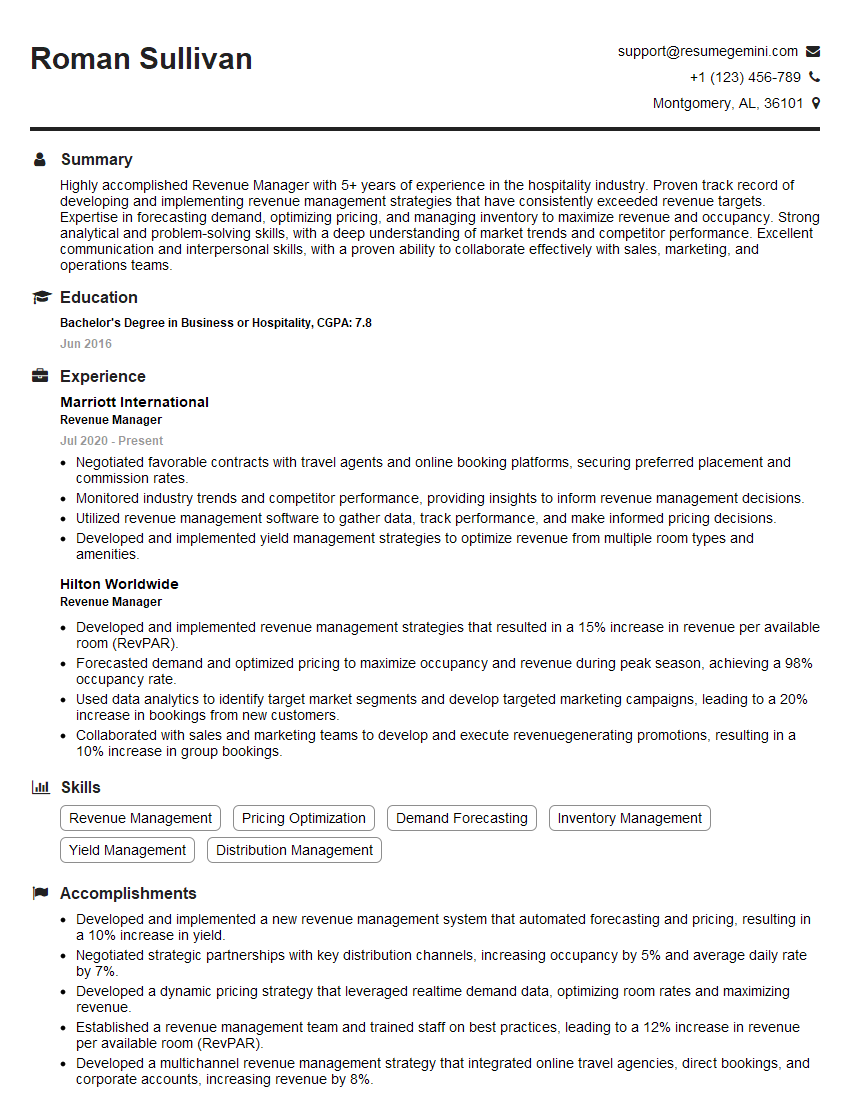
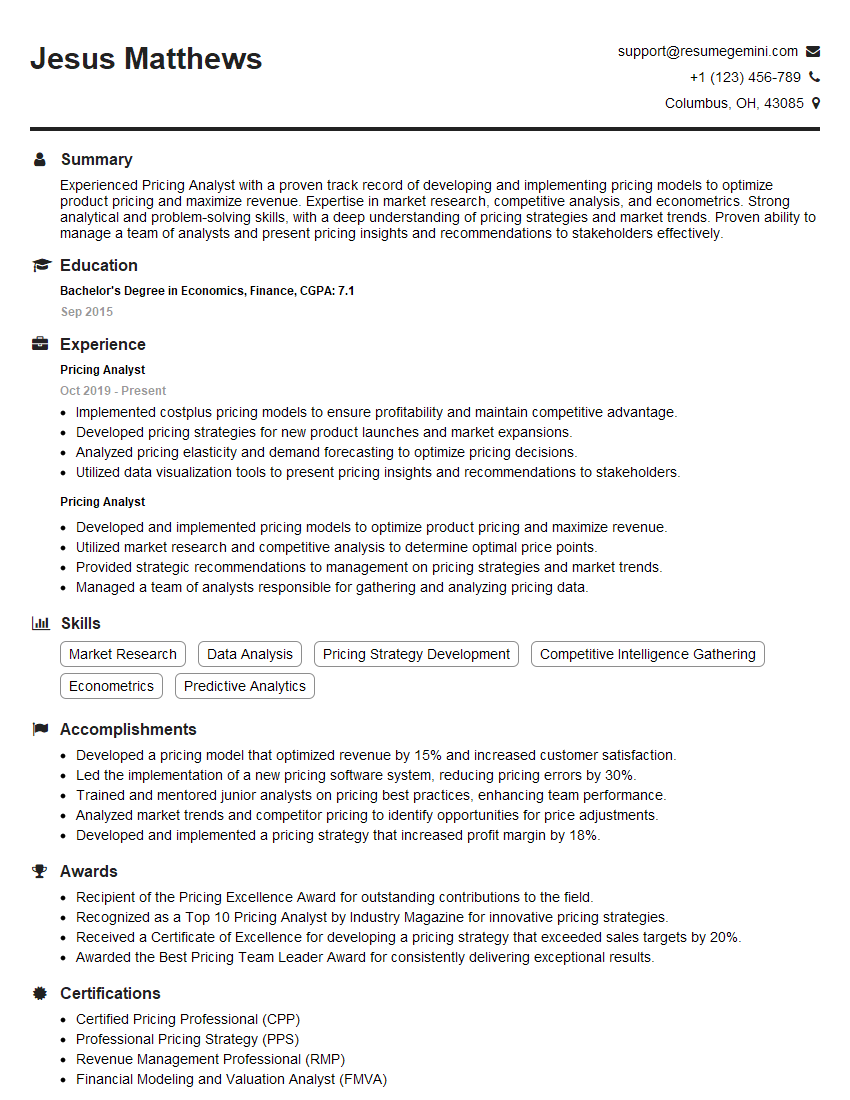
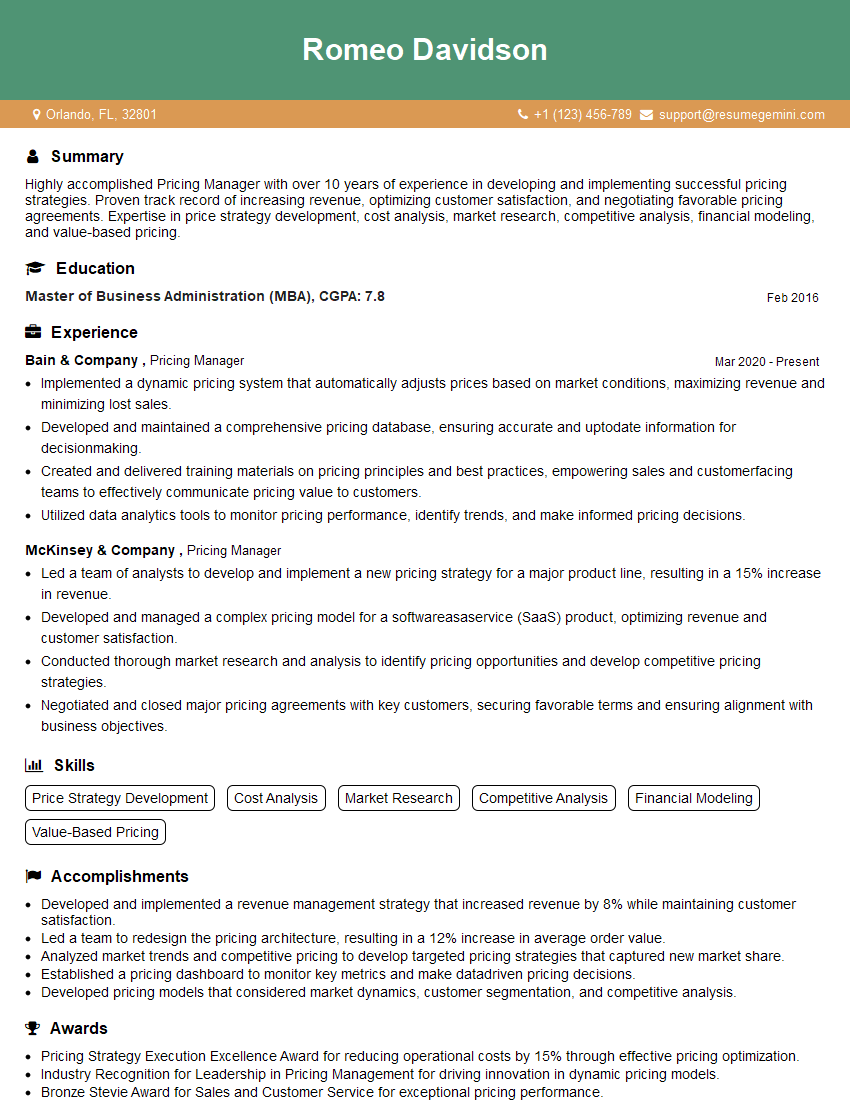
Mastering yield management software is crucial for career advancement in many high-growth industries. Proficiency in this area demonstrates valuable analytical and strategic thinking skills, highly sought after by employers. To maximize your job prospects, create an ATS-friendly resume that showcases your skills and experience effectively. ResumeGemini is a trusted resource that can help you build a professional and impactful resume. Examples of resumes tailored to highlight experience with yield management software are available to guide you.
Explore more articles
Users Rating of Our Blogs
Share Your Experience
We value your feedback! Please rate our content and share your thoughts (optional).
What Readers Say About Our Blog
Hello,
we currently offer a complimentary backlink and URL indexing test for search engine optimization professionals.
You can get complimentary indexing credits to test how link discovery works in practice.
No credit card is required and there is no recurring fee.
You can find details here:
https://wikipedia-backlinks.com/indexing/
Regards
NICE RESPONSE TO Q & A
hi
The aim of this message is regarding an unclaimed deposit of a deceased nationale that bears the same name as you. You are not relate to him as there are millions of people answering the names across around the world. But i will use my position to influence the release of the deposit to you for our mutual benefit.
Respond for full details and how to claim the deposit. This is 100% risk free. Send hello to my email id: [email protected]
Luka Chachibaialuka
Hey interviewgemini.com, just wanted to follow up on my last email.
We just launched Call the Monster, an parenting app that lets you summon friendly ‘monsters’ kids actually listen to.
We’re also running a giveaway for everyone who downloads the app. Since it’s brand new, there aren’t many users yet, which means you’ve got a much better chance of winning some great prizes.
You can check it out here: https://bit.ly/callamonsterapp
Or follow us on Instagram: https://www.instagram.com/callamonsterapp
Thanks,
Ryan
CEO – Call the Monster App
Hey interviewgemini.com, I saw your website and love your approach.
I just want this to look like spam email, but want to share something important to you. We just launched Call the Monster, a parenting app that lets you summon friendly ‘monsters’ kids actually listen to.
Parents are loving it for calming chaos before bedtime. Thought you might want to try it: https://bit.ly/callamonsterapp or just follow our fun monster lore on Instagram: https://www.instagram.com/callamonsterapp
Thanks,
Ryan
CEO – Call A Monster APP
To the interviewgemini.com Owner.
Dear interviewgemini.com Webmaster!
Hi interviewgemini.com Webmaster!
Dear interviewgemini.com Webmaster!
excellent
Hello,
We found issues with your domain’s email setup that may be sending your messages to spam or blocking them completely. InboxShield Mini shows you how to fix it in minutes — no tech skills required.
Scan your domain now for details: https://inboxshield-mini.com/
— Adam @ InboxShield Mini
Reply STOP to unsubscribe
Hi, are you owner of interviewgemini.com? What if I told you I could help you find extra time in your schedule, reconnect with leads you didn’t even realize you missed, and bring in more “I want to work with you” conversations, without increasing your ad spend or hiring a full-time employee?
All with a flexible, budget-friendly service that could easily pay for itself. Sounds good?
Would it be nice to jump on a quick 10-minute call so I can show you exactly how we make this work?
Best,
Hapei
Marketing Director
Hey, I know you’re the owner of interviewgemini.com. I’ll be quick.
Fundraising for your business is tough and time-consuming. We make it easier by guaranteeing two private investor meetings each month, for six months. No demos, no pitch events – just direct introductions to active investors matched to your startup.
If youR17;re raising, this could help you build real momentum. Want me to send more info?
Hi, I represent an SEO company that specialises in getting you AI citations and higher rankings on Google. I’d like to offer you a 100% free SEO audit for your website. Would you be interested?
Hi, I represent an SEO company that specialises in getting you AI citations and higher rankings on Google. I’d like to offer you a 100% free SEO audit for your website. Would you be interested?
good