Are you ready to stand out in your next interview? Understanding and preparing for Expertise in Bookbinding and Finishing Techniques interview questions is a game-changer. In this blog, we’ve compiled key questions and expert advice to help you showcase your skills with confidence and precision. Let’s get started on your journey to acing the interview.
Questions Asked in Expertise in Bookbinding and Finishing Techniques Interview
Q 1. Describe the different types of bookbinding techniques.
Bookbinding techniques are the methods used to physically assemble pages into a cohesive book. The choice of method depends largely on the book’s size, page count, budget, and desired aesthetic. Here are some key techniques:
- Perfect Binding: Common for paperback books, magazines, and journals. The pages are glued together along the spine, then a cover is wrapped around.
- Saddle Stitching: Simple and cost-effective, ideal for booklets and magazines with a low page count. Pages are folded and stapled through the spine.
- Case Binding: A robust method for hardcover books and high-quality publications. Sections of pages are sewn together, then glued to cover boards.
- Spiral Binding/Coil Binding: Pages are punched with holes and bound with a plastic or metal coil. Often used for reports, calendars, and notebooks.
- Wire-O Binding: Similar to spiral binding but uses double-loop wire for a more professional look. Great for notebooks, calendars, and presentation materials.
- Japanese Binding: An ancient technique involving sewing pages together through small holes along the spine, creating a delicate and aesthetically pleasing result.
Each method offers unique advantages and disadvantages regarding cost, durability, and visual appeal.
Q 2. Explain the process of perfect binding.
Perfect binding is a widely used method, particularly for paperback books and magazines. It’s relatively inexpensive and efficient for mass production. Here’s the process:
- Gathering and Collating: The printed sheets are folded and gathered into sections called signatures.
- Adhesive Application: A thin layer of adhesive is applied to the spine edges of the signatures.
- Pressing: The signatures are pressed together to ensure even adhesion and a flat spine.
- Trimming: The spine is often trimmed to create a clean, even edge.
- Cover Application: The glued block of pages is wrapped with a pre-made cover. The cover is carefully adhered to the spine. The glued spine is then carefully pressed so that the pages remain flat.
Think of it like creating a stack of pancakes—you glue the edges together and then wrap them in a wrapper!
Q 3. What are the advantages and disadvantages of saddle stitching?
Saddle stitching is a straightforward and economical binding method. Let’s look at its pros and cons:
- Advantages:
- Cost-effective: It’s one of the cheapest methods, making it ideal for high-volume, low-cost projects.
- Fast Production: The process is relatively quick and simple.
- Lay-flat: The pages lie flat when open.
- Disadvantages:
- Limited Page Count: Only suitable for booklets with a relatively low number of pages (typically under 64 pages).
- Spine Weakness: The staples can weaken the spine, potentially leading to pages tearing out.
- Not Suitable for Thick Documents: The spine can become thick and unwieldy.
A great example is a simple brochure or a small magazine.
Q 4. How do you choose the appropriate binding method for a specific project?
Selecting the right binding method involves careful consideration of several factors:
- Page Count: Perfect binding is good for higher page counts, while saddle stitching is limited.
- Budget: Saddle stitching and perfect binding are more economical than case binding.
- Desired Durability: Case binding offers the best durability, while saddle stitching is least durable.
- Aesthetic Requirements: Case binding offers a sophisticated look, while spiral binding is more functional.
- Project Type: A high-quality novel might need case binding, while a simple calendar could use spiral binding.
For example, a children’s picture book might use perfect binding for its durability and relatively low cost, while a high-end art book would likely benefit from the elegance and strength of case binding.
Q 5. Describe the different types of cover materials and their properties.
Cover materials significantly impact a book’s durability, appearance, and cost. Here are some common types:
- Paperboard: Provides a rigid base for the cover. Different weights and finishes are available for various needs.
- Cloth: Offers a durable and aesthetically pleasing finish. Common types include linen, buckram, and cotton.
- Leather: A luxurious and durable option, but also the most expensive. Offers a rich, tactile experience.
- Synthetic Leather (e.g., PU): A cost-effective alternative to real leather, offering good durability and a variety of textures and colors.
The choice depends on factors like the book’s intended use, target audience, and budget. A cookbook might use a wipeable synthetic leather cover, while a high-end literary work might be bound in cloth or leather.
Q 6. Explain the process of case binding.
Case binding, also known as hardback binding, is a sophisticated and durable method typically used for high-quality books. The process is more complex than other binding techniques:
- Section Sewing: The pages are gathered into sections (signatures) and sewn together along the spine using different methods (e.g., oversewing, kettle stitching).
- Adhesive Application: After sewing, the spine is glued to create a solid block.
- Cover Board Attachment: The spine is glued to pre-made cover boards (usually made of heavy paperboard).
- Cover Material Application: The cover boards are then covered with cloth, leather, or other material.
- Head and Tail Bands: Decorative bands are often added to the top and bottom of the spine for aesthetic appeal and added strength.
- Case Making: The cover is completed with additional elements such as titles, spine lettering (often using foil stamping), and design elements.
- Attaching Cover to Text Block: The finished cover is glued to the prepared text block, often using specialized adhesives.
- Case-in: The spine is carefully glued, ensuring even pressure for a perfect fit and a flat spine.
- Finishing: The book undergoes final checks and inspections to ensure quality.
Imagine it as building a custom-made house for your pages!
Q 7. What are the common finishing techniques used in book production?
Finishing techniques enhance the book’s appearance and marketability. They add a final touch of professionalism and sophistication. Some examples include:
- Foil Stamping: Applying metallic foil (gold, silver, etc.) to create an embossed design or text.
- Embossing: Creating a raised design on the cover, adding texture and visual interest.
- Debossing: The opposite of embossing; it creates an indented design.
- Spot UV Coating: Applying a UV coating to specific areas of the cover for a glossy, high-contrast effect.
- Edge Gilding/Coloring: Applying gold leaf or color to the edges of the pages for a luxurious look.
- Dust Jackets: Protective paper jackets with additional design elements.
These finishing techniques elevate the book from being simply functional to being a beautiful, high-quality product. A simple cookbook might only use a spot UV coating, while a limited edition art book could incorporate multiple finishing techniques like foil stamping, embossing, and head and tail bands.
Q 8. Describe the process of foil stamping.
Foil stamping is a finishing technique that uses heat and pressure to transfer metallic or pigmented foil onto paper or other substrates. Think of it like a really fancy, super precise iron-on decal, but way more refined. It’s used to add a touch of elegance, branding, or decorative elements to books, journals, and other printed materials.
The process typically involves these steps:
- Design Preparation: A die, usually made of brass or magnesium, is created to match the design you want to stamp. This die acts like a custom cookie cutter for your foil.
- Foil Selection: Different types of foil are available, such as hot stamping foil (metallic, pigmented), cold foil (requires a separate UV curing process). The choice depends on the desired look and feel.
- Machine Setup: The die is mounted onto a foil stamping machine. The machine’s temperature and pressure are carefully calibrated to ensure a crisp, clean transfer. This is crucial; too little heat, and the foil won’t adhere; too much, and it can scorch the substrate.
- Foil Stamping: The substrate (book cover, etc.) is fed into the machine. The heated die presses the foil onto the substrate, transferring the design.
- Quality Check: A thorough inspection is done to check for any imperfections such as incomplete transfers, uneven pressure, or foil defects.
For example, I once worked on a project stamping a client’s logo onto 1000 leather-bound journals. Achieving consistent pressure and temperature across all journals was key to ensuring a professional finish.
Q 9. How do you ensure the quality of the finished product?
Ensuring the quality of a finished book is a multifaceted process that begins long before the final binding. It involves meticulous attention to detail at every stage. I use a multi-pronged approach:
- Material Inspection: Beginning with the paper stock, I check for flaws, proper weight, and texture. For covers, I examine the material for consistency and any defects.
- Pre-Press Checks: Before printing, I review the design files for accuracy and resolution, ensuring a sharp, clean print. This includes color profiles and accurate measurements.
- Print Quality Control: I carefully examine the printed sheets for color consistency, sharpness, and any printing defects (e.g., smudging, misregistration).
- Binding Quality Check: This is critical! I check for even sewing, accurate spine alignment, proper glue application, and the overall sturdiness of the binding. A spine that’s not properly glued can lead to pages falling out.
- Finishing Checks: This includes inspecting any additional finishing techniques such as foil stamping, embossing, or edge gilding for consistent quality, accuracy and neatness. I always do a final physical inspection by hand to catch anything the machine might miss.
- Client Approval: Before final delivery, I always provide the client with a sample of the finished product for approval. This allows for feedback and any adjustments needed.
Think of it like building a house: you wouldn’t just throw up the walls and hope for the best. Every step needs careful consideration to achieve a quality, lasting result.
Q 10. What are the common problems encountered in bookbinding and how do you troubleshoot them?
Common problems in bookbinding are often related to materials, machinery, or human error. Here are a few examples and their troubleshooting strategies:
- Uneven Glue Application: This results in pages falling out. Solution: Check the glue application mechanism on the machine and adjust the settings as needed. For hand binding, ensure consistent glue distribution.
- Spine Alignment Issues: Pages might not be aligned correctly causing a crooked spine. Solution: Carefully check the alignment of pages and covers during the binding process. Adjusting the machine’s guides can help.
- Foil Stamping Defects: This can be due to faulty dies, incorrect temperature settings, or improper foil application. Solution: Inspect dies for damage and adjust the machine settings to correct heat and pressure. Ensure the foil is properly positioned.
- Machine Malfunctions: Mechanical problems can disrupt the binding process. Solution: Regular maintenance and prompt attention to any issues; keeping a log book is highly helpful.
Troubleshooting often involves a combination of understanding the underlying cause, using appropriate tools and techniques, and making adjustments to the process or equipment.
Q 11. Explain the importance of quality control in bookbinding.
Quality control is absolutely paramount in bookbinding. It’s the cornerstone of a successful business and the foundation of client satisfaction. Poor quality control leads to damaged reputations, dissatisfied customers, costly reprints, and ultimately, financial losses. Effective quality control measures ensure:
- Consistent Product Quality: Every book produced should meet the same high standards. Clients expect consistency.
- Reduced Errors: Proactive quality control prevents errors from becoming major issues, saving time and money.
- Enhanced Reputation: Delivering high-quality books builds trust and reinforces a strong professional reputation.
- Improved Efficiency: By identifying and addressing problems early, productivity improves, minimizing waste and delays.
- Client Satisfaction: The ultimate goal is client satisfaction; a high quality product speaks for itself.
Imagine receiving a book with pages falling out; you wouldn’t be very happy. Quality control prevents such situations.
Q 12. Describe your experience with different types of binding machinery.
My experience encompasses a broad range of bookbinding machinery, from traditional hand-binding tools to sophisticated automated systems. I am proficient with:
- Casemaking Machines: These automated systems efficiently produce book covers, applying glue, forming the covers, and trimming them to size.
- Sewing Machines: From traditional saddle-stitch sewing to more advanced section sewing machines. I’ve worked with various types, adapting to different speeds and materials.
- Perfect Binding Machines: Used for softcover books where the pages are glued together at the spine. I understand the nuances of glue selection and application crucial for successful binding.
- Foil Stamping Machines: I’m highly skilled in operating and maintaining foil stamping presses, adjusting heat and pressure for optimum results.
- Hand Tools: I have extensive experience with traditional hand-binding techniques, including the use of bone folders, ploughs, and other specialized tools. This allows me to approach projects that require a more bespoke, artisan feel.
Each machine presents its own challenges and rewards. Understanding their capabilities, limitations, and maintenance needs is crucial for efficient and high-quality production.
Q 13. How do you maintain and repair bookbinding equipment?
Maintaining and repairing bookbinding equipment is vital for preventing costly downtime and ensuring consistent quality. My approach involves:
- Regular Cleaning: Daily cleaning is crucial for removing dust, debris, and glue residue that can affect performance.
- Preventive Maintenance: Regular lubrication, adjustment of moving parts, and replacement of worn components are crucial. This extends the lifespan of the equipment.
- Troubleshooting: I’m capable of diagnosing and resolving minor mechanical problems using my in-depth knowledge of the machines’ internal workings. This saves on potential repair costs.
- Calibration Checks: Regular checks ensure accuracy of pressure, temperature, and alignment, critical for consistent quality.
- Professional Servicing: For major repairs or complex issues, I utilize the services of qualified technicians ensuring the safety and accuracy of the equipment. I maintain detailed service records.
Proactive maintenance not only extends the life of the equipment but also minimizes disruptions in production.
Q 14. What safety precautions do you follow while operating bookbinding machinery?
Safety is my utmost priority when operating bookbinding machinery. My safety procedures include:
- Machine Guards: Ensuring all safety guards are in place and functioning correctly before operation. These guards prevent accidental contact with moving parts.
- Personal Protective Equipment (PPE): Consistent use of safety glasses, gloves, and other protective gear as needed to protect against potential injuries from sharp objects, chemicals or moving parts.
- Proper Training: I’ve received comprehensive training on the safe operation of all machinery. I understand the potential hazards and how to avoid them.
- Lockout/Tagout Procedures: Following strict lockout/tagout procedures when performing maintenance or repairs, ensuring the machine is completely de-energized.
- Emergency Shutdown: Knowing the location and proper use of emergency stop buttons. I am trained to handle any emergencies safely and efficiently.
- Regular Inspections: Regular inspections of the machinery and work area for any safety hazards.
Safety is not just a set of rules; it’s a mindset that integrates into every aspect of my work. The value of a book shouldn’t come at the expense of safety.
Q 15. Describe your experience with hand bookbinding techniques.
My experience with hand bookbinding encompasses a wide range of techniques, from the simplest pamphlet stitch to the intricate complexities of long stitch, case binding, and concertina binding. I’ve worked with various materials, including fine leathers, various weights of paper, and specialty fabrics. For instance, I recently completed a project using Japanese stab binding for a limited edition poetry collection, requiring precise placement of holes and careful stitching to ensure a secure and aesthetically pleasing result. Another project involved creating a bespoke leather-bound journal using the Coptic stitch, a technique demanding both precision and patience. My proficiency extends to preparing the materials – accurately cutting, scoring, and preparing the text blocks – before undertaking the binding process itself. I consider hand bookbinding not just a craft, but an art form, requiring a keen eye for detail and a deep understanding of material properties.
- Coptic Binding: Known for its strength and flexibility.
- Long Stitch Binding: Ideal for showcasing the beauty of the text block’s edges.
- Case Binding: A durable method for larger books.
Career Expert Tips:
- Ace those interviews! Prepare effectively by reviewing the Top 50 Most Common Interview Questions on ResumeGemini.
- Navigate your job search with confidence! Explore a wide range of Career Tips on ResumeGemini. Learn about common challenges and recommendations to overcome them.
- Craft the perfect resume! Master the Art of Resume Writing with ResumeGemini’s guide. Showcase your unique qualifications and achievements effectively.
- Don’t miss out on holiday savings! Build your dream resume with ResumeGemini’s ATS optimized templates.
Q 16. How do you manage deadlines and meet production targets?
Meeting deadlines and production targets is crucial in bookbinding. I utilize project management techniques, starting with a thorough assessment of the project scope, including the number of books, complexity of binding, and materials required. I then create a detailed schedule, breaking down the process into manageable tasks with assigned timelines. This involves considering potential bottlenecks and scheduling buffer time to account for unforeseen issues. Regular progress checks allow for timely adjustments. For example, on a recent large-scale project involving 500 copies, I used a Gantt chart to visualize tasks and dependencies, ensuring smooth workflow. Open communication with clients is key to managing expectations and making necessary adjustments along the way.
Q 17. How do you work effectively in a team environment?
Effective teamwork is essential in a bookbinding environment. I’m comfortable collaborating with designers, printers, and other artisans. I actively listen to different perspectives, contributing my expertise while respecting the knowledge and skills of others. My approach focuses on clear communication – setting clear roles and responsibilities from the outset, providing regular updates, and fostering open dialogue to resolve any conflicts or challenges promptly. For instance, on a recent collaboration with a graphic designer, our regular brainstorming sessions facilitated the creation of a unique and innovative book design that incorporated both aesthetic and structural considerations.
Q 18. What software are you familiar with in relation to bookbinding and pre-press?
My software proficiency includes Adobe Acrobat Pro for PDF manipulation and pre-flighting, ensuring print-ready files. I’m also familiar with Adobe InDesign for layout assessment and potential pre-press adjustments, particularly when dealing with unusual page sizes or special binding requirements. While not directly involved in the binding process, these skills are crucial for ensuring a smooth transition from design to production. For example, I’ve used InDesign to check for bleed issues and Acrobat Pro to verify that the PDF conforms to print specifications, preventing potential delays or costly reprints.
Q 19. Describe your experience with different types of paper and their suitability for various binding methods.
Choosing the right paper is crucial for successful bookbinding. Different papers have varying weights, textures, and acidities, affecting their suitability for different binding methods. For example, thin papers might be ideal for pamphlet stitching, while thicker, heavier papers are better suited for case binding. Acid-free papers are essential for archival quality, ensuring the longevity of the bound book. The paper’s texture also influences the aesthetic appeal of the finished product. I have experience working with a wide range of papers, from delicate handmade papers to robust card stock, and I can advise on the best choice depending on the project’s specific requirements and chosen binding style. Using the wrong paper can lead to breakage or unsatisfactory results.
Q 20. How do you calculate the cost of a bookbinding project?
Calculating the cost of a bookbinding project requires careful consideration of several factors. This involves assessing material costs – paper, thread, cloth, board, and any decorative elements. Labor costs are a significant factor, determined by the complexity of the binding method and the time involved. Overhead expenses, such as rent, utilities, and equipment maintenance, should also be included. I typically break down the cost into a per-unit cost, which is then multiplied by the number of books to be bound. Any bespoke or specialized requirements will, naturally, increase the final cost. For example, hand-tooled leather covers significantly increase the cost compared to a simple cloth cover.
Q 21. Explain the importance of understanding client specifications.
Understanding client specifications is paramount. Misinterpretations can lead to costly mistakes and dissatisfied clients. I always initiate projects with a thorough review of the client’s brief, clarifying any ambiguities, and discussing potential challenges or limitations. This includes verifying details such as the number of pages, desired binding method, paper type, cover materials, and any special finishing requirements. Close communication throughout the process ensures that the final product aligns perfectly with their vision. For example, if a client requests a specific type of thread that is not readily available, I would proactively discuss alternatives or explore sourcing options to ensure the project proceeds without unnecessary delays.
Q 22. How do you handle unexpected challenges or problems during a project?
Unexpected challenges are part and parcel of bookbinding. My approach is methodical and prioritizes clear communication. First, I assess the problem: Is it a material issue (e.g., damaged paper), a process issue (e.g., misaligned sections), or something else? Then, I brainstorm solutions, considering the project’s timeline and budget. This might involve consulting reference materials, experimenting with different techniques, or seeking advice from colleagues. For example, if a crucial section became damaged during the sewing process, I wouldn’t panic. Instead, I’d carefully evaluate the extent of the damage. Depending on the severity, I might repair it using conservation techniques like Japanese tissue repair or, if necessary, reprint the section and seamlessly integrate it into the book. Thorough documentation at each step allows me to trace the problem’s origin and improve my process for future projects. Above all, transparent communication with the client is key; I’d explain the challenge and the proposed solution, keeping them informed every step of the way.
Q 23. Describe your problem-solving skills in the context of bookbinding.
Problem-solving in bookbinding is a blend of artistry and technical skill. Consider a scenario where the spine of a book isn’t lying perfectly flat after casing-in. I wouldn’t simply force it; that could lead to damage. Instead, I’d analyze the root cause. Was the glue application uneven? Was the pressure insufficient during pressing? Perhaps the text block was too thick for the chosen cover boards. I’d carefully examine each step of the process, potentially using tools like a bone folder to gently reshape the spine or adjust the tension. If the problem stems from using the wrong adhesive, for instance, I’d switch to a more flexible formula. Documenting these solutions helps improve my future practice. My problem-solving approach also includes exploring alternative techniques – if traditional methods aren’t working, I’m open to experimenting with innovative solutions while keeping the book’s integrity intact.
Q 24. What are the current trends in bookbinding and finishing techniques?
The bookbinding world is constantly evolving. Currently, we see a strong emphasis on sustainability, with increased use of recycled materials and eco-friendly adhesives. Digital printing techniques are impacting book production, leading to more on-demand and personalized books. There’s a resurgence of interest in traditional hand-binding methods, appreciated for their artistry and longevity. Moreover, creative finishing techniques, such as foiling, embossing, and unique cover treatments, are gaining popularity, especially in niche markets like artist books and limited editions. The demand for durable, visually appealing, and ethically produced books is driving these trends.
Q 25. How do you stay updated with the latest industry developments?
Staying current is crucial. I regularly attend industry conferences and workshops, both online and in person. Trade publications, such as specialized bookbinding journals and online forums, are invaluable resources. I actively engage with online communities dedicated to bookbinding, exchanging knowledge and learning from experienced practitioners. Moreover, I explore new materials and techniques through experimentation and by collaborating with other artisans. Continuous learning is not just about staying updated, it’s about refining my craft and innovating.
Q 26. Describe your experience with different types of adhesives used in bookbinding.
My experience encompasses a wide range of adhesives, each with its strengths and weaknesses. For instance, animal-based glues like hide glue offer excellent flexibility and aging properties, perfect for historical restoration projects or books needing exceptional longevity. However, they require precise temperature control. Polyvinyl acetate (PVA) glues are commonly used due to their affordability and ease of application, though they lack the longevity of hide glue. In contrast, PUR (polyurethane reactive) adhesives offer superior strength and water resistance, making them suitable for books needing extra durability, though they require specialized equipment. The choice of adhesive hinges on the project’s requirements – the type of paper, cover material, desired flexibility, and longevity expectations all influence my selection. Each adhesive demands specific application techniques for optimal results.
Q 27. What are the environmental considerations in bookbinding and finishing?
Environmental consciousness is paramount in modern bookbinding. We’re moving towards using recycled paper, sustainably sourced boards, and eco-friendly adhesives with low VOC (volatile organic compound) emissions. Reducing waste through efficient material usage and exploring innovative techniques to minimize energy consumption are crucial. The selection of dyes and inks should also prioritize low environmental impact. Furthermore, supporting suppliers who share these ethical values is an important part of my commitment to environmentally responsible practices. It’s a collective effort to ensure the book’s beauty does not come at the expense of the planet.
Q 28. How do you ensure the longevity and durability of the bound books?
Ensuring longevity involves a multi-faceted approach. Firstly, selecting high-quality materials is crucial – acid-free paper is essential to prevent degradation. The choice of adhesive and its proper application significantly impacts the book’s durability. Proper sewing techniques, like long-stitch sewing or kettle stitch, are chosen depending on the book’s size and weight to ensure a strong text block. Careful pressing is key to achieve a flat, well-formed spine. Finally, using protective techniques like applying a protective cover or enclosure can safeguard the book against damage. Using archival-quality materials and methods is my guiding principle in creating books built to last.
Key Topics to Learn for Expertise in Bookbinding and Finishing Techniques Interview
- Materials and their Properties: Understanding different paper types, board stocks, adhesives, and their suitability for various binding methods. Consider the impact of material choices on the final product’s durability and aesthetic appeal.
- Binding Techniques: Proficiency in various binding methods such as perfect binding, saddle stitching, case binding, spiral binding, and wire-o binding. Be prepared to discuss the advantages and limitations of each technique and when to apply them.
- Finishing Techniques: In-depth knowledge of finishing processes including embossing, debossing, foil stamping, die-cutting, and edge finishing. Be ready to discuss the practical applications and potential challenges of each technique.
- Pre-press Preparation: Understanding the role of pre-press activities like imposition, imposition software and its impact on efficiency and cost-effectiveness in the bookbinding process.
- Quality Control and Troubleshooting: Discuss methods for identifying and resolving common bookbinding and finishing issues, ensuring quality control throughout the production process. Be prepared to describe your problem-solving approach.
- Equipment and Machinery: Familiarity with various bookbinding and finishing machines, including their operation, maintenance, and safety protocols. Highlight your experience with specific machinery and your ability to troubleshoot common equipment problems.
- Production Planning and Management: Discuss your experience in planning and managing bookbinding projects, including scheduling, resource allocation, and cost estimation. Be ready to discuss project timelines and potential bottlenecks.
Next Steps
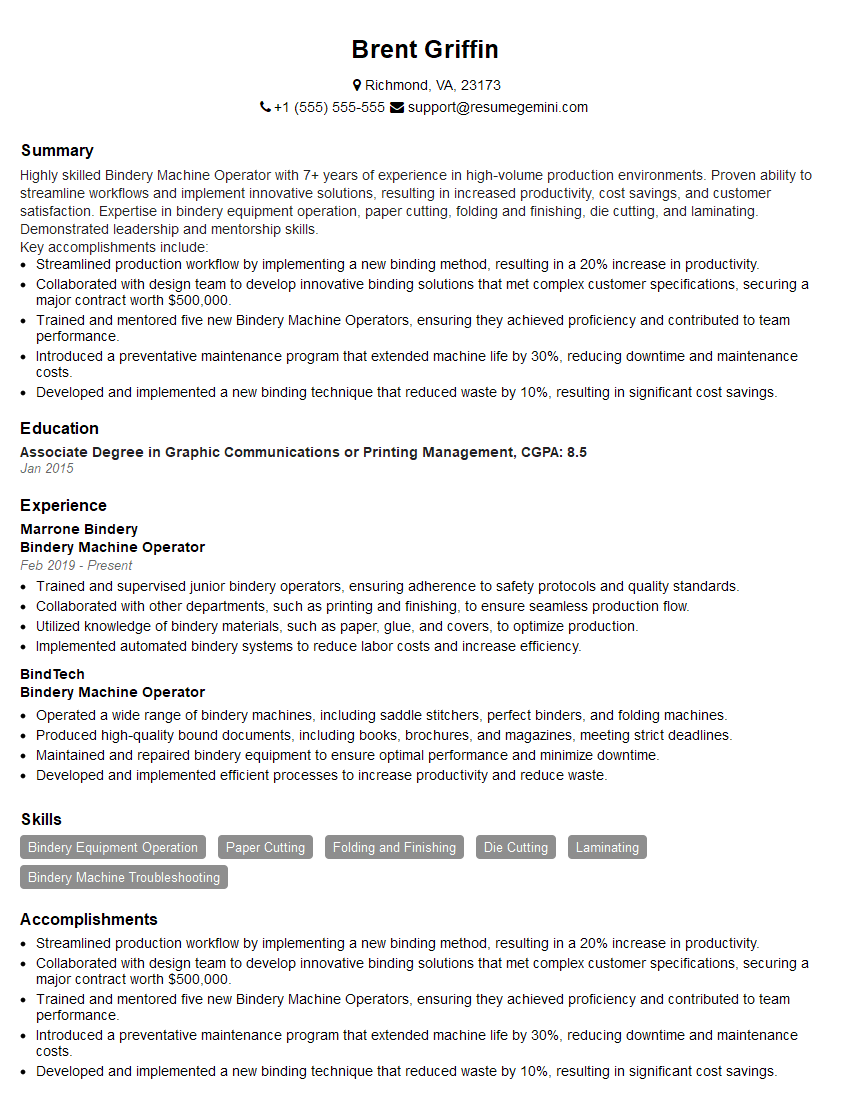
Mastering Expertise in Bookbinding and Finishing Techniques is crucial for career advancement in the publishing and printing industries. A strong understanding of these techniques will significantly enhance your job prospects and allow you to pursue more challenging and rewarding roles. To increase your chances of securing your dream position, creating an ATS-friendly resume is essential. ResumeGemini is a trusted resource that can help you build a professional and impactful resume that highlights your skills and experience effectively. Examples of resumes tailored to Expertise in Bookbinding and Finishing Techniques are available to further guide your resume creation process. Invest time in crafting a compelling resume – it’s your first impression with potential employers.
Explore more articles
Users Rating of Our Blogs
Share Your Experience
We value your feedback! Please rate our content and share your thoughts (optional).
What Readers Say About Our Blog
Attention music lovers!
Wow, All the best Sax Summer music !!!
Spotify: https://open.spotify.com/artist/6ShcdIT7rPVVaFEpgZQbUk
Apple Music: https://music.apple.com/fr/artist/jimmy-sax-black/1530501936
YouTube: https://music.youtube.com/browse/VLOLAK5uy_noClmC7abM6YpZsnySxRqt3LoalPf88No
Other Platforms and Free Downloads : https://fanlink.tv/jimmysaxblack
on google : https://www.google.com/search?q=22+AND+22+AND+22
on ChatGPT : https://chat.openai.com?q=who20jlJimmy20Black20Sax20Producer
Get back into the groove with Jimmy sax Black
Best regards,
Jimmy sax Black
www.jimmysaxblack.com
Hi I am a troller at The aquatic interview center and I suddenly went so fast in Roblox and it was gone when I reset.
Hi,
Business owners spend hours every week worrying about their website—or avoiding it because it feels overwhelming.
We’d like to take that off your plate:
$69/month. Everything handled.
Our team will:
Design a custom website—or completely overhaul your current one
Take care of hosting as an option
Handle edits and improvements—up to 60 minutes of work included every month
No setup fees, no annual commitments. Just a site that makes a strong first impression.
Find out if it’s right for you:
https://websolutionsgenius.com/awardwinningwebsites
Hello,
we currently offer a complimentary backlink and URL indexing test for search engine optimization professionals.
You can get complimentary indexing credits to test how link discovery works in practice.
No credit card is required and there is no recurring fee.
You can find details here:
https://wikipedia-backlinks.com/indexing/
Regards
NICE RESPONSE TO Q & A
hi
The aim of this message is regarding an unclaimed deposit of a deceased nationale that bears the same name as you. You are not relate to him as there are millions of people answering the names across around the world. But i will use my position to influence the release of the deposit to you for our mutual benefit.
Respond for full details and how to claim the deposit. This is 100% risk free. Send hello to my email id: lukachachibaialuka@gmail.com
Luka Chachibaialuka
Hey interviewgemini.com, just wanted to follow up on my last email.
We just launched Call the Monster, an parenting app that lets you summon friendly ‘monsters’ kids actually listen to.
We’re also running a giveaway for everyone who downloads the app. Since it’s brand new, there aren’t many users yet, which means you’ve got a much better chance of winning some great prizes.
You can check it out here: https://bit.ly/callamonsterapp
Or follow us on Instagram: https://www.instagram.com/callamonsterapp
Thanks,
Ryan
CEO – Call the Monster App
Hey interviewgemini.com, I saw your website and love your approach.
I just want this to look like spam email, but want to share something important to you. We just launched Call the Monster, a parenting app that lets you summon friendly ‘monsters’ kids actually listen to.
Parents are loving it for calming chaos before bedtime. Thought you might want to try it: https://bit.ly/callamonsterapp or just follow our fun monster lore on Instagram: https://www.instagram.com/callamonsterapp
Thanks,
Ryan
CEO – Call A Monster APP
To the interviewgemini.com Owner.
Dear interviewgemini.com Webmaster!
Hi interviewgemini.com Webmaster!
Dear interviewgemini.com Webmaster!
excellent
Hello,
We found issues with your domain’s email setup that may be sending your messages to spam or blocking them completely. InboxShield Mini shows you how to fix it in minutes — no tech skills required.
Scan your domain now for details: https://inboxshield-mini.com/
— Adam @ InboxShield Mini
support@inboxshield-mini.com
Reply STOP to unsubscribe
Hi, are you owner of interviewgemini.com? What if I told you I could help you find extra time in your schedule, reconnect with leads you didn’t even realize you missed, and bring in more “I want to work with you” conversations, without increasing your ad spend or hiring a full-time employee?
All with a flexible, budget-friendly service that could easily pay for itself. Sounds good?
Would it be nice to jump on a quick 10-minute call so I can show you exactly how we make this work?
Best,
Hapei
Marketing Director
Hey, I know you’re the owner of interviewgemini.com. I’ll be quick.
Fundraising for your business is tough and time-consuming. We make it easier by guaranteeing two private investor meetings each month, for six months. No demos, no pitch events – just direct introductions to active investors matched to your startup.
If youR17;re raising, this could help you build real momentum. Want me to send more info?
Hi, I represent an SEO company that specialises in getting you AI citations and higher rankings on Google. I’d like to offer you a 100% free SEO audit for your website. Would you be interested?
Hi, I represent an SEO company that specialises in getting you AI citations and higher rankings on Google. I’d like to offer you a 100% free SEO audit for your website. Would you be interested?