The right preparation can turn an interview into an opportunity to showcase your expertise. This guide to Fiber Splicing and Testing interview questions is your ultimate resource, providing key insights and tips to help you ace your responses and stand out as a top candidate.
Questions Asked in Fiber Splicing and Testing Interview
Q 1. Explain the difference between fusion splicing and mechanical splicing.
Fusion splicing and mechanical splicing are both methods of joining optical fibers, but they differ significantly in their approach and resulting connection quality. Fusion splicing uses heat and pressure to melt and fuse the fiber ends together, creating a permanent, extremely low-loss connection. Think of it like welding two pieces of metal – a strong, continuous joint. Mechanical splicing, on the other hand, uses a precisely aligned sleeve or connector to hold the fiber ends in place. This is more like using a strong clamp to hold two pieces of wood together.
Fusion Splicing Advantages: Higher strength, lower loss, more reliable, and generally longer lifespan.
Mechanical Splicing Advantages: Faster, simpler process often requiring less specialized equipment, suitable for temporary connections or situations where fusion splicing is impractical.
In Summary: Fusion splicing is preferred for permanent, high-performance networks where minimal signal loss is crucial, while mechanical splicing offers a quicker, more affordable solution for less demanding applications. The choice depends heavily on the specific project requirements and budget.
Q 2. Describe the process of preparing fiber optic cable for splicing.
Preparing fiber for splicing is a crucial step impacting connection quality. It’s a meticulous process requiring precision and cleanliness. The steps generally include:
- Cable Preparation: The outer jacket and any protective layers are carefully removed from the fiber using a stripping tool, taking care not to damage the fiber itself. Think of this like carefully peeling an orange to get to the segments inside, avoiding any damage to the delicate fruit.
- Fiber Cleaning: The exposed fiber ends are thoroughly cleaned using specialized fiber cleaning wipes or solutions to remove any dust, oil, or debris. Even microscopic particles can significantly degrade the splice quality.
- Cleaving: A precision cleaver creates a perfectly perpendicular and smooth fiber end face. This is critically important for optimal light transmission. An angled or damaged cleave leads to significant signal loss. Imagine trying to connect two pipes – a clean, square cut ensures a perfect seal.
- Inspection: A microscope is used to inspect the cleaved end face for any imperfections. If the cleave is not perfect, it needs to be recleaved.
Proper preparation directly affects the splice loss – a poorly prepared fiber can lead to high losses and connection failures. Each step must be performed meticulously to ensure the highest quality splice.
Q 3. What are the common causes of fiber optic cable damage?
Fiber optic cables, while robust, are susceptible to damage from various sources. These include:
- Physical Damage: Bending, crushing, cutting, or abrasion during installation, maintenance, or due to external factors like rodents or construction work. Think of a delicate thread that can easily be snapped or frayed.
- Environmental Factors: Exposure to extreme temperatures, humidity, or corrosive chemicals can degrade the cable and its protective layers over time.
- Improper Handling: Incorrect handling during installation or storage can lead to micro-bending or cracks, affecting signal transmission.
- Poor Splicing: Faulty splicing or connectorization introduces signal loss and potential failure points.
Understanding the common causes allows for preventative measures during installation, storage, and maintenance. Regular inspection and proper handling techniques minimize the risk of damage.
Q 4. How do you identify and troubleshoot fiber optic cable breaks?
Identifying and troubleshooting fiber breaks involves a systematic approach. First, we use an OTDR to pinpoint the location of the break, followed by visual inspection of the cable. An OTDR shows a significant drop in signal at the break point. We then visually inspect the cable in the area indicated by the OTDR. We may use a continuity tester to ensure the fibers are connected. If the problem isn’t immediately obvious, we might employ a ‘proof-test’ to narrow down the fault location. This could involve tracing back from the end and using light sources to confirm which length is faulty.
Troubleshooting Steps:
- Visual Inspection: Examine the cable for any signs of physical damage along the identified area.
- OTDR Testing: Use the OTDR to precisely locate the break and assess the severity of the fault.
- Continuity Test: Check continuity of the fibers to rule out any unexpected disconnections beyond the initial break.
- Repair/Replacement: Depending on the location and accessibility, the fiber may be spliced, repaired, or replaced entirely.
The specific repair method depends on the nature and location of the break. In some cases, repairing a break is feasible; in others, a cable replacement may be more efficient.
Q 5. Explain the principles of Optical Time Domain Reflectometry (OTDR).
Optical Time Domain Reflectometry (OTDR) is a powerful technique used to test and troubleshoot optical fiber cables. It works by sending a short light pulse down the fiber and measuring the amount of light reflected back at various points. Think of it like sending an echo into a canyon and listening for the echoes that reveal its shape and features. Different features along the fiber cause different amounts of back reflection (echoes).
Principles:
- Light Pulse Injection: An OTDR sends short pulses of light into the fiber.
- Back Reflections: Light is reflected back to the OTDR at different points. Reflections occur at the beginning and end of the fiber as well as at any discontinuity, like a splice or break.
- Time Measurement: The OTDR measures the time it takes for the light pulses to return. The time delay is directly proportional to the distance of the event from the OTDR.
- Signal Analysis: Based on the reflected signal’s strength and time delay, the OTDR generates a trace showing the fiber’s characteristics including length, loss, and events.
OTDRs are indispensable tools for fiber optic network maintenance and fault location.
Q 6. How do you interpret an OTDR trace?
Interpreting an OTDR trace requires understanding its key features. The trace shows the signal’s power level (dB) plotted against the distance (km) along the fiber. A typical trace shows:
- Fresnel Reflection: A large initial reflection at the beginning of the fiber.
- Splices/Connectors: These appear as small dips in the signal level.
- Fiber Loss: A gradual decrease in the signal power along the fiber.
- Events: Abrupt changes in signal level indicating breaks, bends, or other anomalies.
The location of events and the signal loss are key indicators of fiber health. Analyzing the shape, amplitude, and position of features on the trace enables identification of problems like breaks, poor splices, or excessive attenuation. Significant losses or abrupt signal drops often indicate a problem requiring attention. Experience in reading OTDR traces is crucial for accurate fault location and diagnosis.
Consider this: A very steep drop in signal strength in the OTDR trace points toward a break or severe damage in the optical fiber.
Q 7. What are the different types of fiber optic connectors?
Several types of fiber optic connectors are used, each with its strengths and weaknesses. The choice of connector depends on the application, environment, and budget. Common types include:
- SC (Subscriber Connector): A push-pull connector, relatively simple and widely used.
- FC (Ferrule Connector): A screw-on type known for its high precision and repeatability, often used in high-performance applications.
- LC (Lucent Connector): A smaller, more compact connector gaining popularity due to its space-saving design.
- ST (Straight Tip): A bayonet-style connector, simpler and less expensive than FC connectors.
- MT-RJ (Mechanical Transfer-Registered Jack): A double connector for higher bandwidth applications, typically found in Ethernet cabling.
Each connector type has specific insertion loss characteristics and environmental tolerances. Selecting the appropriate connector is vital for ensuring optimal performance and reliability of the optical link.
Q 8. Describe the procedure for terminating fiber optic cables.
Terminating fiber optic cables involves preparing the cable end for connection to a connector or other device. It’s a precise process that requires careful handling to avoid damage to the delicate fiber. The steps generally include:
Cutting the Fiber: Use a fiber optic cleaver to create a perfectly perpendicular and smooth end face. A poorly cleaved end will lead to significant signal loss.
Cleaning the Fiber: Use a lint-free wipe and isopropyl alcohol to remove any dust or debris from the fiber end. Even microscopic particles can disrupt the connection.
Preparing the Connector: Depending on the connector type (SC, LC, FC, etc.), this may involve inserting the fiber into a connector body, epoxy, or other adhesive. Precise alignment is crucial.
Curing (if applicable): If epoxy is used, it needs to cure properly before handling or testing. This ensures a strong and reliable connection.
Testing: After termination, the connection should be tested using an optical power meter and/or an optical time-domain reflectometer (OTDR) to verify the connection quality and identify any losses.
For example, when terminating a single-mode fiber with an SC connector, using a high-quality cleaver is crucial for minimizing losses. Incorrect cutting can cause Fresnel reflections and increase attenuation.
Q 9. What safety precautions should be taken when working with fiber optic cables?
Safety is paramount when working with fiber optics. The primary concern is eye safety, as the laser light used in testing can cause severe and irreversible eye damage. Other precautions include:
Eye Protection: Always wear appropriate safety eyewear rated for the wavelengths of light being used. This is absolutely non-negotiable.
Skin Protection: While not as critical as eye protection, gloves should be worn to prevent cuts from sharp fiber ends and to avoid contamination.
Proper Handling: Avoid bending the fiber too sharply, as this can cause microbends and increase attenuation. Store and handle fibers carefully to prevent damage.
Laser Safety Training: Training on laser safety procedures is essential to ensure awareness of potential hazards and proper handling protocols. This is especially important when using OTDRs.
Grounding: In some high-voltage situations, grounding measures might be required to prevent static discharge damaging the fiber.
A real-world example is a technician who suffered eye damage due to lack of appropriate safety eyewear while working with an OTDR. Always prioritize safety.
Q 10. What are the different types of fiber optic losses?
Fiber optic losses refer to the reduction in optical signal strength as it travels through the fiber. Several factors contribute to these losses:
Attenuation: This is the gradual weakening of the signal due to absorption and scattering within the fiber. It’s typically expressed in decibels per kilometer (dB/km). Factors influencing attenuation include fiber material, wavelength, and temperature.
Splice Loss: Loss introduced at the connection point between two fibers. Imperfect alignment or cleaving causes this loss. It is important to minimize splice loss during the installation.
Connector Loss: Loss at the interface between the fiber and a connector. Poor connector polishing or alignment leads to increased loss.
Macrobending Loss: Loss caused by excessive bending of the fiber. Sharp bends or kinks introduce significant signal loss.
Microbending Loss: Loss due to small-scale bends or irregularities in the fiber. These can be caused by pressure or stresses on the cable.
Think of it like water flowing through a pipe; the pipe itself might cause some friction (attenuation), but leaks (splices/connectors) and kinks (macro/microbends) will cause even more substantial losses.
Q 11. How do you measure fiber optic attenuation?
Fiber optic attenuation is measured using an OTDR (Optical Time-Domain Reflectometer). The OTDR sends light pulses down the fiber and measures the amount of light reflected back at various points. The instrument can analyze the reflected signal to determine the location and magnitude of attenuation along the fiber.
The process typically involves:
Connecting the OTDR: Connect the OTDR to one end of the fiber to be tested.
Launching a Pulse: The OTDR launches a series of light pulses into the fiber.
Analyzing Reflections: The OTDR detects the light backscattered and reflected from various points in the fiber, including connectors, splices, and other discontinuities.
Measuring Attenuation: The OTDR calculates the attenuation based on the signal strength at different points along the fiber. The results are usually displayed graphically, showing the attenuation profile of the fiber link.
The OTDR provides valuable insights into the overall health of the fiber link, identifying areas with high loss due to problems like poor splices or fiber damage. The results are typically reported in dB/km.
Q 12. Explain the concept of splice loss.
Splice loss is the optical power loss that occurs at the point where two optical fibers are joined together. It’s caused by imperfections in the alignment and connection of the fiber ends. Even with careful splicing, some loss is unavoidable. Several factors contribute to splice loss:
Axial Misalignment: When the two fiber cores are not perfectly aligned along their longitudinal axis. This is a common source of splice loss.
Lateral Misalignment: When the centers of the two fiber cores are not perfectly aligned. The more separated the cores, the higher the loss.
Angular Misalignment: When the two fiber ends are not perfectly aligned at the same angle.
Air Gap: A small gap between the fiber ends will introduce significant loss.
Fresnel Reflection: Due to the refractive index difference at the interface between the fiber ends.
Think of it as connecting two water pipes – even if they perfectly fit together, there’s a small chance of water loss due to friction at the joint. Splice loss is minimized by careful polishing of the fiber ends, precise alignment techniques (fusion splicing), and the use of high-quality splicing equipment.
Q 13. What tools and equipment are commonly used in fiber splicing and testing?
Fiber splicing and testing involve a range of specialized tools and equipment:
Fiber Cleaver: Precisely cuts the fiber to create a perfectly flat and perpendicular end face.
Fusion Splicer: Uses heat and pressure to fuse the ends of two fibers together, creating a strong and low-loss connection.
Mechanical Splicer: Creates a connection using precision alignment and a mechanical clamping mechanism.
Optical Power Meter (OPM): Measures the optical power level in a fiber optic system.
Optical Time-Domain Reflectometer (OTDR): Measures the optical attenuation, location of faults, and reflection events along a fiber optic cable.
Fiber Optic Connector Cleaning Kit: Includes specialized wipes, cleaning solutions, and inspection scopes for cleaning connectors.
Fiber Optic Microscope: For inspecting fiber end faces and checking the quality of cleaves and connector terminations.
Visual Fault Locator (VFL): A pen-like device emitting light into the fiber to visually trace the path of the fiber and identify breaks or faults.
The specific tools used depend on the application and the type of fiber being worked with.
Q 14. How do you clean fiber optic connectors?
Cleaning fiber optic connectors is crucial to ensure optimal performance and minimize signal loss. Contamination, even microscopic particles, can cause significant attenuation. The cleaning process should always follow these steps:
Inspection: Before cleaning, inspect the connector end face using a microscope or inspection scope. This determines the level of contamination.
Cleaning: Use a lint-free wipe and isopropyl alcohol (IPA) specifically designed for fiber optics. Wipe in a single, consistent direction across the connector ferrule, avoiding circular motions.
Inspect Again: After cleaning, inspect the connector again to ensure it’s free of debris.
Avoid Touching: After cleaning, avoid touching the connector ferrule. Use connector protectors to prevent recontamination.
It’s important to use only appropriate cleaning materials. Using the wrong materials, such as cotton swabs, can leave behind lint and fibers, worsening the contamination.
Q 15. What is the significance of the cleave quality in fiber splicing?
Cleave quality is paramount in fiber splicing because it directly impacts the splice loss – the signal attenuation at the connection point. A poor cleave results in a fiber end that’s not perfectly perpendicular, leading to increased loss. Imagine trying to connect two Lego bricks with one end angled; the connection won’t be perfect, and you’ll have a gap. Similarly, an uneven cleave creates air gaps and micro-bends at the splice, significantly reducing signal transmission efficiency. A high-quality cleave, achieved using a cleaver with a sharp blade and a consistent, precise movement, creates a flat, perpendicular surface maximizing the contact area between the fibers, minimizing light scattering and reflection, and resulting in a lower splice loss.
Think of it like this: a good cleave is like a clean cut – precise and neat. A bad cleave is like a jagged tear, causing significant problems.
Career Expert Tips:
- Ace those interviews! Prepare effectively by reviewing the Top 50 Most Common Interview Questions on ResumeGemini.
- Navigate your job search with confidence! Explore a wide range of Career Tips on ResumeGemini. Learn about common challenges and recommendations to overcome them.
- Craft the perfect resume! Master the Art of Resume Writing with ResumeGemini’s guide. Showcase your unique qualifications and achievements effectively.
- Don’t miss out on holiday savings! Build your dream resume with ResumeGemini’s ATS optimized templates.
Q 16. Describe the different types of fusion splicers.
Fusion splicers are the workhorses of fiber optic splicing, permanently joining two optical fibers using heat. They come in a few types:
- Electric Arc Fusion Splicers: These are the most common type. They use an electric arc to melt the fiber ends, fusing them together. They are precise and relatively fast, offering repeatable low loss splices. Most field technicians use this type.
- Corded Arc Fusion Splicers: These splicers utilize a similar electric arc but have a corded connection to a separate power source, often providing greater power and stability. This is advantageous in challenging field conditions.
- V-Groove Fusion Splicers: These align the fibers in a precisely shaped groove before fusing them. While offering precise alignment, they are less common due to higher cost and more complex operation.
The choice of fusion splicer depends on factors such as budget, required precision, and the environment where splicing is performed. For high-count deployments or harsh conditions, a robust, corded arc fusion splicer might be preferred. For standard installations, an electric arc fusion splicer is typically sufficient.
Q 17. How do you troubleshoot a high splice loss?
Troubleshooting high splice loss requires a systematic approach. The first step is to visually inspect the splice. Look for:
- Poor Cleave Quality: Uneven, angled, or chipped fiber ends are major culprits. Recleave the fibers and try again.
- Misalignment: Imperfect alignment of the fiber cores results in significant loss. Check the splice alignment on the fusion splicer’s display and re-splice if needed.
- Contamination: Dust, dirt, or oil on the fiber ends can drastically increase loss. Clean the fiber ends with isopropyl alcohol and lint-free wipes before splicing.
- Incomplete Fusion: Ensure the fusion process was complete and the splice is strong and visually uniform. If it looks weak or there’s a gap, re-splice.
- Incorrect Fiber Type: Ensure that you are splicing the correct type of fiber (single-mode to single-mode, etc.). Splicing incompatible fibers results in high loss.
If visual inspection doesn’t reveal the problem, use an optical time-domain reflectometer (OTDR) to pinpoint the location and magnitude of the loss. This allows for precise identification of the faulty splice, helping to determine the root cause.
Q 18. What are the acceptance criteria for fiber optic splices?
Acceptance criteria for fiber optic splices vary depending on the application and network standards, but generally involve:
- Splice Loss: This is the most critical criterion. Acceptable loss values typically range from 0.1 dB to 0.3 dB for single-mode fiber and slightly higher for multi-mode fiber. These values are project-specific and should always be referenced against standards and contractual requirements.
- Return Loss (ORL): Measures light reflected back toward the source. Low return loss is essential for preventing signal degradation. Typical acceptance criteria are -50dB or better.
- Visual Inspection: The splice should be visually inspected to ensure it is free from defects, such as cracks, gaps, or contamination.
- Polarization Mode Dispersion (PMD): In high-speed networks, PMD is relevant. Acceptance criteria vary based on the project’s bandwidth demands.
Exceeding these criteria might require re-splicing or alternative solutions.
Q 19. How do you document your fiber optic splicing and testing work?
Thorough documentation is crucial for maintaining the integrity and traceability of fiber optic networks. My documentation process involves:
- Splice Location: Precise location using GPS coordinates, cable identifiers, and any relevant landmarks.
- Splice Loss Measurements: Detailed record of splice loss values from the OTDR or optical power meter, including date and time.
- Fiber Type and Manufacturer: Identifying the exact type and manufacturer of fibers spliced.
- Splicer Model and Settings: Details about the fusion splicer used, including any specific settings.
- Visual Records: Photographs or videos of the completed splice. This helps with troubleshooting any future issues.
- Technician Identification: Clear identification of the technician who performed the splicing and testing.
- As-Built Drawings: Updating as-built drawings with accurate splice locations, identifiers, and loss values.
All data is typically entered into a database or spreadsheet for easy access and management. This detailed documentation is vital for network maintenance, troubleshooting, and future expansion.
Q 20. What is the role of a test set in fiber optic testing?
A test set, often encompassing an OTDR and an optical power meter, is indispensable for comprehensive fiber optic testing. It’s the tool we use to verify the quality of the fiber optic connection. The OTDR allows for the testing of complete fiber spans, identifying faults and measuring losses at precise locations along the fiber, including splices. It sends light pulses down the fiber and analyzes the reflections to detect events like breaks, splices, and connectors. This is like sending an echolocation signal to locate and characterize anomalies along the cable.
The optical power meter measures the optical power level at various points in the fiber optic system, enabling us to quantify signal attenuation across the entire cable and at individual splices. Together, these functionalities give a complete picture of the health and performance of the fiber optic link.
Q 21. Explain the difference between single-mode and multi-mode fiber.
Single-mode and multi-mode fibers differ fundamentally in their core diameter and the number of light paths they support. Single-mode fiber has a much smaller core (around 8-10 microns), allowing only one path for light to propagate. This is like a single-lane highway for light. This results in lower attenuation and higher bandwidth, making it ideal for long-distance transmission and high-speed data applications.
Multi-mode fiber, in contrast, has a larger core (50 or 62.5 microns), allowing multiple light paths. This is more like a multi-lane highway. While it’s more cost-effective for shorter distances, the multiple paths lead to modal dispersion, limiting its bandwidth and suitability for long-distance high-speed applications. The choice depends on the application: single-mode for long-distance high-bandwidth needs, multi-mode for shorter, lower-bandwidth applications.
Q 22. How do you identify different types of fiber optic cables?
Identifying different fiber optic cables involves examining several key characteristics. Firstly, the cable type is crucial: single-mode fiber (SMF) supports a single light path, ideal for long-distance transmission, while multi-mode fiber (MMF) supports multiple light paths, suitable for shorter distances. You can visually distinguish them by inspecting the core size; SMF has a much smaller core (around 9 microns) than MMF (typically 50 or 62.5 microns). This is often indicated on the cable jacket itself.
Secondly, the cable construction plays a role. You’ll find differences in jacket material (e.g., PVC, HDPE), strength members (like aramid yarn or steel wire for added strength), and the overall cable diameter. Loose-tube cables, for instance, have fibers housed in loose tubes within a larger cable, offering better protection against microbending. Tight-buffered cables have each fiber individually jacketed, making them easier to handle but potentially more susceptible to damage. Finally, the connector type (SC, LC, ST, FC, etc.) significantly influences identification. This usually appears prominently marked on the cable itself.
For example, a thin cable with a small core size and an LC connector is highly likely to be single-mode fiber. A thicker cable with a larger core and an SC connector is more likely to be multi-mode fiber. Always cross-reference markings on the cable jacket to confirm your findings.
Q 23. What are the advantages and disadvantages of different splicing methods?
Fiber splicing methods primarily fall into two categories: fusion splicing and mechanical splicing. Each has its advantages and disadvantages.
- Fusion Splicing: This method uses an electric arc to melt and fuse the fiber ends together, creating a strong and low-loss connection.
- Advantages: Highest splice loss consistency, highest strength, generally longer lifespan.
- Disadvantages: Requires specialized equipment (fusion splicer), more expensive per splice, slower splicing process than mechanical splicing.
- Mechanical Splicing: This method uses precision-aligned sleeves or connectors to join the fiber ends.
- Advantages: Faster splicing, lower initial investment in equipment, easier to learn.
- Disadvantages: Typically higher splice loss, lower strength, shorter lifespan compared to fusion splicing; susceptible to environmental conditions.
The choice between fusion and mechanical splicing depends on the project requirements. For high-bandwidth applications where minimal loss is critical (e.g., long-haul telecommunications), fusion splicing is preferred. For applications where speed and cost are paramount (e.g., some FTTx deployments), mechanical splicing may be more suitable. However, it’s important to prioritize splice quality for optimum network performance irrespective of the chosen method.
Q 24. Describe your experience with different types of OTDRs.
My experience encompasses a range of OTDRs (Optical Time-Domain Reflectometers), from basic handheld units to sophisticated automated systems. I’ve worked with OTDRs from various manufacturers like Viavi Solutions (formerly JDSU), Fluke Networks, and EXFO. These instruments differ in their features, such as pulse width, wavelength range, and dynamic range. A wider dynamic range allows for the detection of weaker reflections, particularly important for very long spans or when dealing with poorly maintained networks. Variable pulse widths offer flexibility; shorter pulses improve resolution for better location accuracy of events, while longer pulses are necessary for greater range.
I’m familiar with using OTDRs for a variety of tasks, including testing single-mode and multi-mode fiber, identifying fiber breaks and splices, measuring attenuation and optical return loss, and locating faults in fiber optic cables. For example, I’ve utilized Viavi’s T-BERD/MTS-5800 for complex network testing, including advanced characterization and troubleshooting of WDM (Wavelength-Division Multiplexing) systems, whereas a more compact handheld unit from Fluke has proved invaluable for quicker field diagnostics.
Different OTDRs will have varied user interfaces and reporting capabilities. Understanding the unique capabilities and limitations of each specific OTDR model is critical for accurate testing and effective problem-solving.
Q 25. How do you ensure the accuracy of your fiber optic measurements?
Ensuring accuracy in fiber optic measurements requires a multi-faceted approach. First, proper calibration of the OTDR is paramount. This involves using a known, standardized reference cable to verify the accuracy of the instrument’s readings. This should be performed regularly, according to the manufacturer’s recommendations.
Secondly, proper test procedures must be followed diligently. This includes selecting appropriate OTDR settings (pulse width, wavelength, averaging) based on the specific fiber type and length being tested. Accurate connector cleanliness and proper connection to the fiber under test minimize error sources. Furthermore, consistent and proper grounding during testing reduces signal interference.
Thirdly, environmental factors must be considered. Temperature fluctuations can influence attenuation measurements. These factors need to be noted and accounted for if possible, or controlled to minimize their effect. Finally, data analysis is critical. Understanding OTDR traces and interpreting the results requires expertise. Recognizing artifacts and anomalies is key to avoiding misinterpretations, especially if working with older cables with multiple splices or with signals contaminated by noise or interference.
Q 26. What are the common problems encountered during fiber optic installation?
Common problems during fiber optic installation are numerous. Microbends, caused by excessive cable bending, can induce signal loss. Macrobends, larger-scale bends, can also severely attenuate signals and even cause catastrophic failure. Improper connectorization, including scratches, dirt, or incorrect cleaving of fiber ends, introduces significant loss. Cable damage during handling and trenching is another frequent issue.
Water ingress is a major concern, as water can absorb light and contaminate the fiber. Incorrect fusion splicing, resulting in high splice losses or weak connections, is common for less experienced technicians. Mislabeling and poor documentation hinder troubleshooting and maintenance later on. Environmental factors such as rodent damage and lightning strikes can also cause outages. Finally, inaccurate or inconsistent fusion splicing can result in high loss and reduced network reliability.
Preventive measures, such as proper cable handling, trenching techniques, and use of proper protective coatings, can mitigate many of these issues. Meticulous attention to detail throughout every stage of the installation process is crucial.
Q 27. How do you handle unexpected issues during a splicing job?
Handling unexpected issues during a splicing job demands a methodical approach. First, safety is paramount; ensure the area is safe and any potentially hazardous situations (like exposed power lines) are addressed. Then, assess the situation: what is the problem? Is it a cable damage, a faulty splice, or a connector issue? Systematically checking the entire cable path helps pinpoint the source of the issue.
Next, use diagnostic tools: OTDR testing helps locate faults or high-loss points, and a visual inspection with a microscope assists in identifying microbending or connector problems. Once the problem is identified, the appropriate remediation steps are taken: this could involve repairing damaged cable, recleaning/replacing a connector, or re-splicing a faulty connection. Thorough documentation of the problem, the diagnostic steps, and the solution is crucial for future reference and maintenance. If the problem is beyond my expertise, I wouldn’t hesitate to seek assistance from senior colleagues or specialists.
Consider the example of discovering a water ingress during a splice inspection. My immediate action would be to isolate the affected section and meticulously dry the fiber before attempting a repair. Careful testing before and after the repair ensures the problem is resolved correctly.
Q 28. Describe a time you had to troubleshoot a complex fiber optic problem.
I once encountered a complex problem in a large-scale fiber optic network deployment. After initial testing, we observed unexpectedly high attenuation and frequent signal drops on a specific link that was several kilometers long. Initial OTDR traces showed multiple points of significant attenuation but nothing obviously catastrophic like a complete fiber break. The first few attempts to resolve these issues by inspecting and replacing suspect sections failed.
Further investigation revealed inconsistent OTDR readings at different times of day, hinting at a variable factor like temperature. We then discovered that the cable had been installed near a significant heat source. The thermal expansion and contraction of the cable were causing microbends at specific points, leading to intermittent high loss. Relocating the cable away from the heat source and appropriately managing the bending radius across the spans completely resolved the issue.
This experience highlighted the importance of meticulous planning and careful consideration of the environment when designing and installing fiber optic networks. It also underscores the need for thorough investigation and not jumping to quick conclusions when diagnosing complex problems. Often, the root cause isn’t immediately apparent and requires persistence and a systematic approach to uncover.
Key Topics to Learn for Fiber Splicing and Testing Interview
- Fiber Optic Cable Types and Properties: Understand the differences between single-mode and multi-mode fibers, their characteristics, and applications in various network environments.
- Splicing Techniques: Master fusion splicing and mechanical splicing techniques, including preparation, fusion parameters, and troubleshooting common issues. Be prepared to discuss the advantages and disadvantages of each method.
- Optical Loss Measurement: Familiarize yourself with the principles of optical power meters and OTDRs (Optical Time-Domain Reflectometers). Understand how to interpret OTDR traces to identify faults and losses within the fiber optic network.
- Fiber Optic Connectors: Learn about different connector types (e.g., SC, FC, LC, ST) and their proper termination techniques. Understand the importance of proper cleaning and inspection for optimal performance.
- Testing and Troubleshooting: Develop your ability to diagnose and resolve common problems encountered during fiber optic installation and maintenance, such as high attenuation, connector issues, and breaks in the fiber.
- Safety Procedures: Demonstrate a strong understanding of safety regulations and practices related to working with fiber optic cables and equipment. This includes laser safety and proper handling procedures.
- Network Topologies: Understand different network topologies (e.g., star, ring, mesh) and how fiber optic cables are used within those structures.
- Fiber Optic Network Components: Be familiar with various network components, including optical transceivers, splitters, and multiplexers and their roles within the overall system.
Next Steps
Mastering Fiber Splicing and Testing opens doors to exciting career opportunities in telecommunications, data centers, and other rapidly growing industries. A strong foundation in these skills will significantly enhance your job prospects and earning potential. To make the most of your search, invest time in crafting a professional, ATS-friendly resume that highlights your abilities. ResumeGemini is a trusted resource for building compelling resumes that stand out to recruiters. They offer examples of resumes tailored to Fiber Splicing and Testing, providing you with a valuable template to showcase your skills and experience effectively. Take the next step towards your dream career today!
Network Engineer Resume Sample

Network Technician Resume Sample
Telecommunications Engineer Resume Sample
Fiber Optics Engineer Resume Sample

Field Service Technician Resume Sample

Fiber Optic Technician Resume Sample
Optical Technician Resume Sample
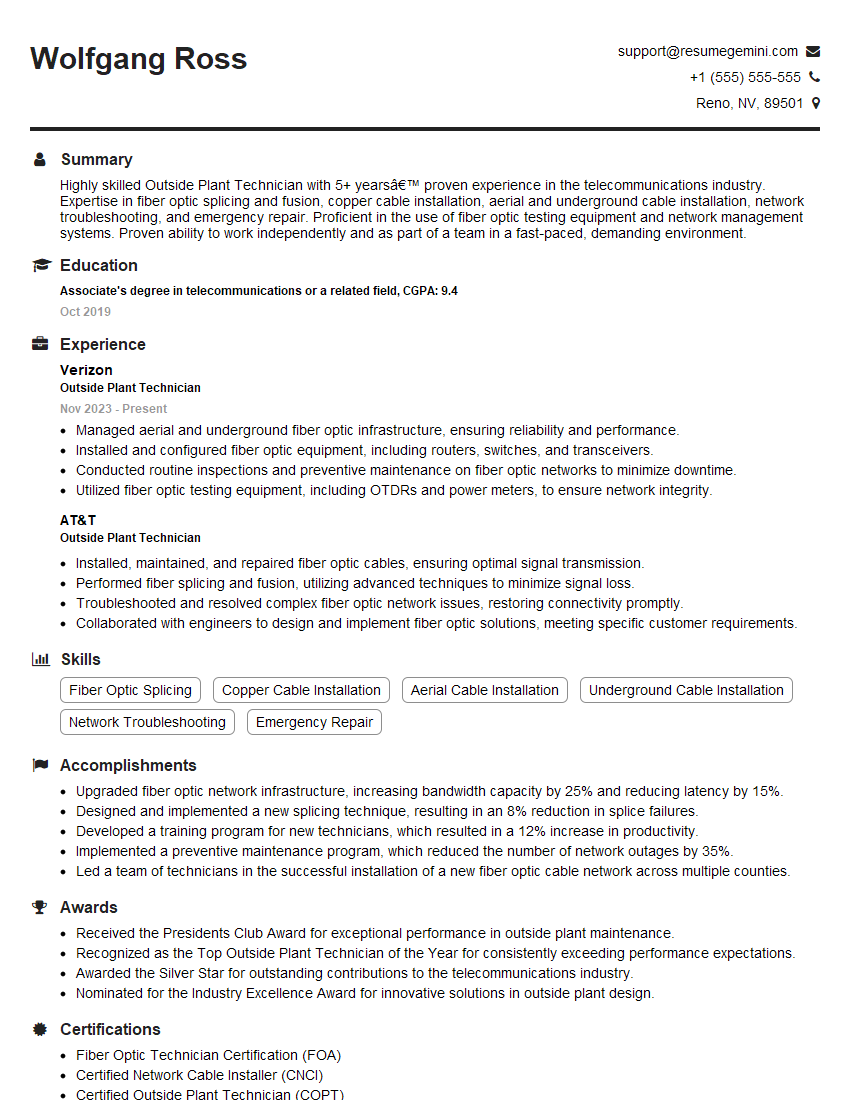
Outside Plant Technician Resume Sample
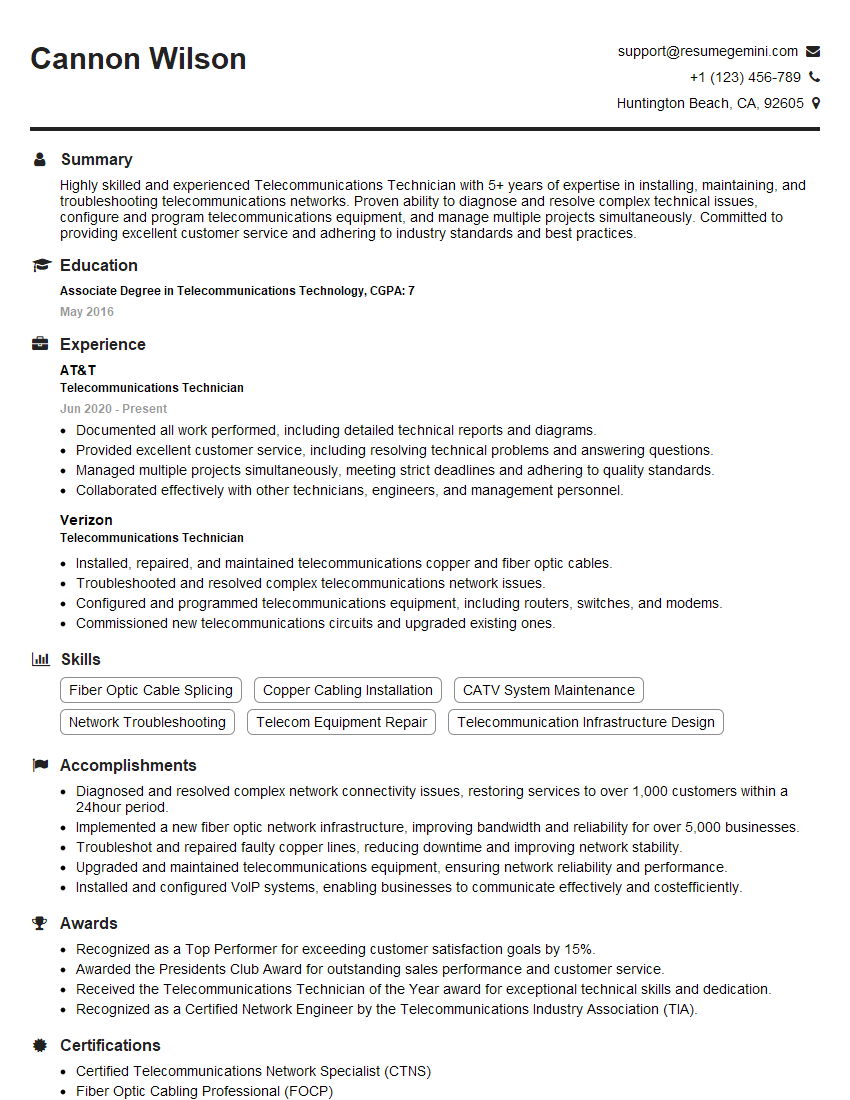
Telecommunications Technician Resume Sample

Cable Splicer Resume Sample
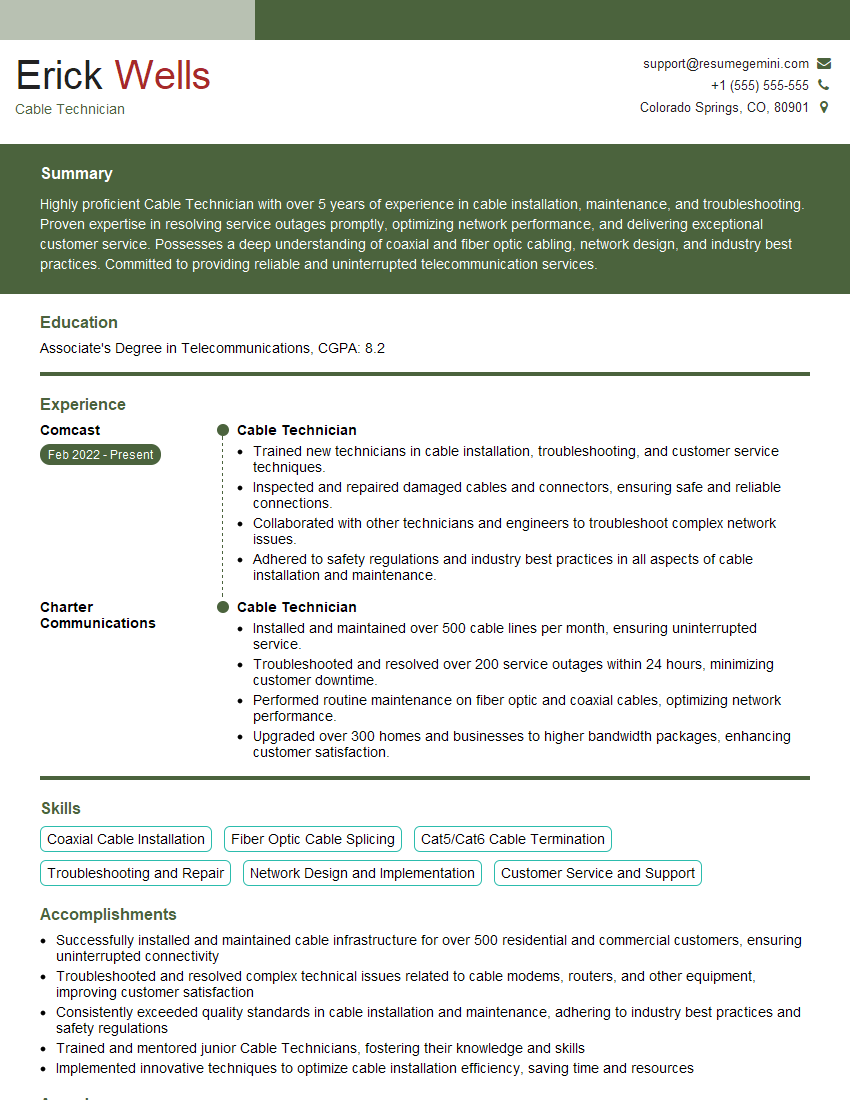
Cable Technician Resume Sample

Fiber Optic Splicer Resume Sample
Explore more articles
Users Rating of Our Blogs
Share Your Experience
We value your feedback! Please rate our content and share your thoughts (optional).
What Readers Say About Our Blog
Very informative content, great job.
good