Interviews are opportunities to demonstrate your expertise, and this guide is here to help you shine. Explore the essential Fluid Flow Modeling interview questions that employers frequently ask, paired with strategies for crafting responses that set you apart from the competition.
Questions Asked in Fluid Flow Modeling Interview
Q 1. Explain the Navier-Stokes equations and their significance in fluid flow modeling.
The Navier-Stokes equations are a set of partial differential equations that describe the motion of viscous fluids. They’re fundamental to fluid mechanics and form the basis of most Computational Fluid Dynamics (CFD) simulations. These equations express the conservation of mass (continuity equation) and momentum (Newton’s second law applied to fluids). They consider forces like pressure gradients, viscosity, and external forces (like gravity).
Significance: The Navier-Stokes equations are significant because they allow us to predict the flow behavior of fluids under various conditions. From the design of aircraft wings to understanding ocean currents, they provide a framework to analyze complex fluid phenomena. However, solving these equations analytically is often impossible except for very simple cases. This is why CFD, using numerical methods, is crucial.
Simplified Representation (Incompressible Flow):
- Continuity Equation:
∇ ⋅ u = 0(Divergence of velocity is zero, meaning fluid is neither created nor destroyed) - Momentum Equation (simplified):
ρ(∂u/∂t + u ⋅ ∇u) = -∇p + μ∇²u + ρg(Describes the balance between inertial forces, pressure forces, viscous forces, and body forces like gravity)
where:
uis the velocity vectorpis pressureρis densityμis dynamic viscositygis acceleration due to gravity
Solving these equations, even numerically, for complex geometries and flows can be computationally expensive and challenging.
Q 2. Describe different turbulence models (e.g., k-ε, k-ω SST) and their applications.
Turbulence models are essential in CFD because solving the Navier-Stokes equations directly for turbulent flows is computationally prohibitive. Turbulence is characterized by chaotic, three-dimensional fluctuations in velocity. Models attempt to approximate the effects of turbulence without resolving all the small scales.
Common Turbulence Models:
- k-ε model: This is a two-equation model that solves for the turbulent kinetic energy (k) and its dissipation rate (ε). It’s relatively simple and computationally inexpensive, making it suitable for many engineering applications. However, it can struggle near walls and in flows with strong streamline curvature.
- k-ω SST model (Shear Stress Transport): This model combines the advantages of k-ω and k-ε models. It performs better in near-wall regions and adverse pressure gradients, accurately predicting boundary layer separation. It’s generally considered more accurate than the standard k-ε model but is more computationally expensive.
Applications:
- k-ε: Suitable for external aerodynamics (e.g., simulating airflow over an airplane wing), free shear flows (e.g., jets and wakes), and many industrial applications where high accuracy near walls is not critical.
- k-ω SST: Preferred for applications involving complex boundary layers, such as flows over airfoils with separation bubbles, internal flows in pipes with complex geometries, and flows with strong adverse pressure gradients.
Choosing the appropriate turbulence model depends heavily on the specific application and the desired level of accuracy. Often, a sensitivity analysis is performed to evaluate the impact of different models on the results.
Q 3. What are the key differences between laminar and turbulent flows?
Laminar and turbulent flows are two fundamental flow regimes characterized by the nature of fluid motion. The distinction lies primarily in the level of mixing and the scale of fluctuations within the flow.
Laminar Flow: In laminar flow, fluid particles move in smooth, parallel layers. There’s minimal mixing between layers. Think of honey slowly dripping down a spoon—a very smooth, predictable flow. It’s characterized by low Reynolds numbers (Re).
Turbulent Flow: In turbulent flow, fluid motion is chaotic, characterized by random fluctuations in velocity and significant mixing between fluid layers. Imagine a rapidly flowing river with eddies and swirling currents—highly unpredictable and chaotic. It’s characterized by high Reynolds numbers (Re). The Reynolds number (Re) is a dimensionless quantity that indicates the relative importance of inertial forces to viscous forces.
Key Differences Summarized:
| Feature | Laminar Flow | Turbulent Flow |
|---|---|---|
| Fluid Motion | Smooth, parallel layers | Chaotic, random fluctuations |
| Mixing | Minimal | Significant |
| Reynolds Number (Re) | Low | High |
| Predictability | High | Low |
| Energy Dissipation | Low | High |
The transition from laminar to turbulent flow is often complex and depends on factors such as the Reynolds number, surface roughness, and geometry.
Q 4. Explain the concept of boundary layers and their impact on fluid flow.
A boundary layer is a thin region of fluid adjacent to a solid surface where the velocity of the fluid changes from zero at the surface (no-slip condition) to the free-stream velocity away from the surface. The boundary layer is crucial because it’s where the majority of the viscous effects occur, influencing drag and heat transfer.
Impact on Fluid Flow:
- Drag: The boundary layer significantly influences the drag force experienced by a body moving through a fluid. A thicker, turbulent boundary layer generally results in higher drag.
- Heat Transfer: The boundary layer is the primary pathway for heat transfer between a solid surface and the surrounding fluid. Turbulent boundary layers generally enhance heat transfer compared to laminar layers.
- Flow Separation: In adverse pressure gradients (where pressure increases in the flow direction), the boundary layer can separate from the surface, leading to flow instability, increased drag, and reduced lift (in aerodynamics).
Example: Consider an airplane wing. The boundary layer on the wing’s surface is crucial for generating lift. A laminar boundary layer is desirable because it produces less drag, but it’s more susceptible to separation. Maintaining a laminar boundary layer for as long as possible is a significant goal in aerodynamic design. Transition to a turbulent boundary layer is often managed carefully.
Q 5. How do you handle boundary conditions in CFD simulations?
Boundary conditions are essential in CFD simulations as they define the fluid’s behavior at the boundaries of the computational domain. They provide the necessary constraints to solve the governing equations and obtain a meaningful solution. Incorrect or incomplete boundary conditions will lead to inaccurate or nonsensical results.
Types of Boundary Conditions:
- Inlet: Specifies the velocity, pressure, or other properties of the fluid entering the domain. This could be a uniform velocity profile or a more complex profile.
- Outlet: Specifies the pressure or a condition on the flow leaving the domain (e.g., a pressure-outlet boundary condition where the pressure is specified).
- Wall: Represents solid surfaces. Common conditions include the no-slip condition (velocity is zero at the wall), adiabatic (no heat transfer), or isothermal (constant temperature) walls.
- Symmetry: Used to reduce the computational domain when the flow is symmetric.
- Periodic: Used for flows that repeat periodically (e.g., flow in a pipe).
Example: In simulating airflow over a car, you might specify a uniform velocity inlet condition at the front, a pressure outlet condition at the back, and no-slip wall boundary conditions on the car’s surface. Appropriate boundary conditions are critical to obtaining realistic and accurate CFD results.
Q 6. Describe different types of numerical methods used in CFD (e.g., Finite Volume, Finite Element).
Several numerical methods are employed in CFD to solve the governing equations. The choice depends on factors such as the complexity of the problem, computational resources, and desired accuracy.
Finite Volume Method (FVM): This is the most commonly used method in CFD. It divides the computational domain into control volumes, and the governing equations are integrated over each volume. FVM is naturally conservative, meaning that mass, momentum, and energy are conserved across the entire domain. It’s robust and well-suited for complex geometries.
Finite Element Method (FEM): FEM approximates the solution within each element using interpolation functions. It’s highly versatile and can handle complex geometries and boundary conditions effectively. FEM is often preferred for problems involving structural interactions or highly irregular meshes.
Other Methods: Other methods include the Finite Difference Method (FDM), which is simpler but less versatile for complex geometries, and Spectral Methods, which are highly accurate but limited to simple geometries.
Choosing a Method: The best method depends on the specific application. FVM is often the first choice due to its robustness and conservation properties, while FEM is suitable when high accuracy near boundaries or complex material properties are important. Specialized methods like spectral methods may be considered when high accuracy and simple geometries are involved.
Q 7. What is mesh generation and why is it crucial for accurate CFD results?
Mesh generation is the process of creating a computational mesh, a collection of interconnected elements (cells or nodes) that discretize the computational domain. This mesh forms the foundation upon which the numerical solution is built.
Crucial for Accuracy: The quality of the mesh is critical for the accuracy and reliability of CFD results. An improperly generated mesh can lead to inaccurate or unstable solutions. Important aspects of mesh generation include:
- Mesh Density: The number of elements affects accuracy. Finer meshes near boundaries or regions of high gradients (like shocks) are typically needed to capture flow features accurately.
- Element Shape: Ideally, elements should be close to equilateral or equiangular to avoid skewness and improve accuracy.
- Mesh Refinement: Refining the mesh in specific regions (adaptive mesh refinement) enhances accuracy where needed without unnecessarily increasing the computational cost.
- Boundary Conformity: The mesh must accurately represent the boundaries of the geometry.
Example: In simulating flow around an airfoil, a finer mesh would be needed near the airfoil surface and the trailing edge to accurately capture the boundary layer and wake. A coarser mesh could be used in regions farther away where gradients are less significant. Poor mesh quality can lead to numerical errors, incorrect predictions of boundary layer separation, and overall inaccurate results.
Q 8. Explain the concept of mesh refinement and its impact on accuracy and computational cost.
Mesh refinement in CFD refers to the process of increasing the density of the computational mesh in specific regions of the geometry. Think of it like zooming in on a map – the more detailed the map (finer mesh), the more accurately you can represent the terrain (fluid flow). This is crucial because fluid flow can be highly complex, with sharp gradients and intricate details.
Impact on Accuracy: A finer mesh generally leads to more accurate results, particularly in regions with high gradients (like boundary layers or shock waves). This is because finer meshes capture more details of the flow field, reducing numerical errors that arise from approximating the governing equations. However, excessively fine meshes can be computationally expensive, and the improvement in accuracy may diminish beyond a certain point.
Impact on Computational Cost: The computational cost of a CFD simulation scales roughly with the number of mesh elements. A finer mesh means significantly more elements, leading to increased memory requirements, longer computation times, and higher processing power demands. Striking a balance between accuracy and computational cost is a critical aspect of mesh refinement, often done through adaptive mesh refinement techniques that focus computational resources on areas needing higher resolution.
Example: Simulating flow around an airfoil. A finer mesh around the airfoil surface is crucial to accurately capture the boundary layer, where viscous effects are dominant, whereas a coarser mesh might suffice in the far-field where the flow is relatively uniform.
Q 9. How do you validate CFD simulation results?
Validating CFD simulation results is a multi-faceted process that ensures the accuracy and reliability of the model. It involves comparing the simulation results against experimental data or analytical solutions, and rigorously checking for inconsistencies or anomalies.
- Experimental Data Comparison: This is the gold standard. If you have experimental data (e.g., velocity profiles, pressure measurements) from a similar physical setup, comparing your simulation results directly against these measurements provides a strong validation. Discrepancies highlight potential issues in the model setup or numerical methods.
- Analytical Solutions: For simpler flow scenarios, analytical solutions (mathematical equations) exist. Comparing simulation results to these solutions can help identify numerical errors or inappropriate assumptions in the simulation.
- Grid Independence Study: This involves running the simulation with progressively finer meshes and observing the changes in the results. If the results converge to a stable value as the mesh is refined, it suggests that the solution is grid-independent, and the numerical error is minimal.
- Code Verification: This involves systematically checking the CFD code itself to ensure that the equations are solved correctly. Techniques like using manufactured solutions, or comparing against established benchmark problems are common.
Example: Simulating flow in a pipe. You could compare the predicted pressure drop against the experimental measurements obtained using pressure taps in a physical pipe. Differences may point to errors in the model’s boundary conditions, turbulence modeling, or even the physical properties used.
Q 10. What are some common sources of error in CFD simulations?
CFD simulations, while powerful, are prone to several sources of error. These errors can be broadly classified into:
- Numerical Errors: These stem from the numerical methods used to solve the governing equations. Discretization errors (approximating continuous equations with discrete values on the mesh), truncation errors (approximating infinite series with a finite number of terms), and round-off errors (due to computer limitations in representing numbers) are common examples. Using higher-order discretization schemes and appropriate numerical solvers can mitigate these errors.
- Modeling Errors: These result from simplifications and assumptions made in the model. For example, using a simpler turbulence model instead of a more computationally intensive one, neglecting certain physical effects, or applying inaccurate boundary conditions can introduce errors.
- Experimental Uncertainty: If validation is based on experimental data, uncertainties in the measurements (e.g., sensor accuracy, repeatability) will propagate to the validation process.
- Mesh-Related Errors: Inadequate mesh resolution (too coarse a mesh) can lead to inaccurate representation of the flow field, especially near boundaries. Mesh skewness and other geometrical aspects also play a critical role.
- Human Error: Mistakes in model setup, input parameters, or post-processing can lead to errors. Careful attention to detail and thorough review are crucial.
Example: Incorrectly specifying the inlet velocity profile can significantly affect the overall simulation results. Similarly, using a turbulent flow model for laminar flow will yield inaccurate predictions.
Q 11. Explain the Reynolds number and its significance in fluid flow.
The Reynolds number (Re) is a dimensionless quantity that characterizes the ratio of inertial forces to viscous forces in a fluid flow. It’s defined as:
Re = (ρVL)/μ
where:
- ρ is the fluid density
- V is a characteristic velocity
- L is a characteristic length
- μ is the dynamic viscosity
Significance: The Reynolds number determines whether a flow is laminar or turbulent.
- Low Re (typically < 2300): Indicates laminar flow, characterized by smooth, orderly motion. Predicting laminar flow is usually simpler.
- High Re (typically > 4000): Indicates turbulent flow, characterized by chaotic, irregular motion and mixing. Turbulent flows are far more complex and require more sophisticated models to accurately predict.
- Transitional flow (between 2300 and 4000): The flow behavior is neither purely laminar nor purely turbulent, and the transition between the two is influenced by factors other than just Re.
Example: Flow in a pipe. A low Reynolds number flow (e.g., slow flow of honey) will be laminar, while a high Reynolds number flow (e.g., fast flow of water) will be turbulent.
Q 12. Describe different types of fluid flow (e.g., compressible, incompressible, Newtonian, non-Newtonian).
Fluid flows can be categorized based on several properties:
- Compressible vs. Incompressible: In compressible flows, the density of the fluid changes significantly due to pressure variations (e.g., supersonic airflow). In incompressible flows, density changes are negligible (e.g., most water flows).
- Newtonian vs. Non-Newtonian: Newtonian fluids have a constant viscosity that is independent of the shear rate (e.g., water, air). Non-Newtonian fluids have a viscosity that depends on the shear rate (e.g., blood, polymers). This means the relationship between shear stress and shear rate is non-linear.
- Laminar vs. Turbulent: As discussed with the Reynolds number, laminar flows are smooth and orderly, while turbulent flows are chaotic and involve intense mixing. The nature of the flow affects heat and momentum transfer significantly.
- Steady vs. Unsteady: Steady flows have properties that do not change with time at any point in the flow. Unsteady flows exhibit changes in flow properties over time.
Example: Air flowing over an airplane wing at high speed is a compressible, turbulent, unsteady flow. Water flowing slowly through a pipe is an incompressible, laminar, steady flow (under typical conditions).
Q 13. What is the difference between steady-state and transient simulations?
The key difference between steady-state and transient simulations lies in how they handle time dependency:
- Steady-state simulations: Assume that the flow properties do not change with time. They aim to find a solution where all the variables are constant in time. This simplifies the computations significantly, making them computationally less expensive. However, this assumption is only valid for flows where the flow properties have reached a stable state after an initial transient period.
- Transient simulations: Account for the time-dependent behavior of the flow. They solve the governing equations over time, capturing the evolution of the flow field. These are more computationally demanding but essential for understanding flows that are inherently unsteady, such as flows with fluctuating boundary conditions, or flows where the initial condition significantly affects the final state.
Example: Simulating flow over a stationary cylinder. A steady-state simulation can be used if we are only interested in the average flow properties around the cylinder once it has reached a stable state. A transient simulation is needed if we want to understand the vortex shedding behind the cylinder, which is a time-dependent phenomenon.
Q 14. Explain the concept of pressure drop in pipe flow.
Pressure drop in pipe flow refers to the decrease in fluid pressure as it flows along the pipe. This drop is primarily caused by two factors:
- Friction Losses: These are due to the frictional resistance between the fluid and the pipe wall. This friction is greater in turbulent flow than in laminar flow. The surface roughness of the pipe also plays a role, with rougher pipes causing a greater pressure drop.
- Minor Losses: These are pressure losses caused by changes in pipe geometry, such as bends, valves, fittings, or expansions and contractions. These losses are often expressed as a dimensionless loss coefficient (K) which is multiplied by the dynamic pressure of the fluid.
The total pressure drop can be calculated using equations like the Darcy-Weisbach equation, which accounts for friction losses:
ΔP = f (L/D) (ρV²/2)
where:
- ΔP is the pressure drop
- f is the Darcy friction factor (dependent on Re and pipe roughness)
- L is the pipe length
- D is the pipe diameter
- ρ is the fluid density
- V is the average fluid velocity
Understanding pressure drop is crucial in designing piping systems to ensure adequate flow and pressure at the destination. Insufficient pressure can lead to inadequate flow rates or even cavitation in the pipe.
Q 15. How do you calculate the frictional losses in a pipe?
Frictional losses in a pipe, also known as head loss due to friction, represent the energy dissipated as heat due to the fluid’s internal friction (viscosity) as it flows through the pipe. We primarily use the Darcy-Weisbach equation to calculate this loss.
The Darcy-Weisbach equation is:
hf = f (L/D) (V2/2g)Where:
hfis the head loss due to friction (meters)fis the Darcy friction factor (dimensionless). This is the most challenging part to determine, as it depends on the Reynolds number (Re) and the pipe’s relative roughness (ε/D).Lis the pipe length (meters)Dis the pipe diameter (meters)Vis the average fluid velocity (meters/second)gis the acceleration due to gravity (approximately 9.81 m/s2)
Determining the friction factor f often requires using either the Moody chart (a graphical representation relating f, Re, and ε/D) or empirical equations like the Colebrook-White equation (an implicit equation requiring iterative solution). For laminar flow (Re < 2000), the friction factor is simply f = 64/Re.
Example: Consider water flowing through a 100m long, 0.1m diameter pipe. If the velocity is 1 m/s and the friction factor (obtained from the Moody chart or Colebrook-White equation) is 0.02, the head loss would be:
hf = 0.02 * (100m / 0.1m) * (12 m2/s2) / (2 * 9.81 m/s2) ≈ 10.2 mThis 10.2m head loss represents the energy lost to friction, which needs to be compensated for by the pump if maintaining a constant flow rate.
Career Expert Tips:
- Ace those interviews! Prepare effectively by reviewing the Top 50 Most Common Interview Questions on ResumeGemini.
- Navigate your job search with confidence! Explore a wide range of Career Tips on ResumeGemini. Learn about common challenges and recommendations to overcome them.
- Craft the perfect resume! Master the Art of Resume Writing with ResumeGemini’s guide. Showcase your unique qualifications and achievements effectively.
- Don’t miss out on holiday savings! Build your dream resume with ResumeGemini’s ATS optimized templates.
Q 16. Describe different types of pumps and their characteristics.
Pumps are crucial in fluid systems for increasing fluid pressure and/or velocity. They are broadly categorized based on their operating principles:
- Centrifugal Pumps: These are the most common type, utilizing a rotating impeller to impart kinetic energy to the fluid. They are characterized by high flow rates at relatively low heads (pressure increase). Applications include water supply systems, industrial processes, and irrigation.
- Positive Displacement Pumps: These pumps trap a fixed volume of fluid and then force it into the discharge line. They achieve higher pressures than centrifugal pumps but at lower flow rates. Examples include piston pumps, gear pumps, and diaphragm pumps, used in applications requiring precise fluid delivery like dispensing chemicals or high-pressure hydraulic systems.
- Axial Flow Pumps: These pumps propel the fluid parallel to the pump shaft, resulting in high flow rates at relatively low pressure increases. They are often used in applications requiring large volumes of fluid with minimal pressure changes, such as water circulation in large cooling systems.
- Rotary Pumps: This is a broad category encompassing several subtypes like gear pumps, vane pumps, and lobe pumps, all of which utilize the rotation of parts to displace fluid. They offer a combination of flow rate and pressure capabilities, depending on the specific design.
Choosing the right pump depends heavily on the specific application, considering factors such as flow rate, head requirements, fluid properties (viscosity, abrasiveness), and budget.
Q 17. Explain the concept of cavitation and its implications.
Cavitation is a phenomenon occurring when the local pressure in a fluid drops below its vapor pressure. This causes the formation of vapor bubbles (cavities) within the fluid. When these bubbles reach a region of higher pressure, they collapse violently, creating shock waves that can damage pump impellers, pipe walls, and other components. Imagine it like tiny, repeated explosions.
Implications of Cavitation:
- Equipment Damage: The erosive forces from collapsing bubbles can severely damage pump components, leading to reduced efficiency, increased maintenance costs, and potential failure.
- Noise and Vibration: Cavitation generates significant noise and vibrations, which can be detrimental to the overall system and potentially indicative of damage.
- Reduced Efficiency: The energy used in forming and collapsing bubbles is wasted, resulting in a less efficient pumping system.
- Performance Degradation: Cavitation leads to a decrease in pump performance, reducing the flow rate and head delivered.
Mitigation: Cavitation can be mitigated by various strategies including increasing the pump suction pressure, using a pump with a larger impeller, reducing the flow rate, or avoiding sharp bends and constrictions in the piping system.
Q 18. What is the importance of dimensional analysis in fluid flow modeling?
Dimensional analysis is a powerful tool in fluid flow modeling that helps simplify complex problems and gain insights without needing to solve the full governing equations. It utilizes Buckingham’s Pi Theorem to identify dimensionless groups (Pi groups) that govern the behavior of the system. These groups combine relevant physical variables, reducing the number of independent variables and making it easier to conduct experiments or simulations.
Importance:
- Experiment Design: It helps design experiments using scaled models, extrapolating results to larger systems. For instance, testing a scaled-down model of a ship’s hull in a towing tank allows prediction of the full-scale ship’s performance.
- Data Correlation: It allows correlating experimental data and developing empirical equations. For example, correlating friction factor with Reynolds number and relative roughness in pipe flow through the Moody chart.
- Equation Simplification: It simplifies complex fluid flow equations by reducing the number of variables and making them easier to solve or analyze.
- Model Verification: Dimensional consistency is a crucial aspect of validating fluid flow models, ensuring the equations make physical sense.
Example: In pipe flow, dimensional analysis reveals the importance of the Reynolds number (Re = ρVD/μ) and the friction factor (f), allowing us to correlate experimental data and create predictive equations without solving the full Navier-Stokes equations.
Q 19. Describe different types of flow measuring devices.
Various devices measure fluid flow, each with its strengths and limitations:
- Orifice Plate: A thin plate with a central hole creates a pressure drop, which correlates to flow rate. Simple and inexpensive but introduces permanent pressure loss.
- Venturi Meter: A converging-diverging section creates a pressure drop, more accurate than orifice plates but more expensive.
- Pitot Tube: Measures local velocity by comparing stagnation pressure to static pressure. Useful for measuring velocity profiles but less suitable for overall flow rate determination.
- Rotameter: A tapered tube with a free-floating float. The float’s position indicates the flow rate, simple and visual but less accurate than other methods.
- Ultrasonic Flow Meter: Measures the transit time of ultrasonic signals through the fluid, non-invasive and suitable for a wide range of fluids. More expensive than mechanical meters.
- Electromagnetic Flow Meter: Uses Faraday’s law of induction to measure flow rate in electrically conductive fluids, non-invasive and accurate but requires conductive fluid.
The choice of flow measuring device depends on factors such as the fluid properties, required accuracy, cost constraints, and the size of the pipe or channel.
Q 20. Explain the concept of fluid viscosity and its effect on flow.
Fluid viscosity is a measure of a fluid’s resistance to flow. Imagine pouring honey versus water – honey is much more viscous, meaning it flows more slowly. Viscosity arises from the internal friction between fluid molecules.
Types of Viscosity:
- Dynamic Viscosity (μ): Represents the shear stress required to maintain a unit velocity gradient in the fluid. Its units are typically Pascal-seconds (Pa·s) or centipoise (cP).
- Kinematic Viscosity (ν): The ratio of dynamic viscosity to density (ν = μ/ρ). Its units are typically square meters per second (m2/s) or centistokes (cSt).
Effect on Flow:
- High Viscosity: Results in slower flow rates, larger pressure drops due to friction, and the formation of thicker boundary layers.
- Low Viscosity: Leads to faster flow rates, smaller pressure drops, and thinner boundary layers.
- Non-Newtonian Fluids: Some fluids, like slurries or polymer solutions, exhibit viscosity changes with shear rate or time, making their flow behavior more complex to model.
Viscosity significantly impacts many engineering calculations, including pipe flow, heat transfer, and lubrication.
Q 21. How do you model multiphase flow?
Modeling multiphase flow – where two or more immiscible fluids (like gas and liquid) coexist – is significantly more complex than single-phase flow. The key challenge lies in accurately capturing the interactions between the phases, including interfacial forces, mass transfer, and momentum exchange.
Modeling Approaches:
- Eulerian-Eulerian Approach: Treats each phase as an interpenetrating continuum, using separate governing equations for each phase coupled through interfacial terms. This approach is suitable for flows with dispersed phases, like bubbly flows or slurries.
- Eulerian-Lagrangian Approach: Models one phase (typically the dispersed phase) as discrete particles tracked individually, while the continuous phase is treated as a continuum. This is often used for modeling droplets or particles in a continuous fluid.
- Volume of Fluid (VOF) Method: Tracks the volume fraction of each phase within each computational cell. It’s well-suited for free-surface flows, like sloshing in a tank or the flow of a liquid in a partially filled pipe.
- Level Set Method: Similar to VOF, but uses a level set function to track the interface between phases. This offers sharper resolution of the interface but can be computationally more demanding.
The choice of method depends on the specific characteristics of the multiphase flow, including the flow regime, phase fractions, and interfacial phenomena. Advanced software packages like ANSYS Fluent and OpenFOAM are used to implement these approaches, often requiring significant computational resources and expertise.
Q 22. Explain the concept of heat transfer in fluid flow.
Heat transfer in fluid flow is the movement of thermal energy between a fluid and its surroundings, or between different parts of the fluid itself. This occurs through three primary mechanisms: conduction, convection, and radiation.
Conduction is the transfer of heat through direct molecular contact within a stationary medium. Imagine a hot spoon in a cup of coffee; the heat travels from the spoon’s handle to your hand through conduction.
Convection is heat transfer through the bulk movement of a fluid. This is crucial in fluid flow, as fluids transfer heat as they move. Think of a pot of boiling water; the hot water rises, carrying heat with it, while cooler water sinks, creating a convection current.
Radiation is the emission of electromagnetic waves, which can travel through a vacuum. While less significant in many fluid flow scenarios, radiation becomes important at high temperatures, such as in combustion processes or furnace design.
In CFD simulations, these mechanisms are modeled using appropriate equations and boundary conditions. For instance, the energy equation, often coupled with the Navier-Stokes equations, accounts for convective and conductive heat transfer. Radiation models, like the Discrete Ordinates Method (DOM) or the Surface-to-Surface Radiation (S2S) method, are used when necessary. The choice of model depends heavily on the specific application and the relative importance of each mechanism.
Q 23. How do you model fluid-structure interaction?
Fluid-structure interaction (FSI) modeling involves simulating the dynamic interplay between a fluid and a deformable structure. It’s crucial in numerous applications, from the design of aircraft wings to the analysis of blood flow in arteries. The key is to treat both the fluid and the structure as coupled systems that influence each other’s behavior.
Several approaches exist for modeling FSI. A common method involves a partitioned approach, where separate solvers are used for the fluid and structure, with data exchanged iteratively at the interface. For example, you might use ANSYS Fluent for the fluid domain and ANSYS Mechanical for the structural domain. This iterative process continues until convergence is achieved. Alternatively, a monolithic approach directly solves the coupled equations, often requiring more complex, specialized software. This results in higher accuracy but adds significant computational cost.
The choice of approach depends on the complexity of the problem and the computational resources available. Simple problems might suffice with a partitioned approach while complex scenarios demand a monolithic approach.
Q 24. What experience do you have with specific CFD software packages (e.g., ANSYS Fluent, OpenFOAM)?
I have extensive experience with ANSYS Fluent and OpenFOAM. With ANSYS Fluent, I’ve been involved in projects ranging from simulating turbulent flow in pipelines to analyzing heat transfer in electronic components. My expertise encompasses meshing techniques, turbulence modeling (k-ε, k-ω SST), and multiphase flow simulations. I’m proficient in setting up and interpreting results, including post-processing visualizations and data analysis.
OpenFOAM, with its open-source nature and flexibility, has been valuable for more specialized simulations and customized model development. I’ve utilized OpenFOAM for developing custom solvers for non-Newtonian fluids and implementing advanced turbulence models. My work with OpenFOAM has also included significant experience with parallel computing techniques for large-scale simulations. I’m comfortable navigating the command-line interface and scripting in various languages to enhance workflow efficiency.
Q 25. Describe a challenging fluid flow problem you have solved.
One challenging project involved simulating the flow of highly viscous, non-Newtonian fluid (a polymer solution) through a complex microfluidic device. The geometry was intricate, with many sharp corners and narrow channels, leading to significant meshing challenges. The non-Newtonian nature of the fluid required a sophisticated constitutive model, and the high viscosity led to slow convergence. Furthermore, the desired accuracy necessitated extremely fine meshes, pushing the limits of available computational resources.
To overcome these challenges, I employed a multi-pronged approach. First, I used a structured mesh in regions with simple geometry and an unstructured mesh for the complex parts, optimizing mesh refinement around critical regions. Second, I implemented an adaptive mesh refinement (AMR) strategy, dynamically refining the mesh in regions with high gradients. Finally, I utilized parallel processing techniques to distribute the computational load across multiple cores. This enabled me to achieve accurate and convergent solutions within a reasonable timeframe.
Q 26. Explain your experience with experimental validation of fluid flow models.
Experimental validation is crucial for ensuring the accuracy and reliability of CFD models. In my previous role, I was involved in a project to validate a CFD model of a wind turbine. We conducted wind tunnel experiments at various wind speeds, measuring pressure distributions and forces on the turbine blades using pressure taps and load cells.
The experimental data was then compared to the CFD simulation results. A quantitative comparison was performed, focusing on key parameters such as lift and drag coefficients, torque, and power output. Any discrepancies were analyzed, leading to refinements in the CFD model, such as adjustments to the turbulence model or boundary conditions. This iterative process of model refinement and validation ensured that the final CFD model accurately predicted the turbine’s performance.
Accurate experimental validation requires careful planning, precise experimental techniques, and robust data analysis methods. Understanding the limitations and uncertainties of both the experimental measurements and the numerical simulations is crucial for a meaningful comparison.
Q 27. How do you approach troubleshooting convergence issues in CFD simulations?
Troubleshooting convergence issues in CFD simulations often involves a systematic approach. First, I carefully examine the residuals to identify any problematic variables. High residuals indicate a lack of convergence for that specific variable. Then, I investigate the potential causes:
- Mesh Quality: Poor mesh quality, such as skewed elements or excessively high aspect ratios, can significantly impede convergence. I check the mesh quality using appropriate metrics and refine or remesh as needed.
- Boundary Conditions: Incorrectly specified boundary conditions can lead to divergence. I meticulously review all boundary conditions, ensuring they are physically realistic and properly implemented.
- Numerical Schemes: The choice of numerical schemes (e.g., for pressure-velocity coupling, spatial discretization) can affect convergence. I might try different schemes, experimenting with more stable, albeit potentially less accurate options.
- Under-relaxation Factors: Adjusting under-relaxation factors can improve convergence, especially for highly nonlinear problems. These factors control the magnitude of changes in solution variables during each iteration.
- Initial Conditions: Poor initial guesses can hinder convergence. I often employ solutions from simpler simulations or use more physically reasonable initial conditions.
Often, a combination of these approaches is necessary. It’s a process of iterative refinement, guided by careful analysis of simulation results and a deep understanding of the underlying physics.
Q 28. Describe your experience with parallel computing in CFD.
Parallel computing is essential for handling the computational demands of large-scale CFD simulations. My experience encompasses both shared-memory and distributed-memory parallel computing techniques. In shared-memory systems, multiple cores within a single processor share access to the same memory space. In distributed-memory systems, different processors have their own memory, requiring communication between processors to exchange data.
I’ve used various parallel solvers within ANSYS Fluent and OpenFOAM. In OpenFOAM, I’ve utilized the built-in parallel capabilities, configuring the simulation to run across multiple processors using MPI (Message Passing Interface). This requires understanding of domain decomposition techniques to efficiently distribute the computational load. Experience with parallel debugging tools is also critical for identifying and resolving issues arising from parallel processing.
The choice of parallel computing approach depends on the problem size, the available hardware, and the solver being used. Efficient parallel implementation is essential to reduce simulation time, allowing us to tackle increasingly complex problems.
Key Topics to Learn for Fluid Flow Modeling Interview
- Governing Equations: Master the Navier-Stokes equations, understanding their limitations and applicability to different flow regimes (laminar, turbulent). Explore simplifying assumptions like the Reynolds Averaged Navier-Stokes (RANS) equations.
- Numerical Methods: Gain proficiency in at least one CFD (Computational Fluid Dynamics) method, such as Finite Volume Method (FVM), Finite Element Method (FEM), or Finite Difference Method (FDM). Understand the strengths and weaknesses of each.
- Turbulence Modeling: Familiarize yourself with various turbulence models (e.g., k-ε, k-ω SST) and their applications. Be prepared to discuss their accuracy and computational cost.
- Mesh Generation and Refinement: Understand the importance of mesh quality in CFD simulations. Discuss techniques for mesh generation and adaptive mesh refinement.
- Boundary Conditions: Master the application of appropriate boundary conditions (inlet, outlet, wall, symmetry) for different flow scenarios. Understand their impact on simulation results.
- Validation and Verification: Understand the importance of validating CFD simulations against experimental data and verifying the numerical accuracy of the solution. Discuss techniques for grid independence studies.
- Practical Applications: Be ready to discuss applications of fluid flow modeling in your field of interest (e.g., aerospace, chemical engineering, environmental engineering). Prepare examples of specific projects or simulations you’ve worked on.
- Software Proficiency: Showcase your experience with relevant CFD software packages (e.g., ANSYS Fluent, OpenFOAM, COMSOL). Highlight your skills in pre-processing, solving, and post-processing.
- Dimensional Analysis and Similarity: Understand the principles of dimensional analysis and its use in scaling and interpreting experimental and numerical results. Discuss concepts like Reynolds number and its significance.
Next Steps
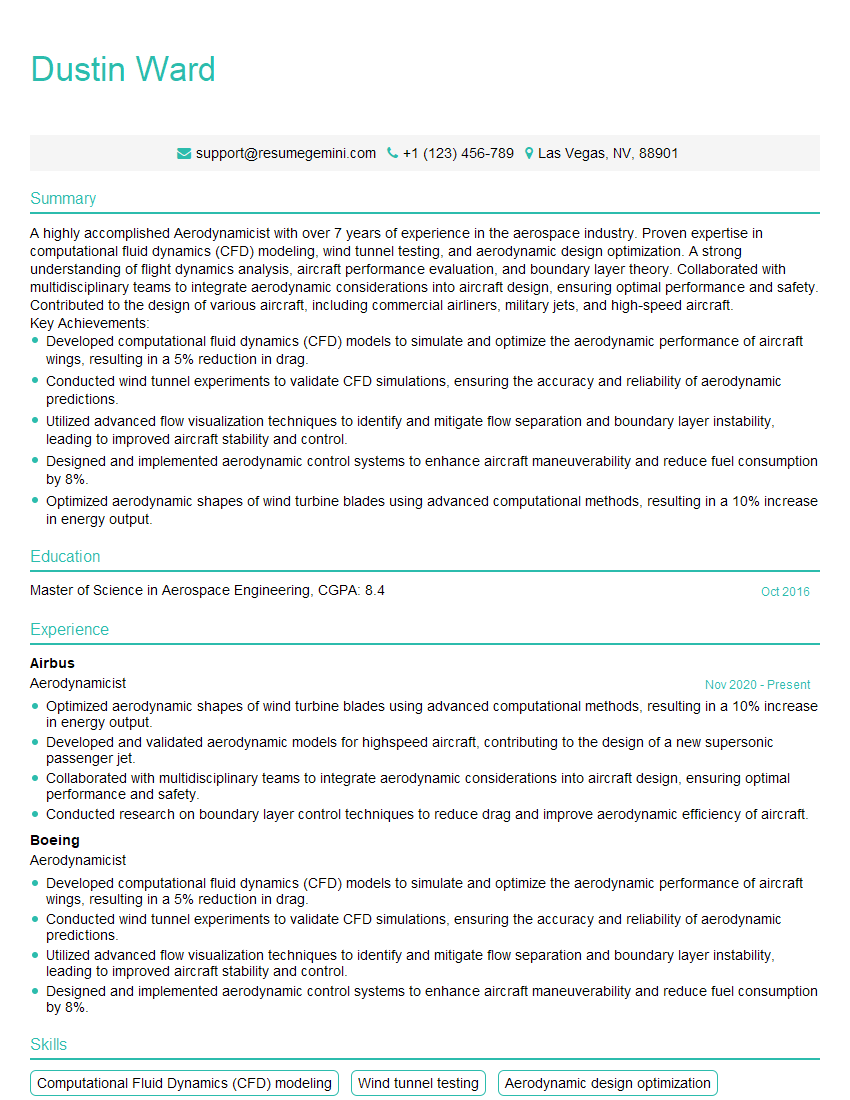
Mastering fluid flow modeling opens doors to exciting career opportunities in diverse and innovative fields. A strong understanding of these concepts is highly valued by employers and directly translates to career advancement. To significantly improve your job prospects, create an ATS-friendly resume that highlights your skills and experience effectively. ResumeGemini is a trusted resource to help you build a professional and impactful resume that gets noticed. We provide examples of resumes tailored specifically to Fluid Flow Modeling to guide you through the process.


Explore more articles
Users Rating of Our Blogs
Share Your Experience
We value your feedback! Please rate our content and share your thoughts (optional).
What Readers Say About Our Blog
Hello,
we currently offer a complimentary backlink and URL indexing test for search engine optimization professionals.
You can get complimentary indexing credits to test how link discovery works in practice.
No credit card is required and there is no recurring fee.
You can find details here:
https://wikipedia-backlinks.com/indexing/
Regards
NICE RESPONSE TO Q & A
hi
The aim of this message is regarding an unclaimed deposit of a deceased nationale that bears the same name as you. You are not relate to him as there are millions of people answering the names across around the world. But i will use my position to influence the release of the deposit to you for our mutual benefit.
Respond for full details and how to claim the deposit. This is 100% risk free. Send hello to my email id: [email protected]
Luka Chachibaialuka
Hey interviewgemini.com, just wanted to follow up on my last email.
We just launched Call the Monster, an parenting app that lets you summon friendly ‘monsters’ kids actually listen to.
We’re also running a giveaway for everyone who downloads the app. Since it’s brand new, there aren’t many users yet, which means you’ve got a much better chance of winning some great prizes.
You can check it out here: https://bit.ly/callamonsterapp
Or follow us on Instagram: https://www.instagram.com/callamonsterapp
Thanks,
Ryan
CEO – Call the Monster App
Hey interviewgemini.com, I saw your website and love your approach.
I just want this to look like spam email, but want to share something important to you. We just launched Call the Monster, a parenting app that lets you summon friendly ‘monsters’ kids actually listen to.
Parents are loving it for calming chaos before bedtime. Thought you might want to try it: https://bit.ly/callamonsterapp or just follow our fun monster lore on Instagram: https://www.instagram.com/callamonsterapp
Thanks,
Ryan
CEO – Call A Monster APP
To the interviewgemini.com Owner.
Dear interviewgemini.com Webmaster!
Hi interviewgemini.com Webmaster!
Dear interviewgemini.com Webmaster!
excellent
Hello,
We found issues with your domain’s email setup that may be sending your messages to spam or blocking them completely. InboxShield Mini shows you how to fix it in minutes — no tech skills required.
Scan your domain now for details: https://inboxshield-mini.com/
— Adam @ InboxShield Mini
Reply STOP to unsubscribe
Hi, are you owner of interviewgemini.com? What if I told you I could help you find extra time in your schedule, reconnect with leads you didn’t even realize you missed, and bring in more “I want to work with you” conversations, without increasing your ad spend or hiring a full-time employee?
All with a flexible, budget-friendly service that could easily pay for itself. Sounds good?
Would it be nice to jump on a quick 10-minute call so I can show you exactly how we make this work?
Best,
Hapei
Marketing Director
Hey, I know you’re the owner of interviewgemini.com. I’ll be quick.
Fundraising for your business is tough and time-consuming. We make it easier by guaranteeing two private investor meetings each month, for six months. No demos, no pitch events – just direct introductions to active investors matched to your startup.
If youR17;re raising, this could help you build real momentum. Want me to send more info?
Hi, I represent an SEO company that specialises in getting you AI citations and higher rankings on Google. I’d like to offer you a 100% free SEO audit for your website. Would you be interested?
Hi, I represent an SEO company that specialises in getting you AI citations and higher rankings on Google. I’d like to offer you a 100% free SEO audit for your website. Would you be interested?
good