Are you ready to stand out in your next interview? Understanding and preparing for Foiling and embossing prepress interview questions is a game-changer. In this blog, we’ve compiled key questions and expert advice to help you showcase your skills with confidence and precision. Let’s get started on your journey to acing the interview.
Questions Asked in Foiling and embossing prepress Interview
Q 1. Explain the difference between blind embossing and registered embossing.
The key difference between blind embossing and registered embossing lies in the relationship between the embossed image and other printed elements. Think of it like this: blind embossing is like sculpting a design onto the surface, while registered embossing is like perfectly placing that sculpture on top of a pre-existing painting.
Blind embossing creates a three-dimensional effect without any ink or foil. The design is raised or recessed, purely from the pressure applied by the embossing die. Imagine the raised lettering on a high-quality invitation. That’s blind embossing. It’s a clean, sophisticated technique.
Registered embossing, on the other hand, aligns the embossed design precisely with printed elements. For example, you might have a logo printed in gold ink, and then an embossed version of the same logo is perfectly overlaid. This requires extremely precise plate alignment and meticulous setup to ensure perfect registration. A common example is a company logo embossed in foil on a business card, where the foil matches the printed version exactly.
Q 2. Describe the process of setting up a foiling press for a specific job.
Setting up a foiling press is a precise and methodical process, critical for achieving a high-quality finish. It starts long before the press itself is even touched. The preparation involves:
- Die Selection and Mounting: Choosing the correct die is crucial, ensuring it matches the design and material. The die then needs to be carefully mounted onto the press, ensuring it’s securely fastened and aligned correctly.
- Foil Loading: Different foils require different loading techniques. The foil needs to be fed smoothly and consistently into the press, avoiding wrinkles or creases which would ruin the final product. We need to check the foil’s roll and ensure that it is properly unwound.
- Pressure Adjustment: The pressure applied to the foil is critical. Too little, and the foil won’t transfer properly. Too much, and you risk damaging the substrate or creating an uneven finish. This often needs fine-tuning during test runs.
- Temperature Control: Many foils require specific temperatures for optimal adhesion. The press’s heating elements need careful calibration to achieve the ideal temperature for the chosen foil and substrate. It’s vital to adjust based on feedback.
- Material Handling: The substrate (the material being foiled, such as card stock or paper) must be fed into the press correctly, smoothly and without wrinkles. Consistent feeding ensures even foil application.
- Test Run and Adjustment: Before full-scale production, always run a test sheet to check the foil application, registration, and overall quality. Adjustments to pressure, temperature, and feed speed are often necessary to perfect the result.
Once all these aspects are checked and adjusted, then only we can proceed to full-scale production.
Q 3. What are the different types of foil available, and when would you use each?
The world of foil is surprisingly diverse! The choice depends heavily on the desired effect, the substrate, and the budget. Here are some common types:
- Hot Stamping Foil: This is the workhorse of the foiling industry. It comes in a vast array of colors, finishes (matte, gloss, pearlescent, holographic), and thicknesses. This is perfect for most applications, giving a luxurious and vibrant finish.
- Cold Foil: Cold foiling is a different process, using a UV-curable adhesive to attach the foil. It’s more environmentally friendly than hot stamping, and is becoming very popular in the market for its clean and sophisticated look. Its applications are mostly in offset printing, packaging, and labels.
- Metallic Foils: These range from classic gold and silver to more modern shades of copper and rose gold, providing a luxurious look. The choice of metallic color is dictated by the project’s aesthetic.
- Pigment Foils: These offer a wider range of colors, beyond the traditional metallic options. They create vibrant, solid colors that can’t be achieved with other foiling methods, such as different shades of blue, green, and red.
- Specialty Foils: This category includes foils with textures, patterns, or special effects such as embossing or glitter. They are designed to give a unique design element to enhance the product’s overall aesthetic.
The choice of foil is determined on a case by case basis and depends on the type of project and desired effect. A simple business card might use standard hot stamping gold foil, while a high-end perfume box could utilize a custom-designed textured foil with an embossed pattern.
Q 4. How do you troubleshoot common foiling and embossing problems?
Troubleshooting foiling and embossing issues requires a systematic approach. It’s like detective work, carefully examining clues to pinpoint the problem.
- Uneven Foiling: This usually points to inconsistencies in pressure, temperature, or foil feed. Check the press settings, inspect the foil for wrinkles, and ensure the substrate is being fed evenly.
- Poor Foil Adhesion: This often results from incorrect temperature settings or the use of an incompatible foil type for the substrate. Adjust the temperature, or try a different foil.
- Registration Issues: Misaligned foiling or embossing usually means problems with the die setup or press registration. Precise setup is paramount and requires careful adjustment.
- Substrate Damage: Excessive pressure or incorrect temperature can damage the substrate. Reduce pressure and recalibrate the temperature.
- Foil Wrinkling or Creasing: This signifies issues with foil feeding or unwinding. Ensure the foil is unwound smoothly.
Each problem has a specific set of causes and solutions. Careful observation and methodical troubleshooting are key to fixing the issue.
Q 5. What are the safety precautions associated with operating foiling and embossing machinery?
Safety is paramount when operating foiling and embossing machinery. These machines are powerful and can cause serious injuries if not handled correctly.
- Personal Protective Equipment (PPE): Always wear appropriate safety glasses, hearing protection, and gloves. These machines are noisy and can cause eye injury or burns from high temperatures.
- Machine Guards: Ensure all safety guards are in place and functioning correctly before operating the machine. These prevent accidental contact with moving parts.
- Proper Training: Only trained and authorized personnel should operate the equipment. Comprehensive training is necessary to understand the machine’s functionalities and safety measures.
- Emergency Stop Procedures: Know the location of emergency stop buttons and how to use them. In case of any accidents, the immediate action is to stop the press.
- Maintenance: Regular maintenance is crucial to prevent accidents and malfunctions. This includes inspection of moving parts and the regular replacement of worn-out components.
- Hot Surfaces: The press and dies can reach extremely high temperatures. Avoid touching them unless absolutely necessary and ensure that the machine has cooled down completely before maintenance or cleaning.
Following these safety precautions minimizes the risk of accidents and injuries while ensuring that operations remain safe and consistent.
Q 6. Explain the importance of die-cutting in relation to foiling and embossing.
Die-cutting plays a crucial role in foiling and embossing, primarily in defining the precise shape and area of application. It’s the foundation upon which the foiling and embossing processes are built.
Think of die-cutting as creating a ‘mask’ for your foil and embossing. The die-cut shape determines the exact area where the foil will be applied or where the embossing will occur. Without die-cutting, foiling and embossing would be applied to the entire sheet, resulting in an uncontrolled and haphazard appearance. Precise die-cutting ensures that your design elements are applied exactly where intended, offering a clean and professional finish.
For example, if you’re foiling a logo on a business card, the die-cutting would create the precise shape of the logo, so that only the logo is foiled, leaving the rest of the card untouched. This process allows for intricate shapes and designs and is essential for any precise work.
Q 7. How do you ensure accurate registration in foiling and embossing?
Accurate registration in foiling and embossing is crucial for a professional and high-quality finished product. It ensures that the foil, embossing, and any pre-printed elements align perfectly.
Achieving accurate registration involves a multi-step approach:
- Precise Die-Making: The dies themselves must be crafted with utmost precision, accurately reflecting the design’s dimensions and placement.
- Careful Plate Mounting: The dies are mounted onto the press with meticulous care, ensuring perfect alignment with the registration marks on the press bed.
- Use of Registration Marks: Using precise registration marks on the substrate is essential for accurate alignment of the foil and embossing. These marks serve as guides for the press operator.
- Test Runs and Adjustments: Several test runs are conducted to verify the registration. Fine adjustments may be necessary to achieve perfect alignment.
- Press Calibration: The press needs to be properly calibrated to ensure consistent and accurate movement, which will result in consistently good registration.
Without proper registration, the final product will appear unprofessional, with misaligned elements detracting from the overall aesthetic appeal. Achieving precise registration requires skill, attention to detail, and a thorough understanding of the equipment and processes.
Q 8. What are the different types of dies used in embossing?
Embossing dies come in various types, each suited for different effects and materials. The choice depends on factors like the depth of embossing required, the design’s intricacy, and the substrate’s thickness.
- Steel Rule Dies: These are the most common, made from hardened steel and cut to the desired shape. They’re durable and versatile, ideal for intricate designs and large production runs. Think of a cookie cutter, but for paper and much more precise.
- Electro-Etched Dies: Created using an etching process, these dies offer finer details and sharper lines compared to steel rule dies. They’re excellent for delicate designs and are often preferred for high-quality embossing on thicker materials.
- Photopolymer Dies: These are made from photopolymer resin and are created using a photographic process. They’re often used for short runs and prototypes, as they are more cost-effective for lower quantities but less durable than steel rule or electro-etched.
- Rotary Dies: Used in high-speed embossing machines, these cylindrical dies are particularly efficient for large-scale projects. Imagine a rolling pin with your design engraved into it, creating a consistent emboss across a large area.
Choosing the right die type is crucial for achieving the desired embossing effect and optimizing production efficiency. A complex design might demand an electro-etched die for detail, whereas a simple logo could suffice with a steel rule die for a larger production run.
Q 9. How do you maintain the quality of foiling and embossing tools and equipment?
Maintaining foiling and embossing tools and equipment is crucial for consistent quality and longevity. It involves a multi-faceted approach:
- Regular Cleaning: After each use, dies should be meticulously cleaned to remove any residue of foil, paper dust, or other materials. Specialized cleaning solutions might be necessary to effectively remove stubborn adhesive. Failure to do so can lead to build-up affecting the quality of future jobs.
- Proper Storage: Dies should be stored in a clean, dry environment, preferably in protective cases to prevent damage and corrosion. Protect the edges of steel rule dies from accidental scratching.
- Periodic Inspection: Regular inspection for damage, wear, or misalignment is key. Sharp edges should be maintained and any signs of damage addressed promptly to avoid imperfections in embossing. This includes checking for burrs on steel rule dies which can cause inconsistencies in the emboss.
- Machine Maintenance: The embossing machine itself requires scheduled maintenance, including lubrication of moving parts, belt adjustments, and periodic calibration. A well-maintained machine contributes significantly to the quality and consistency of the finished product.
- Sharpening/Repair: Dies may require professional sharpening or repair depending on the type of die and the extent of wear and tear. This ensures the dies retain their sharpness and precision for consistent results.
Ignoring maintenance can lead to decreased quality, increased downtime, and ultimately, higher costs. A proactive maintenance schedule ensures optimal performance and extends the lifespan of your equipment.
Q 10. Describe the role of prepress in the overall foiling and embossing process.
Prepress is the critical bridge between design and production in foiling and embossing. It involves preparing all the necessary files and specifications to ensure the successful execution of the project. It’s like creating a detailed blueprint before starting construction.
The prepress phase encompasses:
- Die Creation: The design is translated into a physical die, either through computer-aided design (CAD) software for steel rule or electro-etched dies, or through digital imaging processes for photopolymer dies.
- Artwork Preparation: This involves accurately preparing the artwork to ensure registration (alignment) between the foiling and embossing. Incorrect preparation leads to misalignment of the foil and embossed areas.
- Color Separation (for foiling): If metallic or special effect foils are used, prepress specialists separate the artwork into different color channels to accurately match the foil colors.
- Proofing: Digital or physical proofs are created to ensure accuracy and allow clients to approve the design before the actual production run begins. This helps catch any potential errors early in the process.
- Imposition: If printing is involved before foiling/embossing, the prepress stage manages the arrangement of pages on sheets for efficient printing and finishing.
A well-executed prepress process prevents costly errors during production and significantly impacts the final product’s quality. The importance of precision in this stage cannot be overstated.
Q 11. How do you interpret and utilize prepress specifications for foiling and embossing?
Prepress specifications for foiling and embossing are crucial for a successful outcome. They provide the necessary instructions for the entire process. These specifications will typically include:
- Artwork Files: High-resolution digital files (e.g., PDF, AI, EPS) in the correct color mode (CMYK for printed materials, generally, though spot colors are important for foil). These should clearly indicate areas for foiling and embossing.
- Die Specifications: Detailed specifications of the die, including its type, size, and design, are needed to manufacture the die accurately. This might include a detailed vector file of the die.
- Foil Specifications: The type of foil (e.g., hot foil stamping, cold foil), its color, and finish are critical to achieve the desired effect. Metallic foils require careful consideration of color and finishing options.
- Embossing Specifications: This includes the desired depth and type of embossing (deboss, emboss, etc.) and how this interacts with foil placement. This determines the die’s height and pressure.
- Substrate Information: The type of material (paper, cardstock, etc.) its weight, and its finish are essential parameters to ensure compatibility with the chosen die and process.
Thorough understanding and utilization of these specifications are essential to eliminate any ambiguity and ensure the final product matches the client’s expectations. Any misunderstanding can lead to rework and delay.
Q 12. What are the common file formats used in prepress for foiling and embossing?
Common file formats used in prepress for foiling and embossing include:
- PDF (Portable Document Format): A widely accepted standard, particularly for final artwork and proofs. High-resolution PDFs are essential.
- AI (Adobe Illustrator): A vector-based format preferred for designs containing intricate details, making it ideal for die creation and detailed artwork.
- EPS (Encapsulated PostScript): Another vector format, similar to AI, often used for incorporating illustrations and designs.
- TIFF (Tagged Image File Format): A raster-based format sometimes used for high-resolution images, but vector formats are generally preferred for sharpness in dies and artwork.
The choice of file format depends on the complexity of the design and the software used for its creation. Vector formats (AI, EPS) are generally preferred for dies because they can be scaled without loss of quality.
Q 13. How do you handle color separations for foiling applications?
Color separation for foiling isn’t the same as for CMYK printing. It’s about defining the precise areas where specific foil colors will be applied. It’s not about splitting into cyan, magenta, yellow, and black but about defining individual spots of foil color.
The process typically involves:
- Identifying Foil Colors: Determining the exact foil colors required for the project. Each distinct foil color requires a separate channel/layer in the artwork.
- Creating Spot Color Channels: The design software is used to create separate channels or layers for each foil color. Each layer represents the area where a specific foil color will be applied.
- Precise Registration: Accurate registration between different foil layers is crucial if multiple foil colors are used. Any misalignment results in a messy final product.
- Proofing: A detailed proof is essential to confirm the accurate placement and color of each foil layer before proceeding to production.
Spot color management is key to ensuring the foiling accurately reflects the design intent. For example, you might have one layer for gold foil on a logo and another for a silver foil accent line, requiring precise registration between the two.
Q 14. Explain the concept of ‘make-ready’ in the context of foiling and embossing.
‘Make-ready’ in foiling and embossing refers to the crucial preparatory steps undertaken before the actual production run begins. It’s like preparing the stage for a play.
The make-ready process involves:
- Die Mounting: Carefully mounting the embossing die onto the press, ensuring correct alignment and secure placement.
- Foil Setup: Properly loading and adjusting the foil supply into the machine, ensuring a smooth and consistent feed.
- Pressure Adjustment: Fine-tuning the pressure applied by the die to achieve the desired depth of embossing, varying depending on the material and design. Too much pressure can damage the material, while too little results in a weak emboss.
- Temperature Regulation: If using hot foil stamping, the temperature of the heating element needs to be carefully adjusted for optimal foil adhesion without burning the material.
- Test Runs: Conducting several test runs to assess the quality of the embossing and foiling, adjusting settings as needed to achieve the desired outcome. This is a crucial step to catch inconsistencies before mass production.
A thorough make-ready process significantly impacts the final output’s quality and efficiency. Skipping this step or rushing through it can lead to errors, wasted material, and ultimately, a poor final product. It’s a critical step that many overlook but is vital for quality control.
Q 15. What are some common issues encountered during the foiling process, and how do you resolve them?
Common foiling issues often stem from improper pressure, temperature, or foil application. For instance, inconsistent foiling can result from uneven pressure on the die, leading to patches of missing foil or weak adhesion. This might be due to a faulty die, improperly calibrated machine settings, or substrate inconsistencies. Insufficient heat leads to poor foil adhesion, resulting in flaking or peeling. Conversely, excessive heat can scorch the substrate or cause the foil to melt unevenly.
Troubleshooting and Solutions:
- Uneven Foiling: Check the die for damage or debris, recalibrate machine pressure using test runs on scrap material, and ensure uniform substrate thickness and surface smoothness.
- Poor Adhesion: Increase the temperature gradually during test runs, ensuring the foil is properly aligned and that the correct foil type is used for the substrate. Sometimes a slightly tacky adhesive on the substrate can improve results.
- Foil Wrinkling or Creasing: Reduce machine speed, adjust foil tension, and check for any obstructions in the foiling path. Make sure the substrate is properly fed and avoids tension.
- Scorching: Lower the temperature, reduce the dwell time (the amount of time the foil is under pressure), and consider using a release liner or different foil type.
Systematically addressing these issues through careful experimentation and adjustment is key to successful foiling.
Career Expert Tips:
- Ace those interviews! Prepare effectively by reviewing the Top 50 Most Common Interview Questions on ResumeGemini.
- Navigate your job search with confidence! Explore a wide range of Career Tips on ResumeGemini. Learn about common challenges and recommendations to overcome them.
- Craft the perfect resume! Master the Art of Resume Writing with ResumeGemini’s guide. Showcase your unique qualifications and achievements effectively.
- Don’t miss out on holiday savings! Build your dream resume with ResumeGemini’s ATS optimized templates.
Q 16. How do you calculate the material costs for a foiling and embossing project?
Calculating material costs for a foiling and embossing project involves several factors. You need to account for the cost of the substrate (paper, cardstock, etc.), the foil itself (priced by area or roll), the die (creation and potential wear and tear), and any adhesives or other consumables. Labor costs should also be factored in.
Step-by-step Calculation:
- Substrate cost: Calculate the total area of the substrate needed multiplied by the cost per unit area.
- Foil cost: Determine the foil area needed, accounting for overruns and waste. Multiply this area by the cost per square inch or meter of the specific foil type. Consider foil width and length, and any waste from cutting.
- Die cost: Include the cost of designing and creating the die, plus any costs for maintenance or replacement.
- Consumables: Factor in the cost of inks, adhesives, and other materials required for the process.
- Labor: Calculate labor costs based on the estimated time required for the prepress, foiling, and embossing processes, including machine operation and quality control.
- Overhead: Add a percentage to cover overhead costs such as rent, utilities, and other operational expenses.
Example: Let’s say the substrate costs $100, foil $50, die creation $200, consumables $20, and labor $100. Adding a 10% overhead, the total estimated cost is approximately $500 (100 + 50 + 200 + 20 + 100 + 50).
Q 17. What is the importance of proper pressure and temperature control in foiling and embossing?
Precise control of pressure and temperature is paramount in foiling and embossing. These parameters directly influence the quality of the final product. Insufficient pressure may result in incomplete foil transfer or a weak emboss, while excessive pressure could damage the substrate or the die. Similarly, improper temperature affects foil adhesion; too little heat leads to poor bonding, while too much leads to scorching or inconsistent results.
Think of it like baking a cake; you need the right temperature and baking time for it to come out perfectly. Too little heat and it won’t cook through, too much and it burns. Likewise, you need the correct pressure to fully transfer the foil and impress the embossing details without ruining the materials.
Maintaining Control: Modern machines offer precise digital control over temperature and pressure. Regular calibration and maintenance are crucial, along with using appropriate settings for different foil types and substrate materials. Experienced operators fine-tune these parameters through trial and error on test pieces before production runs.
Q 18. Describe the process of creating a die for embossing.
Die creation for embossing is a specialized process involving skilled artisans or using computer-aided manufacturing (CAM) technology. The process begins with a digital design, usually created using CAD software. This design defines the exact shape, depth, and detail of the embossing.
Traditional Method: In traditional methods, the design is converted into a physical representation. This often involves hand-cutting the design into a metal sheet, usually brass or steel, with extreme precision. This creates a counter-die (female die) that is then used to create a male die (the positive impression). This intricate process requires years of skill and experience.
Modern Method: Modern techniques frequently use CAD/CAM systems. The digital design is transferred directly to a computer-numerical-controlled (CNC) milling machine. The machine precisely carves the design into a metal blank, creating the die to extremely tight tolerances. This method ensures greater accuracy and repeatability compared to the traditional method.
Regardless of the method, rigorous quality checks are conducted throughout the process to ensure the final die meets the required specifications and produces consistent embossing results.
Q 19. How do you determine the appropriate foil type and thickness for a given project?
Selecting the appropriate foil and thickness hinges on several factors, including the substrate material, design complexity, desired visual effect, and budget considerations. The type of foil (cold foil, hot foil, etc.) influences the final appearance and the method of application. Thickness affects the foil’s durability and visual impact.
Considerations:
- Substrate: Thicker, textured substrates may require a thicker foil for proper adhesion and visual impact. The foil’s adhesive needs to be compatible with the substrate material.
- Design: Fine details require a thinner, more flexible foil, while bolder designs might benefit from a thicker foil.
- Visual Effect: Metallic foils provide a glamorous look, while textured foils create a unique tactile and visual experience. The color, finish (matte, gloss), and visual depth will influence the choice of foil.
- Budget: Different foil types and thicknesses have varying costs.
Testing: Before committing to large-scale production, testing is essential. Experiment with different foil types and thicknesses on scrap substrate to determine the optimal combination for achieving the desired visual effect and ensuring adequate adhesion and durability.
Q 20. How do you check the quality of the finished foiling and embossing product?
Quality control of foiled and embossed products involves a multi-stage process that addresses visual and tactile aspects. It starts with inspecting the raw materials to ensure the substrate and foil are free from defects.
Inspection points:
- Foil Adhesion: Check for any peeling, flaking, or inconsistent foil coverage. Apply gentle pressure to verify that the foil is securely bonded to the substrate.
- Embossing Depth and Clarity: Examine the sharpness and consistency of the embossing. Ensure the intended depth and detail are achieved uniformly across the entire product.
- Registration: Confirm that the foil and embossing are accurately aligned with the design intent. Misregistration leads to an unprofessional appearance.
- Surface Defects: Look for any scratches, creases, or other surface imperfections on the substrate or the foil.
- Color Consistency: For colored foils, maintain consistent color saturation across the entire surface.
A thorough visual inspection, complemented by tactile examination for texture and depth, is crucial. Sampling throughout the production run helps ensure consistent quality.
Q 21. What software are you familiar with for prepress workflow?
My prepress workflow experience encompasses several industry-standard software packages. I am proficient in Adobe Illustrator for vector design, ensuring sharp, scalable artwork for die creation and accurate foil placement. I utilize Adobe Photoshop for image editing and color correction to prepare raster images for seamless integration into the process.
For preflighting and proofing, I rely on software such as Esko ArtiosCAD, which helps ensure file integrity and compatibility with the printing and finishing equipment. This software is crucial for designing and preparing dies for foiling and embossing. I’m also experienced with various RIP software (Raster Image Processors) that manage the color profiles and output to the foiling/embossing machine.
Familiarity with these tools allows for efficient workflow management, accurate color representation, and optimized production, resulting in higher-quality output and reduced errors.
Q 22. Explain the differences between hot foil stamping and cold foil stamping.
Hot foil stamping and cold foil stamping are both techniques used to add metallic or colored foil to a substrate, but they differ significantly in their processes and results. Hot foil stamping uses heat and pressure to transfer a thin foil onto the material. Think of it like an iron-on decal, but much more precise and with a more professional finish. The foil is directly heated and bonded to the substrate. This results in a sharper, more vibrant impression, especially with detailed designs. Cold foil stamping, on the other hand, utilizes an adhesive-backed foil that’s applied to the substrate prior to printing. This pre-printed foil is then transferred through a separate printing process (often UV printing), bonding it securely to the paper. This method is ideal for intricate designs or larger foil areas since the foil application is separate from the pressure and heat aspect.
In short: Hot foil is like a direct imprint; Cold foil is like applying a sticker with precision. The choice depends on factors like design complexity, budget, and desired effect.
Q 23. Describe your experience with different types of embossing techniques (e.g., debossing, blind embossing).
My experience encompasses a range of embossing techniques, each lending a unique aesthetic to the final product. Debossing creates an indented impression; imagine pressing a coin into soft clay – the image sinks into the material. It’s often used for a subtle, elegant effect. Blind embossing, conversely, produces a raised impression without any color or foil, just a three-dimensional texture. Imagine pushing up from the back of the clay – the image rises. It gives a luxurious, tactile feel. I’ve worked with both techniques on various substrates, optimizing pressure and die design to achieve the desired depth and clarity. For example, for a delicate invitation, a lighter debossing would be appropriate, while a sturdy book cover might benefit from a deeper blind embossing. Furthermore, I’ve worked with registered embossing, where the embossing aligns precisely with other printing elements like foil stamping, ensuring a perfectly coordinated design.
Q 24. How do you manage production schedules and deadlines in a prepress environment?
Managing prepress schedules requires meticulous planning and proactive communication. I utilize project management software to track all jobs, including deadlines, client approvals, and the various stages of prepress production. This allows for real-time monitoring of progress. I prioritize tasks based on urgency and dependencies, ensuring that critical path items are addressed promptly. If a delay occurs in one area (e.g., client feedback), I immediately reassess the timeline and communicate any potential impact to the client and other relevant teams. Regular status meetings keep everyone informed and proactive in addressing any potential bottlenecks. This combination of planning, communication, and proactive problem-solving ensures projects are completed on time and to the highest standards. My experience involves using Gantt charts and critical path methodologies, ensuring efficient production flow.
Q 25. What is your experience with color proofing in the context of foiling and embossing?
Color proofing in foiling and embossing is crucial to ensure the final product meets client expectations. I use digital proofs showing the anticipated color and texture. For foil, this involves accurately representing the foil color and its interaction with the substrate. This goes beyond simple color matching because foil can appear differently based on the substrate and lighting conditions. For embossing, the proof needs to convey the depth and texture of the raised or indented areas. In some cases, physical proofs are created, using materials and techniques that closely mimic the final product to accurately show the foil and embossing effects together. I strive for accurate representation of both color and texture, considering factors like lighting and substrate interaction to minimize discrepancies between the proof and the final printed piece. The goal is to catch potential issues during the proof stage, so it isn’t a costly surprise after printing.
Q 26. Describe your experience with different types of substrates used in foiling and embossing.
My experience extends across a broad range of substrates, each requiring a different approach to foiling and embossing. I’ve worked with various paper stocks, from lightweight papers for invitations to heavier board for packaging. I’ve also handled synthetics like plastics and PVC, which demand different pressure and temperature settings for optimal results. The choice of substrate significantly impacts the final result. For example, a textured paper might show a different foil effect than a smooth cardstock. Understanding these nuances is crucial for selecting the right settings and ensuring a consistent, high-quality final product across various materials. I meticulously consider the substrate’s properties when setting up the job to get the best possible result.
Q 27. How do you handle and resolve conflicts or discrepancies between design and production?
Resolving conflicts between design and production requires a collaborative approach and clear communication. If a design element proves impossible to reproduce due to technical limitations (e.g., an excessively intricate foil design), I present alternative solutions to the designer, explaining the constraints clearly and offering viable options. This could involve suggesting design adjustments, or alternative techniques that achieve a similar aesthetic. I encourage open dialogue and work closely with the designer to find a solution that balances creative vision with production feasibility. Documenting these discussions and decisions avoids future misunderstandings and ensures everyone is on the same page.
Q 28. Explain your experience with quality control measures throughout the foiling and embossing process.
Quality control is integrated throughout the entire foiling and embossing process. It starts with careful pre-flight checks of all files and dies to identify and rectify potential issues before production begins. During the production run, I conduct regular checks on the quality of the foiling and embossing, assessing factors like registration, consistency of foil application, and embossing depth. This involves visual inspection and sometimes the use of measuring tools. Any discrepancies are documented and addressed immediately. Finally, a thorough inspection of the finished products ensures the final output meets the required quality standards before delivery to the client. This multi-stage approach minimizes defects and maintains the high quality of our work.
Key Topics to Learn for Foiling and Embossing Prepress Interview
- File Preparation & Formats: Understanding different file types (e.g., AI, PDF, PSD), color spaces (CMYK, Pantone), resolution requirements, and proper image setup for optimal foiling and embossing results.
- Die-Making & Design Considerations: Knowledge of die-cutting processes, understanding limitations and possibilities of different die types, and how design choices impact the final product’s appearance and manufacturability.
- Foil Types & Applications: Familiarity with various foil types (hot, cold, holographic), their properties, and suitability for different substrates and design aesthetics. Understanding the process of foil stamping and its limitations.
- Embossing Techniques & Effects: Understanding different embossing techniques (blind, registered, debossing), their impact on the final product, and how to specify desired effects in prepress.
- Color Management & Proofing: The importance of accurate color representation throughout the process, understanding color profiles, and the use of digital proofs to ensure consistent results.
- Prepress Software & Workflow: Proficiency in relevant software (e.g., Adobe Illustrator, Acrobat Pro), understanding the workflow from initial design to final plate preparation, and troubleshooting common prepress issues.
- Quality Control & Problem Solving: Identifying potential issues in prepress files, understanding common flaws and their causes, and implementing solutions to ensure high-quality output.
- Material Selection & Compatibility: Understanding the properties of different substrates (paper, cardstock, etc.) and their suitability for foiling and embossing. Knowing limitations and potential challenges related to material compatibility.
Next Steps
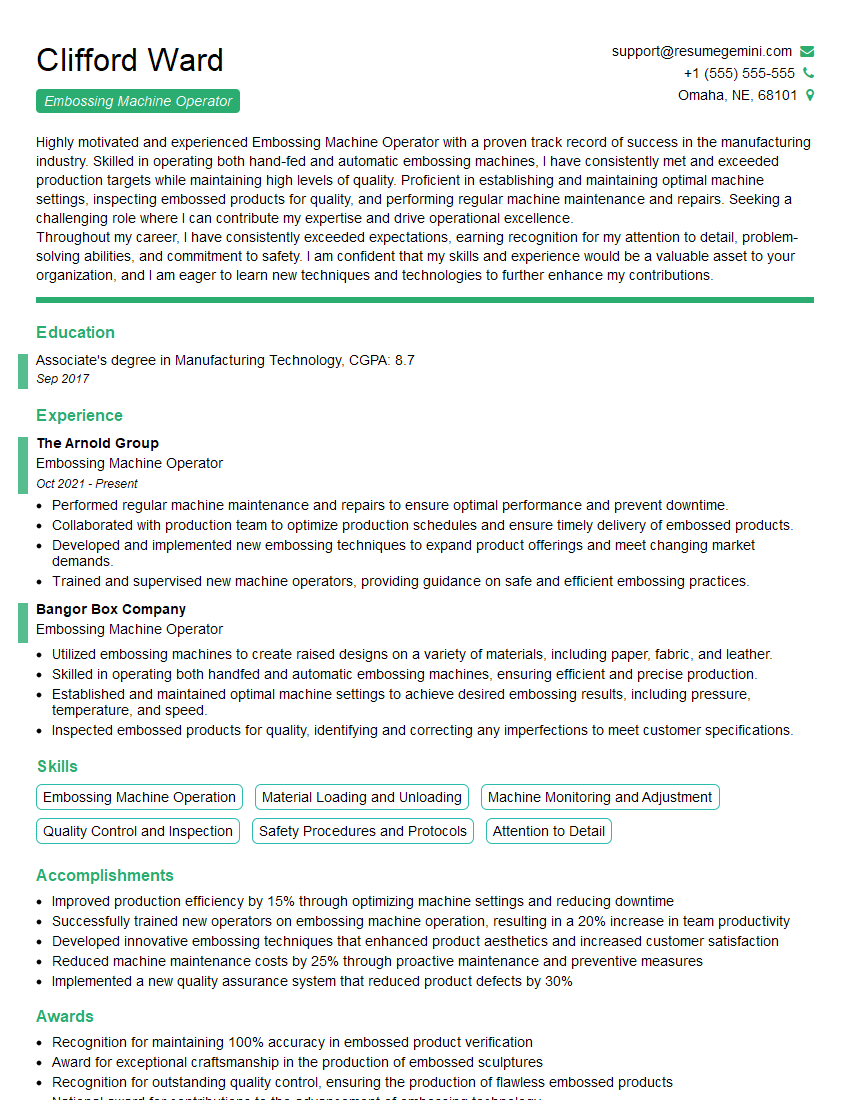
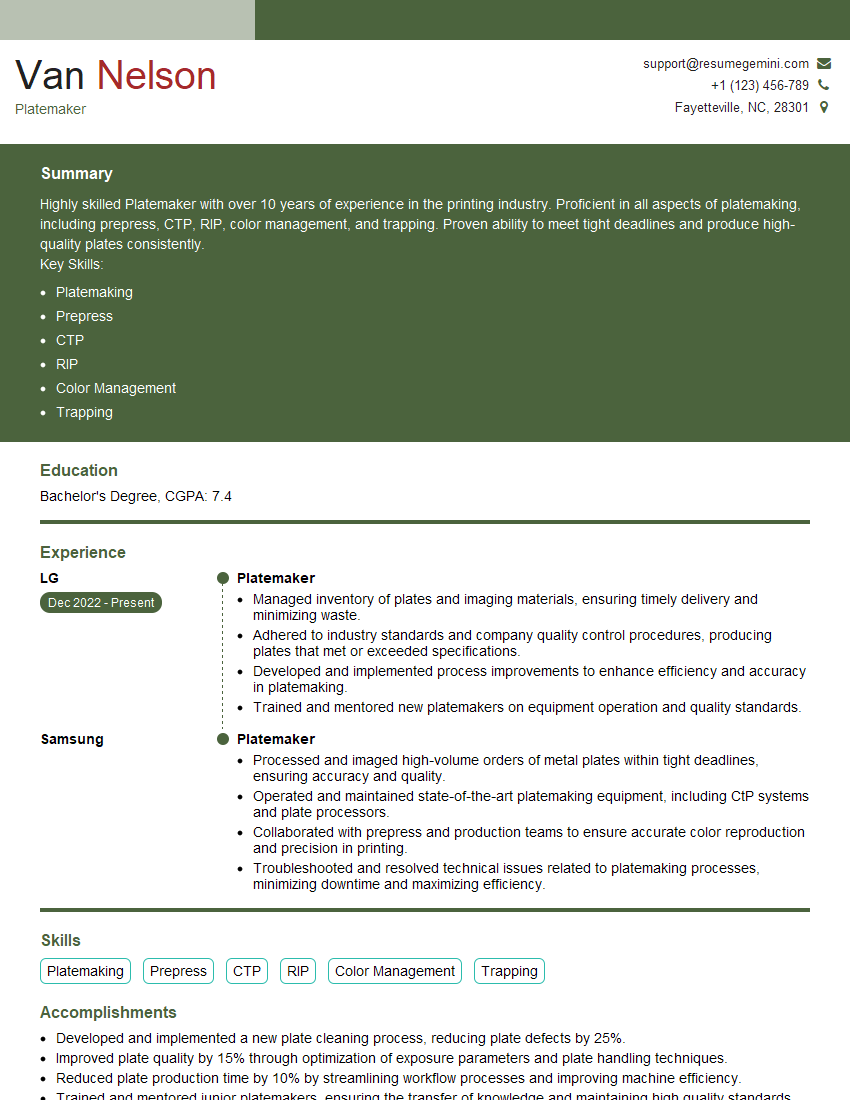
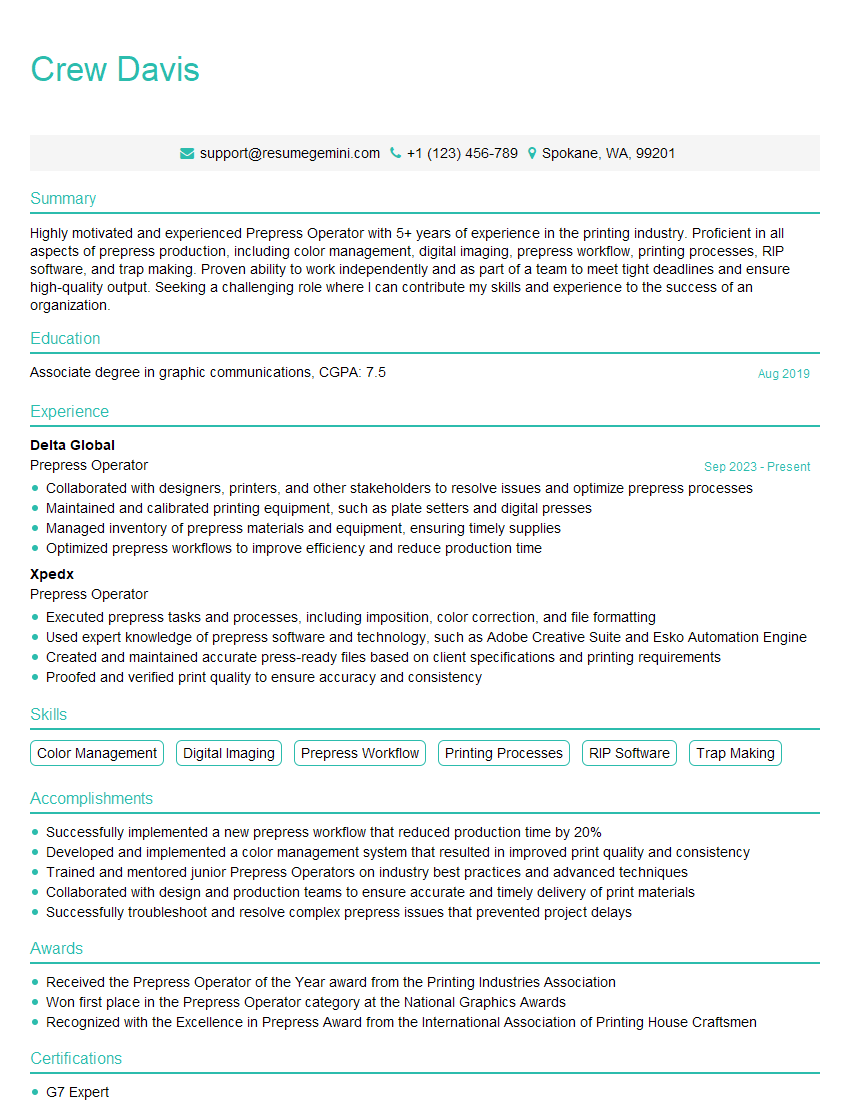
Mastering foiling and embossing prepress significantly enhances your career prospects in the graphic arts and packaging industries. It opens doors to specialized roles with higher earning potential and greater creative control. To maximize your job search success, crafting a strong, ATS-friendly resume is crucial. ResumeGemini is a trusted resource to help you build a professional and impactful resume that highlights your skills and experience effectively. Examples of resumes tailored to foiling and embossing prepress are available to guide you. Take the next step towards your dream career today!


Explore more articles
Users Rating of Our Blogs
Share Your Experience
We value your feedback! Please rate our content and share your thoughts (optional).
What Readers Say About Our Blog
Attention music lovers!
Wow, All the best Sax Summer music !!!
Spotify: https://open.spotify.com/artist/6ShcdIT7rPVVaFEpgZQbUk
Apple Music: https://music.apple.com/fr/artist/jimmy-sax-black/1530501936
YouTube: https://music.youtube.com/browse/VLOLAK5uy_noClmC7abM6YpZsnySxRqt3LoalPf88No
Other Platforms and Free Downloads : https://fanlink.tv/jimmysaxblack
on google : https://www.google.com/search?q=22+AND+22+AND+22
on ChatGPT : https://chat.openai.com?q=who20jlJimmy20Black20Sax20Producer
Get back into the groove with Jimmy sax Black
Best regards,
Jimmy sax Black
www.jimmysaxblack.com
Hi I am a troller at The aquatic interview center and I suddenly went so fast in Roblox and it was gone when I reset.
Hi,
Business owners spend hours every week worrying about their website—or avoiding it because it feels overwhelming.
We’d like to take that off your plate:
$69/month. Everything handled.
Our team will:
Design a custom website—or completely overhaul your current one
Take care of hosting as an option
Handle edits and improvements—up to 60 minutes of work included every month
No setup fees, no annual commitments. Just a site that makes a strong first impression.
Find out if it’s right for you:
https://websolutionsgenius.com/awardwinningwebsites
Hello,
we currently offer a complimentary backlink and URL indexing test for search engine optimization professionals.
You can get complimentary indexing credits to test how link discovery works in practice.
No credit card is required and there is no recurring fee.
You can find details here:
https://wikipedia-backlinks.com/indexing/
Regards
NICE RESPONSE TO Q & A
hi
The aim of this message is regarding an unclaimed deposit of a deceased nationale that bears the same name as you. You are not relate to him as there are millions of people answering the names across around the world. But i will use my position to influence the release of the deposit to you for our mutual benefit.
Respond for full details and how to claim the deposit. This is 100% risk free. Send hello to my email id: lukachachibaialuka@gmail.com
Luka Chachibaialuka
Hey interviewgemini.com, just wanted to follow up on my last email.
We just launched Call the Monster, an parenting app that lets you summon friendly ‘monsters’ kids actually listen to.
We’re also running a giveaway for everyone who downloads the app. Since it’s brand new, there aren’t many users yet, which means you’ve got a much better chance of winning some great prizes.
You can check it out here: https://bit.ly/callamonsterapp
Or follow us on Instagram: https://www.instagram.com/callamonsterapp
Thanks,
Ryan
CEO – Call the Monster App
Hey interviewgemini.com, I saw your website and love your approach.
I just want this to look like spam email, but want to share something important to you. We just launched Call the Monster, a parenting app that lets you summon friendly ‘monsters’ kids actually listen to.
Parents are loving it for calming chaos before bedtime. Thought you might want to try it: https://bit.ly/callamonsterapp or just follow our fun monster lore on Instagram: https://www.instagram.com/callamonsterapp
Thanks,
Ryan
CEO – Call A Monster APP
To the interviewgemini.com Owner.
Dear interviewgemini.com Webmaster!
Hi interviewgemini.com Webmaster!
Dear interviewgemini.com Webmaster!
excellent
Hello,
We found issues with your domain’s email setup that may be sending your messages to spam or blocking them completely. InboxShield Mini shows you how to fix it in minutes — no tech skills required.
Scan your domain now for details: https://inboxshield-mini.com/
— Adam @ InboxShield Mini
support@inboxshield-mini.com
Reply STOP to unsubscribe
Hi, are you owner of interviewgemini.com? What if I told you I could help you find extra time in your schedule, reconnect with leads you didn’t even realize you missed, and bring in more “I want to work with you” conversations, without increasing your ad spend or hiring a full-time employee?
All with a flexible, budget-friendly service that could easily pay for itself. Sounds good?
Would it be nice to jump on a quick 10-minute call so I can show you exactly how we make this work?
Best,
Hapei
Marketing Director
Hey, I know you’re the owner of interviewgemini.com. I’ll be quick.
Fundraising for your business is tough and time-consuming. We make it easier by guaranteeing two private investor meetings each month, for six months. No demos, no pitch events – just direct introductions to active investors matched to your startup.
If youR17;re raising, this could help you build real momentum. Want me to send more info?
Hi, I represent an SEO company that specialises in getting you AI citations and higher rankings on Google. I’d like to offer you a 100% free SEO audit for your website. Would you be interested?
Hi, I represent an SEO company that specialises in getting you AI citations and higher rankings on Google. I’d like to offer you a 100% free SEO audit for your website. Would you be interested?