Interviews are more than just a Q&A session—they’re a chance to prove your worth. This blog dives into essential Forestry Inventory interview questions and expert tips to help you align your answers with what hiring managers are looking for. Start preparing to shine!
Questions Asked in Forestry Inventory Interview
Q 1. Explain the difference between a complete and an incomplete inventory.
The core difference between a complete and an incomplete forest inventory lies in the extent of data collection. A complete inventory, also known as a census, measures every tree within a defined area. Think of it like counting every single grain of sand on a small beach – incredibly detailed but also very time-consuming and expensive. This approach is rarely practical for large forest areas.
Conversely, an incomplete inventory, uses sampling techniques to estimate the characteristics of the entire forest based on a representative subset of trees. Imagine instead of counting every grain of sand, you take several handfuls from different parts of the beach and extrapolate the total number of grains based on your samples. This is far more efficient and cost-effective for large-scale projects, though it introduces a margin of error.
The choice between a complete and incomplete inventory depends on factors like the size of the area, the level of precision required, available resources (time, budget, personnel), and the intended use of the inventory data.
Q 2. Describe various sampling methods used in forestry inventory.
Forestry inventories utilize various sampling methods to gather data efficiently. The selection depends on the inventory’s objectives, terrain, forest structure, and budget. Here are some common approaches:
- Systematic sampling: Establishing a grid and measuring trees at regular intervals. Imagine a chessboard – you might measure trees at every intersection. This is straightforward but can be biased if the grid doesn’t align with natural forest patterns.
- Random sampling: Randomly selecting plots within the forest area. This helps minimize bias but can lead to inefficient plot placement, especially in uneven terrain.
- Stratified random sampling: Dividing the forest into strata (e.g., based on elevation, species composition, or age class) and then applying random sampling within each stratum. This ensures representation from all key forest types.
- Cluster sampling: Grouping plots together to reduce travel time and costs, especially in remote areas. However, this method can increase the sampling error if clusters aren’t representative of the entire forest.
- Double sampling: Combining two different sampling methods, such as aerial photography (for large-scale assessment) and ground measurements (for detailed data). This balances efficiency and accuracy.
Choosing the optimal sampling method is a crucial decision in forest inventory planning, directly impacting the accuracy, precision, and cost-effectiveness of the project.
Q 3. What are the advantages and disadvantages of using aerial photography in forest inventory?
Aerial photography plays a significant role in large-scale forest inventories. Its advantages include:
- Cost-effectiveness for large areas: Surveying vast areas is much faster and cheaper using aerial platforms compared to ground-based methods.
- Comprehensive overview: Provides a bird’s-eye view, revealing forest structure, boundaries, and patterns that are difficult to discern from the ground.
- Accessibility to remote areas: Enables data collection in difficult-to-reach terrains, such as steep slopes or dense forests.
However, aerial photography has limitations:
- Resolution limitations: High-resolution imagery is necessary for detailed tree identification and measurements, which can be costly. Lower resolution may only allow for broad assessments.
- Weather dependence: Cloud cover and poor weather conditions can severely hamper data acquisition.
- Interpretation challenges: Analyzing aerial images requires specialized skills and software to accurately identify tree species, sizes, and crown cover. Image interpretation can be subjective.
- Cost of Equipment and Processing: Obtaining high-quality aerial imagery and processing it requires significant investment.
In practice, aerial photography is often used in conjunction with ground-based measurements to achieve a balance between efficiency and accuracy. For example, aerial photos might be used to delineate stands, and ground plots are then established within those stands for detailed measurements.
Q 4. How do you handle missing data in a forestry inventory dataset?
Missing data is a common challenge in forestry inventories. Effective handling requires careful planning and analysis. Here’s a multi-pronged approach:
- Prevention: Robust data collection protocols, including comprehensive field forms and quality control checks, are crucial in minimizing missing data. Well-trained field crews are essential.
- Imputation: If data is missing for a few variables in a few plots, imputation techniques can be used to fill the gaps. Simple methods include using the mean or median of available data for the variable. More sophisticated methods, like multiple imputation, account for the uncertainty introduced by the imputation.
- Deletion: If a large proportion of data is missing from a plot or if the missing data is not randomly distributed, deleting the incomplete plot may be the best approach to avoid bias. But only after carefully considering whether this would significantly reduce your sample size.
- Modeling: Missing data patterns may be addressed by developing statistical models to predict missing values based on relationships with other variables. Regression models or machine learning algorithms could be used.
The choice of method depends on the extent and nature of missing data, the chosen analysis method, and the acceptance of uncertainty.
Q 5. Explain the concept of stand density and its importance in inventory.
Stand density refers to the number of trees per unit area within a forest stand. It’s a critical measurement in forest inventories because it significantly influences factors like tree growth, competition, and timber yield. High density often leads to smaller trees due to competition for resources (light, water, nutrients), while low density can result in larger, faster-growing trees but potentially lower overall volume per unit area.
Several methods are used to assess stand density:
- Trees per hectare (TPH): A straightforward measure counting the number of trees within a hectare.
- Basal area: The cross-sectional area of all tree stems at breast height (1.37 m), typically expressed in square meters per hectare (m²/ha). Basal area is a more informative measure than simple tree count because larger trees contribute more to the overall stand volume.
- Crown competition factor: This assesses the degree to which crowns overlap, impacting the amount of light and space available to each tree. Higher competition factors indicate denser stands.
Understanding stand density is vital for management decisions, such as thinning operations (removing trees to reduce competition) or determining optimal planting densities.
Q 6. What are the key factors influencing tree growth that you would consider in an inventory?
Many factors influence tree growth, and a comprehensive forest inventory should consider these key elements:
- Climate: Temperature, precipitation, and sunlight are fundamental drivers of tree growth. Differences in these factors across an area influence tree species distribution and growth rates.
- Soil conditions: Soil type, nutrients, moisture content, and drainage significantly affect tree health and vigor. Poor soil conditions can limit growth and increase susceptibility to diseases or pests.
- Competition: Intraspecific (within species) and interspecific (between species) competition for resources greatly affects tree growth. Dense stands often result in smaller trees due to competition for sunlight, water, and nutrients.
- Species characteristics: Different tree species have inherent growth rates and tolerances to various environmental conditions. Knowing the species composition is vital for accurate growth prediction.
- Topography: Elevation, slope, and aspect (direction the slope faces) influence sunlight exposure, soil moisture, and microclimate, impacting tree growth.
- Disturbances: Natural disturbances like fire, windstorms, insect infestations, and disease outbreaks can significantly affect tree growth and mortality. These are crucial to record and include in your inventory to model forest dynamics.
By considering these factors in an inventory, one can develop more accurate growth models and make better informed management decisions.
Q 7. Describe your experience with different forest inventory software (e.g., ArcGIS, ForestPro).
My experience with forest inventory software encompasses both GIS platforms like ArcGIS and dedicated forestry software such as ForestPro. ArcGIS provides excellent spatial analysis capabilities for visualizing and managing forest inventory data. I’ve utilized its geoprocessing tools to create maps of various forest attributes, conduct spatial statistics, and model forest growth. For example, I used ArcGIS to generate maps of basal area and tree density, which were then used to guide thinning operations in a mixed conifer stand.
ForestPro, on the other hand, is a specialized software designed for efficient data collection, analysis, and reporting specifically for forestry inventories. I’ve used it to design and implement sampling protocols, collect field data through mobile devices, and generate comprehensive reports detailing forest characteristics and volume estimates. In a recent project, ForestPro allowed me to streamline the workflow, significantly reducing the time spent on data entry and analysis, leading to timely decision-making for forest management.
My expertise also includes familiarity with other packages such as R and Python and their associated forestry-specific libraries, allowing me to tailor analyses to specific research questions, develop custom models and perform complex statistical analyses.
Q 8. How do you ensure the accuracy and precision of your inventory measurements?
Ensuring accuracy and precision in forestry inventory measurements is paramount. It’s like baking a cake – you need the right ingredients in the right proportions for a perfect result. We achieve this through a multi-pronged approach focusing on both field techniques and data processing.
Careful Field Techniques: This includes using calibrated instruments like diameter tapes and hypsometers, employing standardized measurement protocols (e.g., following specific guidelines for tree selection and measurement points), and employing multiple measurements for each tree to reduce random error. For instance, we might measure diameter at breast height (DBH) at four different points around the tree and average the values.
Quality Control: Regular calibration checks on equipment are crucial. We also implement rigorous quality control procedures during data entry and processing, including double-checking measurements and using statistical methods to identify and correct outliers. We might use software specifically designed for forestry data management to aid in data cleaning.
Sampling Design: A well-designed sampling strategy is key. The sampling method (e.g., systematic, stratified random) must be appropriate for the forest type and the objectives of the inventory. A larger sample size generally increases precision, but cost and time constraints need to be considered. Proper stratification (dividing the forest into homogenous areas) helps reduce sampling error.
Data Analysis: Using appropriate statistical methods to analyze the data, and properly accounting for sampling error and variation, allows us to provide reliable estimates of forest characteristics.
Q 9. Explain the process of calculating timber volume using different methods.
Calculating timber volume involves determining the cubic-meter or board-foot volume of wood in a tree or stand. Several methods exist, each with its own strengths and weaknesses.
Huber’s Formula: This is a simple method suitable for individual trees, estimating volume based on DBH and tree height (h):
Volume = 0.00007854 * DBH^2 * hIt assumes a cylindrical form, which can lead to underestimation for some tree species.Smalian’s Formula: A more accurate method for individual logs where the top and base diameters are significantly different.
Volume = (A1 + A2)/2 * L, where A1 and A2 are the cross-sectional areas at the top and base of the log and L is the length.Newton’s Formula: Similar to Smalian’s, but accounts for taper better. It uses multiple diameter measurements along the log length to estimate volume more precisely.
Volume Tables: Pre-computed tables based on species, DBH, and height provide easy estimates of volume. These are often based on extensive field measurements and are species-specific, reducing errors from shape assumptions.
Stem Analysis: For high accuracy, particularly for older trees, we use stem analysis. We cut sections of a tree and precisely measure the cross-sectional area at each section to calculate total volume. This method is time-consuming, but offers the most accurate volume estimation.
The choice of method depends on the required accuracy, available resources, and species being measured.
Q 10. How do you incorporate GIS technology into your forestry inventory work?
GIS (Geographic Information System) technology is indispensable in modern forestry inventory. It provides a powerful platform for data management, spatial analysis, and visualization.
Mapping and Data Storage: We use GIS to create and manage forest maps, storing inventory data spatially (e.g., linking tree measurements to their precise location). This allows us to analyze tree density, species composition, and other variables across the forest landscape.
Spatial Analysis: GIS facilitates advanced spatial analysis techniques. For example, we can use proximity analysis to identify areas close to water sources or roads, relevant for planning harvesting operations or reforestation efforts. We can also conduct spatial modeling to predict the future growth of forests or assess the impact of various management scenarios.
Integration with Remote Sensing: GIS serves as a central hub to integrate data from remote sensing technologies like LiDAR and satellite imagery. We can overlay remote sensing data onto our inventory maps to enhance accuracy and obtain information about forest structure and biomass.
Decision Support: The spatial visualization capabilities of GIS aid in effective communication and decision-making. We can create detailed maps and reports to communicate our findings and recommendations to stakeholders, such as forest managers or landowners.
In essence, GIS acts as a powerful tool to integrate, analyze, and visualize complex forest inventory data, leading to informed and efficient forest management.
Q 11. Describe your experience with remote sensing techniques used in forest inventory (e.g., LiDAR, satellite imagery).
Remote sensing techniques are revolutionizing forest inventory, allowing for efficient and large-scale assessments. My experience includes using both LiDAR and satellite imagery.
LiDAR (Light Detection and Ranging): LiDAR uses laser pulses to generate 3D point clouds representing the forest canopy and ground surface. From this data, we can derive accurate measurements of tree height, crown diameter, and forest density. LiDAR is particularly valuable in dense forests where traditional field measurements are challenging. For example, we can use LiDAR to accurately estimate the volume of timber in a large, inaccessible area, saving considerable time and cost compared to solely ground-based methods.
Satellite Imagery: Multispectral and hyperspectral satellite imagery offers information about the spectral signature of different forest types. By analyzing pixel values, we can classify forest types, estimate tree cover, and monitor changes in forest health over time. For instance, we can use satellite imagery to identify areas impacted by disease or insect outbreaks.
Both LiDAR and satellite imagery provide complementary data sources that, when integrated with ground-based measurements and GIS, enable us to create highly accurate and detailed forest inventories.
Q 12. How do you interpret forest inventory data to make management recommendations?
Interpreting forest inventory data requires a multifaceted approach that goes beyond simply presenting numbers. It involves understanding the ecological context, considering management objectives, and communicating findings clearly.
Data Analysis: We begin with a detailed analysis of the inventory data, focusing on key variables like tree species composition, density, size distribution, and volume. Statistical methods are used to estimate population parameters and their uncertainty.
Ecological Considerations: We interpret the data in light of ecological principles. This means understanding the relationship between the forest’s structure, composition, and its overall health. For instance, a low density of certain species might indicate issues with habitat or past management practices.
Management Goals: Management recommendations are always tailored to specific objectives, whether it’s timber production, biodiversity conservation, or carbon sequestration. The inventory data helps us to evaluate the current state of the forest relative to the set goals.
Scenario Planning: We often use the inventory data to model the impact of different management scenarios on future forest conditions. For example, we might simulate the effects of various harvesting regimes on timber yield or biodiversity.
Reporting & Communication: Finally, we synthesize our findings into clear and concise reports, using maps and visualizations to help stakeholders understand the implications of the data and the proposed management recommendations.
Essentially, interpreting inventory data is about translating raw numbers into actionable insights that guide effective forest management.
Q 13. What are the common sources of error in forest inventory, and how do you mitigate them?
Forest inventory is susceptible to several sources of error. Identifying and mitigating these is crucial for reliable results. Imagine trying to count all the grains of sand on a beach – it’s a challenge!
Sampling Error: This is inherent in any sampling process. We use appropriate sampling techniques (stratification, random sampling) and statistical methods to estimate and minimize this error.
Measurement Error: This arises from inaccuracies in measuring DBH, height, or other variables. We use calibrated instruments, employ standardized procedures, and perform quality control checks to reduce this error. Training of personnel is key.
Observer Bias: Subjectivity in selecting sample trees or making measurements can introduce bias. Using clearly defined protocols and multiple observers reduces this risk.
Data Entry Errors: Mistakes during data entry can lead to significant inaccuracies. Data entry double-checking and using data validation tools are essential.
Model Error: If using volume equations or models, errors may arise from model limitations or misapplication. Choosing models appropriate to the species and forest conditions is crucial.
Mitigating errors requires a comprehensive approach, encompassing careful planning, rigorous field techniques, robust data processing, and the use of appropriate statistical methods. Regular audits and quality control measures are crucial.
Q 14. Explain your experience with different tree measurement tools (e.g., diameter tapes, hypsometers).
I have extensive experience with a variety of tree measurement tools, essential for accurate data collection.
Diameter Tapes: These are used to measure DBH, a fundamental tree characteristic. Regular calibration is vital to ensure accuracy. I’m proficient in using both standard and specialized tapes, understanding the importance of taking measurements at breast height (1.37m) and accounting for irregularities in tree form.
Hypsometers: These instruments measure tree height. I’m experienced with various types, including Haga altimeters, Suunto hypsometers, and clinometers. Each has its advantages and limitations, and the choice depends on the terrain and forest conditions. I understand the importance of accurate sighting techniques and environmental corrections.
Vertex Hypsometers: These advanced tools combine angle measurement with distance calculation to determine tree height and are particularly useful in situations where direct measurement is challenging.
Relascope: This instrument is used for assessing basal area (the cross-sectional area of trees at breast height). It offers a quick method for estimating stand density and provides essential data for timber volume calculations.
Tree Caliper: To measure irregular stems, I’ve experience with calipers. They are particularly useful for accurately capturing the dimensions of large or oddly-shaped trees.
Proper use and maintenance of these tools are critical for accurate inventory. Regular calibration and training are part of my standard operating procedure.
Q 15. How do you ensure the quality control of your forestry inventory data?
Quality control in forestry inventory is paramount for ensuring data reliability and the validity of subsequent management decisions. It’s a multi-stage process that begins even before fieldwork. We employ several key strategies:
- Rigorous Planning and Protocol Development: Before any data collection, detailed protocols are established, defining sampling methods, measurement techniques, and data recording procedures. This ensures consistency across the entire inventory.
- Pre-field Equipment Calibration and Training: All instruments, from diameter tapes to GPS units, are meticulously calibrated to minimize measurement error. Field crews undergo thorough training on the correct use of equipment and adherence to established protocols. This includes practice sessions and proficiency tests.
- Field Data Validation: During field work, regular checks are implemented. This can include supervisor spot checks, double measurement of key trees, and immediate resolution of any discrepancies noted. Data entry is often performed in the field with real-time quality control checks built into the data entry software.
- Post-field Data Analysis and Verification: Once data collection is complete, rigorous data cleaning and verification occur. This involves checking for outliers, missing values, and inconsistencies. Statistical analysis helps identify potential errors and highlights areas needing further investigation. We might use range checks, plausibility checks, and cross-referencing with other datasets.
- Independent Audits: In large-scale or high-stakes inventories, an independent audit can be conducted by an external team to assess the quality of the entire process and the final data product. This provides an unbiased evaluation and builds confidence in the results.
For example, during a recent inventory, we discovered a systematic bias in diameter measurements using a particular tape. By identifying and correcting this early in the process, we averted significant errors in volume estimations. This illustrates the importance of rigorous quality control at each stage.
Career Expert Tips:
- Ace those interviews! Prepare effectively by reviewing the Top 50 Most Common Interview Questions on ResumeGemini.
- Navigate your job search with confidence! Explore a wide range of Career Tips on ResumeGemini. Learn about common challenges and recommendations to overcome them.
- Craft the perfect resume! Master the Art of Resume Writing with ResumeGemini’s guide. Showcase your unique qualifications and achievements effectively.
- Don’t miss out on holiday savings! Build your dream resume with ResumeGemini’s ATS optimized templates.
Q 16. Describe a time you had to troubleshoot a problem during a forestry inventory project.
During a large-scale inventory project in a mixed hardwood-conifer forest, we encountered unexpected challenges related to GPS accuracy. In dense forest areas with significant canopy cover, the GPS signals were often weak or unreliable, leading to inaccurate location data for our sample plots. This directly affected our ability to accurately map tree species and estimate stand volumes.
To troubleshoot this, we adopted a multi-pronged approach:
- Improved GPS Techniques: We switched to using differential GPS (DGPS) technology which significantly enhanced accuracy by using a base station to correct for atmospheric errors. This required setting up a base station at a known location.
- Ground Truthing: We implemented a system of ground truthing, where we physically verified the plot locations using compass and pacing techniques, especially in areas where GPS signals were weak. This provided independent verification of GPS data.
- Data Interpolation and Spatial Analysis: For the few remaining plots where accuracy remained questionable, we utilized spatial analysis techniques to interpolate plot locations based on nearby, accurately located plots, considering the spatial distribution of tree species and stand characteristics.
This combination of technological upgrades, ground-truthing and sophisticated data analysis methods allowed us to overcome the GPS challenges and successfully complete the inventory with minimal impact on data quality. The lesson learned was the importance of having contingency plans for technological challenges in challenging terrain.
Q 17. How do you handle discrepancies between field measurements and inventory estimations?
Discrepancies between field measurements and inventory estimations are inevitable and often highlight areas requiring further investigation. Several factors can contribute, including measurement errors, sampling variability, and inaccuracies in growth and yield models.
Our approach involves a systematic investigation:
- Review Measurement Procedures: We first review the field measurement procedures, checking for errors in techniques or data recording. We compare the field data with the inventory estimates to identify patterns or trends in the discrepancies.
- Assess Sampling Design: The sampling design is reviewed for its appropriateness. Were sufficient sample plots established? Was the stratification appropriate for the stand heterogeneity? A poorly designed sampling scheme can amplify errors.
- Evaluate Model Assumptions: If inventory estimates rely on growth and yield models, we examine the assumptions underpinning these models to ensure they’re valid for the specific forest being assessed. Out-of-date or inappropriate models can lead to significant biases.
- Re-measurement: In some cases, we re-measure a subset of the plots to assess if there are systematic errors in the initial measurements. This provides a way to quantitatively assess measurement error.
- Adjustments based on Analysis: Based on our analysis, we might choose to adjust the inventory estimates to better reflect the field data. This might involve applying correction factors or refining the growth and yield models. It is crucial to document these adjustments and justify the methods used.
For instance, if we find a consistent underestimation of tree volume in a particular stand, we might examine if the species-specific volume equations we used adequately represent the local variation in tree form. It is important to document the resolution process transparently.
Q 18. What are the ethical considerations in conducting a forest inventory?
Ethical considerations in forestry inventory are crucial, as the data directly influences forest management decisions with broad environmental and social consequences. Key ethical considerations include:
- Transparency and Data Integrity: Maintaining the highest standards of data integrity is fundamental. This involves accurate data collection, transparent documentation of methods, and open reporting of results. Hiding or manipulating data undermines the credibility of the inventory and can lead to poor management decisions.
- Objectivity and Impartiality: The inventory should be conducted objectively, free from bias or influence from external stakeholders. This means following established protocols and avoiding any subjective interpretation of data.
- Environmental Responsibility: The inventory process itself should be conducted in an environmentally responsible manner, minimizing disturbance to the forest ecosystem. This includes following established guidelines for accessing and traversing forest areas.
- Respect for Indigenous and Local Communities: If the inventory impacts areas where Indigenous or local communities have traditional land rights or customary use practices, free, prior, and informed consent (FPIC) must be obtained. Their knowledge and concerns must be respected and incorporated.
- Confidentiality of Data: Protecting the confidentiality of data, particularly where it concerns sensitive information about land ownership or forest management practices, is essential. Appropriate data security measures must be implemented.
For example, avoiding invasive sampling methods in environmentally sensitive areas or carefully obtaining consent from local communities before beginning work on their land demonstrates the commitment to ethical conduct.
Q 19. How familiar are you with forest growth and yield models?
I am very familiar with forest growth and yield models. These models are crucial tools for predicting future forest conditions and making informed management decisions. My experience encompasses both empirical and process-based models.
Empirical Models: These models are statistically derived from historical data on tree growth and yield. They are often simpler to use but their predictive power is limited to the range of conditions represented in the historical data. Examples include stand-level volume equations and diameter distribution models. I’ve used several established models such as the Prodan or Schumacher-Hall equations for volume estimation.
Process-based Models: These models explicitly simulate the physiological processes affecting tree growth, such as photosynthesis, respiration, and nutrient uptake. They are more complex but offer a more mechanistic understanding of growth and are potentially more robust for projecting responses to changes in environmental conditions. Examples include 3PG and FVS. I’ve used 3PG to simulate the growth of individual trees under different management scenarios.
My experience includes model selection, parameter estimation, model validation, and using model outputs for scenario planning. I understand the limitations of each model type and the importance of choosing the most appropriate model for the specific objectives of the inventory and the characteristics of the forest being studied.
Q 20. Explain your understanding of different forest types and their specific inventory requirements.
Different forest types have unique characteristics that influence inventory requirements. The choice of inventory methods and the level of detail required are directly influenced by the forest type.
- Even-aged Stands: These stands typically have trees of similar age and height, simplifying inventory procedures. Simple sampling techniques, such as fixed-area plots, are often sufficient. The primary focus is on stand-level variables like basal area and total volume.
- Uneven-aged Stands: These stands contain trees of various ages and sizes, requiring more complex inventory methods. Individual tree measurements are usually necessary, and point sampling or variable-radius plots are commonly used to capture the diversity of tree sizes. Detailed data on individual tree characteristics is critical.
- Coniferous Forests: Coniferous forests, characterized by needle-bearing trees, often require inventory methods that accommodate the relatively uniform structure and high density of trees. Point sampling can be efficient here.
- Broadleaf Forests: Broadleaf forests, with deciduous trees, often have more varied tree forms and require more attention to individual tree measurements. Variable-radius plots can be useful.
- Tropical Forests: Tropical forests have high biodiversity and complex structures, often necessitating intensive sampling and specialized inventory techniques to capture the species diversity and spatial heterogeneity.
For instance, when working in a dense tropical rainforest, you might employ a combination of remote sensing and ground-based sampling to map forest composition and structure, whereas in a relatively uniform plantation, a simpler sampling design would suffice. The choice of methods always depends on the specific objective and characteristics of the forest.
Q 21. What is your experience with data analysis techniques used in forestry inventory?
My experience with data analysis techniques in forestry inventory is extensive. I utilize a variety of techniques, ranging from basic descriptive statistics to advanced geospatial analyses.
- Descriptive Statistics: Calculating summary statistics (means, variances, standard deviations) to characterize forest characteristics such as tree density, basal area, and volume.
- Regression Analysis: Developing and applying regression models to estimate tree volume, biomass, or other variables based on easily measurable parameters such as diameter and height. I’m familiar with various regression techniques including linear, non-linear, and generalized linear models.
- Spatial Statistics: Using geostatistical techniques such as kriging to interpolate and map forest attributes across the landscape. This helps in creating continuous surfaces for variables like tree density or volume.
- Multivariate Analysis: Employing techniques like principal component analysis (PCA) or cluster analysis to identify patterns and relationships among different forest variables or species compositions.
- Remote Sensing Data Analysis: Analyzing data from aerial photography, LiDAR, or satellite imagery to derive forest cover, tree height, and other structural variables. This involves image classification, object-based image analysis, and other remote sensing processing techniques.
- Geographic Information Systems (GIS): Extensive experience using GIS software (e.g., ArcGIS) for data management, spatial analysis, and map production. I am proficient in using GIS tools for creating inventory maps, generating reports, and visualizing the spatial distribution of forest characteristics.
For example, in a recent project, I used LiDAR data to create a high-resolution digital elevation model (DEM) of the forest, which was then combined with field inventory data to improve the accuracy of volume estimation and identify areas with potential timber harvesting conflicts.
Q 22. Describe your experience working with different stakeholders in a forest inventory project.
Collaboration is the cornerstone of successful forest inventory projects. My experience involves working with a diverse range of stakeholders, including landowners, government agencies, environmental NGOs, and logging companies. Each group brings unique perspectives and priorities to the table. For example, landowners are primarily concerned with the financial value of their timber, while environmental groups focus on biodiversity and ecosystem health. Government agencies often have regulatory requirements and mandates to fulfill.
To effectively manage these diverse interests, I employ a proactive communication strategy. This includes:
- Regular meetings and updates: Keeping all stakeholders informed throughout the project lifecycle.
- Clear and concise communication: Using accessible language to explain technical details.
- Transparency in data collection and analysis: Ensuring everyone understands the methodology and results.
- Active listening and feedback incorporation: Valuing the input of all parties involved and adapting the project as needed.
- Conflict resolution: Mediating disagreements and finding mutually acceptable solutions.
For instance, in one project involving a protected forest, I worked closely with both the logging company and the environmental group to develop a harvesting plan that balanced economic needs with conservation goals. This involved compromises on both sides, but ultimately led to a successful and sustainable outcome.
Q 23. How do you present your inventory findings to a non-technical audience?
Presenting complex forestry data to a non-technical audience requires a shift in communication style. I avoid jargon and technical terms whenever possible. Instead, I rely on visual aids like maps, charts, and graphs to communicate key findings. Storytelling is also crucial. I often frame the data within a narrative, connecting the results to real-world impacts.
For example, instead of saying “The basal area of the stand is 25 m²/ha,” I might say, “This forest is relatively dense, with enough trees to provide significant carbon sequestration and habitat for wildlife.” I might then illustrate this with a map highlighting the areas of high and low density.
I also utilize analogies to help people understand abstract concepts. For example, explaining the concept of tree volume using the analogy of filling a bathtub. The focus is always on the implications of the data, not the technical details behind its generation. The goal is to empower the audience to make informed decisions based on a clear understanding of the forest’s condition.
Q 24. What are the current trends and challenges in forestry inventory?
The field of forestry inventory is undergoing rapid transformation. Several key trends and challenges are shaping the future of the profession.
- Increased use of remote sensing technologies: LiDAR (Light Detection and Ranging) and hyperspectral imagery are becoming increasingly prevalent, providing detailed information about forest structure and composition at a larger scale and lower cost than traditional field methods. This necessitates training on new software and data analysis techniques.
- Integration of Geographic Information Systems (GIS): GIS is fundamental for visualizing, analyzing, and managing spatial data. The ability to integrate data from multiple sources into a GIS environment is essential for comprehensive inventory analysis.
- Growing emphasis on sustainable forest management: Inventories are increasingly used to assess the ecological and economic sustainability of forest operations, driving the need for more sophisticated metrics and modeling techniques beyond simple timber volume estimation.
- Data management and analysis challenges: The sheer volume of data generated by remote sensing and other technologies poses significant challenges in terms of storage, processing, and interpretation. Advanced statistical and machine learning methods are needed to effectively analyze these large datasets.
- Climate change impacts: Forest inventories must adapt to account for the increasing effects of climate change on forest health and productivity. This includes modeling future scenarios and assessing the vulnerability of different forest types.
Q 25. How do you stay up-to-date on the latest technologies and techniques in forestry inventory?
Staying current in this dynamic field requires a multi-faceted approach.
- Professional development courses and workshops: I regularly attend conferences and workshops focused on forestry inventory and related technologies. This allows me to learn about the latest techniques and software from experts in the field.
- Peer-reviewed publications: I actively read scientific journals and publications to stay informed about new research findings and advancements.
- Industry conferences and webinars: Participation in industry events and webinars provides exposure to practical applications and case studies.
- Networking with colleagues: I actively participate in professional organizations and engage with other professionals to share knowledge and best practices.
- Online resources and tutorials: Many online resources offer valuable training materials and software tutorials. I actively utilize those to stay ahead.
For instance, I recently completed a course on using LiDAR data for forest inventory, significantly enhancing my skills in 3D point cloud processing and analysis. This continuous learning ensures my skills remain sharp and relevant.
Q 26. Describe your experience with forest inventory planning and design.
Forest inventory planning and design is critical for ensuring the accuracy, efficiency, and cost-effectiveness of the project. My approach involves a systematic process.
- Defining objectives and scope: Clearly identifying the purpose of the inventory (e.g., timber volume estimation, biodiversity assessment, carbon stock calculation) and the geographic area to be covered.
- Sampling design: Selecting the appropriate sampling method (e.g., systematic, stratified random) based on the objectives, forest characteristics, and budget constraints. This includes determining the sample size, plot size, and spacing.
- Data collection methods: Choosing the appropriate techniques for collecting data (e.g., field measurements, remote sensing). This involves selecting appropriate tools and training field crews.
- Quality control and assurance: Establishing procedures to ensure the accuracy and consistency of data collection and analysis. This includes regular checks and validations.
- Budget and timeline: Developing a realistic budget and timeline for the project, considering the costs of personnel, equipment, and data analysis.
For example, in a recent project involving a large, heterogeneous forest, I used a stratified random sampling design to ensure adequate representation of different forest types. This increased the precision of our estimates and minimized sampling bias.
Q 27. How would you approach a large-scale forest inventory project?
A large-scale forest inventory project demands a highly structured and organized approach. My strategy would involve several key steps:
- Project management framework: Implementing a robust project management framework with clearly defined roles, responsibilities, and timelines. This often involves using project management software.
- Phased approach: Breaking down the project into manageable phases, such as planning, data acquisition, data processing, analysis, and reporting. This allows for better monitoring and control.
- Teamwork and collaboration: Assembling a skilled team with expertise in various aspects of forestry inventory, including field measurement, remote sensing, data processing, and statistical analysis.
- Technology integration: Leveraging appropriate technologies, such as GIS, remote sensing, and data management software to optimize efficiency and accuracy. This includes careful selection and testing of relevant software.
- Data quality control: Establishing rigorous quality control procedures throughout the project to ensure the reliability of data. This might include independent data validation and error checking.
- Communication plan: Developing a comprehensive communication plan to ensure effective communication among team members and stakeholders. Regular progress reports and meetings are crucial.
This phased approach, combined with strong project management and technology integration, is key to successfully completing a large-scale inventory on time and within budget.
Q 28. What are your salary expectations for this role?
My salary expectations are commensurate with my experience and skills in the field of forestry inventory, and aligned with the market rate for similar positions. I am open to discussing a competitive compensation package that reflects the value I will bring to your organization. I would be happy to provide a detailed breakdown of my salary expectations after learning more about the specifics of the role and benefits offered.
Key Topics to Learn for Forestry Inventory Interview
- Forest Mensuration Techniques: Understanding diameter at breast height (DBH) measurements, tree height estimation, and volume calculations. Practical application includes using various instruments like calipers and hypsometers in fieldwork.
- Sampling Methods: Mastering different sampling techniques like fixed-radius plots, variable-radius plots (e.g., Bitterlich sampling), and line transects. Practical application involves designing efficient sampling strategies for different forest types and objectives.
- Data Analysis and Interpretation: Proficiency in using statistical software (e.g., R, SAS) to analyze inventory data, calculate mean values, variances, and conduct relevant statistical tests. Practical application includes creating reports and communicating findings clearly.
- Forest Inventory Software: Familiarity with commonly used software for forest inventory data management and analysis. This might include specific GIS software or specialized forestry inventory packages.
- Growth and Yield Modeling: Understanding the principles of forest growth and yield modeling and their application in predicting future forest conditions. Practical application includes using models to assess sustainable harvesting practices.
- Forest Inventory Design and Planning: Ability to design a comprehensive forest inventory plan based on specific objectives, budget, and time constraints. This includes defining sampling intensity, stratification, and data collection methods.
- Remote Sensing and GIS Applications in Forestry: Understanding the use of aerial photography, LiDAR, and satellite imagery for forest inventory purposes. Practical application involves integrating remote sensing data with ground-based measurements.
Next Steps
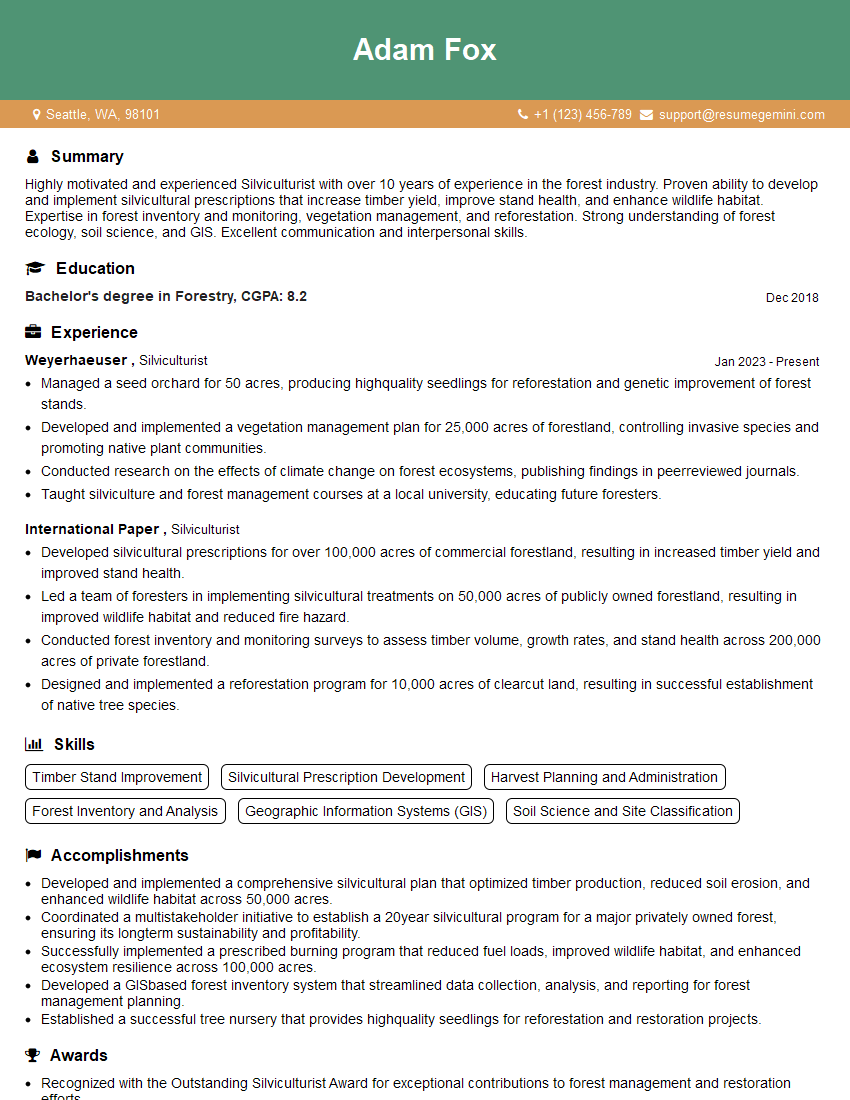
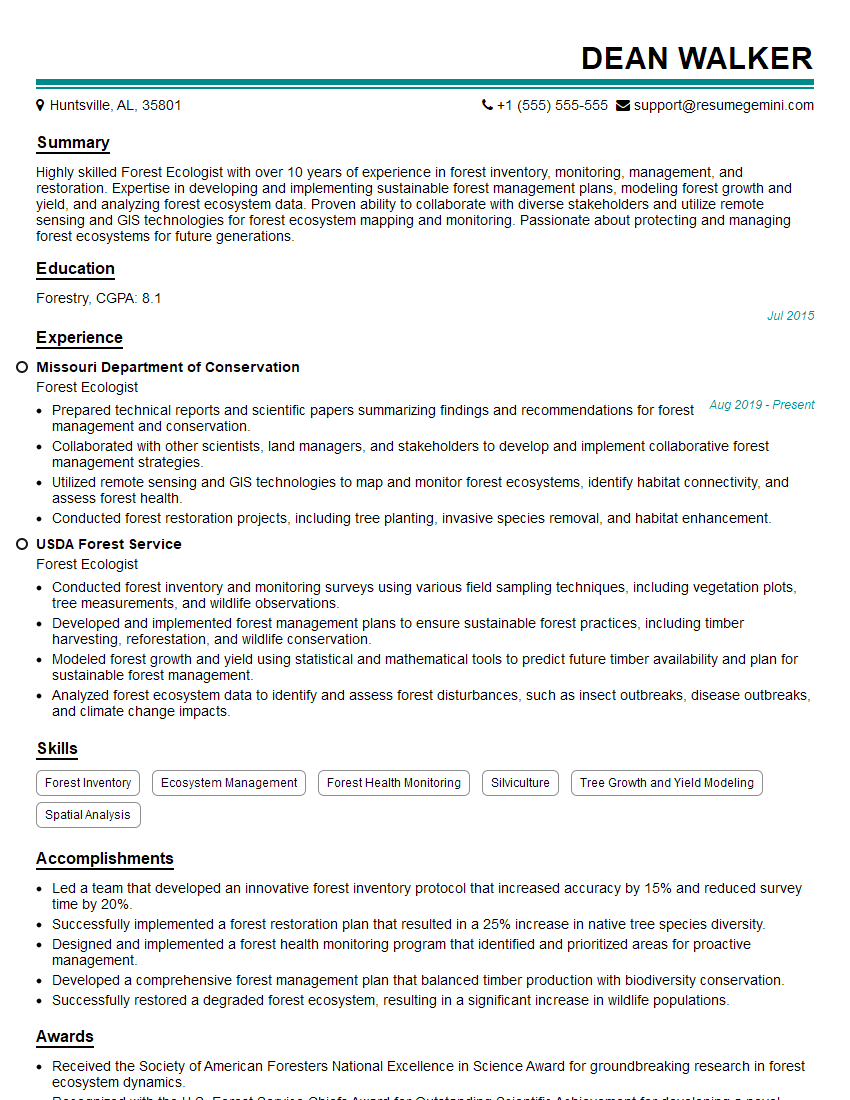
Mastering Forestry Inventory opens doors to exciting career opportunities in sustainable forestry management, conservation, and research. To significantly boost your job prospects, creating a strong, ATS-friendly resume is crucial. ResumeGemini is a trusted resource to help you build a professional and impactful resume that highlights your skills and experience effectively. Examples of resumes tailored specifically to Forestry Inventory positions are available to help guide you.
Explore more articles
Users Rating of Our Blogs
Share Your Experience
We value your feedback! Please rate our content and share your thoughts (optional).
What Readers Say About Our Blog
Hello,
we currently offer a complimentary backlink and URL indexing test for search engine optimization professionals.
You can get complimentary indexing credits to test how link discovery works in practice.
No credit card is required and there is no recurring fee.
You can find details here:
https://wikipedia-backlinks.com/indexing/
Regards
NICE RESPONSE TO Q & A
hi
The aim of this message is regarding an unclaimed deposit of a deceased nationale that bears the same name as you. You are not relate to him as there are millions of people answering the names across around the world. But i will use my position to influence the release of the deposit to you for our mutual benefit.
Respond for full details and how to claim the deposit. This is 100% risk free. Send hello to my email id: [email protected]
Luka Chachibaialuka
Hey interviewgemini.com, just wanted to follow up on my last email.
We just launched Call the Monster, an parenting app that lets you summon friendly ‘monsters’ kids actually listen to.
We’re also running a giveaway for everyone who downloads the app. Since it’s brand new, there aren’t many users yet, which means you’ve got a much better chance of winning some great prizes.
You can check it out here: https://bit.ly/callamonsterapp
Or follow us on Instagram: https://www.instagram.com/callamonsterapp
Thanks,
Ryan
CEO – Call the Monster App
Hey interviewgemini.com, I saw your website and love your approach.
I just want this to look like spam email, but want to share something important to you. We just launched Call the Monster, a parenting app that lets you summon friendly ‘monsters’ kids actually listen to.
Parents are loving it for calming chaos before bedtime. Thought you might want to try it: https://bit.ly/callamonsterapp or just follow our fun monster lore on Instagram: https://www.instagram.com/callamonsterapp
Thanks,
Ryan
CEO – Call A Monster APP
To the interviewgemini.com Owner.
Dear interviewgemini.com Webmaster!
Hi interviewgemini.com Webmaster!
Dear interviewgemini.com Webmaster!
excellent
Hello,
We found issues with your domain’s email setup that may be sending your messages to spam or blocking them completely. InboxShield Mini shows you how to fix it in minutes — no tech skills required.
Scan your domain now for details: https://inboxshield-mini.com/
— Adam @ InboxShield Mini
Reply STOP to unsubscribe
Hi, are you owner of interviewgemini.com? What if I told you I could help you find extra time in your schedule, reconnect with leads you didn’t even realize you missed, and bring in more “I want to work with you” conversations, without increasing your ad spend or hiring a full-time employee?
All with a flexible, budget-friendly service that could easily pay for itself. Sounds good?
Would it be nice to jump on a quick 10-minute call so I can show you exactly how we make this work?
Best,
Hapei
Marketing Director
Hey, I know you’re the owner of interviewgemini.com. I’ll be quick.
Fundraising for your business is tough and time-consuming. We make it easier by guaranteeing two private investor meetings each month, for six months. No demos, no pitch events – just direct introductions to active investors matched to your startup.
If youR17;re raising, this could help you build real momentum. Want me to send more info?
Hi, I represent an SEO company that specialises in getting you AI citations and higher rankings on Google. I’d like to offer you a 100% free SEO audit for your website. Would you be interested?
Hi, I represent an SEO company that specialises in getting you AI citations and higher rankings on Google. I’d like to offer you a 100% free SEO audit for your website. Would you be interested?
good