Interviews are opportunities to demonstrate your expertise, and this guide is here to help you shine. Explore the essential Game Design and Development interview questions that employers frequently ask, paired with strategies for crafting responses that set you apart from the competition.
Questions Asked in Game Design and Development Interview
Q 1. Explain your game design philosophy.
My game design philosophy centers around creating engaging and memorable experiences that prioritize player agency and meaningful choices. I believe a successful game should be more than just a collection of mechanics; it should tell a compelling story or present a captivating challenge that resonates with the player on an emotional level. This means carefully considering the player’s journey, ensuring a smooth learning curve, and providing ample opportunities for discovery and reward. I strive to build games that are both fun and thought-provoking, leaving players with a lasting impression long after they’ve finished playing.
For example, in designing a puzzle game, I wouldn’t just focus on creating difficult puzzles; I’d also consider the visual style, the narrative context surrounding the puzzles, and the overall feeling of accomplishment the player gets from solving them. This holistic approach ensures that the gameplay feels intuitive and rewarding, strengthening the player’s connection to the game.
Q 2. Describe your experience with game engines (Unity, Unreal Engine, etc.).
I have extensive experience with both Unity and Unreal Engine, having used them for various projects ranging from small indie games to larger-scale collaborative endeavors. Unity’s ease of use and extensive asset store make it ideal for rapid prototyping and smaller-scale projects. I’ve utilized its C# scripting capabilities to create complex game mechanics and integrate various assets. Conversely, Unreal Engine’s power and capabilities, particularly its rendering engine and Blueprint visual scripting, are perfect for creating high-fidelity visuals and complex simulations. I’ve used Unreal Engine’s Blueprint system to quickly prototype gameplay features and then transitioned to C++ for performance optimization in larger projects. My proficiency extends to asset creation, animation integration, and performance optimization within both engines.
For instance, in one project, I used Unity to develop a 2D platformer due to its ease of use for 2D development, while in another, I leveraged Unreal Engine’s capabilities to create a visually stunning, realistic first-person shooter with physically based rendering and advanced lighting.
Q 3. How do you balance gameplay mechanics with narrative?
Balancing gameplay mechanics and narrative is crucial for creating a cohesive and engaging gaming experience. The narrative shouldn’t feel tacked on; it should organically emerge from and enhance the gameplay. I achieve this through iterative design. I start by defining core gameplay loops and then build the narrative around these loops, using them to drive the story forward or to reveal narrative details. Mechanics can act as tools to tell the story, and story elements can create meaningful challenges and rewards within the mechanics.
For example, in a narrative-driven RPG, the choice of weapons could impact not only gameplay (damage, range, etc.) but also the narrative, reflecting the player character’s personality and approach to conflict. A character who favors stealth might have a different storyline than one who prefers brute force.
Q 4. What are your preferred game development methodologies (Agile, Waterfall, etc.)?
My preferred game development methodology is a hybrid approach combining elements of Agile and Waterfall. While I value the iterative nature of Agile, particularly its flexibility and ability to respond to changing requirements, I also recognize the benefits of a more structured approach, especially for tasks requiring detailed planning and upfront design, like asset creation. So, I utilize a modified Agile approach, incorporating Waterfall elements where appropriate. We break down development into sprints, focusing on specific features or milestones. However, critical path tasks, such as level design or core engine features, might follow a more structured Waterfall approach to ensure efficient resource allocation and timeline adherence.
This hybrid method allows for both flexibility and structure, crucial for managing the unpredictable nature of game development while maintaining a clear roadmap towards the final product.
Q 5. Describe your process for designing levels or game worlds.
My level design process begins with defining the core gameplay loop and desired player experience. I then create a rough layout, often using simple sketches or diagrams, focusing on pacing, flow, and the overall emotional impact. This initial layout determines the overall structure and progression. I then iterate on this design, adding details, environmental storytelling elements, and carefully placed challenges and rewards to guide players through the world.
For example, when designing a stealth level, I would consider line-of-sight, cover placement, and the placement of enemies to create a challenging but fair experience. I utilize tools like level editors and specialized software to implement the design, consistently testing and refining the level based on playtesting feedback. This iterative process ensures that the level effectively supports the gameplay mechanics and contributes to the overall game experience.
Q 6. How do you handle feedback during the game development process?
Feedback is integral to the game development process. I incorporate feedback from various sources throughout the development lifecycle. This includes playtesting sessions with internal and external testers, gathering data through analytics, and actively monitoring player forums and social media. I use a structured approach to collect and analyze feedback, focusing on identifying trends and patterns rather than individual opinions. This allows us to prioritize fixes and improvements based on their potential impact on the overall gameplay experience. We use tools like Jira to track bug reports and feedback, categorizing and prioritizing them based on severity and impact.
For example, if consistent negative feedback points to a particular level being too difficult, we might adjust enemy placement, provide more clues, or even redesign the level entirely. This data-driven approach helps us make informed decisions, ensuring the final product is engaging and enjoyable for the target audience.
Q 7. Explain your understanding of game balance and its importance.
Game balance is the delicate art of ensuring a fair and engaging experience for all players. It involves carefully adjusting the difficulty, power levels, rewards, and other gameplay elements to create a challenging yet rewarding experience. An unbalanced game can be frustrating and lead to player churn. Achieving balance requires a deep understanding of gameplay mechanics, player psychology, and data analysis. I utilize A/B testing, iterative tuning, and careful monitoring of player statistics to fine-tune the game’s balance.
Consider a multiplayer game: If one weapon is significantly more powerful than others, it will dominate gameplay, making other weapons feel useless and creating an unfair advantage. Careful balancing ensures that all weapons are viable choices, providing diverse strategic options for players.
Q 8. What are some common challenges in game development, and how have you overcome them?
Game development is notorious for its challenges. One major hurdle is scope creep – the tendency for features to expand beyond initial plans, leading to delays and budget overruns. I’ve overcome this by rigorously employing Agile methodologies, breaking down projects into smaller, manageable sprints. This allows for frequent reassessment and adaptation, ensuring we stay on track.
Another common challenge is balancing gameplay. Finding the sweet spot between difficulty, reward, and fun is a constant iterative process. For example, in a recent project, we initially had an overly punishing difficulty curve. Through playtesting and data analysis (analyzing player progression data and identifying drop-off points), we adjusted enemy health, loot drops, and skill progression to improve player engagement and retention. We observed a significant increase in player satisfaction after these adjustments.
Finally, team management can be tricky. Effective communication and collaboration are paramount. In a previous project, we utilized daily stand-up meetings and a central project management system to ensure everyone was informed and coordinated. This transparency prevented duplicated efforts and facilitated problem-solving.
Q 9. Describe your experience with version control systems (Git, Perforce, etc.).
I have extensive experience with both Git and Perforce, choosing the appropriate system based on project needs. Git’s decentralized nature is great for smaller teams and individual projects, allowing for easy branching and merging. I’ve used Git extensively for personal projects and prototyping, leveraging features like branching for experimenting with different game mechanics without affecting the main codebase. git checkout -b new-feature is a command I use frequently to create a new branch for a feature.
For larger projects with bigger teams, Perforce offers robust features for managing large binary assets, especially important for game development. Its centralized architecture facilitates better control and collaboration when dealing with multiple artists, programmers and designers. My experience with Perforce on a large-scale MMORPG project helped us avoid conflicts and ensure everyone was working on the most up-to-date version of assets. We also used Perforce’s change management features to track progress and easily revert to previous versions when necessary.
Q 10. How do you design engaging user interfaces (UI) for games?
Designing engaging UIs requires a user-centered approach. I begin by carefully considering the game’s genre and target audience. A UI for a fast-paced action game will differ significantly from a turn-based strategy game.
Usability is paramount. The UI should be intuitive and easy to navigate, even under pressure. I use clear visual cues, consistent design patterns and information hierarchy (most important information is most prominent) to make it easy for players to understand and interact with the UI elements. For example, using clear color-coding to indicate player health or resources, or using simple icons instead of lengthy text descriptions.
I also believe in iterative design. I conduct playtests early and often to identify areas for improvement. Feedback from playtesters provides invaluable insights into what works and what doesn’t, allowing me to refine the UI until it’s both effective and visually appealing.
Q 11. Explain your approach to player progression and reward systems.
Player progression and reward systems are crucial for player engagement and retention. My approach centers on providing a clear path for players to advance, while constantly offering rewarding experiences. I employ a variety of techniques to ensure a positive loop.
Meaningful Progression: Players should feel a tangible sense of accomplishment as they progress. This can be achieved through unlocking new skills, acquiring better equipment, or gaining access to new areas. For instance, in a role-playing game, a level-up system with visible stat improvements is a fundamental element of progression.
Reward Variety: Offering different types of rewards keeps players motivated. These rewards might include cosmetic items, powerful weapons, story reveals, achievements and in-game currency. A well-designed system will cater to different player preferences.
Feedback Loop: Players need to understand their progress and the impact of their actions. Clear visual indicators, such as experience bars and progress trackers, are important for maintaining engagement. Providing immediate feedback also keeps players motivated by letting them know their actions are having an effect.
Q 12. How do you incorporate accessibility features into game design?
Incorporating accessibility features is essential to ensure a wider audience can enjoy the game. It’s not just about compliance, but about inclusivity. My approach starts from the initial design phase, considering accessibility needs throughout the entire development process.
Visual Accessibility: This includes features like adjustable font sizes, colorblind modes, and high-contrast options. I also ensure sufficient visual separation between UI elements to prevent clutter.
Auditory Accessibility: Clear and descriptive audio cues are essential for players with visual impairments. Subtitles and closed captions are also crucial, and in addition, providing adjustable sound effects and music volume settings allows for better customization.
Motor Accessibility: For players with motor impairments, I include customizable control schemes, allowing them to map buttons to different inputs. Implementing alternative input methods such as voice control can further enhance accessibility.
Cognitive Accessibility: Clear and concise tutorials, optional difficulty levels, and intuitive UI designs are important for players with cognitive differences.
Q 13. Describe your experience with AI programming in games.
My experience with AI programming in games spans various approaches, from simple finite state machines (FSMs) to more complex behavior trees and neural networks. The choice of method depends on the complexity of the AI behavior required.
Finite State Machines (FSMs): These are suitable for relatively simple AI, such as enemy patrol patterns or basic combat actions. I’ve used FSMs to control non-player characters (NPCs) in various games. A simple example is an enemy guard that transitions between states like ‘idle’, ‘patrolling’, and ‘attacking’, based on certain triggers like player proximity.
Behavior Trees: For more complex behaviors, behavior trees offer a hierarchical and flexible structure. I used behavior trees in a strategy game to control AI units, allowing for more sophisticated decision-making based on factors such as unit type, terrain, and enemy presence. They offer greater flexibility and easier modification compared to FSMs.
Neural Networks: While more computationally expensive, neural networks are useful for creating more realistic and adaptive AI behaviors, especially in areas like procedural generation or opponent AI in games like chess or Go. My exploration of neural networks focuses on their use in enhancing the learning aspect of game AI, creating opponents that adapt to player strategies over time.
Q 14. How do you optimize game performance for different platforms?
Optimizing game performance for different platforms is a critical aspect of game development. It requires a multifaceted approach focusing on code optimization, asset management, and platform-specific considerations.
Code Optimization: This involves profiling the code to identify performance bottlenecks. Techniques like reducing draw calls, minimizing memory allocation, and utilizing efficient algorithms are crucial. For example, using object pooling to reuse game objects instead of constantly creating and destroying them greatly improves performance.
Asset Optimization: This includes reducing the size and complexity of game assets such as textures, models, and sounds without significantly impacting visual fidelity. Tools like texture compression and model optimization are frequently used. Techniques like level-of-detail (LOD) rendering, where simpler models are used at greater distances, helps improve performance.
Platform-Specific Optimization: Different platforms have different hardware capabilities and limitations. Optimizing for mobile platforms requires a different approach compared to optimizing for high-end PCs or consoles. This often involves taking advantage of platform-specific APIs and utilizing specialized hardware features.
Q 15. What are your strengths and weaknesses as a game developer?
My greatest strength as a game developer lies in my ability to blend creative vision with technical proficiency. I excel at designing engaging gameplay mechanics and translating those concepts into functional code. I’m proficient in multiple game engines, including Unity and Unreal Engine, and possess a strong understanding of programming principles. I also thrive in collaborative environments, effectively communicating with artists, designers, and programmers to achieve a shared vision. However, my weakness is sometimes getting lost in the details. I can get so focused on perfecting a small element that I lose sight of the bigger picture. I’m actively working on improving my time management and prioritization skills to mitigate this.
For example, on a recent project, I spent several days optimizing a single particle effect. While the result was visually stunning, it ultimately had minimal impact on the overall player experience. This experience taught me the importance of balanced attention to detail and strategic prioritization.
Career Expert Tips:
- Ace those interviews! Prepare effectively by reviewing the Top 50 Most Common Interview Questions on ResumeGemini.
- Navigate your job search with confidence! Explore a wide range of Career Tips on ResumeGemini. Learn about common challenges and recommendations to overcome them.
- Craft the perfect resume! Master the Art of Resume Writing with ResumeGemini’s guide. Showcase your unique qualifications and achievements effectively.
- Don’t miss out on holiday savings! Build your dream resume with ResumeGemini’s ATS optimized templates.
Q 16. Describe your experience with debugging and troubleshooting.
Debugging and troubleshooting are integral parts of my development process. My approach is systematic and iterative. I start by replicating the bug consistently, carefully documenting the steps to reproduce it. Then, I utilize debugging tools within the game engine and IDE to step through the code, inspecting variable values and identifying the source of the error. I often employ print statements or logging functions to track the flow of execution and pinpoint problem areas. If the issue is complex, I break it down into smaller, more manageable parts. I also leverage online resources and communities, searching for solutions or asking for help when necessary. I believe in a collaborative approach; bouncing ideas off colleagues and seeking diverse perspectives often speeds up the troubleshooting process.
For instance, in one project, a seemingly random crash occurred. Using a combination of logging and memory analysis tools, I discovered a memory leak within a specific game object. By carefully tracking the object’s lifecycle and implementing proper resource management, I successfully resolved the issue.
Q 17. How do you stay up-to-date with the latest trends in game development?
Staying current in the rapidly evolving world of game development requires a multifaceted approach. I actively follow industry news through dedicated websites, publications, and podcasts such as Gamasutra, Game Developer, and various YouTube channels covering game development. Attending industry conferences and workshops, both in-person and online, provides invaluable insights into the latest technologies and trends. I also engage with online communities, participating in forums and discussions to learn from others’ experiences and challenges. Finally, I consistently experiment with new tools and techniques, dedicating time to personal projects that allow me to explore cutting-edge technologies and experiment with innovative approaches.
For example, I recently participated in a GDC online session covering the latest advancements in real-time ray tracing. This allowed me to incorporate this technology into a personal project, enhancing the visual fidelity and realism of my game.
Q 18. Explain your understanding of game monetization strategies.
Game monetization strategies are crucial for ensuring the sustainability of game development. My understanding encompasses several models, including free-to-play (F2P) with in-app purchases (IAPs), premium models, subscription services, and advertising. Each model has its strengths and weaknesses and should be carefully considered based on the target audience and game genre. F2P with IAPs requires a well-balanced game economy, ensuring that players feel rewarded for their spending without resorting to predatory practices. Premium models are best suited for games offering high-quality, complete experiences upfront. Subscription models, like those in MMOs, provide continuous revenue streams but necessitate ongoing content updates and community engagement. Advertising should be incorporated tastefully, avoiding interruptions to gameplay.
For example, a F2P mobile game might use a gacha system for monetization, offering players randomized chances to obtain desirable in-game items. This requires careful balancing to ensure fairness and avoid a pay-to-win scenario.
Q 19. How do you create compelling and believable game characters?
Creating compelling and believable game characters involves a multifaceted approach focusing on both narrative and mechanical design. I start by developing a strong backstory for each character, including motivations, flaws, relationships, and personal arcs. This informs their dialogue, actions, and overall personality. Their visual design, including appearance and animation, should reinforce their character traits. Furthermore, the character’s gameplay mechanics, such as their abilities and skills, should align with their personality and backstory. I emphasize creating characters with depth and nuance, avoiding stereotypical representations and exploring the complexities of human behavior.
For instance, a villain might not be simply evil but driven by understandable, albeit misguided, motivations. This makes the character relatable and creates a more engaging narrative.
Q 20. What is your experience with different game genres?
My experience spans various game genres, including action-adventure, strategy, puzzle, and simulation games. I have worked on both small indie projects and larger AAA titles, which exposed me to different development processes and challenges. In action-adventure, I focused on creating dynamic combat systems and immersive narratives, while in strategy games, I concentrated on developing balanced mechanics and AI. Puzzle game development emphasized innovative gameplay and satisfying problem-solving, and my simulation experience involved creating realistic systems and engaging simulations. This diversity has provided me with a broad skillset and understanding of different design principles and player expectations.
For example, I contributed to the design of a real-time strategy game where I developed a robust AI system capable of adapting to different player strategies and challenging even experienced players.
Q 21. How do you use data analysis to improve game design?
Data analysis is crucial for iterative game design and improvement. I use analytics to track player behavior, identify areas for enhancement, and measure the success of implemented changes. Key metrics I analyze include player retention, session length, conversion rates, and in-game events. Tools like Google Analytics, specialized game analytics platforms, and internal logging systems are invaluable in gathering and interpreting this data. I then use this information to adjust gameplay mechanics, balance game economy, improve user interface, and refine the overall player experience. A/B testing allows for controlled experiments to assess the impact of specific design changes.
For example, if player retention is low after a certain level, the data might indicate a difficulty spike or a lack of engaging content. This informs adjustments to the game’s progression or the introduction of new features to address these issues.
Q 22. Explain your experience with collaborative tools for game development.
Throughout my career, I’ve extensively utilized various collaborative tools crucial for efficient game development. My experience spans from traditional methods to cutting-edge software. I’m proficient with version control systems like Git, using platforms such as GitHub and GitLab for seamless code management and collaborative branching. This allows multiple developers to work simultaneously on different aspects of the game without overwriting each other’s work. We use branching strategies like Gitflow to manage features, hotfixes, and releases effectively.
Beyond code, I’m adept at using project management tools such as Jira and Trello to track tasks, deadlines, and progress. These tools facilitate clear communication and task assignment within the team. For visual collaboration, we frequently utilize online whiteboards like Miro or Figma for brainstorming, designing levels, and prototyping UI/UX. Finally, regular communication is key, and we utilize platforms like Slack or Microsoft Teams for instant messaging, file sharing, and quick updates.
For example, in my previous role, we used a combination of Git, Jira, and Slack to develop a mobile RPG. Jira helped us break down the project into manageable tasks, assigning them to specific team members. Git ensured code integrity and allowed for parallel development, while Slack provided a platform for quick questions and immediate feedback, dramatically improving our workflow and communication.
Q 23. Describe your approach to testing and quality assurance (QA).
My approach to testing and QA is multifaceted and emphasizes a proactive strategy beginning in the early stages of development. It’s not simply an end-of-development process, but an integral part of each iteration. I believe in employing a combination of automated and manual testing methods. Automated tests are crucial for regression testing, ensuring that new code doesn’t break existing functionalities. We use frameworks like Unity’s built-in testing tools or third-party solutions like TestRail to automate repetitive tests and improve efficiency.
Manual testing, however, remains essential. This includes playtesting sessions with both internal team members and external testers representing our target audience. This helps uncover usability issues, balance problems, and bugs that automated tests might miss. We prioritize different types of testing, including unit testing (individual components), integration testing (interactions between components), system testing (the entire game), and user acceptance testing (feedback from real players). Gathering feedback is crucial, and we use tools like survey platforms to collect quantitative and qualitative data from testers.
For instance, in one project, we discovered a critical performance issue during manual playtesting that automated tests hadn’t caught. This highlighted the importance of combining both approaches for comprehensive quality assurance.
Q 24. How do you handle conflicting priorities during development?
Conflicting priorities are an inevitable part of game development. My approach to handling them involves a combination of prioritization frameworks, clear communication, and proactive problem-solving. We often use a weighted scoring system to rank competing features or bug fixes based on factors like impact on gameplay, player experience, and development effort. This provides an objective basis for decision-making.
Transparent communication is key. We hold regular team meetings where we openly discuss conflicting priorities, presenting the rationale behind each item’s weight in the prioritization system. This fosters a shared understanding and buy-in from the team. If compromises are needed, we involve all stakeholders to find creative solutions that minimize the impact on the overall project goals. Sometimes, features might be postponed to a later update or iteration to ensure the project stays on schedule and meets its primary objectives.
Think of it like resource allocation. You have a limited budget (time and resources), and you must spend it wisely. Prioritization frameworks help you make informed decisions on where to allocate those resources to maximize the overall value of the final product.
Q 25. How familiar are you with different game development pipelines?
I’m familiar with various game development pipelines, from agile methodologies to more traditional waterfall approaches. My experience encompasses both linear pipelines, where development progresses sequentially through stages (design, production, testing), and iterative pipelines, where development happens in short cycles with frequent feedback and adjustments. I understand the advantages and disadvantages of each approach. Waterfall is suitable for projects with well-defined requirements and less scope for change, while agile methods are better suited for projects with evolving requirements and a need for adaptability.
I’m proficient in using different software and tools associated with these pipelines. This includes using game engines like Unity and Unreal Engine, along with associated tools for level design, animation, scripting, and sound design. I also have experience integrating middleware solutions, such as physics engines or networking libraries, and optimizing the pipeline for different platforms (PC, consoles, mobile).
For example, I’ve worked on projects using Scrum, an agile methodology, where we had sprint cycles of two weeks, regularly assessing our progress and adapting our plans based on feedback. In other projects, a more linear approach was more appropriate due to the fixed scope and contractual obligations.
Q 26. Describe a time you had to overcome a technical challenge in game development.
In a previous project, we encountered a significant performance bottleneck during the final stages of development. Our game, a large-scale open-world RPG, experienced severe frame rate drops in densely populated areas. Initially, we tried optimizing individual assets and code sections, but the problem persisted. After profiling the game extensively, using tools provided by the engine and external profiling software, we identified the culprit: inefficient memory management of dynamic objects within the game world.
To solve this, we implemented a more sophisticated object pooling system. Instead of constantly creating and destroying game objects, we reused pre-allocated objects from a pool. This significantly reduced the load on the garbage collector, leading to a dramatic improvement in frame rate. We also implemented level-of-detail techniques, which reduced the polygon count of distant objects, further enhancing performance. This involved careful coordination between the programmers, artists, and level designers to balance visual fidelity and performance.
This experience underscored the importance of proactive performance profiling and optimization throughout the development cycle, not just as a last-minute fix. It also highlighted the value of collaborative problem-solving and utilizing appropriate tools for efficient debugging.
Q 27. How do you ensure your game design is inclusive and caters to a diverse audience?
Creating inclusive game design is paramount. It’s not just about adding diverse characters; it’s about designing systems and mechanics that are accessible and enjoyable for everyone, regardless of their background, abilities, or preferences. My approach involves multiple steps starting with diverse representation in character design and narratives, avoiding stereotypes and promoting positive representation of diverse groups.
Beyond representation, accessibility is key. This includes ensuring the game is playable by individuals with disabilities. We consider features such as customizable controls, adjustable difficulty levels, colorblind modes, and text-to-speech options. Playtesting with a diverse group, including people with disabilities, provides invaluable insights and helps us identify potential accessibility barriers. We use feedback loops to improve and refine accessibility features continuously.
Furthermore, we strive to create gameplay that is universally engaging. This means avoiding design choices that could alienate certain players, such as overly complex mechanics or culturally insensitive content. We ensure our game’s tone and themes are respectful and inclusive, promoting a positive and welcoming experience for all.
Q 28. What are your salary expectations?
My salary expectations are commensurate with my experience and skills in game development, and the specific requirements of the role. I’m open to discussing a competitive salary range based on the specifics of the position and the company’s compensation structure. I’m more interested in a challenging and rewarding role that allows me to utilize my skills and contribute to the creation of high-quality games than focusing solely on a specific numerical figure.
Key Topics to Learn for Game Design and Development Interview
- Game Design Fundamentals: Understanding core game mechanics, player experience design (UX/UI), level design principles, narrative design, and game balancing. Consider analyzing successful games to understand these elements in practice.
- Game Development Processes: Familiarize yourself with agile development methodologies, iterative design, version control (like Git), and the importance of collaboration within a development team. Practice explaining your approach to problem-solving within a team environment.
- Programming & Scripting: Demonstrate proficiency in at least one relevant programming language (C++, C#, Java, Python, etc.) and its application to game development. Be prepared to discuss data structures, algorithms, and object-oriented programming concepts.
- Game Engines: Gain practical experience with popular game engines like Unity or Unreal Engine. Be ready to discuss your projects and the challenges you overcame using these tools.
- Art & Assets: While not always a requirement, understanding the pipeline of creating and integrating game assets (models, textures, animations) is beneficial. Being able to discuss collaboration with artists is valuable.
- Technical Design & Problem Solving: Prepare to discuss how you approach technical challenges in game development. This includes debugging, performance optimization, and finding creative solutions to complex problems. Consider examples from your own projects.
- Portfolio & Project Showcase: Be ready to discuss your portfolio, highlighting your contributions and the technologies you used. Focus on the challenges you faced and how you overcame them. Emphasize your role and responsibilities.
Next Steps
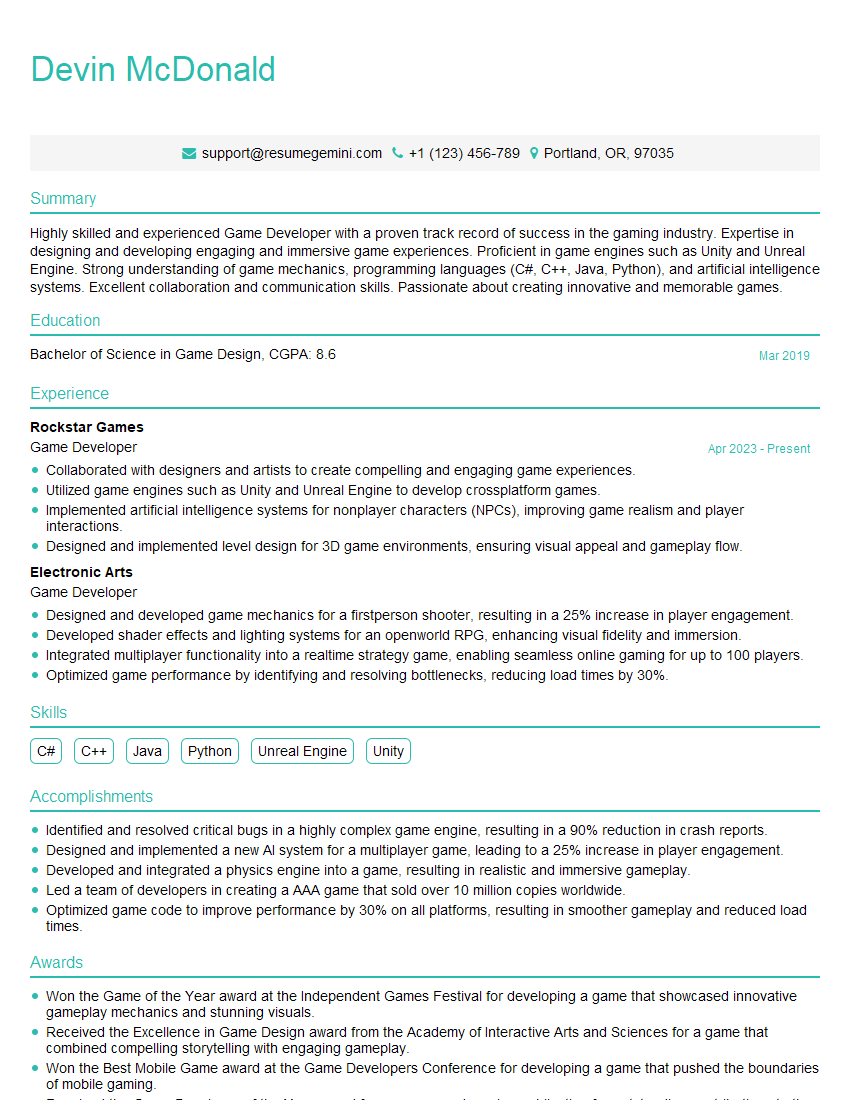
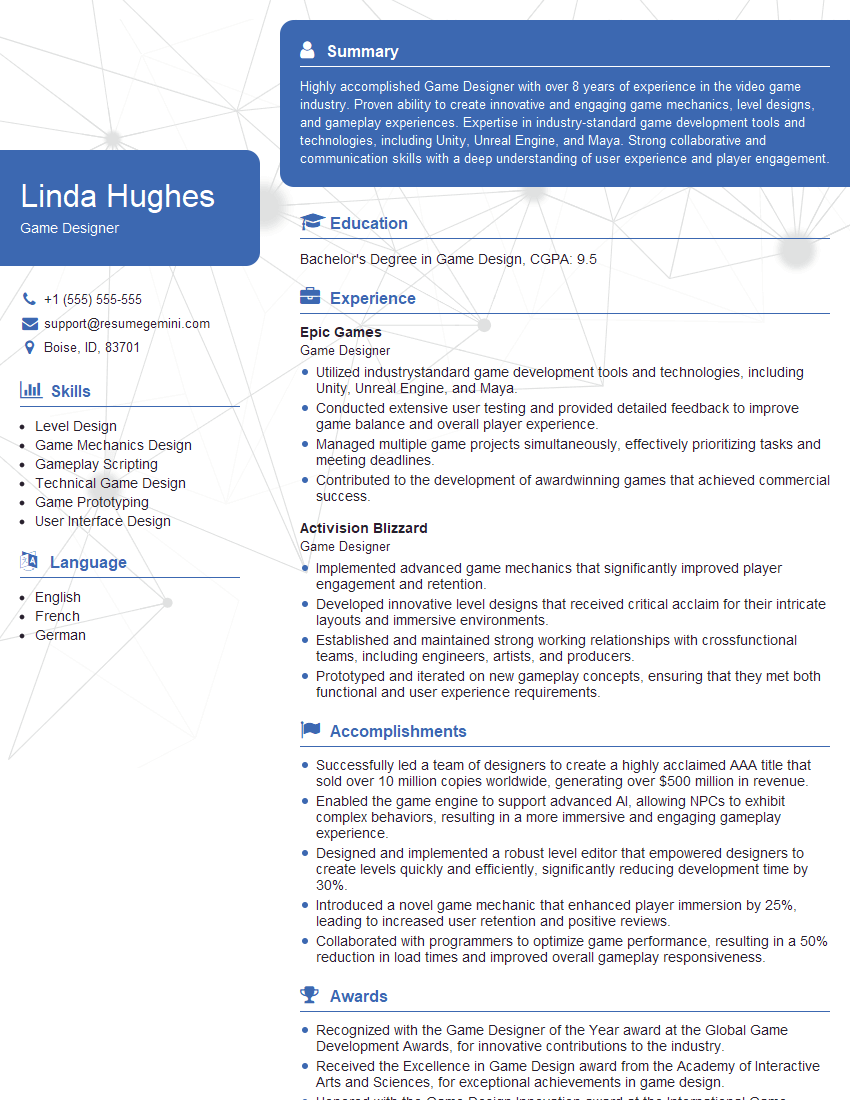
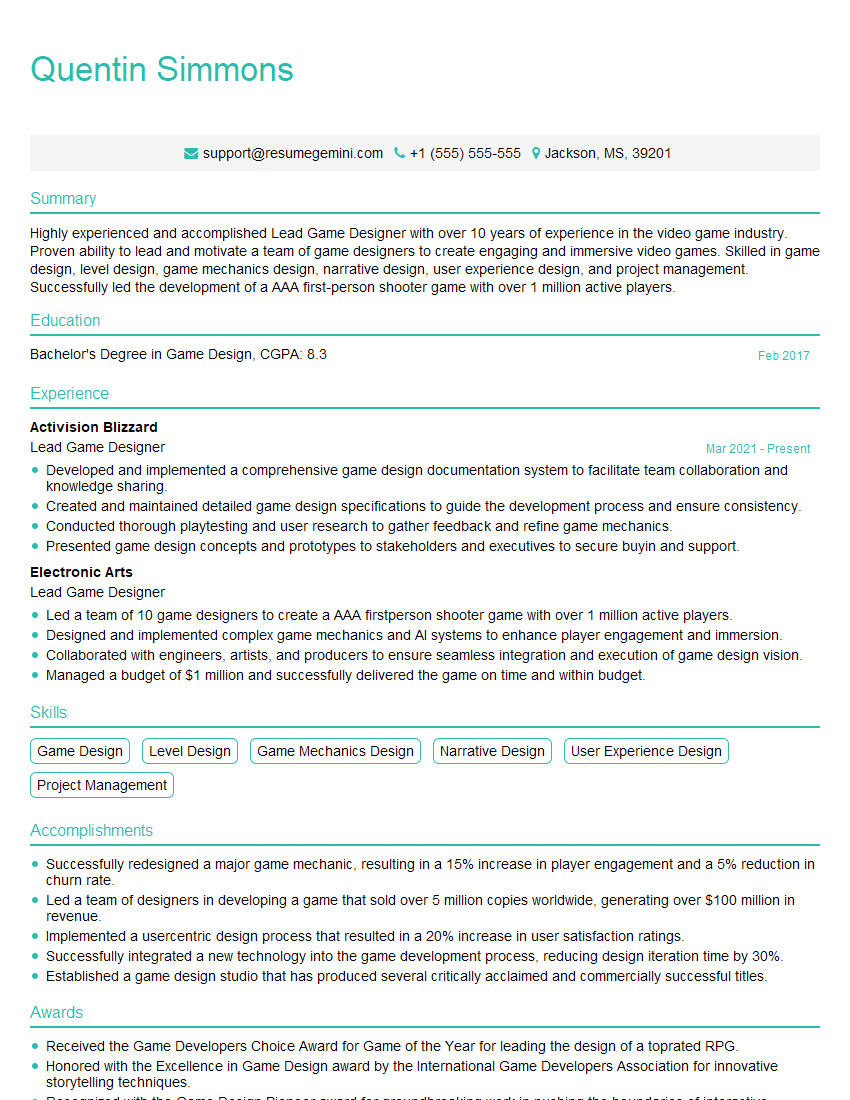
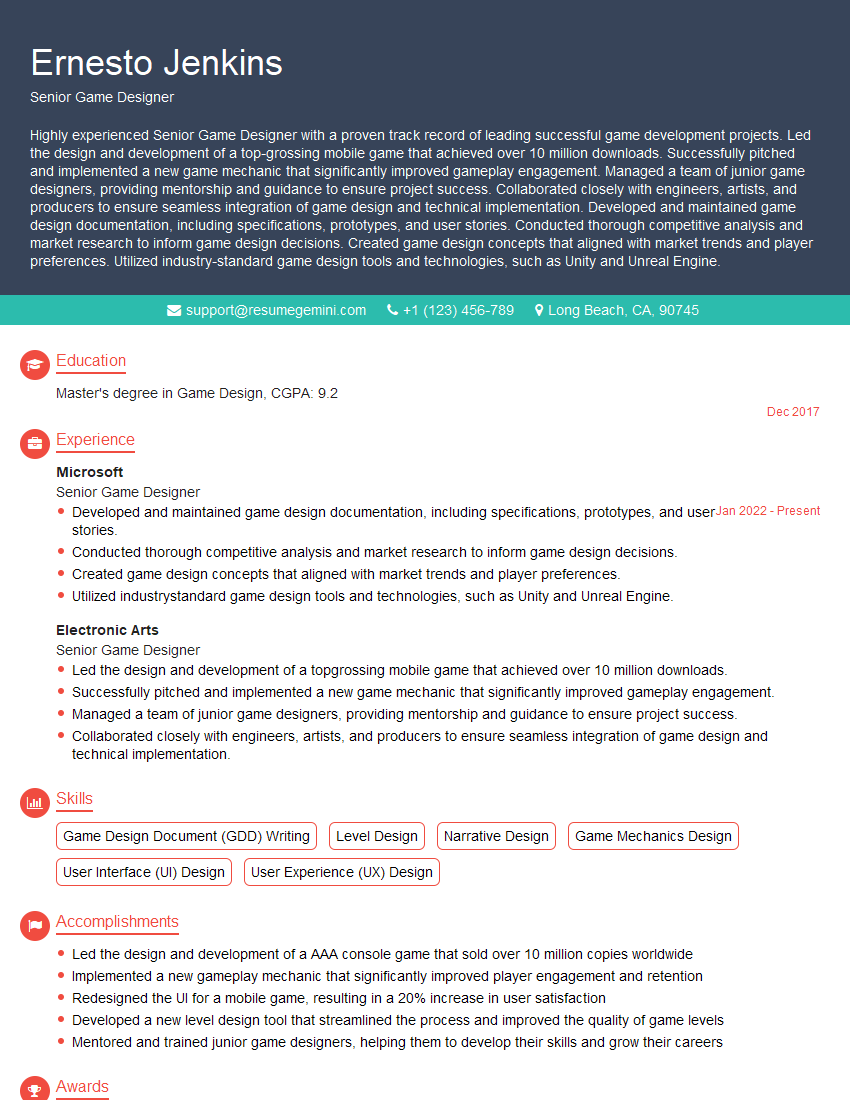
Mastering Game Design and Development opens doors to a dynamic and creative career path, offering exciting opportunities for growth and innovation. A strong resume is crucial to landing your dream role. Creating an ATS-friendly resume significantly improves your chances of getting noticed by recruiters and hiring managers. To build a compelling and effective resume, we strongly recommend using ResumeGemini, a trusted resource designed to help you craft a professional document that highlights your skills and experience. ResumeGemini provides examples of resumes tailored specifically to Game Design and Development, offering invaluable guidance and templates to help you present your qualifications effectively.
Explore more articles
Users Rating of Our Blogs
Share Your Experience
We value your feedback! Please rate our content and share your thoughts (optional).
What Readers Say About Our Blog
Hello,
we currently offer a complimentary backlink and URL indexing test for search engine optimization professionals.
You can get complimentary indexing credits to test how link discovery works in practice.
No credit card is required and there is no recurring fee.
You can find details here:
https://wikipedia-backlinks.com/indexing/
Regards
NICE RESPONSE TO Q & A
hi
The aim of this message is regarding an unclaimed deposit of a deceased nationale that bears the same name as you. You are not relate to him as there are millions of people answering the names across around the world. But i will use my position to influence the release of the deposit to you for our mutual benefit.
Respond for full details and how to claim the deposit. This is 100% risk free. Send hello to my email id: [email protected]
Luka Chachibaialuka
Hey interviewgemini.com, just wanted to follow up on my last email.
We just launched Call the Monster, an parenting app that lets you summon friendly ‘monsters’ kids actually listen to.
We’re also running a giveaway for everyone who downloads the app. Since it’s brand new, there aren’t many users yet, which means you’ve got a much better chance of winning some great prizes.
You can check it out here: https://bit.ly/callamonsterapp
Or follow us on Instagram: https://www.instagram.com/callamonsterapp
Thanks,
Ryan
CEO – Call the Monster App
Hey interviewgemini.com, I saw your website and love your approach.
I just want this to look like spam email, but want to share something important to you. We just launched Call the Monster, a parenting app that lets you summon friendly ‘monsters’ kids actually listen to.
Parents are loving it for calming chaos before bedtime. Thought you might want to try it: https://bit.ly/callamonsterapp or just follow our fun monster lore on Instagram: https://www.instagram.com/callamonsterapp
Thanks,
Ryan
CEO – Call A Monster APP
To the interviewgemini.com Owner.
Dear interviewgemini.com Webmaster!
Hi interviewgemini.com Webmaster!
Dear interviewgemini.com Webmaster!
excellent
Hello,
We found issues with your domain’s email setup that may be sending your messages to spam or blocking them completely. InboxShield Mini shows you how to fix it in minutes — no tech skills required.
Scan your domain now for details: https://inboxshield-mini.com/
— Adam @ InboxShield Mini
Reply STOP to unsubscribe
Hi, are you owner of interviewgemini.com? What if I told you I could help you find extra time in your schedule, reconnect with leads you didn’t even realize you missed, and bring in more “I want to work with you” conversations, without increasing your ad spend or hiring a full-time employee?
All with a flexible, budget-friendly service that could easily pay for itself. Sounds good?
Would it be nice to jump on a quick 10-minute call so I can show you exactly how we make this work?
Best,
Hapei
Marketing Director
Hey, I know you’re the owner of interviewgemini.com. I’ll be quick.
Fundraising for your business is tough and time-consuming. We make it easier by guaranteeing two private investor meetings each month, for six months. No demos, no pitch events – just direct introductions to active investors matched to your startup.
If youR17;re raising, this could help you build real momentum. Want me to send more info?
Hi, I represent an SEO company that specialises in getting you AI citations and higher rankings on Google. I’d like to offer you a 100% free SEO audit for your website. Would you be interested?
Hi, I represent an SEO company that specialises in getting you AI citations and higher rankings on Google. I’d like to offer you a 100% free SEO audit for your website. Would you be interested?
good