Every successful interview starts with knowing what to expect. In this blog, we’ll take you through the top Garment Steaming interview questions, breaking them down with expert tips to help you deliver impactful answers. Step into your next interview fully prepared and ready to succeed.
Questions Asked in Garment Steaming Interview
Q 1. What types of fabrics require different steaming techniques?
Different fabrics react differently to steam due to their fiber composition and weave. For instance, delicate fabrics like silk or lace require a gentler approach, using lower heat and maintaining a greater distance from the garment. Heavier fabrics like wool or linen can tolerate more direct steam and higher heat settings. Synthetic fabrics like polyester or nylon might require less steam to avoid damage or unwanted shine.
- Delicate Fabrics (Silk, Lace, Rayon): Low heat, greater distance, quick passes to avoid saturation.
- Medium-weight Fabrics (Cotton, Linen, Wool blends): Moderate heat, controlled steam application, potentially longer exposure time.
- Heavy Fabrics (Wool, Linen): Higher heat setting (if your steamer allows), shorter, more direct bursts of steam.
- Synthetic Fabrics (Polyester, Nylon): Low heat setting, cautious steam application, to avoid melting or creating shine.
It’s crucial to always test a small, inconspicuous area of the garment first to check for any adverse reactions to the steam before treating the entire piece.
Q 2. How do you identify and address wrinkles on delicate fabrics?
Handling wrinkles on delicate fabrics requires a gentle touch and the right tools. I always start by carefully inspecting the fabric for any weak points or embellishments. For example, beads or sequins can be easily damaged by heat. The key is to use low heat and to hold the steamer further from the fabric than you would with sturdier materials. Consider using a pressing cloth or thin towel between the steamer and the garment to add an extra layer of protection.
For very delicate fabrics, I often prefer to use a handheld steamer with a lower setting and gently ‘hover’ the steam over the wrinkles. Rapid, direct blasts of steam can damage delicate fibers. Think of it like carefully coaxing the wrinkles out rather than forcefully attacking them.
If the wrinkles persist, I might use a combination of steaming and careful hand-pressing using my fingers, always working from the inside of the garment to avoid causing stress to the outside surface.
Q 3. Explain the process of steaming different garment types (e.g., shirts, dresses, pants).
Steaming different garment types requires adapting techniques based on their shape and fabric.
- Shirts: I typically start with the back, then the sleeves, working my way to the front. Keeping the shirt taut and smooth helps prevent new wrinkles from forming. I pay extra attention to collars and cuffs, using the pointed nozzle of the steamer to get into those areas. For dress shirts, I might use a low-heat setting on a professional steamer to ensure a crisp, wrinkle-free finish.
- Dresses: The approach depends on the dress’s style and fabric. A simple A-line dress can be steamed fairly easily by hanging it and working from top to bottom. More intricate dresses or those with delicate embellishments might require more care and section-by-section steaming. I always check labels for cleaning instructions.
- Pants: Steaming pants typically involves working from the waist down, smoothing the fabric as I go. I use the steamer’s nozzle to carefully target wrinkles around the seams and pockets. For creases in trousers, I’ll often use the steamer to ‘set’ the existing crease, enhancing its sharpness.
Regardless of the garment type, I always ensure it’s clean, properly hung, and that the steamer’s water reservoir is filled with distilled water to prevent mineral buildup.
Q 4. Describe your experience with various types of garment steamers (handheld, professional).
My experience spans both handheld and professional garment steamers. Handheld steamers are great for quick touch-ups and travel, offering portability and ease of use. Their smaller size and lower power output make them ideal for delicate fabrics. However, they might require multiple passes for stubborn wrinkles and are generally less powerful. I often use these for my personal clothing and for small steaming jobs on location.
Professional-grade steamers, on the other hand, are more powerful and efficient, handling larger items quickly. Their larger water tanks and higher steam output allow for quicker wrinkle removal, even on heavy or stubborn fabrics. They’re also often equipped with features like adjustable steam settings and attachments to optimize steaming for different garment types. In a professional setting, this is my go-to. The increased power means I can steam more garments quickly and efficiently, streamlining my workflow. The ability to adjust the steam is particularly important, as it allows me to cater my steaming techniques to different fabrics.
Q 5. How do you maintain and clean a garment steamer?
Maintaining a garment steamer is crucial for its longevity and effectiveness. After each use, I empty the water reservoir and run it empty for a minute or two to ensure any remaining water evaporates. Regular cleaning prevents mineral buildup, which can clog the steam vents and reduce efficiency. For this, I use a solution of distilled water and white vinegar. I let the steamer cool completely before cleaning to avoid burns. I’ll also regularly check the steam vents to ensure they’re clear. The frequency of this cleaning depends on the hardness of your local water and your steaming frequency.
For professional steamers, maintenance might involve periodic descaling or professional service depending on the model. Always consult the manufacturer’s instructions for specific maintenance guidelines.
Q 6. What safety precautions do you take when using a garment steamer?
Safety is paramount when using a garment steamer. I always ensure the steamer is on a stable surface, away from flammable materials. I never leave the steamer unattended while it’s operating. I make sure to use distilled water to avoid mineral buildup and potential damage. I allow the steamer to cool down completely before handling or storing it, and I warn anyone nearby about the hot steam. I keep the cord away from water to prevent electric shocks. Finally, I am mindful of the hot steam itself, keeping it away from my face and skin. Always wear appropriate heat-resistant gloves, especially when handling the steamer after use.
Q 7. How do you handle stubborn wrinkles that don’t respond to steaming?
Stubborn wrinkles that resist steaming might require a more comprehensive approach. Sometimes, the fabric itself is the issue. If steaming fails, I try to determine the root cause: is it a crease caused by folding, or a deep wrinkle caused by prolonged pressure? I often employ a combination of techniques:
- Ironing: For stubborn creases, I may resort to using a low-heat iron on top of a pressing cloth. This approach should be used with extreme caution on delicate fabrics.
- Pre-treatment: Lightly dampening the wrinkled area before steaming can sometimes soften the fibers and make them more receptive to steam.
- Professional Cleaning: In severe cases, professional dry cleaning may be necessary to address stubborn creases or wrinkles, particularly on fabrics with complex structures or delicate embellishments.
- Identifying fabric: A proper identification of the fabric is key to effective treatment.
Remember to always test a small, inconspicuous area first before applying any treatment to the entire garment. This helps avoid accidental damage and ensure that your chosen method works effectively on the fabric.
Q 8. What are the common mistakes to avoid during garment steaming?
Avoiding mistakes during garment steaming is crucial for preserving the garment’s quality and appearance. Common pitfalls include holding the steamer too close, which can scorch delicate fabrics; steaming for too long, leading to over-saturation and potential damage; and neglecting to check fabric care labels, which may contain specific steaming instructions.
- Holding the steamer too close: Think of the steamer as a gentle breeze, not a blowtorch. Maintain a consistent distance of about 6-8 inches from the fabric.
- Over-steaming: Like overcooking food, over-steaming can ruin the fabric. Steam until wrinkles are gone; don’t continue steaming unnecessarily.
- Ignoring care labels: Always consult the garment’s care instructions before steaming. Some fabrics might require specific techniques or prohibit steaming altogether.
For example, I once accidentally scorched a silk blouse by holding the steamer too close. The resulting mark was irreversible, highlighting the importance of maintaining proper distance and using a gentle approach.
Q 9. How do you adapt your steaming technique to different fabric weights?
Adapting steaming technique to different fabric weights is essential for achieving optimal results without causing damage. Heavier fabrics like wool or velvet require a more deliberate and thorough steaming process, while lighter fabrics like silk or chiffon need a gentler touch.
- Heavy fabrics: For heavier fabrics, use a lower steam setting and make slow, deliberate passes with the steamer. It might take longer, but it prevents over-saturation and potential damage. You may also need to use a pressing cloth for extra protection.
- Light fabrics: Lighter fabrics often respond well to quick, light passes with the steamer, held at a slightly greater distance. It’s essential to avoid prolonged exposure to steam.
Imagine steaming a heavy wool coat versus a delicate silk scarf. The coat requires a longer, more deliberate approach, while the scarf requires a brief and gentle touch. Knowing the nuances of each fabric type is key.
Q 10. How do you determine the appropriate steam settings for various fabrics?
Determining the appropriate steam settings for various fabrics involves understanding the fabric’s composition and sensitivity to heat and moisture. Generally, delicate fabrics like silk and rayon require lower steam settings and shorter exposure times, while more durable fabrics like cotton and linen can tolerate higher settings and longer steaming.
- Delicate fabrics (silk, rayon, lace): Low steam setting, short bursts of steam, and a greater distance from the fabric.
- Medium-weight fabrics (cotton, linen, wool): Medium steam setting, controlled passes, and potentially a pressing cloth.
- Heavy fabrics (velvet, corduroy): Lower steam setting, slow, deliberate passes, and a pressing cloth.
Always test the steam setting on an inconspicuous area of the garment first to ensure it doesn’t cause damage. For instance, before steaming a whole silk dress, I’d test the setting on an inside seam to prevent any surprises.
Q 11. What is the difference between steaming and ironing?
Steaming and ironing, while both used to remove wrinkles, differ significantly in their approach and results. Ironing uses direct heat to press wrinkles flat, potentially causing damage to delicate fabrics or leaving a sheen on others. Steaming, on the other hand, uses moist heat to relax fibers and release wrinkles, making it a gentler and more versatile method.
- Ironing: Direct heat application; creates a crisp, pressed finish; can damage delicate fabrics; may leave a sheen or scorch marks.
- Steaming: Moist heat application; gentler on fabrics; produces a more natural drape; less likely to cause damage.
Think of it this way: ironing is like aggressively straightening a piece of paper, while steaming is like gently coaxing it into shape using humidity. Steaming is often preferred for delicate fabrics or garments with embellishments.
Q 12. How do you prevent water marks or damage during steaming?
Preventing water marks or damage during steaming is a matter of technique and preparation. Using the correct steam settings, maintaining a safe distance from the fabric, and using a pressing cloth for delicate materials all play crucial roles. Additionally, ensuring your steamer is properly filled with distilled water helps prevent mineral deposits that can leave stains.
- Use distilled water: Tap water contains minerals that can leave residue on fabrics.
- Maintain distance: Hold the steamer at the recommended distance to prevent over-saturation.
- Use a pressing cloth: For delicate fabrics, a pressing cloth acts as a barrier to prevent direct contact with the steam.
- Test on inconspicuous area: Always test your steam settings on a hidden area first.
For instance, I always use a pressing cloth when steaming silk or lace, and I make sure to hold the steamer far enough away so I don’t get the garment soaking wet. This is essential for maintaining the integrity of the material.
Q 13. Describe your experience with steaming garments with embellishments (buttons, beads).
Steaming garments with embellishments requires extra care and attention to prevent damage. The key is to avoid direct steam contact with the embellishments themselves. For delicate beads, sequins, or embroidery, a pressing cloth is essential. For sturdier embellishments, you can gently steam around them, but never directly on top.
- Pressing cloth: Always use a pressing cloth when steaming over embellishments to protect them from direct steam.
- Gentle approach: Use slow, deliberate passes, and avoid lingering over any one area.
- Avoid direct contact: Never point the steamer directly at the embellishments.
I recall steaming a beaded evening gown once. I carefully placed a pressing cloth over the beads before steaming, working around them in slow, gentle passes. The result was a beautifully refreshed garment without any damage to the delicate beads.
Q 14. How do you handle steaming garments with different types of linings?
Steaming garments with different types of linings requires careful consideration of the lining’s material and its reaction to steam. Some linings are more delicate than others, requiring a gentler steaming approach. Often, it’s best to steam the garment from the outside, taking care to avoid over-saturation which could seep through and damage the lining.
- Identify lining material: Knowing the lining’s material is essential to determine the appropriate steaming technique.
- Steam from the outside: Whenever possible, steam from the outer layer of the garment.
- Use a pressing cloth: A pressing cloth is always recommended, especially if the lining is delicate.
- Test in inconspicuous area: Test the steam setting on an inconspicuous area first to check for any adverse reactions.
I once had to steam a coat with a silk lining. To protect the lining, I used a pressing cloth and worked carefully from the outer layer of the coat, making sure not to over saturate the fabric. The careful approach prevented any damage to the silk lining.
Q 15. How do you ensure that steamed garments are ready for display or delivery?
Ensuring garments are ready for display or delivery after steaming involves a multi-step process focused on achieving a perfect, wrinkle-free finish and ensuring the garment’s overall presentation is immaculate.
- Inspection: After steaming, I meticulously inspect each garment for any remaining wrinkles, creases, or imperfections. This often involves checking the garment from multiple angles under good lighting.
- Finishing Touches: Depending on the garment type, this might include lightly pressing certain areas with a hand press or using a specialized tool to sharpen collars or cuffs.
- Hanging and Presentation: Garments are then hung on appropriate hangers to maintain their shape and prevent creasing. For delicate items, I might use padded hangers or garment bags. The presentation is crucial; the garment should hang naturally and gracefully.
- Quality Control Check: A final check is performed before the garment is deemed ready. This confirms that it meets the highest standards of quality and is presentable for the client.
For example, a silk dress requires a gentler approach than a wool suit. The steaming time, distance from the steamer, and the level of pressure applied are all adjusted based on the fabric.
Career Expert Tips:
- Ace those interviews! Prepare effectively by reviewing the Top 50 Most Common Interview Questions on ResumeGemini.
- Navigate your job search with confidence! Explore a wide range of Career Tips on ResumeGemini. Learn about common challenges and recommendations to overcome them.
- Craft the perfect resume! Master the Art of Resume Writing with ResumeGemini’s guide. Showcase your unique qualifications and achievements effectively.
- Don’t miss out on holiday savings! Build your dream resume with ResumeGemini’s ATS optimized templates.
Q 16. How do you handle urgent requests for garment steaming?
Handling urgent requests for garment steaming requires a combination of prioritization, efficiency, and excellent communication. My strategy focuses on:
- Immediate Assessment: I immediately assess the urgency and the number of garments involved.
- Prioritization: Urgent requests are prioritized over others, often interrupting ongoing tasks to meet the deadline.
- Efficient Workflow: I optimize my steaming technique to work quickly without compromising quality. This often involves using multiple steamer heads or strategically organizing my workspace.
- Communication: I communicate regularly with the requester, providing updates on the progress and estimated completion time. Transparency is vital to manage expectations.
I remember one instance where a high-profile client needed a complete outfit steamed within an hour before a major event. By effectively managing my time and streamlining the process, I delivered the garments on time and to the client’s complete satisfaction.
Q 17. Explain your experience with working under pressure or meeting deadlines.
I thrive under pressure and consistently meet deadlines. My experience in high-volume environments, such as [mention a previous role or situation], has honed my ability to work efficiently and effectively under tight constraints.
My approach involves:
- Effective Time Management: Breaking down large tasks into smaller, manageable steps allows for better progress tracking and prevents feeling overwhelmed.
- Prioritization: Focusing on the most critical tasks first ensures timely completion of the most important items.
- Adaptability: Remaining flexible and adaptable allows me to react effectively to unexpected changes or challenges.
- Proactive Problem-Solving: Identifying potential bottlenecks early on enables me to find solutions proactively and avoid delays.
For example, during a fashion show, we had to steam hundreds of garments in a very short time frame. By working collaboratively with my team and efficiently organizing our work, we successfully met the deadline and exceeded expectations.
Q 18. How do you maintain a high level of quality and consistency in your steaming work?
Maintaining consistent high-quality steaming requires a combination of skill, precision, and attention to detail. I achieve this through:
- Consistent Steaming Technique: I follow established best practices consistently, including maintaining a safe distance from the garment, using the appropriate steam setting, and using proper movements to avoid damaging the fabric.
- Regular Equipment Maintenance: Cleanliness and proper maintenance of my steamer are paramount to ensuring the quality and longevity of the equipment and the quality of the steaming process.
- Fabric Knowledge: Understanding various fabrics and their sensitivities helps me tailor my approach, resulting in optimized steaming for each garment.
- Quality Control Checks: Regular checks throughout the process ensure that the quality remains consistent, allowing for early identification of any issue.
Think of it like baking a cake – consistent ingredients and methods lead to a consistently good result. In my work, consistent technique and attention to detail ensures a consistently excellent finish on every garment.
Q 19. How do you troubleshoot common garment steamer malfunctions?
Troubleshooting garment steamer malfunctions requires a systematic approach. My process involves:
- Safety First: Always disconnect the steamer from the power source before attempting any repairs.
- Identify the Problem: Determine the nature of the malfunction. Is it not heating, producing insufficient steam, leaking, or something else?
- Check the Obvious: Ensure the water tank is filled with the correct type of water and that the steamer is properly plugged in.
- Consult the Manual: Refer to the user manual for troubleshooting steps or suggestions.
- Clean the Steamer: Build-up of mineral deposits can affect performance. Regularly cleaning the steamer head and water reservoir is essential.
- Seek Professional Help: If the problem persists after checking the above points, it’s best to consult a professional technician or contact the manufacturer for repairs.
For example, if the steamer is not producing enough steam, I would first check the water level and then examine the heating element for any obstructions. If the problem persists, cleaning or professional help might be required.
Q 20. What is your preferred steaming technique for removing creases from suits?
My preferred technique for removing creases from suits involves a combination of careful steaming and gentle manipulation. I start by hanging the suit on a properly shaped suit hanger.
- Targeted Steaming: I use a controlled steaming approach, holding the steamer head a few inches away from the fabric, focusing on creased areas like the shoulders, lapels, and trouser creases.
- Gentle Brushing: Using a soft brush, I gently manipulate the fabric while steaming to help the steam penetrate and smooth out the creases.
- Attention to Detail: I pay particular attention to delicate areas, such as the lining and buttonholes, avoiding direct steam exposure to prevent damage.
- Cooling Phase: After steaming, I allow the suit to hang and cool down naturally before handling it again to help maintain the press.
It’s like sculpting with steam – you need a light touch and a good understanding of the material to achieve the desired result.
Q 21. How do you handle steaming large quantities of garments efficiently?
Steaming large quantities of garments efficiently requires a systematic approach and often involves teamwork. My strategy involves:
- Organization: Garments are sorted and grouped according to fabric type, style, and level of creasing to optimize the steaming process.
- Work Flow: I create a clear workflow, ensuring that garments move smoothly through each stage of the process, from inspection to steaming and final presentation.
- Teamwork (if applicable): If working with a team, clear roles and responsibilities are assigned, leveraging each team member’s strengths.
- Efficient Steaming Techniques: I utilize my expertise in quick but effective steaming techniques to maintain quality while maximizing output.
- Batch Processing: Processing similar garments in batches streamlines the process.
I’ve successfully managed large-scale steaming projects, such as preparing garments for a large-scale fashion event or a major retail store launch, by implementing these strategies. Communication, organization, and efficient workflow are key to successful high-volume steaming.
Q 22. What are the best practices for storing steamed garments?
Proper storage after steaming is crucial for maintaining the garment’s appearance and preventing wrinkles from returning. Think of it like setting your hair – you style it perfectly, but if you don’t take care of it, it’ll quickly become messy again.
Hang Delicate Items: For delicate fabrics like silk, chiffon, or lace, always hang them on padded hangers to avoid stretching or creasing. Let them air dry completely after steaming to prevent moisture damage.
Fold Heavier Fabrics: Heavier fabrics like wool or linen can be carefully folded and placed on a shelf. Ensure the folds are neat and even to prevent sharp creases. Consider using acid-free tissue paper between layers to prevent color transfer or staining.
Proper Environment: Store garments in a cool, dry place away from direct sunlight and humidity. Excess moisture can lead to mildew and damage the fabric. A well-ventilated closet or dresser is ideal.
Avoid Overcrowding: Don’t overcrowd your closet or drawers. Give garments ample space to breathe to prevent wrinkles from forming due to compression.
Q 23. Describe your understanding of different fabric compositions and their steaming requirements.
Understanding fabric composition is paramount in garment steaming. Different fibers react differently to heat and moisture. Imagine steaming a delicate flower versus a sturdy oak tree – you’d use a completely different approach!
Natural Fibers (Cotton, Linen, Wool, Silk): These are generally more susceptible to damage from high heat. Steaming should be done at a lower temperature and a greater distance from the fabric to avoid scorching or shrinking. Silk, for instance, requires very gentle steaming.
Synthetic Fibers (Polyester, Nylon, Rayon): Synthetics are usually more resistant to heat and can withstand higher steaming temperatures. However, excessive heat can still melt or damage some synthetics, so caution is always advised.
Blends: Blends require a careful assessment of the dominant fiber and its steaming requirements. For example, a cotton-linen blend would require a more gentle approach than a polyester-cotton blend.
Delicate Fabrics (Lace, Embroidery): These often require a very low temperature steam setting and a considerable distance from the fabric to protect the intricate details. A hand steamer might be preferable for these fabrics.
Q 24. How do you handle customer complaints about steamed garments?
Handling customer complaints is critical. My approach prioritizes understanding the issue, resolving it swiftly, and ensuring customer satisfaction. I think of it like being a detective – I need to uncover the root cause and find the best solution.
Listen Empathetically: I always begin by actively listening to the customer’s concerns without interruption. This shows respect and allows me to fully grasp the problem.
Investigate Thoroughly: I carefully examine the garment to identify the cause of the complaint (e.g., scorching, water spots, wrinkles). This might involve checking the fabric type and steaming settings used.
Offer a Solution: Depending on the issue, I may offer re-steaming, a refund, or other appropriate compensation. The goal is always to find a fair and satisfactory resolution.
Document Everything: I meticulously document all aspects of the complaint, including the customer’s details, the nature of the issue, and the actions taken to resolve it. This helps in tracking trends and improving service.
Q 25. How do you work effectively as part of a team in a busy environment?
In a busy environment, teamwork is essential. I’m a firm believer in clear communication and collaborative problem-solving. Think of it like a well-oiled machine – each part plays a crucial role, and smooth operation relies on everyone working together.
Communication: I proactively communicate with my team members about workload, potential bottlenecks, and any challenges I encounter. I use both verbal and written communication to ensure clarity.
Collaboration: I readily assist my colleagues when needed and actively participate in team discussions to find efficient solutions. I’m happy to share my expertise and learn from others.
Prioritization: In busy periods, I focus on prioritizing tasks based on urgency and importance. This ensures that we meet deadlines and maintain a high level of service.
Adaptability: I am flexible and adapt to changing priorities and demands, understanding that a busy environment requires adaptability.
Q 26. Explain your experience with inventory management related to garment steaming supplies.
Inventory management for garment steaming supplies is vital for efficient operation. It’s like managing the ingredients for a successful recipe – you need the right amount of each item to avoid shortages or waste.
Tracking: I use a system (could be digital or manual) to track the quantity of each supply item (e.g., distilled water, garment bags, hanger covers). Regular stock checks are crucial to prevent running out of essentials.
Ordering: I anticipate demand and place orders for supplies in advance, considering factors like seasonal peaks and the types of garments being processed. This helps avoid delays and keeps the operation running smoothly.
Storage: I ensure that supplies are stored properly to prevent damage or spoilage. This may involve specific storage conditions for certain items (e.g., distilled water in a cool, dry place).
Waste Reduction: I implement strategies to minimize waste, such as using refillable containers and responsibly disposing of used materials.
Q 27. How do you stay updated on new techniques and trends in garment steaming?
Staying updated is crucial in any field, and garment steaming is no exception. New technologies and techniques are constantly emerging. It’s like staying current with the latest fashion trends – you need to be in the know to provide the best service.
Industry Publications: I regularly read trade magazines and journals related to textile care and garment steaming to stay abreast of the latest advancements.
Online Resources: I utilize online platforms and forums to learn about new techniques and best practices from other professionals in the field.
Workshops and Conferences: I actively participate in workshops and conferences to learn from experienced professionals and network with colleagues.
Continuous Learning: I actively seek out online courses and tutorials to enhance my skills and expand my knowledge base.
Q 28. Describe a time you had to solve a challenging problem related to garment steaming.
Once, we received a delicate silk gown that was severely wrinkled and stained with a stubborn, unknown substance. It was a real challenge because aggressive cleaning methods could have damaged the fabric. Think of it like a delicate archeological find – you need a careful approach to preserve it.
Assessment: I first identified the fabric’s composition and the nature of the stain. A gentle cleaning test was performed on an inconspicuous area.
Solution Development: Based on research and my experience, I developed a plan involving low-temperature steam, specialized cleaning agents (tested beforehand), and delicate brushing techniques.
Implementation: I meticulously implemented the plan, carefully monitoring the gown’s condition throughout the process. Patience was key.
Success: Through a methodical approach, we successfully removed the stain and restored the gown’s pristine condition. The client was overjoyed, and it highlighted the importance of careful problem-solving and knowledge of different fabric types.
Key Topics to Learn for Your Garment Steaming Interview
- Understanding Fabric Types and Their Properties: Knowing how different fabrics react to steam (e.g., silk, wool, cotton, linen) is crucial for preventing damage and achieving optimal results.
- Mastering Steaming Techniques: Practice different steaming techniques for various garments (e.g., shirts, dresses, suits, delicate fabrics). This includes understanding appropriate steam levels, distances, and durations.
- Equipment Operation and Maintenance: Demonstrate familiarity with different types of garment steamers (handheld, professional-grade). Know how to maintain, clean, and troubleshoot common issues.
- Safety Procedures and Precautions: Highlight your understanding of safety protocols related to steam burns, electrical hazards, and proper handling of equipment.
- Quality Control and Inspection: Explain how you identify and address imperfections after steaming, ensuring the garment meets high-quality standards.
- Time Management and Efficiency: Discuss strategies for streamlining the steaming process to meet deadlines and maintain a high volume of work.
- Troubleshooting Common Steaming Issues: Be prepared to discuss solutions for wrinkles that don’t respond to steaming, water spots, or other common problems.
- Professionalism and Client Interaction: Emphasize your understanding of maintaining a professional demeanor and interacting respectfully with clients or colleagues.
Next Steps
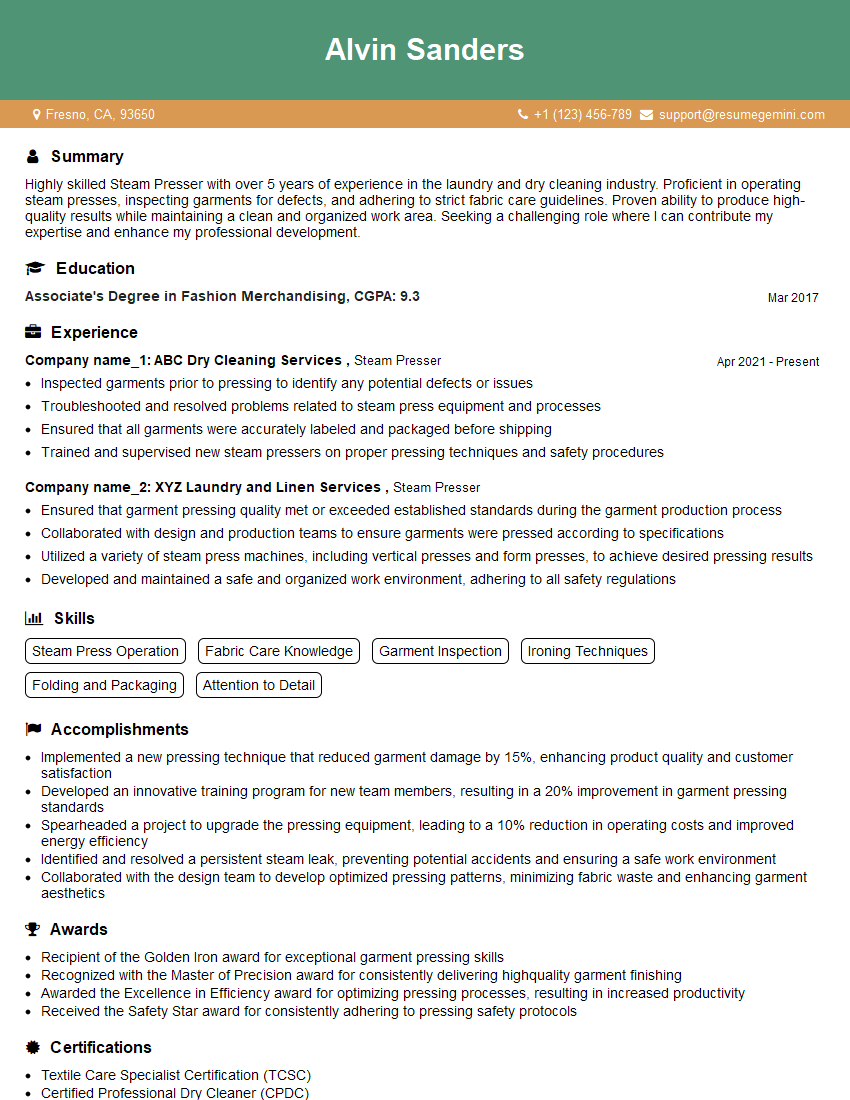
Mastering garment steaming opens doors to exciting career opportunities in various industries, from high-end fashion boutiques to large-scale laundry services. To maximize your job prospects, it’s essential to present your skills effectively. Crafting an ATS-friendly resume is key to getting your application noticed by recruiters. We highly recommend using ResumeGemini to build a compelling and professional resume that highlights your expertise in garment steaming. ResumeGemini provides examples of resumes tailored to this specific field, giving you a head start in creating a standout application.
Explore more articles
Users Rating of Our Blogs
Share Your Experience
We value your feedback! Please rate our content and share your thoughts (optional).
What Readers Say About Our Blog
Attention music lovers!
Wow, All the best Sax Summer music !!!
Spotify: https://open.spotify.com/artist/6ShcdIT7rPVVaFEpgZQbUk
Apple Music: https://music.apple.com/fr/artist/jimmy-sax-black/1530501936
YouTube: https://music.youtube.com/browse/VLOLAK5uy_noClmC7abM6YpZsnySxRqt3LoalPf88No
Other Platforms and Free Downloads : https://fanlink.tv/jimmysaxblack
on google : https://www.google.com/search?q=22+AND+22+AND+22
on ChatGPT : https://chat.openai.com?q=who20jlJimmy20Black20Sax20Producer
Get back into the groove with Jimmy sax Black
Best regards,
Jimmy sax Black
www.jimmysaxblack.com
Hi I am a troller at The aquatic interview center and I suddenly went so fast in Roblox and it was gone when I reset.
Hi,
Business owners spend hours every week worrying about their website—or avoiding it because it feels overwhelming.
We’d like to take that off your plate:
$69/month. Everything handled.
Our team will:
Design a custom website—or completely overhaul your current one
Take care of hosting as an option
Handle edits and improvements—up to 60 minutes of work included every month
No setup fees, no annual commitments. Just a site that makes a strong first impression.
Find out if it’s right for you:
https://websolutionsgenius.com/awardwinningwebsites
Hello,
we currently offer a complimentary backlink and URL indexing test for search engine optimization professionals.
You can get complimentary indexing credits to test how link discovery works in practice.
No credit card is required and there is no recurring fee.
You can find details here:
https://wikipedia-backlinks.com/indexing/
Regards
NICE RESPONSE TO Q & A
hi
The aim of this message is regarding an unclaimed deposit of a deceased nationale that bears the same name as you. You are not relate to him as there are millions of people answering the names across around the world. But i will use my position to influence the release of the deposit to you for our mutual benefit.
Respond for full details and how to claim the deposit. This is 100% risk free. Send hello to my email id: lukachachibaialuka@gmail.com
Luka Chachibaialuka
Hey interviewgemini.com, just wanted to follow up on my last email.
We just launched Call the Monster, an parenting app that lets you summon friendly ‘monsters’ kids actually listen to.
We’re also running a giveaway for everyone who downloads the app. Since it’s brand new, there aren’t many users yet, which means you’ve got a much better chance of winning some great prizes.
You can check it out here: https://bit.ly/callamonsterapp
Or follow us on Instagram: https://www.instagram.com/callamonsterapp
Thanks,
Ryan
CEO – Call the Monster App
Hey interviewgemini.com, I saw your website and love your approach.
I just want this to look like spam email, but want to share something important to you. We just launched Call the Monster, a parenting app that lets you summon friendly ‘monsters’ kids actually listen to.
Parents are loving it for calming chaos before bedtime. Thought you might want to try it: https://bit.ly/callamonsterapp or just follow our fun monster lore on Instagram: https://www.instagram.com/callamonsterapp
Thanks,
Ryan
CEO – Call A Monster APP
To the interviewgemini.com Owner.
Dear interviewgemini.com Webmaster!
Hi interviewgemini.com Webmaster!
Dear interviewgemini.com Webmaster!
excellent
Hello,
We found issues with your domain’s email setup that may be sending your messages to spam or blocking them completely. InboxShield Mini shows you how to fix it in minutes — no tech skills required.
Scan your domain now for details: https://inboxshield-mini.com/
— Adam @ InboxShield Mini
support@inboxshield-mini.com
Reply STOP to unsubscribe
Hi, are you owner of interviewgemini.com? What if I told you I could help you find extra time in your schedule, reconnect with leads you didn’t even realize you missed, and bring in more “I want to work with you” conversations, without increasing your ad spend or hiring a full-time employee?
All with a flexible, budget-friendly service that could easily pay for itself. Sounds good?
Would it be nice to jump on a quick 10-minute call so I can show you exactly how we make this work?
Best,
Hapei
Marketing Director
Hey, I know you’re the owner of interviewgemini.com. I’ll be quick.
Fundraising for your business is tough and time-consuming. We make it easier by guaranteeing two private investor meetings each month, for six months. No demos, no pitch events – just direct introductions to active investors matched to your startup.
If youR17;re raising, this could help you build real momentum. Want me to send more info?
Hi, I represent an SEO company that specialises in getting you AI citations and higher rankings on Google. I’d like to offer you a 100% free SEO audit for your website. Would you be interested?
Hi, I represent an SEO company that specialises in getting you AI citations and higher rankings on Google. I’d like to offer you a 100% free SEO audit for your website. Would you be interested?